FX sentiment cautious, Euro and Sterling slide

By eToro – The Euro and the Sterling gave up earlier gains from last week as risk aversion play weighed on the high  yielders. Last week the high yielding currencies among them the Euro and the Sterling were able to recover  losses and rebound against the Dollar and the Yen as better than expected job figures lifted recovery hops.  Nonfarm payrolls one of the strongest indicators of Job health in the US fell by -36k jobs against an expected  fall of -50k jobs. The Euro was able to rebound from the 1.34 zone to above 1.37 against the Dollar and topped  around 124¥ to the Yen.

The Euro and the Sterling opened the week also on a positive note; however the fact  that EU and US leaders only expressed solidarity to Greece without offering financial aid moved FX players to  be cautious pushing the Sterling and Euro to give up earlier gains. The Euro slide back to the 1.36 area after hitting 1.37 at the opening session and the Sterling moved back to the 1.5$ after failing to edge above 1.52$.Investors were expecting Greece to reach some sort of resolution to its debt problem and the fact that Greece failed to do so, elevated sovereign debt fears and moved investors to a risk aversion play shifting to Yen and Dollar positions to curb risk.

Euro and Sterling in tight range:

216

The sterling is within a tight range a break of 1.52 could move the bullish correction to resume; a close below 1.5 would move the pair to retest the 1.47-1.48 support.

39

A break of the 1.38 upper range would confirm the bullish correction has resumed, while a break of the 1.34 support could lead the pair to drift further south.

Daily Forex Market Analysis provided by eToro

Disclaimer: Trading in the Foreign Exchange market might carry potential rewards, but also potential risks. You must be aware of the risks and are willing to accept them in order to trade in the foreign exchange market. Don’t trade with money you can’t afford to lose.

© 2009 eToro Blog.

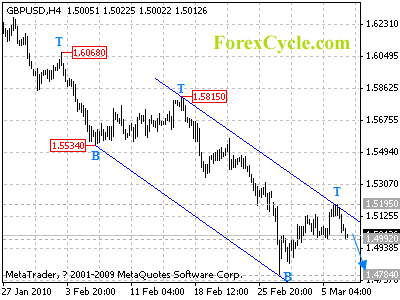
GBPUSD breaks below 1.4992 key support

GBPUSD breaks below 1.4992 key support, suggesting that a short term cycle top has been formed at 1.5195 level on 4-hour chart. Deeper decline towards 1.4784 previous low is expected later today, a breakdown below this level will indicate that the downtrend from 1.6456 (Jan 19 high) has resumed, then another fall to 1.4500 area could be seen to follow. Resistance is now at 1.5195, only rise above this level will indicate that the fall from 1.6456 has completed at 1.4784 already.

gbpusd

Daily Forex Signals

Eye on the Yen

After dipping below the 89 level against the Dollar rumors over BoJ stimulus pushed the Dollar Yen trade above the 90 mark once again. Ahead of the Japanese GDP figures investors are betting Japanese growth will be revised downwards from the preliminary figure of 4.6% YoY published in February as capital expenditures, one of the biggest lagers of the Japanese economy is expected to grow less than previously expected. Although the Japanese economy is still expected grow above 4% for 2009 after the revision, the Japanese government is far from being pleased with the performance of the economy. The 4.6% growth in GDP comes after more than a 10% drop in 2008 alongside weak consumer spending and most importantly deflation. The deflationary pressures are currently one of the biggest concerns of Japanese policy makers as it risks the stability of the fragile recovery by pressing corporate profits down.

The last CPI figure stand at -1.3% YoY for January  and with investors expecting a lower GDP figure FX players bet pressure from the Japanese government on the BoJ could lead to additional stimulus from the BoJ. The BoJ main channel of stimulus to the economy is to assist credit. The BoJ currently holds above 100 Billon Dollars of credit facilities to Banks. If the BoJ will decide to expand the program it will literally mean more money printing, for FX players more money printing means a lower Yen. Investors reacted rather quickly to the rumors on BoJ stimulus and crowded their bets on a lower Yen. The Japanese Yen depreciated the most against the high yielders with the GBP/JPY gaining around 400 pips in 3 days and the AUD/JPY gaining more than 250 pips. If however the BoJ for some reason will not act to expand credit and dovish figures will continue to stream in than Yen sellers might find themselves in choppy waters rather quickly.

Daily Forex Market Analysis provided by eToro

Disclaimer: Trading in the Foreign Exchange market might carry potential rewards, but also potential risks. You must be aware of the risks and are willing to accept them in order to trade in the foreign exchange market. Don’t trade with money you can’t afford to lose.

© 2009 eToro Blog.

Has USD/DKK Reached Its Peak

By Anton Eljwizat

• Below is the weekly chart of the USD/DKK currency pair.

• The technical indicators used are the Slow Stochastic, Relative Strength Index (RSI) and MACD.

• Point1: The RSI signals that the price of this pair currently floats in the over-bought territory, indicating downward pressure.

• Point 2: The Slow Stochastic indicates a bearish cross, signaling that the next move may be in a downward direction.

• Point 3: The MACD indicates an impending bearish cross, which may signal a downward movement is going to occur in the near future.

• Forex traders can take advantage of this impending movement by having their Entry Orders in place to capture this reversal.

USD/DKK Weekly Chart

Forex Market Analysis provided by Forex Yard.

© 2006 by FxYard Ltd

Disclaimer: Trading Foreign Exchange carries a high level of risk and may not be suitable for all investors. There is a possibility that you could sustain a loss of all of your investment and therefore you should not invest money that you cannot afford to lose. You should be aware of all the risks associated with Foreign Exchange trading.

Market’s Calmness Looks to End

Source: ForexYard

After a week of relatively peaceful trading, much harsher volatility is expected for this week’s trading. The main questions for this week are whether the U.S. economy will continue to provide positive data and whether the Greek debt crisis will reach a solution. An answer to each of these questions will have a significant impact on the market.

Economic News

USD – Non-Farm Payrolls Data Fail to Shake the Dollar

The Dollar saw a relatively calm trading session against the major currencies during the past week. The Dollar retained the 1.3650 level against the Euro and the 1.5100 level against the Pound. The Dollar only saw a rising trend against the Yen, and the USD/JPY pair is now traded above the 90.00 level.

The Dollar’s steady rates against the majors came mainly as a result of the solid employment data from the U.S. The Non-Farm Payrolls dropped by 36,000 as the Unemployment Rate was held at 9.7%. Both results have beaten forecasts, yet failed to have a significant impact on the market. The results didn’t proove that the employment condition in the U.S. is improving as there were more unemployed individuals in February than in January. However the results were better-than-forecasted and showed that the employment’s deterioration was halted as the unemployment rate has reached below 10.0% for two consecutive months.

As for the week ahead, many interesting economic publications are expected from the U.S. Traders are advised to pay special attention to the Trade Balance, the weekly Unemployment Claims, the Retails Sales and the Consumer Sentiment reports. The recent peaceful trading of the Dollar shows that investors are waiting for clearer signs whether the U.S. economy is truly recovered or is the more negative data expected. This week’s leading publications are likely to try and answer this question – and the Dollar will be largely affected as a result.

EUR – Euro Keeps Steady Rates against the Majors

The Euro kept a steady rate against the Dollar and the Pound during last week’s trading session. The Euro slid at the beginning of last week vs. the Dollar, yet managed to correct the losses before the weekend. The Euro also saw a bullish trend against the Yen and the EUR/JPY pair is trading around the 123.50 level.

The Euro kept steady rates against most of the major currencies due to two main reasons. The first reason is the Greece debt issue. The Euro-Zone did not publish a rescue-plan for Greece till now, however many political leaders, such as the French President Nicolas Sarkozy have stated that the Euro-Zone will be ready to help Greece if its financial problems worsened. This has managed to halt the Euro’s freefall from the past month. In addition, the economic data from the Euro-Zone showed that the economies are stabilizing. The German Retails Sales remained unchanged from December and the European Gross Domestic Product rose by merely 0.1% in the last quarter. This also supported the steady rates of the Euro.

Looking ahead to this week, traders are advised to follow every update regarding the Greece debt crisis as this seems to set the tone for the trading of the Euro in the near future. If the Euro-Zone will publish a rescue plan, the Euro is likely to be boosted as a result. However, indications that the Greek economic condition is worsening could weaken the Euro if there is no concrete rescue plan offered by the Euro-Zone. Traders should also follow the leading economic publications from Germany and France as they also have large impact over the Euro.

JPY – Yen Slides as Risk Appetite Grows

The Yen dropped against all the major currencies during Friday’s trading session. After a week of quiet trading, the Yen dropped 100 pips against the Dollar and about 200 pips against the Euro since Friday.

It appears that the U.S. Payrolls data from Friday, which delivered better-than-expected figures, has weakened the Yen against the major currencies. The end results have increased demand for higher-yielding assets on bets that the global economy is recovering. In addition, speculations that the Bank of Japan (BoJ) would further loosen its monetary policy to avoid deflationary pressure in the economy also weakened the Yen. Traders should also take under consideration that one of the BoJ’s goals is to see a weak Yen in the attempt to support Japanese exports.

As for this week, traders should focus on two leading publications from the Japanese economy. Analysts have forecasted that the Core Machinery Orders have dropped by 3.6% during January, following a 20% in December. If the end result will be similar, the Yen is likely to weaken as a result. Traders should also follow the Final Gross Domestic Product (GDP) release on Wednesday night. Expectations are for a 1.0% rise in the last quarter. Such a result will indicate that the Japanese economy is recovering and is likely to support the Yen.

Oil – Crude Oil Prices Continue to Rise

Prices of Crude Oil rose at a steady rate during last week’s trading session. With the beginning of last week, crude oil was traded for about $78.00 a barrel. At the moment, crude is traded for close to $82 a barrel.

Crude Oil is rising on speculations that the global economic recovery in addition to supply restrictions by the Organization of the Petroleum Exporting Countries (OPEC) will increase demand for oil. The better-than-expected Non-Farm Employment data from the U.S. economy also supported Crude Oil, as this suggested that the American economy is indeed recovering, as unemployment is stabilizing.

As for this week, traders should follow the major economic news from the U.S. and the Euro-Zone as those seem to have the largest impact on Oil prices. In addition, traders should also follow the U.S. Crude Oil Inventories on Wednesday, as this report tends to have an instant impact on the market.

Technical News

EUR/USD

The hourly and 2 hour charts’ RSI are floating in the overbought territory with the hourly, 2 hour and 4 hour charts’ Slow Stochastic exhibiting a bearish cross. Going short with tight stops for the day may be advised.

GBP/USD

The hourly, 2 hour and 8 hour charts’ RSI are floating in the overbought territory with the 4 hour chart’s Slow Stochastic exhibiting a bearish cross. Going short for the day may be advised.

USD/JPY

The 2 hour, 4 hour and 8 hour charts’ RSI is floating in the overbought territory, while a breach of the upper Bollinger Band is evident on the 8 hour chart. Furthermore, a bearish cross is evident on the 4 hour and 8 hour charts’ Slow Stochastic. Going short for the day may be advised.

USD/CHF

A bullish cross is evident on the 2 hour and 4 hour charts’ Slow Stochastic with the 2 hour with the hourly and 2 hour RSI floating in the oversold territory. Going long for the day may be advised.

The Wild Card

AUD/JPY

The pair’s 2 hour, 4 hour and 8 hour RSI are floating in the overbought territory. A breach of the upper Bollinger Band is evident on the 4 hour and 8 hour charts, while a bearish cross is evident on the 4 hour and 8 hour charts’ Slow Stochastic. Forex traders may be advised to go short for the day.

Forex Market Analysis provided by Forex Yard.

© 2006 by FxYard Ltd

Disclaimer: Trading Foreign Exchange carries a high level of risk and may not be suitable for all investors. There is a possibility that you could sustain a loss of all of your investment and therefore you should not invest money that you cannot afford to lose. You should be aware of all the risks associated with Foreign Exchange trading.

Forex Weekly Market Update 8th Mar, 10

The global markets jumped higher last week, capping off a robust trading week for the S&P 500 Index.  The benchmark index finished the week up 34 points or 3%. The UK FTSE Index hit a new 52 week high and is now dealing with its 200 week moving average. Oil and Gasoline, had solid gains and could be the impetus for a break of the top of the recent trading range. The Euro and the Pound where unchanged for the week as investors are still fearful of European debt issues. The Nasdaq also hit a 52 week high, settling up 88 points or 3.9%.

113

The week started off with strong data out of the United Kingdom.  The PMI  survey released Monday showed the purchasing managers index for the U.K.’s manufacturing sector was unchanged at a 15-year high of 56.6 in February.  A second straight reading at this lofty level helped lift the FTSE and the US indices to higher levels.

Over in the U.S, Personal income increased by 0.1% compared to the prior month, while personal spending climbed by 0.5%, according to the Commerce Department. The saving rate slowed to the smallest since 2008. Economists were expecting a 0.4% increase in income and a 0.4% increase in spending for January.  Income has increased six straight months and spending has increased four straight times. The saving rate in January was the lowest since 2.9% in October 2008. The rate was 3.3% in January, compared to 4.2% in December.

The ISM index fell to 56.5 in February from 58.4 in January. The ISM has been above 50 for seven consecutive months. The new orders index dropped to 59.5 from 65.9, and the production index fell to 58.4 from 66.2. The employment index rose to 56.1 from 53.3, the third month above 50, indicating that more firms are hiring than shedding workers.  The prices paid index slipped to 67 from 70, showing that price pressures are high but easing.

On the housing side, construction spending declined 0.6% as expected, at a seasonally adjusted annual rate of $884.1 billion compared to the prior month, according to the Commerce Department.  December outlays were unrevised at a drop of 1.2%. November spending tumbled a revised 2.5%.   Economists surveyed estimated spending in January on construction would tumble 0.6%.  Residential construction project spending in January increased 1.1% to $269.15 billion, after dropping a revised 2.6% in December.  Construction spending declined 0.6% as expected, at a seasonally adjusted annual rate of $884.1 billion compared to the prior month.

On Wednesday, Private-sector jobs in the U.S. fell 20,000 in February, according to a national employment report published Wednesday by payroll giant Automatic Data Processing Inc. The ADP loss was below the 50,000 drop projected by economists. The estimated change of employment for January 2010 was revised down, from a decline of 22,000 to a decline of 60,000. The February employment decline was the smallest since employment began falling in February 2008. ADP said the adverse weather had only a very small effect on the ADP report due to the methodology used to construct it.  One must note the ADP survey tallies only private-sector jobs, while the Bureau of Labor Statistics’ nonfarm payroll data includes government workers.

In its latest beige book report, the Fed said nine out of its 12 regional districts reported that economic activity improved, but in most cases the increases were modest, with activity held back by the Feb. 4-7 and Feb. 9-11 snowstorms.  The beige book is a summary of economic activity prepared for use at the U.S. central bank’s next policy-setting meeting, March 16. The latest report, prepared by the Federal Reserve Bank of Kansas City, examined economic conditions across the Fed’s districts based on information collected on or before Feb. 22.  “Richmond reported that economic activity slackened or remained soft across most sectors, due to especially severe February weather in that region,” the report said.  February’s severe winter weather is expected to hurt several sectors of the economy.

On Thursday the markets focused on the ECB and the BOE.  The European Central Bank left its benchmark interest rate unchanged Thursday and is expected to scale back special lending to banks introduced during the financial crisis, while the Bank of England’s Monetary Policy Committee voted to keep policy unchanged and extremely loose. Trichet commented on the situation and stated that the ECB will continue to conduct its weekly refinancing operations as fixed-rate tenders with full allotment for a long as needed, and at least until Oct.12. Inflation was fairly subdued; therefore the bank had no problems commenting on its “helping” policy.

Over in the U.K, BOE policy makers emphasized that they could increase the central bank’s bond-buying program, also known as quantitative easing, if the U.K.’s economic recovery begins to falter. The U.K. economy has picked up significantly since the MPC launched its unconventional policy one year ago, but many challenges remain. The U.K. government is saddled with a huge debt burden from propping up banks and supporting demand during the financial crisis, which will require it to cut spending and raise taxes. Households and companies will also be restrained by high levels of debt.

On Friday, the US Labor Department reported that the U.S. economy slashed fewer jobs than expected in February and the unemployment rate was steady at 9.7% despite stormy weather on the East Coast last month.  The report showed that nonfarm payrolls fell by 36,000 compared with a revised 26,000 drop in January.  Economists polled were expecting payrolls to fall by 50,000 mainly because of the severe weather. The January figure was revised from an originally reported 20,000 decline to a 26,000 decline and December was revised up by 40,000.  The unemployment rate, which is calculated using a different household survey, remained at 9.7% last month. Economists were expecting the jobless rate to edge higher to 9.8%.

215

Forex

The RBA pursued its rate normalization process and hiked interest rates by another 25 basis points (to 4%, bringing the cumulative tightening of monetary policy to 100basis points). According to our analysis, the RBA is probably not done yet on the rate hike front, but the central bank will remain cautious in its policy actions. There was nothing in the statement suggesting that another rate rise is likely in April, with Governor Stevens just reiterating that rates should move closer to ‘average’.

The Australian Q409 GDP data justified the RBA’s rate increase. Q409 GDP was reported up 0.9% q/q, adding on to revised (upwardly) 0.3% quarterly increase previously and for a yearly rate accelerating to a better than expected +2.7% from +0.9%. This year, the economy is expected to grow by 3%.

From a technical point of view, the AUD increased during the week and is expected to test its prior highs. When observing the fundamentals, one can see that the medium-term bullish outlook is intact: higher commodity prices, higher rates and an improving growth environment are all supportive.

38

The Bank of Canada took a more hawkish stance boosting the Canadian dollar. While the target overnight rate was left unchanged at 0.25% as expected, the central bank indicated that inflation risks were no longer tilted to the downside and that core inflation has been slightly firmer than projected.  The BoC acknowledged that Canadian economic activity has been higher than it had projected in the January MPR.  That said, the BoC reiterated the target overnight rate would remain at current levels until the end of Q210.  The bottom line is that the BoC is likely to hike ahead of most other major central banks including the Federal Reserve.  The Canadian economy is in the cusp of feeling the impact of potential central bank tightening, which should push the Canadian dollar to support.

Daily Forex Market Analysis provided by eToro

Disclaimer: Trading in the Foreign Exchange market might carry potential rewards, but also potential risks. You must be aware of the risks and are willing to accept them in order to trade in the foreign exchange market. Don’t trade with money you can’t afford to lose.

© 2009 eToro Blog.

Learn Elliott Wave Analysis — Free

Often, basics is all you need to know.

By Editorial Staff

Understand the basics of the subject matter, break it down to its smallest parts — and you’ve laid a good foundation for proper application of… well, anything, really. That’s what we had in mind when we put together our free 10-lesson online Basic Elliott Wave Tutorial, based largely on Robert Prechter’s classic “Elliott Wave Principle — Key to Market Behavior.” Here’s an excerpt:

Successful market timing depends upon learning the patterns of crowd behavior. By anticipating the crowd, you can avoid becoming a part of it. …the Wave Principle is not primarily a forecasting tool; it is a detailed description of how markets behave. In markets, progress ultimately takes the form of five waves of a specific structure.

The personality of each wave in the Elliott sequence is an integral part of the reflection of the mass psychology it embodies. The progression of mass emotions from pessimism to optimism and back again tends to follow a similar path each time around, producing similar circumstances at corresponding points in the wave structure.

These properties not only forewarn the analyst about what to expect in the next sequence but at times can help determine one’s present location in the progression of waves, when for other reasons the count is unclear or open to differing interpretations.

As waves are in the process of unfolding, there are times when several different wave counts are perfectly admissible under all known Elliott rules. It is at these junctures that knowledge of wave personality can be invaluable. If the analyst recognizes the character of a single wave, he can often correctly interpret the complexities of the larger pattern.

The following discussions relate to an underlying bull market… These observations apply in reverse when the actionary waves are downward and the reactionary waves are upward.

Idealized Elliott Wave Pattern

1) First waves — …about half of first waves are part of the “basing” process and thus tend to be heavily corrected by wave two. In contrast to the bear market rallies within the previous decline, however, this first wave rise is technically more constructive, often displaying a subtle increase in volume and breadth. Plenty of short selling is in evidence as the majority has finally become convinced that the overall trend is down. Investors have finally gotten “one more rally to sell on,” and they take advantage of it. The other half of first waves rise from either large bases formed by the previous correction, as in 1949, from downside failures, as in 1962, or from extreme compression, as in both 1962 and 1974. From such beginnings, first waves are dynamic and only moderately retraced. …

Read the rest of this 10-lesson Basic Elliott Wave Tutorial online now, free! Here’s what you’ll learn:

  • What the basic Elliott wave progression looks like
  • Difference between impulsive and corrective waves
  • How to estimate the length of waves
  • How Fibonacci numbers fit into wave analysis
  • Practical application tips for the method
  • More

Keep reading this free tutorial today.


Elliott Wave International (EWI) is the world’s largest market forecasting firm. EWI’s 20-plus analysts provide around-the-clock forecasts of every major market in the world via the internet and proprietary web systems like Reuters and Bloomberg. EWI’s educational services include conferences, workshops, webinars, video tapes, special reports, books and one of the internet’s richest free content programs, Club EWI.

Crude Oil Hits near $82.50 Level

printprofile

Crude oil prices rose significantly in the last two weeks and peaked at $82.30 per barrel. However, the 8-hour chart is suggesting that a recent upwards trend is loosing steam and a bearish correction is impending. Forex traders involved with commodities like this can take advantage of this knowledge by going short on crude oil now, and at a great entry price!

• Below is the 8-hour chart for crude oil by ForexYard.

• The technical indicators used are the Slow Stochastic, RSI and Williams Percent Range.

• Point 1: The RSI signals that the price of this pair currently floats in the over-bought territory, suggesting downward pressure.

• Point 2: The Slow Stochastic indicates an impending bearish cross, which may signal a downward movement is going to occur in the near future.

• Point 3: The Williams Percent Ranges is showing that this pair is heavily over-bought and may be experiencing strong downward pressure.

Crude Oil 8-Hour Chart
crude oil 8-3-2010

EURUSD is forming sideways movement between 1.3435 and 1.3838

EURUSD is forming a sideways movement in a range between 1.3435 and 1.3838. Another rise towards 1.3838 is expected later today. As long as this level holds, the price action in the trading range is treated as consolidation of downtrend from 1.4579 and one more fall to 1.3300 is still possible after consolidation. However, a break above 1.3838 resistance will indicate that the fall from 1.4579 has completed at 1.3435 already.

eurusd

Daily Forex Forecast

FOREX: US Dollar ends week mixed, GBP/USD falls for 3rd week.

By CountingPips.com

The U.S. dollar ended a very busy news week mixed against the other major currencies, according to currency data from Oanda. The U.S. currency made clear gains versus the British pound and Japanese yen while showing very slight gains against the euro, Swiss franc and the New Zealand dollar in the week that ended March 5th. The dollar, meanwhile, fell against the Canadian dollar and Australian dollar for the week.

The largest gain for the dollar this week was against the Japanese yen with a 128 pip increase followed by the 98 pip advance versus the British pound (see chart). The dollar declined by over 229 pips against the Canadian dollar while declining by 122 pips to the Australian dollar.

The GBP/USD fell for the third straight week and for the sixth out of the last seven weeks. Since February 14th to March 5th, the GBP/USD has decreased from 1.5701 to 1.5137 for a loss of 564 pips in the last three weeks.

Futures Bets vs Euro pullback from record highs, Pound shorts rise

Futures bets against the euro decreased from their record high levels as of March 2nd, according to the Commitments of Traders (COT) data released on Friday by the Chicago Mercantile Exchange. Non-commercial futures positions, those taken by hedge funds and large speculators, were net short the euro against the U.S. dollar by 66,770 contracts after being net short the euro by 71,623 contracts the week before. The net short euro positions had increased for six consecutive weeks before this week’s pullback and have coincided with the euro’s sharp decline against the dollar that brought the EUR/USD to a ten-month low on March 2nd.

The COT report is published every Friday by the Chicago Mercantile Exchange (CME) and shows futures positions as of the previous Tuesday. It can be a useful tool for traders to gauge investor sentiment and to look for potential changes in the direction of a currency or commodity. Each currency contract is a quote for that currency directly against the U.S. dollar, where as a net short amount of contracts means that more speculators are expecting that currency to fall against the dollar and net longs expect that currency to rise versus the dollar.

Other major currencies net short in the CME futures market against the dollar this week were the British pound and Swiss franc while the Japanese yen, Australian dollar, Canadian dollar, and New Zealand dollar all had a net long amount of contracts. The British Pound Sterling net shorts increased for the sixth week in a row with net shorts rising to -67,549 after a total of -62,884 last week. The Swiss franc net short positions registered -6,310 contracts after -8,819 net shorts last week.

The Japanese yen had net long positions of 32,552 contracts, up from 1,717 the week prior. The Australian dollar futures positions were net long by 48,761 contracts after last week totaling net long 38,992 contracts. Canadian dollar long positions were net by 38,289 contracts after 28,421 net longs last week and the New Zealand dollar net longs were 5,112 this week after last week being 6,392 net long contracts.

Busy News Week Roundup:

This week featured many important economic releases and was highlighted by Friday’s U.S. government employment report that showed employment fell by 36,000 workers. The jobs report was better than the forecasts and maintained the flow of optimism that a U.S. economic recovery is underway. Other major releases included the Australian Reserve Bank hiking their interest rate to 4.00 percent as expected while the Bank of England, European Central Bank and the Bank of Canada all held rates steady.

Australia’s retail sales grew by 1.2 percent in January from the month before while Australia’s GDP rose by 0.9 percent in the fourth quarter for a 2.7 percent annual increase.

The Eurozone employment rate leveled at 9.9 percent and beat forecasts predicting the rate to rise to 10.1 percent. Retail sales out of the Eurozone fell by 0.3 percent in January to fall by 1.3 percent on an annual basis. The EU’s GDP grew by 0.1 percent in the fourth quarter to match forecasts and to register a 2.1 percent decrease from the fourth quarter of 2008.

Canada’s GDP grew by 0.6 percent in December and by 5.0 percent on an annualized basis in the fourth quarter of 2009 while Switzerland’s GDP expanded by 0.7 percent in the fourth quarter and marked an annual increase of 0.6 percent.

Other U.S. data showed that service-sector business activity grew by more than expected in February while manufacturing activity fell by more than expected in two different data releases by the Institute for Supply Management. The ADP employment change came in with a 20,000 worker decrease to match forecasts while the governments initial jobless claims data this week fell by 29,000 workers. Pending home sales levels fell for the second month in a row in January by 7.6 percent but were still 8.8 percent above the January 2009 sales level.

Upcoming Events:

Next week’s economic calender highlights include the Swiss unemployment rate, Swiss retail sales, British trade balance, Germany’s consumer price index, Australian employment change, U.S. trade balance, Canada’s employment change and U.S. retail sales. Interest rate decisions are due out of New Zealand on Wednesday and out of Switzerland on Thursday with market forecasts expecting rate holds.

Have a great weekend!