How to Protect Against Currency Collapse

In response to our question, “Did the Housing Bust Fuel the Consumer Spending Binge?” Taipan Daily reader Mike writes:

Just a quick additional thought on the [consumer spending binge piece]. California actually encourages strategic default. Homeowners in California are not personally liable… So, if the house is worth only 50 or 60 percent of the amount of the mortgage, which is not uncommon, the owner just walks away. I know a couple of people who’ve done this. What is surprising is that more people haven’t done this. Of course, it eventually kills your credit rating.

Mike

Marina Del Rey

Yep. Trashing the credit rating thing is the thing. Maintaining a good credit rating used to take precedence. Now it doesn’t matter for a hill of beans.

Ironic, too, in that the U.S. government is working from the same playbook…

One of the dominant themes of the past few years has been a massive private-to-public debt transfer. When the government decided to bail out the banks, it essentially committed trillions in taxpayer dollars (via purchases, backstops and guarantees) to soaking up toxic assets. The same logic applied to propping up the housing market.

The thing is, even Uncle Sam has a credit rating to maintain. In order to keep the party going, the United States relies on hefty foreign purchases of dollar-denominated debt. The more debt that America piles on, the less attractive that debt becomes.

This is why your editor finds it sobering, and frightening, how cavalier investors seem to be when it comes to rising debt costs. It is not just strategically defaulting homeowners who have elected to “kill their credit rating” for the sake of short-term relief. The most powerful government in the world is doing it too.

Deadly Debt Service Costs

The U.S. relies on low interest rates to keep its debt service cost down to a reasonable level. (To understand what this means, imagine a household with $5,000 a month in income and $1,000 a month in interest rate charges on all their credit cards. That balance would represent a “debt service cost” of 20%.)

Once debt service cost hits a certain threshold relative to income, the heavy debtor passes the point of no return – making de facto bankruptcy all but guaranteed. This dynamic holds true for countries as much as individuals.

That’s why breakouts like the one above are no laughing matter. When government bonds fall in value, interest rates rise – and so do debt service costs.

Were foreign investors to start selling large quantities of U.S. government bonds (or simply to go on an extended buying strike), long-term interest rates would skyrocket. That would throw the economy into turmoil.

Were a fiscal catastrophe like the above to unfold, though, the United States would still avoid technical default. There is no need for that, ever, because the Federal Reserve can always technically meet U.S. obligations by printing more currency.

This is why, for countries that borrow heavily in their own currency, the real threat is not the more traditional understanding of debt default. It is outright currency collapse.

In a time of debt crisis, in other words, the logic goes like this: “So there’s a debt crisis because no one is buying our bonds? Fine, we’ll buy ‘em back ourselves with freshly printed dollars (or sterling, or euros, etc). So now there’s new panic because of all the forex paper we’ve flooded onto the market? Too bad… that’s someone else’s problem, not ours. Nobody forced them to honor ‘Federal Reserve Notes’ after all.”

Protecting Against Currency Collapse

If you live in a heavily indebted Western country, currency collapse is a genuine concern. If the private-public debt load gets to be too heavy for an economy to bear, rampant currency debasement will inevitably be the politicians’ chosen way out.

And so, whether your primary savings account is denominated in dollars, pounds, euros or something else, you have to think about the “weapons of mass financial destruction” – i.e. rows on rows of printing presses – owned by your respective central bankers, and the government’s willingness to use them.

Now, we could spill a lot of ink talking about “collapse mitigation strategies.” In fact, we could have an entire multi-day investment conference built around the theme, with multiple experts outlining the various escape routes in great detail.

Today, though, it makes sense to just cover a few basics, to help get your mind wrapped around the subject.

Collapse Avoidance Strategy #1: Foreign Bank Account

This is a very simple idea, but one that takes a little bit of doing to execute on. If your main concern is a bad currency, one direct step you can take is holding your cash in a stronger, sounder currency.

You can do this by opening up a foreign bank account and transferring a meaningful chunk of savings into it. Or, alternatively, you can make use of a bank (such as EverBank) or brokerage option that lets you manually adjust the currency mix.

Personally speaking, I bank with EverBank (among others) and trade with Interactive Brokers. I have the option of ‘$USD alternatives’ for my cash in both places. For some, though, a literal foreign bank account will be even more desirable.

Given the risk of eventual capital controls – something that any government will consider in a time of serious enough crisis – having a chunk of capital domiciled in a foreign location could be a wise thing. Our new service, Wealth Legacy Advisory, features expert advice on topics just such as these (opening foreign bank accounts and such).

Collapse Avoidance Strategy #2: ADRs (American Depositary Receipts)

Another useful collapse avoidance strategy involves the use of ADRs, or American Depositary Receipts. An ADR is basically a foreign stock traded on a U.S. exchange. For example, consider Companhia Siderurgica Nacional (SID:NYSE).

SID, which trades on the New York Stock Exchange, is the U.S.-based ticker for a Brazilian steel company.

Were, say, the USD to collapse, an investment like SID might still do very well. Being based in Brazil, with a global roster of clients, SID could see its dollar-denominated value rise stratospherically were the buck to turn to confetti.

There are a number of ADRs representing global companies, headquartered in fiscally sound jurisdictions, that would function as powerful “stores of value” were the currencies of one or more Western nations to plummet. These ADRs could function as useful proxies for cash under the right circumstances.

Collapse Avoidance Strategy #3: Hard Assets

Then, of course, there is the hard asset option. When it comes to paper currency concerns, there is a reason why gold has held its reputation as a store of value for thousands of years.

In short, politicians and fractional reserve lenders have been ripping off the citizenry since Roman times. Gold has been a worthy counterbalance for just as long. And given the right environment, many other forms of hard assets could step up as “stores of value” in the event of major currency collapse. Better to own oil in the ground, for example, than little slips of paper with Tim Geithner’s signature on them.

Collapse Avoidance Strategy #4: The Ultra-Resource Index CD

Last but not least, I would be remiss not to remind you about a special “hedge” product specifically designed to protect against currency collapse.

That hedge product is the EverBank Ultra Resource Index CD. Conceived by the Taipan Publishing Group and created by EverBank at our request, the Ultra Resource Index CD offers a basket of the following currencies:

  • Australian dollar
  • Hong Kong dollar
  • Canadian dollar
  • New Zealand dollar
  • Norwegian krone
  • Singapore dollar

Because all currrency trading is “relative,” the basket of currencies mentioned above will do very well in the event of a Western-debt-fueled forex meltdown. (And, in fact, this basket already has done very well by a number of measures.)

The logic is simple: Instead of owning currencies being printed en masse by countries deep in debt (like Britain and the U.K.), you want to own currencies being issued by fiscally responsible countries with a heavy backing of natural resources and surplus cash reserves.

(I am obligated to add that EverBank pays a small commission to Taipan on sales of the Ultra Resource Index CD. But given that the concept was our idea, specifically crafted to address the needs of readers like you, I think you can see how the arrangement makes sense. To find out more about the Ultra Resource Index CD, click here.)

There is much more to say on this topic, but hopefully this gets you off to a good start. If you have any specific questions or comments on currency collapse and how to avoid it, let us know: [email protected].

Don’t forget to follow us on Facebook and Twitter for the latest in financial market news, company updates and exclusive special promotions

Forex Daily Market Review: 07/04/2010

Forex Market Review by Finexo.com

Past Events
• USD FOMC Meeting Minutes
• EUR Sentix Consumer Confidence, out at 2.5 versus expected -5.9, prior -7.5
• GBP Construction PMI, out at 53.1 versus expected 48.8, prior 48.5
• AUD Cash Rate, out at 4.25% as expected, prior 4.0%

Upcoming Events
• GBP Manufacturing Production m/m (0830 GMT)
• GBP Asset Purchase Facility (1100 GMT)
• GBP Monetary Policy Committee Rate Statement (Tentative)
• GBP Official Bank Rate (1100 GMT)
• EUR Minimum Bid Rate (1145 GMT)
• EUR ECB Press Conference (1230 GMT)
• USD Unemployment Claims (1230 GMT)

Market Commentary
In the US the minutes of the March Federal Open Market Committee were released yesterday in Washington. Federal Reserve officials saw signs of a strengthening recovery that could be hobbled by high unemployment and tight credit and some warned of raising rates too soon.

“While recent data pointed to a noticeable pickup in the pace of consumer spending during the first quarter, participants agreed that household spending going forward was likely to remain constrained by weak labor market conditions, lower housing wealth, tight credit, and modest income growth,” minutes of the March 16 FOMC  meeting showed.

Fed officials are looking for signs of self-sustaining growth before they begin their exit from the most aggressive monetary policy in U.S. history. Payrolls rose by 162,000 last month, the most in three years and manufacturing grew at the fastest pace in more than five years.  However last month’s increase in payrolls, the third in the past five months, wasn’t enough to push down the jobless rate. The economy has lost more than 8 million jobs since the recession began in December 2007 and the unemployment rate is 9.7%.
Euro Zone investor confidence unexpectedly moved to a positive territory in April, results of a key survey showed yesterday. A measure for Euro area investor sentiment rose to 2.52 in April from – 7.48 in March, the Sentix research group said. That was the first positive figure since June 2008. Economists had predicted a reading of -5.9.

The Euro slid on markets early yesterday after a news report claimed Greece wanted to bypass International Monetary Fund involvement in a rescue. The nation’s Finance Minister George Papaconstantinou quickly responded to the report and said his government has not tried to modify the terms of the package to exclude the IMF. He said that the EU aid plan was “important” for Greece and Europe, and the nation has not sought to activate the aid plan.

However the Euro closed the day down against the US Dollar at EUR 1.3363. Against the Pound the Euro dropped 0.46% to close at GBP 0.8773.

The European minimum bid rate is due to be published tomorrow at 11:45 GMT. Jean-Claude Trichet isn’t predicted to move the rate from 1%. Trichet’s words in the ECB press conference will probably shake the Euro – likely topics include the Greece agreement and the future of the European economies.

In the UK the construction sector expanded in March for the first time in more than two years, led by a sharp rise in new orders in the housing and commercial sectors. The Chartered Institute of Purchasing and Supply/Markit construction PMI index jumped to 53.1 last month from 48.5 in February – the first reading above the 50 level that divides growth from contraction since February 2008.

Incoming new orders increased during March for the first time in four months and only the second time in the past two years. However, construction firms continued to shed jobs in March and concern over cutbacks in government spending meant they were less optimistic than in February.

“Though it’s great to see the UK construction sector turn the corner after two years of relentless contraction, it’s still very early days,” said David Noble, chief executive officer at the Chartered Institute of Purchasing and Supply. “The recession hit construction the hardest and because the industry is operating from such a low base, this upturn may be short-lived.”

Of the three subsectors, house-building showed the strongest rise in activity, expanding for a seventh consecutive month. Commercial activity reported growth for the first time since February 2008. The civil engineering sub-sector, which is typically more reliant on public spending, contracted. Construction accounts for around 6% of Britain’s economic output. In the first quarter as a whole, British construction activity was broadly unchanged, suggesting the sector is no longer acting as a drag on GDP.

Early tomorrow the UK manufacturing production PMI will be released. This indicator dropped by 0.9% last month, the first drop in five months, hurting the Pound. A correction is predicted this time – a rise of 0.7%. Note that manufacturing is 80% of industrial production which is published at the same time, that figure is expected to rise by 0.5%.

This week’s major announcement for the Pound is the rate decision; the announcement will be made tomorrow at 11.45 GMT. The rate is expected to remain unchanged at 0.5%. The Asset Purchase Facility is also expected to remain unchanged.

Against the US Dollar yesterday the Pound gained 0.18% to close trading at GBP 1.5241.
American unemployment claims will also be published tomorrow at 12:30 GMT. Yet another drop in the weekly jobless claims is due. After reaching 439K last week, they’re predicted to drop to 432K, supporting more job gains in the next Non Farm Payrolls.

Finally yesterday Australia’s central bank raised its benchmark interest rate to 4.25% and signaled further increases, dismissing warnings that higher borrowing costs are already eroding consumer spending. Governor Glenn Stevens boosted the overnight cash rate target from 4%, the Reserve Bank of Australia said in a statement in Sydney yesterday. The Aussie gained 0.74% against the US Dollar following the announcement, jumping from AUD 0.9207 to AUD 0.9276.

Stevens was the first G-20 policy maker to raise borrowing costs twice this year. By contrast, the U.S. Federal Reserve Chairman Ben S. Bernanke said last month that the world’s biggest economy “continues to require the support of accommodative monetary policies.” The Fed has kept its benchmark rate close to zero since late 2008 and the European Central Bank’s rate is at a record low of 1%.

Forex Market Review & Analysis by Finexo.com

Disclaimer: Trading the foreign exchange (Forex) carries a high level of risk, and may not be suitable for all investors.

Forex Technical Analysis – GBP/USD – Double Bottom Reversal

By Russell Glaser – The Cable’s long term bearish trend appears to be weakening. In the process, a double bottom reversal pattern may be forming on the daily chart.

As shown below in the forex technical analysis, the daily chart displays the long term trend line has been broken and a potential double bottom taking place.

This common reversal pattern has two points near the same price level and takes the shape of a W. The resistance line rests at the peak of the pattern at the price of 1.5380. This potential double bottom will be complete when the price breaks above this resistance level.

Traders need to be aware that this remains a potential double bottom until the resistance line is breached. This could simply be a consolidation pattern before a resumption of the long term downward sloping trend.

The future price move after a breach of the resistance level can be measured from the resistance line down to the bottom of the chart pattern. This would be a potential price move higher of approximately 600 pips. This would also signal a reversal of the long term downward trend and the beginning of a new uptrend.

Special thanks go out to FX Salesman Joseph Binestock for his recognition of the chart pattern.

Forex Market Analysis provided by Forex Yard.

© 2006 by FxYard Ltd

Disclaimer: Trading Foreign Exchange carries a high level of risk and may not be suitable for all investors. There is a possibility that you could sustain a loss of all of your investment and therefore you should not invest money that you cannot afford to lose. You should be aware of all the risks associated with Foreign Exchange trading.

Crude Oil Inventories and Bernanke’s Speech to Move the Forex Market Today

By Ashley Smith – After traders caught up with markets that were closed for Easter, new economic data is set to be released today that should influence the price of spot crude oil and the dollar.

GBP – Services PMI – 8:30 GMT
– A survey of business conditions and future outlook – a leading indicator of economic health
– Expected to show little change. A worse than expected result will likely intensify the Pounds decline.

USD – Fed Chairman Bernanke Speaks – 17:15 GMT
– With no assuring remarks from yesterday FOMC meeting minutes regarding monetary policy tightening in the near future, investors will be awaiting any signs for Bernanke regarding interest rate increases and the state of the U.S economic recovery.

USD – Crude Oil Inventories – 14:30
– With Oil prices heading towards the $90 a barrel level, consumer demand remains an important variable. Any decline in inventories will likely help push Oil prices towards that level.

Forex Market Analysis provided by Forex Yard.

© 2006 by FxYard Ltd

Disclaimer: Trading Foreign Exchange carries a high level of risk and may not be suitable for all investors. There is a possibility that you could sustain a loss of all of your investment and therefore you should not invest money that you cannot afford to lose. You should be aware of all the risks associated with Foreign Exchange trading.

EUR Falls versus USD over Renewed Greece Concerns

Source: Forex Yard

Disagreement over Greece’s rescue package reignited concerns over the pace of recovery in the Euro-Zone, dampening demand for the common currency. The U.S Dollar reached parity with the Canadian Dollar yesterday, briefly trading below the CAD for the first time since July 2008.

Economic News

USD – USD Trades Higher versus Most Counterparts

The Dollar strengthened Tuesday as new doubts surfaced about Greece’s financial situation and economic recovery. Supporting the USD further were minutes from the FOMC meeting which trimmed the forecasts for economic growth and inflation while not giving any hints as to when the extended period of low rates is expected to change in the near future.

Contributing to the greenback’s strength was the fact that European and British markets were closed Monday and last Friday for Easter, and Tuesday was the first opportunity of markets to react to the positive economic data released from the U.S during those days, particularly Monday’s ISM Non Manufacturing PMI and Pending Home Sales.

The Canadian Dollar reached parity versus the USD Tuesday, trading higher than the greenback for the first time since July 2008 as Crude Oil Prices continue to rise on prospects of an increase in interest rates ahead of the U.S.

EUR – EUR Down on Renewed Greece Concerns

New reports concerning Greece’s dissatisfaction with the standby credit plan agreed to during a European Union summit last month and the involvement of the IMF reignited negative sentiment towards the EUR. The EUR weakened to $1.3379 from $1.3399.

The British pound was also lower Tuesday, falling to $1.5239 in today’s early trading, after British Prime Minister Gordon Brown set a date for the much anticipated U.K. general election. Sterling dropped against 10 of its 16 most traded currency pairs over concerns the elections will result in a parliament in which no party wins a clear majority. The U.K fiscal troubles are a major part behind the election.

Looking ahead to today, traders should follow the release of the British Services PMI at 8:30 GMT. A better than expected result might help revive the Pound.

JPY – Yen Rises on Renewed Concerns over Global Recovery

The Yen continued its rise against the EUR Tuesday as concerns over Greece’s rescue package dampened demand for the common currency and boosted demand for the safety of the Japanese currency. The Yen rose to 125.36 per EUR in today’s Asian trading from 125.67 yesterday; however, it stayed relatively unchanged against the Dollar at 93.70 per Dollar from 93.79 yesterday.

The Australian Dollar rose 0.8% to 92.78 U.S. cents Tuesday after the Reserve Bank of Australia hiked its key interest rate a quarter of a percentage point, to 4.25%, as expected by most economists.

The BOJ Press Conference and Overnight Call Rate are expected today. While the interest rate is expected to remain unchanged, the press conference is expected to provide direction for the JPY for the day as well as the rest of the week.

OIL – Crude Stays Higher Ahead of Inventory Release

Crude Oil futures stayed higher Tuesday ahead of today’s release of U.S. energy supply data. Light, sweet crude for May delivery settled at $86.84 a barrel on the New York Mercantile Exchange.

Oil wavered most of the day Tuesday as a shaky stock market and strong Dollar weighed on Crude prices. Crude did receive a boost following the release of minutes from the FOMC meeting which signaled that monetary policy is unlikely to tighten in the near future, boosting commodities as an alternative investment.

For today, traders should follow the release of the U.S Crude Oil inventory data which are expected to show a decline in inventories. Better than or as expected results may help push Oil prices closer to the $90 a barrel level.

Technical News

EUR/USD

Euro weakness continues as the pair broke through the bearish flag continuation pattern that appeared on the daily chart. We may expect the pair to continue to fall as the 7-day Relative Strength Indicator is sloping sharply lower. The indicator has moved into the oversold level and traders may want to stay short until the indicator moves back above the 30 level.

GBP/USD

A double bottom pattern has formed on the daily chart, signaling a potential shift in the long term trend. The first bottom formed on March 1st, the second bottom occurred on March 25th, and the resistance level rests at 1.5385. A break of this resistance line will signal a completion of the double bottom pattern and a turn to a bullish trend. The move higher could be the measurement from the resistance line to the bottom, approximately 600 pips.

USD/JPY

The daily chart shows the uptrend may be weakening, as the MACD histogram has begun to slope downwards, signaling the momentum of the price move is fading. Traders will want to look for 2 signals before going short. Two potential signals may be a breach of the 10-day RSI below the 70 line and the second signal being the price moving below the support level of 93.75.

USD/CHF

The pair continues to move higher and the indicators do not show any resistance on the daily chart. Traders will want to be aware of the resistance level resting at 1.0750. A breach of this price level could propel the pair higher to the next significant resistance line of 1.0820.

The Wild Card

Gold

Spot gold could see resistance to the recent uptrend that has taken place since the end of March. The price is approaching the 23.6% Fibonacci retracement level from the previous long term bullish trend on the daily chart. Forex and commodity traders may be wise to anticipate the price to fall once it arrives at this key level of $1139.

Forex Market Analysis provided by Forex Yard.

© 2006 by FxYard Ltd

Disclaimer: Trading Foreign Exchange carries a high level of risk and may not be suitable for all investors. There is a possibility that you could sustain a loss of all of your investment and therefore you should not invest money that you cannot afford to lose. You should be aware of all the risks associated with Foreign Exchange trading.

CFD Trading Now Available at ForexYard!

printprofile

In keeping up with the growing demand for online trading, ForexYard is now providing clients with the ability to trade in the CFD market. Have you ever wanted to profit from the rise or fall of the S&P 500 or NASDAQ? Trading in CFDs, or Contracts for Difference, gives you this ability in a click of a button with no hassle, and without the complexity of trading with a futures or stock broker.

CFD trading allows traders to enjoy all the benefits of owning a commodity or index without having to physically own the actual instrument itself. To put it simply, you can buy an index if you believe it will rise in value or sell if you think it will drop. Just like buying and selling forex!

Much like trading in the foreign exchange (Forex) market, CFDs are instantaneous exchanges of contracts between buyers and sellers with an agreement to exchange the difference in value upon closing the contract. So you can buy (go Long) or sell (go Short) any index or commodity with no worries of strange or difficult-to-understand rules prevalent in other markets.

ForexYard allows the trading of a wide array of market indices which represent some of the most significant markets worldwide. Now you can buy and sell indices like the NASDAQ 100, Dow Jones Industrial, S&P 500, and the Nikkei 225, just to name a few. (See full list of available indices here). All at a click of a button.

Simply open one of our Standard Trading Accounts, download our trading software, and enjoy the comfort and excitement of trading in the CFD market!

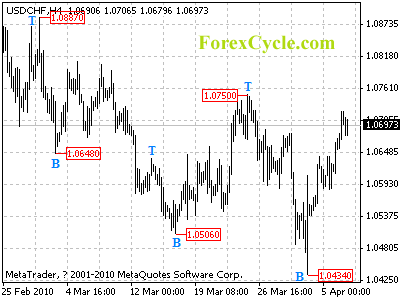
USDCHF’s bounce extends to 1.0721

USDCHF’s bounce from 1.0434 extends further to as high as 1.0721 level. Further rally to test 1.0750 resistance is still possible later today. Pullback would more likely be seen before breaking above this level. Support is at 1.0650 followed by 1.0600, below these levels will indicate that a cycle top has been formed on 4-hour chart, then the fallowing downtrend could take price back towards 1.0434 previous low.

usdchf

Daily Forex Forecast

Forex Daily Market Commentary

By GCI Forex Research

Fundamental Outlook at 1500 GMT (EDT + 0500)

The euro depreciated vis-à-vis the U.S. dollar today as the single currency tested bids around the US$ 1.3355 level and was capped around the $1.3495 level.  The common currency fell significantly on new concerns about Greece’s fiscal condition.  A report suggested Greece may try to bypass the International Monetary Fund’s involvement in financial assistance to the country because the conditions may be too tight.  Greek finance minister Papaconstantinou denied the report and said the country has never sought to exclude the IMF from the rescue package.  Greece needs to borrow about €42 billion in 2010 and this may include as much as US$ 10 billion in U.S. dollar bonds.  IMF officials are expected to meet with Greek officials again this week.  In another report, there is talk that Greek investors and corporations are moving assets outside of Greece for asset protection purposes.  This is the latest chapter in the Greek saga and it is likely not the last.  Some dealers have suggested Greece’s woes are analogous to AIG’s and have compared the situations involving Portugal and Spain to Lehman’s troubles, in reference to the U.S. investment banking giant that was not bailed out.  Data released in the eurozone today saw the April Sentix investor confidence index print at +2.5, up from the prior reading of -7.2.  EMU-16 March PMI data will be released tomorrow.  In U.S. news, minutes from the Federal Open Market Committee’s March meeting were released today and they reported “While recent data pointed to a noticeable pickup in the pace of consumer spending during the first quarter, participants agreed that household spending going forward was likely to remain constrained by weak labor market conditions, lower housing wealth, tight credit, and modest income growth.”  The minutes also revealed “Participants saw recent inflation readings as suggesting a slightly greater deceleration in consumer prices than had been expected. A number of participants observed that moderation in price changes was widespread across many categories of spending.” Most dealers believe the Fed will wait to raise its benchmark federal funds target rate for several months because they want to see if consumer prices are more inflationary or deflationary and they will want to see ongoing improvements in the U.S. labour market.  It was reported on Friday that March non-farm payrolls expanded at their highest rate in three years. Minneapolis Fed President Kocherlakota today said he supports the gradual sale of mortgage-backed securities. The Fed last week ended a massive US$ 1.25 trillion MBS-buying program that provided liquidity to the financial system.  Euro bids are cited around the US$ 1.3175 level.

¥/ CNY

The yen appreciated vis-à-vis the U.S. dollar today as the greenback tested bids around the ¥93.65 level and was capped around the ¥94.35 level. Finance Minister Kan reported Bank of Japan Governor Shirakawa is “doing a very good job.”  Financial services minister Kamei reported the government will need to enact additional fiscal measures to stop the strong deflationary pressures that are evident.  Japan’s ability to implement additional budgetary stimuli is rather limited given the massive amount of outstanding Japanese government bonds. Data released in Japan today saw the February coincident index improve to 100.7 from 100.3 while the February leading economic index improved to 97.9 from 96.7.  The central bank may increase its assessment of the Japanese economy on account of an improvement in the export sector and the recent improvement in the Tankan survey of corporate sentiment.  The Nikkei 225 stock index lost 0.50% to close at ¥11,282.32. U.S. dollar offers are cited around the ¥96.85 level.  The euro moved lower vis-à-vis the yen as the single currency tested bids around the ¥125.35 level and was capped around the ¥127.35 level.  The British pound moved lower vis-à-vis the yen as sterling tested bids around the ¥142.05 level while the Swiss franc moved lower vis-à-vis the yen and tested bids around the ¥87.50 level. In Chinese news, the U.S. dollar was unchanged vis-à-vis the Chinese yuan as the greenback closed at CNY 6.8257 in the over-the-counter market.  The big news involving China continues to be that the Obama administration is delaying the release of a report due 15 April that could have potentially labeled China a currency manipulator.  The move to delay the release of the report could signal negotiations are ongoing between the two countries or could signal China may let the yuan appreciate further in the coming days.  Chinese leadership will visit Washington, D.C. on 12-13 April.  It was reported today that China’s net foreign debt totaled US$ 428.6 billion at the end of 2009, up 14% y/y.

The British pound depreciated vis-à-vis the U.S. dollar today as cable tested bids around the US$ 1.5125 level and was supported around the $1.5305 level. Cable spun lower after Prime Minister Brown called for a general election on 6 May and Parliament was dissolved.  The consensus is that the election could end in a hung Parliament even if challenger Cameron of the Tory party unseats the unpopular Brown.  Data released in the U.K. today saw March construction PMI improve to 53.1 from 48.5 in February.  Cable bids are cited around the US$ 1.4455 level.  The euro moved lower vis-à-vis the British pound as the single currency tested bids around the £0.8765 level and was capped around the £0.8860 level.

CHF

The Swiss franc depreciated vis-à-vis the U.S. dollar today as the greenback tested offers around the CHF 1.0720 level and was supported around the CHF 1.0610 level. Data released in Switzerland today saw March consumer price inflation up 0.1% m/m and 1.4% y/y.  Swiss National Bank is said to have intervened in the market last week by selling Swiss francs in what is estimated to have been a massive operation.  Swiss monetary, financial, and government officials have been warning that they will not tolerate a further increase in the franc in recent weeks but many traders speculated the central bank would not intervene to weaken the franc on account of growth in the Swiss economy.  While forecasts for economic growth and inflation have both been upwardly revised in recent weeks, SNB’s latest probable intervention underscores their commitment to preserving an export-driven recovery.   U.S. dollar offers are cited around the CHF 1.0920 level.  The euro moved lower vis-à-vis the Swiss franc as the single currency tested bids around the CHF 1.4315 level while the British pound moved higher vis-à-vis the Swiss franc and tested offers around the CHF 1.6335 level.

Forex Daily Market Commentary provided by GCI Financial Ltd.

GCI Financial Ltd (”GCI”) is a regulated securities and commodities trading firm, specializing in online Foreign Exchange (”Forex”) brokerage. GCI executes billions of dollars per month in foreign exchange transactions alone. In addition to Forex, GCI is a primary market maker in Contracts for Difference (”CFDs”) on shares, indices and futures, and offers one of the fastest growing online CFD trading services. GCI has over 10,000 clients worldwide, including individual traders, institutions, and money managers. GCI provides an advanced, secure, and comprehensive online trading system. Client funds are insured and held in a separate customer account. In addition, GCI Financial Ltd maintains Net Capital in excess of minimum regulatory requirements.

DISCLAIMER: GCI’s Daily Market Commentary is provided for informational purposes only. The information contained in these reports is gathered from reputable news sources and is not intended to be U.S.ed as investment advice. GCI assumes no responsibility or liability from gains or losses incurred by the information herein contained.

FOREX: AUD/USD advances over 0.9250 after Australia’s Interest Rate hike

By CountingPips.com

The Australian dollar has surged higher against the US dollar today in forex trading after the Reserve Bank of Australia increased its interest rate by 25 basis points and hinted more rate increases could follow. The Aussie-dollar pair (AUD/USD) has advanced by over approximately 85 pips today in trading to trade at its highest level since January 15th. The AUD/USD has now risen above the 0.9250 level in the U.S. session after opening the day around the 0.9197 exchange rate level.

The pair started its ascension higher following the expected rake hike this morning as the Australian cash rate now stands at 4.25 percent, well above the close-to-zero rates in many other major nations. This was the fifth rate increase for Australia in the last six months and marked a 14-month high interest rate level.

Reserve Bank of Australia governor Glenn Stevens said in the statement accompanying the rate decision that Australia’s “output growth over the year ahead is likely to exceed that seen last year” and that the “rate of unemployment appears to have peaked at a much lower level than earlier expected.”

Stevens also said that interest rates have been below their average for borrowers and that “it is appropriate for interest rates to be closer to average.” He added that this was one step in the direction towards the “process” of getting rates near their average, prompting speculation rates could go higher as soon as next month’s meeting.

AUD/USD 1-Hour Chart – The Aussie today accelerating higher against the US dollar with help from the RBA’s interest rate hike to trading above 0.9275 today. The pair has climbed to its highest exchange rate since January 15th after trading as low as 0.8578 on February 5th.

Forex - AUDUSD

Gold Tests $1135/oz

By Fast Brokers – Gold has broken through previous April highs and is testing the patience of 3/17 highs and the psychological $1135/oz level.   Strength in gold comes amid renewed weakness in the risk trade as the Euro and Pound take a beating.  Fresh uncertainty in Greece is sending government bond yields higher and investors divesting from the risk trade in succession.  Additionally, the Cable is being hit by the announcement of parliamentary elections being held on May 6th and the concept of a hung parliament slowly becoming reality.  Risk aversion has sent investors towards gold and higher yielding currency pairs.  Hence, gold’s usual negative correlation with the Greenback has gone astray as investors digest negative psychological developments.  Meanwhile, the precious metal is separating itself further from key downtrend lines running through March 3rd highs, or the $1150/oz area.  Therefore, gold could have some more topside momentum left for the near-term.  The Fed now comes into focus with the release of FOMC meeting minutes this afternoon, and investors will be paying attention to see whether the central bank’s economic outlook has improved in the wake of positive U.S. data.  Although the U.S. will be quiet on the data front tomorrow, investors will receive some important data from the UK along with the BoJ’s monetary policy announcement during the Asia trading session.  Investors should also keep an eye on the data wires for any more developments in Greece.

Technically speaking, gold faces topside technical barriers in the form of the psychological $1135/oz area and 3/17 highs.  As for the downside, gold has fresh uptrend lines serving as technical cushions along with intraday, 4/2, and 4/1 lows.

Present Price: $1132.90/ oz
Resistances: $1133.09/oz, $1134.05/oz, $1135.01/oz, $1135.88/oz, $1137.04/oz
Supports: $1131.72/oz, $1130.76/oz, $1129.86/oz, $1128.21/oz, $1127.28/oz, $1126.56/oz
Psychological: $1130/oz, March highs and April lows

(click chart to enlarge)

Market Commentary provided by Fast Brokers.

Disclaimer: FastBrokers’ market commentary is provided for information purposes only and under no circumstances should be regarded neither as an investment advice nor as a solicitation or an offer to sell/buy any financial product. FastBrokers assumes no responsibility or liability from gains or losses incurred by the information herein contained.

Risk Disclosure: There is a substantial risk of loss in trading futures and foreign exchange. Please carefully review all risk disclosure documents before opening an account as these financial instruments are not appropriate for all investors.