BoE and ECB rate decision

eToro News

1

The ECB Rate Decision-The ECB is expected to leave rates unchanged at a record low of 1% amid weak economic conditions while outlaying inflationary risks as remote. The ECB will be keen to indicate current rates are appropriate especially with the Greek debt woes still echoing at the background. Overall investors expect the first rate hike by the ECB at the beginning of 2011 and any rate hike of the ECB before that time horizon due to elevated inflation rather than growth could have a negative spine off.

The BoE Rate Decision will be at the centre-The BoE is expected to leave rates unchanged at 0.5% with consensus polls pointing on an expected rate hike by the end of 2010.Investors will be alert to the BoE remarks on two major subjects QE and economic growth. QE an emergency measure which involves capping bond yields and printing money simultaneously is used to stimulate credit in a weak economy. If the BoE will mention future QE this literally mean the BoE sees more future economic weakness and will be ready to print more money. This will be of course Pound bearish. In addition if the BoE will outlay a rather subdued economic growth story even without mentioning QE then investors’ consensus on the BoE rate hike could shift from the end of 2010 to 2011 which is also rather bearish for the Sterling Bearish. However if the BoE will suggest carful optimism this could confirm investors bets on a better than expected UK recovery and will move investors to crowd on more Sterling bets. This will probably affect the most on EUR/GBP which could fall further.

Technical Update

EUR.GBP, Daily

2

The Pair is reaching the 0.875 support after a rather sharp bearish selloff. The pair’s journey south still looks in place. We suggest waiting for a slight bounce to the 0.887-0.89 zone before riding this bearish cycle.

Technical Opportunities

GBP.USD, Daily

3

General Overview- The Pair is currently trading sideways and it is unclear to which direction the pair will eventually break.  Nevertheless we currently see a good risk reward bearish trade using this range.

Trading Advice- Place your stop loss above the upper range at 1.54 and ride a bearish cycle to 1.49.

4

Daily Forex Market Analysis provided by eToro

Disclaimer: Trading in the Foreign Exchange market might carry potential rewards, but also potential risks. You must be aware of the risks and are willing to accept them in order to trade in the foreign exchange market. Don’t trade with money you can’t afford to lose.

© 2009 eToro Blog.

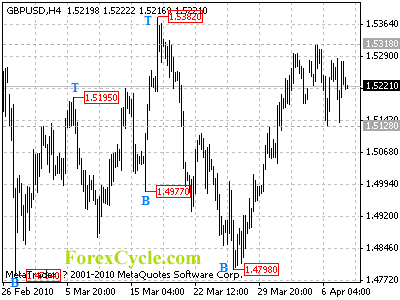
GBPUSD pulled back from 1.5318

Being contained by 1.5382 previous high resistance, GBPUSD pulled back from 1.5318 and traded in a narrow range between 1.5128 and 1.5318. Support is at 1.5128, a break below this level will indicate that a cycle top has been formed at 1.5318 on 4-hour chart, then deeper decline could be seen to 1.4900 area. However, above 1.5382 key resistance will indicate that the longer term downtrend from 1.6875 (Nov 16, 2009 high) has completed at 1.4784 already.

gbpusd

Daily Forex Reports

FOREX: US Dollar advances vs Canadian Loonie after falling to parity

By CountingPips.com

The U.S. dollar has gained back some ground today versus the Canadian “loonie” dollar after falling to parity this week for the first time since July of 2008. The USD/CAD pair fell to equal footing in yesterday’s trading and again earlier today before buying support lifted the pair to its highest level in two days.  The USD/CAD has gained approximately 45 pips from the day’s opening exchange rate to trade at the 1.0062 level and the pair is advancing for the first day this week. Last week, the USD/CAD fell for four out of the five days for over a 150 pip total loss.

Economic news released today out of Canada showed that building permits fell by more than expected in February. Permits declined by 0.5 percent in February following a 4.7 percent revised decrease in January. Market forecasts were expecting a 2.0 percent increase for the month. Despite the monthly decrease, the annual permits level was 56.7 percent higher than the February 2009 level during the financial crisis.

Elsewhere, the U.S. dollar has been mixed in forex trading against the other major currencies. The dollar has gained versus the euro, British pound and Swiss franc while falling against the Japanese yen, New Zealand dollar and the Australian dollar.

The US stock markets, meanwhile, took a break in their recent rally with a losing session today as the Dow Jones fell by approximately 72 points, the Nasdaq decreased approximately 6 points and the S&P 500 slid by over 6 points. Oil traded lower to $85.88 while gold gained $17.20 to level at $1,152.30 per ounce.

USD/CAD 1-hour Chart – The US Dollar breaking out of its steady downtrend to the Canadian Dollar in forex trading today.  This recent downward price channel started from the March 26th high and culminated in the USD/CAD falling to 0.9978 on April 6th to mark its lowest level in 20 months. The MACD indicator turned positive for the first time since March 29th while the Relative Strength Index topped out at a 67 reading today. Current price action is taking place near the 23.6 fibonacci retracement level on the down move from 1.0302 (March 26th) to yesterday’s low at 0.9978.

forex-usdcad

Forex Daily Market Commentary

By GCI Forex Research

Fundamental Outlook at 1500 GMT (EDT + 0500)

The euro depreciated vis-à-vis the U.S. dollar today as the single currency tested bids around the US$ 1.3325 level and was capped around the $1.3410 level.  There is growing talk that Greece will default on its debt and this was exacerbated by a market rumour today that Germany is withdrawing its support for financial assistance to Greece.  The yield on 10-year Greek bonds reached 407bps over benchmark German bunds today, the highest level since the euro’s introduction in 1999.  Continued pressure on Greek assets is also rendering it more difficult for other highly-indebted eurozone countries including Portugal and Spain to address their fiscal imbalances.  The common currency also came off on a report that the eurozone registered zero growth in the fourth quarter, a downgrade from the earlier report of 0.1% growth and down from the third quarter’s 0.3% growth rate.  On an annualized basis, Q4 growth was off 2.2% y/y from the previous reading of -2.1% y/y.  Other EMU-16 data released today saw March PMI services improve to 54.1 from the prior reading of 53.7 while the EMU-16 March PMI composite improved to 55.9 from the prior reading of 55.5.  Also, EMU-16 February producer price inflation printed at 0.1% m/m and -0.5% y/y.  February retail sales data will be released tomorrow.  The European Central Bank is expected to keep monetary policy unchanged tomorrow and for the foreseeable future given the sluggish economic recovery and ongoing problems with eurozone sovereign debt.  In U.S. news, data released today saw MBA mortgage applications decline 11.0% in the latest week while February consumer credit fell to –US$ 11.5 billion from the prior reading of +US$ 10.6 billion.  Data to be released tomorrow include weekly initial jobless claims, continuing jobless claims, and March ICSC chain store sales.  Former Federal Reserve Chairman Greenspan defended his tenure at the Fed in Congressional testimony today, adding enhanced regulation of financial institutions may have averted some of the credit crises over the past couple of years.  Additionally, Greenspan reported the securitization of sub-prime mortgages also contributed to the crises as global investors scrambed for yield.  Fed Chairman Bernanke today reported the U.S. is “far from out of the woods,” citing a “troubled” commercal real estate sector and “very weak” hiring.  Bernanke did not today reiterate that rates will remain low for an “extended period” but noted “stimulative” rates will aid growth.  Euro bids are cited around the US$ 1.3175 level.

¥/ CNY

The yen appreciated vis-à-vis the U.S. dollar today as the greenback tested bids around the ¥93.40 level and was capped around the ¥94.25 level.  As expected, Bank of Japan voted to keep interest rates unchanged overnight with its main unsecured overnight call rate unchanged at 0.1%.  BoJ Governor Shirakawa reported “We have confirmed that the economy is currently picking up steadily and on top of that, we are seeing some signs of future progress.”  Government pressure on the central bank to ease policy further will likely continue and some BoJ-watchers expect the central bank will loosen policy further again before the end of the quarter.  The central bank last month doubled a lending program to ¥20 trillion.  Some dealers believe the BoJ will increase its growth forecasts later this month on account of the recent improvement in the export sector.  Data to be released in Japan tonight include the February current account total, February trade balance, and February machine orders.  The Nikkei 225 stock index climbed 0.09% to close at ¥11,292.83.  U.S. dollar offers are cited around the ¥96.85 level.  The euro moved lower vis-à-vis the yen as the single currency tested bids around the ¥124.60 level and was capped around the ¥126.15 level.  The British pound moved lower vis-à-vis the yen as sterling tested bids around the ¥141.75 level while the Swiss franc moved lower vis-à-vis the yen and tested bids around the ¥87.00 figure. In Chinese news, the U.S. dollar depreciated vis-à-vis the Chinese yuan as the greenback closed at CNY 6.8255 in the over-the-counter market, down from CNY 6.8257.  People’s Bank of China announced it will sell three-year bills tomorrow for the first time since June 2008 to drain cash from the economy.  PBoC-watchers believe this tightening step will precede eventual increases in benchmark rates and will probably coincide with increases in the yuan’s value.  China overnight reported the U.S. and China agree to “respect each other’s core concerns and major values” and added China wants positive ties with the U.S.  The big news involving China continues to be that the Obama administration is delaying the release of a report due 15 April that could have potentially labeled China a currency manipulator.  The move to delay the release of the report could signal negotiations are ongoing between the two countries or could signal China may let the yuan appreciate further in the coming days.  Chinese leadership will visit Washington, D.C. on 12-13 April.  It was reported today that China’s net foreign debt totaled US$ 428.6 billion at the end of 2009, up 14% y/y.  Chinese and U.S. officials will convene in Washington, D.C. next week and will discuss China’s exchange rate policy and other key issues.  People’s Bank of China adviser Li Daokui was on the tape overnight noting China may raise interest rates if the increase in inflation continues and pushes inflation above 3%.

The British pound appreciated vis-à-vis the U.S. dollar today as cable tested offers around the US$ 1.5285 level and was supported around the $1.5135 level.  Data released in the U.K. today saw the March BRC shop price index decline to 1.2% m/m while the March PMI services index fell to 56.5 in March from 58.4 in February.  Bank of England is expected to keep interest rates unchanged tomorrow and to maintain its asset purchase program at £200 billion.  Cable continues to move lower as Prime Minister Brown called for a general election on 6 May and Parliament was dissolved.  The consensus is that the election could end in a hung Parliament even if challenger Cameron of the Tory party unseats the unpopular Brown.  Cable bids are cited around the US$ 1.4455 level.  The euro moved lower vis-à-vis the British pound as the single currency tested bids around the £0.8750 level and was capped around the £0.8820 level.

CHF

The Swiss franc depreciated vis-à-vis the U.S. dollar today as the greenback tested offers around the CHF 1.0745 level and was supported around the CHF 1.0680 level. Swiss National Bank is thought to have intervened again today by selling the franc but this will remain unconfirmed and is far from certain because while the pair appreciated quickly, it did not appreciate by more than 35 pips.  Still, the SNB may have sold francs for euro in smaller size today to remind the market that it will not tolerate a stronger franc.  Data released in Switzerland today saw February retail sales print weaker-than-expected at +3.1% y/y.  U.S. dollar offers are cited around the CHF 1.0920 level.  The euro moved higher vis-à-vis the Swiss franc as the single currency tested offers around the CHF 1.4355 level while the British pound moved higher vis-à-vis the Swiss franc and tested offers around the CHF 1.6380 level.

Forex Daily Market Commentary provided by GCI Financial Ltd.

GCI Financial Ltd (”GCI”) is a regulated securities and commodities trading firm, specializing in online Foreign Exchange (”Forex”) brokerage. GCI executes billions of dollars per month in foreign exchange transactions alone. In addition to Forex, GCI is a primary market maker in Contracts for Difference (”CFDs”) on shares, indices and futures, and offers one of the fastest growing online CFD trading services. GCI has over 10,000 clients worldwide, including individual traders, institutions, and money managers. GCI provides an advanced, secure, and comprehensive online trading system. Client funds are insured and held in a separate customer account. In addition, GCI Financial Ltd maintains Net Capital in excess of minimum regulatory requirements.

DISCLAIMER: GCI’s Daily Market Commentary is provided for informational purposes only. The information contained in these reports is gathered from reputable news sources and is not intended to be U.S.ed as investment advice. GCI assumes no responsibility or liability from gains or losses incurred by the information herein contained.

AUD/USD Moves Sideways

By Fast Brokers – The Aussie is moving sideways below its psychological .93 level after yesterday’s solid pop past March lows.  The RBA decided to stay aggressive with its monetary policy and opted to raise rates by another 25 basis points to 4.25%.  Demand from Asia for Australia’s commodities is continuing to power its economy forward.  Despite recent slowdowns in housing and retail sales the RBA forecasts rising prices.  Hence, the central bank doesn’t seem too hesitant about raising again should economic fundamentals improve.  That being said, the RBA’s rate hike has solidified the Aussie’s upward trajectory unless upcoming economic data disappoints.  Australia will release key employment figures tomorrow and it will be interesting to see if the RBA’s hawkish stance forebodes of positive employment data.  Should tomorrow’s numbers come in strong, this could add to the Aussie’s upward momentum.  However, a pullback in employment has the potential to erase weekly gains.  Australia will not be the only country busy on the wire with the BoE and ECB making monetary policy decisions of their own during the European trading session.  Although both central banks are expected to stand pat, monetary policy statements always carry the potential to move FX markets.  Therefore, investors should keep a close eye on the greenback’s reaction as tomorrow’s news hits the wire.

Technically speaking, the Aussie faces technical barriers in the form of intraday and 1/14 highs.  Speaking of which, the Aussie is creeping towards previous 2010 highs, meaning the 93 area could prove to be a tough barrier to crack over the near-term.  As for the downside, the Aussie has multiple uptrend lines serving as technical cushions along with intraday, 4/6, and 3/31 lows.  Additionally, the psychological .92 and.91 levels could serve as a technical cushion should it be tested.

Price: .9259
Resistances: .9264, .9278, .9291, .9304, .9316, .9330
Supports: .9247, .9230, .9214, .9194, .9185, .9173, .9161
Psychological: .93, .92 March Lows and Highs

(click chart to enlarge)

Market Commentary provided by Fast Brokers.

Disclaimer: FastBrokers’ market commentary is provided for information purposes only and under no circumstances should be regarded neither as an investment advice nor as a solicitation or an offer to sell/buy any financial product. FastBrokers assumes no responsibility or liability from gains or losses incurred by the information herein contained.

Risk Disclosure: There is a substantial risk of loss in trading futures and foreign exchange. Please carefully review all risk disclosure documents before opening an account as these financial instruments are not appropriate for all investors.

USD/JPY Limps Lower After BoJ Meeting

By Fast Brokers – The USD/JPY is limping lower after the BoJ decided to keep its monetary policy unchanged as expected.  Though the central bank noted continual deflationary pressures, it also cited improvements in export demand and manufacturing.  Hence, Japan’s export-oriented economy continues to benefit from the strong economic performance of the Pacific.  That being said, investors have opted to nibble on the Yen today and are locking in some profits following the currency pair’s impressive run towards 95.  Despite recent weakness, the USD/JPY’s uptrend is still in play as the currency pair solidifies well above its highly psychological 95 level and key downtrend lines.  Meanwhile, the U.S. will be quiet on the data-front today, meaning present trends could play out until tomorrow barring any unexpected psychological developments.  However, activity should pick up tomorrow with Australia kicking off the session by releasing key employment data.  The BoE and ECB with follow with they own monetary policy decision accompanied by heavily-weighted fundamental data from the UK.  The wealth of data and news normally creates an environment supporting volatility, so investors should keep an eye on the greenback’s reaction to tomorrow’s flow, particularly the central bank monetary policy decisions.

Technically speaking, the USD/JPY faces technical barriers in the form of previous April highs and the currency pair’s psychological 95 level.  As for the downside, the USD/JPY has multiple uptrend lines serving as technical cushions along with 4/2, 4/1, and 3/30 lows.  Additionally, the psychological 93 level could serve as a psychological cushion should it be tested.

Present Price: 93.76
Resistances: 93.86, 94.06, 94.26, 94.40, 94.56, 94.74, 94.89
Supports: 93.67, 93.57, 93.45, 93.30, 93.09, 92.84
Psychological: .95, .94, .93, 2010 highs

(click chart to enlarge)

Market Commentary provided by Fast Brokers.

Disclaimer: FastBrokers’ market commentary is provided for information purposes only and under no circumstances should be regarded neither as an investment advice nor as a solicitation or an offer to sell/buy any financial product. FastBrokers assumes no responsibility or liability from gains or losses incurred by the information herein contained.

Risk Disclosure: There is a substantial risk of loss in trading futures and foreign exchange. Please carefully review all risk disclosure documents before opening an account as these financial instruments are not appropriate for all investors.

GBP/USD Weakens as Services Slow

By Fast Brokers – The Cable is trading lower again today despite yesterday’s comeback from intrasession lows.  The Cable experienced a large leg down after Services PMI printed below analyst expectations.  A slowdown in services is disconcerting for the UK since the nation’s GDP is heavily services weighted.  That being said, it will be interesting to see whether this pullback in services is reflected in upcoming UK employment data.  Meanwhile, the Cable is recovering from today’s lows and has managed to stay above yesterday’s lows thus far.  However, today’s Services PMI figure could drag on the Cable since the U.S. will be quiet on the data front today.  The data and news wires will pick up steam tomorrow with Australia kicking the day off by releasing important employment data.  The UK will follow with the Halifax HPI and Manufacturing Production.  It will be interesting to see what impact volatility in the Pound has had on demand for manufactured goods.  Highlighting the session will be BoE and ECB monetary policy decisions.  With parliamentary elections set for next month it is difficult to foresee the BoE tightening monetary policy and effectively slowing the economic recovery.  On the other hand, looser liquidity could be perceived as fiscally irresponsible.  Therefore, it would not be surprising to see the BoE stand pat and keep its policy unchanged.  That being said, any surprise action from the BoE could have a considerable impact on the Cable.

Technically speaking, the Cable is still trading comfortable above downtrends running through March 17 highs, or the 1.5380 area.  Hence, the Cable’s uptrend is still alive and well despite today’s pullback.  Additionally, the Cable has fresh uptrend lines serving as technical cushions along with intraday and 3/31 lows.  On the other hand, the Cable has dropped below April 2nd lows, and it will be interesting to see if the currency pair can stage an intraday recovery.

Present Price: 1.5219
Resistances: 1.5229, 1.5244, 1.5259, 1.5267, 1.5280, 1.5293
Supports: 1.5210, 1.5198, 1.5188, 1.5177, 1.5167, 1.5151
Psychological: 1.53, 1.52, March highs and April Lows

(click chart to enlarge)

Market Commentary provided by Fast Brokers.

Disclaimer: FastBrokers’ market commentary is provided for information purposes only and under no circumstances should be regarded neither as an investment advice nor as a solicitation or an offer to sell/buy any financial product. FastBrokers assumes no responsibility or liability from gains or losses incurred by the information herein contained.

Risk Disclosure: There is a substantial risk of loss in trading futures and foreign exchange. Please carefully review all risk disclosure documents before opening an account as these financial instruments are not appropriate for all investors.

EUR/USD Loses Ground as Uncertainty Persists

By Fast Brokers – The EUR/USD is continuing yesterday’s pullback as uncertainty continues to build regarding rising bond yields in Greece.  Politicians have been relatively quiet since yesterday’s statement implying Greece’s objection to IMF involvement in potential financial aid packages due to the apparent extremity of requested austerity measures.  Unraveling conditions in Greece have sent investors back towards the dollar, gold, and higher yielding currencies such as the Aussie and Loonie.  The EU also gave investors little to cheer about data-wise after Final GDP and PPI each printed a basis point below expectations.  Hence, it seems problems in the Mediterranean are impacting the EU as a whole as the union tries to contain Greece’s fiscal crisis and prevent contagion.  Meanwhile, the U.S. will be relatively quiet on the data wire today, leaving the EUR/USD up to its present trend and any unforeseen psychological developments.  On an encouraging note, the EUR/USD is still trading above March lows, meaning an uptrend may still be salvageable.  However, it seems investors will need more clarification from EU officials soon.  Investors will then turn their attention to tomorrow’s busy lineup.  Investors will receive key economic data from Australia in the morning, followed by ECB and BoE monetary policy decisions during the afternoon.  It is hard to imagine the ECB will tighten considering the damage being done to the region by fiscal problems in Greece.  However, if the central bank were to tighten liquidity this could give the EUR/USD a boost to the topside.  On the other hand, if the ECB were to loosen to support the economic recovery this could place downward pressure on the EUR/USD with a possible retest of March lows.  Either way, tomorrow could be a busy day in the FX markets considering the wealth of news and data on the way.

Technically speaking, the EUR/USD has dropped back below 3/31 lows, a negative development.  However, the currency pair does have multiple uptrend lines to fall back on along with the psychological 1.33 level and March lows.  However, the EUR/USD has certainly been dealt a damaging near-term blow.  As for the topside, downtrends are mounting as the EUR/USD drops.  Additionally, the currency pair faces technical barriers in the form of intraday highs and the psychological 1.34 and 1.35 levels should they be tested.

Present Price: 1.3353
Resistances: 1.3363, 1.3374, 1.3383, 1.3395, 1.3403, 1.3411
Supports:  1.3352, 1.3346, 1.3339, 1.3331, 1.3322, 1.3312
Psychological: March lows, 1.35, 1.34, 1.33

(click chart to enlarge)

Market Commentary provided by Fast Brokers.

Disclaimer: FastBrokers’ market commentary is provided for information purposes only and under no circumstances should be regarded neither as an investment advice nor as a solicitation or an offer to sell/buy any financial product. FastBrokers assumes no responsibility or liability from gains or losses incurred by the information herein contained.

Risk Disclosure: There is a substantial risk of loss in trading futures and foreign exchange. Please carefully review all risk disclosure documents before opening an account as these financial instruments are not appropriate for all investors.

Understanding the Fed — Not Just the Myths About the Fed

By Editorial Staff

If you would like to understand more about how the U.S. Federal Reserve works, you can spend some time on its website — or you can get the real story. Elliott Wave International has collected eight of Robert Prechter’s most trenchant articles about what the Fed actually does. He takes on the misleading myths about the Fed and explains what’s really going on as he writes about these topics.

How the Fed manufactures money

  • How the Fed encourages the growth of credit — and why that’s deflationary
  • What gives the Fed the authority to bail out troubled institutions
  • The difference between creating money and facilitating credit
  • Whether the Fed can manipulate the stock market or economy
  • How the Fed is ignoring historical lessons about central banks
  • How the Fed’s actions, combined with public outrage, may ultimately lead to its demise

The eBook with eight chapters is called Understanding the Fed: How to protect yourself from the common and misleading myths about the U.S. Federal Reserve. Here’s an excerpt to give you a taste of what you will learn.

*****

The Fed’s “Uncle” Point Is in View
Chapter 13 of Conquer the Crash is titled, “Can the Fed Stop Deflation?” The answer given there was an emphatic no. In barely a year the faith –and that’s what it was–in the Fed’s inflating power has pretty much died. Conquer the Crash quoted The Wizard of Oz, and now anyone can see that there is no magic: just a man yanking on levers and blowing smoke. Back in 1929, consortiums of big banks, using their depositors’ money, tried to save the debt-laden stock market. They failed. This time, the new consortium was bigger: the Federal Reserve. But Conquer the Crash anticipated the end of that game, too: “The bankers’ pools of 1929 gave up on this strategy, and so will the Fed if it tries it.”

It is finally becoming obvious to everyone that the Fed is failing in extending its bag of tricks to stop deflation. The Fed’s balance sheet now contains more than 50 percent mortgage and other bank debt. Perhaps the Fed is willing to blow the rest of its AAA assets in the form of Treasury bonds, but somewhere between now and then is the Fed’s uncle point. The markets, however, are not so dumb as to wait for it.
They can already see the end of that road, and they are moving now, ahead of it.

The Last Bastion against Deflation: The Federal Government
Now that the downward portion of the credit cycle is firmly in force, further inflation is impossible. But there is one entity left that can try to stave off deflation: the federal government.

The ultimate source of all the bad credit in the U.S. financial system is Congress. Congress created the Federal Reserve System and many privileged lending corporations: Fannie Mae, Freddie Mac, Ginnie Mae, Sallie Mae, the Federal Housing Administration and the Federal Home Loan Banks, to name a few. The August 2008 issue cited our estimate that the mortgage-encouraging entities that Congress created account for 75 percent of all U.S. debt creation with respect to housing. For investors in mortgage (in)securities, the ratio is even greater. Recent reports show that these agencies, which have been stealing people blind by taking interest for nothing, account for a stunning 82 percent of all securitized mortgage debt. Roughly speaking, the government directly encouraged the indebtedness of four out of five home-related borrowers. As noted in the August issue, it indirectly encouraged the rest through the Fed’s lending to banks and the FDIC’s guarantee of bank deposits. These policies allowed borrowers to drive up house prices to absurd levels, making them unaffordable to people who wanted to buy them with actual money. Proof that these mortgages are artificial and the product of something other than a free market is the fact that while Germany, for example, has issued mortgage-backed securities with a value equal to 0.2 percent of its annual GDP, the U.S. has issued them so ferociously that their value has reached 49.6 percent of annual GDP, a multiple of 250 times Germany’s rate, and that is not in total value but only in value relative to the U.S.’s much larger GDP. (Statistics courtesy of the British Treasury.)

Do You Want to Really Understand the Fed? Then keep reading this free resource as soon as you become a free member of Club EWI. Join now!

Well, the ultimate source of this seemingly risk-free credit still exists, at least for now. When Bernake & Co. met in the back rooms of the White House in recent weekends, he must have said this: “Boys, we’re nearly out of ammo. We have $400b. of credit left to lend, and we have two percentage points lower to go in interest rates. The only way to stave of deflation is for you to guarantee all the bad debts in the system.” So far, government has leapt to oblige. One of its representatives strode to the podium to declare that it would pledge the future production of the American taxpayer in order to trade, in essence, all the bad IOUs held by speculators in Fannie and Freddie’s mortgages for gilt-edged, freshly stamped U.S. Treasury bonds.

Now, what exactly does that mean for deflation? This latest extension of the decades-long debt-creation scheme has essentially exchanged bad IOUs for T-bonds. This move does not create inflation, but it is an attempt to stop deflation. Instead of becoming worthless wallpaper and 20-cents-on-the-dollar pieces of paper, these IOUs have, through the flap of a jaw, maintained their full, 100 percent liability. This means that the credit supply attending all these mortgages, which was in the process of collapsing, has ballooned right back up to its former level.

You might think this shift of liability is a magic potion to stave off deflation. But it’s not.

Believers in perpetual inflation will ask, “What’s to stop this U.S. government from simply adopting all bad debts, keeping the credit bubble inflated?” Answer: The U.S. government’s IOUs have a price, an interest rate and a safety rating. Just as mortgage prices, rates and safety ratings were under investors’ control, so they are for Treasuries. Remember when Bill Clinton became outraged when he found out that “a bunch of bond traders,” not politicians determined the price of T-bonds and the interest rates that the government must charge? If investors begin to fear the government’s ability to pay interest and principal, they will move out of Treasuries the way they moved out of mortgages. The American financial system is too soaked with bad debt for a government bailout to work, and the market won’t let politicians get away with assuming all the bad debts. It may take some time for the market to figure out what to do about it, but as always, there is no such thing as a free lunch. The only question is who pays for it.

The Fed is nearly out of the picture, so the consortium of last resort, the federal government, is assuming the job of propping up the debt bubble. It is multiples bigger than any such entity that went before, because it can draw on the liquidity of American taxpayers and clandestinely steal value from American savers. So the question comes down to this: Will the public put up with more financial exploitation? To date, that’s exactly what it has done, but social mood has entered wave c of a Supercycle-degree decline, and voters are likely to become far less complacent, and more belligerent, than they have been for the past 76 years.

An early hint of the public’s reaction comes in the form of news reports. In my lifetime, I can hardly remember times when the media questioned benevolent-sounding actions of the government. Articles were always about who the action would “help.” But many commentators have more accurately reported on the latest bailout. USA Today’s headline reads, “Taxpayers take on trillions of risk.” (9/8) This headline is stunning because of its accuracy. When the government bailed out Chrysler, no newspaper ran an equally accurate headline saying, “Congress assures long-run bankruptcy for GM and Ford.” They all talked about why it was a good thing. This time, realism and skepticism (at a later stage of the cycle it will be cynicism and outrage) attend the bailout. The Wall Street Journal’s “Market Watch” reports an overwhelmingly negative response among emailers. Local newspapers’ “Letters” sections publish comments of dismay and even outrage. CNBC’s Mark Haines, in an interview on 9/8 with MSNBC, began by saying ironically, “Isn’t socialism great?” This breadth of disgust is new, and it’s a reflection of emerging negative social mood.

Social mood trends arise from mental states and lead to social actions and events. Deflation is a social event. Ultimately, social mood will determine whether deflation occurs or not. When voters become angry enough, Congressmen will stop flinging pork at all comers. Now the automakers want a bailout. Voters have remained complacent about it so far, but this benign attitude won’t last. The day the government capitulates and announces that it can’t bail out everyone is the day deflationary psychology will have won out.

Do You Want to Really Understand the Fed? Then keep reading this free resource as soon as you become a free member of Club EWI. Join now!

Elliott Wave International (EWI) is the world’s largest market forecasting firm. EWI’s 20-plus analysts provide around-the-clock forecasts of every major market in the world via the internet and proprietary web systems like Reuters and Bloomberg. EWI’s educational services include conferences, workshops, webinars, video tapes, special reports, books and one of the internet’s richest free content programs, Club EWI.

Eurozone GDP turns flat in 4th Quarter of 2009

By CountingPips.com

The eurozone’s economic growth was revised lower than previously estimated in the fourth quarter of 2009, according to a second estimate by Eurostat released today. The 16-nation eurozone gross domestic product showed a flat reading or no growth in the October to December quarter after a previous estimate showed that GDP had advanced by 0.1 percent.

On an annual basis for the fourth quarter, eurozone GDP fell by a seasonally adjusted 2.2 percent from the fourth quarter of 2008. The previous estimate had pegged the annual decline for the fourth quarter at 2.1 percent.

The eurozone had registered five straight quarters of declining economic growth and experienced its first recession on record before emerging from the recession in the third quarter of 2009 with a quarterly GDP advance of 0.4 percent.

Greece, which has had well publicized sovereign debt problems and may potentially need a bailout, registered a 0.8 percent GDP decline in the fourth quarter following a decline of 0.5 percent in the third quarter. Greece’s economy contracted all four quarters of 2009 and fell by 2.5 percent on an annual basis for the fourth quarter from the fourth quarter of 2008.

The EU27 saw a rise in GDP by 0.1 percent for the fourth quarter following a 0.3 percent gain in the third quarter. On an annual basis, GDP was down by 4.3 percent for the EU27.

Germany, the eurozone’s largest economy, which emerged out of recession in the second quarter, saw a flat GDP reading for the fourth quarter following a 0.7 percent rise in the third quarter. France, the eurozone’s 2nd largest economy, showed GDP growth of 0.6 percent for the fourth quarter and expanded for the third straight quarter. Other EU16 countries showing a positive GDP in the quarter were Belgium, the Netherlands, Austria, Slovenia, Malta and Slovakia.