Silver Set for a Bullish Correction

By Dan Eduard

Since markets opened this week, the price of silver has dropped over 130 pips and is currently trading around the 26.60 level. Technical indicators are now showing that the precious metal may be due for a bullish correction in the near future. This could give ForexYard traders an excellent opportunity to open buy positions at a great entry price before the upward breach occurs.

We will be looking at the daily chart for silver. The technical indicators being analyzed are the Williams Percent Range, Stochastic Slow and Relative Strength Index.

1. The Williams Percent Range is currently at the -90 level, well below what is considered to be oversold territory. Typically, when a commodity reaches this level, an upward correction soon follows.

2. The Stochastic Slow has just formed a bullish cross, further signaling that an upward correction is likely to occur.

3. The Relative Strength Index is currently approaching the oversold region. Should it breach the lower support line, silver will likely start to move north.

Forex Market Analysis provided by ForexYard.

© 2006 by FxYard Ltd

Disclaimer: Trading Foreign Exchange carries a high level of risk and may not be suitable for all investors. There is a possibility that you could sustain a loss of all of your investment and therefore you should not invest money that you cannot afford to lose. You should be aware of all the risks associated with Foreign Exchange trading.

Forex Daily Market Commentary

By GCI Forex Research

Fundamental Outlook at 0800 GMT (EDT + 0400)

USD

A disappointing Australian CPI reading allowed the dollar to advance against its Australian counterpart in an otherwise quiet Asia trading session. The BoJ opted to keep policy unchanged. EURUSD traded 1.3628-1.3684, and USDJPY 82.34-82.64. The Nikkei-225 is 1.1% firmer at the time of writing, and the S&P 500 finished +0.58% ahead. President Obama is due to deliver his State of the Union address tonight, a speech in which job creation is expected to feature prominently. At the margin, this could support the US dollar, but its main drivers this week are more likely to be the FOMC announcement and the Q4 GDP data. Our analysts do not think that the FOMC statement will suggest a near-term change in monetary policy. Both the consensus and our US economists are expecting a strong rise of 3.5% q/q annualised rate for Q4 GDP.
EUR

Newswires, citing an unnamed Eurozone source, said EU leaders will have an informal discussion on the Eurozone crisis at the Feb. 4 summit and that formal decisions are expected at the late March summit.
The ECB settled only €146 mn worth of bond purchases last week under its Securities Markets Program, down from €2.313 bn the week before.
The Irish finance minister said the finance bill would pass through parliament by Saturday and the main opposition party said an election is likely in the last week of February. The passage of the finance bill removes the worry that parliament would be dissolved without reaching a final agreement on the last piece of budget legislation.
French President Sarkozy said that the dominating theme of France’s chairmanship of the G20 would revolve around FX reforms and highlighted a code of conduct on capital controls as one of his goals.
JPY

The Bank of Japan kept policy unchanged and continues to target a 0-0.1% range for the overnight call rate. No additional measures were announced. The bank revised up its CPI forecast for the fiscal year 2011 to +0.3% y/y from the earlier estimate of +0.1% y/y. Our Japan economics team does not anticipate a BoJ hike until 2013.
GBP

BoE MPC member Andrew Sentence maintained his hawkish stance and said the BoE risks its credibility by failing to tackle inflation. He said the time has come for action and he sees CPI rising to at least 4% during 2011 as it is boosted by global factors, a weaker exchange rate and healthy domestic demand. MPC member Posen has recently affirmed his dovish stance, and the Jan. 13 BoE minutes, due for release on Wednesday, will show if any other MPC member has sided with either of these two non-consensus views.
The consensus expects Q4 GDP to weaken to +0.5% q/q. A stronger print is likely to be sterling-positive, as it may stoke expectations of an early BoE hike.
AUD

The AUD weakened after CPI for Q4 failed to live up to consensus expectations, rising only +0.4% q/q (cons. +0.7%) and +2.7% y/y (cons. +3.0%). Our analysts stick to their view that the next RBA rate hike will not happen until H2 this year.
CAD

The BoC revised down its 2011 core inflation outlook though it still it reaching the 2% target by end-2012. The y/y readings for both headline and core CPI for December are expected to increase, though any rate hikes by the BoC are expected to be gradual this year.

TECHNICAL OUTLOOK
USDCHF clears 0.9521/0.9486 zone.
EURUSD BULLISH While support holds at 1.3541, expect gain towards 1.3741/86 resistance zone ahead of 1.3825.
USDJPY BEARISH Break of 81.85 would open 80.94 while resistance at 83.68 holds.
GBPUSD BULLISH Focus is on 1.6059/94 resistance zone. Initial support defined at 1.5838.
USDCHF BEARISH Breach of 0.9521/0.9486 has exposed 0.9415 ahead of 0.9301 key low. Initial resistance is at 0.9623.
AUDUSD BEARISH Move below 0.9804 would expose 0.9753. Resistance is at 1.0077.
USDCAD BEARISH Remains below 1.0034 as focus is on 0.9889/0.9838 support zone.
EURCHF BULLISH Bullish outlook with focus on 1.3069 ahead of 1.3122. Initial support is defined at 1.2815.
EURGBP BULLISH Break of 0.8563 would open up the way towards 0.8648. Initial support lies at 0.8461.
EURJPY BULLISH The cross has potential to climb to 113.03 ahead of 113.59 Fibonacci level next. Initial support lies at 112.19.

Forex Daily Market Commentary provided by GCI Financial Ltd.

GCI Financial Ltd (”GCI”) is a regulated securities and commodities trading firm, specializing in online Foreign Exchange (”Forex”) brokerage. GCI executes billions of dollars per month in foreign exchange transactions alone. In addition to Forex, GCI is a primary market maker in Contracts for Difference (”CFDs”) on shares, indices and futures, and offers one of the fastest growing online CFD trading services. GCI has over 10,000 clients worldwide, including individual traders, institutions, and money managers. GCI provides an advanced, secure, and comprehensive online trading system. Client funds are insured and held in a separate customer account. In addition, GCI Financial Ltd maintains Net Capital in excess of minimum regulatory requirements.

DISCLAIMER: GCI’s Daily Market Commentary is provided for informational purposes only. The information contained in these reports is gathered from reputable news sources and is not intended to be U.S.ed as investment advice. GCI assumes no responsibility or liability from gains or losses incurred by the information herein contained.

Shifting Fundamentals Boast Well For Krona

By Russell Glaser

Increased rates of growth and rising interest rates are all positive factors for continued gains in the Scandinavian currencies, particularly the SEK and the NOK.

In an interview yesterday, Merrill Lynch’s Bill O’Neil, chief investment officer for Europe made the case for investors to move a portion of fixed income funds from Europe to selected Nordic countries such as Finland, Sweden, Denmark, and Norway.

O’Neil sighted a difference in monetary policy as a key advantage that these Nordic nations have over their European counterparts. Europe has the difficulty of assigning one interest rate to 17 sovereign nations, all with differing rates of growth and inflation. A disparity exists between the central nations of Europe such as Germany and France, versus the peripheral nations of the euro zone.

Germany is the engine of growth for the EU as the Bundesbank recently increased its 2011 GDP forecast to 2.2% from 1.8%. This is in stark contrast to the struggling peripheral nations of Europe who are dealing with high levels of unemployment and slowing growth. In the 3Q of 2010, the economy of Greece contracted 1.2%.

2011 growth rates in Sweden and Finland are expected to come in as high as 3%. Last year the Swedish economy grew 5.5%.

The Nordic countries, with the exception of Finland who is a member of the European Monetary Union, all set their own monetary policy. Economists expect rising interest rates which will in turn boost the Scandenavian currencies. Norway announced its intention to begin raising interest rates in the middle of this year. Sweden has already increased its benchmark interest rate four times last year and Swedish interest rates currently stand at 1.25% and are expected to continue to rise.

Expectations for an increase in European interest rates have also developed in the markets, but economists expect the European Central Bank to raise rates in the 3Q and at a slower pace than their Scandinavian counterparts.

Higher rates of growth and rising interest rates are all positive factors for continued gains in the Scandinavian currencies against both the euro and the dollar, particularly the USD/SEK and the EUR/NOK.

Forex Market Analysis provided by ForexYard.

© 2006 by FxYard Ltd

Disclaimer: Trading Foreign Exchange carries a high level of risk and may not be suitable for all investors. There is a possibility that you could sustain a loss of all of your investment and therefore you should not invest money that you cannot afford to lose. You should be aware of all the risks associated with Foreign Exchange trading.

Euro Reaches Two-Month High Against USD

Source: ForexYard

The euro held near a two-month high against the USD during the Asian trading session on Tuesday, with $1.37 firmly in its sight as the market showed only the barest signs of fatigue after a 6% rally in the past two weeks. The EUR was up around 0.3% at 1.3650 against the greenback after climbing as high as 1.3685, its highest since November.

Economic News

USD – Dollar Declines as Stock Market Rallies

The U.S dollar fell against most of its major currencies on Monday, hitting its lowest level in nearly two-months against the EUR, as gains in stocks prompted investors to wade into riskier currency trades. By yesterday’s close, the USD fell against the EUR, pushing the oft-traded currency pair to 1.3650. The dollar experienced similar behavior against the CHF and closed at 0.9490.

The U.S. dollar had already been under pressure on expectations the U.S. Federal Reserve would not rush to raise its interest rates and on the growing view that the greenback has become a funding currency for carry trades. In addition, analysts attributed the fall in the dollar, which has been treated as a lower risk and safe-haven investment, to growing optimism that the worst of the financial crisis has passed. This has caused investors to buy higher-yielding currencies which rallied earlier this month.

Looking ahead to today, the most important economic indicator in today’s trading is the Consumer Confidence around 15:00 GMT. This report is very important and is likely to generate dollar volatility. Traders should pay close attention to the market as there will likely be several opportunities for traders to capitalize on the market fluctuations which are likely to follow this release.

EUR – EUR/USD Hits Two-Month High

The EUR rallied against the dollar on Monday, hitting a two-month high near $1.37 as expectations of higher euro zone interest rates sparked traders to push the currency above important technical levels. The EUR was up around 0.3% at 1.3650 after climbing as high as 1.3685, its highest since November.

Political turmoil in Ireland again highlighted problems in indebted euro zone countries and a suicide bombing at Russia’s biggest airport capped the European currency’s rise. But the euro gained momentum in the New York session, and traders said tough talk on inflation from European Central Bank President Jean-Claude Trichet on Sunday was a catalyst driving it to its highest level since November.

In addition, solid data on euro zone industrial orders and a robust euro zone flash estimate of services purchasing managers activity also bolstered the currency.

Investors may look for the unusual price volatility to continue in the EUR/USD as the pair attempts to stabilize and find new support and resistance lines. Large price jumps such as these are not common place and present terrific opportunities to take advantage of the price swings for large profitable gains.

JPY – Yen Experience Mix Results against Major Currencies

The Japanese yen completed yesterday’s trading session with mixed results versus the major currencies. The JPY fell against the CHF yesterday, pushing the oft-traded currency pair to 86.90. The JPY was unchanged vs. the EUR yesterday and closed its trading session at around the 112.55 level. The JPY did see some bullishness as well as it gained 40 points against the USD and closed at around 82.45.

The Japanese markets were expected to have a relatively heavier effect on the JPY versus its major currency counterparts today as the Overnight Call Rate was released during the Asian trading session.

The rate was left unchanged, but traders will be paying close attention to the Bank of Japan (BOJ) Press Conference, tentatively scheduled for today, to look for expectations of Japan’s economic future, especially considering the speculation that measures will be taken to devalue the yen. A bullish statement from the BOJ could lead some traders to believe that it is forecasting a rosier financial climate in Japan. Others fear that the climate is declining and monetary measures may be taken to directly influence currency prices.

Crude Oil – Crude Oil Falls 1%

Oil fell more than 1% to around $82.70 a barrel on Monday as ample U.S. inventories were seen and after Saudi Arabia’s oil minister expressed concerns about the influence of speculators on prices.

A Saudi Arabian oil official issued remarks which indicated that the Organization of Petroleum Exporting Countries could raise production this year due to a faster than expected growth in demand for the cartel’s oil.

As for today, traders are advised to watch carefully the leading stock markets and the major economic indicators which will be published from the U.S. and euro-zone in order to predict the next movements in oil prices.

Technical News

EUR/USD

The pair has recorded much bullish behavior in the past several days. However, the technical data indicates that this trend may reverse soon. For example, the daily chart’s Stochastic Slow signals that a bearish reversal is imminent. A downward trend today is also supported by the 4-hour chart’s RSI. Going short with tight stops may turn out to pay off today.

GBP/USD

The GBP/USD cross has experienced a bullish trend for the past 3 weeks. However, it seems that this trend may be coming to an end. The RSI of the daily chart shows the pair floating in the overbought territory, indicating that a downward correction will happen soon. Going short with tight stops might be a wise choice.

USD/JPY

The pair has been range-trading for a while now, with no specific direction. The daily chart’s Slow Stochastic is providing us with mixed signals. The 4 hour charts do not provide a clear direction as well. Waiting for a clearer sign on the hourlies might be a good strategy today.

USD/CHF

The daily chart is showing mixed signals with its RSI fluctuating in neutral territory. However, the 4-hour Chart’s RSI is already floating in oversold territory indicating that a bullish correction might take place in the near future. Going long with tight stops might be the right strategy today.

The Wild Card

Crude Oil

Crude oil prices are once again dropping, and the commodity is currently trading around $87.50 per barrel. Now, the 8-hour chart’s RSI is giving bullish signals, indicating that crude oil may go up. This might give forex traders a great opportunity to enter the upcoming bullish trend at a great price.

Forex Market Analysis provided by ForexYard.

© 2006 by FxYard Ltd

Disclaimer: Trading Foreign Exchange carries a high level of risk and may not be suitable for all investors. There is a possibility that you could sustain a loss of all of your investment and therefore you should not invest money that you cannot afford to lose. You should be aware of all the risks associated with Foreign Exchange trading.

UK Economy Contracts -0.5% In Q4 2010

In Brief

The first estimate of UK GDP for Q4 2010 shows a contraction of -0.5%.

Talks between the Coalition and UK banks to increase lending and curb bonuses have collapsed.

Bond auctions on the EFSF have been highly successful, and boosted confidence in the euro.

Spain’s Government may not be doing enough to curb fears of an ECB bailout.

In Depth

UK

The UK economy shrank -0.5% in the last quarter of 2010, according to figures released by the Office for National Statistics this morning. We can speculate the contraction was caused by the bad weather conditions throughout December and the Christmas season. However regardless of any hearsay it clearly suggests UK economic recovery is more fragile than previously thought.

Furthermore, talks between the UK government and leading banks (known as Project Merlin) have collapsed today. The Coalition aimed to rein in excessive bonuses and increase lending from the banks to small businesses. However, last minute demands from Chancellor George Osborne were viewed as a step too far by the banks, and the talks faltered.

EU

The first ECB (European Central Bank) bond auction on the EFSF rescue fund was a massive success on Monday. Demand during the auction meant the EFSF bond was oversubscribed many times over. This suggests the markets have a great deal of confidence in the rescue fund, and bodes well for the euro.

Furthermore, this morning the Gfk Consumer Confidence survey in Germany has been released. It reveals that German consumers are highly optimistic about their finances looking ahead to February. The survey increased to 5.7 this month, compared to 5.5 last month and estimates of 5.4.

On the other hand, confidence in the Spanish Government’s restructuring of its finance sector is low this morning. The Government has stumped up the cash to restructure Spain’s regional banks (called cajas) but not its central banks. This has raised concerns that Spain isn’t doing enough to repair its financial sector, and could need an EU bailout.

Coming Up

The US Consumer Confidence survey for January is released this afternoon. It will indicate how confident US consumers are in their prosperity, and could affect the US dollar. In addition, this evening Bank of England Governor Mervyn King is scheduled to make a speech this evening. This will be closely watched for comments about the state of the UK economy.

By Peter Lavelle with specialist currency broker Pure FX.

Weakness Seen In The US Dollar


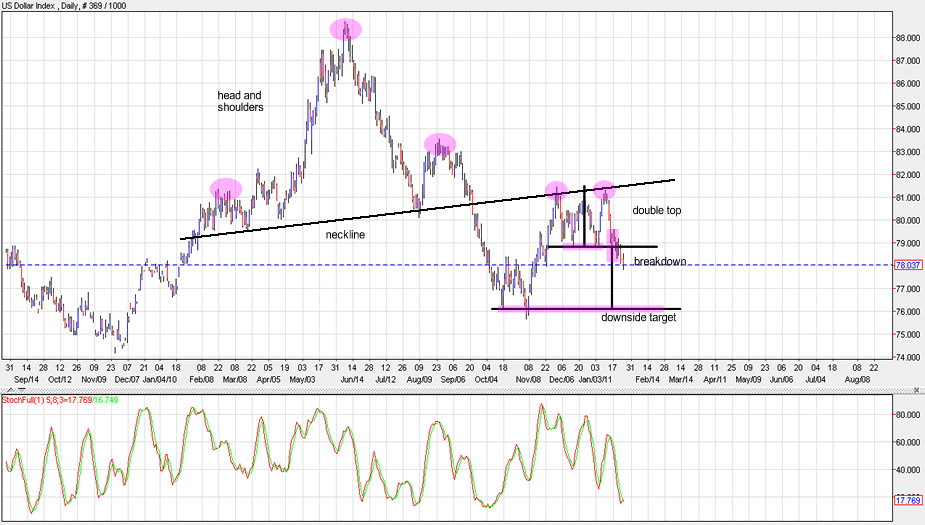
Much attention was given to the stock market for the past couple of weeks. Today, however, I’d like to divert your minds for a while towards the almighty US dollar. The US dollar index (USDX) is an index that measures the value of the USD against a basket of currencies namely the euro (EUR), British pound (GBP), Canadian dollar (CAD), Swedish krona (SEK), Swiss franc (CHF), and Japanese yen (JPY). The value of the index goes up when the greenback appreciates versus the above mentioned currencies (considering their weights) and vice versa.

As you can see from its daily chart above, the US dollar based on its index appears to be moving in the southern direction in the days or weeks to come. The index actually broke down from a head and shoulders pattern back in September 2010. During this time we also saw the dollar dipping against most of its major peers. The index then bottomed to a low of 75.631 in October before rallying back towards the head and shoulders’ neckline around 81.444 in just a little less than a month. The neckline, though, acted as a resistance to keep it from moving higher. Since then, the index had traded sideways within a box until it broke down a couple of days ago from a smaller double top formation. If selling pressure continues and the USDX is not able to keep its head back above 79 in the near term then it could further slide towards its downside target of just above 76.00.

On the economic side, the US’s consumer price index (CPI), which measures the change in the price of a basket of goods and services, cooled to 1.5% for whole of 2010 from 2.7% in the previous year. The core version of the account which excludes food and energy prices because of their inherent volatility only grew by 0.1% month-over-month in December for the second straight month, resulting to a year-over-year change of only 0.8%. Relatively cheaper prices actually supported domestic retail sales which grew by 6.7% in the same year which was its highest gain since it posted a 8.2% rise in 1999. The jump in retail sales helped push the country’s consumption, which accounts for about 70% of the US’s GDP, to expand by 4.0%.

On January 28, The US’s advance GDP for the first quarter of 2010 will be on deck. The US economy is seen to have grown by 3.5% following a 2.6% expansion in the previous quarter. So given the increase in retail sales which translated to the advance in consumer spending, the US could indeed hit the market’s consensus. Since the country’s CPI is only at 1.5% for 2010 which is at the Federal Reserve’s lower end of its usual target range for inflation, a better than expected economic growth would not really place a lot of pressure on the Fed for it to tighten its policies. Investors, given their upbeat outlook, would place their money away from the greenback into other assets like currencies that offer higher yields.

More on LaidTrades.com

Week Ahead Market Report: 1/24/2011

Investors this week are hoping the markets positive momentum continues with good economic data and strong corporate earnings releases. Good morning, Im Kristin Bianco, with the Week Ahead Market Report for January 24, 2011.

What’s In Barrons: Week of January 24th 2011

Some of the major headlines from Barron’s this week includes that GE (GE) shares are poised to break new ground in 2011. Nvidia’s (NVDA) stock could practically double to $40. Salesforce’s (CRM) growth prospects can’t justify a sky-high price. While M&F Worldwide (MFW) is a cheap, speculative stock.General Electric, GE, Nvidia, NVDA, Salesforce, CRM, M&F Worldwide, MFW, Financial, News, Business, Stock, Trading, Market, Analysis

Halliburton’s Q4 Results Beat Expectations

Oil services giant Halliburton (HAL) said today its fourth quarter earnings totaled $605 million, or $0.66 per share, compared to $243 million, or $0.27 per share, in the same quarter last year. Adjusted earnings of $0.68 per share beat analyst expectations, as did revenue that rose to $5.2 billion compared to $3.7 billion in the same quarter last year.