Interview With The Snr. Markets Analyst – What Makes A Successful Forex Trader?

By Jim Gilberti,

In a recent meeting with our Snr. Markets Analyst at Axis Financial Source, Ltd., I asked him a simple question. What made a successful trader in the Forex market? He told me that it could be summed up in three basic rules:

Rule #1 Make a trading plan
Rule #2 Execute the plan
Rule #3 Under no circumstances change the plan midstream

Our Snr. Markets Analyst holds an MBA in International Finance, is a member of the The Professional Risk Managers’ International Association (PRMIA) and has traded and analyzed the financial markets for over 15 years.

He went on to say that you always hear the “experts” talking about the trillions of dollars being traded in the Forex market. What they don’t tell you is that 90% of all traders loose their money. It’s a zero sum game. For every winner, there’s a lot more people loosing their money and the market is unforgiving. He told me that from his experience, the primary reason most traders loose their funds is uncertainty about what they’re doing. So, you’re going to need to be better organized and better prepared than the other guy. Do your due diligence and put together a trading strategy that you feel comfortable with and set it in stone. You must approach your trading like a business, not a hobby.

Once your trading plan is established, it’s vital that you know your system like the back of your hand. You obtain this discipline by demo trading. Demo trade your system until it becomes so second nature, you can do it in your sleep. Then do it again and again. The added experience and knowledge will give you the certainty to perform your trading system by the numbers no matter what the market throws at you. Don’t be in such a hurry to loose your money.

Then, when you pull the trigger, let the trade either hit your stop loss, target or break even point. In our experience, this allows your overall trading model the room to breath, as we say. The percentages involved with your strategy need time to pan out and it’s the long haul you should be concerned about anyway.

Above all, “Do not over leverage”. Using proper money management is at least, if not more important than your trading system. Never risk more than 3% of your account on any one trade. This way you can loose 6 out of 10 trades and still make money. Remember, this is a numbers game. So, if you’re trading a $10,000 account and are confident with your system you can loose 60% of the time and still be in profit. It’s not uncommon to encounter a four trade losing streak. Experienced traders have similar or even longer loosing streaks. The reason they’re successful is because they use low leverage.

Our “Managed Signal Account” generally only risks 2% of the account per trade and we will only approach 3% if we are nicely in profit for the month. Please note that it gets exponentially more difficult to recuperate your account as losses mount and raising your leverage when you’re negative is the fast track to major losses that are unrecoverable. This is where your trading discipline comes into play that was forged from sufficient demo trading. Strict adherence to prudent risk management will keep you in the game.

Our Snr. Markets Analyst could not overstress that you need to have realistic expectations about your trading. Think of it as the difference between risk capital and gambling money. It’s not like going to a Vegas casino and if you view your trading in any way like you’re gambling, the odds are great that you too will be flying home broke.

Which brings us to the matter of the use of robots. In our opinion, they don’t work. If they did, no one would be trading live and we’d all be living large. Remember, it’s a zero sum game. So, why would anyone sell you their money making machine for $100 when they could be using it themselves to get rich?

Finally, our Snr. Markets Analyst feels that unless your using a news-type trading strategy, directly designed to trade during financial news, that it’s wise to stay out of the market during these times. It’s been his experience that trading during days with major financial news holds more danger than benefit.

Good Trading!

About the Author

Dir. Client Relations, Axis Financial Source, Ltd. http://Premiermarketsadvisory.com is powered by Axis Financial Source, Ltd.

Forex Courses – 4 Reasons You Should Use a Course to Learn Currency Trading

By Monica Hendrix

In a market where 90% of all traders lose, you need a solid education to help you make money and the best Forex courses will teach you the skills you need to survive in the markets and make triple digit gains. So if you want to get on the road to a great second income and learn the skills you need to win, you should consider a Forex course.

The 4 main advantages a course will give you are outlined below.

1. You Get to Learn Proven Strategies

The courses come from real traders and not only will they teach you proven strategies for success, they will also explain the logic upon which there based, so you will have the confidence to trade them yourself in real time.

You can Judge the profit potential Before You Trade
All the best courses will have daily newsletters and profit updates, where you get to see the vendor trade in real time. This allows you to see how the system works, how profitable it is and see if it’s a system you want to use in the market.

2. You Cut Your Learning Curve

You can teach yourself to trade and develop your own strategy – but if you have no experience, this will take a lot of time. When you buy a course, the vendor has done all the hard work for you and tested all the tools and strategies so you get a complete trading package you can use for big gains.

3. There Affordable

The best Forex courses cost no more, than a few good books and you can get them for around a hundred dollars which is affordable to any trader.

4. You Get to Learn with No Risk

The best Forex courses allow you to learn to trade without any risk. They simply invite you to try the course and if for any reason, you don’t want to use it you will get your money back within a 60 day trial period.

Winners and Losers In Forex Trading

While most traders think they can make money and not do any work by using an automated Forex software package, the smart trader knows that unless you get a good education and learn the basics you will lose. The serious trader therefore, decides to learn all about the markets and do some work. If you want to win at currency trading, there is no quicker and easier way to learn than using a currency trading course.

About the Author

NEW! 2 X FREE ESSENTIAL TRADER PDFS

ESSENTIAL FOREX TRADING COURSE

For free 2 x trading Pdf’s, with 50 of pages of essential Forex info and the BEST Forex Courses for success, visit our website at: http://www.learncurrencytradingonline.com.

Basic Wave Patterns: How a Zigzag Differs from a Flat

By Elliott Wave International

The big picture for Elliott wave analysis is five-wave patterns followed by three-wave patterns.  Let’s look at the three-wave corrections more closely to get a bead on how they differ from one another. This excerpt from EWI’s Basic Tutorial describes in detail what you need to know about so-called zigzag and flat corrections to be able to recognize them on a price chart.

* * * * *

Excerpted from Lesson 3 of EWI’s Basic Tutorial

A single zigzag in a bull market is a simple three-wave declining pattern labeled A-B-C. The subwave sequence is 5-3-5, and the top of wave B is noticeably lower than the start of wave A, as illustrated in Figures 1-22 and 1-23.


Figure 1-22 and Figure 1-23

In a bear market, a zigzag correction takes place in the opposite direction, as shown in Figures 1-24 and 1-25. For this reason, a zigzag in a bear market is often referred to as an inverted zigzag.


Figure 1-24 and Figure 1-25

Occasionally zigzags will occur twice, or at most, three times in succession, particularly when the first zigzag falls short of a normal target. In these cases, each zigzag is separated by an intervening “three,” producing what is called a double zigzag (see Figure 1-26) or triple zigzag. These formations are analogous to the extension of an impulse wave but are less common.


Figure 1-26

The correction in the Standard and Poor’s 500 stock index from January 1977 to March 1978 (see Figure 1-27) can be labeled as a double zigzag.…Within impulses, second waves frequently sport zigzags, while fourth waves rarely do.


Figure 1-27

* * * * *

Excerpted from Lesson 4 of EWI’s Basic Tutorial

A flat correction differs from a zigzag in that the subwave sequence is 3-3-5, as shown in Figures 1-29 and 1-30. Since the first actionary wave, wave A, lacks sufficient downward force to unfold into a full five waves as it does in a zigzag, the B wave reaction, not surprisingly, seems to inherit this lack of countertrend pressure and terminates near the start of wave A. Wave C, in turn, generally terminates just slightly beyond the end of wave A rather than significantly beyond as in zigzags.


Figure 1-29 and Figure 1-30

In a bear market, the pattern is the same but inverted, as shown in Figures 1-31 and 1-32.


Figure 1-31 and Figure 1-32

Flat corrections usually retrace less of preceding impulse waves than do zigzags. They participate in periods involving a strong larger trend and thus virtually always precede or follow extensions. The more powerful the underlying trend, the briefer the flat tends to be. Within impulses, fourth waves frequently sport flats, while second waves do so less commonly.

What might be called “double flats” do occur. However, Elliott categorized such formations as “double threes,” a term we discuss in Lesson 9.

The word “flat” is used as a catchall name for any A-B-C correction that subdivides into a 3-3-5. In Elliott literature, however, three types of 3-3-5 corrections have been identified by differences in their overall shape. In a regular flat correction, wave B terminates about at the level of the beginning of wave A, and wave C terminates a slight bit past the end of wave A, as we have shown in Figures 1-29 through 1-32. Far more common, however, is the variety called an expanded flat, which contains a price extreme beyond that of the preceding impulse wave. Elliott called this variation an “irregular” flat, although the word is inappropriate as they are actually far more common than “regular” flats.

Ready to learn more about how to use the Wave Principle? EWI’s Basic Tutorial is written to give you all that you need to know to get started on your own wave analysis. To get access to this useful Basic Tutorial, sign up to become a Club EWI member here. Here’s what you’ll learn:

  • What the basic Elliott wave progression looks like
  • Difference between impulsive and corrective waves
  • How to estimate the length of waves
  • How Fibonacci numbers fit into wave analysis
  • Practical application tips for the method
  • More

Keep reading this free tutorial today.

This article was syndicated by Elliott Wave International and was originally published under the headline Basic Wave Patterns: How a Zigzag Differs from a Flat. EWI is the world’s largest market forecasting firm. Its staff of full-time analysts led by Chartered Market Technician Robert Prechter provides 24-hour-a-day market analysis to institutional and private investors around the world.

EEI Corporation – Great Fundamentals But Not Its Technicals

EEI Corporation or EEI as listed in the Philippine Stock Exchange is in the construction industry involved in building power generating and transmission facilities, oil refineries, chemical and cement plants, food and beverage manufacturing facilities and semiconductor assembly plants. They also build high rise landmarks as well as government roads, rails and bridges. EEI Corporation, along with foreign join venture Al Rushaid Construction Co. Ltd., recently got a $200-million subcontract deal with Saudi Aramco Mobil Refinery Co.’s  clean fuels project in Saudi Arabia which is expected to start on 2013.

On the technical side, the EEI stocks since the start of 2009 rose sixfold from PHP 0.78 to a 2-year high of PHP 4.70 last September which at the same is the ascending channel‘s resistance. The resistance showed heavy selling pressure and from there on, the stocks started to decline. EEI then broke down from the ascending channel’s support and tried to head back up but failed. The attempt rise just completed the right shoulder of the head and shoulders pattern in the daily chart. In the near term, the stocks look bearish as it broke down from the neckline of the said pattern last Friday. The same happened to Megaworld (MEG), if you wish to see it, kindly check my post. Gauging the size of the head and shoulders and added to the breakdown point, we’ll get a target price of PHP 3.00 which is both a technical and psychological support so heaving buying pressure will most likely take place here. However, before it reaches that marker, the PHP 3.60 and PHP 3.20 support levels need to be broken. The MACD is moving below 0 and the 50-period moving average has crossed below the 100-period moving average which signals weakness. On the brighter side, EEI is still overall on an uptrend if it rebounds in the given supports and the current decline could only be in the near term. The immediate hurdle that EEI needs to surpass to regain its upward momentum is the 4-month resistance. A successful surge above it could prompt the stocks to ascend toward the next resistance at PHP 4.09.

More on LaidTrades.com

Easy 100 Pips In The Euro Against The US Dollar!

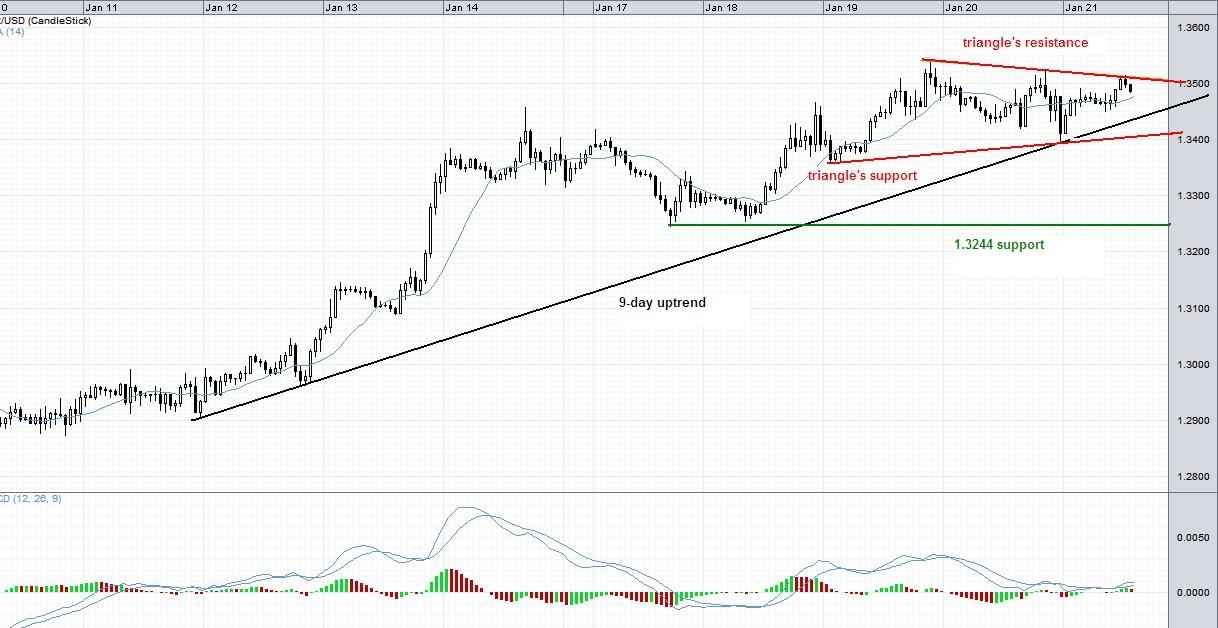
Good day forexers! In my technical analysis, there could be a symmetrical triangle forming in the 1-hour chart of the Euro versus the US dollar currency pair (EUR/USD). Symmetrical triangles are often neutral so the breakout bias would most likely be from where the trend is coming from. In our case right here, the triangle’s coming from an uptrend. This could be a fast move and very suitable for intra-day traders especially those who only trade the EUR/USD pair!

If this forex pair breaks above the resistance of the symmetrical triangle pattern, it could reach my target of 1.3650. I got this by gauging the size of the base of the triangle added to the possible breakout point. Even though a breakdown is less likely to happen, there are chances for the EUR/USD to drop from the symmetrical triangle. If it does fall below the 9-day uptrend and eventually from the triangle pattern, my target price would be the next support at 1.3244. So either ways the EUR/USD breaks to, an easy 100 pips that is! The worse case is if it goes sideways…

More on LaidTrades.com

The Rebirth of Phoenix Petroleum (PNX)


Good morning everyone! Phoenix Petroleum or PNX in the Philippine Stock Exchange busted into the scene in yesterday’s trading with a 7.94% gain when it rose from PHP 12.28 to close at PHP 13.32. But what got my attention was the huge volume that accompanied the move. Apparently, there was a big block purchase of 10 million shares at PHP 12.80. In my last post about this issue (kindly check it here), I mentioned the possibility that PNX would follow Petron Corporation’s (PCOR) footsteps (remember when PCOR rose by more than 250% in less than a month). At that time, PNX showed a similar technical set-up, forming a pennant. Unfortunately, the pennant was invalidated when it broke down and the stock skidded to a low of PHP 10.58. It’s a good thing that the red moving average was able to catch it and push it back higher. Coincidentally, the level where it pivoted back was also the 50% Fibonacci retracement level of the stocks recent up wave.

Anyway, renewed confidence buoyed PNX. And in yesterday’s session, it made a valid breakout from a flag formation. So judging by the height of pole of the flag, PNX could rise all the way to PHP 18.00. A temporary resistance, however, could be met at its previous high at PHP 13.80. Yesterday’s participation, though, suggests that the people who bought in especially the one who purchased 10 million shares at PHP 12.80 would not sell it down.

Fundamentally, the company is expecting its 2010 revenues to reach PHP 14 billion from PHP 5.8 billion in 2009 on higher fuel sales. According to the country’s Department of Energy (DOE), its market share also doubled to 2.5% from 1.12% during the year. For 2011, the company is aiming to put up around PHP 1.5 billion in capital expenditure that will be used to improve its terminal and depot facilities. Part of it will also be used to further widen its retail network by adding 80 more gasoline stations all over the country. Such expansion, of course, will not only improve the company’s operations but also create new streams of future cash inflows. By the way, Phoenix will already embark in a capital raising program starting next week. Participation among banks and other private and even public institutions here would help the company’s cause.

More on LaidTrades.com


Blast Furnace To Fire Up TKC Steel Corporation (T)


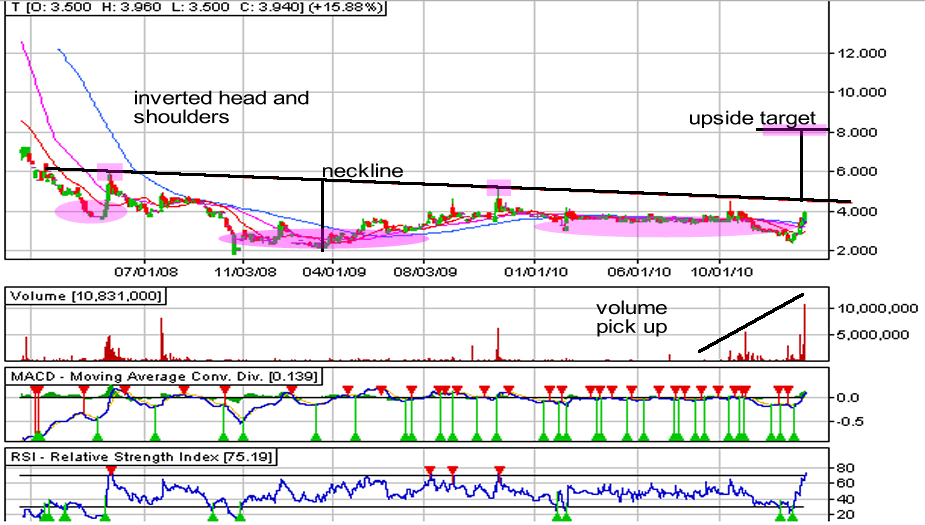
By the looks of it, TKC Steel Corporation or T in the Philippine Stock Exchange, a company engaged in the manufacturing and distribution of various steel products, is on the verge of a major move. As you can see from its chart above, T has recently broken out from a pennant pattern. I would say that breakout is valid given the relative surge in volume in yesterday’s (January 19) move. Moreover, the volume since the start of the new year has picked up nicely, suggesting an increasing interest among buyers on the stock. Anyway, yesterday’s breakout could send it all the way to PHP 4.50 (gauged by projecting the height of the pennant’s pole from the point of breakout). The story does not end there since the PHP 4.50 marker, in case you do not know, is the neckline of a much larger inverted head and shoulders formation.

So for the past two and half years, T has hibernated into a long inverted head and shoulders. As mentioned, yesterday’s breakout from a recent pennant could send it right at the neckline of the inverted head and shoulder. Now, it would need more buying pressure to breach this neckline because of the duration of its sleep but once it does, the bulls are going to party from then on. Speaking of buying pressure, buying interest as indicated in its volume has picked up significantly for the past 3 months, indicating that there are people who are indeed accumulating the stock. A breakout, by the way, from the inverted head and shoulders could send it towards the PHP 8.00 level.

Fundamentally, TKC Corporation disclosed in October last year that its subsidiary, Treasure Steelworks Corporation (TSC), was about to do a series of testing regarding the completion of a fully integrated steel mill, the first in the country. TSC acquired and installed two blast furnaces in its factory in Iligan City. Such would improve the company’s steel making capability which in turn would reflect in its productivity and profitability. The completion of the mill would likewise allow the company to make use of the locally mined iron ore. And once the series of tests are complete, the company will quickly proceed with the blasting of the furnace. As of now, no formal disclosure regarding the testing has been made public. But given the T’s recent movements, it appears that an announcement could be on the deck soon.

More on LaidTrades.com


New Zealand Dollar Looking To Revisit Its All-Time High Against The Greenback


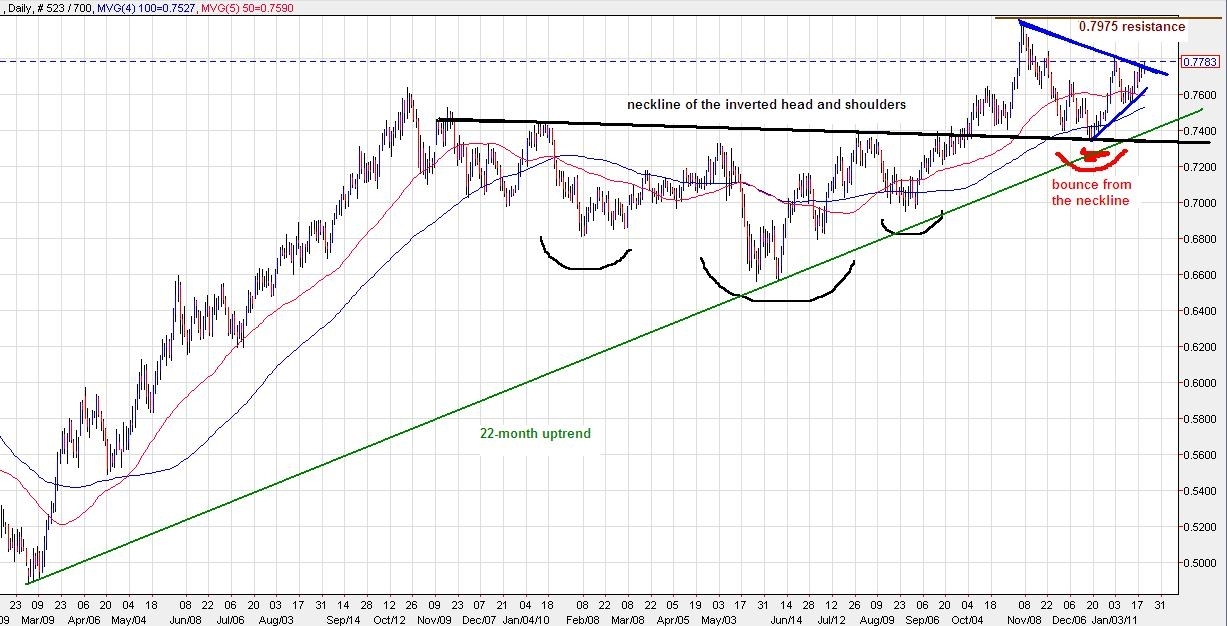
The New Zealand dollar versus the US dollar (NZD/USD) is currently at 0.7770.  In simple terms, 0.7770 USD is equal to 1.00 NZD. In my technical perspective, from September of 2009 to 2010, the forex pair consolidated sideways and formed an inverted head and shoulders on an uptrend. A month after, it broke out from the said pattern until it reached a 2-year high of 0.7975. Then it declined, found some support at the head and shoulders’ neckline and bounced back up to where it currently is. Tomorrow will be crucial for the New Zealand dollar as the data on their country’s Consumer Price Index (CPI) will be released. New Zealand’s previous CPI was 1.1% and the forecast for tomorrow from various sources will be around 2%.

The NZD/USD has its 22-month uptrend intact and standing above the 50 and 100-period moving averages which indicates the bulls are taking over. There could also be an ugly looking symmetrical triangle pattern. Given the upside potential of this formation. If we get the size of the base of this triangle and add it up to the possible breakout point, we could get a target price which could hit the 0.8214 all-time high. However, before NZD/USD reaches that, it first needs to surpass the 0.7975 resistance. On the flip side, in case this currency pair drops, the significant support could be the 22-month uptrend. If it further breaks below that level, it could fall until it finds some support around the neckline of the inverted head and shoulders. In logical terms, if the triangle pattern fails or whatever pattern shows up and disappoints, as long as the uptrend remains intact,  I’d stay bullish on the NZD/USD and revisiting its all-time high would be easy.

More on LaidTrades.com

Silver Losing Its Shine


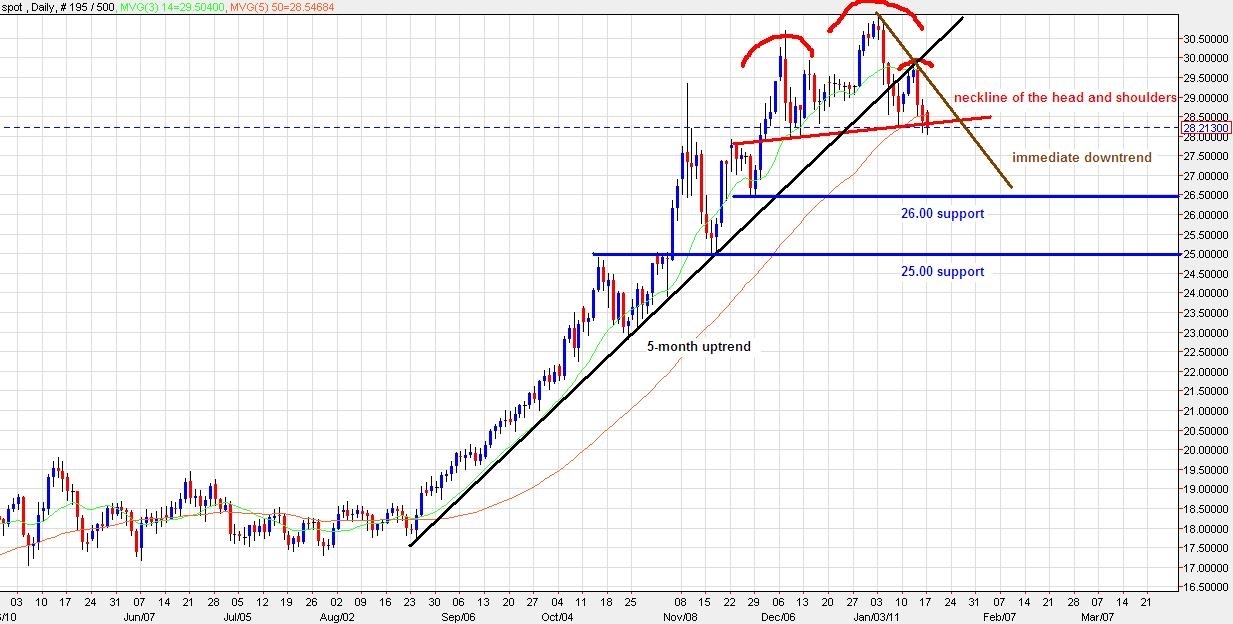
Hello commodity peeps! Here’s an update on my analysis on silver. From my last post (kindly check here), silver broke down from its 5-month uptrend. The price of gold along with other precious metals dropped as well. One reason is profit taking. In my opinion, another reason is… With the current fiscal situation in the US results to a weaker US dollar. Thus, alternative investments rise such as precious metals and we can see this with the recent run when gold, silver and copper hit all-time high. When these commodities rise, it reinforces the US dollar to drop lower. As a result, the more the US currency value declines, the more their government debt from other country increases. Of course, they don’t want that that to happen so the US government tries to stabilize their currency.

In my technical perspective, after silver broke down from its 5-month uptrend, it tried to head back up but failed. In the process, it seemed to have completed the right shoulder of the a head and shoulders formation and is on the verge of breaking down from the said pattern. The neckline around the 28.30 area is being tested and the 28.00 level are showing signs of heavy buying pressure. However, silver is now moving below the 14 and 50-period moving average that could add to an easier break below the 28.00 price mark. This could bring its price all the way to the next support at 26.50. If more weakness is shown, a drop to the next support at 25.00 could be hasty. On the bull side, a successful move pass above its immediate downtrend could indicated a trek back north. After that, the next resistance could be 30.00.

More on LaidTrades.com

Filinvest Land Inc. (FLI) Seven Months Ago


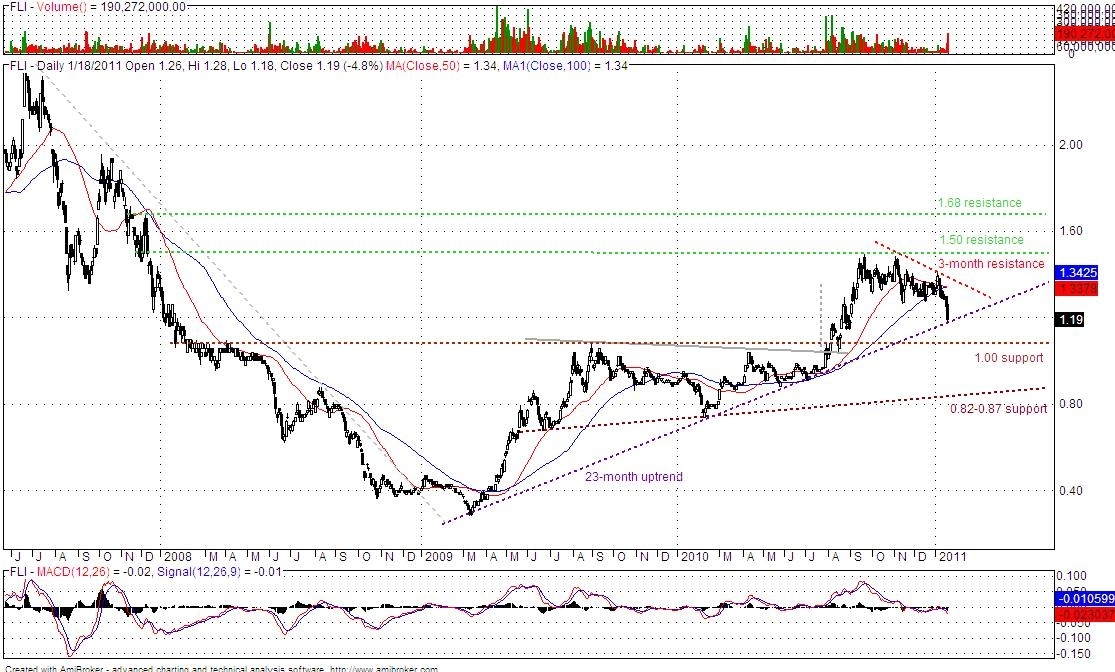
In June 2010, Filinvest Land Inc. was my Philippine stock pick. During that moment, I mentioned that there was an ascending triangle pattern forming and upon breakout, the stocks could reach a target price of PHP 1.33 as for my technical analysis (kindly check it here). I was kinda iffy of my “conservative” target price since some people were saying the stocks were no good and were bearish. But yeah, I had to get over other people’s emotions so I stuck to my analysis. As what the big boys say on trading, “you first need to trust yourself before you trust your analysis”. When FLI broke out, I posted this once again in August of 2010 (kindly check here) and mentioned that if the momentum of the triangle’s breakout pushes the stocks upward,  PHP 1.33 will easily be at its door. It did and without a sweat,  my target price was reached and surpassed. A 2-year high of PHP 1.50 was made. It may not have overly performed like JG Summit (JGS) and DMCI Holdings (DMC) but it still made a 30% profit in 1 month.

Looking at its chart now, after the stocks of Filinvest Land Inc reached PHP 1.50, it began to decline. It’s currently at PHP 1.19 just right above its 23-month uptrend. The question now is, will it bounce off or breakdown from the trend? That I don’t know and we’ll have to see in the following trading days. However, I do know that the stocks are moving below the 50 and 100-period moving averages which may not be good but personally, I’m still with the bulls as long as the uptrend remains intact. If FLI breaks down from the trend and continues to drop, there could be some heavy buying pressure at PHP 1.00 which is both its technical and psychological support. A further drop below that area could lead the stocks to the next support at PHP 0.82-0.87. If it bounces back up, the immediate marker could be the 3-month resistance. The next resistance after that could be PHP 1.50 then off to PHP 1.68.

More on LaidTrades.com