Brixton Metals Focuses on the Atlin Gold Camp

By The Gold Report

Source: Thibaut Lepouttre for Streetwise Reports   07/08/2019

This company working in British Columbia is awaiting assay results of a 1,000-meter hole at Thorn, kicking off its exploration season, explains Thibaut Lepouttre of the Caesars Report.

After focusing on the cobalt camp in 2018, Brixton Metals Corp. (BBB:TSX.V) is shifting gears and will spend of its time and effort on the Atlin Goldfields project in British Columbia. After successfully assembling a contiguous land package allowing Brixton to secure ownership of almost the entire Atlin gold camp, Brixton is gearing up for its first ever summer exploration campaign in the region.

But the company’s exploration season will be kicked off by one deep drill hole at Thorn, where it plans to follow up on a thick layer of copper mineralization that had been identified during previous exploration campaigns.

This results in a two-pronged approach for Brixton Metals this year.
2019 Will Be the Year for the Atlin Gold Camp

Brixton Metals has been carefully putting its land position in the Atlin Goldfields together for the past few years and is now sitting on a total land package in excess of a thousand square kilometers. Brixton Metals is the first company that has been able to consolidate almost the entire gold camp under one umbrella (there still are some small claims owned by third parties in the district, but Brixton Metals clearly is the dominant player.
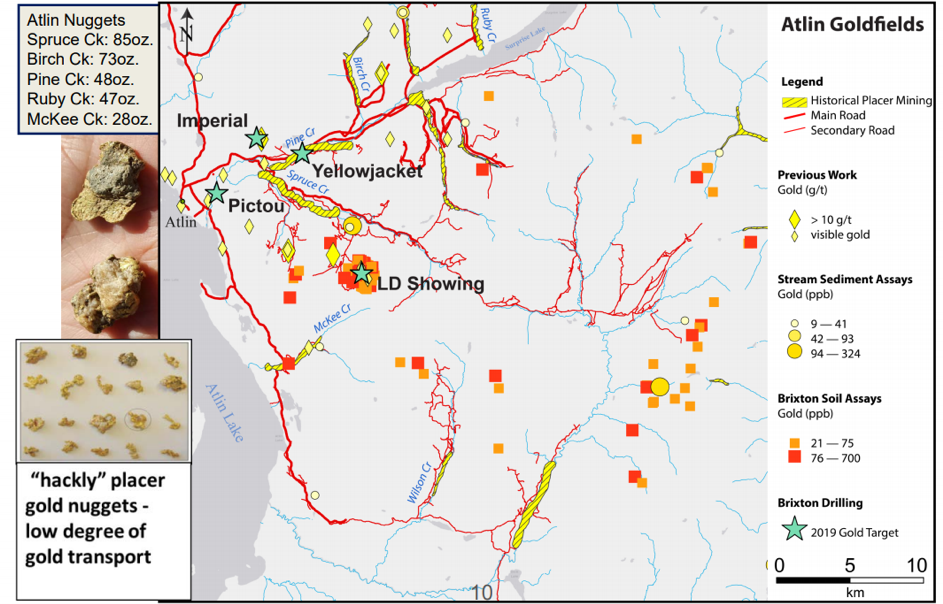
The Atlin project is particularly interesting because of its very rich history: Data indicate placer mining has been ongoing for in excess of a century, and some of Canada’s largest gold nuggets were actually discovered in this camp. In fact, the largest nugget ever found on Canadian soil weighed 85 ounces and was found here, in the Atlin gold camp. This provides plenty of reason for an exploration company to have a closer look at Atlin as modern exploration techniques could help Brixton to target the feeder zones. After all, the gold nuggets and placer gold had to come from somewhere.

This doesn’t mean Brixton can just go in, drill a few holes and find gold all over the place; that’s not how it works. Let’s first take a step back to have a look at the bigger picture, as Atlin Goldfields seems to host three different rock types.

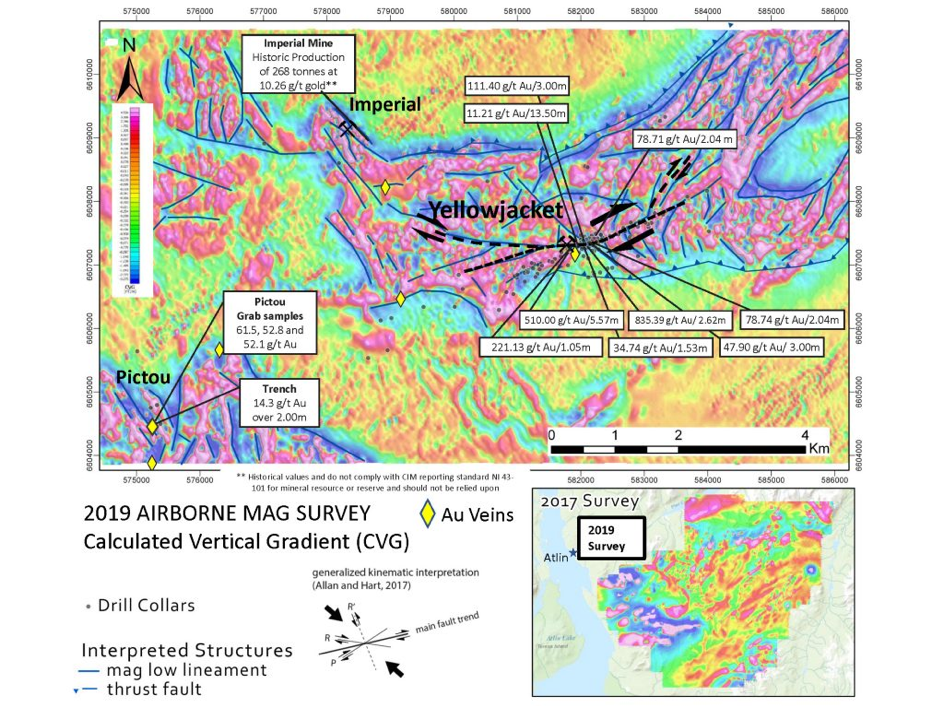
The Yellowjacket zone probably contains the low-hanging fruit, as this area has been mined before, a mining permit for up to 200 tonnes per day remains valid and it currently still hosts a historical resource estimate of almost half a million tonnes at an average grade of just over 10 grams per tonne (10 g/t) gold. That’s a good start, but we also shouldn’t discard the historical drill intervals at Yellowjacket where the previous operators encountered, for instance, 3 meters of almost 48 g/t gold, 5.6 meters of in excess of 500 g/t gold, and in excess of 2.5 meters at 853 g/t gold.

Of course, these intervals containing grades of in excess of 100 g/t gold will always remain the exception, but it does indicate the system is very prospective and prolific, and Brixton will very likely put these zones at the top of its list of priorities.

Another high-priority target would be the LD showing, which is located just 10 kilometers southeast of Yellowjacket, but Brixton will also focus on the Imperial and Pictou zones, while a newly discovered gold-in-soil anomaly should also be followed up on.

Brixton won’t rush into Atlin, but will use and apply a methodological exploration program which will include additional sampling programs to further refine its drill targets on the 8 “areas of interest” before effectively drilling the ones that stand out.

The company has received the final report of a 1,922-kilometer airborne magnetic survey over the Atlin Goldfields project, which used a cesium magnetometer to identify anomalies on the property. Brixton is still interpreting the data from this survey, but it identified an abundance of structures and cross structures that may play a dominant role in the structural controls of the gold mineralization.
Atlin, a Second Barkerville/Caribou?

Brixton Metals compares its Atlin gold camp with the Barkerville/Caribou gold camp, also in British Columbia. Some companies use comparable projects/districts that could considered to be a stretch, but we feel Brixton’s comparison does make sense. In both districts there has been a rich history of in excess of 100 years of placer mining with a cumulative gold production of millions of ounces of gold. The total production at Barkerville/Caribou (3.4 million ounces from placer activities and 1.2 million ounces from historical mining activities) is better documented than the total gold production at Atlin, but based on historical data and documents, Brixton estimates the Atlin gold camp was responsible for up to 2 million ounces recovered from placer operations.
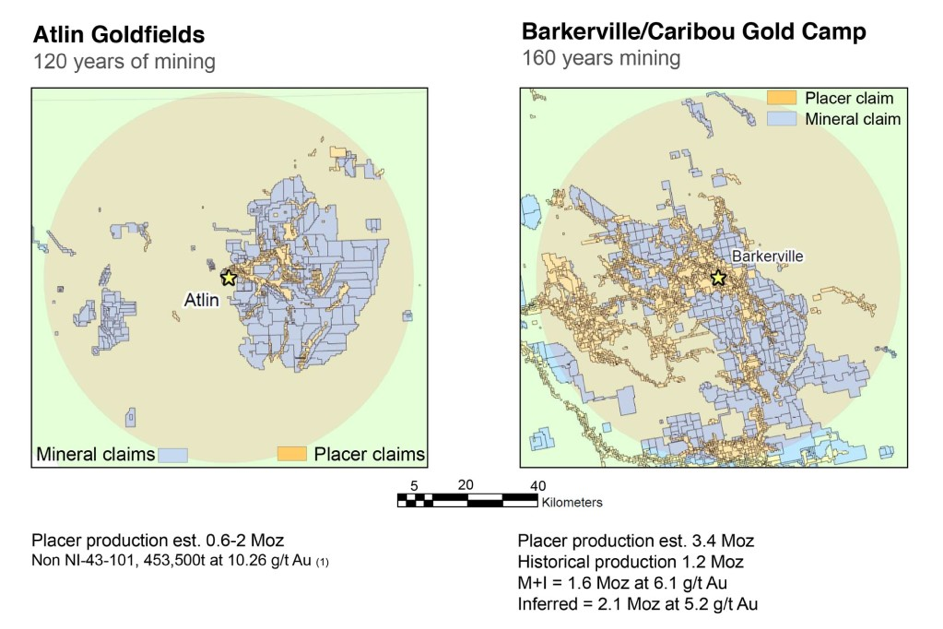
The Barkerville system is more mature than the Atlin gold camp, as the feeder gold zone at Atlin hasn’t been discovered yet, but that’s exactly the challenge Brixton Metals is rising to.

But for Now, All Eyes Are on Thorn

Although the main focus of this year’s exploration budget will be on the Atlin gold camp, Brixton Metals has decided it wants to drill one deep hole at Thorn, where the company hopes to hit widespread porphyry-type mineralization. This deep hole is meant to follow up on a previous exploration hole that was drilled in 2013, which ended in copper mineralization at depth, and another hole drilled in 2012, which returned 30 meters containing 1.18% copper. This, combined with the discovery of the Outlaw zone and the porphyry zones at the Chivas and Camp Creek targets, provides a whole new perspective on the Thorn project. Originally thought to be a high-grade silver project, the widespread copper mineralization may provide a whole new perspective on Thorn.

These are excellent copper values, and although the 0.53% copper encountered in hole 13-119 appears to be low, that grade is sufficient to make a block-cave operation work, as Newcrest Mining Ltd. (NCM:ASX) is currently mining a grade of 0.36 g/t gold and 0.26% copper at its Cadia mine in Australia. As the previously drilled hole ended in mineralization, Brixton would like to figure out how deep the mineralization runs, and while a 1,000-meter hole won’t be cheap, it’s the best way to gain a lot more insight in the copper mineralization at depth.
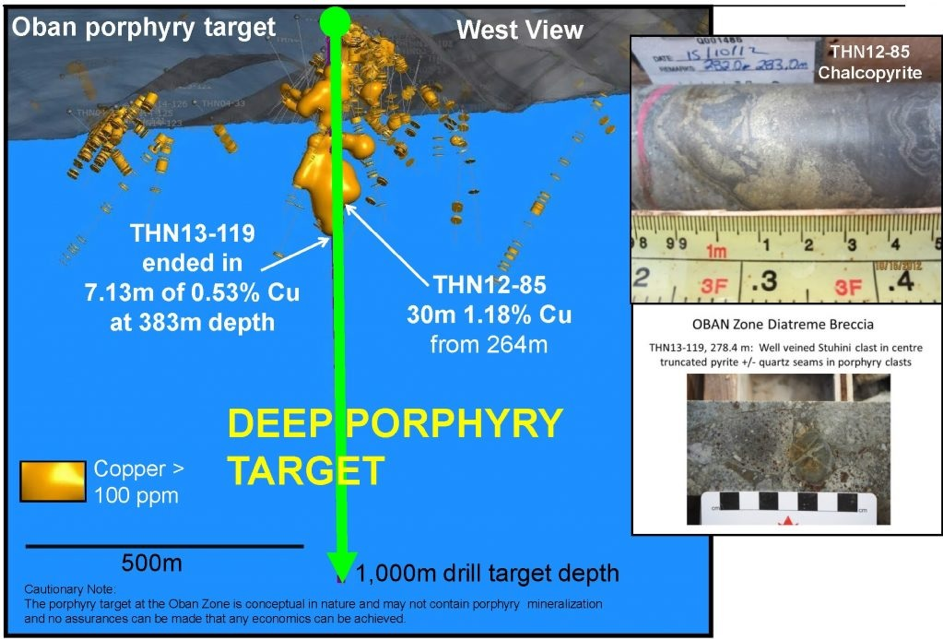
The drill program at Thorn started about a month ago, and we expect the hole to be completed relatively soon. It will still take a few weeks before we see the assay results (Brixton may decide to release the drill results in batches, or wait until it has assayed the complete 1,000 meter of drill core).

A CA$2.4M Working Capital Position

As of the end of September (when Brixton’s financial year ended), the company still had a working capital position of approximately CA$1.35 million (CA$1.35M), but it preferred to “play it safe” and pulled the trigger on a financing in November, which was closed in December.

Brixton raised CA$2.78M, of which approximately CA$750,000 was raised in hard dollars by issuing 4.9 million units priced at CA$0.15, and an additional CA$2.04M was raised in a flow-through financing at CA$0.17. The units contain a full warrant allowing the warrant holders to acquire an additional share in Brixton at CA$0.25 for a period of two years (until December 2020). The warrants do contain an acceleration clause, which calls for an expedited expiration date should Brixton’s shares trade above CA$0.50 for 20 consecutive trading days.

As of the end of March (which are the most recently filed financial statements), Brixton had a remaining working capital position of approximately CA$2.4M. It’s important to emphasize the majority of the funds are going in the ground. Of the CA$1.9M in cash expenses during the first half of Brixton’s financial year, CA$1.1M was spent on exploration and evaluation expenses. That’s quite a lot considering the exploration programs are usually scaled back a bit during the winter periods. During the preceding financial year, almost two-thirds of all expenses were spent on the projects, which is an excellent ratio.

Conclusion

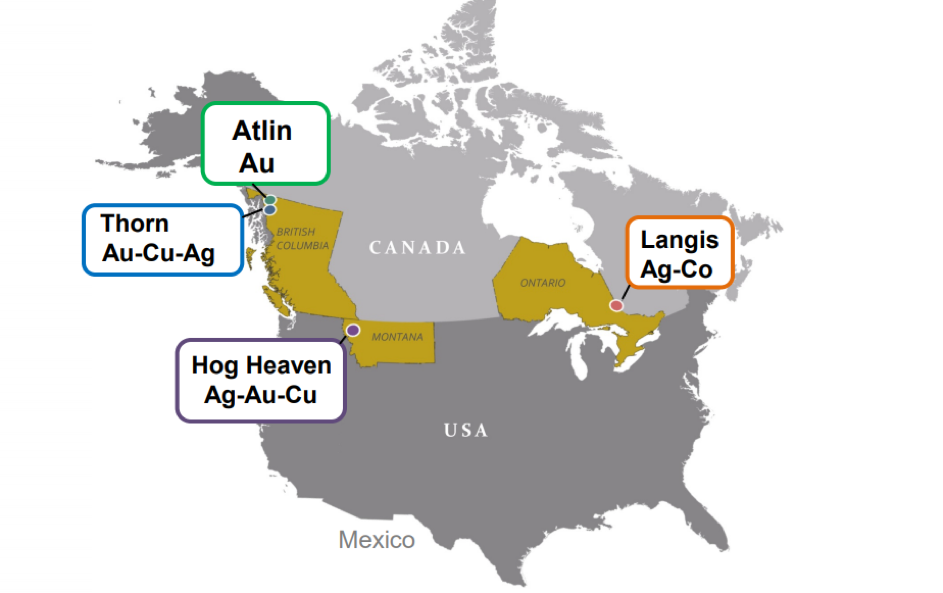
The past few years haven’t been easy for Brixton Metals, but the company was able to keep its portfolio together and now has four quality assets, and two of them (Atlin and Thorn) will be focused on this year.

Hog Heaven remains an interesting project, while Brixton will very likely also follow up on its kimberlite discovery at Langis, but it’s awaiting more detailed information on its discovery to design a more accurate “plan of action,” which makes the decision to focus on Atlin and Thorn a bit easier.

The deep hole at Thorn should be completed soon, and then we’ll just have to wait for the lab to provide the company with the assay results.

Thibaut Lepouttre is the editor of the Caesars Report, a newsletter and mining portal based in Belgium that covers several junior mining companies with a special focus on precious metals and base metals. Lepouttre has a Bachelor of Law degree and two economics masters degrees that have forged his analytical approach to the mining sector. Considered a number cruncher, Lepouttre focuses on the valuations of companies and is consistently on the lookout for the next undervalued mining company.

Sign up for our FREE newsletter at: www.streetwisereports.com/get-news

Disclosure:
1) Thibaut Lepouttre: I, or members of my immediate household or family, own securities of the following companies mentioned in this article: a long position in Brixton Metals. My company has a financial relationship with the following companies referred to in this article: Brixton Metals. I determined which companies would be included in this article based on my research and understanding of the sector. All images were sourced from Brixton Metal’s publicly available documents. Additional disclosures are below.
2) The following companies mentioned in this article are billboard sponsors of Streetwise Reports: None. Click here for important disclosures about sponsor fees.
3) Statements and opinions expressed are the opinions of the author and not of Streetwise Reports or its officers. The author is wholly responsible for the validity of the statements. The author was not paid by Streetwise Reports for this article. Streetwise Reports was not paid by the author to publish or syndicate this article. Streetwise Reports requires contributing authors to disclose any shareholdings in, or economic relationships with, companies that they write about. Streetwise Reports relies upon the authors to accurately provide this information and Streetwise Reports has no means of verifying its accuracy.
4) This article does not constitute investment advice. Each reader is encouraged to consult with his or her individual financial professional and any action a reader takes as a result of information presented here is his or her own responsibility. By opening this page, each reader accepts and agrees to Streetwise Reports’ terms of use and full legal disclaimer. This article is not a solicitation for investment. Streetwise Reports does not render general or specific investment advice and the information on Streetwise Reports should not be considered a recommendation to buy or sell any security. Streetwise Reports does not endorse or recommend the business, products, services or securities of any company mentioned on Streetwise Reports.
5) From time to time, Streetwise Reports LLC and its directors, officers, employees or members of their families, as well as persons interviewed for articles and interviews on the site, may have a long or short position in securities mentioned. Directors, officers, employees or members of their immediate families are prohibited from making purchases and/or sales of those securities in the open market or otherwise from the time of the interview or the decision to write an article until three business days after the publication of the interview or article. The foregoing prohibition does not apply to articles that in substance only restate previously published company releases.

( Companies Mentioned: BBB:TSX.V,
)

Systematic, Property-Wide Exploration Underway at Quebec Gold Project

By The Gold Report

Source: James Kwantes for Streetwise Reports   07/08/2019

The goal of the till geochemical survey is to identify high-grade drill targets in new areas, as well as increasing grade and tonnage at existing deposits, Resources Opportunities editor James Kwantes writes.

The history of major metals discoveries is rife with stories of deposits that were only uncovered when geologists looked beyond existing mineralization systems, or considered new models. Sometimes the best discoveries occur when exploration takes place off the beaten path—even when there are gold ounces underneath that path. An open mind sometimes opens doors, to both new discoveries and greater shareholder value.

For example, Ivanhoe’s Kamoa-Kakula copper deposit in the Democratic Republic of Congo was already one of the world’s richest and largest copper discoveries when company geologists decided to look further afield. In March 2017 they drilled a new discovery—Kakula West—4 kilometers west of existing mineralization, making an already world-class deposit even richer.

More recently, Discovery Group company Great Bear Resources Ltd. (GBR:TSX.V; GTBDF:OTC) drilled the Bear-Rimini discovery at its Dixie project in Red Lake, Ontario. Great Bear had been intercepting plenty of high-grade gold mineralization at its Hinge and Dixie Limb Zones, with a very pleasing 1-year stock chart to match. But the company’s push beyond areas of known mineralization led Great Bear to hit pay dirt with Bear-Rimini, drilling multiple shallow high-grade intercepts a full 2.5 kilometers away from existing gold zones.

Genesis Metals Corp. (GIS:TSX.V; GGISF:OTC) has a long way to go before being mentioned in the same breath as Ivanhoe or Great Bear. But the company is utilizing a similar exploration ethos at its Chevrier gold project in Quebec’s Abitibi Greenstone Belt, 35 km southwest of Chibougamau. Genesis, also part of the Discovery Group, is in the middle of a property-wide till geochemical survey at the claims package. It’s an exploration method that has paid off for IAMGOLD, which is drilling the nearby Monster Lake and Nelligan high-grade gold discoveries with its JV partners.

Genesis recently expanded its Chevrier holdings to 275 square kilometers. The goal of the program is to identify high-grade drill targets in new areas, with a secondary focus on increasing grade and tonnage at existing deposits. Genesis’s market capitalization of $7.45 million is underpinned by a resource estimate of 395,000 ounces Indicated grading 1.45 g/t gold and 297,000 ounces Inferred grading 1.33 g/t (0.5 g/t cutoff for open pit, 0.95 g/t for underground). Genesis geologists believe there is yet-uncovered high-grade gold mineralization at Chevrier.

“The idea is to bring in fresh eyes to do systematic property-wide exploration, for the very first time,” said Genesis President Jeff Sundar, who was recently appointed CEO in a management shuffle that saw Adrian Fleming appointed chairman of the board (replacing Brian Groves). Fleming has been involved in discoveries around the world and was CEO and cofounder of Underworld Resources, which discovered and defined the White Gold deposit in Yukon. Underworld sold to Kinross for $138 million in 2010.

North Vancouver-based Vector Geological Solutions is running the property-wide soil sampling program. Vector and partner IOS are using a track-mounted sampling machine to take soil samples at 200-meter lines across the entire Chevrier property. The Fancamp Deformation Zone, the belt that hosts Chevrier, used to be covered by glaciers. Knowing the direction of the ice sheets and interpreting the shape and nature of the gold grains in the till will be key to evaluating the survey results. Geological mapping, prospecting and geophysics will follow, along with a potential drill program later this year.

For years, Quebec has been recognized as one of the best mining jurisdictions, globally. The province is keen to maintain that reputation and has invested billions of dollars into Plan Nord, the extensive infrastructure plan designed to open up the province’s vast north to mining and industry. As for Chevrier, the project is located in a mining-friendly area near major highways and a rail line, with an airport nearby. That’s a tick in the infrastructure box.

Quebec’s support extends to financial assistance for companies doing mining exploration work in the province. The Genesis exploration program is being funded by a $520,000 private placement that closed on May 30. Three Quebec government-sponsored investment funds participated for $350,000 of that total.

The Chibougamau district is heating up along with the gold price, which is trading at about US$1,400 an ounce but has shown strength of late. Encouragingly, Vector’s exploration methodology mirrors tools used by other companies that have successfully identified high-grade gold discoveries nearby. Those include the Monster Lake gold deposit southwest of Chevrier, which already hosts 433,000 ounces of gold (Inferred) at 12.14 g/t Au. Operator IAMGOLD and JV partners TomaGold (45%) and Quinto (5%) continue to hit intercepts above 20 g/t at Monster.

Vanstar’s Nelligan project, about 25 kilometers southwest of Chevrier, is also generating excitement. The latest assays at Nelligan, where IAMGOLD can earn up to an 80% interest, included 6 meters grading 56.5 g/t gold and 7.7 meters grading 7.02 g/t.

And there is an ongoing takeover battle between Osisko and Agnico Eagle that will result in a new neighbor for Chevrier. Osisko looks to have the upper hand: Chantrell Ventures, an Osisko vehicle that will be renamed O3 Mining, recently sweetened its bid for Alexandria Minerals. The move was in response to a hostile offer from Agnico, with both companies eyeing Alexandria’s Val d’Or land package. Alexandria also has the Fancamp property bordering Chevrier to the south and the Embry claims to the north.

Genesis has systematically built its land position and its latest acquisition was the Trenholme claims formerly held by Agnico Eagle. The gold mining company had hit mineralization there—including an intercept of 1.5 meters of 4.5 g/t gold—but shifted focus and let the claims lapse. Genesis picked up the block from a prospector who staked the claims after Agnico left.

Dan MacNeil, Vector’s founder and principal consultant, believes there is “probably some low-hanging fruit outside the resource.” MacNeil’s resume includes stints at Barrick Gold and Anglo American and his partner at Vector, Alan Wainwright, was a co-winner of the H.H. “Spud” Huestis prospecting award in 2013 for the exploration and development of Kaminak Gold’s Coffee gold deposit.

One of the other co-winners of the award was geologist Rob Carpenter, who is now a Genesis advisor. Carpenter co-founded and served as the first CEO of Kaminak Gold, which built the multi-million-ounce Coffee deposit and sold for $520 million to Goldcorp in 2016. Carpenter will be assisting Vector and Genesis in the hunt for high-grade at Chevrier.

People are key to any successful junior mining company and Genesis has a rock-solid roster. The Discovery Group has racked up several wins in a bear market, including Kaminak Gold (sold to Goldcorp), Northern Empire Resources (sold to Coeur Mining) and ongoing drilling success at Great Bear. Principals John Robins and Jim Paterson have come on as Genesis advisors and their impressive track records bode well for success. In addition to Carpenter, Genesis also added exploration geologist Garrett Ainsworth and engineer/financier Andrew Ramcharan as advisors late last year.

The company’s market cap of about $7.45 million is underpinned by the Chevrier resource, a majority of which is open-pittable. But it’s the prospect of high-grade gold intercepts on the expanded claims package—in a rich district with proven high-grade mineralization—that probably offers the most upside for Genesis shares.

Genesis Metals (GIS-V, GGISF-OTC)
Price: 0.07
Shares outstanding: 109.3 million (132.2M fully diluted)
Market cap: $7.45 million

James Kwantes is the editor of Resource Opportunities, a subscriber supported junior mining investment publication. Kwantes has two decades of journalism experience and was the mining reporter at Vancouver Sun, the city’s paper of record.

Sign up for our FREE newsletter at: www.streetwisereports.com/get-news

Disclosure: Genesis Metals is a Resource Opportunities sponsor company and James Kwantes owns Genesis shares, which makes me biased. Genesis Metals is a high-risk junior exploration stock. All investors need to do their own due diligence and/or consult a qualified investment advisor.

Streetwise Disclosure:
1) James Kwantes’ disclosures are listed above.
2) The following companies mentioned are billboard sponsors of Streetwise Reports: Great Bear Resources. Click here for important disclosures about sponsor fees. The information provided above is for informational purposes only and is not a recommendation to buy or sell any security.
3) Statements and opinions expressed are the opinions of the author and not of Streetwise Reports or its officers. The author is wholly responsible for the validity of the statements. The author was not paid by Streetwise Reports for this article. Streetwise Reports was not paid by the author to publish or syndicate this article. Streetwise Reports requires contributing authors to disclose any shareholdings in, or economic relationships with, companies that they write about. Streetwise Reports relies upon the authors to accurately provide this information and Streetwise Reports has no means of verifying its accuracy.
4) The article does not constitute investment advice. Each reader is encouraged to consult with his or her individual financial professional and any action a reader takes as a result of information presented here is his or her own responsibility. By opening this page, each reader accepts and agrees to Streetwise Reports’ terms of use and full legal disclaimer. This article is not a solicitation for investment. Streetwise Reports does not render general or specific investment advice and the information on Streetwise Reports should not be considered a recommendation to buy or sell any security. Streetwise Reports does not endorse or recommend the business, products, services or securities of any company mentioned on Streetwise Reports.
5) From time to time, Streetwise Reports LLC and its directors, officers, employees or members of their families, as well as persons interviewed for articles and interviews on the site, may have a long or short position in securities mentioned. Directors, officers, employees or members of their immediate families are prohibited from making purchases and/or sales of those securities in the open market or otherwise from the time of the interview or the decision to write an article until three business days after the publication of the interview or article. The foregoing prohibition does not apply to articles that in substance only restate previously published company releases. As of the date of this article, officers and/or employees of Streetwise Reports LLC (including members of their household) own securities of Newmont Goldcorp and Coeur Mining, companies mentioned in this article.

Resource Opportunities Disclaimer: Readers are advised that this article is solely for information purposes. Readers are encouraged to conduct their own research and due diligence, and/or obtain professional advice. The information is based on sources which the publisher believes to be reliable, but is not guaranteed to be accurate, and does not purport to be a complete statement or summary of the available data.

Photo provided by the author.

( Companies Mentioned: GIS:TSX.V; GGISF:OTC,
GBR:TSX.V; GTBDF:OTC,
)

Gold Exploration in the Heart of the Abitibi Greenstone Belt

By The Gold Report

Source: Brian Leni for Streetwise Reports   07/09/2019

Brian Leni, founder of Junior Stock Review, profiles a gold explorer with a project in Quebec in the prolific Abitibi Greenstone Belt.

What is the significance of surpassing $1400 USD per ounce of gold?

Personally, I view the price of gold as a bellwether for the global economy, essentially signalling the health of markets. Without a doubt in my mind, the complexity of the global marketplace is only increasing, and because of this I can’t help but think that any of these attempts to control it will fail and only add to the damage that has already been done.

Ultimately, I believe, we are headed to some sort of reset of the global monetary system and breaking $1400 USD per ounce, a price we haven’t seen since 2013, signals we are getting closer.

So what does this mean for the junior gold companies? Great question.

I think a bullish outlook for a metal price is a poor reason to invest within the junior resource sector, however, while this is my view, it seems that the vast majority of investors think differently.

Therefore, I suspect, given the rise in the gold price, we may be entering a new bull market in gold stocks.

Today, I have an update on Genesis Metals Corp. (GIS:TSX.V; GGISF:OTC), a junior gold company that is exploring and developing its flagship Chevrier Gold Project, in the world famous Abitibi Greenstone Belt in Quebec.

Let’s take a look.

Genesis Metals Corporation
Market Cap – $7.4 million (at the time of writing)
Shares – 109.2 million
FD – 132.1 million
Management and Advisors – 16%
Other Major Shareholders – Osisko Mining, Eric Sprott, Gold 2000, Delbrook Capital, U.S. Global Investors, SIDEX/SDBJ and Medalist Capital – 34%
Retail – 50%

Chevrier Gold Project – 2019 Exploration

2019 marks a reboot in Genesis’ approach to developing its flagship Chevrier Gold Project.

What do I mean by this? Well, the last few years, much of the exploration and development dollars have been spent on expanding and delineating the project’s Main Zone.

In all, the money has been well spent, as the updated resource estimate, released earlier this year, reveals the Main Zone has an indicated resource of 395,000 ounces at 1.45 g/t and an inferred resource of 297,000 ounces att 1.33 g/t, using a 0.5 g/t cut-off.

This field season at Chevrier will be different, as the company looks to generate new high-grade gold targets, as it has expanded its land package along the Fancamp Deformation Corridor and, more importantly, has enlisted Dr. Rob Carpenter and the highly accomplished team at Vector Geological Solutions to lead a modern exploration program across the entire property.

The Vector team is made up of Dan MacNeil and Dr. Alan Wainwright, each which has had extensive exploration experience and successes within the sector.

Exploration will begin with property-wide till sampling. For those who aren’t familiar, till sampling is used to identify target metals, such as gold, in areas that have been glaciated.

In these regions, glaciers have eroded the target metals from the underlying rock and transported them away from their source. Therefore, today, by digging down to the till layer, which sits right above the bedrock, exploration teams can better sample for gold.

Till sampling is a highly effective tool in an exploration company’s arsenal and will reveal where they should focus its attention with localized geological mapping, trenching and geophysics.

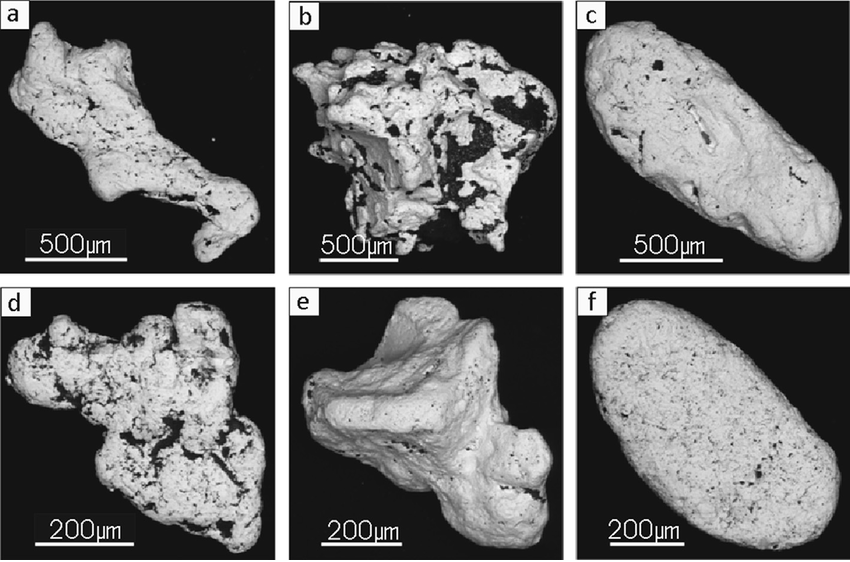
It is key that while the existence of gold within the till samples is obviously paramount, the Vector team isn’t necessarily as concerned with the grade of gold, but more on the gold grain morphology.

MacNeil explained to me that the grain morphology is vital in understanding the source of gold, as the shape and surface texture of the gold grain is an indicator of how far away the gold may have travelled from its source.

http://www.juniorstockreview.com/wp-content/uploads/2019/07/morphology-new.png
Source: Research Gate – Grain Morphology Example

Chevrier has been expanded to 275 square kilometers along one of the most famous gold corridors within the Abitibi. With this methodical approach to exploration, I think that there is a high probability that they will identify a few great high-grade gold targets for the next drill program.

Secondly, we have to keep in mind that the Main Zone is still open at depth, which, in my mind, shows great promise for further expansion of the deposit. The Abitibi is famous for its deep, steeply dipping high-grade gold deposits and, therefore, the next drill program should be chock full of high potential targets.

Changes in Leadership

On June 24, Genesis announced the resignation of Chairman and CEO Brian Groves and the appointments of Adrian Fleming as chairman of the Board and Jeff Sundar as interim CEO.

To refresh your memory, Fleming is a geologist by trade with over 40 years of experience in both technical and executive roles. Some highlights include being a founding director at Northern Empire and Underworld Resources, both of which were acquired by majors.

Additionally, Sundar has been a driving force behind Genesis as its president over the last few years and, I think, will do well in his new role. Sundar has over 20 years of experience in the mining industry, and is a former director of Northern Empire, which was sold to Coeur Mining for $117 million in October of 2018. Also, he was a VP/director of Underworld Resources, which was acquired by Kinross for $140 million in the last cycle.

The Genesis team is rounded out by exploration manager Andre Liboiron; director John Florek; independent directors Keenan Hohol, Robert Scott and Steve Williams.

A Discovery Group Company

Genesis Metals Corp. is a part of the Discovery Group of Companies, which is led by John Robins and Jim Paterson. Discovery Group has churned out some of the best stories the sector has seen over the last few years.

A few of the M&A successes have been Kaminak Gold Corp., which was sold to Goldcorp for $520 million, and Northern Empire Resources Corp. Which was sold this past summer to Coeur Mining for $117 million.

Additionally, you have other high-quality resource projects, such as Bluestone Resources Inc., Fireweed Zinc Ltd. and Great Bear Resources, all of which have had success over the last year, as they move their projects forward.

In short, Genesis’ entry into Discovery Group speaks to the potential of the company and to its management team, a group in which Robins and Paterson must have confidence, as their reputations are now linked.

Strategic Advisors

While not being a part of the company’s main team, strategic advisors can play key roles in the development of a project. In particular, Genesis has done a great job assembling a cast of advisors that have resumes filled with success, particularly in exploration, resource expansion, capital markets and, arguably most important to the Genesis story, M&A.

Being a Discovery Group Company comes with not only the notoriety of being a part of the group, but also means, in this case, that both Robins and Paterson will play strategic advisor roles for the company.

John Robins is a professional geologist by trade with a wide variety of experience over the course of his more than 30 years within the industry. Robins was both a founder and chairman of Kaminak and, in 2008, was recognized for his achievements in mining exploration by the Association for Mineral Exploration British Columbia with the H.H. “Spud” Huestis Award.

Jim Paterson has more than 22 years within the mining industry with experience in raising capital, M&A, joint-ventures, spin-outs, RTOs and IPOs. Currently, he is chairman and CEO of Valore Metals Corp and was a founding director of Northern Empire Resources Corp.

Genesis will benefit greatly from having these two men as strategic advisors, as it moves its flagship Chevrier Gold Project forward.

New Additions

In November of 2018, Genesis announced that Dr. Rob Carpenter, Dr. Andrew Ramcharan and Garrett Ainsworth would be joining its list of strategic advisors.

Dr. Carpenter is a professional geoscientist with over 25 years of experience in the resource sector. He is best known as co-founder, president and CEO of Kaminak Gold Corporation (2005 to 2013) and its multi-million ounce Coffee Gold Project, where he is credited with the initial discovery and leading the company to it maiden resource estimate. Kaminak was sold to Goldcorp in 2016 for $520 million.

Dr. Ramcharan is a professional engineer with over 18 years of experience in operations, project evaluation, M&A, finance and investor relations. Most recently, he was a managing director of project evaluation for both debt and equity financings at Sprott Inc.

Last but not least, Garrett Ainsworth is a geologist by trade and former VP exploration for NexGen Energy, which discovered the world-class Arrow Uranium Deposit in Canada’s Athabasca Basin.

4th Best Jurisdiction for Mining Investment in the World

From a jurisdictional standpoint, it doesn’t get much better than Quebec when it comes to mining investment attractiveness. The Fraser Institute (FI) gives Quebec an index score of 88.38, ranking it second in Canada and fourth in the world. FI’s mining investment attractiveness index score is reflective of both the mineral potential and the government policy perception of the region.

Quebec’s Mineral Potential

Quebec is home to 25 producing mines and over 350 surface mineral mining operations, putting the value of Quebec’s mineral shipments at $8.7 billion in 2014 (Investissement Quebec). Quebec is Canada’s second largest producer of gold, largest producer of iron and zinc, and the only North American producer of niobium. The mineral wealth is evident and is a big reason why FI ranks Quebec among the world’s top ten in mining investment attractiveness.

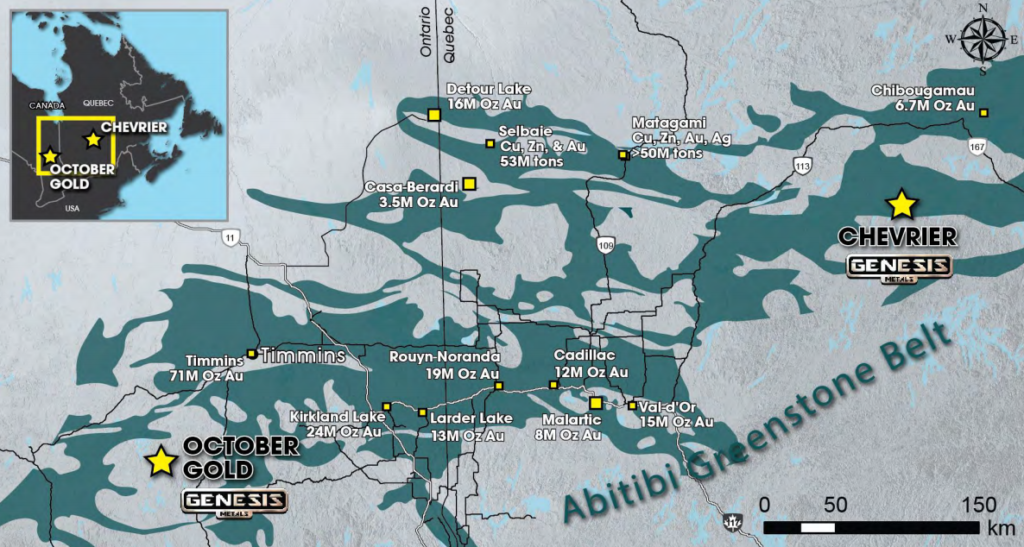
Highlighting Quebec’s world-class mineralization is the Abitibi Greenstone Belt (AGB), which is 150 km wide and stretches 650 km from roughly Wawa, Ontario, to Val d’Or, Quebec. The belt has produced millions of ounces of gold over its history, with the Cadillac Gold Camp, Virginiatown, Rouyn-Noranda Gold Camp, and Val d’Or Gold Camp being just a few of its largest contributors.

genesis updated abitibi map

Quebec Politics and Infrastructure

The government of Quebec supports mineral exploration within its borders with a tax credit system that refunds 25% of eligible exploration expenses for non-operating corporations, and 10% of eligible exploration expenses for operating corporations (Financial Incentives). So, roughly, for every $1 of non-flow-through raised capital spent by a Quebec based mineral explorer, 25 cents will come back to the company, which can effectively be rolled right back into further exploration work. This is not only a huge plus for the company and its shareholders, but an ingenious way for the province to promote mineral exploration.

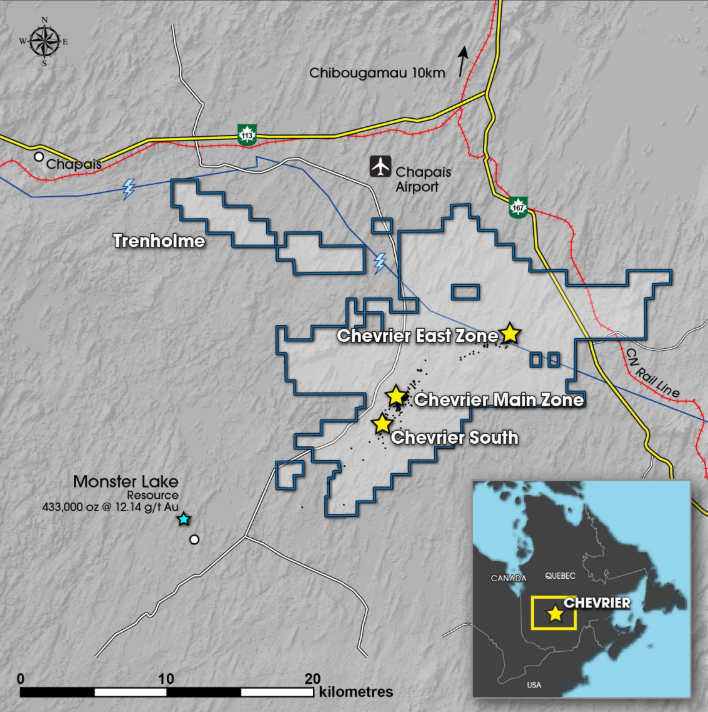
The long history of mining in the AGB means that most regions of the belt are accessible or near infrastructure such as highways, rail, power, and deep water ports along the St. Lawrence Seaway. Also, Quebec boasts some of the most competitive electricity rates in Canada, as its hydroelectric dams constitute a major portion of its electricity production.

http://www.juniorstockreview.com/wp-content/uploads/2019/07/Chevrier-July-2019.png

Finally, Quebec takes great pride in a transparent mining system, which is built around three key pillars:

“Open access to resources is ensured on the largest possible portion of territory, Mineral rights are granted on a first-come, first-served basis and if a discovery is made, the title holder can be reasonably sure of obtaining the right to develop the resource.” ~ Investissement Quebec

NOTE: Quebec provincial funds, SIDEX, SDBJ and FTQ, have participated in past private placements in Genesis and now own a good portion of stock. In my mind, it’s a great indication of the potential value that the Chevrier Gold Project may have moving forward.

Favorable politics and world-class geology—for me, it doesn’t get much better than Quebec, as far as your investment buck goes!

Chevrier Gold Project

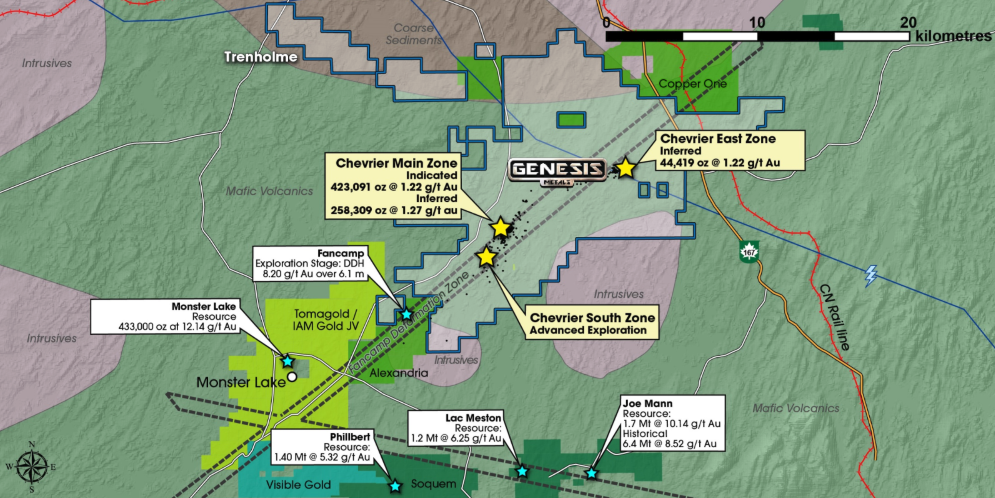
Genesis’ 100%-owned Chevrier Gold Project encompasses 275 square km and is located 35 km south of Chibougamau, Quebec, in the heart of the Abitibi Greenstone Belt. Chevrier straddles 15 km of the Fancamp Deformation Zone, and is 15 km northeast of IAMGOLD’s high-grade Monster Lake gold deposit.

NOTE: The IAMGOLD and Toma Gold Monster Lake JV released their maiden inferred resource of 433,300 ounces of gold at 12.14 g/t at a 3.5 g/t cut-off.

http://www.juniorstockreview.com/wp-content/uploads/2019/07/Chevrier-july-2019-projects.png

Chevrier Gold Project History

Prior to Genesis, the area in which the Chevrier deposit is located was owned and explored by Inmet Mining Inc. (Minnova), which, in 1989, was the first to drill the now Main Zone of Chevrier, where it intersected gold grading 5.4 g/t. The property was then purchased by Geonova Explorations, which outlined Chevrier’s Main Zone.

In 2007, the property changed owners once again, with Tawsho taking the reins. That company went on to complete a 2,792 km aeromagnetic survey, a ground EM Time Domain survey, 24 diamond drill holes, an independent NI 43-101 resource estimate (by Met-Chem Canada Inc.), and a 5,000 ton bulk sample.

Since Genesis acquired Chevrier in Q2 of 2016, it has completed a long list of work that includes the inventory of more than 70,000 meters of drill core, the re-sampling and re-assaying of selected mineralized intervals, re-sampling of four trenches, 3D modelling of Main, South and East Zones, 50+ km of IP surveying, and executed a 10,000 meter drill program, which focused on confirming historical Geonova drill holes, exploration stepout holes on the Main Zone Deposit and the exploration of other IP and geological targets. Results from this program can be found on Sedar.

New Geological Model

Over its 29 year history, Chevrier has seen 213 drill holes, totalling over 87,000 meters. However, the Genesis team is the first to consolidate, re-evaluate and form a comprehensive geological model regarding the Main Zone’s gold mineralization.

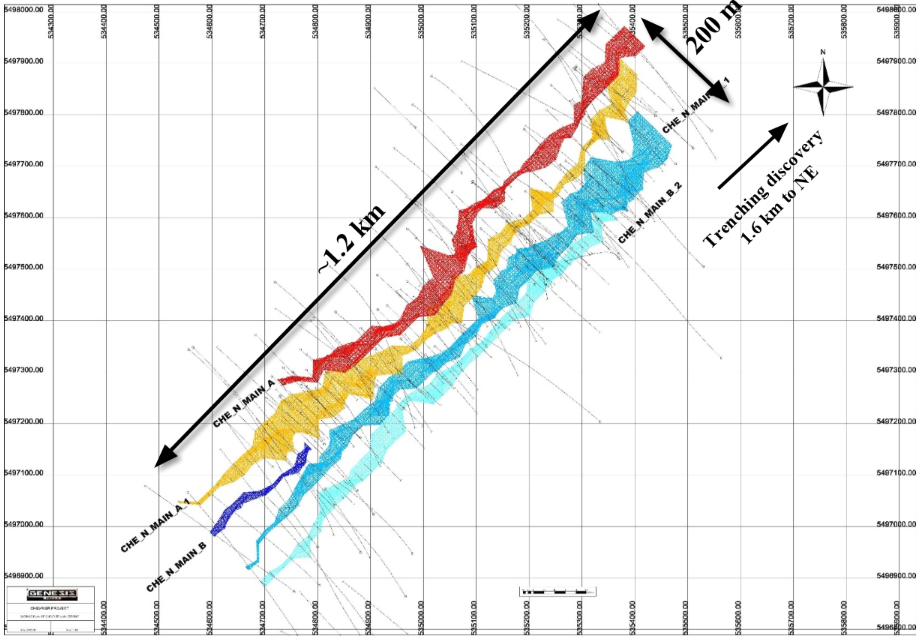
Below is an image of the mineralization within the Main Zone, using a 0.3 g/t Au grade shell.

http://www.juniorstockreview.com/wp-content/uploads/2019/07/Main-deposit-plain-view.png

Chevrier Gold Project – Plain View of the Main Zone Deposit

Chevrier Gold Project Resource Update

Using the new geological model and the compiled data from the most recent drill program, Genesis has released an updated resource for the Chevrier Gold Project. The updated resource includes the Main and East Zones and, as described in the previous section of the report, envisions a mining scenario in which there is both an open pit and underground workings.

Indicated Gold Resource – 395,000 ounces averaging 1.45 g/t

Inferred Gold Resource – 297,000 ounces averaging 1.33 g/t

NOTE: With a combined indicated and inferred resource of 692,000 ounces of gold, and with Genesis’ MCAP sitting below $10 million, this presents an interesting value proposition. Keep in mind, not all ounces are of equal value, but nonetheless, this is a good high-level indicator of value.

This is a great start for the Genesis team as, collectively—indicated and inferred—they sit very close to 1 million ounces of gold in an area of the Abitibi that looks poised for development in the coming years. Clearly, the next move for the Genesis team is to expand this new resource, which will be aided by its newly formed strategic advisors team.

2019 and beyond should be very interesting for investors as they move forward.

Chevrier Resource Expansion

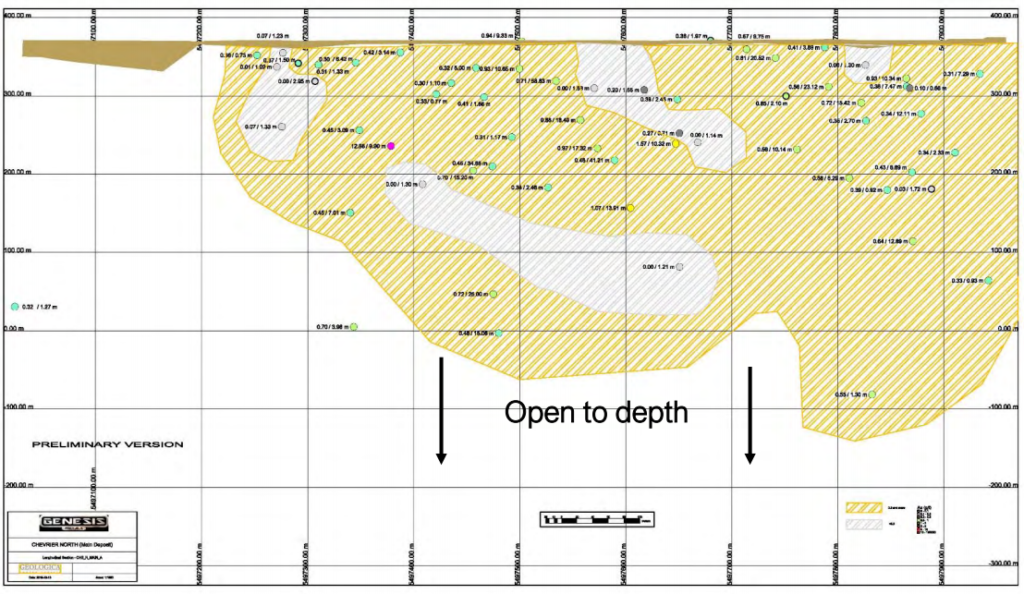
In terms of expanding the deposit, one of the best possibilities comes with drilling deeper, as the Principal Zones remain open at depth.

updated long section
Chevrier Gold Project – Long Section of the Main Zone Deposit

To date, I believe there have only been a handful of holes drilled below 400m, each of which hit mineralization. Given the nature of many of the Abitibi gold deposits, such as Osisko Mining’s Windfall Lake Gold Project, there is certainly the potential for more ounces to be found at depth.

I look forward to the next drill program which will test the extent of the mineralization at depth, and will most certainly tackle the other high priority targets on the property.

Concluding Remarks

The new gold bull market may be upon us, owning undervalued junior gold companies, such as Genesis, could be highly advantageous in the weeks and months ahead.

Investing in junior resource companies is risky and, therefore, in my opinion, you need to seek out companies that are led by strong management teams, who can navigate the risk and propel the company forward.

Genesis Metals is a company that I am invested in and believe has the horsepower, in terms of the management team, to move the Chevrier Gold Project forward. Clearly, the company must focus on expanding the resource by drilling deeper and exploring the property’s high priority targets.

As outlined in my report, there is a strong list of advisors who have “been there and done that” within the resource sector, and I am confident will have a great influence on the direction of Genesis moving forward.

Summarizing my thesis for investment, here are what I think are a few of Genesis’ most compelling strengths:

  • A proven management team: Sundar, Fleming, Florek and Liboiron
  • Strategic Advisors: Discovery Group’s John Robbins and James Paterson, Dr. Robert Carpenter, Dr. Andrew Ramcharan, and Garrett Ainsworth.
  • Strategic Shareholders List Headlined by: Osisko Mining, Eric Sprott, Delbrook Capital, Gold 2000, US Global Investors, SIDEX/SDBJ/FTQ and Medalist Capital
  • Located in the 4th best jurisdiction in the world, Quebec
  • Systematic 2019 exploration program led by Vector Geological Solutions – high-grade gold targeting
  • Expanded land package with high exploration potential, Chevrier Gold Project and October Gold Project
  • Great bang for its drilling buck, as its all-in drill costs, thus far, have roughly averaged $220 per meter

Brian Leni is the founder and editor of Junior Stock Review. He is a professional engineer who has over 10 years of experience in heavy industry.

Sign up for our FREE newsletter at: www.streetwisereports.com/get-news

Disclaimer: The following is not an investment recommendation, it is an investment idea. I am not a certified investment professional, nor do I know you and your individual investment needs. Please perform your own due diligence to decide whether this is a company and sector that is best suited for your personal investment criteria. Currently, I do not own Genesis Metals Corporation stock. All Genesis Metals Corporation analytics were taken from their website and press release. Genesis Metals Corporation is a Sponsor of Junior Stock Review.

I hope you will find this article interesting and useful, and will have further interest in upcoming articles on mining. To never miss a thing, please subscribe to my free newsletter, in order to get an email notice of my new articles soon after they are published.

Disclaimer:
The Critical Investor is not a registered investment advisor, currently has a long position in this stock, and Genesis Metals is a syndication sponsoring company. The Critical Investor is compensated for the syndication of this article by Genesis Metals. All facts are to be checked by the reader. For more information go to www.genesismetalscorp.com and read the company’s profile and official documents on www.sedar.com, also for important risk disclosures. This article is provided for information purposes only, and is not intended to be investment advice of any kind, and all readers are encouraged to do their own due diligence, and talk to their own licensed investment advisors prior to making any investment decisions.

Streetwise Reports Disclosure:
1) The Critical Investor’s disclosures are listed above.
2) The following companies mentioned in the article are sponsors of Streetwise Reports: None. Click here for important disclosures about sponsor fees. The information provided above is for informational purposes only and is not a recommendation to buy or sell any security.
3) Statements and opinions expressed are the opinions of the author and not of Streetwise Reports or its officers. The author is wholly responsible for the validity of the statements. The author was not paid by Streetwise Reports for this article. Streetwise Reports was not paid by the author to publish or syndicate this article. Streetwise Reports requires contributing authors to disclose any shareholdings in, or economic relationships with, companies that they write about. Streetwise Reports relies upon the authors to accurately provide this information and Streetwise Reports has no means of verifying its accuracy.

4) The article does not constitute investment advice. Each reader is encouraged to consult with his or her individual financial professional and any action a reader takes as a result of information presented here is his or her own responsibility. By opening this page, each reader accepts and agrees to Streetwise Reports’ terms of use and full legal disclaimer. This article is not a solicitation for investment. Streetwise Reports does not render general or specific investment advice and the information on Streetwise Reports should not be considered a recommendation to buy or sell any security. Streetwise Reports does not endorse or recommend the business, products, services or securities of any company mentioned on Streetwise Reports.
5) From time to time, Streetwise Reports LLC and its directors, officers, employees or members of their families, as well as persons interviewed for articles and interviews on the site, may have a long or short position in securities mentioned. Directors, officers, employees or members of their immediate families are prohibited from making purchases and/or sales of those securities in the open market or otherwise from the time of the interview or the decision to write an article until three business days after the publication of the interview or article. The foregoing prohibition does not apply to articles that in substance only restate previously published company releases. As of the date of this article, officers and/or employees of Streetwise Reports LLC (including members of their household) own securities of Newmont Goldcorp and Coeur Mining, companies mentioned in this article.

Graphics provided by the author.

( Companies Mentioned: GIS:TSX.V; GGISF:OTC,
)

Canada maintains rate but trade conflicts cloud outlook

By CentralBankNews.info

      Canada’s central bank left its benchmark target for the overnight rate steady at 1.75 percent but turned slightly more dovish as the outlook is clouded by “escalating global trade conflicts and geopolitical tensions” that is weighing on business sentiment despite stronger-than-expected economic growth in the second quarter.
The Bank of Canada (BOC), which has kept its key rate steady since October 2018, said the economy, as expected, was returning to its growth potential after temporary weakness in late 2018 and early 2019, and raised its 2019 growth forecast to 1.3 percent from April’s forecast of 1.2 percent as a surge in oil production helped propel growth, consumer spending continues to grow steadily and residential investment appears to have stabilized.
But softer foreign demand, lower commodity prices and trade restrictions are leaving their negative impact and BOC lowered its 2020 growth outlook to 1.9 percent from a previous 2.1 percent. The outlook for 2021 was unchanged at 2.0 percent.
Canada’s gross domestic product grew 1.3 percent year-on-year in the first quarter of this year, down from 1.6 percent in the previous quarter, but BOC raised its forecast for growth in the second quarter to 1.3 percent from 1.0 percent in its latest monetary policy report.
After holding its rate steady at 0.50 percent for two years, BOC in July 2017 began tightening its monetary policy stance and raised its rate five times before pausing in October 2018 as the global economic momentum began to wane.
As other major central banks, BOC turned more dovish in the beginning of this year but in May it turned slightly more upbeat as it became clear the slowdown at the end of last year and early this year was temporary and the economy was beginning to rebound.
Today’s statement is slightly more downbeat than in May, reflecting an economy that is growing around its potential but uncertainty from trade conflicts and global tensions is taking a toll on business sentiment and clouding the outlook.
“Taken together, the degree of accommodation being provided by the current policy interest rate remains appropriate,” BOC said, adding it would be paying particular attention to the energy sector and the impact of trade conflicts on the prospects for growth and inflation in incoming data.

     Inflation is largely in line with BOC’s target of 2.0 percent and is forecast to ease to 1.8 percent this year, slightly down from 1.9 percent in April’s monetary policy report, before rising to 1.9 percent in 2020 and 2.0 percent in 2021.

     In May Canada’s headline inflation rate jumped to 2.4 percent from 2.0 percent on higher transport  and food costs.

     The Bank of Canada issued the following statement:


“The Bank of Canada today maintained its target for the overnight rate at 1 ¾ percent. The Bank Rate is correspondingly 2 percent and the deposit rate is 1 ½ percent.
Evidence has been accumulating that ongoing trade tensions are having a material effect on the global economic outlook. The Bank had already incorporated such negative effects in previous Monetary Policy Reports (MPR) and in this forecast has made further adjustments in light of weaker sentiment and activity in major economies. Trade conflicts between the United States and China, in particular, are curbing manufacturing activity and business investment and pushing down commodity prices.
Policy is responding to the slowdown: central banks in the US and Europe have signalled their readiness to provide more accommodative monetary policy and further policy stimulus has been implemented in China. In this context, global financial conditions have eased substantially. The Bank now expects global GDP to grow by 3 percent in 2019 and to strengthen to around 3 ¼ percent in 2020 and 2021, with the US slowing to a pace near its potential. Escalation of trade conflicts remains the biggest downside risk to the global and Canadian outlooks.
Following temporary weakness in late 2018 and early 2019, Canada’s economy is returning to growth around potential, as expected. Growth in the second quarter appears to be stronger than predicted due to some temporary factors, including the reversal of weather-related slowdowns in the first quarter and a surge in oil production. Consumption is being supported by a healthy labour market. At the national level, the housing market is stabilizing, although there are still significant adjustments underway in some regions. A material decline in longer-term mortgage rates is supporting housing activity. Exports rebounded in the second quarter and will grow moderately as foreign demand continues to expand. However, ongoing trade conflicts and competitiveness challenges are dampening the outlook for trade and investment. The Bank projects real GDP growth to average 1.3 percent in 2019 and about 2 percent in 2020 and 2021.
Inflation remains around the 2 percent target, with some recent upward pressure from higher food and automobile prices. Core measures of inflation are also close to 2 percent. CPI inflation will likely dip this year because of the dynamics of gasoline prices and some other temporary factors. As slack in the economy is absorbed and these temporary effects wane, inflation is expected to return sustainably to 2 percent by mid-2020.
Recent data show the Canadian economy is returning to potential growth. However, the outlook is clouded by persistent trade tensions. Taken together, the degree of accommodation being provided by the current policy interest rate remains appropriate. As Governing Council continues to monitor incoming data, it will pay particular attention to developments in the energy sector and the impact of trade conflicts on the prospects for Canadian growth and inflation.”


RoboMarkets Title Sponsor of Women’s Volleyball Team AEL

RoboMarkets, a European broker that provides services for online trading on global financial markets, has become the title sponsor of the women’s volleyball team AEL (Limassol). In accordance with the long-term contract terms, the team that participates in women’s volleyball league of Cyprus will bear the name “RoboMarkets AEL”. In addition to that, the broker’s logo will be placed on the team’s sport outfit.

Since the moment the team was founded in Limassol in 1976, TRB-Danoi ΑΕΛ (AEL Limassol), rebranded later to RoboMarkets AEL, has hold leading positions among volleyball teams of the republic of Cyprus. RoboMarkets AEL is the winningest team in the history of the Cypriot women’s volleyball – as of today, it has won the Championship 29 times. Also, the team is a 28-time winner of the women’s volleyball Cup of Cyprus and a 13-time winner of the women’s volleyball Super Cup of Cyprus.

Konstantin Rashap, CBO at RoboMarkets: “We’re very proud that one of the best volleyball team in Cyprus is named after our Company and glad to support the athletes. For us, they represent a great team spirit and winning traditions. We’re ready to support the team in their ambitions to become better and will break new grounds together!”


About RoboMarkets

RoboMarkets is an investment company with the CySEC license No. 191/13. RoboMarkets offers investment services in many European countries by providing traders, who work on financial market, with access to its proprietary trading platforms. More detailed information about the Company’s products and activities can be found on the official website at www.robomarkets.com.


Is a Lithium Sector Rebound Coming? Is This Company Too Cheap to Ignore?

The Energy Report

Source: Peter Epstein for Streetwise Reports   07/09/2019

Peter Epstein of Epstein Research explains why he believes this company stands out from many of the lithium explorers in Argentina.

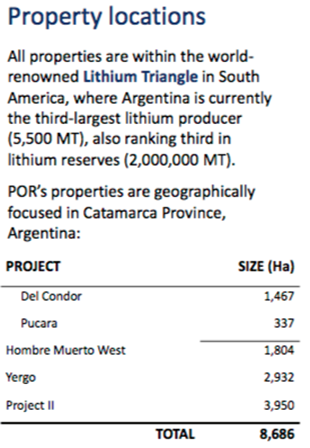
Portofino Resources Inc. (POR:TSX.V; POT:FSE) is a high-risk lithium junior with three brine projects in Catamarca province, Argentina. I say “high risk,” but that should go without saying. All lithium juniors are high risk. There are 13–14 publicly listed, pre-PFS (prefeasibility study) stage companies (Neo Lithium has completed a PFS, Millennial Lithium is expected to deliver a BFS in August) with all, or substantially all, of their properties in Argentina.

But, how many of those companies are proactively moving forward? How many have good projects? Which companies still have to make substantial cash payments to complete acquisition(s)?

Portofino Resources moving forward, several peers dead in the water

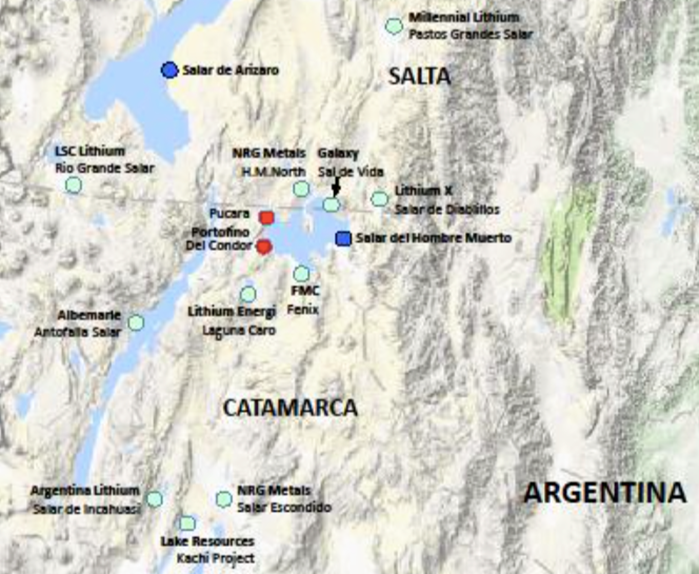
Portofino is clearly moving the ball forward on two of its three projects, and it does not owe a lot of money to property vendors. Although it’s too early to know if the company has good assets, one of its two main projects, Hombre Muerto West (HMW), is in the single best salar in Argentina—Salar del Hombre Muerto.

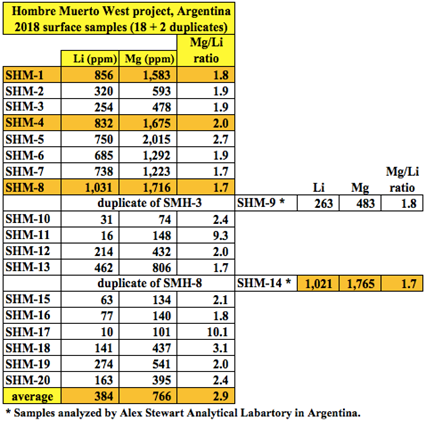
Last year, 18 near-surface samples were taken, plus two duplicates, on the two concessions that total 1,804 hectares. The top three samples averaged 906 mg/L Li and had a low average Mg:Li ratio of 1.8 to 1.

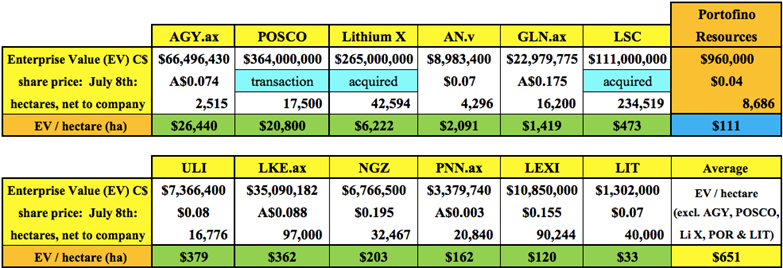
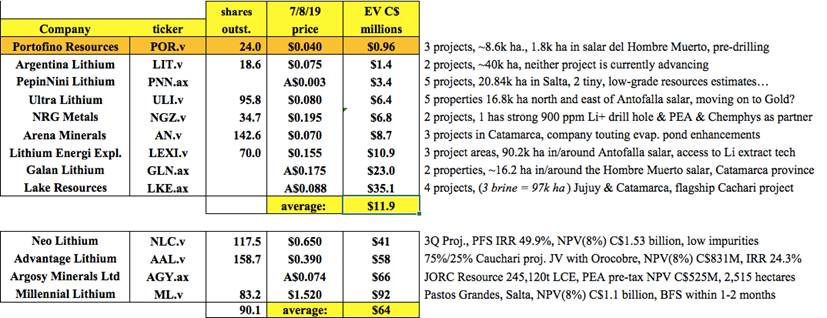
Neighbors in and around Hombre Muerto include Livent Corp. (formerly FMC), Korean giant POSCO and Australia-listed Galaxy Resources. Within the past six months, POSCO paid ~$364 million to Galaxy for 17,500 hectares, that’s ~$20,800/ha—a figure 187 times greater than the $111/ha Portofino trades at (see chart below). That land package reportedly has a 2.54 million tonne LCE Indicated + Inferred resource.

I’m not suggesting that Portofino’s three project areas are worth north of $20K/ha, not even close, but if management delivers good drill results at HMW, there’s likely ample room for improvement in the company’s valuation.

The average ratio of Enterprise Value to property size (excluding AGY.ax, POSCO, Lithium X, POR.v and LIT.v) is $651/ha, six times that of Portofino. I excluded AGY.ax & LIT.v as outliers. That average of $651/ha is going to move higher as several companies drop land packages in the next 6–12 months.

In a better lithium juniors market, Portofino would be a prime takeout target…

At least 13 companies, POSCO, Galaxy, Livent, Lithium Americas, Ganfeng, Albemarle, Orocobre, Neo Lithium, Argosy Minerals, Millennial, Advantage Lithium, Lake Resources and Galan Lithium, have a strategic reason to be watching Portofino’s progress at Hombre Muerto closely. Acquiring Portofino could be a cheap option on three projects that, while not proven, have not been disproven either.

Having properties in and around salars that have not hosted poor drill results is of paramount importance. Many of the salars in Argentina that were explored in 2017 and 2018 ended up the subject of poor, very poor or merely mediocre drill results.

For example, Salar de Pocitos was drilled by Pure Energy Minerals and Liberty One Lithium, neither company had any luck. Salar de Arizaro was drilled, the assays showed low-grade Li with high levels of magnesium. Other salars certainly fall into this category, no-go zones, at least until the next lithium bull market!

If one believes that lithium prices and investor sentiment will rebound, exact timing unknown, Portofino Resources could offer tremendous bang for the buck. Of course, a lot is riding on the drilling at HMW later this year. However, Portofino’s Yergo project is alive and kicking, fighting not to be forgotten when all eyes are on HMW. If management can deliver good drill results, that should enable the funding of both follow up work at HMW and, perhaps, an initial drill program at Yergo in 1h 2020.

The 2,932 hectare Yergo project is less than 20 km from Neo Lithium’s high-grade 3Q project and shares geological features with 3Q. Exploration to date has been promising. For instance, near-surface samples showed good Li values and very low magnesium to lithium ratios. Most projects in Argentina have Mg/Li ratios between 2.5 and 4.5 to 1. The Yergo samples averaged less than 1.0 to 1. The lower the Mg/Li ratio, the less expensive it is to process the brine.

Unlike several companies in the chart below, Portofino has minimal cash payments to make. In fact, between now and the end of 2020 less than US$50K is due, none over the remainder of this year. And, importantly, there are no work commitments or royalties.

In looking at the 13 names on the chart—where their properties are, the number of recent press releases and their cash balances—there are several that I think are LESS likely to survive as lithium juniors with projects in Argentina than Portofino. Yet, Portofino has an enterprise value that’s about 90% below the average enterprise value of [LIT.v, PNN.ax, ULI.v, NGZ.v, AN.v, LEXI.v, GLN.ax and LKE.ax].

To reiterate, many of Portofino’s peers in Argentina have projects in and around salars with fairly recent exploration disappointments (poor or inconclusive drill results, drilling mishaps, etc.). Most projects aren’t being actively explored, especially if a large property payment is due. Many companies are waiting for payment dates, hoping for a sector rebound, before investing any additional funds.

Since Portofino has very low near-term financial commitments, especially compared to peers, (each project is held via a 4-year option agreement), management has been able to prudently advance HMW and Yergo in a very difficult market. In my opinion, based on peer company press releases, only four (including Portofino) of the nine companies in the top section of the chart are actively exploring / developing.

Promising near-surface samples at HMW, now a promising geophysical survey

Last week, Portofino Resources announced the results of a geophysical survey done on its 100%-controlled Hombre Muerto West project. The geophysical survey follows last year’s near-surface brine sampling program, which identified values up to 1,031 mg/L lithium and a favorable average magnesium to lithium ratio of 1.99.

Interpretation of the survey by a local geological consultant indicates multiple zones of low resistivity (i.e., conductivity). Conductive anomalies were found to extend from surface to about 250 meters and extend horizontally for at least 2.5 km (on the Condor concession).

Management believes that a likely cause of the conductivity is lithium-bearing brines. However, until the property is drilled later this year, no one knows for sure. Based upon previously identified, near-surface Li-brine results and the new geophysical survey, multiple promising drill targets have been identified.

Is this news sexy? Is it highly exciting? No. But, to reiterate, Portofino Resources has a sub C$1 million market cap and is advancing two prospective lithium brine projects. Most juniors have very little, or nothing to say.

One peer in Argentina has had just one press release the entire year, and it was that a director had resigned! Another has zero project-related press releases so far in 2019. If and when the sector rebounds, many juniors around the world will find themselves 6–12 months behind the companies that were able to advance their projects.

If the lithium sector improves later this year and management can deliver good drill results at HMW, the company’s 24.0 million shares outstanding might be hard to find near the current price of C$0.04. The average share count of the other Canadian-listed juniors in the chart is 90.1 million.

Make no mistake, this is a very high risk situation, but with high risk, there’s often the opportunity for high reward. I believe that an investment in Portofino Resources (TSX-V: POR) (FSE: POT) offers a compelling risk/reward proposition.

Peter Epstein is the founder of Epstein Research. His background is in company and financial analysis. He holds an MBA degree in financial analysis from New York University’s Stern School of Business.

Sign up for our FREE newsletter at: www.streetwisereports.com/get-news


Disclosures: The content of this article is for information only. Readers fully understand and agree that nothing contained herein, written by Peter Epstein of Epstein Research [ER], (together, [ER]) about Portofino Resources, including but not limited to, commentary, opinions, views, assumptions, reported facts, calculations, etc. is not to be considered implicit or explicit investment advice. Nothing contained herein is a recommendation or solicitation to buy or sell any security. [ER] is not responsible under any circumstances for investment actions taken by the reader. [ER] has never been, and is not currently, a registered or licensed financial advisor or broker/dealer, investment advisor, stockbroker, trader, money manager, compliance or legal officer, and does not perform market making activities. [ER] is not directly employed by any company, group, organization, party or person. The shares of Portofino Resources are highly speculative, not suitable for all investors. Readers understand and agree that investments in small cap stocks can result in a 100% loss of invested funds. It is assumed and agreed upon by readers that they will consult with their own licensed or registered financial advisors before making any investment decisions.

At the time this article was posted, Peter Epstein owned shares of Portofino Resources and Portofino was an advertiser on [ER].

Readers understand and agree that they must conduct their own due diligence above and beyond reading this article. While the author believes he’s diligent in screening out companies that, for any reasons whatsoever, are unattractive investment opportunities, he cannot guarantee that his efforts will (or have been) successful. [ER] is not responsible for any perceived, or actual, errors including, but not limited to, commentary, opinions, views, assumptions, reported facts & financial calculations, or for the completeness of this article or future content. [ER] is not expected or required to subsequently follow or cover events & news, or write about any particular company or topic. [ER] is not an expert in any company, industry sector or investment topic.


Streetwise Reports Disclosure:
1) Peter Epstein’s disclosures are listed above.
2) The following companies mentioned in the article are billboard sponsors of Streetwise Reports: None. Click here for important disclosures about sponsor fees. The information provided above is for informational purposes only and is not a recommendation to buy or sell any security.
3) Statements and opinions expressed are the opinions of the author and not of Streetwise Reports or its officers. The author is wholly responsible for the validity of the statements. The author was not paid by Streetwise Reports for this article. Streetwise Reports was not paid by the author to publish or syndicate this article. Streetwise Reports requires contributing authors to disclose any shareholdings in, or economic relationships with, companies that they write about. Streetwise Reports relies upon the authors to accurately provide this information and Streetwise Reports has no means of verifying its accuracy.

4) The article does not constitute investment advice. Each reader is encouraged to consult with his or her individual financial professional and any action a reader takes as a result of information presented here is his or her own responsibility. By opening this page, each reader accepts and agrees to Streetwise Reports’ terms of use and full legal disclaimer. This article is not a solicitation for investment. Streetwise Reports does not render general or specific investment advice and the information on Streetwise Reports should not be considered a recommendation to buy or sell any security. Streetwise Reports does not endorse or recommend the business, products, services or securities of any company mentioned on Streetwise Reports.
5) From time to time, Streetwise Reports LLC and its directors, officers, employees or members of their families, as well as persons interviewed for articles and interviews on the site, may have a long or short position in securities mentioned. Directors, officers, employees or members of their immediate families are prohibited from making purchases and/or sales of those securities in the open market or otherwise from the time of the interview or the decision to write an article until three business days after the publication of the interview or article. The foregoing prohibition does not apply to articles that in substance only restate previously published company releases.

Graphics provided by author.

( Companies Mentioned: POR:TSX.V; POT:FSE,
)

June NZ Electronic Card Transactions

By Orbex

After the RBA cut rates twice in a row, all eyes are now on the RBNZ to see if they will follow suit. Given how close the economies are connected, and that the economic figures have been following the same path, it’s not unlikely to expect that the central banks would have similar policies.

The RBNZ was the first to pull the trigger but has since held fast while the RBA cut. There is an increasing consensus that August will have what analysts are calling the “first” rate cut for the remainder of the year. This, of crouse, implies that there will be more than one.

However, there is still a lot of data coming up before the next meeting in August. So, the market is going to be looking really closely at the data to see if the RBNZ will take the same route as the RBA.

The Data

Tomorrow we get the first important data that could give us some insight into what might happen with the rates. Electronic Card Retail sales data is the proxy for consumer sentiment that Kiwi followers use. It also gives us some insight into what to expect from inflation.

Let’s not forget that later in the month, we’ll also be getting quarterly consumer sentiment and CPI, two important data points that could certainly sway the RBNZ.

With the release tomorrow, we get the full set of reports for Q2 to see how retail sales have been doing. This is why this data point might be extra important this time around.

What We Are Looking For

Expectations are for card transactions to stay in negative growth for the second consecutive month at -0.1%. However, this would be an improvement over the -0.5% of the prior month. This would bring annual growth to just 0.7%, compared to 3.2% registered the last time around.

Electronic card sales have been bouncing around since the beginning of the year and failing to maintain consistent growth. Many see that as a reflection of a lack of consumer confidence in line with the lack of business confidence seen in the country of late.

What to Expect from the Markets

Given the wealth of poor data from New Zealand lately, a positive surprise from the data series might help give the Kiwi some support. A result worse than -0.5% of last month could be affirm the negative growth trend, and negatively impact the currency.

If two months of electronic card transactions come in negative, especially if the last one is below -0.4%, then we could expect disappointing results from consumer confidence. Just as importantly, inflation could slip lower. This would put pressure on the RBNZ to take further action.

The Government Weighs In

In that line of thinking, recently, the NZ government has been taking credit for the low dollar. They affirmed that they were interested in reviewing the Reserve Banking Act.

Politically, the exchange rate is seen quite positively, especially with the current high price of dairy. However, these positives for the economy are not reflected in other data. This means that even these tailwinds aren’t enough to help the economy.

With New Zealand now officially in winter, we are getting the underlying economic data without the positive distortion of record tourist arrivals. If the data doesn’t pick up soon, we might be in for a series of depressing economic data until November, when the tourist season picks up again.

By Orbex


Sangamo and Pfizer Report Positive Results for Hemophilia A Study

By The Life Science Report

Source: Streetwise Reports   07/08/2019

Sangamo Therapeutics and partner Pfizer reported positive results for phase 1/2 Alta study for hemophilia A at the International Society on Thrombosis and Hemostasis Congress in Melbourne, Australia.

Sangamo Therapeutics Inc. (SGMO:NASDAQ) shares are up more than 8% today on high volume after the company and its partner Pfizer Inc. (PFE:NYSE) jointly announced updated results after the close of trading Friday evening for their Phase 1/2 Alta study evaluating investigational SB-525 gene therapy for severe hemophilia A.

The company reported that data showed that SB-525 was generally well tolerated and demonstrated a dose-dependent increase in Factor VIII (FVIII) activity levels.

“The initial results of the Alta study presented at International Society on Thrombosis and Hemostasis Congress demonstrate that SB-525 has the potential to be a predictable and reliable treatment that may bring clinical benefit to patients with hemophilia A,” stated Adrian Woolfson, M.D., Ph.D., Sangomo’s EVP of Research and Development.

The joint news release stated that “based on the accumulating results from the Alta study, the U.S. Food and Drug Administration (FDA) has granted regenerative medicine advanced therapy (RMAT) designation for SB-525 gene therapy to treat severe hemophilia A.”

In addition to partnering with Pfizer on hemophilia applications, Sangamo also collaborates with Kite, a Gilead Sciences, Inc. (GILD:NASDAQ) company, on developing next-generation ex vivo cell therapies to treat cancer; Sanofi (SNY:NASDAQ) on developing gene-edited cell therapies for the treatment of beta thalassemia and sickle cell disease; and Shire plc now Takeda Pharmaceutical Co. Ltd. (4502:JP) on developing therapeutics for Huntington’s disease.

Sangamo shares have traded more than 14 million shares in the first half of trading, greatly exceeding the 200-day average daily volume of 1.944 million shares. So far today, the firm’s shares have traded between $12.20 to $13.33 and are currently trading at $12.34/share, up $0.94/share (+8.25%) over Friday’s close of $11.40. While today’s trading action appears very positive, it is important to note that the stock is trading pretty much at the mid-point of the 52-week high and low prices of $19.25 (09/04/18) and $6.26 (02/07/19) respectively.

Sign up for our FREE newsletter at: www.streetwisereports.com/get-news

Disclosure:
1) Stephen Hytha compiled this article for Streetwise Reports LLC and provides services to Streetwise Reports as an independent contractor. He or members of his household own securities of the following companies mentioned in the article: None. He or members of his household are paid by the following companies mentioned in this article: None.
2) The following companies mentioned in this article are billboard sponsors of Streetwise Reports: None. Click here for important disclosures about sponsor fees.
3) Comments and opinions expressed are those of the specific experts and not of Streetwise Reports or its officers. The information provided above is for informational purposes only and is not a recommendation to buy or sell any security.
4) The article does not constitute investment advice. Each reader is encouraged to consult with his or her individual financial professional and any action a reader takes as a result of information presented here is his or her own responsibility. By opening this page, each reader accepts and agrees to Streetwise Reports’ terms of use and full legal disclaimer. This article is not a solicitation for investment. Streetwise Reports does not render general or specific investment advice and the information on Streetwise Reports should not be considered a recommendation to buy or sell any security. Streetwise Reports does not endorse or recommend the business, products, services or securities of any company mentioned on Streetwise Reports.
5) From time to time, Streetwise Reports LLC and its directors, officers, employees or members of their families, as well as persons interviewed for articles and interviews on the site, may have a long or short position in securities mentioned. Directors, officers, employees or members of their immediate families are prohibited from making purchases and/or sales of those securities in the open market or otherwise from the time of the interview or the decision to write an article until three business days after the publication of the interview or article. The foregoing prohibition does not apply to articles that in substance only restate previously published company releases.

( Companies Mentioned: PFE:NYSE,
SGMO:NASDAQ,
)

Predictive Modeling Suggest Oil Headed Much Lower

By TheTechnicalTraders.com

Our Adaptive Dynamic Learning (ADL) predictive price modeling system is suggesting Crude Oil will likely continue to find resistance near $64 as a price ceiling and trend lower over the next 3 to 5 months – eventually breaking below the $40 price level near the end of 2019 or in early 2020.

Our research team believes this move could very well be contingent on a continued decline in global economic activity as well as our research suggesting that global currencies could be setting up for a breakdown event.

The USA and FED will do everything in their powers to keep the economy looking strong and to hold markets up like talking about rate cuts, but eventually the music will stop, but until then we need to be long and strong stocks and keep a close eye on leading indicators like small caps, oil, transportation and industrial sectors for early warning signs.

Please read the following research posts for more information:

Report #1: PART III – DEBT CRISIS TO BE REBORN IN 2020

Report #2: KING DOLLAR RIDES HIGHER CREATING PRESSURES ON FOREIGN ECONOMIES

Report #3: FEAR DRIVES MARKET EXPECTATIONS

We believe the breakdown in support for Crude Oil will coincide with a general perception of global economic weakness, foreign Central Bank posturing and the possibility that foreign currency weakness may push global demand for Oil much lower than current expectations.

The volatility increased suggested near the right side of this chart, in late 2019 and early 2020, are indicative of oil prices reaching a critical support level while attempting to re-balance supply/demand-side economic factors against historic price lows.  This will likely become a period where global oil traders feel the need to try to push oil prices higher while supply/demand factors settle to establish a basis price level for future price trends.

IN CONCLUSION:

If our ADL predictive modeling is correct, we will see rotation between $47 and $64 over the next 3+ months before a breakdown in price hits in November 2019.  This will be followed by two fairly narrow price range months (December 2019 and January 2020) where oil prices will tighten near $45 to $50.  After that tightening, we believe an extremely volatile price move will happen in February through April 2020 that could see oil prices trade as low as $22 and as high as $51 over a two to three-month span.

As we’ve continued to state, 2019 and 2020 are going to include incredible opportunities for skilled technical traders and investors.  Think about how a more like this in Oil and the global markets will reflect into the precious metals markets and the US Dollar?

Be prepared for these incredible price swings before they happen and learn how you can identify and trade these fantastic trading opportunities in 2019, 2020, and beyond with our  Wealth Building & Global Financial Reset Newsletter.  You won’t want to miss this big move, folks.  As you can see from our research, everything has been setting up for this move for many months – most traders/investors have simply not been looking for it.

Join me with a 1 or 2-year subscription to lock in the lowest rate possible and ride my coattails as I navigate these financial market and build wealth while others lose nearly everything they own during the next financial crisis. Join Now and Get a 1oz Silver Round or Gold Bar Shipped To You Free.

I can tell you that huge moves are about to start unfolding not only in currencies, metals, or stocks but globally and some of these supercycles are going to last years. A gentleman by the name of Brad Matheny goes into great detail with his simple to understand charts and guide about this. His financial market research is one of a kind and a real eye-opener. 2020 Cycles – The Greatest Opportunity Of Your Lifetime

As a technical analysis and trader since 1997, I have been through a few bull/bear market cycles. I believe I have a good pulse on the market and timing key turning points for both short-term swing trading and long-term investment capital. The opportunities are massive/life-changing if handled properly.

I’M GIVING THIS GOLD BAR AWAY WITH 2-YEAR MEMBERSHIPS
AND 1OZ SILVER ROUND TO 1 YEAR SUBSCRIBERS

So kill two birds with one stone and subscribe for two years to get your
FREE GOLD BAR and enough trades to profit through the next metals
bull market and financial crisis!

SUBSCRIBE -> FREE GOLD BAR -> GET WINNING TRADES

Chris Vermeulen –  TheTechnicalTraders.com


The Phony Wealth Effect and Gold

By The Gold Report

Source: Rudi Fronk and Jim Anthony for Streetwise Reports   07/08/2019

Rudi Fronk and Jim Anthony, cofounders of Seabridge Gold, discuss what real wealth is and if financial assets should be considered real wealth.

Our contention is that gold is real wealth. Gold is its own final settlement and no one else’s liability. What this means is simply that gold stands for itself, it does not depend upon the faith and good credit of any other person or thing…it is universally accepted as final settlement. It has been so for thousands of years.

And in these days of radical central bank policies, gold has no central bank to control its issuance or its value. Its value is determined by those who wish to exchange it for other valuable things. Its issuance is established by the fact that it is rare and difficult to extract.

The question is this: Are financial assets…securities such as stocks and bonds…real wealth? Our answer is that they are if a dollar’s worth of securities can be exchanged for a dollar’s worth of goods and services. Unlike gold, financial assets are claims on something else. For example, a common share is a claim on a proportionate share of future earnings from the sale of goods and services by an enterprise for which the common share represents part ownership. Gold backs itself. Securities need the backing of the entity which issued them; the claims issued must be money good for the securities to represent wealth.

So, it stands to reason that securities must ultimately be backed by an equivalent value of goods and services in the real economy.

What, then, are we to make of the fact that the U.S. economy has credit market debt of $70 trillion as claims against a $22 trillion economy as measured by real GDP (which, by the way, includes a lot of less than real items such as government spending)? The $70 trillion (of which about $40 trillion is in domestically issued bonds) is someone’s liability but it is also someone’s asset, including pension funds and other savings vehicles meant to defer spending into the future where it is depended upon to fund consumption.

To debt claims we must add about $34 trillion in equity claims, the estimated current value of the U.S. stock market. This tally does not include private company ownership, privately generated debt, real estate and cash balances which are also stores of value and potential claims against the real economy.

The global picture is no better. Total stock market valuations are about $78 trillion while the global bond market is estimated at around $110 trillion against world real GDP of about $75 trillion.

Meanwhile, the current dollar value of the world’s above ground gold supply is about $8 trillion, more than half of which is probably not immediately tradable since it is in the form of jewelry and artifacts.

Clearly, from these numbers, there are far more players of the musical chairs game than there are chairs. Claims against the real economy have grown exponentially faster than the economy that must meet those claims. Either real GDP must rise at an unprecedented pace or the value of financial assets must fall precipitously. We have a huge phony wealth problem which is unsustainable and it cannot be fixed by monetary policy that has as it method the printing of more claims.

What is the resolution of this mismatch of real vs. financial assets? Investors will begin to flee to reliable value that protects their wealth and purchasing power. We think that inevitably means fleeing to the backing of gold.

This article is the collaboration of Rudi Fronk and Jim Anthony, cofounders of Seabridge Gold, and reflects the thinking that has helped make them successful gold investors. Rudi is the current Chairman and CEO of Seabridge and Jim is one of its largest shareholders. Disclaimer: The authors are not registered or accredited as investment advisors. Information contained herein has been obtained from sources believed reliable but is not necessarily complete and accuracy is not guaranteed. Any securities mentioned on this site are not to be construed as investment or trading recommendations specifically for you. You must consult your own advisor for investment or trading advice. This article is for informational purposes only.

Sign up for our FREE newsletter at: www.streetwisereports.com/get-news

Disclosures:
1) Statements and opinions expressed are the opinions of Rudi Fronk and Jim Anthony and not of Streetwise Reports or its officers. The authors are wholly responsible for the validity of the statements. Streetwise Reports was not involved in any aspect of the content preparation. The authors were not paid by Streetwise Reports for this article. Streetwise Reports was not paid by the authors to publish or syndicate this article. The information provided above is for informational purposes only and is not a recommendation to buy or sell any security. Streetwise Reports requires contributing authors to disclose any shareholdings in, or economic relationships with, companies that they write about. Streetwise Reports relies upon the authors to accurately provide this information and Streetwise Reports has no means of verifying its accuracy.
2) Rudi Fronk and Jim Anthony: we, or members of our immediate household or family, own shares of the following companies mentioned in this article: Seabridge Gold. We personally are, or members of our immediate household or family are, paid by the following companies mentioned in this article: Seabridge Gold.
3) Seabridge Gold is a billboard sponsor of Streetwise Reports. Click here for important disclosures about sponsor fees.
4) This article does not constitute investment advice. Each reader is encouraged to consult with his or her individual financial professional and any action a reader takes as a result of information presented here is his or her own responsibility. By opening this page, each reader accepts and agrees to Streetwise Reports’ terms of use and full legal disclaimer. This article is not a solicitation for investment. Streetwise Reports does not render general or specific investment advice and the information on Streetwise Reports should not be considered a recommendation to buy or sell any security. Streetwise Reports does not endorse or recommend the business, products, services or securities of any company mentioned on Streetwise Reports.
5) From time to time, Streetwise Reports LLC and its directors, officers, employees or members of their families, as well as persons interviewed for articles and interviews on the site, may have a long or short position in securities mentioned. Directors, officers, employees or members of their immediate families are prohibited from making purchases and/or sales of those securities in the open market or otherwise from the time of the interview or the decision to write an article until three business days after the publication of the interview or article. The foregoing prohibition does not apply to articles that in substance only restate previously published company releases.