Dollar could get lift from stronger-than-expected US GDP print

By Han Tan, Market Analyst, ForexTime

Most Asian currencies are set to end the week on the back foot against the US Dollar, with the Dollar index (DXY) having gained about 0.7 percent so far this week. The Greenback has been whipsawed of late by shifting market expectations over the scope of next week’s widely expected Fed rate cut. Despite the dovish rhetoric employed by the Fed, the Dollar index has shown remarkable resilience, recovering from sub-96 levels in late June to now be within touching distance of the 98 mark.

A better-than-expected US Q2 GDP print due Friday could be another stepping stone for DXY to embrace the 98 handle for the first time since May. The Greenback is expected to remain fundamentally supported by the US economy’s resilience compared to its major developed peers. This is especially in light of ECB President Mario Draghi’s admission that the EU economic outlook is getting “worse and worse”.

ECB leaves door open for Fed to cut rates first

The Euro hit a fresh two-year low only to recover sharply after the European Central Bank paved the way for an interest rate cut later this year. Although the ECB left interest rates unchanged at the July meeting, at the time of writing, markets are pricing in an 84.7 percent chance of a 10-basis point cut to interest rates in September.

At already a record low of minus 0.4 percent, investors will wonder if pushing interest rates further into negative territory will be enough to sustain the EU’s economic growth momentum. More stimulus, such as a revival of the ECB’s bond-buying programme, may be required to ensure the EU’s economic conditions do not capitulate in the face of persistent global headwinds.

Should market grow increasingly expectant of a larger-than-expected stimulus package for the EU economy in September, accompanied by worsening economic data in the interim, that could open a path below 1.10 for EURUSD. The dovish language employed by Draghi should hearten Euro bears, as the rate-cuts chorus among global central bankers grows louder.

Boris vs. Brussels in Brexit bog

The Brexit impasse has already reared its ugly head, just days into Boris Johnson’s tenure as UK Prime Minister, as European Commissioner Jean-Claude Juncker rejected Johnson’s suggestion for any changes to the existing Brexit deal. The deadlock appears to solidify market concerns over the prospects of a no-deal Brexit, keeping the Pound rooted around the 1.24 mark against the US dollar.

Investors will be looking for signs as to who will break first – Boris or Brussels. Should both sides stick to their guns and a no-deal Brexit materialises, that is set to trigger a fresh round of risk aversion in Q4 while dragging the global growth outlook lower going into 2020.


Disclaimer: The content in this article comprises personal opinions and should not be construed as containing personal and/or other investment advice and/or an offer of and/or solicitation for any transactions in financial instruments and/or a guarantee and/or prediction of future performance. ForexTime (FXTM), its affiliates, agents, directors, officers or employees do not guarantee the accuracy, validity, timeliness or completeness, of any information or data made available and assume no liability as to any loss arising from any investment based on the same.


Forex-Time-LogoArticle by ForexTime

ForexTime Ltd (FXTM) is an award winning international online forex broker regulated by CySEC 185/12 www.forextime.com

Turkey cuts rate 425 bps but to maintain cautious stance

By CentralBankNews.info

     Turkey’s central bank lowered its benchmark one-week repo auction rate by a larger-than-expected 4.25 percentage points to 19.75 percent due to an improved outlook for inflation but said it still needs to maintain a “cautious monetary stance” to ensure inflation continues to decline.
      It is the first rate cut by the Central Bank of Republic of Turkey (CBRT) under Murat Uysal, the former deputy governor who was appointed as governor on July 6 after Murat Cetinkaya was fired for failing to follow Turkish President Recep Tayyip Erdogan’s instructions to lower rates.
     Cetinkaya’s dismissed by president decree sparked fresh concern over the independence of the central bank as it was the first time a central bank governor had been dismissed since a 1980 military coup. Cetinkaya still had 10 months remaining on this 4-year term, which began in 2016.
     Erdogan has long put pressure on the central bank to cut rates and according to press reports the tipping point for him came after June 12, when CBRT maintained its key rate at 24.0 percent for the ninth consecutive month, disregarding Erdogan’s instructions to cut the rate by 300 basis points.
     Under Cetinkaya the central bank raised rates by a total of 16 percentage points in 2018, including a shock 625 point hike in September, to curb inflation after the lira’s sharp plunge in August to a record low of 6.96 to the U.S. dollar.
    Since then the Turkish lira has risen and inflation has declined, and ironically, Cetinkaya’s dismissal came as analysts were already expecting him to begin cutting rates this month by around 250 basis points.
     In April the central bank had begun to shift toward easier policy by dropping an earlier reference to tightening its policy if needed and it forecast inflation would fluctuate between 12.1 percent and 17.1 percent and end 2019 at 14.6 percent.
    After a quick rise and then decline after today’s rate cut, the Turkish lira settled slightly firmer at 5.7 to the U.S. dollar, continuing the appreciation seen since May 9 after hitting a 2019-low of 6.16.
      However, since the start of this year the lira has still depreciated 7.4 percent and by 33 percent since the start of 2018. In 2018 the lira fell 28 percent against the U.S. dollar.
     Turkey’s inflation rate fell to 15.72 percent in June, continuing a steady decline since a 15-year high of 25.24 percent in October 2018 but is still way above the central bank’s medium-term target of 5 percent.
     In today’s statement the central bank said the outlook for inflation has continued to improve, citing domestic demand and tight monetary conditions supporting disinflation, supported by a decline in unprocessed food and energy prices.
     “In lights of these developments, recent forecast revisions suggest that inflation is likely to materialize slightly below the projections of the April Inflation Report by the end of the year,” CBRT said.
     The central bank’s 5-member monetary policy committee said maintaining disinflation was the key to reducing sovereign risk, achieving lower long-term rates and a stronger economic recovery and this requires continued “cautious monetary stance.”
    It added the extent of monetary tightness would be determined the underlying trend of inflation.
     In the wake of Cetinkaya’s firing, ratings agency Fitch has downgraded Turkey’s sovereign rating to “BB-,” saying his removal highlights a deterioration in institutional independence, economic policy coherence and credibility.
     The move also risks damaging weak domestic confidence, evidenced by rising dollarization, jeopardizes the inflow of foreign capital needed to meet Turkey’s external financing requirement and worsening economic outcomes.
     Turkey’s economy has shrunk in the last two years on an annual basis, with gross domestic product in the first quarter of this year down 2.6 percent after a 3.0 percent fall in the previous quarter.
      On a quarterly basis, Turkey bounced back in the first quarter with GDP expanding 1.3 percent after shrinking 2.4 percent in the fourth quarter of 2018, 1.5 percent in the the third quarter and 0.1 percent in the second quarter.
     “Recently released data indicate a moderate recovery in the economic activity,” the central bank said, noting goods and services exports were on an uptrend despite the weaker global outlook, and exports are expected to continue to contribute to the gradual economic recovery.


     The Central Bank of the Republic of Turkey released the following statement:

“The Monetary Policy Committee (the Committee) has decided to reduce the policy rate (one-week repo auction rate) from 24 percent to 19.75 percent.
Recently released data indicate a moderate recovery in the economic activity. Goods and services exports continue to display an upward trend despite the weakening in the global economic outlook, indicating improved competitiveness. In particular, strong tourism revenues support the economic activity through direct and indirect channels. Looking forward, net exports are expected to contribute to the economic growth and the gradual recovery is likely to continue with the help of the disinflation trend and the partial improvement in financial conditions. The composition of growth is having a positive impact on the external balance. Current account balance is expected to maintain its improving trend.
Recently, weaker global economic activity and heightened downside risks to inflation have strengthened the possibility that advanced economy central banks will take expansionary monetary policy steps. While these developments support the demand for emerging market assets and the risk appetite, rising protectionism and uncertainty regarding global economic policies are closely monitored in terms of their impact on both capital flows and international trade.
Inflation outlook continued to improve. In the second quarter, inflation displayed a significant fall with the contribution from a deceleration in unprocessed food and energy prices. Domestic demand conditions and the tight monetary policy continue to support disinflation. Underlying trend indicators, supply side factors, and import prices lead to an improvement in the inflation outlook. In light of these developments, recent forecast revisions suggest that inflation is likely to materialize slightly below the projections of the April Inflation Report by the end of the year. Accordingly, considering all the factors affecting inflation outlook, the Committee decided to reduce the policy rate by 425 basis points.
The Committee assesses that maintaining a sustained disinflation process is the key for achieving lower sovereign risk, lower long-term interest rates, and stronger economic recovery.  Keeping the disinflation process in track with the targeted path requires the continuation of a cautious monetary stance. In this respect, the extent of the monetary tightness will be determined by considering the indicators of the underlying inflation trend to ensure the continuation of the disinflation process. The Central Bank will continue to use all available instruments in pursuit of the price stability and financial stability objectives.
It should be emphasized that any new data or information may lead the Committee to revise its stance.
The summary of the Monetary Policy Committee Meeting will be released within five working days.”


ECB ready to adjust all easing tools, including rates, QE

By CentralBankNews.info

The European Central Bank (ECB) left its key interest rates steady but said it “stands ready to adjust all of its instruments,” including cutting interest rates and launching a new round of asset purchases, to ensure inflation rises toward its target.
The ECB, the central bank for the 19 European countries that use the euro currency, said its governing council had asked staff to examine ways to reinforce its forward guidance on policy rates, along with measures that could mitigate the impact of further easing on commercial banks, such as a tiered system of reserve renumeration, along with options of the size and composition of potential new net purchases.
“The Governing Council also underlined the need for a highly accommodative stance of monetary policy for a prolonged period of time, as inflation rates, both realized and projected, have been persistently below levels that are in line with its aim,” the ECB said.
The ECB, which last month delayed any rate hike for the second time in only three months, said it was “determined” to act if inflation continues to fall short of its aim and now expects key interest rates “to remain at their present or lower levels through the first half of 2020, and in any case for as long as necessary to ensure the continued sustained convergence of inflation to its aim over the medium term.”
In its June guidance the ECB merely said it expected interest rates to remain at their “present levels” at least through the first half of next year, today adding the word “lower.”
The ECB’s benchmark interest rate, the refinancing rate, has been steady at 0.0 percent since March 2016 and in June last year the ECB was confident an economic slowdown was temporary and began to prepare investors for higher interest rates by the second half of this year.
At that point the ECB also wrapped up its asset purchases, which began in March 2015 and reached some 2.6 trillion euros in December 2018.
But by March this year it became clear the economic slowdown was dragging on and the ECB began pushing back the time frame for any rate hike and launched a new series of long-term lending programs (TLTRO-III) to ensure easy financing in an effort to boost economic growth and inflation.
Today the ECB confirmed it will continue to reinvest and payments from securities purchases under its earlier asset purchase program, know as quantitative easing, for an extended period past the date when it starts to raise interest rate.
“Incoming information since the last Governing Council meeting in June indicates that while further employment gains and increasing wages continue to underpin the resilience of the economy, softening global growth dynamics and weak international trade are still weighing on the euro area outlook,” Draghi said, the manufacturing sector is especially affected by uncertainties and the rising threat of protectionism.
The euro area economy expanded by only 1.2 percent year-on-year in the first quarter of this year, the same as in the previous quarter, and Draghi said the latest data point to somewhat slow growth in the second and third quarters of this year, with risks tilted to the downside.
In its quarterly forecast from June the ECB raised its 2019 growth forecast slightly to 1.2 percent from 1.1 percent in March but lowered the 2020 and 2021 forecast to 1.4 percent from 1.6 percent and 1.5 percent, respectively.
Inflation ticked up to 1.3 percent in June from 1.2 percent in May but Draghi expects inflation to decline over coming months due to futures prices for oil, and inflation expectations have declined while underlying inflation remains muted.
In June the ECB raised its 2019 inflation forecast slightly to 1.3 percent from a previous forecast of 1.2 percent but lowered the 2020 forecast to 1.4 percent from 1.5 percent, still well-below the ECB’s target of “below, but close to 2 percent.”
In a separate statement, the ECB council supported the European Union’s council’s appointment of Christine Lagarde, managing director of the International Monetary Fund (IMF) since July 2011, as its next president when Draghi’s 8-year term expires on Oct. 31.


    The European Central Bank published the following press release, followed by the introductory statement by ECB President Mario Draghi:
“At today’s meeting the Governing Council of the European Central Bank (ECB) decided that the interest rate on the main refinancing operations and the interest rates on the marginal lending facility and the deposit facility will remain unchanged at 0.00%, 0.25% and -0.40% respectively. The Governing Council expects the key ECB interest rates to remain at their present or lower levels at least through the first half of 2020, and in any case for as long as necessary to ensure the continued sustained convergence of inflation to its aim over the medium term.
The Governing Council intends to continue reinvesting, in full, the principal payments from maturing securities purchased under the asset purchase programme for an extended period of time past the date when it starts raising the key ECB interest rates, and in any case for as long as necessary to maintain favourable liquidity conditions and an ample degree of monetary accommodation.
The Governing Council also underlined the need for a highly accommodative stance of monetary policy for a prolonged period of time, as inflation rates, both realised and projected, have been persistently below levels that are in line with its aim. Accordingly, if the medium-term inflation outlook continues to fall short of its aim, the Governing Council is determined to act, in line with its commitment to symmetry in the inflation aim. It therefore stands ready to adjust all of its instruments, as appropriate, to ensure that inflation moves towards its aim in a sustained manner.
In this context, the Governing Council has tasked the relevant Eurosystem Committees with examining options, including ways to reinforce its forward guidance on policy rates, mitigating measures, such as the design of a tiered system for reserve remuneration, and options for the size and composition of potential new net asset purchases.
The President of the ECB will comment on the considerations underlying these decisions at a press conference starting at 14:30 CET today.”
 
INTRODUCTORY STATEMENT
“Ladies and gentlemen, the Vice-President and I are very pleased to welcome you to our press conference. We will now report on the outcome of today’s meeting of the Governing Council, which was also attended by the Commission Vice-President, Mr Dombrovskis.
Based on our regular economic and monetary analyses, we decided to keep the key ECB interest rates unchanged. We expect them to remain at their present or lower levels at least through the first half of 2020, and in any case for as long as necessary to ensure the continued sustained convergence of inflation to our aim over the medium term. 
We intend to continue reinvesting, in full, the principal payments from maturing securities purchased under the asset purchase programme for an extended period of time past the date when we start raising the key ECB interest rates, and in any case for as long as necessary to maintain favourable liquidity conditions and an ample degree of monetary accommodation.
The Governing Council also underlined the need for a highly accommodative stance of monetary policy for a prolonged period of time, as inflation rates, both realised and projected, have been persistently below levels that are in line with its aim. Accordingly, if the medium-term inflation outlook continues to fall short of our aim, the Governing Council is determined to act, in line with its commitment to symmetry in the inflation aim. It therefore stands ready to adjust all of its instruments, as appropriate, to ensure that inflation moves towards its aim in a sustained manner.
In this context, we have tasked the relevant Eurosystem Committees with examining options, including ways to reinforce our forward guidance on policy rates, mitigating measures, such as the design of a tiered system for reserve remuneration, and options for the size and composition of potential new net asset purchases.
Incoming information since the last Governing Council meeting in early June indicates that, while further employment gains and increasing wages continue to underpin the resilience of the economy, softening global growth dynamics and weak international trade are still weighing on the euro area outlook. Moreover, the prolonged presence of uncertainties, related to geopolitical factors, the rising threat of protectionism, and vulnerabilities in emerging markets, is dampening economic sentiment, notably in the manufacturing sector. In this environment, inflationary pressures remain muted and indicators of inflation expectations have declined. Therefore, a significant degree of monetary stimulus continues to be necessary to ensure that financial conditions remain very favourable and support the euro area expansion, the ongoing build-up of domestic price pressures and, thus, headline inflation developments over the medium term. 
Let me now explain our assessment in greater detail, starting with the economic analysis. Following a rise of 0.2% in the fourth quarter of 2018, euro area real GDP increased by 0.4%, quarter on quarter, in the first quarter of 2019. Incoming economic data and survey information continue to point to somewhat slower growth in the second and third quarters of this year. This mainly reflects the ongoing weakness in international trade in an environment of prolonged global uncertainties, which are particularly affecting the euro area manufacturing sector. At the same time, activity levels in the services and construction sectors are resilient and the labour market is still improving. Looking ahead, the euro area expansion will continue to be supported by favourable financing conditions, further employment gains and rising wages, the mildly expansionary euro area fiscal stance and the ongoing – albeit somewhat slower – growth in global activity.
The risks surrounding the euro area growth outlook remain tilted to the downside, reflecting the prolonged presence of uncertainties, related to geopolitical factors, the rising threat of protectionism, and vulnerabilities in emerging markets.
Euro area annual HICP inflation increased to 1.3% in June 2019, from 1.2 % in May, as higher HICP inflation excluding food and energy more than offset lower energy price inflation. On the basis of current futures prices for oil, headline inflation is likely to decline over the coming months, before rising again towards the end of the year. Looking through the recent volatility due to temporary factors, measures of underlying inflation remain generally muted. Indicators of inflation expectations have declined. While labour cost pressures have strengthened and broadened amid high levels of capacity utilisation and tightening labour markets, the pass-through of cost pressures to inflation is taking longer than previously anticipated. Over the medium term underlying inflation is expected to increase, supported by our monetary policy measures, the ongoing economic expansion and stronger wage growth. 
Turning to the monetary analysis, broad money (M3) growth stood at 4.5% in June 2019, after 4.8% in May. Sustained rates of broad money growth reflect ongoing bank credit creation for the private sector and low opportunity costs of holding M3. The narrow monetary aggregate M1 continues to be the main contributor to broad money growth on the components side.
The annual growth rate of loans to non-financial corporations remained unchanged at 3.8% in June 2019. Notwithstanding some moderation from the peak recorded in September 2018, the annual growth rate of loans to non-financial corporations continues to be robust. The annual growth rate of loans to households also remained unchanged at 3.3% in June, continuing its gradual improvement. Overall, loan growth is still benefiting from historically low bank lending rates. The euro area bank lending survey for the second quarter of 2019 indicates that loan growth continued to be supported by increasing demand across all loan categories. At the same time, credit standards for loans to enterprises tightened in the second quarter amid concerns about the economic outlook, while they remained broadly unchanged for loans for house purchase.
Our monetary policy measures, including the forthcoming new series of targeted longer-term refinancing operations (TLTRO III), will help to safeguard favourable bank lending conditions and will continue to support access to financing, in particular for small and medium-sized enterprises.
To sum up, a cross-check of the outcome of the economic analysis with the signals coming from the monetary analysis confirmed that an ample degree of monetary accommodation is still necessary for the continued sustained convergence of inflation to levels that are below, but close to, 2% over the medium term.
In order to reap the full benefits from our monetary policy measures, other policy areas must contribute more decisively to raising the longer-term growth potential and reducing vulnerabilities. The implementation of structural reforms in euro area countries needs to be substantially stepped up to boost euro area productivity and growth potential, reduce structural unemployment and increase resilience. The 2019 country-specific recommendations should serve as the relevant signpost. Regarding fiscal policies, the mildly expansionary euro area fiscal stance is providing support to economic activity. At the same time, countries where government debt is high need to continue rebuilding fiscal buffers. All countries should reinforce their efforts to achieve a more growth-friendly composition of public finances. Likewise, the transparent and consistent implementation of the European Union’s fiscal and economic governance framework over time and across countries remains essential to bolster the resilience of the euro area economy. Improving the functioning of Economic and Monetary Union remains a priority. The Governing Council welcomes the ongoing work and urges further specific and decisive steps to complete the banking union and the capital markets union.
We are now at your disposal for questions.”
 

What To Expect From Mexican Trade Balance

By Orbex

After a pretty quiet week on the economic front in Mexico, time to get ready for macro data to start picking up. We’ll be turning our attention to the Trade Balance, which is normally important for any currency. Given the trade situation between Mexico and it’s largest partner, the US, it’s extra important.

The really important data coming up in the next week are the GDP figures for Q2. This means that analysts are pouring over any data to give them clues as to what to expect. Mexico is flirting with a technical recession with last year’s fourth quarter coming in flat and the quarter after that negative. We could expect substantial volatility in the peso, even without the surprise of trade-related tweets from President Trump.

What We are Looking For

There are several bits of data all released at once. However, we’ll be focusing on the trade balances since those are the ones most likely to move the market. Usually, attention is focused on the seasonally adjusted number, but both can influence the exchange rate. This is especially true if they come in far from expectations. Often it’s the components of the trade balance that have more impact than the simple balance.

The consensus of expectations is for the trade balance to slip back into negative at -$746M. This is a significant drop from the $984M surplus last month. As for the non-seasonally adjusted number, expectations are also for it to return to negative at -$1.03B. This would be the mirror image of last month’s $1.03B surplus.

The Trends

Mexico has been recording a trade surplus for about four months now. This isn’t exactly a usual situation for the country. The trade balance tends to bounce back and forth over the 0 line, typically spending more time in negative territory. A long-term trade surplus is rare. This is one of the factors leading to presume a trade deficit is in the cards really soon.

The recent trade surplus has been supported by increasing exports in manufactured goods, especially automobiles to the US. During this period the exchange rate has remained largely stable, despite high inflation. What has been happening, though, is imports have been shrinking when excluding petroleum products. The positive trade balance is being attributed more to a drop in internal demand than improving trade conditions.

The Outlook

A couple of days ago we had a survey of economists by Citibanamex. Expectations were for economic growth of 1.2% for this year. Inflation was projected to stay above the central bank’s target at 3.7% on average for this year. Despite the inflation outlook, expectations remain for the next action to come out of the Banxico will be a rate cut.

In the central bank’s minutes from the last meeting, there was a consensus that the economy was slowing faster than expected (a position that was contradicted by President Lopez Obrador a couple of days later), and that would lead to lower inflation. While in general a weaker peso might be expected to support exports and widen the trade balance, there are political considerations. The USMCA deal is yet to be ratified, and there is also uncertainty about how the new administration will address the economy.

Unless we have a major change in the data trajectory over the next couple of weeks, the bulls don’t seem to have much to work with in the medium term.

By Orbex


Biopharma’s New License Agreement with Gilead ‘Brings Strong Validation and Economics’

By The Life Science Report

Source: Streetwise Reports   07/23/2019

The specifics and benefits of the deal are discussed in an H.C. Wainwright & Co. report.

In a July 22 research note, H.C. Wainwright & Co. analyst Ed Arce reported that DURECT Corp. (DRRX:NASDAQ) entered an agreement concerning its SABER technology and SABER-based products with Gilead Sciences.

DURECT gave Gilead the exclusive global rights to use DURECT’s SABER technology, which affords sustained release for long-acting injectable products, to develop and commercialize such a product for the human immunodeficiency virus (HIV). DURECT also granted Gilead the exclusive option to license additional SABER-based products targeted at HIV and the hepatitis B virus (HBV). The two California-based firms will collaborate on specific related programs; Gilead will control and fund their development.

“Given Gilead’s longstanding expertise and global leadership in both the HIV and HBV therapeutic areas, we believe this collaboration provides substantial validation to the SABER platform, especially given that the core technology has been around for over a decade,” commented Arce. (The first SABER-based product received U.S. Food and Drug Administration approval in 2011.)

Arce pointed out the benefits of the deal. For one, the “substantial economics” of it afford DURECT with “cash runway and flexibility.” For the lead HIV asset only, Gilead is to pay DURECT up to $170 million, comprised of a $25 million upfront payment, up to $75 million in potential development and regulatory milestones and up to $70 million in potential sales-based milestones. This is in addition to single-digit, tiered royalties on product sales.

Plus, for every additional SABER-based, HIV or HBV-directed product that Gilead may decide to license, it must pay DURECT up to $150 million in upfront, development, regulatory and sales-based milestones as well as single-digit, tiered royalties on sales.

Arce reported that DURECT had $28.8 million in cash as of March 31, 2019. Adding the $15 million in net proceeds from the recent registered direct offering and the $25 million upfront payment from Gilead takes the pro forma total to $68.8 million, enough cash runway for 2.5 years, according to management.

Another positive of the Gilead deal is that “other SABER deals could come,” Arce purported. Management indicated that much like the one with Gilead, other undisclosed preclinical feasibility programs are in progress. “As such,” added Arce, “we believe it possible that one or more license agreements could result from these programs.”

Arce highlighted that despite the latest development concerning SABER, DURECT’s primary focus still remains on its lead candidate DUR-928, and the three data readouts expected in H2/19 “should, in our view, lead to significant share price appreciation, if positive.”

They are final data from a Phase 2a study of intravenously administered DUR-928 in patients with alcoholic hepatitis; data, including biomarkers and MRI-PDFF results, from the Phase 1b, 28-day study of oral DUR-928 in NASH patients with F1–F3; and data from the Phase 2 study of once-daily topical DUR-928 in patients with mild to moderate plaque psoriasis.

H.C. Wainwright has a Buy rating and a $3.50 per share price target on DURECT, whose current share price is around $0.96.

Sign up for our FREE newsletter at: www.streetwisereports.com/get-news

Disclosure:
1) Doresa Banning compiled this article for Streetwise Reports LLC and provides services to Streetwise Reports as an independent contractor. She or members of her household own securities of the following companies mentioned in the article: None. She or members of her household are paid by the following companies mentioned in this article: None.
2) The following companies mentioned in this article are billboard sponsors of Streetwise Reports: DURECT Corp. Click here for important disclosures about sponsor fees.
3) Comments and opinions expressed are those of the specific experts and not of Streetwise Reports or its officers. The information provided above is for informational purposes only and is not a recommendation to buy or sell any security.
4) The article does not constitute investment advice. Each reader is encouraged to consult with his or her individual financial professional and any action a reader takes as a result of information presented here is his or her own responsibility. By opening this page, each reader accepts and agrees to Streetwise Reports’ terms of use and full legal disclaimer. This article is not a solicitation for investment. Streetwise Reports does not render general or specific investment advice and the information on Streetwise Reports should not be considered a recommendation to buy or sell any security. Streetwise Reports does not endorse or recommend the business, products, services or securities of any company mentioned on Streetwise Reports.
5) From time to time, Streetwise Reports LLC and its directors, officers, employees or members of their families, as well as persons interviewed for articles and interviews on the site, may have a long or short position in securities mentioned. Directors, officers, employees or members of their immediate families are prohibited from making purchases and/or sales of those securities in the open market or otherwise from the time of the interview or the decision to write an article until three business days after the publication of the interview or article. The foregoing prohibition does not apply to articles that in substance only restate previously published company releases.

Disclosures from H.C. Wainwright & Co., DURECT Corporation, First Take, July 22, 2019


Investment Banking Services include, but are not limited to, acting as a manager/co-manager in the underwriting or placement of securities, acting as financial advisor, and/or providing corporate finance or capital markets-related services to a company or one of its affiliates or subsidiaries within the past 12 months.

I, Ed Arce and Thomas Yip, certify that 1) all of the views expressed in this report accurately reflect my personal views about any and all subject securities or issuers discussed; and 2) no part of my compensation was, is, or will be directly or indirectly related to the specific recommendation or views expressed in this research report; and 3) neither myself nor any members of my household is an officer, director or advisory board member of these companies.

None of the research analysts or the research analyst’s household has a financial interest in the securities of DURECT Corporation (including, without limitation, any option, right, warrant, future, long or short position).

As of June 30, 2019 neither the Firm nor its affiliates beneficially own 1% or more of any class of common equity securities of DURECT Corporation.

Neither the research analyst nor the Firm has any material conflict of interest in of which the research analyst knows or has reason to know at the time of publication of this research report.

The research analyst principally responsible for preparation of the report does not receive compensation that is based upon any specific investment banking services or transaction but is compensated based on factors including total revenue and profitability of the Firm, a substantial portion of which is derived from investment banking services.


The Firm or its affiliates did not receive compensation from DURECT Corporation for investment banking services within
twelve months before, but will seek compensation from the companies mentioned in this report for investment banking
services within three months following publication of the research report.

The Firm does not make a market in DURECT Corporation as of the date of this research report.

H.C. Wainwright & Co., LLC and its affiliates, officers, directors, and employees, excluding its analysts, will from time to time have long or short positions in, act as principal in, and buy or sell, the securities or derivatives (including options and warrants) thereof of covered companies referred to in this research report.

( Companies Mentioned: DRRX:NASDAQ,
)

Interim Data Indicate Multiantigen Cell Therapy in Solid Tumors ‘Just Might Work’

By The Life Science Report

Source: Streetwise Reports   07/23/2019

The immuno-oncology company’s findings are reviewed in a ROTH Capital Partners report.

In a July 22 research note, ROTH Capital Partners analyst Tony Butler reported that “encouraging data” from Marker Therapeutics Inc.’s (MRKR:NASDAQ) Phase I trial, TACTOPS, “could provide an upside to our current price target.”

The immuno-oncology company presented these findings surrounding the clinical evaluation of MultiTAA T-cells in pancreatic cancer on July 20 and hosted a follow-up conference call on July 22 to review them.

The promising early outcome is the “chemo-combo cohort (arm A) seemingly outperformed, although it remains too early to call as several patients have been treated for less than 11 months,” Butler highlighted.

The analyst reviewed the patient makeup and reported results of all three trial arms.

Arm A was compossed of patients who responded to first-line treatment after diagnosis. In Marker’s trial, they were given chemotherapy, either Folfirinox or a combination of gemcitabine and nab-paclitaxel, alternating with MultiTAA T-cells.

Results were that of the nine patients, five (56%) experienced clinical benefit, and two (33%) achieved an overall response as best tumor response. One patient who received Folfirinox had an ongoing complete response at month 11. Two patients receiving administered the gemcitabine combination had ongoing partial responses at months six and 11. “Considering that median overall survival for patients receiving Folfirinox and gemcitabine plus nab-paclitaxel are 11.5 months and 8.5 months, respectively, these ongoing responses are encouraging,” Butler indicated.

Arm B were patients who could not tolerate or were refractory to first-line chemotherapy. They were given MultiTAA T-cells as a monotherapy. One of six (17%) patients with metastasized disease achieved stable disease that lasted for up to seven months.

Arm C enrolled patients with resectable disease who got one preoperative infusion and will receive five additional doses following surgery as adjuvant therapy. Two of three patients (67%) achieved stable disease that lasted for an average of 5.5 months.

About the Phase 1 study results, Butler concluded, “Overall, we find the early evidence of efficacy of tumor shrinkage measured using independent assessments encouraging.” He relayed that Marker’s management team noted the possibility of conducting a subsequent study similar to arm A in which patients are administered MultiTAA concurrently with chemotherapy.

ROTH has a Buy rating and a $10 per share target price on Marker Therapeutics, whose stock is trading at around $5.50 per share.

Sign up for our FREE newsletter at: www.streetwisereports.com/get-news

Disclosure:
1) Doresa Banning compiled this article for Streetwise Reports LLC and provides services to Streetwise Reports as an independent contractor. She or members of her household own securities of the following companies mentioned in the article: None. She or members of her household are paid by the following companies mentioned in this article: None.
2) The following companies mentioned in this article are billboard sponsors of Streetwise Reports: None. Click here for important disclosures about sponsor fees.
3) Comments and opinions expressed are those of the specific experts and not of Streetwise Reports or its officers. The information provided above is for informational purposes only and is not a recommendation to buy or sell any security.
4) The article does not constitute investment advice. Each reader is encouraged to consult with his or her individual financial professional and any action a reader takes as a result of information presented here is his or her own responsibility. By opening this page, each reader accepts and agrees to Streetwise Reports’ terms of use and full legal disclaimer. This article is not a solicitation for investment. Streetwise Reports does not render general or specific investment advice and the information on Streetwise Reports should not be considered a recommendation to buy or sell any security. Streetwise Reports does not endorse or recommend the business, products, services or securities of any company mentioned on Streetwise Reports.
5) From time to time, Streetwise Reports LLC and its directors, officers, employees or members of their families, as well as persons interviewed for articles and interviews on the site, may have a long or short position in securities mentioned. Directors, officers, employees or members of their immediate families are prohibited from making purchases and/or sales of those securities in the open market or otherwise from the time of the interview or the decision to write an article until three business days after the publication of the interview or article. The foregoing prohibition does not apply to articles that in substance only restate previously published company releases.

Disclosures from ROTH Capital Partners, Market Therapeutics, Inc., Flash Note, July 22, 2019

Regulation Analyst Certification (“Reg AC”): The research analyst primarily responsible for the content of this report certifies the following under Reg AC: I hereby certify that all views expressed in this report accurately reflect my personal views about the subject company or companies and its or their securities. I also certify that no part of my compensation was, is or will be, directly or indirectly, related to the specific recommendations or views expressed in this report.

ROTH makes a market in shares of Marker Therapeutics, Inc. and as such, buys and sells from customers on a principal basis.

ROTH Capital Partners, LLC expects to receive or intends to seek compensation for investment banking or other business relationships with the covered companies mentioned in this report in the next three months.

( Companies Mentioned: MRKR:NASDAQ,
)

Alianza Minerals Closes Financing; Drilling to Start at Haldane in August

By The Gold Report

Source: The Critical Investor for Streetwise Reports   07/23/2019

The Critical Investor takes a look at recent news from this Nevada explorer, including the success of its recent oversubscribed CA$1.1M financing.


Haldane exploration camp

After Alianza Minerals Ltd. (ANZ:TSX-V) increased the earlier announced CA$750,000 financing to CA$1 million, after it received plenty of interest, this CA$0.05 round eventually closed at CA$1.1 million, which is nothing but successful for a tiny CA$5 million market cap at the time of closing.

According to management, a number of existing shareholders were keen to average down at these low prices, but also a few new groups came in following the hard work of Executive Chairman Mark T. Brown and CEO Jason Weber. The financing consisted of CA$691,000 in $0.05 non-flow-through units with a full warrant (three-year, $0.10), and CA$414,000 in $0.06 flow-through shares. Finders’ fees of 7.5% in cash and 7.5% in finders’ warrants were paid to eligible parties.All in all, this meant 20.7 million additional shares and 13.8 million warrants, which when all exercised would mean considerable dilution but nothing out of the ordinary. The share structure still is very decent at 81 million outstanding, and it really is time to spend serious money on drilling. With this extra money Alianza will be able to expand the upcoming drill program at their flagship Haldane silver project, which is good news, of course.

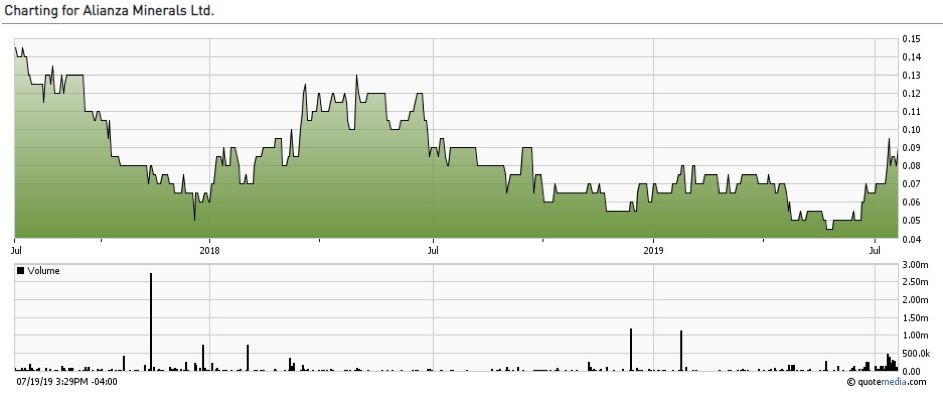
Investors seemed to realize they missed their chances at the financing as the gold price and a modestly following silver price went up, and sentiment started changing for junior explorers. Pretty intense buying in the open markets in the last few weeks saw the share price of Alianza almost fully recover to levels seen the last time in Q2 2018. It now stands at $0.09/share again.


Share price; two-year time frame

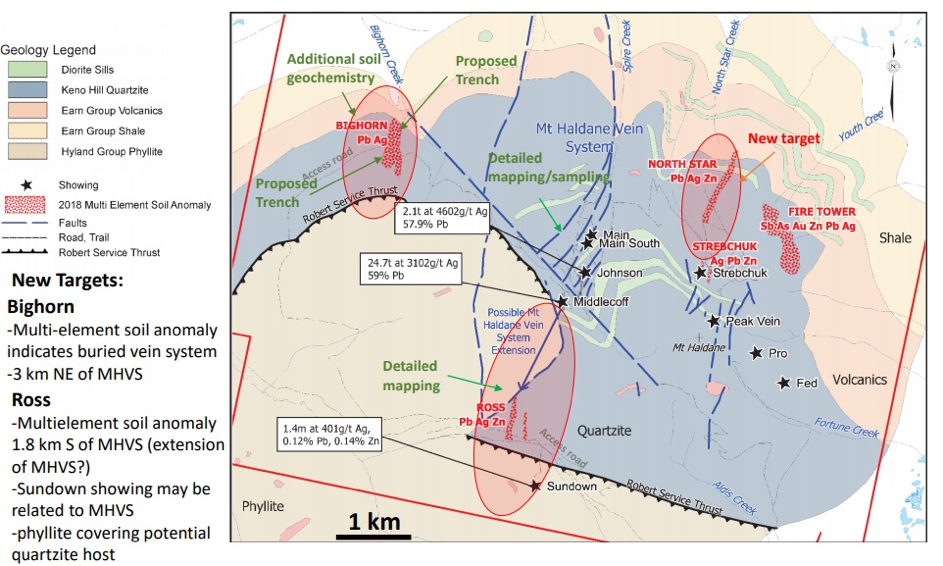
In the meantime, Alianza completed its phase 1 work program at Haldane, consisting of soil geochemical sampling, mapping and trenching. This program was intended to further define drill targets, for which a phase 2 program is slated to start in August. The main focus for management are the new targets like the Bighorn anomaly, and the extensions of known target areas like the Ross and Mount Haldane Veins System targets. According to the news release, a decent amount of work has been completed for phase 1:

“Trenching was completed at the Bighorn and MHVS areas, with three trenches totaling 153 metres excavated at the Bighorn Anomaly and one new trench (West Fault Road trench) completed at the MHVS. Eighty-seven grab and chip samples and 8 soil samples were collected from trenches. Additional soil geochemical sampling was also completed west of the Bighorn Anomaly and several lines of in-fill soil samples were collected at the MHVS where prior sampling widely-spaced or incomplete. A total of 409 soils were collected.”

The locations of phase 1 work are in green:

Too bad they didn’t provide any results in the announcement yet, but analytical results are expected any day now. Historical results were pretty impressive, so I expect some high-grade sampling results here. The main goal was to define controlling structures, and refine the location of the offset fault on the Robert Service Thrust Fault (see low right on the map), which, in turn, results in drill targets, of course. The results for the assays are expected in October/November 2019.

Besides Haldane, Alianza also has the Hochschild Mining Plc (HOC:LSE) joint venture (JV) operational. Hochschild has optioned three Nevada sediment-hosted gold properties from Alianza. The BP and Bellview properties are located in the southern extension of the Carlin Trend, while the Horsethief property represents an off-trend gold target located 26 kilometers east of Pioche, Nevada. The Horsethief property is considered the most prospective by Alianza, and already was the focus of attention. As a reminder, here are the JV terms for the Horsethief and BP properties again:

“1. Horsethief Property
Hochschild can earn a 60% interest in the Horsethief Property by conducting US$5 million in exploration on the property over a 5.5-year period, with a committed minimum expenditure of US$500,000 in the first 18 months and a minimum US$500,000 in each subsequent year. Within 60 days of acceptance of the first option, Hochschild may elect to undertake a second option to earn an additional 10% (total 70%) in the property by funding a further US$5 million in exploration over 3 years (minimum US$500,000 in exploration per year).

3. BP Property
Hochschild can earn a 60% interest in the BP Property by conducting US$2.5 million in exploration on the property over a 4.5-year period, with a committed minimum expenditure of US$100,000 in the first 18 months and a minimum US$500,000 in each subsequent year. Within 60 days of acceptance of the first option, Hochschild may elect to undertake a second option to earn an additional 10% (total 70%) in the property by funding a further US$2.5 million in exploration over 3 years (minimum US$500,000 in exploration per year). Alianza is the operator. Hochschild will reimburse Alianza for 2018 property taxes and permit costs, totalling approximately US$41,600.”

According to this news release published at the end of June, the first phase of exploration work at Horsethief was completed, but I found it to be a bit confusing that no results were published on Horsethief, as they will be at Haldane, for example. According to CEO Weber, this was done because of the nature of the work, which was almost entirely mapping and structural analysis. Some samples were taken, but not very many, and those results will be published when they are recieved.

Drilling for Horsethief will likely be starting up in October/November, and December will most likely see the drilling results subject to approval of the earn in partner Hochschild.

In the same news release it was mentioned that the phase 1 field program on the BP Project had commenced. BP will not see any drilling this year, as the 2019 program is expected to occur in two phases.The first, consisting of mapping and geochemical sampling, will occur in June and July, with a second phase of detailed mapping and sampling, and possibly geophysics, to be completed in September. Results should come in around December as well.

Conclusion

After signing two deals with Hochschild and Coeur Mining Inc. (CDE:NYSE), two household silver names in the space, defining targets and raising another CA$1.1 million, Alianza Minerals is good to go for drilling at their flagship silver Haldane project. This will happen in August, and with precious metals sentiment improving (although silver at a lower pace than gold, but catching up lately), finally there seems to be some kind of sentiment reversal for the good toward silver, which has been very negative since the last bull market, which ended in 2012.

Experts point at very low physical holdings, but as banks have bought large amounts, I only see a manipulated market with no real fundamentals—sentiment drivers at most, as I like to call them. I have no clue where gold and silver will go in the near future, but as long as gold stays above $1,400/ounce and silver above $16/ounce, things are looking slightly brighter nowadays. And, of course, this matters for Alianza, as improved metals sentiment could be a formidable catalyst on good drill results at Haldane. I am watching with interest.

I hope you will find this article interesting and useful, and will have further interest in my upcoming articles on mining. To never miss a thing, please subscribe to my free newsletter on my website http://www.criticalinvestor.eu to get an email notice of my new articles soon after they are published.

The Critical Investor is a newsletter and comprehensive junior mining platform, providing analysis, blog and newsfeed and all sorts of information about junior mining. The editor is an avid and critical junior mining stock investor from The Netherlands, with an MSc background in construction/project management. Number cruncher at project economics, looking for high quality companies, mostly growth/turnaround/catalyst-driven to avoid too much dependence/influence of long-term commodity pricing/market sentiments, and often looking for long-term deep value. Getting burned in the past himself at junior mining investments by following overly positive sources that more often than not avoided to mention (hidden) risks or critical flaws, The Critical Investor learned his lesson well, and goes a few steps further ever since, providing a fresh, more in-depth, and critical vision on things, hence the name.

Sign up for our FREE newsletter at: www.streetwisereports.com/get-news

Disclaimer:

The author is not a registered investment advisor, and currently has a long position in this stock. Alianza Minerals is a sponsoring company. All facts are to be checked by the reader. For more information go to www.alianzaminerals.comand read the company’s profile and official documents on www.sedar.com, also for important risk disclosures. This article is provided for information purposes only, and is not intended to be investment advice of any kind, and all readers are encouraged to do their own due diligence, and talk to their own licensed investment advisors prior to making any investment decisions.

Streetwise Reports Disclosure:
1) The Critical Investor’s disclosures are listed above.
2) The following companies mentioned in the article are sponsors of Streetwise Reports: None. Click here for important disclosures about sponsor fees. The information provided above is for informational purposes only and is not a recommendation to buy or sell any security.
3) Statements and opinions expressed are the opinions of the author and not of Streetwise Reports or its officers. The author is wholly responsible for the validity of the statements. The author was not paid by Streetwise Reports for this article. Streetwise Reports was not paid by the author to publish or syndicate this article. Streetwise Reports requires contributing authors to disclose any shareholdings in, or economic relationships with, companies that they write about. Streetwise Reports relies upon the authors to accurately provide this information and Streetwise Reports has no means of verifying its accuracy.

4) The article does not constitute investment advice. Each reader is encouraged to consult with his or her individual financial professional and any action a reader takes as a result of information presented here is his or her own responsibility. By opening this page, each reader accepts and agrees to Streetwise Reports’ terms of use and full legal disclaimer. This article is not a solicitation for investment. Streetwise Reports does not render general or specific investment advice and the information on Streetwise Reports should not be considered a recommendation to buy or sell any security. Streetwise Reports does not endorse or recommend the business, products, services or securities of any company mentioned on Streetwise Reports.
5) From time to time, Streetwise Reports LLC and its directors, officers, employees or members of their families, as well as persons interviewed for articles and interviews on the site, may have a long or short position in securities mentioned. Directors, officers, employees or members of their immediate families are prohibited from making purchases and/or sales of those securities in the open market or otherwise from the time of the interview or the decision to write an article until three business days after the publication of the interview or article. The foregoing prohibition does not apply to articles that in substance only restate previously published company releases. As of the date of this article, officers and/or employees of Streetwise Reports LLC (including members of their household) own securities of Coeur Mining, a company mentioned in this article.

Charts and graphics provided by the author.

( Companies Mentioned: ANZ:TSX-V,
)

ECB holds rates but flags rate cut in September

By Lukman Otunuga, Research Analyst, ForexTime

Investors who were looking for a quick opportunity to attack the Euro were given the thumps up this afternoon after the European Central Bank (ECB) left the doors wide open for an interest rate cut later this year.

Although interest rates were left unchanged this month, markets are already pricing in an over 80.0% probability of a 10-basis point cut to interest rates in September.

At already a record low of minus 0.4%, investors will wonder whether lower interest rates will be enough to sustain the EU’s economic growth momentum. Mario Draghi has stated that “data point to somewhat weaker growth in Q3 and Q4”. “Significant monetary stimulus” may be required to ensure the EU’s economic conditions do not deteriorate further amid external risks.

The dovish language employed by Mario Draghi does little to hearten global investors over the EU’s economic prospects. Germany’s dismal manufacturing PMI and business confidence data in July also pointed to stuttering growth momentum in Europe’s growth engine, which makes an economic rebound for the EU in the second half of the year increasingly unlikely.

The EURUSD initially tumbled towards 1.110 against the Dollar, setting a new two year low before later rebounding sharply towards 1.1170. Prices have scope to test 1.1200 in the near term before bears re-enter the scene.

Turkish Central Bank joins global easing bandwagon

Less than three weeks following the news that attracted global headlines over the 6 July weekend that former Turkish Central Bank Governor, Murat Cetinkaya had been dismissed, President Erdogan has finally got what he has long called for – lower interest rates in Turkey.

In his first monetary policy meeting as Central Bank Governor, Murat Uysal has not wasted any time whatsoever in cutting interest rates. Interest rates in Turkey have been cut by 4.5% today and although the general consensus was that an interest rate cut would be the outcome of the policy meeting, a 425 basis point move lower is still higher than the 2-3% market expectations.

Although cooling inflation and soft economic fundamentals have provided a valid reason for the central bank to hop aboard the global easing bandwagon, the independence of the central bank will come into question following an interest rate cut that had occurred in just the first monetary policy meeting of the new Governor of the Central Bank of Turkey.

The USDTRY initially punched above 5.7700 before sinking back below 5.6600 as investors digested the rate decision.

With the new Central Bank Governor already stating last week that there is “room to manoeuvre” on monetary policy, this not only keeps the doors open to more interest rates cuts, but will also increase the probability of this being a matter of “when” and not “if” the Central Bank strikes again before the year concludes.

Disclaimer: The content in this article comprises personal opinions and should not be construed as containing personal and/or other investment advice and/or an offer of and/or solicitation for any transactions in financial instruments and/or a guarantee and/or prediction of future performance. ForexTime (FXTM), its affiliates, agents, directors, officers or employees do not guarantee the accuracy, validity, timeliness or completeness, of any information or data made available and assume no liability as to any loss arising from any investment based on the same.


Forex-Time-LogoArticle by ForexTime

ForexTime Ltd (FXTM) is an award winning international online forex broker regulated by CySEC 185/12 www.forextime.com

CATTLE Analysis: Higher Chinese beef demand bullish for live cattle prices

By IFCMarkets

Higher Chinese beef demand bullish for live cattle prices

China’s beef imports jumped in June. Will the LCATTLE price continue rebounding?

China’s beef imports jumped to an all-time high in June. China is the world’s top meat consumer, and pork is the most commonly consumed meat. However, pig inventories plunged 26% in June from a year earlier, decimated by the spread of African swine fever (ASF). The ASF virus is driving up pork prices, with consumers turning to cheaper protein substitutes, including beef. China’s beef purchases in foreign markets rose 63% in June from a year earlier to 160,467 tons. Higher Chinese demand for beef is bullish for live cattle prices.

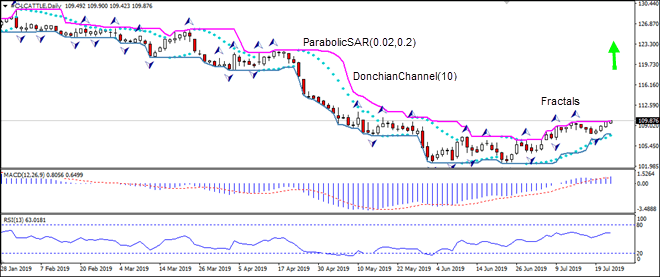
LCATTLE is retracing higher 07/25/2019 Technical Analysis IFC Markets chart

On the daily timeframe the LCATTLE:D1 is retracing higher after hitting 24-month low in the end of May.

  • The Parabolic indicator gives a buy signal.
  • The Donchian channel indicates uptrend: it is narrowing up.
  • The MACD indicator gives a bullish signal: it is above the signal line and the gap is widening.
  • The RSI oscillator is rising but has not reached the overbought zone yet.

We believe the bullish momentum will continue after the price breaches above the upper boundary of Donchian channel at 109.91. This level can be used as an entry point for placing a pending order to buy. The stop loss can be placed below the last fractal low at 107.58. After placing the order, the stop loss is to be moved every day to the next fractal low, following Parabolic signals. Thus, we are changing the expected profit/loss ratio to the breakeven point. If the price meets the stop loss level (107.58) without reaching the order (109.91), we recommend cancelling the order: the market has undergone internal changes which were not taken into account.

Technical Analysis Summary

OrderBuy
Buy stopAbove 109.91
Stop lossBelow 107.58

Market Analysis provided by IFCMarkets

Silver Price Target during the Next Bull Market

By TheTechnicalTraders.com

It is time to explore the details of our Gold vs. Silver ratio research and to start to understand the potential for profits within this move in precious metals.  The first part of our research article highlighted the Gold vs. Silver ratio and why we believe the “reversion process” that is taking place in price could be an incredible opportunity for traders.

Historically, when the Gold vs. Silver ratio reaches an extreme level, and precious metals begin to rally, a reversion within the ratio takes place, which represents a revaluation process for silver prices compared to gold prices.  This typically means that the prices of Silver will accelerate to the upside as the price of gold moves higher – resulting in a decrease in the ratio level.

This reversion process related to precious metals pricing is an opportunity for traders to take advantage of an increased pricing advantage to generate profits.

For every drop of 5.0 points in the gold/silver ratio, the price of Silver should increase by 6.5% to 7.5% to the price of Gold.

This research is based on our belief that Gold and Silver will continue to rally and potentially enter a parabolic upside price advance soon.  If this takes place and precious metals begin to skyrocket higher, the ratio level will react in a hyperactive “reversion process” where Silver may move higher at a rate that is substantially faster than Gold.  This is the process that we are exploring and our researchers are attempting to shed some insight into this event.

I believe a reversion process has already begun to take place within the precious metals market.  We believe this reversion process is about to explode as a dramatic revaluation event unfolds over the next 12+ months.  This process will become more evident to traders as the price of Gold continues to rally towards the $1750+ level and as the price of Silver explodes higher in larger and larger advances.

Gold/Silver/US Dollar ratio chart

This Gold/Silver/US Dollar ratio chart is the basis of our analysis for the reversion process event and the associated revaluation event.  Our previous analysis suggests Gold will attempt a move to levels above $1650 to $1700 on the next breakout move higher.  This next upside price move will expose the price reversion event for all traders to witness and we have mapped out the expected Silver price advantage for all traders going forward.

Gold/Silver Ratio – Silver Price vs Ratio Level

We put together this reference table to assist all traders in understanding just how important this move could be to them.  This reference table shows the current Gold/Silver price levels (in GREY) as the ratio levels change from 88 to lower levels.

If the price of Gold were to stay at the same $1426 level while Silver rallied to prompt an 82 or 77 ratio level, the price of silver would move from the current price of $16.19 to $17.39 or $18.52 in order to reflect this decreased ratio level.  That represents a 7.5% to 14.3% price increase.

Yet if the price of Gold advances to $1650 or $1750 while the ratio level drops to the 82 or 77 ratio level (because Silver advances fast than Gold), then the price of Silver would move from the current price of $16.19 to $20.12 to $22.73.  That move represents a 24.2% to 40.3% price increase in Silver when Gold increased only 15.7% to 22.7%.

What If Silver Advances Quicker Than Gold?

If Silver advances even faster than our “what if” scenario, above, and Gold continues to advance as we expect, the increased price reversion process taking place in Silver as a process of this revaluation event could result in a 70% to 110% fast price advance in Silver than the price advance that takes place in Gold.

We believe the next upside price leg in Silver will target $19.50 to $22.75.  This target range supports the highlighted area on our Ratio table (below).  In other words, we believe the ratio level will attempt to quickly move toward the 70 to 77 level as Gold prices rally over the next few months.  This would push silver up into the $22.50 to $25 price level very quickly.

What If Gold Rallies Faster Than Silver?

If Gold were to rally above $1950 on an extended upside price advance before August or September, we believe the reversion process would become extremely hyperactive in nature and the price of Silver could push well above $29~34 per ounce – may be even higher.

This declining ratio level acts as a turbo-boost for the price of Silver as Gold continues to advance.  The recent rotation to the downside suggests the ratio relationship between Gold and Silver has already stated a reversion process – the only question is “where will it end?”.  Our researchers believe it will stop where it stops and we believe the 65 level on the Ratio chart is just the initial target for this first upside leg.

Imagine where Silver could go if the ratio level fell to levels below 40 and gold rallied to $2500 or more?  Ok, stop imagining and take a look at this second extended ratio table.

Pay attention to the fact that Silver could rally more than 300% if Gold moves up above $1750 and the Gold/Silver ratio drops below the 55 level.  If Gold were to continue to rally and the Gold/Silver ratio continued to fall, Silver could rally well above $50 over the long run.

Silver Price Range As Gold/Silver Ratio Move To the Average

We’ve attempted to graph the ranges of the expected move in Silver into segments based on the Gold/Silver ratio to assist traders in understanding just how powerful this setup really is.  Imagine what it would take for Gold to move up to levels above $1750 (which is our expected target for the next leg higher) and for Silver to rally into the 55 to 65 ratio level.  If that happens, the expected target price for Silver would be somewhere between $30 and $40 – more than 100% higher than the current price of Silver.

If you think $50 is unimaginable or unrealistic, we’ve just shown you why it is possible these levels could be reached before the end of 2019 or in 2020.  If you have not grasped the reality of what is likely to unfold over the next 6 to 12+ months in the global markets and that precious metals are the setup of the decade, then pay attention to the fact that gold and silver are poised for moves ranging from 40% to 240% over the next 12+ months depending on the scale and scope of this move.

Our current objectives for the ratio levels are still 55 to 65 within this next move higher where Gold will target $1750.  Beyond that level, we’ll have to update you as the price continues to explore new highs.

CONCLUDING THOUGHTS:

In short, don’t miss the trade of the decade. These opportunities for skilled technical traders over the next 16+ months is incredible.  Huge price swings, incredible trends, big rotations and we could see nearly 300%+ profits to be had if you know what to trade and when.  These types of opportunities are perfect for skilled technical traders like us and we want to help you prepare for and trade these opportunities.

This bear market for stocks and the new bull market for metals has been a long time coming, but finally, almost all the signs are showing that it’s about to start. As a technical analyst since 1997 having lost a fortune and making a fortune from bull and bear markets I have a good understanding of how to best attack the market during its various stages.

Be prepared for these incredible price swings before they happen and learn how you can identify and trade these fantastic trading opportunities in 2019, 2020, and beyond with our  Wealth Building & Global Financial Reset Newsletter.  You won’t want to miss this big move, folks.  As you can see from our research, everything has been setting up for this move for many months – most traders/investors have simply not been looking for it.

Join me with a 1 or 2-year subscription to lock in the lowest rate possible and ride my coattails as I navigate these financial market and build wealth while others lose nearly everything they own during the next financial crisis. Join Now and Get a 1oz Silver Round or Gold Bar Shipped To You Free.

I can tell you that huge moves are about to start unfolding not only in currencies, metals, or stocks but globally and some of these supercycles are going to last years. A gentleman by the name of Brad Matheny goes into great detail with his simple to understand charts and guide about this. His financial market research is one of a kind and a real eye-opener. 2020 Cycles – The Greatest Opportunity Of Your Lifetime

As a technical analysis and trader since 1997, I have been through a few bull/bear market cycles. I believe I have a good pulse on the market and timing key turning points for both short-term swing trading and long-term investment capital. The opportunities are massive/life-changing if handled properly.

FREE GOLD & SILVER WITH MEMBERSHIPS

Kill two birds with one stone and subscribe for two years to get your FREE PRECIOUS METAL and get enough trades to profit through the next metals bull market and financial crisis!

Chris Vermeulen – TheTechnicalTraders.com