Large precious metals speculators cut back on their bearish net positions in the Copper futures markets again this week, according to the latest Commitment of Traders (COT) data released by the Commodity Futures Trading Commission (CFTC) on Friday.
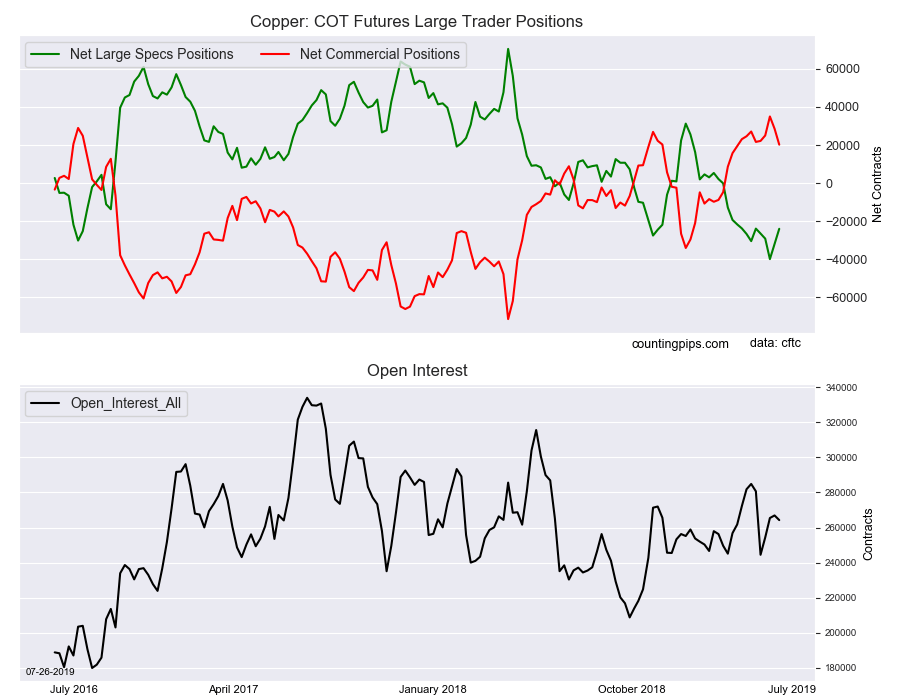
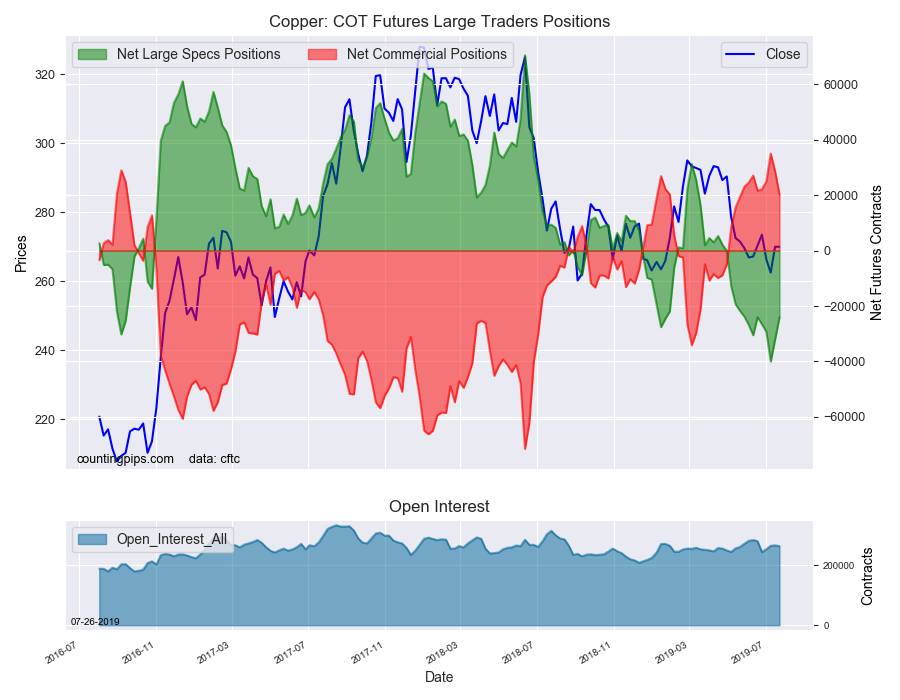
The non-commercial futures contracts of Copper futures, traded by large speculators and hedge funds, totaled a net position of -24,049 contracts in the data reported through Tuesday July 23rd. This was a weekly change of 7,894 net contracts from the previous week which had a total of -31,943 net contracts.
The week’s net position was the result of the gross bullish position (longs) rising by 2,742 contracts (to a weekly total of 76,464 contracts) and combined with the gross bearish position (shorts) which dropped by -5,152 contracts for the week (to a total of 100,513 contracts).
Starting April 23rd, speculators went into full bearish mode and pushed their net positions lower and lower for eleven out of twelve weeks to the most bearish level since June of 2016. The last two weeks has seen speculators take their foot off the gas as bearish positions have declined by a total of 15,938 contracts over that period. The current standing remains bearish but is below the -30,000 net contract level for the first time in three weeks.
Copper Commercial Positions:
The commercial traders position, hedgers or traders engaged in buying and selling for business purposes, totaled a net position of 20,202 contracts on the week. This was a weekly loss of -8,375 contracts from the total net of 28,577 contracts reported the previous week.
Copper Futures:
Over the same weekly reporting time-frame, from Tuesday to Tuesday, the Copper Futures (Front Month) closed at approximately $270.0 which was virtually unchanged from the previous closing week, according to unofficial market data.
*COT Report: The COT data, released weekly to the public each Friday, is updated through the most recent Tuesday (data is 3 days old) and shows a quick view of how large speculators or non-commercials (for-profit traders) as well as the commercial traders (hedgers & traders for business purposes) were positioned in the futures markets.
The CFTC categorizes trader positions according to commercial hedgers (traders who use futures contracts for hedging as part of the business), non-commercials (large traders who speculate to realize trading profits) and nonreportable traders (usually small traders/speculators).
Welcome to this week’s Market Wrap Podcast, I’m Mike Gleason.
Coming up we continue our discussion on the importance of sound money — and we are going to check in on the progress at both the state and federal levels. Jp Cortez of the Sound Money Defense League joins me to update us about sound money bills across the nation and also shares his group’s sound money scorecard — revealing which states have policies that favor sound money and which states are simply abysmal. So, stick around for my very interesting conversation with Jp Cortez, coming up after this week’s market update.
As investors look ahead to a likely rate cut next week by the Federal Reserve, gold and silver markets are consolidating their recent gains. The gold market is giving back 0.4% this week, bringing spot prices to $1,422 an ounce. Silver, on the other hand, is showing significant outperformance for the second straight week – up 1.2% since last Friday’s close to trade at $16.49, and the fact that it hasn’t broken down to this point after last week’s rally should be viewed quite positively.
Turning to platinum, the catalytic metal registers a weekly gain of 2.1% to come in at $867. And finally, palladium is headed higher by 1.3% this week to trade at $1,533 per ounce as of this Friday morning recording.
A big move in metals markets could come after the Fed’s policy meeting next Wednesday. Of course, the magnitude and direction of the move will depend on what Jerome Powell and company do and say.
Central bankers are under immense political pressure to lower interest rates and resume purchases of government bonds. A recent downturn in manufacturing and home sales data may well give them cover to roll out new stimulus even as the stock market sits near a record high.
It remains to be seen whether stocks will be the primary beneficiaries of Fed easing. If investors fear the Fed is inflating to try to get out in front of an oncoming recession, they may rotate out of economically sensitive equities and seek inflation protection in hard asset related investments.
One thing that is certain to continue inflating is government debt. On Monday, President Donald Trump announced he reached a grand compromise with Senate Majority Leader Mitch McConnell and House Speaker Nancy Pelosi on the federal budget.
In reality, though, neither side made any meaningful compromises when it comes to spending restraint. Instead, Republicans and Democrats came together to compromise the nation’s fiscal health by blowing through previously installed spending caps and raising the debt limit. That paves the way for another $320 billion in deficit spending.
Under the deal, the debt ceiling will be suspended until July 2021 – effectively taking it off the table as a campaign issue in 2020.
Many Republicans cheered increases in military spending while Democrats celebrated increases in pet social programs that the White House had once tried to put on the chopping block. The budget President Trump originally sent to Congress contained numerous cuts to discretionary programs. The proposed cuts weren’t enough to balance the budget, but they were symbolically important to fiscal conservatives.
Now they are left with nothing to latch onto except perhaps the faint hope that if he wins a second term, Trump would engage in a budget fight with Congress and finally deliver on his promise to drain the swamp.
Some Republicans think the time to fight against wasteful deficit spending is now. The House Freedom Caucus is opposing the budget deal, as is Kentucky Senator Rand Paul.
For most members of Congress, though, the political price of standing in the way of spending is simply too great.
When Senator Paul insisted recently that that funding for 9-11 first responders be offset by spending reductions elsewhere in the budget, he got viciously attacked from all sides. The attacks were amplified by liberal comedian Jon Stewart and the mainstream media. At the end of the day, only one other Senator supported Rand Paul’s lonely campaign to stop new spending from being added to the national credit card.
Ironically, the budget deal that President Trump now backs represents exactly the sort of “bad deal” he railed against on the 2016 campaign trail.
Donald Trump: We have $19 trillion dollars in debt going very soon to $21 trillion because we made a bad budget deal. We have got a mess in this country. We owe $19 trillion. We owe $19 trillion as a country, and we’re going to knock it down, and we’re going to bring it down bigly and quickly. We’re going to bring jobs back. We’re going to bring business back. We’re going to stop our deficits. We’re going to stop our deficits. We’re going to do it very quickly.
Campaign Audience: How? How? How? Donald Trump: Oh, how? Are you ready? Number one, we have tremendous cutting to do.
Well, the national debt has since gone from $19 to over $22 trillion. Instead of dealing with it directly by cutting spending as candidate Trump had suggested, President Trump now aims to reduce the cost of servicing the debt. He is pushing the Fed to lower interest rates and resume Quantitative Easing. He is also pushing for a weaker dollar to diminish the real value of the trillions we owe to ourselves and to foreign governments including China.
Republicans defenders of the deficit-expanding budget deal say it will help rebuild our military and enhance national security. But at some point, the skyrocketing national debt will itself become a national security risk to America.
Investment banking analysts at JPMorgan recently issued a report warning that the U.S. dollar could soon lose its world reserve currency status. Trump administration officials appear to be worried about this prospect as well. They fear adversarial countries such as Russia, Iran, and Venezuela will successfully circumvent U.S. sanctions using alternative trading channels such as Instex.
In the meantime, Russia and China continue to add steadily to their gold reserves.
If the dollar standard falls, then gold holders will be in a far more secure position than those that hold only promises issued by governments.
Well now for more on the state of money — more specifically, the only money mentioned in the U.S. Constitution, gold and silver — let’s get right to this week’s exclusive interview.
Mike Gleason: It is my privilege, now, to welcome in Jp Cortez, with the Sound Money Defense League, a non-partisan national public policy organization working to restore sound money on the state and federal level.
Jp is a proponent of, and has studied in the Austrian School of Economics, and his role at SMDL as policy director, has him regularly testifying at legislative hearings and speaking at various events throughout the country.
His articles and analysis have appeared in many national news publications, including The Washington Examiner, Huffington Post, Mises Institute, Foundation for Economic Education, and more, and he’s a frequent guest on various podcasts and national radio shows to talk about the importance of sound money legislation. And it’s a real pleasure to have him on with us today.
Jp, thanks for the time and welcome.
Jp Cortez: Mike, I appreciate you having me on. Thank you so much.
Mike Gleason: Well, Jp, as we start out today, let’s set the stage here and first have you explain why this idea of sound money is important in the first place, and then, as a follow up to that, what kind of policies would help restore and reinforce sound money? Let’s begin with that.
Jp Cortez: Sure. In fact, actually, I’d like to take a step back from there. I think it’s important to define sound money and kind of understand what it is to really understand the implications that it has.
So sound money, just to begin, a cursory definition is money that isn’t really prone to severe appreciation or depreciation in the purses in power of the money over the long term. And this is a function that’s aided by the self-correcting processes that a free market has. It’s a money that has been subject to competition and to market forces, over a long enough timeline that we see, and we collectively understand that it’s a money that holds up.
And so it’s important because historically, now that we know what sound money is, historically we can seize it, it’s the linchpin of a prosperous society. Throughout history, if you look back, you can go back to the Roman Empire and see the debasing of money is not something new to the United States. Dollar devaluation has a long and storied history.
And so understandably, Roman soldiers were getting upset when their government was issuing less pure coins to fund the empire that they’d created. And so I think sound money and the importance of sound money can really be boiled down into two value propositions.
The first is that, sound money reduces uncertainty. The money that we choose has really, really important impacts on how societies, as a whole function, the ways societies spend, the way they save, the way they invest. The entire process from capital accumulation to capital investment is very dependent, or at least strongly influenced on the money that we use.
So, by moving to a sound money, we find that uncertainty is reduced, and entrepreneurs and consumer and investors can better and more accurately react and really take account of the signals that are being provided by the market.
The second kind of important point of sound money is that it acts as a safeguard against big government. So, on top of, and aside from any sort of economic implications that the money you choose may have, sound money acts as a safeguard against big government. I like to imagine sound money as sort of an equal opportunity money. It’s very inclusive in that we all have things about the government we don’t like, whether it’s massive wars, or domestic spying, or immigration, whatever it may be, there are things that the government does that we don’t like.
And without sound money in a monetary system like the one we have today, the government doesn’t need consent from its people to do these things that we don’t like. They can just print the money. But under sound money, a government has to turn to direct taxation to fund wars, to fund ineffective policies on domestic drug use, or illegal domestic spying, or constitutional, or rather unconstitutional wars.
Mike Gleason: Yeah, and obviously there’s taxation a couple of different ways. One is the old fashion way where they raise our taxes, and the other one is that stealth tax, the inflation tax which happens through printing all that money that the Treasury Department’s doing to pay for all this, like you mentioned.
Now I know that the Sound Money Defense League has released a Sound Money Index, which scores each state and assess how well they’re doing when it comes to the sound money policy. And that index is also available at MoneyMetals.com, as well, by the way.
So, talk about the state of the states, Jp. What was the criteria you used there? And give us a run down on some of the best and worst states for sound money.
Jp Cortez: Mike, if you don’t mind, I’d like to go back. You asked a question about what policies would help send sound money or help facilitate sound money in the United States.
Real quick, I think mostly the biggest issue here is the taxes – the taxation around money, sales tax and capital gains tax, and all of these things that serve as a disincentive to using sound money every day. In a lot of ways, in 1971 you could say that the American dollar hit an iceberg, with the closing of the Gold Window, with Nixon’s actions, money hit an iceberg. And there are very few lifeboats available to people to get off this sinking ship. And to tax money is to throw shackles on one of the few lifeboats that is available to move away from an asset that we know is moribund, that we know is depreciating, and that, historically, we know eventually will die as all fiat currencies have.
So, back to the Sound Money Index. Yeah, the Sound Money Index is a really cool project that we put together. It’s the first of its kind and we ranked all 50 states. At least, in 2018, we ranked all 50 states using nine specific indicators, nine points of criteria to determine which states offer the most pro sound money environments in the country.
So, to that end, last year we had Utah, Wyoming, and Texas. Those were our top three. They had recently passed laws. The Wyoming Sound Money Act eliminated all taxation liability on gold and silver in Wyoming. Arizona had recently passed a capital gains exemption, exempting gold and silver from capital gains. Utah, of course, in 2011 had the original Sound Money Act.
And so, this year it’s exciting to see the renaissance, the revolution of sound money continue on the state level. This year in West Virginia, we had two bills that were introduced, and fortunately I’m happy to say that gold and silver are no longer taxed in West Virginia anymore.
In Nebraska and Washington, tax hungry legislators over there tried to introduce bills to impose taxes where exemptions had already been passed. I’m happy to say that, because of grassroots efforts, and because of in-state dealers and other coming in to really voice their concerns, those efforts were squashed.
Unfortunately in Ohio, we suffered a defeat. It’s kind of a strange dynamic that’s playing out there. Not too long ago, there’s still a cloud hanging over Ohio of a swindler, a rare coin “Investor” who swindled Ohio taxpayers out of 50 million dollars in taxpayer money. And so, Ohio had a bad taste in its mouth, it was an environment that was sort of against sound money to begin with, and it was an uphill battle. But we look forward to bringing, hopefully new legislation next year and helping to convince and really show the Ohio legislature that they made a big mistake. And the people most harmed by their mistakes, unfortunately are the poorest… the savers, those on fixed income, retirees, the people who can’t afford to hedge the loss of their purchasing power.
Mike Gleason: You mentioned Utah and Wyoming and Texas as your top ones there on the Sound Money Index. How about some of those bottom states?
Jp Cortez: Ah well, at the bottom, the 2019 Sound Money Index hasn’t come out yet, but the 2018 Sound Money Index has six states with a zero score. That is Arkansas, Maine, Kentucky, New Jersey, West Virginia, and Vermont.
And so part of the reason I’m so fired up about sound money, and part of the reason that the path looks clearer than it ever has before to restoring sound money, is that just these here, just in these bottom three states, three of these states this past session introduced legislation to remove taxes on sound money. Arkansas, Maine, and West Virginia, all three introduced legislation.
Unfortunately not all of them passed, but West Virginia is making big strides, and state policy is more of an incremental game and it’s laying the foundation to continue to build on this in future sessions.
Mike Gleason: Yeah, certainly a lot going on at the legislative level over the last couple of years, which is one of the big reasons why we wanted to have you on to kind of update us on all this.
Now what about federally, Jp? We’ve all heard Trump make some pro sound money comments, although he did a little more of that as Candidate Trump than he has as President Trump. What’s with the situation at the federal level, what kind of legislation or executive action can be pursued there?
Jp Cortez: Yeah, it was really exciting to hear Trump, and Pence, talk so favorably about a gold standard while they were on a campaign trail. Unfortunately that’s simmered down a little bit, but with the recent news about Trump’s plan to nominate Judy Shelton to the Fed, we’re seeing sound money kind of make an uptick again here, at least in mainstream media.
So, it’s exciting, and there’s a lot going on here aside from the potential nomination. Just generally, the IRS a while ago, unilaterally decided that gold and silver are collectibles, that is to say there’s no difference from gold and silver to a Beanie Baby, or a baseball card, or something like that. So, at the top level, one of the easiest things that could happen at the federal level is for the IRS to just decide either, A, we are not going to tax gold and silver at a discriminatorily high 28%. Another option is just to stop taxing at all, this classification is wrong.
That’s probably all that could happen without legislation, but fortunately there are a few sound money allies in Congress that have been fighting this fight. Just this year, Alex Mooney, Representative Alex Mooney from West Virginia has introduced two pieces of legislation. One, to very broadly remove taxation on gold and silver coins, rounds, and ingots, foreign and domestic, which would be a very broad and great step forward for sound money. Representative Mooney also introduced an Audit the Gold bill. The bill that calls for a full assay, inventory and audit of all the U.S.’s gold holdings and any encumbrances on that gold that might exist. And then it calls for subsequent audits ever five years too.
So, our last audit was mostly for show, and it was in the 1950s, and we haven’t really seen or heard much about America’s gold since then. So, it’s great to have Representative Mooney on the front lines, calling for an audit on this stuff.
Mike Gleason: Yeah hopefully he can get some more allies there in congress. These are certainly uphill battles, and we would love to see him get some others to join him in those efforts.
Well, as we begin to wrap up here, Jp, any other comments or anything else you want to share with our audience, or maybe something else that we haven’t touched on yet?
Jp Cortez: Yeah, great. I’d just like to talk about the Sound Money Scholarship really quick, Mike. As you know, the Sound Money Defense League in conjunction with Money Metals Exchange offers and awards the Sound Money Scholarship every year. We’ve been doing this since 2016, we offer money for deserving students, high school seniors, undergrads and graduate students who have shown a very acute understanding of the problems in economics that we’re faced with today.
So, every year we award five scholarships. Two to undergrad and high school students, and then two to graduate students. And then we also have People’s Choice Award where we get on social media and try to spread the word as much as we can about the essays that these incredible students are writing.
These are questions, essay prompts, that are on the Federal Reserve, and money and (the) gold standard. We have a Blue Ribbon panel of judges – Austrian economists, professors, pundits – who’ll come in and they’ll grade the essays, they’ll judge the essays and determine the winner.
So, I encourage anyone, any students, if you know any students, please let them know about the scholarship, it’s an awesome opportunity, it’s a great way to get published. And the deadline this year is September 30th and you can look on Money Metals website or Sound Money’s website for more information.
Mike Gleason: Yeah, the only scholarship of its kind, a gold-backed scholarship out there, it’s a great thing, and we’re happy to partner with the Sound Money Defense League, and we certainly urge anyone to take advantage of that and let’s see if we can give away some more scholarships this year to some very deserving people.
Well, keep up the great work, Jp, it’s a vitally important cause and we appreciate the time very much, and I look forward to having you on again in the future to update us on a lot of what’s going on these legislative fronts, because I know you’re following it and are involved like nobody else when it comes to the sound money related bills. We wish you continued success in those efforts and, thanks again for the time, take care.
Jp Cortez: Thanks a lot, Mike. I look forward to coming back with some good news.
Mike Gleason: Absolutely. Well, that will do it for this week, thanks again to Jp Cortez, policy director at the Sound Money Defense League. For more information or to follow these ongoing sound money efforts, or to even make a donation to help support the mission of sound money advancement, please visit SoundMoneyDefense.org. And in terms of the previously mentioned Gold-Backed Scholarship, you can find that on the Sound Money site or you can also check out details on that at MoneyMetals.com/scholarship.
Mike Gleason: And be sure to check back here next Friday for our next Weekly Market Wrap Podcast. Until then, this has been Mike Gleason with Money Metals Exchange, thanks for listening, and have a great weekend everybody.
The Money Metals News Service provides market news and crisp commentary for investors following the precious metals markets.
Precious metals investors are once again excited about silver as the price has shot up 10% in the past month. Not only has silver experienced some nice gains in July, but it has also broken out above its multi-year Symmetrical Triangle Formation. But, what is the current silver market price action telling us about where the shiny metal goes from here? While we have seen some nice daily moves in the silver price, it seems to be peaking around that $16.60 area for the past week. Currently, the silver price is trading at $16.62 at midday.
Furthermore, the silver price has outperformed gold, pulling the Gold-Silver Ratio down from 95/1 at the beginning of July to 85/1 today. Which means, in just a few short weeks, one ounce of gold can now only buy 85 ounces of silver compared to 95 oz two weeks ago. Talk about a significant change in the Gold-Silver Ratio in a relatively short period of time.
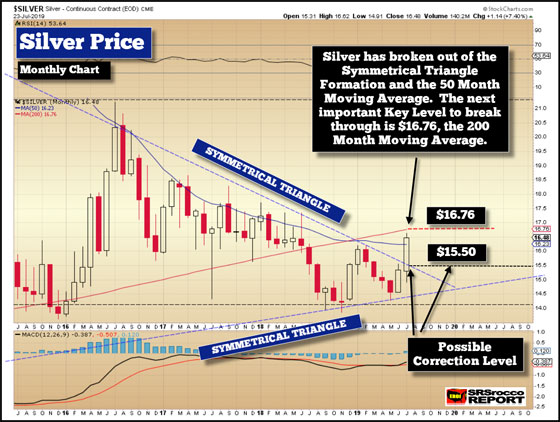
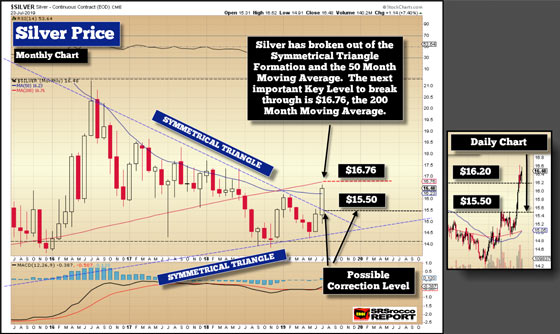
So, where does the silver price go from here?? Good question. Well, if we look at the following Long-Term Monthly chart of silver, we can see that it has broken out of the Symmetrical Triangle Formation. It has also moved nicely above the 50 Month Moving Average (MMA – BLUE LINE) at $16.23:
Each candlestick in the chart above represents one month’s worth of trading. As we can see, the silver price has surpassed the 50 MMA and is attempting to reach the next important key level, the 200 MMA (RED LINE) at $16.76. I would bet that the silver price will at LEAST touch that $16.76 level, or go possibly higher before any correction takes place. Why? Because, it wouldn’t be unusual for silver to pause for a moment and correct back down to the $15.50 before going higher.
However, that $15.50 Level is critical for the silver price for it to remain in a Bullish Trend because that is the top of the Symmetrical Triangle Formation line. I have seen this day in a day out in the markets. A large percentage of stocks will go back and test (touch) the breakout area before moving higher. Of course, it’s not a guarantee that this will occur. Especially how crazy the markets have become with the Fed possibly cutting rates next week, but we shouldn’t view it as unfavorable if it does happen.
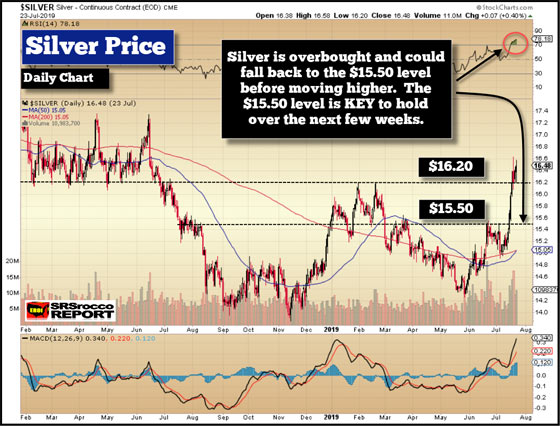
Now, if we look at the Daily Silver Chart, the $15.50 level is also a key support area:
Please understand, I am NOT SAYING the silver price will go back down to the $15.50 level, but if it did, it wouldn’t be unusual for traders. That being said, the $16.20 level is also another SUPPORT-RESISTANCE LEVEL. From Feb-Jun 2018, $16.20 was a support level, but once it fell below that, it became a resistance level. We can see this in the silver price action Jan-Feb 2019. The silver price touched it twice but did not go above it. Furthermore, the Daily chart RSI (top of the chart) shows that silver is overbought. But again, it could go even higher.
So, you see, these TECHNICAL LEVELS are important guidelines for traders, hedge funds, investors, and institutions. And, it is no coincidence that the $15.50 level in the Daily Chart was also a Key Level in the Monthly Chart via the Symmetrical Triangle Formation:
As I have stated several times, a BREAKOUT occurs when the price finally pushes through a critical resistance level in a big way. So, when silver broke out of the upper Symmetrical Triangle Line in the monthly chart, it also broke above the very same $15.50 resistance level on the daily chart. However, BREAKOUTS tend to be more impressive when they do so from longer-term chart formations.
It will be interesting to see how the silver price performs over the next 7-10 days, before and after the Fed FOMC meeting on July 30-31st. If the Fed announces a 50 basis point rate cut during the FOMC meeting, we could see the silver price breakout significantly above the 200 MMA of $16.76. That is if the price remains close to this level for the next week.
There is a lot more I will be explaining about the Silver Price in my upcoming Youtube video this weekend. If you haven’t subscribed to my SRSrocco Report Youtube Channel, please do so at the link below.
The Money Metals News Service provides market news and crisp commentary for investors following the precious metals markets.
Azerbaijan’s central bank lowered its benchmark interest rate for the 9th time since last February and said the trend toward a neutral monetary policy would continue as long as inflation is expected to remain within the bank’s target. The Central Bank of the Republic of Azerbaijan (CBA) cut its discount rate by another 25 basis points to 8.25 percent and has now cut it by a total of 675 points since February 2018. It is CBA’s fifth rate cut this year, with the rate cut 150 basis points, as inflation continues to rise toward the bank’s target of 4.0 percent, plus/minus 2 percentage points. Azerbaijan’s inflation rate rose to 2.5 percent in June, continuing to accelerate from 1.7 percent in January on higher food prices, and CBA said inflation is expected to reach the upper part of its target range by the end of the year due to expanding domestic demand. Azerbaijan’s inflation rate has come down faster than expected since mid-2017 when it hit 14 percent, triggering CBA’s flurry of rate cuts and the inflation target for 2019 was also lowered to 4.0 percent from an earlier 6-8 percent.
CBA said monetary policy decisions during the remainder of the year will be based on the forecast for inflation, the balance of internal and external risks, especially how fiscal stimulus affects prices.
Helped by the rise in oil prices earlier this year Azerbaijan’s trade surplus has widened, boosting its currency reserves to US$49.1 billion, and both oil and non-oil exports are higher.
Last month the International Monetary Fund forecast Azerbaijan’s economic growth would rise to 2.7 percent this year from 1.4 percent last year, with measures, such as higher wages, pensions and social assistance, providing economic stimulus and protecting the most vulnerable in society.
The Southern Gas Corridor natural gas pipeline, a European initiative to reduce its reliance on Russian gas, will become operational this year, boosting Azerbaijan’s output and the fiscal surplus that is seen rising to 5.8 percent of gross domestic product.
Azerbaijan’s current account surplus is also seen exceeding 10 percent of GDP in the near term, IMF said, calling on continued fiscal consolidation to save oil income for future generations.
Azerbaijan’s economy grew 3.0 percent in the first quarter of this year, up from 1.4 percent in the previous quarter.
Note: This overview has an informative and tutorial character and is published for free. All the data, included in the overview, are received from public sources, recognized as more or less reliable. Moreover, there is no guarantee that the indicated information is full and precise. Overviews are not updated. The whole information in each overview, including opinion, indicators, charts and anything else, is provided only for familiarization purposes and is not financial advice or а recommendation. The whole text and its any part, as well as the charts cannot be considered as an offer to make a deal with any asset. IFC Markets and its employees under any circumstances are not liable for any action taken by someone else during or after reading the overview.
Daniel Carlson of Tailwinds Research discusses a major collaboration with the Cleveland Clinic for his top pick stock of the year.
In January we proclaimed Anixa Biosciences Inc. (ANIX:NASDAQ) to be Tailwinds’ stock of the year. This designation was awarded due to potential major milestones in both the detection and the curing of cancer. With its Cchek prostate diagnostic shooting for CLIA approval in the next few months and with its CAR-T ovarian cancer therapeutic getting closer to an IND (investigational new drug) filing), ANIX is a stock with the possibility of a very rewarding second half in store for investors.
However, as much as we were already eagerly anticipating the next few months, with the announcement of the licensing of a potential breast cancer vaccine, Anixa has taken it one step further. By broadening its platform into cancer prevention, the company has proven the unique value and attractiveness of its platform and given investors another reason to be excited for the future. Dr. Amit Kumar and his team have demonstrated again that the company’s model of licensing cancer programs, outsourcing development, and keeping overhead and burn at a low level makes Anixa an attractive partner for clinicians while providing shareholders potential blockbusters without having to bear the typically significant development costs associated with product development.
Why did Angelina Jolie get a double mastectomy?
In a day and age where it seems that physical appearances are more valued than ever, particularly around the Hollywood elite, I remember finding it very interesting that one of the leading beauties of the big screen underwent breast removal when she didn’t have cancer! What would cause someone to undergo voluntary surgery to pro-actively fight breast cancer? Isn’t breast cancer an area in which we have made significant strides in terms of both detection and cures?
Indeed, we have come a long way in battling cancer, however, like most diseases, cancer comes in many different forms and varieties. In the case of breast cancer, we have made great strides towards treating most strains. However, there exists a form of breast cancer called Triple Negative Breast Cancer (TNBC) that remains an elusive target to treatments. This cancer is particularly difficult to fight and is the deadliest form of breast cancer. It’s also not that uncommon, as 1525% of breast cancer patients have TNBC. This disease remains a big problem.
TNBC is frequently found in people who carry a mutation in their BRCA1 gene. I guess that’s the “good news” about this cancer; it’s possible through genetic testing to know if someone has a natural propensity to develop the cancer. Angelina Jolie fell into this category. With an 87% chance of developing TNBC, she opted for the radical move of preemptive surgery. Several members of her family had died from TNBC breast cancer, and most likely they carried the mutations, which were passed on the Ms. Jolie.
Exciting Pre-clinical Data in TNBC Prevention
The bad news is that, despite great efforts, there hasn’t been the success in treating TNBC as has been seen in other breast cancers. On the other hand, there has recently been a lot of good news in pre-clinical work on developing a vaccine for TNBC. Most significant here is the work of Dr. Tuohy at the Cleveland Clinic.
In his work, Dr. Tuohy has targeted the α-Lactalbumin protein. Here’s an excerpt from an abstract he has published that explains why this represents such a great potential target.
“α-Lactalbumin’s expression in normal tissues is confined exclusively to the breast during late pregnancy and lactation, but is also expressed in the vast majority of human triple negative breast cancers (TNBC)the most aggressive and lethal form of breast cancer and the predominant form that occurs in women at high genetic risk including those with mutated BRCA1 genes.”
Dr. Tuohy has been working on a cancer vaccine since 2002. His most recent efforts have culminated in very successful animal studies. By injecting mice with a vaccine, mice that have been bred such that they are guaranteed to develop breast cancer, Dr. Tuohy has shown an astounding success rate in preventing breast cancer. Fully one hundred percent of the mice that would have all normally gotten breast cancer never got the disease. A complete success in any program is virtually unheard of. Of course, the control mice, that were not treated with the vaccine, all contracted breast cancer.
Needless to say, these phenomenal results haven’t gone unnoticed. Through a Department of Defense program (believe it or not, the DoD is one of the biggest funders of breast cancer research, having spent $3.3 billion in a program started in 1992), Dr. Tuohy and the Cleveland Clinic have received a $6.2 million grant to develop the vaccine. This is enough funding to take the program through two phase 1 clinical trials.
Why Anixa?
With the addition of a potentially blockbuster vaccine for Triple Negative Breast Cancer, Anixa has pulled off its own triple play: it is working on products in cancer detection, treatment and now prevention. On the surface, this seems like a lot on its plate. When you realize that Anixa has six employees, it begs the questions of why would the Cleveland Clinic partner with Anixa and how does Anixa hope to move all three products forward?
The answer lies in the company’s unique business model. Dr. Kumar, Anixa’s CEO, has focused his attention on an asset light model since he joined the company just two years ago. In an interview with Tailwinds in late 2018, here’s what he had to say about this business model as it relates to its CAR-T program.
“We are working with collaborators at every step By working with our current collaborators and others in the future we can potentially create an asset that is valued at factors of 100 or even 1000 times as much as we invest. So far, we and our collaborators have taken a really innovative science project almost to the starting line of clinical trials, all in less than one year and for only about $1 million dollars.”
That’s the Anixa business model in a nutshell. Finding innovative projects, working with partners to leverage their expertise, infrastructure and personnel, and developing these programs with minimal expense to existing shareholders.
While this business model is good for investors as it keeps dilution to a minimum, it is also quite attractive to potential licensors. By not simply taking over, and bringing in-house, development of a project, Anixa allows the initial creators to remain involved. This is attractive to places like the Cleveland Clinic and Dr. Tuohy as it enables them to remain in charge of a project that has been theirs all along. If this breast cancer vaccine is to become a blockbuster hit, Dr. Tuohy and the Cleveland Clinic will forever be associated with the product.
Another Shot on Goal
As we enter the second half of 2019, Anixa stands on the cusp of some major milestones. We can expect to see Cchek on the market, with CLIA approval, in the next few months. Additionally, its CAR-T program should be filing an IND with the FDA near the end of the year.
By licensing this vaccine from the Cleveland Clinic, Anixa has brought in house a third potential blockbuster product. Admittedly, a vaccine may be a few years from being approved by the FDA. Clinical trials to prove a vaccine is safe is a big step; to prove it prevents cancer in a large number of patients over a long period of time will require years of studies. That’s the negative to this story; it’s going to take a while. However, Dr. Kumar hopes after the early phase 1 studies or early phase 2, big commercial partners will be interested in licensing the technology and funding the downstream studies needed to understand long-term effectiveness. It’s important to note that while the phase 1 studies will be focused on safety, there are some specific measurements and analyses designed to provide indicators of long-term effectiveness.
On the positive side, Anixa has just brought in house a vaccine with a huge potential market and the potential to change women’s health forever. The pre-clinical results have been outstanding. With recent advances in immunology, the market is incredibly receptive to vaccines and Anixa and Cleveland Clinic’s timing couldn’t be better.
Meanwhile, this product comes at a minimal expense to Anixa. With the DoD grant of $6.2 million, the project is funded through the phase 1 human studies. Anixa and the Cleveland Clinic could file an IND, run a trial, receive positive results, and apply for a phase 2 trial without it costing the company much money at all. With the clinical fees all paid for, the total expense to Anixa is going to run around $250,000 per annum. That is a pittance for a potential multi-billion dollar product.
At Tailwinds, we continue to be impressed with the work done by Dr. Kumar and his team. Their ability to cost-effectively build out a cancer platform is impressive. With now three shots on goal, their stable is full of interesting product candidates. And, with their unique business model, they have the bandwidth to continue bringing in new products. We remain convinced that Anixa is a great risk/reward stock and it remains our top pick of the year.
Daniel Carlson is the founder and managing member of Tailwinds Research Group and its parent company DFC Advisory Services, which is a licensed registered investment advisor (CRD # 297209). Tailwinds is a microcap focused research company that provides research on and consults to over 20 emerging growth companies in the technology and life sciences arenas. DFC Advisory Services is an RIA that manages money dedicated to investing in the companies covered by Tailwinds. For more information on these two companies and their track record, please see www.tailwindsresearch.com. Prior to founding these two entities, Dan spent many years working with small public companies, having been CFO of two public companies and helping finance many others. A 1989 graduate from Tufts University with a degree in Economics, Dans formative years in business were spent as an equity trader, first on the Pacific Coast Stock Exchange then on the buyside at several multi-billion dollar firms.
This article was submitted by Tailwinds Research. For more information on Tailwinds Research or on Anixa Biosciences, please visit www.tailwindsresearch.com.
Tailwinds is engaged by Anixa Biosciences and owns stock in the company. For a complete list of disclosures, please click here.
Disclosure: 1) Daniel Carlson: I, or members of my immediate household or family, own shares of the following companies mentioned in this article: Anixa Biosciences. I personally am, or members of my immediate household or family are, paid by the following companies mentioned in this article: None. My company has a financial relationship with the following companies referred to in this article: Anixa Biosciences. Additional disclosures and disclaimers are above. I determined which companies would be included in this article based on my research and understanding of the sector. 2) The following companies mentioned in this article are billboard sponsors of Streetwise Reports: None. Click here for important disclosures about sponsor fees. The information provided above is for informational purposes only and is not a recommendation to buy or sell any security. 3) Statements and opinions expressed are the opinions of the author and not of Streetwise Reports or its officers. The author is wholly responsible for the validity of the statements. The author was not paid by Streetwise Reports for this article. Streetwise Reports was not paid by the author to publish or syndicate this article. Streetwise Reports requires contributing authors to disclose any shareholdings in, or economic relationships with, companies that they write about. Streetwise Reports relies upon the authors to accurately provide this information and Streetwise Reports has no means of verifying its accuracy. 4) This article does not constitute investment advice. Each reader is encouraged to consult with his or her individual financial professional and any action a reader takes as a result of information presented here is his or her own responsibility. By opening this page, each reader accepts and agrees to Streetwise Reports’ terms of use and full legal disclaimer. This article is not a solicitation for investment. Streetwise Reports does not render general or specific investment advice and the information on Streetwise Reports should not be considered a recommendation to buy or sell any security. Streetwise Reports does not endorse or recommend the business, products, services or securities of any company mentioned on Streetwise Reports. 5) From time to time, Streetwise Reports LLC and its directors, officers, employees or members of their families, as well as persons interviewed for articles and interviews on the site, may have a long or short position in securities mentioned. Directors, officers, employees or members of their immediate families are prohibited from making purchases and/or sales of those securities in the open market or otherwise from the time of the interview or the decision to write an article until three business days after the publication of the interview or article. The foregoing prohibition does not apply to articles that in substance only restate previously published company releases.
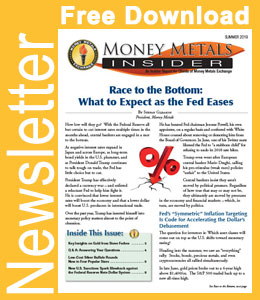
Please hit the download link and check it out right away!
You’ll get access to Steve Forbes’ insights provided to Money Metals customers during directly his recent podcast interview with Mike Gleason.
Your free Money Metals Insider newsletter also outlines the likely impact of a new Fed easing cycle and the rising risk of a global downgrade in the Federal Reserve Note “dollar.” Plus, we answer your questions about coin premiums and the recent prosecution involving a well-known TV promoter of “rare” coins.
Of course, not only does Money Metals offer super competitive pricing when you want to buy, but also we are without a doubt the #1 place in the country to SELL or STORE your precious metals as well.
Here are the highlights from your free Money Metals Insider newsletter:
So download the PDF of this fantastic free newsletter right now – and pass it around to your friends! It’s another free benefit for those who have signed up for the Money Metals email list.
The Money Metals News Service provides market news and crisp commentary for investors following the precious metals markets.
Bob Moriarty of 321gold makes the case for investment in a gold stock about to emerge from hibernation.
This fall is going to get exciting. As many others are waking up to the obvious conclusion, the wheels are falling off the world’s financial carriage. I see a general stock market high in August/September followed by a giant liquidity event and a big crash in October. Resource shares may be dragged lower but will be the first to recover as investors rush to the only safe haven still left.
There are dozens of inexpensive gold and silver stocks that have been in hibernation for years and are about to wake up. Viva Gold Corp. (VAU:TSX.V; VAUCF:OTCBB) is one.
Viva picked up the 376,000-ounce Tonopah gold project from the bankruptcy court for $25,000. It carried a 7% NSR [net smelter return], which frankly was totally unworkable in any sane financial environment. Management of Viva went to the NSR holders and convinced them to smarten up and got the NSR down to a more realistic 2%.
The prior operator of the property was Midway Gold Corp., which went into bankruptcy. Midway was looking for a high-grade small underground mine. Viva has looked over the $20 million worth of prior drilling and has realized Midway couldn’t see the forest because of all the trees in the way. With the existing pit-constrained resource, Viva realizes they could have a small, six- to seven-year mine life, but they see much more potential in a larger open-pit heap-leach operation.
Viva sees a 1.5-kilometer (1.5 km) strike length with the existing resource at one end and an already drilled out 30,000 ounces. Over the next six months Viva intends to drill off this trend to determine if the resource is continuous or to find more potential open pits.
Viva has already expanded the M&I [measured and indicated] resource by 36% with only 26 short drill holes. Obviously a renewed interest in gold as a response to the increase in price will help the highly leveraged stocks the most. With Viva you are buying high-quality ounces for about US$15/ounce. That’s not going to last long in a gold bull market.
I own shares bought in the open market and I intend to participate in the private placement. Viva Gold is an advertiser and that means I am biased. Do your own due diligence.
Bob and Barb Moriarty brought 321gold.com to the Internet almost 16 years ago. They later added 321energy.com to cover oil, natural gas, gasoline, coal, solar, wind and nuclear energy. Both sites feature articles, editorial opinions, pricing figures and updates on current events affecting both sectors. Previously, Moriarty was a Marine F-4B and O-1 pilot with more than 832 missions in Vietnam. He holds 14 international aviation records.
Disclosure: 1) Bob Moriarty: I, or members of my immediate household or family, own shares of the following companies mentioned in this article: Viva Gold. My company has a financial relationship with the following companies mentioned in this article: Viva Gold is an advertiser on 321 Gold. I determined which companies would be included in this article based on my research and understanding of the sector. 2) The following companies mentioned are billboard sponsors of Streetwise Reports: None. Click here for important disclosures about sponsor fees. 3) Statements and opinions expressed are the opinions of the author and not of Streetwise Reports or its officers. The author is wholly responsible for the validity of the statements. The author was not paid by Streetwise Reports for this article. Streetwise Reports was not paid by the author to publish or syndicate this article. The information provided above is for informational purposes only and is not a recommendation to buy or sell any security. Streetwise Reports requires contributing authors to disclose any shareholdings in, or economic relationships with, companies that they write about. Streetwise Reports relies upon the authors to accurately provide this information and Streetwise Reports has no means of verifying its accuracy. 4) The article does not constitute investment advice. Each reader is encouraged to consult with his or her individual financial professional and any action a reader takes as a result of information presented here is his or her own responsibility. By opening this page, each reader accepts and agrees to Streetwise Reports’ terms of use and full legal disclaimer. This article is not a solicitation for investment. Streetwise Reports does not render general or specific investment advice and the information on Streetwise Reports should not be considered a recommendation to buy or sell any security. Streetwise Reports does not endorse or recommend the business, products, services or securities of any company mentioned on Streetwise Reports. 5) From time to time, Streetwise Reports LLC and its directors, officers, employees or members of their families, as well as persons interviewed for articles and interviews on the site, may have a long or short position in securities mentioned. Directors, officers, employees or members of their immediate families are prohibited from making purchases and/or sales of those securities in the open market or otherwise from the time of the interview or the decision to write an article until three business days after the publication of the interview or article. The foregoing prohibition does not apply to articles that in substance only restate previously published company releases.
Russia’s central bank lowered its key interest rate by 25 basis points to 7.25 percent, as widely expected, and repeated its guidance from last month that further rate cuts are possible in as the bank moves toward a neutral monetary policy stance in the first half of 2020. It is Bank of Russia’s second rate cut this year following a similar cut rate in June, with the central bank saying inflation is continuing to slow while economic growth is lower than expected. “Weak economic activity, along with temporary factors, limits inflation risks over the short-term horizon,” the central bank said, confirming it expects inflation to return to its target of 4.0 percent in early 2020. Earlier this month Elvira Nabiullina, central bank governor, told Reuters the bank would like to complete its easing cycle by mid-2020 by trimming the rate in small steps after saying in June that one of two rate cuts were possible by the end of this year. Nabiullina estimates monetary policy will be neutral when the rate reaches a range of 6.0 to 7.0 percent. Russia’s central bank embarked on an easing cycle in January 2015 as it slowly rolled back a sharp 750 basis point rate hike in December 2014 to protect the ruble, which plunged in the wake of a conflict with Ukraine. Between January 2015 and April 2018 the key interest rate was cut by a total of 9.75 percentage points as inflation began to ease and the ruble slowly firmed but the easing cycle came to a sharp halt when fresh sanctions by the United States over Russia’s meddling in the U.S. 2016 presidential election triggered a 10 percent plunge in the ruble and a 9 percent fall in Moscow stock market. In September and December, 2018 Russia’s central bank then raised its rate twice by a total of 50 basis points in proactive moves to curb inflation from a combination of higher import prices from the lower ruble and a rise in value-added-taxes to 20 percent on Jan. 1, 2019. After steadily rising in the second half of last year, inflation in Russia peaked in March this year at 5.3 percent and eased further to 4.7 percent in June and was close to 4.6 percent as of July 22 as inflation continues to follow the bank’s expected path. Core inflation also declined in June for the first time since March 2018 to 4.6 percent as consumer demand constrains inflation along with the rise in the ruble this year and lower vegetable prices. While inflation expectations among businesses have declined, the central bank said households’ inflation expectations had not changed materially since April and remain elevated. However, it expects a continued decline in inflation to pave the way for lower expectations. “Disinflationary risks exceed pro-inflationary risks over the short-term horizon,” the central bank said, pointing to weak domestic and external demand. Growth in Russia’s economy has been slower due to weak investment and a drop in exports and a rise in industrial output in the second quarter may not be steady, the bank said. In the first half of the year fiscal policy also constrained economic activity but the central bank expects government spending to rise in the second half, adding “the risk of a slowdown in global economic growth still looms,” in the event of a further tightening of trade restrictions. Russia’s gross domestic product slowed to annual growth of 0.5 percent in the first quarter of this year from 2.7 percent in the fourth quarter of last year. The ruble has been steadily appreciating since September last year and was trading at 63.15 to the U.S. dollar today, up 10.3 percent this year and up 26 percent since record lows around 80 to the dollar in February 2016. The Bank of Russia issued the following press release:
“On 26 July 2019, the Bank of Russia Board of Directors decided to cut the key rate by 25 bp to 7.25% per annum. Inflation slowdown is continuing. At the same time, inflation expectations remain elevated. Russian economy’s growth rate is coming in lower than the Bank of Russia’s expectations. Weak economic activity, along with temporary factors, limits inflation risks over the short-term horizon. According to the Bank of Russia’s forecast, taking into account the pursued monetary policy, annual inflation will return to 4% in early 2020.
If the situation develops in line with the baseline forecast, the Bank of Russia admits the possibility of further key rate reduction at one of the upcoming Board of Directors’ meetings and a transition to neutral monetary policy in the first half of 2020. In its key rate decision-making, the Bank of Russia will take into account actual and expected inflation dynamics relative to the target and economic developments over the forecast horizon, as well as risks posed by domestic and external conditions and the reaction of financial markets.
Inflation dynamics. Inflation slowdown is continuing. Annual consumer price growth rate declined to 4.7% in June (from 5.1% in May 2019) and was close to 4.6% according to the estimates as of 22 July. June results show that annual core inflation declined for the first time since March 2018 and reached 4.6%. Seasonally adjusted monthly consumer price growth rate slowed down to 0.1% in June vs 0.3-0.4% in February-May. According to Bank of Russia estimates, most monthly inflation indicators reflecting the most sustainable price movements are close to 4% (annualised).
Consumer demand trends constrain inflation. Temporary disinflationary factors also contributed to slowing consumer price growth, including ruble appreciation since the beginning of the year and the decline in fruit and vegetable prices on the back of early new harvest arrival. Annual inflation dynamics were also influenced by base effects.
In June and July, business price expectations continued to decline. Households’ inflation expectations have not materially changed since April and remain elevated. Inflation slowdown paves the way for a future decline in inflation expectations.
According to the Bank of Russia’s forecast, taking into account the pursued monetary policy, annual inflation will return to 4% in early 2020.
Monetary conditions. Monetary conditions continued to ease since the last Board meeting. Among other things, this was driven by the change in expectations of financial market participants with regard to the Bank of Russia’s key rate path and the downward revision of expected interest rate paths in the US and the euro area. OFZ yields and deposit interest rates continued to decline. The Bank of Russia’s decisions to cut the key rate and the decline in OFZ yields observed since the beginning of this year create conditions for the decrease in deposit and lending rates in the future.
In June, real sector lending continued to grow on the back of eased monetary conditions. Annual growth rate of loans to non-financial organisations reached the maximum level since 2015 while the growth rate of household loans stabilised after a tangible increase in the previous months.
Economic activity. Russian economy’s growth rate since the beginning of the year has been lower than the Bank of Russia’s expectations. This was caused by weak investment activity dynamics and a significant drop in annual export growth rates, including on the back of weaker external demand. The second quarter saw an increase in annual industrial production growth, which may not be steady. Retail trade turnover growth continued to decline YoY amid falling real disposable household incomes. Unemployment remains at the historic lows. However, given the contracting number of employees and the labour force, it does not create any additional inflationary pressure.
In the first half of the year, fiscal policy had additional constraining effect on the economic activity, which is in part related to the shift of implementation schedule of a number of national projects planned by the Government. Since the second half of 2019, government spending, including investment expenditures, is expected to rise.
Inflation risks. Disinflationary risks exceed pro-inflationary risks over the short-term horizon. This is primarily related to the weak dynamics of domestic and external demand.
That said, significant risks are posed by elevated and unanchored inflation expectations. The risk of a slowdown in global economic growth still looms caused, among other things, by the further tightening of international trade restrictions. Geopolitical factors might lead to strengthened volatility in global commodity and financial markets, affecting exchange rate and inflation expectations. Supply-side factors in the oil market may amplify volatility of global oil prices. However, the revision of interest rate paths in the US and the euro area in June and July reduces the risks of considerable capital outflows from emerging markets.
Fiscal policy may cause a meaningful impact on inflation dynamics over both the short- and medium-term horizons. The catch-up growth of budget spending in the second half of the current year may have a pro-inflationary effect in late 2019 — early 2020. Moving on, potential decisions on the use of the liquid part of the National Wealth Fund in excess of the threshold level set at 7% of GDP may exert upward pressure on inflation.
The Bank of Russia leaves mostly unchanged its estimates of risks associated with wage movements, prices of individual food products, and possible changes in consumer behaviour. These risks remain moderate.
If the situation develops in line with the baseline forecast, the Bank of Russia admits the possibility of further key rate reduction at one of the upcoming Board of Directors’ meetings and a transition to neutral monetary policy in the first half of 2020. In its key rate decision-making, the Bank of Russia will take into account actual and expected inflation dynamics relative to the target and economic developments over the forecast horizon, as well as risks posed by domestic and external conditions and the reaction of financial markets.
The Bank of Russia Board of Directors will hold its next rate review meeting on 6 September 2019. The press release on the Bank of Russia Board decision and the medium-term forecast is to be published at 13:30 Moscow time.”
Edwards Lifesciences is trading higher after reporting higher than expected adjusted earnings for Q2/19. The company estimates that the FDA will approve its SAPIEN 3 valve and SAPIEN 3 Ultra system in Q3/19.
Structural heart disease and critical care monitoring device and platform firm Edwards Lifesciences Corp. (EW:NYSE)announced second quarter earnings after the market closed yesterday.
The firm reported sales for Q2/19 ending June 30, 2019, were $1.1 billion, up 15% over the prior year, or 14% on an underlying basis. Fully diluted earnings per share (EPS) for the quarter decreased to $1.14, while adjusted EPS grew higher than expected by 11% to $1.38.
For Q2/19, the company reported Transcatheter Aortic Valve Replacement (TAVR) sales increased to $678 million in Q2/19, an increase of 16% over Q2/18, or 18% on an underlying basis. According to the company, those results grew in-line with estimated global procedure growth. Edwards advised that global average selling prices remained stable, and its global competitive position was consistent with both Q1/19 and Q2/18.
Surgical Structural Heart sales for the Q2/19 were $218 million, up 15% compared to Q2/18 and Critical Care sales were $184 million for Q2/19, up 9% over Q2/18 boosted by strong growth of HemoSphere advanced monitoring platform sales in the U.S.
Chairman and CEO of Edwards Lifesciences Michael A. Mussallem stated, “We are pleased to report stronger than expected sales growth in the second quarter, which continued a long-term trend of reaching more patients with innovative therapies and creating value. . .Increased demand for TAVR therapy resulted in underlying total company sales growth of 14 percent, which also reflected strength in all four of our product lines across all regions.”
Mr. Mussallem added, “We now estimate that in Q3/19 the FDA will approve the SAPIEN 3 valve and SAPIEN 3 Ultra system for patients with low surgical risk. Over time, we expect the SAPIEN 3 Ultra valve system will replace SAPIEN 3 valve globally.”
The company updated its business outlook: “For 2019, the company now expects total sales to be between $4.0 billion and $4.3 billion, with underlying sales growth around the top end of its previous 9 to 12% range. Additionally, the company raised its full year 2019 adjusted earnings per share guidance to $5.20 to $5.40 from $5.10 to $5.35. For the third quarter 2019, the company projects total sales to be between $1.02 billion and $1.06 billion, and adjusted EPS of $1.13 to $1.23.”
Based in Irvine, Calif., Edwards Lifesciences identifies itself as the global leader in patient-focused medical innovations for structural heart disease and critical care monitoring and states that its commitment to transformational heart valve technology began in 1960 with the first commercially available heart valve. Product offerings include tissue replacement heart valves and repair products, as well as transcatheter heart valves for those patients considered at intermediate or greater risk for conventional valve replacement.
Edwards also provides technologies that facilitate on-pump cardiac surgery procedures through smaller incisions. Theses minimally invasive valve surgery solutions include soft tissue retractors, venous and arterial cannulae, aortic occlusion, venting and coronary sinus catheters. Edwards additionally provides evidence-based programs such as Enhanced Surgical Recovery Program that support the implementation and compliance to protocolized care pathways in the OR and ICU.
The firm’s shares opened 11.63% higher today at $218.16 (+$22.70) over the prior day’s $195.46 closing price. Shares have traded today between $211.34-219.71 on higher than average volume setting both an intraday 52-week and 5-year high price. The stock is currently trading at $211.41/share (+15.95, +8.16%).
Disclosure: 1) Stephen Hytha compiled this article for Streetwise Reports LLC and provides services to Streetwise Reports as an independent contractor. He or members of his household own securities of the following companies mentioned in the article: None. He or members of his household are paid by the following companies mentioned in this article: None. 2) The following companies mentioned in this article are billboard sponsors of Streetwise Reports: None. Click here for important disclosures about sponsor fees. 3) Comments and opinions expressed are those of the specific experts and not of Streetwise Reports or its officers. The information provided above is for informational purposes only and is not a recommendation to buy or sell any security. 4) The article does not constitute investment advice. Each reader is encouraged to consult with his or her individual financial professional and any action a reader takes as a result of information presented here is his or her own responsibility. By opening this page, each reader accepts and agrees to Streetwise Reports’ terms of use and full legal disclaimer. This article is not a solicitation for investment. Streetwise Reports does not render general or specific investment advice and the information on Streetwise Reports should not be considered a recommendation to buy or sell any security. Streetwise Reports does not endorse or recommend the business, products, services or securities of any company mentioned on Streetwise Reports. 5) From time to time, Streetwise Reports LLC and its directors, officers, employees or members of their families, as well as persons interviewed for articles and interviews on the site, may have a long or short position in securities mentioned. Directors, officers, employees or members of their immediate families are prohibited from making purchases and/or sales of those securities in the open market or otherwise from the time of the interview or the decision to write an article until three business days after the publication of the interview or article. The foregoing prohibition does not apply to articles that in substance only restate previously published company releases.