Investors stampede for safety as Trump strikes again

Article by ForexTime

A wave of risk aversion is sweeping across financial markets this morning after US President Donald Trump announced a new round of tariff hikes on Chinese imports.

In an unexpected move that dealt a crippling blow to global sentiment, Trump said he would impose a 10% tariff on the remaining $300 billion of Chinese imports from September 1. With China already pledging countermeasures if the US implements the additional tariffs, things could get really messy   – something that will ultimately cripple risk sentiment even further.

The negative mood across markets suggests that investors are jittery over sizzling trade tensions between the world’s two largest economies sabotaging the already fragile global growth outlook.

Asian equities were painted red during early trading following Wall Street’s declines overnight. In Europe, shares are positioned to open lower as investors avoid riskier assets. The caution from Asian and European markets could find its way back into Wall Street this afternoon.

King Dollar hit by Trump tariffs, NFP in focus

Investors who were looking for an opportunity to attack the Dollar were given the thumbs up yesterday after Trump said he would impose additional tariffs on China.

Trump’s decision has certainly placed the Federal Reserve in a tricky position and boosted expectations over another US rate cut this year. The Dollar is likely to extend losses against a basket of major currencies ahead of the US jobs report this afternoon. Given how future US rate cuts will be influenced by economic data, there will be a strong focus on this afternoon’s jobs data.

This week has already offered some mixed data surrounding US employment. The July ADP employment data topped expectations by rising 156k while jobless claims rose by 8,000 to 215,000 in the seven days ending July 27.

Should the July NFP meet or exceed market forecasts, investors may re-evaluate whether the Fed will cut interest rates again. However, a disappointing report should strengthen the argument for lower rates in the United States – ultimately weakening the Dollar.

Pound diced and minced by no deal Brexit fears

Sterling has been diced and minced by rising fears over the United Kingdom crashing out of the European Union with no Brexit deal in place.

The thickening fog of uncertainty around Brexit has prevented the Bank of England from joining the global monetary easing train this month. Although the BoE has stated that “interest rates could move in either direction if there’s a no-deal Brexit”, the next move is veering towards an interest rate cut as Brexit fears shroud the UK economy. With domestic economic conditions likely to deteriorate further as uncertainty over Brexit intensifies, it is a question of when rather than if the BoE will cut interest rates in 2019.

The GBPUSD remains bearish on the weekly charts. With bears firmly fastened into the driving seat, the downside momentum has the potential to send prices towards 1.2000 in the short to medium term.

Commodity spotlight – Gold

Gold glittered with extreme intensity on Thursday, jumping to a fresh two week high above $1445 as Trump’s tariff tweets sent investors stampeding to safety.

The precious metal has scope to push higher this afternoon if the pending US jobs report fails to meet market expectations. With concerns over slowing global growth, renewed US-China trade tensions and Brexit uncertainty accelerating the flight to safety, Gold is fundamentally bullish.

Focusing on the technical picture, an intraday breakout above $1445 could encourage a move higher towards $1450 and $1470, respectively.

Disclaimer: The content in this article comprises personal opinions and should not be construed as containing personal and/or other investment advice and/or an offer of and/or solicitation for any transactions in financial instruments and/or a guarantee and/or prediction of future performance. ForexTime (FXTM), its affiliates, agents, directors, officers or employees do not guarantee the accuracy, validity, timeliness or completeness, of any information or data made available and assume no liability as to any loss arising from any investment based on the same.


Forex-Time-LogoArticle by ForexTime

ForexTime Ltd (FXTM) is an award winning international online forex broker regulated by CySEC 185/12 www.forextime.com

EMA Opinion Bodes Well for Biopharma’s Drug Getting Orphan Status

By The Life Science Report

Source: Streetwise Reports   07/31/2019

The designation, opinion and asset are discussed in a ROTH Capital Partners report.

In a July 29 research note, ROTH Capital Partners analyst Scott Henry reported that Anavex Life Sciences Corp. (AVXL:NASDAQ) is pursuing orphan status from the European Medicines Agency (EMA) for ANAVEX 2-73 as a treatment for Rett syndrome.

A positive opinion from the EMA’s Committee for Orphan Medicinal Products (COMP) was already issued, highlighted Henry. It means European regulators believe ANAVEX 2-73, a sigma-1 receptor agonist, for use in Rett syndrome patients meets the requirements for orphan drug designation. “This is a significant development milestone for the company,” Henry commented.

Specifically, Rett syndrome is a rare, life threatening disease without satisfactory treatment. With fewer than 5 cases per 10,000 occurring in Europe, this form of autism has an associated life expectancy of 20–40 years, described Henry. There is no current treatment for the cause of Rett syndrome itself, only for comorbid conditions, for which drugs are the standard of care. The second criterion for orphan status is that ANAVEX 2-73 could potentially provide significant benefit to Rett patients.

The EMA COMP opinion bodes well for Anavex being granted the orphan drug designation in the European market, the analyst pointed out. In fact, ROTH expects it to happen within 30 days. (ANAVEX 2-73 already has orphan drug status in the United States, as of 2016.)

The benefits of the designation in the European Union (EU), Henry pointed out, include decreased regulatory fees for the company, help with protocol and document filing and, potentially, a faster path to regulatory approval in Europe. Anavex 2-73 also would have exclusivity in the EU for 10 years.

ANAVEX 2-73 is currently being evaluated in Rett syndrome in two Phase 2 clinical trials, one in the U.S., the other in Australia. Topline data are expected around year-end 2019 and early 2020, with results from the U.S. likely being released first. “Provided ANAVEX 2-73 will achieve both primary safety and quality positive signal from the secondary efficacy measures, these studies could provide a commercial path for ANAVEX 2-73 as the first to market for the treatment of Rett syndrome in the U.S. and Europe,” Henry noted.

ROTH has a Buy rating and a $10 per share target price on Anavex, whose stock is currently trading at around $2.57 per share.

Sign up for our FREE newsletter at: www.streetwisereports.com/get-news

Disclosure:
1) Doresa Banning compiled this article for Streetwise Reports LLC and provides services to Streetwise Reports as an independent contractor. She or members of her household own securities of the following companies mentioned in the article: None. She or members of her household are paid by the following companies mentioned in this article: None.
2) The following companies mentioned in this article are billboard sponsors of Streetwise Reports: None. Click here for important disclosures about sponsor fees.
3) Comments and opinions expressed are those of the specific experts and not of Streetwise Reports or its officers. The information provided above is for informational purposes only and is not a recommendation to buy or sell any security.
4) The article does not constitute investment advice. Each reader is encouraged to consult with his or her individual financial professional and any action a reader takes as a result of information presented here is his or her own responsibility. By opening this page, each reader accepts and agrees to Streetwise Reports’ terms of use and full legal disclaimer. This article is not a solicitation for investment. Streetwise Reports does not render general or specific investment advice and the information on Streetwise Reports should not be considered a recommendation to buy or sell any security. Streetwise Reports does not endorse or recommend the business, products, services or securities of any company mentioned on Streetwise Reports.
5) From time to time, Streetwise Reports LLC and its directors, officers, employees or members of their families, as well as persons interviewed for articles and interviews on the site, may have a long or short position in securities mentioned. Directors, officers, employees or members of their immediate families are prohibited from making purchases and/or sales of those securities in the open market or otherwise from the time of the interview or the decision to write an article until three business days after the publication of the interview or article. The foregoing prohibition does not apply to articles that in substance only restate previously published company releases.

Disclosures from ROTH Capital Partners, Anavex Life Sciences Corp., Flash Note, July 29, 2019

Regulation Analyst Certification (“Reg AC”): The research analyst primarily responsible for the content of this report certifies the following under Reg AC: I hereby certify that all views expressed in this report accurately reflect my personal views about the subject company or companies and its or their securities. I also certify that no part of my compensation was, is or will be, directly or indirectly, related to the specific recommendations or views expressed in this report.

ROTH makes a market in shares of Anavex Life Sciences Corp. and as such, buys and sells from customers on a principal basis.

Shares of Anavex Life Sciences Corp. may be subject to the Securities and Exchange Commission’s Penny Stock Rules, which may set forth sales practice requirements for certain low-priced securities.

ROTH Capital Partners, LLC expects to receive or intends to seek compensation for investment banking or other business relationships with the covered companies mentioned in this report in the next three months.

( Companies Mentioned: AVXL:NASDAQ,
)

Will Trump Initiate Currency Intervention?

By Money Metals News Service

Following months of cajoling by the White House, the Federal Reserve finally cut its benchmark interest rate. However, the reaction in equity and currency markets was not the one President Donald Trump wanted – or many traders anticipated.

The Trump administration wants the Fed to help drive the fiat U.S. dollar lower versus foreign currencies, especially those of major exporting countries.

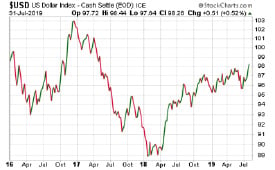
Instead, the U.S. Dollar Index rallied throughout July ahead of the expected rate cut and continued rallying after Fed chairman Jerome Powell made it official on Wednesday.

U.S. Dollar Index - July 31, 2019

In fact, the Federal Reserve Note broke out to its highest level since early 2017.

The Fed also announced it would end its balance sheet reduction program a month earlier than originally scheduled.

These dovish policy changes apparently weren’t dovish enough. The central bank could have gone for a 50-basis-point cut instead of the more routine quarter point cut it delivered. It could also have announced a new Quantitative Easing program.

Perhaps the biggest market-moving disappointment (equity bearish, dollar bullish) was Fed Chairman Jerome Powell shooting down the idea of an extended rate-cutting cycle.

In his press conference, he described the cut as “mid-cycle adjustment” that didn’t necessarily imply follow-up cuts.

As he often does, President Trump vented his displeasure via a tweet: “What the Market wanted to hear from Jay Powell and the Federal Reserve was that this was the beginning of a lengthy and aggressive rate-cutting cycle which would keep pace with China, The European Union and other countries around the world….”

Trump is certainly correct in his observation that Europe and other regions are far outpacing of the U.S. in terms of ultra-accommodative monetary policy.

Several countries have now gone to negative interest rate policy. An estimated $13 trillion in negative-yielding bonds now sits in the accounts of holders who are apparently content with losing money at a fixed rate.

Gold and Silver Show Strength in All Currencies

The upshot is that gold and silver have recently been breaking out in terms of euros, yen, yuan, and other foreign currencies.

Precious metals have also fared quite well in terms of Federal Reserve Notes. Even though the Dollar Index rose more than 2% in July, gold managed to come out of the month with a 2% gain. Silver put on an even more impressive 7% advance.

Precious metals are rallying versus all currencies, a good harbinger of a major bull market ahead. When our currency finally turns down, the recent strength in metals could be amplified – big league.

Trump Administration Contemplates Intervening in Currency Markets

As our centrally planned monetary system is currently set up, it’s the responsibility of the Treasury Department – not the Federal Reserve – to manage the value of the U.S. dollar versus foreign currencies.

Toward that end, the Treasury’s Exchange Stabilization Fund has the power to carry out both direct and indirect market interventions.

The idea of manipulating our currency value in foreign exchange markets has been discussed by the White House. The idea was recently rejected – at least publicly.

According to a July 26th Bloomberg story, “President Donald Trump has rejected, for now, the idea of aggressive currency intervention that could give the U.S. an edge with its trading partners by weakening the dollar.”

Bloomberg further notes, “officials weighed proposals to publicly talk down the dollar’s value or weaken the greenback by intervening in currency markets using Treasury’s $94 billion exchange stabilization fund.”

Falling

Treasury Steven Mnuchin apparently talked Trump out of pursuing a currency manipulation/counter-manipulation scheme. But that was before Jay Powell (who was appointed to the Fed at Mnuchin’s recommendation) came out with a policy statement that pushed the greenback to a two-year high.

Trump could be running out of patience as he fears his re-election campaign will run out of time before voters see any beneficial fruits of his trade battles.

Even if he was talked out of making currency intervention a formal policy of the administration, that doesn’t mean it won’t be carried out anyway behind the scenes, through secret Treasury department operations.

Meanwhile, the Fed is in easing mode with odds still favoring another rate cut by September. No other major central bank is looking to tighten. It’s a race to the bottom.

Regardless of whether Europe, China, Japan, or the United States “wins” by undercutting its currency more than the others, precious metals and commodities will serve as objective measures of value.

Gold, by breaking out to a multi-year high when priced in Federal Reserve Notes and continuing to advance despite its strength versus other fiat currencies, is sending an important message to investors. Namely, it is quite possible to lose real value by holding wealth in a nominally appreciating currency.


The Money Metals News Service provides market news and crisp commentary for investors following the precious metals markets.

King Dollar humbled by disappointing data; Euro minced and diced

By Lukman Otunuga, Research Analyst, ForexTime

The Dollar was close to surrendering all of Thursday’s gains after US Manufacturing PMI figures missed market expectations by falling to 51.2 last month.

American manufacturers grew in July at the slowest pace in three years thanks to US-China trade disputes hitting exports and eroding global growth. With manufacturers in the world’s largest economy caught in the trade war crossfire, expectations are likely to mount over the Fed coming to the rescue. This sentiment is being reflected in the Dollar Index which is retreating from a two year as of writing. Where the DXY concludes this week will be heavily influenced by the US jobs report on Friday.

Focusing on the technical picture, the Dollar Index has turned bullish on the weekly charts. The solid breakout above the 98.20 resistance level should open the doors towards 99.00 and 100.00.

Alternatively, an intraday breakdown below 98.50 is likely to encourage a move back towards 98.20. Should 98.20 prove to be unreliable support, prices have scope to sink back towards 97.00.

EURUSD crumbles to fresh 2019 low

An appreciating Dollar is offering nothing but pain and punishment for the Euro which is currently trading near a 2019 low at 1.1050.
The currency pair is heavily bearish on the daily charts as there have been consistently lower lows and lower highs. With the Euro fundamentally bearish due to economic conditions in Europe and a dovish ECB, the path of least resistance for the EURUSD points south.

Technical traders will continue to closely observe how prices behave below the 1.1100 level. Sustained weakness below this support should open a path towards 1.1000 and 1.0900 in the near term.

Yen thrives on market uncertainty and confusion 

The Japanese Yen has appreciated against every single G10 currency today thanks to uncertainty across financial markets.

Confusion from yesterday’s Fed meeting, concerns over Brexit and lingering global fears have sent investors rushing towards the Japanese Yen. The currency is set to extend gains ahead of the US jobs report on Friday, as investors adopt a guarded approach towards riskier assets.

The USDJPY remains bearish on the weekly charts as there have been consistently lower lows and lower highs. A solid weekly close below 108.00 should open a path towards 107.00 and 106.00, respectively.

AUDUSD attacks 0.6830 

The AUDUSD is under pressure on the weekly charts. All bears need is a weekly close below 0.6830 to trigger a decline towards 0.6650.


Disclaimer: The content in this article comprises personal opinions and should not be construed as containing personal and/or other investment advice and/or an offer of and/or solicitation for any transactions in financial instruments and/or a guarantee and/or prediction of future performance. ForexTime (FXTM), its affiliates, agents, directors, officers or employees do not guarantee the accuracy, validity, timeliness or completeness, of any information or data made available and assume no liability as to any loss arising from any investment based on the same.


Forex-Time-LogoArticle by ForexTime

ForexTime Ltd (FXTM) is an award winning international online forex broker regulated by CySEC 185/12 www.forextime.com

What To Expect From Australia Retail Sales

By Orbex

Overnight we will get the last bit of market-moving data ahead of the RBA interest rate decision next week. Since the central bank holding steady is not a foregone conclusion in this environment, traders will be looking closely to see how consumer demand has been affected by recent policy changes.

June Retail Sales are the first of this data set to have the effect of the RBA’s rate cuts. And, if the plan is working, we should see some improvement.

Otherwise, further action from the central bank might be on the cards, which will likely weaken the Aussie. But, if there is an improvement, we might be able to cover over some of the effect caused by recent news that China was getting concerned over the price of iron ore.

What We Are Looking For

This time around we get monthly and quarterly retail sales figures. However, the market is probably going to mainly focus on the former. Without any other major data expected overnight, this is likely the point we could expect the most volatility from Australia until next week.

Expectations are for monthly retail sales to modestly grow at 0.2%. This would be up from 0.1% posted in May. For reference, a “normal” range for retail sales is between 0% and 0.5% monthly. So, if we were to get a result outside of that, we’d expect a larger market reaction. Let’s not forget that we recently saw Australia post the largest trade surplus on record. This was aided in part by a drop in imports signaling that retail sales are likely to be depressed.

Projections indicate that quarterly retail sales could pick up the pace to 0.5%. This would be an increase from a -0.1% contraction in the first quarter. January’s results significantly impacted the prior quarter economic sentiment, following press speculation of a housing crash and recession during December. An improvement over the prior quarter would be a matter of course in this scenario.

The Details

Almost as important as the headline number are the components of the data that provide some insight into the trends. Over the last few months, spending on household goods and clothing have been the worst performers. This indicates that Australians are trimming back on less essential goods. Meanwhile, spending on food has continued to increase at the same pace.

Non-food spending, however, has been negative several times so far this year. This is considered to be a better gauge of discretionary spending. Should the RBA’s actions be helping prop up consumer demand, we ought to see an improvement in this figure.

Prices Aren’t Cooperating

Inflation stagnated in the first quarter. And, for the moment, projections of an increase are based on the expectation that the RBA’s action will have an effect. However, consumer prices are largely determined by discretionary spending.

Therefore, if that part of retail sales doesn’t improve significantly over the next couple of reports, we could see further weakness in the Aussie dollar as traders consider more central bank action.

Furthermore, unemployment hasn’t managed to return back to 5.0%. Reports now state that it is at its highest in a year, mostly because it’s largely stagnant. Without increasing wage pressures, it would be harder to expect increasing consumer demand in the near term.

By Orbex


UPDATED-This week in monetary policy: Interest rate cuts in the wake of U.S. Federal Reserve cut

By CentralBankNews.info

     (Following weekly table has been updated with changes in interest rates as of Aug. 1 following the U.S. Federal Reserve’s 25 basis point rate cut on July 31.)
     The table includes the name of the country, the date of the last policy decision, the current policy rate, the result of the last policy decision, the change in the policy rate year to date, and the rate one year ago.
    The table is updated when the latest decisions are announced and can always accessed by clicking on This Week.
WEEK 31
JUL 29 – AUG 3, 2019:
JAPAN30-Jul-0.10%00-0.10%         DM
ARMENIA30-Jul5.75%0-256.00%
BANGLADESH31-Jul6.00%006.00%         FM
MOLDOVA31-Jul7.50%501006.50%
DOMINICAN REP.31-Jul4.75%-25-755.50%
UNITED STATES31-Jul2.25%-25-252.00%         DM
BULGARIA31-Jul0.00%000.00%         FM
BAHRAIN31-Jul2.50%-25-252.25%         FM
SAUDI ARABIA 31-Jul2.75%-25-253.00%
KUWAIT31-Jul3.00%003.00%         FM
UAE31-Jul3.00%-25-252.75%         EM
BRAZIL31-Jul6.00%-50-506.50%         EM
QATAR1-Aug4.75%-25-255.00%         EM
MACAU1-Aug2.50%-25-252.25%
HONG KONG1-Aug2.50%-25-252.25%         DM
CZECH REPUBLIC1-Aug2.00%0251.25%         EM
UNITED KINGDOM1-Aug0.75%000.75%         DM
JORDAN1-Aug4.50%-25-254.25%         FM


XAUUSD Gold Analysis: Diminished Fed easing expectations bearish for XAUUSD

By IFCMarkets

Diminished Fed easing expectations bearish for XAUUSD

Federal Reserve indicated a 25 basis point rate cut yesterday was not the start of a lengthy easing cycle. Will the XAUSUSD continue retracing lower?

Central banks continuing purchases of gold are a major support for gold prices. Russia’s central bank led gold purchases by central banks in 2018, acquiring 274.3 metric tons to reduce reliance on the U.S. dollar. Other big buyers included Turkey, Kazakhstan, India, Iraq, Poland, and Hungary. In first-quarter this year gold purchases by central banks, led by Russia and China, were the highest in six years as countries diversify their assets away from the U.S. dollar. Global gold reserves rose 145.5 tons in Q1, a 68 percent increase from a year earlier, according to World Gold Council. Central banks bought 651.5 tons in 2018, versus 375 tons in 2017. That’s the largest net purchase of gold since 1967. However as the Federal Reserve cut interest rates on July 31, 2019 for the first time in ten years, Fed Chairman Jerome Powell said “It’s not the beginning of a long series of rate cuts,” while adding “I didn’t say it’s just one rate cut.” And President Trump said it was not “ the beginning of a lengthy and aggressive rate-cutting cycle” that markets “wanted to hear.” Slower than expected pace of Fed monetary easing is bearish for gold prices.

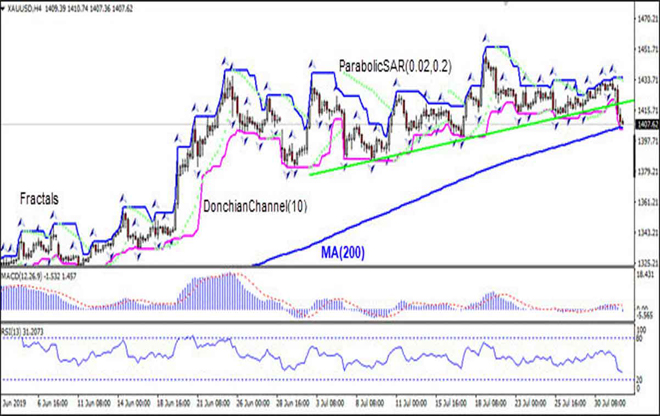
XAUUSD is testing MA(200) 08/01/2019 Technical Analysis IFC Markets chart

On the 4-hour timeframe the XAUUSD:H4 is retracing lower after breaching the support line, and is testing the 200-period Moving Average MA(200). These are bearish.

  • The Parabolic indicator has formed a sell signal.
  • The Donchian channel indicates downward bias: it is widening down.
  • The MACD indicator gives a bearish signal: it is above the signal line and the gap is narrowing.
  • The RSI oscillator is falling but has not reached the oversold zone yet.

We believe the bearish momentum will continue after the price breaches below the lower boundary of Donchian channel at 1404.08. This level can be used as an entry point for placing a pending order to sell. The stop loss can be placed below the last fractal high at 1435.07. After placing the order, the stop loss is to be moved every day to the next fractal high, following Parabolic signals. Thus, we are changing the expected profit/loss ratio to the breakeven point. If the price meets the stop loss level (1435.07) without reaching the order (1404.08), we recommend cancelling the order: the market has undergone internal changes which were not taken into account.

Technical Analysis Summary

OrderSell
Sell stopBelow 1404.08
Stop lossAbove 1435.07

Market Analysis provided by IFCMarkets

Markets are rocked by the Fed – but the Chair made the right call

By George Prior

President Trump is angry and financial markets are disappointed with the Federal Reserve’s statement on interest rates yesterday – but the Fed Chairman made the right call, affirms the boss of one of the world’s largest independent financial advisory organizations.

The comments from Nigel Green, founder and CEO of deVere Group, comes as markets have been rocked at Chairman Jay Powell’s suggestion that the U.S. central bank’s first rate cut in a decade does not necessarily mean it will be followed up with an aggressive rate-cutting program.

Donald Trump lashed out at the Fed’s decision via Twitter.

Mr Green notes: “The markets have been left reeling by the hawkish approach taken by Powell as they had largely priced-in two more rate cuts this year based on previous signals by the Fed.

“Powell appeared to brush off concerns of a serious downturn within the next 18 months that the inverted yield curve is suggesting. But it’s a tough call for Powell, when recent economic data has been fairly decent.

“Do they conduct their monetary policy based on economic data, or what the bond market bullies them into?

“It seems to be an unpopular view, but I believe the Chair made the right call in the current climate.”

“The markets want central bankers to give a clear forward path for rates, not nuanced, complex messages. But they should not necessarily expect this to happen.”

He continues: “As they often do, the markets have given a knee-jerk reaction to something they were not expecting. But if you read between the lines, the Chair’s statement is, in fact, fundamentally more dovish than the markets have so far recognised.

“I believe once this sinks in, it will be acknowledged accordingly by the markets.”

The deVere CEO concludes: “The Fed is dismissing angry calls by the President and has ignored market expectations, thus far. Whatever happens in this current climate, those investors with a multi-asset, long-horizon approach are best positioned to reap the benefits and sidestep the risks.”

About:

deVere Group is one of the world’s largest independent advisors of specialist global financial solutions to international, local mass affluent, and high-net-worth clients.  It has a network of more than 70 offices across the world, over 80,000 clients and $12bn under advisement.

FOMC Fails To Dampen Dollar

By Orbex

Dollar Drives Higher

USD has continued to rally firmly over the European morning in response to the FOMC rate decision last night. As was widely expected, the Fed cut rates by .25%. However, bulls were left disappointed by the forward guidance given by Fed’s Powell. The chairman said that the central bank doesn’t foresee this being the start of a lengthy easing cycle and instead, is likely just a “mid-cycle adjustment”. USD index trades 98.63 last with price having broken above the 98.26 overnight.

Euro Under Pressure

EURUSD has been shattered by the Fed rate cut announced yesterday. Price collapsed below 1.1130 support and is near approaching the 1.1027 support. Weak eurozone inflation data yesterday, along with a raft of weaker eurozone PMI sets today is keeping sentiment skewed heavily to the downside today.

BOE Keeps Rates on Hold

GBPUSD trades with a heavy tone today. While the BOE kept rates unchanged, in line with broad market expectations, downward revisions to the bank’s growth forecasts weighed on investor sentiment. Once again, the bank outlined the looming risks from Brexit as part of its decision. GBPUSD trades 1.2113 last with price struggling around the 1.2115 level, having briefly pierced below the level earlier today in reaction to the decision.

Risk Assets Disappointed By Fed Forward Guidance

Risk assets reacted with severe disappointment to yesterday’s US rate cut. The market had been anticipating a much more dovish tone from the Fed. They were caught offside by Powell’s downplaying of future rate cut odds. SPX500 reversed sharply from the 3019.15 level, breaking back under 3000 to test 2970.95 support, which is holding for now.

Safe Havens Mixed

Safe havens have had a mixed day against USD so far. While both were heavily weaker in response to the initial post-FOMC reaction, JPY has strengthened against USD while gold remains subdued. USDJPY trades 109.08 last. This is down from the initial 109.30s highs seen yesterday. XAUUSD trades 1406.59 last with price having traded heavily back below the 1433.48 level.

Crude Capped by FOMC

Oil prices have firmed again today following some initial weakness in the wake of a stronger USD. Crude trades 57.88 last with the market still supported by the EIA report yesterday. The report confirmed a seventh consecutive weekly drawdown in US crude stores. The ongoing decline in stores is helping alleviate concerns over the crude demand outlook which had been weighing on prices.

High Betas Back Under Pressure

USDCAD has softened a little today, as oil prices recover. However, price remains well supported on the back of yesterday’s explosive topside move. This saw price breaking out to its highest level since early June. Price trades 1.3216 last, with focus on further upside in the near term.

AUDUSD has posted a small recovery today on the back on the initial USD surge yesterday. AUD has also been under pressure from the lackluster conclusion to the first round of new trade talks between the US and China. While Washington has said that talks will continue in September, the lack of detail around the talks suggest that little progress was made. AUDUSD trades .6848 last, just up off the .6830 lows.

By Orbex


Ichimoku Cloud Analysis 01.08.2019 (AUDUSD, NZDUSD, USDCAD)

Article By RoboForex.com

AUDUSD, “Australian Dollar vs US Dollar”

AUDUSD is trading at 0.6846; the instrument is moving below Ichimoku Cloud, thus indicating a descending tendency. The markets could indicate that the price may test Tenkan-Sen and Kijun-Sen at 0.6885 and then resume moving downwards to reach 0.6750. Another signal to confirm further descending movement is the price’s rebounding from the descending channel’s upside border. However, the scenario that implies further decline may be cancelled if the price breaks the cloud’s upside border and fixes above 0.6975. In this case, the pair may continue growing towards 0.7085.

AUDUSD
Risk Warning: the result of previous trading operations do not guarantee the same results in the future

NZDUSD, “New Zealand Dollar vs US Dollar”

NZDUSD is trading at 0.6554; the instrument is moving below Ichimoku Cloud, thus indicating a descending tendency. The markets could indicate that the price may test the cloud’s downside border at 0.6565 and then resume moving downwards to reach 0.6450. Another signal to confirm further descending movement is the price’s rebounding from the resistance level. However, the scenario that implies further decline may be cancelled if the price breaks the cloud’s upside border and fixes above 0.6610. In this case, the pair may continue growing towards 0.6685.

NZDUSD
Risk Warning: the result of previous trading operations do not guarantee the same results in the future

USDCAD, “US Dollar vs Canadian Dollar”

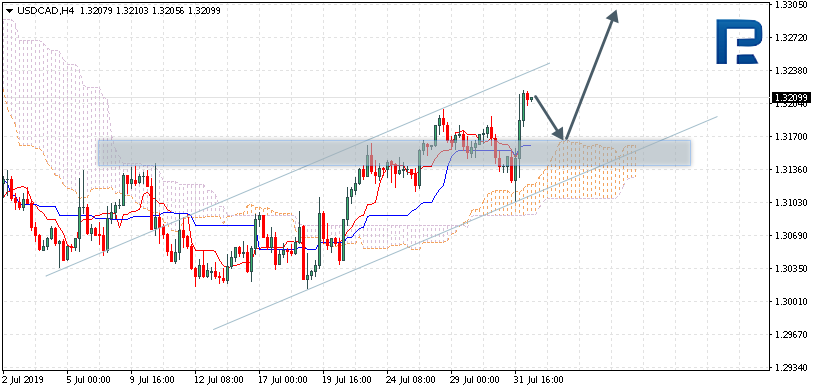
USDCAD is trading at 1.3209; the instrument is moving above Ichimoku Cloud, thus indicating an ascending tendency. The markets could indicate that the price may test the cloud’s upside border at 1.3170 and then resume moving upwards to reach 1.3295. Another signal to confirm further ascending movement is the price’s rebounding from the support level. However, the scenario that implies further growth may be cancelled if the price breaks the cloud’s downside border and fixes below 1.3095. In this case, the pair may continue falling towards 1.3015.

USDCAD

Article By RoboForex.com

Attention!
Forecasts presented in this section only reflect the author’s private opinion and should not be considered as guidance for trading. RoboForex LP bears no responsibility for trading results based on trading recommendations described in these analytical reviews.