August 21, 2019 – Limassol, Cyprus – RoboMarkets, an investment company, has extended the sponsorship agreement with Autolife rally team until the end of 2019. Under the agreement, RoboMarkets will be the team’s title sponsor at two more races at least, in Jordan and Cyprus.
RoboMarkets/RoboForex group has been cooperating with Autolife, the team of Roman Starikovich and Bert Heskes, for a couple of years now. In 2017, the team successfully made the finish line at the prestigious Dakar rally and then was ranked third at the Greece Offroad 2019 this June. In 2019, the team’s competition schedule has at least to more races: Jordan Baja (Jordan) and CAA Rally Championship (Cyprus). In both contests, the team will compete for the win in Toyota Hilux Overdrive, their car, which is nicknamed “The mighty bumblebeast”.
Konstantin Rashap, CBO at RoboMarkets: “We continue our cooperation with Autolife and are very pleased with the results demonstrated by the team. We hope that the team of Starikovich and Heskes will continue their run of success at the nearest races and properly prepare for the upcoming Dakar 2020 rally in Saudi Arabia, the application for participation in which has already been submitted”.
About Autolife
Autolife team is an international rally team consisting of Roman Starikovich and Bert Heskes. The team was founded in 2015 and since then has covered a long and thorny way to success and become the first Cypriot team ever to successfully make the finish at the most dangerous and complicated rally in the world of motorsport, the Dakar.
About RoboMarkets
RoboMarkets is an investment company with the CySEC license No. 191/13. RoboMarkets offers investment services in many European countries by providing traders, who work on financial market, with access to its proprietary trading platforms. More detailed information about the Company’s products and activities can be found on the official website at www.robomarkets.com.
The technical picture on the EUR/USD currency pair remains mixed. The trading instrument continues to consolidate. At the moment, the key support and resistance levels of 1.10700 and 1.11100 can be distinguished. The euro can recover further. The investors took a wait-and-see attitude before the publication of the FOMC protocols, which may indicate the further rate of adjustment of the monetary policy of the Fed. Recall, that earlier Donald Trump once again criticized the Central Bank for a strong dollar. We also recommend that you keep track of current information regarding the trade conflict between Washington and Beijing. Positions must be opened from key levels.
The Economic News Feed for 21.08.2019:
– Sales in the secondary housing market (US) – 17:00 (GMT+3:00);
Indicators do not give accurate signals: the price crossed 50 MA and 100 MA.
The MACD histogram is in the positive zone, but below the signal line, which gives a weak signal to buy EUR/USD.
The Stochastic Oscillator is in the neutral zone, the %K line began to cross the %D line. There are no signals at the moment.
Trading recommendations
Support levels: 1.10700, 1.10500
Resistance levels: 1.11100, 1.11300, 1.11650
If the price consolidates above 1.11100, expect a correction toward 1.11300-1.11600.
Alternatively, the quotes can descend toward 1.10500-1.10300.
The GBP/USD currency pair
Technical indicators of the currency pair:
Prev Open: 1.21236
Open: 1.21698
% chg. over the last day: +0.30
Day’s range: 1.21328 – 1.21750
52 wk range: 1.2015 – 1.3385
Since the beginning of this week the trading on the GBP/USD currency pair has been very active. At the same time, there is no defined trend. GBP is in lateral movement. At the moment, the local support and resistance levels are: 1.21250 and 1.21550, respectively. GBP/USD quotes have a potential for recovery. Today we recommend paying attention to economic releases from the USA. Positions must be opened from key levels.
The Economic News Feed for 21.08.2019 is calm.
Indicators do not give accurate signals: the price is consolidating near 50 MA and 100 MA.
The MACD histogram is in the positive zone, but below the signal line, which gives a weak signal to buy GBP/USD.
The Stochastic Oscillator is in the oversold zone, the %K line began to cross the %D line. There are no signals at the moment.
Trading recommendations
Support levels: 1.21250, 1.21000, 1.20700
Resistance levels: 1.21550, 1.21750, 1.22000
If the price consolidates above 1.21550, expect further growth 1.21800-1.22000.
Alternatively, the quotes could descend toward 1.21000-1.20800.
The USD/CAD currency pair
Technical indicators of the currency pair: 1.33234
Prev Open: 1.33234
Open: 1.33177
% chg. over the last day: -0.04
Day’s range: 1.32989 – 1.33242
52 wk range: 1.2727 – 1.3664
The USD/CAD currency pair has stabilized after a sharp increase since the beginning of this week. CAD is currently consolidating. The local support and resistance levels are 1.33000 and 1.33250, respectively. Financial market participants took a wait and see attitude before the release of important economic reports from the USA and Canada. We also recommend paying attention to the dynamics of oil quotes. Positions must be opened from key levels.
At 15:30 (GMT + 3: 00) we expect an inflation report for Canada.
Indicators do not give accurate signals: 50 MA crossed 100 MA.
The MACD histogram is near the 0 mark.
The Stochastic Oscillator is in the neutral zone, the %K line is above the %D line, which indicates bullish sentiment.
Trading recommendations
Support levels: 1.33000, 1.32750, 1.32500
Resistance levels: 1.33250, 1.33450, 1.33700
If the price consolidates above 1.33250, expect further growth toward 1.33500-1.33700.
Alternatively, the quotes could drop toward 1.32750-1.32500.
The USD/JPY currency pair
Technical indicators of the currency pair:
Prev Open: 106.624
Open: 106.223
% chg. over the last day: -0.34
Day’s range: 106.220 – 106.551
52 wk range: 104.97 – 114.56
The USD/JPY currency pair is in lateral movement. There is no defined trend. At the moment, the trading instrument is testing a local resistance of 106.550. Mark 106.200 is the immediate support. USD/JPY quotes have the potential for further growth. Today, investors will evaluate the FOMC protocols. We also recommend paying attention to the dynamics of yield on US government bonds. Positions must be opened from key levels.
The Economic News Feed for 21.08.2019 is calm.
Indicators of accurate signals do not give: the price is testing 50 MA.
The MACD histogram is near the 0 mark.
The Stochastic Oscillator is near the overbought zone, the %K line crossed the %D line. There are no signals at the moment.
Trading recommendations
Support levels: 106.200, 105.750, 105.500
Resistance levels: 106.550, 106.750, 107.000
If the price consolidates above 106.550, expect further growth toward 107.000-107.200.
Alternatively, the quotes can drop toward 105.800-105.600.
Millennial Lithium CEO Farhad Abasov speaks with Peter Epstein of Epstein Research about his company’s just released bank feasibility study.
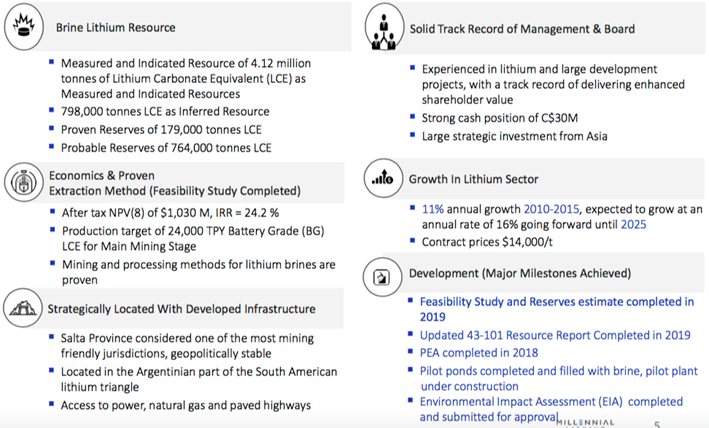
The following CEO interview was conducted by email in the two weeks ended August 18th. At a time when “battery metals” junior mining companies have been stalled, not just lithium companies, but cobalt, vanadium and other high-tech, “green” metals, Millennial Lithium Corp. (ML:TSX.V; MLNLF:OTCMKTS) has advanced its flagship project all the way through a Bank Feasibility Study (BFS). And, the company still has approximately C$30 million in the bank.
Millennial’s BFS describes a lithium brine project that could reach commercial production in 2021. A pilot plant will be up and running later this year. Off-take discussions are well underway, and management’s goal is to have project financing arranged by year end. These are exciting times for the team.
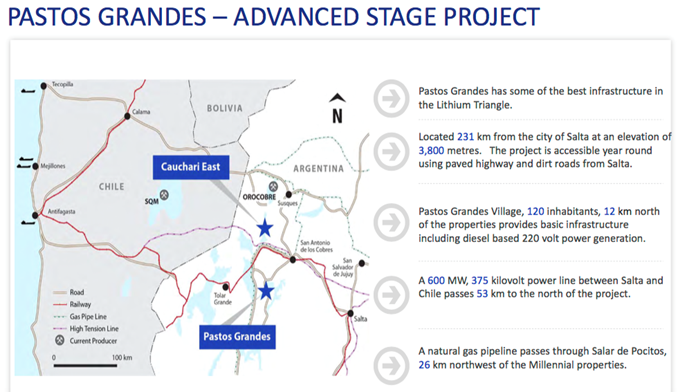
This morning (August 19th), Lithium Americas (TSX: LAC) announced the closing of a US$160 million cash injection from Ganfeng Lithium, taking Ganfeng’s ownership in the Caucharí-Olaroz JV project from 37.5% to 50%. This was done at the project level; no new shares of Lithium Americas were issued. US$160 million for an additional 12.5% values the project at US$1.28 billion, 50% attributable to LAC. Great news for Lithium Americas and for other advanced-stage lithium brine projects in Argentina, such as Millennial’s 100%-owned Pastos Grandes project.
Peter Epstein: Please give us the very latest snapshot of Millennial Lithium.
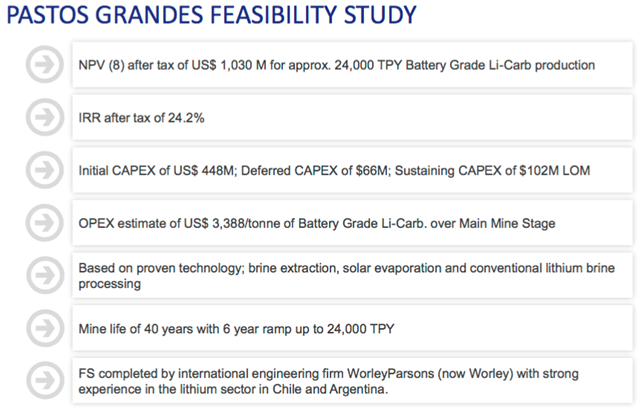
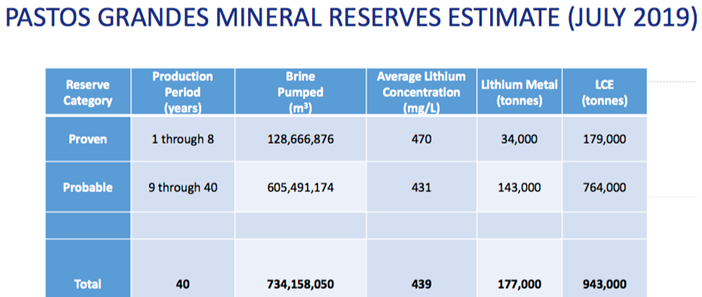
Farhad Abasov: The big news for us is that we released a Bank Feasibility Study (BFS) on our flagship 100%-owned Pastos Grandes lithium brine project. The after-tax NPV (8%) of US$1 billion was 25% above the NPV (8%) number in the preliminary economic assessment (PEA). We are one of just three or four companies with BFS-stage projects in Argentina, putting us, we think, 618 months ahead of most peers, some of whom will never reach BFS stage. The other two publicly listed players, Australia-listed Galaxy Resources and Lithium Americas, have much larger market caps than we do, even after consideration of other projects they own.
We are building a pilot plant that will operate at 3 tonnes of lithium carbonate per month, allowing us to build up an inventory of finished product to send to customers and for ongoing test work. With a BFS and pilot plant in hand, we will be well positioned to talk to prospective strategic and financial parties, as well as potential off-take partners. Those discussions are underway.
Peter Epstein: Almost everyone agrees that demand for lithium will be off the charts by the mid-2020s, but investment in the sector has been anemic. Is there a disconnect?
Farhad Abasov: Unfortunately, there’s a lot of confusion in the market, helped along by self-proclaimed experts, most of whom have little experience with specialty chemicals in general, or lithium in particular. Keep one thing in mind, the oversupply in spodumene concentrate is related only to the shortage of available chemical conversion capacity in China. It has nothing to do with global demand for lithium chemicals.
While newsworthy setbacks on lithium projects such as Nemaska’s has created a heightened degree of uncertainty, the market could consume four times as much lithium carbonate in 2025 or 2026 than was produced last year. Increases in supply this year and next come nowhere near meeting this scale of growth. I find it hard to believe that the entire market could be in oversupply in the medium term, notwithstanding short-term oversupply in the near term.
Peter Epstein: What are the most important differences between Millennial’s PEA and your newly released BFS?
Farhad Abasov: Good question. A key difference was that production of 25,000 tonnes/year in the PEA (20,000 tonnes battery grade (>99.5% Li2CO3) and 5,000 tonnes technical grade), has been enhanced. The production rate in the BFS is 24,000 tonnes/year, but it’s now 100% battery grade. Also, life of mine was extended from 25 to 40 years. Importantly, the level of accuracy in our BFS is much tighter at +15%/-15%, versus +35%/-35% in the PEA.
The cap-ex number in the BFS is 9% higher than that of the PEA due to three items. First, the addition of a final purification stage to ensure battery-grade (99.5% Li2CO3) lithium carbonate production. Second, the inclusion of a photo-voltaic plant to provide low-cost power, and third, an operations camp, (the PEA assumed the use of a contractor).
Op-ex increased by 5% due to higher usage and cost of reagents, primarily soda ash and lime, and the inclusion of the purification stage I mentioned. The BFS also included a pond expansion beginning in year 5 to maintain production levels and improve product quality. So, an increase of 9% and 3% in capex/opex, but an increase of 25% in after-tax NPV and a higher degree of certainty in project fundamentals.
Peter Epstein: What are the primary business catalysts for the remainder of the year? First half of 2020?
Farhad Abasov: The primary catalysts are the construction and start of a pilot processing plant, approval of our EIA by Salta province officials, securing off-take agreements, obtaining financial commitments and ongoing discussions with prospective strategic and financial partners in the lithium and energy industries.
Peter Epstein: What are the main takeaways of the BFS?
Farhad Abasov: We maintained and/or improved many financial metrics. We reported an after-tax IRR of 24% (before tax 28%), and NPV8 of US$1 billion (before tax US$1.6 billion). All indications are that Pastos Grandes can be a successful, high-purity lithium carbonate producer with capex and opex in line with other low-cost brine operations and projects in Argentina.
The BFS has opex at approximately $3,400 per tonne of battery grade lithium carbonate, placing the proposed operation in the lowest quartile of production costs, making it less vulnerable to lithium pricing and more attractive to funding partners.
Peter Epstein: Why aren’t giant car companies getting behind specific lithium projects or companies in Argentina? Toyota, Volkswagen, BMW, Nissan, Ford, GM, Honda have market caps averaging over US$50 billion.
Farhad Abasov: Automakers know the car business, not chemicals. Not since the days of Henry Ford have they had, or even exerted, direct presence in the materials supply chain. Large car companies are under the mistaken impression that lithium is a commodity, that supply can be “switched on” at short notice.
The message has not seemed to penetrate this type of end-useraccustomed as they are to working at very large volumes, but low marginsthat lithium supply is exactly the opposite.
Peter Epstein: No one can question Argentina’s mineral wealth, especially its lithium. However, the country has high inflation, a weak currency and a presidential election in three months. How risky is Argentina?
Farhad Abasov: Country risk in Argentina is overstated due to “flashy” headlines. The population as a whole is well educated and productive, hampered only by a legacy of sub-optimal policies, which are resolvable. As far as natural resources go, the country has low-cost lithium brine sources and a national mining law that is among the most transparent in the world.
Peter Epstein: Please brag about your management team, board and technical advisers.
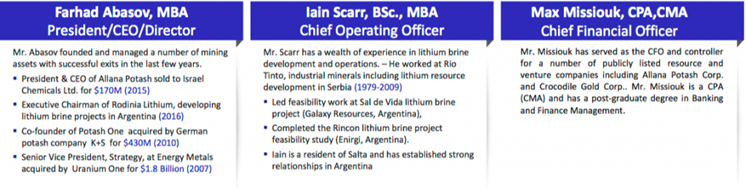
Farhad Abasov: We have an excellent and experienced team in place; both on the capital markets side and especially within our technical team. We have been a part of numerous mining successes including multiple M&A transactions. Given the strength of the Pastos Grandes project, we’ve been able to attract a world-class mining team; with experience in lithium project development, mining and processing. I invite readers to please visit our website for full biographies of our team.
Peter Epstein: Who are your largest shareholders?
Farhad Abasov: By group, management and insiders are still the largest shareholder at approximately 20%. Hong Kong listed GCL, one of the largest solar power companies in the world, owns 17%. A number of other well-known funds in Europe, Asia and North America own a combined 10%.
Peter Epstein: You moved directly from Preliminary Economic Assessment to Bank Feasibility Study, skipping the Pre-Feasibility Study (PFS) that almost every other company does. How did your team get comfortable with this decision?
Farhad Abasov: The main factor is that the Pastos Grandes brine reserve is relatively uncomplicated. While having to address normal issues associated with building and commissioning a new extraction operation and a high-purity chemical production facility, Millennial does not have to invent or develop anything new.
The process, already shown to work on our brine, is the norm in the industry. With no new technology to develop, prove and trial, we felt it was not necessary to extend the development path. As important, the team is highly experienced in specialty chemicals and lithium, from extraction through to marketing and strategy.
Peter Epstein: Funding Pastos Grande will be a major undertaking. What methods are you considering?
Farhad Abasov: At this time, funding will most likely include a combination of standard project debt, equity and off-take agreements /pre-payments on off-take. We’ve been diligently working on project financing for Pastos Grandes over the past year. We hope to have our financing in place before year-end.
Peter Epstein: Is there a scenario in which Millennial would not use solar evaporation ponds?
Farhad Abasov: There are no plans, nor any need to alter course at this time. Testing and implementing direct extraction technologies would be expensive in terms of both time and cost. There is only one direct extraction operation in the world today, and available expertise to develop such an operation is very difficult to find.
Peter Epstein: Please explain how your team is interacting with local communities.
Farhad Abasov: Millennial has enjoyed very good relations with the local community. Our two main projects include a joint business development and recreation building, designed so that the company and the community can work side-by-side for the benefit of the project, while also providing business opportunities for local residents. The most popular activity at this time is the commissioning of a new water well for the village.
Water supply to date has been from a surface stream. Drawing from surface water in an area with both humans and a robust domesticated animal population, has led to poor public health in the village. Millennial’s geologists identified and drilled a deeper well into a cleaner water aquifer. Testing proved that it is clear of contaminants, allowing us to install and commission a new local distribution system later this month.
Peter Epstein: Why should readers consider buying shares of Millennial Lithium over other lithium companies?
Farhad Abasov: We have the right team in the right place at the right time. Despite fiscal challenges in Argentina, it’s still the first or second best place on earth to harvest lithium with solar evaporation ponds. Lithium prices have come down from very high levels, but we don’t need a high lithium price next year or the year after. By the time we’re ramping up production we expect prices to be stronger.
We have an advanced-stage project with a BFS on it. As end users figure out that global supply of battery-grade lithium is highly uncertain, they will turn to the most advanced projects. Our Pastos Grandes project, Lithium Americas’ JV project with Ganfeng, and Galaxy’s Sal de Vida project are, without question, three of the most advanced brine projects in the world. We have about $30 million in cash, enough to fund us into next year.
Peter Epstein is the founder of Epstein Research. His background is in company and financial analysis. He holds an MBA degree in financial analysis from New York University’s Stern School of Business.
Disclosures: The content of this article is for information only. Readers fully understand and agree that nothing contained herein, written by Peter Epstein of Epstein Research [ER], (together, [ER]) about First Vanadium Corp., including but not limited to, commentary, opinions, views, assumptions, reported facts, calculations, etc. is not to be considered implicit or explicit investment advice. Nothing contained herein is a recommendation or solicitation to buy or sell any security. [ER] is not responsible under any circumstances for investment actions taken by the reader. [ER] has never been, and is not currently, a registered or licensed financial advisor or broker/dealer, investment advisor, stockbroker, trader, money manager, compliance or legal officer, and does not perform market making activities. [ER] is not directly employed by any company, group, organization, party or person. The shares of First Vanadium Corp. are highly speculative, not suitable for all investors. Readers understand and agree that investments in small cap stocks can result in a 100% loss of invested funds. It is assumed and agreed upon by readers that they will consult with their own licensed or registered financial advisors before making any investment decisions.
AX1 Capital Corp. retained Epstein Research for a six-month advertising campaign. AX1 Capital is closely affiliated with Millennial Lithium. It is 100%-owned by a single individual who has a contract for services with Millennial Lithium. This individual owns 150,000 restricted share units and a similarly modest number of warrants in the company. Therefore, readers should consider Epstein Research [ER] to be biased in favor of Millennial Lithium. Peter Epstein of [ER] does not own any shares, warrants, options or restricted share units of Millennial Lithium.
Readers understand and agree that they must conduct their own due diligence above and beyond reading this article. While the author believes he’s diligent in screening out companies that, for any reasons whatsoever, are unattractive investment opportunities, he cannot guarantee that his efforts will (or have been) successful. [ER] is not responsible for any perceived, or actual, errors including, but not limited to, commentary, opinions, views, assumptions, reported facts & financial calculations, or for the completeness of this article or future content. [ER] is not expected or required to subsequently follow or cover events & news, or write about any particular company or topic. [ER] is not an expert in any company, industry sector or investment topic.
Streetwise Reports Disclosure: 1) Peter Epstein’s disclosures are listed above. 2) The following companies mentioned in the article are billboard sponsors of Streetwise Reports: None. Click here for important disclosures about sponsor fees. The information provided above is for informational purposes only and is not a recommendation to buy or sell any security. 3) Statements and opinions expressed are the opinions of the author and not of Streetwise Reports or its officers. The author is wholly responsible for the validity of the statements. The author was not paid by Streetwise Reports for this article. Streetwise Reports was not paid by the author to publish or syndicate this article. Streetwise Reports requires contributing authors to disclose any shareholdings in, or economic relationships with, companies that they write about. Streetwise Reports relies upon the authors to accurately provide this information and Streetwise Reports has no means of verifying its accuracy.
4) The article does not constitute investment advice. Each reader is encouraged to consult with his or her individual financial professional and any action a reader takes as a result of information presented here is his or her own responsibility. By opening this page, each reader accepts and agrees to Streetwise Reports’ terms of use and full legal disclaimer. This article is not a solicitation for investment. Streetwise Reports does not render general or specific investment advice and the information on Streetwise Reports should not be considered a recommendation to buy or sell any security. Streetwise Reports does not endorse or recommend the business, products, services or securities of any company mentioned on Streetwise Reports. 5) From time to time, Streetwise Reports LLC and its directors, officers, employees or members of their families, as well as persons interviewed for articles and interviews on the site, may have a long or short position in securities mentioned. Directors, officers, employees or members of their immediate families are prohibited from making purchases and/or sales of those securities in the open market or otherwise from the time of the interview or the decision to write an article until three business days after the publication of the interview or article. The foregoing prohibition does not apply to articles that in substance only restate previously published company releases.
The US dollar has moved away from local highs and fallen against a basket of major currencies. Investors have taken a wait-and-see attitude before the publication of the FOMC minutes, which may indicate the further rate of adjustment of the Fed’s monetary policy. On August 22-24, a banking symposium will be held in Jackson Hole, where the Fed’s Chairman Jerome Powell will speak. Financial market participants expect the official to give signals to further interest rate cut. As previously reported, US President Donald Trump criticized the actions of the Central Bank and insisted on the regulator to reduce the interest rate by 100 basis points. The US dollar index (#DX) closed the trading session in the negative zone (-0.16%).
Investors are also focused on the meeting of the G7 countries – France, Germany, Great Britain, Italy, Canada, the USA, and Japan. The meeting will be held on August 24-26 in Biarritz (France).
The “black gold” prices show positive dynamics. Futures for the WTI crude oil are currently testing the $56.20 mark per barrel. At 17:30 (GMT+3:00), a report on the US crude oil inventories will be published.
Market Indicators
Yesterday, the bearish sentiment was observed in the US stock markets: #SPY (-0.77%), #DIA (-0.63%), #QQQ (-0.77%).
The 10-year US government bonds yield has moved away from local lows. At the moment, the indicator is at the level of 1.60-1.61%.
The news feed for 2019.08.21:
– Core consumer price index in Canada at 15:30 (GMT+3:00); – Existing home sales in the US at 15:30 (GMT+3:00); – Publication of the FOMC minutes at 21:00 (GMT+3:00).
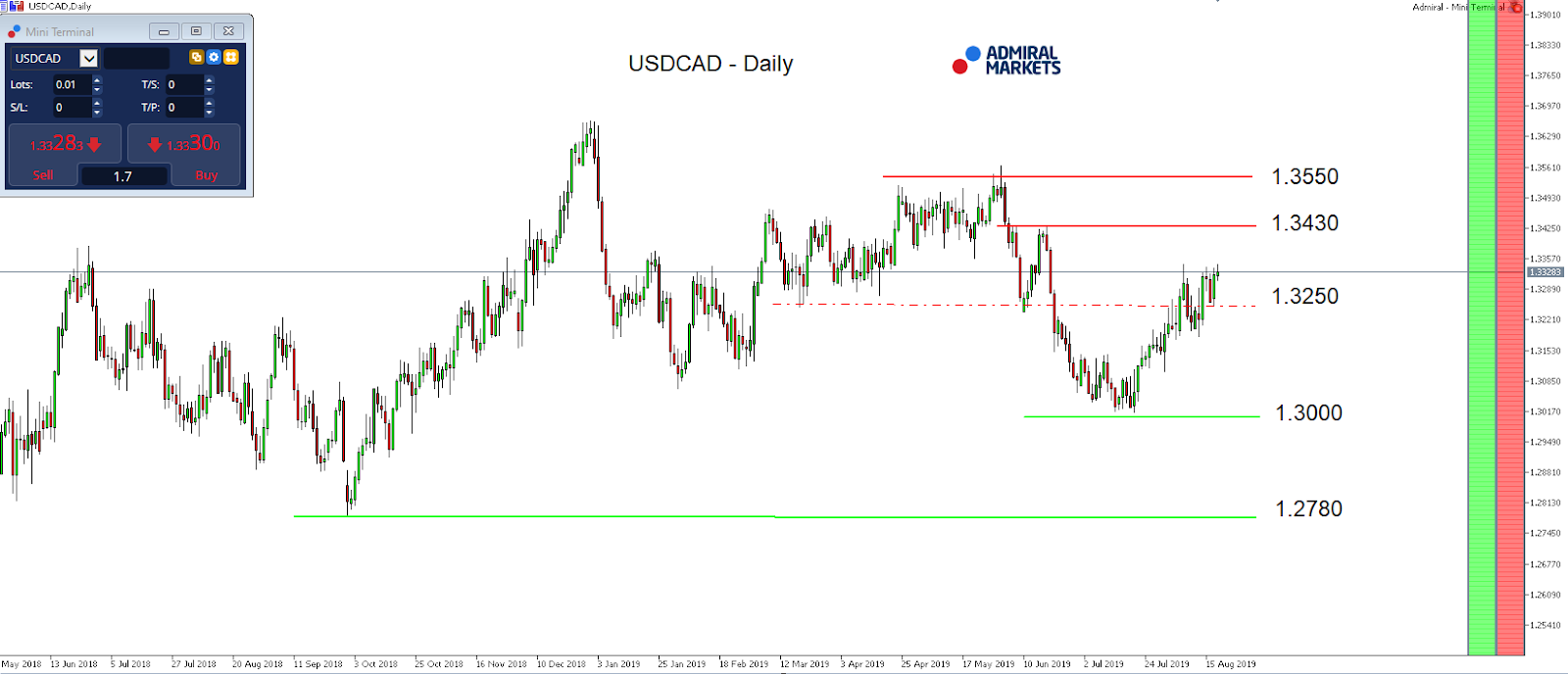
Today we want to focus on the USD/CAD, and the upcoming release of Canadian inflation data. After recent data showed a negative print (MoM) in June for the first time since last December, combined with oil prices not gaining significant momentum over the month of July and rising fears of a further escalation in the trade war between the US and China, it will be interesting to see if Canadian inflation can fulfil the current projection of 0.2%.
In our opinion, every print below 0.2% would potentially result in rising speculation of a dovish BoC by September 4, and the central bank is openly concerned about the trade dispute between the US and China at the last July meeting.
While the latest economic indicators were on track on with Canadian inflation being on target, any disappointing print could, in combination with the global economic slowdown and increasingly dovish central banks around the globe force the BoC to join this rhetoric and result in a push lower in the CAD.
That said, a print below 0.2% (MoM) could push the USD/CAD back above 1.3300, levelling the path up to 1.3550, stop-over around 1.3420/50.
If, on the other hand, inflation comes in above expectation, the currency pair could see another test of the region around 1.3000, since market participants could await the BoC to stick to a “wait-and-see”-approach at the next meeting.
Source: Admiral Markets MT5 with MT5-SE Add-on USD/CAD Daily chart (between May 22, 2018, to August 20, 2019). Accessed: August 20, 2019, at 10:00pm GMT – Please note: Past performance is not a reliable indicator of future results, or future performance.
In 2014, the value of the USD/CAD increased by 9.4%, in 2015, it increased by 19.1%, in 2016, it fell by 2.9%, in 2017, it fell by 6.4%, in 2018, it increased by 8.4%, meaning that after five years, it was up by 28.4%.
Discover the world’s #1 multi-asset platform
Admiral Markets offers professional traders the ability to trade with a custom, upgraded version of MetaTrader 5, allowing you to experience trading at a significantly higher, more rewarding level. Experience benefits such as the addition of the Market Heat Map, so you can compare various currency pairs to see which ones might be lucrative investments, access real-time trading data, and so much more. Click the banner below to start your FREE download of MT5 Supreme Edition!
Disclaimer: The given data provides additional information regarding all analysis, estimates, prognosis, forecasts or other similar assessments or information (hereinafter “Analysis”) published on the website of Admiral Markets. Before making any investment decisions please pay close attention to the following:
This is a marketing communication. The analysis is published for informative purposes only and are in no way to be construed as investment advice or recommendation. It has not been prepared in accordance with legal requirements designed to promote the independence of investment research, and that it is not subject to any prohibition on dealing ahead of the dissemination of investment research.
Any investment decision is made by each client alone whereas Admiral Markets shall not be responsible for any loss or damage arising from any such decision, whether or not based on the Analysis.
Each of the Analysis is prepared by an independent analyst (Jens Klatt, Professional Trader and Analyst, hereinafter “Author”) based on the Author’s personal estimations.
To ensure that the interests of the clients would be protected and objectivity of the Analysis would not be damaged Admiral Markets has established relevant internal procedures for prevention and management of conflicts of interest.
Whilst every reasonable effort is taken to ensure that all sources of the Analysis are reliable and that all information is presented, as much as possible, in an understandable, timely, precise and complete manner, Admiral Markets does not guarantee the accuracy or completeness of any information contained within the Analysis. The presented figures refer that refer to any past performance is not a reliable indicator of future results.
The contents of the Analysis should not be construed as an express or implied promise, guarantee or implication by Admiral Markets that the client shall profit from the strategies therein or that losses in connection therewith may or shall be limited.
Any kind of previous or modeled performance of financial instruments indicated within the Publication should not be construed as an express or implied promise, guarantee or implication by Admiral Markets for any future performance. The value of the financial instrument may both increase and decrease and the preservation of the asset value is not guaranteed.
The projections included in the Analysis may be subject to additional fees, taxes or other charges, depending on the subject of the Publication. The price list applicable to the services provided by Admiral Markets is publicly available from the website of Admiral Markets.
Leveraged products (including contracts for difference) are speculative in nature and may result in losses or profit. Before you start trading, you should make sure that you understand all the risks.
Following a rather slow week as far as the economic data is concerned, the Fed meeting today will be one to watch. Investors are likely to remain on the sidelines in the run-up to the release of the FOMC minutes today.
The data comes as the Boston Fed president, Rosengren said that there was no need to lower interest rates. Rosengren was one of the two voting members who dissented against the rate cuts.
Euro Bounces as Italy PM Resigns
The euro ignored the news from Italy that Prime Minister Giuseppe Conte announced his resignation. The news came on Tuesday after weeks of speculation following discord with the Interior Minister. Conte blamed the minister for undermining the government’s efforts to pass its budget. The developments could potentially lead to fresh elections in Italy.
Will the EURUSD Maintain the Upside Bounce?
The currency pair initially slipped to lows of 1.1064 before posting a strong rebound. The gains could be limited to 1.1100. However, a close above this level could see the resistance failing. This would potentially invalidate the bearish flag pattern and could put the euro on track to continue the upside. There is also a possibility of a double bottom that has formed near 1.1064. A breakout above 1.1112 could trigger the double bottom pattern.
Sterling Jumps as PM Attempts to Negotiate With EU
The pound posted gains on Tuesday after PM Johnson called upon the EU. Talking about the Brexit deal, Johnson called for EU officials to remove the Irish backstop. Johnson said that the backstop was unviable but said that a deal could still be reached by October 31st. The EU has so far maintained that the Irish backstop was not up for negotiation.
GBPUSD Holds Support at 1.2082
Sterling briefly retested the support area of 1.2082 before posting gains. With the support level being established, the descending wedge pattern is likely to take shape. This will put the minimum upside to 1.2210 initially. A close above this level will see the GBPUSD likely to push higher towards the main resistance area of 1.2533 – 1.2511.
Gold Attempts to Retrace Losses
The precious metal attempted to post some modest gains on Tuesday. Price action was seen largely trading within Monday’s range that was set. Investors could remain on the sidelines ahead of the FOMC meeting minutes due for release later today. The initial panic following the 10 and 2-year yield curve inversion is also starting to fade as well, giving rise to risk appetite.
XAUUSD Rally Looks Done, For Now
Price action in the precious metal looks to be easing to the upside. XAUUSD briefly retested the resistance area at 1508. As long as this resistance holds, we could anticipate a downside with the lower support at 1485.70. While there is a possibility that price will remain within the said range, a breakout to the downside is quite likely to build up.
The monthly existing home sales report is due today by the National Association of Realtors. The data will provide estimates of the value of the existing home sale conditions in the US economy.
The existing home sales data is a monthly measure of the sales volume of existing single-family units including condos and co-ops.
The report measures the sales of homes that are owned and occupied before being put on the market. The data covers more than 90% of total home sales and captures the completed transactions.
Economists polled forecast that existing home sales will fall 0.2% on the month in July.
This comes on the back of a 1.7% decline in existing home sales in June. The declines in June are seen as a pullback following the strong gains that were registered in May. Total existing home sales rose just 5.41 million compared to 5.27 million previously.
This was a 2.2% decline in existing homes on a year over year basis.
US Existing Home Sales, May 2019
Typically, the run-up to the summer months has a seasonal tendency to rise. At the same time, the underlying interest rate conditions also play a role.
So far, existing home sales have been weaker since June. The data for July is expected to continue this trend but at a slower pace than before.
Existing Home Sales Fall Despite Cheaper Mortgage Rates
The trend in the existing home sales comes amid the US economy seeing a rather stable period of interest rates. Mortgage rates have been falling steadily. However, this has failed to push up demand for existing home sales.
In the June release, the declines were seen due to a number of factors. These included lower inventory and pent-up demand. Typically, lower inventory pushes home prices higher. The median home sales prices have been rising for the 88th consecutive month.
On a year over year basis, existing median home prices rose 4.3% from the year before. However, the total housing inventory remained unchanged from a year ago.
There were increases in prices of both single-family units as well as condo and co-op sales. The higher costs could possibly be one of the reasons for the existing home sales report to be trending weaker.
However, given the currently expected decline, it would potentially mark a slower pace of declines compared to the previous month.
Can Existing Home Sales Pick Up in the Coming Months?
The current economic situation in the United States remains somewhat mixed. With the trade dispute with China ranking high, consumers remain cautious. The Fed cut rates in July and noted that it was only an adjustment.
Thus, despite a strong labor market, it is likely that consumers, both first-time homebuyers and investors, will be treading cautiously.
This comes amid the fact that the percentage of first time home buyers rose 35% in sales. This was up from 32% in the month before. The underlying data indicates that there is still demand as far as first time home buyers are concerned.
Asian stocks are following their US counterparts lower, with markets reluctant to get ahead of themselves in hoping for a near-term resolution to the US-China conflict. The intensifying concerns over the state of the global economy have only soured the outlooks for open and trade-dependent Asian economies, with such fears feeding into the performances of risk assets.
Until there is a meaningful breakthrough in the US-China impasse, it would be a big ask for Asian assets to carve out substantial gains over the near-term, while a more pronounced slowdown in the global economy will only reflect negatively in the currencies across Asia and emerging-markets.
Dollar bulls in “never-say-die” mode as investors await Fed minutes, Powell’s speech
Asian currencies are having a tough time battling against the US Dollar’s never-say-die performance, even as the Greenback’s attempt at a new 2019 high has lost some steam ahead of the release of the Fed’s July meeting minutes. Markets are hoping that the latest FOMC minutes will provide some insights into the decision three weeks ago to cut US interest rates for the first time since 2008. Investors are clamouring for some sorely-needed clarity on the Fed’s policy bias, given Fed chair Jerome Powell’s convoluted guidance following the FOMC’s end-July meeting.
Markets will also be keenly watching Powell’s speech this Friday for more clues, whereby another fudged policy outlook from the Fed chair could trigger another bout of volatility in the markets. As things stand, markets are currently pricing in three more Fed rate cuts throughout the remainder of the year. Despite the expected dovishness out of the world’s most influential central bank, Dollar bulls are not ready to relinquish the reins to the bears, as they keep the Dollar index above the psychologically-important 98 level for the time being. The Greenback’s resilience continues being fueled by the deteriorating global economic outlook, which has spurred market participants towards the safety of the Dollar.
Italian political risks add to Euro’s woes
The Euro has been testing the 1.11 support level against the Dollar so far this week, as Italy’s political turmoil adds to the dismal outlook on the bloc’s currency. The heightened political risks in Italy are fostering doubt over policy continuity, especially with regards to Italy’s fiscal deficit, which has been a major point of contention with the EU establishment.
The Euro has already been weighed down by external headwinds due to the protracted US-China conflict, along with Brexit uncertainties, with the economic pressures prompting an overtly dovish bias out of the European Central Bank. The latest ECB minutes as well as the PMI readings out of EU-member economies due over the coming days could exert more downward pressure on the Euro, should markets get the sense that imminent monetary policy stimulus is sorely needed. Given the increasingly evident downside risks, markets are left with scarce cause for optimism with regards to the EU, considering that the Euro has already weakened by some 3.2 percent against the US Dollar so far this year.
Disclaimer: The content in this article comprises personal opinions and should not be construed as containing personal and/or other investment advice and/or an offer of and/or solicitation for any transactions in financial instruments and/or a guarantee and/or prediction of future performance. ForexTime (FXTM), its affiliates, agents, directors, officers or employees do not guarantee the accuracy, validity, timeliness or completeness, of any information or data made available and assume no liability as to any loss arising from any investment based on the same.
Dollar weakens as Trump calls for deeper rate cuts
US stock indexes pulled back on Tuesday despite president Trump’s confirmation Tuesday that he was looking at tax cuts, including cutting payroll taxes. The S&P 500 fell 0.8% to 2900.51. Dow Jones industrial lost 0.7% to 25962.44. The Nasdaq retreated 0.7% to 7948.56. The dollar strengthening reversed as president Trump said the Federal Reserve should consider deeper cuts to key interest rates, of around 1%: the live dollar index data show the ICE US Dollar index, a measure of the dollar’s strength against a basket of six rival currencies, lost 0.2% to 98.15 but is higher currently. Stock index futures point to higher market openings today.
FTSE 100 leads European indexes retreat
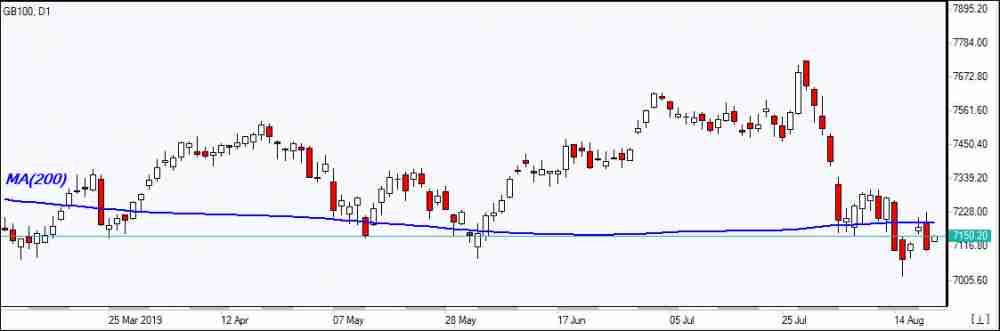
European stocks recovery faltered on Tuesday as Italian Prime Minister Giuseppe Conte announced his resignation from the government. Both the EUR/USD and GBP/USD turned higher yesterday and both pairs are lower currently. The Stoxx Europe 600 ended 0.7% lower as Italy’s coalition government between anti-immigration Lega party and the anti-establishment Five Star Movement (M5S) unraveled after Matteo Salvini, deputy prime minister and leader of Lega party, called for the vote and a new general election last week. The German DAX 30 lost 0.6% to 11651.18. France’s CAC 40 slid 0.5%. UK’s FTSE 100 fell 0.9% to 7125.
Australia’s All Ordinaries Index leads Asian indexes retreat
Asian stock indices are mostly in negative territory today. Nikkei lost 0.3% to 20618.57 despite resumed yen slide against the dollar. Chinese stocks are mixed: the Shanghai Composite Index is up 0.03% while Hong Kong’s Hang Seng index is 0.04% lower. Australia’s All Ordinaries Index gave up most of previous session gains falling 0.9% despite Australian dollar’s move lower against the greenback.
Brent futures prices are rising today. The American Petroleum Institute late Tuesday report indicated US crude inventories fell by 3.5 million barrels last week. Prices rose yesterday: October Brent gained 0.5% to $60.03 a barrel on Tuesday. Today at 16:30 CET the Energy Information Administration will release US Crude Oil Inventories.
Note: This overview has an informative and tutorial character and is published for free. All the data, included in the overview, are received from public sources, recognized as more or less reliable. Moreover, there is no guarantee that the indicated information is full and precise. Overviews are not updated. The whole information in each overview, including opinion, indicators, charts and anything else, is provided only for familiarization purposes and is not financial advice or а recommendation. The whole text and its any part, as well as the charts cannot be considered as an offer to make a deal with any asset. IFC Markets and its employees under any circumstances are not liable for any action taken by someone else during or after reading the overview.
The Euro is staging a modest recovery against the Dollar despite Italy’s Prime Minister Guiseppe Conte confirming that he will resign ahead of a no-confidence vote.
It remains unclear whether this will open doors to a snap election or if parliament will be asked to try and form a new government. Whatever the outcome, it will certainly have a lasting impact on the Euro which remains entangled with a fierce battle with domestic and external risks.
Fears over the largest economy in Europe heading for a deep recession mixed with speculation over the European Central Bank cutting interest rates in September are positioned to weaken the Euro. An appreciating Dollar should compound to the downside pressure and open doors towards 1.1000 and lower on the EURUSD.
Taking a look at the technical picture, the EURUSD remains bearish on the weekly and daily charts. Sustained weakness below 1.1100 is seen triggering a decline towards 1.1000 and 1.0900, respectively.
Sterling capped below 1.2200
The road ahead for Sterling is filled with many obstacles and potholes as Brexit haunts investor attraction towards the currency.
This sentiment continues to be reflected in the Pound’s depressed price action as gains remain capped below the 1.2200 resistance level. Sustained weakness under this level should encourage a move back towards 1.2100 and 1.2000, respectively.
While a breakout above 1.2200 has the potential to trigger a technical rebound higher, the next major wall of resistance can be found around 1.2400.
USDJPY outlook tilts to downside on risk aversion
Market caution is set to boost appetite for safe-haven assets such as the Japanese Yen.
The Japanese Yen has appreciated against every single G10 currency since Monday and is positioned to push higher on risk aversion. Technical traders will continue closely observing how the Japanese Yen behaves around 106.35. Further downside remains on the cards are long as prices can keep below the 107.00 resistance level. The intraday breakdown under 106.50 should pave a path towards 106.00 and 105.50.
Disclaimer: The content in this article comprises personal opinions and should not be construed as containing personal and/or other investment advice and/or an offer of and/or solicitation for any transactions in financial instruments and/or a guarantee and/or prediction of future performance. ForexTime (FXTM), its affiliates, agents, directors, officers or employees do not guarantee the accuracy, validity, timeliness or completeness, of any information or data made available and assume no liability as to any loss arising from any investment based on the same.