COFFEE Analysis: Lower Columbia coffee output bullish for coffee price

By IFCMarkets

Lower Columbia coffee output bullish for coffee price

Columbia coffee output declined in August. Will the coffee prices continue rising?

Columbia coffee production in August 2019 amounted to 1.119 mln 60-kg bags, down 11.0% from 1.258 mln in the same month last year, data from the Fedecafe – National Federation of Coffee Growers show. Columbia is the third largest coffee producing nation in the world – 810,000 metric tons of coffee beans in 2016. Lower Columbia coffee output is bullish for coffee prices.

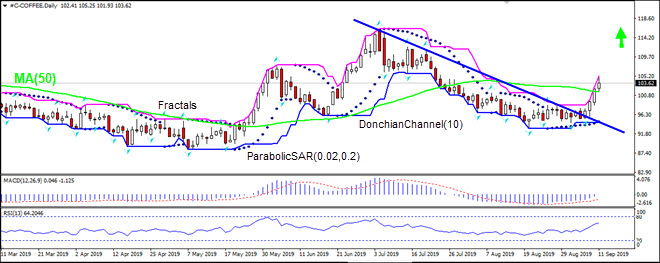
COFFEE breached above MA(50) 09/12/2019 Technical Analysis IFC Markets chart

On the daily timeframe the Coffee: D1 has breached above the resistance line and the 50-day moving average MA(50), these are bullish developments.

  • The Parabolic indicator gives a buy signal.
  • The Donchian channel indicates uptrend: it is titled up.
  • The MACD indicator gives a bullish signal: it is below the signal line and the gap is narrowing.
  • The RSI oscillator is rising but has not breached into overbought zone yet.

We believe the bullish momentum will continue after the price breaches above the upper boundary of Donchian channel at 95.51. This level can be used as an entry point for placing a pending order to buy. The stop loss can be placed above the last fractal low at 94.49. After placing the order, the stop loss is to be moved every day to the next fractal low, following Parabolic signals. Thus, we are changing the expected profit/loss ratio to the breakeven point. If the price meets the stop loss level (94.49) without reaching the order (102.75), we recommend cancelling the order: the market has undergone internal changes which were not taken into account.

Technical Analysis Summary

OrderBuy
Buy stopAbove 102.75
Stop lossBelow 94.49

Market Analysis provided by IFCMarkets

ECB cuts deposit rate 10 bps, restarts QE at 20 bln euros

By CentralBankNews.info

The European Central Bank (ECB) lowered one of its key policy rates and restarted its asset purchases, and signaled it could loosen its policy further to ensure inflation rises towards its target.

The ECB, the central bank for the 19 counties that share the euro, cut its deposit rate by another 10 basis points to minus 0.50 percent, the first cut since March 2016, but left its benchmark refinancing rate steady at 0.0 percent and the lending rate at 0.25 percent.

The ECB omitted its previous reference of keeping rates low through the first half of 2020 and said it now expects rates “to remain at their present or lower levels until it has seen the inflation outlook robustly converge to a level sufficiently close to, but below, 2% within its projection horizon, and such convergence has been consistent reflected in underlying inflation dynamics.”

As signaled in July, the ECB restarted its asset purchase program – known as quantitative easing – and will be buying securities worth 20 billion euros from Nov. 1, with the program to “run as long as necessary to reinforce the accommodative impact of its policy rates, and to end shortly before its starts raising the key ECB interest rates.”

In addition, reinvestments of any maturing securities will continue “for an extended period” past the date the ECB stars raising rates, or as long as necessary to maintain favorable liquidity conditions.

The ECB, which in March decided to proceed with another round of targeted longer-term refinancing operations, TLTRO III, said this would be adjusted to ensure favorable bank lending conditions while a two-tier system for reserve renumeration would be introduced that exempts parts of banks’ holdings of excess liquidity from the negative deposit facility.

The European Central Bank issued the following statement:

“At today’s meeting the Governing Council of the ECB took the following monetary policy decisions:
(1) The interest rate on the deposit facility will be decreased by 10 basis points to -0.50%. The interest rate on the main refinancing operations and the rate on the marginal lending facility will remain unchanged at their current levels of 0.00% and 0.25% respectively. The Governing Council now expects the key ECB interest rates to remain at their present or lower levels until it has seen the inflation outlook robustly converge to a level sufficiently close to, but below, 2% within its projection horizon, and such convergence has been consistently reflected in underlying inflation dynamics.
(2) Net purchases will be restarted under the Governing Council’s asset purchase programme (APP) at a monthly pace of €20 billion as from 1 November. The Governing Council expects them to run for as long as necessary to reinforce the accommodative impact of its policy rates, and to end shortly before it starts raising the key ECB interest rates.
(3) Reinvestments of the principal payments from maturing securities purchased under the APP will continue, in full, for an extended period of time past the date when the Governing Council starts raising the key ECB interest rates, and in any case for as long as necessary to maintain favourable liquidity conditions and an ample degree of monetary accommodation.
(4) The modalities of the new series of quarterly targeted longer-term refinancing operations (TLTRO III) will be changed to preserve favourable bank lending conditions, ensure the smooth transmission of monetary policy and further support the accommodative stance of monetary policy. The interest rate in each operation will now be set at the level of the average rate applied in the Eurosystem’s main refinancing operations over the life of the respective TLTRO. For banks whose eligible net lending exceeds a benchmark, the rate applied in TLTRO III operations will be lower, and can be as low as the average interest rate on the deposit facility prevailing over the life of the operation. The maturity of the operations will be extended from two to three years.
(5) In order to support the bank-based transmission of monetary policy, a two-tier system for reserve remuneration will be introduced, in which part of banks’ holdings of excess liquidity will be exempt from the negative deposit facility rate.
Separate press releases with further details of the measures taken by the Governing Council will be published this afternoon at 15:30 CET.

The President of the ECB will comment on the considerations underlying these decisions at a press conference starting at 14:30 CET today.”

www.CentralBankNews.info


What Is A Contract For Difference?

By Orbex

Entering the forex markets as a beginner trader can be quite overwhelming. Aside from the risks and charts that tend to intimidate budding investors, there’s also a whole bunch of FX “lingo” that can be difficult to get the hang of.

Perhaps the first of these “forex-isms” you’ll come across is the term “CFDs”.

But don’t be discouraged by the fancy abbreviation! This acronym is effectively just a 3-letter depiction of the concept of the forex markets. And we’ve simplified it all for you today.

Breaking Down CFDs

A contract for difference, or CFD, is an agreement between a forex broker and trader that allows you to speculate on the price movement of a financial instrument.

In the forex markets, the financial instruments you can speculate on are currencies, commodities, indices, energies, and equities.

As an FX trader, you choose a financial instrument and speculate on whether its value will increase or decrease. In the case of currencies, you speculate on the value of one currency against another.

You then open a trade or “position” accordingly, typically on an MT4 online trading platform.

And just like that, you’ve entered a contract for difference!

This contract means that you and your broker have agreed to exchange the difference between the opening price of the contract and the closing price of the contract, without you ever physically purchasing or acquiring the asset you’re trading.

Let’s Take an Example of a CFD

If you believe the price of gold will go up, you will open a “buy” position, hoping to then sell whatever value of the gold you’ve bought for more money at a later date.

If it goes your way, you can decide to close the “contract” or position at a higher price than what it cost at its opening, meaning you’ve walked away with a profit.

So, CFDs are simply a way for you to monetize and profit from your speculation that the price of gold will go up, without you ever having to physically buy, ship and store a whole load of gold bars.

But remember – the forex markets are risky. If the market moves contrary to your speculative position or trade, you may lose all the money you’ve invested, depending on the closing price of the contract. However, you can always predefine the price at which you wish to close the position, and that’s called the “stop loss” price.

Why Trade CFDs

Before online CFD trading arrived, anyone who wasn’t a financial professional or institution could neither access nor profit from the global forex markets (apart from by physically exchanging money).

CFDs, therefore, enable anyone with an interest in the FX markets to partake in this global industry, no matter where they are in the world.

CFDs are also leveraged products. This means you can invest as little as 1% of the capital needed to yield profits from forex market movements.

In addition, since CFDs monetize your prediction on price movement, you can profit from “short selling”, (or speculating that the price of an asset will go down,) without physically “owning” it to begin with.

So, regardless of how the markets are doing, there is always money to be made and risk to be managed. And you don’t have to have a hefty stash of valuable stock shares to become a forex trader!

What Do I Need to Trade CFDs? 

Well, the very basics include a laptop, an internet connection and an account with your forex broker of choice.

However, beyond that, you need to have a good few (hundred!) hours of research and practice on a demo account under your belt before you risk your capital.

These days, we can’t even order a meal without doing extensive research on the restaurant. So investing your money in forex trading should be no different.

Which brings us to another essential: having an allocated amount of money that you are willing to lose. If there’s one thing you’ll quickly learn in the forex market, it’s that it’s volatile and everchanging. So never enter an FX trade with capital you are not prepared to part with.

Now that you know what CFDs are, it’s time for you to learn more about forex trading. And, most importantly, to get practicing on a free MT4 demo account!

By Orbex
 

Japanese Candlesticks Analysis 12.09.2019 (USDCAD, AUDUSD)

Article By RoboForex.com

USDCAD, “US Dollar vs Canadian Dollar”

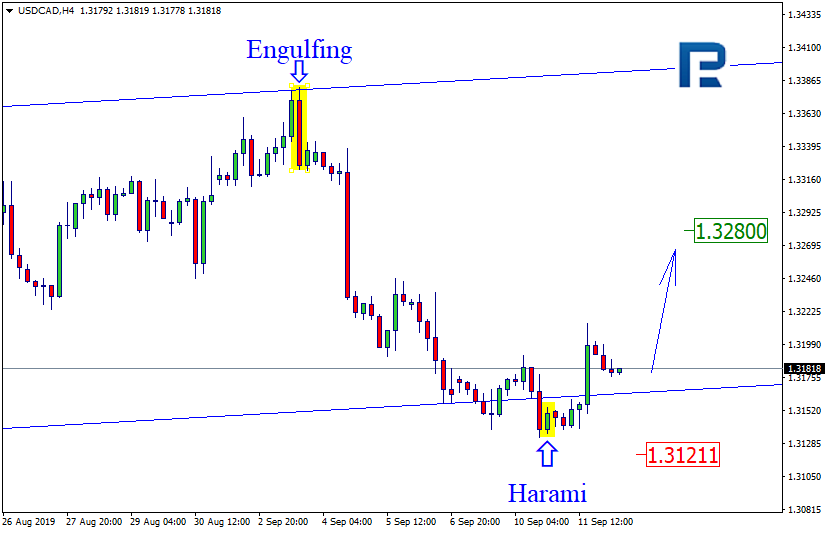
As we can see in the H4 chart, USDCAD continues trading close to the rising channel’s downside border and forming reversal patterns. Right now, the pair is trying to reverse after forming Harami pattern. At the moment, it may be assumed that the price may complete a slight correction and resume growing towards 1.3280. However, we shouldn’t ignore a possibility that the instrument may update the low and continue its decline to reach 1.3121.

USDCAD
Risk Warning: the result of previous trading operations do not guarantee the same results in the future

AUDUSD, “Australian Dollar vs US Dollar”

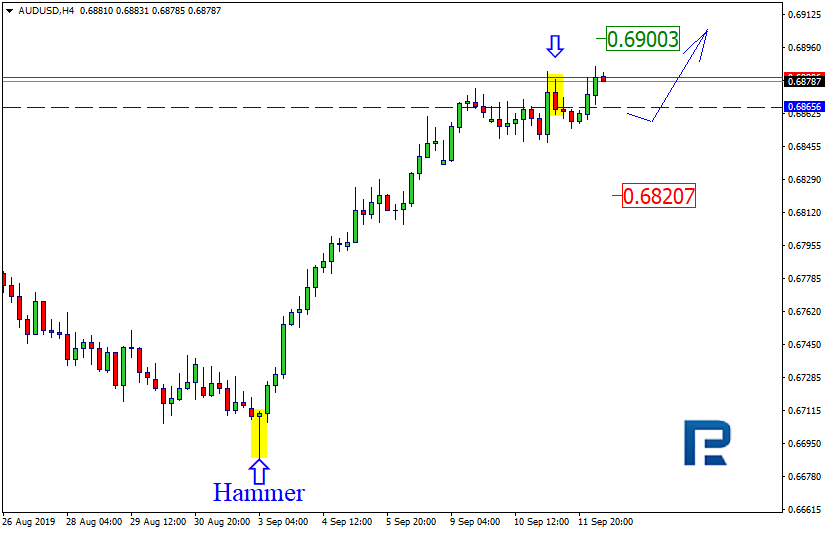
As we can see in the H4 chart, AUDUSD is trading close to the resistance level and forming reversal patterns, including Harami. The pair wasn’t able to reverse and updated the high instead. Judging by the previous movements, we may assume that the price may continue trading upwards to reach 0.6900. However, we shouldn’t ignore a possibility that the instrument may resume falling 0.6820.

AUDUSD

Article By RoboForex.com

Attention!
Forecasts presented in this section only reflect the author’s private opinion and should not be considered as guidance for trading. RoboForex LP bears no responsibility for trading results based on trading recommendations described in these analytical reviews.

EURUSD Analysis: Falling industrial production bearish for EURUSD

By IFCMarkets

Falling industrial production bearish for EURUSD

Industrial production in euro-zone fell 0.4% over month in July 2019, when 0.2% decline was forecast. The decline followed 1.6% drop over month in June. Will the EURUSD decline?

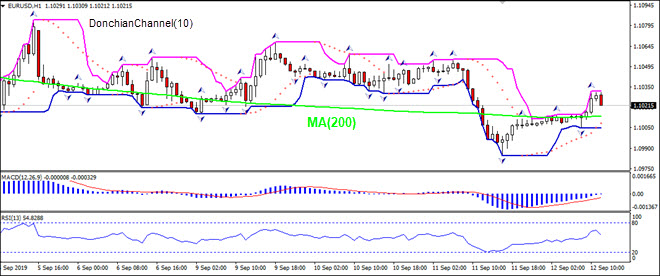
EURUSD rising above MA(200)

On 1-hour timeframe EURUSD: H1 is in uptrend. The price has crossed above the 200-period moving average MA(200) which has started to rise.

Technical Analysis Summary

OrderBuy
Buy stopAbove 1.1032
Stop lossBelow 1.1005

Market Analysis provided by IFCMarkets

Murrey Math Lines 12.09.2019 (USDCHF, GOLD)

Article By RoboForex.com

USDCHF, “US Dollar vs Swiss Franc”

In the H4 chart, USDCHF is expected to test the resistance at 3/8, rebound from it, and then resume falling towards the support at 1/8. However, this scenario may no longer be valid if the price breaks 3/8 to the upside. After that, the instrument may continue growing towards the resistance at 4/8.

USDCHF_H4
Risk Warning: the result of previous trading operations do not guarantee the same results in the future

In the M15 chart, the pair may break the downside line of the VoltyChannel indicator and, as a result, move downwards to reach the support at 1/8 from the H4 chart.

USDCHF_M15
Risk Warning: the result of previous trading operations do not guarantee the same results in the future

XAUUSD, “Gold vs US Dollar”

In the H4 chart, XAUUSD is moving below 8/8. In this case, the price is expected to continue falling to reach the support at 7/8. However, this scenario may no longer be valid if the price breaks 8/8 to the upside. After that, the instrument may continue growing towards the resistance at +1/8.

GOLD_H4
Risk Warning: the result of previous trading operations do not guarantee the same results in the future

As we can see in the M15 chart, the pair has broken the downside line of the VoltyChannel indicator and, as a result, may continue its decline.

GOLD_M15

Article By RoboForex.com

Attention!
Forecasts presented in this section only reflect the author’s private opinion and should not be considered as guidance for trading. RoboForex LP bears no responsibility for trading results based on trading recommendations described in these analytical reviews.

The Analytical Overview of the Main Currency Pairs on 2019.09.12

by JustForex

The EUR/USD currency pair

Technical indicators of the currency pair:
  • Prev Open: 1.10432
  • Open: 1.10094
  • % chg. over the last day: -0.27
  • Day’s range: 1.10075 – 1.10152
  • 52 wk range: 1.0931 – 1.1817

The single currency fell to a weekly low against the US dollar before today’s ECB meeting. It is expected that the regulator will reduce the rate on deposit funds to -0.50% from -0.40%. Experts also predict that the Central Bank may announce the introduction of additional measures to stimulate the economy. We recommend that you pay attention to the comments and rhetoric of the ECB representatives. Currently, the EUR/USD currency pair is consolidating. The key trading range is 1.09900-1.10200. Positions must be opened from these marks.

The Economic News Feed for 12.09.2019:

  • – ECB key interest rate announcement (EU) – 14:45 (GMT+3:00);
  • – US inflation report (EU) – 15:30 (GMT+3:00);
EUR/USD

The price fixed below 50 and 100 MA, which signals the strength of sellers.

The MACD histogram is in the negative zone, but above the signal line, which gives a weak signal to sell GBP/USD.

The Stochastic Oscillator is in the neutral zone, the %K line began to cross the %D line. There are no signals at the moment.

Trading recommendations
  • Support levels: 1.09900, 1.09600, 1.09300
  • Resistance levels: 1.10200, 1.10500, 1.10650

If the price consolidates above the level of 1.10200, consider purchasing EUR/USD. The price is expected to rise to 1.10500-1.10700.

Alternatively, the quotes can decrease toward 1.09600-1.09400.

The GBP/USD currency pair

Technical indicators of the currency pair:
  • Prev Open: 1.23447
  • Open: 1.23173
  • % chg. over the last day: -0.11
  • Day’s range: 1.23173 – 1.23361
  • 52 wk range: 1.1995 – 1.3385

The GBP/USD currency pair continues to consolidate. There is no defined trend. The key support and resistance levels are 1.23100 and 1.23800, respectively. In the near future, technical correction of the trading instrument is rather possible. Market participants are waiting for new information regarding the Brexit process. Today we recommend paying attention to economic releases from the USA. Positions must be opened from key levels.

The Economic News Feed for 12.09.2019 is calm.

GBP/USD

Indicators do not give accurate signals: the price crossed 50 MA and 100 MA.

The MACD histogram is near 0.

The Stochastic Oscillator is in the neutral zone, the %K line crossed the %D line. There are no signals at the moment.

Trading recommendations
  • Support levels: 1.23100, 1.22550, 1.22100
  • Resistance levels: 1.23800, 1.24400

If the price consolidates below the support level of 1.23100, expect a correction toward 1.22600-1.22400.

Alternatively, the quotes can grow toward 1.24000-1.24300.

The USD/CAD currency pair

Technical indicators of the currency pair:
  • Prev Open: 1.31528
  • Open: 1.31923
  • % chg. over the last day: +0.25
  • Day’s range: 1.31770 – 1.32000
  • 52 wk range: 1.2727 – 1.3664

The USD/CAD currency pair began to recover. The trading tool has updated local highs. CAD came under pressure after a sharp collapse in oil prices during yesterday’s trading. At the moment, the key support and resistance levels are: 1.31650 and 1.32000, respectively. USD/CAD quotes have the potential for further correction. Today we recommend paying attention to economic releases from the USA. Positions must be opened from key levels.

The news background on the Canadian economy is calm.

USD/CAD

Indicators do not give accurate signals: the price is consolidating near 50 MA and 100 MA.

The MACD histogram is in the positive zone, but below the signal line, which gives a weak signal to buy USD/CAD.

The Stochastic Oscillator is in the neutral zone, the %K line is above the %D line, which indicates further correction of the USD/CAD quotes.

Trading recommendations
  • Support levels: 1.31650, 1.31350, 1.31000
  • Resistance levels: 1.32000, 1.32250, 1.32450

If the price consolidates above the round level of 1.32000, expect further correction toward 1.32250-1.32450.

Alternatively, the quotes could drop to 1.31400-1.31200.

The USD/JPY currency pair

Technical indicators of the currency pair:
  • Prev Open: 107.538
  • Open: 107.812
  • % chg. over the last day: +0.43
  • Day’s range: 107.775 – 108.168
  • 52 wk range: 104.97 – 114.56

The USD/JPY currency pair continues to show a steady uptrend. The trading tool again updated local highs. USD/JPY found resistance at 108.150. Mark 107.800 is already a “mirror” support. In the near future, technical correction is not ruled out. Today we recommend paying attention to the news background from the USA. Positions must be opened from key levels.

During the Asian trading session, positive data on business activity in the Japanese services sector were published.

USD/JPY

Indicators signal the strength of buyers: the price has fixed above 50 MA and 100 MA.

The MACD histogram is in the positive zone and above the signal line, indicating bullish sentiment.

The Stochastic Oscillator is in the neutral zone, the %K line is below the %D line, which indicates a possible correction of the USD/JPY currency pair.

Trading recommendations
  • Support levels: 107.800, 107.500, 107.150
  • Resistance levels: 108.150, 108.500

If the price consolidates above 108.150, expect further growth toward 108.500-108.700.

Alternatively, the quotes could drop toward 107.600-107.400.

by JustForex

The ECB Meeting Is in the Focus of Attention

by JustForex

Yesterday, the US dollar recovered part of the losses against a basket of world currencies. The dollar index (#DX) closed the trading session in the green zone (+0.33%). Positive economic releases from the US supported the greenback. In August, the core producer price index rose by 0.3% (m/m), which was higher than the market expectations of 0.2% (m/m). Today, investors will assess data on inflation in the US.

Financial market participants are focused on today’s ECB meeting. It is expected that the Central Bank will reduce the deposit rate to -0.50% from -0.40%. Experts also forecast that the regulator may announce the introduction of additional measures to stimulate the Eurozone economy. We recommend paying attention to the comments by the ECB representatives.

Investors continue to monitor the trade relations between the US and China. The partners took steps to resolve trade disputes, which further weakened demand for the safe-haven currencies. Beijing has exempted 16 categories of US goods from additional tariffs. At the same time, Donald Trump said on Twitter that he would delay the tariff increase on Chinese imports scheduled for October by two weeks.

There are aggressive sales in the “black gold” market. Currently, futures for the WTI crude oil are testing the $55.35 mark per barrel.

Market Indicators

Yesterday, the bullish sentiment prevailed in the US stock markets: #SPY (+0.71%), #DIA (+0.85%), #QQQ (+0.94%).

The 10-year US government bonds yield has moved away from local highs. At the moment, the indicator is at the level of 1.72-1.73%.

The Economic News Feed for 12.09.2019:
  • – ECB interest rate decision at 14:45 (GMT+3:00);
  • – US inflation report at 15:30 (GMT+3:00).

by JustForex

USD Recovers As PPI Better Than Expected

By Orbex

The US dollar index was seen posting solid gains on Wednesday. The recovery comes after the index was trading rather muted in the previous sessions. Economic data on the day saw the US producer prices index rising more than expected. Headline PPI rose 0.1% on the month while core PPI grew 0.3%.

Euro Retreats Ahead of ECB Meeting

The euro currency extended declines on Wednesday ahead of the ECB monetary policy meeting. The initial euphoria of a possible QE announcement faded as reflected in the bond markets. Yields on the German bonds rose after hitting record lows on Wednesday. The expectations are for the ECB to announce a cut to the key deposit rate but the size of the QE program remains questionable.

EURUSD Flirts Near Yearly Lows

The currency pair’s declines see a possible move back to the previous lows. The euro currency is trading close to September 3 lows of 1.0925. This comes following a hidden bearish divergence on the daily chart. Watch for a test of minor support at 1.0971. A breakdown below this level could see fresh lows coming off the common currency.

EURUSD

Boris Johnson’s Brexit Plans Hits Legal Hurdles

The Pound sterling was muted as Scottish court rules Parliament suspension unlawful. The UK Prime Minister’s decision to suspend the parliament was deemed unlawful by a Scottish court. The ruling sets the stage for a showdown between the UK government and the opposition. Lawmakers ruled that Boris Johnson’s decision to suspend the parliament was done in order to prevent them from debating Brexit.

GBPUSD Trades Flat for the Moment

The currency pair was seen closing with a doji pattern for two consecutive days. This comes following a bullish engulfing candlestick pattern formed earlier on Monday. The upside looks limited for the moment. Price will test the resistance area of 1.2406 ahead of a correction lower.

GBPUSD

Gold Prices Hold Steady Ahead of ECB Meeting

The precious metal was recovering off the declines from earlier this week. This comes as investors await the ECB to unveil its monetary policy plans. The main topic will be the ECB’s QE plans and its size. For the moment, markets remain mixed on the size and the scope of the bond purchase program.

XAUUSD Finds Support. Can it Bounce Higher?

Gold has managed to established support at 1485 as expected. Price action will remain flat in the near term within the levels of 1485 and 1508. A breakout from this range will set the direction in the near term. To the upside, watch for a potential lower high forming. This will indicate a possible start to a steeper correction.

xauusd

By Orbex


US Consumer Prices To Slow In August

By Orbex

The monthly inflation report for August will be coming out later today during the US trading session. Inflation expectations, based on the economists polled, point to a moderation in the data.

Economists forecast that inflation will rise 0.1% on the month in August. This comes after a 0.3% increase in July.

Meanwhile, on a year over year basis, headline inflation will likely remain steady at 1.8%.

The core inflation rate, which excludes the volatile food and energy prices, is expected to rise by 0.2%, slowing from the 0.3% increase in July. This is expected to bring the yearly core inflation rate to rise 2.3% on the year, up from 2.2% previously.

Inflation remains subdued although it is close to the Fed’s 2.0% inflation target rate. Following a strong performance in July, consumer prices could recede from the highs in July.

The inflation data comes ahead of the September Fed meeting. Investors are discounting a quarter basis point rate cut. The cut comes amid a mix of slowing growth and inflation which has remained stubbornly low.

U.S. CPI
US CPI and Core PCE Price Index

Could Lower Gasoline Prices Pull Inflation Lower?

The basis for lower expectations on inflation comes partly due to lower gasoline prices. Gasoline prices peaked in July, partly contributing to the higher inflation figures.

However, around mid-July, gasoline prices have been steadily declining. This potentially translates to lower consumer prices over the month. But, offsetting weaker gasoline prices, are the US shelter prices.

Data as of July showed that shelter prices remained robust during the month. It is unlikely that we could expect to see a decline in August.

Meanwhile, the price of WTI Crude oil stayed somewhat subdued from July’s performance. 

Oil prices were down over 4.5% during August. This could potentially signal some weakness that could seep into the monthly inflation data.

Chances Are High That Inflation Report Could Be Overlooked

Considering the timing of the inflation data, it is quite likely that investors will look past the report. The Federal Reserve is due to meet on September 18th. The likelihood of a quarter basis point rate cut is priced in.

This comes after last week’s labor market report which came out mixed. While wages rose, the pace of jobs added during the month was weak. At the same time, the past revisions to data also remain to the downside.

Given the ongoing trade war between the US and China, it is quite likely that a surprise beat on the inflation estimates will change the Fed’s view on rates.

As a result, the inflation report could be largely ignored by market participants.

However, the underlying trends in inflation are something to look into. There is a good chance that inflation could slowly rise close to the Fed’s inflation target rate of 2.0%. The question is whether the Fed will remain patient enough for this to happen.

The central bank has come under pressure, especially from President Trump, to do more to lower borrowing costs.

Recent data covering the personal consumption expenditure or PCE showed that inflation rose by 1.4% on the headline and 1.6% on the core in July. The core PCE has been consistently below the Fed’s inflation target rate of 2.0% for the most part of 2019.

The recent patch of economic data from the US continues to give a mixed picture.

Within this context, we could, therefore, expect to see inflation to reflect the same as well. A subdued reading is perhaps only going to strengthen the conviction that the central bank will cut rates in September.

By Orbex