The small-cap energy storage firm just signed a global production agreement with industry heavyweight Jabil.
The Punch:
Eguana Technologies Inc. (EGT:TSX.V; EGTYF:OTCQB), which provides solutions for residential and commercial energy storage is about to supremely capitalize on a wave of industry catalysts and government-led solar powered storage initiatives. These advancements affecting demand, distribution and production culminate into a “perfect electrical storm,” which should boost revenues from about $1 million per quarter to six times that amount and beyond in the next 12 months. The product is there, the installs are waiting, the last piece of the puzzle, which was to exponentially ramp up production, was ushered in through a recently announced big-fish partnership backed with the essential, scalable financing. Since that announcement we see a clear buying signal as the stock has a solid base at $0.10. EGT.V appears to now have the momentum to climb back to a previous plateau of $0.17, then beyond as this translates into real sales.
That big fish is a global production agreement, announced September 3, with industrial giant Jabil Inc. (JBL:NYSE), a $4.5 billion market-cap company with more than $22 billion in global revenue. The sweetener on the entire arrangement is that Eguana is now backstopped, with working capital support by Export Development Canada (EDC) to guarantee its loans and lines of credit with Eguana’s banking partners, so production and financing is instant and scalable from one to 100,000 units.
“Given the success the company has had building out our distribution and dealer network, we needed a manufacturing partner with the ability to produce around the world, with an engineering and design core competency, and a global supply chain and logistics network,” said Justin Holland, Eguana’s CEO. “Jabil has over 100 manufacturing sites and more than 200,000 employees, providing Eguana the scalability and reliability required to service our customer base and growing demand.
“Having EDC’s support for working capital is a significant step forward for Eguana,” said Holland. “As orders continue to scale, working capital becomes critical to recognizing revenue, and this agreement immediately lowers our cost of capital and allows us to get Jabil started immediately.”
After developing the brains behind the batteries in an ever-changing market, it looks like the market is about to clash head-on into Eguana’s photovoltaic (PV)that’s “solar power” to you and metwo-way energy storage system. The “two-way” is important as it relates to the grid, but more on that later.
The Purpose:
Eguana’s vision is “to become a global leader in residential and small commercial grid tied energy storage systems.” Strategically, the company remains focused on product standardization, with pre-integrated, factory assembled, software driven energy storage systems with flexible capacity to the market. Put simply, all of this had led to Eguana developing smart battery storage systems that enable households or small commercial businesses with legacy or newly installed solar panel electrical units to store excess power in lithium batteries. This enables the owner to store power off the grid andeven betterto sell excess power back to the grid, through what is known as “feed-in tariffs.” Over the past few decades, in the push toward clean renewable energy, utility providers and governments would offer installation incentives and feed-in tariffs, an incentive for residential or small commercial solar power, to be sold back to the grid. It created an arbitrage system that rewarded solar-power customers, a motivation beyond the environmentally friendly aspect of renewable energy. However, over the recent years those incentives have decreased and now the game is to provide incentives for power storage rather than the power itself.
Two key global markets leading the PV storage trend and adapting Eguana power control solutions are Germany and Australia. “You skip forward to what’s happened in the last four years in South Australia, for example; well, those feed-in tariffs, those subsidies, continue to reduce,” said Holland. “And that was by design, because everyone’s now using this stuff. Before, residents in Australia were getting 65 cents per kilowatt to deliver power onto the grid. Then in 2017 the utilities and government recognized they don’t need to do this anymore, so they dropped the feed-in tariffs down to 10 cents. And now there’s a new arbitrage opportunity for the homeowner who’s thinking, ‘Why would sell my solar power for 10 cents, come home, and buy off the grid at 40 cents? I’m going to stick a battery in the middle of this whole thing and save money, be less reliant on the grid, and reduce my carbon footprint with renewable energy.’ When it comes down to it, the real incentive starts with ‘I’m going to save money. I’m going to have a more reliable energy source.'”
To maintain flexibility, Eguana has focused on the software layer of the entire energy storage architecture. Ownership of the power control systems (PCS) provides control over the energy storage design, reliability and key performance characteristics of the system. The company has a development partnership and is fully integrated with LG Chem, a global-leading battery supplier and is fully tested and endorsed by Mercedes Benz Energy. Eguana, because of this focus on the software layer of the PCS, has the flexibility to be the “agnostic” player in the space with the flexibility to adapt new and legacy battery and PV systems. It’s a significant competitive advantage for them to not be relying on specific providers to adapt to Eguana’s battery controls.
“What Eguana focused on in the past and excels at today is power control,” says CEO Justin Holland. “So that’s the brains of the battery system, it determines how to move the energy in and out of it, and onto the grid, while providing protection for the battery modules. It’s a testament to Eguana to have a partnership with a world leader like LG. It’s this protective layer for the battery modules that has given Eguana a complete flow through to the LG battery warranty.’
According to industry researcher GTM Research, the annual residential energy storage market size is expected to grow at a CAGR of 44% to beyond $3 billion by 2023, so even a slice of that pie can be significant for a company such as Eguana that now has an opportunity to significantly ramp up sales in key markets such as Germany, Australia and beyond.
The Partnerships
In Europe, Eguana has partnered exclusively with Hanwha Q CELLS to deliver its residential Enduro product as part of Q CELLS industry leading Q.HOME+ package. Hanwha Q CELLS is one of the world’s largest and most recognized photovoltaic manufacturers for its high-performance, high-quality solar cells and modules. It is also the current European market leader for residential rooftop PV installations, with more than 17,000 residential systems installed in 2018 alone.
The Q CELL network includes over 1,000 trained sales and installation partners throughout Europe. The Eguana Enduro will provide the Q.HOME+ package with residential energy storage capability, allowing homeowners to utilize their self-generated energy at night. Approximately one out of every two residential solar installations have an accompanying integrated battery.
According to Bloomberg, the German market remains the largest market and has topped 5 billion and continues to grow at a 10% rate per year. The agreement with Hanwha Q CELLS has the size and scale required to enter the largest and most competitive market for Eguana.
According to a Mackie Research report published back in March this year, “We believe the Q CELLS agreement could provide about $3 million in revenue in the first year alone. Cumulatively about 3,500 units over three years could provide $20 million potential.”
In Australia, Eguana established its Adelaide sales, training and manufacturing facility, and increased its local staff to support dealer partners locally and across the country. The South Australian market is expected to be one of the fastest growing markets in the world for residential storage based on the government-run Home Battery Scheme, which provides grant and loan subsidies for energy storage. Installations have been steadily increasing since the first volume delivery was completed at the end of the quarter. Eguana has also qualified for the Simply Energy virtual power plant (VPP) program, Simply Extra. With 10 installation partners in South Australia and two national distribution partners through the onboarding process, the company expects to see further growth in orders and revenues from this key region
The Home Battery Scheme offers $100 million in state government subsidies for up to 40,000 households to install battery storage in their homes with individual grants of up to A$6,000 to help purchase batteries. In addition, the Clean Energy Finance Corporation will offer A$100 million in loans to help purchase rooftop solar. The 40,000 batteries will create a state-wide Virtual Power Plant, a new phenomenon that Eguana has addressed with battery-agnostic capabilities right out of the box.
South Australia has 230,000 rooftop solar deployments; over the next few years the state may be producing more rooftop solar supply than demand, which creates grid challenges.
In May this year Eguana introduced Sharpe Energy Rating Systems (ERS) as its newest partner delivering the Eguana Evolve energy storage system to support Simply Energy’s Simply Extra Virtual Power Plant in South Australia. This is the first VPP to be launched in support of South Australia’s Home Battery Scheme storage incentive program, which aims to install 40,000 systems over the next two years. As a result, Sharpe ERS has placed an opening order valued over $2.3 million and expects to see immediate order uptake in the region.
Speaking to the Home Battery Scheme effect, Mackie Research noted in late 2018, “We suspect this announcement could be very positive for EGT’s F2019 order intake. Medium term, a 10% penetration in South Australia implies at roughly $12 million revenue opportunity for EGT versus 9-month (Sept) revenue of about $4 million.
Meanwhile, Eguana’s other partnerships contributing to revenue include more than 20 solar dealer partnerships in the U.S. and Caribbean islands; a partnership with Puerto Rico’s top two solar installers, Maximo Solar and New Energy Puerto Rico; and the leading Hawaiian solar installer, Hawaii Energy Connection, all supported with more than 300 trained and Eguana certified contractors.
The Production Ramp Up
The bottleneck to this point is not product or market demand, but production and the related financing. But that has now been blown wide open with a new agreement with Jabil Inc. (NYSE:JBL). Jabil is a worldwide manufacturing services company headquartered in St. Petersburg, Florida. With 100 plants in 28 countries, and 170,000 employees worldwide, Jabil is a massive manufacturing conglomerate, one of the biggest behind Flextronics. The company has a market capitalization of about $4.5 billion and more than $22 billion in trailing 12-month revenues.
“Jabil has the size and scale to get better pricing on everything,” said Holland. “Battery modules, all the components, virtually the entire supply chain, and they’re underway right now in engineering, building in cost savings, streamlining components. We also now have working capital support from EDC, another step forward for the company, that will be backstopping a letter of credit from Comerica.” Export Development Canada (EDC) is Canada’s export credit agency, offering trade financing, export credit insurance, bond services and foreign market expertise. “Normally to get a letter of credit you have to deposit cash. In this case, EDC is effectively collateralizing purchase orders. You got purchase orders for 2 million dollars? EDC guarantees the bank financing. ‘Here’s a load of credit,’ Jabil gets going.
“So that is huge. That now allows you to scale because Jabil will buy from LG and all the other component suppliers, manufacture it, ship it, you collect the money from the customer, then you pay Jabil. Then you do it all over again.”
The Proposition:
Consider how a top line revenue boost of X6 should affect a company with about 235 million shares out at current price of CA$0.115 for a market cap of ~CA$26 million. Eguana completed a CA$4 million preferred share financing and loan settlement with the company’s largest shareholder, Doughty Hanson (26%), in January to help finance imminent working capital needs, as well as two convertible debenture tranches in June and August totaling $4.2 million, of which Doughty Hanson took an additional CA$1.2 million. The company has nominal warrant overhang of 21 million warrants, and insider ownership of about 30%.
Due to delays of Jabil/EDC agreements, Eguana’s revenues for the period ending June 30, 2019, were low at CA$774,670 in fiscal Q3 and CA$2.6 million in the nine-month year-to-date period, compared to CA$3.8 million in the same period in 2018, for a current 12-month trailing revenues of around CA$4 million, so trading at a multiple of 5.5 times. With anticipated revenues to ramp up to CA$6 million per quarter based on the aforementioned agreements and a gross profit margin around 20%, it’s not entirely unreasonable for investors to weather this storm well north of the current CA$0.115 support level.
Knox Henderson is a journalist and capital markets communications consultant. He has advised for a broad range of small cap companies in the resource, life sciences and technology sectors for more than 25 years.
Disclosure: 1) Knox Henderson: I, or members of my immediate household or family, do not own shares of the following companies mentioned in this article: Eguana Technologies. I personally am, or members of my immediate household or family are, paid by the following companies mentioned in this article: Eguana Technologies. My company has a financial relationship with the following companies mentioned in this article: None. I determined which companies would be included in this article based on my research and understanding of the sector. 2) The following companies mentioned in this article are billboard sponsors of Streetwise Reports: Eguana Technologies. Click here for important disclosures about sponsor fees. As of the date of this article, an affiliate of Streetwise Reports has a consulting relationship with Eguana Technologies. Please click here for more information. An affiliate of Streetwise Reports is conducting a digital media marketing campaign for this article on behalf of Eguana Technologies. Please click here for more information. The information provided above is for informational purposes only and is not a recommendation to buy or sell any security. 3) Statements and opinions expressed are the opinions of the author and not of Streetwise Reports or its officers. The author is wholly responsible for the validity of the statements. The author was not paid by Streetwise Reports for this article. Streetwise Reports was not paid by the author to publish or syndicate this article. Streetwise Reports requires contributing authors to disclose any shareholdings in, or economic relationships with, companies that they write about. Streetwise Reports relies upon the authors to accurately provide this information and Streetwise Reports has no means of verifying its accuracy. 4) This article does not constitute investment advice. Each reader is encouraged to consult with his or her individual financial professional and any action a reader takes as a result of information presented here is his or her own responsibility. By opening this page, each reader accepts and agrees to Streetwise Reports’ terms of use and full legal disclaimer. This article is not a solicitation for investment. Streetwise Reports does not render general or specific investment advice and the information on Streetwise Reports should not be considered a recommendation to buy or sell any security. Streetwise Reports does not endorse or recommend the business, products, services or securities of any company mentioned on Streetwise Reports. 5) From time to time, Streetwise Reports and its directors, officers, employees or members of their families, as well as persons interviewed for articles and interviews on the site, may have a long or short position in securities mentioned. Directors, officers, employees or members of their immediate families are prohibited from making purchases and/or sales of those securities in the open market or otherwise from the time of the interview or the decision to write an article until three business days after the publication of the interview or article. The foregoing prohibition does not apply to articles that in substance only restate previously published company releases. As of the date of this article, officers and/or employees of Streetwise Reports LLC (including members of their household) own securities of Eguana Technologies, a company mentioned in this article.
Key points management made on a recent investor tour are presented in a BMO Capital Markets report.
In a Sept. 5 research note, analyst Andrew Kaip reported that BMO Capital Markets raised its target price on Pretium Resources Inc. (PVG:TSX; PVG:NYSE) to CA$24 per share from CA$20 given that “we continue to see upside for shares of Pretium.”
After BMO took Joe Ovsenek, CEO, and John Hayes, senior vice president of corporate development, through Toronto to meet with investors, Kaip wrote, “we sense investors are beginning to become more comfortable with the company’s execution and are now more focused on future priorities such as upcoming catalysts.”
In his report, Kaip summarized the highlights from management’s comments.
1. As for H1/19 performance, Pretium is expected to increase production quarter over quarter and achieve its H1/19 guidance of 170,000 ounces (170 Koz) gold along with its 2019 guidance of 390420 Koz.
2. By the end of September, Pretium must decide whether or not to buy back 75% of the gold sales offtake. Kaip indicated that “at current metal prices, it makes sense to spend the $60 million.”
3. Pretium will continue to pay down debt throughout the rest of this year and next. Ovsenek said he’d like the company debt free.
4. Expansion plans to 3,800 tons per day (3.8 Ktpd) by year-end 2019 are on track. Only minor mill upgrades still need to be done. Kaip added that “permitting has opened the door to further expansion to 5 Ktpd.”
5. By September’s end, Pretium will finish a 70 kilometer infill drill program aimed at converting half of the Indicated resource to Measured. “We expect infill drilling to improve the quality of the resource and lead to a more robust reserve estimate,” commented Kaip. Pretium will need to decide whether or not to revise the mine plan to encompass longitudinal hole stoping.
6. Starting in 2020, Pretium can start allocating $40 million toward a dividend or an NCIB, under the terms of the debt facility, and the leaning seems be toward a dividend.
BMO removed the Speculative component of its Outperform rating on Pretium, “given improved execution year to date,” noted Kaip.
Disclosure: 1) Doresa Banning compiled this article for Streetwise Reports LLC and provides services to Streetwise Reports as an independent contractor. She or members of her household own securities of the following companies mentioned in the article: None. She or members of her household are paid by the following companies mentioned in this article: None. 2) The following companies mentioned in this article are billboard sponsors of Streetwise Reports: Pretium Resources. Click here for important disclosures about sponsor fees. 3) Comments and opinions expressed are those of the specific experts and not of Streetwise Reports or its officers. The information provided above is for informational purposes only and is not a recommendation to buy or sell any security. 4) The article does not constitute investment advice. Each reader is encouraged to consult with his or her individual financial professional and any action a reader takes as a result of information presented here is his or her own responsibility. By opening this page, each reader accepts and agrees to Streetwise Reports’ terms of use and full legal disclaimer. This article is not a solicitation for investment. Streetwise Reports does not render general or specific investment advice and the information on Streetwise Reports should not be considered a recommendation to buy or sell any security. Streetwise Reports does not endorse or recommend the business, products, services or securities of any company mentioned on Streetwise Reports. 5) From time to time, Streetwise Reports LLC and its directors, officers, employees or members of their families, as well as persons interviewed for articles and interviews on the site, may have a long or short position in securities mentioned. Directors, officers, employees or members of their immediate families are prohibited from making purchases and/or sales of those securities in the open market or otherwise from the time of the interview or the decision to write an article until three business days after the publication of the interview or article. The foregoing prohibition does not apply to articles that in substance only restate previously published company releases. As of the date of this interview, officers and/or employees of Streetwise Reports LLC (including members of their household) own securities of Pretium Resources, a company mentioned in this article.
Disclosures from BMO Capital Markets, Pretium Resources, September 5, 2019
IMPORTANT DISCLOSURES
Analyst’s Certification I, Andrew Kaip, hereby certify that the views expressed in this report accurately reflect my personal views about the subject securities or issuers. I also certify that no part of our compensation was, is, or will be, directly or indirectly, related to the specific recommendations or views expressed in this report.
Analysts who prepared this report are compensated based upon (among other factors) the overall profitability of BMO Capital Markets and their affiliates, which includes the overall profitability of investment banking services. Compensation for research is based on effectiveness in generating new ideas and in communication of ideas to clients, performance of recommendations, accuracy of earnings estimates, and service to clients.
Analysts employed by BMO Nesbitt Burns Inc. and/or BMO Capital Markets Limited are not registered as research analysts with FINRA. These analysts may not be associated persons of BMO Capital Markets Corp. and therefore may not be subject to the FINRA Rule 2241 restrictions on communications with a subject company, public appearances and trading securities held by a research analyst account.
Company Specific Disclosures
Disclosure 5: BMO Capital Markets or an affiliate received compensation for products or services other than investment banking services within the past 12 months from Pretium Resources. Disclosure 6C: Pretium Resources is a client (or was a client) of BMO Nesbitt Burns Inc., BMO Capital Markets Corp., BMO Capital Markets Limited or an affiliate within the past 12 months: C) Non-Securities Related Services. Disclosure 8A: BMO Capital Markets or an affiliate has a financial interest in 1% or more of any class of the equity securities of Pretium Resources. Disclosure 16: A research analyst has extensively viewed the material operations of Pretium Resources. Disclosure 17: Pretium Resources has paid or reimbursed some or all of the research analyst’s travel expenses.
For Important Disclosures on the stocks discussed in this report, please click here.
Chris Taylor, CEO of Great Bear Resources, talks with Maurice Jackson of Proven and Probable about his company’s exploration efforts in Canada’s prolific Red Lake District.
Maurice Jackson: Joining us for our conversation is Chris Taylor, the president, director and CEO of Great Bear Resources Ltd. (GBR:TSX.V; GTBDF:OTC). Pleasure to be speaking with you today to share the value proposition before us in Great Bear Resources. Before we delve into project specifics, Mr. Taylor, please introduce us to Great Bear Resources and what is the opportunity you present to the market?
Chris Taylor: Great Bear is a Canada focused high-grade gold explorer. Our project, the Dixie property, is located in the Red Lake District of Ontario, which is quite famous for being probably the premier high-grade gold district in the country.
Maurice Jackson: Speaking of opportunity, I think you’re being quite modest here. Great Bear has rewarded shareholders in the last 52 weeks with a 400% return. Congratulations. The company’s been able to answer a series of questions with very impressive results and they are all responding with yes. Let’s find out why the stock price is soaring. Great Bear Resources is focused on a new high-grade gold discovery in Red Lake, Ontario. Take us there and provide us with some historical context on the region.
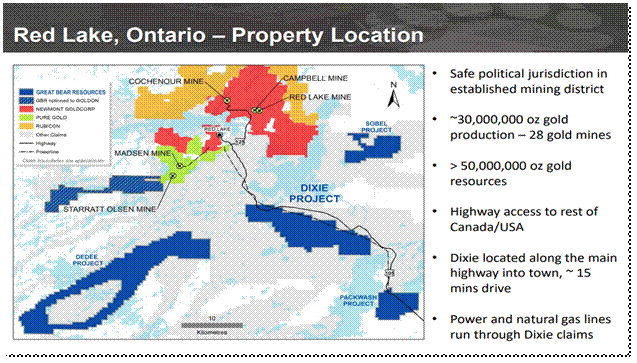
Chris Taylor: Red Lake is known for producing a large number of high-grade gold ounces. It’s quite road accessible. You can connect in through the remainder of Ontario and down into the U.S. just below that. There’s about 30 million ounces of gold produced in the district to date. The majority of that is from Newmont Goldcorp’s main Red Lake gold mine. What we have in our project is effectively a large high-grade gold discovery, with multiple gold zones, and it’s located about a mile or two off the side of the highway, with a power line that runs over the project and therefore we have low exploration costs. This is an area where investors and the dollars that they provide to the company turn into meters of drill core drilled with very cost effective structures due to excellent infrastructure.
Maurice Jackson: There’s some strategic advantages that Great Bear Resources has over its peers that are exploring for gold with regards to brownfields exploration. Please share some of those virtues on exploration and from a capital standpoint.
Chris Taylor: In this area, one of the main advantages is low-cost exploration. And this is because effectively, rather than looking for minerals on the top of a mountain or up in the Arctic Circle or in the heart of Africa, you’re in a civilized jurisdiction that’s politically stable. This means that you end up with lower drill costs, lower operational costs. There are assay labs within a 20-minute drive from our project in downtown Red Lake, which has a full service community, skilled population of workers and obviously a very extensive history of mining. Effectively this is cost effective exploration where investment dollars turn into meters and that turns into performance in the share price as long as you continue to be successful, and Great Bear certainly has been up to this point.
Maurice Jackson: We’ve covered the region. Mr. Taylor, please introduce us to your flagship, Dixie gold project, and share some of the project highlights.
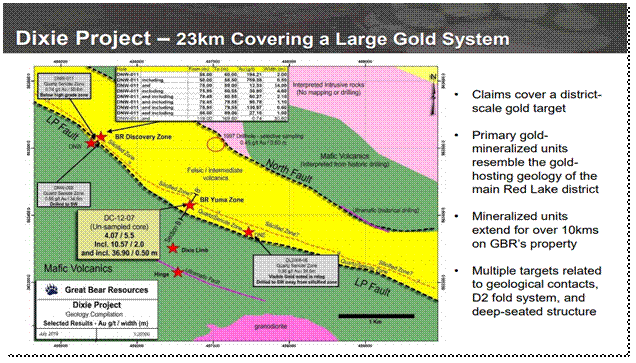
Chris Taylor: The Dixie gold property is located about a 20-minute drive from downtown Red Lake, so that means it’s also about a 20-minute drive from one of the largest gold mines in the area. And the property is located in greenstone type rocks. These are Archean age greenstones that are mesothermal gold faults.
Effectively from tip to tip on this large LP fault structure, which is where we’ve made three of our most recent gold discoveries, is about 22 kilometers long end to end. Within the fault itself, the main area of it, we think is the most prospective is about 18 to 20 kilometers long. We’ve only drilled at this point about 15% of that structure, but every drill hole that we’ve put into the fault itself and the immediately adjacent area has gold mineralization. This is truly what could be characterized as a brand new district scale gold discovery.
Great Bear is working on a big greenstone-hosted, high-grade gold system. And quite exciting with the discoveries that we’ve been making is that a lot of the gold that we’re drilling goes right to the surface. And that’s quite exceptional in Red Lake because Red Lake, other than being famous for high-grade gold, it’s famous for mines that go down a mile, a mile and a half deep vertically from surface. And on our project, excellent gold results have been generated really right to the surface bedrock interface. It’s quite exciting.
Maurice Jackson: It certainly is. And to really appreciate the opportunity before us, please share some of the similarities between Newmont Goldcorp’s Red Lake gold mine and the Dixie gold project.
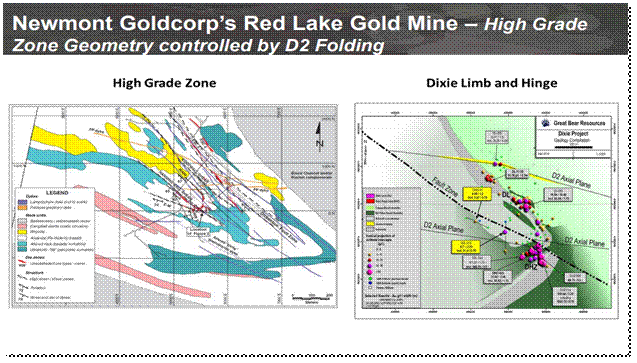
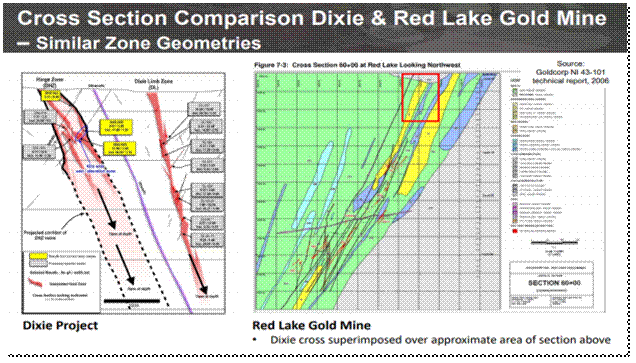
Chris Taylor: Newmont Goldcorp is working on high-grade quartz veins. Gold is hosted in high-grade quartz veins that extend down to, I’ll use Canadian terminology here, down to about two and a half kilometers or more in depth. And that’s very, very similar to the first gold zones that we found on our Dixie property, the Dixie Limb and the Hinge zones. These were exciting discoveries that we had over a year ago now, and that’s very similar geometrically in terms of the types of mineralization and the gold grade distributions. The size, when you look at it from a surface map perspective, very much like what we found early on. And that’s similar to two of our zones and very dissimilar from a bunch of the other major zones that we found recently on our property.
Maurice Jackson: The Dixie gold project hosts five zones. What has Great Bear Resources most excited here?
Chris Taylor: We were very excited up to the last six-month period with the types of consistent and repeatable high-grade gold numbers that we were generating from the Hinge zone discovery and the Dixie Limb discovery. And this was very, very similar in terms of the gold grades and other patterns of mineralization and rock type to what you see at the main mines in the district. However, just over the last number of months, which has been the fuel for a very strong response in our share performance as well, is this very large fault structure. The LP fault structure down the project hosts an entirely different type of disseminated high-grade gold mineralization, and those are two words, disseminated and high-grade, that you don’t often hear in the same sentence. And to make that more exciting from our point of view is that gold mineralization extends, again, right to the near surface. This is a new type of gold mineralization in the Red Lake District, and that’s what makes this so compelling as an exploration story is that we’re really just beginning the discovery process along this big new target.
Maurice Jackson: The company has been issuing a series of very impressive drill results. Please share some of the results and what this means going forward for the company.
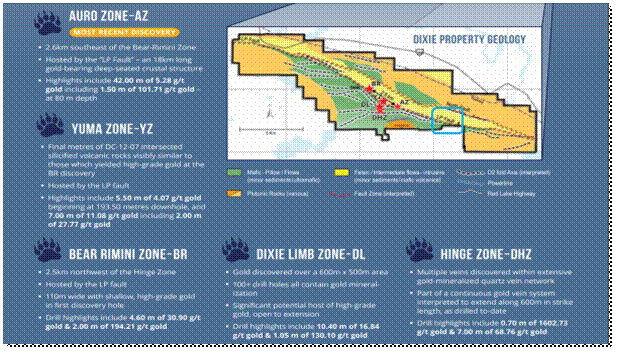
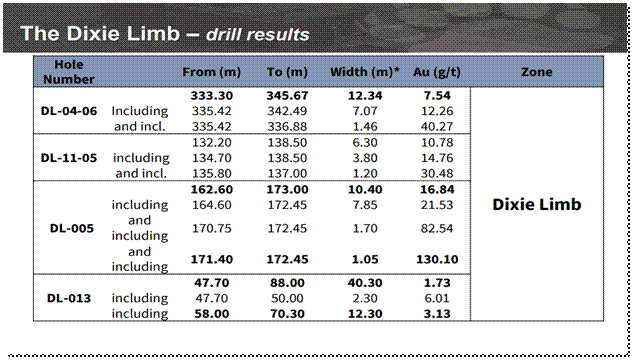
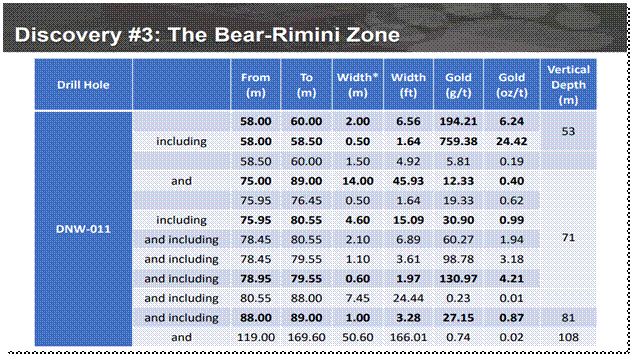
Chris Taylor: Recently, one of the new zones that we’ve discovered called the Auro Zone on the LP fault generated a near-surface intercept of about 42 meters of about 5.28 grams per ton gold. Now, that’s exceptional in a sense that that’s a high-grade gold intercept in and of itself, but the fact that that’s sitting right in the near surface is very interesting. And within that zone, there was about a meter and a half of about 100 grams per ton gold. That’s over 3 ounces per ton gold, and what we’re seeing as we drill along that fault are additional very high gold grades, including at the Bear-Rimini discovery. Near surface, we had a zone that was about 2 meters of just about 200 grams per ton gold, and then below that there was about a 14 meters zone of about 12 grams per ton there below that.
And then just beside that, there was another zone which was about 50 meters of about three quarters of a gram per ton, showing us that we have these large intervals of bulk tonnage-type gold mineralization adjacent and flanking and surrounding the high-grade zones that we’ve been finding. Before that, within the Dixie Limb and the Hinge zones, these are the high-grade Red Lake-style gold veins, which they’re located about a kilometer to the west of the zones that I was just describing. Noteworthy of mention, at some intervals, we had a couple of meters with an ounce per ton range, so somewhere in the 20 to 40 gram per ton range. That’s very typical for some of the intercepts that we’ve seen, but once in a while you get true bonanza grade gold intercepts.
I remember releasing a result, it was about a meter of about 900 grams per ton gold at the beginning of 2019, and I think that included, it was approximately 0.6 meters of about 1,600 grams per ton gold. These are phenomenally high-grade gold results, which is what the district is associated with, and those results were also a driver for value appreciation in Great Bear.
Maurice Jackson: Take us to the Hinge zone, which has been quite active the last year, and walk us through a cross section comparison between the Dixie and the Red Lake gold mine.
Chris Taylor: These are effectively very similar types of deposits, the Hinge zone and the Red Lake gold mine. They have similar types of alteration around the gold veins, the red brown hydrothermal biotite alteration. What you’re looking for in this district typically to make grade at most of the deposits is about 2 meters of about 10 grams per ton gold. And the reason being the 10 gram per ton gold number tends to be economic in this area that you can extract it and pay and make money at those levels, and then the 2 meter width is about what the mining equipment width is.
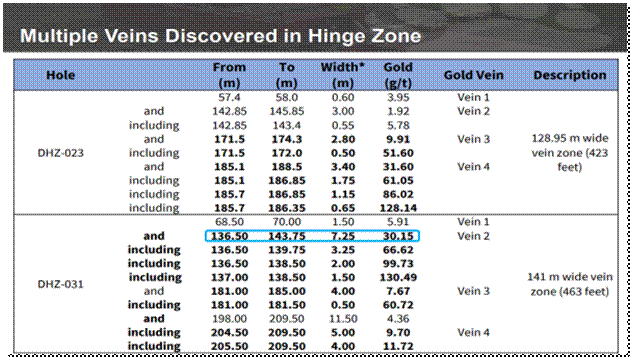
The 2 meter’s is about the minimum width that would flank the vein and that’s what you’d be aiming for. When considering the district, one would be looking these veins that range from 30 centimeters wide to a couple meters wide, and they’ll mine these things in the district all the way down to many kilometers depth, and that’s what Goldcorp and now Newmont Goldcorp have been doing for many years. That’s very similar to what we’re seeing within the Hinge zone, except the Hinge zone has been surprising us repeatedly with multiple gold veins in many of the drill holes.
Great Bear Resources has been locating intervals that are wide zones of gold bearing quartz veins, sometimes up to over a hundred meters in drill quartz where you see repeated gold veins of anywhere from 30 centimeters to several meters in width. And I believe the widest that identified is about 7 meters of about an ounce per ton gold. And those are incredibly robust developed gold bearing vein systems, definitely on par with some of the best in the district.
Maurice Jackson: Moving on to the Bear-Rimini Zone, what would you like to share with us? Because there’s some impressive stuff going on there as well.
Chris Taylor: The Bear-Rimini zone hosts some of the numbers I was quoting recently. A couple of meters of a couple hundred grams, 14 meters of 12 grams. This is a zone of a wide disseminated gold mineralization that’s within a felsic volcanic unit that we see over many kilometers where we’ve drilled it so far, and that’s entirely new for the Red Lake District. Most of the gold in the area is hosted by these gold bearing veins, but they tend to be within what we call mafic and ultramafic volcanic rocks, and those are effectively, if you look at them with your naked eye, those are dark colored rocks, dark green rocks, typical greenstone belt rocks.
The rocks that we’re drilling in the Bear-Rimini zone are quite light in color. They’re very different chemically, they have a very different origin, and they occur in big thick units of these felsic volcanic packages with other units intruded into them, and that’s where we’re seeing these new gold discoveries. The Bear-Rimini zone is something that has not been seen before in the Red Lake District to the best of my knowledge, and it has the potential for many kilometers of strike length certainly. We’ve already drilled it over about 3.2 kilometers and so far it’s wide open to extension.
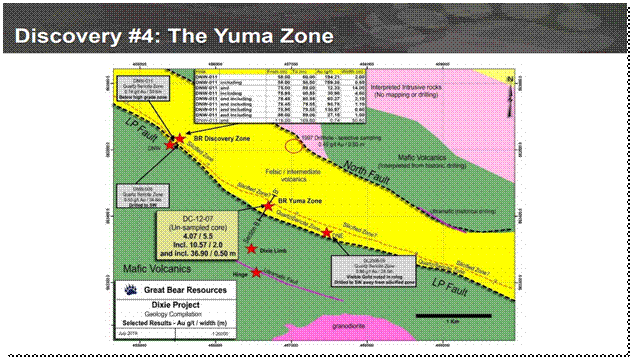
Maurice Jackson: Finally, and equally important, take us to the Yuma zone. Why are shareholders enthusiastic about this zone?
Chris Taylor: The Yuma zone is effectively a 1.5 kilometers stepout along the same structure from the Bear-Rimini zone, and it contains multiple zones of high-grade gold mineralization and those are flanked by wide intervals of this low-grade gold mineralization that you see globally in many open pit deposits. And the Yuma zone is very similar to the new zone that we’ve recently announced, which is another kilometer stepout along that fault, which is the Auro zone.
Collectively the Bear-Rimini, Yuma and Auro zones all have the same geology that’s been intersected in drilling and they all contain a combination of high-grade gold and that’s flanked by these wide zones of low-grade mineralization that projects right to surface. The market and our geologists, and everybody involved in the Great Bear story, is very excited by these because it’s very rare to see this combination of high grades surrounded by the bulk tonnage mineralization, and especially to see it along drill centers that are spaced kilometers apart, and to see that consistency of geology and gold mineralization. That’s what’s exciting here is the scale of these discoveries is really something that you don’t see very often.
Maurice Jackson: Let’s discuss some important topics germane to the project, beginning with reversionary interests. Are there any on your projects?
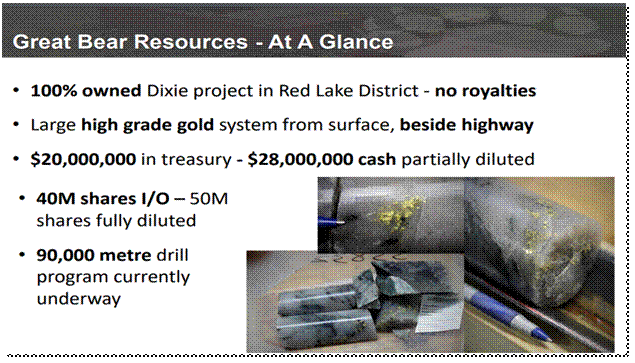
Chris Taylor: No, actually another fairly unique characteristic of Great Bear and its properties is that the properties are 100% owned by the company and on top of that, there are no royalties of any kind owed to other parties on these projects. All of the benefit of these discoveries flows to our shareholders.
Maurice Jackson: That is quite impressive and something you don’t run into quite often. We’re going to get into some numbers later in this discussion, but from a capital expenditure standpoint, what is your largest expense, and at what cost?
Chris Taylor: We’re spending right now about a million dollars a month on drilling and exploration work. And if you look at the money that Great Bear has raised, about 80 cents on every dollar goes to drilling and exploration work. The remaining costs, probably about 10 cents of that, would be salaries and other things and we obviously have to keep the company moving. And, of course, like every other company in our type of space, we do marketing and promotion and these sort of outreach. That’s probably another 10 cents on the dollar. But the vast majority of the money that we raise turns right into meters of gold bearing core, drilled out of the ground. It’s been very cost effective that way because of the infrastructure access on the property.
Maurice Jackson: What is your relationship with the indigenous people?
Chris Taylor: We have an excellent relationship with the local indigenous groups. And we’ve been fortunate that we recently sponsored a student work program for this summer, and we also have ongoing business relationships with some of the community members who are providing, for instance, drill core boxes for the program. That’s a very tall order because we drill a lot of core and we look forward to more of this cooperation while we go forward. These are communities in this area that are very familiar with mining and many of the community members are active in the mining industry and also in forestry and other natural resource work.
Maurice Jackson: Are you fully permitted?
Chris Taylor: Yes. The work that we’re doing now is fully permitted. There have been no issues regarding permitting or execution of the work that we need to carry out.
Maurice Jackson: Is the ultimate goal for Great Bear Resources to develop the Dixie gold project and sell it or build a mine?
Chris Taylor: This is a question I get asked a lot because a company needs to be prepared to put the project forward through all the exploration stages and through into production. What you need to always think about in the back of your mind though is that very few junior companies in our shoes that make this scale of discovery make it through that production process on their own, typically at some point there are a number of major producing gold companies in the world and they are looking for these types of assets. Their reserves are always being depleted and the combinations of high-grade gold, near-surface gold and access to infrastructure that we have certainly put the Dixie property at the front of the pack when it comes to comparable gold projects that these guys are looking at.
Maurice Jackson: We’ve discussed the good. Let’s address the bad. What can go wrong and what is your action plan to mitigate that role?
Chris Taylor: One of the biggest errors that a company can make is effectively, in our situation, when you’re onto a district-scale type discovery, is that the company will prematurely focus on resource development and definition on one particular zone to the detriment of wider exploration, and making the discoveries that will ultimately add the most value for a company. Great Bear is very cognizant of that. We try not to get led by the market into drilling hundreds and hundreds of holes onto any particular zone and trying to define it too early.
That’s one of the concerns that companies are often forced into just because they have difficulty accessing capital. We’ve been very successful raising funds and employing those funds on our own terms, and that’s led to the sequence of discoveries that we continue to make. Other risks that we would have would be very much like other companies in our space. Besides something geologically that constrains the amount of gold mineralization, that’s typical risk. There are no special risks for our project. It’s in a fully permitted operating mining district, and it’s one of these areas where you don’t get the political risks or other risks that you see in other jurisdictions. We are in a safe and a stable area to work in.
Maurice Jackson: Switching gears, let’s discuss the people responsible for increasing shareholder value. Mr. Taylor, please introduce us to your board of directors.
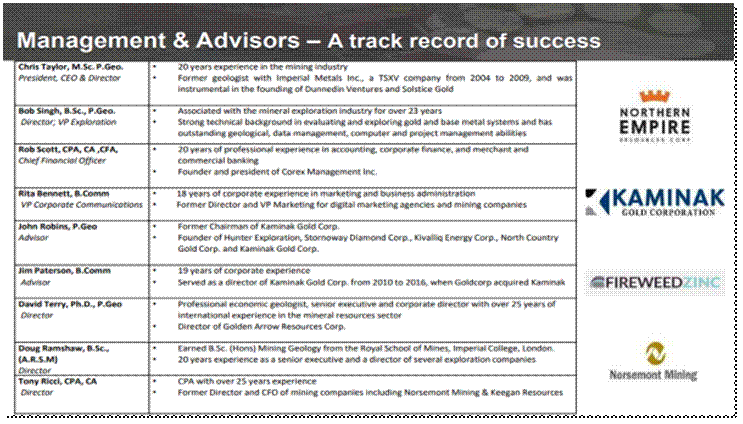
Chris Taylor: One of the key members of the board of directors is my partner in business within Great Bear, Mr. Bob Singh. He’s a professional geologist and he was responsible with originating contacts of his in the Red Lake district for the Dixie property as a business opportunity for the company. Bob is a member of the board and he’s been instrumental in this success to date. We have two relatively famous industry advisors, and they are Mr. John Robins and Mr. Jim Paterson. They were responsible and involved with the Kaminak gold discovery in the Yukon a few years back, and its subsequent sale to Goldcorp for about half a billion dollars.
Other board members include Dr. David Terry and we have Mr. Doug Ramshaw and Mr. Tony Ricci. These are all independent directors of the company, all experienced industry veterans, and they’ve been down the road on many discoveries over the years, and Mr. Rob Scott is our CFO. We have an experienced independent group of directors, and recently we’ve added somebody who’s quite experienced in the marketing space as a VP of corporate communications, Rita Bennett. Collectively we put a very effective team of people together within Great Bear and I think we’re getting the message out, and definitely delivering on our promises to shareholders.
Maurice Jackson: Who is Chris Taylor and what makes him qualified for the task at hand?
Chris Taylor: These questions are always probably the worst to answer for somebody like myself. I don’t like talking about myself that much. I’m an exploration geologist by background, but I have an academic background. I have a Masters degree in Structural Geology, at various times in my life I’ve crawled all over various mountain ranges here, there and everywhere including the Himalayas, the Andes, the various stuff up in Alaska, all over the United States and Canada. My background, I used to be the vice-president in exploration with Great Bear Resources almost 10 years ago now, and during the decline in the mining cycle, I ended up taking control of the company being offered that by the board at the time.
I restructured the board of directors, found financing for the company. Often, when financing was difficult to acquire, I would keep it going using my own bank account. And what we did was find that compelling mix of traits in a project, in this case the Dixie property, that had the opportunity to really build value for shareholders. I’ve been focused on that for years now. It’s been about nine years with Great Bear and I’ve gone through every effort to make sure that our shareholders have the best shot at success with a project like this, and Dixie has certainly not failed to deliver it.
Maurice Jackson: It certainly hasn’t. Who is on your management team and what skill sets do they bring to Great Bear Resources?
Chris Taylor: Well, Great Bear runs a very tight ship in this sense. We have a small number of executives. There’s myself as the president and CEO, Bob Singh as VP exploration. We’re both on the board of the company. Rob Scott, I mentioned before, our CFO, and we also have Rita, who I mentioned as VP corporate communications, and we deal with a very qualified group of consulting geologists they’re based in Red Lake and they’ve lived there for many years, and I used to work for Goldcorp and other companies in the area that’s called Rimini Exploration. The Rimini people were ex Goldcorp people and are helping us run the project on a day to day level.
We have been very efficient using very minimal staffing and extra costs, and we’re trying to put as much of the money as we raise as we can into the ground. It’s a lean, mean, hopefully very qualified team, and I think the proof was in the pudding with these things. If we keep generating value for shareholders, we don’t want to end up with a bloated corporate structure that eats up dollars that could otherwise you put into the ground.
Maurice Jackson: Let’s get into some numbers. Please share the capital structure for Great Bear Resources.
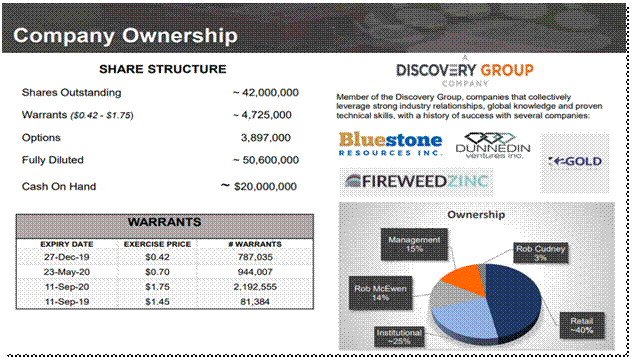
Chris Taylor: Great Bear is a very tightly structured company despite the fact that we’ve been actively exploring for a few years now. We have about 42 million shares issued and outstanding on a fully diluted basis including remaining warrants, there aren’t very many left, and options. We’re just over 50 million shares issued and outstanding. The capital structure is very tight in this company compared to most of our peer groups in the industry.
Maurice Jackson: How much cash and cash equivalents do you have?
Chris Taylor: In Canadian dollars, we have about $18.5 million cash in the till right now, and there are several millions, $7 to $8 million, of additional funding available through in the money warrants and options. All told, we’re looking at over $25 million in cash and cash equivalents at the moment, which is sufficient for us to drill nonstop at this rate without the requirement to finance again all the way through past the end of 2020.
Maurice Jackson: That’s correct because I think you referenced your burn rate was about a million per month, is that correct?
Chris Taylor: That’s correct. That’s three rigs drilling all the time on the project, 12 months a year.
Maurice Jackson: How much debt do you have?
Chris Taylor: We don’t have any debt at all.
Maurice Jackson: This is quite impressive, sir. Who are the major shareholders and what is their level of commitment?
Chris Taylor: The largest individual shareholder in the company is Mr. Rob McEwen. He was in charge of Goldcorp at the time of its high-grade zone discovery, about a decade and a half ago, in Red Lake, and I remember when we put out one of the zones that we discovered, the Hinge zone, we put out news and within an hour of that news hitting the news wires, I was on the phone with Mr. McEwen and he became our largest shareholder at that time. I remember exactly what he said. He said, “Chris, I’ve seen this story play out before. I know how it ends and I want to be your premier shareholder in Great Bear.” Mr. McEwen is the largest individual that we have involved.
We have another shareholder who we’ve not named, Mr. Rob Cudney. He owns a few percent of the company individually. He was involved with a company called Gold Eagle Mines, which also had a major discovery in Red Lake. They sold that deposit to Goldcorp before they drilled off a resource, for about a billion and a half dollars. And he likewise was very interested in becoming a shareholder of the company. Those of us in management collectively with us and our families, we have about 15% of the outstanding shareholdings of the company. I think Mr. McEwen has about 14%, Mr. Cudney has a few percent, management has 15%. We have institutional ownership, which is increasing on a regular basis.
That would likely be up to the 25 to 30% range at this point, and the remainder of the float is owned by retail. At this point, we have not committed ourselves to any particular large mining company or other large investment institution that would have a say in how we’re operating. We operate completely independently and that gives us the ability to make these discoveries without having external mandates supplied to us. It’s been a very successful formula for us.
Maurice Jackson: Are there any redundant assets on the books that we should know about?
Chris Taylor: No.
Maurice Jackson: Are there any change of control fees? And if yes, what is the compensation?
Chris Taylor: Change of control fees within Great Bear I believe three of us that would have a change of control provision, and these would be to the tune of probably collectively between the number of people that are involved on the order of a couple million dollars in the event that that occurs. These are very insignificant costs relative to the scale of the project and the value of the company.
Maurice Jackson: Is management charging a consultant fee for any services?
Chris Taylor: No. Management in this case are all salaried, so effectively it’s a standard salary commensurate with our level of experience in the industry, and it would be according to standard in industry parameters.
Maurice Jackson: In closing, multilayered question here. What is the next unanswered question for Great Bear Resources? When can we expect a response and what determines success?
Chris Taylor: One of the principal questions that I get asked is how much gold is there on your property? And, of course, we’d like to figure that out as well, and that also goes very nicely into the second part of your question is when will this be revealed? Well, this is an ongoing 90,000 meter currently exploration program and we’re funded for way beyond that in terms of number of meters that we can drill, so I would expect that the market and shareholders will understand over time just how big this system is and I believe as the limits of the gold mineralization are sought and they’re hopefully eventually found, we will then see commensurate value come in with the story much as it has been doing. The value proposition for investors here is to be part of the discovery process on a project that looks like it has the potential to be much bigger than the majority of prospects like this that have been seen in the last number of years.
Maurice Jackson: Chris, what keeps you up at night that we don’t know about?
Chris Taylor: Well, a number of years ago, I was in the same boat as everybody else that had a dream and a vision for growing a company like this through the discovery process that was always about finding enough money to keep that drill rig turning. We’ve been very successful on that front in the sense that we recently completed a bought-deal placement that was doubly oversubscribed, so we ended up raising twice as much money at a higher price than we had originally sought, and we’re currently so well funded that we don’t need to go back to the market for a long time.
Right now, what keeps me up is no longer those mundane concerns that are typical of the industry. Right now, my main concern is that we don’t make it through enough exploration until we get an offer that’s too good to be refused from a large mining company and we end up having to hand over the project at too early of a stage. Fortunately for us, because we’re independent in terms of our shareholder base and very well funded, I can’t see that that will happen before we have significant room to grow from this point. And that’s what I really look forward to.
Maurice Jackson: Great Bear Resources can stand on the merits of his own work, but the coincide with it, you have the catalyst of also having a resurgent gold price, a six-year high. Does that change anything for you though?
Chris Taylor: I would suggest that the increased gold prices probably liven up the space in terms of potential M&A activity. There’s always interest on the M&A side, but the ability to consummate deals, if you listen to large mining companies, they’ll often tell you that they want to buy assets at the bottom of the market, but if you look at when they actually do buy assets, it’s when you have a bit of a bull market scenario going on. For us, the high gold prices, in Canadian dollar terms, gold is now at record levels that have never been seen before.
And that means that projects, projects in Canada, have a potential profitability far beyond what they would have had even just a few years ago, and that means that Canada and Red Lake jurisdictions like ours that are easy to access and have existing mining infrastructure, these are premier destinations for large companies to go and seek major discoveries, and we think that we’re on top of one of those.
There are no downsides for us with the rising gold price, but the kind of mineralization that we’re seeing, whether gold prices are higher or even quite a bit lower, I would anticipate that these would have robust economics going forward. If you look at comparable deposits in the area, they’re quite profitable even well below $1,200 dollars an ounce gold, $1,100 an ounce gold. With the kind of environment that you’re looking at now, it’s nothing but good news for companies that are in our situation.
Maurice Jackson: Mr. Taylor, last question. What did I forget to ask?
Chris Taylor: I guess, maybe you forgot to ask what gets me out of bed in the morning? And I think that’s an easy one to answer. To be on top of a discovery process like this in Great Bear, every morning is a little bit like Christmas. I get updates and the drill rig has gone into a new area and it’s found gold here and it’s found gold there, but one of the things that I really enjoy that really drives me is just benefiting our shareholder base. These are people, and if you think about it, when we were a tiny little company just two years ago with a sub $5 million market cap, people were taking money and giving it to us to go drill based on our vision of what this project could be.
I love to be able to reward shareholders for their trust. And whether you came in at 50 cents, or $5, or $10 ultimately, whatever it’s going to be, I’ll do my very best because I’m a big shareholder and I understand that the faith you put in us, you want to see returns on that investment. That’s why I’m very focused on limiting dilution in the company, keeping the share structure tight and making sure that the money that we raise turns into money that that’s supplied in the ground so that we can find more gold. So that’s what drives me. I love talking about it. I love talking to shareholders. I work for shareholders and I’m always happy to talk to them. I guess that’s maybe the one thing that you forgot to ask me.
Maurice Jackson: One of the questions I will receive is, Maurice, do you think that the stock is going to melt up referring to Great Bear Resources? I’m like, “You’re witnessing the beginning of it.”
Chris Taylor: Yes.
Maurice Jackson: And I stress, the beginning. I think this is just the beginning stages for you. The stars are aligning and if you are considering becoming a shareholder, what’s the website address to so much to go to, sir?
Chris Taylor: Have a look at www.greatbearresources.ca. That’s our website. Have a look at that. You can look at all the technical information. We’re very transparent in terms of disclosure. You should be able to find all the maps and drill sections and 3D models and descriptions of where every hole has been and keep in mind we don’t hide drill holes. Often when you read releases from companies, they give you highlighted drill holes in the release and everything else is undisclosed. With Great Bear, we disclose everything all the time.
Maurice Jackson: I found that hard to believe that companies would hide the bad results?
Chris Taylor: Well, they say for remaining results, go to the website. Well, you can do that with us, but the results have already been disclosed in a news release. We’re very transparent that way and I think that sets us apart from other people as well. So please go, check out our website, www.greatbearresources.ca, and have a look at the technical information there. Hopefully that will give you something to be interested in.
Maurice Jackson: For direct inquiries, call 604.646.8354 or you may email [email protected]. Great Bear Resources trades on the TSX.V: GBR | OTCQB: GTBDF.
Before you make your next bullion purchase, make sure you call me. I’m a licensed representative for Miles Franklin Precious Metals Investments, where we provide a number of options to expand your precious metals portfolio from physical delivery, offshore depositories, precious metal IRAs, and private blockchain distribute ledger technology. Call me directly at 855.505.1900 or you may email [email protected]. Finally, please subscribe to provenandprobable.com for Mining Insights and Bullion Sales.
Chris Taylor of Great Bear Resources, thank you for joining us today on Proven and Probable.
Maurice Jackson is the founder of Proven and Probable, a site that aims to enrich its subscribers through education in precious metals and junior mining companies that will enrich the world.
Disclosure: 1) Maurice Jackson: I, or members of my immediate household or family, own shares of the following companies mentioned in this article: None. I personally am, or members of my immediate household or family are, paid by the following companies mentioned in this article: None. My company has a financial relationship with the following companies mentioned in this article: Great Bear Resources is a sponsor of Proven and Probable. Proven and Probable disclosures are listed below. 2) The following companies mentioned in this article are billboard sponsors of Streetwise Reports: Great Bear Resources. Click here for important disclosures about sponsor fees. 3) Statements and opinions expressed are the opinions of the author and not of Streetwise Reports or its officers. The author is wholly responsible for the validity of the statements. The author was not paid by Streetwise Reports for this article. Streetwise Reports was not paid by the author to publish or syndicate this article. The information provided above is for informational purposes only and is not a recommendation to buy or sell any security. Streetwise Reports requires contributing authors to disclose any shareholdings in, or economic relationships with, companies that they write about. Streetwise Reports relies upon the authors to accurately provide this information and Streetwise Reports has no means of verifying its accuracy. 4) This article does not constitute investment advice. Each reader is encouraged to consult with his or her individual financial professional and any action a reader takes as a result of information presented here is his or her own responsibility. By opening this page, each reader accepts and agrees to Streetwise Reports’ terms of use and full legal disclaimer. This article is not a solicitation for investment. Streetwise Reports does not render general or specific investment advice and the information on Streetwise Reports should not be considered a recommendation to buy or sell any security. Streetwise Reports does not endorse or recommend the business, products, services or securities of any company mentioned on Streetwise Reports. 5) From time to time, Streetwise Reports LLC and its directors, officers, employees or members of their families, as well as persons interviewed for articles and interviews on the site, may have a long or short position in securities mentioned. Directors, officers, employees or members of their immediate families are prohibited from making purchases and/or sales of those securities in the open market or otherwise from the time of the interview or the decision to write an article until three business days after the publication of the interview or article. The foregoing prohibition does not apply to articles that in substance only restate previously published company releases. As of the date of this article, officers and/or employees of Streetwise Reports LLC (including members of their household) own shares of Newmont Goldcorp, a company mentioned in this article.
Proven and Probable LLC receives financial compensation from its sponsors. The compensation is used is to fund both sponsor-specific activities and general report activities, website, and general and administrative costs. Sponsor-specific activities may include aggregating content and publishing that content on the Proven and Probable website, creating and maintaining company landing pages, interviewing key management, posting a banner/billboard, and/or issuing press releases. The fees also cover the costs for Proven and Probable to publish sector-specific information on our site, and also to create content by interviewing experts in the sector. Monthly sponsorship fees range from $1,000 to $4,000 per month. Proven and Probable LLC does accept stock for payment of sponsorship fees. Sponsor pages may be considered advertising for the purposes of 18 U.S.C. 1734.
The Information presented in Proven and Probable is provided for educational and informational purposes only, without any express or implied warranty of any kind, including warranties of accuracy, completeness, or fitness for any particular purpose. The Information contained in or provided from or through this forum is not intended to be and does not constitute financial advice, investment advice, trading advice or any other advice. The Information on this forum and provided from or through this forum is general in nature and is not specific to you the User or anyone else. You should not make any decision, financial, investments, trading or otherwise, based on any of the information presented on this forum without undertaking independent due diligence and consultation with a professional broker or competent financial advisor. You understand that you are using any and all Information available on or through this forum at your own risk.
Tuesday registered a surprise beat in electronic card retail sales data. Now, the next bit of market-moving data is tomorrow’s (or later tonight, depending on where you are) BusinessNZ Manufacturing Index.
This is like the Kiwi version of PMI and it can change the direction of the currency.
So far this week, the NZD has been trending stronger thanks to a series of good data. The resumption of trade talks is also a contributing factor.
Some analysts are pointing to the trend continuing at least until next Wednesday’s FOMC meeting. Expectations for the Fed to cut rates are keeping the kiwi bid against its American counterpart.
What We Are Looking For
The consensus among analysts is for the PMI data to return to just barely expansion at 50.2. This would be up substantially from 48.2 in the prior month.
July was the first time that this series dropped into contraction since mid-2013. So, a return to expansion, even if just technically, would likely be a relief to markets.
The worrisome part when it comes to the medium-term outlook is that not only has the manufacturing PMI been trending downward since the beginning of the year, but it continued to do so even as the RBNZ was cutting rates. And the rate cuts were part of an effort to spur growth and make access to capital easier.
There is More Hope Than Actuality
The expectations of a more upbeat number are banking on an improving outlook, rather than the current situation. We should remember that the PMI is a composite averaging the businesses’ perception of the current environment, and how they see it will be in six months.
Usually, the current situation tends to be better than the outlook, simply because there is uncertainty about what will happen in the future.
But, if the RBNZ’s plans were to work, and the trade dispute between the US and China were to be resolved, then that would give businesses a reason to expect a better future. Therefore, it would raise the total PMI despite a generally depressed view of the current situation.
The Causes
At the beginning of the week, we had some disappointing manufacturing volume data. It showed that the sector was slowing faster in the second quarter than expected.
This would lead us to suspect that PMIs will be less than auspicious for now. Especially considering that during the last quarter, businesses reported that they intended to keep, or in some cases cut, their capital expenditure programs.
The thing about New Zealand manufacturing is, though, that it’s mostly for the domestic market. Industrial exports from New Zealand account for a very small section of the market, indicating that the results in the PMI are a better reflection of the domestic economy, than any effect the country might be having from the trade war.
There is Cause for Strength
On that note, many analysts argue that New Zealand is less affected than other countries by the trade issues because even though China is the nation’s largest importer, it’s primarily of consumer goods for the domestic market. And China’s domestic figures have remained healthy since May of last year.
In summary, barring unforeseen circumstances, there are several issues lining up to support NZD strength in the short term. The question is whether the RBNZ will be satisfied with the economic figures and reemphasize its easing bias.
Shares of Mallinckrodt Plc are trading more than 60% higher today on news that the company is selling its CDMO subsidiary BioVectra Inc. to H.I.G. Capital for $250 million.
Global biopharmaceutical company Mallinckrodt Plc (MNK:NYSE)announced today that it has entered into a definitive agreement to sell its wholly owned subsidiary BioVectra Inc. to an affiliate of H.I.G. Capital, a leading global private equity investment firm, for approximately $250 million. The terms of the sale include fixed consideration of $175 million composed of an upfront payment of $135 million, a long-term note for $40 million and contingent payments of up to $75 million that will enable Mallinckrodt to capture future BioVectra growth potential.
The transaction is expected to close in Q4/19, subject to customary closing conditions, and the notice states that it is not anticipated that the sale will have any material tax impact for Mallinckrodt. The company indicates that it intends to use the proceeds from this divestiture consistent with its previously disclosed capital allocation priorities, and asserts that the transaction continues to advance its strategic focus on branded biopharmaceuticals by monetizing a non-core business.
The release identifies BioVectra as a contract development and manufacturing organization (CDMO) whose global client base includes many of the top biopharmaceutical companies in the world. BioVectra has over 45 years of experience specializing in cGMP microbial fermentation, complex chemistry – high potency APIs, biologics and formulation development. After the sale, BioVectra will continue to supply an active pharmaceutical ingredient supporting Mallinckrodt’s specialty brands business under a long-term arrangement.
President and CEO of Mallinckrodt Mark Trudeau stated, “This transaction continues to advance Mallinckrodt’s strategic focus on branded, high-growth biopharmaceuticals by monetizing a non-core business…While we recognize the longer-term growth potential for BioVectra, we believe that the structure of this deal enables us to participate in the future success of the business, and therefore we see this sale as the best option for both Mallinckrodt and BioVectra moving forward.”
Mike Gallagher, managing director at H.I.G. Capital commented, “We are excited to support BioVectra’s exceptional leadership and highly dedicated employees…BioVectra demonstrates a tremendous ability to generate robust organic growth and utilizes a broad set of technical capabilities to deliver outstanding service and quality. They are completing major capital expenditure programs to significantly expand capacity and the company is well positioned to capitalize on growing demand for their services.”
Mallinckrodt reports that it is a global business consisting of multiple wholly owned subsidiaries that develop, manufacture, market and distribute specialty pharmaceutical products and therapies. The company’s Specialty Brands reportable segment’s areas of focus include autoimmune and rare diseases in specialty areas like neurology, rheumatology, nephrology, pulmonology and ophthalmology; immunotherapy and neonatal respiratory critical care therapies; analgesics; and gastrointestinal products. Its Specialty Generics reportable segment includes specialty generic drugs and active pharmaceutical ingredients.
H.I.G. Capital was founded in 1993 and is a large global private equity and alternative assets investment firm with more than $34 billion of equity capital under management. The firm is based in Miami, with offices in New York, Boston, Chicago, Dallas, Los Angeles, San Francisco and Atlanta in the U.S., as well as international affiliate offices in London, Hamburg, Madrid, Milan, Paris, Bogotá, Rio de Janeiro and São Paulo. H.I.G. specializes in providing debt and equity capital to small and mid-sized companies. The firm’s current portfolio includes more than 100 companies with combined sales in excess of $30 billion.
Mallinckrodt started today with a market capitalization of about $176.4 million. The company has 84.01 million shares outstanding, and as of yesterday had a short interest of around 50.9%. The stock has a 52-week price range of $1.4334.10/share. MNK shares opened today at $2.27 (+$0.27, +8.10%) compared to yesterday’s closing price of $2.10. The stock has traded on higher than average volume today between $2.23 and $3.57/share and currently is trading at $3.40 (+$1.30, +61.90%).
Disclosure: 1) Stephen Hytha compiled this article for Streetwise Reports LLC and provides services to Streetwise Reports as an independent contractor. He or members of his household own securities of the following companies mentioned in the article: None. He or members of his household are paid by the following companies mentioned in this article: None. 2) The following companies mentioned in this article are billboard sponsors of Streetwise Reports: None. Click here for important disclosures about sponsor fees. 3) Comments and opinions expressed are those of the specific experts and not of Streetwise Reports or its officers. The information provided above is for informational purposes only and is not a recommendation to buy or sell any security. 4) The article does not constitute investment advice. Each reader is encouraged to consult with his or her individual financial professional and any action a reader takes as a result of information presented here is his or her own responsibility. By opening this page, each reader accepts and agrees to Streetwise Reports’ terms of use and full legal disclaimer. This article is not a solicitation for investment. Streetwise Reports does not render general or specific investment advice and the information on Streetwise Reports should not be considered a recommendation to buy or sell any security. Streetwise Reports does not endorse or recommend the business, products, services or securities of any company mentioned on Streetwise Reports. 5) From time to time, Streetwise Reports LLC and its directors, officers, employees or members of their families, as well as persons interviewed for articles and interviews on the site, may have a long or short position in securities mentioned. Directors, officers, employees or members of their immediate families are prohibited from making purchases and/or sales of those securities in the open market or otherwise from the time of the interview or the decision to write an article until three business days after the publication of the interview or article. The foregoing prohibition does not apply to articles that in substance only restate previously published company releases. 6) This article does not constitute medical advice. Officers, employees and contributors to Streetwise Reports are not licensed medical professionals. Readers should always contact their healthcare professional for medical advice.
It’s the most widely anticipated recession in history. The recession hasn’t arrived yet – and may not do so anytime soon – but the mainstream media still can’t stop talking about it.
Consider this strange article from NBC News. It purports to show that young adults are posting dark, ironic memes to social media in reaction to a “possible recession looming.” It’s a possible, undated, undefined downturn of unknown severity that millennials are supposedly now coping with in advance!
CNN, meanwhile, sees “signs of a potential looming recession” – more severe in scope, presumably, than the network’s actual viewer ratings recession.
The free-flowing recession talk in the media can create something of a self-fulfilling prophecy.
If consumers and business owners begin to fear an oncoming recession, they may pare back spending and put capital investments on hold – which in turn will cause GDP to weaken.
“The snowball of a recession has begun to roll,” writes former U.S. Senator Judd Gregg (R). “When the mindset of American business shifts from expansion to defensive restructuring, a recession cannot be far behind. It becomes a self-fulfilling event.”
Trump Economy Slows… But Hasn’t Yet Slid
Some key indicators are pointing toward an economic slowdown:
Despite low official unemployment numbers across the board, jobs growth has slowed to its weakest pace since 2011.
Despite getting a boost from the Trump tax cuts, corporate earnings growth is now decelerating.
Copper and other economically sensitive industrial metals are showing relative weakness.
The Treasury yield curve recently inverted.
And, likely as a result of trade disputes between the U.S. and China, manufacturing activity has slumped to a multi-year low.
GDP itself its slowing. U.S. gross domestic product in the in the second quarter came in at 2% growth (down from 3% earlier in the year) – its second worst showing since President Donald Trump took office.
Still, it’s not an actual recession. Yet.
If a recession does hit between now and November 2020, President Donald Trump’s chances of getting re-elected will be slim.
That political reality isn’t lost on Democrats. They are practically begging for a recession! Some in the media are trying to engineer one through their propaganda campaigns aimed at manipulating mass psychology.
There is even a possibility that the Federal Reserve will sabotage the economy to hurt President Trump. Former New York Fed President William Dudley is explicitly urging Fed policymakers to withhold economic stimulus as a way of rebuking Trumponomics and tilting the election in favor of his opponent.
The Fed appears to be back in stimulus mode at the moment, however. The question is whether the so far tepid rate-cutting campaign will be enough to extend an already overextended economic expansion (officially the longest in history) through 2020.
Perhaps a few more injections of “monetary methadone” (as trends forecaster Gerald Celente dubs it) will send the stock market back to new highs and forestall the inevitable recession for another year or two.
If monetary planners take interest rates down to zero to prevent a recession, they will then have few conventional tools left in their toolbox.
They can potentially take rates below zero or invoke other emergency measures, but there will be strong institutional resistance to doing so until the economy and financial markets actually do begin to collapse.
The longer the Fed staves off the recession by inflating the economy with debt, the worse the eventual collapse will be. Investors should therefore be preparing for hard times ahead.
Which Hard Assets Hold Up Best During Tough Times?
Diversifying out of conventional financial assets is an obvious and necessary step. Hard assets can offer protection both from economic turmoil and inflation.
However, not all hard assets are created equal.
Some tend to correlate strongly with the business cycle and may therefore perform poorly during a recession. Others are more counter-cyclical and can benefit from a bad economy accompanied by safe-haven flight out of the stock market.
The premier safe-haven hard asset is gold. Prices for the money metal have gained during five of the past seven recessions that have occurred since 1970. In 2008, gold was one of the only alternative investment assets to show a gain for the year.
Silver is less reliable during economic downturns. It performed fantastically during the stagflationary 1970s. But in general silver tends to fare poorly when a bad economy causes demand from industrial users to weaken.
Rising investment demand can make up some of that decline. Silver is historically and foundationally a form of money. During a financial panic or currency crisis, the masses may rediscover its monetary utility. That makes silver more promising to hold during hard times than a straight-up industrial metal.
The other precious metals, platinum and palladium, have no real history of being used as money. Investment buying amounts to less than 3% of their total demand profiles (with the bulk of demand for platinum group metals coming from the highly cyclical automotive industry).
Not surprisingly, platinum and palladium face long odds during recessions. In fact, platinum prices have declined through the duration of six out of the last seven recessions.
One reason why things might be different this time: platinum just recently traded off a historically large discount versus gold. It could steadily close that gap until it regains a price premium over gold (which it last held in 2014).
If you are optimistic about the U.S. economy averting recession in the months ahead, then the white metals (platinum, palladium, and silver) will likely be your presently preferred precious metals holdings.
If you are less optimistic, or simply more risk averse, then you may find greater comfort in holding the time-tested universal hedge of gold.
The Money Metals News Service provides market news and crisp commentary for investors following the precious metals markets.
By CentralBankNews.info Turkey’s central bank lowered its policy rate for the second time this year but said it would maintain a cautious monetary stance to ensure inflation continues to decline, with the outlook for inflation determining the extent of future monetary tightness.
The Central Bank of Turkey (CBRT) cut its benchmark one-week repo rate by a larger-than-expected 325 basis points to 16.50 percent and has now lowered it by a total of 750 points this year following a cut in July after Governor Murat Uysal took over from Murat Cetinkaya who was fired for failing to follow President Recep Tayyip Erdogan’s instructions to lower rates.
CBRT said the repo rate was now consistent with its projected disinflation path, which is critical for achieving lower sovereign risk, lower long-term rates and a stronger economic recovery. Turkey’s inflation rate declined to 15.01 percent in August from 16.65 percent in July and domestic demand and the current tight monetary policy continue to support a further decline, with the central bank expecting inflation to fall faster than it projected in July.
Turkey’s economy is slowly improving but remains in contraction, with gross domestic product in the second quarter shrinking by an annual 1.5 percent following a fall of 2.4 percent in the first quarter and 2.8 percent in the fourth quarter of last year.
“Recently released data indicate that moderate recovery in economic activity continues,” the central bank said, adding net exports were contributing to growth while investment remains weak and private consumption has gradually improved.
The Central Bank of the Republic of Turkey issued the following press release:
“The Monetary Policy Committee (the Committee) has decided to reduce the policy rate (one-week repo auction rate) from 19.75 percent to 16.50 percent.
Recently released data indicate that moderate recovery in economic activity continues. In the first half of the year, the contribution of net exports to economic growth continued, while investment demand remained weak and the contribution of private consumption gradually increased. Goods and services exports continue to display an upward trend despite the weakening in the global economic outlook, indicating improved competitiveness. In particular, strong tourism revenues support the economic activity through direct and indirect channels. Leading indicators point to a partial improvement in the sectoral diffusion of economic activity. Looking forward, net exports are expected to contribute to economic growth and the gradual recovery is likely to continue with the help of the disinflation trend and the improvement in financial conditions. The composition of growth is having a positive impact on the external balance. Current account balance is expected to maintain its improving trend.
Recently, advanced economy central banks have started to adopt more expansionary policies as global economic activity weakened and downside risks to inflation heightened. While these developments support the demand for emerging market assets and the risk appetite, rising protectionism and uncertainty regarding global economic policies are closely monitored in terms of their impact on both capital flows and international trade.
Inflation outlook continued to improve. In addition to the stable course of the Turkish lira, improvement in inflation expectations and mild domestic demand conditions supported the disinflation in core indicators. In August, consumer inflation displayed a significant fall with the contribution of core goods, energy and food groups. Domestic demand conditions and the level of monetary tightness continue to support disinflation. Underlying trend indicators, supply side factors, and import prices lead to an improvement in the inflation outlook. In light of these developments, recent forecast revisions suggest that inflation is likely to materialize slightly below the projections of the July Inflation Report by the end of the year. Accordingly, considering all the factors affecting inflation outlook, the Committee decided to reduce the policy rate by 325 basis points. At this point, the current monetary policy stance, to a large part, is considered to be consistent with the projected disinflation path.
The Committee assesses that maintaining a sustained disinflation process is the key for achieving lower sovereign risk, lower long-term interest rates, and stronger economic recovery. Keeping the disinflation process in track with the targeted path requires the continuation of a cautious monetary stance. In this respect, the extent of the monetary tightness will be determined by considering the indicators of the underlying inflation trend to ensure the continuation of the disinflation process. The Central Bank will continue to use all available instruments in pursuit of the price stability and financial stability objectives.
It should be emphasized that any new data or information may lead the Committee to revise its stance.
The summary of the Monetary Policy Committee Meeting will be released within five working days.”
After pledging to do whatever it takes to preserve the Euro back in 2012, Mario Draghi in his final meeting as ECB president has unleashed a wave of new stimulus measures to revive the Eurozone economy.
The central bank cut interest rates for the time since 2016 while restarting its Quantitative Easing programme by 20 billion euros, below market expectations. There was also an announcement of a two-tier system and adjustments to its targeted long-term refinancing operations (LTRO) to further promote lending.
Although Draghi has done “whatever it takes” before he hands the mantle to Christine Lagarde, it seems markets are disappointed with the ECB’s actions. Given the concerns revolving around the health of the Eurozone economy, most were expecting Draghi to launch a monetary policy bazooka to jolt the economy.
However, the argument for the ECB saving some ammunition in the monetary policy toolbox could be for when economic conditions worsen. It is worth keeping in mind that the Eurozone is not only dealing with developments at home, but risks in the form of Brexit and Trump imposing tariffs on European goods. With the ECB cutting its growth forecasts for 2019 and 2020, there is potential for further easing down the line should economic conditions both domestically and externally deteriorate further.
The Euro collapsed like a house of cards following the rate decision with prices crashing towards 1.0930 against the Dollar before later recovering towards 1.1000. Further weakness may be on the cards in the near term as investors digest the ECB’s action and prospects of potential easing down the line.
Disclaimer: The content in this article comprises personal opinions and should not be construed as containing personal and/or other investment advice and/or an offer of and/or solicitation for any transactions in financial instruments and/or a guarantee and/or prediction of future performance. ForexTime (FXTM), its affiliates, agents, directors, officers or employees do not guarantee the accuracy, validity, timeliness or completeness, of any information or data made available and assume no liability as to any loss arising from any investment based on the same.
Crude has been knocked lower this week as worsening global conditions and a series of forecast downgrades have trumped the latest moves in inventories data.
On Tuesday, the American Petroleum Institute reported a 7.23 million barrel decline in US crude stores. This initially boosted oil. The Energy Information Administration report then confirmed this move on Wednesday.
The EIA reported that in the week ending September 6th, US crude stores fell by a substantial 6.9 million barrels. This is more than double the forecasts for a 2.7 million barrel decline.
The data also showed gasoline inventories falling by a further 700k barrels per day. This extended declines from the 2.4 million barrel drop over the prior week.
The report was now all bullish, however, as distillate fuel inventories, which include heating and diesel, came in higher by 2.7 million barrels over the week. They thus extended the gains of 2.5 million barrels over the prior week.
EIA Ups Its US Crude Production Forecasts
The EIA also released its latest Short Term Energy Outlook.
In it, it forecast a further rise in US crude production over both this year and next. The EIA projects that US crude production will rise by a further 1.25 million barrels per day over 2019 to end the year at 12.24 million barrels per day.
The latest forecast also projects a 990k barrel rise over 2020 to take crude production in the US up to 13.23 million barrels per day.
OPEC Meeting Underway
This data will be particularly frustrating for OPEC. The oil cartel is currently meeting for the first time since June.
The relentless rise in US crude production over the year has diluted the upside price impact of OPEC’s production cuts. OPEC has been cutting oil production across its member states, and across a group of allied non-OPEC producers led by Russia, since the start of the year.
Indeed, given the fresh outbreak of trade tariffs between the US and China, as well as generally slower global economic conditions, the group announced in June that it would be extending cuts until Q1 2020. The aim of this was to counter soft demand.
OPEC Cuts Global Oil Demand Forecasts
In its latest global outlook released this week, OPEC has revised global oil demand lower once again.
They now expect demand to fall by 60k barrels per day to just 1.08 million barrels per day as of 2020. The cartel cites ongoing trade wars and worse global economic conditions as the reason for softer demand. The question now is whether OPEC will take further measures to counter this soft demand environment.
The energy minister from Iraq has said that OPEC originally discussed cuts of up to 1.6 – 1.8 million barrels per day when production cut discussions first began last year.
He claimed that the group would, of course, be discussing further options at this point. However, the Russian energy minister said that there were no fresh proposals on the table at this point (ahead of the meeting).
For now, the market is waiting to hear the outcome of this meeting, which could pave the way for deeper cuts.
Technical Perspective
The upside move in oil this week saw price briefly piercing above the bearish trend line from year to date highs. However, the 58.38 level resistance capped the move and price is now back below the trend line. For now, the market remains rangebound between resistance at the 58.38 level and support along the 51.29 base. Any topside break will see a test of the 60.50 level next while any move to the downside (breaking 51.27) could pave the way for much lower levels in oil over the medium term.
After years of improvements in drilling techniques and impressive “efficiency gains,” there is now evidence that the U.S. shale industry is reaching the end of the road on well productivity.
A report earlier this month from Raymond James & Associates finds that the U.S. shale industry may struggling to achieve further productivity gains. If these improvements begin to fizzle out, it could result in “an inflection point in future global oil supply/demand balances,” the investment bank said.
Well productivity is “tracking WAY below our model,” analysts Marshall Adkins and John Freeman wrote in the report. They note that U.S. oil production is up less than 100,000 bpd over the first seven months of 2019, compared to the 600,000-bpd increase over the same period in 2018.
The analysts note that over the past eight years, Raymond James has been one of the most aggressive forecasters for U.S. shale growth, and even then, actual output tended to exceed their forecasts. But this year U.S. shale growth is significantly below their prediction.
The reason is that productivity improvements have suddenly come to an end. Since 2010, initial production rates for the first 30 days of production (IP-30) improved by 30 percent annually on average, according to Raymond James. That was largely the result of the “bigger hammer” approach, the bank said. In other words, drillers threw more of everything at the problem – more money, longer laterals, more sand, and more frac stages. Earlier this decade, IP-30 rates were growing by roughly 40 percent per year. But that slowed to 11 percent in 2017 and 15 percent last year.
However, in the first seven months of 2019, IP-30 rates are up only 2 percent, compared to the 10 percent prediction from Raymond James. Part of the reason is that there is simply a limit to “more, longer and bigger,” the analysts said. “We believe that this represents clear evidence that U.S. well productivity gains are beginning to reach maximum limits and may even roll over in the coming years as the industry struggles to offset well interference issues and rock quality deterioration.” Even 2018 figures may have been a “one-off” increase as the oil majors – Chevron and ExxonMobil – escalated activity.
But perhaps the first 30 days is too short of a timeframe to analyze well productivity. So, the investment bank looked at 90 days of production (IP-90). On that metric, the industry is faring even worse, showing an outright decline of 2 percent in the first half of the year compared to the first six months of 2018.
“Recent Permian IP-90 well productivity trends are especially dire,” the analysts wrote. “While U.S. IP-90s declined 2%, Permian IP-90s declined 10% relative to 2018.” Because the Permian is the largest source of shale production and the most important source of growth, whatever happens there will determinate the trajectory for U.S. production figures on the whole.
Raymond James said that a slight uptick in productivity on an IP-30 basis but a decline on an IP-90 basis suggests that well interference is taking a toll. In other words, shale well performance is suffering as time goes on because wells have been spaced too close together. “Put another way, the average decline curve is becoming steeper than we thought because the wells are starting to cannibalize each other,” the analysts wrote.
Problems with “parent-child” well interference have become more of a concern over the past year or so, which refers to the first well drilled within a given block (the parent well), and subsequent wells drilled (the child wells). As Raymond James notes, not only do they cannibalize each other, but the longer the parent is online, the more the block sees a drop in pressure.
But here’s the thing – a lot of companies have drilled parent wells on various tracts, incentivized to do so because their leases can expire if they don’t demonstrate activity. They held off on the child wells, focusing on drilling parents. Then, at a later point, they go back and drill child wells to squeeze more oil from their acreage. The problem is that so much of the output growth over the last few years came from parent wells. Going forward, the growth will need to increasingly come from the less productive child wells.
But as Raymond James notes, the longer they wait, the less productive the child wells become, because the area loses more and more pressure over time.
In specific terms, the average child well is 30 percent less productive than the parent. But a child well drilled six months after the parent may only see a 10 percent degradation in productivity, while a two-year delay might result in more substantial 40 percent reduction in productivity.
On the other hand, the “cube development” approach, which entails intense development all at the same time, also has problems. Cube development consists of multiple wells, often rising to more than a dozen, are drilled pretty much simultaneously to avoid well interference and pressure decline. Also, in theory, costs are lower because it takes less time, while shared infrastructure reduces costs as well.
But well interference still occurs, and a growing number of companies have reported disappointing results, suggesting that there are limits to density. In a high-profile admission just a few weeks ago, Concho Resources said its 23-well “Dominator” project proved disappointing. The company said it would space out its projects more. Raymond James says there is some middle ground on well-density that companies still need to figure out, but because the industry has boasted about ever-increasing well-density, the pullback is translating into stagnating productivity.
Ultimately, the investment bank says that because of weaker-than-expected productivity, U.S. oil production may only grow by around 350,000 bpd in 2020, versus the market consensus of around 1.5 million barrels per day. In a scenario in which productivity actually falls to zero, production would remain flat for the next few years.
Because “the single most important driver of the oil market over the next decade will be trends in U.S. well productivities,” Raymond James analysts wrote, this is “VERY bullish for oil prices next year.”
“Given that the oil market seems to be pricing in virtually unlimited U.S. oil supply growth at $50/bbl over the next five years, the implications…are very, very important to upside oil price surprises over the coming years.”