Pakistan maintains rate, current stance to lower inflation

By CentralBankNews.info
Pakistan’s central bank left its policy rate steady after nine rate hikes since January 2018, saying the current policy stance was appropriate to being inflation down to its target range of 5 -7 percent over the next two years.
The State Bank of Pakistan (SBP), which has raised its rate by a total of 7.50 percentage points over the last 20 months, including 3.25 percentage points this year, added inflation had been largely as expected since its last monetary policy meeting in July and inflation projections for fiscal 2020 were largely unchanged.
SBP’s decision to keep its rate steady today comes after it said on July 16 that it was finished raising rates in response to the fall in the rupee over the last 18 months and from now on interest rates would be set in response to the outlook for inflation.
Since late July the rupee has risen and volatility subsided after the introduction of a market-based exchange rate system that followed an agreement with the International Monetary Fund (IMF) in May, which included a US$6.0 billion support package and unlocked another $38 billion from international partners.
After today’s policy decision the rupee jumped 0.5 percent to 156.1 to the U.S. dollar and is up 3.1 percent since July 29. But compared with early December 2017, before the SBP began raising rates to defend the rupee, the rupee has lost one-third of its value.
Prior to the IMF-deal – the country’s 13th since 1988 – Pakistan had followed a “strong rupee” exchange rate policy and effectively fixed it against the U.S. dollar at a rate that was too high, with the result the central bank had burned through reserves to defend it.
Pakistan’s inflation rate rose to 11.63 percent in August from 10.3 percent in July, reflecting the pass-through of earlier exchange rate depreciation, higher utility and food prices.
SBP confirmed its previous forecast for inflation to average 11 -12 percent in fiscal 2020, up from an average of 7.3 percent in 2018/19.
Pakistan’s economy has been slowing as expected but SBP confirmed its forecast for growth to average around 3.5 percent in fiscal 2020, which began on July 1, up from 3.3 percent in fiscal 2019.

The State Bank of Pakistan released the following monetary policy statement:

1. At its meeting on 16th September 2019, the Monetary Policy Committee (MPC) decided to leave the policy rate unchanged at 13.25 percent. The decision reflected the MPC’s view that inflation outcomes have been largely as expected and inflation projections for FY20 have remained unchanged since the last MPC meeting on 16th July, 2019. The MPC also viewed that, based on available information, the current stance of monetary policy was appropriate to bring inflation down to the target range of 5 – 7 percent over the next twenty-four months.
2. In reaching this decision, the MPC considered key economic developments since the last MPC meeting, developments in the real, external and fiscal sectors, and the resulting outlook for monetary conditions and inflation.

Key developments since the last MPC meeting
3. The MPC noted two key developments since the last MPC meeting. First, the interbank foreign exchange market had adjusted relatively well to the introduction of the market-based exchange rate system. The initial volatility and associated uncertainty in the exchange market had subsided. Reflecting these improved sentiments and continued adjustment in the current account, the rupee had strengthened modestly against the US dollar since the last MPC, unlike its previous trend. Second, on the external front, the US Fed, as anticipated, reduced its policy rate by 25 basis points (bps), followed by policy rate cuts by other major central banks around the world. This would help in lowering pressures on emerging markets’ currencies and potentially increase financial inflows.

Real sector
4. Recent economic activity indicators show a gradual slowdown, in line with earlier expectations, and the MPC continued to expect average growth in FY20 of around 3.5 percent. The slowdown is more pronounced in domestic oriented industries such as automobiles and steel. This trend is also reflected in the Large-scale Manufacturing (LSM) index which contracted by 3.6 percent in FY19, somewhat more than earlier expectations. On the other hand, the MPC noted that the LSM index does not fully capture activity in some key industries such as high value-added textile products. Export volumes have been growing briskly even though the growth in export dollar proceeds has been less pronounced due to declining international unit prices. The MPC also noted that the SBP-IBA Consumer and Business Confidence Surveys conducted during Aug-Sep 2019 show a modest improvement in the outlook for the economy. The outlook for agriculture and the services sectors was largely unchanged from the time of the previous MPC meeting. The agriculture sector growth is expected to improve considerably in FY20 over the last fiscal year while growth in services is expected to moderate gradually. In sum, the MPC continued to expect that economic activity would gradually turn around as business sentiment improves.

External sector
5. The external sector continued to show significant improvement with a sizeable reduction of around 32 percent (or 1.5 percent of GDP) in the current account deficit during FY19. The trend continued in the first month of FY20 as well. Specifically, driven by an encouraging 11 percent growth in exports and a contraction of 25.8 percent in imports, the current account deficit declined to US$ 579 million in July 2019 compared to US$ 2,130 million in the same period last year. This, together with the disbursement of program related inflows and activation of the Saudi oil facility, helped to build SBP’s foreign exchange reserves, which as of 6th September 2019, stood at US$ 8.46 billion. This is an increase of around US$ 1.18 billion from the end-June FY19 level. The improvements in the balance-of-payments and market sentiment allowed SBP to reduce its forward short liability position and hence increase its net international reserves.

Fiscal Sector
6. Recent developments in the fiscal sector had been mixed. On the one hand, revised figures showed that fiscal policy had been considerably more expansionary in FY19 than earlier expected with a primary deficit of 3.5 percent of GDP and an overall fiscal deficit of 8.9 percent of GDP. On the other hand, tax revenues (net of refunds) had grown considerably in July and August of FY20 which suggested that the economic slowdown may not be as pronounced as may have been feared. The MPC noted that fiscal prudence and meeting the program targets is essential to sustaining the improvement in macroeconomic stability.

Monetary and inflation outlook
7. On a cumulative basis, private sector credit (PSC) contracted by 1.3 percent in Jul-Aug FY20 showing the results of previous monetary tightening. The MPC noted that inflation developments were broadly similar between the new and the old base CPI: inflation had gradually risen over the previous months and remained high in both year-on-year and month-on-month terms. Core inflation had also risen in recent months. These developments were in line with the SBP’s earlier projections and reflected the pass-through of earlier exchange rate depreciation, adjustment in utility prices, and an increase in food prices. In sum, the MPC expected inflation to average 11 – 12 percent in FY20.
8. The MPC also considered risks to the inflation outlook. On the one hand, inflation could rise above the baseline projections in case of fiscal slippage or other adverse developments. On the other hand, inflation could begin to fall earlier than expected if oil prices decline, aggregate demand slows faster than expected, or the exchange rate appreciates. ”
www.CentralBankNews.info


EURUSD Analysis: Falling German wholesale prices bearish for EURUSD

By IFCMarkets

Falling German wholesale prices bearish for EURUSD

German wholesale prices accelerated decline in August when an increase was forecast. Will the EURUSD continue falling?

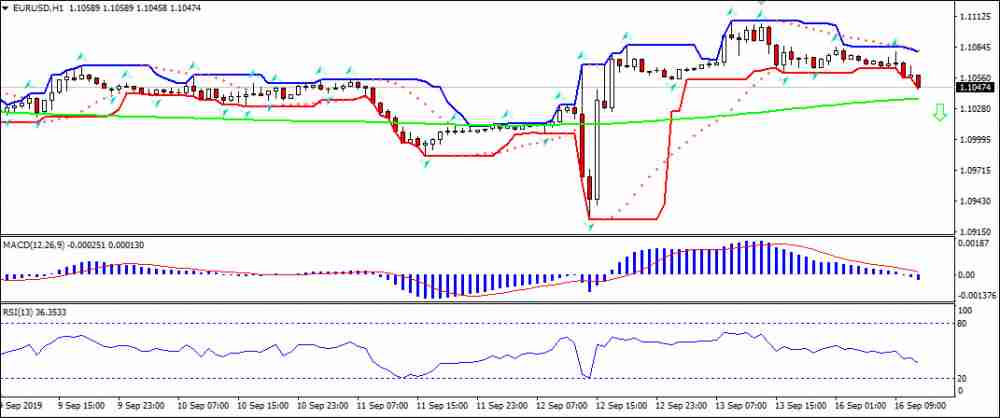
EURUSD falling toward MA(200)

On 1-hour timeframe EURUSD: H1 is in downtrend. The price is declining toward the 200-period moving average MA(200).

Technical Analysis Summary

OrderSell
Sell stopBelow 1.1044
Stop lossAbove 1.1064

Market Analysis provided by IFCMarkets

Soybeans Analysis: Lower soybean supply forecast bullish for soybean price

By IFCMarkets

Lower soybean supply forecast bullish for soybean price

Soybean output estimate was downgraded in latest WASDE report. Will the soybean prices continue rising?

United States Department of Agriculture lowered it soybean production projection in monthly WASDE report to 3.581 billion bushels, down 47 million on a lower yield forecast of 47.9 bushels per acre. Domestic and global ending stocks were also revised downward. And China announced last Thursday a massive purchase of U.S. soybeans – 22.0 million bushels, the largest single-day purchase since June. Lower soybean output and higher demand is bullish for soybean prices.

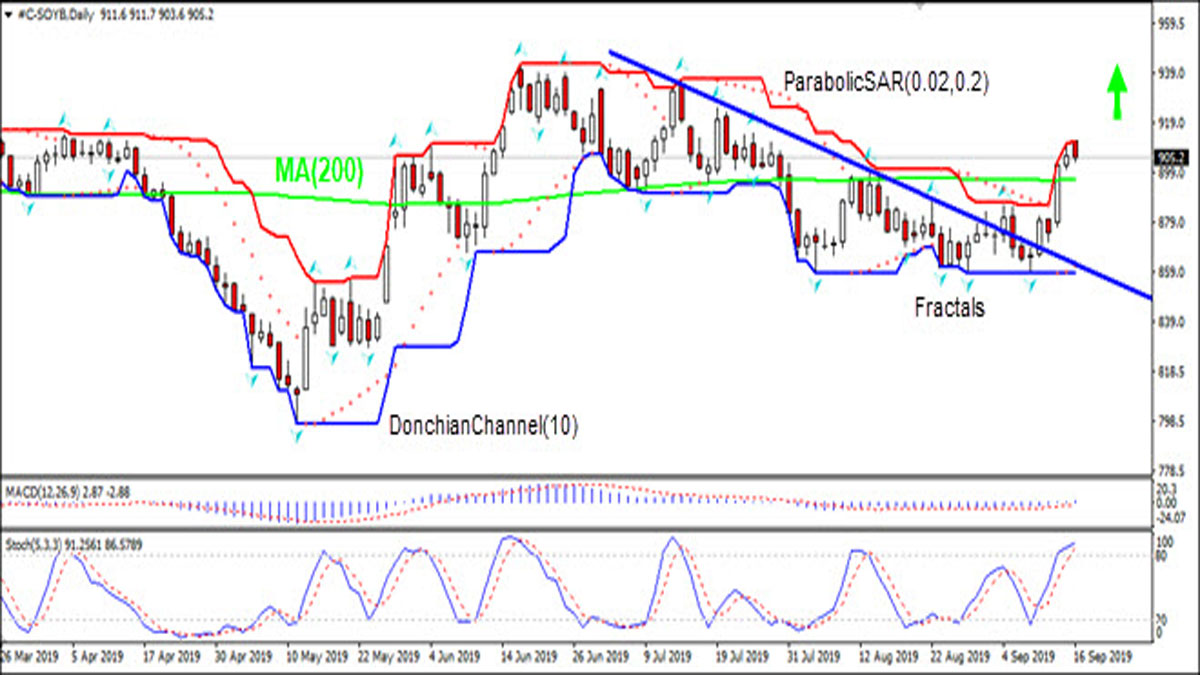
SOYBEAN rising above MA(200) 09/16/2019 Technical Analysis IFC Markets chart

On the daily timeframe the SOYB: D1 has breached above the resistance line and the 200-day moving average MA(200), these are bullish developments.

  • The Parabolic indicator gives a buy signal.
  • The Donchian channel indicates no trend: it is flat.
  • The MACD indicator gives a bullish signal: it is above the signal line and the gap is widening.
  • The RSI oscillator has breached into the overbought zone, this is bearish.

We believe the bullish momentum will continue after the price breaches above the upper boundary of Donchian channel at 911.7. This level can be used as an entry point for placing a pending order to buy. The stop loss can be placed above the last fractal low at 858.3. After placing the order, the stop loss is to be moved every day to the next fractal low, following Parabolic signals. Thus, we are changing the expected profit/loss ratio to the breakeven point. If the price meets the stop loss level (858.3) without reaching the order (911.7), we recommend cancelling the order: the market has undergone internal changes which were not taken into account.

Technical Analysis Summary

OrderBuy
Buy stopAbove 911.7
Stop lossBelow 858.3

Market Analysis provided by IFCMarkets

Bitcoin will get a healthy price boost from the Fed this week: deVere CEO

By George Prior

Bitcoin is likely to get given a price boost by the U.S. Federal Reserve this week, forecasts the boss of a global financial advisory giant.

The prediction from Nigel Green, founder and CEO of deVere Group, which launched deVere Crypto in early 2018, comes ahead of the U.S. central bank’s meeting on September 17 and 18.

Mr Green notes: “The Fed looks likely to follow the European Central Bank and cut rates this week by perhaps a quarter of a percentage point. This comes after it slashed interest rates for the first time in a decade in July on U.S.-China trade war tensions.

“Bitcoin, the world’s largest cryptocurrency by market cap, is likely to breakout of its recent sideways trading pattern and be given a healthy boost by the Fed’s rate cut.

“This is because an interest rate cut reduces the incentive to keep the fiat currency. In addition, rate cuts typically lead to higher inflation, which reduces the purchasing power of traditional currencies.

“As such, Bitcoin, and other decentralized cryptocurrencies, become more attractive and the price will adjust upwards accordingly.”

Last month, the deVere CEO said that Bitcoin can be expected to imminently reach $15,000 for four main reasons.

“First, geopolitical issues, such as the U.S.-China trade war and Brexit, are intensifying and investors will increase exposure to decentralized, non-sovereign, secure digital currencies, such as Bitcoin, to shield them from the turmoil taking place in traditional markets.

“Second, technical network improvements are further improving performance. Bitcoin’s hash rate has smashed through another new all-time high recently and this fuels investor confidence.

“Third, the 2020 Bitcoin halving will help drive the price skywards.  The code for mining Bitcoin halves around every four years and the next one is set for May 2020. When the code halves, miners receive 50 per cent fewer coins every few minutes.  History shows that there is typically a considerable Bitcoin surge resulting from halving events.

“And fourth – and perhaps the most important one – is that public awareness is consistently growing. Cryptocurrencies, and in particular Bitcoin, are increasingly part of mainstream finance. This is evidenced not only in the financial sector, in which all major banks are increasingly looking at blockchain and crypto, but with big names within the tech and retail sectors too.”

Today, he observes: “Added to these key reasons should also be inflation and governments’ current monetary policies which are driving investors towards Bitcoin and the wider crypto market.”

He concludes: “We can expect cryptocurrencies, now widely regarded as the future of money, to do well as the global economy slows and central banks ease monetary policies in response to this.”

About:

deVere Group is one of the world’s largest independent advisors of specialist global financial solutions to international, local mass affluent, and high-net-worth clients.  It has a network of more than 70 offices across the world, over 80,000 clients and $12bn under advisement.

Safe Haven Flows Support Dollar

By Orbex

Dollar Drives Higher

The US dollar has started the week on a better footing following the heavy sales seen at the end of last week. Rising tensions between the US and Iran, in the wake of the weekend’s drone strike attacks on Saudi Oil sites, has seen equities prices coming off, fuelling safe-haven inflows for USD. USD index trades 97.87 last. Looking ahead this week, the key focus in on the September FOMC meeting, with opinions split as to whether the Fed will ease again.

EUR Reverses Lower

EURUSD has been a little softer today as a higher US dollar weighs on the rate. The market has recently seen strong buying in the wake of the ECB announcing fresh easing at its September meeting. The market seems skeptical as to the effectiveness of the new measures and for now, EURUSD remains above the 1.1025 level broken in the post ECB move.

GBP Softens

GBPUSD has softened also, in light of the stronger US dollar. The backdrop remains broadly GBP positive for now, however, as the risk of a no-deal Brexit has receded significantly. The market is now awaiting the outcome of tomorrow’s UK Supreme Court hearing on Johnson’s proroguing of parliament. If the decision is upheld this could be a further boost for GBPUSD which trades 1.2444 last, sitting just below the 1.2493 level for now.

Risk Assets Weak But Recovering

Risk assets have been under pressure today as the market digests the uptick in geopolitical tensions in the Middle East. Iran has responded to US accusations that it was behind the drone attacks, denying the claims and warning that it is ready for war. SPX500 trades 2992.73 last, and though still in the red, we have seen a partial bounce off the day’s lows.

Safe Havens Supported

Safe havens have both been higher against USD today. Following large gaps at the open as the market reacted to news of the drone strike on Saudi oil sites, momentum has paused though JPY and gold both remain bid against USD. XAUUSD trades 1504.47 last, with price still below the 1522.75 level for now. USDJPY trades 107.74 last, with price sitting back above the 107.62 level for now.

Crude Reverses Gains

Oil prices have seen a wild session so far today. Following the massive gap open last night, which saw prices spiking 20% higher (their largest ever one day move) price has since reversed to close nearly half of the gap. Aramco has said that it aims to have around two-thirds of production up and running again by the end of Monday which has helped curb the spike higher. Oil trades 59.21 last, sitting above the broken 58.67 level for now.

AUD Up, CAD Down

USDCAD has been higher so far today, with CAD weighed on by both the stronger USD and the move lower in oil following the gap higher at the open last night. USDCAD trades 1.3268 last with price still well supported above 1.3207 for now.

AUDUSD has been higher today again. The backdrop of positive expectations around ongoing US/China trade talks is helping keep AUD bid. News of a potential interim trade deal between the two largest global economies has been a big boost for AUD which is often used as a proxy to trade China. AUDUSD trades .6878 last with price still above the .6852 level for now.

By Orbex


Forex Technical Analysis & Forecast 16.09.2019 (EURUSD, GBPUSD, USDCHF, USDJPY, AUDUSD, USDRUB, USDCAD, GOLD, BRENT, BTCUSD)

Article By RoboForex.com

EURUSD, “Euro vs US Dollar”

EURUSD is consolidating around 1.1062. Today, the pair may fall towards 1.1057 and then grow to break 1.1111. Later, the market may continue trading upwards with the target at 1.1200.

EURUSD
Risk Warning: the result of previous trading operations do not guarantee the same results in the future

GBPUSD, “Great Britain Pound vs US Dollar”

After completing the ascending wave at 1.2500, GBPUSD is consolidating around 1.2463. Possibly, the pair may start a new correction towards 1.2407 and then form one more ascending structure with the target at 1.2530.

GBPUSD
Risk Warning: the result of previous trading operations do not guarantee the same results in the future

USDCHF, “US Dollar vs Swiss Franc”

USDCHF is still moving downwards to reach 0.9850. According to the main scenario, the price may reach this level and then and start another growth with the target at 0.9925.

USDCHF
Risk Warning: the result of previous trading operations do not guarantee the same results in the future

USDJPY, “US Dollar vs Japanese Yen”

USDJPY is consolidating around 107.87. Today, the pair may form a new descending structure to reach 107.45 and then resume trading inside the uptrend with the target at 107.87.

USDJPY
Risk Warning: the result of previous trading operations do not guarantee the same results in the future

AUDUSD, “Australian Dollar vs US Dollar”

AUDUSD is consolidating around 0.6872. Possibly, today the pair may start another growth towards 0.6915 and then resume trading downwards to reach 0.6888. After that, the instrument may form one more ascending structure with the target at 0.6928.

AUDUSD
Risk Warning: the result of previous trading operations do not guarantee the same results in the future

USDRUB, “US Dollar vs Russian Ruble”

USDRUB is moving downwards. Today, the pair may reach 64.40 and then resume trading upwards to reach 64.70. Later, the market may continue moving downwards with the first target at 63.50.

USDRUB
Risk Warning: the result of previous trading operations do not guarantee the same results in the future

USDCAD, “US Dollar vs Canadian Dollar”

USDCAD has completed the correction at 1.3222. Today, the pair may form one more ascending structure towards 1.3307 and then resume falling to return to 1.3222.

USDCAD
Risk Warning: the result of previous trading operations do not guarantee the same results in the future

XAUUSD, “Gold vs US Dollar”

Gold is consolidating around 1505.50. If later the price breaks this range to the downside, the instrument may resume trading downwards with the target at 1471.90; if to the upside – then start another growth to reach 1526.60.

GOLD
Risk Warning: the result of previous trading operations do not guarantee the same results in the future

BRENT

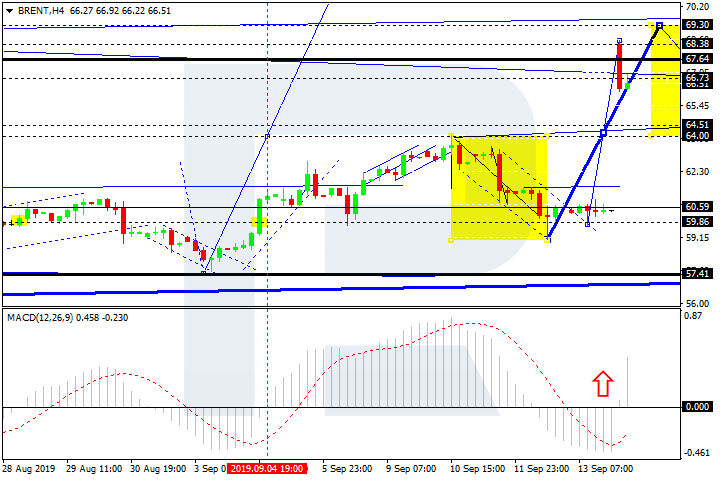
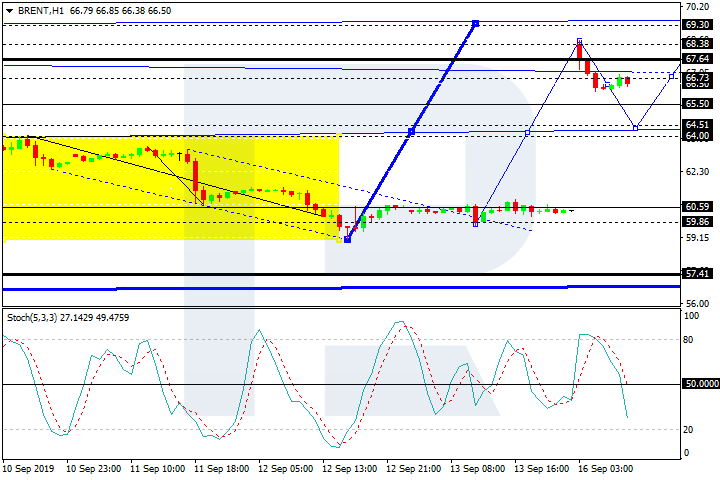
Brent has reached 68.38; right now, it is correction towards 64.73. Later, the market may resume trading inside the uptrend with the target at 69.30.

BRENT
Risk Warning: the result of previous trading operations do not guarantee the same results in the future

BTCUSD, “Bitcoin vs US Dollar”

BTCUSD is consolidating above 10180.00. Possibly, today the pair may move downwards to reach 9850.00 and then resume growing to return to 10180.00. After that, the instrument may form a new descending structure with the target at 9800.00.

BITCOIN

Article By RoboForex.com

Attention!
Forecasts presented in this section only reflect the author’s private opinion and should not be considered as guidance for trading. RoboForex LP bears no responsibility for trading results based on trading recommendations described in these analytical reviews.

Fibonacci Retracements Analysis 16.09.2019 (GOLD, USDCHF)

Article By RoboForex.com

XAUUSD, “Gold vs US Dollar”

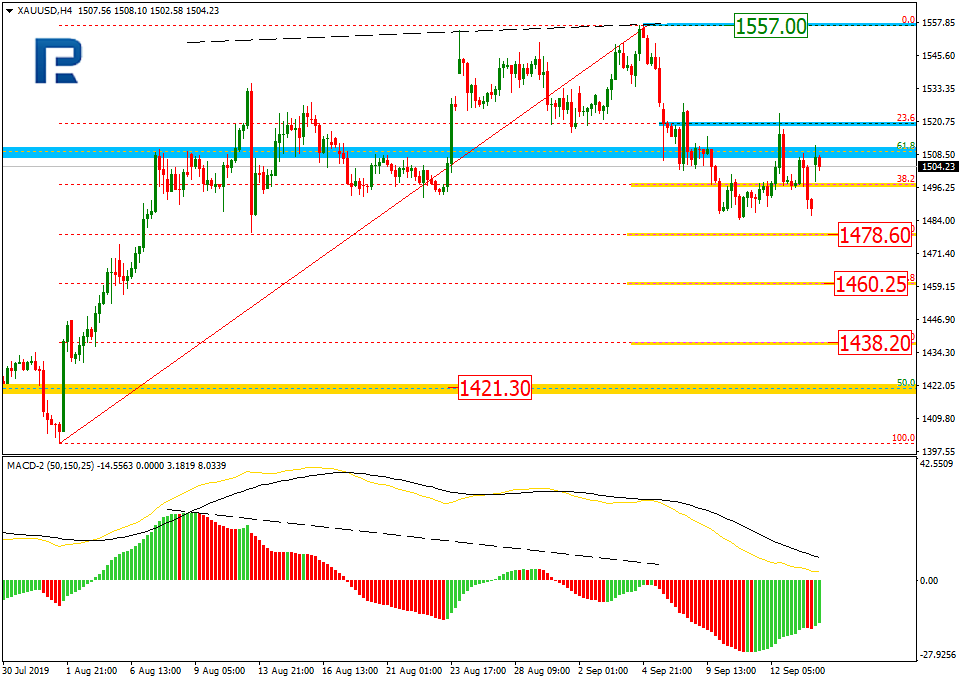
As we can see in the H4 chart, after reaching 38.2% fibo, XAUUSD has returned to 23.6% fibo. The current movement may be considered as a short-term correction before a new descending wave. The next downside targets may be 50.0%, 61.8%, and 76.0% fibo at 1478.60, 1460.25, and 1438.20 respectively. The key resistance is the high at 1557.00.

GOLD_H4
Risk Warning: the result of previous trading operations do not guarantee the same results in the future

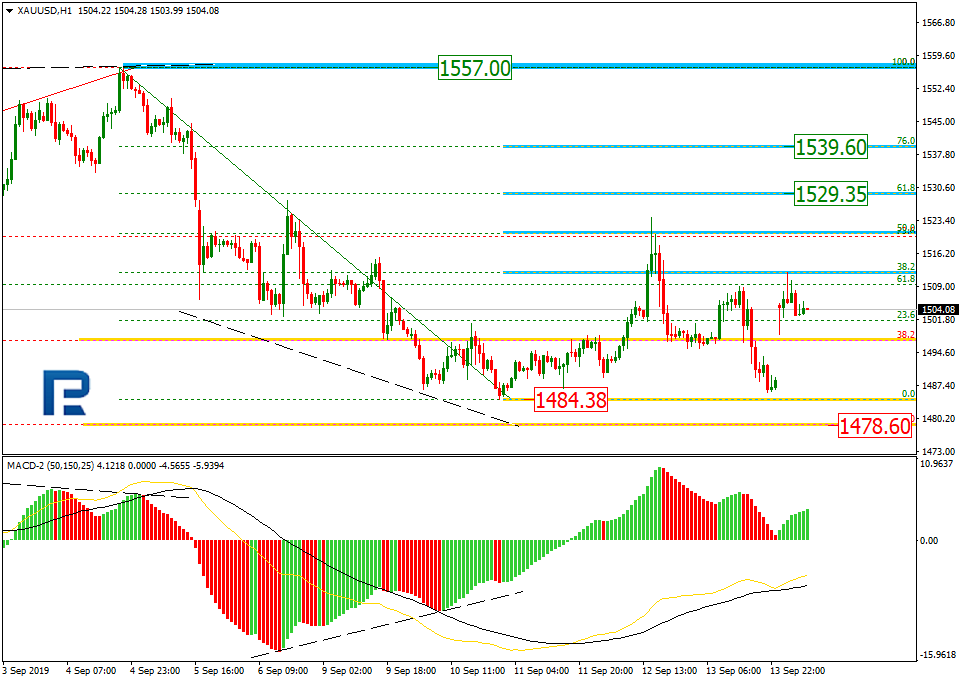
In the H1 chart, the convergence made the pair start a new pullback to the upside, which has already reached 50.0% fibo. The next upside targets may be 61.8% and 76.0% fibo at 1529.35 and 1539.60 respectively. The key support is the low at 1484.38.

GOLD_H1
Risk Warning: the result of previous trading operations do not guarantee the same results in the future

USDCHF, “US Dollar vs Swiss Franc”

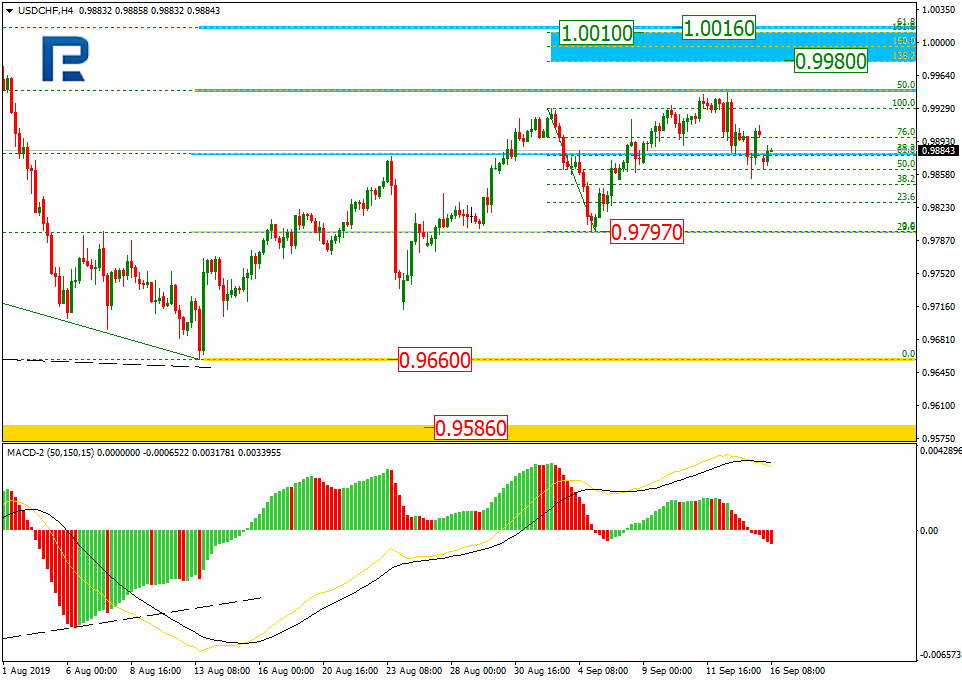
As we can see in the H4 chart, the correctional uptrend has already reached 50.0% fibo. At the same time, there is a divergence on MACD, which may indicates a new descending wave. However, as long as the price doesn’t break the support at 0.9797, USDCHF is expected to continue growing towards the post-correctional extension area between 138.2% and 161.8% fibo at 0.9980 and 1.0010 respectively, as well as 61.8% fibo at 1.0016.

USDCHF_H4
Risk Warning: the result of previous trading operations do not guarantee the same results in the future

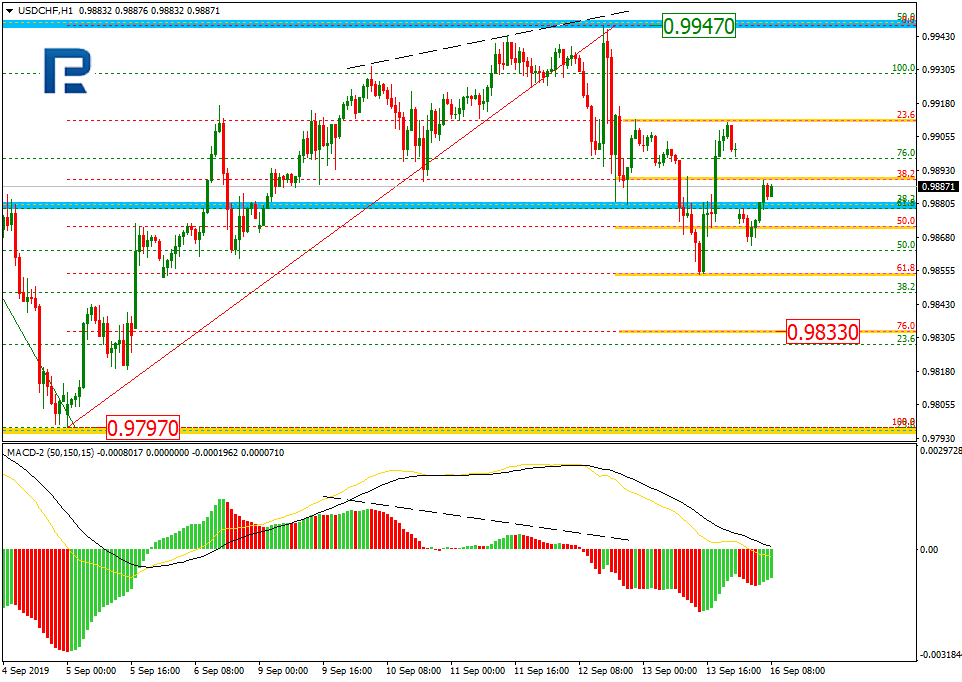
In the H1 chart, after reaching 61.8% fibo, USDCHF is correcting upwards. As long as the indicator lines are directed to the downside, one shouldn’t exclude a possibility that the price may fall to reach 76.0% fibo at 09833, while the rising impulse will be heading towards 0.9947.

USDCHF_H1

Article By RoboForex.com

Attention!
Forecasts presented in this section only reflect the author’s private opinion and should not be considered as guidance for trading. RoboForex LP bears no responsibility for trading results based on trading recommendations described in these analytical reviews.

Massive Moves In Oil Following Drone Strike

By Orbex

Record Moves in Oil

Its been an extremely volatile start to the week for oil markets. Traders are reacting to the news over the weekend of drone attacks on the world’s largest oil processing site in Saudi Arabia. The strike, which hit the Aramco controlled site at Abqaiq as well as the nearby oil field in Khurais wiped out a massive 5.7 million barrels of crude.

To put this in perspective, the attack erased around 50% of Saudi Arabia’s oil output and around 5% of total global oil supply. In response, crude prices gapped higher by over 20% at the open last night, marking their largest spike higher on record.

Who was Behind the Attacks?

The Houthi rebel group from Yemen, which has been behind a spat of attacks on Saudi pipelines, claimed immediate responsibility for the attacks. However, the US has accused Iran of being responsible for the attacks with US secretary of State Mike Pompeo blaming the attacks on Tehran.  Pompeo told reporters there is “no evidence the attacks came from Yemen”.

Adding that:

“Amid all the calls for de-escalation, Iran has now launched an unprecedented attack on the world’s energy supply.”

Trump Joins In

Indeed, while not explicitly naming Iran, Trump wrote on Twitter:

“Saudi Arabia oil supply was attacked. There is reason to believe that we know the culprit, are locked and loaded depending on verification, but are waiting to hear from the Kingdom as to who they believe was the cause of this attack, and under what terms we would proceed!”

Iran Says it is Ready for War

Iran responded immediately to the US accusations, denying claims it was behind the attacks, and warning that it is ready for war with the US. Iranian foreign ministry spokesman Abbas Mousavi said Washington was using a “maximum pressure” strategy against Iran, though due “its failure [the US] is leaning toward maximum lies”.

These comments come on the back of a warning from a senior commander in the Iranian Revolutionary Guard who warned that US military bases and aircraft carriers (some stationed as far as 1243 miles from Iran) are well within range of Iranian missiles, adding that Iran is ready for a “full-fledged war”.

Risk of War

Tensions between the US and Iran have been escalating significantly this year. Following earlier attacks on Saudi Oil tankers, as well as the shooting down of an American drone, the US deployed warships to the strait of Hormuz. At on point, Trump had reportedly approved a full air strike on Iran, only to then cancel the decision. As the world watches on, many fear that this latest episode has exponentially increased the chances of a full military conflict between the two nations.

OPEC

While the geopolitical impact and threat of war is a major concern, higher oil prices should soften the blow for OPEC. Meeting last week, the group downgraded its global oil demand forecasts for this year and next and has said that it is considering further crude production cuts when it meets in December. At the group’s last meeting in June, it extended the production cuts which started in January, now due to run until the end of Q1 2020.

Trade War

The ongoing trade standoff between the US and China is also driving oil prices. Crude had been trading higher earlier in the year as negotiations looked to be heading towards a deal but crashed when talks broke down in May as fresh tariff exchanges started. The market is now waiting for the next round of trade talks due this month following the re-starting of negotiations last month. Any positive developments should help keep oil supported in the near term.

Technical Perspective

WTI

The spike higher in crude saw prices breaking above the 61.03 June 2019 highs to trade highs of 62.26 before reversing back below the level. Price is now retesting the broken 58.67 level which is holding as support, for now. While above here, there is room for price to stabilise and continue to work higher. If we drop back below this level, however, focus will be on a retest of the broken bearish trend line from year to date highs next.

By Orbex


Oil Intends To Skyrocket

By Dmitriy Gurkovskiy, Chief Analyst at RoboForex

The Oil market is extremely volatile and fluctuates significantly early in another September week. Brent is currently trading at 66.30 USD and may continue soaring.

It’s all about attacks of drones on Saudi Arabia facilities, which took place last weekend. There were two attacks on the Saudi Aramco oil facilities in Khurais and Abqaiq, one of which is the largest refinery in the world. This refining capacity covers about half of all oil production in Saudi Arabia, which is about 6 billion barrels per day. If damages are serious, and such is indeed the case, as they say, refineries won’t be restored very quickly. This, in its turn, means that Saudi Arabia’s supplies to the global oil market will significantly reduce and this quantity deficiency is what pushes the oil prices upwards.

The USA has already announced that the country is ready to fill the void with its own supplies, but the aspects of this are quite subtle.

Houthi rebels have already taken credit for the incident, but there are other versions as well, for example, Iran.

In the H4 chart, Brent is moving inside the third rising wave with the target at 69.30; right now, it is correcting towards 64.50. Later, the market may grow to reach 69.30 and then return to 64.50. After that, the instrument may resume trading upwards with the target at 70.60. From the technical point of view, this scenario is confirmed by MACD Oscillator: its signal is moving directly upwards.

As we can see in the H1 chart, Brent has completed another ascending structure and reached the target at 68.30; right now, it is correcting downwards to reach 64.50. After that, the instrument may start another growth towards 69.30. From the technical point of view, this scenario is confirmed by Stochastic Oscillator: its signal line has broken 50 to the downside, thus confirming a further correction.

Disclaimer

Any predictions contained herein are based on the authors’ particular opinion. This analysis shall not be treated as trading advice. RoboForex shall not be held liable for the results of the trades arising from relying upon trading recommendations and reviews contained herein.


The Analytical Overview of the Main Currency Pairs on 2019.09.16

by JustForex

The EUR/USD currency pair

Technical indicators of the currency pair:
  • Prev Open: 1.10638
  • Open: 1.10731
  • % chg. over the last day: +0.11
  • Day’s range: 1.10678 – 1.10864
  • 52 wk range: 1.0931 – 1.1817

An ambiguous technical picture has developed on the EUR/USD currency pair. A trading instrument is consolidating. Unidirectional trends are not observed. Recall that last week the ECB introduced additional measures to stimulate the eurozone economy. At the moment, participants in financial markets have taken a wait and see attitude before the Fed meeting. The local support and resistance levels are: 1.10550 and 1.10850, respectively. We recommend opening positions from these marks.

The Economic News Feed for 16.09.2019 is calm. At 15:30 (GMT+3:00), the NY Empire State manufacturing activity index will be published.

EUR/USD

The price fixed above 50 MA and 100 MA, which signals the strength of buyers.

The MACD histogram is in the positive zone, but below the signal line, which gives a weak signal to buy EUR/USD.

The Stochastic Oscillator is near the oversold zone, the %K line crossed the %D line. There are no signals at the moment.

Trading recommendations
  • Support levels: 1.10550, 1.10200, 1.09900
  • Resistance levels: 1.10850, 1.11100, 1.11300

If the price consolidates above the level of 1.10850, consider buying EUR/USD. The potential movement is to 1.11200-1.11400.

Alternatively, the qutoes could decrease toward 1.10300-1.10100.

The GBP/USD currency pair

Technical indicators of the currency pair:
  • Prev Open: 1.23325
  • Open: 1.24649
  • % chg. over the last day: +1.36
  • Day’s range: 1.24563 – 1.25028
  • 52 wk range: 1.1995 – 1.3385

The GBP/USD currency pair continues to show a pronounced upward trend. On Friday, September 13, the quotes grew by more than 170 points. Northern Ireland’s largest political party agreed to accept some of the rules of the European Union after Brexit. Currently, GBP/USD quotes are consolidating. Local levels of support and resistance are: 1.24300 and 1.25000, respectively. In the near future, technical correction is not ruled out. Positions must be opened from key levels.

The Economic News Feed for 16.09.2019 is calm.

GBP/USD

The price fixed above 50 MA and 100 MA, which signals the strength of buyers.

The MACD histogram is in the positive zone, but below the signal line, which gives a weak signal to buy GBP/USD.

The Stochastic Oscillator is in the oversold zone, the %K line crossed the %D line. There are no signals at the moment.

Trading recommendations
  • Support levels: 1.24300, 1.23800, 1.22900
  • Resistance levels: 1.25000, 1.25500

If the price consolidates above the resistance level of 1.25000, expect growth toward 1.25400-1.25600.

Alternatively, the quotes can correct toward 1.23800-1.23400.

The USD/CAD currency pair

Technical indicators of the currency pair:
  • Prev Open: 1.32041
  • Open: 1.32203
  • % chg. over the last day: +0.56
  • Day’s range: 1.32109 – 1.32479
  • 52 wk range: 1.2727 – 1.3664

Today, the USD/CAD currency pair opened with a gap down of more than 60 points. Demand for commodity currencies grew significantly amid a sharp rally of oil quotes. Prices for oil rose by almost 10% after attacks on oil facilities in Saudi Arabia, which led to a loss of about 5-6% of world production of raw materials. At the moment, USD/CAD quotes are consolidating in the range of 1.32100-1.32500. Positions must be opened from these marks.

The Economic News Feed for 16.09.2019 is calm.

USD/CAD

Indicators point to the strength of buyers: the price has fixed above 50 MA and 100 MA.

The MACD histogram is in the positive zone, but below the signal line, which gives a weak signal to buy USD/CAD.

The Stochastic Oscillator is located near the overbought zone, the %K line is above the %D line, which also indicates bullish sentiment.

Trading recommendations
  • Support levels: 1.32100, 1.31800, 1.31600
  • Resistance levels: 1.32500, 1.32850, 1.33150

If the price consolidates above 1.32500, expect further growth 1.32800-1.33000.

Alternatively, the quotes could drop 1.31800-1.31600.

The USD/JPY currency pair

Technical indicators of the currency pair:
  • Prev Open: 108.080
  • Open: 107.531
  • % chg. over the last day: -0.30
  • Day’s range: 107.498 – 107.914
  • 52 wk range: 104.97 – 114.56

The USD/JPY currency pair is in lateral movement. Unidirectional trends are not observed. In the near future, technical correction of the trading instrument is not ruled out after a significant increase since the beginning of this month. At the moment, the local support and resistance levels are 107.500 and 107.900, respectively. We recommend that you pay attention to the dynamics of the yield of US government securities. Positions must be opened from key levels.

Japan’s financial markets are closed due to the holiday.

USD/JPY

Indicators do not give accurate signals: the price crossed 50 MA and 100 MA.

The MACD histogram is in the negative zone, which indicates a bearish mood.

The Stochastic Oscillator is in the overbought zone, the %K line crossed the %D line. There are no signals at the moment.

Trading recommendations
  • Support levels: 107.500, 107.150, 106.700
  • Resistance levels: 107.900, 108.250, 108.500

If the price consolidates below 107.500, expect further correction toward 107.000.

Alternatively, the quotes can grow toward 108.250-108.500.

by JustForex