Yesterday, trading was very active on currency majors. The dollar index (#DX) closed the trading session in the green zone (+0.38%). Investors continue to monitor the situation in the “black gold” market. On Saturday, September 14, there were attacks on oil facilities in Saudi Arabia, which led to the loss of more than 5% of the world production of raw materials. The US blames Iran for the attack, Iran denies all charges. We recommend following the current information on this issue.
The Australian dollar has been declining after the publication of the RBA meeting minutes on monetary policy. The regulator is concerned about the state of the global economy and is ready to reduce interest rates further, if necessary. Investors are still focused on trade negotiations between Washington and Beijing, as well as the situation concerning Brexit.
At the moment, oil quotes have become stable after the sharp rally the day before. Futures for the WTI crude oil exceeded the $62 mark per barrel.
Market Indicators
Yesterday, the main US stock indices closed in the negative zone: #SPY (-0.31%), #DIA (-0.52%), #QQQ (-0.45%).
Currently, the 10-year US government bonds yield is at 1.82-1.83%.
The Economic News Feed for 17.09.2019:
– German ZEW economic sentiment at 12:00 (GMT+3:00);
– ZEW economic sentiment in the Eurozone at 12:00 (GMT+3:00);
– Industrial production in the US at 16:15 (GMT+3:00).
Oil prices explode higher on Saudi supply disruption
Biggest winners and losers from negative supply shocks
Dollar enjoys risk-off flows
The explosive appreciation in oil prices could not have come at a more testing period for the global economy currently embroiled in trade wars, geopolitical risks and fears over decelerating economic growth.
Oil bulls are clearly back in the picture after drone attacks on Saudi Arabia’s oil fields over the weekend wiped out 5.7 million barrels of the kingdom’s production, equivalent to more than 5% of the world’s daily supply. Although Saudi Arabia’s spare capacity and US Strategic Petroleum Reserves could plug some of the lost output, where oil trades in the near term will be influenced by how long it takes for Saudi production to fully recover. It is this concern over negative supply shocks amid geopolitical tensions which should keep oil prices buoyed in the short term. However, where the commodity trades in the longer term will depend on many factors including global growth, geopolitics and US-China trade developments.
The dynamics influencing oil prices are certainly swinging back to supply-side factors and this is being reflected in oil’s bullish price action following the monumental disruption.
Who are the biggest winner and losers from higher oil prices?
While higher oil prices are a welcome development for oil-producing countries like the United States, Russia and Canada among many others, it has the potential to increase the running costs of businesses ultimately igniting inflationary pressures. Rising inflation will be a drag on consumer spending, which may end up pressuring economic growth further.
Emerging market energy importers like Turkey, India and South Africa will feel the heat from appreciating oil prices as it may not only stoke inflationary pressures but complicate the central banks’ efforts to ease monetary policy to boost growth. Rising oil also presents a risk to China, the world’s second-largest economy, due to its strong appetite for imported energy.
The biggest winner will be the United States due to its status as the world’s largest oil producer, although everyone will lose if elevated oil prices tip the global economy into recession.
Dollar firms on safe-haven flows
Heightened geopolitical tensions in the Middle East are encouraging investors to maintain a safe distance from riskier assets.
In times of uncertainty and unease, the Dollar is still seen as a destination of safety and this continues to be reflected in the Dollar Index (DXY). Should risk aversion remain a major theme, the DXY will push higher ahead of the Federal Reserve meeting this week. While the path of least resistance for the DXY points north, where prices close this week will be heavily influenced by the FOMC meeting and Chair Powell’s press conference.
Disclaimer: The content in this article comprises personal opinions and should not be construed as containing personal and/or other investment advice and/or an offer of and/or solicitation for any transactions in financial instruments and/or a guarantee and/or prediction of future performance. ForexTime (FXTM), its affiliates, agents, directors, officers or employees do not guarantee the accuracy, validity, timeliness or completeness, of any information or data made available and assume no liability as to any loss arising from any investment based on the same.
Dollar strengthening resumes despite expectations of a rate cut
US stock indexes pulled back on Monday as oil prices jumped after a Saturday attack on Saudi Arabia’s oil-production facilities. The S&P 500 finished 0.3% lower at 2997.96. Dow Jones industrial dropped 0.5% to 27076.82. The Nasdaq composite fell 0.3% to 8153.54. The dollar strengthening resumed despite expectations of a rate cut at the Fed two-day meeting which starts today: the live dollar index data show the ICE US Dollar index, a measure of the dollar’s strength against a basket of six rival currencies, jumped 0.5% to 98.64 and is higher currently. Stock index futures point to mixed openings today.
CAC 40 posts biggest loss among European indexes
European stocks turned lower on Monday as tensions rose in Middle East after the weekend drone attack on Saudi Arabia oil refinery. Both GBP/USD and EUR/USD turned lower yesterday with both pairs down currently. The Stoxx Europe 600 index ended 0.4% lower led by consumer goods shares. The DAX 30 lost 0.7% to 12380.31. France’s CAC 40 dropped 0.9% and UK’s FTSE 100 slid 0.6% to 7321.41 as European Commission President Jean-Claude Juncker said it was now up to the British government to offer a solution to the Brexit impasse.
Chinese stocks fall while other Asian indexes gain
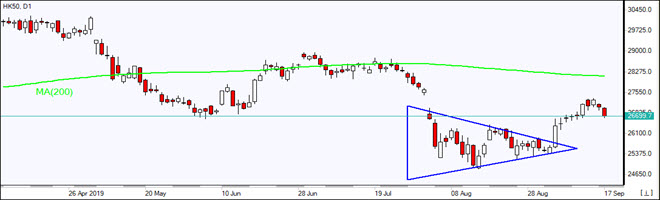
Asian stock indices are mixed today. Nikkei rose 0.1% to 22001.32 as President Trump told US and Japan were ready to sign a limited trade deal and the yen slide against the dollar continued. Markets in China are falling after report Monday industrial production growth was lower than expected in August: the Shanghai Composite Index is down 1.7% and Hong Kong’s Hang Seng Index is 1.6% lower. Australia’s All Ordinaries Index extended gains 0.3% as Australian dollar slide against the greenback accelerated.
Brent futures prices are extending gains today after sharp gains Monday following Saturday’s attack on Saudi oil facilities that halved the kingdom’s oil output. Prices jumped yesterday: November Brent crude closed 14.6% higher at $69.05 a barrel on Monday.
Note: This overview has an informative and tutorial character and is published for free. All the data, included in the overview, are received from public sources, recognized as more or less reliable. Moreover, there is no guarantee that the indicated information is full and precise. Overviews are not updated. The whole information in each overview, including opinion, indicators, charts and anything else, is provided only for familiarization purposes and is not financial advice or а recommendation. The whole text and its any part, as well as the charts cannot be considered as an offer to make a deal with any asset. IFC Markets and its employees under any circumstances are not liable for any action taken by someone else during or after reading the overview.
Running True Multi-Core Multithreaded Python using Numba
KMeans Clustering
Summary
Introduction
It’s as good a time to be writing code as ever – these days, a little bit of code goes a long way. Just a single function is capable of performing incredible things. Thanks to GPUs, Machine Learning, the Cloud, and Python, it’s is easy to create “turbocharged” command-line tools. Think of it as upgrading your code from using a basic internal combustion engine to a nuclear reactor. The basic recipe for the upgrade? One function, a sprinkle of powerful logic, and, finally, a decorator to route it to the command-line.
Writing and maintaining traditional GUI applications – web or desktop – is a Sisyphean task at best. It all starts with the best of intentions, but can quickly turn into a soul crushing, time-consuming ordeal where you end up asking yourself why you thought becoming a programmer was a good idea in the first place. Why did you run that web framework setup utility that essentially automated a 1970’s technology – the relational database – into series of python files? The old Ford Pinto with the exploding rear gas tank has newer technology than your web framework. There has got to be a better way to make a living.
The answer is simple: stop writing web applications and start writing nuclear powered command-line tools instead. The turbocharged command-line tools that I share below are focused on fast results vis a vis minimal lines of code. They can do things like learn from data (machine learning), make your code run 2,000 times faster, and best of all, generate colored terminal output.
Here are the raw ingredients that will be used to make several solutions:
Python has a reputation for slow performance because it’s fundamentally a scripting language. One way to get around this problem is to use the Numba JIT. Here’s what that code looks like:
First, use a timing decorator to get a grasp on the runtime of your functions:
deftiming(f): @wraps(f)defwrap(*args, **kwargs):
ts = time()
result = f(*args, **kwargs)
te = time()
print(f'fun: {f.__name__}, args: [{args}, {kwargs}] took: {te-ts} sec')
return result
return wrap
Next, add a numba.jit decorator with the “nopython” keyword argument, and set to true. This will ensure that the code will be run by the JIT instead of regular python.
@timing@numba.jit(nopython=True)defexpmean_jit(rea):"""Perform multiple mean calculations"""
val = rea.mean() ** 2return val
When you run it, you can see both a “jit” as well as a regular version being run via the command-line tool:
How does that work? Just a few lines of code allow for this simple toggle:
@cli.command()defjit_test(jit):
rea = real_estate_array()
if jit:
click.echo(click.style('Running with JIT', fg='green'))
expmean_jit(rea)
else:
click.echo(click.style('Running NO JIT', fg='red'))
expmean(rea)
In some cases a JIT version could make code run thousands of times faster, but benchmarking is key. Another item to point out is the line:
click.echo(click.style('Running with JIT', fg='green'))
This script allows for colored terminal output, which can be very helpful it creating sophisticated tools.
Using the GPU with CUDA Python
Another way to nuclear power your code is to run it straight on a GPU. This example requires you run it on a machine with a CUDA enabled. Here’s what that code looks like:
@cli.command()defcuda_operation():"""Performs Vectorized Operations on GPU"""
x = real_estate_array()
y = real_estate_array()
print('Moving calculations to GPU memory')
x_device = cuda.to_device(x)
y_device = cuda.to_device(y)
out_device = cuda.device_array(
shape=(x_device.shape[0],x_device.shape[1]), dtype=np.float32)
print(x_device)
print(x_device.shape)
print(x_device.dtype)
print('Calculating on GPU')
add_ufunc(x_device,y_device, out=out_device)
out_host = out_device.copy_to_host()
print(f'Calculations from GPU {out_host}')
It’s useful to point out is that if the numpy array is first moved to the GPU, then a vectorized function does the work on the GPU. After that work is completed, then the data is moved from the GPU. By using a GPU there could be a monumental improvement to the code, depending on what it’s running. The output from the command-line tool is shown below:
Running True Multi-Core Multithreaded Python using Numba
One common performance problem with Python is the lack of true, multi-threaded performance. This also can be fixed with Numba. Here’s an example of some basic operations:
@timing@numba.jit(parallel=True)defadd_sum_threaded(rea):"""Use all the cores"""
x,_ = rea.shape
total = 0for _ in numba.prange(x):
total += rea.sum()
print(total)
@timingdefadd_sum(rea):"""traditional for loop"""
x,_ = rea.shape
total = 0for _ in numba.prange(x):
total += rea.sum()
print(total)
@cli.command()@click.option('--threads/--no-jit', default=False)defthread_test(threads):
rea = real_estate_array()
if threads:
click.echo(click.style('Running with multicore threads', fg='green'))
add_sum_threaded(rea)
else:
click.echo(click.style('Running NO THREADS', fg='red'))
add_sum(rea)
Note that the key difference between the parallel version is that it uses @numba.jit(parallel=True) and numba.prange to spawn threads for iteration. Looking at the picture below, all of the CPUs are maxed out on the machine, but when almost the exact same code is run without the parallelization, it only uses a core.
$ python nuclearcli.py thread-test
$ python nuclearcli.py thread-test --threads
KMeans Clustering
One more powerful thing that can be accomplished in a command-line tool is machine learning. In the example below, a KMeans clustering function is created with just a few lines of code. This clusters a pandas DataFrame into a default of 3 clusters.
Finally, the output of the Pandas DataFrame with the cluster assignment is show below. Note, it has cluster assignment as a column now.
$ python -W nuclearcli.py cluster
Clustered DataFrame
0
1
2
3
4
TEAM
Chicago Bulls
Dallas Mavericks
Sacramento Kings
Miami Heat
Toronto Raptors
GMS
41
41
41
41
41
PCT_ATTENDANCE
104
103
101
100
100
WINNING_SEASON
1
0
0
1
1
…
…
…
…
…
…
COUNTY
Cook
Dallas
Sacremento
Miami-Dade
York-County
MEDIAN_HOME_PRICE_COUNTY_MILLIONS
269900.0
314990.0
343950.0
389000.0
390000.0
COUNTY_POPULATION_MILLIONS
5.20
2.57
1.51
2.71
1.10
cluster
0
0
1
0
0
$ python -W nuclearcli.py cluster --num 2
Clustered DataFrame
0
1
2
3
4
TEAM
Chicago Bulls
Dallas Mavericks
Sacramento Kings
Miami Heat
Toronto Raptors
GMS
41
41
41
41
41
PCT_ATTENDANCE
104
103
101
100
100
WINNING_SEASON
1
0
0
1
1
…
…
…
…
…
…
COUNTY
Cook
Dallas
Sacremento
Miami-Dade
York-County
MEDIAN_HOME_PRICE_COUNTY_MILLIONS
269900.0
314990.0
343950.0
389000.0
390000.0
COUNTY_POPULATION_MILLIONS
5.20
2.57
1.51
2.71
1.10
cluster
1
1
0
1
1
Summary
The goal of this article is to show how simple command-line tools can be a great alternative to heavy web frameworks. In under 200 lines of code, you’re now able to create a command-line tool that involves GPU parallelization, JIT, core saturation, as well as Machine Learning. The examples I shared above are just the beginning of upgrading your developer productivity to nuclear power, and I hope you’ll use these programming tools to help build the future.
Many of the most powerful things happening in the software industry are based on functions: distributed computing, machine learning, cloud computing (functions as a service), and GPU based programming are all great examples. The natural way of controlling these functions is a decorator-based command-line tool – not clunky 20th Century clunky web frameworks. The Ford Pinto is now parked in a garage, and you’re driving a shiny new “turbocharged” command-line interface that maps powerful yet simple functions to logic using the Click framework.
Noah Gift is lecturer and consultant at both UC Davis Graduate School of Management MSBA program and the Graduate Data Science program, MSDS, at Northwestern. He is teaching and designing graduate machine learning, AI, Data Science courses and consulting on Machine Learning and Cloud Architecture for students and faculty.
Noah’s new book, Pragmatic AI, will help you solve real-world problems with contemporary machine learning, artificial intelligence, and cloud computing tools. Noah Gift demystifies all the concepts and tools you need to get results—even if you don’t have a strong background in math or data science. Save 30% with the code, “KITE”.
This post is a part of Kite’s new series on Python. You can check out the code from this and other posts on our GitHub repository.
Investors across the globe are entering the trading week on a mission to avoid riskier assets following drone attacks on Saudi Arabi’s oil fields over the weekend.
This bombshell development could not have come at a more painful time for the global economy currently engaged in a gruelling battle with trade developments and geopolitical risks. Heightened geopolitical tensions in the Middle East should accelerate the flight to safety ultimately sending investors rushing towards safe-haven assets like the Japanese Yen, Gold and Dollar. We can already see this sentiment in the Dollar Index (DXY) which has jumped 0.77% as of writing to trade above 98.60. While the DXY is positioned to blast higher amid the risk-off mood, where prices conclude this week will be heavily influenced by the Federal Reserve meeting on Wednesday.
In regards to the technical picture, the DXY is bullish on the daily charts. A strong daily close above 98.60 should inspire a move towards 99.00 and 99.20.
Are Oil bulls really back in town?
The dynamics influencing oil prices are set to swing back to supply-side factors after the attacks on key Saudi Arabia oil facilities removed 5.7 million barrels from the markets.
Oil prices were explosively bullish today, rising 20% during early trading before later surrendering almost half of the gains. Given how the absence of 5.7 million barrels is equivalent to 50% of Saudi Arabia’s Oil production and roughly 5% of global supplies, the outlook for oil tilts to further upside on this massive supply disruption. The longer it takes for Saudi Arabia’s oil production to recover, the stronger the argument for higher oil prices in the short to medium term.
Whether Oil can appreciate towards $100 will depend on many factors, ranging from global growth, US-China trade developments and OPEC +. I still believe that as long as demand remains missing from the equation, the upside for oil will be capped down the road. Looking at the technical picture, WTI Crude is bullish on the daily charts with prices trading around $60.90 as of writing. A Daily close above $60 should inspire a move towards $63.80 and $65.00.
Disclaimer: The content in this article comprises personal opinions and should not be construed as containing personal and/or other investment advice and/or an offer of and/or solicitation for any transactions in financial instruments and/or a guarantee and/or prediction of future performance. ForexTime (FXTM), its affiliates, agents, directors, officers or employees do not guarantee the accuracy, validity, timeliness or completeness, of any information or data made available and assume no liability as to any loss arising from any investment based on the same.
Fibrocell Science’s shares are trading up 60% today after the company announced that it agreed to be acquired by Castle Creek Holdings for $63.3 million, or $3.00 per share.
Cell and gene therapy company Fibrocell Science Inc. (FCSC:NASDAQ), which focuses on transformational autologous cell-based therapies for skin and connective tissue diseases, announced it has reached an agreement to be acquired by Castle Creek Pharmaceutical Holdings Inc., the parent company of Castle Creek Pharmaceuticals LLC.
Under the terms of the agreement, Castle Creek will acquire Fibrocell for approximately $63.3 million, including repayment of debt and other financial instruments, in cash. Fibrocell common stockholders will receive all-cash consideration of $3.00 per share. Fibrocell reports that the offer represents a 63% premium to Fibrocell’s 30-day volume weighted average price as of September 11, 2019. The transaction has already been approved by the Boards of Directors of both companies and is expected to close in Q4/19 subject to customary closing conditions, including Fibrocell shareholder approval. Upon completion of the transaction, Fibrocell will become a privately held subsidiary of Castle Creek with Fibrocell’s employees continuing as employees of the combined company.
Fibrocell’s president and CEO John Maslowski commented on the sale, “We are incredibly pleased to announce this transaction, which we believe is in the best interests of both shareholders and patients…We believe that combining with Castle Creek has a strong strategic rationale, as they have the expertise and resources necessary to continue the development of both FCX-007 and FCX-013, potentially bringing these and additional novel products to patients in need.”
Greg Wujek, CEO of Castle Creek Pharmaceuticals, stated, “Following our licensing agreement to develop and commercialize FCX-007, our experience working together on rare dermatological conditions caused us to quickly realize that Castle Creek and Fibrocell could achieve even greater synergies by combining the companies into one…With Castle Creek’s resources, Fibrocell’s gene therapy platform can be advanced into additional areas of high, unmet need with the potential to develop multiple promising new therapies.”
Fibrocell’s portfolio includes FCX-007 and FCX-013. FCX-007 is an investigational, late-stage stage gene therapy product candidate for the treatment of recessive dystrophic epidermolysis bullosa (RDEB), a congenital and progressive orphan skin disease caused by the deficiency of the protein COL7. A Phase 3 trial was initiated recently, and if successful, a Biologics License Application (BLA) filing is expected in 2021. The company states that FCX-007 has been granted Orphan Drug designation, Rare Pediatric Disease designation, Fast Track designation and Regenerative Medicine Advanced Therapy (RMAT) designation by the FDA. FCX-013 is described as an investigational, gene therapy candidate for the treatment of moderate to severe localized scleroderma. FCX-013 is an autologous fibroblast genetically modified using lentivirus and encoded for matrix metalloproteinase 1 (MMP-1), a protein responsible for breaking down collagen. FCX-013 is currently enrolling for the Phase 1 portion of a Phase 1/2 clinical trial. The firm advises that the FDA has granted Orphan Drug designation, Rare Pediatric Disease designation and Fast Track designation to FCX-013.
These product candidates are expected to augment Castle Creek Pharmaceuticals’ CCP-020, an investigational, late-stage topical ointment under development for the treatment of epidermolysis bullosa simplex, further strengthening Castle Creek Pharmaceuticals as a leader in dermatology.
Castle Creek Pharmaceutical Holdings is a privately held holding company that holds and invests in companies in the orphan dermatology space. It s subsidiary Castle Creek Pharmaceuticals is a biopharmaceutical company developing innovative therapies for patients with rare, serious or debilitating dermatologic conditions. The firm states that it is dedicated to developing and bringing novel therapies to those living with epidermolysis bullosa.
Fibrocell notes that it is a cell and gene therapy company focused on improving the lives of people with rare diseases of the skin and connective tissue by utilizing its proprietary autologous fibroblast technology to develop personalized biologics that target the underlying cause of disease.
FCSC shares opened much higher today at $2.92 (+$1.09, +59.56%) over yesterday close of $1.83. Since the open shares have traded on high volume in a very narrow trading range of $2.922.95/share and are currently trading at $2.92 (+$1.09 +59.56%).
Disclosure: 1) Stephen Hytha compiled this article for Streetwise Reports LLC and provides services to Streetwise Reports as an independent contractor. He or members of his household own securities of the following companies mentioned in the article: None. He or members of his household are paid by the following companies mentioned in this article: None. 2) The following companies mentioned in this article are billboard sponsors of Streetwise Reports: None. Click here for important disclosures about sponsor fees. 3) Comments and opinions expressed are those of the specific experts and not of Streetwise Reports or its officers. The information provided above is for informational purposes only and is not a recommendation to buy or sell any security. 4) The article does not constitute investment advice. Each reader is encouraged to consult with his or her individual financial professional and any action a reader takes as a result of information presented here is his or her own responsibility. By opening this page, each reader accepts and agrees to Streetwise Reports’ terms of use and full legal disclaimer. This article is not a solicitation for investment. Streetwise Reports does not render general or specific investment advice and the information on Streetwise Reports should not be considered a recommendation to buy or sell any security. Streetwise Reports does not endorse or recommend the business, products, services or securities of any company mentioned on Streetwise Reports. 5) From time to time, Streetwise Reports LLC and its directors, officers, employees or members of their families, as well as persons interviewed for articles and interviews on the site, may have a long or short position in securities mentioned. Directors, officers, employees or members of their immediate families are prohibited from making purchases and/or sales of those securities in the open market or otherwise from the time of the interview or the decision to write an article until three business days after the publication of the interview or article. The foregoing prohibition does not apply to articles that in substance only restate previously published company releases. 6) This article does not constitute medical advice. Officers, employees and contributors to Streetwise Reports are not licensed medical professionals. Readers should always contact their healthcare professional for medical advice.
Tomorrow we could get some extra volatility in Euro pairs with the release of key sentiment data from both Germany and the eurozone. Both figures come out at the same time. The market typically focuses on the largest economy in Europe. After risk sentiment getting a boost from Thursday’s ECB meeting, the question is whether that will continue.
The ZEW conducted their survey of major German and European firms in the lead-up the ECB decision. It’s too soon to see an effect from the policy changes in the central bank, of course. But given how strong the consensus was that some kind of easing would be in the offing, German businesses could have had a substantial improvement in their outlook, the portion of the survey that was most negative.
What We are Looking For
The market usually cares most about the ZEW Economic Sentiment Indicator (ESI). This measures expectations for the next six months. The consensus is for a substantial improvement, but still staying firmly in contraction, at -34.7 from -44.1 prior. This would reverse the trend seen since May when the indicator turned downwards and plunged to the worst result since the Euro crisis of 2011. During that same period, GDP in Germany slipped into negative growth.
Furthermore, the current situation assessment is expected to improve. The projection for theZEW Economic Situation is -3.2. This would be a substantial improvement from -13.5 in the prior month, yet still in contraction.
ZEW ESI for Europe is expected at -32.2, an improvement also. This is from the prior month’s multi-year low of -43.6.
Rationale
Aside from the effect of the at-the-time expected ECB action, one of the primary reasons to expect improvement in the figures this time around is a reversal in why they came in so bad last time. Last month’s poor result was attributed to a worsened trade dispute as well as increased Brexit uncertainty. The survey was done in the middle of the Parliament prorogation announcement.
Now that it seems the US and China are back at the negotiating table, and Brexit has returned to its normal level of chaos, risk sentiment has improved a bit. This has supported the DAX over the last couple of days, with the ECB measures seen helping the financial sector as well as supplying more liquidity to the market.
It’s Not All That Positive
While the markets might have felt relieved with the ECB’s action, and there is a slightly less negative atmosphere from the trade talks, that doesn’t mean that the concerns of German (and European) businesses have been resolved. Many firms have repeatedly said that regulatory issues are impacting them and that they are finding export difficult. The lower Euro might be helping with the latter, but comparatively the yuan is even lower. German industrial production is “overpriced” on the exchange market, in comparison with other rivals.
Analysts and the markets might be getting ahead of themselves in terms of German industrial sentiment. There is usually a period of euphoria following new QE measures. This data might be a return to reality and disappoint the markets. With expectations of such a large improvement, it’s hard to see a surprise beat. However, a result below expectations would be quite easy.
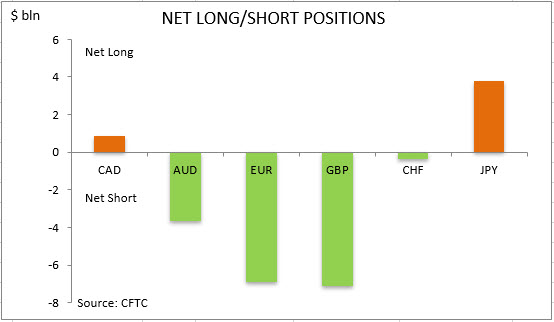
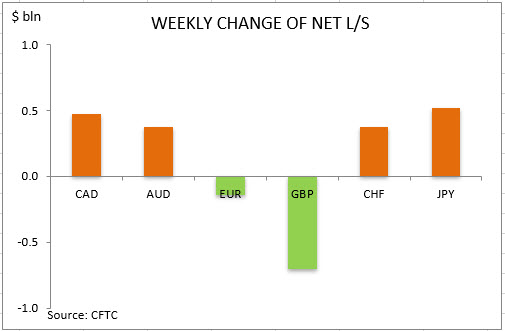
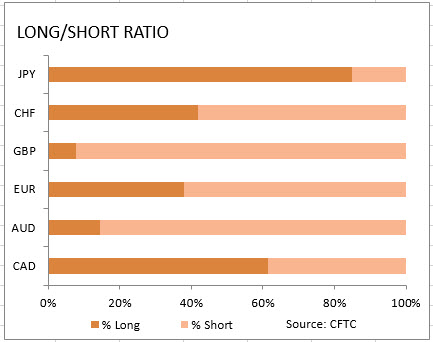
US dollar net long bets declined to $13.34 billion from $14.24 billion against the major currencies during the one week period, according to the report of the Commodity Futures Trading Commission (CFTC) covering data up to September 10 and released on Friday September 13. The dollar weakened as the Labor Department reported US economy added below expected 130,000 jobs in August, after 159,000 new job creation in July.
Note: This overview has an informative and tutorial character and is published for free. All the data, included in the overview, are received from public sources, recognized as more or less reliable. Moreover, there is no guarantee that the indicated information is full and precise. Overviews are not updated. The whole information in each overview, including opinion, indicators, charts and anything else, is provided only for familiarization purposes and is not financial advice or а recommendation. The whole text and its any part, as well as the charts cannot be considered as an offer to make a deal with any asset. IFC Markets and its employees under any circumstances are not liable for any action taken by someone else during or after reading the overview.
Sector expert Michael Ballanger uses storytelling and personal experience to unpack the myths and machinations behind the precious metals and financial markets.
“Destroyers seize gold and leave to its owners a counterfeit pile of paper.” Ayn Rand
Why don’t we start things off a tad differently this evening? Let me relate to you all a parable from the Book of Quantitative Easing where all is good and noble in the world of government oversight, the most widely used oxymoron in the history of mankind.
Granny Smith, now in her late nineties, wakes up one morning and finds that her dear husband for nigh-on seventy years has gone on to meet his Maker. But alas, as distraught as one would expect her to be, she is covertly delighted because, well, old Egbert Smith was not exactly the man she married and being forced to change his diaper and his bedsheets each night had grown both tiresome and difficult.
When the lawyer had finished probating the will after eight meetings that could have been just as effective with one, it was learned that Granny was in possession of a sizeable pool of capital, on the order of US$5,000,000. She immediately ordered a meeting with that nice young man from the bank that “smiles at me and always smells good” in an effort to determine what she should do with her money.
You see, for the past fifty years, husband Egbert handled the family finances because, well, women were not expected to understand money. But prior to marriage, Granny had a job in a bank and was quite proficient in helping “customers” (as opposed to “clients”) understand how the bank was trying to screw them. She understood fully the “Power of Compounding” long before some wannabe-evangelist-cum-motivational-speaker windbag decided to sell a million copies of his latest (plagiarized) book. However, I digress. . .
She enters the mahogany-walled offices of the bank CEO with her handbag full of post-it-note reminders of just how he is going to try to make her $5,000,000 work for him instead of her and sits down in the largest, plushest, most expensive, high-backed chair in banker history.
“Five mil is a lot of money” is the opening salvo of this former drug-dealer-car-salesman-turned-bank-CEO as he shows her a chart of the five top banks’ CD (certificate of deposit) rates. “The range for a 5-year CD is minus 0.23 to minus 0.29 with the our bank, highlighted in yellow. Remember, we value your money,” he says and then asks his “administrative assistant” to fetch them some tea and cookies. “And I want you to know that safety is paramount.”
Granny Smith looks at Mr. Bank CEO and says, “Forgive me, Mr. Morgan, but I am an old lady trying to understand your business so please describe to me what is meant by the minus sign before those figures.”
“Well, Mrs. Smith, it’s pretty simple. We protect your money from thieves and corporate raiders and the government so that you can live the rest of your life stress-free.”
Granny looks up at him quizzically from a half-knitted tea cozy and two very intimidating needles as she says, “Well thank you, but what I meant to ask was what return I will have on my money if I deposit it at your bank in your government-insured Certificate of Deposit?”
At this point the banker starts fiddling with his tie and perspiring heavily as he goes on for another fifteen minutes about “global uncertainty” and “government guarantees” and “bank safety,” and at the exact moment he decides to launch into his “final close,” to get $5,000,000 cash into his bank, which desperately needs to shore up the $6 billion in bad car loans, little Granny Smith interrupts him with this, the most innocent of all questions: “Mr. CEO, if I give you and your wonderful bank all of my five million dollars, how much will I get back after five years?”
Now choking on the ramifications of a truthfully answered question, Mr. Bank CEO pivots into the “You-don’t seem-to-understand” defensive formation, followed by yet another twenty minutes of diatribe.
At this point of the early evening, Granny has been transformed from an “innocent and quite defenseless elderly lady” to “totally pissed off and ready-to-rumble granny-goon,” and decides to ask the banker the ultimate question. Holding a Hewlett Packard financial calculator in her left hand while pointing one of her knitting needles at his throat with her right, she snarls “How much freakin’ money do I get back on September 12, 2024, if I give you my $5 million today?”
The banker stands up; he straightens his tie; he wipes his brow; and he says to the now openly hostile granny, “$4,290,435, my dear, but with the full safety and security of our bank.”
Granny: “So, let me get this straight. I give you five million dollars today and five years from now, when Im 103, you give me back less than i started with???”
The banker CEO smiles bravely and says, “Welcome to the New World Order, Mrs. Smith.”
She grabs her bag, rising quickly from the high-backed chair, and says with the utmost of decorum, “Welcome to the World of f-you, Mr. Banker.” And leaves the building.
And so ends the first parable.
Why, pray tell, would anyone in their right mind, let alone a fiduciary entrusted with the prudent stewardship of client capital, ever buy a financial instrument from a high-risk institution (remember subprime?) that guarantees a negative yield to maturity? Now, I don’t pretend to be a balance sheet genius, nor do I profess to understand all the financial engineering that is practiced these days but it seems to me there is a checklist of possible reasons. Here are but a few:
You have borrowed money from the financial institution and they demand you put up collateral in the form of a bond yielding negative returns. In other words, they layer a second level of “fees” on you, jacking up your effective cost of borrowing to inflated levels;
Your financial institution uses government securities as a reserve requirement in order to soften the interest expense to the government. Since the government regulates your financial institution, they are forced to play ball and the added inconvenience is passed along to the customer,
You are a professional money manager that sees rates going from 1% to 2%, thus opening up a potential capital gain in the price of the bond. As there is an inverse relationship between yield and price, declining yields are accompanied with rising price, hence the rationale for playing the “Greater Fool” game. The early idiot sells the useless bond to a bigger idiot and banks the gain;
And finally,
You were walking to work this morning and were hit on the head by a falling quote machine thrown by an incensed gold trader and were senseless when you made the decision to buy a bond that ensures that you will lose money.
I am sure there are many, many more reasons someone buys a negative-yielding financial instrument, and reasons that are quite possibly more sophisticated than the ones listed above. The point I make is that when you really think about the symptoms of a collapsing global banking system, one needs look no further than the 65% of all global bonds that are delivering a negative yield.
Strong economies are found in regions and countries that are sporting strong balance sheets, just as strong companies are able to cover interest costs from existing cash flow with ease. After several decades of mercantilist behavior fully supported by governments across the globe, with the exception of those countries (Russia, China, Cuba, Zimbabwe, and now Venezuela) that attempted to function under socialist/communist systems of government, we have now arrived at the ultimate tipping point, where government spending now not just exceeds, but dwarfs, tax receipts.
In the case of China, where the shadow banking system cloaks much of their toxic debt, they do not have the additional burden of entitlements, which are the Achilles heel of the American government, military, and banking system. Whenever I look around and try to find a country living within its means, I am hard-pressed to find one. Maybe the Sultan of Brunei could offer lessons as his country sports the lowest debt-to-GDP (gross domestic product) ratio on the list, and while Japan is the worst offender, their total debt at $9 trillion pales in comparison to United States’ $19 trillion debt load. What the U.S. dollar bulls fail to take into consideration is that the entitlements of Medicare, Medicaid and Social Security have to be added to that figure, and the reason they don’t is that they can’t figure out the numbers.
Falling into the realization category of The Emperor’s New Clothes, I contend that we are today at the precipice of a massive drop in global living standards brought on by the final reconciliation of debt. Individual citizens who take advantage of generous lending practices and pile on layer after layer of debt always encounter that point in time where bankruptcy arrives first slowly, then suddenly (thanks to Ernest Hemingway), because cash flow from earnings or dividends and interest falls disastrously short of cash outflow.
At that point, assets must be sold to reduce debt, and while individual citizens can sell things like homes or automobiles or cottages, governments can only sell land. And as any politician knows (think the Greek Islands), the mere mention of carving off a piece of Hawaii or Vancouver Island to pay down someone else’s obligation is certain career suicide. Hence, and with good reason, governments are movingno racingto get the trillions upon trillions in toxic bonds to a negative yielding setup, because just as interest expense is a charge upon the government income statement, interest earned (by negative yielding bonds) is a credit. In this manner, there suddenly exists an accounting function whereby debt becomes an asset, and in this manner, the deadbeat global central banks and criminally compromised treasury departments are able to prolong the largest Ponzi scheme in history.
I further contend that the public is coming to the realization that the smartest people in the room are rarely politicians and never central bankers. However, the best communicators in the room from a political perspective are those who can speak to the masses in a language and style foreign to most educated people (think Donald Trump). After fifty or so years of movie star orators like Ronald Reagan, Bill Clinton and Barack Obama, public perception within the lunch-bucket crowd has now swayed away from “slick” and is gravitating to “blunt” with factual accuracy in the message a mere bonus.
I refer to this growing malaise of disenchantment and unrest as being rooted in one wordmistrust. That mistrust is going to manifest itself within large pools of investible capital fleeing the 10-year safety-net investment strategy, where every 10% drop is met with Fed intervention and jawboning, winding up in alternative investments such as gold and silver. We have already witnessed the impact of the Millennials and GenY-ers on cryptocurrency deals in 20132017 and then cannabis deals from 20132019. The moves in those two sectors were mind-blowing because, as a generation, with thanks to the wonderment of social media, their access to timely information allows them to move in swarms, not unlike bee colonies, chasing deals in mob-like fashion while exiting with the same virulence.
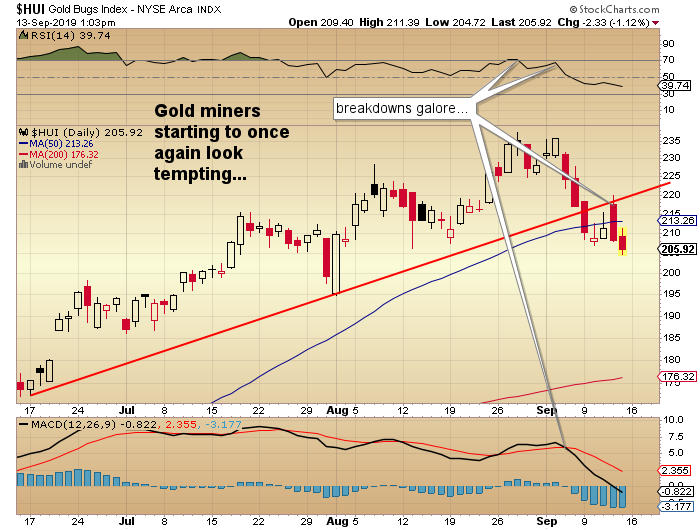
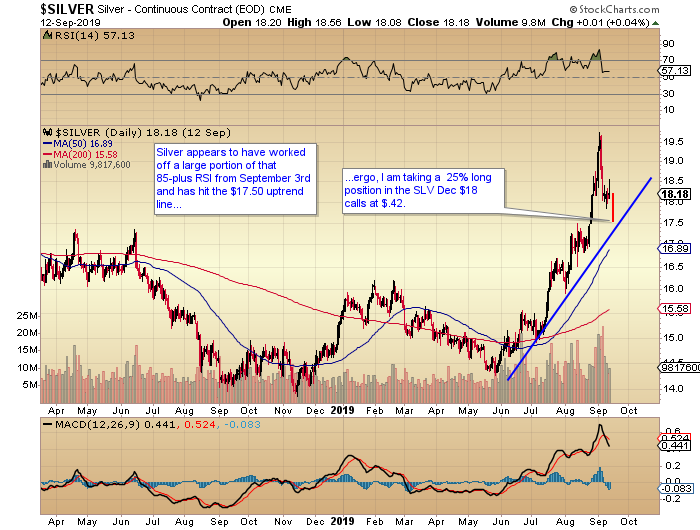
This impulsiveness is the reason we are getting such wild swings in everything, and no better example of that than in the recent JuneSeptember advance in silver from $14.50 in late May to $19.75 on Sept. 4. It took three months for silver to get through $17/ounce, but only three more weeks to peak at $19.75, as the last $2.75 was a wholly new breed of investor arriving into the precious metals markets. Having never been laid out by the bullion bank traders before, they were like sheep being sent to the corral, and just as quickly as they inhaled every share of GDX and GDXJ above $30 and $42 respectively, bludgeoning their way in, today they are all bludgeoning their way out. Same drill over at the Crimex; late longs in silver and gold are being beaten like rented mules.
I sounded the alarm back in June, when gold first attempted to surmount the five-year resistance at $1,3501,375 and while I stand behind the reasoning, I was overly cautious and exited the GLD call options, NUGT, and JNUG way early. I kept 100% positions in the GGMA portfolio in physical gold and silver and held on (for dear life) as the GDX and GDXJ positions screamed ahead until late August, when I sold 50% positions in the $30 and $43 range (GDX and GDXJ respectively), with the balance jettisoned on Sept. 4.
Also sold at or near the top was Great Bear Resources Ltd. (GBR:TSX.V; GTBDF:OTC) (at $9.02) for a 292% profit from Jan. 2. So, between the leveraged and non-leveraged trades, the GGMA portfolio is ahead 163% for the year and is sitting on a 53% cash position, looking for a reentry point to the unleveraged miner ETFs as a starter, followed by the leveraged ones (including GLD and SLV calls) if and when we get to a deeply oversold position.
Now, Ive had a number of people message me with congratulatory salutations on some of the trades but make no mistake about it: I am terrified to be without positions in the GDX and GDXJ, or, as they say, “flat and nervous.” In fact, I feel more anxiety being underinvested and cashed up than I did when I was fully invested and down 15%.
On that note, let me clarify. We are finally in the throes of angst that accompany all bull markets in their early stages. My favorite is silver for all of the reasons you have been reading for the past forty-six months, since I opined in December 2015 that we had just ended the 20112015 bear market and were about to embark on a brand new bull, one that would (and will) change fortunes and lifestyles for all on board.
That opinion has not changed. In fact, for reasons well documented in this publication and others, conditions are ripe for a hyperinflationary conflagration that will, based upon the sheer magnitude of scurrilous counterfeiting of sovereign currencies around the world, make 1921 Weimar Germany look like a tea party. There is only one sanctuary for savings in a world of monetary madness, and that sanctuary absolutely must reside outside of the banking system, because the tattered tentacles of Deutsche Bank are intertwined with the shadow banks in Shanghai, which are, in turn, part of a global labyrinth of debt and collusion and intervention and fraud.
I will repeat analogy from years past. When you visit a pig farm, you see brown pigs and white pigs and pink pigs and even mottled pigs, but at day’s end and the bell is sounded, every pig in the sty sullies up to the feeding trough regardless of color. Similarly, banks can be from the United States or the UK or China or Brussels; they all depend on “fiat” (decree or mandate) and when this growing mistrust of the system finally embodies itself in the daily decisions of investors around the world, all banks will topple, regardless of their locale. At that point, and fear explodes, there will be simply not enough gold and silver to satiate demand. Where infinite and urgent demand meets limited and tightly held supply, pricing chaos ensues. That is what I expect, and that is why I am “flat and nervous.”
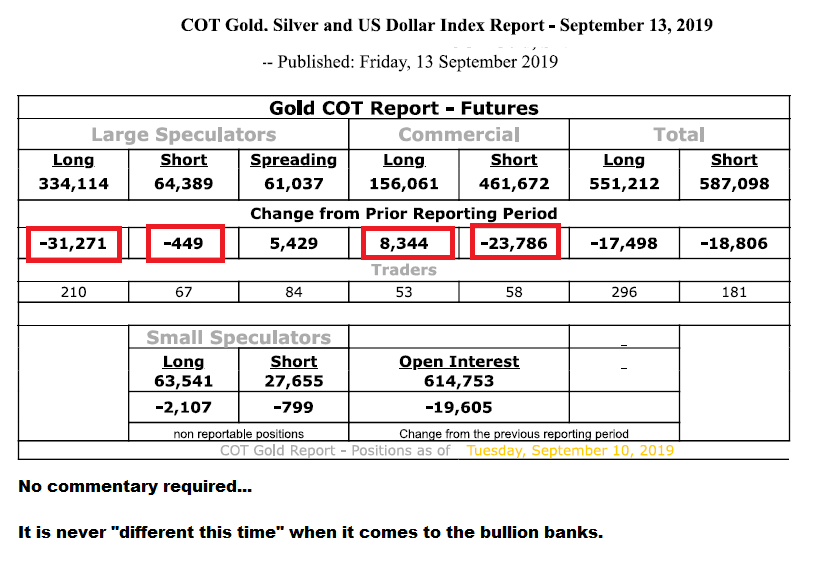
I close out the week by reminding you all that despite what you are being fed about a “new paradigm” and that “it’s different this time,” take one look at the COT Report and realize that the 33,130 contracts covered during the last COT reporting period probably involved a $3040 per ounce clip that represents 100 ounces per contract or $100-125 million in profits taken by bullion banks from the pockets of investors and speculators. At the top in very early September, I counted no fewer than fifty articles in the blogosphere that finger-wagged their conviction that the forces of good had finally and convincingly defeated the “cartel” and it was now “safe” to ignore the bullion banks and go “all in.”
It is late in the Friday trading session, and with the weakness in today’s session in silver, it has now corrected back to a level where, while not egregiously oversold yet, it represents a decent reentry with a small amount of capital into the SLV December $18 calls at $0.42 for a trade to $2.50 by expiry. I will probably be bidding for 25% positions in the GDX at $26.50 and GDXJ at $36 on Monday morning, after which I will overmedicate myself and take a bold swipe at the diabolical duo of NUGT and JNUG. Edging one’s toe into the waters has always served me well because averaging up is a far wiser strategy than averaging down. (Just ask my bank manager, accountant, psychiatrist and pharmacist).
Originally trained during the inflationary 1970s, Michael Ballanger is a graduate of Saint Louis University where he earned a Bachelor of Science in finance and a Bachelor of Art in marketing before completing post-graduate work at the Wharton School of Finance. With more than 30 years of experience as a junior mining and exploration specialist, as well as a solid background in corporate finance, Ballanger’s adherence to the concept of “Hard Assets” allows him to focus the practice on selecting opportunities in the global resource sector with emphasis on the precious metals exploration and development sector. Ballanger takes great pleasure in visiting mineral properties around the globe in the never-ending hunt for early-stage opportunities.
Disclosure: 1) Michael J. Ballanger: I, or members of my immediate household or family, own securities of the following companies mentioned in this article: None. My company has a financial relationship with the following companies referred to in this article: None. I determined which companies would be included in this article based on my research and understanding of the sector. Additional disclosures are below. 2) The following companies mentioned in this article are billboard sponsors of Streetwise Reports: Great Bear Resources. Click here for important disclosures about sponsor fees. 3) Statements and opinions expressed are the opinions of the author and not of Streetwise Reports or its officers. The author is wholly responsible for the validity of the statements. The author was not paid by Streetwise Reports for this article. Streetwise Reports was not paid by the author to publish or syndicate this article. Streetwise Reports requires contributing authors to disclose any shareholdings in, or economic relationships with, companies that they write about. Streetwise Reports relies upon the authors to accurately provide this information and Streetwise Reports has no means of verifying its accuracy. 4) This article does not constitute investment advice. Each reader is encouraged to consult with his or her individual financial professional and any action a reader takes as a result of information presented here is his or her own responsibility. By opening this page, each reader accepts and agrees to Streetwise Reports’ terms of use and full legal disclaimer. This article is not a solicitation for investment. Streetwise Reports does not render general or specific investment advice and the information on Streetwise Reports should not be considered a recommendation to buy or sell any security. Streetwise Reports does not endorse or recommend the business, products, services or securities of any company mentioned on Streetwise Reports. 5) From time to time, Streetwise Reports LLC and its directors, officers, employees or members of their families, as well as persons interviewed for articles and interviews on the site, may have a long or short position in securities mentioned. Directors, officers, employees or members of their immediate families are prohibited from making purchases and/or sales of those securities in the open market or otherwise from the time of the interview or the decision to write an article until three business days after the publication of the interview or article. The foregoing prohibition does not apply to articles that in substance only restate previously published company releases.
Charts provided by the author.
Michael Ballanger Disclaimer: This letter makes no guarantee or warranty on the accuracy or completeness of the data provided. Nothing contained herein is intended or shall be deemed to be investment advice, implied or otherwise. This letter represents my views and replicates trades that I am making but nothing more than that. Always consult your registered advisor to assist you with your investments. I accept no liability for any loss arising from the use of the data contained on this letter. Options and junior mining stocks contain a high level of risk that may result in the loss of part or all invested capital and therefore are suitable for experienced and professional investors and traders only. One should be familiar with the risks involved in junior mining and options trading and we recommend consulting a financial adviser if you feel you do not understand the risks involved.
Michael Nowak, the global head of trading for both base and precious metals at JPMorgan Chase, allegedly oversaw an illegal market manipulation operation.
He was placed on leave in late August and is a target in a widening DOJ criminal probe.
Reuters reports that Nowak and Gregg Smith, whose title is unknown at this time, are the third and fourth people now implicated in a criminal price rigging scheme at the bank. They may not be the last.
Christian Trunz and John Edmonds, who worked for Nowak, have already pleaded guilty and agreed to cooperate with the investigation. They have outlined an operation that spanned nearly a decade and “thousands” of fraudulent trades. They have said their training in the dark arts of rigging prices and cheating clients was provided by more senior bank executives.
They may have been referring to Nowak and/or Smith, though neither have been arrested or charged as yet. If charges are forthcoming, Nowak will be the highest placed executive to face the music thus far.
Should Nowak also plead guilty and provide evidence against his superiors, things will get even more interesting. It would signal the matter isn’t going to be handled in the usual way, i.e. with some lower level staffer taking the fall – and regulators pretending the problem has been addressed.
Traders at Bank of America and Deutsche Bank have also pleaded guilty to spoofing. Evidence shows them working together with their peers at other bullion banks, including JPMorgan, to cheat their respective clients.
The picture emerging is not one of traders at competing banks striving to serve clients well and win business, though that is what naive clients expected. Instead, bankers placed bets against their customers. Then they used their weight in the markets and called in favors with friends at other banks to assure they won those bets.
These and other schemes may have worked to push prices down, something long suspected by frustrated gold bugs.
The bullion banks are infamous for their massive short positions in gold and silver. Whether all those shorts are simply a natural by-product of selling contracts to any and all retail speculators, or whether they are piled up as part of a deliberate price suppression effort sanctioned by the Fed, is not certain.
Either way, the bullion banks’ incentive, generally speaking, is to profit from betting prices will fall.
All too often that entails rigging markets and defrauding clients.
The Justice Department and federal regulators might end up being the least of the bullion banks’ worries. Class-action attorneys and the victims they represent are readying civil lawsuits.
If they can provide proof to juries that traders at multiple banks spent years operating a large and well-coordinated racket, under the supervision and direction of very senior executives, the potential liability will be huge.
The Money Metals News Service provides market news and crisp commentary for investors following the precious metals markets.