NZDUSD Analysis: Getting ready for trade talks between the US and China

By IFCMarkets

Getting ready for trade talks between the US and China

On October 10-11, the next trade talks between the USA and China will start. Will the New Zealand dollar quotations grow?

Deliveries of goods to China account for approximately 20% of New Zealand’s exports. Because of this, possible positive factors for the Chinese economy may support the New Zealand currency. US President Donald Trump said that he counts on success in negotiations with China. Another positive factor for the New Zealand dollar may be the good results of the Global Dairy Trade auction of dairy products. Sales volumes increased by 3.7%, and the average price – by 0.2%. Auctions are held 2 times a month, the next will be held on October 15. The dynamics of the New Zealand dollar may be affected by the indicator of business activity in industry (Manufacturing PMI), which will be published on October 11.

NZDUSD

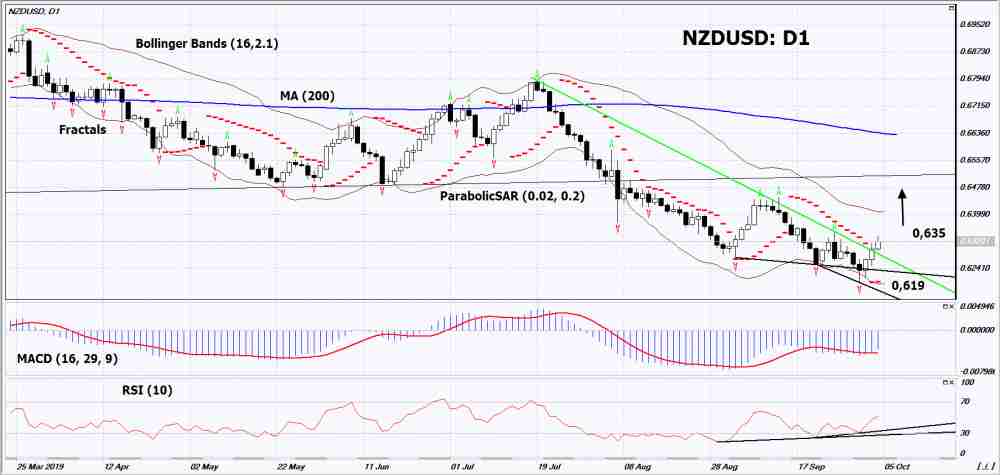
На дневном таймфрейме, NZDUSD: D1 вышел из нисходящего тренда наверх. Ряд индикаторов технического анализа сформировали сигналы к повышению. Дальнейший рост котировок возможен в случае публикации позитивных данных в Новой Зеландии и успеха на американо-китайских торговых переговорах.

  • The Parabolic indicator demonstrates a signal to increase.
  • The Bolinger bands narrowed, indicating a volatility decrease. Both Bollinger Lines Tilt Up.
  • The RSI indicator is above the 50 mark. It has formed a double divergence to increase.
  • The MACD indicator gives a bullish signal.

The bullish momentum may develop if NZDUSD exceeds its last upper fractal: 0.635. This level can be used as an entry point. Initial stop lose may be placed below the last lower fractal, 4-year low, Parabolic signal and the lower Bollinger line: 0.619. After opening the pending order, the stop shall be moved following the Bollinger and Parabolic signals to the next fractal minimum. Thus, we are changing the potential profit/loss to the breakeven point. More risk-averse traders may switch to the 4-hour chart after the trade and place a stop loss moving it in the direction of the trade. If the price meets the stop level (0,619) without reaching the order (0,635), we recommend to cancel the order: the market sustains internal changes that were not taken into account.

Technical Analysis Summary

PositionBuy
Buy stopAbove 0,635
Stop lossBelow 0,619

Market Analysis provided by IFCMarkets

US-China Trade Talks To Resume

By Orbex

Trump Optimistic Over Deal

US and Chinese officials are due to meet later this week for the next round of trade talks. There has been a great deal of speculation over recent weeks regarding the potential for a partial trade deal.

Reports began circling in the summer regarding the notion of an “interim” trade deal, as a stepping stone towards a fuller deal later on.

The interim deal is based around the scaling back of US tariffs on Chinese goods in exchange for China making concessions on agricultural purchases and intellectual property.

Commentary on the ongoing trade talks has been largely positive. Trump told reporters that a deal with China could come sooner than people think.

Speaking on Friday, Trump told reporters:

“We’ve had good moments with China. We’ve had bad moments with China. Right now, we’re in a very important stage in terms of possibly making a deal. But what we’re doing is we’re negotiating a very tough deal. If the deal is not going to be 100% for us, then we’re not going to make it.”

China to Reduce Scope of Discussions

However, over the weekend, the latest commentary from Chinese officials has not been as encouraging.

Reports highlight that Chinese officials have reduced the scope of the issues they are willing to negotiate.

According to reports, China is not willing to discuss commitments on industrial policy or government subsidies, both of which have been key issues for the US.

Investor Uncertainty Returns

Uncertainty ahead of the trade talks is dampening risk sentiment for now.

If the two sides are unable to show any progress at the upcoming meetings this week, we could see a great period of risk aversion developing.

Recent data has shown the ongoing damage to the US economy from Trump’s trade war. US manufacturing hit ten-year lows over September while the NFPs showed the US economy adding just 136k jobs last month.

Fed to Ease Further?

With the US economy having visibly slowed, the Fed is likely to ease further this year.

Although at the last meeting there was an increased number of policymakers opposed to a rate cut, conditions have weakened materially since then. The market pricing is now suggesting a rate cut by December, though October pricing is also rising now.

The trade talks have been the key issue this year, highlighted by a number of central banks, posing a threat to the global economy.

If the US and China are not able to deliver a positive result this week this will keep the pressure on the Fed, keeping the outlook bearish for USD.

Technical Perspective

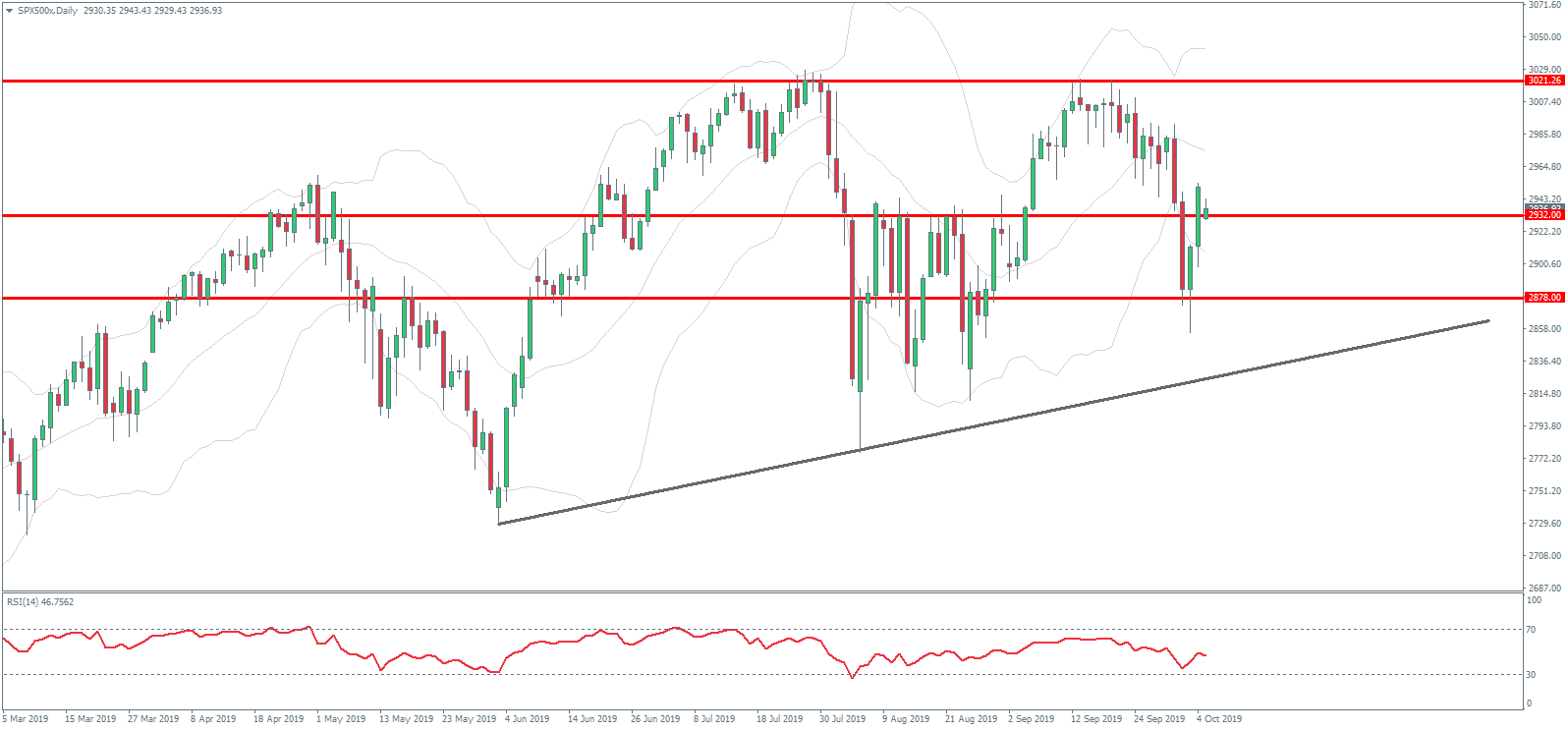
The SPX500 has posted a solid recovery following last week’s losses with price bouncing off the 2878 support level to trade back above the 2932 level.

In line with the longer-term trend, focus remains on a further move higher. With the bullish trend line from summer lows still intact, the resistance level at 3021.26 should be tested again in the coming sessions especially if we see positive news from US-China trade talks.

By Orbex


What is Web Scraping?

By Zac Clancy for Kite.com

Table of Contents

  • Introducing web scraping
  • Some use cases of web scraping
  • How does it work?
  • Robots.txt
  • A simple example
  • Working with HTML
  • Data processing
  • Next steps

Introducing web scraping

Simply put, web scraping is one of the tools developers use to gather and analyze information from the Internet.

Some websites and platforms offer application programming interfaces (APIs) which we can use to access information in a structured way, but others might not. While APIs are certainly becoming the standard way of interacting with today’s popular platforms, we don’t always have this luxury when interacting with most of the websites on the internet.

Rather than reading data from standard API responses, we’ll need to find the data ourselves by reading the website’s pages and feeds.

Some use cases of web scraping

The World Wide Web was born in 1989 and web scraping and crawling entered the conversation not long after in 1993.

Before scraping, search engines were compiled lists of links collected by the website administrator, and arranged into a long list of links somewhere on their website. The first web scraper and crawler, the World Wide Web Wanderer, were created to follow all these indexes and links to try and determine how big the internet was.

It wasn’t long after this that developers started using crawlers and scrapers to create crawler-based search engines that didn’t require human assistance. These crawlers would simply follow links that would come across each page and save information about the page. Since the web is a collaborative effort, the crawler could easily and infinitely follow embedded links on websites to other platforms, and the process would continue forever.

Nowadays, web scraping has its place in nearly every industry. In newsrooms, web scrapers are used to pull in information and trends from thousands of different internet platforms in real time.

Spending a little too much on Amazon this month? Websites exist that will let you know, and, in most cases, will do so by using web scraping to access that specific information on your behalf.

Machine learning and artificial intelligence companies are scraping billions of social media posts to better learn how we communicate online.

So how does it work?

The process a developer builds for web scraping looks a lot like the process a user takes with a browser:

  1. A URL is given to the program.
  2. The program downloads the response from the URL.
  3. The program processes the downloaded file depending on data required.
  4. The program starts over at with a new URL

The nitty gritty comes in steps 3 and, in which data is processed and the program determines how to continue (or if it should at all). For Google’s crawlers, step 3 likely includes collecting all URL links on the page so that the web scraper has a list of places to begin checking next. This is recursiveby design and allows Google to efficiently follow paths and discover new content.

There are many heavily used, well built libraries for reading and working with the downloaded HTML response. In the Ruby ecosystem Nokogiri is the standard for parsing HTML. For Python, BeautifulSoup has been the standard for 15 years. These libraries provide simple ways for us to interact with the HTML from our own programs.

These code libraries will accept the page source as text, and a parser for handling the content of the text. They’ll return helper functions and attributes which we can use to navigate through our HTML structure in predictable ways and find the values we’re looking to extract.

Scraping projects involve a good amount of time spent analyzing a web site’s HTML for classes or identifiers, which we can use to find information on the page. Using the HTML below we can begin to imagine a strategy to extract product information from the table below using the HTML elements with the classes products and product.

<table class="products">
  <tr class="product">...</tr>
  <tr class="product">...</tr>
</table>

In the wild, HTML isn’t always as pretty and predictable. Part of the web scraping process is learning about your data and where it lives on the pages as you go along. Some websites go to great lengths to prevent web scraping, some aren’t built with scraping in mind, and others just have complicated user interfaces which our crawlers will need to navigate through.

Robots.txt

While not an enforced standard, it’s been common since the early days of web scraping to check for the existence and contents of a robots.txt file on each site before scraping its content. This file can be used to define inclusion and exclusion rules that web scrapers and crawlers should follow while crawling the site. You can check out Facebook’s robots.txt file for a robust example: this file is always located at /robots.txt so that scrapers and crawlers can always look for it in the same spot. Additionally, GitHub’s robots.txt, and Twitter’s are good examples.

An example robots.txt file prohibits web scraping and crawling would look like the below:
User-agent: *
Disallow: /

The User-agent: * section is for all web scrapers and crawlers. In Facebook’s, we see that they set User-agent to be more explicit and have sections for Googlebot, Applebot, and others.

The Disallow: / line informs web scrapers and crawlers who observe the robots.txt file that they aren’t permitted to visit any pages on this site. Conversely, if this line read Allow: /, web scrapers and crawlers would be allowed to visit any page on the website.

The robots.txt file can also be a good place to learn information about the website’s architecture and structure. Reading where our scraping tools are allowed to go – and not allowed to go – can help inform us on sections of the website we perhaps didn’t know existed, or may not have thought to look at.

If you’re running a website or platform it’s important to know that this file isn’t always respected by every web crawler and scraper. Larger properties like Google, Facebook, and Twitter respect these guidelines with their crawlers and information scrapers, but since robots.txt is considered a best practice rather than an enforceable standard, you may see different results from different parties. It’s also important not to disclose private information which you wouldn’t want to become public knowledge, like an admin panel on /admin or something like that.

A simple example

To illustrate this, we’ll use Python plus the BeautifulSoup and Requests libraries.

import requests
from bs4 import BeautifulSoup

page = requests.get('https://google.com')
soup = BeautifulSoup(page.text, 'html.parser')

We’ll go through this line-by-line:

page = requests.get('https://google.com')

This uses the requests library to make a request to https://google.com and return the response.

soup = BeautifulSoup(page.text, 'html.parser')

The requests library assigns the text of our response to an attribute called text which we use to give BeautifulSoup our HTML content. We also tell BeautifulSoup to use Python 3’s built-in HTML parser html.parser.

Now that BeautifulSoup has parsed our HTML text into an object that we can interact with, we can begin to see how information may be extracted.

paragraphs = soup.find_all('p')

Using find_all we can tell BeautifulSoup to only return HTML paragraphs <p> from the document.

If we were looking for a div with a specific ID (#content) in the HTML we could do that in a few different ways:

element = soup.select('#content')
# or
element = soup.find_all('div', id='content')
# or
element = soup.find(id='content')

In the Google scenario from above, we can imagine that they have a function that does something similar to grab all the links off of the page for further processing:

links = soup.find_all('a', href=True)

The above snippet will return all of the <a> elements from the HTML which are acting as links to other pages or websites. Most large-scale web scraping implementations will use a function like this to capture local links on the page, outbound links off the page, and then determine some priority for the links’ further processing.

Working with HTML

The most difficult aspect of web scraping is analyzing and learning the underlying HTML of the sites you’ll be scraping. If an HTML element has a consistent ID or set of classes, then we should be able to work with it fairly easily, we can just select it using our HTML parsing library (Nokogiri, BeautifulSoup, etc). If the element on the page doesn’t have consistent classes or identifiers, we’ll need to access it using a different selector.

Imagine our HTML page contains the following table which we’d like to extract product information from:

NAME

CATEGORY

PRICE

ShirtAthletic$19.99
JacketOutdoor$124.99

BeautifulSoup allows us to parse tables and other complex elements fairly simply. Let’s look at how we’d read the table’s rows in Python:

# Find all the HTML tables on the page
tables = soup.find_all('table')

# Loop through all of the tables
for table in tables:
	# Access the table's body
	table_body = table.find('tbody')
	# Grab the rows from the table body
	rows = table_body.find_all('tr')

	# Loop through the rows
	for row in rows:
    	    # Extract each HTML column from the row
    	    columns = row.find_all('td')

    	    # Loop through the columns
    	    for column in columns:
        	  # Print the column value
        	  print(column.text)

The above code snippet would print Shirt, followed by Athletic, and then $19.99 before continuing on to the next table row. While simple, this example illustrates one of the many strategies a developer might take for retrieving data from different HTML elements on a page.

Data processing

Researching and inspecting the websites you’ll be scraping for data is a crucial component to each project. We’ll generally have a model that we’re trying to fill with data for each page. If we were scraping restaurant websites we’d probably want to make sure we’re collecting the name, address, and the hours of operation at least, with other fields being added as we’re able to find the information. You’ll begin to notice that some websites are much easier to scrape for data than others – some are even defensive against it!

Once you’ve got your data in hand there are a number of different options for handling, presenting, and accessing that data. In many cases you’ll probably want to handle the data yourself, but there’s a slew of services offered for many use cases by various platforms and companies.

  • Search indexing: Looking to store the text contents of websites and easily search? Algolia and Elasticsearch are good for that.
  • Text analysis: Want to extract people, places, money and other entities from the text? Maybe spaCy or Google’s Natural Language API are for you.
  • Maps and location data: If you’ve collected some addresses or landmarks, you can use OpenStreetMap or MapBox to bring that location data to life.
  • Push notifications: If you want to get a text message when your web crawler finds a specific result, check out Twilio or Pusher.

Next steps

In this post, we learned about the basics of web scraping and looked at some simplistic crawling examples which helped demonstrate how we can interact with HTML pages from our own code. Ruby’s Nokogiri, Python’s BeautifulSoup, and JavaScript’s Nightmare are powerful tools to begin learning web scraping with. These libraries are relatively simple to start with, but offer powerful interfaces to begin to extend in more advanced use cases.

Moving forward from this post, try to create a simple web scraper of your own! You could potentially write a simple script that reads a tweet from a URL and prints the tweet text into your terminal. With some practice, you’ll be analyzing HTML on all the websites you visit, learning its structure, and understanding how you’d navigate its elements with a web scraper.
This article originally appeared on Kite.com (Reprinted with permission)


US Unemployment Falls To 50-Year Low

By Orbex

The monthly nonfarm payrolls report surprised with the unemployment rate falling to 3.5%. This marked the lowest unemployment levels since 1959.

Payrolls grew by 136,000 missing the estimates of 145,000.

The payroll figures for August were revised higher to 168,000 from 130,000 and July’s figures were revised to 166,000 from 159,000.

The average hourly earnings, however, grew at an annualized pace of 2.9%. The data brought some life back to the US dollar which had fallen after weak manufacturing and services PMI numbers earlier last week.

Euro Closes the Week with Modest Gains

The euro managed to close in the green on a weekly basis. The gains were primarily driven by a weaker USD.

Friday’s payrolls saw the dollar paring losses but still closed in the red. This saw the euro posting a four-day winning streak.

A lack of any new fundamentals from the eurozone saw the gains to be rather muted.

Will EURUSD Maintain the Upside Bias?

The currency pair settled comfortably above the support turned resistance area of 1.0944 – 1.0925. Price action is yet to test this level to reconfirm support. If support is formed at this level, we anticipate further gains in store. The upside could prevail which will see the EURUSD targeting the 1.1030 resistance area.

Brexit Uncertainty Builds, Calls for Delay Rise

UK PM Boris Johnson’s new Brexit deal saw lukewarm response from policymakers in Brussels. With a lack of any clear enthusiasm, the focus shifts to a possible delay of the Brexit deadline once again.

News outlets report that the Scottish court ruled that PM Johnson must seek an extension if no deal is reached by October 19th. However, the British Prime Minister has maintained his stance that the UK will leave EU regardless of a deal by October 31st.

GBPUSD Stays Muted to Brexit Drama

The pound sterling logged some modest gains on Friday. Price action remains trading within the resistance area of the 1.2370–1.2291 region. On a weekly basis, the GBPUSD closed with modest gains.

However, the weekly bearish bias remains. Unless GBPUSD closes above 1.2370, we expect the downside momentum to pick up the pace once again.

Gold Prices Give Back Gains After Payrolls Report

The precious metal closed flat on Friday giving up the gains from earlier in the day. The precious metal was seen once again closing the week on a positive note.

The gains were primarily led by weak ISM manufacturing and services reports. However, with the unemployment rate falling to new lows, investor risk appetite rose.

XAUUSD to Maintain Sideways Range

Gold prices are likely to trade in the range between 1508 and 1485. Failure to break past the upper level leaves the precious metal exposed to further losses. Watch the lower level of 1485, which could give way.

A close below this level will see the correction resuming. The downside target remains at the 1431–1428 level of support.

By Orbex


Forex Technical Analysis & Forecast 07.10.2019 (EURUSD, GBPUSD, USDCHF, USDJPY, AUDUSD, USDRUB, USDCAD, GOLD, BRENT, BTCUSD)

Article By RoboForex.com

EURUSD, “Euro vs US Dollar”

EURUSD is consolidating around 1.0971. Possibly, today the pair may break this level to the downside to reach the target at 1.0950. If this level is broken as well, the instrument may continue trading inside the downtrend with the first target at 1.0903.

EURUSD
Risk Warning: the result of previous trading operations do not guarantee the same results in the future

GBPUSD, “Great Britain Pound vs US Dollar”

GBPUSD has finished the first descending impulse at 1.2277; right now, it is correction with the target at 1.2355. After that, the instrument may start the second impulse to break 1.2266 and then continue trading downwards with the second target at 1.2197.

GBPUSD
Risk Warning: the result of previous trading operations do not guarantee the same results in the future

USDCHF, “US Dollar vs Swiss Franc”

After completing the descending correction at 0.9933, USDCHF has formed the ascending impulse towards 0.9966. Possibly, the pair may start a new decline to reach 0.9940, thus forming a new consolidation range. If later the price breaks this range to the upside at 0.9966, the instrument may start a new growth with the first target at 0.9988.

USDCHF
Risk Warning: the result of previous trading operations do not guarantee the same results in the future

USDJPY, “US Dollar vs Japanese Yen”

USDJPY is moving upwards to reach 107.17. Later, the market may start a new correction towards 106.80 and then form one more ascending structure with the first target at 108.00.

USDJPY
Risk Warning: the result of previous trading operations do not guarantee the same results in the future

AUDUSD, “Australian Dollar vs US Dollar”

AUDUSD has reached the target of the second ascending impulse; right now, it is correcting with the target at 0.6731 at least. After that, the instrument may continue trading upwards with the first target at 0.6794.

AUDUSD
Risk Warning: the result of previous trading operations do not guarantee the same results in the future

USDRUB, “US Dollar vs Russian Ruble”

USDRUB has reached 64.60; Today, the pair may start another correction with the target at 65.04. Later, the market may continue trading inside the downtrend with the first target at 64.50.

USDRUB
Risk Warning: the result of previous trading operations do not guarantee the same results in the future

USDCAD, “US Dollar vs Canadian Dollar”

USDCAD is consolidating around 1.3321. Possibly, today the pair may fall towards 1.3295 to finish the correction. After that, the instrument may form one more ascending structure with the target at 1.3373.

USDCAD
Risk Warning: the result of previous trading operations do not guarantee the same results in the future

XAUUSD, “Gold vs US Dollar”

Gold has completed the first descending impulse along with the correction. Today, the pair may form the second descending impulse to break 1495.70 and then continue trading downwards with the second target at 1478.60.

GOLD
Risk Warning: the result of previous trading operations do not guarantee the same results in the future

BRENT

Brent is forming the first ascending impulse towards 60.25. Later, the market may start a new correction to reach 58.50 and then form one more ascending structure to break 61.22. After that, the instrument may continue trading upwards with the second target at 64.05.

BRENT
Risk Warning: the result of previous trading operations do not guarantee the same results in the future

BTCUSD, “Bitcoin vs US Dollar”

BTCUSD has completed the correction by reaching 7800.00. Today, the pair may start another growth towards 7940.00 and then form a new descending structure to reach 78500.00, thus forming a consolidation range. If later the price breaks this range to the upside, the instrument may resume trading upwards with the target at 8125.00; if to the downside at 1.3200 – continue the downtrend towards 7647.00.

BITCOIN

Article By RoboForex.com

Attention!
Forecasts presented in this section only reflect the author’s private opinion and should not be considered as guidance for trading. RoboForex LP bears no responsibility for trading results based on trading recommendations described in these analytical reviews.

Fibonacci Retracements Analysis 07.10.2019 (GOLD, USDCHF)

Article By RoboForex.com

XAUUSD, “Gold vs US Dollar”

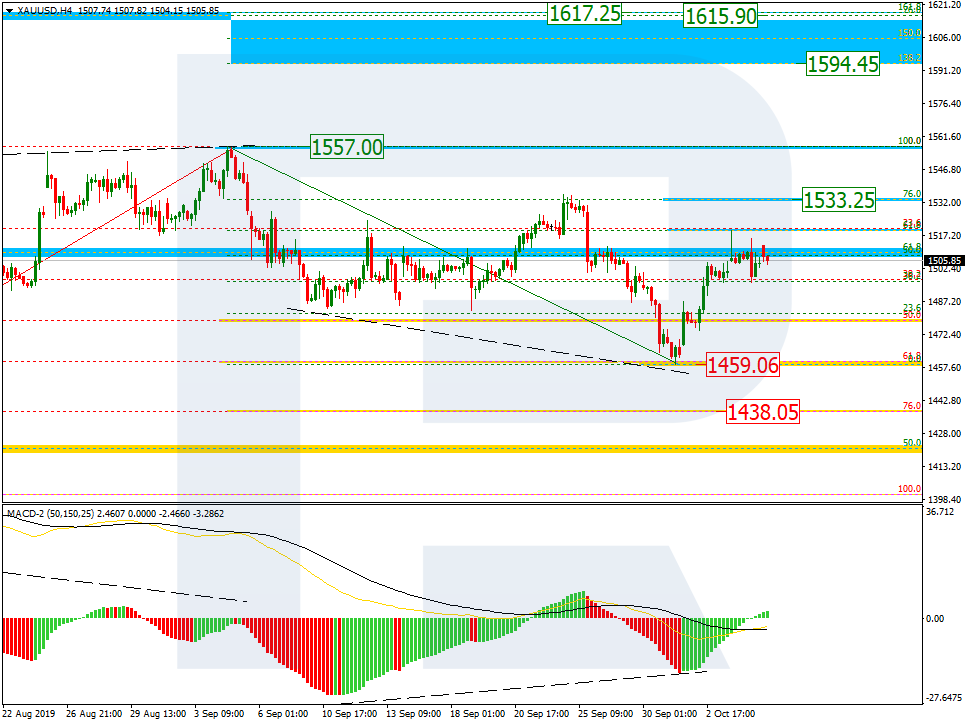
As we can see in the H4 chart, the convergence made the pair complete the descending correction at 61.8% fibo and start a new growth, which has already reached 61.8% fibo. The next upside targets may be 76.0% fibo at 1533.25 and the high at 1557.00. If XAUUSD breaks the high, the instrument may continue growing towards the post-correctional extension area between 138.2% and 161.8% fibo at 1594.45 and 1617.25 respectively.

GOLD_H4
Risk Warning: the result of previous trading operations do not guarantee the same results in the future

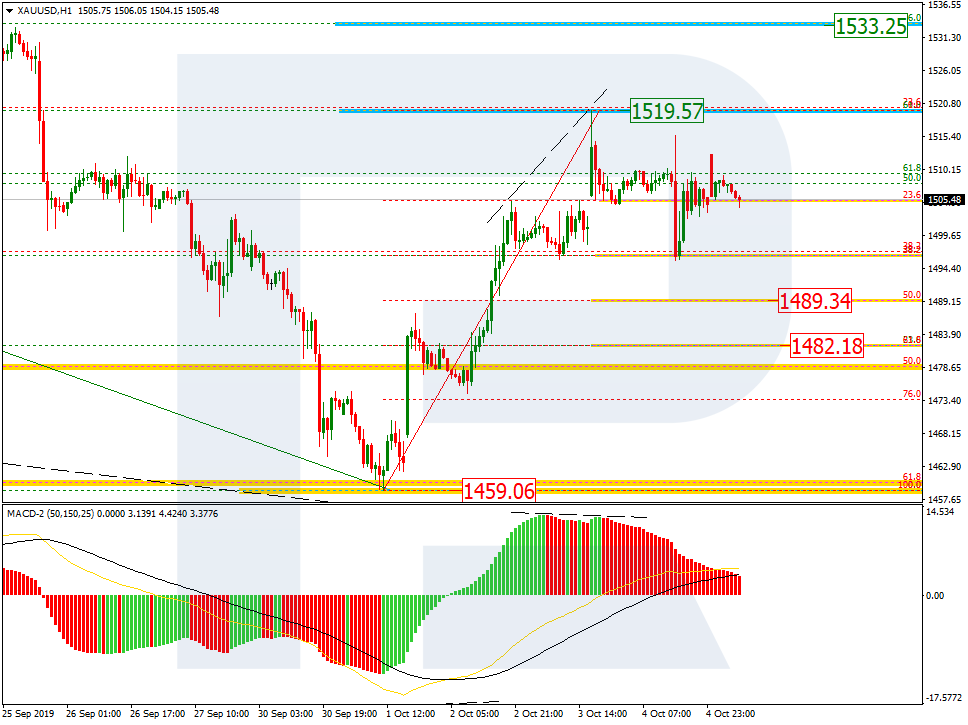
In the H1 chart, we can see a short-term pullback, which has already reached 38.2% fibo and may yet continue towards 50.0% and 61.8% fibo at 1489.34 and 1482.18 respectively. The resistance is the high at 1519.57.

GOLD_H1
Risk Warning: the result of previous trading operations do not guarantee the same results in the future

USDCHF, “US Dollar vs Swiss Franc”

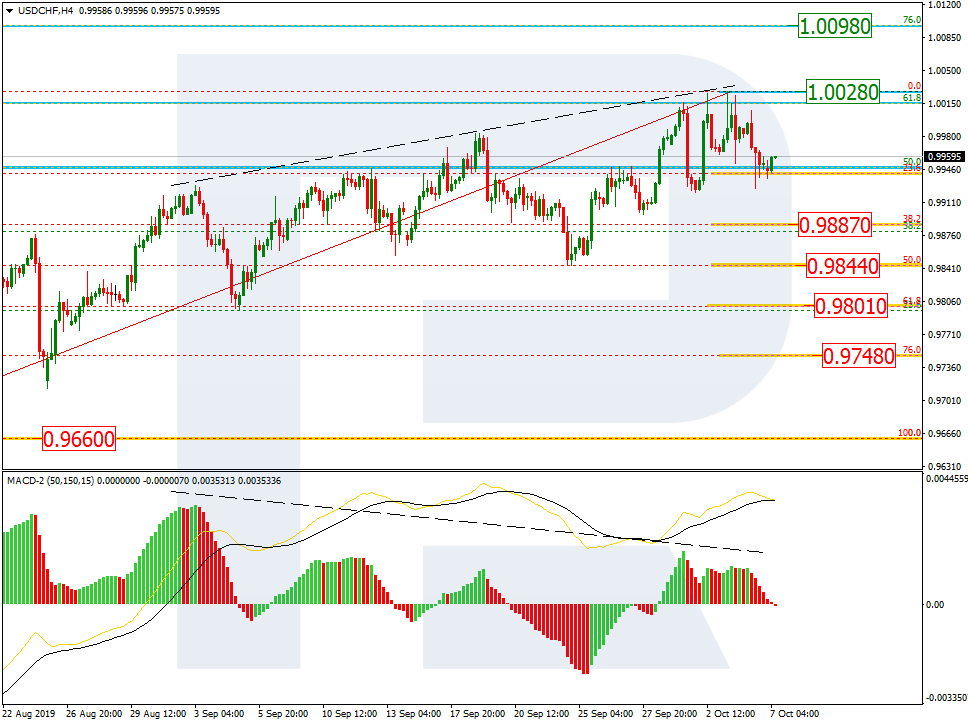
As we can see in the H4 chart, the divergence made the pair finish the ascending tendency at 61.8% fibo. However, if the price breaks the high at 1.0028, the tendency may yet continue to reach 76.0% fibo at 1.0098. Still, the divergence indicates a new decline in the first place, which has already reached 23.6% fibo. The next downside targets may be 38.2%, 50.0%, 61.8%, and 76.0% fibo at 0.9887, 0.9844, 0.9801, and 0.9748 respectively.

USDCHF_H4
Risk Warning: the result of previous trading operations do not guarantee the same results in the future

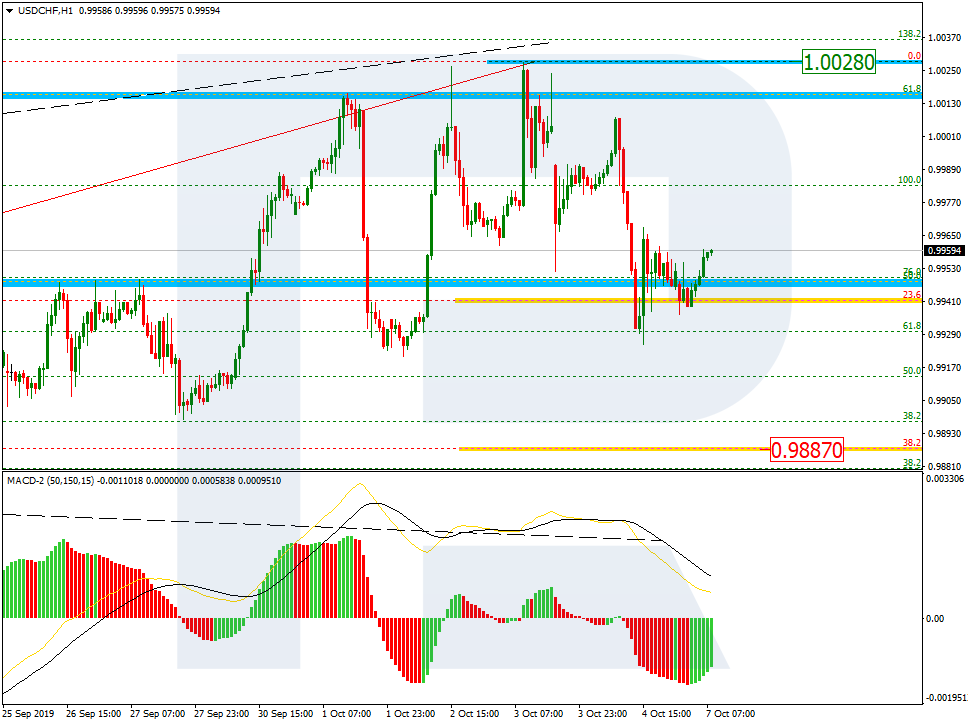
In the H1 chart, after completing the descending impulse, the pair is still testing 23.6% fibo. The next downside target is 38.2% fibo at 0.9887.

USDCHF_H1

Article By RoboForex.com

Attention!
Forecasts presented in this section only reflect the author’s private opinion and should not be considered as guidance for trading. RoboForex LP bears no responsibility for trading results based on trading recommendations described in these analytical reviews.

Weekly Market Outlook: Fed Minutes & Powell’s Speech

By Orbex

The week will see a continuation of various economic reports and scheduled speeches by central bankers which will continue to keep the markets busy.

The events that stand out include the meeting minutes from the Federal Reserve and the ECB.

Fed Chairman, Jerome Powell will be speaking along with a number of other Fed members. BoE’s Carney is also slated to make an appearance this week.

In the backdrop of last week’s data, the economic indicators are painting a mixed picture.

The declines in both manufacturing and services PMI are certainly a cause for concern. But this was made up for by Friday’s jobs report. Still, investors continue to raise the odds of another rate cut from the Federal Reserve.

Data from the eurozone is sparse, save for the ECB meeting minutes. This will be the last meeting minutes under the leadership of ECB Chief, Mario Draghi.

Here’s a brief look at the key economic events coming up for the week ahead.

Fed Minutes & Speeches Could Outline Forward Guidance

The Federal Reserve cut rates twice already. The recent declines from the ISM’s index raised the prospects of further rate cuts. But still, the markets remain mixed. The Federal Reserve maintains the view that the U.S. economy is on a firm footing. Investors will get a glimpse into the policy makers’ thinking this week.

FOMC Meeting Minutes: What to Watch

The Federal Reserve’s FOMC met in September. The central bank cut rates by another quarter basis point amid some dissenting votes.

The Federal Reserve has so far maintained the view that the US economy is strong, albeit losing some momentum. Investors will be looking to the Fed meeting minutes for more insights as to how the decision to cut was reached.

Of particular interest will be the Fed’s repo operationsFed Chair Powell also hinted that the central bank could look at organically growing its balance sheet once again.

All Eyes on September Inflation Report

The US Department of Commerce will be releasing the monthly inflation report this week. The core inflation rate has been outperforming the headline CPI, rising for the third consecutive month.

Despite this, CPI remains sluggish and stubbornly below the Fed’s 2.0% inflation target rate. Medical care among others is still one of the key drivers of price inflation. But energy prices remain weak.

The volatile goods prices which saw a strong increase in August could dissipate. Investors expect headline inflation to rise just 0.1% on the month to an annualized pace of 1.8%.

The core inflation rate is forecast to rise by 0.2%, making for a softer reading for September. Core CPI is forecast to remain steady at 2.4% on a year over year basis.

BoE & Economic Data to dictate GBP Flows

The clock ticks closer to the October 31st deadline for the UK to leave the EU.

Despite fresh proposals being submitted, the EU remains unconvinced. Meanwhile, PM Johnson remains adamant about leaving the EU on the set deadline. But the court ruling for the parliament to block a no-deal Brexit makes it complicated.

Will the GBP continue to ignore the Brexit developments?

BoE Member Lineup for Week Ahead

Various members of the Bank of England’s monetary policy committee are set to take turns this week. Starting with BoE Governor Mark Carney, other members include Haldane and Tenreyro.

The BoE has remained on the sidelines so far, but recently there has been an increase in calls for a possible rate cut. UK economic data points to an impending recession.

UK GDP to Stay Flat in August

The UK’s Office for National Statistics (ONS) will be releasing the monthly GDP figures this week.

Economists are seeing that growth stagnated during the month. This comes on the back of a surprising 0.3% increase in July.

Besides the GDP report, industrial, manufacturing and construction output figures are also due. All three measures are forecast to post a decline or remain sluggish.

This would be consistent with the ONS’s view that the jump in July’s GDP was something not to read too seriously. But the big question is how the GBP will react in the week ahead.

By Orbex


The Analytical Overview of the Main Currency Pairs on 2019.10.07

by JustForex

The EUR/USD currency pair

Technical indicators of the currency pair:
  • Prev Open: 1.09638
  • Open: 1.09789
  • % chg. over the last day: +0.05
  • Day’s range: 1.09726 – 1.09899
  • 52 wk range: 1.0884 – 1.1623

The EUR/USD currency pair has stabilized. A trading instrument is consolidating. There is no defined trend. EUR/USD quotes test local support and resistance levels at 1.09650 and 1.09900, respectively. On Friday, the US published a rather weak report on the US labor market in September. Investors continue to monitor the progress of trade negotiations between Washington and Beijing. We do not exclude further growth of the EUR/USD currency pair. Positions must be opened from key levels.

Today, the publication of important economic releases is not planned. We recommend that you pay attention to the speech of the head of the Fed.

EUR/USD

The price fixed above 50 MA and 100 MA, which signals the strength of buyers.

The MACD histogram is in the positive zone, but below the signal line, which gives a weak signal to buy EUR/USD.

The Stochastic Oscillator is in the neutral zone, the %K line is below the %D line, which indicates a bearish sentiment.

Trading recommendations
  • Support levels: 1.09650, 1.09400, 1.09050
  • Resistance levels: 1.09900, 1.10250

If the price consolidates above 1.09900, expect further growth toward 1.10200-1.10400.

Alternatively, the quotes could drop toward 1.09400-1.09200.

The GBP/USD currency pair

Technical indicators of the currency pair:
  • Prev Open: 1.23288
  • Open: 1.23030
  • % chg. over the last day: -0.15
  • Day’s range: 1.23030 – 1.23367
  • 52 wk range: 1.1995 – 1.3385

An ambiguous technical picture has developed on the GBP/USD currency pair. Sterling is currently consolidating. The key support and resistance levels are: 1.22850 and 1.23400, respectively. Last week, British Prime Minister Boris Johnson submitted to the European Union the final proposal for the country’s withdrawal from the bloc. We recommend that you keep track of current information on this issue. Positions must be opened from key levels.

The Economic News Feed for 07.10.2019 is not planned.

GBP/USD

Indicators do not give accurate signals: the price crossed 50 MA and 100 MA.

The MACD histogram is near the 0 mark. There are no signals at the moment.

The Stochastic Oscillator is in the neutral zone, the %K line is below the %D line, which indicates a bearish sentiment.

Trading recommendations
  • Support levels: 1.22850, 1.22450, 1.22100
  • Resistance levels: 1.23400, 1.23800, 1.24150

If the price consolidates above 1.23400, expect further growth toward 1.23800-1.24100.

Alternatively, the quotes could decrease toward 1.22500-1.22200.

The USD/CAD currency pair

Technical indicators of the currency pair:
  • Prev Open: 1.33330
  • Open: 1.33224
  • % chg. over the last day: -0.16
  • Day’s range: 1.33043 – 1.33272
  • 52 wk range: 1.2727 – 1.3664

The USD/CAD currency pair continues to trade in a flat. The technical picture is ambiguous. At the moment, the support and resistance levels can be distinguished at 1.33000 and 1.33400. Participants in financial markets expect additional drivers. A trading instrument has the potential for further growth. We recommend that you pay attention to the dynamics of prices of “black gold”. Positions must be opened from key levels.

The Economic News Feed for 07.10.2019 is calm.

USD/CAD

Indicators do not give accurate signals, the price crossed 50 MA.

The MACD histogram is near the 0 mark.

The Stochastic Oscillator is near the overbought zone, the %K line is above the %D line, which gives a weak signal to buy USD/CAD.

Trading recommendations
  • Support levels: 1.33000, 1.32800, 1.32550
  • Resistance levels: 1.33400, 1.33700

If the price consolidates above 1.33400, expect further growth toward 1.33700-1.33900.

Alternatively, the quotes could decrease toward 1.32800-1.32600.

The USD/JPY currency pair

Technical indicators of the currency pair:
  • Prev Open: 106.913
  • Open: 106.637
  • % chg. over the last day: -0.16
  • Day’s range: 106.652 – 106.905
  • 52 wk range: 104.97 – 114.56

The USD/JPY currency pair stabilized after a sharp fall last week. At the moment, the trading instrument is in lateral movement. USD/JPY quotes are testing the key support and resistance levels: 106.600 and 107.000, respectively. In the near future, technical correction is not ruled out. We recommend that you pay attention to the dynamics of the yield of US government securities. Positions must be opened from key levels.

The Economic News Feed for 07.10.2019 is calm.

USD/JPY

Indicators do not give accurate signals: the price crossed 50 MA.

The MACD histogram is near 0. There are no signals at the moment.

The Stochastic Oscillator is in the overbought zone, the %K line began to cross the %D line. There are no signals at the moment.

Trading recommendations
  • Support levels: 106.600, 106.300
  • Resistance levels: 107.000, 107.300, 107.650

If the price consolidates below 106.600, expect quotes to fall toward 106.300-106.000.

Alternatively, the quotes could correct toward 107.300-107.500.

by JustForex

Euro Is Up for Further Growth

By Dmitriy Gurkovskiy, Chief Analyst at RoboForex

Early in another October week, EUR/USD is consolidating at 1.0983, but may yet continue growing.

Former European Central bankers have published a memorandum on the ECB monetary policy where they attacked it and said it was “based on the wrong diagnosis and risks eroding its independence”. Former policymakers believe that in case of the Euro Area economy and the ECB, the interest rates, as a control and management tool, have become more irrelevant recently, while the risks have grown a lot. In their opinion, the longer the regulator continues its ultra-loose rates policy, the higher the probability that it will fail.

Of course, this opinion pretty much has the right to exist. It appears that the ECB was too late to respond to the inflation decline and missed the right moment to do avoid it. At the same time, it’s difficult to agree that the low rates policy won’t work, because in this case, the banking system will “reboot” itself.

Last Friday, the USA published several reports on the labor market. The Unemployment Rate wasn’t expected to change, but it dropped significantly in September, from 3.7% to 3.5%, the lowest level over the last 50 years. The Average Hourly Earnings remained unchanged, although it was expected to add 0.3% m/m, and that put the pressure on the USD. The Non-Farm Employment Change was 136K in September against the expected reading of 145K. By the way, the August number was revised upwards, up to 168K.

In the H4 chart, EUR/USD has completed the ascending wave, which may be considered as a correction of the previous descending wave; right now, it is trading to rebound from 1.0997 to the downside. One can see the first descending impulse along with the correction. At the moment, the pair is forming the second impulse with the target at 1.0950. after breaking this level, the price may continue trading inside the downtrend with the first target at 1.0903. However, this scenario may no longer be valid if the price steadily grows to break 1.0998. In this case, the pair may choose an alternative scenario to extend the correction towards 1.1004. From the technical point of view, this scenario is confirmed by MACD Oscillator: its signal line is moving high above 0. Basically, the line is expected to fall towards 0. Later, it may break this level and boost the decline.

As we can see in the H1 chart, EUR/USD is consolidating above 1.0970. According to the main scenario, the price is expected to trade inside the downtrend. After breaking 1.0970, the pair may continue falling towards 1.0950. And that’s just a half of this descending wave. After a slight consolidation, the instrument may resume falling to reach 1.0903. However, this scenario may no longer be valid if the price steadily grows to break 1.0998. In this case, the instrument may choose an alternative scenario, which implies extending the ascending wave towards 1.1000. From the technical point of view, this scenario is confirmed by Stochastic Oscillator: its signal line is moving inside the “oversold area”, thus indicating further consolidation and growth towards 50. Still, if later the line rebounds from 50, the current downtrend may get faster.

Disclaimer

Any predictions contained herein are based on the authors’ particular opinion. This analysis shall not be treated as trading advice. RoboForex shall not be held liable for the results of the trades arising from relying upon trading recommendations and reviews contained herein.


Today the First Round of Negotiations Between Washington and Beijing Will Start. Investors Assess the US Labor Market Report

by JustForex

The US dollar has become stable against a basket of major currencies. The dollar index (#DX) closed Friday’s trading session in the negative zone (-0.05%). The US has published rather weak labor market data for September. Thus, the number of people employed in the nonfarm sector of the country grew only by 136K, while experts forecasted an increase by 140K. Average hourly earnings (YoY) rose in September by 2.9% instead of 3.2%. However, the unemployment rate fell to 3.5% from 3.7%.

The trade conflict between the US and China has come to the fore again. Today, the first round of negotiations in Washington, which will last two days, will start. Most experts believe that the deal is hardly to be concluded. Investors also continue to monitor the situation concerning Brexit. Last week, British Prime Minister, Boris Johnson, submitted to the European Union the final proposal for the country’s exit from the bloc. We recommend following current information on these issues.

The “black gold” prices continue to recover after a significant drop last week. At the moment, futures for the WTI crude oil are testing the $53.00 mark per barrel.

Market Indicators

On Friday, there was the bullish sentiment in the US stock markets: #SPY (+1.35%), #DIA (+1.39%), #QQQ (+1.47%).

The 10-year US government bonds yield is at the level of 1.52-1.53%.

The Economic News Feed for 07.10.2019:
  • Today, the publication of important economic news is not expected. We recommend paying attention to the speech by the Fed Chairman Powell.

by JustForex