Akcea Therapeutics Inks Worldwide Licensing Deal with Pfizer for Investigative Antisense Therapy, Shares Up 30%

By The Life Science Report

Source: Streetwise Reports   10/07/2019

Akcea Therapeutics’ shares are trading 30% higher today on news that it has entered into a worldwide exclusive licensing agreement with Pfizer for AKCEA-ANGPTL3-LRx used in the treatment of patients with cardiovascular and metabolic diseases.

This morning global biopharmaceutical firm Akcea Therapeutics Inc. (AKCA:NASDAQ), a majority-owned affiliate of Ionis Pharmaceuticals Inc. (IONS:NASDAQ), and Pfizer Inc. (PFE:NYSE) jointly announced that the companies have entered into a “worldwide exclusive licensing agreement for AKCEA-ANGPTL3-LRx, an investigational antisense therapy being developed to treat patients with certain cardiovascular and metabolic diseases.”

The company explains in the report that AKCEA-ANGPTL3-LRx is designed to reduce the “production of angiopoietin-like 3 (ANGPTL3) protein in the liver, a key regulator of triglycerides, cholesterol, glucose and energy metabolism. AKCEA-ANGPTL3-LRx is currently being evaluated in a Phase 2 study in patients with Type 2 diabetes, hypertriglyceridemia and non-alcoholic fatty liver disease (NAFLD).”

Under the terms of the agreement, Akcea and Ionis will “receive a $250 million upfront license fee to be split equally between the two companies and Akcea will settle its $125 million obligation to Ionis in Akcea common stock. Both companies are also eligible to receive development, regulatory and sales milestone payments of up to $1.3 billion and tiered, double-digit royalties on annual worldwide net sales following marketing approval of AKCEA-ANGPTL3-LRx.” The report noted that Pfizer will be responsible for all development and regulatory activities and costs beyond those associated with the ongoing Phase 2 study. Akcea will also have the right at its option, prior to regulatory filing for marketing approval, to participate in certain commercialization activities with Pfizer in the U.S. and certain additional markets. The firm advises that the transaction is subject to clearance under the Hart-Scott Rodino Antitrust Improvements Act and other customary closing conditions.

Damien McDevitt, Ph.D., Akcea’s Interim CEO commented, “AKCEA-ANGPTL3-LRx has the potential to treat people suffering from certain cardiovascular and metabolic diseases. Given the unmet medical need for this patient population and the broad market potential, we believe Pfizer’s expertise and breadth of experience in cardiovascular and metabolic diseases makes it well suited to accelerate clinical development of AKCEA-ANGPTL3-LRx, and to deliver it to patients in need of additional therapies for these life threatening diseases.”

Pfizer’s Chief Scientific Officer and President of Worldwide Research & Development and Medical Mikael Dolsten, added, “Pfizer is committed to delivering breakthrough medicines to patients with unmet medical needs…AKCEA-ANGPTL3-LRx is a novel therapy that will complement our clinical mid-stage internal medicine pipeline, and we believe that our deep expertise in cardiovascular and metabolic diseases will help allow this program to reach its maximum potential for patients.”

Akcea Therapeutics is headquartered in Boston, Mass., and is an affiliate of Ionis Pharmaceuticals. Akcea describes itself as a global biopharmaceutical company focused on developing and commercializing drugs to treat patients with serious and rare diseases with leading-edge, RNA-targeted medicines. The firm’s programs target cardiometabolic lipid disorders and hereditary transthyretin (TTR) amyloidosis. The firm indicates that it is commercializing TEGSEDI (inotersen) and WAYLIVRA (volanesorsen) as well as advancing a mature pipeline of novel drugs, including AKCEA-APO(a)-LRx, AKCEA-ANGPTL3-LRx, AKCEA-APOCIII-LRx, and AKCEA-TTR-LRx, with the potential to treat multiple diseases. The company states that all six drugs were discovered by Ionis, and are based on Ionis’ proprietary antisense technology.

Pfizer is a research-based global biopharmaceutical company engaged in the discovery, development and manufacture of healthcare products. Its global portfolio is composed of many household name brand prescription medications including Prevnar 13, Xeljanz, Eliquis, Lipitor, Celebrex, Pristiq and Viagra.

Pfizer has a market cap of approximately $198.7 billion. PFE shares opened relatively unchanged today at $35.82 (-$0.11, -0.31%) and have since traded between $35.80 and $36.26/share today.

Akcea shares opened up higher today at $19.00 (+$3.87, +25.58%) compared to Friday’s closing price of $15.31. Since the open shares have traded between $18.80 and $22.47 and are currently trading at $19.71 (+4.58, +30.27%).

Sign up for our FREE newsletter at: www.streetwisereports.com/get-news

Disclosure:
1) Stephen Hytha compiled this article for Streetwise Reports LLC and provides services to Streetwise Reports as an independent contractor. He or members of his household own securities of the following companies mentioned in the article: None. He or members of his household are paid by the following companies mentioned in this article: None.
2) The following companies mentioned in this article are billboard sponsors of Streetwise Reports: None. Click here for important disclosures about sponsor fees.
3) Comments and opinions expressed are those of the specific experts and not of Streetwise Reports or its officers. The information provided above is for informational purposes only and is not a recommendation to buy or sell any security.
4) The article does not constitute investment advice. Each reader is encouraged to consult with his or her individual financial professional and any action a reader takes as a result of information presented here is his or her own responsibility. By opening this page, each reader accepts and agrees to Streetwise Reports’ terms of use and full legal disclaimer. This article is not a solicitation for investment. Streetwise Reports does not render general or specific investment advice and the information on Streetwise Reports should not be considered a recommendation to buy or sell any security. Streetwise Reports does not endorse or recommend the business, products, services or securities of any company mentioned on Streetwise Reports.
5) From time to time, Streetwise Reports LLC and its directors, officers, employees or members of their families, as well as persons interviewed for articles and interviews on the site, may have a long or short position in securities mentioned. Directors, officers, employees or members of their immediate families are prohibited from making purchases and/or sales of those securities in the open market or otherwise from the time of the interview or the decision to write an article until three business days after the publication of the interview or article. The foregoing prohibition does not apply to articles that in substance only restate previously published company releases.
6) This article does not constitute medical advice. Officers, employees and contributors to Streetwise Reports are not licensed medical professionals. Readers should always contact their healthcare professionals for medical advice.

( Companies Mentioned: AKCA:NASDAQ,
PFE:NYSE,
)

Tocqueville’s Hathaway acknowledges the political incorrectness of gold

By Money Metals News Service

Tocqueville’s latest Gold Strategy Letter by fund manager John Hathaway wonderfully details the case for gold’s price to rise even as the letter omits a few crucial things, as respectable people in finance must do when discussing the monetary metal.

Gata Painting

Systemic risks are increasing in the world financial system, Hathaway notes, but “have yet to trigger an appropriate market response.”

Now why should that be? Could it be on account of surreptitious market intervention by governments and central banks?

Hathaway doesn’t say. But at least he acknowledges the profound political incorrectness of gold.

“In our conversations with numerous investment professionals on the topic,” Hathaway continues, “we generally find that an understanding of the investment case for gold does not translate into action on behalf of their clients. Why? Gold has become the third rail of investment ideas and represents career risk for any investment manager who fails to beat benchmarks because of metal exposure.

“For that reason gold is episodically underweighted by professional managers and retail investors of all stripes ranging from high net worth to ‘moms and pops.’ Antipathy to the investment theme seems to stem from the possibility of success that could undercut mainstream thinking. If you underperform because of gold exposure, you could lose your job. On the other hand, if you lose money in ‘FAANG’ stocks or other crowd favorites, you are safe from criticism.”

I would be a little more candid. As author and fund manager Jim Rickards said on CNBC 10 years ago last month, “When you own gold you’re fighting every central bank in the world”.

Maybe not every central bank anymore, since Eastern European and Asian central banks have been buying lately, though of course they don’t want to have to compete with retail purchases by ordinary investors.

But certainly you’re fighting Western governments and central banks. Better not to mention their surreptitious interventions in the gold market if you want to avoid government auditing and preserve your invitations to Wall Street’s forthcoming Christmas parties.

Hathaway’s enumeration of the reasons gold should rise is posted at Tocqueville here.

If you want to determine whether gold will rise, you may do best to plant some listening devices in the office of the U.S. Treasury secretary and the trading rooms of the Federal Reserve Bank of New York, the Bank for International Settlements in Basel, Switzerland, and the Bank of England in London. No respectable person in finance dares to direct any critical questions there.


The Money Metals News Service provides market news and crisp commentary for investors following the precious metals markets.

Analyst: Gold Explorer Warrants Top Pick Status

By The Gold Report

Source: Streetwise Reports   10/07/2019

The rationale for this view of the company is provided in an Echelon Wealth Partners report.

In an Oct. 3 research note, analyst Gabriel Gonzalez reported that Echelon Wealth Partners continues to consider Revival Gold Inc. (RVG:TSX.V) a Top Pick, as the company’s 2019 exploration program results “firm up the Beartrack-Arnett Creek thesis.”

That thesis is that potential exists for restarting a mining operation on the properties, perhaps first launching a heap-leach operation that capitalizes on the existing infrastructure at Beartrack and then moving to a larger-scale milling operation at Beartrack.

“We believe the combined Beartrack-Arnett Creek properties could yield a potentially compelling mining project for any intermediate to senior gold producer,” commented Gonzalez.

Through its 2019 exploration program, Revival extended mineralization at Arnett Creek, and a geophysics survey suggested further attractive potential there. As such, the explorer is updating its geological model such that it will inform additional Arnett Creek exploration.

As for what’s next, Revival should release phase 2 metallurgical test results on Beartrack’s mill feed before year-end 2019. Then in Q1/20, the company intends to complete a resource update that should outline additional growth potential at both properties. “On a headline basis, we expect the new resource to provide a maiden NI 43-101 compliant resource for Arnett Creek,” Gonzalez indicated.

Echelon has a Speculative Buy rating and a CA$1.90 per share 12-month price target on Revival. Its current share price is about CA$0.67.

“We believe that beyond 12 months, Revival could delineate a 3,000,000-plus ounce resource to support a preliminary economic assessment,” Gonzalez concluded.

Sign up for our FREE newsletter at: www.streetwisereports.com/get-news

Disclosure:
1) Doresa Banning compiled this article for Streetwise Reports LLC and provides services to Streetwise Reports as an independent contractor. She or members of her household own securities of the following companies mentioned in the article: None. She or members of her household are paid by the following companies mentioned in this article: None.
2) The following companies mentioned in this article are billboard sponsors of Streetwise Reports: None. Click here for important disclosures about sponsor fees.
3) Comments and opinions expressed are those of the specific experts and not of Streetwise Reports or its officers. The information provided above is for informational purposes only and is not a recommendation to buy or sell any security.
4) The article does not constitute investment advice. Each reader is encouraged to consult with his or her individual financial professional and any action a reader takes as a result of information presented here is his or her own responsibility. By opening this page, each reader accepts and agrees to Streetwise Reports’ terms of use and full legal disclaimer. This article is not a solicitation for investment. Streetwise Reports does not render general or specific investment advice and the information on Streetwise Reports should not be considered a recommendation to buy or sell any security. Streetwise Reports does not endorse or recommend the business, products, services or securities of any company mentioned on Streetwise Reports.
5) From time to time, Streetwise Reports LLC and its directors, officers, employees or members of their families, as well as persons interviewed for articles and interviews on the site, may have a long or short position in securities mentioned. Directors, officers, employees or members of their immediate families are prohibited from making purchases and/or sales of those securities in the open market or otherwise from the time of the interview or the decision to write an article until three business days after the publication of the interview or article. The foregoing prohibition does not apply to articles that in substance only restate previously published company releases. As of the date of this interview, officers and/or employees of Streetwise Reports LLC (including members of their household) own securities of Revival Gold, a company mentioned in this article.

Disclosures from Echelon Wealth Partners, Revival Gold Inc., October 3, 2019

Echelon Wealth Partners compensates its Research Analysts from a variety of sources. The Research Department is a cost centre and is funded by the business activities of Echelon Wealth Partners including, Institutional Equity Sales and Trading, Retail Sales and Corporate and Investment Banking.

I, Garbriel Gonzalez, hereby certify that the views expressed in this report accurately reflect my personal views about the subject securities or issuers. I also certify that I have not, am not, and will not receive, directly or indirectly, compensation in exchange for expressing the specific recommendations or views in this report.

Important Disclosures:
Is this an issuer related or industry related publication? Issuer.

Does the Analyst or any member of the Analyst’s household have a financial interest in the securities of the subject issuer? No

The name of any partner, director, officer, employee or agent of the Dealer Member who is an officer, director or employee of the issuer, or who serves in any advisory capacity to the issuer.? No

Does Echelon Wealth Partners Inc. or the Analyst have any actual material conflicts of interest with the issuer? No

Does Echelon Wealth Partners Inc. and/or one or more entities affiliated with Echelon Wealth Partners Inc. beneficially own common shares (or any other class of common equity securities) of this issuer which constitutes more than 1% of the presently issued and outstanding shares of the issuer? No

During the last 12 months, has Echelon Wealth Partners Inc. provided financial advice to and/or, either on its own or as a syndicate member, participated in a public offering, or private placement of securities of this issuer? Yes

During the last 12 months, has Echelon Wealth Partners Inc. received compensation for having provided investment banking or related services to this Issuer? Yes

Has the Analyst had an onsite visit with the Issuer within the last 12 months? No

Has the Analyst or any Partner, Director or Officer been compensated for travel expenses incurred as a result of an onsite visit with the Issuer within the last 12 months? No

Has the Analyst received any compensation from the subject company in the past 12 months? No

Is Echelon Wealth Partners Inc. a market maker in the issuer’s securities at the date of this report? No

( Companies Mentioned: RVG:TSX.V,
)

Monetary Madness Puts U.S. Dollar Holders in Jeopardy

By Money Metals News Service

We’re in uncharted territory. Never before have U.S. fiscal and monetary policy been leveraged so heavily to boost an economy that wasn’t even in recession.

Something will break – and it could be the value of U.S. currency. The Federal Reserve Note now faces devaluation pressures on multiple fronts.

With the federal government running a trillion-dollar budget deficit and an election year approaching, fiscal restraint is a dead letter in Washington, D.C. Politicians are fighting over who can promise to borrow and spend the most.

Meanwhile, President Donald Trump is trying to talk the dollar down versus the currencies of China and other trading partners.

Even as Trump vents frustration at the Federal Reserve on a near daily basis for being too tight, the central bank is actually ramping up its monetary easing policies.

They may not call it “Quantitative Easing,” but in September Federal Reserve officials launched a massive new campaign of liquidity injections that will expand their balance sheet by hundreds of billions of dollars. This was all prompted by trouble in the overnight lending “repo” market, where a lack of liquidity caused interest rates to spike to multiples of the Fed funds rate.

The Fed embarrassingly lost control of its own benchmark rate, threatening the credibility of its central planning powers.

The Fed barely managed to avert a wider financial crisis with its emergency market operations. And it soon became clear that the initial liquidity injections into the repo market would be insufficient for the big banks that depend on it.

Hellicopter Money

Officials had to raise their maximum daily repo facility and extend the duration of their repo operations.

These “temporary” open market operations are starting to look more permanent.

According to Morgan Stanley strategist Kelcie Gerson, “We maintain that these temporary repo operations will not prove to be a sufficient long-term solution to the recent funding pressure. Ultimately, the Fed will need to increase the size of its balance sheet permanently.”

The Fed’s brief attempt at balance sheet reduction earlier this year (Quantitative Tightening) saw the Fed’s assets trimmed by about $600 billion. Now it appears likely that the central bank will steadily add that $600 billion (and possibly more) back to its balance sheet by next year.

Fed policymakers may also be on course to take interest rates down to zero – or possibly even below zero. Former Fed chairman Alan Greenspan has said it’s only a matter of time before negative rates (i.e., a penalty tax on savings) arrive in the U.S.

An Ideal Environment for Gold and Silver

What this monetary madness all may be building toward (albeit inadvertently) is an ideal environment for precious metals.

Gold and silver markets broke out to multi-year highs this past summer. They have rallied this year in spite of the fact that the U.S. Dollar Index so far refuses to break down.

Dollar Weakens

Gold and silver are looking strong in terms of all major fiat currencies. It makes sense given that central bankers around the world are all pursuing easy money policies of their own.

Still, it’s been largely a stealth rally in metals up to this point.

Gold and silver aren’t garnering much attention in the financial media – perhaps because the U.S. stock market has also rallied.

Equities could potentially run up further as the Fed continues to ease. But if the recent hiccups in the repo market are a sign of bigger trouble to come in the financial system, then the Fed may be behind the curve and the stock market may be headed for some wild swings lower.

Although gold and silver can go up based on their own fundamentals regardless of how financial markets perform, public demand for physical bullion tends to go up during times of fear.

If ordinary investors and savers come to fear an accelerating loss of purchasing power in their dollar-denominated holdings, look out above!


The Money Metals News Service provides market news and crisp commentary for investors following the precious metals markets.

Potential AUD Reaction To Westpac Consumer Sentiment

By Orbex

The next major event on the economic calendar that could affect the AUD and NZD is the release of Westpac’s Consumer Confidence survey.

Immediately after the release, we could have a couple of dozen pip move in the market. But for long term FX traders, it’s relevant to get a better understanding of the future evolution of the AUD.

Consumer sentiment is one of the driving factors in inflation. And, from there, it could determine whether the RBA will take action to maintain price stability.

The central bank has been desperately trying to get consumers back into the market and get them spending. But, so far, it appears to not be all that successful.

The next set of data will help us see if there is some improvement. Or, it might increase the likelihood that the RBA will bring forward their next rate cut.

What Are We Expecting?

Last week, the National Australia Bank published its State Economic Overview report. This included a survey of consumer sentiment at a state level.

The conclusion was that consumer sentiment had weakened since the prior survey, which foreshadows that the Westpac version will also be lower than prior.

However, the Westpac survey is conducted two weeks after the NAB’s. So, that would put it after the latest RBA move.

September’s Consumer Sentiment survey dropped into negative -1.7%. The survey tends to fluctuate quite a bit, with a negative figure followed by a comparable positive result.

Without a consensus among analysts, a result hasn’t been priced into the market. Generally, however, two consecutive negative reads in consumer sentiment provide a negative outlook for the currency. The last time that happened was at the beginning of the housing crisis in December.

As for a chance for a bump on the upside, we wouldn’t expect a significant move higher unless the result beat the mirror of last month’s result. In other words, above +1.7%.

This would break the downward trend in consumer sentiment that’s been the average since the beginning of the year.

The Details

Unlike the business sentiment figure released earlier today, the consumer sentiment survey asks respondents how they expect their personal finances to evolve over the next year. This gives us a longer horizon of expectations.

To get some insight into what’s going on with consumer sentiment in the increasingly low-interest-rate environment, we can look at other indicators. In order for consumers to spend, they need to have money, be it from their salaries or from credit.

Jobs Numbers Still Strong

Australia continues to add jobs, despite the relatively poor performance in the economy. The rate, however, hasn’t been enough to keep up with the number of people entering the workforce.

So, unemployment has been slowly ticking up since the beginning of the year.

Unemployment growth hasn’t been enough to dampen wage growth, however. It continues at pretty much the same pace all year long.

Where consumers are cutting back, and to the presumed annoyance of the RBA, is in credit. Private credit has been trending downward the last several months, with a smaller proportion of Australians taking on debt. Part of that might be explained by the drop in home sales.

In any case, the latest trends show consumers are not convinced the worst is behind them. That is likely to keep inflation low.

Unless there is a significant change in consumer sentiment in the near future, AUD would likely stay under pressure as traders try to calibrate when the next RBA cut will be.

By Orbex


Nasdaq Mini Speculators raised their bullish bets last week

October 8th – By CountingPips.comReceive our weekly COT Reports by Email

Nasdaq Mini Non-Commercial Speculator Positions:

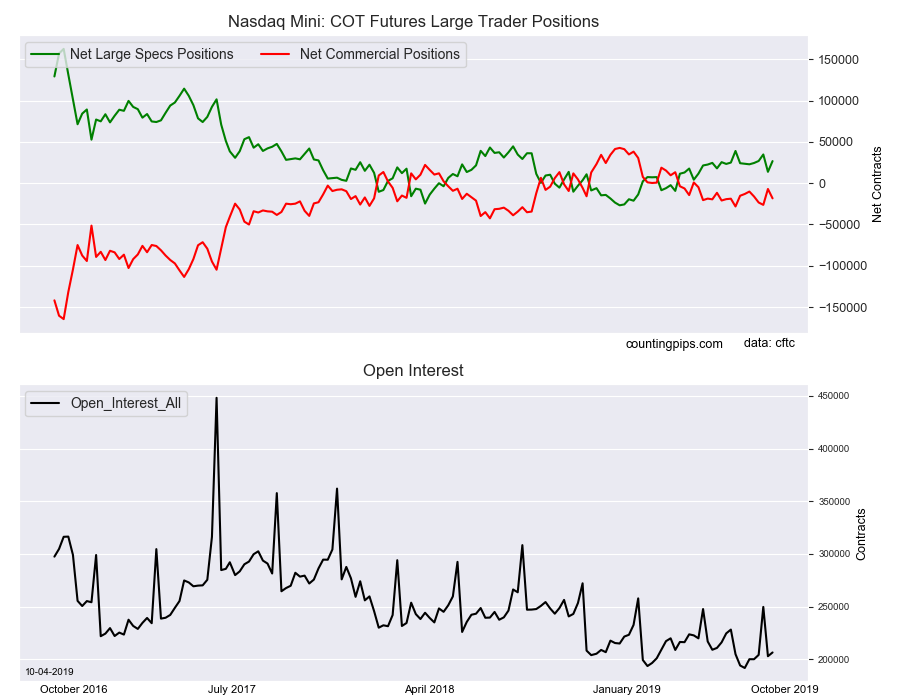
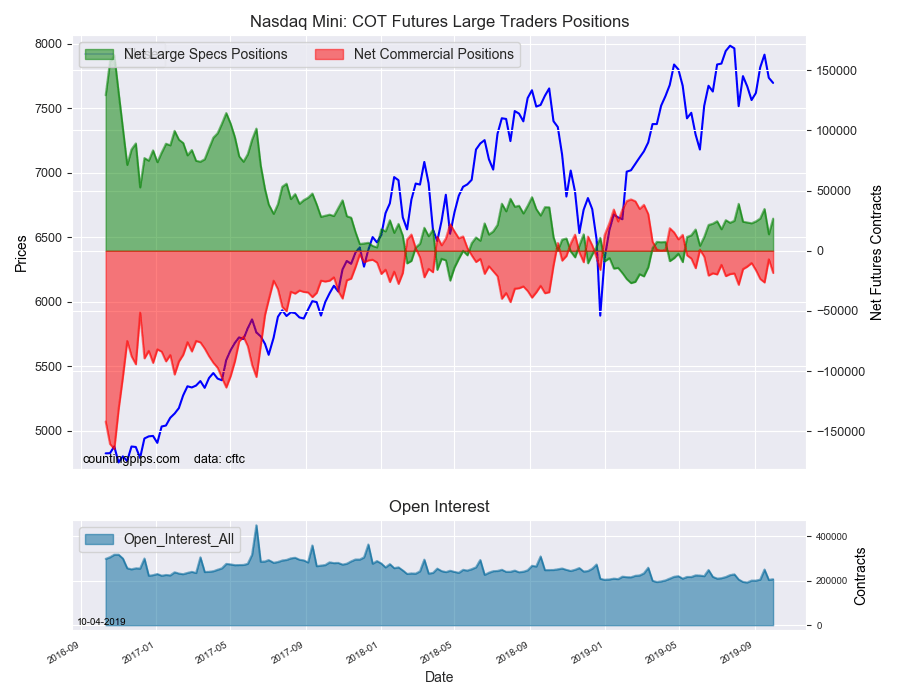
Large stock market speculators increased their bullish net positions in the Nasdaq Mini futures markets last week, according to the latest Commitment of Traders (COT) data released by the Commodity Futures Trading Commission (CFTC) on Friday.

The non-commercial futures contracts of Nasdaq Mini futures, traded by large speculators and hedge funds, totaled a net position of 26,772 contracts in the data reported through Tuesday October 1st. This was a weekly change of 12,993 net contracts from the previous week which had a total of 13,779 net contracts.

The week’s net position was the result of the gross bullish position (longs) advancing by 5,311 contracts (to a weekly total of 75,051 contracts) while the gross bearish position (shorts) fell by -7,682 contracts for the week (to a total of 48,279 contracts).

Nasdaq mini speculators sharply boosted their bets by the most in eight weeks last week following a sharp decrease (-21,014 contracts) the week prior. The bullish position has risen for four out of the previous five weeks and the overall standing has now been in bullish territory for twenty-one straight weeks, dating back to May 14th.

Nasdaq Mini Commercial Positions:

The commercial traders position, hedgers or traders engaged in buying and selling for business purposes, totaled a net position of -18,366 contracts on the week. This was a weekly shortfall of -11,345 contracts from the total net of -7,021 contracts reported the previous week.

ONEQ ETF:

Over the same weekly reporting time-frame, from Tuesday to Tuesday, the ONEQ ETF, which tracks the price of Nasdaq Index, closed at approximately $7695.5 which was a drop of $-39.75 from the previous close of $7735.25, according to unofficial market data.

*COT Report: The COT data, released weekly to the public each Friday, is updated through the most recent Tuesday (data is 3 days old) and shows a quick view of how large speculators or non-commercials (for-profit traders) as well as the commercial traders (hedgers & traders for business purposes) were positioned in the futures markets.

The CFTC categorizes trader positions according to commercial hedgers (traders who use futures contracts for hedging as part of the business), non-commercials (large traders who speculate to realize trading profits) and nonreportable traders (usually small traders/speculators).

Find CFTC criteria here: (http://www.cftc.gov/MarketReports/CommitmentsofTraders/ExplanatoryNotes/index.htm).

Article By CountingPips.comReceive our weekly COT Reports by Email

US Treasury Bond Speculators increased bearish bets for 2nd week

October 8th – By CountingPips.comReceive our weekly COT Reports by Email

US Treasury Bond Non-Commercial Speculator Positions:

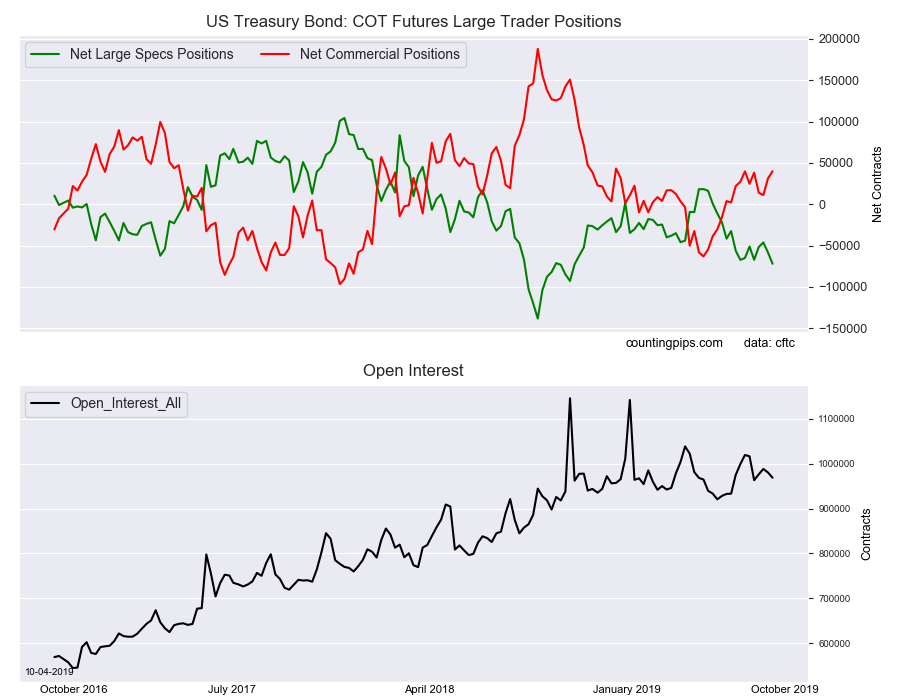
Large bond speculators added to their bearish net positions in the US Treasury Bond futures markets last week, according to the latest Commitment of Traders (COT) data released by the Commodity Futures Trading Commission (CFTC) on Friday.

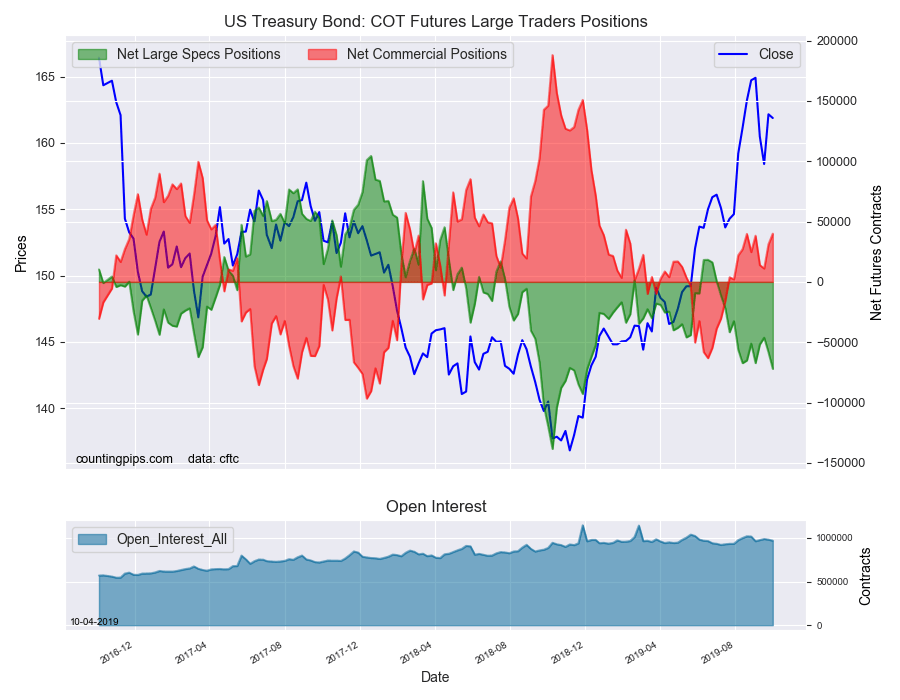
The non-commercial futures contracts of US Treasury Bond futures, traded by large speculators and hedge funds, totaled a net position of -72,037 contracts in the data reported through Tuesday October 1st. This was a weekly change of -13,723 net contracts from the previous week which had a total of -58,314 net contracts.

The week’s net position was the result of the gross bullish position (longs) sliding by -4,916 contracts (to a weekly total of 120,784 contracts) while the gross bearish position (shorts) rose by 8,807 contracts for the week (to a total of 192,821 contracts).

US Long Bond Speculators added to their bearish bets for the second straight week and pushed the overall net level to the most bearish standing of the year. The net position had been in bullish territory as recent as July 2nd but speculator sentiment has deteriorated since then. The current speculative level is now at the most bearish point since December 4th of 2018.

US Treasury Bond Commercial Positions:

The commercial traders position, hedgers or traders engaged in buying and selling for business purposes, totaled a net position of 39,948 contracts on the week. This was a weekly gain of 8,807 contracts from the total net of 31,141 contracts reported the previous week.

US Treasury Bond Futures:

Over the same weekly reporting time-frame, from Tuesday to Tuesday, the US Treasury Bond Futures (Front Month) closed at approximately $161.87 which was a fall of $-0.28 from the previous close of $162.15, according to unofficial market data.

*COT Report: The COT data, released weekly to the public each Friday, is updated through the most recent Tuesday (data is 3 days old) and shows a quick view of how large speculators or non-commercials (for-profit traders) as well as the commercial traders (hedgers & traders for business purposes) were positioned in the futures markets.

The CFTC categorizes trader positions according to commercial hedgers (traders who use futures contracts for hedging as part of the business), non-commercials (large traders who speculate to realize trading profits) and nonreportable traders (usually small traders/speculators).

Find CFTC criteria here: (http://www.cftc.gov/MarketReports/CommitmentsofTraders/ExplanatoryNotes/index.htm).

Article By CountingPips.comReceive our weekly COT Reports by Email

GBPUSD Analysis: UK house prices decline bearish for GBPUSD

By IFCMarkets

UK house prices decline bearish for GBPUSD

Halifax Bank of Scotland house price index declined in September when a gain was expected. Will the GBPUSD decline?

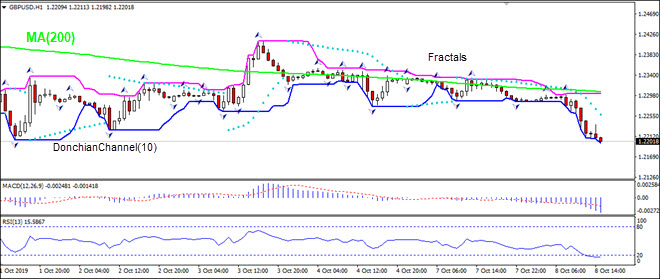
GBPUSD falling below MA(200)

The price chart on 1-hour timeframe shows GBPUSD: H1 is trading sideways. The price is below the 200-period moving average MA(200) which is falling. And the RSI is in the oversold zone which is bullish. There is no trend yet formed, traders have to decide when it would be a best time to enter the market.

Market Analysis provided by IFCMarkets

Technical Analysis Methods For Trend Trading

By Orbex

Trends are defined by a strong motive action in price.

In such markets, price tends to maintain the momentum and the prevailing trend. Trading the trending FX markets is of course widely preferred over other methods such as range forex trading or breakout forex trading.

Depending on the type of asset class you are looking at, the trends may vary. Generally, trends are more pronounced in commodities.

One of the reasons behind this is the asset class itself. For example, natural gas, grains and so on depend on seasonality.

There are times when there is an increased demand for commodities and times when demand falls.

Depending on the seasonal factors, trends are clearly established. In the forex markets, one can also find currency pair trends that tend to span a considerable period of time, depending on economic and other factors.

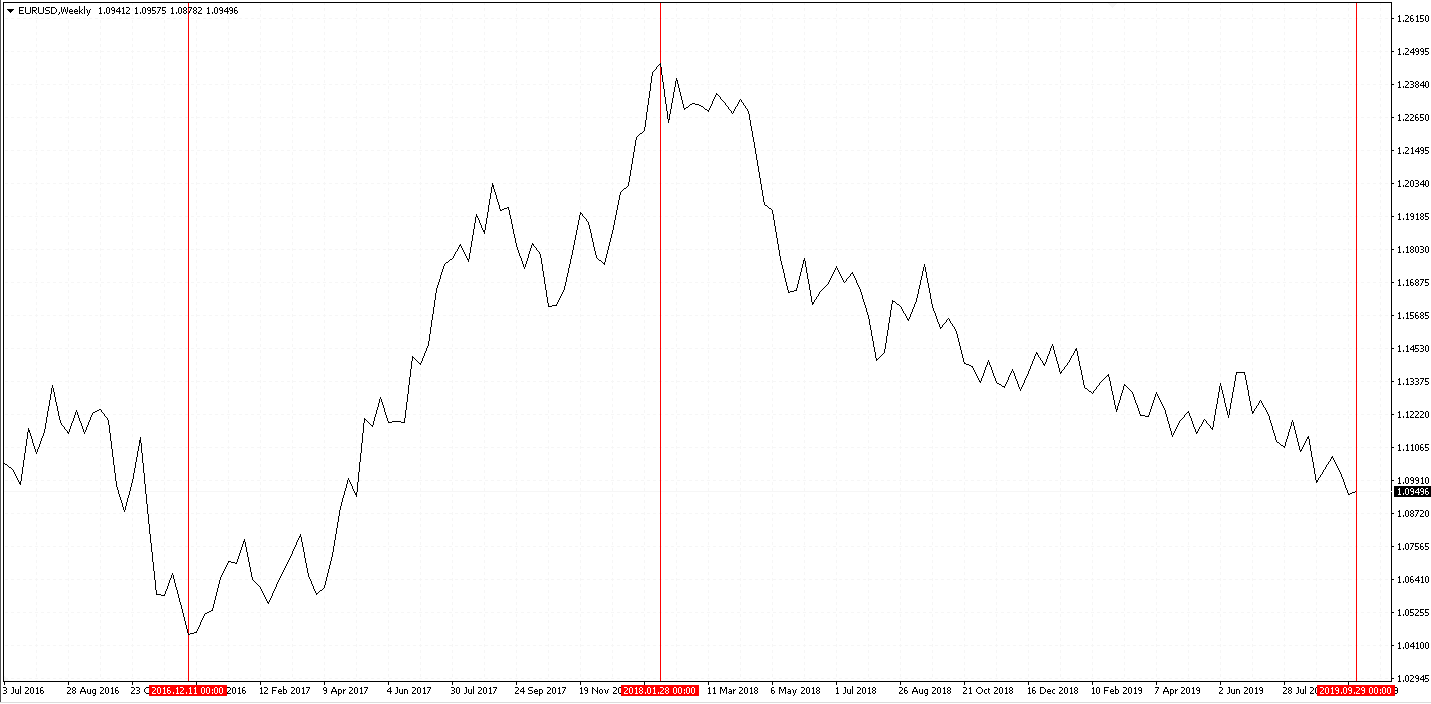
For example, the EURUSD was in a clear uptrend for the periods of December 2016 through late January 2018.

Likewise, the currency pair has been in a descent since January 2018. When such trends are established, forex traders can take advantage of the momentum and position themselves on the right side of the market.

EURUSD Trends

 Ways to Use Technical Analysis to Trade Trends

As an FX trader, you can trade the markets using different methods of technical analysis.

Here are some useful methods of trading trending markets using technical analysis.

1. The HiLo Method

Trends, as you know, tend to correct themselves. This can lead to different segments of trends. For example, the monthly trend might be up, but a 4-hour chart can show a downtrend. This is nothing but a correction to the major uptrend.

The HiLo method can tell forex traders when a trend could end on a specific timeframe, or at least when a trend could weaken to a correction level. For example, when a recent price level is penetrated downwards on the 4-hour chart, this can be an indication of uptrend exhaustion. The end of the trend would be validated only if the daily chart signaled an identical pattern.

Using the HiLo method, FX traders are able to identify potential levels where prices are likely to correct to or reverse from and continue with the major trend.

This is nothing but trading swing highs and swing lows that move along with the trend.

With the HiLo (High Low) method, forex traders usually keep an eye on the second swing high or low, as usually the first gives in to take-profit pressures.

2. Using Trend Lines

Using price action methods such as trend lines, traders can anticipate the potential test of the trend line. Of course, price might not always respect the trend line, but it gives an estimate of the price levels to which a security may fall.

Using trend lines, one can also chart potential swing highs and lows. Or vice versa.

Draw trendlines by connecting two highs or lows with a diagonal line. The breakout or rejection at the trendline can be used to confirm the resumption of the trend or invalidate it.

3. Technical Indicators (Divergence)

While there are many technical indicators one can use, the oscillator divergence is one of the best.

Divergence is when two data sets fail to move in tandem. In trading parlance, when price is making a higher high, the oscillator is also expected to behave similarly.

But when there is a divergence between price and oscillator, it can point to potential corrections in price.

Using divergence as a tool (and possibly combining it with the retracement method), forex traders can anticipate where potential trend corrections could end.

This allows FX traders to find the best turning points in price and help to enter the trend.

What is the Goal of Trend Trading Anyway?

While trend forex trading might seem as simple as trading in the direction of the trend, that is just a blanket term.

The main gold of trend trading is to firstly identify the trend (which has already been established) and to find the turning points in the trend.

This allows FX traders to find the best possible price entry points into riding the trends.

Using one of the different ways outlined, forex traders are able to build their own trading systems for trading the trending markets.

By Orbex


Turkey To Invade Syria As US Withdraws

By Orbex

Trump Abandons Kurds in Syria

President Trump has signaled a major shift in US foreign policy this week, paving the way for a Turkish military operation in Syria.

The announcement comes amidst a sudden withdrawal of US troops from the Turkish-Syrian border.

US and Turkish troops had been working together along the border to maintain separation between warring Turkish and Kurdish factions.

Turkish Forces Poised to Move

With the US pulling out of the area, Turkish forces are reportedly gathering near the border ready for an impending invasion.

The “safe zone” patrols carried about by US and Turkish troops ran into trouble as Turkey stated its plans to develop military posts further within Syria to return non-Kurdish Syrian refugees.

However, these plans recovered immediate opposition from the Syrian Democratic Forces, which are Kurdish-led.

Trump Criticized

Turkey has criticized the US over its support for Kurdish-led fighters in Syria. This is because Turkey considers the Kurds to be a terrorist group.

However, the Kurdish-led SDF has been a key ally of the US in fighting the Islamic State in Syria.

Even Trump’s own military advisers have recommended maintaining a troop presence in north-east Syria to continue fighting IS.

US Will Not Support Turkish Operation

According to reports, President Erdogan of Turkey and Donald Trump spoke over the weekend.

Erdogan informed Trump of his plans to move ahead with invading Syria.

The White House issued a statement this week saying:

“Turkey will soon be moving forward with its long-planned operation into northern Syria. The United States Armed Forces will not support or be involved in the operation, and United States forces, having defeated the ISIS territorial ‘Caliphate,’ will no longer be in the immediate area.”

Trump Follows Through on Withdrawal Calls

The US withdrawal from the region comes after Trump first called for a complete US military withdrawal in December last year.

However, in the face of a severe reaction from the Pentagon, as well as across the political spectrum, Trump reversed the call.

Erdogan Threatens International Community

Erdogan is calling for a “safe zone” to be established of 20 x 300 miles.

This would allow the Turkish army to return a million Syrian refugees who are currently in Turkey. The Turks have threatened the international community with sending the refugees to Europe if it does not back the initiative.

However, Turkey has come under immediate criticism for the move. Many Middle East analysts are saying this could prove to be incredibly destabilizing for the region.

Technical Perspective

TRY was down sharply in response to news of an imminent move deeper into Syria.

USDTRY continues to trade within the large contracting-triangle pattern which has framed price action over the year so far.

Recently, USDTRY has found support along the structural shelf around 5.6388 and is currently challenging local resistance at the 5.8374 level.

Above here, the next key level to watch is the 5.9765 zone with the bearish contracting-triangle trend line coming in just ahead. For now, focus remains on a further push higher with TRY likely to come under further pressure as operations begin.

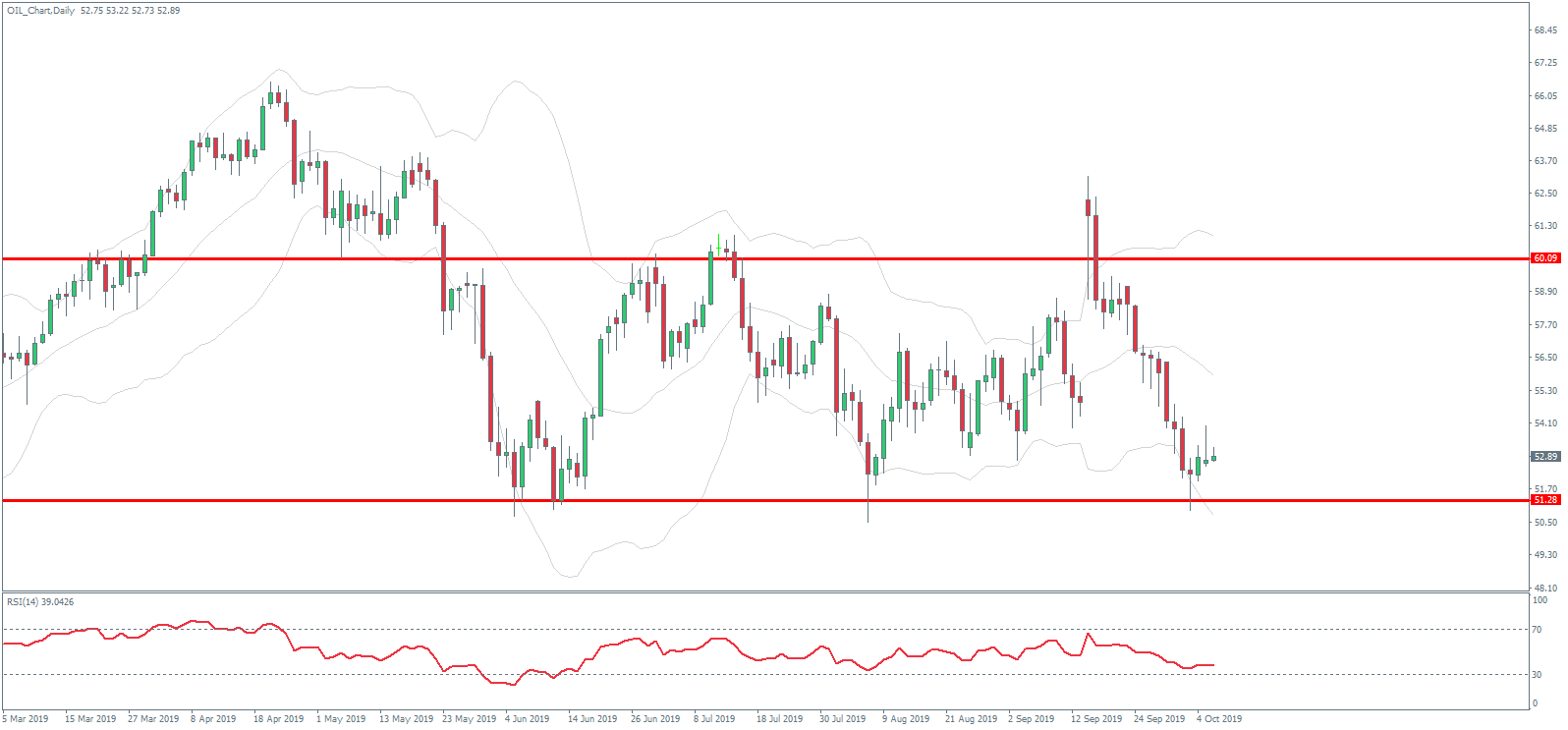
Traders should also keep an eye on crude prices as Turkey presses ahead with its planned operations. Any rise in tension in the Middle East typically translates into higher crude prices as the market anticipates supply disruptions.

Crude recently tested the 51.28 level support on the declines seen last week. This level is holding for now. But, it could see a further rotation higher within the range between 51.28 and resistance at the 60.09 level where price has mainly been contained over the last four months.

By Orbex