Making Sense Of Market Cycles And Technical Analysis

By Orbex

Everything is cyclical.

This isn’t a new observation – if we go back to ancient Greek philosophy, there was a consensus that the circle was the expression of perfection precisely because everything cycles.

Financial markets, as a reflection of the changes in how people value things, are cyclical as well.

Some asset classes are more likely to fall into cyclical patterns than others. Commodities and Forex especially are prone to cycle up and down, which makes understanding market cycles and knowing how to identify them, an essential aspect of long term forex trading profitability.

We measure some cycles in decades, while others are short enough to affect day trading.

But, they all follow a pattern and are one of the basic aspects of the forex markets upon which technical analysis is built. After all, predicting the future is about identifying patterns and projecting them forward.

So, what do we need to know about cycles?

Breaking Down the Wheel

We can identify market cycles, no matter the underlying asset, with four “steps” or parts to the cycle.

Because currencies tend to move up and down more than, for example, stocks, it’s usually easier to see the cycles. These are the four “phases” of a forex market cycle:

1: Accumulation

The cycle starts at the bottom, where valuations are the best. This is where the asset is “cheap”. Generally, people are reluctant to invest at this point, because the market has just come off a losing trend.

If we are talking about a longer term cycle, press reports will often be negative, with the media talking about the current recession.

This is when market insiders, innovators, and traders, with their ear to the ground, get involved. They swoop in to snap up the lower priced assets.

On a longer scale, for example, in forex, this might be buying undervalued commodity currencies. Because you can make money in both directions in Forex, a countercyclical trader might see sell options as undervalued during periods of market optimism.

2: Mark Up

The second phase is when people start to realize that the market is turning around, and there are opportunities.

This is when the average forex trader jumps on the bandwagon, trying to ride the upward trend. There are still good opportunities, but they run out as people rush into the market.

This portion of the market is characterized by bullish sentiment. In the short cycles, it might just be investor commentary. In longer cycles, you’ll see a lot of optimism in the press, about how the recession is finally over and it’s time to get into the market.

Trading volume goes up, and people jump in out of fear of being left out.

3: Distribution

With everyone jumping in to buy, eventually, all the buy money is put into the market. So, the dynamic between sellers and buyers balances out.

This is what we might call the “peak” of the market. We see the upward trend leveling off, while price action goes up and down. Traders who are late to the game can prop up the market for a while, maintaining the horizontal trend.

Generally, investor sentiment is high. Forex traders have made a lot of money and want to make more. The press will usually talk about how good the market is, focusing on success stories.

There will, however, be a minority of analysts and traders talking about an impending recession. But, typically, people ignore them.

4: Markdown

The trading cycle comes to an end when the number of sellers finally overwhelms the buyers. The market price then starts to fall.

Often it will fall faster than it rose, because many of the buyers refuse to sell out of misplaced optimism and fear of loss. Especially traders who are late to the cycle! They get stopped out, precipitating the market collapse.

Often, the media won’t notice the decline until it’s already happened. Official data for a recession doesn’t come out until the recession has fully taken hold.

In shorter cycles, such as those that happen over a period of days, many times the press won’t even notice.

Technicals

One of the most popular technical indicators for identifying and tracking these cycles are Elliott waves.

However, most indicators are either designed to track cycles (oscillators) or the ups and downs around cycles (trends). Trend forex traders are, in the end, just taking advantage of steps 2 and 4 of the cycle.

Whatever your preferred technical analysis method, it works by identifying at least a portion of the cycle. Shorter-term cycles are part of and drive longer-term cycles. Whether you are a short term or a long term forex trader, the market patterns are similar, even if some indicators are more convenient than others.

By Orbex


Gold Ends Lower On Trade Deal Optimism

By Orbex

Gold

Precious metals have had a very changeable week as a combination of factors have driven flows in both directions. Ultimately, price was contained within the ongoing 1481.93 – 1522.75 range which has framed price action over the last five to six weeks.

The FOMC minutes helped underpin gold as, despite the division among policymakers, the fed cited a concerned outlook for the US economy. While some members voted against a rate cut, others were in favour of a larger rate cut. With many in the fed noting that recessionary risks in the US have increased notably over recent months.

Looking ahead, the outlook remains subdued given the downturn in global growth and ongoing trade tensions with China. The market is pricing in one further rate cut this year most likely in December. Though the prospect of an October rate cut is now receiving greater attention. USD was down heavily in response to the minutes release which helped buoy gold prices.

News of the US army withdrawing from the Turkish/Syrian border has also prompted concerns for stability in the region. Turkey is invading Syria to establish a safe zone in which it can re-settle around one million Syrian refugees. However, the move has been opposed by the SDF and the risk of military conflict is rising.

The 13th round of trade talks being held this week got underway yesterday amidst a backdrop of cautious optimism from traders. The market is hopeful that the two sides will be able to agree to a partial trade deal which can act as a stepping-stone towards a fuller deal down the line.

The first day of talks concluded without a deal being agreed, though Trump told reporters “We had a very, very good negotiation with China”. Chinese Vice Premier Liu He told reporters that “The Chinese side came with great sincerity, willing to cooperate with the US on the trade balance, market access, and investor protection”.

Technical Perspective

Gold prices remained capped by the upper line of the falling wedge pattern which has framed the recent consolidation near highs. For now, a further push to the upside is still in the outlook.

However, If we break below the 1433.24 level, the 1392.28 level is the next support zone to watch.

Silver

Silver prices have broken free of their typical correlation with gold prices this week.

Prices traded higher over the week, after recovering from initial lows. A weaker USD has been helpful for Silver. It has also benefitted from optimism around ongoing US /China trade negotiations.

Silver stands to gain from a trade deal (albeit a partial one) given its frequent industrial usage. This often sees it deriving support from upward moves in equities, particularly industrial indexes.

Technical Perspective

Silver prices continue to range between the 17.3408 support and resistance at the 18.6397 level. Silver prices remain capped by the upper trend line of the bull flag pattern which has formed on the pullback from recent highs. While above 17.3408, the focus remains on a further move higher.

However, If prices break down below the current support, the next major support level is down at 16.2130 which also holds the retest of the broken long term bearish trend line. To the topside, the 18.6397 level remains the key marker to break.

By Orbex


The Concern for the Secretive Bio-Geopolitics

By Dan Steinbock  

Recently, many countries in Asia have suffered from deadly and costly epidemics. While globalization and climate change may play a causal role, germ geopolitics cannot be excluded any longer.

Entomological, anti-animal and crop-based diseases typically occur for natural reasons. All three have also be aggravated by globalization and climate change. However, evidence suggests that some of these outbreaks may also involve prior deployment in “biological programs” and “research.”

Take anthrax, for instance. Despite the post-9/11 concerns, the bacteria continue to be “researched.” In May 2015, Pentagon confirmed that its lab in Utah had “inadvertently” sent live anthrax samples to one of its military bases in South Korea. Last April, civic groups and residents took to the street to protest against biological agent experiments, which the US was reportedly conducting at Busan’s Port Pier 8. Pentagon’s budget estimates suggest the project was ongoing with funds set aside for live agent tests.

These issues remain sensitive in East Asia, in light of the US biowarfare against North Koreans and Chinese in the 1950s and contemporary geopolitics. Biological agents have dual-use functions. Like new technologies, they can save but also incapacitate and destroy human lives.

Asian Swine Fever: Epidemics Vs Geopolitics

Asian swine fever (ASF) is a hemorrhagic fever of pigs with mortality rates close to 100 percent and major economic losses. Historically, the first ASF outbreak took place in Kenya in 1907 and the first outside Africa in Portugal in 1957. That’s the official story.

In reality, by the early ’50s, several viruses, including ASF, were available in Fort Terry, a US bio-warfare facility in Plum Island, New York. Between the 1960s and late ‘90s, Cuba accused Washington of ten biological warfare attacks following serious infectious disease outbreaks. None were proven conclusively, but several most likely occurred. In 1971, pigs in Havana hog farm were diagnosed with ASF virus, which caused half a million pigs to be slaughtered. As Cuba suffered food shortage, the UN labeled the outbreak the “most alarming event” of 1971.

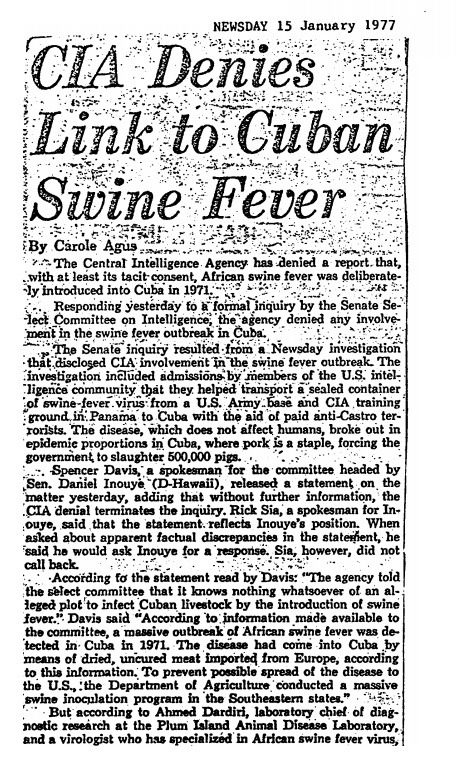
The debacle remained a mystery until 1977, when Long Island Newsday reported the virus was delivered from a US army base; the site of joint Army-CIA covert operations in the Panama Canal Zone. US Central Intelligence Agency (CIA) denied involvement. Yet, bio-warfare historian Norman Covert has affirmed CIA had access to the laboratories.

“CIA Denies Link to Cuban Swine Fever”

Following the Cold War, the ASF threat seemed to have been defused. But as a series of “color revolutions” took off in Eastern Europe – in countries targeted for NATO enlargement – the ASF in 2007 spread to Georgia in the Caucasus and thereafter widely to neighboring countries, including Armenia, Azerbaijan and several territories in Russia.

After a decade of relative quiet, the first ASF outbreak in China was reported in Shenyang in August 2018. It was thought to have come to China via Russia or Eastern Europe; that is, through the “color revolutions” countries.

The timing is intriguing. In China, the spread of ASF began with the US trade war after mid-2018. As a result, US pork sales to China were over three times pricier already last spring than a year before, despite the US retaliatory tariffs. China’s over 400 million pigs account for half of the world total. The ASF is a major threat to global food security.

US Trade War, China’s ASF Epidemic, Soaring Import Prices

China’s Breeding Saw Population, 2016-19

Source: FAO (UN), USDA (US), MARA (China)

Ethnic Bio-Bombs, Non-Endemic Outbreaks   

After the Cold War, the Nunn-Lugar Cooperative Threat Reduction Program (CTRP) was created presumably to keep the former Soviet Union’s nuclear and chemical infrastructure from rogue nations and terrorists. But as Congress in 1996 began to expand the program internationally, so did efforts to capitalize on its offensive uses.

In particular, the neoconservative Project for New American Century (PNAC), the ideological force behind the subsequent Bush administration’s foreign policy, declared in its manifesto Rebuilding America’s Defenses (2000) that “advanced forms of biological warfare that can ‘target’ specific genotypes may transform biological warfare from the realm of terror to a politically useful tool.”

Previously, such efforts at biological “ethnic bombs” had occurred mainly in apartheid-era South Africa and Rhodesia; the PNAC builds on the Israeli “ethno-bomb” idea to target specific genetic traits among target populations.

By May 2007, Russia banned all exports of human bio samples, due to concern for “genetic bio-weapons” targeting Russian population. Reportedly, some of these institutions, including Harvard Public Health and USAID, have collected biological material in China as well. In October 2018, Russian Defense Ministry claimed the spread of viral diseases from Georgia, including African swine fever since 2007, could be connected to a US lab network in the area, where more than 70 Georgians had died in odd conditions.

The lab network, a branch of the Nunn-Lugar bio-initiative, belongs to the multimillion-dollar Cooperative Biological Engagement Program (CBEP) funded by Pentagon’s Cooperative Threat Reduction Agency (DTRA). The CBEP labs are located in 25 countries, including in Eastern Europe (e.g., Georgia and Ukraine), the Middle East, Africa and Southeast Asia. In several locations, there have been reported outbreaks of tropical diseases, which are not endemic to the area.

Despite high-level Russian calls for a “comprehensive evaluation” and “joint inspections,” pleas for multilateral cooperation have been ignored. In its 2020 multimillion-dollar budget, the DTRA characterizes the “bio-security” program in Asia as “the partner of choice in a region competing against Chinese influence.”

Pressing Need for Multipolar Cooperation

Even the discoverer of the devastating Lyme disease Willy Burdorfer participated in US bio-warfare, according to science bestseller Bitten (2019). That has triggered New Jersey Rep. Chris Smith’s investigation into whether Pentagon has experimented with tics and other insects as biological weapons.

International concern is rising over the role of potential covert goals in viral outbreaks. By September, the Fall armyworm, a pest that can damage a wide variety of crops, had spread to 25 Chinese provinces posing a severe threat to food security. Described first in 1797, it used to be endemic only to Americas. After the Trump 2016 win, it has globalized faster than Facebook. Only crisis measures permitted China to contain the threat “for this year.”

A new Pentagon program called “Insect Allies” funded by the Defense Advanced Research Projects Agency (DARPA) relies on gene editing and hopes to infect insects with modified viruses, presumably to make US crops more resilient. In contrast, international scientists suggest such programs do not represent agricultural research but new bio-weapon programs, which violate the Biological Weapons Convention.

During the Cold War, the threat of the mutually assured destruction constrained nuclear and bio-warfare risks, however. The contemporary era is devoid of such constraints and thus far more dangerous. The most effective way to resolve the contested bio-warfare challenges would be to build on international multilateral biological arms control, particularly the 1925 Geneva Protocol, the 1972 Biological and Toxin Weapons Convention (BWC) and the 1993 Chemical Weapons Convention (CWC).

With rising climate risks and geopolitical tensions, no single country should have monopoly over biological agents in the 21st century. What’s desperately needed is multipolar cooperation among the major advanced economies and large emerging powers.

About the Author:

Dr. Dan Steinbock is the founder of Difference Group and has served at the India, China and America Institute (US), Shanghai Institute for International Studies (China) and the EU Center (Singapore). For more, see http://www.differencegroup.net/  

A shorter version of the commentary was released by China-US Focus on October 10, 2019


Forex Technical Analysis & Forecast 11.10.2019 (EURUSD, GBPUSD, USDCHF, USDJPY, AUDUSD, USDRUB, USDCAD, GOLD, BRENT, BTCUSD)

Article By RoboForex.com

EURUSD, “Euro vs US Dollar”

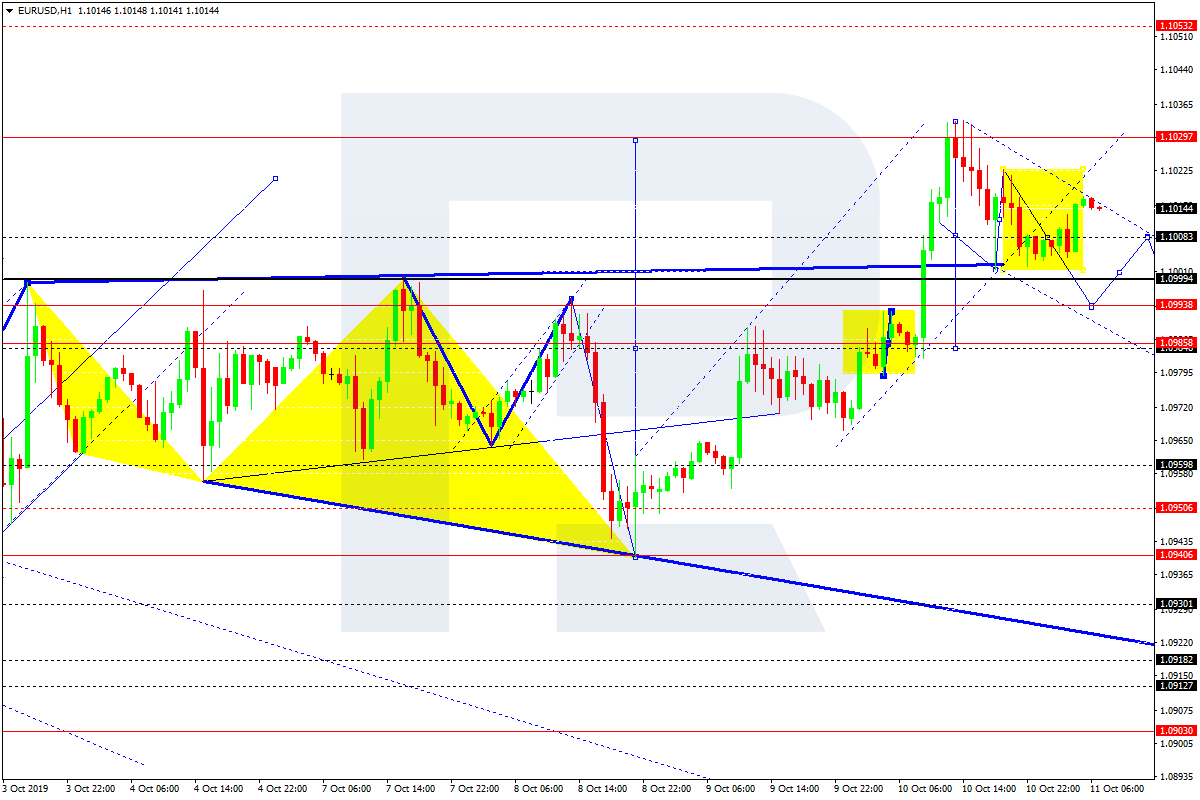
After forming the consolidation range around 1.0985 and breaking it upwards, EURUSD has completed the descending impulse from 1.1031 along with the correction. Possibly, today the pair may form the second impulse to reach 1.0944 and then start another correction towards 1.1088. Later, the market may resume trading downwards with the target at 1.0985.

EURUSD
Risk Warning: the result of previous trading operations do not guarantee the same results in the future

GBPUSD, “Great Britain Pound vs US Dollar”

GBPUSD is moving upwards. Possibly, the pair may a new wave to the upside to reach 1.2551 and then start another decline towards 1.2382. After that, the instrument may resume trading upwards with the target at 1.2565.

GBPUSD
Risk Warning: the result of previous trading operations do not guarantee the same results in the future

USDCHF, “US Dollar vs Swiss Franc”

USDCHF is moving upwards. Today, the pair may reach 0.9981 and then form a new descending structure 0.9976. After that, the instrument may continue trading upwards with the target at 1.0014.

USDCHF
Risk Warning: the result of previous trading operations do not guarantee the same results in the future

USDJPY, “US Dollar vs Japanese Yen”

USDJPY is moving upwards as well; it has broken 107.70 and right now is forming a continuation pattern. Possibly, today the pair may grow to reach 108.34 and then fall to return to 107.70. Later, the market may form one more ascending structure with the target at 108.87.

USDJPY
Risk Warning: the result of previous trading operations do not guarantee the same results in the future

AUDUSD, “Australian Dollar vs US Dollar”

AUDUSD has completed the ascending wave at 0.6780; the structure of the fifth wave implies further growth towards 0.6793. Later, the market may start a new correction to the downside with the target at 0.6725.

AUDUSD
Risk Warning: the result of previous trading operations do not guarantee the same results in the future

USDRUB, “US Dollar vs Russian Ruble”

USDRUB is falling towards 64.30. Possibly, today the pair may reach this level and then resume trading upwards with the target at 64.82. Later, the market may start another decline to reach 64.10.

USDRUB
Risk Warning: the result of previous trading operations do not guarantee the same results in the future

USDCAD, “US Dollar vs Canadian Dollar”

After breaking the consolidation range to the downside, USDCAD has fallen towards 1.3273. Today, the pair may start another correction to reach 1.3309 and then form a new descending structure towards with the target at 1.3289.

USDCAD
Risk Warning: the result of previous trading operations do not guarantee the same results in the future

XAUUSD, “Gold vs US Dollar”

After breaking 1501.60 to the downside, Gold has reached 1492.30; right now. it is consolidating around 1494.50. According to the main scenario, the price is expected to form one more ascending structure to return to 1501.60 to test it test below and then resume trading inside the downtrend with the first target at 1486.60.

GOLD
Risk Warning: the result of previous trading operations do not guarantee the same results in the future

BRENT

Brent is moving upwards. Possibly, today the pair may reach 60.33 and then consolidate around it. After breaking this range to the upside, the instrument may resume trading upwards with the predicted target at 63.63.

BRENT
Risk Warning: the result of previous trading operations do not guarantee the same results in the future

BTCUSD, “Bitcoin vs US Dollar”

BTCUSD is growing towards 8700.00. Today, the pair may reach this level and then start a new decline with the target at 8400.00. Later, the market may form one more ascending structure towards 9000.00.

BITCOIN

Article By RoboForex.com

Attention!
Forecasts presented in this section only reflect the author’s private opinion and should not be considered as guidance for trading. RoboForex LP bears no responsibility for trading results based on trading recommendations described in these analytical reviews.

Trade Deal Hopes Boost Risk Sentiment

By Orbex

Flat CPI Weighs on USD

The US dollar has been a little lower over the final European morning of the week. US CPI data released yesterday saw a 0% change month on month at 1.7% on the headline reading.

This, on the back of a dovish set of FOMC minutes, is boosting expectations of an October rate cut. USD index trades 98.28 last, testing the 98.30 support.

EUR Higher on Weak USD

EURUSD has been firmer against USD today in the wake of the continued selloff in the greenback. EUR has been supported over the second half of the week by the release of the ECB meeting minutes which highlighted the extent of the division within the ECB.

This has put the prospect of further ECB easing in doubt. EURUSD trades 1.1017 last, testing the 1.1025 level once again.

GBP Rises on Brexit Deal Hopes

GBPUSD has been firmly higher this morning. Weakness in USD, as well as increased optimism over the prospect of a Brexit deal, is helping boost GBP.

Positive commentary on the back of the meeting between Johnson and Varadkar is keeping hopes of a deal alive. GBPUSD trades 1.2502 last, nearing the 1.2582 September highs.

Risk Rallies On Friday

Risk assets have been firmly higher today also with the market displaying optimism over US/China trade talks heading into the weekend.

The first day of talks concluded with Trump praising the progress made in the talks, adding more hope that an interim trade deal can be done. SPX500 trades 2968.08, pushing above last week’s highs.

Gold & JPY Lower

Safe havens have ended the week lower on Friday as a late-week surge in equities prices has seen diminished safe-haven inflow.

The market remains hopeful that the 13th round of US/China trade talks underway today can produce a deal. If so, this would keep safe havens pressured in the near term.

USDJPY trades 108.14 last. While XAUUSD trades 1496,90, back below the 1500 level.

Crude Surges on Trade Optimism

Oil prices have been higher today also as a result of optimism over the ongoing US/China trade talks. Hopes of a deal are helping offset concerns over the demand outlook in crude which has been weighing on prices recently. Crude trades 54.53 last, sitting well up off the 51. 22 level low. Yesterday, the EIA reported a further build in US crude stores, marking a fourth consecutive weekly rise.

CAD Boosted By Oil Rise

USDCAD has traded lower over the European morning on Friday as the combined backdrop of a weaker USD and stronger oil prices are helping boost CAD.

Positive commentary on the progression of current US/China trade talks is also boosting CAD. USDCAD trades 1.3272 last, sitting back well beneath the 1.33 level.

Aussie Higher on Trade Hopes

AUDUSD has ended the week on a positive note as trade deal optimism boost AUD back to 2-week highs at .6791 last. The potential for a gap higher at the open next week is high given the positive comments made after day one of the trade talks which are continuing today.

By Orbex


Fibonacci Retracements Analysis 11.10.2019 (BITCOIN, ETHEREUM)

Article By RoboForex.com

BTCUSD, “Bitcoin vs US Dollar”

As we can see in the H4 chart, after breaking the local high at 8530.70, the rising correction has reached 38.2% fibo. The next upside targets may be 50.0% and 61.8% fibo at 9075.00 and 9405.00 respectively. If the price breaks the low at 7675.00, BTCUSD will continue falling to reach the mid-term correctional target, 61.8% fibo at 7350.00.

BITCOIN
Risk Warning: the result of previous trading operations do not guarantee the same results in the future

In the H1 chart, the divergence made the pair start a new short-term pullback, which is getting close to 38.2% fibo at 8410.80. Later, this decline may continue towards 50.0% and 61.8% fibo at 8290.30 and 8167.50 respectively. The resistance is at 8809.00.

BTCUSD
Risk Warning: the result of previous trading operations do not guarantee the same results in the future

ETHUSD, “Ethereum vs. US Dollar”

As we can see in the H4 chart, the correctional uptrend has reached 61.8% fibo, which is the resistance of the long-term descending channel. In this case, the ETHUSD is expected to start a new decline. After breaking the low at 152.28, this decline may be heading towards 76.0% fibo at 148.60 and then the post-correctional extension area between 138.2% and 161.8% fibo at 140.40 and 125.85 respectively.

ETHUSD
Risk Warning: the result of previous trading operations do not guarantee the same results in the future

In the H1 chart, the divergence on MACD made the pair start a new short-term decline, which is getting close to 38.2% fibo at 186.00. Later, the decline may continue towards 50.0% and 61.8% fibo at 182.50 and 178.95 respectively. The resistance is at 197.37.

ETHEREUM

Article By RoboForex.com

Attention!
Forecasts presented in this section only reflect the author’s private opinion and should not be considered as guidance for trading. RoboForex LP bears no responsibility for trading results based on trading recommendations described in these analytical reviews.

Investors Expect US President and Chinese Vice Premier to Meet

by JustForex

The US dollar fell against a basket of major currencies. The dollar index (#DX) closed yesterday’s trading session in the negative zone (-0.41%). The sentiment of financial market participants worsened after a tweet by the US President. Donald Trump tweeted the following: “Big day of negotiations with China. They want to make a deal, but do I? I meet with the Vice Premier tomorrow at The White House.” So now investors are still following the negotiations between the US and China with even greater attention. It is not yet clear whether countries will conclude an agreement.

Yesterday, weak US economic data was also published. So, the core consumer price index rose only by 0.1% in September instead of 0.2%. In addition, mixed reports were released in the UK. Thus, GDP (y/y) grew by 1.1% instead of 0.9%, but GDP (m/m) decreased by 0.1%, although experts did not expect any changes. Manufacturing production declined by 0.7% in August instead of the expected growth by 0.1%. At the same time, demand for the British pound has grown significantly due to the prospects for a settlement of the Brexit process. Irish Prime Minister, Leo Varadkar, said a Brexit agreement could be concluded by the end of October that would allow the UK to leave the European Union step by step.

The “black gold” prices have been growing. Currently, futures for the WTI crude oil are testing the $54.55 mark per barrel.

Market Indicators

Yesterday, there was the bullish sentiment in the US stock markets: #SPY (+0.68%), #DIA (+0.60%), #QQQ (+0.77%).

The 10-year US government bonds yield increased significantly. At the moment, the indicator is at the level of 1.67-1.68%.

The Economic News Feed for 11.10.2019:
  • – Report on the labor market in Canada at 15:30 (GMT+3:00).

by JustForex

The Analytical Overview of the Main Currency Pairs on 2019.10.11

by JustForex

The EUR/USD currency pair

Technical indicators of the currency pair:
  • Prev Open: 1.09713
  • Open: 1.10053
  • % chg. over the last day: +0.36
  • Day’s range: 1.10043 – 1.10195
  • 52 wk range: 1.0884 – 1.1623

EUR/USD currency pair went up after a long consolidation. The trading tool has updated key extremes. EUR/USD quotes found resistance at around 1.10300. Round level 1.10000 is already a “mirror” support. Demand for risky assets grew amid hopes for an interim trade agreement between Washington and Beijing. We recommend that you keep track of current information on this issue. A trading instrument has the potential for further growth. Positions must be opened from key levels.

The Economic News Feed for 11.10.2019:

  • – Import and Export Price Indices (US) – 15:30 (GMT+3:00);
EUR/USD

Indicators signal the strength of buyers: the price has fixed above 50 MA and 100 MA.

The MACD histogram is in the positive zone, but below the signal line, which gives a weak signal to buy EUR/USD.

The Stochastic Oscillator has reachedthe overbought zone, the %K line crossed the %D line. There are no signals at the moment.

Trading recommendations
  • Support levels: 1.10000, 1.09700, 1.09450
  • Resistance levels: 1.10300, 1.10500

If the price consolidates above the resistance level of 1.10300, expect further growth toward 1.10500-1.10800.

Alternatively, the quotes could decrease toward 1.09800-1.09500.

The GBP/USD currency pair

Technical indicators of the currency pair:
  • Prev Open: 1.22094
  • Open: 1.24315
  • % chg. over the last day: +1.84
  • Day’s range: 1.24239 – 1.24668
  • 52 wk range: 1.1959 – 1.3385

Yesterday, we observed aggressive purchases on the GBP/USD currency pair. The demand for GBP has grown significantly. The quotes grew by more than230 points. The trading tool has updated key highs. On Thursday, Irish Prime Minister Leo Varadkar announced that a Brexit agreement could be concluded by the end of October that would allow the United Kingdom to leave the European Union in an orderly manner. At the moment, GBP/USD quotes are consolidating in the range 1.24100-1.24650. GBP can recover further. You should open positions from the key levels.

The Economic News Feed for 11.10.2019 is calm. Keep an eye out for the Brexit news.

GBP/USD

The price fixed above 50 MA and 100 MA, which signals the strength of buyers.

The MACD histogram is in the positive zone, but below the signal line, which gives a weak signal to buy GBP/USD.

The Stochastic Oscillator is in the neutral zone, the %K line crossed the %D line. There are no signals at the moment.

Trading recommendations
  • Support levels: 1.24100, 1.23500, 1.23200
  • Resistance levels: 1.24650, 1.25000

If the price consolidates above 1.24650, expect further growth toward 1.25000-1.25300.

Alternatively, the quotes could decrease toward 1.23700-1.23500.

The USD/CAD currency pair

Technical indicators of the currency pair:
  • Prev Open: 1.33303
  • Open: 1.32898
  • % chg. over the last day: -0.33
  • Day’s range: 1.32737 – 1.33000
  • 52 wk range: 1.2727 – 1.3664

The USD/CAD currency pair is dominated by bearish sentiment. The trading instrument has set new local lows. At the moment, USD/CAD quotes are testing the support level of 1.32700. Round level 1.33000 is already a “mirror” resistance. The Canadian dollar has the potential for further growth against the US dollar. Additional support for Looney is provided by the positive dynamics of oil quotes. Today, investors will evaluate the report on the labor market in Canada. We recommend opening positions from key levels.

The Economic News Feed for 11.10.2019:

  • – Economic Event (CAD) – 00:00 (GMT+3:00);
  • – Economic Event (CAD) – 00:00 (GMT+3:00);
  • – Economic Event (CAD) – 00:00 (GMT+3:00);
USD/CAD

Indicators pooint to the strength of sellers: the price has fixed below 100 MA.

The MACD histogram is in the negative zone and continues to decline, which signals a bearish sentiment.

The Stochastic Oscillator is in the neutral zone, the% K line is below the% D line, which also gives a signal to sell USD/CAD.

Trading recommendations
  • Support levels: 1.32700, 1.32500, 1.32350
  • Resistance levels: 1.33000, 1.33200, 1.33450

If the price consolidates below 1.32700, expect a further drop toward 1.32500-1.32300.

Alternatively, the quotes could grow toward 1.33200-1.33400.

The USD/JPY currency pair

Technical indicators of the currency pair:
  • Prev Open: 107.457
  • Open: 107.962
  • % chg. over the last day: +0.38
  • Day’s range: 107.850 – 108.130
  • 52 wk range: 104.97 – 114.56

On the USD/JPY currency pair, purchases prevail. The trading tool has updated local highs. Demand for the safe haven currencies has weakened amid the prospects for a trade ceasefire between the US and China, as well as the settlement of the Brexit process. At the moment, USD/JPY quotes are consolidating. The local support and resistance levels are: 107.750 and 108.100, respectively. A trading instrument has the potential for further growth. We recommend opening positions from key levels.

The Economic News Feed for 11.10.2019 is calm.

USD/JPY

The price fixed above 50 MA and 100 MA, which signals the strength of buyers.

The MACD histogram is in the positive zone, indicating bullish sentiment.

The Stochastic Oscillator is in the neutral zone, the %K line crossed the %D line. There are no signals at the moment.

Trading recommendations
  • Support levels: 107.750, 107.450, 107.100
  • Resistance levels: 108.100, 108.450

If the price consolidates above 108.100, expect further growth toward 108.400-108.600.

Alternatively, the quotes could decrease toward 107.450-107.200.

by JustForex

USD/JPY at the mercy of the US-Chinese trade dispute

By Admiral Markets

Source: Economic Events October 11, 2019 – Admiral Markets’ Forex Calendar

With the US Trade Talks to finish today, we want to take a look at the USD/JPY.

After tensions in the trade dispute between the US and China heated up again in the first half of this week, after news broke that the White House continues to consider capital control like limiting Chinese stocks in the US Government Fund or similar, the USD/JPY attacked the region around 106.80/107.00, but didn’t break lower, but instead stabilised over the last days.

Nevertheless, when looking at the daily chart, we feel vindicated in an overall bearish outlook for the currency pair, at least as long as the USDJPY trades below 108.50/109.00.

And even if we get to hear any positive signs of at least a partial trade deal with the US and China negotiating topics like intellectual property or Government subsidies in the upcoming months respectively in 2020, a rather sooner than later attempt to break below 106.80/107.00 in the days to come remains a serious option.

A big driver here could be from the comments made by Fed chairman last Tuesday at a speech in Denver, where Powell said that the FED will resume Asset Purchases to prevent a cash crunch and bringing QE4 officially on the table (even though (surprisingly) emphasizing that it is not a QE).

With that in mind, we consider another attempt to break back below 106.80/107.00 with a significant higher probability than USDJPY trying to break back above 108.50/109.00.

This is still and especially true if any signs of risk aversion start to materialise where a next wave of selling could result in USDJPY being pushed below 105.80 and trigger further selling, quickly activating the region around 105.00 again:

Source: Admiral Markets MT5 with MT5-SE Add-on USD/JPY Daily chart (between August 24, 2018, to October 10, 2019). Accessed: October 10, 2019, at 10:00pm GMTPlease note: Past performance is not a reliable indicator of future results, or future performance.

In 2014, the value of the USD/JPY increased by 13.7%, in 2015, it increased by 0.5%, in 2016, it fell by 2.8%, in 2017, it fell by 3.6%, in 2018, it fell by 2.7%, meaning that after five years, it was up by 4.1%.

Discover the world’s #1 multi-asset platform

Admiral Markets offers professional traders the ability to trade with a custom, upgraded version of MetaTrader 5, allowing you to experience trading at a significantly higher, more rewarding level. Experience benefits such as the addition of the Market Heat Map, so you can compare various currency pairs to see which ones might be lucrative investments, access real-time trading data, and so much more. Click the banner below to start your FREE download of MT5 Supreme Edition!

Download MetaTrader 5 and begin trading today!

Disclaimer: The given data provides additional information regarding all analysis, estimates, prognosis, forecasts or other similar assessments or information (hereinafter “Analysis”) published on the website of Admiral Markets. Before making any investment decisions please pay close attention to the following:

  1. This is a marketing communication. The analysis is published for informative purposes only and are in no way to be construed as investment advice or recommendation. It has not been prepared in accordance with legal requirements designed to promote the independence of investment research, and that it is not subject to any prohibition on dealing ahead of the dissemination of investment research.
  2. Any investment decision is made by each client alone whereas Admiral Markets shall not be responsible for any loss or damage arising from any such decision, whether or not based on the Analysis.
  3. Each of the Analysis is prepared by an independent analyst (Jens Klatt, Professional Trader and Analyst, hereinafter “Author”) based on the Author’s personal estimations.
  4. To ensure that the interests of the clients would be protected and objectivity of the Analysis would not be damaged Admiral Markets has established relevant internal procedures for prevention and management of conflicts of interest.
  5. Whilst every reasonable effort is taken to ensure that all sources of the Analysis are reliable and that all information is presented, as much as possible, in an understandable, timely, precise and complete manner, Admiral Markets does not guarantee the accuracy or completeness of any information contained within the Analysis. The presented figures refer that refer to any past performance is not a reliable indicator of future results.
  6. The contents of the Analysis should not be construed as an express or implied promise, guarantee or implication by Admiral Markets that the client shall profit from the strategies therein or that losses in connection therewith may or shall be limited.
  7. Any kind of previous or modeled performance of financial instruments indicated within the Publication should not be construed as an express or implied promise, guarantee or implication by Admiral Markets for any future performance. The value of the financial instrument may both increase and decrease and the preservation of the asset value is not guaranteed.
  8. The projections included in the Analysis may be subject to additional fees, taxes or other charges, depending on the subject of the Publication. The price list applicable to the services provided by Admiral Markets is publicly available from the website of Admiral Markets.
  9. Leveraged products (including contracts for difference) are speculative in nature and may result in losses or profit. Before you start trading, you should make sure that you understand all the risks.

By Admiral Markets

EURUSD: increased risk of returning to 1.0990

By Alpari.com

On Thursday the 10th of October, trading on the EURUSD pair closed up. The rate rose to 1.1034 during the European session. Demand from the dollar fell amid optimism among investors that a deal would be reached between the US and China. Markets are expecting an interim deal to be struck.

China’s Vice Premier Lui He said on Thursday that China is ready to make a deal with the US on matters that both sides care about in order to prevent the situation from escalating any further.

In the US session, the EURUSD pair came under pressure on account of the collapse on the EURGBP cross. The pair corrected from 1.1034 to 1.1002. Meanwhile, the pound surged by 250 pips, marking a 2% rise following renewed hope on the issue of Brexit. Irish Taoiseach Varadkar said that a Brexit deal is possible by the end of October that would see the UK undergo an orderly exit from the EU.

Day’s news (GMT+3):

  • 15:30 Canada: unemployment rate (Sep), net change in employment (Sep).
  • 15:30 US: import price index (Sep).
  • 17:00 US: Michigan consumer sentiment index (Oct).
  • 20:00 US: Baker Hughes US oil rig count.

EURUSD H1Current situation:

Today marks the end of the talks between the US and China. Macroeconomic data is therefore of secondary importance. Everyone except for traders using technical analysis is invested in the results of these talks. Nobody knows how they will end, but today we expect the bulls to cash in on their long positions. Buy on expectations, sell on the facts.

We expect the pair to visit 1.1028 followed by a decline to 1.0988. We’ve highlighted an imbalance zone between 1.0990 and 1.1005 according to yesterday’s volume profile. 1.1005 is the VAL (Value Area Low). It’s likely that if this level doesn’t hold up, the pair will quickly slip to 1.0990.

By Alpari.com