USDIDX Analysis: The US dollar has suffered on a backdrop of lower global risks

By IFCMarkets

The US dollar has suffered on a backdrop of lower global risks

Progress in US-China trade negotiations and Brexit conditions caused a weakening of the US dollar. Will the USDIDX index quotations continue falling?

The US dollar was previously viewed as a currency of refuge against the backdrop of global trade risks. Bloomberg said on Friday that negotiations between the US and China are very successful. US President Donald Trump said a deal with the PRC will not require Congressional approval. EU officials said they would continue to work with the UK to avoid a “rough” Brexit. Investors hope to sign an agreement before the country’s exit from the EU, scheduled for October 31, 2019. This helped strengthen the euro and the pound and lower the USDIDX. An additional negative for the dollar is the expectation of a Fed rate cut at the next meeting on October 30.

USDIDX

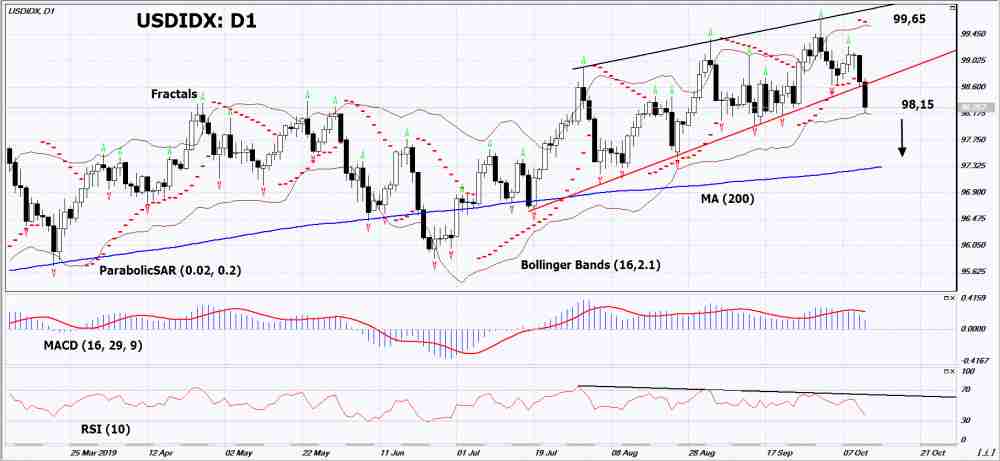
On the daily timeframe the USDIDX: D1 broke down the support line of the uptrend. Various technical analysis indicators formed a downtrend signal. Quotations reduction is possible in case of publication of negative data on the US economy.

  • The Parabolic indicator shows a signal to decrease.
  • The Bolinger bands widened, indicating high volatility. Both Bollinger Lines Slope Down.
  • The RSI indicator is below the 50 mark. It has formed a double divergence to fall.
  • The MACD indicator gives a bearish signal.

The bearish momentum may develop if USDIDX falls below its last low and the lower Bollinger line: 98.15. This level can be used as an entry point. The initial stop lose may be placed higher than the last upper fractal, the maximum since May 2017, the upper Bollinger line and the Parabolic signal: 99.65. After opening the pending order, the stop shall be moved following the Bollinger and Parabolic signals to the next fractal minimum. Thus, we are changing the potential profit/loss to the breakeven point. More risk-averse traders may switch to the 4-hour chart after the trade and place a stop loss moving it in the direction of the trade. If the price meets the stop level (99,65) without reaching the order (98,15), we recommend to cancel the order: the market sustains internal changes that were not taken into account.

Technical Analysis Summary

PositionSell
Sell stopBelow 98,15
Stop lossAbove 99,65

Market Analysis provided by IFCMarkets

EURUSD Analysis: German PPI slowing bearish for EURUSD

By IFCMarkets

German PPI slowing bearish for EURUSD

German producer price index decline was steeper than expected in September. Will the EURUSD decline?

EURUSD rising above MA(200)

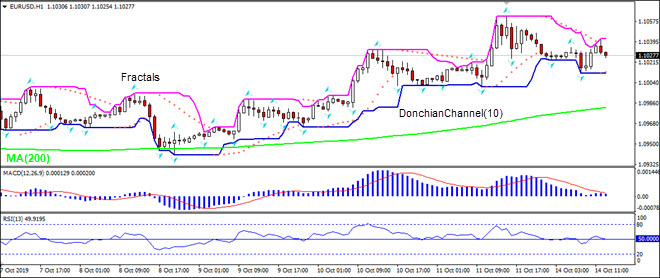
The price chart on 1-hour timeframe shows EURUSD: H1 is still trading sideways. The price is above the 200-period moving average MA(200) which is rising. And the RSI is at 50 level and has not reached the overbought zone. There is no trend yet formed, traders have to decide when it would be a best time to enter the market.

Market Analysis provided by IFCMarkets

Forex Technical Analysis & Forecast 14.10.2019 (EURUSD, GBPUSD, USDCHF, USDJPY, AUDUSD, USDRUB, USDCAD, GOLD, BRENT, BTCUSD)

Article By RoboForex.com

EURUSD, “Euro vs US Dollar”

After rebounding from 1.1000 and completing another ascending structure at 1.1062, EURUSD has finished one more descending impulse along with the correction; right now, it is forming the second descending impulse with the target at 1.0986. Later, the market may start a new growth to return to 1.1062.

EURUSD
Risk Warning: the result of previous trading operations do not guarantee the same results in the future

GBPUSD, “Great Britain Pound vs US Dollar”

GBPUSD has finished another ascending structure; right now, it is forming the descending impulse with the target at 1.2477, which may be considered as a correction. After that, the instrument may continue trading upwards with the target at 1.2704.

GBPUSD
Risk Warning: the result of previous trading operations do not guarantee the same results in the future

USDCHF, “US Dollar vs Swiss Franc”

USDCHF has another correctional structure to the downside to reach 0.9960. Possibly, today the pair may form another ascending wave to break 0.9982. After that, the instrument may continue trading upwards with the target at 1.0015.

USDCHF
Risk Warning: the result of previous trading operations do not guarantee the same results in the future

USDJPY, “US Dollar vs Japanese Yen”

USDJPY is forming the fifth ascending structure towards 108.87. Today, the pair may start a new correction to reach 107.82 and then resume trading towards 108.87 to complete this ascending wave. Later, the market may form a new descending structure with the first target at 106.50.

USDJPY
Risk Warning: the result of previous trading operations do not guarantee the same results in the future

AUDUSD, “Australian Dollar vs US Dollar”

AUDUSD has completed another ascending wave. Today, the pair may start a new correction to reach 0.6755 at least. Later, the market may form one more ascending structure with the target at 0.6840.

AUDUSD
Risk Warning: the result of previous trading operations do not guarantee the same results in the future

USDRUB, “US Dollar vs Russian Ruble”

USDRUB continues falling; it has formed a narrow consolidation range around 64.12. According to the main scenario, the price is expected to continue trading inside the downtrend with the predicted target at 63.00.

USDRUB
Risk Warning: the result of previous trading operations do not guarantee the same results in the future

USDCAD, “US Dollar vs Canadian Dollar”

USDCAD is still correcting. Possibly, today the pair may grow to reach 1.3257 and then form a new descending structure towards 1.3148. After that, the instrument may start another growth with the target at 1.3350.

USDCAD
Risk Warning: the result of previous trading operations do not guarantee the same results in the future

XAUUSD, “Gold vs US Dollar”

Gold has completed another descending wave at 1480.80; right now, it is consolidating around this level and this range may be considered as a downside continuation pattern. The predicted target is at 1459.33. An alternative scenario implies that the price may start a new correction towards 1495.36 and then resume trading inside the downtrend. The key target of this wave is at 1445.15.

GOLD
Risk Warning: the result of previous trading operations do not guarantee the same results in the future

BRENT

Brent is consolidating around 60.36. According to the main scenario, the price is expected to continue trading upwards with the predicted target at 62.70. After that, the instrument may start a new correction to reach 60.60 and then form one more ascending structure with the short-term target at 63.63.

BRENT
Risk Warning: the result of previous trading operations do not guarantee the same results in the future

BTCUSD, “Bitcoin vs US Dollar”

BTCUSD is correcting. Possibly, the pair may form a new descending structure towards 8060.00. Later, the market may start another growth to reach 8850.00 and then continue trading inside the downtrend with the target at 8000.00.

BITCOIN

Article By RoboForex.com

Attention!
Forecasts presented in this section only reflect the author’s private opinion and should not be considered as guidance for trading. RoboForex LP bears no responsibility for trading results based on trading recommendations described in these analytical reviews.

US-China Trade Headlines Bring Optimism To The Markets

By Orbex

The trade talks between the United States and China produced some positive headlines. This brought back optimism into the markets which have been flip-flopping in response to the developments.

President Donald Trump confirmed that there is a trade deal with China on Friday.

He stated that the deal will come in phases. Trump also said that the US was postponing the tariff increase due to come into effect next week.

Germany’s Final Inflation Unchanged

The final inflation report for Germany for September confirmed that consumer prices were unchanged on the month. This was consistent with the flash estimates from a few weeks ago. The stale inflation growth comes as the ECB restarted its QE program in September.

EURUSD Clears Resistance, More Upside Ahead?

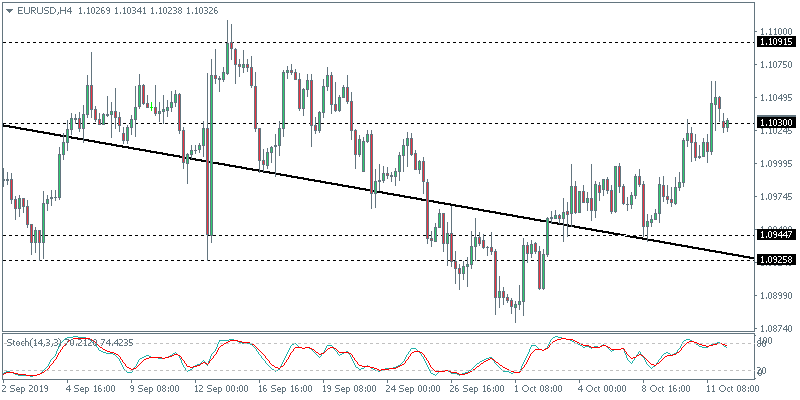
The currency pair managed to clear the 1.1030 level of resistance. Price action eased back but prices were promptly rejected. The gains, if maintained could see the common currency attempting to test the 1.1091 level. This marks the previous resistance level that has held. The downside opens up only if the EURUSD closes below 1.1030.

Brexit Talks Push Sterling Higher

The positive developments on the Brexit talk saw investors bidding the sterling higher. The GBP gained over 1.87% on Friday and marked the biggest two-day gain since December 2008.

The GBP rose following the joint statement from the UK and Irish prime ministers that a deal was possible. The UK is set to leave the EU on October 31st.

GBPUSD Likely to Maintain the Upside Momentum

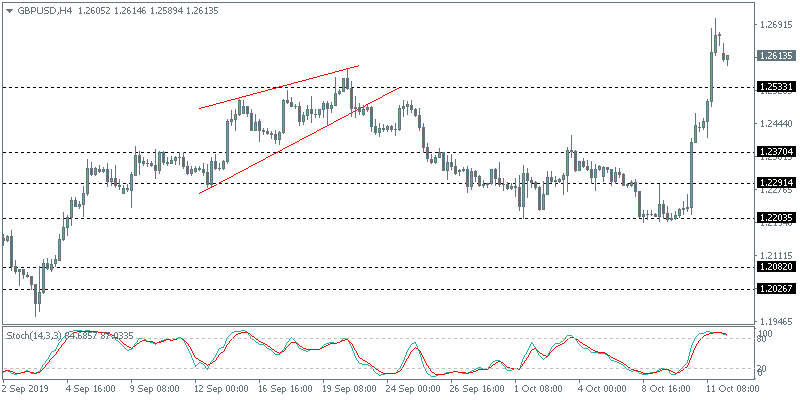
The currency pair broke out from its range, confirming the upside after breaking past the 1.2370 resistance. The strong momentum saw prices breaking past the 1.2533 level eventually by Friday’s close.

Any near term retracement will see this level of 1.2533 being tested. A retest of support at 1.2533 will see further gains for GBPUSD. The next main upside target is at 1.2740.

Crude Oil Rises After Attacks on Iranian Oil Tanker

Crude oil prices caught a bid on Friday. This came on reports of an attack on an Iranian oil tanker. The rockets that were fired were said to have come off the Saudi coast, once again raising the prospects of unrest in the Middle East. The gains come after crude oil prices turned flat over the past few sessions.

Can WTI Crude Oil Rise Higher?

After oil prices broke past the 53.55 level of resistance, there is potential for further upside. In the near term, any retracement will see the retest of 53.55 for support. As long as prices do not fall below this level, the upside bias remains.

Oil prices were trading within the range of 53.55 and 51.70. The upside breakout now opens the way for further gains. The next main target is at 57.50 where resistance holds.

By Orbex


Fibonacci Retracements Analysis 14.10.2019 (GOLD, USDCHF)

Article By RoboForex.com

XAUUSD, “Gold vs US Dollar”

As we can see in the H4 chart, the convergence made the pair complete the ascending impulse at 61.8% fibo. The current situation may be considered as an attempt to form a new wave to the downside and continue the descending tendency. To confirm this scenario, the price must break the low at 1459.06. in this case, the downside target will be 76.0% fibo at 1438.05. at the same time, one shouldn’t exclude the opposite scenario, according to which the pair may start a new rising impulse towards the local high. After breaking it, the instrument may continue growing to reach 76.0% fibo at 1533.40 and the key high at 1557.00.

GOLD_H4
Risk Warning: the result of previous trading operations do not guarantee the same results in the future

In the H1 chart, the correctional downtrend has reached 76.0% fibo. MACD indicator implies further decline towards 1459.06. The resistance is the high at 1519.57.

GOLD_H1
Risk Warning: the result of previous trading operations do not guarantee the same results in the future

USDCHF, “US Dollar vs Swiss Franc”

As we can see in the H4 chart, the divergence made the pair stop at 61.8% fibo and start a new correction. However, if the price breaks the high at 1.0028, the tendency may yet continue to reach 76.0% fibo at 1.0098. Still, the divergence indicates a new decline in the first place towards 38.2%, 50.0%, 61.8%, and 76.0% fibo at 0.9887, 0.9844, 0.9801, and 0.9748 respectively.

USDCHF_H4
Risk Warning: the result of previous trading operations do not guarantee the same results in the future

In the H1 chart, after completing the descending impulse, the pair corrected to the upside by 61.8%. However, if the price reaches 76.0% fibo at 0.9998, the instrument may continue growing to break the high at 1.0028. The support is at 0.9905.

USDCHF_H1

Article By RoboForex.com

Attention!
Forecasts presented in this section only reflect the author’s private opinion and should not be considered as guidance for trading. RoboForex LP bears no responsibility for trading results based on trading recommendations described in these analytical reviews.

US-China trade truce spurs risk appetite; cautious optimism still warranted

By Han Tan, Market Analyst, ForexTime

Asian stocks and currencies are gaining as risk-on sentiment courses through the markets following the US-China trade truce that was reached prior to the weekend. The increased risk appetite has dampened safe haven assets: Gold has shed about 1 percent to fall below $1490 since the trade truce was announced, the Japanese Yen is now trading above 108 against the US Dollar, while yields on 10-year US Treasuries have breached 1.70 percent for the first time since October 1. Japanese and US markets will be closed today for a holiday.

Investors are drawing relief from the US-China trade truce which staves off the immediate threat of a near-term escalation in trade tensions, given that the previously threatened US tariff hike on October 15 will be delayed. Even as investors welcome the prospects of a “very substantial phase one deal” being signed between the US and China next month, lessons learned since 2018 from watching the US-China trade conflict unfold will still guide investors’ near-term decisions. There remains the risk of markets being blindsided by a sudden spike in US-China trade tensions.

Until the deal is signed, and there’s enough compliance and follow-through that appease all stakeholders, investors can’t fully rule out the risk of another flare-up in US-China trade tensions. Such a risk warrants an air of caution among investors for the time being.

Pound breaches 1.27 versus US Dollar only to fall away, as doubts climb over Brexit deal

The latest rally in GBPUSD topped out at 1.27, around its 200-day moving average, before shedding about 0.9 percent to drop back below 1.26 at the time of writing. Investors’ initial optimism over the prospects of a Brexit deal have waned following reports that the chief EU Brexit negotiator, Michel Barnier, now deems the UK’s proposals as still inadequate.

The latest price action in the Pound reminds investors that Sterling’s gains are not guaranteed amid the lingering uncertainties surrounding Brexit. With less than three weeks remaining before the October 31 deadline, any Brexit deal must be approved by the EU leaders’ summit and the UK Parliament over the coming days. Should the Brexit deal overcome those political hurdles, GBPUSD is expected to carve a path towards 1.30, while the lower 1.20 range would come into focus if the Brexit deal hits yet another stone wall, be it in Brussels or Westminster.

Disclaimer: The content in this article comprises personal opinions and should not be construed as containing personal and/or other investment advice and/or an offer of and/or solicitation for any transactions in financial instruments and/or a guarantee and/or prediction of future performance. ForexTime (FXTM), its affiliates, agents, directors, officers or employees do not guarantee the accuracy, validity, timeliness or completeness, of any information or data made available and assume no liability as to any loss arising from any investment based on the same.


Forex-Time-LogoArticle by ForexTime

ForexTime Ltd (FXTM) is an award winning international online forex broker regulated by CySEC 185/12 www.forextime.com

Deal! Bullish fireworks in the DAX30 CFD, new yearly highs soon?

By Admiral Markets

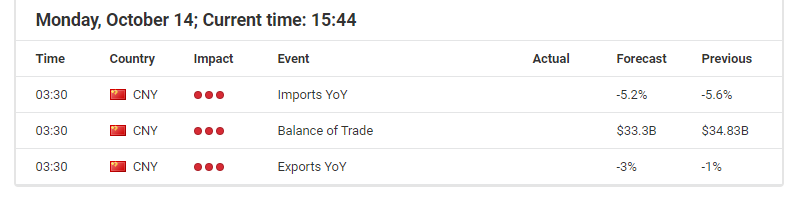
Source: Economic Events October 14, 2019 – Admiral Markets’ Forex Calendar

Friday’s developments in the US-Chinese trade talks resulted in the presentation of a partial trade deal between the US and China. This caused some heavy price action fireworks by happy DAX30 CFD bulls into the weekly close.

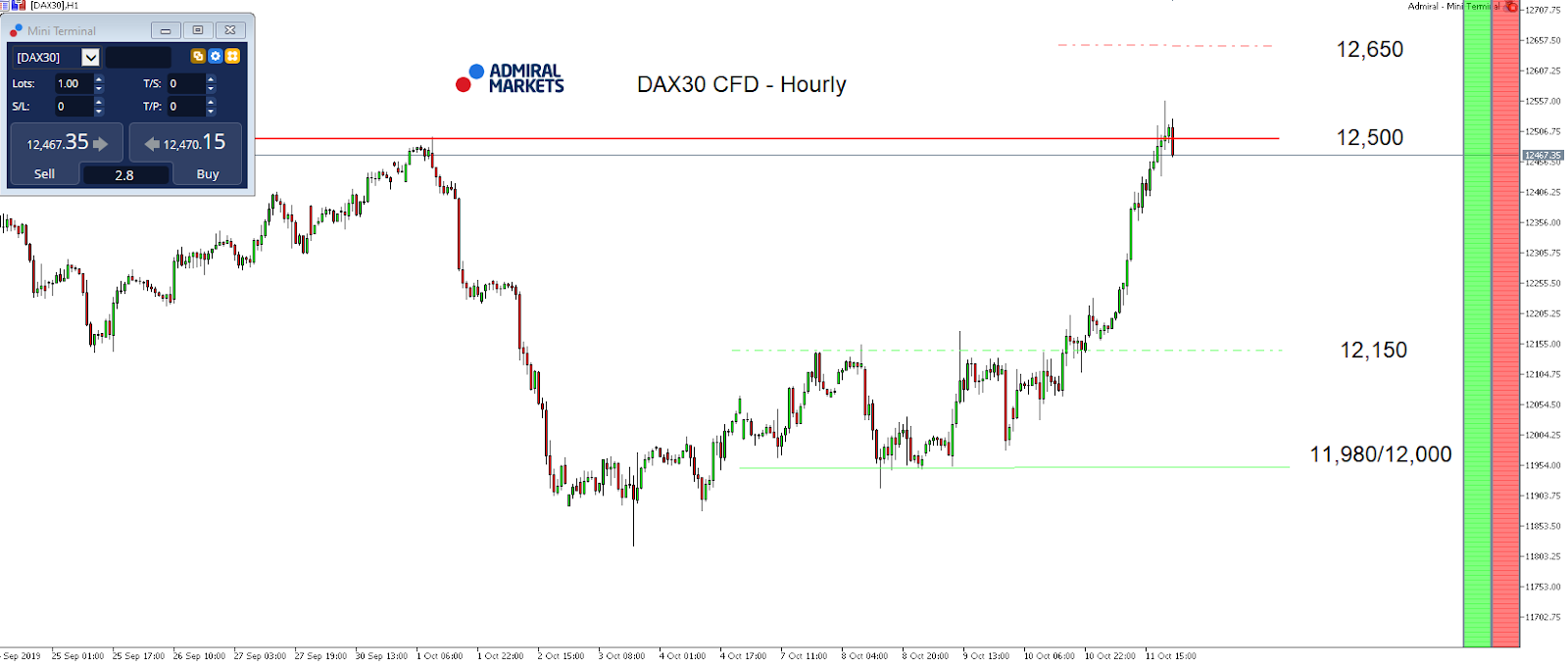
The German index recaptured 12,150 points and found, in addition to the lessening of US-Chinese tensions, another bullish driver with a Brexit deal finally on the horizon between the EU and UK, too.

As a result, the DAX30 CFD gained more than 2%, and went for a test of the region around 12,500 points.

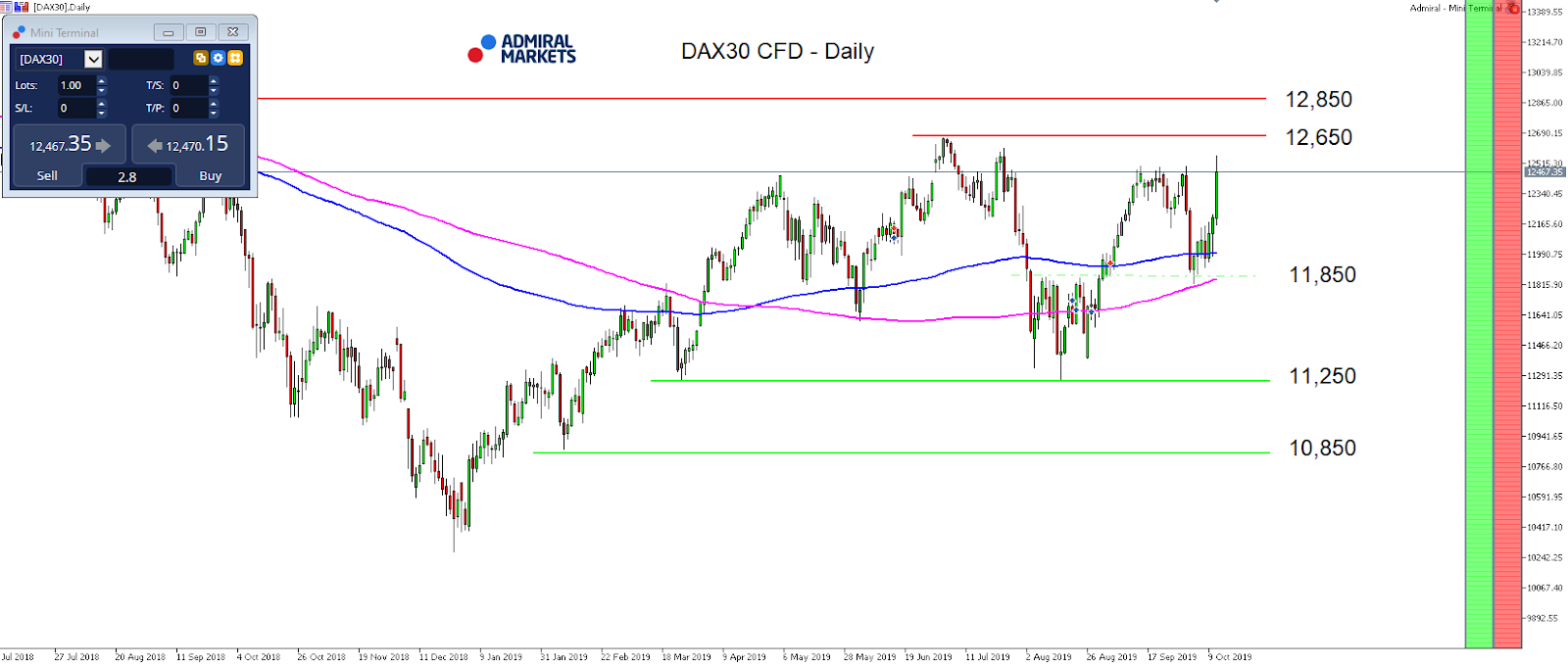
The start of this week has a key level to watch: a break higher activates the region around the current yearly highs around 12,650 points.

Still, we remain a little cautious and try to not become overly optimistic in regards to a direct walk through on the upside since the mode looks very extended and a consolidation, even though at an elevated level slightly below 12,500 points, seems likely.

After the extended mode is reduced then over time, a test of 12,650 points in the days to come has a high probability.

A sharper pullback (even though unlikely) would find a first target and solid support around the Friday-breakout level around 12,150 points:

Source: Admiral Markets MT5 with MT5-SE Add-on DAX30 CFD Hourly chart (between September 24, 2019, to October 11, 2019). Accessed: October 11, 2019, at 10:00pm GMT

Source: Admiral Markets MT5 with MT5-SE Add-on DAX30 CFD Daily chart (between July 5, 2018, to October 11, 2019). Accessed: October 11, 2019, at 10:00pm GMT – Please note: Past performance is not a reliable indicator of future results, or future performance.

In 2014, the value of the DAX30 CFD increased by 2.65%, in 2015, it increased by 9.56%, in 2016 it increased by 6.87%, in 2017 it increased by 12.51%, in 2018 it fell by 18.26%, meaning that after five years, it was up by 10.5%.

Discover the world’s #1 multi-asset platform

Admiral Markets offers professional traders the ability to trade with a custom, upgraded version of MetaTrader 5, allowing you to experience trading at a significantly higher, more rewarding level. Experience benefits such as the addition of the Market Heat Map, so you can compare various currency pairs to see which ones might be lucrative investments, access real-time trading data, and so much more. Click the banner below to start your FREE download of MT5 Supreme Edition!

Download MetaTrader 5 and begin trading today!

Disclaimer: The given data provides additional information regarding all analysis, estimates, prognosis, forecasts or other similar assessments or information (hereinafter “Analysis”) published on the website of Admiral Markets. Before making any investment decisions please pay close attention to the following:

  1. This is a marketing communication. The analysis is published for informative purposes only and are in no way to be construed as investment advice or recommendation. It has not been prepared in accordance with legal requirements designed to promote the independence of investment research, and that it is not subject to any prohibition on dealing ahead of the dissemination of investment research.
  2. Any investment decision is made by each client alone whereas Admiral Markets shall not be responsible for any loss or damage arising from any such decision, whether or not based on the Analysis.
  3. Each of the Analysis is prepared by an independent analyst (Jens Klatt, Professional Trader and Analyst, hereinafter “Author”) based on the Author’s personal estimations.
  4. To ensure that the interests of the clients would be protected and objectivity of the Analysis would not be damaged Admiral Markets has established relevant internal procedures for prevention and management of conflicts of interest.
  5. Whilst every reasonable effort is taken to ensure that all sources of the Analysis are reliable and that all information is presented, as much as possible, in an understandable, timely, precise and complete manner, Admiral Markets does not guarantee the accuracy or completeness of any information contained within the Analysis. The presented figures refer that refer to any past performance is not a reliable indicator of future results.
  6. The contents of the Analysis should not be construed as an express or implied promise, guarantee or implication by Admiral Markets that the client shall profit from the strategies therein or that losses in connection therewith may or shall be limited.
  7. Any kind of previous or modeled performance of financial instruments indicated within the Publication should not be construed as an express or implied promise, guarantee or implication by Admiral Markets for any future performance. The value of the financial instrument may both increase and decrease and the preservation of the asset value is not guaranteed.
  8. The projections included in the Analysis may be subject to additional fees, taxes or other charges, depending on the subject of the Publication. The price list applicable to the services provided by Admiral Markets is publicly available from the website of Admiral Markets.
  9. Leveraged products (including contracts for difference) are speculative in nature and may result in losses or profit. Before you start trading, you should make sure that you understand all the risks.

By Admiral Markets

EURUSD: pair trading at the balance point

By Alpari.com

All the majors rose against the US dollar last week, except for the safe havens. The biggest mover was the pound (+2.54%), followed by the Canadian dollar (+0.87%), the euro (+054%), the Aussie dollar (+0.35%), and finally the Kiwi dollar (+0.33%). The yen dropped by 1.42% and the Swiss franc by 0.14%.

The US and China have concluded negotiations. US President Trump announced that a partial deal has been reached, which will be signed in the coming weeks. The agreement covers issues such as the purchase of agricultural produce, exchange rates, and intellectual property rights. The planned hike on import tariffs has been cancelled.

Markets had already factored in a positive end to the talks, so growth on the EURUSD pair was limited to 1.1063.

Day’s news (GMT+3):

  • 11:00 Eurozone: industrial production (Aug).
  • 21:00 US: monthly budget statement (Sep).

EURUSD H1Current situation:

Trading on the euro has opened down in Europe. Since the negotiations between the US and China are over, there are no more factors for growth. The last three trading days have all had similar trajectories. It’s unlikely that this pattern will be repeated again today. We’re forecasting a recovery to 1.1050, where we expect traders to cash in on their long positions. It would be nice to then see the pair drop from the upper to the lower boundary of the channel. If the pair manages to stay above 1.10 over the next couple of days, then we can entertain the possibility of a breakout towards 1.11.

By Alpari.com

Trade war pause boosts risk assets

By Hussein Sayed, Chief Market Strategist (Gulf & MENA), ForexTime

  • Stocks rally on US-China  ‘Phase I’  deal
  • US 10 Year – 3 Month Treasury yield spread moves into positive territory
  • Earnings season unofficially kicks off this week

Investors who were desperate for positive news finally got some at the end of last week. After an ongoing US-China trade war that has lasted 18 months and rattled financial markets, the White House administration announced on Friday that the two sides had agreed on phase one of a trade deal. The EU is undergoing substantial negotiations with the Brits to resolve the Brexit dilemma, which saw Sterling jump five figures in two days. On the monetary side, the Fed addressed the issue of short-term lending by extending its temporary repo operation and decided to buy more short-term Treasury bills.

The positive developments over the end of last week boosted equity markets with the S&P 500 closing 1.1% higher on Friday to end three consecutive weeks of declines. More importantly, the US Treasury yield curve steepened dramatically, with the 10 Year – 3 Month Treasury yield spread moving back into positive territory for the first time since late May.

While such optimism may lend risk assets further support over the coming days, it is still too early to conclude that a new bull run will occur. What we do know so far is that the US has agreed to stop a planned increase for this Tuesday of an additional 5% in tariffs on $250 billion of Chinese goods. Meanwhile, China agreed to buy $40 to $50 billion of US agricultural products and committed to open its markets to US financial services.

The “Phase I” deal did not really address the most sensitive issues in the trade dispute, especially technology transfer, intellectual property theft and currency manipulation.  The deal also didn’t remove any of the existing tariffs on Chinese imports. If you’re a US or a Chinese business, such developments will not help deciding on your future plans. That’s why I like to call the current agreement a trade truce rather than a trade deal.

President Trump may want a more robust deal heading into the election season and given the ongoing impeachment inquiry. However, nothing guarantees that talks don’t breakdown again like we saw in May.

Back to fundamentals 

While we continue to see a lot of background noise related to trade and geopolitical issues, investors will need to focus back on fundamentals.

US banks unofficially kick off the Q3 earnings season on Tuesday. According to Factset, financials are likely to see revenues drop given the negative impact from lower interest margins. Overall, earnings are expected to decline 4.1% for the S&P 500 companies following a 0.4% drop in the second quarter.

Looking at where the S&P 500 index stands right now, it doesn’t reflect such pessimism. Falling interest rates and hopes of a trade deal have pushed stocks up near record highs. However, we need strong positive earnings surprises for stocks to hold near these levels.

Disclaimer: The content in this article comprises personal opinions and should not be construed as containing personal and/or other investment advice and/or an offer of and/or solicitation for any transactions in financial instruments and/or a guarantee and/or prediction of future performance. ForexTime (FXTM), its affiliates, agents, directors, officers or employees do not guarantee the accuracy, validity, timeliness or completeness, of any information or data made available and assume no liability as to any loss arising from any investment based on the same.


Forex-Time-LogoArticle by ForexTime

ForexTime Ltd (FXTM) is an award winning international online forex broker regulated by CySEC 185/12 www.forextime.com

Singapore eases policy on muted inflation and growth

By CentralBankNews.info

Singapore’s central bank loosened its monetary policy stance for the first time since April 2016 as inflationary pressures are expected to remain muted and economic growth below potential due to the ongoing downturn in the global electronics cycle as well as the pullback in investment spending, partly from the uncertainty in U.S.-China trade relations.

The Monetary Authority of Singapore (MAS), which targets the value of the Singapore dollar against a basket of currencies to control inflation, said it would “reduce slightly the rate of appreciation theS$NEER policy band” but retain the width of the policy band and the level at which it is centered.

The economy of trade-based Singapore has slowed sharply in the last five quarters due to the drag on growth from the manufacturing sector while the services and construction sectors have expanded.

Singapore’s gross domestic product grew by annual 0.1 percent in the third and second quarters of this year and MAS said there were “nascent signs” the global downturn could spill into domestic demand in some of Singapore’s major trading partners despite more accommodative policy.

MAS expects Singapore’s economy to pick up modestly in 2020 but output is still expected to remain below potential, keeping inflation muted.

GDP is expected to growth around the midpoint of the zero to 1.0 percent range this year.

Core inflation has been decelerating since December last year and was steady at 0.8 percent t in July and August. In the quarters ahead, MAS expects external sources of inflation to remain benign amid weak demand and well-supplied food and oil markets.

For this year MAS expects core inflation in the lower end of a 1.0 to 2.0 percent range and then average 0.5 to 1.5 percent in 2020.

    The Monetary Authority of Singapore released the following statement:

INTRODUCTION

1.   In its April 2019 Monetary Policy Statement, MAS maintained the rate of appreciation of the S$NEER policy band. There was also no change to the width of the policy band or the level at which it was centred. This policy stance was assessed to be appropriate, given contained inflationary pressures and a narrowing of the positive output gap.
Chart 1
S$ Nominal Effective Exchange Rate (S$NEER)
2.   Over the last six months, the S$NEER has fluctuated within the upper half of the policy band, reflecting shifts in global risk sentiment and capital inflows into Singapore. The three-month S$ SIBOR edged up from 1.9% in end-April 2019 to 2.0% in end-June, before falling back to 1.9% in August, where it has remained as at end-September.

OUTLOOK

3.   Growth in the Singapore economy has slowed over the first three quarters of the year. It is expected to pick up modestly in 2020, although this projection is subject to considerable uncertainty in the external environment. Core inflation has come in lower than anticipated in recent months, and will remain subdued in the year ahead.

Growth Backdrop

4.   According to the Advance Estimates released by the Ministry of Trade and Industry today, the Singapore economy grew by 0.1% year-on-year in Q3 2019, similar to the preceding quarter. In the last six months, the drag on GDP growth exerted by the manufacturing sector has intensified, reflecting the ongoing downturn in the global electronics cycle as well as the pullback in investment spending, caused in part by the uncertainty in US-China relations. In comparison, activity in the services sectors continued to expand, supported mainly by finance & insurance and business services. The construction sector also remained on a recovery path, and grew for the third consecutive quarter in Q3.
5.   Global economic growth is expected to slow discernibly in 2019 compared to the previous two years, and should stabilise in 2020 barring further shocks. Growth had eased more significantly in Q2 2019 as the cumulative effect of the tariffs and elevated policy uncertainty took a heavier toll on manufacturing and trade. There are nascent signs that the downturn could spill over into domestic demand in some of Singapore’s major trading partners in the quarters ahead, even as macroeconomic policy conditions in these economies have turned more accommodative.
6.   Against this global backdrop, the weakness in electronics production and its supporting industries in Singapore is likely to persist over the near term. At the same time, the finance & insurance and information & communications services sectors should continue to expand, underpinned by domestic demand in the region and ongoing digitalisation-related investments. Within the domestic-oriented sectors, the outlook for the retail industry has dimmed but growth in education, health & social services is expected to stay resilient. The construction sector should also recover further in the year ahead, given the strong pipeline of public infrastructure projects.
7.   On the whole, Singapore’s GDP growth is projected to come in at around the mid-point of the 01% forecast range in 2019 and improve modestly in 2020. The output gap has turned slightly negative and this is expected to persist into 2020, which will keep inflationary pressures muted.

Inflation Trends and Outlook

8.   MAS Core Inflation, which excludes costs of accommodation and private road transport, fell significantly to an average of 0.8% year-on-year in July–August 2019, from 1.4% in H1. Part of this decline was anticipated, reflecting falling costs of electricity & gas, and the dissipation of the effect of previous water price increases. However, retail and services inflation came in lower than expected. CPI-All Items inflation eased by a smaller extent over the same period, from 0.6% to 0.4%, as higher private road transport costs and a slower decline in imputed rentals on owner-occupied accommodation partially offset the moderation in core inflation.
9.   In the quarters ahead, external sources of inflation are likely to be benign, amid weak demand conditions, and generally well-supplied food and oil commodity markets. However, oil prices could be volatile in the near term, reflecting geopolitical risks. On the domestic front, labour market conditions are softening as firms become more cautious about hiring. This would lower wage growth in 2019 and 2020 compared to last year. At the same time, non-labour costs such as retail rents should stay subdued. Meanwhile, the extent to which businesses can pass on accumulated costs to consumers would be constrained by poorer consumer sentiment and greater market competition.
10.  As for the non-core components of the CPI, the negative contribution of imputed rentals to headline inflation should gradually dissipate in the coming months. However, private road transport costs are unlikely to increase significantly, as weakening sentiment and wider availability of alternative modes of transport weigh on the demand for cars.
11.  MAS Core Inflation is expected to come in at the lower end of the 1–2% range in 2019, and average 0.5–1.5% in 2020. Meanwhile, CPI-All Items inflation is projected to be around 0.5% this year and average 0.5–1.5% in 2020.

MONETARY POLICY

12.  Singapore’s GDP growth should pick up modestly in 2020, but the level of output will remain below potential. Consequently, inflationary pressures should be muted. MAS Core Inflation is likely to remain below its historical average over the next few quarters before rising gradually over the medium term.
13.  MAS will therefore reduce slightly the rate of appreciation of the S$NEER policy band. There will be no change to the width of the policy band and the level at which it is centred. This measured adjustment to the policy stance is consistent with medium-term price stability, given the current economic outlook. MAS will continue to closely monitor economic developments and is prepared to recalibrate monetary policy should prospects for inflation and growth weaken significantly. “