The US dollar is changing slightly against a basket of currency majors. The dollar index (#DX) closed yesterday’s trading session with a slight decrease (-0.02%). “Political successes” of the US in the conflict with Turkey supported the US currency. It should be recalled that US President Donald Trump demanded from Turkey to stop the Turkish military operation in Syria, but Turkey refused to do so. As a result, the United States imposed sanctions on Turkey. The US annulled sanctions for Turkey and now the conflict with Turkey has receded into the background.
Today, investors are focused on the ECB interest rate decision, as well as on the latest statement by Mario Draghi. President of the European Central Bank (ECB) Mario Draghi will hold the last meeting on monetary policy. On October 31, Mario Draghi ends his mandate at the head of the ECB. Investors do not expect any significant changes to the ECB at the upcoming meeting.
Also, the situation concerning Brexit is still unclear. British Prime Minister Boris Johnson told European Council President Donald Tusk that he did not want another delay in Britain’s exit from the EU and was confident that he would be able to vote in Parliament for the Brexit deal until October 31. However, it is not yet clear what will be in the near future.
The “black gold” prices have been growing amid resolving the conflict with Turkey. Currently, futures for the WTI crude oil are testing the $55.65 mark per barrel.
Market Indicators
Yesterday, there was the bullish sentiment in the US stock markets: #SPY (+0.29%), #DIA (+0.16%), #QQQ (+0.19%).
The 10-year US government bonds yield has risen again. At the moment, the indicator is at the level of 1.75-1.76%.
The Economic News Feed for 24.10.2019:
– ECB interest rate decision at 14:45 (GMT+3:00);
– Core durable goods orders in the US at 15:30 (GMT+3:00);
The last major market-moving data of this rather busy week for the euro is the Ifo Business Climate Index.
The expectation is for it to confirm the host of downbeat economic reports we’ve been getting over the last few weeks. The question now seems to be “how bad is it?”
At the start of the week, the Bundesbank announced that Germany had likely slipped into technical recession. In its monthly report, the bank projected a slight economic contraction this quarter.
Bundesbank tried to give a positive interpretation of their conclusion. They argued that it wasn’t a real recession, but with more technical terms.
Still, it’s not likely to support the euro, which might be nearing the end of its rise on Brexit deal optimism over the last couple of weeks.
The Breakdown
The Ifo survey is rather similar in function to PMI, and often moves in tandem. However, it surveys CEOs, and sets the contraction-expansion line at 100. The trick for interpreting the data is to gauge the difference between the current situation and the outlook.
Survey respondents are asked how they expect their business (note that this is not the same as the economy) to be in six months.
The Business Climate Index is a combination of current and future prospects. For traders, however, the outlook of 9,000 of the largest German companies gives some insight into what we might see in the currency going forward.
What We Are Looking For
The headline number is the Business Climate Index. Expectations are for this to continue into contraction at 93.1 from 94.6 prior.
Note that this isn’t a flash reading. It corresponds to the survey conducted at the end of September. So, we aren’t likely to see much effect from the recent easing in trade concerns.
If the results meet expectations, this would be the worst performance in nearly a decade. So much so that it harkens back to the last great recession.
With such a negative outlook already expected, there isn’t much room for a reaction to the downside.
We’d have to see a substantially sub-expectations result to jolt the market. On the other hand, this raises the possibility of a surprise relief rally if the index would show a continuation of the “bounce” from August. So, something over 95 or even better, closer to 96.
The Components
We expect the Ifo Current Business situation to worsen a bit to 98.0 from 98.5.
But, let’s not forget that the survey was done immediately after the US won an arbitration case in the WTO that allowed for applying punitive tariffs on Europe over Airbus subsidies. In the environment of increasing trade difficulties, one would expect German businesses to feel things had gotten worse, as exports continue to struggle.
Projections indicate that the Ifo Business Expectations will actually increase to 91.0 from 90.8 prior. Just a technical improvement, but that’s the only kind that seems to be coming out of Germany lately.
The problem here is that if businesses continue to think that the environment won’t improve, they won’t be eager to increase spending, expand production and hire new people. All these things that are necessary to strengthen the euro in the medium term.
Most major German companies will have issued their third-quarter reports by the end of next week. This will give analysts a broader insight into German’s economy and prospects of getting out of the potential technical recession. In the medium term, Germany’s best hope for economic support might be the end of Brexit uncertainty if a deal finally gets through Parliament.
An ambiguous technical picture has developed on the EUR/USD currency pair. The trading instrument is consolidating. The local support and resistance levels are 1.11150 and 1.11450, respectively. Participants in financial markets are sitting it out before the ECB meeting. It is expected that the regulator will maintain the basic parameters of monetary policy at the same level. We recommend that you pay attention to the comments and rhetoric of representatives of the Central Bank. Investors will also evaluate important economic releases from the eurozone and the United States. Open positions from the key levels.
The Economic News Feed for 24.10.2019:
– A number of indicators on business activity (GER, EU) – 10:30, 11:00 (GMT+3:00);
– ECB decision on interest rate (EU) – 14:45 (GMT+3:00);
– Durable Goods Orders (US) – 15:30 (GMT+3:00);
– Primary Real Estate Sales (US) – 17:30 (GMT+3:00);
Indicators do not provide accurate signals: 50 MA crossed 100 MA.
The MACD histogram moved into the positive zone, indicating a bullish sentiment.
The Stochastic Oscillator is in the neutral zone, the %K line is below the %D line which gives a signal to sell EUR/USD.
Trading recommendations
Support levels: 1.11150, 1.10850, 1.10550
Resistance levels: 1.11450, 1.11750
If the price consolidates below 1.11150, expect the quotes to fall EUR/USD to 1.10850-1.10600.
Alternatively, the quotes could grow toward 1.11750-1.12000.
The GBP/USD currency pair
Technical indicators of the currency pair:
Prev Open: 1.28703
Open: 1.29140
% chg. over the last day: +0.37
Day’s range: 1.29023 – 1.29286
52 wk range: 1.1959 – 1.3385
GBP/USD currency pair is consolidating. There is no defined trend. GBP is under pressure due to the uncertainty surrounding Brexit. We recommend you to keep track of current information on this issue. At the moment, the local support and resistance levels are 1.28850 and 1.29350, respectively. Financial market participants also expect a release of important reports on the US economy. Open positions from the key levels.
The Economic News Feed for 24.10.2019 is calm.
Indicators do not give accurate signals: the price crossed 50 MA and 100 MA.
The MACD histogram is close to 0.
The Stochastic Oscillator is in the neutral zone, the %K line began to cross the %D line. There are no signals at the moment.
Trading recommendations
Support levels: 1.28850, 1.28400, 1.27600
Resistance levels: 1.29350, 1.30100
If the price consolidates below 1.28850, you need to look for entry points to the market to open short positions. The price will fall toward 1.28000.
Alternatively, the quotes can grow toward 1.30000-1.30300.
The USD/CAD currency pair
Technical indicators of the currency pair:
Prev Open: 1.30934
Open: 1.30717
% chg. over the last day: -0.14
Day’s range: 1.30707 – 1.30845
52 wk range: 1.2727 – 1.3664
The USD/CAD currency pair is still dominated by bearish sentiment. The trading tool again updated local lows. Looney is currently consolidating. The key range is 1.30700-1.31000. In the near future, technical correction after a prolonged fall is not ruled out. Today we recommend that you pay attention to the dynamics of prices for oil, as well as economic reports from the United States. Open positions from the key levels.
The Economic News Feed for 24.10.2019 is calm.
Indicators do not give accurate signals: the price is testing 50 MA and 100 MA.
The MACD histogram is in the negative zone but above the signal line, which gives a weak signal to sell USD/CAD.
The Stochastic Oscillator is in the overbought zone, the %K line crossed the %D line. There are no signals at the moment.
Trading recommendations
Support levels: 1.30700, 1.30400, 1.30200
Resistance levels: 1.31000, 1.31200, 1.31450
If the price consolidates below 1.30700, expect the quotes to drop toward 1.30400-1.30200.
Alternatively, the quotes could grow toward 1.31400-1.31600.
The USD/JPY currency pair
Technical indicators of the currency pair:
Prev Open: 108.480
Open: 108.671
% chg. over the last day: +0.14
Day’s range: 108.576 – 108.688
52 wk range: 104.97 – 114.56
USD/JPY is still trading in a long flat. The technical picture is ambiguous. Financial market participants expect up-to-date information regarding the settlement of trade disputes between Washington and Beijing, as well as the situation around Brexit. At the moment, the local support and resistance levels are 108.500 and 108.700, respectively. We also recommend paying attention to the dynamics of yield on US government bonds. Open positions from the key levels.
The Economic News Feed for 24.10.2019:
Indicators do not give accurate signals: 50 MA crossed 100 MA.
The MACD histogram is in the positive zone, but below the signal line, which gives a weak signal to buy USD/JPY.
The Stochastic Oscillator is in the neutral zone, the %K line is above the %D line, which indicates a bullish sentiment.
Trading recommendations
Support levels: 108.500, 108.250, 108.000
Resistance levels: 108.700, 108.900
If the price consolidates below 108.500, the price will fall toward 108.300-108.100.
Alternatively, the quotes could grow toward 108.900-109.200.
The US dollar index was seen trading lower towards Wednesday’s close. These declines come following a day after the USD posted strong gains. The subdued trading comes as the economic calendar has been quiet for the most part this week. The FOMC meeting is due in a week’s time but the blackout period means that there isn’t much news to fall back upon.
Euro Gains as the Dollar Retreats
The euro currency has been posting some modest gains against the dollar on Wednesday. This comes ahead of today’s ECB meeting. It will be the last monetary policy meeting under the leadership of ECB President Mario Draghi. Economic data from the Eurozone was quiet.
Can the EURUSD Maintain the Rebound?
The currency pair rebounds following a day of declines. However, we expect that the upside is limited for the moment. EURUSD could post a lower high which will confirm the downside. The currency pair will likely test the lower support at 1.1075–1.1062 region, unless the previously two-year high is breached.
Sterling Pares Losses as Brexit Delay likely
The UK Brexit saga continues. On Tuesday, British lawmakers passed the Brexit deal. But the deal failed to pass through before the October 31st deadline. The EU is currently mulling over the extension. Speculation is rife that Brexit could be postponed to January 2020.
GBPUSD Gains to Remain Limited
The upside bounce in GBPUSD comes as the currency pair fell to the support area of 1.2865. The sideways range is likely to prevail within the 1.2865–1.2960 region. As long as this level holds, we expect the bias to be to the downside. The lower support at 1.2582 is the next target. Alternately, if GBPUSD breaks out above the resistance area, then we anticipate further gains.
Gold Posts Gains on Modest Safe-Haven Demand
Gold prices posted meager gains on Wednesday amid some flows into safe-haven assets. This comes ahead of the Fed meeting next week. Expectations for a rate cut remains high. But a disappointment from the Fed is also possible. Equity markets remained steady as investors wait for more clues.
XAUUSD Consolidates into an Ascending Triangle Pattern
The precious metal is seen establishing resistance at 1495 level. Amid this resistance, the commodity is posting higher highs. Therefore, a strong breakout above 1495 will trigger the upside bias, Gold could rise to at least 1511.50 level in the short term. The upside failure will, of course, see the bias shift back to the initial support at 1462.
On Wednesday the 23rd of October, trading on the euro closed slightly up. The pair is looking for a balance point ahead of the ECB meeting and amid the ongoing uncertainty over Brexit. British Prime Minister Boris Johnson has told European Council President Donald Tusk that he doesn’t want to delay Brexit. He believes that his deal can still be approved by Parliament before the end of the month.
The pair didn’t drop to 1.1087 as expected, with 1.1110 holding firm. From there, the pair recovered to 1.1142. There don’t seem to be any growth factors ahead of the ECB meeting and Mario Draghi’s press conference to follow. This will be today’s key event. Markets are well aware that the global economy has slowed down due to the ongoing trade conflict, so no one is expecting a hawkish tone from Draghi.
Aside from the ECB meeting, traders will also have their eyes on trade talks between the US and China, Brexit, and the upcoming FOMC meeting. The forecast on today’s chart only goes as far as the ECB rate decision. Nobody knows what will happen to the euro during Draghi’s speech. With 70 hours of consolidation from the 1.1179 high, everything points towards a breakout of the 1.1110 – 1.1087 zone by the bears. This could be wrong, but for now there don’t seem to be any buy signals on the euro, no less ahead of such important events.
By Hussein Sayed, Chief Market Strategist (Gulf & MENA), ForexTime
S&P 500 closes above 3,000 despite earnings miss from Caterpillar
ECB expected to keep policy unchanged as Draghi steps down
Sterling traders await EU’s extension decision
Equity markets in Asia were slightly higher this morning as the S&P 500 managed to close back above the 3,000 psychological level on Wednesday. The commonly followed equity indices is less than 1% away from its record high despite disappointing earnings from the likes of Caterpillar and Texas Instruments. These two companies are seen as a proxy for the ongoing trade war, however more than 80% of corporates announcing earnings so far have managed to beat estimates. If this ratio continues for the rest of the Q3 earnings season and better developments are seen on the US-China trade front, there’s a high chance of US indices breaking above July’s record highs.
Goodbye Mario Draghi
After eight years at the helm of the European Central Bank, Mario Draghi reaches the end of his Presidency in which he helped to save the Euro. While his cheap money era did deliver some successes, the mandate of ensuring price stability was not achieved and the ECB Governing Council is extremely divided. It’s now up to the new President Christine Lagarde to fix the house.
Do not expect today’s meeting to deliver significant moves in the Euro. A series of stimulating measures have already been taken last month with the announcement of a new asset purchasing program and cutting of deposit rates. Draghi will instead reiterate his calls on governments to step up with fiscal measures as monetary policy on its own won’t cure the Eurozone’s stalling economy. Many hope that Christine Lagarde has more clout in pushing governments, given her political background, especially if data next month shows the region has fallen into recession.
Today’s PMI releases will also be of great importance to Euro traders. Markets anticipate a slight improvement relative to last month, so any surprise to the downside, particularly in Germany, will likely lead to a selloff in the single currency.
Brexit Extension
Sterling moved in tight ranges last night after rallying 5.5% over the past nine trading days. There weren’t a lot of Brexit developments yesterday as EU ambassadors agreed to accept Prime Minister Johnsons’ request for an extension to Brexit. However, they have yet to agree on how long the extension should last. Although the French are pushing for a tighter deadline, the base case scenario remains until January 31. If this extension is granted, then a UK general election will likely be the next step. If an election is called and approved by the House of Commons, expect to see more volatility in Sterling, although any downside pressure will be limited given that a hard Brexit scenario is now off the table.
Disclaimer: The content in this article comprises personal opinions and should not be construed as containing personal and/or other investment advice and/or an offer of and/or solicitation for any transactions in financial instruments and/or a guarantee and/or prediction of future performance. ForexTime (FXTM), its affiliates, agents, directors, officers or employees do not guarantee the accuracy, validity, timeliness or completeness, of any information or data made available and assume no liability as to any loss arising from any investment based on the same.
US stocks resumed advancing on Wednesday despite mixed earnings reports. The S&P 500 rose 0.3% to 3004.52. The Dow Jones industrial average added 0.17% to 26833.95 as Caterpillar and Boeing added 1.2% and 1% respectively on smaller than expected earnings misses. Nasdaq gained 0.19% to 8119.79. The dollar weakening resumed as the House Price Index growth slowed to 0.2% on month in August when steady growth at 0.4% was expected. The live dollar index data show the ICE US Dollar index, a measure of the dollar’s strength against a basket of six rival currencies, slipped 0.1% to 97.45 and is lower currently. Stock index futures point to higher openings today.
FTSE 100 leads European indexes gains despite Brexit uncertainty
European stock market managed to notch another gain on Wednesday despite further deterioration in consumer confidence for October. Both GBP/USD and EUR/USD turned higher yesterday with both pairs gaining currently. The Stoxx Europe 600 added 0.1% led by basic resources shares. Germany’s DAX 30 rose 0.3% to 12798.19. France’s CAC 40 slid 0.1% while UK’s FTSE 100 gained 0.7% to 7260.74 as EU member states delayed a decision on whether to grant Britain a three-month Brexit extension. The European Central Bank meets today and is expected to hold steady.
Hang Seng leads Asian indexes gains
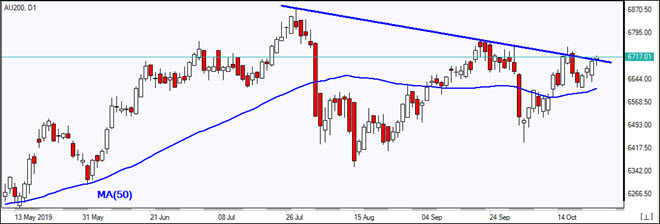
Asian stock indices are mixed today despite president Trump’s comment US was doing ‘fantastically well’ with China trade talks. Nikkei rose 0.6% to 22750.60 as yen continued its slide against the dollar. Chinese stocks are mixed: the Shanghai Composite Index is down 0.02% while Hong Kong’s Hang Seng Index is 0.9% higher. Australia’s All Ordinaries Index extended gains 0.3% as Australian dollar resumed its slide against the greenback.
Brent futures prices are lower today. Prices gained yesterday on surprise US crude inventories decline as the Energy Information Administration reported US crude stocks fell by 1.7 million barrels, first decline in six weeks, with gasoline supplies falling by 3.1 million barrels. December Brent crude added 2.5% to $61.17 a barrel on Wednesday.
Note: This overview has an informative and tutorial character and is published for free. All the data, included in the overview, are received from public sources, recognized as more or less reliable. Moreover, there is no guarantee that the indicated information is full and precise. Overviews are not updated. The whole information in each overview, including opinion, indicators, charts and anything else, is provided only for familiarization purposes and is not financial advice or а recommendation. The whole text and its any part, as well as the charts cannot be considered as an offer to make a deal with any asset. IFC Markets and its employees under any circumstances are not liable for any action taken by someone else during or after reading the overview.
Maurice Jackson of Proven and Probable speaks with the CEO of a company upping its game in silver districts in the Yukon and Colorado.
Maurice Jackson: Joining us for conversation today is Greg Johnson, the CEO of one of the market’s leading silver explorers, Metallic Minerals Corp. (MMG:TSX.V; MMNGF:OTCMKTS). Mr. Johnson, what a pleasure to have you back on our program to discuss the latest developments by Metallic Minerals, which is known for high-grade silver in the Keno Hill Silver District of Canada’s Yukon Territory. Mr. Johnson, for someone new to Metallic Minerals, please share the investment opportunity the company presents to the market.
Greg Johnson: Metallic Minerals is a leading explorer for silver and gold, and we are focused in some of the highest-grade, historic, producing districts for those metalsparticularly the Keno Hill silver district, and with our recent acquisition in the southwestern U.S. in the La Plata mining district.
Maurice: In a press release issued last week, Metallic Minerals announced a strategic investment by one of the sector’s leading resource investors, billionaire Eric Sprott. What an accomplishment. Take us behind the scenes for a moment and give us some background on the details on this transaction.
Greg: Well, Maurice, as you know, Eric is very bullish on silver, as well on the other metals in the precious metals spacebut particularly on silver. We are very excited to have Eric as a strategic level investor in the company. You may know that he was one of the early investors in NOVAGOLD Resources Inc. (NG:TSX; NG:NYSE.MKT), and was a great supporter and sponsor of the company. So, I’m really excited to be working with Eric again. I think it’s really recognition of the value that we’ve been building; particularly our Keno Hill Silver Project, and the potential with that opportunity.
Maurice: Mr. Johnson, what does this suggest to current and prospective shareholders when one of our industry’s most prominent and renowned investors is taking a strategic level investment into Metallic Minerals?
Greg: Well, I think it says a couple of things. I think it says that smart money, experienced money, which this is reallytheir focus is on starting to put real money to work in the sector. And it highlights that we’ve been through a very difficult market. But you know, this is the one of those buy low, high-quality opportunities that that comes along every 10 years or so in our sector.
Secondly, I think its real recognition of the value that we’ve created in Metallic Mineralsthe fact that the Keno Hill silver district is so compelling in terms of its grade historically, and the geologic understanding that it’s just such a strong opportunity for new discovery and for developing high-grade silver resources that can be brought rapidly to market.
Greg: The Keno Hill Silver District really has an amazing history. Many people know of the Klondike gold rush at the turn of the last century. What they may not know is there was more value in silver that came out of the Keno Hill Silver District in the Yukon than out of all of the Klondike.
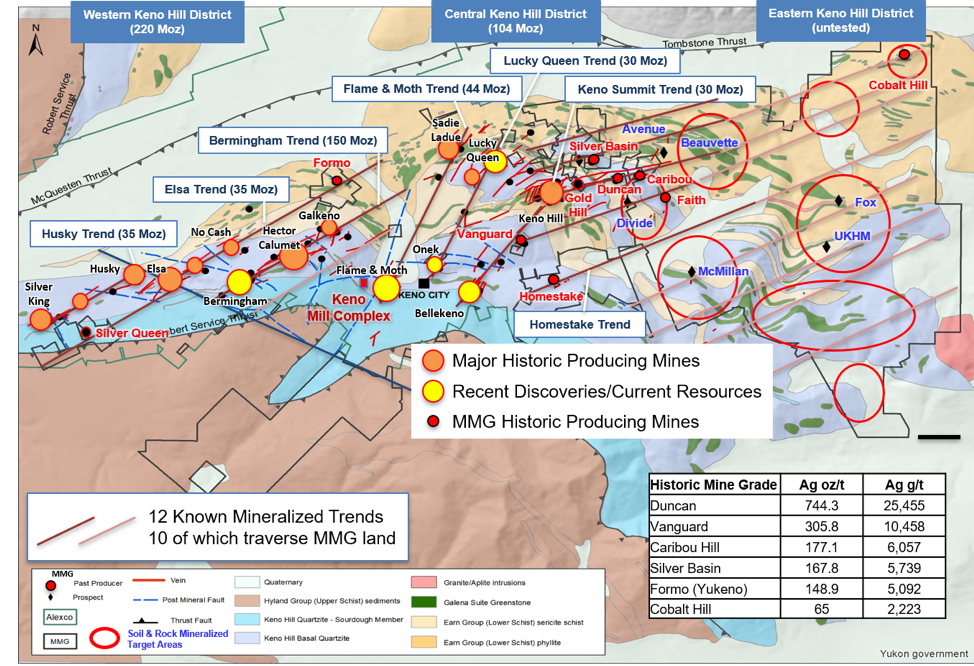
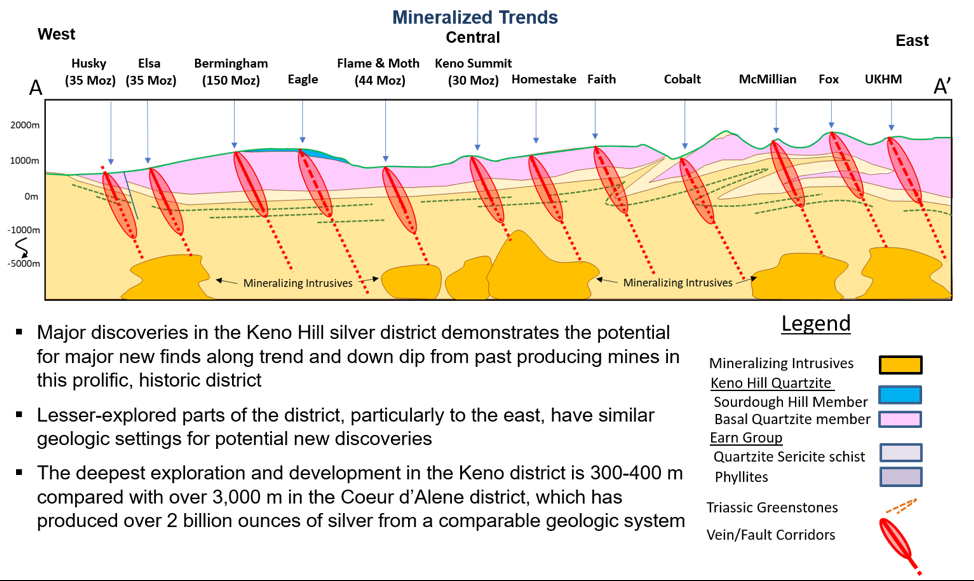
It was discovered shortly after the Klondike gold rush. There were a number of individual miners who came in and found, in the western part of the district, these veins that were sticking right out of the mountain side. And over time there’s been over 300 million ounces in past production and current resources at some of the highest grades in the industry.
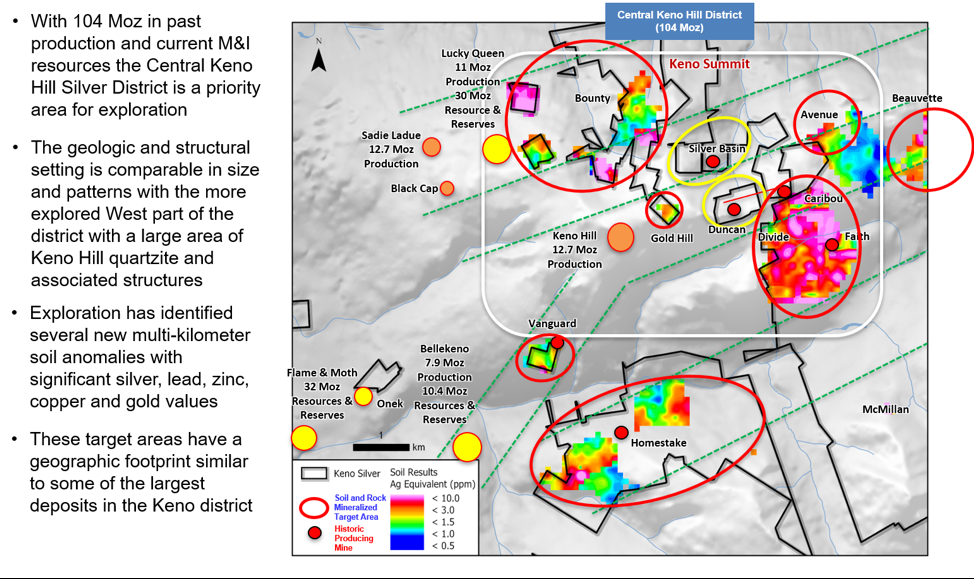
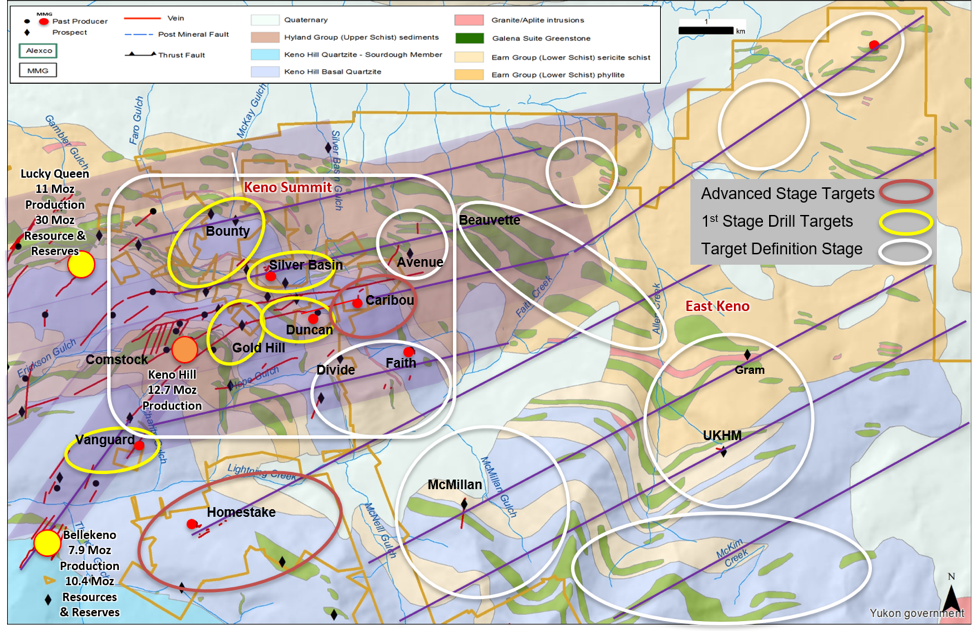
So, it’s a very exciting place to be doing new exploration and to be bringing in new perspectives. Because of that long history, as you can imagine, it had quite a patchwork of land ownership. We have managed, over the last couple of years, to acquire the entire eastern part of the district, where the geology continues and has the same structure, and that’s where we’ve developed some very exciting targets that I’m sure we’ll talk about. Thats in addition to our holdings within the central, western and even down dip on the west part of the districts, [where] we’re quite excited about [continuing] to build on some of those new discoveries in the district that have been made recently by Alexco Resource Corp. (AXU:NYSE.MKT; AXR:TSX).
Maurice: In reference to your neighbor Alexco, they’ve made some pretty amazing silver discoveries in the past couple of years in the Keno Hill district and have a number of important upcoming milestones. Can you give us some background on what we can expect to see happening in this famous historic mining district over the next few months?
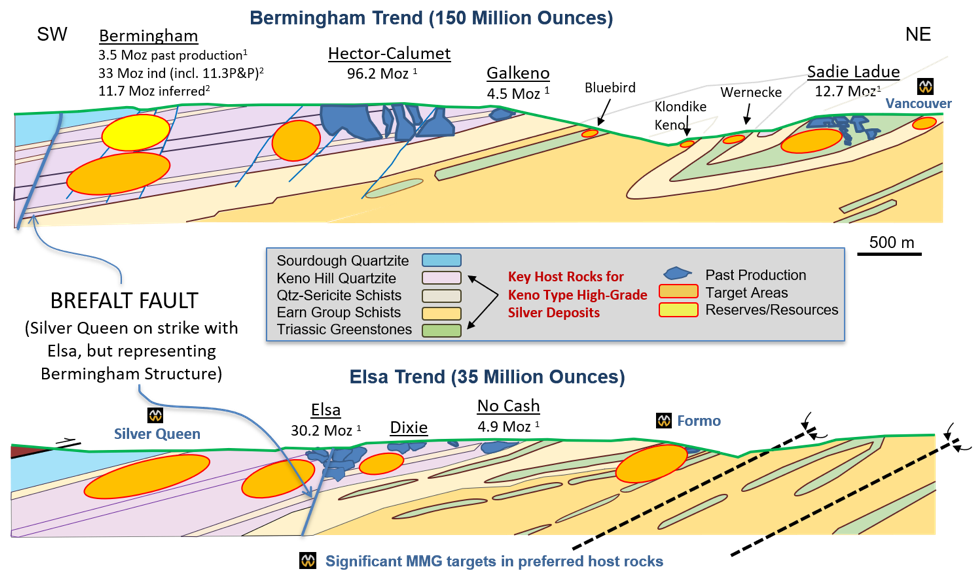
Greg: The Alexco story is really an exciting one. Over the last 10 years in the district, but particularly in the last several years, they’ve made two major silver discoveries, about 60 million ounces. Their Bermingham silver deposit, which they are going back into production with, will arguably be the best high-grade silver mine in the world, starting right at surface, with exceptional grades of well over a thousand grams per tonne silver. It’s really a game changer, not only for an Alexco but for the district as a whole, indicating that if you can find those kinds of deposits near where the some of the biggest deposits in the district had been previously mined, that there are still all kinds of opportunitieslow-hanging fruit, as we say in the industryto find a new major discoveries.
In terms of near-term milestones, Alexco has announced to the market that they will be turning on the two new mines at Bermingham and Flame and Moth. And I believe that they are scheduled to start producing ore again in the fourth quarter of this year. It’s an exciting time in the district, to see production restarting, and it’s an exciting time for us to be exploring in that same district and really starting to understand and advance, through our systematic exploration work, the potential that we have.
Maurice: And now focusing on Metallic Minerals work in the Keno Hill Silver District. Please walk us through what you have discovered so far there.
Greg: It’s been a systematic process. This is going into our third year as a company. We started out in the late summer of 2016. The first year was quite focused on acquisition of our land package, 166 square kilometers. And following that, it was really a synthesis process of acquiring the historic information, the exploration, the mines that were developed on our groundthere are eight different historic mines where they had high enough grades to mine by hand at the surface in the 1920s and ’30sgoing back in and re-looking at those. We say in the business that the best place to find a mine is right next to where one has already been found, and so really being able to bring a modern approach to exploration into this district that has this amazing history.
It was a process of prioritization, where we took 40 different target areas and prioritized those based on the ones that have the most information and the most potential. Three of those we’ve already been drilling on and we’ve been able to hit the structures on those three targets very consistently, probably hitting the structure on about a 90% success rate. We’re hitting Keno-style high-grade mineralization, so the same material that you’re seeing over on the western part of the district with Alexco. We’re now starting to step along those structures, down dip and laterally, looking for where they’re going to get wider, where we can build up the tonnage.
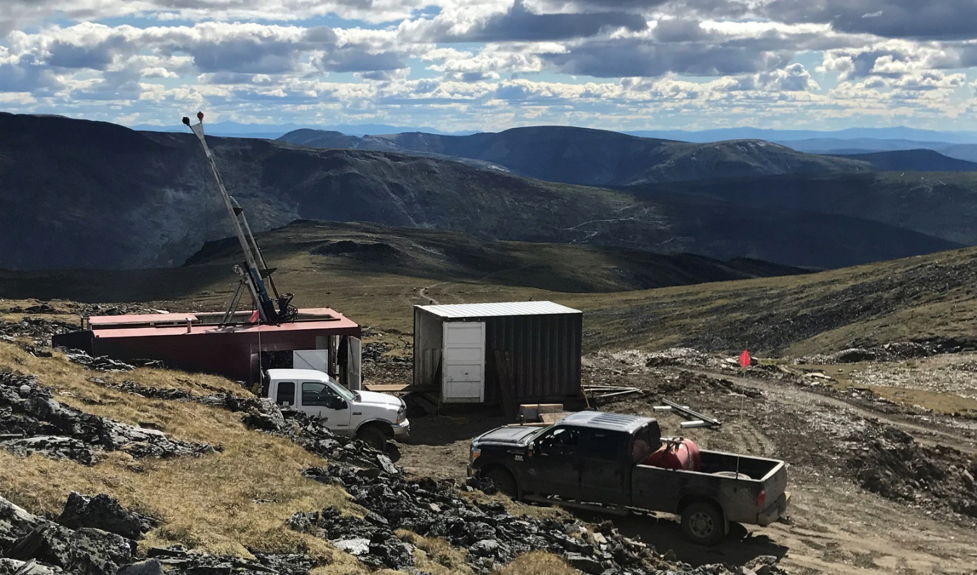
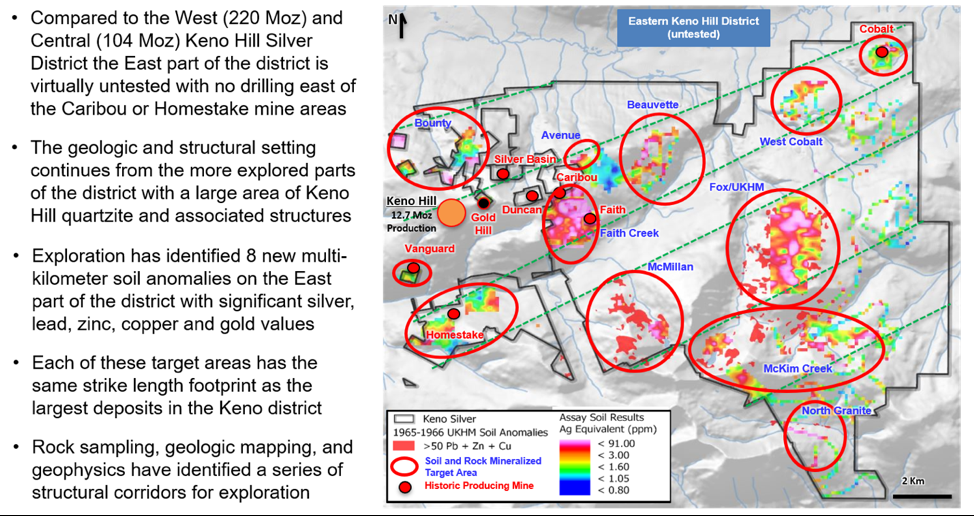
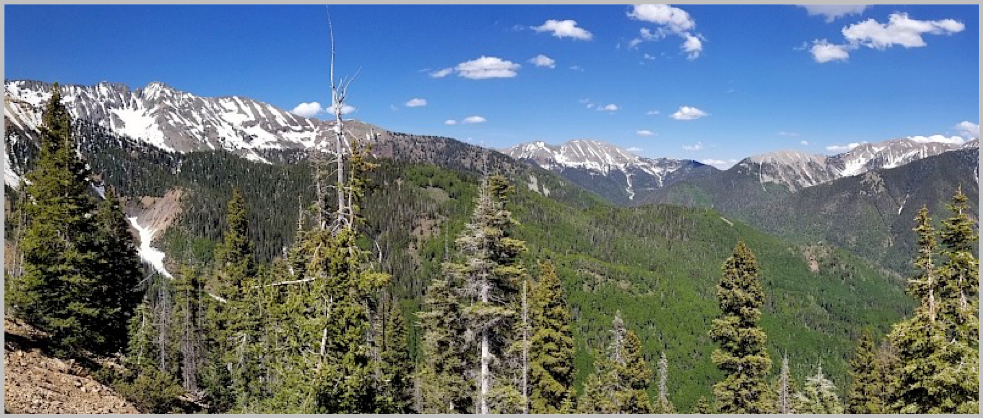
But you know, the real success there is we’ve already got three targets that we’re building on starter resources. We’ve got three additional targets that are advanced enough that they’re ready to drill, and we’ll be looking to get the first holes into those probably in early 2020. And then on the Eastern part of the district, which is quite amazing, you’ve got half the district. Though it has the same geology and the same structural setting as we see on the west, because it was more remote historicallyit didn’t have road access and it’s forestedit really didn’t get the exploration focus that the western part of the district did.
We’ve gone in and conducted geophysics, soil sampling, really applied our modern exploration tool set, and we’re very pleasantly surprised and pleased to have defined 10 targets that exceed two to five kilometers in length that are each showing enriched silver in soils and rocks that indicate very significant silver targets. Our teams were back out on those sites this year. Results are going to be coming from that work here fairly soon, but they’ve been able to confirm that, in fact, we are seeing Keno-style rubble crop, as we call it. [This is] vein rubble at the surface that is showing Keno-type grades: 500 to 1,000 grams per tonne silver values. We’re onto something very significant and the scale of these targets are larger than anything that’s been previously seen in district, so it’s quite an exciting time for us.
Maurice: I think that’s exactly what the value proposition that Mr. Sprott saw, based off what you just conveyed to us. What should we expect in terms of news from the ongoing work at Keno Hill?
Greg: We’re just wrapping up those field programs now. Of course, it takes a bit of time for results to come back from the assay lab, but I would anticipate that we should have news flow over the coming weeks and months as those programs start to come in. A particular focus of the program was refining these targets. Many of these soil anomalies and mineralized areas were open-ended. In other words, we didn’t know where the edges were, so we extended those soil lines and we’re really trying to figure out what are the highest grade and the best targets, with the idea that we’d be looking to come in early next year and start to drill test those and really get a sense for how big they areas well as continuing to advance those targets that already have drilling that we’re building these initial resources on.
Maurice: Let’s leave the Yukon for a moment and introduce investors to the newest project in the Metallic portfolio. We see that you’ve turned your focus southward and that Metallic Minerals has announced strategic acquisition of the La Plata silver-gold-copper project located in southwest Colorado. Mr. Johnson, please introduce us to the value proposition of the La Plata Silver-Gold-Copper Property.
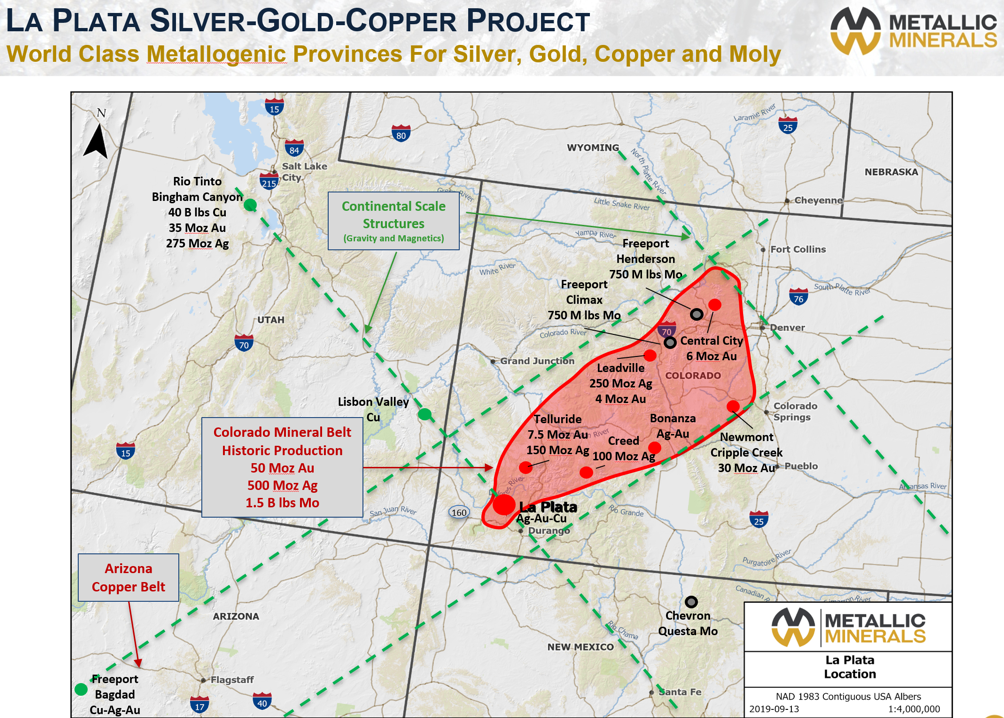
Greg: This is an exciting opportunity. Part of our approach in Metallic Minerals, and in the other companies in the Metallic Group of Companies, has been to be open to opportunities. In my experience, sometimes you just have to be in the right place at the right time and be able to recognize value that perhaps others haven’t. In the case of our new acquisition in the La Plata District, it is in the United States, in the very southwestern corner of Colorado. It’s in what’s called the Colorado mineral belt, which is this amazing area of both historic and current production. Almost 50 million ounces of gold has been produced from this mineral belt and 500 million ounces of silver, so almost half a billion ouncesmostly, like in Keno Hill, from relatively shallow, high-grade vein systems. But you also have big operators like Newmont Goldcorp Corp. (NEM:NYSE), with their Cripple Creek mine complex that has over 30 million ounces of gold.
We’ve seen production from a number of these districts that’s measured in the five-plus-million-ounce range, and in terms of silver, hundreds of millions of ounces, so we know we’re in the right neighborhood on this project. It’s got a long history. It’s called the La Plata project because it was discovered by the Spanish, who found high-grade silver all the way back in the 1700s, and they only paid attention to something if it was quite spectacular.
And then, similar to the Keno district, but earlier in terms of the start, we saw over 90 high-grade mines and prospects get developed between the 1880s and the 1940, when World War II broke out. During that period, the focus by these individual miners was on the high-grade silver and gold vein systems that cropped right out at surface and were being mined by hand, much like the Keno District.
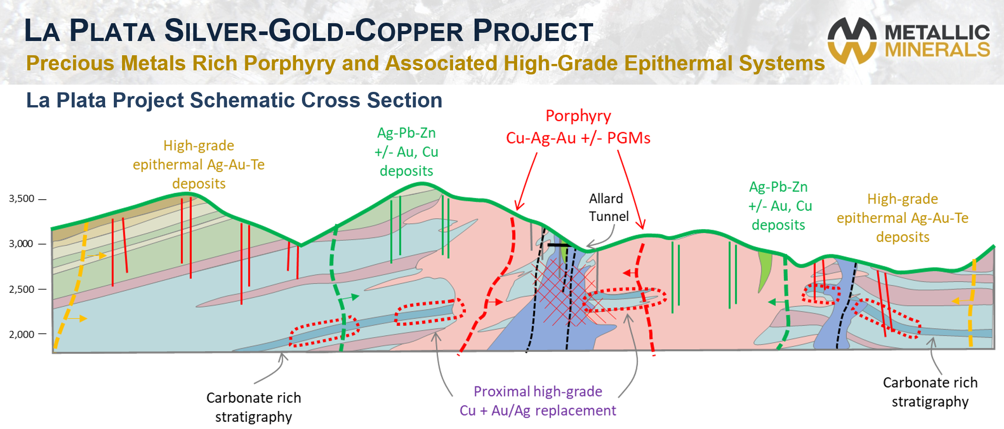
The U.S. shut down mining during the war years and effectively we didn’t see the individual miners come back. But in the 1950s and ’60s, we saw some of the major copper companiesRio Tinto Plc (RIO:NYSE; RIO:ASX; RIO:LSE; RTPPF:OTCPK) first, followed later by Phelps Dodge, which is now Freeport-McMoRan Inc. (FCX:NYSE)recognizing that there was a major precious-metals-rich porphyry system in the center of this vein district. So, they came in and started drilling these porphyry targets. Of course, back in 1960, copper was less than $0.60 a pound, so they would’ve been looking for exploration targets that would indicate something that could be mined in bulk at over 1% copper. In today’s world, copper deposits that are being looked at are often measured in the 0.20.3% copper grades. So, it’s a very different world at a $2.50+ copper price.
What this work that was done in the 50s and 60s did was show that we have a very large, high-precious-metals porphyry system in the center of the district. They drilled enough holes to define an historic resource that starts right at surface that would indicate a very significant copper and silver historic resource that’s open-ended. What’s exciting for us is that this district has basically seen no exploration. Phelps Dodge held it all the way through the late nineties, when it was acquired by the two parties that we did our agreement with.
The last kind of significant work in the district, outside of the drilling on the porphyry system, was mapping in the 1940s. There’s never been systematic exploration in terms of soils or geophysics or any of the modern tools that we’ve been employing recently at Keno to great success. We control the entire district and we’ve got the opportunity to come in and work on something where we believe we have a potential Keno-type district that surrounds a historic mineral resource that could be rapidly advanced to resources in the ground. So, we’re really quite excited about this acquisition and this development.
Maurice: I have to commend you. I’m very impressed with the company’s business acumen, as Metallic Minerals provides shareholders with exceptional upside through a strategic acquisition of half of one of the world’s richest silver districts at Keno Hill, and now follows that with the 100% acquisition of one the richest silver-gold districts in the USA. This gives Metallic Minerals not just value leverage to rising precious metal prices, but the ability to build new insignificant resources very quickly. What are the details of the La Plata transaction, and are there any backend rights or royalties?
Greg: One of the exciting things about this is that the district hasn’t seen exploration since Rio Tinto and Phelps Dodge, and it was just held for decades. So, we were able to do an agreement with the vendors that acquired the ground from Phelps Dodge at the bottom of the last copper market cycle. There’s a small royalty with a buydown, so we’ve got 100% on this. It’s an option because we have four years to basically get in, to do the work that we need to do to demonstrate we’ve got a significant resource here. These holders that we’ve done the option agreement with are going to receive shares. So, they’re going to be investors just like you and I, and their expectation is their value will come from appreciation in the share price relative to this opportunity.
Maurice: I’m smiling ear to ear. These are some great strategic moves you’re making, Mr. Johnson. Kudos to you. What type of work is being conducted at La Plata, and when can we expect results?
Greg: The nice thing about this more southern project is that it gives us a longer exploration season. We’ve got teams that are on the ground now and we’re basically doing those geologic layers; teams are out doing rock sampling, mapping soils. We’re undertaking a variety of geophysical surveys, really trying to understand particularly the high-grade vein systems outside of the porphyry in order to move this towards first drill testing by early next year.
Maurice: Switching gears, Mr. Johnson, please share the current capital structure of Metallic Minerals. And who are the major shareholders?
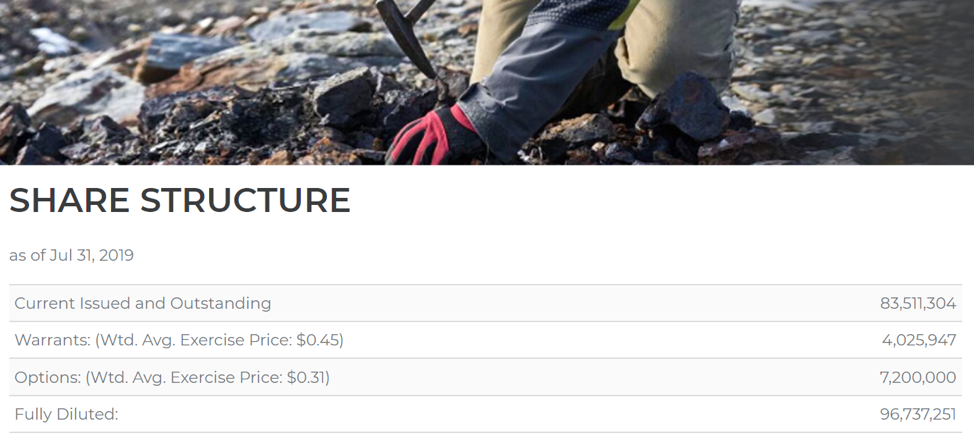
Greg: Well, currently there’s about 83.5 million shares outstanding. With Mr. Eric Sprott coming in, he will be our largest individual shareholder. Management owns about 25% of the company. We’ve been building our institutional ownership base. We have names like US Global and others that are prominent resource funds that already own something on the order of about 12% of the shares. We’ve got a number of high net worth individuals who have invested in some of our past companies, and then our retail component. We’ve got a nice tight share structure, particularly for the assets that we have in the company. And we’ve got some great supporters in the shareholder register.
Maurice: What would you like to say to current and prospective shareholders regarding the opportunity that is before us right now in the market with Metallic Minerals and the silver sector specifically?
Greg: I think we touched early on that we are at one of these unique inflection points in the cycle. The metal price cycle peaked back in 2011 and we’ve seen the bear market ensue from there. And then over the last several years we’ve really been in a market bottoming, consolidation phase. With investors like Eric Sprott putting money to work along with some of these sophisticated mining funds, this is really an opportunity for investors to be looking at high quality names in the sector.
Metallic Minerals, based on what we’ve been quietly building during the bear market, is really taking advantage of the fact that we were in a bear market to acquire assets that we would probably not likewise be able to go after during more busy and higher-valued times of the sector cycle, so I think there’s a real value opportunity here. These are new companies that the market is not yet aware of and, of course, it’s always challenging for investors to find out about these smaller cap companies because there’s just not a lot of research coverage. But I think it’s a real opportunity to be buying quality. I think we’re at a major inflection point in the precious metal cycle that really could be one of those rare buy low opportunities that we all look for.
Maurice: Speaking of companies and speaking of quality, Metallic Minerals is part of the Metallic Group of Companies. Can you walk us through, briefly, the Metallic Group and share the common synergies and strategies that you’ve been executing with all three companies?
Greg: This has been something that’s been evolving over the last couple of years. But we had the opportunity, really coming out of the bear market, to [ask] “how do we create value as a group?” These are a number of individuals that I’ve worked with in the past at NOVAGOLD, people from the Ivanhoe Group; we have people that have worked with the major mining companies and we were able to say, “We know we’ve been in a bear market, we think that transition is happening. . .so how can we go after this?” So we’ve focused on brownfields acquisitions; in other words, acquisitions in districts where you already have found mines. And in the case of each of the three Metallic Group companies, each one is adjacent to either existing or past production.
This means all the infrastructure is already there: roads, power. . .so that means the development pathway is going to be not only less capital-intensive, but probably a much faster course to production. And, uniquely in each of these three cases, these are some of the highest-grade producers in their metal class, so these are really exceptional districts to be exploring in. Because they were smaller companies that were operating these mines, they did not acquire all the exploration ground in their districts and that presented the opportunity, in the bear market, for us to go in [and] do the hard work to stitch together these current land packages. The first company was Metallic Minerals, which we’ve been speaking about, and that was 2016. In 2017, we had the opportunity to pick up the Lower Stillwater complex in Montana, adjacent to the Stillwater mines, which are among the highest-grade platinum and palladium producers in the world.
That acquisition was followed almost immediately by Sibanye Gold Ltd. (SBGL:NYSE) out of South Africa, acquiring the Stillwater mines for $2.2 billion. So, we’re really solidifying the value proposition there. The third and the newest company, which just started trading in January of this year, is Granite Creek Copper. It is focused in the Carmacks/Minto Copper District in the Yukon, just south of the Minto mine, which was previously owned by Capstone Mining and now by Pembridge Resources (PERE:LSE), and they’re bringing back into production.
But again, it is a district that’s shown the opportunity to find high-grade deposits, as with the other Metallic Group companies, and that has the existing infrastructure in place. So, it’s really quite a unique series of opportunities that we’ve been able to put together in the group of companies. And in the case of each one, the ground that had been tied up for more than 50 years and had not seen modern exploration. So, we’re really excited about all three companies in the Metallic Group.
Collectively, the three companies bring an opportunity in a mix of metals where you’ve got dedicated managements and boards in each company, you’ve got reduced costs and synergies between the group and a deeper technical team that can have some collaboration across the three. So, it’s a very exciting opportunity to bring these together. The Metallic Group companies represent unique value in the mining space and in all three companies we believe we have the potential to move to new resources in the near term. And as you know, that is one of the biggest drivers in creating value in the exploration space.
Maurice: And for audience members, we’re proud to share that all three Metallic Group companies referenced are sponsors of Proven and Probable, and equally, we are proud to be shareholders of all three. Mr. Johnson, for readers who want to get more information about Metallic Minerals, please share the website address.
Maurice: For direct inquiries, please contact Chris Ackerman at (604) 629-7800 ext. 1, or you may email [email protected]. Metallic Minerals trades on the TSX.V: MMG | OTCQX: MMNGF.
As a reminder, I’m a licensed representative for Miles Franklin precious metals investments. We provide a number of options to expand your precious metals portfolio, from physical delivery, offshore depositories, precious metal IRAs, and private blockchain distributed ledger technology. Call me directly at (855) 505-1900, or you may e-mail: [email protected]. Finally, please subscribe to ProvenandProbable.com where we provide mining insights and bullion sales. Greg Johnson of Metallic Minerals, thank you for joining us today on Proven and Probable.
Greg: Thanks for having us. It was a pleasure.
Maurice Jackson is the founder of Proven and Probable, a site that aims to enrich its subscribers through education in precious metals and junior mining companies that will enrich the world.
Disclosure: 1) Maurice Jackson: I, or members of my immediate household or family, own shares of the following companies mentioned in this article: Metallic Minerals, Granite Creek Copper, Group Ten Metals. I personally am, or members of my immediate household or family are, paid by the following companies mentioned in this article: None. My company has a financial relationship with the following companies mentioned in this article: Metallic Minerals, Granite Creek Copper and Group Ten Metals are sponsors of Proven and Probable. Proven and Probable disclosures are listed below. 2) The following companies mentioned in this article are billboard sponsors of Streetwise Reports: Group Ten Metals, Granite Creek Copper and Metallic Minerals. Click here for important disclosures about sponsor fees. As of the date of this article, an affiliate of Streetwise Reports has a consulting relationship with Group Ten Metals, Granite Creek Copper and Metallic Minerals. Please click here for more information. 3) Statements and opinions expressed are the opinions of the author and not of Streetwise Reports or its officers. The author is wholly responsible for the validity of the statements. The author was not paid by Streetwise Reports for this article. Streetwise Reports was not paid by the author to publish or syndicate this article. The information provided above is for informational purposes only and is not a recommendation to buy or sell any security. Streetwise Reports requires contributing authors to disclose any shareholdings in, or economic relationships with, companies that they write about. Streetwise Reports relies upon the authors to accurately provide this information and Streetwise Reports has no means of verifying its accuracy. 4) This article does not constitute investment advice. Each reader is encouraged to consult with his or her individual financial professional and any action a reader takes as a result of information presented here is his or her own responsibility. By opening this page, each reader accepts and agrees to Streetwise Reports’ terms of use and full legal disclaimer. This article is not a solicitation for investment. Streetwise Reports does not render general or specific investment advice and the information on Streetwise Reports should not be considered a recommendation to buy or sell any security. Streetwise Reports does not endorse or recommend the business, products, services or securities of any company mentioned on Streetwise Reports. 5) From time to time, Streetwise Reports LLC and its directors, officers, employees or members of their families, as well as persons interviewed for articles and interviews on the site, may have a long or short position in securities mentioned. Directors, officers, employees or members of their immediate families are prohibited from making purchases and/or sales of those securities in the open market or otherwise from the time of the interview or the decision to write an article until three business days after the publication of the interview or article. The foregoing prohibition does not apply to articles that in substance only restate previously published company releases. As of the date of this article, officers and/or employees of Streetwise Reports LLC (including members of their household) own shares of Group Ten Metals, Granite Creek Copper and Metallic Minerals, companies mentioned in this article.
Proven and Probable LLC receives financial compensation from its sponsors. The compensation is used is to fund both sponsor-specific activities and general report activities, website, and general and administrative costs. Sponsor-specific activities may include aggregating content and publishing that content on the Proven and Probable website, creating and maintaining company landing pages, interviewing key management, posting a banner/billboard, and/or issuing press releases. The fees also cover the costs for Proven and Probable to publish sector-specific information on our site, and also to create content by interviewing experts in the sector. Monthly sponsorship fees range from $1,000 to $4,000 per month. Proven and Probable LLC does accept stock for payment of sponsorship fees. Sponsor pages may be considered advertising for the purposes of 18 U.S.C. 1734.
The Information presented in Proven and Probable is provided for educational and informational purposes only, without any express or implied warranty of any kind, including warranties of accuracy, completeness, or fitness for any particular purpose. The Information contained in or provided from or through this forum is not intended to be and does not constitute financial advice, investment advice, trading advice or any other advice. The Information on this forum and provided from or through this forum is general in nature and is not specific to you the User or anyone else. You should not make any decision, financial, investments, trading or otherwise, based on any of the information presented on this forum without undertaking independent due diligence and consultation with a professional broker or competent financial advisor. You understand that you are using any and all Information available on or through this forum at your own risk.
Thibaut Lepouttre of Caesars Report profiles this company exploring its large land package in Finland’s greenstone belt.
Introduction
Finland would hardly be a country you’d think of when considering exploration companies. However, it’s not such a far-fetched idea as senior producer Agnico Eagle Mines (AEM, AEM.TO) has been a successful producer in Finland for years now and its Kittila gold mine is the largest gold producer in Europe.
Firefox Gold Corp. (FFOX:TSX.V) has assembled a large land package in Finland’s greenstone belt. Two properties are drill ready and after having completed a phase 1 drill program earlier this year, Firefox is gearing up for a follow-up winter exploration program, and drilling has already started on the Mustajarvi project.
The Central Lapland Greenstone Belt: one of the last un(der)explored greenstone belts
The main area we will focus on in this article is the Central Lapland Greenstone Belt (CLGB).
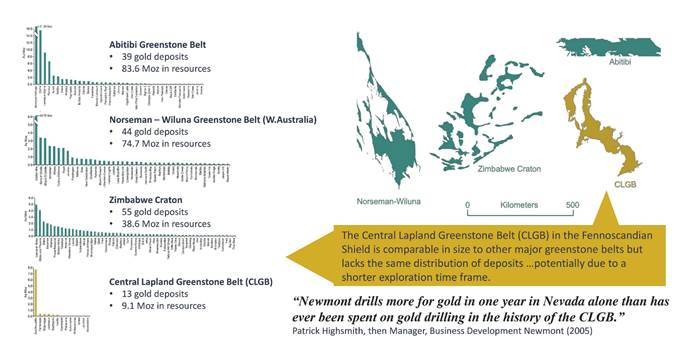
The CGLB hasn’t been thoroughly explored yet (due to a lack of expertise, the semi-duopoly of mineral exploration in Finland, and the focus on non-precious metals), and in the past 30 years of exploration activities on the Lapland Belt, approximately 13 deposits holding a combined 9 million ounces of gold have been discovered. Nice, but not jaw-dropping. Especially not when compared to the Abitibi Greenstone Belt, which hosts 100 mines with a combined production coming up close to 200 million ounces.
Does this mean the CLGB is a copy of the Abitibi with a similar amount of gold waiting to be uncovered? No. But it does indicate that if you’re exploring for gold in Finland, that greenstone belt probably is “the place to be” due to it being underexplored. In fact, the main focus on gold only started just 56 years ago, so this is a virtually untouched greenstone belt.
Additionally, there’s an interesting historical angle here as well. Once the mining sector in Finland was opened up for foreign investment, the CLGB was staked by companies that were pursuing base metals: First Quantum Minerals and Anglo American were the dominant land owners. They couldn’t care less about the gold as they were looking for large base metal deposits just like Boliden’s Kevitsa mine, a copper-nickel mine with platinum and palladium as by-product credits, and Anglo American was actually successful as it discovered the Sakatti project (also a Cu-Ni-PGM project).
So it’s really just since about 5 years that exploration companies have had a dedicated gold-focused approach in Lapland. And that means the entire greenstone belt is in its infancy with regards to exploration.
Zooming in on the two main properties: Mustajarvi and Jeesio
1. Mustajarvi
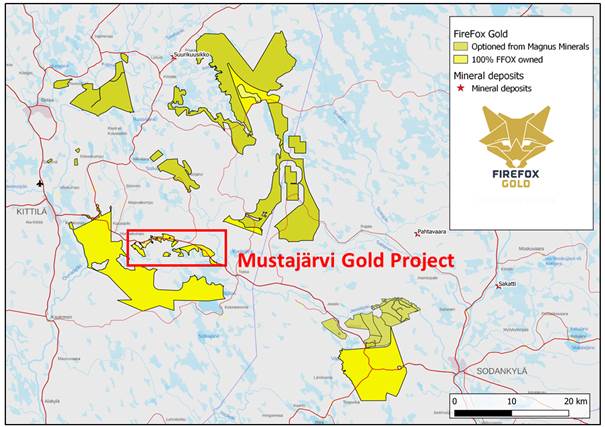
The Mustajarvi project is a 1.5 square kilometer area in the Kittila region of Finland, the town that lent its name to the Agnico Eagle gold mine in the Central Lapland Greenstone Belt.
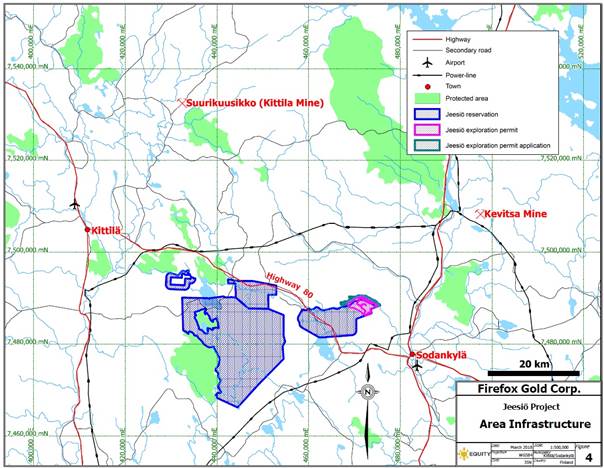
One of the main reasons why the Central Lapland Greenstone Belt is so attractive is the presence of existing infrastructure. Highway 80, which connects the cities of Kittila and Sodankyla, runs right through the Mustajarvi claims. Additionally, the entire region is very much pro-mining as both Agnico Eagle (Kittila Gold mine) and Bolliden (Kevitsa nickel-copper mine) have active operations within a 60-kilometer radius from both Kittila and the Mustajarvi project.
The gold mineralization at Kittila was originally discovered in the late 1980s when Outokumpu detected anomalous gold values in till samples where after a more methodic till sampling program confirmed the existence of gold mineralization. Enough evidence for Outokumpu to direct a drill rig to the property and 12 very short holes (averaging less than 60 meters) were drilled on the gold-in-till anomaly. Surprisingly, although they were very shallow, 11 of the 12 holes did encounter gold with an average grade of in excess of 1 g/t and two intervals really stood out: hole 1 encountered 2.7 meters at 14.58 g/t gold and hole 4 encountered a stunning 12 meters at 2.68 g/t gold.
Since Outokumpu walked away from the property, a few companies poked around and left. One of the previous owners of the property was Agnico Eagle, which tried to drill three holes but encountered numerous problems, abandoned the holes and dropped the property. Mustajarvi was recently held privately by the chairman of the gold panning association before it was added to Aurora Exploration and subsequently rolled into Firefox Gold. So Mustajarvi was basically “virgin territory” until Firefox started working on the claims.
It completed a first drill program in 2018 and the summary of the drill results is another reason why we enjoy Firefox’s transparency. Of the eight holes that were drilled as part of a 1,100-meter drill program, six holes contained gold. A 75% success ratio is excellent, but Firefox also still mentions the “empty” holes in its corporate documentation whereas most other exploration companies would just not refer to those holes.
So, a high level of transparency at Firefox Gold, and the six remaining holes encountered interesting zones of 4.1 meters at 1.87 g/t gold (including a very narrow 35 centimeters of 11.63 g/t gold, which means the remaining 3.75 meters contained about 0.96 g/t gold) as well as 3.65 meters of 0.97 g/t gold, and 2 meters containing 45 g/t gold and 0.16% cobalt.
Most of the 2018 gold-bearing drill intervals were quite short (in general between 0.5 and 2 meters), but Firefox is still just zeroing in on its targets. The grades are absolutely excellent for mineralization this close to surface, but it would be nice to see some thicker intervals.
2. Jeesio
The Jeesio property is substantially larger than Mustajarvi as it consists of a total of 460 square kilometers. Similar to Mustajarvi, the access to existing infrastructure is absolutely excellent as parts of the land package are actually overlapping highway 80 while there are two powerlines readily available on the north and south side of the Jeesio project.
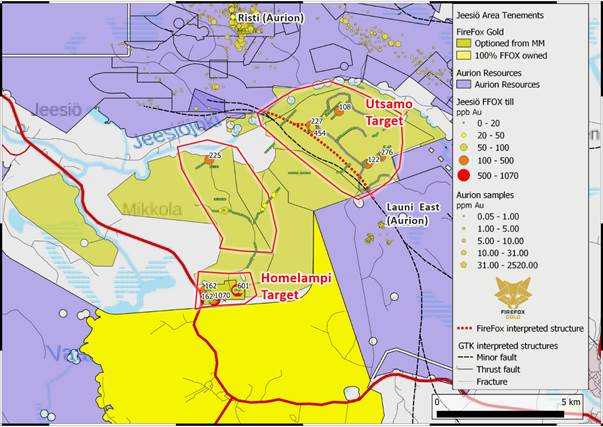
There’s one specific area of the Jeesio project that looks quite interesting. The Utsamo zone, which is a part of the Jeesio target, is located literally in between the two gold discoveries made by Aurion Resources. As you may remember, Aurion found gold at both Risti (with intervals of for instance 28 meters containing 9.42 g/t gold and 31 meters containing 3.51 g/t gold) as well as Launi East (which hasn’t been drilled yet, but the recent sampling program returned high grade gold assays, not unsimilar to what Aurion discovered at Risti).
Of course, that doesn’t mean the gold zones continue through the Utsamo target, but as far as a “nearology play,” the Utsamo zone is a very interesting piece of real estate as it could be the missing link between Risti and Launi as a magnetic survey has identified a 2.8 kilometer long target which Firefox’ geos think is a part of the Sirkka shear zone that does look like it’s continuing onto the Aurion properties:
This exploration target was further validated by Firefox’ sampling program, which outlined several gold in till anomalies, while the structural interpretation appears to be following the contact between the meta-sediments and mafic intrusive rocks.
Again, there’s absolutely no guarantee Firefox will find anything economic. But having all these elements and knowing another exploration company actually did find (high-grade) gold on both sides of the structure makes this a very juicy exploration target, and we are happy to see Firefox is planning to drill-test the Utsamo target this quarter. As we are very impressed with the methodological drill program at Mustajarvi (see later), we expect Firefox to have a well thought out plan for Utsamo as well once it solves its luxury problem.
And Utsamo does create a luxury problem for Firefox as it looks like there are several promising targets (and we expect additional groundwork to unveil even more targets). So even if the first holes don’t intersect (high-grade) gold mineralization, the Utsamo zone should definitely not be written off. It’s a large zone and we can’t really expect the company to make a discovery with the first few holes.
Drilling has already started at Mustajarvi
Drilling is actually already underway as Firefox has initiated a nine-hole drill program on the Mustajarvi zone, where up to 1,500 meters will be drilled. The first four holes will zoom in on the high-grade results that were encountered in last winter’s exploration drill program (with, for instance, 2 meters containing just over 45 g/t gold) and two holes will test the ground for mineralization an additional 25 and 50 meters down dip, while the remaining two holes will try to expand the mineralization by 25 meters both to the east and the west. Small steps, but these four holes will provide Firefox with a lot of geological data that could then be used to design additional exploration programs.
In fact, the entire drill program is mainly about gaining more knowledge of the deposit as holes 5 and 6 will focus on the areas that have previously been drilled by Outokumpu, which encountered additional high-grade zones. One hole will test for the continuation of this mineralization, while hole 6 will try to twin one of the historical holes in an attempt to recover more of the core (which will help with the interpretation of the structures) as Outokumpu’s drill program had very poor core recovery results due to faults and fractures in the rock.
Holes 7-9 will be the bigger stepout holes as Firefox would definitely like to test whether or not it has a potential elephant by its tail. Two of the three final holes will be drilled almost half a kilometer away toward the northeast while the final hole will be a stepout hole 250 meters in the opposite direction (southwest). As such, these three holes will provide a preliminary indication of the mineralized zone over a 700-meter strike zone.
Running a tight ship with a low G&A
We are always very impressed when a company is able to keep its overhead expenses low. While some exploration stage companies have a corporate overhead of millions of dollars per year, Firefox Gold has applied the correct mindset right from the beginning.
In the first six months of the year, Firefox’s total expenses were C$711,000. This doesn’t sound low but once we filter out the C$418,000 in exploration efforts that were expensed rather than capitalized, the true corporate overhead was less than C$300,000 for the first semester. Remarkable, and 60% of the total expenses were spent on the properties. That by itself is already a good ratio but in a recent phone call with CEO Carl Löfberg, he indicated he wants to see that ratio increase to at least 70%. That shouldn’t be too difficult as a C$250,000 hike in exploration expenses would already accomplish that. But honor where honor is due, and Firefox scored some bonus points with us for its excellent financial stewardship.
As of the end of June, Firefox had a working capital position of around C$350,000 (including C$430,000 in cash) and the recent raise, which was completed last month, didn’t come as a complete surprise.
Within two weeks after announcing a financing of “up to C$1M” Firefox already closed its second and final tranche, raising a total of C$570,500 by issuing 3.8 million units. Each unit consisted of one common share as well as a full warrant allowing the warrant holders to purchase an additional share at C$0.20 during a two-year period.
The financing was “priced to sell” with a very attractive warrant (which could act as some sort of “secondary financing” further down the road as the 3.8 million warrants would bring in an additional C$760,000), and although Firefox initially mentioned a raise of up to C$1M, it was happy to close on just over half of that amount instead of leaving the financing open. After looking at the company’s financial statements, Firefox appears to have a very low overhead cash burn with almost 70% of the expenses effectively being spent on the project to make more targets drill ready.
And although Firefox raised just over half a million Canadian dollars, CEO Löfberg appears to be very confident this will carry the company to January/February and by then, the assay results from the fall drill program should be out. If those drill programs are successful, Firefox should be able to top up its treasury on the back of those results.
Conclusion
It doesn’t happen very often that an entire greenstone belt was up for grabs. Aurion Resources has the first mover advantage, but Firefox Gold is benefiting from the second mover advantage: Aurion has proven it is possible to make new gold discoveries on the greenstone belt, which will make it easier for Firefox to tell its own story and pre-prepare the market for exploration updates.
Drilling has started at Mustajarvi and as last year’s drill program already had a 75% success ratio, Firefox can just build onto that success in its pursuit to expand the gold system on the property. And with a current market capitalization of just over C$5 million, the risk-reward ratio appears to be very interesting at Firefox Gold.
Thibaut Lepouttre is the editor of the Caesars Report, a newsletter and mining portal based in Belgium that covers several junior mining companies with a special focus on precious metals and base metals. Lepouttre has a Bachelor of Law degree and two economics masters degrees that have forged his analytical approach to the mining sector. Considered a number cruncher, Lepouttre focuses on the valuations of companies and is consistently on the lookout for the next undervalued mining company.
Disclosure: 1) Thibaut Lepouttre: The author has a long position in Firefox Gold. The author’s company has a financial relationship with Firefox Gold. The author determined which companies would be included in this article based on his research and understanding of the sector. Additional disclosures are available here. 2) The following companies mentioned in this article are billboard sponsors of Streetwise Reports: None. Click here for important disclosures about sponsor fees. 3) Statements and opinions expressed are the opinions of the author and not of Streetwise Reports or its officers. The author is wholly responsible for the validity of the statements. The author was not paid by Streetwise Reports for this article. Streetwise Reports was not paid by the author to publish or syndicate this article. Streetwise Reports requires contributing authors to disclose any shareholdings in, or economic relationships with, companies that they write about. Streetwise Reports relies upon the authors to accurately provide this information and Streetwise Reports has no means of verifying its accuracy. 4) This article does not constitute investment advice. Each reader is encouraged to consult with his or her individual financial professional and any action a reader takes as a result of information presented here is his or her own responsibility. By opening this page, each reader accepts and agrees to Streetwise Reports’ terms of use and full legal disclaimer. This article is not a solicitation for investment. Streetwise Reports does not render general or specific investment advice and the information on Streetwise Reports should not be considered a recommendation to buy or sell any security. Streetwise Reports does not endorse or recommend the business, products, services or securities of any company mentioned on Streetwise Reports. 5) From time to time, Streetwise Reports LLC and its directors, officers, employees or members of their families, as well as persons interviewed for articles and interviews on the site, may have a long or short position in securities mentioned. Directors, officers, employees or members of their immediate families are prohibited from making purchases and/or sales of those securities in the open market or otherwise from the time of the interview or the decision to write an article until three business days after the publication of the interview or article. The foregoing prohibition does not apply to articles that in substance only restate previously published company releases.
Shares of Biogen Inc. opened nearly 39% higher today after the firm announced plans to submit a Biologics License Application to the FDA in early 2020 for its Alzheimer’s drug aducanumab based on new analysis of larger datasets from two phase 3 studies. The company also announced Q3/19 earnings today.
Prior to the market open this morning Biogen Inc. (BIIB:NASDAQ) and Eisai Co. Ltd. (4523:JP) announced that, “after consulting with the U.S. Food and Drug Administration (FDA), Biogen plans to pursue regulatory approval for aducanumab, an investigational treatment for early Alzheimer’s disease.”
The company outlined in the report that “the decision to file is based on a new analysis, conducted by Biogen in consultation with the FDA, of a larger dataset from the Phase 3 clinical studies that were discontinued in March 2019 following a futility analysis.” The company further noted that it plans to file a Biologics License Application (BLA) in early 2020 and that submission will include data from the Phase 1/1b and Phase 3 EMERGE and ENGAGE studies.
The company explains in the report that “aducanumab (BIIB037) is an investigational human monoclonal antibody studied for the treatment of early Alzheimer’s disease. Biogen licensed aducanumab from Neurimmune under a collaborative development and license agreement and since October 2017 Biogen and Eisai have collaborated on the development and commercialization of aducanumab globally.”
Biogen’s CEO Michel Vounatsos commented, “With such a devastating disease that affects tens of millions worldwide, today’s announcement is truly heartening in the fight against Alzheimer’s. This is the result of groundbreaking research and is a testament to Biogen’s steadfast determination to follow the science and do the right thing for patients…We are hopeful about the prospect of offering patients the first therapy to reduce the clinical decline of Alzheimer’s disease and the potential implication of these results for similar approaches targeting amyloid beta.”
In a joint statement, Dr. Anton Porsteinsson, William B. and Sheila Konar Professor of Psychiatry, Neurology and Neuroscience, director of the University of Rochester Alzheimer’s Disease Care, Research and Education Program (AD-CARE), and principal investigator, added, “This large dataset represents the first time a Phase 3 study has demonstrated that clearance of aggregated amyloid beta can reduce the clinical decline of Alzheimer’s disease, providing new hope for the medical community, the patients, and their families…There is tremendous unmet medical need, and the Alzheimer’s disease community has been waiting for this moment. I commend Biogen, the FDA, the medical community, and the patients and their study partners for their persistence in working to make today’s announcement a reality.”
On a very busy day for Biogen, the firm also announced positive Q3/19 earnings in a separate release today. In that report the company indicated that Q3/19 revenue increased by 5% to $3.60 billion compared to $3.44 billion in Q3/18. Over the same period GAAP diluted EPS increased 17% to $8.39, up from $7.15 and Non-GAAP diluted EPS increased 24% to $9.17, up from $7.40.
CEO Michel Vounatsos commented on the earnings, “Biogen delivered solid performance in the Q3/19 driven by continued resilience from our MS core business and growth from SPINRAZA and biosimilars…SPINRAZA continued on a strong trajectory, particularly outside the U.S., and we are preparing for the expected launch of VUMERITY, which we believe will be an important addition to our market-leading multiple sclerosis portfolio…we made strong progress in our pipeline as we initiated new clinical programs targeting Parkinson’s disease and brain contusion, and we look forward to nine important data readouts by the end of next year.”
Biogen is a biopharmaceutical company based in Cambridge, Mass., which specializes in discovering, developing and delivering innovative therapies for people living with serious neurological and neurodegenerative diseases. The company states that it “has the leading portfolio of medicines to treat multiple sclerosis, has introduced the first approved treatment for spinal muscular atrophy, commercializes biosimilars of advanced biologics, and is focused on advancing research programs in multiple sclerosis and neuroimmunology, neuromuscular disorders, movement disorders, Alzheimer’s disease and dementia, ophthalmology, immunology, neurocognitive disorders, acute neurology, and pain”.
Eisai Co. Ltd. is a global research and development-based pharmaceutical company headquartered in Tokyo, Japan. The company employs approximately 10,000 people globally and indicates that it strategically focuses on the areas neurology and oncology. The firm has a market capitalization of around $14.61 billion (1585.94 billion yen) and trades on the Tokyo Stock Exchange.
Biogen began the day with a market capitalization of about $41.2 billion with approximately 184.4 million shares outstanding. BIIB shares opened nearly 39% higher today at $310.00 (+$86.49, +38.70%) compared to yesterday’s closing price of $223.51. The stock has traded today between $279.42 and $318.00/share and currently is trading at $287.64 (+$64.13, +28.69%).
Disclosure: 1) Stephen Hytha compiled this article for Streetwise Reports LLC and provides services to Streetwise Reports as an independent contractor. He or members of his household own securities of the following companies mentioned in the article: None. He or members of his household are paid by the following companies mentioned in this article: None. 2) The following companies mentioned in this article are billboard sponsors of Streetwise Reports: None. Click here for important disclosures about sponsor fees. 3) Comments and opinions expressed are those of the specific experts and not of Streetwise Reports or its officers. The information provided above is for informational purposes only and is not a recommendation to buy or sell any security. 4) The article does not constitute investment advice. Each reader is encouraged to consult with his or her individual financial professional and any action a reader takes as a result of information presented here is his or her own responsibility. By opening this page, each reader accepts and agrees to Streetwise Reports’ terms of use and full legal disclaimer. This article is not a solicitation for investment. Streetwise Reports does not render general or specific investment advice and the information on Streetwise Reports should not be considered a recommendation to buy or sell any security. Streetwise Reports does not endorse or recommend the business, products, services or securities of any company mentioned on Streetwise Reports. 5) From time to time, Streetwise Reports LLC and its directors, officers, employees or members of their families, as well as persons interviewed for articles and interviews on the site, may have a long or short position in securities mentioned. Directors, officers, employees or members of their immediate families are prohibited from making purchases and/or sales of those securities in the open market or otherwise from the time of the interview or the decision to write an article until three business days after the publication of the interview or article. The foregoing prohibition does not apply to articles that in substance only restate previously published company releases. 6) This article does not constitute medical advice. Officers, employees and contributors to Streetwise Reports are not licensed medical professionals. Readers should always contact their healthcare professionals for medical advice.