Frank Holmes: Gold Is Going to $10,000

By The Gold Report

Source: Streetwise Reports   10/22/2019

Frank Holmes, CEO of U.S. Global Investors, discusses why he believes gold will go to $10,000, weighs in on the cryptocurrency versus gold debate, and explains why his gold and precious metals ETF is outperforming its peers, naming some of its top performing companies.

The Gold Report: Frank, you’ve said you expect gold to reach $10,000/oz. Can you tell us about your prediction and the factors that you see behind it?

Frank Holmes: When you look at the world of gold and at negative real interest rates, it is unprecedented that in the world, especially in the European Union (EU), there’s a real lack of commitment to fiscal stimulus by streamlining business-killing regulations. Instead, the strategy has been to make money have no value, a negative real interest rate. Denmark, for instance, offers you to take out a mortgage. It pays you to take out a mortgage. It’s ridiculous, and it doesn’t address the underlying cause of the economic slowdown.

And so you’re seeing Switzerland printing money. It floats a bond issue, no yield on it really, and then no one buys it except for itself. And then it goes and buys 15%, and it owns 15% of its own stock market. Japan has done the same thing. You’re seeing other countries like China continue to buy gold, and many of the Eastern European countries continue to buy gold.

There’s a very strong demand with the zero interest rate monetary stimulus, and every time we have a slowdown, there are more and more trillions of dollars needed to actually move the dial of 1% gross domestic product (GDP). So currencies are devaluing, and countries are doing it in concert. The masquerade is that the G20 used to compete against each other. Now these finance administrators and central bankers all get together, and they have a concerted effort to synchronize taxes and regulations and use monetary policy as a way to try to stimulate economic growth.

When you realize the magnitude of it, it’s very easy to see gold go up as the real asset. It’s a very rational argument. The last time we saw gold go in a cycle like this, it went from $275 up to $700, then ratcheted back, and then went to $1,900. You can easily get a fivefold increase in the price of gold.

And that’s where I said gold could reach $10,000, because the supply of gold is not increasing the way money supply is being increased, and GDP per capita is increasing in China and India, which together constitute 40% of the world’s population—and which love gold for love and gift giving.

After I came out with the $10,000 gold prediction, I got topped by the great Pierre Lassonde, chairman of Franco-Nevada Corp. (FNV:TSX; FNV:NYSE). At the Denver Gold Forum he said that he’s looked at gold in the past 30 years, how much it’s gone up, who were the biggest gold producers 30 years ago, who they are today, the total supply, etc. And he said for the next 30 years, gold could easily be $25,000 on the upside, minimum $5,000. It could happen earlier. So I think now that $10,000 is a very reasonable and rational argument.

The other interesting part is that the best performing asset class for the past 20 years has been real estate investment trusts. The second best has been gold. Long-term tax-free bonds have been unbelievably successful also.

So the thought process that there’s no real change in this interest rate scenario as we had in 1980, when gold peaked because interest rates rose to 20%—this is a very different cycle from where monetary and fiscal policy were rebalanced by Paul Volcker and Ronald Reagan. We don’t have that conviction to balance that. So I remain very bullish. Ray Dalio, who runs the largest hedge fund in the world, is a big advocate of gold. Six to 10% is a very sound positioning place in a portfolio.

Gold’s supply side is limited. There have been no major discoveries, and it’s very difficult to bring on new supply. So we do have peak supply. And we did have it, by the way, in oil until the frackers came along. But there’s no innovation similar to fracking that’s going to change the world of gold.

TGR: Do you see silver and platinum group elements moving in lockstep with gold?

FH: Palladium has had a bigger move for very sound reasons, and that is supply side is restricted. The biggest producer is Russia. And for catalytic converters, the demand remains strong, even though car sales have slowed down. We’re only using platinum. So I think with platinum and palladium, one has to take a look at the supply side. When the trade war finally gets settled, and the Purchasing Managers’ Index, which is forward looking, turns positive—where the last month is above three months—then I think that platinum and palladium will rise even more so.

But I think silver is the special one. I just love silver. Silver’s the best gift to give to your children, your grandchildren. Unlike toys and video games, if you get them silver, they always keep it. I think it’s inexpensive. The DNA of the volatility of silver is basically 50% greater. So if gold goes up 10%, you can expect silver to go up 15%. I think that silver was lagging until recently, so I remain very positive and constructive on silver. And with the whole technology buildout and healthcare and the aging population, silver is a very important part of the healthcare demand.

TGR: Let’s move to cryptocurrency. You’re in a unique position as chairman of HIVE Blockchain Technologies Ltd. (HIVE:TSX.V; PRELF:OTC), a cryptocurrency mining company. Where do you stand on digital currencies versus gold?

FH: That’s a great discussion because you hear all the time that some young technos think gold is bad and Bitcoin is good. So HIVE: What’s so special is that it was the first industrial-scale miner of Ethereum and then Bitcoin. We recently announced our quarterly results, and I’m happy that we had healthy margins, much bigger than the gold mining companies on average. Only gold royalty companies have bigger margins. And I think that this debate is sort of silly. Millennials and the Y Generation are used to playing video games, which is a multibillion-dollar business. I’m talking about a business bigger than movies, theater and music combined. More than $35 billion a year is spent on mobile gaming. A lot of the games over the years have been paying these kids, when they’re good, in cryptocurrency, digital money. And so they’re used to digital money, and they’re used to speculating. If they’re good at the games, they get these coins, and then they can upgrade within their system.

So along comes this idea of cryptocurrency and moving money around the world digitally. Younger people understand digital money much easier than guys my age. So I believe that digital money is just not going to go away.

I also believe this is true for gold; gold is not going to go away. We all have to remember that when Cyprus’ banks went basically insolvent, what did they do? They froze the ATM machines. You couldn’t get your paper cash either, and you couldn’t get your money. Those who owned gold and silver outside of it had liquidity. We can take a look at San Juan, Puerto Rico. When the hurricanes hit, electricity doesn’t work. Guess what? They can’t use Bitcoin. Cash works, as do gold and silver for that liquidity. And when people wanted to get out of Syria, the first people to get out were the mothers who had gold. They didn’t have Bitcoin, and they didn’t have digital money.

So, I don’t think we should sell gold to buy Bitcoin. I think they’re both alternative asset classes, and they’re important parts of a portfolio. I believe that 10% weighting in gold is prudent and rational, and having a couple points in digital currency, especially when you’re younger, is a clever way of having that diversified portfolio.

TGR: Would you talk about HIVE? It has been on a rollercoaster. What’s been happening with the company and where is it today?

FH: Great question. Bitcoin peaked at $19,000 with the futures market. When that futures market came out, it was used as a proxy, as a force to buy Bitcoin down. JP Morgan knocked it and had its consultants knock Bitcoin, Ethereum, etc., throughout all of 2018 until February 2019, when it came out with its own coin. And then, all of a sudden, that was the bottom in cryptocurrencies.

Also in 2018, Facebook and Google stopped allowing cryptocurrency advertising on their sites. Then all of a sudden on Facebook you can advertise again, and in May it came out with plans for the Libra coin. Immediately Bitcoin soared even further. Now, it’s come off because the Bank of International Settlements and central banks are fearful of digital money. But it’s coming. And other central banks are talking about why it’s important.

And so that knock against Facebook immediately started a selloff, then we had a rally. Now, Mark Zuckerberg, the CEO of Facebook, has to meet with government officials on his coin. He’s hired consultants and lobbyists to push this agenda through.

I think digital money is for real. I think that if you had a Libra coin backed by 20% gold, as Steve Forbes recommended to Zuckerberg, because it has 2 billion followers around the world, digital currency would explode to the upside. It’s a stable coin, as they call it, which is different. So there’s something happening.

And the thing that really impressed me in 2001, when gold took off for us up to 2005 and there was a big correction, from $500 back to $400-and-change—money kept coming in. New shareholders were coming in and buying gold stocks, and buying and buying and buying during the whole correction, so that when gold ran up to $700, they participated in that.

And in that whole crash of Bitcoin and Ethereum, the number of new players coming in has grown at a 45-degree angle. This is a unique market that’s not leveraged, that doesn’t have obligations against it and that has the ability to trade much higher. So I remain bullish on it.

Our company HIVE Blockchain mines what it calls virgin coins, newly minted coins, because we have to lock and re-lock the code, and we get paid new coins for doing that. They’re virgin coins, so they have no anti-money laundering concerns. That’s why the Securities and Exchange Commission has not allowed an exchange-traded fund (ETF) to go through, because it doesn’t want to find out someone from the dark market slipped their coin into an ETF listed on the New York Stock Exchange (NYSE). We don’t have that issue. Our coins are very valuable because they’ve never been touched.

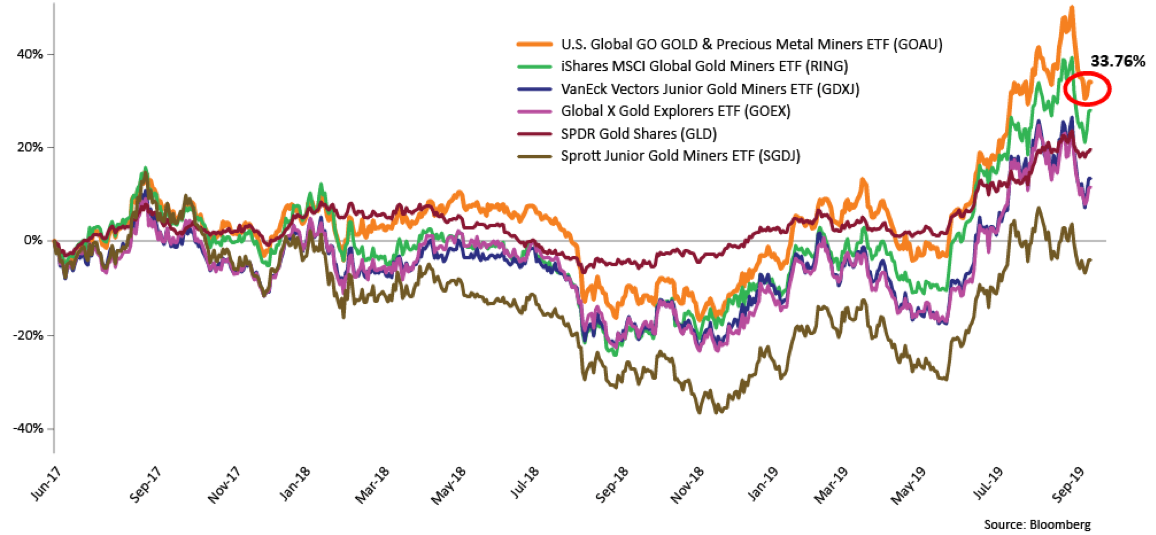
TGR: Let’s move on to gold. U.S. Global Investors has the U.S. Global GO GOLD and Precious Metal Miners ETF (GOAU:NYSE.Arca), which has been in existence for a couple of years now, and it’s been outperforming many of its peers in this latest gold run-up. First, can you explain how your stock selection works?

FH: I had become frustrated in seeing in the gold market the way the stocks were acting, and so we started applying our quant approach. We used 100 different factors. We spent over 8,000 hours digging to try to understand it. What we noticed is there are some macro forces that all investors should realize. Of all these factors you look at, some are good for screening stocks, others are very good for picking stocks.

And I noticed that they like royalty companies, and so do I. And I’ve always advocated to your readership Franco-Nevada Corp. (FNV:TSX; FNV:NYSE), Wheaton Precious Metals Corp. (WPM:TSX; WPM:NYSE) and Royal Gold Inc. (RGLD:NASDAQ; RGL:TSX) because they have a superior business model that has lower volatility in revenue, cash flow and earnings, and royalty companies have the highest revenue per employee of any industry group on the NYSE.

If both revenue and cash flow of last quarter are above four quarters, you start getting more people interested in your stock. The quant funds buy the gold stocks that are demonstrating that. They look for companies that have higher returns on cash, higher returns on invested capital.

We started building a model. We went down to 28 stocks. The three biggest royalty companies are 10% each. They rebalance each quarter. And among the rest of them, the turnover is based on which has the cheapest relative value to cash flow multiples, which has the highest returns on invested capital and which has the strongest momentum in revenue and cash flow. We go down to $200 million ($200M) market caps, and we pick those stocks.

With the Market Vectors Gold Miners ETF (GDX:NYSE.Arca) and Market Vectors Junior Gold Miners ETF (GDXJ:NYSE.Arca), a lot of these gold mining companies have done mergers that make the topline look great, but on a per share basis, it’s destructive. So the quant funds don’t buy those stocks. They buy those companies that are accretive, that do acquisitions that are accretive and the reserves per share are growing, the cash flow per share is growing, the revenue per share is growing.

I’ll give you a classic example. The GDXJ in the past decade has diluted the shareholders’ factors by 47%. That is, all the constituents in there have done so many mergers or dumb financings that are non-accretive, that basically those stocks become orphaned until they repair themselves.

A great stock was IAMGOLD Corp. (IMG:TSX; IAG:NYSE). It had that revenue per share of over four quarters, it had the cash flow, it had returns on capital that were extremely attractive. Then we raised our model. The stock went on a huge run and then in January, it had problems. Its revenue and its cash flow per share dropped. We kicked it out, and it’s done nothing but fall down. When it finally gets that turned around, then it can apply. So our model is very efficient because it’s looking at those factors. GOAU has performed very well.
holmes1

TGR: What companies have been leading the pack in the GOAU ETF?

FH: Half of them are looking for who has momentum. The other half are looking for who’s the cheapest. So at the beginning of this run, the Australian stocks had very, very attractive multiples. They were the best performers. So they were very instrumental for us when we looked at those names.

But if I take a look today at the holdings with the royalty companies, we don’t know who’s going to win the race each quarter, but something’s going to happen.

One of the stocks that is really inexpensive or has that momentum is North American Palladium Ltd. (PDL:TSX; PAL:NYSE). It looks like Brookfield Business Partners (BBU:NYSE) wants to sell its position, and I think that’s a stock to be taken out. It’s probably going to be taken out at a much higher price. It showed up in the model because of the five factors we use; it knocks the ball out of the park.

Another one is Silvercorp Metals Inc. (SVM:TSX; SVM:NYSE).

The new kid on the block that has very attractive metrics is K92 Mining Inc. (KNT:TSX.V).

Another one would be OceanaGold Corp. (OGC:TSX; OGC:ASX), which has the Haile project coming onstream on the East Coast in the Carolinas. That’s a stock that’s done exceptionally well.

Detour Gold Corp. (DGC:TSX) has shown up, which is interesting, as a stock that has made a turn.

A stock that has very attractive factors that’s in West Africa is SEMAFO Inc. (SMF:TSX; SMF:OMX). We used to own Endeavour Mining Corp. (EDV:TSX; EVR:ASX). It went out. It didn’t meet those factors, whereas SEMAFO is extremely attractive both on relative valuation—it’s inexpensive—and it has momentum.

TGR: Do you rebalance quarterly?

FH: Yes, we rebalance quarterly. So really, it’s almost active. It’s rules based. And we have a third party that has our quant model, the algorithm. They run it, and they pick the stocks. And we run it. And then there’s a discussion about whether we missed something because the biggest thing I learned in this whole exercise is you have to check the data all the time. You just can’t have a black box. Your margin of error starts to rise each quarter if you don’t double check and triple check your data.

By the way, it’s interesting, because the quant model led me into another company called Goldspot Discoveries Inc. (SPOT:TSX.V), which I became the chairman of, and invested in. We’ve had a very unstable investor who has been blowing up the stock. But I went into this company because it has artificial intelligence (AI) at the core. We have nine people on the Goldspot team with doctorates. Did you know that a Ph.D. in Silicon Valley is worth $5 million? We have nine of them. That’s worth US$45 million or CA$60 million. This is a company with a $10 million market cap that’s profitable when we take a look at the turn. And it has leverage from the upside, because it gets stock positions and royalties on some of the junior mining.

Major figures in mining like Eric Sprott own a big piece. We have Elliott Management Corp., through its Triple Flag Mining Finance. It is a major shareholder, like ourselves. It has a huge institutional sponsorship. But one of the early founders is basically liquidating his stock, looking for other adventure investing, and it’s provided just a great opportunity to accumulate. And I like it because it’s technology based, and it has helped Rob McEwen find a couple new discovery holes. Hochschild’s chief financial officer is on the board, and the company has used it to remap everything in Peru. It found it extremely useful. I think this technology applied to mining is going to be the future.

TGR: Earlier you said that precious metals mining hasn’t seen innovation equivalent to fracking in the oil industry, and is unlikely to, but it sounds like this could be the closest thing to it.

FH: Yes, it could be. It diminishes the risk of exploration spending. When Goldcorp was using IBM’s Watson—IBM didn’t have nine Ph.D. geoscientists that we have, along with 11 other scientists.

Goldspot is doing work for Gran Colombia Gold Corp. (GCM:TSX). That’s another one of those stocks I’ve recommended before, especially its gold notes listed on the Toronto Stock Exchange. It pays 8.25%. When gold is above $1,250/ounce, it pays a higher yield. So I’m enjoying a 12% coupon. The rest of the world is going to zero interest rates. It’s in our mutual funds, and guess what? It covers all the fund expenses. You only have to have 5%, and it’s very stable. But it has a high, high yield. So we’ve gotten our money back already, once when we first made that initial investment from the coupon. Gran Colombia is now using Goldspot to help fast-track the development of its production in Colombia.

Yamana Gold Inc. (YRI:TSX; AUY:NYSE; YAU:LSE) is using Goldspot’s technology too. The chairman of Yamana has told me that he finds it exceptional—a detailed analysis—and it helps identify locations the company never thought of.

Eric Sprott loves it. He’s a big shareholder. He’s used it and continues to use it.

So Goldspot is growing. It has a new product that’s very inexpensive for the junior explorers, like $50,000, to help organize all their data and to give them, basically, a screening positioning, so they can become more digital and coordinate all of the different geoscientists for that. Then if they want detailed mapping on the ground, etc., that will cost hundreds of thousands of dollars more. But it has that product that I think the junior explorers need to help them get caught up with this digital world.

TGR: Any parting thoughts for our readers?

FH: I think you have to realize, what I call, the DNA of volatility of gold. Most of the New York mob, as I like to call it, are still anti-gold, and you just have to recognize that. They try to spin that gold is more volatile than the S&P 500, but we just did an analysis. The 10-day volatility of gold is 2%, and the S&P is 3%. So over any rolling 10-day period, it is a non-event 7% of the time for the S&P to go up or down 3%, and gold is only 2%. And quite often, if the S&P falls 3%, gold is up 2%, so it’s a great counterweight to a portfolio.

Also recognize that silver’s volatility is more than that. Silver is more like the 3%. And when we look at the digital currencies, they’re more like a huge magnitude, they’re 12% volatility, so much more volatile. But you can use the volatility to your favor. I’ve written about it extensively in Managing Expectations, on our website at usfunds.com, to explain what sigmas mean and how you can think like a quant trader.

TGR: Thank you for your time, Frank.

Frank Holmes is CEO and chief investment officer at U.S. Global Investors, which manages a diversified family of funds specializing in natural resources, emerging markets and gold and precious metals. In 2016, Holmes and portfolio manager Ralph Aldis received the award for Best Americas Based Fund Manager from the Mining Journal. In 2011 Holmes was named a U.S. Metals and Mining “TopGun” by Brendan Wood International, and in 2006, he was selected mining fund manager of the year by the Mining Journal. He is also the co-author of The Goldwatcher: Demystifying Gold Investing. More than 30,000 subscribers follow his weekly commentary in the award-winning Investor Alert newsletter, which is read in over 180 countries. Holmes is a much sought-after keynote speaker at national and international investment conferences. He is also a regular commentator on the financial television networks CNBC, Bloomberg, BNN and Fox Business, and has been profiled by Fortune, Barron’s, The Financial Times and other publications.

Disclosure:
1) Patrice Fusillo conducted this interview for Streetwise Reports LLC and provides services to Streetwise Reports as an employee. She owns, or members of her immediate household or family own, shares of the following companies mentioned in this article: None. She is, or members of her immediate household or family are, paid by the following companies mentioned in this article: None.
2) The following companies mentioned in this interview are billboard sponsors of Streetwise Reports: None. Click here for important disclosures about sponsor fees. The information provided above is for informational purposes only and is not a recommendation to buy or sell any security.
3) Frank Holmes: I, or members of my immediate household or family, own shares of the following companies mentioned in this article: None. I, or members of my immediate household or family, are paid by the following companies mentioned in this article: None. My company has a financial relationship with the following companies mentioned in this interview: HIVE Blockchain Technologies. Funds controlled by U.S. Global Investors hold securities of the following companies mentioned in this article: Franco-Nevada, Wheaton Precious Metals, Royal Gold, IAMGOLD Corp., North American Palladium Ltd., K92 Mining Inc., OceanaGold Corp., Detour Gold Corp., SEMAFO Inc., Gran Colombia Gold Corp. and Yamana Gold Inc.. I determined which companies would be included in this article based on my research and understanding of the sector. I had the opportunity to review the interview for accuracy as of the date of the interview and am responsible for the content of the interview.
4) The interview does not constitute investment advice. Each reader is encouraged to consult with his or her individual financial professional and any action a reader takes as a result of information presented here is his or her own responsibility. By opening this page, each reader accepts and agrees to Streetwise Reports’ terms of use and full legal disclaimer. This article is not a solicitation for investment. Streetwise Reports does not render general or specific investment advice and the information on Streetwise Reports should not be considered a recommendation to buy or sell any security. Streetwise Reports does not endorse or recommend the business, products, services or securities of any company mentioned on Streetwise Reports.
5) From time to time, Streetwise Reports LLC and its directors, officers, employees or members of their families, as well as persons interviewed for articles and interviews on the site, may have a long or short position in securities mentioned. Directors, officers, employees or members of their immediate families are prohibited from making purchases and/or sales of those securities in the open market or otherwise from the time of the interview or the decision to write an article until three business days after the publication of the interview or article. The foregoing prohibition does not apply to articles that in substance only restate previously published company releases. As of the date of this interview, officers and/or employees of Streetwise Reports LLC (including members of their household) own securities of Franco-Nevada, a company mentioned in this article.

( Companies Mentioned: DGC:TSX,
FNV:TSX; FNV:NYSE,
SPOT:TSX.V,
GCM:TSX,
HIVE:TSX.V; PRELF:OTC,
IMG:TSX; IAG:NYSE,
KNT:TSX.V,
PDL:TSX; PAL:NYSE,
OGC:TSX; OGC:ASX,
SMF:TSX; SMF:OMX,
SVM:TSX; SVM:NYSE,
)

Chile cuts rate 3rd time as protests affect economy

By CentralBankNews.info

Chile’s central bank cut its monetary policy rate for the third time and said it assumes “a further monetary boost is needed” to ensure inflation converges towards its target as recent events, which include violent protests against price hikes and a state of emergency, will affect economic activity.

The Central Bank of Chile’s board unanimously cut its monetary policy rate by a further 25 basis points to 1.75 percent and has now lowered it by 125 points following cuts in June and September.

The cut in June followed a 25-point rate hike in January so the net reduction in the policy rate this year is 100 points.

“The complex developments that have occurred in the country in recent days will have an impact on the evolution of the economy,” the central bank said, adding activity in the short run will be affected by the partial breakdown of the country and damaged infrastructure.

The central bank said its December Report would include an analysis of the impact of the recent events, the outlook for inflation and the response of monetary policy.

Today’s rate cut follows the central bank’s warning in September that further easing might be required to boost inflation amid disappointing economic activity and the escalating trade conflict between the U.S. and China.

Chile, the world’s largest copper producer, has been hit by falling demand and a slump in prices for copper since June last year.

Several cities in Chile, including the capital of Santiago, have been hit by days of riots, which have led to thousands of arrests and 15 deaths in response to a hike in public transportation costs.

The violence led President Sebastian Pinera to declare a state of emergency, placing the military in charge of security. But Pinera has also acknowledged government failures and announced economic reforms intended to restore calm.

The protests have hit financial markets hard, with the peso falling 2.2 percent to 726.6 to the U.S. dollar in recent days to be down 4.5 percent this year, Chile’s main stock index has fallen 3.6 percent since last Friday, and JP Morgan has lowered the country to underweight from neutral.

Looking abroad, the central bank said the external scenario was largely in line with it had expected in September “and continues to be marked by major tension spots, a deterioration of manufacturing, investment and global trade.”

In June the central bank cut its forecast for 2019 growth to 2.75 – 3.5 percent from the March forecast of 3.0 – 4.0 percent, and 2018’s growth of 4.0 percent.

The Central Bank of Chile issued the following press release:

“In its monetary policy meeting, the Board of the Central Bank of Chile decided to lower the monetary policy interest rate by 25 basis points, to 1.75%. The decision was adopted unanimously by all five Board members.
The external scenario is in line with forecasts in the September Monetary Policy Report, and continues to be marked by major tension spots, a deterioration of manufacturing, investment, and global trade. Accordingly, the growth outlook has been adjusted downward in several economies. The monetary authorities have further increased the stimuli while the markets, with ups and downs, show bounded increases in long-term interest rates and stock indexes. The copper price posted virtually no change since the last monetary policy meeting, and the oil price, despite transient supply disruptions, tended to decline.
Third-quarter data at hand are in line with the last Report’s baseline scenario. The expansion of activity outperformed that of the first half, while investment remained dynamic. On the consumption side, growth in the wage mass has been flat, consumer confidence has deteriorated and consumer goods imports have declined. Financial conditions are still favorable. CPI inflation is still near 2% annually, with persistently weak services in the CPIEFE. The various inflation expectations indicators show no significant variation.
The complex developments that have occurred in the country in recent days will have an impact on the evolution of the economy. Short-run activity will be affected by the partial breakdown of the country and damaged infrastructure. Towards the medium term, most important will be the magnitude and timeline of reconstruction works, the impact on confidence and the effects of the course of action announced by the Government. So far this scenario has had bounded effects on the local financial markets, including a depreciation of the peso and corrections in the fixed-income market. The stock exchange showed a somewhat sharper decline. The December Report will bring a thorough more informed analysis of the impact of the recent events on the economy, the inflation outlook and the response of monetary policy.

The Board’s decision assumes that for inflation to converge to the target a further monetary boost is needed, which will be assessed in the light of the macroeconomic scenario, especially after the events of recent days. With that, the Board reiterates its will to conduct monetary policy with flexibility, so that projected inflation stands at 3% over the two-year horizon.
The minutes from this monetary policy meeting will be published at 8:30 hours of Monday 11 November 2019. The next monetary policy meeting will be held on Friday 6 December, and the statement thereof will be published at 18:00 hours the same day.”

    www.CentralBankNews.info


Angola holds rate, raises RRR as it lets kwanza float

By CentralBankNews.info

Angola’s central bank left its benchmark interest rate, the BNA rate, unchanged at 15.50 percent interest but raised the reserve requirement and established a new interest rate for a 7-day facility as it implemented a floating exchange rate regime for the kwanza in which its value is set according to demand and supply.

At an extraordinary meeting of the National Bank of Angola’s (BNA) monetary policy committee to evaluate the ongoing reform of the exchange rate regime that began in January 2018, a 10 percent interest rate was set for a 7-day maturity facility, the zero percent rate was kept for the overnight liquidity-absorbing facility, the reserve requirement for kwanza liabilities was raised to 22 percent from 17 percent, and a 2.0 percent margin on the reference exchange rate by commercial banks trading in foreign currency was removed.

In addition, BNA said it had decided to relax the limits on various payment instruments used to finance goods imports.

BNA said it wants to implement the new market-determined exchange rate regime quickly, describing the current conditions as “the best possible” following the start of the macroeconomic stabilization program.

The free float of the kwanza is the latest major reform move by the BNA since Governor Jose Massano took over in October 2017 as part of Angolan President Joao Laurenco’s efforts to clean up the country’s image as a corrupt state.

Massano’s reforms include replacing the fixed exchange rate regime with auctions to set a reference rate in January 2018, adopting the monetary base as an operational variable to better control liquidity, lowering and changing the basis for banks’ mandatory reserves, and unifying the rate on the marginal lending facility with that of the bank’s basis interest rate.

The kwanza has declined steadily since the fixed regime was ended in January 2018 and was trading at 455.17 to the U.S. dollar today, down 32.2 percent this year and down 63.5 percent since the previous peg of 166 to the dollar.

As part of its efforts to improve the country’s financial sector, the BNA revoked the banking licenses of two banks in January after they failed to raise their capital to meet new minimum levels and Massano has said more banks may have their licenses revoked when the results of asset quality assessments are released later this month.

Angola, Africa’s second largest oil producer, currently has 26 banks and any commercial bank that needs to raise its capital will have until June 2020 if the assessment determines shortages.

Angola’s economy still hasn’t recovered fully after the plunge in crude oil prices in 2014, with economic output last year still below that of 2014.

In the second quarter of this year gross domestic product contracted by an annual 0.1 percent, down from a 0.3 percent fall in the first quarter of this year.

Angola’s inflation rate fell to 16.08 percent in September, its lowest since January 2016, and in September Massano told Bloomberg inflation was expected to fall below 10 percent by 2022, proving scope for interest rates to be lowered.

BNA has cut its key rate twice this year, in January and May, by a total of 100 basis points.

www.CentralBankNews.info


First Look At German Business Sentiment For October

By Orbex

After being whipsawed yesterday with the results from the Brexit vote in the UK Parliament, the euro is in for another busy day tomorrow with a host of key events.

Before we get to the ECB’s interest rate decision, we have a set of fresh economic data from Europe. The most important and market-moving will be the German PMI.

The flash reading is especially interesting for the markets because it’s a preliminary view for the current month. It has the most up-to-date perception of what’s going on in the economy.

It also typically has a direct impact on the exchange rate. And, with the ECB largely expected to stay the course, it might be the highlight of the trading day.

What We Are Looking For

We start with France, where we could have our first complication.

Of the three PMI surveys, the one that is most relevant for the euro is the manufacturing measure.

Expectations are for the manufacturing PMI for France to slip back into contraction again at 49.1 compared to 50.1 prior.

Admittedly, this figure has been hovering around the tipping point between contraction and expansion since the beginning of the year. So, the market will likely be sanguine about another PMI below 50.

As for the other measures, we can expect services PMI to stay in expansion at 51.5 compared to 51.1 prior. This should be enough to keep the Composite PMI in the positive as well at 51.1 expected, compared to 50.8 in September.

The Major Event

Germany reports fifteen minutes after France.

Expectations are for manufacturing PMI to deepen into contraction to 40.0 compared to 41.7 las month. This would be a continuation of the downward trend that it has been having for nearly two years at this point. It would also be the worst result since the last major recession, a bad sign for Germany’s future economic prospects.

There is a pretty broad consensus that we’ll get bad news from Germany’s manufacturing sector. This sector is still having trouble with exports.

The recent tariffs applied by the US following the WTO resolution aren’t expected to have any measurable impact. The only positive thing analysts might get from this is that it will increase pressure on the German government to raise spending. However, that’s still a long shot, and it’s fraught with its own problems.

Of course, there is a potential for a surprise on the upside. However, we wouldn’t expect substantial strength in the euro unless the Manufacturing PMI showed a substantial improvement over the trend, so something over 44.

As for the other data from Germany, expectations are for the services PMI to remain in expansion at 51.2 compared to 51.4 last month. Even if this data matches expectations, it could be seen as negative for the euro. It would be a confirmation of the sudden drop in the perspective on the German domestic economy that we saw in September.

Second-Tier Measures

We can expect composite PMI for Germany to remain in contraction at 49.2. This would be an improvement over 48.5 prior despite the consensus that manufacturing will deteriorate.

Half an hour later, we get PMI’s for the eurozone, but they typically have little effect on the market since the market already has a good idea of what to expect after digesting the other major economies.

Still, expectations are for the manufacturing PMI for the eurozone to stay firmly in contraction at 45.0. This would be a worsening from 45.7 prior, and largely being dragged down by Germany.

By Orbex


Markets Await Mario Draghi’s Last ECB Meeting

By Orbex

The upcoming October ECB meeting this week is drawing a lot of attention from the markets. This is because it will be the last meeting with current president Mario Draghi as head of the ECB.

Following the bank’s rate cut at its last meeting, we aren’t expecting the ECB to adjust monetary policy again.

The minutes from the last meeting revealed an intense split within the policymakers at the ECB with several members against easing. In light of this, the likelihood of doves being able to affect further easing at this stage seems diminished.

Eurozone Data Has Worsened

However, since the last meeting, data out of the eurozone has worsened materially.

Several key indicators over the last month have indicated weakness in the eurozone economy. Chief among these was the September manufacturing PMI. This showed that factory activity in the eurozone had fallen into contractionary territory, marking the indicator’s lowest readings since the global financial crisis.

Inflation has been stubbornly low over recent months, with declines over September exacerbated by weaker energy prices. Industrial production and retail sales were also notably low over September.

German Economy Faltering

While eurozone data as a whole has been disappointing, data weakness out of Germany is also causing concern. The German manufacturing engine has slowed significantly over the last year fuelled by the decline of the automobiles sector.

With the US recently approving fresh tariffs to certain EU goods, the outlook for the eurozone remains clouded.

Forward Guidance in Focus

Although the ECB isn’t likely to announce any more easing at this point, traders will be keen to gauge whether any further easing will come this year.

The key to this will be assessing the level of division which remains in the ECB. If policymakers are still fiercely divided over the course of further action, this could see some upside in EUR as traders cover short positions on longer-term trades.

For now, the division among policymakers has been confined to any further asset purchases. As such, the market is still expecting a further cut to the deposit rate before the end of the year.

Lagarde To Continue with Easing

Christina Lagarde will take over from Draghi as of next month. As yet, the market is unclear on where she stands on ECB monetary policy.

However, it is likely that she will look to continue Draghi’s approach of monetary easing given the weakness remaining in the eurozone economy. Furthermore, given the downside risks, it certainly seems unlikely that the ECB will move away from an easing stance in the near term.

Technical Perspective

The current rally in EURUSD has seen price breaking above the 1.1217 level. However, for now, price remains within the bearish trend line from 2019 highs.

The 1.1218 level is the next topside market to watch with the 61.8% retracement from the summer highs coming in just ahead of that level. To the downside, any retracement lower will put the focus back on a further test of the 1.0926 level.

By Orbex


5 Ways To Improve Your Technical Analysis Skills

By Orbex

Technical analysis can sometimes be seen as an easier approach to forex trading than fundamental analysis.

But, truth be told, there is quite a bit of a learning curve to it.

Many forex traders who are just starting out find it challenging to understand the technicals. And it does take a good amount of practice to build familiarity with the charts.

In fact, even intermediate FX traders with some experience still find technical analysis challenging.

But, as with most things, the only solution is to practice, practice, and practice some more.

So, to make the learning curve just that little bit easier, here are five ways to improve your technical analysis and forex trading skills.

1. Find Out What Works & Stick To It

Some FX traders jump from one method to another in search of the perfect trading system or approach to technical analysis.

If you want to get good at technical analysis, the key is to find a method that works for you and stick to it until you’re well-versed with the ins and outs of how it works. This will enable you to automatically identify areas where you can improve, and adapt your strategy accordingly.

2. Multi-time Frame or Just a Single Time Frame?

There can be an endless debate on the merits of using a multiple time-frame approach in technical analysis. Some FX traders swear by it, while others are just fine using technical analysis on a single time frame.

What few people realize is that switching from one time frame to another means you might be able to spot something that you would otherwise miss.

Bear in mind that although it’s helpful, this will in no way give you that sought after edge in the markets that we all chase.

The key is to understand whether the time frame(s) you are using complement the technical analysis methods that you are using.

3. Go Back to Basics

You might be using price action techniques or perhaps you’re partial to forex indicators. No matter what methods you employ, it always helps to research deeper into the techniques you are employing.

Some technical analysis methods date back decades. For example, Elliott wave and Andrew’s pitchfork methods have been around for ages. If you happen to use such methods in technical analysis, you can understand how the concepts began and why.

You would be surprised to see how much the technical analysis methods you are using today have changed over the years.

While it can just be a good walk down memory lane, you can also find yourself picking up a trick or two. This will no doubt help you become more confident with technical analysis.

4. Learn What Markets to Work On

Whether it is forex, stock CFDs or commodity CFDs that you are trading, some technical analysis methods are purely designed for a particular market.

Therefore, it makes sense that you first understand the markets that your technical analysis methods were initially designed for.

As an example, simple indicators such as the Advance/Decline or the VIX indicators are primarily suited for the stock markets.

Would it, therefore, make sense for you to use such indicators in the currency markets? Obviously not! Likewise, it always helps to pause and step back to understand what markets the technical analysis methods are designed for.

5. Read & Learn

For many forex traders, technical analysis learning ends with a method that they are comfortable with. But it’s something that evolves on a day to day basis. The only way to improve your technical analysis methods is to ensure that you are up to date.

This could mean having to subscribe to technical trading journals or even purchase some books on technical analysis. My personal recommendation would be John J. Murphy’s book. It’s a great way to start your research and gives great insights into the various technical analysis methods!

By Orbex


Georgia raised rate 3rd time in 2 months, lari rises

By CentralBankNews.info

Georgia’s central bank raised its monetary policy rate for the third time in two months and reiterated that it would continue to tighten its policy until the pressure on the lari’s exchange rate is eliminated and ease the upward pressure on inflation.

The National Bank of Georgia (NBG) raised its rate by 100 basis points to 8.50 percent and has now raised it 200 basis points following earlier hikes on Sept. 4 and Sept. 25.

The three rate hikes more than reverse two 25-basis point rate cuts in January and March, and the lari responded positively to the central bank’s move, rising 0.2 percent to 2.960 per U.S. dollar. However, the lari still remains 9.5 percent below the start of this year.

“The nominal effective exchange rate of the GEL remains at an impaired level and is pushing up inflation,” the central bank said, adding further policy decisions will depend on how quickly inflationary pressures from the exchange rate will be eliminated.

Georgia’s inflation rate has accelerated in the last three months, rising to 6.4 percent in September from 4.9 percent in August, boosted by higher taxes on cigarettes and the lower lari.

The central bank targets inflation of 3.0 percent and said demand is only partly offsetting the upward pressure on inflation from the fall in the lari as preliminary data indicate an acceleration in economic growth.

Georgia’s gross domestic product eased to annual growth of 4.5 percent in the second quarter from 4.9 percent in the first quarter and NBG said early data show the improvement in the current account balance had continued in the third quarter.

In the second quarter Georgia’s current account deficit narrowed to US$139.6 million from $232.3 in the first quarter and NBG said maintaining this positive trend, along with tighter monetary policy, will help strengthen the exchange rate and thus change the inflationary trend.

Last month the International Monetary Fund (IMF) welcomed Georgian authorities commitment to prudent macroeconomic policies and structural reform, including NBG’s rate hike.

The IMF also noted a significant adjustment in the current account in the first half of this year, with higher exports and remittances, along with falling imports,  helping narrow the deficit.

The IMF maintained its forecast for Georgia’s economy to growth 4.6 percent this year and inflation to ease to 5.4 percent by the end of the year and then converge toward the 3.0 percent target in 2020 as monetary conditions tighten.

The current account deficit is projected by the IMF to narrow by almost 2 percentage points of GDP to 6.0 percent of GDP this year.

 www.CentralBankNews.info


EURUSD Analysis: Consumer sentiment decline bearish for EURUSD

By IFCMarkets

Consumer sentiment decline bearish for EURUSD

The consumer confidence index decreased in euro area more than expected in October. Will the EURUSD decline?

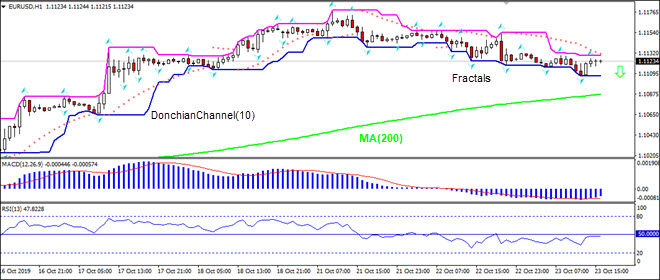
EURUSD falling toward MA(200)

The price chart on 1-hour timeframe shows EURUSD: H1 is in downtrend. The price is falling toward the 200-period moving average MA(200) which is rising. The RSI oscillator is rising toward 50 level.

Technical Analysis Summary

OrderSell
Sell stopBelow 1.1107
Stop lossAbove 1.1127

Market Analysis provided by IFCMarkets

NZDUSD Analysis: Narrowing New Zealand trade deficit bullish for NZDUSD

By IFCMarkets

Narrowing New Zealand trade deficit bullish for NZDUSD

New Zealand’s trade deficit narrowed in September more than expected. Will the NZDUSD rise?

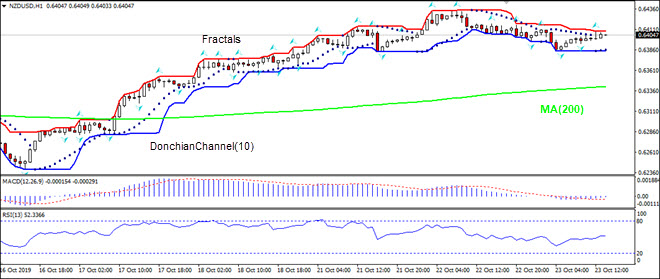
NZDUSD rising above MA(200)

The price chart on 1-hour timeframe shows NZDUSD: H1 is trading sideways. The price is rising above the 200-period moving average MA(200) which is rising. And the RSI oscillator is above 50 level but has not reached the overbought zone. There is no trend yet formed, traders have to decide when it would be a best time to enter the market.

Market Analysis provided by IFCMarkets

Equities In The Green On Brexit Delay Hopes

By Orbex

USD Traders Waiting on Next Round of Data

The US dollar has been higher across the European morning today as equities have seen some downside in the face of ongoing uncertainty over Brexit and US/China trade negotiations. US and Chinese officials are due to hold further talks tomorrow aimed at paving the way for the recently agreed “phase one” trade deal to be signed. Ahead of those talks, focus tomorrow will be on durable goods and manufacturing data. Any further data weakness is likely to put an end to the current recovery in USD.

EUR Lower Ahead of ECB Tomorrow

EURUSD has been weaker today as the recovery in USD has seen selling pressure in the single currency ahead of tomorrow’s ECB meeting. The market is not looking for the ECB to make any policy adjustments tomorrow. However, traders will be keen to judge whether the bank is likely to make any further easing announcements this year. The recent patch of Eurozone data weakness in the Eurozone raises the risk of a dovish tone to tomorrow’s meeting. EURUSD trades 1.1112 last having fallen back below the 1.1127 level.

GBP Down Amidst Brexit Uncertainty

GBPUSD has been lower over the session so far today, weighed upon by a stronger US dollar and Brexit uncertainty. Following another parliamentary defeat last night, Boris Johnson has said that he will now wait to see if the EU agrees to extend Brexit once again as per the request made by the PM, in line with the terms of the recently passed Benn Bill.

Risk Assets Remain Firm

Risk assets have been higher across the European morning today, reflecting a sense of relief that Brexit now looks likely to be postponed once again. Furthermore, following phone calls on Monday, US and Chinese officials are due to speak on Friday which is keeping the market hopeful that a trade deal will indeed be signed between the two nations. SPX500 trades 2995.13 last.

Gold Higher, JPY Lower

Safe havens have both been firmer today with JPY and gold trading higher against USD. With the market still pricing in an October rate cut from the Fed, gold price remains underpinned here. XAUUSD trades 1492.58 last, still holding above 1481.93 support. USDJPY trades 108.44 last having been rejected at the 108.84 level.

Crude Lower On Inventories Build

Oil prices have seen some weakness today as the market waits for the headline EIA report to be released later. The API report released yesterday showed a further build in US crude stores which weighed on prices. If the EIA report today confirms this build, further downside will likely be seen. Crude trades 54 last, still capped by the 55 level resistance.

CAD Under Pressure

USDCAD has been a little lower today despite a stronger USD and weaker oil prices. USDCAD trades 1.3099 last, still sitting above the 1.3068 support following the last two weeks of declines which have seen price falling from highs above 1.33. For now, focus remains on further weakness in the near term.

AUD Retreats For Now

AUDUSD has been a little lower today so far as uncertainty around US/China trade negotiations has seen a pause in recent upside momentum. However, with talks due to continue on Friday there is still room for further upside in AUD should we see positive headlines around the talks. AUDUSD trades .6845 last, sitting back below the .6850 level as of writing.

By Orbex