Ukraine cuts rate 4th time, sees easing through 2021

By CentralBankNews.info

Ukraine’s central bank cut its key policy rate by another 100 basis points to 15.50 percent and said it expects to continue to lower the rate toward 8.0 percent by the end of 2021, provided inflation continues to decline toward its target of 5.0 percent.

The National Bank of Ukraine (NUB) has now cut its rate by a total of 250 basis points this year following cuts in April, July, September and today.
The largest rate cuts are expected to take place next year as inflation returns toward the target range and inflation expectations improve but NBU said the path toward a 8.0 percent rate could also be slower if risks to inflation emerge, or rates could be cut faster if inflation falls faster.

“These cuts will greatly depend on whether or not key internal reforms are sped up,” NBU said, pointing to reforms in a memorandum of understanding between the government and the central bank, along with judicial reforms that establish the rule of law in the country.

Inflation in September dropped to 7.5 percent from 8.8 percent in August is continuing to slow in October, NBU said.

The central bank is still expecting inflation to fall to 6.3 percent by the end of 2019, meeting the target range in early 2020 and the target at the end of 2020.

NBU is in the first stages of implementing inflation targeting, which is characterized by disinflation toward its optimal target, and its 2019 policy guidelines set out a quarterly trajectory for inflation to reach 5.25 percent, plus/minus 2 percentage points by September, and then 5.0 percent, plus/minus 1 percentage point starting in December.

Despite the slowing global economy, demand in Ukraine has been improving along with consumer sentiment and higher agricultural production, with growth accelerating to 4.6 percent in the second quarter, up from 2.5 percent in the first quarter.

NBU expects the economy to continue to expand and forecast growth will average 3.5 percent this year and in 2020, and 4.0 percent in 2021.

The National Bank of Ukraine released the following press release:

“The Board of the National Bank of Ukraine has taken a decision to cut its key policy rate to 15.5% per annum effective 25 October 2019. The NBU continues the cycle of monetary policy easing as inflation is firmly declining towards the target of 5%.
In September 2019, consumer inflation declined to 7.5% yoy, below the forecast published in the July Inflation Report. Inflation continued to slow in October according to the NBU’s preliminary estimates.
The steady disinflation has been driven by a gradual easing of underlying pressures on prices, reflected in a rapid slowdown of core inflation. The tight monetary policy was one of the reasons behind the strengthening of the hryvnia and improvement in inflation expectations. That has a major impact on prices, surpassing the effect of factors that push prices upwards, particularly the effect of the sustained consumer demand.
Inflation will continue to decline towards the target of 5%
Same as before, inflation is projected to decline to 6.3% as of the end of 2019, meet the target range in early 2020, and reach the medium-term target of 5% at the end of 2020.
By the end of 2019, core inflation will slow more than expected, while fuel prices will remain below last year’s levels due to the stronger hryvnia.  At the same time, supply of vegetables affected by unfavorable weather will put an upward pressure on prices. Therefore, considering the offsetting effect of these factors, the NBU maintains its inflation forecast for the end of 2019.
Same as this year, the tight monetary stance will continue to push inflation lower, to 5% in 2020–2021. Despite the gradual reduction in the key policy rate, its real value will remain high on the back of improved inflation expectations. Relatively high real interest rates will keep hryvnia financial instruments attractive for investors and thus influence the exchange rate of the national currency.
As a result, the more favorable FX market will neutralize the pressure domestic demand has on prices, which will be somewhat higher according to the new forecast.
Other factors behind the gradual disinflation will include:
  • a prudent fiscal policy
  • relatively low energy prices on the global markets
  • an increase in food supply driven by higher productivity in agriculture.
In 2019–2021, the economy of Ukraine will grow steadily, at 3.5%–4%
Compared to the July macroeconomic forecast, the NBU has revised its economic growth forecast upwards, to 3.5% in 2019 and 2020 and 4% in 2021. The revision was driven by the sustained domestic demand, higher productivity in agricultural production, and improved consumer sentiment.
In the meantime, slower growth in the global economy and worsened terms of trade will weigh on economic growth in 2020.
The 2019–2021 current account deficit will remain acceptable
Despite the stronger hryvnia, the current account deficit in 2019 will narrow to 2.9% of GDP, thanks to an improvement in the terms of trade and the rich grain harvest.


In 2020–2021, the current account deficit will widen slightly, as a result of a decrease in natural gas transit and less favorable global commodity prices (lower iron ore prices and gradually rising energy prices).
Further cooperation with the International Monetary Fund remains the basic assumption of the macroeconomic forecast
The current NBU forecast assumes the new IMF cooperation program will be approved by the end of 2019.  This will allow Ukraine to attract other official financing, improve the conditions of access to the international capital markets, and support the interest of investors in Ukrainian assets.
As a result, notwithstanding the large external debt repayments, the international reserves will range at around USD 23–24 billion in 2019 and the following years, which is sufficient to cover three months of future imports.
A delay in entering into a new cooperation agreement with the IMF, and increased threats to macrofinancial stability – mainly due to Ukrainian court rulings – pose the key risks to the said macroeconomic forecast, and in particular to inflation decreasing to its target in 2020 
When materialized, these risks could deteriorate exchange rate and inflation expectations, and make it harder for Ukraine to access the international capital markets in order to repay a heavy debt load in the coming years.
The following risks also remain important:
  • the complete halt of the transit of Russian gas through Ukraine
  • intensified trade tensions and more turbulent global financial markets
  • an escalation of the military conflict and new trade restrictions introduced by Russia.
A more rapid decline in underlying inflationary pressures than anticipated, coupled with no change in the balance of risks, have made it possible to ease monetary policy somewhat more quickly this year than envisaged in the previous macroeconomic forecast. As a result, the Board has cut the key policy rate by 1 pp, to 15.5%.
The NBU’s forecast scenario envisages that the key policy rate will be cut further, to 8% as of the end of 2021, provided that inflation steadily declines to its 5% target
As before, the largest decrease in the key policy rate is expected to take place in 2020, along with inflation returning to its target range and inflation expectations improving.
If the above inflation risks, both internal and external, materialize, the key policy rate could decline to 8% more slowly.
That said, the key policy rate could be cut, to 8%, much more quickly. These cuts will greatly depend on whether or not key internal reforms are sped up. These reforms are those that are envisaged in the memorandum of understanding signed by the Ukrainian government and the NBU, and the judicial reform required to establish the rule of law in Ukraine.
The decision to cut the key policy rate to 15.5% was approved by NBU Board Decision No._-D On the Key Policy Rate, dated 24 October 2019.
A summary of the discussion by Monetary Policy Committee members that preceded this decision will be published on 4 November 2019.
A new detailed macroeconomic forecast will be published in the central bank’s Inflation Report on 31 October 2019.
The next meeting of the NBU Board on monetary policy issues will be held on 12 December 2019 as scheduled.”


OATS Analysis: Lower output expectations bullish for oats price

By IFCMarkets

Lower output expectations bullish for oats price

USDA forecasts lower US oats production. Will the oats prices continue rising?

The US Department of Agriculture National Agricultural Statistics Service ( NASS ) Small Grains Summary projected 2019/20 oat production at 54.2 million bushels, 6.2 million below last month’s for comparable States. The decline was due both lower yield and planting projections. Average yield is estimated at 64.4 bushels per acre, down 2.0 bushels from last month’s forecast. And harvested area is projected 67,000 acres lower at 842,000 acres. Lower production is bullish for oats price.

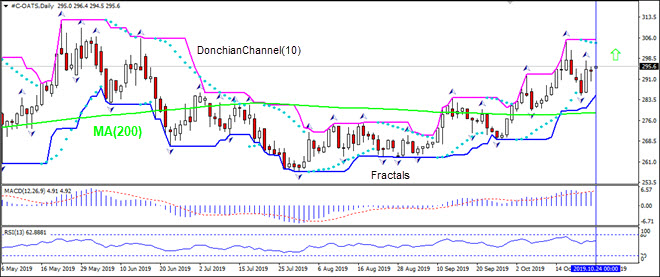
OATS:D1 is rising above MA(200) 10/24/2019 Technical Analysis IFC Markets chart

On the daily timeframe the OATS: D1 is above the 200-day moving average MA(200) which is rising .

  • The Parabolic indicator gives a sell signal.
  • The Donchian channel indicates uptrend: it is narrowing up.
  • The MACD indicator gives a bullish signal: it is above the signal line and the gap is widening.
  • The RSI oscillator is rising but has not reached the overbought zone.

We believe the bullish momentum will continue. A pending order to buy can be placed above the level 296.4. The stop loss can be placed below the lower Donchian boundary at 285.1. After placing the order, the stop loss is to be moved every day to the next fractal low, following Parabolic signals. Thus, we are changing the expected profit/loss ratio to the breakeven point. If the price meets the stop loss level (285.1) without reaching the order (296.4), we recommend cancelling the order: the market has undergone internal changes which were not taken into account.

Technical Analysis Summary

OrderBuy
Buy stopAbove 296.4
Stop lossBelow 285.1

Market Analysis provided by IFCMarkets

Turkey cuts rate 3rd time, inflation to determine future

By CentralBankNews.info

Turkey’s central bank lowered its policy rate by a larger-than-expected 250 basis points and said the extent of future monetary tightness would be determined by the trend of underlying inflation to ensure inflation continues to decline.

The Central Bank of the Republic of Turkey (CBRT) cut its benchmark one-week repo rate to 14.0 percent and has now cut it by a total of 1,000 basis points this year following cuts in July, September and today.

While a moderate recovery of economic activity in Turkey is continuing, investment remains weak, weaker global growth is tempering external demand and exports are expected to contribute less to economic growth.

The outlook for inflation is continuing to improve and inflation by the end of the year is likely to be “notably below” the forecast from the July inflation report, CBRT added.

The Central Bank of the Republic of Turkey issued the following press release:

“Participating Committee Members

Murat Uysal (Governor), Murat Çetinkaya, Ömer Duman, Uğur Namık Küçük, Oğuzhan Özbaş, Emrah Şener, Abdullah Yavaş.
The Monetary Policy Committee (the Committee) has decided to reduce the policy rate (one-week repo auction rate) from 16.50 percent to 14 percent.
Recently obtained data indicate that moderate recovery in economic activity continues. Leading indicators point to continuing improvement in the sectoral diffusion of economic activity. However, investment demand remains weak. While industrial production has been highly volatile due to working day effects associated with official holidays in recent months, its underlying trend has maintained a moderate pace of growth. While favorable effects of improved competitiveness prevail, weakening global economic outlook tempers external demand. Looking forward, net exports are expected to contribute to economic growth, although to a lesser extent, and the gradual recovery is likely to continue with the help of the disinflation trend and improvement in financial conditions. Current account balance, which has recently recorded significant improvement due to the composition of growth, is expected to maintain a moderate course.
Recently, advanced economy central banks have been pursuing more expansionary policies as weakening global economic activity and downside risks to inflation became more evident. While these developments support the demand for emerging market assets and the risk appetite, rising protectionism and uncertainty regarding global economic policies are closely monitored in terms of their impact on both capital flows and international trade.
Inflation outlook continued to improve. In addition to the stable course of the Turkish lira, improvement in inflation expectations and mild domestic demand conditions supported the disinflation in core indicators. In September, with the contribution of strong base effects, consumer inflation displayed a significant fall particularly in core goods and food inflation. Domestic demand conditions and the level of monetary tightness continue to support disinflation. Underlying trend indicators, supply side factors, and import prices lead to an improvement in the inflation outlook. In light of these developments, recent forecast revisions suggest that inflation is likely to materialize notably below the projections of the July Inflation Report by the end of the year. Accordingly, considering all the factors affecting inflation outlook, the Committee decided to reduce the policy rate by 250 basis points. At this point, the current monetary policy stance, to a large part, is considered to be consistent with the projected disinflation path.
The Committee assesses that maintaining a sustained disinflation process is the key for achieving lower sovereign risk, lower long-term interest rates, and stronger economic recovery.  Keeping the disinflation process in track with the targeted path requires the continuation of a cautious monetary stance. In this respect, the extent of the monetary tightness will be determined by considering the indicators of the underlying inflation trend to ensure the continuation of the disinflation process. The Central Bank will continue to use all available instruments in pursuit of the price stability and financial stability objectives.
It should be emphasized that any new data or information may lead the Committee to revise its stance.
The summary of the Monetary Policy Committee Meeting will be released within five working days.”

    www.CentralBankNews.info


AUDUSD Analysis: Australia’s slowing private business activity bearish for AUDUSD

By IFCMarkets

Australia’s slowing private business activity bearish for AUDUSD

Expansion slowed in Australia’s manufacturing and services sectors in October. Will the AUDUSD continue falling?

AUDUSD falling toward MA(200)

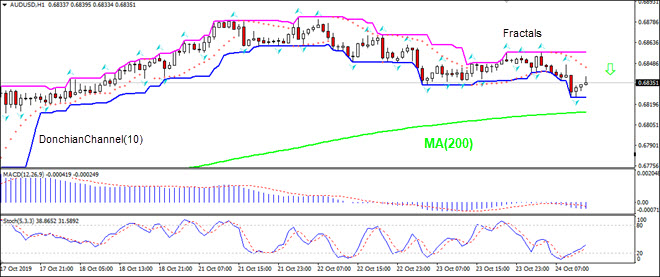
On 1-hour timeframe AUDUSD: H1 is in downtrend, above the 200-period moving average MA(200) which is levelling off. The Stochastic indicator is below 50 level and rising.

Technical Analysis Summary

OrderSell
Sell stopBelow 0.6824
Stop lossAbove 0.6844

Market Analysis provided by IFCMarkets

Indonesia cuts rate 4th time to boost domestic growth

By CentralBankNews.info

Indonesia’s central bank lowered its benchmark interest rates for the fourth consecutive month to boost bank lending “as a pre-emptive measure to stimulate domestic economic growth momentum against a backdrop of global economic moderation.”

Bank Indonesia (BI) cut its benchmark 7-day reverse repo rate by another 25 basis points to 5.00 percent and has now cut it by 100 points following cuts in July, August, September and today.

BI also cut its deposit rate (DF) by a similar 25 basis points to 4.25 percent and the lending rate (LF) to 5.75 percent.

In addition to providing easier lending rates, BI said its policy was supported by a strategy to maintain adequate liquidity to facilitate the transmission of an accommodative monetary policy while a deepening of payment systems and financial markets will also help foster economic growth.

“Going forward, Bank Indonesia will monitor domestic and global economic developments in using its room to implement and accommodative policy mix in order to maintain controlled inflation and external stability as well as to support economic growth momentum,” BI said.

Despite the positive outcome from recent trade talks between the U.S. and China, BI said global economic growth was continuing to moderate and flatter economic growth in the U.S. was due to retreating economic confidence triggered by declining exports. This is stifling non-residential investment and household consumption, also including in Europe, Japan, China and Japan.

BI lowered its 2019 forecast for Indonesia’s economic growth slightly to “the lower end” of a 5.0 to 5.4 percent range from last month’s forecast of “below the midpoint” of 5.0 to 5.4 percent.

For 2020 BI confirmed its forecast for growth towards the midpoint of a 5.1 to 5.5 percent range.

Indonesia’s inflation rate remains under control and BI confirmed its forecast for inflation this year to be below the midpoint of its target range of 3.5 percent, plus/minus 1 percentage point.

For 2020 inflation is seen within its new target range of 3.0 percent, plus/minus 1 percentage point.

Bank Indonesia released the following statement:


“The BI Board of Governors agreed on 23rd and 24th October 2019 to lower the BI 7-day Reverse Repo Rate by 25 bps to 5,00%, Deposit Facility (DF) rates lowered 25 bps to 4,25% and Lending Facility (LF) rates lowered 25 bps to 5,75%. The policy is consistent with controlled inflation and attractive returns on domestic financial investment assets, and as a pre-emptive measure to stimulate domestic economic growth momentum against a backdrop of global economic moderation. Furthermore, the policy is supported by a monetary operations strategy optimised to maintain adequate liquidity and facilitate the effective transmission of an accommodative policy mix. Bank Indonesia is maintaining an accommodative macroprudential policy stance in order to stimulate bank lending and expand economic financing. Payment system policy and financial market deepening will also be strengthened to foster economic growth. Going forward, Bank Indonesia will monitor domestic and global economic development in using its room to implement an accommodative policy mix in order to maintain controlled inflation and external stability as well as to support economic growth momentum. In addition, Bank Indonesia will continue to strengthen coordination with the Government and other relevant authorities in order to maintain economic stability and catalyse domestic demand, while boosting exports and tourism and attracting foreign capital flows, including Foreign Direct Investment (FDI).
Global economic growth is continuing to moderate despite less uncertainty after the United States and China met for trade talks in October 2019. A softening in the global economy stems from declining world trade volume due to the ongoing trade dispute between the United States and China, coupled with sluggish production activity reported in a number of countries. Flatter growth in the United States is due to retreating economic confidence triggered by declining exports, which is stifling non-residential investment and household consumption. Similar conditions have been observed in Europe, Japan, China and India. Current global dynamics have exacerbated downside pressures on oil prices and international commodity prices, leading to mild inflationary pressures. In response, various countries have loosened monetary policy and introduced fiscal stimuli. Meanwhile, less uncertainty in global financial markets has driven foreign capital inflows to developing economies. Moving forward, uncertainty triggered by trade tensions between the United States and China along with other geopolitical risks will continue to demand vigilance due to the potential impact on efforts to stimulate economic growth and maintain foreign capital inflows to bolster external stability
Strong global headwinds continue to overshadow Indonesia’s economy. The ongoing export contraction has improved despite waning global demand and lower international commodity prices. The modest gains come amidst positive manufacturing export growth, especially automotive exports to ASEAN, and gold exports. Investment, non-building investment in particular, remains weak, yet the latest surveys point to an upsurge predicted in the fourth quarter of 2019 as business confidence continues to grow. Meanwhile, building investment growth has been maintained by the development of national strategic projects. Household consumption growth remains stable, supported by low inflation and social aid program (bansos) disbursements. Moving forward, the policy mix instituted by Bank Indonesia in conjunction with the Government is expected to maintain economic growth momentum in Indonesia, which Bank Indonesia projects towards the lower end of the 5.0-5.4% range in 2019 before increasing towards the midpoint of the 5.1-5.5% range in 2020.
Indonesia’s balance of payments is expected to improve in the third quarter of 2019, thereby reinforcing external resilience. Solid Balance of Payment (BOP) performance is backed by a capital and financial account surplus coupled with a manageable current account deficit. Portfolio investment recorded a net inflow of USD4.8 billion in the third quarter of 2019, induced by a promising domestic economic outlook and attractive domestic financial investment assets. Meanwhile, the current account deficit is predicted at a manageable level due to dwindling demand for imports and the impact of domestic policies to control imports, including the B-20 program. The position of reserve assets in Indonesia remains solid, recorded at USD124.3 billion at the end of September 2019, equivalent to 7.2 months of imports or 7.0 months of imports and servicing government external debt, which is well above the international adequacy standard of three months. Looking forward, Bank Indonesia projects a manageable current account deficit in 2019 and 2020 in the 2.5-3.0% of GDP range, supported by a maintained influx of foreign capital. In addition, Bank Indonesia will continue to strengthen policy synergy with the Government and other relevant authorities in order to increase external resistance, while attracting more FDI.
The Rupiah has strengthened again in line with maintained BOP performance.  In October 2019, the Rupiah appreciated 1.18% (ptp) on the level recorded at the end of September 2019. Cumulatively from January until 23rd October 2019, therefore, the rupiah has appreciated 2.50% (ytd). The stronger Rupiah is supported by a well-functioning foreign exchange supply and demand mechanism from the business sector in addition to maintained foreign capital inflows. In addition, slightly less global financial market uncertainty has spurred positive sentiment concerning the Rupiah. Moving forward, Bank Indonesia predicts Rupiah exchange rate stability in line with the currency’s fundamental value and maintained market mechanisms based on the sustained inflow of foreign capital to Indonesia congruent with the promising domestic economic outlook and attractive returns, as well as the positive impact of looser monetary policy in advanced economies. Bank Indonesia will continue to accelerate financial market deepening in the money market and foreign exchange market in order to support exchange rate policy effectiveness and strengthen domestic financing.
Low and stable inflation remains under control. Annually, headline inflation was recorded at 3.39% (yoy) in September 2019, down from 3.49% (yoy) the month earlier. Inflation was edged downwards by the Consumer Price Index (CPI) in September 2019, which recorded 0.27% (mtm) deflation after posting 0.12% (mtm) inflation the month earlier. Inflation was supported by controlled core inflation in line with anchored inflation expectations as a result of policy consistency by Bank Indonesia to maintain price stability, manage aggregate demand, ensure the exchange rate moves in line with the currency’s fundamental value and minimise the impact of global prices. In addition, volatile foods (VF) recorded deflation on corrections to food prices and inflationary pressures on administered prices remained low, which also contributed to control inflation in the reporting period. Moving forward, Bank Indonesia will consistently maintain price stability and strengthen policy coordination with the central and regional governments to control inflation. Therefore, Bank Indonesia predicts inflation below the midpoint of the 3.5±1% target corridor in 2019 and subsequently maintained within the target range in 2020, namely 3.0±1%.
Effective monetary policy transmission has been underpinned by adequate liquidity in the banking industry combined with a stable and efficient money market. The average daily transaction volume on the interbank money market remained high in September 2019 at Rp17.95 trillion. Adequate liquidity was also maintained in the banking industry, as reflected by a ratio of liquid assets to deposits of 19.47% in August 2019, relatively stable compared with the 19.66% recorded in July 2019. Consequently, interbank rates faced declines on all tenors, including the overnight interbank rate as the operational target of monetary policy, which continued to converge on the policy rate at 5.24% in September 2019. The weighted average deposit rate fell 13 basis points on the previous period to 6.57% in September 2019. On the other hand, lending rates have also started to come down, primarily due to investment loans and working capital loans, which were recorded at 10.11% and 10.33% respectively in the reporting period. Meanwhile, growth of narrow money (M1) and broad money (M2) in August 2019, namely 6.59% (yoy) and 7.33% (yoy) respectively, was consistent with domestic economic growth. Bank Indonesia will continue to ensure adequate liquidity and increase efficiency in the money market, while strengthening transmission of the accommodative policy mix.
Financial system stability has been maintained despite the bank intermediation function requiring attention.  This was reflected by a high Capital Adequacy Ratio (CAR) of 23.48% in August 2019, coupled with a low level of non-performing loans at 2.60% (gross) or 1.20% (nett). Public listed corporations maintained solid performance in line with sound repayment capacity, which further supported financial system stability. Notwithstanding, credit growth moderated from 9.58% (yoy) in July 2019 to 8.59% (yoy) in August 2019, primarily weighed down by restrained demand for corporate loans. On the other hand, deposit growth in August 2019 was recorded at 7.62% (yoy), down from 8.04% (yoy) in July 2019. Bank Indonesia believes the accommodative monetary and macroprudential policy mix will effectively stimulate credit growth without disrupting financial system stability. Therefore, Bank Indonesia projects growth of outstanding loans disbursed by the banking industry in the 10-12% (yoy) range in 2019 and 11-13% (yoy) in 2020, while projecting deposit growth in the 7-9% (yoy) range in 2019 and 8-10% (yoy) in 2020.
The payment systems, both cash and non-cash, remain uninterrupted.  The position of currency in circulation grew 4.57% (yoy) in September 2019, while non-cash payment transactions using ATM/debit cards, credit cards and electronic money grew 5.71% in August 2019, dominated by ATM/debit cards with a 93.78% share. Impressive growth of e-money transactions was maintained in August 2019 at 230.25% (yoy) in line with greater public uptake of digital currency and broader e-money integration into the digital ecosystem. Bank Indonesia constantly strives to maintain an uninterrupted payment system in order to support development of the digital economy and finance. Furthermore, Bank Indonesia also advocates expanding the electronification program, particularly for local government transactions, and accelerating digital transformation in the financial sector through various initiatives.”
 

Crude Higher On Bullish EIA Report

By Orbex

Inventories Fall Unexpectedly

Oil markets have been higher this week in response to the Energy Information Administration reporting an unexpected drawdown in US crude stores. Analysts had been looking for a 5 million barrel rise in US crude stores.

However, the report showed that in the week to October 18th, US crude inventories fell by 1.7 million barrels.

The data also showed that refinery crude runs increased by 429k barrels per day over the week. And refinery utilization rates increased by 2.1%.

Crude prices jumped by around 1% in response to the news. This has assuaged some of the recent concerns over demand levels for crude.

Imports Drop

US crude imports declined last week by 873k barrels over the week falling to their lowest level on record. This also helped boost oil prices. Meanwhile, exports were higher by 435k barrels to hit a record 3.7 million barrels per day.

Looking at the rest of the data, the report shows that gasoline stores were lower by 3.1 million barrels over the week. This is in contrast to the market forecasts of a 2,3 million barrel decline.

Similarly, distillate stockpiles, including diesel and heating oil, were also lower. They declined by 2.7 million barrels, slightly less than forecasts of a 2.8 million barrel decrease.

Risk Factors Improving

The rise in crude prices this week comes amidst a background of improved risk appetite. This is as a result of developments within Brexit negotiations and US-China trade talks.

Brexit now looks likely to be delayed given the defeats suffered by Boris Johnson in parliament this week. Consequently, the UK has now requested Brexit to be delayed further which the EU is currently considering.

The EU is likely to approve the request, which will see Article 50 extended until the end of January next year. Risk appetite has been supported in the wake of this development, with the UK now likely to avoid a hard Brexit.

The US and China are expected to sign off on the deal agreed at the latest trade talks earlier this month.

Talks have been continuing behind the scenes and current commentary remains positive. So, Trump’s plan to have himself and Xi sign the deal at the November APEC meeting might come to fruition.

If the deal comes to pass, this should offer support to oil prices which have been heavily impacted by the ongoing tariff war.

Technical Perspective

Crude prices are climbing back above 55 following the latest EIA data. The recovery off 51.25 support is gathering strength here. While above this level, focus is on a further push higher with the 57.78 level the next price to watch. However, back below this level focus will turn to a further test of the 51.25 zone which remains the key downside level to watch.

By Orbex


Traders Waiting On ECB

By Orbex

USD Higher Ahead of Key Data

The US dollar has been firmer over the European morning today with the USD index continuing to recover off the recently tested 96.99 level to trade 97.24 last. Over the US session today, traders will receive Durable Goods data and the flash manufacturing PMI reading for October. The PMI reading will be closely watched. This is given the two prior months of negative readings which have raised grave concerns over the health of the US economy.

EUR Lower on Data Miss – ECB Up Next

EURUSD has seen a heavy reversal over the session so far, conceding initial gains on a raft of weak data this morning. Eurozone manufacturing PMI was seen unchanged at 45.7 over October, staying at cycle lows. German PMI data sets were equally disappointing with manufacturing remaining in negative territory also.

Today focus will be on the ECB meeting and though the bank is not expected to adjust policy, given continued data weakness, traders will be keen to get the latest outlook. EURUSD is now once again testing the 1.1127 level from above.

GBP Lower As UK Awaits Brexit Delay Decision

GBPUSD has been lower against USD today. The latest on Brexit is that the EU is yet to give a decision on the UK’s Article 50 extension request. They are however expected to approve it. The UK PM is now pushing for a general election in December ahead of what would be the new Brexit deadline of January 31st 2020. GBPUSD trades 1.2829 last, capped by the 1.3033 level so far this week.

Risk Outlook Remains Favourable

Risk assets have had a quiet session so far with SPX500 sitting at 3008.03, broadly unchanged on the session. With Brexit likely to be delayed again and with US/China trade talks progressing, there is a better risk backdrop at the moment. This means further upside in equities is likely.

Safe Havens Muted

Safe havens have been quiet today also, given the limited moves in risk assets. Gold and the Japanese yen are both fairly even against USD so far today. However, US data later today could see some upside moves in safe havens if we get further data weakness. USDJPY trades 108.66 last, still capped by 108.84 for now. XAUUSD trades 1489.43 last, still clinging to 1481.93 support for now.

Crude Rallies on Bullish EIA Report

Oil prices have been a little softer so far today though are higher on the week as the EIA reported an unexpected drop in US crude stores last week. The move has been attributed to the sharp fall in US crude imports and puts an end to the five weeks of inventory build-up seen recently. Crude trades 55.60 last, sitting above the 55 level once again.

Loonie Higher

USDCAD has been higher today. This is given the stronger USD and weakness seen in oil prices over the session so far today. USDCAD trades 1.3082 last, having recovered yet again off the 1.3068 level which remains the key support level to watch.

AUD Down On Data Miss

AUDUSD has been sharply lower today following the release of PMI data sets overnight. This saw all sectors barely remaining in positive territory over the month and each having declined from the prior month’s levels. AUDUSD trades .6827 last having fallen back below the .6850 level on the latest decline.

By Orbex


ECB October Meeting Preview – Draghi’s Last Meeting

By Orbex

The European Central Bank will be holding its monetary policy meeting this week on Thursday.

This will be the last monetary policy meeting for Mario Draghi. Draghi was instrumental in steering the eurozone through the major global downturns during his eight-year tenure.

This included the global financial crisis and as well as Greece’s sovereign debt crisis.

Investors do not expect to see much action from this week’s meeting. Despite the various measures undertaken by Draghi, the outgoing ECB chief still faces criticism. Draghi hands over the reins of the central bank to ex-IMF chief Christine Lagarde.

ECB Rates

Lagarde will officially take over the affairs of the European Central Bank starting the 1st of November 2019.

The ECB’s deposit facility rate and the marginal lending rate will remain steady at this week’s meeting. The rather flat expectations come as investors wait for the ECB’s QE to get started.

The central bank will begin its Asset Purchase Program starting November 1st.

Concerns on Negative Rates Gains Traction

It is not surprising the various members of the ECB’s governing council have started to criticize the negative interest rates. But this is something not new. Similar views can be seen from the Bank of Japan.

In Japan, despite launching a massive QE program, the Bank of Japan has failed to stimulate the economy. Inflation remains stubbornly low. But the negative rate continues which is seen harming the banking system.

The ECB’s deposit facility rate turned negative for the first time in June 2014, after staying at zero for most of 2012 and 2013.

Still, the central bank has nothing to show for.

While the ECB ended its QE in December 2018 amid signs of a pickup in growth, it was only for a short while. Growth sputtered since late 2018 and began to deteriorate thereafter. This prompted the central bank to revive its QE program.

The deposit facility was further cut down by a quarter-point to -0.50%.

The recent move by the ECB was in tandem with the global theme. Monetary policy, which was dovish only until the start of the year has taken a turn for the worse.

Various major central banks such as the Fed, the BoJ, RBA and the RBNZ have been on a dovish policy path.

Draghi Calls for Fiscal Spending

In a speech at an event in Washington, Draghi said that eurozone governments should do more. This has been something that Draghi has been very vocal about. Urging the various regional governments to revive spending, Draghi has always maintained the view monetary policy alone would not help in reviving growth.

As the last meeting concludes, investors will already be looking to the new incoming ECB President, Lagarde. The eurozone’s inflation remains well below the 2.0% inflation target.

Recent inflation reports saw the eurozone consumer prices falling further to 0.9% on the year. Meanwhile, core inflation has held steady at 1.0%. This is far off from the central bank’s inflation target rate.

It is, therefore, not surprising that various members of the central bank’s governing council are looking for ways to stoke inflation. With monetary policy not having much to show for, questions remain whether the ECB will look to new ways.

For the moment, investors do not expect to see much happening. The incoming ECB President will preside over QE 2. It will not be surprising to see some governing council members shifting focus to Lagarde.

However, the prospects of a drastic shift to the ECB’s policies remains unlikely for the moment.

By Orbex


Ichimoku Cloud Analysis 24.10.2019 (AUDUSD, NZDUSD, USDCAD)

Article By RoboForex.com

AUDUSD, “Australian Dollar vs US Dollar”

AUDUSD is trading at 0.6840; the instrument is moving above Ichimoku Cloud, thus indicating an ascending tendency. The markets could indicate that the price may test the cloud’s upside border at 0.6815 and then resume moving upwards to reach 0.6935. Another signal to confirm further ascending movement is the price’s rebounding from the rising channel’s downside border. However, the scenario that implies further growth may be canceled if the price breaks the cloud’s downside border and fixes below 0.6775. In this case, the pair may continue falling towards 0.6685.

AUDUSD
Risk Warning: the result of previous trading operations do not guarantee the same results in the future

NZDUSD, “New Zealand Dollar vs US Dollar”

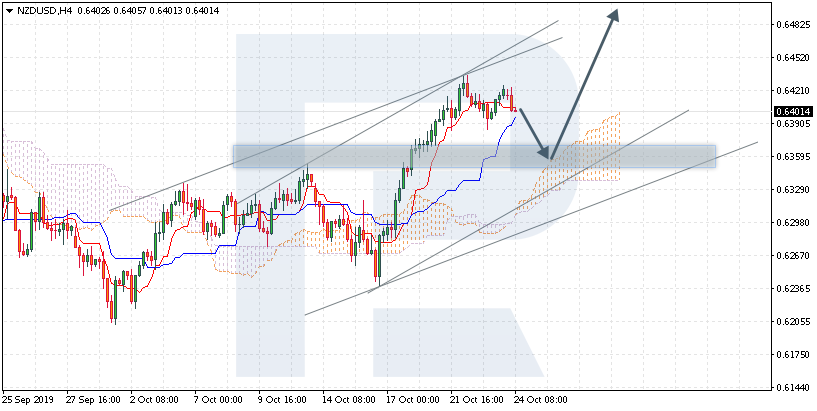
NZDUSD is trading at 0.6401; the instrument is moving above Ichimoku Cloud, thus indicating an ascending tendency. The markets could indicate that the price may test the cloud’s upside border at 0.6360 and then resume moving upwards to reach 0.6485. Another signal to confirm further ascending movement is the price’s rebounding from the rising channel’s downside border. However, the scenario that implies further growth may be canceled if the price breaks the cloud’s downside border and fixes below 0.6315. In this case, the pair may continue falling towards 0.6225.

NZDUSD
Risk Warning: the result of previous trading operations do not guarantee the same results in the future

USDCAD, “US Dollar vs Canadian Dollar”

USDCAD is trading at 1.3079; the instrument is moving below Ichimoku Cloud, thus indicating a descending tendency. The markets could indicate that the price may test Tenkan-Sen and Kijun-Sen at 1.3105 and then resume moving downwards to reach 1.2955. Another signal to confirm further descending movement is the price’s rebounding from the descending channel’s upside border. However, the scenario that implies further decline may be canceled if the price breaks the cloud’s upside border and fixes above 1.3215. In this case, the pair may continue growing towards 1.3305.

USDCAD

Article By RoboForex.com

Attention!
Forecasts presented in this section only reflect the author’s private opinion and should not be considered as guidance for trading. RoboForex LP bears no responsibility for trading results based on trading recommendations described in these analytical reviews.

Murrey Math Lines 24.10.2019 (USDCHF, GOLD)

Article By RoboForex.com

USDCHF, “US Dollar vs Swiss Franc”

As we can see in the H4 chart, USDCHF is consolidating between 5/8 and 3/8. In this case, the price is expected to test 5/8, rebound from it, and then resume falling to reach the support at 3/8. However, this scenario may no longer be valid if the price breaks 5/8 to the upside. After that, the instrument may continue growing towards 6/8.

USDCHF_H4
Risk Warning: the result of previous trading operations do not guarantee the same results in the future

In the M15 chart, the pair may break the downside line of the VoltyChannel indicator and, as a result, move downwards to reach 3/8 from the H4 chart.

USDCHF_M15
Risk Warning: the result of previous trading operations do not guarantee the same results in the future

XAUUSD, “Gold vs US Dollar”

In the H4 chart, XAUUSD is still consolidating. In this case, the price is expected to break 4/8 and then continue growing to reach the resistance at 5/8. However, this scenario may no longer be valid if the price breaks 3/8 to the downside. After that, the instrument may continue falling towards the support at 2/8.

GOLD_H4
Risk Warning: the result of previous trading operations do not guarantee the same results in the future

As we can see in the M15 chart, the pair has broken the upside line of the VoltyChannel indicator and, as a result, may continue the ascending tendency on this timeframe towards the resistance at 5/8 from the H4 chart.

GOLD_M15

Article By RoboForex.com

Attention!
Forecasts presented in this section only reflect the author’s private opinion and should not be considered as guidance for trading. RoboForex LP bears no responsibility for trading results based on trading recommendations described in these analytical reviews.