The US dollar is being traded without clear dynamics against a basket of currency majors. The dollar index (#DX) closed yesterday’s trading session in the red zone (-0.09%). Investors still follow the US-China trade agreement. The tension between two countries eased after the Office of the US Trade Representative said the US was considering extending some tariff exclusions on $34 billion of imports from China. Also, financial market participants took a wait-and-see attitude before the Fed meeting.
The British pound has been growing after it became known that British Prime Minister Boris Johnson officially agreed to delay Brexit until January 31, 2020. Surely, Johnson did not want to allow the delay and still believe that it will harm the UK. Therefore, the head of the European Council, Donald Tusk, states the issue is a “flextension”. That is, the country will be able to exit the EU before the deadline if Johnson manages to convince the parliament. EU leaders also approved the Brexit extension from October 31, 2019, to January 31, 2020.
The “black gold” prices are declining. Currently, futures for the WTI crude oil are testing the $55.20 mark per barrel. At 22:30 (GMT+2:00), API weekly crude stock will be published.
Market Indicators
Yesterday, there was the bullish sentiment in the US stock markets: #SPY (+0.56%), #DIA (+0.45%), #QQQ (+0.99%).
The 10-year US government bonds yield has moved away from local highs. At the moment, the indicator is at the level of 1.82-1.83%.
The Economic News Feed for 29.10.2019:
– CB consumer confidence index in the US at 16:00 (GMT+2:00);
– Pending home sales index in the US at 16:00 (GMT+2:00).
The Conference Board will be releasing the monthly consumer confidence index data today.
A measure of how American consumers feel, the consumer confidence index is a closely watched report.
Typically, stronger levels of confidence translate to higher consumption. The US economy is a domestic-demand and consumption-driven economy. Therefore, the CB data will give economists a glimpse into the sentiment and thus potential expectations on growth.
The consumer confidence index from the Conference Board is one of the many forward-looking indicators focusing on consumer sentiment. For this year, consumer confidence rose to highs of 135.7 in July.
Economists forecast that the consumer confidence index will rise to 128.2 for October. It marks a modest rebound from September’s drop to 125.1. The index started the year on a sour note. In January, the index was at 120.2. But, since then, there has been a steady increase.
Conference Board’s Consumer Confidence Index, September 2019
The index is now close to the historical highs of 137.9 seen during October of 2018. Looking over the data, the consumer confidence index still remains close to historical highs. Therefore, from a month to month perspective, the data might not give an accurate view.
Declines and rises are part of the monthly volatility for the consumer sentiment index. Over the span of this year, consumer confidence has been somewhat mixed. This is largely due to the uncertainty in the global markets.
For US consumers in particular, the trade war with China remains a major concern. This is a concern that boils down to impacting the GDP growth as well.
Can the CB Consumer Confidence Index rise in October?
There have been a couple of positive developments in the global markets during the month. For the United States, in particular, progress on the China and US trade talks was a welcome shift.
The US and China were in a protracted trade war since the past few quarters. Neither of the two sides showed signs of giving up. This led to both sides levying higher tariffs on the respective imports of goods.
But, in October, both sides made progress. Both sides will be finalizing the terms of the first phase of the deal sometime in early to mid-November. Response from the equity markets was muted, however. Still, investors cheered for the progress.
This could very well see a flow into the consumer confidence as well. The ability to push through trade negotiations is a welcome change.
Meanwhile, on the monetary policy side, the central bank has also been supportive to some extent.
The central bank has been cutting rates steadily. Another (third) rate cut is widely expected this week. Lower interest rates translate to affordable credit. This, in turn, puts more money to spend among the consumer class.
The labor market is still strong with the unemployment rate at historic lows. Wage growth is steady while inflation is largely stable, although below the Fed’s inflation target rate.
Therefore, considering the above, it wouldn’t be surprising to see consumer confidence rising.
However, due to consumer confidence reflecting the ground reality, any fault lines are likely seen here.
Therefore, a weaker reading could indicate some caution. Still, with the January readings at 120, there is quite a bit of room.
As long as the index doesn’t fall dramatically, the markets are likely to be assured that growth, although slow, will still expand.
On Monday the 28th of October, trading on the euro closed up. This was probably a technical correction following Friday’s drop. This correction was partly the result of traders adjusting their positions ahead of the FOMC meeting.
European Council President Donald Tusk announced that the EU27 have approved a Brexit extension to the 31st of January. Today, this decision should be confirmed at government level in each member state. Is this good? No, because this is now the third time the Brexit date has been moved. The fewer delays we get, the quicker the UK will exit the EU, and deferring the exit date means that the uncertainty continues.
Day’s news (GMT+3):
10:45 France: consumer confidence (Oct).
12:30 UK: net lending to individuals (Sep), M4 money supply (Sep), mortgage approvals (Sep).
16:00 US: S&P/Case-Shiller home price indices (Aug).
17:00 US: consumer confidence (Oct), pending home sales (Sep).
Current situation:
The pair moved as predicted, although with a slight divergence. The correction allowed the indicators to unload, and now the pair has its sights set on 1.1057. The pair is currently trading at 1.1090. The euro should gather some downwards pace when the rate drops below 1.1085. There are some divergences between timeframes, so we should get a small bounce from the trend line.
The FOMC is holding a meeting this week. The US regulator is expected to slash interest rates by 25 base points for the third time this year. The probability of this happening is put at 94.1%.
MPs reject Boris Johnson’s bid for December election
Dollar on standby ahead of Fed meeting
Gold slides below psychological $1500 level
The mood across financial markets continues to brighten after President Donald Trump said that Washington “was ahead of schedule” on a trade deal with China.
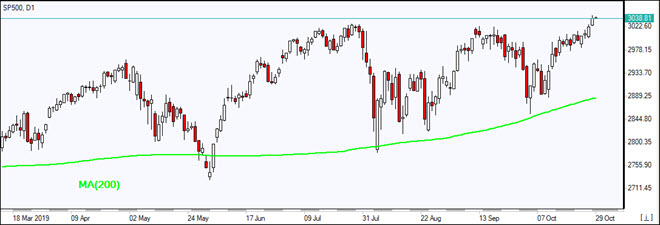
This encouraging news has certainly injected global equity bulls with a renewed sense of confidence as optimism increases that the two largest economies in the world will sign “phase one ” of the trade agreement soon. Shares across Asia are pushing higher on Tuesday amid the risk-on sentiment, after the S&P 500 hit an all time record high overnight on the back of trade hopes and prospects of lower interest rates by the Fed. The positive vibe from Asian markets should also support European stocks and potentially Wall Street later this afternoon.
Fourth time lucky? Johnson seeks snap election again
There was little to cheer about on Monday in Brexit news despite the European Union granting Britain a flexible three-month extension to the Brexit process until 31 January 2020.
Although this has prevented the UK from leaving the European Union on October 31 without a deal, it is simply kicking the can down the road. This sentiment is clearly being reflected in the British Pound which offered a fairly muted reaction to the third Brexit extension. With British lawmakers rejecting Prime Minister Boris Johnson’s plan for an early election in December, where do we go from here? While Johnson is expected to try again for an early election on Tuesday, history could repeat itself for the fourth time in two months. Until investors are offered proper direction and clarity on Brexit, Sterling’s rise may be capped below 1.30.
Dollar waits for FOMC meeting
The Dollar held steady against a basket of major currencies on Tuesday ahead of the FOMC meeting on Wednesday. With markets widely expecting the Fed to dish out another insurance rate cut in face of trade uncertainty and global growth concerns, much attention will be directed towards Jerome Powell’s press conference. Should Powell sound less dovish than expected, investors are likely to revaluate whether the Federal Reserve will cut interest rates in December.
Gold in the spotlight
Gold has stumbled into the trading week under pressure thanks to the improving market mood and risk-on sentiment. Given how prices are trading below the $1500 level, further downside could be on the cards in the short term.
However, investor expectations over the Federal Reserve cutting interest rates in October coupled with Brexit uncertainty should stimulate appetite towards the precious metal in the medium term. The longer-term outlook will remain influenced by US-China trade developments and global growth concerns. Although most remain cautiously optimistic over the two largest economies in the world signing a “phase one” trade deal, there is still room for disappointment as talks have fallen apart in the past. Focusing on the technical picture, Gold is tracking sideways on the daily charts but the breakdown below $1500 should open a path towards $1485.
Disclaimer: The content in this article comprises personal opinions and should not be construed as containing personal and/or other investment advice and/or an offer of and/or solicitation for any transactions in financial instruments and/or a guarantee and/or prediction of future performance. ForexTime (FXTM), its affiliates, agents, directors, officers or employees do not guarantee the accuracy, validity, timeliness or completeness, of any information or data made available and assume no liability as to any loss arising from any investment based on the same.
The week continued being volatile yesterday following a number of impactful events affecting market sentiment.
For one, Trump indicated that a trade deal with China is very likely now, driving flows into equities and away from safe havens.
In Europe on the other hand, the European Commission granted another extension request for Brexit, removing recent gains from gold.
Meanwhile, traders’ expectations for another Fed cut are increasing.
Equities Hit Record Highs Following Trump Comments
On Tuesday night Trump said that “Washington was ahead of schedule to sign a very big portion” of a potential trade deal with China.
Stocks were upbeat on hopes for trade progress and also on the back of renewed Fed sentiment. The CME FedWatch tool shows market participants expect another cut with a 95% probability.
In addition, markets moved higher on good US earnings reports and are expected to be volatile for the rest of the week.
SPX Breaks All-Time High, More Room to Upside
With a number of risk-positive events pushing equities up the SPX marked a fresh ATH yesterday at 3041.
Although expectations remain upbeat, prices are near an exhaustion level that could mark the competition of minute correction c with an ending diagonal near 3048.
Brexit Risks Recede But Uncertainty Looms
Johnson accepted the EU’s granted extension yesterday in a bid to push for a general election in December. This allowed markets to take a breather on at least one of the lingering Brexit risk components.
UK’s MPs rejected BoJo’s bid, however. This left the pound somewhat mixed despite the extension news which should have provided some good gains.
Pound Expected to Remain Mixed, Looking Bearish Short-term
GBPUSD responded to both bearish and bullish headlines, initially driven up but then discounted most gains following the ‘election’ snapback.
Trading within intermediate wave (3) and having potentially ended minute 5 we can now focus on whether the current structure leads to a zigzag correction near 1.27.
Politics Drive Markets Away from Safe-Havens
It was a good week for gold up until Trump’s trade comments. The good news surrounding a potential trade deal drove gold back down below the 1500 handle. With added pressures from Brexit, even partial, resolution the yellow metal could remain bearish in the short-term.
XAUUSD Triangle Hints to Further Declines
The last spike to the upside allowed bulls to take profits and start selling to perhaps completing the corrective minor wave 4.
With prices under the round level and after the throwback to 1515, markets could now push the commodity near 1440. This would be where the complex correction could finally complete.
US stocks broadened gains on Monday as president Trump said US and China were going “probably to be ahead of schedule” with signing the phase one trade deal. The S&P 500 finished 0.6% higher at new record high 3044.08. Dow Jones industrial added 0.5% to 27090.72. The Nasdaq composite rose 1% to 8325.99. The dollar strengthening halted as Chicago Fed National Activity Index turned negative for September while US trade deficit narrowed more than expected: the live dollar index data show the ICE US Dollar index, a measure of the dollar’s strength against a basket of six rival currencies, slipped 0.05% to 97.75 but is higher currently. The Fed tow-day policy meeting starts today, and futures on US stock indices point to mixed openings.
DAX posts biggest gain among European indexes
European stock market extended gains for fourth straight session on Monday. Both EUR/USD and GBP/USD turned higher yesterday with both pairs retreating currently. The Stoxx Europe 600 index ended 0.3% higher. The DAX 30 rose 0.4% to 12941.71. France’s CAC 40 gained 0.2% and UK’s FTSE 100 added 0.1% to 7331.28 as European Union granted a three-month extension to Brexit while UK parliament rejected Prime Minister Boris Johnson’s call to hold an early election on December 12.
Nikkei rises while Chinese stocks fall
Asian stock indices are mixed today. Nikkei ended 0.5% higher at 22974.13 with yen little changed against the dollar. Markets in China are falling despite reports US is considering extending tariff exemptions that were approved last December on $34 billion on Chinese goods. The Shanghai Composite Index is down 0.9% and Hong Kong’s Hang Seng Index is 0.4% lower. Australia’s All Ordinaries Index extended gains 0.1% as Australian dollar continued its climb against the greenback.
Brent futures prices are extending losses today on demand sustainability concerns. Prices fell yesterday: December Brent crude closed 0.7% lower at $61.57 a barrel on Monday.
Note: This overview has an informative and tutorial character and is published for free. All the data, included in the overview, are received from public sources, recognized as more or less reliable. Moreover, there is no guarantee that the indicated information is full and precise. Overviews are not updated. The whole information in each overview, including opinion, indicators, charts and anything else, is provided only for familiarization purposes and is not financial advice or а recommendation. The whole text and its any part, as well as the charts cannot be considered as an offer to make a deal with any asset. IFC Markets and its employees under any circumstances are not liable for any action taken by someone else during or after reading the overview.
Web scraping is one of the tools at a developer’s disposal when looking to gather data from the internet. While consuming data via an API has become commonplace, most of the websites online don’t have an API for delivering data to consumers. In order to access the data they’re looking for, web scrapers and crawlers read a website’s pages and feeds, analyzing the site’s structure and markup language for clues. Generally speaking, information collected from scraping is fed into other programs for validation, cleaning, and input into a datastore or its fed onto other processes such as natural language processing (NLP) toolchains or machine learning (ML) models. There are a few Python packages we could use to illustrate with, but we’ll focus on Scrapy for these examples. Scrapy makes it very easy for us to quickly prototype and develop web scrapers with Python.
Scrapy concepts
Before we start looking at specific examples and use cases, let’s brush up a bit on Scrapy and how it works.
Spiders: Scrapy uses Spiders to define how a site (or a bunch of sites) should be scraped for information. Scrapy lets us determine how we want the spider to crawl, what information we want to extract, and how we can extract it. Specifically, Spiders are Python classes where we’ll put all of our custom logic and behavior.
import scrapy
classNewsSpider(scrapy.Spider):
name = 'news'
...
Selectors:Selectors are Scrapy’s mechanisms for finding data within the website’s pages. They’re called selectors because they provide an interface for “selecting” certain parts of the HTML page, and these selectors can be in either CSS or XPath expressions.
Items:Items are the data that is extracted from selectors in a common data model. Since our goal is a structured result from unstructured inputs, Scrapy provides an Item class which we can use to define how our scraped data should be structured and what fields it should have.
Suppose we love the images posted to Reddit, but don’t want any of the comments or self posts. We can use Scrapy to make a Reddit Spider that will fetch all the photos from the front page and put them on our own HTML page which we can then browse instead of Reddit.
To start, we’ll create a RedditSpider which we can use traverse the front page and handle custom behavior.
Above, we’ve defined a RedditSpider, inheriting Scrapy’s Spider. We’ve named it reddit and have populated the class’ start_urls attribute with a URL to Reddit from which we’ll extract the images.
At this point, we’ll need to begin defining our parsing logic. We need to figure out an expression that the RedditSpider can use to determine whether it’s found an image. If we look at Reddit’s robots.txt file, we can see that our spider can’t crawl any comment pages without being in violation of the robots.txt file, so we’ll need to grab our image URLs without following through to the comment pages.
By looking at Reddit, we can see that external links are included on the homepage directly next to the post’s title. We’ll update RedditSpider to include a parser to grab this URL. Reddit includes the external URL as a link on the page, so we should be able to just loop through the links on the page and find URLs that are for images.
classRedditSpider(scrapy.Spider):
...
defparse(self, response):
links = response.xpath('//a/@href')
for link in links:
...
In a parse method on our RedditSpider class, I’ve started to define how we’ll be parsing our response for results. To start, we grab all of the href attributes from the page’s links using a basic XPath selector. Now that we’re enumerating the page’s links, we can start to analyze the links for images.
defparse(self, response):
links = response.xpath('//a/@href')
for link in links:
# Extract the URL text from the element
url = link.get()
# Check if the URL contains an image extensionif any(extension in url for extension in ['.jpg', '.gif', '.png']):
...
To actually access the text information from the link’s href attribute, we use Scrapy’s .get() function which will return the link destination as a string. Next, we check to see if the URL contains an image file extension. We use Python’s any() built-in function for this. This isn’t all-encompassing for all image file extensions, but it’s a start. From here we can push our images into a local HTML file for viewing.
defparse(self, response):
links = response.xpath('//img/@src')
html = ''for link in links:
# Extract the URL text from the element
url = link.get()
# Check if the URL contains an image extensionif any(extension in url for extension in ['.jpg', '.gif', '.png']):
html += '''
< a href="{url}" target="_blank">
< img src="{url}" height="33%" width="33%" />
< /a>
'''.format(url=url)
# Open an HTML file, save the resultswith open('frontpage.html', 'a') as page:
page.write(html)
# Close the file
page.close()
To start, we begin collecting the HTML file contents as a string which will be written to a file called frontpage.html at the end of the process. You’ll notice that instead of pulling the image location from the ‘//a/@href/‘, we’ve updated our links selector to use the image’s src attribute: ‘//img/@src’. This will give us more consistent results, and select only images.
As our RedditSpider’s parser finds images it builds a link with a preview image and dumps the string to our html variable. Once we’ve collected all of the images and generated the HTML, we open the local HTML file (or create it) and overwrite it with our new HTML content before closing the file again with page.close(). If we run scrapy runspider reddit.py, we can see that this file is built properly and contains images from Reddit’s front page.
But, it looks like it contains all of the images from Reddit’s front page – not just user-posted content. Let’s update our parse command a bit to blacklist certain domains from our results.
If we look at frontpage.html, we can see that most of Reddit’s assets come from redditstatic.com and redditmedia.com. We’ll just filter those results out and retain everything else. With these updates, our RedditSpider class now looks like the below:
import scrapy
classRedditSpider(scrapy.Spider):
name = 'reddit'
start_urls = [
'https://www.reddit.com'
]
defparse(self, response):
links = response.xpath('//img/@src')
html = ''for link in links:
# Extract the URL text from the element
url = link.get()
# Check if the URL contains an image extensionif any(extension in url for extension in ['.jpg', '.gif', '.png'])\
andnot any(domain in url for domain in ['redditstatic.com', 'redditmedia.com']):
html += '''
< a href="{url}" target="_blank">
< img src="{url}" height="33%" width="33%" />
< /a>
'''.format(url=url)
# Open an HTML file, save the resultswith open('frontpage.html', 'w') as page:
page.write(html)
# Close the file
page.close()
We’re simply adding our domain whitelist to an exclusionary any()expression. These statements could be tweaked to read from a separate configuration file, local database, or cache – if need be.
Extracting Amazon price data
If you’re running an ecommerce website, intelligence is key. With Scrapy we can easily automate the process of collecting information about our competitors, our market, or our listings.
For this task, we’ll extract pricing data from search listings on Amazon and use the results to provide some basic insights. If we visit Amazon’s search results page and inspect it, we notice that Amazon stores the price in a series of divs, most notably using a class called .a-offscreen. We can formulate a CSS selector that extracts the price off the page:
With this CSS selector in mind, let’s build our AmazonSpider.
import scrapy
from re import sub
from decimal import Decimal
defconvert_money(money):return Decimal(sub(r'[^\d.]', '', money))
classAmazonSpider(scrapy.Spider):
name = 'amazon'
start_urls = [
'https://www.amazon.com/s?k=paint'
]
defparse(self, response):# Find the Amazon price element
prices = response.css('.a-price .a-offscreen::text').getall()
# Initialize some counters and stats objects
stats = dict()
values = []
for price in prices:
value = convert_money(price)
values.append(value)
# Sort our values before calculating
values.sort()
# Calculate price statistics
stats['average_price'] = round(sum(values) / len(values), 2)
stats['lowest_price'] = values[0]
stats['highest_price'] = values[-1]
Stats['total_prices'] = len(values)
print(stats)
A few things to note about our AmazonSpider class: convert_money(): This helper simply converts strings formatted like ‘$45.67’ and casts them to a Python Decimal type which can be used for computations and avoids issues with locale by not including a ‘$’ anywhere in the regular expression. getall(): The .getall() function is a Scrapy function that works similar to the .get() function we used before, but this returns all the extracted values as a list which we can work with. Running the command scrapy runspider amazon.py in the project folder will dump output resembling the following:
It’s easy to imagine building a dashboard that allows you to store scraped values in a datastore and visualize data as you see fit.
Considerations at scale
As you build more web crawlers and you continue to follow more advanced scraping workflows you’ll likely notice a few things:
Sites change, now more than ever.
Getting consistent results across thousands of pages is tricky.
Performance considerations can be crucial.
Sites change, now more than ever
On occasion, AliExpress for example, will return a login page rather than search listings. Sometimes Amazon will decide to raise a Captcha, or Twitter will return an error. While these errors can sometimes simply be flickers, others will require a complete re-architecture of your web scrapers. Nowadays, modern front-end frameworks are oftentimes pre-compiled for the browser which can mangle class names and ID strings, sometimes a designer or developer will change an HTML class name during a redesign. It’s important that our Scrapy crawlers are resilient, but keep in mind that changes will occur over time.
Getting consistent results across thousands of pages is tricky
Slight variations of user-inputted text can really add up. Think of all of the different spellings and capitalizations you may encounter in just usernames. Pre-processing text, normalizing text, and standardizing text before performing an action or storing the value is best practice before most NLP or ML software processes for best results.
Performance considerations can be crucial
You’ll want to make sure you’re operating at least moderately efficiently before attempting to process 10,000 websites from your laptop one night. As your dataset grows it becomes more and more costly to manipulate it in terms of memory or processing power. In a similar regard, you may want to extract the text from one news article at a time, rather than downloading all 10,000 articles at once. As we’ve seen in this tutorial, performing advanced scraping operations is actually quite easy using Scrapy’s framework. Some advanced next steps might include loading selectors from a database and scraping using very generic Spider classes, or by using proxies or modified user-agents to see if the HTML changes based on location or device type. Scraping in the real world becomes complicated because of all the edge cases, Scrapy provides an easy way to build this logic in Python.
This post is a part of Kite’s new series on Python. You can check out the code from this and other posts on our GitHub repository.
Sector expert Michael Ballanger ruminates on the bubble-popping influence of government and the banking sector on cryptocurrencies, and offers a brief rundown on his most current holdings.
To put it mildly, the business of financial forecasting is not only an inexact science, it is a magnified case study in handicapping, the likes of which you find in sports betting such as horse racing or basketball. You take a basket of data inputs, such as the last five heats run by a certain filly or the accuracy of a basketball player shooting free throws and you assign various weights to the data, which allows you to determine whether the horse or the player has the ability to shine.
In financial forecasting, you take a similar basket of inputs, such as 10-year Treasury yields and average dividend yields, plus a barrage of other factors, which allows you to gauge direction and amplitude. In sports, you are handicapping a winner, and by how much, while in financial forecasting you are handicapping the direction and by how much.
The difference between the two lies in veracity: Can I trust the input data upon which I make a decision? In sports, thanks to the wonderment of instant replays and television, a horse’s track record is out there for all to see, while a basketball player’s shooting accuracy is exactly the same. Not so with the economic data provided by the government or GSEs that fall under the watchful eye of the central banks and/or treasury department. I do not place one iota of faith in the big numbers, such as unemployment, wage growth, and gross domestic product (GDP), largely because their manipulation has become commonplace among incumbent presidents. Therefore, it is far easier to predict winners in athletics than it is in the financial arena, unless you discount all government statistics as “compromised” (which I do, all the time).
What prompted this line of thought this morning was an article from Coindesk.com that essentially confirmed my engrained cynicism in all markets here in the nineteenth-soon-to-be-twentieth year since the New Millennium arrived. Back in mid-2017, friends were bombarding me for my opinion on Bitcoin and Litecoin and a myriad of other cryptocurrency names. All I could say is, “Why ask me? I don’t own any.” This was my quaint little way of admitting that I too wrapped up in the trials and tribulations of the precious metals markets to care a whit about some phony alternative money scam. Any market moving from under $100 to over $19,000 in less than five years is, today, and was, in 2017, a bubble waiting desperately for a reason to be popped. That reason arrived on Halloween Day 2017. with this statement from the CME Group:
“Given increasing client interest in the evolving cryptocurrency markets, we have decided to introduce a bitcoin futures contract,” said Terry Duffy, CME Group Chairman and Chief Executive Officer. “As the world’s largest regulated FX marketplace, CME Group is the natural home for this new vehicle that will provide investors with transparency, price discovery and risk transfer capabilities.”
The exact second that I read that, I immediately thought of all of the reasons I have amassed, over forty-odd years, for why I refer to the CME as the “Crimex,” and as soon as my laughter subsided, I scrambled to determine the exact date that Bitcoin futures were to begin trading. After it was determined that it was scheduled for mid-December, I wrote: Cryptojunkies: Beware the Ides of December, a publication that capsulized my distrust of anything “Crimex” with the following paragraph:
“As I wrote about in the commentary entitled The True Meaning of Bitcoin’s Success, this is all about the arrival of the hyperinflationary melt-up characterized by various asset classes going into systemic price spikes. Stated another way, it is about the purchasing power of fiat currencies experiencing sudden and dramatic crashes. This recent narrative of a digital currency replacing gold as a store of value is as non-sensical as the idea that ‘dollars’ whether from the U.S., Canada or Zimbabwe, will maintain their purchasing power over time. The bankers reeled in gold in 2013; they will reel in the Bitcoin as well. What both have in common is the medium of control.”
The rest, as they say, is history, because Bitcoin peaked at $19,898 the exact night that futures trading began, and within the next year, found a bottom in the $3,000 range, taking a large number of Bitcoin enthusiasts into insolvency. Thank you, CME Group, and Mr. Duffy.
Now, the speech given by former CFTC [U.S. Commodity Futures Trading Commission] Chairman Christopher Giancarlo at the Pantera Summit in San Francisco last Monday, has to go down as the biggest “in your face” flaunting of the role of government in what are supposed to be “free markets” that I have ever witnessed. He is quoted as saying: “We saw a bubble building and we thought the best way to address it was to allow the market to interact with it,” with “we” being the various agencies and departments. Also from the article: “One of the untold stories of the past few years is that the CFTC, the Treasury, the SEC and the [National Economic Council] director at the time, Gary Cohn, believed that the launch of bitcoin futures would have the impact of popping the bitcoin bubble. And it worked.”
So let me get this straight. Three months before the launching of Bitcoin futures, Terry Duffy is extolling the virtues of his exchange for its “transparency, price discovery and risk transfer capabilities,” while secretly, the four agencies/departmentsincluding the Treasury (under Smilin’ Stevie Mnuchin)are quietly conspiring to use that venerable institution to torpedo the cryptocurrency bubble, and with it the life savings of thousands of Millennials drawn into the bubble in the final months. Did anyone tell the late arrivals that were listening to Mr. Duffy that there was “another agenda?” Are actions like these typical of “free market capitalists?”
I arguefor the recordthat there is today, and will be in the undeterminable future, absolutely zero chance of me believing anything that emanates from the odious underbelly of the CME Group nor its conspiratorial allies, the CFTC, the Treasury Department, the SEC [Security and Exchange Commission] or the NEC [National Economic Council]. These are the stockroaches of the world, hellbent on supporting the stock markets, and by any and all means. while muting the precious metals markets (remember the Sunday Night Massacre back in April 2013?)all the while using the unregulated Crimex as its “hit man.”
And yet, I see numerous analysts and newsletter gurus offering copious e-mails, posts, and tweets with breathless, table-pounding “research,” either fundamental or technical, expounding gold purchases or zinc purchases or copper purchases on the basis of “conclusive evidence” supporting an investment thesis. All I can do is just shake my head. How on earth can you invest in anything where the inputs are so skewed by sample contamination or agenda bias? The only method that seems to work effectively, at least for meand certainly not a no-braineris using various momentum studies such as RSI [relative strength index] and MACD [moving average convergence/divergence] to avoid dramatic drawdowns.
However, what does not work is relying on CME data, such as bank participation data or GLD net inflow/outflow data (because the custodian is one of the notorious billion banks, HSBC Bank Plc). In a rigged casino, victory is avoiding losses.
If we take this a step further, I am looking at the most recent economic data as measured against the backdrop of Federal Reserve “policy.” If one considers the recently announced and introduced FOMO/POMO injections of billions of dollars of “liquidity” (printed money) into the banking system, amid a record low unemployment rate and the S&P within half a percent of all-time highs, one might conclude that the policymakers are not looking at the same data set. How can your actions be so blatantly stimulative when the economy is already booming?
There is something out there not quite right with the banking system around the world and since the banks all have counterparty risks of both domestic and global natures and origins, the recapitalized American banks may actually be inextricably linked to a foreign bank or foreign banking syndicate caught in a liquidity/capital quagmire. I am speculating that the departure of Draghi will be a timely one, and that the source of the Fed panic has a Eurozone origin.
My advice to all is this: You keep only three months’ cash within the banking system, and that is to pay for the necessities such as rent/mortgages, food and utilities. Your retirement nest egg and savings/wealth must be situated outside of the banking system, in order to be inaccessible to the confiscatory policies of the banks/government.
Now, that does not mean that private independent brokers (like Schwab or Questrade) are part of the same sweep, or that keeping your stock certificates in your safe/vault is a bad idea. High-yielding dividend-paying corporations such as utilities and food providers, while not totally immune from a banking sector accident, will still pay dividends. You just don’t want then held by a bank-owned broker whose back office could freeze access to any income generated.
It may seem trivial to many of you that I would react so vehemently to the admissions of Mr. Giancarlo last Monday, but I’m sorry; it is behavior most vile and it sickens me. To learn that anvil of government influence was dropped into the “free market,” so boasted of by Trump advisor, Larry Kudlow, is a contradiction to beat all contradictions. To invite people to trade in BTC futures knowing full well that they were designed as a bubble-breaking enforcement tool, and actually brag about it a mere two years later, is (in a perfect world) a class-action lawsuit waiting to happen. Of course, it won’t happen because this is a totally imperfect world in which we trade and invest, but also one filled with deception, deceit and disillusionment.
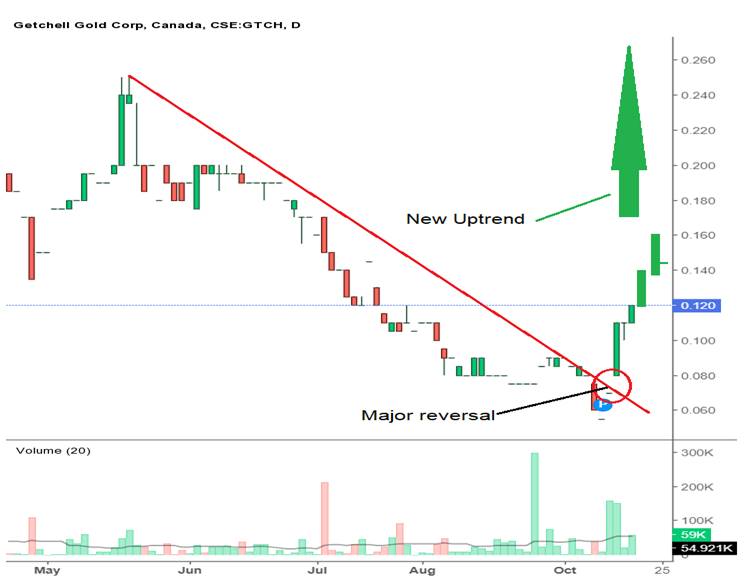
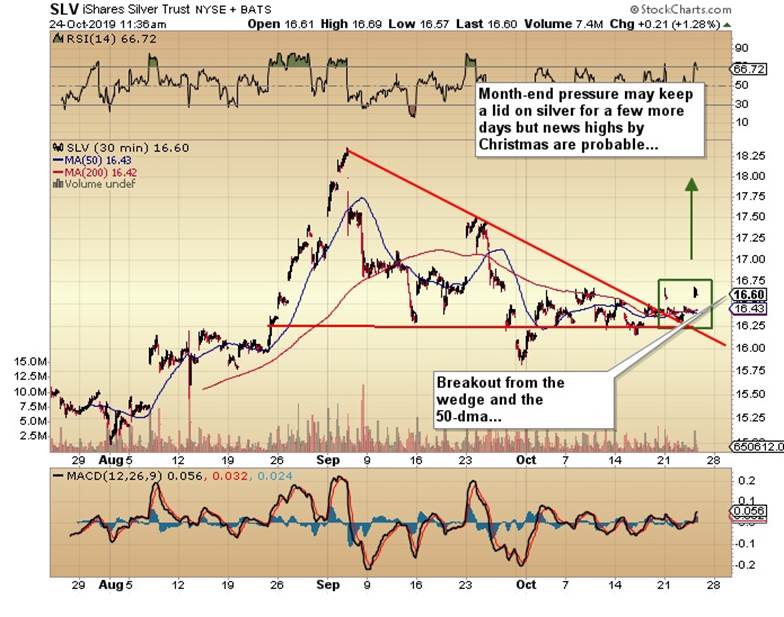
Shifting gears, to the extent that one still feels obliged to trade precious metals, I remain 100% invested in the GLD, SLV, GDX, and GDXJ, as well as a basket of juniors including Aftermath Silver Ltd. (AAG:TSX.V), Goldcliff Resource Corp. (GCN:TSX.V), Getchell Gold Corp. (GTCH:CSE) and Stakeholder Gold Corp. (SRC:TSX.V). I am also short the GSR from 92.4 (looking for 70). The only leveraged holding is a small position in the SLV December $18 calls from US$0.35 (now $0.24), and I am looking to add substantially to them possibly later in the week. The SLV chart is mildly constructive, having reclaimed the 50-daily moving average, which sits at $16.42, and moved above the downtrend line at $16.25.
Month-end is approaching fast and while we had a decent day today, I am fearful of a looming take-down between now and Halloween.
The overbought condition for both silver and gold has now been worked off, and considering that RSI for gold resided in the plus-75 zone for literally most of June, the recent 51.74 reading gives me a far-superior setup, while silver’s, at 52.93, is also in great shape. Mind you, these are not the minus-30 oversold “gifts” we had in late-summer 2018, but with conditions so precarious, and without knowing why the Fed has hit the panic button, the overall setup for both metals could not be better.
Originally trained during the inflationary 1970s, Michael Ballanger is a graduate of Saint Louis University where he earned a Bachelor of Science in finance and a Bachelor of Art in marketing before completing post-graduate work at the Wharton School of Finance. With more than 30 years of experience as a junior mining and exploration specialist, as well as a solid background in corporate finance, Ballanger’s adherence to the concept of “Hard Assets” allows him to focus the practice on selecting opportunities in the global resource sector with emphasis on the precious metals exploration and development sector. Ballanger takes great pleasure in visiting mineral properties around the globe in the never-ending hunt for early-stage opportunities.
Disclosure: 1) Michael J. Ballanger: I, or members of my immediate household or family, own securities of the following companies mentioned in this article: Aftermath Silver, Getchell, Goldcliff, Stakeholder. My company has a financial relationship with the following companies referred to in this article: None. I determined which companies would be included in this article based on my research and understanding of the sector. Additional disclosures are below. 2) The following companies mentioned in this article are billboard sponsors of Streetwise Reports: None. Click here for important disclosures about sponsor fees. As of the date of this article, an affiliate of Streetwise Reports has a consulting relationship with Aftermath. Please click here for more information. 3) Statements and opinions expressed are the opinions of the author and not of Streetwise Reports or its officers. The author is wholly responsible for the validity of the statements. The author was not paid by Streetwise Reports for this article. Streetwise Reports was not paid by the author to publish or syndicate this article. Streetwise Reports requires contributing authors to disclose any shareholdings in, or economic relationships with, companies that they write about. Streetwise Reports relies upon the authors to accurately provide this information and Streetwise Reports has no means of verifying its accuracy. 4) This article does not constitute investment advice. Each reader is encouraged to consult with his or her individual financial professional and any action a reader takes as a result of information presented here is his or her own responsibility. By opening this page, each reader accepts and agrees to Streetwise Reports’ terms of use and full legal disclaimer. This article is not a solicitation for investment. Streetwise Reports does not render general or specific investment advice and the information on Streetwise Reports should not be considered a recommendation to buy or sell any security. Streetwise Reports does not endorse or recommend the business, products, services or securities of any company mentioned on Streetwise Reports. 5) From time to time, Streetwise Reports LLC and its directors, officers, employees or members of their families, as well as persons interviewed for articles and interviews on the site, may have a long or short position in securities mentioned. Directors, officers, employees or members of their immediate families are prohibited from making purchases and/or sales of those securities in the open market or otherwise from the time of the interview or the decision to write an article until three business days after the publication of the interview or article. The foregoing prohibition does not apply to articles that in substance only restate previously published company releases. As of the date of this article, officers and/or employees of Streetwise Reports LLC (including members of their household) own securities of Aftermath Silver, Getchell, Goldcliff and Stakeholder, companies mentioned in this article.
Charts provided by the author.
Michael Ballanger Disclaimer: This letter makes no guarantee or warranty on the accuracy or completeness of the data provided. Nothing contained herein is intended or shall be deemed to be investment advice, implied or otherwise. This letter represents my views and replicates trades that I am making but nothing more than that. Always consult your registered advisor to assist you with your investments. I accept no liability for any loss arising from the use of the data contained on this letter. Options and junior mining stocks contain a high level of risk that may result in the loss of part or all invested capital and therefore are suitable for experienced and professional investors and traders only. One should be familiar with the risks involved in junior mining and options trading and we recommend consulting a financial adviser if you feel you do not understand the risks involved.
By CentralBankNews.info Tunisia’s central bank maintained its key interest rates, noting the stabilization of inflation following the easing of some prices of foods and services amid slow economic growth. The Central Bank of Tunisia (BCT) has kept its rate steady since a 100-basis-point rate hike in February as part of a 350-point tightening cycle that began in April 2017. Tunisia’s headline inflation rate has been decelerating since late 2018 and was steady at 6.7 percent in September and August while core inflation, which excludes food and subsidized goods, fell to 6.9 percent from 7.0 percent in August, the central bank said. In its statement, the bank’s board underlined the slow pace of economic growth and said this would not exceed 1.4 percent for 2019, mainly due to weak exports, business-oriented sectors, and mining. Tunisia’s gross domestic product ticked up to an annual rate of 1.2 percent in the second quarter of this year, up from 1.1 percent in the first quarter but down from 2.9 percent in the second quarter of 2018 and 2.7 percent in the first quarter of last year. Last month the governor of BCT, Marouane El-Abassi, said he expects inflation to drop to 6.9 percent by the end of the year and then gradually declined to 6.5 percent in 2020 and 5.9 percent in 2021. Tunisia’s inflation rate has been pushed up by automatic adjustments of wages to energy costs and increases in public sector wages, both of which the International Monetary Fund (IMF) has criticized.
The US Stock market rallied on Friday, October 25, on TESLA earnings crushing expectations as well as news that any positive US trade deal outcomes could see almost immediate removal of future tariffs that are scheduled to be implemented near the end of October. This was enough for the markets to rally from the start of trading and continue to push higher until near Noon in NY. After new highs were reached, the markets contracted a bit headed into the close.
Gold shot up early this morning before the news related to the US trade deal hit. Our opinion is that this is a natural advancement in precious metals that is not new related or muted by some external factors. Precious metals have been setting up a sideways FLAG formation for over 2 months and we believe the apex/breakout move is near.
Oil was somewhat flat to close out the week and closed trading near $56.63. The past three days we have seen oil rise from the $53 level to the current price levels, but we believe oil is still fundamentally oversupplied and that price will continue to weaken over time.
The real question before all of us right now is will this new nominal high represent a new breakout bullish price trend heading into a US Presidential Election cycle, or is this more price rotation within a defined price range?
If you consider all the shifting aspects of the US political and economic landscape as well as the current geopolitical and economic factors, we believe any real breakout move will come as we get closer to November 2020 – not now. We believe this is still price rotation and we believe the NQ is the likely cause of this new nominal price high on Friday. Tesla crushed earnings and that set a positive tone for Friday’s trading.
Transportation Index Daily Chart
The TRAN, Transportation Index, is still trading near current resistance and has not shown any true new price high yet. It will be interesting to see how the markets open up early next week and what news may drive a new price trend by then.
Mid-Cap Sector Daily Chart
The Mid-Cap has failed to rally to recent price highs which suggest this is not a broad market rally. We would want to see more defined price advancement across all sectors and above recent price highs to call this a broad market rally/breakout
Pay attention to the new that originates this weekend. We don’t believe a deal will be reached with regards to trade as quickly as some others may believe and we still believe the next 12+ months of the US Presidential election cycle will be full of surprises. We may start to get more clarity of a true price trend after the New Year (2020). Until then, we’re staying cautious of these price rotations and picking our trades.
I urge you visit my Wealth Building Newsletter and if you like what I offer, join me with the 1-year subscription to lock in the lowest rate possible and ride my coattails as I navigate these financial markets and build wealth while others lose nearly everything they own during the next financial crisis. Join Now and Get a Free 1oz Silver Bar!
I can tell you that huge moves are about to start unfolding not only in metals, or stocks but globally and some of these supercycles are going to last years. A gentleman by the name of Brad Matheny goes into great detail with his simple to understand charts and guide about this. His financial market research is one of a kind and a real eye-opener. PDF guide: 2020 Cycles – The Greatest Opportunity Of Your Lifetime
As a technical analysis and trader since 1997, I have been through a few bull/bear market cycles. I believe I have a good pulse on the market and timing key turning points for both short-term swing trading and long-term investment capital. The opportunities are massive/life-changing if handled properly.