EURUSD Analysis: Money supply growth slowing bullish for EURUSD

By IFCMarkets

Money supply growth slowing bullish for EURUSD

Annual growth rate of euro-zone broad monetary aggregate M3 decreased to 5.5% in September from 5.8% in August. Will the EURUSD rise?

EURUSD falling below MA(200)

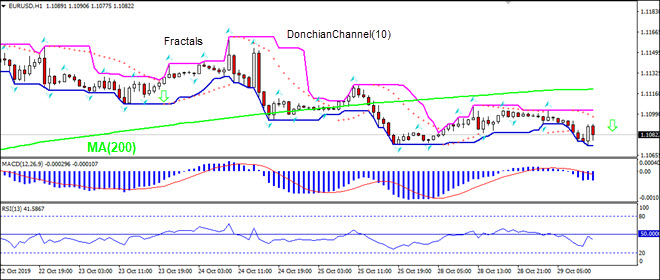
On 1-hour timeframe EURUSD: H1 is in downtrend, below the 200-period moving average MA(200) which is levelling off. The RSI indicator is below 50 level but has not reached oversold zone.

Technical Analysis Summary

OrderSell
Sell stopBelow 1.1073
Stop lossAbove 1.1093

Market Analysis provided by IFCMarkets

ECB Welcomes New President: Christina Lagarde

By Orbex

Dollar Higher But For How Long?

The US Dollar has traded higher over the morning so far on Tuesday as equities prices have pulled back a little from yesterday’s highs. Optimism over US/China trade talks has boosted risk sentiment though for now, the rally in equities is pausing, allowing USD to recover. The outlook for USD remains bearish however, given that the Fed is expected to ease further when it meets tomorrow. USD index trades 97.70 last, testing last week’s highs.

EUR Lower Following Lagarde Induction

EURUSD has been firmly lower today in light of the resurgence in USD. Draghi yesterday handed the reigns over to new ECB President Christina Lagarde and called for unity among policymakers going forward. Lagarde said that her first goal will be the unity of the ECB and is planning to carry out a review of ECB policy and its impact. EURUSD trades 1.1080 last, further down off the 1.1217 level.

GBP Down Despite Brexit Delay

GBPUSD has been lower today also as the stronger US Dollar weighs on price. The EU has now agreed to the UK’s extension request, with a new deadline of January 31st, 2020. However, the EU has said that if the UK can agree to a deal before that time it can leave sooner. Focus now turns to the potential for UK elections with the PM pushing for a 12th December date. GBPUSD trades 1.2828 last.

SPX500 Pulls Back From Fresh Record Highs

Risk assets have been a little softer today, seeing some pairing of the gains made yesterday in response to positive comments around US/China trade talks as well as news of Brexit being delayed again. SPX500 printed fresh record highs yesterday though is sitting just off them for now at 3035.03 last. While above 3028.38, focus remains on further upside.

Safe Haven Flows Dry Up

Safe havens have been lower today, reflecting the environment of both a stronger USD and a general improvement in risk appetite. With equities having made solid moves higher yesterday, both JPY and gold have been pushed down against USD. USDJPY trades 108.93 last while XAUUSD trades 1486.32, back below the round figure once again.

Crude Slide Deepens

Oil prices have been knocked firmly lower today, extending the week’s losses. The moves come despite the better expectations around a US/China trade deal, which should be supporting crude prices.  A stronger USD is clearly exerting some downside pressure here as traders await the first looks at industry data with the API report due later today ahead of tomorrow’s headline EIA report. Despite last week’s drawdown, traders are wary of a return to surpluses given the concerns over global demand for oil. Crude trades 55.14 last.

CAD Down On Oil Dump

USDCAD has been a little higher today in light of a stronger USD and weaker oil prices which have weighed on CAD. For now, however, price is retesting the underside of the broken 1.3068 level following the heavy sell-off over recent weeks. While below here, further losses are likely.

AUD Soft But Holding

AUDUSD has been weaker today also given the pairing back of upside seen across risk assets so far today. Expectations that the US and China will sign a deal should ultimately keep AUD supported in the near term with a Fed rate cut also likely to underpin price action. AUDUSD trades .6847 last, up off the week’s lows.

By Orbex


US-China Trade Deal Nearly Done

By Orbex

Deal Coming Soon

SPX500 rocketed to fresh highs yesterday in response to comments from President Trump.

The comments have fuelled speculation that the “phase one” trade deal agreed upon verbally on October 10th, could now be signed imminently.

Trump told reporters outside Joint Base Andrews in Maryland yesterday:

“We are looking probably to be ahead of schedule to sign a very big portion of the China deal, we’ll call it phase one but it’s a very big portion.”

The President explained that the deal in question would “take care of the farmers” and “also take care of a lot of the banking needs.” He added:

“So we’re about I would say a little bit ahead of schedule maybe a lot ahead of schedule,”

China To Beef Up Farm Purchases

Media reports have noted sources saying that the discussions which took place on Friday last week saw China demand that the US cancel some of the current tariffs on Chinese goods.

This would be in exchange for committing to ramping up its agricultural purchases of US farm goods. The US is reportedly looking for China to commit to specifics regarding time and price for buying these items.

However, China is still looking to secure buyer discretion.

China Sounding Optimistic Also

Trump’s comments echo those of Chinese officials over the weekend who also said that the deal is moving along swiftly. They claimed that only a few final details are yet to be confirmed.

The mood in the markets this week reflects the level of relief among traders. This, of course, is thanks to the damage that the now 16-month trade war has wrought on the global economy.

Many central banks, as well as the IMF, have highlighted the damage caused by the tariff war. The war has prompted most G10 central banks to return to easing. It also caused the IMF to slash its global growth forecast this year to just 3%, the lowest level since the GFC.

So, with the two countries looking ever closer to signing deal, how much do we know about what is to be included?

The Deal

According to Bloomberg, the current “phase one” deal includes:

  • A pause in tariffs escalation. The 5% increase due on $250 billion on October 15th was suspended. However, the goods remain under a 25% tariff along with $110 billion of goods under tariff since September 1st. The threat of a further tariff on $160 billion due on December 15th remains. However, we can expect them to remove it in line with the deal.
  • Concessions on intellectual property. The US is seeking to end systematic, state-backed Chinese appropriation of US intellectual property. While China has made commitments, these largely refer to actions that have already been taken. So, the US is likely to push for more.
  • Commitments on currency. The two countries will agree on a bilateral commitment over exchange rates. This will likely see the US removing the “currency manipulator” label it applied earlier this year.
  • Chinese commitments on US agricultural products. China recently resumed its purchases of soybeans and pork. However, it is set to double these purchases under the new deal.
  • Purchases of other goods. China also set to commit to purchases of items such as US commercial aircraft and natural gas.
  • The deal also lays out a dispute resolution mechanism. This is important as it means that China will be held accountable to ensure that it follows through on promises made in the deal.

Technical Perspective

USDCNH is sitting at a major support zone. Along with the structural support offered by prior lows between 7.0318 – 7.0484, price is also supported by the rising trend line from year to date lows. If we break below here, the next support zones to watch will be the 7.0055 and 6.9810 levels.

By Orbex


NZDCHF Analysis: Negotiations between USA and China are successful

By IFCMarkets

Negotiations between the USA and China are successful

In this review, we suggest to consider the currency pair New Zealand dollar against the Swiss franc Will the NZDCHF quotations grow? Such dynamics are observed with the weakening of the Swiss franc and the strengthening of the New Zealand dollar.

The main factor in the decrease in the quotations of the Swiss franc may be a decrease in global risks amid progress in the US-Chinese negotiations. This progress was announced by US President Donald Trump. The first stage of trade agreements between the United States and China can be signed during the Asia-Pacific Economic Cooperation (APEC) summit in Chile on November 16-17, 2019. The Swiss franc, previously regarded as a safe haven currency, may lose some of its appeal. In turn, for the New Zealand dollar, successful trade negotiations are positive sign, since China is New Zealand’s most important trading partner. Inflation and the index of business activity in industry (PMI) for October, as well as retail sales for September will be published on November 1st in Switzerland .These data may affect the Swiss franc. On October 31, a review of the economy by the Reserve Bank of New Zealand will be released, which can affect the rate of the New Zealand dollar.

Soyb

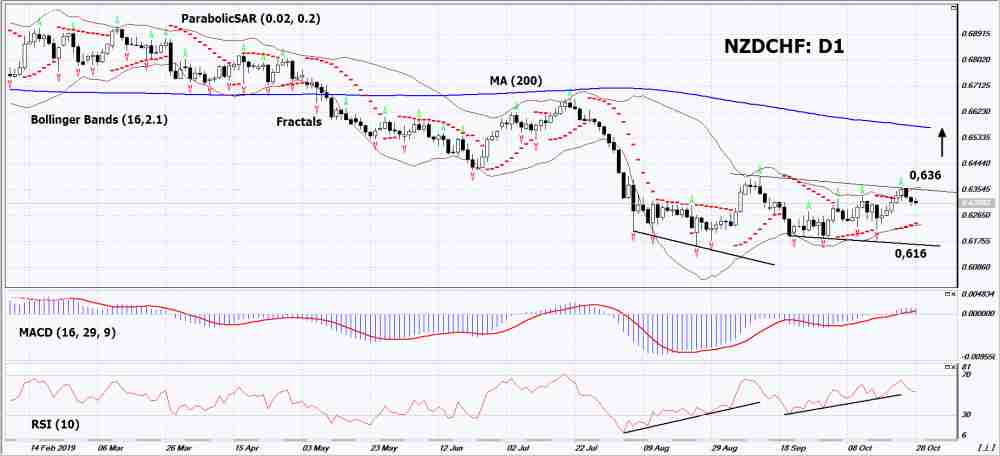
On the daily timeframeNZDCHF: D1 approached the upper limit of the neutral range. Before opening a buy position, it must be broken up. Various technical analysis indicators have generated signals to increase. Further growth of quotations is possible in case of successful trade negotiations between China and the USA and the publication of weak economic data in Switzerland.

  • The Parabolic indicator gives a bullish signal.
  • The Bolinger bands narrowed, indicating a volatility decrease. Both Bollinger lines are up.
  • The RSI indicator is above the mark of 50. It has formed a divergence to increase.
  • The MACD indicator demonstrates an uptrend signal.

The bullish momentum may develop if NZDCHF exceeds the last upper fractal and the upper Bollinger line: 0.636. This level can be used as an entry point. Initial stop lose may be placed below the 4-year low, the lower Bollinger line and the Parabolic signal: 0.616. After opening the pending order, the stop shall be moved following the Bollinger and Parabolic signals to the next fractal minimum. Thus, we are changing the potential profit/loss to the breakeven point. More risk-averse traders may switch to the 4-hour chart after the trade and place a stop loss moving it in the direction of the trade. If the price meets the stop level (0,616) without reaching the order (0,636), we recommend to cancel the order: the market sustains internal changes that were not taken into account.

Technical Analysis Summary

PositionBuy
Buy stopAbove 0,636
Stop lossBelow 0,616

Market Analysis provided by IFCMarkets

Armenia holds rate, keeps easy stance on low inflation

By CentralBankNews.info
Armenia’s central bank kept its benchmark refinancing rate at 5.50 percent but said it would maintain a stimulative monetary position as inflation is expected to remain below the target in coming months before gradually returning to it in the medium term.
The Central Bank of Armenia (CBA), which has lowered its rate twice this year, added the decision to maintain the rate today reflected the lack of inflationary pressures from abroad, the expected impact of fiscal policy and the gradual recovery in inflation.
CBA cut its rate by a total of 50 basis points this year following cuts in September and January.
Headline inflation in Armenia fell slightly to 0.5 percent in September from 0.6 percent in August while core inflation eased to 1.3 percent in August from 1.5 percent in July.
CBA targets inflation of 4.0 percent, plus/minus 1.5 percentage points.
In September CBA attributed the low inflation rate in recent months to a seasonal decline in agricultural prices that reflects international commodity prices.
CBA said today it was ready to respond adequately to ensure price stability in light of the downward risk to inflation, mainly due to external developments and fiscal policy.
Economic activity in the third quarter remained at a high level, with private consumption driving domestic demand, supported by monetary stimulus and injection of liquidity, CBA said. Although stimulus from fiscal policy had expanded in the third quarter, its impact on domestic demand is still seen as contained.
In the second quarter of this year Armenia’s gross domestic product grew 6.5 percent year-on-year, down from 7.2 percent in the first quarter.
Armenia’s dram firmed steadily from March through August but since then it has moved sideways and was trading at 475.6 to the U.S. dollar today, up 1.7 percent this year.

www.CentralBankNews.info


Australia’s FDI may decrease significantly after China’s reforms

By ForexNewsNow

Foreign Direct Investment in Australia is extremely diverse when we first take a look, but the moment we compare it to the FDI of a developing nation we quickly see a large disparity between active players.

Right now, according to research, the biggest investor in the Australian economy is the United States, pretty much like anywhere else. However, 2018 saw a significant decrease in the FDI of Australia after the trade war between China and the United States started to heat up a little bit.

The US was forced to decrease its FDI in Australia in order to allocate more in slightly closer jurisdictions to the Mainland. Countries such as Japan, South Korea, Taiwan and all of the South-East Asian countries received much more support from the US economy, which was a clear indication of the US’s efforts to increase their influence in the region.

When it comes to China though. They decided to double down on pretty much any country they could get their hands on. The FDI in Australia from China increase by $5 billion in 2018 alone and is set to increase even more in 2019.

Should the trend continue of the US decreasing FDI and China increasing it, by 2021 Australia will have a new largest investor of their local economy in the face of China.

This puts immense pressure on the local authorities as it’s quite hard to collaborate with a country that has different morals to a governing policy. Thus, Australia could find itself under pressure from forcing regulations or various other economic policies.

But that’s beside the point. What needs to be addressed is the economic implications that current Chinese economic policies could bring to Aussies.

Investment in Australia besides official FDI

One major variable we need to take into account is the unofficial FDI into the Australian economy coming from Mainland China. As unfortunate as it may be, most of the unofficial FDI comes in the form of money laundering from China.

Wealthy Chinese citizens usually get the desire to escape the Chinese economy once they’ve made their fortunes, which forces them to make significant investments in neighboring democracies to qualify for citizenship.

However, in order to qualify for their citizenship, the investment needs to be private rather than corporate. Considering that the Chinese government has strict regulations on private investments abroad, it’s getting harder and harder to qualify for other countries.

The slightly more lax regulation applies to countries like Australia and Canada, which is why we see so many Chinese nationals in these countries. Most of them used the opportunity to invest in things such as real-estate or local Aussie companies, which then gave them the opportunity to switch citizenship and move their wealth outside of China.

Another popular method is sending their children to Australia for university studies, after which the Australian law allows them to stay and work. After spending around 5 years in the country, these young Chinese nationals are prioritized as immigrants and thus, are granted citizenship much more easily, without requiring large investments.

The family members that still remain in the Mainland then start the process of transferring their wealth to their child in Australia and manage to legitimize their “de-funding” of the local economy.

Straight up illegal money laundering

Another part of FDI in the Australian economy, which the Aussie government may not have wanted to happen was through the transportation of wealthy Chinese gamblers.

One occasion with Crown Casino has already been unearthed and is being investigated if this activity was in direct violation of the Chinese gambling laws. Considering that several Crown employees have been arrested in the Mainland a year ago, it’s safe to say that it was.

The event didn’t necessarily damage the relations between China and Australia as it was a private venture. But the investigation could soon find out that the dealings were also guaranteed by Aussie lawmakers.

Because of such an event, Australian casino games for real money have started to be pressured by stricter surveillance, therefore adding a bit more costs to their compliance departments. Although the costs are not that high, it could add up significantly over the course of the following years.

Chinese economic policy that could tank FDI

A new economic policy in China could potentially limit the billions of dollars funneling towards the Australian economy illegally.

This policy was first announced by President Xi Jinping on Thursday last week, where he emphasized the importance of adopting the blockchain technology into the local economy.

This would have been amazing news for Aussie crypto companies, but the reality is not that bright.

The adoption of the blockchain does not necessitate the adoption of cryptocurrencies in China. It’s rather a creation of the groundwork for the adoption of the state digital currency that the People’s Bank of China is developing as we speak.

It’s basically a policy to advance the digital economy, thus limiting the flow of physical cash outside of the country.

This means that if the Chinese economy is largely digitized, it will become extremely hard to move cash outside of the country without the government taking notice.

Therefore, all of the “unregistered” investments that were coming into Australia may soon disappear, thus limiting cash inflow.

Will it take a toll on the economy?

It’s very unlikely for a couple of billion dollars in an economy as large as Australia take a huge toll. However, it’s likely that the AUD will be somehow affected considering the drop in demand.

Pair that up with the already serious issues due to the trade war, and we get a pretty bleak picture for the Australian economy in the coming years. Unless the USA resumes its past investment strategies in the region.

By ForexNewsNow
Japanese Candlesticks Analysis 29.10.2019 (USDCAD, AUDUSD)

Article By RoboForex.com

USDCAD, “US Dollar vs Canadian Dollar”

As we can see in the H4 chart, USDCAD is still trading close to the support level and forming reversal patterns, such as Doji, Hammer, and Inverted Hammer. Right now, the pair is trying to reverse and may continue growing towards 1.3186. However, we shouldn’t ignore another scenario, according to which the instrument may fall to reach 1.3030.

USDCAD
Risk Warning: the result of previous trading operations do not guarantee the same results in the future

AUDUSD, “Australian Dollar vs US Dollar”

As we can see in the H4 chart, AUDUSD has formed another reversal pattern, Hammer, in the middle of the rising channel. At the moment, the pair is reversing. Judging by the previous movements, we may assume that the price may reverse and then return to 0.6880. However, we shouldn’t ignore an alternative scenario, which implies that the instrument may resume falling towards 0.6777.

AUDUSD

Article By RoboForex.com

Attention!
Forecasts presented in this section only reflect the author’s private opinion and should not be considered as guidance for trading. RoboForex LP bears no responsibility for trading results based on trading recommendations described in these analytical reviews.

UK Election 2019: Expect the pound and UK financial assets to be increasingly volatile

By George Prior

The pound and UK financial assets will be volatile in the run-up to Britain’s first December general election since 1923 – and will remain so in the event of another hung parliament.

This is the warning from Nigel Green, CEO and founder of deVere Group, one of the world’s largest independent financial advisory organizations, as opposition party Labour announces it is now backing the government’s bill for a December election, regardless of the date.

Mr Green comments: “This is a critical stage in the slow-moving, damaging, torturous Brexit saga.

“Expect the pound and UK financial assets to be increasingly volatile in the run-up to the general election, given the wide-ranging set of outcomes.

“The most detrimental of these outcomes for sterling, UK financial assets and the wider British economy, include another hung parliament or a victory for Jeremy Corbyn’s Labour party.”

He continues: “Boris Johnson’s intention to secure a majority within the House of Commons is by no means guaranteed.

“The Brexit Party will use the fact that Mr Johnson did not deliver Brexit by October 31 – something on which he staked his whole premiership.

“The Remain vote could also be split between Labour, the Liberal Democrats, the Greens and the Scottish National Party.

“Political fragmentation on this scale has never happened before in the UK.

“Therefore, a hung parliament looks like an alarming possibility, meaning there could be no majority to quickly and smoothly resolve the Brexit chaos.

“Should grinding deadlock continue, the UK economy would still haemorrhage investment and confidence. The fallout of Brexit has cost the UK three and a half years of lost opportunity and many, many tens of billions of pounds. This would only intensify with another hung parliament.”

He adds: “Meanwhile Jeremy Corbyn’s Labour party will campaign on the most radical, left-wing manifesto in more than a generation.

“Should he win this election, his anti free-market policies – such as the re-nationalisation of industries from utilities to railways to postal services, and the forcing of companies to give 10% of their shares to staff – plus his high-tax policies, including a possible wealth tax, will spook the financial markets, hit long-term sustainable growth of the British economy, put more pressure on UK financial assets, and lead to a significant sell-off of the pound.

Mr Green concludes: “The general election is set to be the most contentious and uncertain in generations. Investors now need to protect and build their wealth and assets by ensuring they are properly diversified across asset classes, sectors, currencies and regions.”

About:

deVere Group is one of the world’s largest independent advisors of specialist global financial solutions to international, local mass affluent, and high-net-worth clients.  It has a network of more than 70 offices across the world, over 80,000 clients and $12bn under advisement

Ichimoku Cloud Analysis 29.10.2019 (AUDUSD, NZDUSD, USDCAD)

Article By RoboForex.com

AUDUSD, “Australian Dollar vs US Dollar”

AUDUSD is trading at 0.6853; the instrument is moving above Ichimoku Cloud, thus indicating an ascending tendency. The markets could indicate that the price may test Tenkan-Sen and Kijun-Sen at 0.6825 and then resume moving upwards to reach 0.6955. Another signal to confirm further ascending movement is the price’s rebounding from the rising channel’s downside border. However, the scenario that implies further growth may be canceled if the price breaks the cloud’s downside border and fixes below 0.6775. In this case, the pair may continue falling towards 0.6695.

AUDUSD
Risk Warning: the result of previous trading operations do not guarantee the same results in the future

NZDUSD, “New Zealand Dollar vs US Dollar”

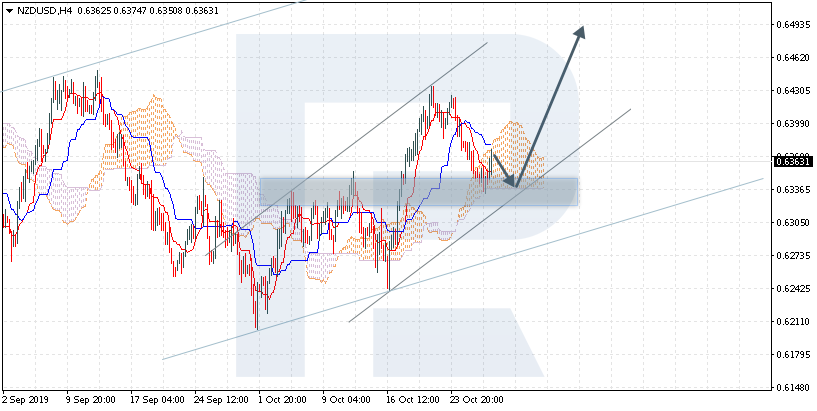
NZDUSD is trading at 0.6363; the instrument is moving inside Ichimoku Cloud, thus indicating a sideways tendency. The markets could indicate that the price may test the cloud’s downside border at 0.6335 and then resume moving upwards to reach 0.6495. Another signal to confirm further ascending movement is the price’s rebounding from the rising channel’s downside border. However, the scenario that implies further growth may be canceled if the price breaks the cloud’s downside border and fixes below 0.6320. In this case, the pair may continue falling towards 0.6235. After breaking the cloud’s upside border and fixing above 0.6415, the price may resume its ascending tendency.

NZDUSD
Risk Warning: the result of previous trading operations do not guarantee the same results in the future

USDCAD, “US Dollar vs Canadian Dollar”

USDCAD is trading at 1.3055; the instrument is moving below Ichimoku Cloud, thus indicating a descending tendency. The markets could indicate that the price may test Tenkan-Sen and Kijun-Sen at 1.3080 and then resume moving downwards to reach 1.2935. Another signal to confirm further descending movement is the price’s rebounding from the descending channel’s upside border. However, the scenario that implies further decline may be canceled if the price breaks the cloud’s upside border and fixes above 1.3165. In this case, the pair may continue growing towards 1.3245.

USDCAD

Article By RoboForex.com

Attention!
Forecasts presented in this section only reflect the author’s private opinion and should not be considered as guidance for trading. RoboForex LP bears no responsibility for trading results based on trading recommendations described in these analytical reviews.

The Analytical Overview of the Main Currency Pairs on 2019.10.29

by JustForex

The EUR/USD currency pair

Technical indicators of the currency pair:
  • Prev Open: 1.10804
  • Open: 1.11003
  • % chg. over the last day: +0.14
  • Day’s range: 1.10889 – 1.11025
  • 52 wk range: 1.0884 – 1.1623

An ambiguous technical picture has developed on the EUR/USD currency pair. A trading instrument is consolidating. At the moment, the local support and resistance levels are 1.10750 and 1.11050, respectively. Investors expect up-to-date information regarding trade negotiations between the US and China, as well as the Fed meeting. EUR/USD quotes have the potential to further decline. Today, financial market participants will evaluate important economic reports from the United States. We recommend opening positions from key levels.

The Economic News Feed for 29.10.2019:

  • – Consumer Confidence Index by CB (US) – 16:00 (GMT+2:00);
  • – Incomplete Real Estate Sales Index (US) – 16:00 (GMT+2:00);
EUR/USD

Indicators do not give accurate signals: the price crossed 50 MA.

The MACD histogram is close to 0.

The Stochastic Oscillator is located near the oversold zone, the %K line is below the %D line, which gives a weak signal to sell EUR/USD.

Trading recommendations
  • Support levels: 1.10750, 1.10450, 1.10200
  • Resistance levels: 1.11050, 1.11250, 1.11500

If the price consolidates below the level of 1.10750, expect a further drop toward 1.10450-1.10300.

Alternatively, the quotes could grow toward 1.10450-1.10300.

The GBP/USD currency pair

Technical indicators of the currency pair:
  • Prev Open: 1.28207
  • Open: 1.28601
  • % chg. over the last day: +0.22
  • Day’s range: 1.28350 – 1.28608
  • 52 wk range: 1.1959 – 1.3385

The GBP/USD currency pair continues to consolidate. The technical pattern is ambiguous. At the moment, the local support and resistance levels are 1.28100 and 1.28700, respectively. Investors are waiting for new information regarding the Brexit process. British Prime Minister Boris Johnson formally agreed to extend the country’s withdrawal from the Union until January 31, 2020. A trading instrument can descend further. Open positions from the key levels.

The Economic News Feed for 29.10.2019 is calm.

GBP/USD

Indicators do not give accurate signals: the price crossed 50 MA and 100 MA.

The MACD histogram is getting closer to 0.

The Stochastic Oscillator is in the neutral zone, the %K line is above the %D line which indicates a bullish sentiment.

Trading recommendations
  • Support levels: 1.28100, 1.27600, 1.27000
  • Resistance levels: 1.28700, 1.29450, 1.30100

If the price consolidates below 1,28100, expect GBP/USD quotes to fall toward 1.27600-1.27400.

Alternatively, the quotes could grow toward 1.29200-1.29400.

The USD/CAD currency pair

Technical indicators of the currency pair:
  • Prev Open: 1.30606
  • Open: 1.30549
  • % chg. over the last day: -0.10
  • Day’s range: 1.30517 – 1.30599
  • 52 wk range: 1.2727 – 1.3664

Looney is still in lateral movement. There is no defined trend. At the moment, USD/CAD quotes are consolidating near the support level of 1.30500. 1.30750 acts as local resistance. CAD has potential for further growth against the USD. Pay attention to economic releases from the United States, as well as the dynamics of oil prices. Open positions from key levels.

The Economic News Feed for 29.10.2019 is calm.

USD/CAD

Indicators do not give accurate signals: the price is testing 50 MA and 100 MA.

The MACD histogram has moved into the negative zone, indicating a bearish sentiment.

The Stochastic Oscillator is in the neutral zone, the %K line is below the %D line, which gives a signal to sell USD/CAD.

Trading recommendations
  • Support levels: 1.30500, 1.30200, 1.30000
  • Resistance levels: 1.30750, 1.31000, 1.31200

If the price consolidates below the support level of 1.30500, expect the quotes to drop toward 1.30200-1.30000.

Alternatively, the quotes could grow toward 1.31000.

The USD/JPY currency pair

Technical indicators of the currency pair:
  • Prev Open: 108.670
  • Open: 108.982
  • % chg. over the last day: +0.22
  • Day’s range: 108.936 – 109.068
  • 52 wk range: 104.97 – 114.56

The USD/JPY currency pair has moved up and updated local highs. The USD/JPY quotes reached a round level of 109,000. The 108.850 is already a mirror support. Currently, the currency pair is consolidating. Investors expect important economic releases from the United States. The trading instrument has the potential for further growth. We recommend opening positions from key levels.

The Economic News Feed for 29.10.2019 is calm.

USD/JPY

The price fixed above 50 MA and 100 MA, which signals the bullish mood.

The MACD histogram is in the positive zone, but below the signal line, which gives a weak signal to buy USD/JPY.

The Stochastic Oscillator is in the neutral zone, the %K line crossed the %D line. There are no signals at the moment.

Trading recommendations
  • Support levels: 108.850, 108.700, 108.500
  • Resistance levels: 109.050, 109.300, 109.500

If the price consolidates above 109.050, expect further growth toward 109.300-109.400.

Alternatively, the quotes could fall toward 108.700-108.500.

by JustForex