Why Nobody Chants “End the Fed” Anymore

By Money Metals News Service

Americans hated it when the Federal Reserve handed trillions of dollars to crooked Wall Street banks following the 2008 Financial Crisis. Politicians were confronted about the merits of central banking and bailouts.

For the first time in history, college students were chanting “End the Fed” at campaign rallies as Ron Paul took the central bank to task during his presidential campaigns.

U.S. Federal Reserve System Logo

Virtually everyone in America vehemently opposed the central bank handing piles of cash to the same bankers whose greed and fraud had caused the Financial Crisis.

Little has changed, but the public’s revulsion taught them an important lesson. If they give handouts to greedy and fraudulent bankers, they had better do it in secret.

Avoiding a public outcry is probably why there is scant information about what is actually happening in the repo markets right now. The Fed continues to ramp up its overnight lending operations and has now poured in just short of three quarters of a trillion dollars in the past month.

The stated reasons for injecting all of this freshly printed cash are dubious at best.

We know private banks suddenly priced the risk of overnight lending to other banks multiples higher. The Fed’s program, which was originally presented as a fix to a very temporary problem, has now been expanded and extended multiple times.

The actual problem has turned out NOT to be short-lived, and the sums involved in addressing it are staggering.

Bailout Stamp

The Fed just ramped up its commitment to now provide $690 billion in supposedly short-term funding. It will onboard the associated risk at a rate far below what the private market dictates.

One or more banks are seriously short of cash. Their peers won’t, or can’t, extend a short term, fully collateralized loan at less than punitive rates.

That’s why the Fed stepped in with another massive handout. As far as the Fed is concerned, no bankers should pay for whatever sins and mismanagement led them into trouble.

Jerome Powell and other Fed officials aren’t going to admit that, of course. They also don’t want the public to know which firms are getting these backdoor bailouts, or why.

They want Americans not to worry or pay much attention. We’re told repo loans are secured by bullet proof collateral – U.S. Treasuries. They aren’t talking about why this collateral isn’t providing comfort to private sector lenders who want much higher rates.

The Fed might just get away with it, too. Nobody is chanting “End the Fed” anymore. Candidates aren’t talking about the central bank… with the exception of Donald Trump, who has done an about face since his election. He now lambasts the Fed for not doing nearly enough.

The wealth transfer from Main Street to Wall Street looks set to continue unchallenged. When the next bubble pops, Americans may again remember why a central bank which responds to every problem by printing vast sums and handing it to other bankers is a terrible idea.


The Money Metals News Service provides market news and crisp commentary for investors following the precious metals markets.
Dollar weakened on US retail sales decline

By IFCMarkets

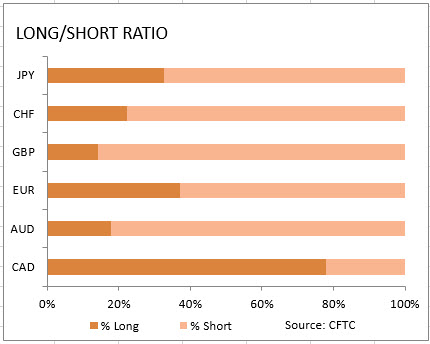
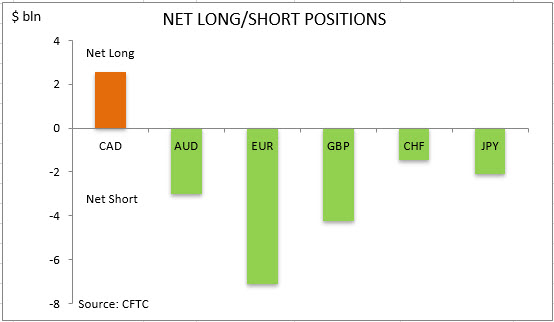
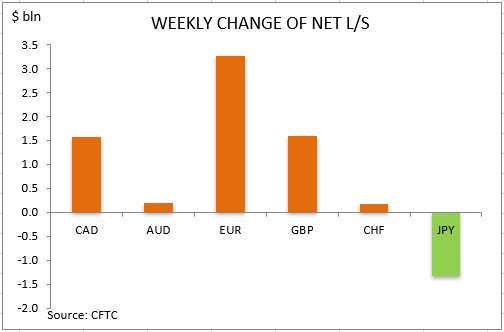
US dollar bullish bets fell to $15.31 billion from $20.77 billion against the major currencies during the one week period, according to the report of the Commodity Futures Trading Commission (CFTC) covering data up to October 22 and released on Friday October 25. The ICE US Dollar index USDX continued falling on weak US economic data including manufacturing sector performance and decline of retail sales in September of 0.3% over month when 0.3% increase was expected.

CFTC Sentiment vs Exchange Rate

October 22 2019BiasEx RateTrendPosition $ mlnWeekly Change
CADbullishpositive25501569
AUDbearishnegative-3014201
EURbearishnegative-70993264
GBPbearishnegative-42181599
CHFbearishnegative-1432166
JPYbearishnegative-2093-1330
Total-15306


commitment of traders net long short
commitment of traders weekly change
market sentiment ratio long short positions

Market Analysis provided by IFCMarkets

Note:
This overview has an informative and tutorial character and is published for free. All the data, included in the overview, are received from public sources, recognized as more or less reliable. Moreover, there is no guarantee that the indicated information is full and precise. Overviews are not updated. The whole information in each overview, including opinion, indicators, charts and anything else, is provided only for familiarization purposes and is not financial advice or а recommendation. The whole text and its any part, as well as the charts cannot be considered as an offer to make a deal with any asset. IFC Markets and its employees under any circumstances are not liable for any action taken by someone else during or after reading the overview.

Kazakhstan maintains rate as inflation seen in target

By CentralBankNews.info
Kazakhstan’s central bank left its base rate steady at 9.25 percent and reiterated its forecast for inflation to end this year around 5.7 to 5.8 percent and then settle within its target corridor of 4.0 to 6.0 percent until the end of 2020.
The National Bank of the Republic of Kazakhstan (NBK) also reiterated its guidance from last month that future policy decisions would be based on how inflation evolves in comparison with its target.
NBK raised its rate by 25 basis points in September, unwinding a rate cut in April and returning the rate to its level seen from October 2018 to March 2019.
Kazakhstan’s inflation rate eased to 5.3 percent in September from 5.5 percent in August while core inflation, which excludes the prices of fruits and vegetables, regulated services and energy, eased to 7.7 percent from 7.9 percent.
The growth in food prices accelerated in September to 9.1 percent, mainly due to higher domestic prices pulled up by higher world market prices, and meat and meat product prices were up 13.5 percent year-on-year.
But inflationary expectations did not change significantly, the NBK said, and over the next 12 months inflation is seen at 5.4 percent.
Business activity is also continuing to growth, with short-term economic indicators up 4.7 percent in the first 9 months of the year and investments up 9.7 percent.
The tenge has firmed in recent days and was trading at 388.6 to the U.S. dollar today but is still down 3.3 percent since the start of this year.

www.CentralBankNews.info

The Best Sentiment Indicators

By Orbex

Sentiment analysis is often the least considered if not outright forgot of the different types of market analysis. Perhaps the reason for that is it’s hard to get inside the head of a single trader, let alone millions of them across the world. So gauging sentiment is difficult and often not as precise as technical or fundamental analysis.

However, sentiment moves the market. On a very basic level, whether traders are eager to buy or itching to sell, is what moves prices up and down. In fact, sentiment can be considered one of the characteristics of certain currencies or other assets. For example, safe-haven currencies are popular when market sentiment has shifted to be risk-averse. Gold tends to go down when market sentiment is optimistic.

Gauging Sentiment

The question then is, how do we measure whether how the market is feeling? Some traders simply go by observing what kind of assets are moving. From that, they get a general idea if the market is willing to take risks or not. This is hardly precise and isn’t all that helpful in analyzing a specific asset, such as a currency pair.

On the other end, there is a diverse range of computer programs that are being designed to scan twitter, news articles, and other market chatter to collate phrases and terms used by traders. The idea is to try to objectively measure the optimism and pessimism of traders. However, these programs are still in their infancy. It’s questionable if a machine is the best tool for measuring people’s emotions.

So, What do we Have?

There are some more sophisticated indicators that are based on trading patterns, and an understanding of trader psychology. Some of these are really popular. That makes them better measures of market sentiment because of the self-fulfilling prophecy characteristic of the market. If everyone is using a particular indicator, then the market tends to behave like everyone is using that indicator.

Probably the most popular of the general sentiment indicators is the VIX, which is a volatility indicator. Volatility indicators work on the theory that markets tend to move up and down a lot more during periods of market uncertainty. Traders generally don’t like uncertainty, because it implies more risk, so they will retreat to safer assets.

The VIX is compiled by the CBOE (Chicago Board of Exchange) and measures volatility across the markets. It is so popular that you can trade derivative assets based on it. But, for practical purposes, it’s a measure of general volatility in the market. If it goes up, then arguably traders are less likely to take risks; and if it goes down, we might see a boost in riskier assets.

But for Individual Assets?

If you are interested in a particular asset, say a currency pair, you can use some technical indicators that measure volume. Higher volumes generally indicate more interest; a higher volume of sales would indicate a negative sentiment, while a higher volume of buying would show positive sentiment.

On-Balance Volume (OBV) is probably the most popular of the volume indicators. It considers an increase in price at the close as a higher volumes. In theory, if the volume diminishes while the price continues to move higher, it’s an indicator of a trend reversal. That’s why this indicator is popular among trend traders.

By Orbex


GBPUSD Analysis: Slower decline of UK retail sales bullish for GBPUSD

By IFCMarkets

Slower decline of UK retail sales bullish for GBPUSD

UK Confederation of British Industry reported retail sales declined less than expected in October. Will the GBPUSD rise?

EURUSD rising toward MA(200)

The price chart on 1-hour timeframe shows GBPUSD: H1 is in uptrend. The price is rising toward the 200-period moving average MA(200) which is rising. The RSI oscillator is rising but has not reached the overbought zone.

Technical Analysis Summary

OrderBuy
Buy stopAbove 1.2859
Stop lossBelow 1.2839

Market Analysis provided by IFCMarkets

Trick Or Treat For Brexit?

By Orbex

October 31st Deadline Still Active

The October 31st Brexit deadline is right around the corner and it is safe to say that this really is a case of “Trick or Treat”.  Last week was a frustrating one for the UK and also for markets.  In a vote on the PM’s Withdrawal Agreement Bill, the PM was eventually successful in gaining parliamentary approval for his deal. However, in the second vote, which was on the express passing of the bill (to allow for the October 31st Brexit) MPs voted against Johnson.

Johnson Requests Delay

In the wake of that parliamentary defeat, Johnson was instructed by the Benn Bill legislation passed by MPs last month to request an extension to the Article 50 deadline. After some deliberation, which unsettled GBP, the extension request has now been approved by the EU. However, the EU has not yet said what the new deadline will be. In light of this, uncertainty remains around whether the deadline will be sooner than the January 31st, 2020 deadline set out in the Benn Bill, or later.

Timeframe Important

Given the confusion and division which remains, if the EU offers a deadline within the next month or so, this will likely be bearish for GBP. The reason being is that the chances of MPs agreeing on delivering Brexit in that timeframe remain very slim. This raises the risk once again of a no-deal Brexit. However, if the EU agrees to the 3-month extension or offers a later deadline, this would likely boost GBP. This would allow more time for MPs to work on agreeing to deliver Brexit. Furthermore, the chances of a no-deal outcome would be reduced, offering further support.

Election Risk

While the dynamic seems fairly straightforward, the situation has become more complex due to developments within the domestic political space. PM Johnson is now pushing for early general elections ahead of Christmas. However, to call these elections he would need parliamentary support with Jeremy Corbyn (leader of the opposition). Corbyn is so far saying he will not offer support for elections unless the prospect of a no-deal is taken off the table.

If we see these elections happen, they will have a further impact on the Brexit outlook. Clearly, at this stage, a Conservative government would likely press ahead with a no-deal Brexit in order to get Brexit done. On the other hand, a Labour government would very likely hold a second referendum which raises the prospect of Brexit being cancelled altogether. If we see a hung parliament (which appears most likely) then the current quagmire will continue and Brexit will likely be delayed again.

Second Referendum?

However, there has been another plot twist as UK newspaper The Guardian is reporting that a group of Remainer MPs are planning to take over the Commons Agenda (in the same way that was done to pass the Benn Bill) next week to allow for a parliamentary vote on holding a second referendum. If successful, this could once again raise the prospect of Brexit being canceled if the public is given a second vote.

Macron Threatens Veto

Over the weekend, we have also seen the emergence of a new factor. French Prime Minister Emmanuel Macron has said that he will veto any extension to Article 50 (thus forcing a no-deal Brexit by October 31st). He will do this if Jeremy Corbyn doesn’t agree to support elections or if parliament doesn’t ratify Johnson’s Brexit deal. Macron has given Monday as the deadline for this ultimatum.

Technical Perspective

Clearly, there is plenty to watch this week and the risk of volatility is extremely elevated. GBPUSD recently broke out above the bearish trend line from year to date highs, though reversed just shy of testing the 1.3032 level. The rest of 1.2771 has held as support for now keeping the focus on further upside. Above 1.3022, the next zone to watch is the 1.3297 level. However, if price breaks back under the bearish trend line, 1.2487 is the next support to watch.

By Orbex


XAGMXN Silver/Peso Analysis: Getting ready for publishing the statistics in Mexico

By IFCMarkets

Getting ready for publishing the statistics in Mexico

In this review, we suggest to consider the Silver vs. MXN Personal Composite Instrument (PCI). It reflects the price dynamics of silver versus the Mexican peso. Will the XAGMXN quotations grow?

Such dynamics indicates price growth of silver and a weakening of the Mexican peso. Since September 2019, the peso has strengthened by 5%. Meanwhile, US President Donald Trump expressed concern that Congress might not have time to ratify before the end of this year a new mutual trade agreement between the US, Canada and Mexico, the USMCA, which should replace the previous NAFTA. The postponement of USMCA ratification could have a negative effect on the Mexican peso and the Canadian dollar. This week Mexico will publish data on foreign trade for September, GDP for the 3rd quarter and an indicator of business activity in industry (PMI) for October. They can affect the dynamics of the peso. The growth of precious metals quotations, including gold and silver, can contribute to new global risks against the backdrop of Brexit’s next problems. The new agreement between Britain and the European Union requires the approval of the British Parliament. According to GFMS, silver imports to India increased by 8% in the 3rd quarter of 2019 compared to the same period last year. At the same time, in January-September of the current year it grew by 11%. The main demand was in the jewelry industry and investment. In developing countries, silver has become more attractive against the backdrop of expensive gold.

XAGMXN

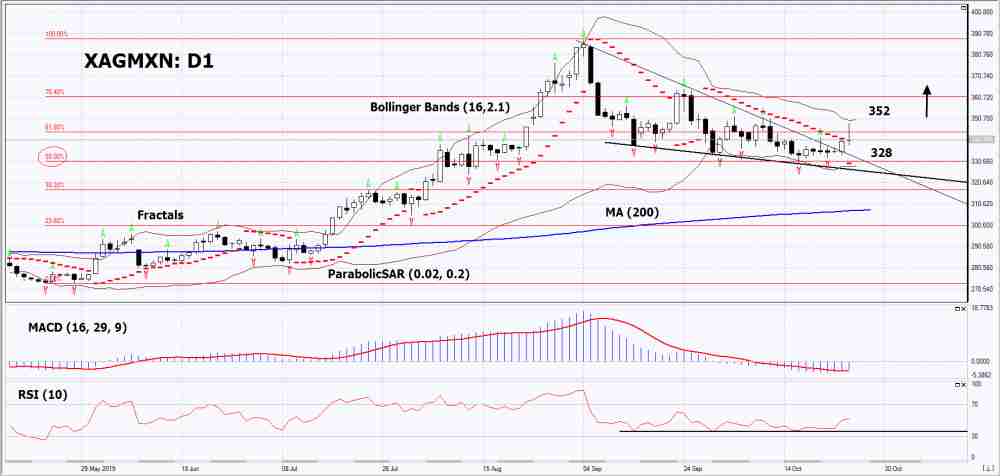
On the daily timeframe XAGMXN: D1 moved up from the downtrend. Various technical analysis indicators have generated signals to increase. Further growth is possible if high demand for precious metals and negative macroeconomic data in Mexico continue.

  • The Parabolic indicator demonstrates a signal to increase.
  • The Bolinger bands narrowed, indicating volatility decrease. Both Bollinger Lines Slope Up.
  • The RSI indicator is above the mark of 50. It has formed a divergence to increase.
  • The MACD indicator gives a bullish signal.

The bullish momentum may develop if XAGMXN exceeds its last two upper fractals and the upper Bollinger line: 352. This level can be used as an entry point. The initial stop lose may be placed below the last lower fractal, the lower Bollinger line and the Parabolic signal: 328. After opening a pending order, the stop shall be moved following the Bollinger and Parabolic signals to the next fractal minimum. Thus, we are changing the potential profit/loss to the breakeven point. More risk-averse traders may switch to the 4-hour chart after the trade and place a stop loss moving it in the direction of the trade. If the price meets the stop level (352) without reaching the order (328), we recommend to cancel the order: the market sustains internal changes that were not taken into account.

Technical Analysis Summary

PositionBuy
Buy stopAbove 352
Stop lossBelow 328

Market Analysis provided by IFCMarkets

Risk Rallies On Trade Deal Hopes

By Orbex

Focus on FOMC

The US dollar has been a little weaker over the European session so far on Monday. Traders’ main focus this week will be the October FOMC meeting due on Wednesday. In line with the recent worsening of US economic data, the market is forecasting a further .25% rate cut from the Fed. USD Index trades 97.53 last.

EUR Boosted By Weak USD

EURUSD has been higher at the start of the week as the single currency takes advantage of a weaker USD. If the Fed pushes ahead with a further rate cut this week that could create room for more upside in EUR in the short term. This is given that the ECB is likely to remain on hold in the near term while incoming ECB President Lagarde assesses the bank’s monetary policy approach. EURUSD trades 1.1098 last, still well below the key 1.1217 level.

EU TO Deliver Brexit Delay Date

GBPUSD has bee a little higher against USD so far today though upside has been tempered by ongoing uncertainty around Brexit. The UK is awaiting the outcome of the EU’s Brexit-delay deadline decision this week which should see Brexit postponed beyond the current October 31st Brexit date. However, until such a deadline has been given the risk of a no-deal exit is still a technical possibility. GBPUSD trades 1.2829 last, still sitting above the 1.2771 level for now.

SPX500 Near All-Time Highs

Risk assets have started the week on a positive footing. With Brexit likely to be delayed, US/China trade talks pointing towards a deal and the Fed expected to cut further this week, equities investors are being given a green light. SPX500 trades 3027.30 last, testing the 3028.38 resistance level ahead of fresh all-time highs.

Safe Havens Weaker

Safe havens have seen diminished inflows this week given the improved risk environment. Both JPY and gold have been lower against the US dollar. The BOJ is not expected to ease this week though it could be forced to if the post-FOMC reaction drives JPY higher meaningfully. USDJPY is now once again testing the 10872 level. XAUUSD trades 1504.61 last, still above the round figure for now though down off the key 1522.75 level.

Crude Still Strong

Oil prices have had a subdued session so far though are trading marginally in the green. The background remains supportive near term with US/China talks progressing well and the Fed expected to cut rates this week. Last week the EIA reported an unexpected draw in US crude stores. Traders will be closely watching this week’s report on Wednesday to see if the move continued. Crude trades 56.42 last.

CAD Keeps On Climbing

USDCAD is still battling it out around the 1.3068 level though remains just under the level for now. The recovery in oil prices along with a weaker USD is keeping the outlook bearish for the loonie. This is especially in light of the expected Fed rate cut this week which should see prices move lower yet again.

AUD Helped By Trade Hopes

AUDUSD has been higher over the day so far on Monday taking its cues from a weaker USD and improved risk sentiment. Headlines around the latest US/China trade talks on Friday helped boost AUD which will benefit strongly from a deal. AUDUSD trades .6831 last.

By Orbex


Stock Picking Strategies That Work

Do you know why a lot of people are intimidated at the thought of investing in the stock market? It’s because they are afraid to take risks. We all know that the economy has its fair share of ups and downs but despite its precariousness, one thing is certain, over the years, the market has remained to be an excellent medium to invest your money in. Sure, it comes with risks but as long as you know what you are doing it’s safe to say that the risks aren’t going to be that high.

If you have finally convinced yourself to invest, we assume that you at least have some basic knowledge on stock picking and stock concepts otherwise, there’s a pretty good chance you might find yourself buried in debt, God forbid. You see, there are virtually thousands of potential stocks, the question is, how will you know which of those to choose? You can’t possibly go through every income statement that’s out there, true, but you can take advantage of clever stock-picking strategies to stay safe.

The following are time-tested stock-picking strategies you can use to your advantage.

Know Your Goals

The first step that will help you select the stocks to invest is in knowing your goals. Some investors are concentrating more on capital appreciation, capital preservation and some are more focused on generating income. If you are interested in the income you should consider low-growth firms like those in the utility industry. However, if you are more interested in capital preservation you should consider investing in blue-chip corporations. Investors who are interested in capital appreciation should look for companies with various life cycle stages and market capitalization. When you’ve already set your goals you can actually combine these different strategies when picking stocks. One of the fundamental techniques in investing is narrowing your choices and when you’ve come up with your prospects you can then analyze their financial status.

Keep Your Eyes Peeled

Investing isn’t about intuition or gut feel it’s about knowing the facts. This is why you must keep your eyes peeled on current events in the market. Expand your knowledge and read as much as you can from online financial websites, magazines and blog posts. The more you know the more confident you will be on your decision. You don’t have to do it all day. A few readings a day is already enough. Who knows, maybe reading a random blog post could be your winning ticket to financial freedom. Research has become relatively easier nowadays because of the Internet. Plus you can read different points of view from various investment professionals that will help you come up with a decision.

Look for Companies

After determining your goals your next step is to find companies that you are interested in. First of all look at the ETFs and then evaluate their holdings and learn about their previous performance. Again, take advantage of search engine sites. A quick search can be done in seconds by typing “Industry Y ETF”. While you’re at it, make sure you are using a screener in filtering stocks. Filter stocks by choosing specific features such as sector and industry. You can also check out their dividend yield and their market capitalization to gain more information about the companies. Don’t ever stop researching because reading about stocks will get you a long way. Read about financial news releases, stock analysis and other blog posts that are relevant to the stock market.

Pay Attention To Corporate Presentations

When you’ve gathered important pieces of information your next step is to focus on investor presentations. Yes, they are not as detailed and as structured as financial statements but it will give you a sneak peek and a good grasp on how they are making money. It will also give you an idea about the company’s future based on their goals and the direction they are heading.

Takeaway

Although these strategies will not tell you what company to invest it, it will give you vital information that will jumpstart the process. It’s going to be rough and confusing but once you have all the information that you need, you can be confident about your decision because you know that it is based on numbers, facts, and researched figures.

Looking for Stock Picking Strategies That Work?

Yes, investing can be tough and scary, but it doesn’t really have to be as long as you take the time to learn the ropes. Trust us, eventually, you’ll be in charge and be in control of your finances. If you have been looking for more information about stocking picking strategies and want something that consistently works, contact us today. Gorilla Trades is here to give you the guidance you need and help you turn your investments into consistent gains.

By Taylor Wilman


EURUSD Analysis: Lower import prices bearish for EURUSD

By IFCMarkets

Lower import prices bearish for EURUSD

The euro-zone index of import prices decreased by 2.5% in September 2019 compared to the corresponding month of the preceding year. Will the EURUSD decline?

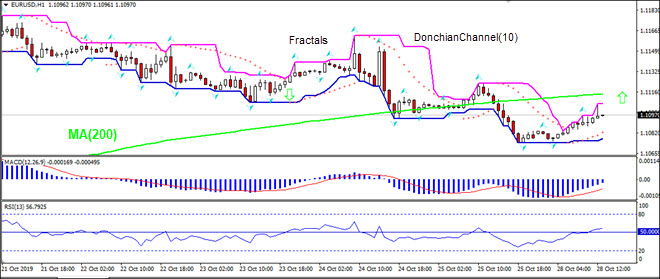
EURUSD rising toward MA(200)

The price chart on 1-hour timeframe shows EURUSD: H1 is in uptrend. The price is rising toward the 200-period moving average MA(200) which is rising. The RSI oscillator is rising but has not reached the overbought zone.

Technical Analysis Summary

OrderBuy
Buy stopAbove 1.1106
Stop lossBelow 1.1086

Market Analysis provided by IFCMarkets