Thailand cuts rate 2nd time to boost growth, inflation

By CentralBankNews.info

Thailand’s central bank cut its policy rate for the second time in four months, saying economic growth is slowing more than expected as a decline in exports is affecting domestic demand and employment while inflation is below the lower bound of its target.

The Bank of Thailand (BOT) cut its policy rate by another 25 basis points to 1.25 percent and has now cut it by 50 points this year, catching up with the easing by some of the other emerging market central banks in Asia, such as Indonesia (4 rate cuts), the Philippines (3 rate cuts) and South Korea (2 rate cuts).

The last time BOT’s policy rate was lowered to this level was in April 2009 during the global financial crises and it remained at that level until July 2010.

Mirroring the decision in August, when BOT cut its rate for the first time since April 2015, the policy committee was split, with five members voting to cut while two voted to maintain the rate, arguing the monetary policy stance is already accommodative and policy space should be preserved to cope with any potential risks in the future.

“Most members viewed that a more accommodative monetary policy stance would contribute to economic growth and support the rise of headline inflation toward the target,” BOT said, adding the country is facing higher external risks from trade tensions, the economic outlook of China and advanced economies, which could affect domestic demand, as well as geopolitical risks.

     As in September, when BOT maintained its rate, the bank’s monetary policy committee said it would remain data-dependent going forward but the Thai economy continues to face structural problems that will affect its competitiveness and economic growth.

In September, BOT also said growth was lower than previously assessed and below potential and cut its 2019 growth forecast to 2.8 percent from 3.3 percent and the 2020 forecast to 3.3 percent from 3.7 percent due to weak exports.

Last week BOT said third-quarter growth might be less than its 2.9 percent forecast. In the second quarter the economy slowed to 2.3 percent annual growth from 2.8 percent in the first quarter, continuing the deceleration since 5.0 percent growth in the first quarter of 2018.

Thailand’s government in August launched a 310 billion baht stimulus package, comprised of cash handouts and cash rebates, and government officials have said they may launch additional stimulus to boost the economy.

Compounding sluggish global demand for its exports, the baht is strong and BOT “expressed concerns over the baht appreciation against trading partners countries.”
The baht, driven up by the country’s current account surplus and foreign fund inflows, has trended upwards since October 2015 and is up 7.33 percent this year to 30.28 to the U.S. dollar although it has slipped this month.

BOT said it supported a relaxation of foreign exchange regulations to encourage capital outflows and promote more balanced capital flows which should alleviate pressure on the baht and help the private sector better manage exchange rate risks.

Thailand’s inflation rate fell to 0.11 percent in October from 0.32 percent in September and well below BOT’s target range of 2.5 percent, plus/minus 1.5 percentage points on lower-than-expected energy prices and the global slowdown.

In September BOT cut its inflation forecast for 2019 to 0.8 percent from 1.0 percent but retained the 2020 forecast at 1.0 percent.
BOT has proposed narrowing the inflation target for next year and the finance ministry has agreed with the new target, as yet unknown, and said this week it was submitting it for cabinet approval.

The Bank of Thailand issued the following press release:

“The Committee voted 5 to 2 to cut the policy rate by 0.25 percentage point from 1.50 to 1.25 percent, effective immediately. Two members voted to maintain the policy rate at 1.50 percent.
          In deliberating their policy decision, the Committee assessed that the Thai economy would expand at a lower rate than previously assessed and further below its potential due to a decline in exports which affected employment and domestic demand. Headline inflation was projected to be below the lower bound of the inflation target. Overall financial conditions remained accommodative. Financial stability risks had already been addressed to some extent, although there remained pockets of risks that warranted monitoring. Most members viewed that a more accommodative monetary policy stance would contribute to economic growth and support the rise of headline inflation toward the target. Most members thus voted to cut the policy rate at this meeting. Nevertheless, two members viewed that under the already accommodative monetary policy at present, the policy rate cut might not lend additional support to economic growth, compared with potentially increased financial stability risks. In addition, there remained a need to preserve the limited policy space for coping with potentially increasing risks in the future.
          The Thai economy was expected to expand at a lower rate than previously assessed and further below its potential. Merchandise exports contracted more than the previous assessment and were projected to recover more slowly than expected due to the slowdown of global trade volume affected by trade tensions. Tourism would grow at a lower rate. Regarding domestic demand, private consumption was expected to slow down despite supports from fiscal stimulus measures. This was due to moderated household income and sharp decline in employment, particularly in export-related manufacturing sectors, as well as elevated household debt. Private investment would expand at a lower rate than previously assessed. However, the relocation of production base to Thailand and public-private partnership projects for infrastructure investment would support investment in the period ahead. Public expenditure would grow at a lower rate than previously estimated owing partly to delay in state-owned enterprise investment projects. The Committee viewed that the Thai economy would face higher risks in the following period, especially external risks from trade tensions, the economic outlook of China and advanced economies that could affect domestic demand, as well as geopolitical risks. Furthermore, the Committee would monitor the impact of fiscal stimulus measures and public expenditure, together with the progress of major infrastructure investment and its knock-on effects on private investment. 
          The annual averages of headline inflation in 2019 and 2020 were projected to be below the lower bound of the inflation target due to lower-than-expected energy prices in tandem with global economic slowdown. In addition, core inflation was expected to moderate owing to subdued demand-pull inflationary pressures. The Committee viewed that structural changes contributed to more persistent inflation than in the past. Such changes included the expansion of e-commerce, rising price competition, and technological development which reduced costs of production. 
         Financial conditions over the previous period had been accommodative. Real interest rates and government bond yields remained low. Liquidity in the financial system remained ample. These allowed financing by the private sector to continue expanding. However, loans extended to both businesses and consumers would exhibit slower growth. With regard to exchange rates, the Committee expressed concerns over the baht appreciation against trading partner currencies, which might affect the economy to a larger degree amid heightened uncertainties pertaining to the external front. The Committee supported the relaxation of foreign exchange regulations to encourage capital outflows and promote more balanced capital flows, which would alleviate pressures on the baht and help the private sector to better manage exchange rate risks. The Committee still saw a need to continue to closely monitor developments of exchange rates and capital flows and would consider implementing appropriate measures in addition if necessary. 
         Financial stability remained sound overall, but there remained a need to monitor risks that might pose vulnerabilities to financial stability in the future, especially the deterioration in the quality of SME loans. The Committee viewed that the implemented macroprudential measures had, to some extent, curbed accumulation of vulnerabilities in the financial system. However, there remained a need to monitor (1) search-for-yield behavior in the prolonged low interest rate environment, (2) debt accumulation and debt servicing capability of households and SMEs, (3) growth in assets held by saving cooperatives and the interconnectedness among saving cooperatives, and (4) leverage by large corporates that might underprice risks. The Committee viewed that microprudential and macroprudential measures should be appropriately combined to ensure financial stability.
          Looking ahead, the Committee would monitor developments of economic growth, inflation, and financial stability, together with associated risks, in deliberating appropriate monetary policy going forward. Nevertheless, the Thai economy would continue to face structural problems, which would affect competitiveness and economic growth outlook. This should be firmly addressed by all related parties.”
 

Is Forex Trading Easy?

By Orbex

This might seem like an easy question to answer, but with all things that involve humans and subjectivity, it’s complicated.

A lot of people out there want to believe – or want you to believe, rather – that forex trading is easy money. That’s not the case at all, as it turns out.

Usually, when you consider if something is easy or not, you’re comparing it to something else. And since people who trade forex generally do it to make money, the salient question for a lot of people is… is forex trading easier than my current job? (And this factors in whether you can make more money trading than at your current job.)

And well, that depends on what your current job is!

Removing the Subjectivity

Obviously, it’s a lot easier for Usain Bolt, for example, to do a 100-yard dash than, say, Donald Trump.

There are a lot of personal factors that go into what makes something easy. So, we need to delve into what could be objective measures of what forex trading is like, and then you can see how easy it would be for you.

Forex trading is one of the more popular retail trading platforms out there. There are a couple of reasons for that.

First, it’s a very large market with over $5 trillion dollars trading each day. But what’s relevant for us now is the second reason: more people find it easier to learn how to do than most other forms of financial trading.

It’s not Wall Street

When it comes to trading, one gets the image of guys with slick hair and matching suits in front of a bank of terminals handling sophisticated market operations. Or having insane parties, if you’ve watched The Wolf of Wall Street too many times.

While it’s true that you can find a lot of sophisticated things to do in Forex, generally you can do a lot of trading without getting involved in complex market analysis.

The thing is, unlike other forms of trading, Forex involves something we already deal with on a daily basis: money. We all have money, we all buy and sell things. We know what money is and how it works. This makes an introduction to forex trading – buying and selling money – much easier.

Forex trading doesn’t require a sophisticated knowledge of finance, or even economics. There is some math involved, and you probably should be familiar with spreadsheets. Some knowledge of economics is useful, but not mandatory. And you certainly don’t need a college degree.

The Comforts of Home

The other factor to make forex trading a lot more accessible and easy is the introduction of forex trading platforms like MT4.

These computer programs not only allow you to trade from virtually anywhere there is an internet connection (like, for example, your living room), but they simplify the process of trading enormously. You can trade with literally a click of a button.

Forex trading has several “levels”; where you can learn the basics and make money consistently with a simple strategy. In fact, you can just copy some other, more experienced forex trader. But you can always learn more and more and advance into increasingly more sophisticated trading methods, techniques and strategies.

There is a Great Community

Of course the more you know, the better trading decisions you will make. There is a wealth of knowledge on the internet and in online communities to help orient you and learn.

That’s one of the advantages of such a large market; you aren’t directly competing with fellow FX traders. There are a lot of resources available to help you get started and get more involved, as well as learn and grow from your peers as you go along.

By Orbex


USDCAD Analysis: Slower improvement of Canadian trade balance bullish for USDCAD

By IFCMarkets

Slower improvement of Canadian trade balance bullish for USDCAD

Canada’s international trade deficit narrowed less than expected in September: to 1.0 billion from 1.2 billion Canadian dollars in August. Will the USDCAD rise?

USDCAD rising above MA(200)

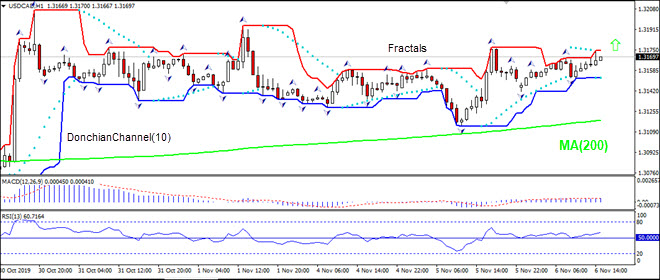
The price chart on 1-hour timeframe shows USDCAD: H1 is in uptrend. The price is rising above the 200-period moving average MA(200) which is rising. The RSI oscillator is above 50 level but has not reached the overbought zone.

Technical Analysis Summary

OrderBuy
Buy stopAbove 1.3175
Stop lossBelow 1.3155

Market Analysis provided by IFCMarkets

Trade Optimism Boosts Risk Sentiment

By Orbex

US President Donald Trump announced on Tuesday that China and the United States agreed, in principle, to the first phase of a deal.

Reports indicate that both sides are also looking at rolling back the tariffs. Investors cheered the news as the appetite for risk assets continued to grow. Both sides are yet to sign off on this first phase.

Euro Continues to Give Back Gains

The euro maintained its bearish retreat. The risk-on sentiment has pushed the USD higher. A lack of economic data from the eurozone also saw investors trading based on the global risk-off narrative.

The US ISM non-manufacturing PMI was above estimates, adding to the dollar’s strength. Non-manufacturing activity expanded to 54.7, beating estimates and the results of the previous month.

Can the EURUSD Bounce Back from Support?

The currency pair fell to the support level as expected earlier. The question is whether price will be able to bounce off this support area.

The support level of 1.1075 – 1.1062 remains key for the currency pair. A break down below this level will accelerate declines to the next lower support at 1.1005. To the upside, prices could remain range-bound if the support holds.

Oil Prices Rally as Trade War Cools

Crude oil prices gathered momentum, rising for the third consecutive daily session. The gains on Tuesday were over one percent. They came amid US and China trade talks progressing better than expected.

There is also optimism that OPEC could cut production to give prices a boost. However, OPEC also released a report which cut demand for crude oil, but investors brushed it aside.

WTI Crude Oil on Track to Test Resistance

The gains in oil prices come after the bounce from the support area of 54.71 – 54.42. Price action has posted strong gains and the current momentum will see oil prices reaching for 57.64 – 57.87 region.

With resistance likely to form at this level, there is a risk that oil prices could remain range-bound in the short term.

Gold Prices Retreat on Market Optimism

Investors continued to shun the safe-haven gold, returning to risky assets. The US and China trade wars remain one of the major themes pushing risk appetite higher.

Gold has been trading weaker and the recent gains failed to post any fresh highs. Moderately better than expected data from the US also kept the precious metal’s prices in check.

Will Gold Continue to Fall Further?

The current bearish momentum could see gold prices posting declines. The lower support area of 1462 remains the key support for now.

A retest of this level could, however, see prices stabilizing. But for this to happen, gold must close below the trend line convincingly. The daily chart shows the bearish formation which points to the declines for the moment.

By Orbex


USDPLN Analysis: Getting ready for a meeting of the Central Bank of Poland

By IFCMarkets

Getting ready for a meeting of the Central Bank of Poland

The next meeting of the National Bank of Poland will be held on November 6, 2019. Will the USDPLN quotations continue growing?

The upward movement indicates weakening of the Polish zloty against the US dollar. It is expected that the National Bank of Poland will keep the rate at the current level of 1.5%, at which it has been since 2015. However, theoretically, the National Bank may announce any plans for easing monetary policy in the future. In October, the Polish PMI indicator of business activity in the industry fell to a minimum in 10 years and amounted to 45.6 points. Its decline has been observed for 12 consecutive months. It should be noted that on November 13 the balance of the current account for September will be published in Poland, and on November 14 – the GDP for the 3rd quarter. These data may also affect the dynamics of the zloty.

USDPLN

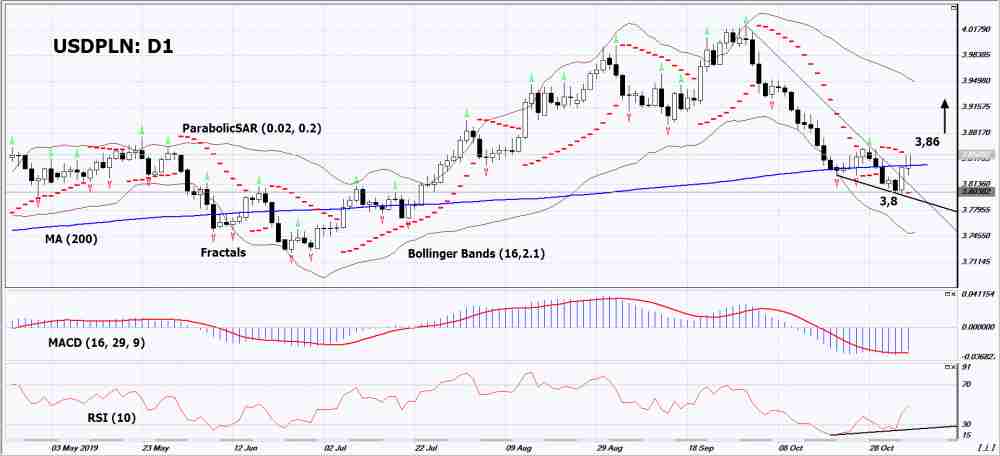
On the daily timeframe USDPLN: D1 broken up the resistance line of the falling trend. Now it is growing as part of the correction. Various technical analysis indicators have generated signals to increase. Further growth of quotations is possible if the monetary policy of the Polish National Bank is relaxed.

  • The Parabolic indicator gives an uptrend signal.
  • The Bolinger bands widened, indicating high volatility. The bottom line of the Bollinger has a slope up.
  • The RSI indicator is below the 50 mark. It has formed a divergence to increase.
  • The MACD indicator gives a bullish signal.

The bullish momentum may develop if USDPLN exceeds the last upper fractal: 3.86. This level can be used as an entry point. The initial stop lose may be placed below the Parabolic signal: 3.8. After the opening of the pending order, the stop shall be moved following the Bollinger and Parabolic signals to the next fractal minimum. Thus, we are changing the potential profit/loss to the breakeven point. More risk-averse traders may switch to the 4-hour chart after the trade and place a stop loss moving it in the direction of the trade. If the price meets the stop level (3,8) without reaching the order (3,86), we recommend to cancel the order: the market sustains internal changes that were not taken into account.

Technical Analysis Summary

PositionBuy
Buy stopAbove 3,86
Stop lossBelow 3,8

Market Analysis provided by IFCMarkets

Iceland cuts rate 5th time but signals pause

By CentralBankNews.info

Iceland’s central bank lowered its policy rate for the 5th consecutive time but signaled it would now take a pause, saying the impact of the easing had yet to come fully to the fore and “the current interest rate level should suffice to ensure medium-term price stability and full capacity utilization.”

The Central Bank of Iceland (CBI) cut the rate on its 7-day term deposits by 25 basis points to 3.0 percent and has now cut it by 150 basis points this year following cuts in May, June, August, October and today.

The outlook for economic growth in the second half of this year has deteriorated relative to the August monetary bulletin and CBI lowered its forecast for 2020 economic growth to 1.6 percent from an earlier 1.9 percent while the forecast for 2019 was unchanged for a contraction of 0.2 percent.

“The forthcoming fiscal easing will pull in the same direction,” CBI said, adding the outlook could still be overly optimistic, in particular in view of global economic uncertainty.

The forecast for growth in 2021 was raised to 2.9 percent from an earlier 2.7 percent and growth in 2022 was also seen at 2.7 percent as public investment helps boost domestic demand to growth of 3.7 percent in 2020 and 3.2 percent in 2021.

After a severe recession following the global financial crises, tourism helped launch an economic boom in Iceland, with the economy growing 4.6 percent in 2017 and 2018.

But the tourism boom has now subsided, partly hit by a collapse in budget airline WOW and a high Icelandic krona, while exports were hit hard by the plunge in exports and the fishing of capelin due to rising ocean temperatures amid uncertainty surrounding Icelandair’s grounded Boeing 737 Max aircraft.

Iceland’s economy has begun to bounce back and grew 2.7 percent in the second quarter of this year after shrinking  0.9 percent in the first quarter while inflation has slowed steadily this year to 2.8 percent in October from 3.0 percent in September and a 2019-high of 3.6 percent in May.

The decline in inflation has been faster than CBI forecast in August and inflation expectations have also been falling, which also meant CBI’s monetary stance had slightly tightened.

CBI forecast consumer price inflation will average 2.9 percent this year, down from the August forecast of 3.0 percent but up from 2018’s 2.6 percent.

In 2020 and 2021 inflation is seen averaging 2.2 percent, rising to 2.4 percent in 2022.
CBI targets inflation of 2.5 percent.

The Central Bank of Iceland issued the following statement:

“The Monetary Policy Committee (MPC) of the Central Bank of Iceland has decided to lower the Bank’s interest rates by 0.25 percentage points. The Bank’s key interest rate – the rate on seven-day term deposits – will therefore be 3%.
According to the Bank’s new macroeconomic forecast, published in the November Monetary Bulletin, the GDP growth outlook for H2/2019 has deteriorated relative to the August forecast. In H1, however, GDP growth exceeded the forecast, and a contraction of 0.2% is therefore expected for the year as a whole, as was projected in August. The outlook for 2020 has also deteriorated, with GDP growth now forecast at 1.6%.
Inflation has been at or above 3% since the spring but eased to 2.8% in October. Underlying inflation has been more persistent, however. Headline inflation is expected to subside faster than was forecast in August and align with the target towards the end of this year. Inflation expectations have continued to fall and are at target by most measures. The monetary stance has therefore tightened slightly between MPC meetings.
The Bank’s interest rates have been cut by 1.5 percentage points since the spring, and the impact of this has yet to come fully to the fore. Lower interest rates have supported demand, and based on the Bank’s forecast, the current interest rate level should suffice to ensure medium-term price stability and full capacity utilisation. The forthcoming fiscal easing will pull in the same direction. The economic outlook could be overly optimistic, however, particularly in view of global economic uncertainty.
Near-term monetary policy decisions will depend on the interaction between developments in economic activity, on the one hand, and inflation and inflation expectations, on the other.”


USD Rallies On Data Beat

By Orbex

Services Sector Recovers

The US Dollar surged higher yesterday as the latest US economic data provided some welcome relief for USD bulls.

The October US ISM Non-Manufacturing reading came in above expectations reflecting a rebound in the non-manufacturing sector (which is a far larger share of US GDP than manufacturing).

The reading came in at 54.7 last month, up from 52.6 in September and well above the forecast of 53.5. Given the weakness in this indicator over recent months, the results caused a relief rally in USD. The index jumped from low to higher 98s.

Looking at the breakdown of the reading for the service sector, sales, new orders, and employment all rebounded last month following falling to a three year low in September. The data is highly important for USD traders given that the services sector comprises broadly two-thirds of US economic activity.

Fed on Hold

This latest reading has taken on stronger importance in the wake of the October FOMC.

The Fed cut rates by a further .25% as expected. However, Powell highlighted that the bank will now look to hold off on any further adjustments. This will be the case while it monitors the economy as well as external factors (trade war).

Essentially, the Fed is happy to keep rates on hold going forward provided there isn’t another leg lower in data or any collapse in US-China trade talks. With last Friday’s NFP report coming in above expectations and now the services sector rebounding, there is a small bit of positive momentum building.

December Rate Cut Expectations Fall

Pricing for a December rate cut from the Fed has now fallen further. The CME Group FedWatch tool IS showing just a 5% chance of a further cut, down from the 20% reading just after the FOMC.

The big test for USD will come next week when we get the October CPI reading. If CPI can print in line with expectations or register a mild beat, this should keep the near-term USD trend positive.

However, any surprise to the downside could see USD longs unwound just as quickly. Remember, the Fed’s data-dependent stance has two-way risk. If data disappoints between now and the December FOMC meeting, the Fed could quite easily move rates lower again.

Trade Talks Still On Watch

Alongside incoming data, the Fed will be closely watching the US-China trade negotiations.

Recent commentary and headlines suggest that the two sides are on course to sign off on the “phase one” trade deal in the coming months.

If the deal is signed, this will be positive for the US economy and should take further pressure off the Fed.

However, if talks stumble again, USD could again come under pressure.

Technical Perspective

The rally in USD is seeing the index challenging last week’s highs now, ahead of the next key structural resistance at the 98.08 level. This will be an important zone to watch. Any reversal from there could prove to be the right shoulder of a large head and shoulders pattern. This would put focus on a move back below the 97.01 level. However, above there, focus will turn to the 99.05 resistance just ahead of 2019 highs.

By Orbex

Jeremy Corbyn as UK Prime Minister would trigger an exodus of wealth

By George Prior

A Jeremy Corbyn-led government will lead to an exodus of high-net-worth individuals from Britain, warns the CEO of one of the world’s largest independent financial advisory organizations.

The warning from deVere Group’s chief executive, Nigel Green, comes as UK Prime Minister Boris Johnson today launches his official election campaign with a column in The Daily Telegraph in which he compares opposition Labour Leader Jeremy Corbyn to Stalin over his “hatred” of wealth creators.

Mr Green notes: “Whilst I wouldn’t have used the language employed by Mr Johnson, through his anti-business rhetoric, and high tax and low-profit policies Jeremy Corbyn does routinely take swiping broadsides at the wealthy.

“It’s our experience that an increasing number of high-net-worth clients are legitimately worried about the damaging impact of a Jeremy Corbyn-led government on their finances.

“There are real concerns from these individuals that should Mr Corbyn sweep into power he would increase inheritance taxes, income taxes, stamp duty and capital gains taxes, potentially even roll out capital controls, and slash other areas, such as pensions tax relief.”

He continues: “I believe we can realistically expect a Corbyn government would trigger an exodus of the country’s most successful and wealthiest individuals who contribute significantly both directly and indirectly to the British economy.

“Soaking the rich doesn’t work because these people, typically, have the resources to move to lower tax jurisdictions if the tax burden in the UK becomes too great.  They are internationally mobile.

“Should these largely job and wealth-creating individuals emigrate – and according to our anecdotal evidence a high number very well could – government finances will suffer considerably because they contribute a disproportionately large amount to the state’s coffers.”

Mr Green adds: “It would also likely deter top international talent and investors from coming to the UK too, which would negatively impact long-term, sustainable economic growth prospects.”

The deVere CEO concludes: “If Mr Corbyn is serious about having the better-off pay more tax, they should cut rates further and allow them to become wealthier.

“This would incentivise top achievers, who prop-up ‘The System’, to remain in the UK.  However, I suspect that implementing this economically-sound philosophy would be political suicide for Jeremy Corbyn.”

About:

deVere Group is one of the world’s largest independent advisors of specialist global financial solutions to international, local mass affluent, and high-net-worth clients.  It has a network of more than 70 offices across the world, over 80,000 clients and $12bn under advisement


Forex Technical Analysis & Forecast 06.11.2019 (EURUSD, GBPUSD, USDCHF, USDJPY, AUDUSD, USDRUB, USDCAD, GOLD, BRENT, BTCUSD)

Article By RoboForex.com

EURUSD, “Euro vs US Dollar”

After breaking 1.1118, EURUSD has reached 1.1065. Possibly, today the pair may return to 1.1118 to test it from below and then form a new descending structure with the target at 1.1063.

EURUSD
Risk Warning: the result of previous trading operations do not guarantee the same results in the future

GBPUSD, “Great Britain Pound vs US Dollar”

GBPUSD has finished the first descending wave at 1.2866. Today, the pair may start another correction to reach 1.2917 and then continue trading downwards with the target at 1.2765.

GBPUSD
Risk Warning: the result of previous trading operations do not guarantee the same results in the future

USDCHF, “US Dollar vs Swiss Franc”

After completing the ascending wave at 0.9888 and forming another consolidation range around it, USDCHF has broken it upwards to reach 0.9933; right now, it is consolidating around this level. Possibly, the pair may expand the range towards 0.9938 and then start a new decline with the target at 0.9888.

USDCHF
Risk Warning: the result of previous trading operations do not guarantee the same results in the future

USDJPY, “US Dollar vs Japanese Yen”

After forming the consolidation range above 109.07, USDJPY has broken it downwards. According to the main scenario, the price is expected to trade downwards to reach 108.87 and then form one more ascending structure towards 109.04. Later, the market may resume its decline with the target at 108.52.

USDJPY
Risk Warning: the result of previous trading operations do not guarantee the same results in the future

AUDUSD, “Australian Dollar vs US Dollar”

AUDUSD is consolidating around 0.6900. Possibly, the pair may reach 0.6877 and then resume trading upwards to return to 0.6900.

AUDUSD
Risk Warning: the result of previous trading operations do not guarantee the same results in the future

USDRUB, “US Dollar vs Russian Ruble”

USDRUB is correcting towards 63.69. Later, the market may resume falling with the short-term target at 63.00.

USDRUB
Risk Warning: the result of previous trading operations do not guarantee the same results in the future

USDCAD, “US Dollar vs Canadian Dollar”

After finishing the descending impulse towards 1.3137, USDCAD has completed the correction. Possibly, the pair may form a new descending impulse to reach 1.3104 and then start another growth with the target at 1.3160.

USDCAD
Risk Warning: the result of previous trading operations do not guarantee the same results in the future

XAUUSD, “Gold vs US Dollar”

After completing the descending structure at 1479.30, Gold is consolidating near the lows. Today, the pair may break the range upwards to reach 1493.45. After that, the instrument may form a new descending structure to return to 1478.30.

GOLD
Risk Warning: the result of previous trading operations do not guarantee the same results in the future

BRENT

After finishing the ascending structure at 63.50, Brent is correcting towards 62.50. After that, the pair may grow to reach 62.85. If later the price breaks this range to the downside, the market may continue the correction to reach 61.50; if to the upside – resume trading inside the uptrend with the target at 64.90.

BRENT
Risk Warning: the result of previous trading operations do not guarantee the same results in the future

BTCUSD, “Bitcoin vs US Dollar”

BTCUSD is moving upwards to reach 9415.00. Later, the market may form a new descending structure towards 9130.00 and then start another growth with the target at 9600.00.

BITCOIN

Article By RoboForex.com

Attention!
Forecasts presented in this section only reflect the author’s private opinion and should not be considered as guidance for trading. RoboForex LP bears no responsibility for trading results based on trading recommendations described in these analytical reviews.

Risk Rally Pauses On Strong US Data

By Orbex

USD Retracing Data Gains

The US dollar has been a little softer over the morning so far on Wednesday. The weakness comes despite better data yesterday which saw the US ISM Non-Manufacturing reading rebounding firmly over October, recovering off three years lows plumbed in September. USD index trades 97.64 last, still well up off the 97.01 level support.

EUR Rises on Weak USD

EURUSD is stronger this morning, benefiting from a softer US dollar. Nothing on the domestic datasheet today, so flows likely to remain tied to US trading. Fed’s Evans due to speak later though not likely to be too market moving in the wake of the FOMC. EURUSD trades 1.1090 last, heading back towards the 1.1024 support level.

GBP Quiet Ahead of BOE Tomorrow

GBPUSD has had a muted session so far today with traders remaining cautious ahead of tomorrow’s headline BOE event. The BOE is not expected to cut rates though traders do note growing downside risks. We are likely to see further downward revisions in the bank’s new forecasts. GBP remains supported near recent highs on the back of news that Brexit will be delayed until the end of January 2020, trading 1.2880 last.

Risk Rally Pauses

Risk assets have seen a pause in upside momentum into the middle of the week. SPX500 is trading 3072.48 last just a little under yesterday’s closing price and down off recent highs. The stronger-than-expected US data is the likely culprit for some position squaring at these levels though focus remains on further upside in the near term. This is given the better relations between the US and China and the likelihood of a deal being signed this month.

JPY & Gold Rally

Safe havens have benefited today from the weaker tone to risk appetite as well as a softer US dollar. Both JPY and gold have risen against USD as some mild safe-haven flows are noted. XAUUSD trades 1487.97 last, sitting back below the round figure for now following yesterday’s sell-off in reaction to better US data. USDPY trades 108.95 last, pulling back from recent highs seen earlier this week.

Traders Waiting on EIA

Oil prices have seen some weakening today on the back of yesterday’s API report. The report showed an unexpected 4 million barrel increase in US crude stores. Traders are now waiting on the headline EIA report today which could send oil sharply lower if a surplus is confirmed. Last week, the EIA reported a 5.7 million barrel rise in US crude stores. Another increase today would raise concerns over the demand outlook once again. Crude trades 56.79 last.

CAD Contained

USDCAD trades 1.3160 last, sitting back atop the 1.3145 level for now. Weakness in crude prices is being offset somewhat by the softer US dollar today, keeping flows contained here. More stagnation around this level is likely until trades receive the next data catalyst, with Canadian employment figures due on Friday.

AUD Holds Near Highs

AUDUSD has had a very quiet session so far today with price hovering around the .69 mark, just above the week’s lows. With the rally in risk assets having paused for now, AUD is seeing a loss of volatility. However, in light of better expectations regarding a forthcoming US/China trade deal, the outlook remains bullish near term.

By Orbex