Caution is set to dominate financial markets on Tuesday as investors juggle with trade uncertainty and tensions in Hong Kong.
The general tone of markets remains cautiously optimistic over the United States and China signing a “phase one” trade deal. However, this sentiment continues to be tested by conflicting signals as US President Trump last Friday dismissed China’s claim that the US will roll back tariffs on Chinese imports as part of an interim deal. These types of mixed signals from US-China trade talks is not only fostering confusion but weighing on global risk appetite as investors move to the sidelines.
Asian stocks struggled for direction on Tuesday following the mixed performance of Wall Street overnight. Slow progress on the US-China trade could rekindle global growth concerns ultimately spurring risk aversion. Given the lack of clarity offered on trade developments, all eyes will be on President Donald Trump who is scheduled to speak to the Economic Club of New York later today. Any fresh hints on progress in trade negotiations will be warmly received by investors.
Pound turbocharged by rising chances of Conservative majority
Sterling bulls were injected with a renewed sense of confidence on Monday after Nigel Farage said his Brexit party will not contest Conservative seats in the upcoming election.
This development certainly comes as an early Christmas gift to Boris Johnson as it raises the odds of a Conservative majority being secured at the December election. The prospects of a Conservative victory breaking the Brexit deadlock and offering direction is likely to support the British Pound in the near term. Away from Brexit, Britain’s economy avoided a recession in the third quarter of 2019 by expanding 0.3% but the annual pace of growth was the slowest in almost 10 years at 1%. Given that the Pound offered a muted reaction to the report confirms how the currency remains heavily influenced by the election and developments in Westminster.
Looking at the technical picture, the GBPUSD is bullish on the daily charts. A solid daily close above 1.2890 should see a push towards the psychological 1.3000 level. Alternatively, sustained weakness below 1.2890 may trigger a decline back towards 1.2790.
Crude Oil moved by trade developments
Crude oil prices struggled for direction on Tuesday amid fears about the outlook for energy demand thanks to uncertainty around US-China trade talks. Although there is some measure of cautious optimism over trade talks, mixed signals from both sides could strain global sentiment and investor confidence. Given how Oil bulls and bears remain heavily influenced by growth and demand concerns, further losses could be on the horizon should trade uncertainty persist.
Focusing on the technicals, WTI Crude is under pressure on the daily charts. Sustained weakness below $57.50 should encourage a decline towards $57.00 and $56.00.
Disclaimer: The content in this article comprises personal opinions and should not be construed as containing personal and/or other investment advice and/or an offer of and/or solicitation for any transactions in financial instruments and/or a guarantee and/or prediction of future performance. ForexTime (FXTM), its affiliates, agents, directors, officers or employees do not guarantee the accuracy, validity, timeliness or completeness, of any information or data made available and assume no liability as to any loss arising from any investment based on the same.
US stocks ended slightly lower on Monday as China deal doubts took over after President Trump’s denial over the weekend the US and China had agreed to roll back tariffs. The S&P 500 finished 0.2% lower at 3087.01. Dow Jones industrial however added 0.04% to new record 27691.49 led by 4.6% rally in Boeing after the plane maker announced it expected the grounded 737 Max fleet to return to commercial service in January. The Nasdaq composite slipped 0.1% to 8464.27. The dollar strengthening halted as Boston Fed President Eric Rosengren proposed increasing capital buffers for large banks globally. The live dollar index data show the ICE US Dollar index, a measure of the dollar’s strength against a basket of six rival currencies, slipped 0.1% to 98.21 but is higher currently. Futures on US stock indices point to higher openings.
CAC 40 gains while other European indexes slip
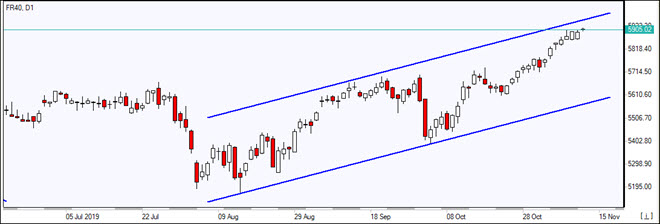
European stock indexes closed mixed on Monday with mixed data providing little support. Both EUR/USD and GBP/USD turned higher yesterday with both pairs climbing currently against the background of reports Trump would announce this week that he is delaying a decision on whether to slap tariffs on imported European Union autos for another six months. The Stoxx Europe 600 index ended virtually unchanged while basic resource shares slid 1.6% as data revealed Italy’s industrial output fell 0.4% in September after 0.4% growth in August. The DAX 30 lost 0.2% to 13198.37. France’s CAC 40 however rose 0.1% and UK’s FTSE 100 fell 0.4% to 7328.54 despite report UK GDP grew by 0.3% in the third quarter.
Nikkei rebound leads Asian indexes gains
Asian stock indices are also mixed today with no new development in US-China trade talks. Nikkei rebounded 0.8% to 23520.01 as yen slide against the dollar resumed. Markets in China are rising despite continuing violent protests in Hong Kong. The Shanghai Composite Index is up 0.2% and Hong Kong’s Hang Seng Index is 0.4% higher. Australia’s All Ordinaries Index turned 0.3% lower as Australian dollar resumed its climb against the greenback.
Note: This overview has an informative and tutorial character and is published for free. All the data, included in the overview, are received from public sources, recognized as more or less reliable. Moreover, there is no guarantee that the indicated information is full and precise. Overviews are not updated. The whole information in each overview, including opinion, indicators, charts and anything else, is provided only for familiarization purposes and is not financial advice or а recommendation. The whole text and its any part, as well as the charts cannot be considered as an offer to make a deal with any asset. IFC Markets and its employees under any circumstances are not liable for any action taken by someone else during or after reading the overview.
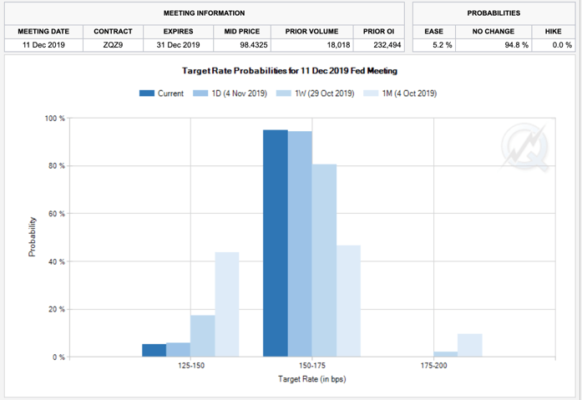
Since the most recent rate cut, we have seen the probability of further interest rates cuts by the US Federal Reserve swing from almost a 50% chance of further rate cuts in December, now to a 5.2% chance of further rate cuts from the Fed. Essentially the market is pricing in no further rate cuts. What does it mean for the yield curve? What does it mean for gold, gold stocks, and the S&P 500?
Consumer Confidence – Rates – Unemployment
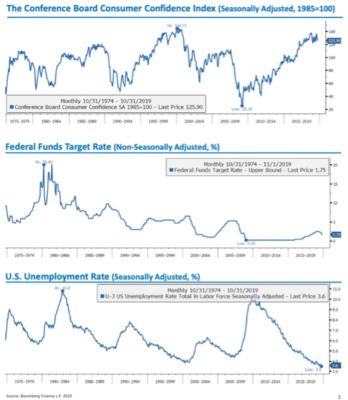
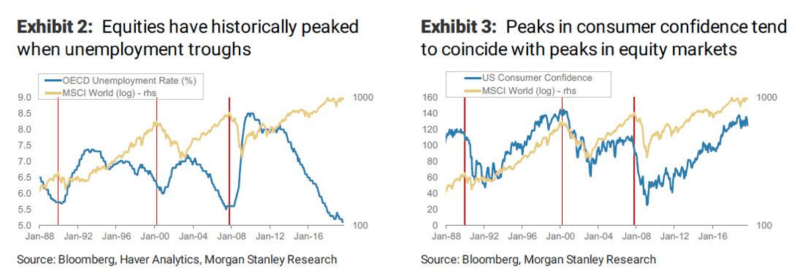
Once Consumer confidence peaks, we get further rate cuts, and then unemployment rises. What does consumer confidence tell us about the market?
All Eyes on the Consumer
When we look at the Conference Board Consumer Confidence Index, it commonly PEAKS, when the stock market is peaking, and then in the following weeks and months, as the unemployment rate is troughing, we begin to see the unemployment rate start to accelerate.
Hotel Industry
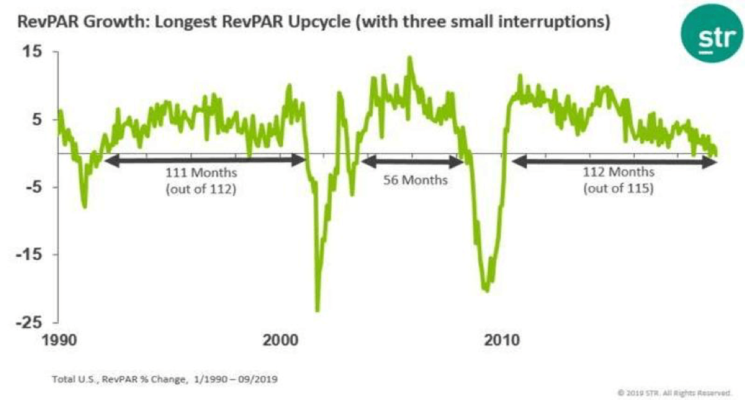
Let’s look at one key leading indicator in the hotel industry that reflects spending by both consumers and businesses. “As HotelNewsNow reports, In September, US hotels recorded the second monthly revenue-per-available-room decline of 2019, declining by 0.3%, as average daily rates increased by 0.6%, but that was not enough to overcome the 0.9% occupancy decline.” Occupancy in the US has declined for three of the past 4 months. Is the hotel demand highlighting further slowdown in consumer spending?
FED RATE CUT, YIELD CURVE, and GOLD
Historically once the Fed rate cuts enough to fix the yield curve from being inverted to no longer being inverted, just like in 2001 and 2007, we saw a recession in the following months ahead. We don’t think this recession will be as severe as 2008 because we don’t want to get caught up with anchoring to the most recent recession. Gold has outperformed the S&P 500 when the US 10 Year minus the US 3-month was no longer inverted because of the fed cutting interesting rates. Now we are back to where we were in 2001 and 2008, with our preference to be overweight gold relative to the S&P 500. Gold in these environments relative to the S&P 500, is poised to outperform.
Gold or Gold Stocks
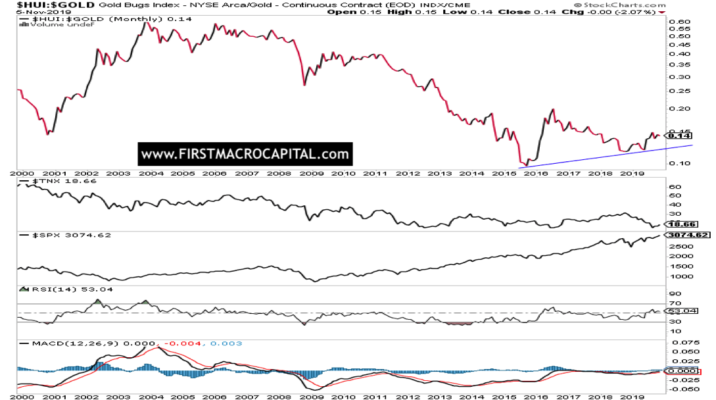
What about gold versus gold stocks? Depending on your time horizon, gold stocks are positioned to outperform gold in the coming years. That being said, in the near-term gold stocks may be impacted if the entire market sells off, but we would expect them to bottom much earlier than the S&P 500 as the materials sector tends to outperform in the early stages of the new business cycle. Gold and gold stocks will bounce around, with gyrations. The bottom is in for gold stocks relative to gold when the ratio bottomed in 2016. For the long-term investor, holding on here is most important to generate multi-bagger opportunities.
Gold Stocks vs S&P 500
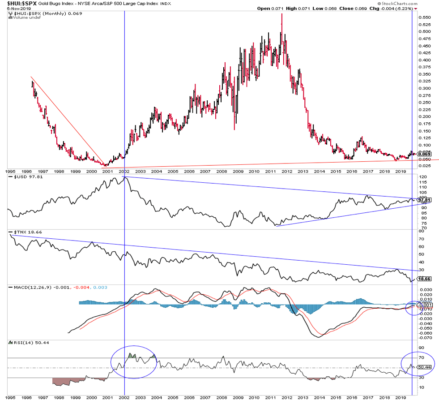
Important, the US Dollar peaked in 2002, resulting in gold stocks outperforming S&P 500 in the coming 12-18months. Gold stocks are back to their 2002 lows versus the S&P 500, and if you are willing to take a 12-18 month view, it looks increasingly probable that gold stocks will outperform the S&P 500 as gold stocks head higher and the S&P 500 falls. The US dollar weakens and the rotation out of tech (largest sector of S&P 500) into commodity stocks. The world is presenting a gift to investors and those looking for new asymmetric opportunities.
“You can hate if you want to, but you’ll be with me in time” – Rev. Run
Get the exact checklist that
Paul Farrugia, BCom. Paul is the President & CEO of First Macro Capital. He helps his clients take advantage of cycle opportunities across all sectors and asset classes, for the long-term. He provides a checklist to find winning gold and silver mining producer stocks, to take advantage of the commodity cycle.
Disclaimer:
The information contained herein is obtained from sources believed to be reliable, but its accuracy cannot be guaranteed. It is not designed to meet your financial situation – we are not investment advisors, nor do we give personalized investment advice. The opinions expressed herein are those of the publisher and are subject to change without notice. It may become outdated, and there is no obligation to update any such information.
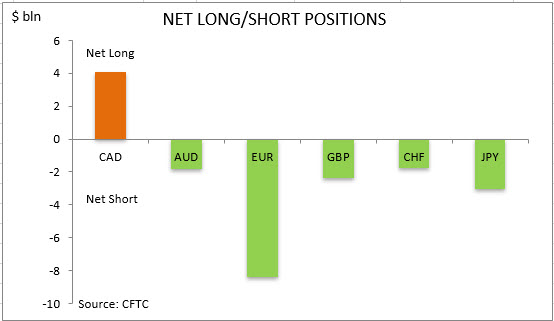
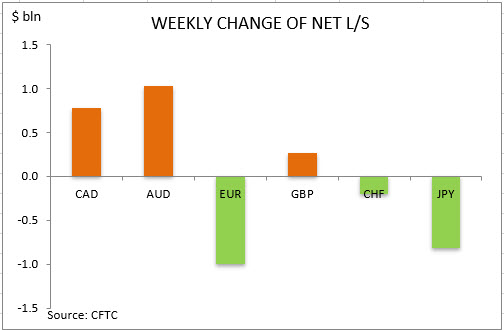
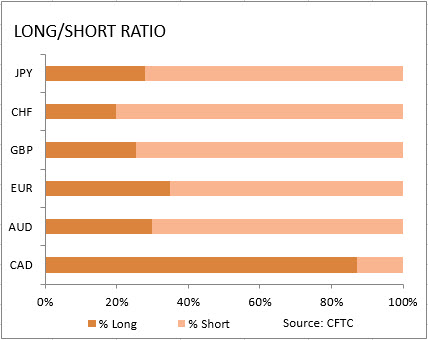
US dollar bullish bets rose to $13.33 billion from $6.63 billion against the major currencies during the one week period, according to the report of the Commodity Futures Trading Commission (CFTC) covering data up to November 5 and released on Friday November 8. The ICE US dollar index rebounded as the Federal Reserve announced 3rd cut in interest rates this year but signaled no further cuts in the near future, the Institute of Supply Management’s service sector activity index rose to 54.7% in October, up from 52.6% in September, and US economy added higher than expected 128 thousand new jobs in October.
Note: This overview has an informative and tutorial character and is published for free. All the data, included in the overview, are received from public sources, recognized as more or less reliable. Moreover, there is no guarantee that the indicated information is full and precise. Overviews are not updated. The whole information in each overview, including opinion, indicators, charts and anything else, is provided only for familiarization purposes and is not financial advice or а recommendation. The whole text and its any part, as well as the charts cannot be considered as an offer to make a deal with any asset. IFC Markets and its employees under any circumstances are not liable for any action taken by someone else during or after reading the overview.
Sterling exploded higher on Monday, gaining roughly 0.8% against the dollar after the Brexit party said it would not contest Conservative seats in the upcoming election.
This surprise development certainly comes as an early Christmas gift for Prime Minister Boris Johnson ahead of the December 12th election. Given how the prospects of a decisive Conservative win will provide some sort of clarity and direction on Brexit, the Pound is positioned to push higher in the near term. However, it will be unwise to completely rule out the possibility of Britain leaving the European Union with no deal in January 2020 thanks to the unpredictable nature of Brexit.
The fact that Sterling has appreciated against every single G10 currency despite the soft GDP data published on Monday continues to highlight how the currency remains mostly driven by Brexit and political developments. Economic growth in the United Kingdom rebounded by 0.3% during the third quarter of 2019 but annual growth was the weakest seen in almost 10 years at 1%.
Looking at the technical picture, Pound bulls are in the driving seat with prices trading around 1.2885 as of writing. A solid daily close above 1.2890 should open the doors back towards the psychological l 1.3000 level. Alternatively, sustained weakness below 1.2890 may invite a drop back towards 1.2790.
Gold sinks deeper into the abyss
Gold tumbled to a three-month low on Monday thanks to the improving market mood and cautious optimism over US-China trade developments.
The precious metal burned its way through the $1455 support level as the risk-on mood quelled appetite for safe-haven assets. Although the precious metal could extend losses in the near term towards $1440, downside losses are likely to be capped by global growth concerns and lower interest rates across the world.
Taking traders will continue to closely observe whether bears could drag prices towards $1440. Should this point prove to be a reliable support, a technical rebound back towards $1470 could be in the cards.
Disclaimer: The content in this article comprises personal opinions and should not be construed as containing personal and/or other investment advice and/or an offer of and/or solicitation for any transactions in financial instruments and/or a guarantee and/or prediction of future performance. ForexTime (FXTM), its affiliates, agents, directors, officers or employees do not guarantee the accuracy, validity, timeliness or completeness, of any information or data made available and assume no liability as to any loss arising from any investment based on the same.
Over recent months global economic and political uncertainty have led many lenders to reduce the availability of finance for businesses, which could spell disaster for the global economic market. Challenges such as Donald Trump and his potential impeachment, Brexit and the UK’s pending election and other global social and political issues are causing financial institutions to become more reticent about the money they lend, particularly to small businesses. This reduction in lending is despite the fact that there is a definite increase in the number of businesses looking to borrow money.
Some areas of the business finance market, such as asset finance, have actually seen growth over recent months despite these challenges. For those markets that are struggling to gain financing, growth is often slow as entrepreneurs struggle to find loans to fund their ambitions and existing businesses find themselves without the capital to expand.
In such times many companies and innovators look towards alternative forms of financing, but economic uncertainty causes issues with these also. The entire lending space is struggling, with major blows such as the collapse of payday lending giant QuickQuid causing ripples throughout the market, and as such even alternative lending options are harder for businesses to access in this climate.
There are some signs that the future will be brighter, with a new SME Charter seeing banks and other lenders pledging to support UK businesses through Brexit, but despite this many companies are still facing a struggle to obtain the finance they need. It can be tough for companies of all sizes to gain greater funding, and without money they can struggle to grow and even close down.
For those businesses struggling to find finance, technology is the key to overcoming the challenges the lending industry currently poses. Platforms like Become offer an alternative way to accesses finance by bringing lenders and businesses together so that they can negotiate loans that will suit both parties. Evidence suggests that half of small businesses do not access funding solutions, and platforms such as this could provide an alternative way for them to find, understand and access the funding they need.
In all, with the future of the global political space uncertain, more SMEs and lenders should use funding technology to stimulate economic growth. Technology has the potential to offer businesses access to the funding they need, as well as offering lenders the chance to easily find the perfect companies to invest in, and as such it is the perfect tool for improving the global financial outlook over the coming years.
In Asian countries car sales are declining worldwide
According to Japanese Automobile Manufacturers Association (JAMА), the manufacture of cars in Japan in august 2019 was decreased by 2.2 % if compared to a year ago. Will the palladium quotations fall?
80 % of the world’s consummation of palladium is accounted for by the automotive industry and the production of catalysts to reduce harmful gasoline engine emissions. Another 5% is consumed by the global chemical industry. As environmental standards tightened, the demand for autocatalysts increased and the price of palladium soared 3 times in the last 3 years. Now it has reached the psychological level of $ 1600 / ounce for the 2nd time. Meanwhile, according to the estimates of the Association of European Businesses, the Association of European Automobile Manufacturers and a number of consulting agencies, sales of automobiles in the world decreased by 7.4% in 1Q2019 compared to the same period of 2018. The data for the first half of the year may turn out to be even worse, since according to official data, the decline in car sales in China in January-May 2019 was 15.2%. Note that after 3-fold growth of palladium quotations, its consumption has decreased in the jewelry and electronics industry, in dental prosthetic and in the issue of investment coins and bars. Theoretically, it is possible to increase the dependence of quotations on the state of affairs in the global automotive industry and the chemical industry.
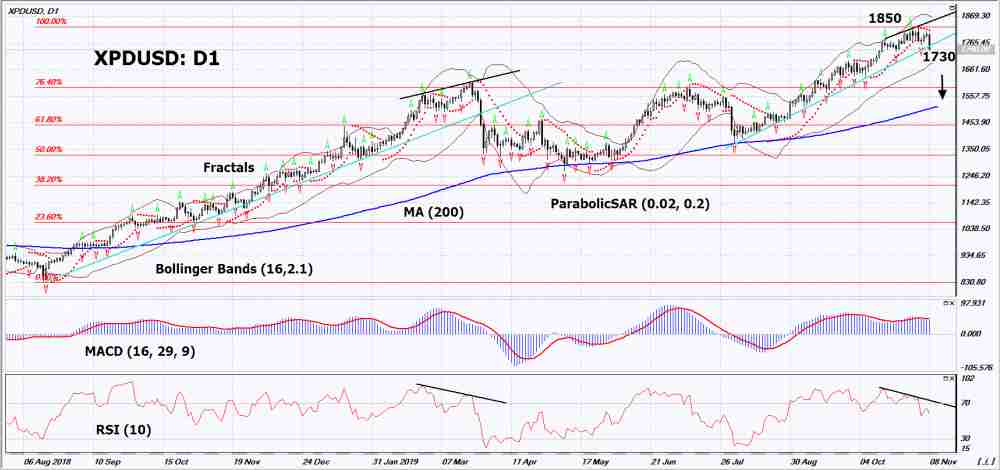
On the daily timeframe, XPDUSD: D1 breached down the support line of the uptrend. The price decrease is possible in case of a decline in global demand of gasoline cars and, thus, the demand of autocatalysts from palladium.
The Parabolic indicator demonstrates a signal to decrease.
The Bolinger bands narrowed, indicating a volatility decrease. The upper band is titled downward
The RSI indicato is above 50. It has formed a negative divergence.
The bearish momentum may develop in case XPDUSDfalls below the two last fractal lows: 1730. This level may serve as an entry point. The initial stop loss may be placed above the last fractal high, the historic high, the upper Bollinger band and the Parabolic signal at 1850. After opening the pending order, the stop shall be moved following the Bollinger and Parabolic signals to the next fractal maximum. Thus, we are changing the potential profit/loss to the breakeven point. More risk-averse traders may switch to the 4-hour chart after the trade and place a stop loss moving it in the direction of the trade. If the price meets the stop level (1850) without reaching the order (1730), we recommend to cancel the order: the market sustains internal changes that were not taken into account.
Bob Moriarty of 321gold discusses the stock price of this explorer with a major gold resource in the Yukon.
White Gold Corp. (WGO:TSX.V; WHGOF:OTCBB) is one of those companies with great partners, Kinross Gold as well as Agnico Eagle, over 1.7 million ounces in a gold resources in one of the best gold camps in Canada but can’t seem to get any respect. At the end of December of last year the shares traded as high as $1.69 but have tumbled lately to a new yearly low of $0.73.
I’ve said this before and I’ll keep saying it until everyone gets it. The key to making a profit in investing is to buy when things are cheap and sell when they are dear. White Gold has gone from $0.54 in September of 2018 up to $2 a month later and has dribbled back down. Surely there was a lot of potential to trade those shares at a profit in there somewhere.
In spite of the bundles of crisp $100 bills being tossed on a bonfire by the Fed since a Black Swan event in mid-September that no one can seem to figure out what caused, speculators in gold got carried away. The open interest hit a new record high and lately the price dropped a lot as gold is making a perfectly normal correction. Generally we have a low in mid-summer and at the end of the year at Tax Loss Silly Season and I think this year will be no different.
White Gold had fifteen million warrants from a 2016 private placement that expired on October 27th. The warrants were at $0.27 so you may safely assume all of them were exercised. The good news is that it brought in $3.35 million in cash to the treasury. The bad news is that due to a basic lack of liquidity sellers of the shares in order to exercise their warrants have driven the price of the stock down by 25% in the last month even while the company is charging forward.
Part of the price mismatch is due to investors being overloaded with information on the various projects White Gold is advancing. White Gold controls over 40% of the land in the White Gold district including 35 different properties. White Gold is not advancing one or two flagship projects; they are advancing the entire frigging district.
The company’s 2019 exploration program called for 17,000 meters of core drilling and an additional 7,500 meters of Reverse Circulation drilling. A revised 43-101 just based on the 2018 exploration work was released in late July. It showed a 25% increase in 43-101 resources at the Golden Saddle and Arc projects to over 1.5 million ounces of gold.
I fear investors are getting bogged down in minutiae as one press release after another is posted and they are simply confused. Rather than trying to understand the numbers to compare with other companies with drill programs only 10% of the size of White Gold, investors should think about the big investors in WGO, Kinross and Agnico Eagle.
Each company owns about 18.9% of the shares. All in all, about 60% of the shares are in the hands of insiders leaving a relatively small float of 40% for everyone else.
The gold exploration space has changed over the last twenty years. The majors and mid-tier mining companies have left the exploration business. And each year they consume more and more of their young. So in the near future the big mining companies must go on a binge of buying up juniors with real resources in friendly environments.
White Gold serves as the exploration arm of both Kinross and Agnico Eagle. When the proven resource gets big enough and the price of gold high enough we know that one or both of those companies will belly up to the bar and buy WGO.
I was buying Great Bear Resources at $0.50 a share before they started releasing extraordinary results. I knew and I told them they were on to something big. Great Bear is now $5.87 a share and they have a $248 million market cap. White Gold closed at $0.77 on Friday and shows a $95 million-market cap. In my view White Gold is the better company but it has a market cap only 40% of what GBR has.
The price is cheap today because (1) investors can’t cope with half a dozen projects being advanced at the same time and (2) a flood of shares being sold to pay for the $0.27 warrants. As to (1), ignore it; you don’t have to keep track of a bunch of projects. Let Kinross and Agnico Eagle do your due diligence for you and (2) as the overhang of shares stops since the warrants have expired, expect a pop in the share price.
I’m looking for the correction in the price of gold and silver to continue. Mid-December would be a great time for a low if the DSI goes below 10 for both of them and Tax Loss Silly Season ends. But while I see a lot of juniors declining into year-end, I suspect WGO will go higher. The reason for their decline in price has passed.
White Gold is an advertiser and I bought shares in the open market. Do your own due diligence.
White Gold Corp. WGO-V $0.77 (Nov 11, 2019) WHGOF-OTCBB 113.4 million shares White Gold website.
Bob Moriarty founded 321gold.com, with his late wife, Barbara Moriarty, more than 16 years ago. They later added 321energy.com to cover oil, natural gas, gasoline, coal, solar, wind and nuclear energy. Both sites feature articles, editorial opinions, pricing figures and updates on current events affecting both sectors. Previously, Moriarty was a Marine F-4B and O-1 pilot with more than 832 missions in Vietnam. He holds 14 international aviation records.
Disclosure: 1) Bob Moriarty: I, or members of my immediate household or family, own shares of the following companies mentioned in this article: White Gold. White Gold is an advertiser on 321 Gold. I determined which companies would be included in this article based on my research and understanding of the sector. 2) The following companies mentioned are billboard sponsors of Streetwise Reports: None. Click here for important disclosures about sponsor fees. 3) Statements and opinions expressed are the opinions of the author and not of Streetwise Reports or its officers. The author is wholly responsible for the validity of the statements. The author was not paid by Streetwise Reports for this article. Streetwise Reports was not paid by the author to publish or syndicate this article. The information provided above is for informational purposes only and is not a recommendation to buy or sell any security. Streetwise Reports requires contributing authors to disclose any shareholdings in, or economic relationships with, companies that they write about. Streetwise Reports relies upon the authors to accurately provide this information and Streetwise Reports has no means of verifying its accuracy. 4) The article does not constitute investment advice. Each reader is encouraged to consult with his or her individual financial professional and any action a reader takes as a result of information presented here is his or her own responsibility. By opening this page, each reader accepts and agrees to Streetwise Reports’ terms of use and full legal disclaimer. This article is not a solicitation for investment. Streetwise Reports does not render general or specific investment advice and the information on Streetwise Reports should not be considered a recommendation to buy or sell any security. Streetwise Reports does not endorse or recommend the business, products, services or securities of any company mentioned on Streetwise Reports. 5) From time to time, Streetwise Reports LLC and its directors, officers, employees or members of their families, as well as persons interviewed for articles and interviews on the site, may have a long or short position in securities mentioned. Directors, officers, employees or members of their immediate families are prohibited from making purchases and/or sales of those securities in the open market or otherwise from the time of the interview or the decision to write an article, until one week after the publication of the interview or article.
To paraphrase a famous writer, “Forex can change your life. But for the better? Well…”
There are lots of articles talking about the risks of forex trading. But, when it comes to the question of changing your life, you really want to know if it’s for the better.
After all, no one spends time studying and risks their money to be worse off!
But first, we need to disappoint some people. Trading Forex definitely does not mean dropping your savings into a trading account, then suddenly becoming a millionaire who can divide time between sipping margaritas on the beach and driving a Ferrari.
No one suddenly makes a pile of money with forex trading, despite what that YouTube ad might have claimed.
A Dose of Reality
A much more common scenario for successful Forex traders is having a supplementary income to their current job, which helps build their savings for future endeavors.
Some FX traders do switch to full time, but usually, this is after gaining considerable experience and setting up other forms of passive income.
Like most market trading, results from forex trading vary. Conditions change, and strategies need to be updated.
So, for most forex traders, the income they get from it isn’t exactly consistent. This is despite most successful FX traders putting a lot of effort into making their trading outcomes as consistent as possible!
It’s an Investment
Many people do find forex trading to be easier than other sorts of financial investment. However, it’s still a sophisticated market.
It requires a sizeable investment in time and attention to learn how things work, and to get good enough at trading to consistently make profits.
Some people have a knack for it, so it’s easier than for others. But, like all things, no one is an expert in anything with little effort.
So, it makes sense that after spending a good bit of time learning financial instruments and getting consistently better at deciphering what’s going on in the FX markets, you won’t want to stop doing it. Which is why most forex traders are usually in it for the long haul.
They are not trying to get rich quick; they are trying to make a reasonable income over an extended period of time.
How Likely is a Change?
We have to address the elephant in the room, which is the small print on (reputable) forex broker ads: the percentage of potential FX traders who lose money.
Usually, it’s the majority, with up to two-thirds losing money.
Why? Well, that’s an entire article in itself. But basically, they are people looking to get quick, easy money and are neither doing their research nor practicing proper money management techniques.
There are several skills that you need to become good at forex. These include discipline, risk management and proper investment administration. And these are all skills that are useful in other areas of your life!
This is one of the reasons that some people find transitioning to forex easier than others. They already have many of the personality and technical skills that underlie the market analysis part.
In fact, there are some people who are really good at the forex market analysis part but haven’t mastered risk management, or emotional control. Therefore, they find a more lucrative career in financial analysis instead of plying the markets themselves.
It’s not all about the Benjamins
Basically, forex can change your life, most reasonably by supplementing your current income. How much of a change that will be depends on what your life looks like now, how good you get at forex trading, and what you do with the extra money.
But it can also change your life in other ways as you acquire the knowledge and skillsets that make you a good forex trader, such as understanding the economy, how to manage your money, and evaluate risks and probabilities.
Late on Friday, markets were boosted by news that Trump had agreed to roll-back tariffs on Chinese goods as part of the effort to get a trade deal signed. However, over the weekend, Trump stated that the reports were untrue and clarified that he has not agreed to roll-back tariffs on Chinese goods.
The reports emanated from comments made by the Chinese Ministry of Commerce saying that the two countries had agreed to remove tariffs in stages. This was to allow for an end to the trade war which has gone on for 18 months and ravaged both economies.
Chia Demands Tariff Removal
China has consistently demanded that tariffs be rolled back as part of its criteria for doing a deal. With the US having recently postponed the latest scheduled set of tariffs, many were hopeful that negotiations were leading in the right direction. However, Trump has made it clear that wide-scale rolling back of tariffs is not on the cards, at least not yet.
Trump Says Roll-Back Reports Not True
Speaking with reporters, Trump said:
“They’d like to have a rollback but I’ve not agreed to anything. China would like to get somewhat of a rollback, not a complete rollback because they know I won’t do it.
We’re getting along very well with China. They want to make a deal … frankly, they want to make a deal a lot more than I do. I’m very happy right now, we’re taking in billions of dollars.”
Trade Deal Expected to Be Signed This Weekend
Currently, traders are waiting for Trump and Xi to sign the deal agreed upon in early October. The hope is that this will occur when they meet in Chile at the end of the week.
Trump has been pushing for a November signing and is keen to move on to discussions for “phase two” of the deal. However, the US has warned China that any further delays will be met with consequences.
He has stated that as of December 15th, if a deal is yet to be signed, it will apply new tariffs to $156 billion of Chinese goods. With the threat of further tariffs looming, traders are hopeful that China will cooperate, avoiding the need for further tariffs.
Two-Way Risk
Equities markets have been well support over recent weeks as headlines and comments around the talks continue to suggest a deal is coming. Given the built-up level of expectation in the market, if China does not sign off on the deal this week, we are likely to see traders react with disappointment.
This could see some sharp reversals in equities markets.
Central banks and the IMF are all warning of the damage the trade war is causing to the global economy. So, there is a major focus on ending the tariffs and repairing global trade. If talks falter once again, it will be very damaging for investor confidence. In fact, it will likely leading to a period of risk aversion across markets.
Technical Perspective
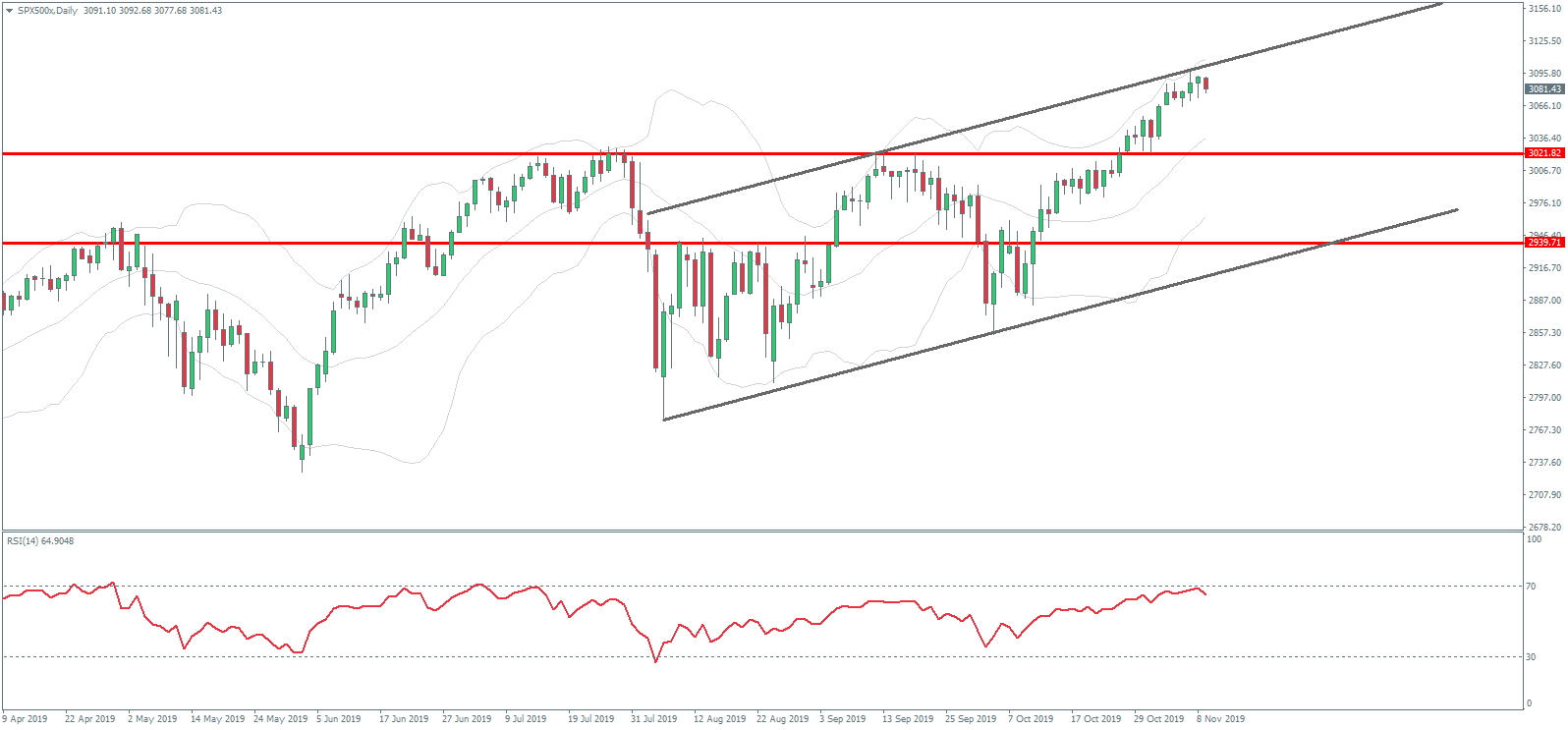
The rally in SPX500 over the last two weeks has seen price breaking out to fresh, all-time highs. However, with the index is currently testing the top of the local bullish channel, we could see some short-term correction.
The 3021.82 level will be the key zone to watch. While price holds above there, further upside is likely. However, back below there and focus will shift to the 2939.71 level with the rising channel low in the vicinity also.