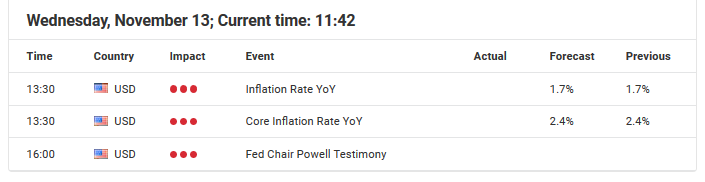
Today, the recent volatility in Gold could find a new trigger when the US inflation rate is published, and Fed chairman Jay Powell testimony on the economy before US Congress in the afternoon.
After the Fed cut came as expected, rates by 25 basis points on October 30, but didn’t deliver any significant further impulses or signs in regards to future monetary policy steps. The “data dependent” part in the Fed statement left market participants speculating that the Fed won’t deliver any dovish hints or a looser monetary policy announcement in the next few months.
“Obviously”, because in the first days of November 10-year US-Treasury yields took on bullish momentum, gaining over 20 basis points while Gold dropped significantly below 1,500 USD.
With expectations among market participants of another Fed rate cut by 25 basis points in December dropping to around 5%, indicating that such a step is very unlikely, so the bullish outlook for Gold darkened a little.
But, if US core inflation comes in below the expected rate of 2.4% and in addition to that Jay Powell’s remarks in front of the US Congress later that day raises fears around a rather sooner than later darkening US economic outlook, the yellow metal could make back at least some of the recent losses.
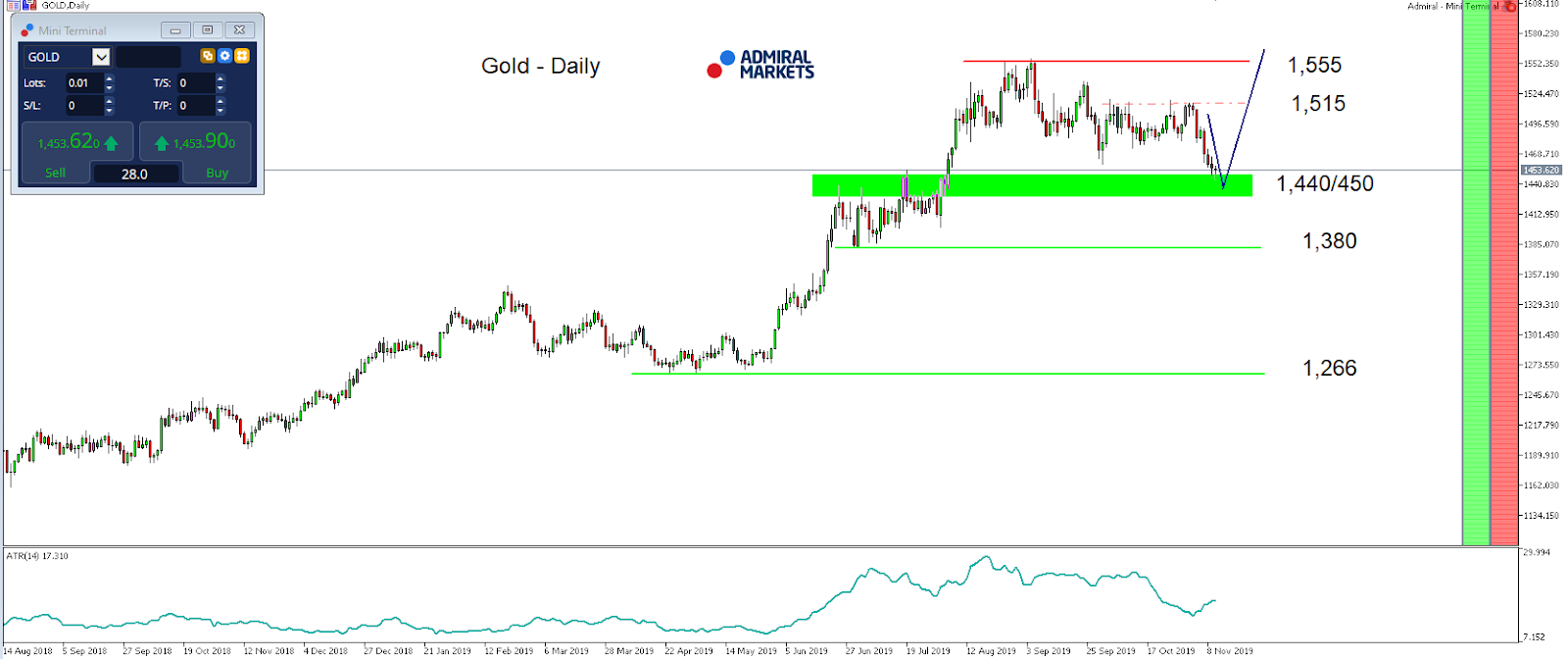
Still, only if Gold bulls succeed in breaking above 1,520 USD, another test of the current yearly highs around 1,557 USD would be possible, currently the mode seems short-term bearish.
Nevertheless, the overall technical picture on a daily time-frame looks still solid, didn’t significantly darken after the drop below 1,500 USD, but instead brings now a potential mid-term long trigger around 1,440/450 USD into play:
Source: Admiral Markets MT5 with MT5-SE Add-on Gold Daily chart (between August 14, 2018, to November 12, 2019). Accessed: November 12, 2019, at 10:00pm GMT – Please note: Past performance is not a reliable indicator of future results, or future performance.
In 2014, the value of Gold fell by 1.7%, in 2015, it fell by 10.4%, in 2016, it increased by 8.1%, in 2017, it increased by 13.1%, in 2018, it fell by 1.6%, meaning that after five years, it was up by 6.4%.
Discover the world’s #1 multi-asset platform
Admiral Markets offers professional traders the ability to trade with a custom, upgraded version of MetaTrader 5, allowing you to experience trading at a significantly higher, more rewarding level. Experience benefits such as the addition of the Market Heat Map, so you can compare various currency pairs to see which ones might be lucrative investments, access real-time trading data, and so much more. Click the banner below to start your FREE download of MT5 Supreme Edition!
Disclaimer: The given data provides additional information regarding all analysis, estimates, prognosis, forecasts or other similar assessments or information (hereinafter “Analysis”) published on the website of Admiral Markets. Before making any investment decisions please pay close attention to the following:
This is a marketing communication. The analysis is published for informative purposes only and are in no way to be construed as investment advice or recommendation. It has not been prepared in accordance with legal requirements designed to promote the independence of investment research, and that it is not subject to any prohibition on dealing ahead of the dissemination of investment research.
Any investment decision is made by each client alone whereas Admiral Markets shall not be responsible for any loss or damage arising from any such decision, whether or not based on the Analysis.
Each of the Analysis is prepared by an independent analyst (Jens Klatt, Professional Trader and Analyst, hereinafter “Author”) based on the Author’s personal estimations.
To ensure that the interests of the clients would be protected and objectivity of the Analysis would not be damaged Admiral Markets has established relevant internal procedures for prevention and management of conflicts of interest.
Whilst every reasonable effort is taken to ensure that all sources of the Analysis are reliable and that all information is presented, as much as possible, in an understandable, timely, precise and complete manner, Admiral Markets does not guarantee the accuracy or completeness of any information contained within the Analysis. The presented figures refer that refer to any past performance is not a reliable indicator of future results.
The contents of the Analysis should not be construed as an express or implied promise, guarantee or implication by Admiral Markets that the client shall profit from the strategies therein or that losses in connection therewith may or shall be limited.
Any kind of previous or modeled performance of financial instruments indicated within the Publication should not be construed as an express or implied promise, guarantee or implication by Admiral Markets for any future performance. The value of the financial instrument may both increase and decrease and the preservation of the asset value is not guaranteed.
The projections included in the Analysis may be subject to additional fees, taxes or other charges, depending on the subject of the Publication. The price list applicable to the services provided by Admiral Markets is publicly available from the website of Admiral Markets.
Leveraged products (including contracts for difference) are speculative in nature and may result in losses or profit. Before you start trading, you should make sure that you understand all the risks.
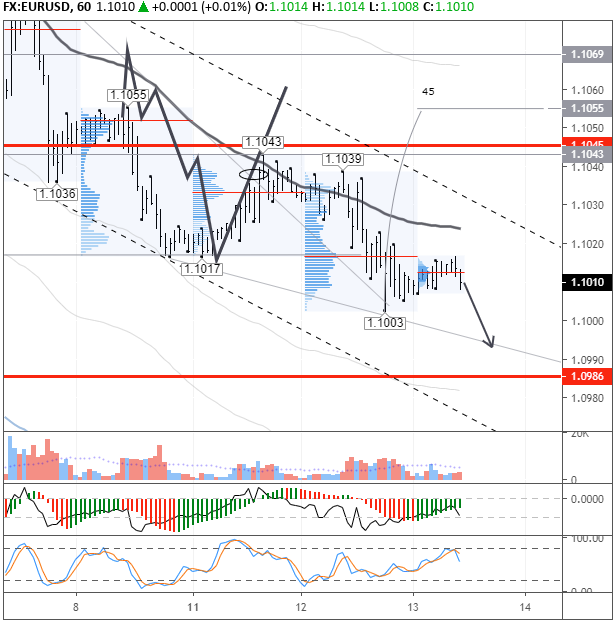
On Tuesday the 12th of November, the value of the euro slumped by the end of trading. In the US session, the pair moved to 1.1003. The dollar index continues to grow, based on the expectation that the US Federal Reserve will not slash interest rates at the end of the year. There is also uncertainty concerning the situation with negotiations between the US and China. Market players had expected President Trump to share details about the current state of trade negotiations yesterday, but he did not provide them.
Day’s news (GMT +3):
10:00 Germany: Consumer Price Index (MoM) (Oct).
12:30 UK: Retail Price Index (MoM) (Oct), Producer Price Index – Output (MoM) n.s.a. (Oct), Consumer Price Index (MoM) (Oct), Prodcuer Price Index – Input (MoM) (Oct).
13:00 Eurozone: Industrial Production s.a. (MoM) (Sep).
16:30 USA: Consumer Price Index (MoM) (Oct).
19:00 USA: Fed’s Chair Powell testifies.
22:00 USA: Monthly Budget Statement (Oct).
Current situation:
At the time of writing, the euro is valued at 1.1008. However, the pair’s trades continue to follow a bearish trend, and, as a result, there is a real risk that the euro could well fall below 1.10 in the next five hours. The forecast target for the first half of the European session is 1.0995. Currently, sellers can test the area of 1.0985. If the euro weakens against the backdrop of a rising dollar and decline on the euro crosses, then the falldown will accelerate to 1.0971.
To begin to consider an upwards correction, we need to gain a foothold above 1.1050. In order to reach this figure, we will need to make it through the 1.1025-1.032 zone.
Asian stocks are trading lower, despite their US counterparts tantalisingly close to setting new record highs, as investors continue sieving through potential signals from the noise surrounding the highly anticipated US-China trade deal. US President Donald Trump teased markets saying that a deal could happen “soon”, even as he repeated his tariff threats. Risk aversion appears to be creeping back into the markets, allowing safe haven assets to trim their month-to-date losses. Gold has pushed back towards $1460 while USDJPY has returned to sub-109.0 levels at the time of writing.
With most Asian currencies currently weaker against the US Dollar, the near-term outlook for Asian currencies remain primarily dictated by the prospects of a US-China trade deal, as investors are hopeful that the signing will take place by year-end. Considering that much of the optimism surrounding the trade deal has been priced in, this suggests that the upside for Asian currencies appear limited, with potential gains further muted by the Dollar’s resilience.
Powell’s speech, US data unlikely to trigger massive moves in DXY
Considering that President Donald Trump’s latest speech offered no new clues surrounding the US-China trade deal, the Dollar will now turn its immediate attention to the incoming US economic data, as well as Fed chair Jerome Powell’s testimony before Congress. Powell is expected to reiterate that US monetary policy is currently in a “good place”, with markets currently expecting the Fed to stand pat on US interest rates at least through the first half of 2020. However, should Powell make what is perceived to be a dovish comment, that could prompt some immediate softness in the Dollar.
The upcoming releases of the October US CPI and retail sales data should support the narrative that the FOMC will leave its policy settings unchanged over the coming months. With inflation subdued and consumers still keeping economic growth momentum intact, the US economy is expected to continue its outperformance over its peers, which should buffer the DXY’s resilience.
Brent stumbles as US-China trade deal prospects dictate prices
Brent futures have retreated below $62/bbl, as markets await fresh signals surrounding the US-China trade talks. With the next OPEC+ meeting just weeks away, it appears that the alliance is pinning their hopes squarely on a trade deal to send Oil prices higher, rather than triggering deeper supply cuts. An official trade deal would offer some sorely needed reprieve for the near-term outlook on global demand, while injecting confidence into Oil bulls going into 2020.
Disclaimer: The content in this article comprises personal opinions and should not be construed as containing personal and/or other investment advice and/or an offer of and/or solicitation for any transactions in financial instruments and/or a guarantee and/or prediction of future performance. ForexTime (FXTM), its affiliates, agents, directors, officers or employees do not guarantee the accuracy, validity, timeliness or completeness, of any information or data made available and assume no liability as to any loss arising from any investment based on the same.
The Critical Investor looks into the uranium explorer’s work in Argentina and the political situation in the country with the recent election of a new president.
1. Introduction
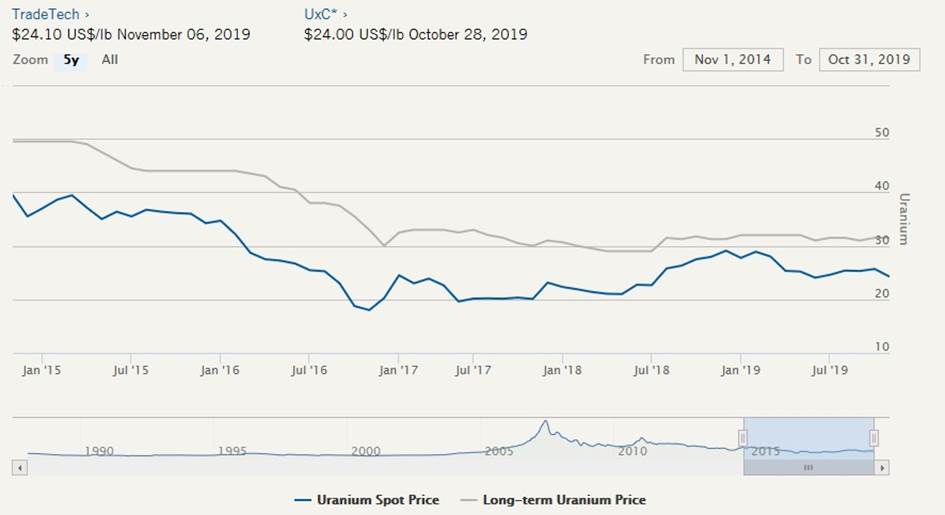
It has been a quiet year so far for Blue Sky Uranium Corp. (BSK:TSX.V; BKUCF:OTC), as the uranium oxide spot prices dropped off again after a run-up in H2 2018, rising almost 50%, only to pull back another 20% or so from these heights as can be seen at this chart, which can be found on the website of Cameco:
Nonetheless, as one of the premier low cost development plays in the uranium space, Blue Sky managed to continue working on its Amarillo Grande project in the Rio Negro province in Argentina, and recently raised fresh cash. This time it managed to get C$0.87M from the markets, earlier in July it closed a C$0.68M private placement. This is impressive, as uranium sentiment is not positive, and investors are not sure what to think of the newly elected president Fernandez in Argentina. He isn’t all that bad according to various sources, more on this later.
As most exploration and drilling is very near surface, these new funds enable Blue Sky to continue working on its flagship Ivana project, which in turn could likely improve economics further. As a reminder, at a relatively (industry wide) low base case uranium oxide (U3O8) price of US$50/lb U3O8, the after-tax NPV8 is US$135.2 million and the IRR is 29.3%. These are very decent numbers as most competitors use US$6065/lb U3O8 for their base cases. Initial capex is US$128.05 million, and the all-in sustaining costs (AISC) net of vanadium credits is US18.27/lb U3O8. This AISC is amongst the lowest in the industry. However, keep in mind that the entire project is not economic at this time as the long term (or also called contract) uranium oxide price is US$32/lb U3O8, as is any project worldwide except the ISR operations in Kazakhstan and Arrow of NexGen Energy, but it sits at the front of low cost projects and operations, and as such might be one of the uranium projects with the biggest leverage to the uranium price. Let’s have a look at the current state of affairs for Blue Sky Uranium.
All presented tables are my own material, unless stated otherwise.
All pictures are company material, unless stated otherwise.
All currencies are in US Dollars, unless stated otherwise.
2. Financings
As mentioned, the company recently closed a private placement (PP), to be precise on October 23. Blue Sky raised aggregate gross proceeds of $868,999.95 through the non-brokered private placement, by the issuance of 5,793,333 units at a subscription price of $0.15 per unit. Each unit consisted of one common share and one transferrable common share purchase warrant. Each warrant will entitle the holder thereof to purchase one additional common share at $0.25 per share for two years from the date of issue.
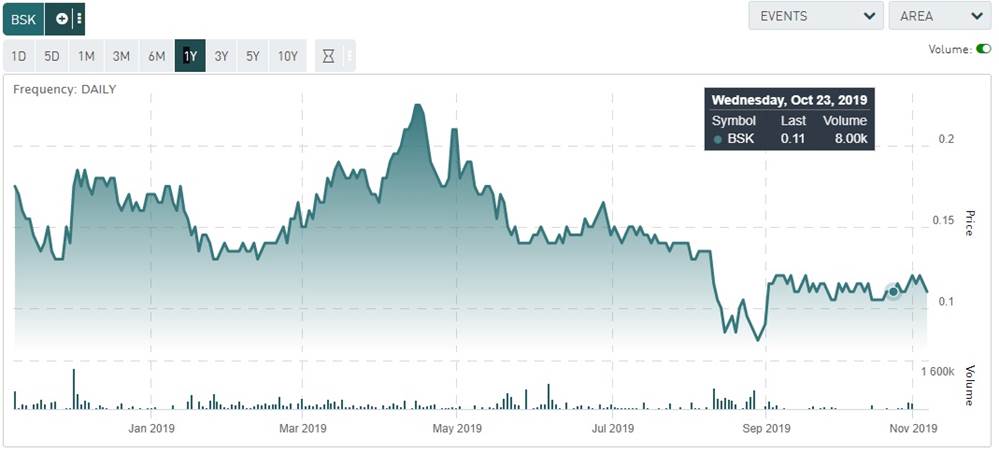
I always like a non-brokered PP, as in this case management didn’t have to use the brokers, which in turn not always mobilize the most committed shareholders. Usually management taps into its own group of personally known investors, which almost guarantees longer term holders, and no warrant flippers. The subscription price of C$0.15 is also a decent premium compared to the closing price of C$0.11 that day:
I could say something about the full warrant as existing shareholders probably preferred to see a half warrant or no warrant at all, but we have to be realistic here; Blue Sky did well at such a premium at this subdued sentiment. At least the warrant period is limited to two years, but there was no accelerated expiry clause for the warrants, as we will see at the July private placement which comes up next. The proceeds of the financing will be used for exploration programs on the projects in Argentina and for general working capital. This financing is subject to regulatory approval, and keep in mind that there is a four month hold period expiring on February 23, 2020.
So far about the October financing, Blue Sky Uranium also did a raise in July as mentioned. In this, again, non-brokered private placement, 4,528,182 units at C$0.15 were issued in two tranches, and aggregate gross proceeds of $679,227 were received by the company. Each unit consisted of one common share and again one full warrant. Each warrant will entitle the holder thereof to purchase one additional common share at $0.25 per share for three years from the date of issue. So far this is in line with the latest financing, although the exercise period is one year longer which is good.
Another addition neutralizing this is the accelerated expiry of the warrants. If the volume weighted average price for the company’s shares is $0.50 or greater for a period of five consecutive trading days, then the company may deliver a notice to the warrant holder that the warrants must be exercised within twenty days from the date of delivery of such notice, otherwise the warrants will expire at 4:30 p.m. (Vancouver time) on the twenty-first day after the date of delivery of the notice.
As can be seen in the price chart above, this round was done at no premium, full warrant, three year warrant exercise period combined with an accelerated expiry at C$0.50. I am not a fan of accelerated expiries, especially in juniors and even more especially in uranium juniors, as the upside potential is truly explosive as we have seen during other spikes in the uranium price, and this is the reason most investors are willing to invest in uranium in the first place in my view. Notwithstanding this, Blue Sky did well to raise this in a very difficult market at no discount, so it could continue with its exploration program for 2019, consisting of IP surveys and auger drilling. Blue Sky expects to have sufficient funds to last well into Q2 2020, but expects to raise more in order to fund RC drilling in 2020. But before I delve into exploration, let’s rehash developments for uranium itself.
3. Uranium
I’m not going to repeat the entire paragraph from my first article on Blue Sky Uranium, but will mention and update the most important items. Consensus is nowadays, that necessary pricing to bring a lot of Western production online could involve US$50/lb U3O8 levels, and maybe even higher, for various reasons. It is rumored by experts that for example Cameco’s McArthur River mine, the largest and highest grade single deposit uranium mine in the world, needs a complex, difficult and expensive expansion to mine the next phase, and this is only economic at US$50/lb. It is even suggested that it would be cheaper to buy and build Arrow, the Tier I deposit of NexGen Energy, and this seems valid on the longer term as Arrow appears to be much more profitable than McArthur River or Key Lake at the moment. But of course, as a development project with long permitting periods as a uranium mine, it can’t be switched on just like that. In the meantime, Cameco fulfills its delivery duties by buying in the spot market, buying which could reach as much as 20 million pounds U3O8 this year.
It is not the only one doing this, as for example traders, banks and hedge funds are buying uranium oxides left and right in order to speculate on future price increases. A new fund, Yellow Cake PLC, has an offtake agreement in place with KazAtomProm, which accounted for the buying of 8.1M lb U3O8 at the discounted price of US$21.01/lb U3O8 in 2018, and gives Yellow Cake the possibility, not the obligation, to buy large quantities for the next nine years, to the tune of US$100 million each year.
Prices of uranium are always, just like gold, subject of widespread sentiments and not the result of a healthy supply/demand mechanism, although the uranium markets are well known by the number of utilities (the nuclear power plants) in production, under construction, etc. Something that isn’t very well understood, however, but obviously key to demand, is the stockpiling by utilities, usually by fulfilling their long term contracts, like the Japanese appeared to be doing during the shutdown since 2011. Because of this, for a while the markets expected a huge stockpile to come on the market sooner or later, when it would be clear Japan would dismantle its nuclear reactors. This development didn’t pan out as we know now, and it is expected that Japanese utilities will enter the LT markets in a few years after they restarted. It is also expected that not all Japanese reactors will be restarted, so in my view there should be a lots and lots of Japanese stockpiles available for restarting utilities.
It is widely agreed upon that the growing net number of reactors will eventually generate increased demand, which would in turn create shortages based on current supply levels. However, this can take a few years to materialize.
Uranium oxide supply isn’t switched on in a short period of time, and an increase in demand by utilities can’t be met by the mining industry in time, and this is the catalyst all uranium investors are waiting for. It will probably take at least one year to have McArthur River and Rabbit Lake back online again, and the same or even longer goes for existing or new ISR operations of KazAtomProm. It recently said it could add 7M lb U3O8 of production annually by investing US$100 million many times over, but ISR is slow to ramp up, it takes about 18 months after the wells are in place. On a side note, it remains to be seen if these companies really can ramp up efficiently in this time frame, as we have seen that for example existing and producing lithium assets are ramping up to higher production rates much slower than anticipated. Whether this has technical reasons, pricing reasons or else remains to be seen, but I can’t rule out such developments with uranium either.
Besides this, there is spare capacity waiting in Australia (Olympic Dam [BHP], which will likely be expanded as soon as uranium contract prices improve meaningfully, and the Honeymoon Mine [Uranium One], which was closed in 2013 due to low prices, will be reopened again in that case) and possibly Kazakhstan, currently globally the largest producer. In Namibia there is the Langer Heinrich (Paladin Energy) mine waiting for better times, but it will be clear that new production capacity will take a lot of time. Besides this, the Chinese-owned Husab Mine is coming online this year.
But all these mines and projects have one thing in common: it takes time, to the tune of 1.52 years, before nameplate production is reached. And when the spot market has dried up because of all the buying by Cameco, etc., and utilities start buying, there is no time. Much has been made of the potential sale of current stockpiles of utilities, but most of these stockpiles are government owned and will not go back to the markets again. On an important side note: the ramping up production of Kazakhstan since 2005 at very cheap prices has effectively put most U.S. producers out of business. A large part of this Kazakh production went to China, which has massive stockpiles, accounting for more than half of total stockpiles worldwide.
According to the World Nuclear Association, global demand is expected to rise to 180M lb U3O8 in 2025, supply will be an estimated 140M lb U3O8 at the time, including restarted McArthur River, Key Lake and Kazatomprom mines. Six years is a long time of course, in the meantime the industry had to deal with another issue, the Section 232 Petition. The well-known proposal by Ur-Energy and Energy Fuels involving a 25% quota on domestic uranium was shot down by the U.S. government. President Trump denied his Secretary of Commerce the possibility of going forward with the proposal, as he seemed to deem current developments as too insignificant to take action:
“Currently, the country imports about 93% of its commercial uranium, compared to 85.8% in 2009,” Trump wrote. “The Secretary found that this figure is because of increased production by foreign state-owned enterprises, which have distorted global prices and made it more difficult for domestic mines to compete.
“At this time, I do not concur with the Secretary’s finding that uranium imports threaten to impair the national security of the United States as defined under section 232 of the Act. Although I agree that the Secretary’s findings raise significant concerns regarding the impact of uranium imports on the national security with respect to domestic mining, I find that a fuller analysis of national security considerations with respect to the entire nuclear fuel supply chain is necessary at this time.”
This outcome was more or less expected, as opposed to the miners supporting the proposal stood the very powerful utilities sector, which didn’t like potentially higher uranium prices as a result of eventual quota. But I must say, to see the proposal making it all the way to the Secretary of Commerce, putting it on the desk of Trump, was impressive in itself as I didn’t see much viability in it. Canada and Australia account for almost 60% of U.S. uranium supply, and Kazakhstan delivers another 11%, so I don’t see a large dependence on countries like China or Russia. I had to revise my views on the position of Kazakhstan, which I viewed as relatively independent of Russia, because of being a NATO partner country
This might be true in a direct way, but indirectly the Kazatomprom facilities were built by Russia and served the Russian nuclear program for decades, and Russia still has enormous financial/business influence in the country with large investments, so although the Kazakh president might not be the best friend of Putin, I don’t expect him to act independently from Russia in this regard. Therefore, all actions by Kazatomprom must be seen in this light, and I believe now that they will do everything to gain world dominance in uranium production. They might have used the Chinese rare earth strategy, the parallels are remarkable.
What is the situation in Argentina these days regarding nuclear energy?
Argentina has three nuclear reactors generating about 5% of its electricity. Its current annual consumption is approximately 300 tonnes U3O8 (or 660,000 lb U3O8). The country’s first commercial nuclear power reactor began operating in 1974 and collectively the three plants produce 1667 MWe. The current reactors include a CANDU 6 and a Siemens design; the next two planned reactors are to be built by China National Nuclear Corporation. Additionally, five research reactors are operated by the National Commission of Atomic Energy (CNEA) and others.
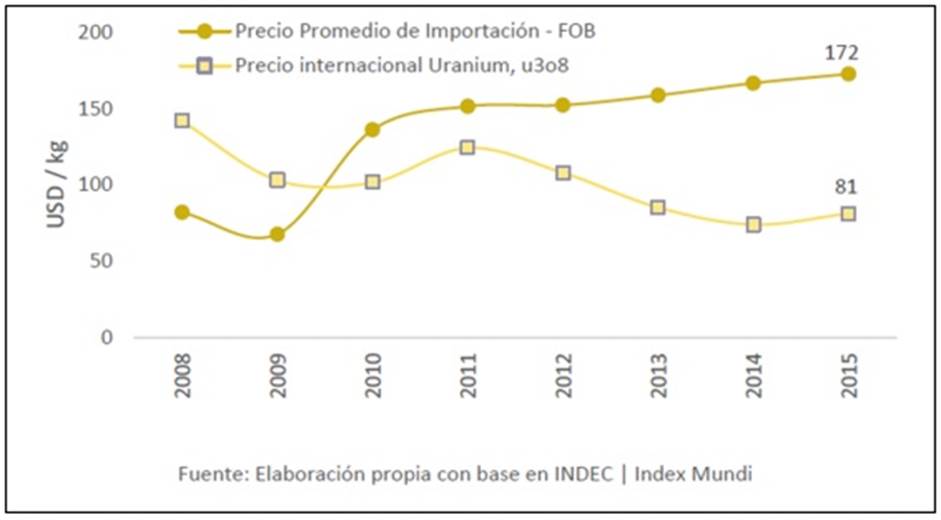
Two further research reactors are under construction. The CAREM-25 nuclear reactor, which has been developed by CNEA with INVAP and others, since 1984, is a modular 100 MWt simplified pressurized water reactor designed to be used for electricity generation (27 MWe gross, 25 MWe net) or as a research reactor or for water desalination. The prototype will be followed by a larger version, possibly 200 MWe with potential to upscale to 300 MWe. Sites in Argentina and internationally are being considered for the CAREM-25. Argentina requires 100% importation of its uranium supply. As shown in Figure 19-1 below, sourced from the Mining and Energy Industry of Argentina, the 2015 price paid for uranium was more than double the international market price for uranium.
It doesn’t look like this situation will be solved anytime soon in Argentina, and provides an excellent environment for Blue Sky and the Grosso Group to negotiate with the government on long term contracts. Talking about Argentina, let’s have a quick look at the result of the elections.
4. New President for Argentina
On October 27, left wing politician Alberto Fernandez was elected as president of Argentina, and right beside him stood the one and only Christina Fernandez de Kirchner, coming in as the new vice president of the country. Foreign capital can’t be too happy about this development, and as anticipated, a turn in the federal government is almost certainly after the pro-business course of current and outgoing president Macri. The only problem for Macri was that he couldn’t turn around the economy of Argentina, and actually aggravated the situation.
This upcoming political change has already represented uncertainties for the Argentine economy and the Argentine peso has suffered a significant depreciation in the last two months, and it may continue for a while until new government is established. This kind of uncertainty however also represents a reduction in costs due to the depreciation, as long as this depreciation outscores inflation. This reduction could also compensate the anticipated increase in country risk to a certain degree. Nobody is waiting for another YPF nationalization debacle as Kirchner pulled off in 2012, but not all is lost as it is anticipated that Fernandez is more moderate.
According to this Mining.com article, during his campaign, Fernandez met with representatives from 24 mining companies with projects in the country and told them he considered mining an opportunity, rather than a problem. He also promised to revisit the country’s controversial glacier protection law, and said that his technical team, led by economist Guillermo Nielsen, is working on a regime to guarantee clear rules for 10 years within the natural resources sector. A large pipeline of projects is waiting for development, to the tune of US$29 billion. Fernandez seems to have developed an economic agenda which includes a 10 year growth plan for the mining industry, led by the lithium sector. This is somewhat of a surprise to me as lithium is very speculative and the relevant lithium projects aren’t anywhere close to a large part of this US$29 billion pipeline, but who knows.
Other articles (in Spanish) tuned in on how Fernandez recognizes the importance of mining and its exports, but also mentioning for example the province of San Juan as a guiding example, as this province always looked after the interests of local communities surrounding mining projects. Furthermore, Fernandez is looking to initiate a Minister of Mines as he sees mining as key in revitalizing the economy, a position to be filled by the current Minister of Mining at San Juan Province, Alberto Hensel.
Other plans to stimulate exports by mining are series of tax breaks and other fiscal stimuli, as Hensel did when he was in charge as provincial minister. Hensel also acknowledged that Argentina changed mining regulations and fiscal regimes far too often, resulting in foreign capital fleeing the country. He wants to change this. So it seems although Peronist and protectionist by nature, the new government seems to understand they have to do things differently this time, very different. Let’s wait and see.
At provincial level, the Governor of Rio Negro was already elected few months ago and the actual governing party will continue for another four years. Therefore, the provincial supports to the sector is not expected to be modified. In fact, elected Governor has strongly mentioned the support to non-conventional O&G production and mining development.
On a closing note for politics before I switch to an update of exploration programs: Blue Sky Uranium also has numerous projects in the Chubut province. Situated directly south of Rio Negro, Chubut hosts several uranium deposits; however, none are currently in production and the provincial government has enacted restrictions against open-pit mining. The company’s projects in this area, Sierra Colonia, Tierras Coloradas, Regalo and Cerro Parva, comprising more than 150,000 hectares of 100% controlled mining properties, are shelved now because of this. Chubut is known as one of two anti-mining provinces that didn’t sign the new Macri normalization policy, which aimed at having a universal mining policy for every province in Argentina. Chances are that the new government can make changes in this regard.
5. Exploration Programs
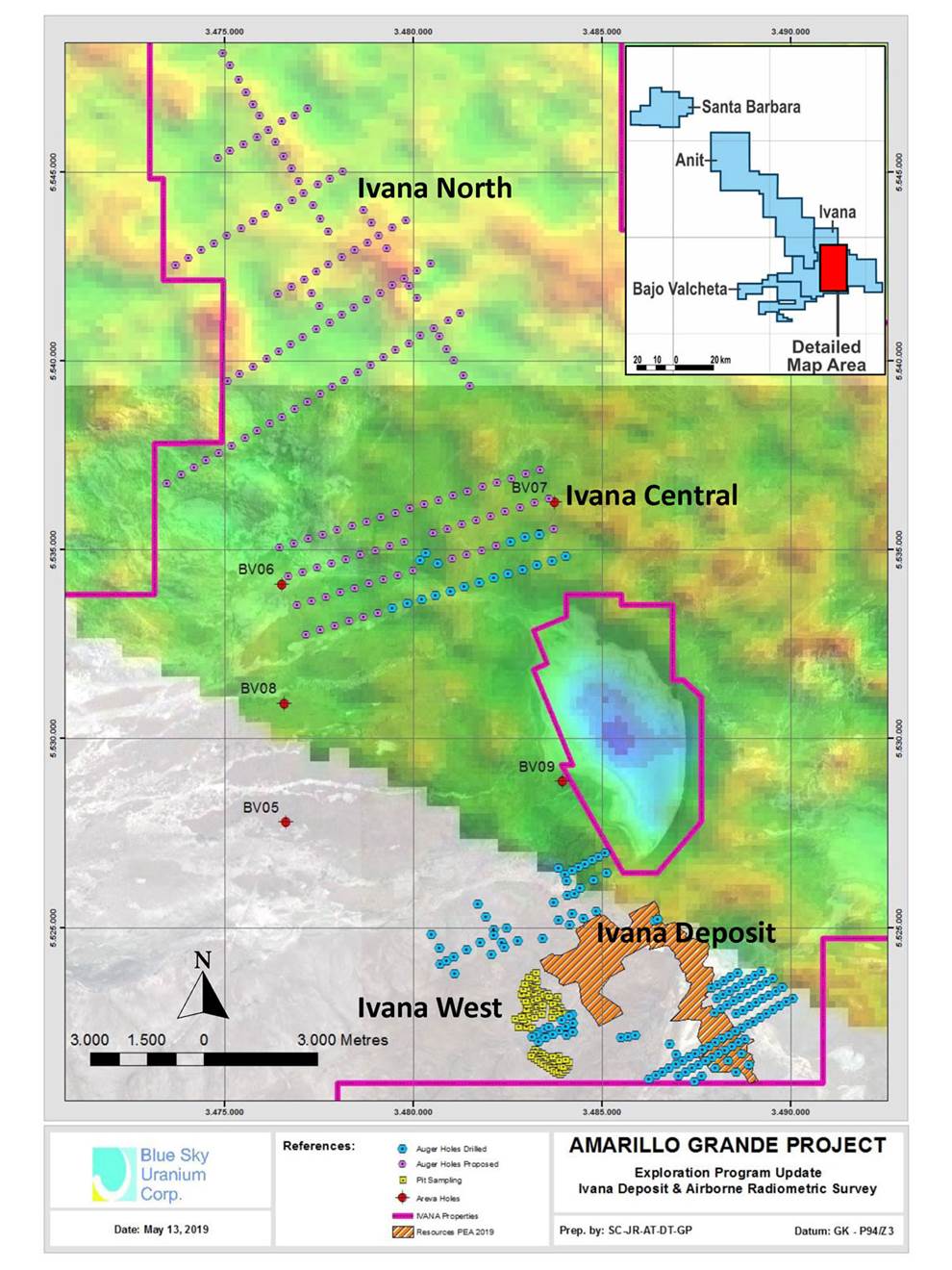
The exploration program continues on past recognized exploration targets located along a 25km-long corridor northwards of Ivana deposit, named Ivana North and Ivana Central, in order to increase the existing Inferred resource of 22.7M lbs U3O8 as much as possible:
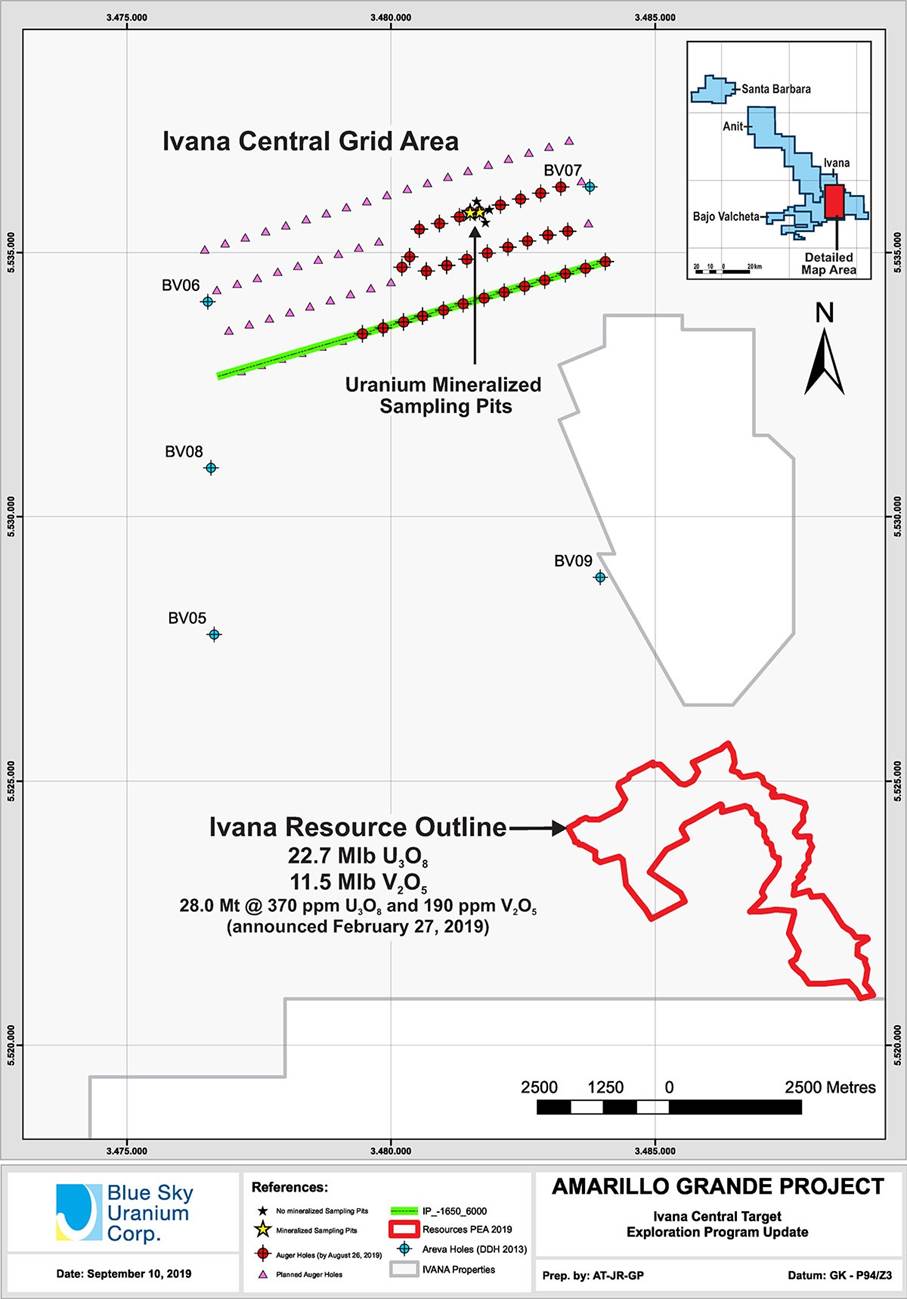
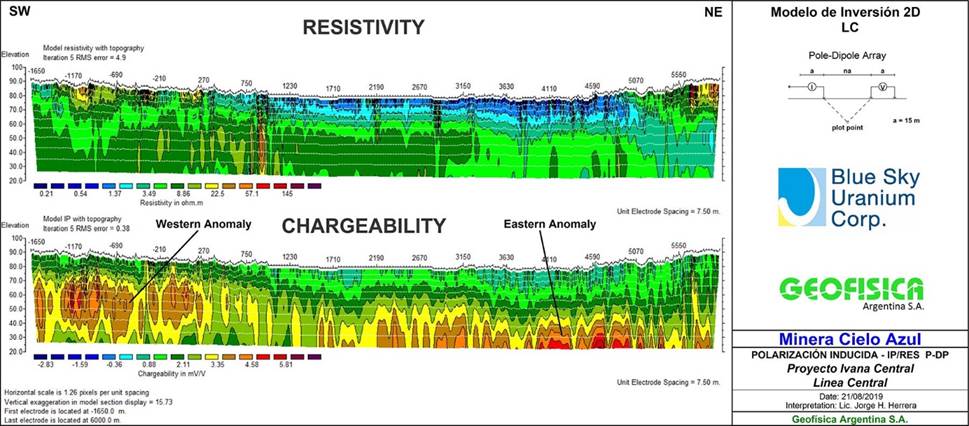
The strategy includes expansion of the known resources at Ivana deposit, and find more deposits near surface similar to Ivana deposit following the geological regional 145km trap, or redox front, where examples worldwide (as at Kazakhstan) composed of several deposits (4 of the top 10 mines are at the same district in Kazakhstan, and Cameco estimated the regional resource potential in 250 Mlb @ 500ppm U3O8). The exploration efforts were focused at Ivana Central until now, and included auger drilling and IP-survey. This target was developed based on re-assessment of the diamond drill cores drilled back in 2013 in JV with Areva. This assessment identified geological and geochemical signatures indicating the potential presence of multiple blind mineralized horizons similar to the primary mineralization at Ivana deposit, where the shallower horizon is potentially located at 30m in depth. According to management, the aim of the auger drilling is to catch subtle radiometric or geochemical anomalies confirming the presence of a blind system and its potential location. Initial auger holes helped, combined with previous exploration results, to locate a 6km-long IP testing survey, designed to detect the presence of pyrite or organic matter that may be interpreted as the trap for uranium, carried by oxidized waters in the past and generated an accumulative economic deposit. The original test was extended to 7.65km:
As a result, the IP detected two chargeability anomalies (pyrite and organic matter are chargeable), one to the west that may be interpreted as the expected horizon at 30m in depth, and another to the east located deeper probably at 4050m from surface. Both anomalies are open, and new IP-survey lines are expected to be completed in November.
The Ivana North area was first recognized back in 2010 as results of the airborne radiometric survey and follow up exploration prospecting. The initial sampling works done at Ivana North had already detected the presence of uranium/vanadium mineralization similar to the mineralization later recognized where the Ivana deposit is located today, at 20km to the south. The target area covering 10x6km radiometric and follow up sampling anomalies is planned to be covered by geophysics and auger drilling in order to adjust later RC drilling program. The works in this area are expected to be launched in the next weeks with the first IP-testing survey line followed by auger drilling.
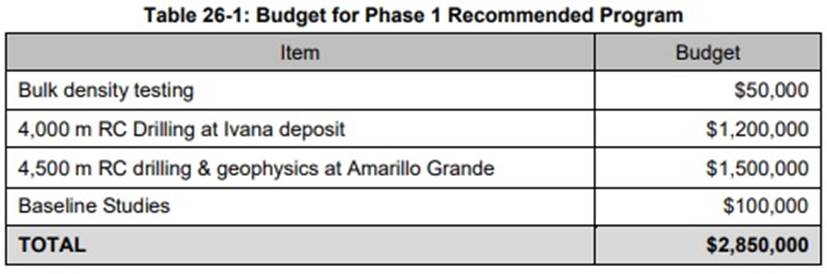
Once completed both programs, the company expects to launch a 4,500m RC drilling program in different phases at both targets. This program is expected to be initiated at the beginning of 2020, and the company is looking to raise more money to fund it, more or less following the budget estimates in the latest resource report:
The goal is to demonstrate that Blue Sky could actually control an entire uranium/vanadium district, with potential to comprise multiple deposits with significant upside potential for tonnage and economics.
As a reminder, if Blue Sky Uranium indeed manages to delineate an estimated 100M lb U3O8 and a useful amount of V2O5, it isn’t unrealistic in that case to double or even triple production capacity and double LOM. In this case some economies of scale could kick in, and despite the expected lower average grade and increased capex, the post-tax NPV8 should be able to come in at least around US$300350M, with the IRR roughly estimated at 2728% as well, maybe higher depending on the amount of higher grade ore they could delineate in the future. The company is proceeding with the expansion of the current resource and setting up work programs for the upcoming Pre Feasibility Study (PFS), and for this it is not allowed to include Inferred resources, so the entire resource needs to be converted first. Fortunately, the continuity of mineralization seems to be excellent according to management. Actual spacing of the drilling pattern allows to convert most of the resources into indicated resources. They were not converted yet by the QP because the metallurgical results were received after the resource estimation. The budget presented above includes the drilling costs to convert all actual resources into indicated (4000m).
6. Conclusion
Blue Sky Uranium managed to raise another C$0.87 million after raising C$0.68 million back in July, which is impressive in a subdued market for uranium, and mining in general except gold producers. It enabled the company to proceed with IP surveys and auger drilling, defining drill targets for a new RC drill campaign early next year. At the same time, Alberto Fernandez was elected as the new president for Argentina, and fortunately, despite his left wing Peron style protectionist/socialist background, he seems to be quite pro-mining. He not only recognized the importance and potential of the mining industry for revitalizing the economy, but is also planning on having a new Ministry of Mines, for which his Prime Minister candidate already has proven plans based on fiscal stimulation in mind. So although Kirchner is back as a vice president this time, it seems Fernandez is much more realistic with regard to mining than Macri and Kirchner combined. Very surprising. Let’s hope it all pans out well for Blue Sky Uranium.
I hope you will find this article interesting and useful, and will have further interest in my upcoming articles on mining. To never miss a thing, please subscribe to my free newsletter on my website http://www.criticalinvestor.eu to get an email notice of my new articles soon after they are published.
The Critical Investor is a newsletter and comprehensive junior mining platform, providing analysis, blog and newsfeed and all sorts of information about junior mining. The editor is an avid and critical junior mining stock investor from The Netherlands, with an MSc background in construction/project management. Number cruncher at project economics, looking for high quality companies, mostly growth/turnaround/catalyst-driven to avoid too much dependence/influence of long-term commodity pricing/market sentiments, and often looking for long-term deep value. Getting burned in the past himself at junior mining investments by following overly positive sources that more often than not avoided to mention (hidden) risks or critical flaws, The Critical Investor learned his lesson well, and goes a few steps further ever since, providing a fresh, more in-depth, and critical vision on things, hence the name.
The author is not a registered investment advisor, and has a long position in this stock. Blue Sky Uranium is a sponsoring company. All facts are to be checked by the reader. For more information go to www.blueskyuranium.com and read the company’s profile and official documents on www.sedar.com, also for important risk disclosures. This article is provided for information purposes only, and is not intended to be investment advice of any kind, and all readers are encouraged to do their own due diligence, and talk to their own licensed investment advisors prior to making any investment decisions.
Streetwise Reports Disclosure: 1) The Critical Investor’s disclosures are listed above. 2) The following companies mentioned in the article are sponsors of Streetwise Reports: None. Click here for important disclosures about sponsor fees. The information provided above is for informational purposes only and is not a recommendation to buy or sell any security. 3) Statements and opinions expressed are the opinions of the author and not of Streetwise Reports or its officers. The author is wholly responsible for the validity of the statements. The author was not paid by Streetwise Reports for this article. Streetwise Reports was not paid by the author to publish or syndicate this article. Streetwise Reports requires contributing authors to disclose any shareholdings in, or economic relationships with, companies that they write about. Streetwise Reports relies upon the authors to accurately provide this information and Streetwise Reports has no means of verifying its accuracy.
4) The article does not constitute investment advice. Each reader is encouraged to consult with his or her individual financial professional and any action a reader takes as a result of information presented here is his or her own responsibility. By opening this page, each reader accepts and agrees to Streetwise Reports’ terms of use and full legal disclaimer. This article is not a solicitation for investment. Streetwise Reports does not render general or specific investment advice and the information on Streetwise Reports should not be considered a recommendation to buy or sell any security. Streetwise Reports does not endorse or recommend the business, products, services or securities of any company mentioned on Streetwise Reports. 5) From time to time, Streetwise Reports LLC and its directors, officers, employees or members of their families, as well as persons interviewed for articles and interviews on the site, may have a long or short position in securities mentioned. Directors, officers, employees or members of their immediate families are prohibited from making purchases and/or sales of those securities in the open market or otherwise from the time of the interview or the decision to write an article until three business days after the publication of the interview or article. The foregoing prohibition does not apply to articles that in substance only restate previously published company releases.
The banking system may not be as sound we’ve been led to believe. It continues to get propped up through central bank interventions, which strongly suggests it wouldn’t be able to stand on its own.
Last Thursday, the Federal Reserve injected another $115 billion into financial markets via “temporary operations.” The Fed is targeting the repo market in particular, through which banks lend to each other on an overnight basis.
For some reason, banks have grown weary of committing liquidity to each other in what should be one of the safest lending markets on the planet.
Perhaps they are being overly cautious. Perhaps they (or one in particular) are simply being opportunistic.
After all, the liquidity shortage in the repo market led to a massive deluge of subsidized liquidity from the Federal Reserve and the launch of what is effectively a new phase of Quantitative Easing. When something goes wrong in the financial system, banks win.
JPMorgan Chase may have triggered the whole mini-crisis by moving more than $130 billion of excess cash out of the pool of reserves. That created a domino effect that tightened overall liquidity in the interbank lending market.
Former Congressman Ron Paul proffers another explanation:
“One cause of the repo market’s sudden cash shortage was the large amount of debt instruments issued by the Treasury Department in late summer and early fall. Banks used resources they would normally devote to private sector lending and overnight loans to purchase these Treasury securities.
This scenario will likely keep recurring as the Treasury Department will have to continue issuing new debt instruments to finance continuing increases in in government spending.”
Regardless of the cause, if the Fed had not intervened millions of people with holdings in bank accounts and money market funds could have seen their wealth diminish or even disappear.
Although Jerome Powell and company have apparently stabilized the repo market (for now), questions remain about systemic risks in the financial system.
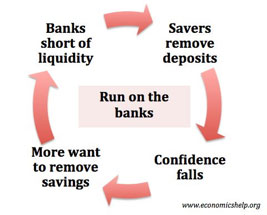
Critics of fractional reserve banking have long noted that it renders banks inherently vulnerable to bank runs.
Prior to the Federal Reserve System backstop and FDIC “insurance” for deposits, banks had to maintain much larger equity cushions. Some backed deposits dollar for dollar. Today major banks are so highly leveraged, they may only have 5 cents in reserve for every dollar of deposits.
A plunge in their capital value, a major economic downturn, or a crisis event that triggered mass withdrawals could render most banks insolvent. Since major banks have been deemed “too big to fail,” the government and the central bank would stand ready to bail them out.
But what if the authorities fall so far behind the curve that the whole financial system one day collapses on itself?
That came dangerously close to happening in 2008. Had the Fed let one more iconic financial institution go the way of Lehman Brothers, all the big banks may have quickly followed suit. Customer deposits would have been frozen until the authorities figured out how to bail out or bail in the banks on an unprecedented scale.
Money market funds should maintain a stable value even during severe downturns in stock or bond markets. In practice, they could be vulnerable to a “black swan” event that hits the financial system in a way nobody expects.
When such an event occurred in 2008, some large money market funds “broke the buck” – at least temporarily – and failed to maintain their promised stable value. Money market assets held via a brokerage account or mutual fund are generally not insured.
Treasury-only money market funds can be held to minimize credit risk.
They hold only short-term U.S. Treasury bills. During a credit crunch, Treasuries would theoretically be the safest, most liquid IOUs to hold – especially since the Federal Reserve has now committed to purchasing T-bills on a monthly basis.
Of course, T-bills aren’t guaranteed to preserve purchasing power. They are instead virtually guaranteed to lose purchasing power over time versus inflation.
Holding hard assets outside the banking system is therefore a must if you want to protect against the risks to the financial system as well as the currency that underpins it. Gold and silver are the ultimate money and could become premier “growth” assets during a monetary crisis.
The last thing you’d want to do with your precious metals is get them tied up inside the banking system.
Safe-deposit boxes at banks are generally not suitable for precious metals storage. Some banks have policies that explicitly prohibit storing gold bullion. Regardless, your gold would be at risk in the event the bank goes under or gets raided by government agents.
We’re not here suggesting that you immediately liquidate and close all your bank accounts. Going unbanked would be an awful inconvenience for most people. Instead, just be sure you hold some liquid wealth outside the financial system sufficient to get you through any potential banking breakdowns.
The Money Metals News Service provides market news and crisp commentary for investors following the precious metals markets.
We could be heading into some significant volatility for the NZD later tonight in the lead up to and in the aftermath of the RBNZ interest rate decision.
There is an increasing chance that the bank might take action, with this being the last meeting for the year. As if to confirm this, Governor Orr has scheduled a press conference for an hour after the rate decision.
Expectations have been changing about the likelihood of a rate cut in the last few days. As recently as last Friday there was a bias in the consensus against a rate cut.
However, earlier today, the RBNZ released its inflation expectations report, which was lower than what the market expected. This influenced the math on the potential of a rate hike.
What We Are Expecting
The current consensus shows that there is about a 60% chance of a rate cut this time around. Not exactly a strong case for a more accommodative stance.
There also appears to be a significant split between what people say they are expecting, and where they are putting their money.
While the majority of analysts are calling for a rate cut, swap rates are not moving as strongly in that direction This suggests that many investors are not willing to actually bet on a rate cut (though that gap has closed a bit in the final hours of the NZ trading day).
The Case For
Analysts argue that economic growth has been the weakest since 2013, and business confidence remains depressed. Inflation has been struggling so far this year, staying away from the bank’s target.
Additionally, the RBNZ has mentioned previously that they are more concerned with economic growth than strict currency stability. Then there is the fact that there isn’t a scheduled meeting for a while, so this the last chance for the bank to adjust rates.
The Case Against
Those who suggest the RBNZ might hold until February point to the weaker exchange rate, which while beneficial for exporters, drags on inflation.
On the other hand, recent electronic card transactions have turned up, and the building sector seems to have found some footing. This shows that the housing issues from earlier in the year are probably at an end.
The Situation
The RBNZ has been the most aggressive in their cuts of the major central banks. In fact, it was the first to start the recent race to the bottom.
Despite this, however, general economic data from New Zealand has continued to underperform, even as interest rates approach what is seen as the lower bound. Arguably, the RBNZ is running out of ammunition in an era of increasing economic uncertainty.
The Outlook
In any case, there still is a strong consensus that the bank’s projections will remain firmly dovish. Along with the rate decision, we also get the Monetary Policy Statement. In the statement, the RBNZ will give its projections of how rates will evolve in the future.
As a matter of comparison, the current market projections are for one rate cut by February to 0.75% (that is, a cut either tomorrow or in the next meeting), to be followed by a further cut in the second quarter of next year.
This would bring the rate to the lower end of the range at 0.5%, and presumably the end of the cutting cycle.
So far this year, the NZD has been the worst of the majors in performance compared to the US dollar. A hold by the RBNZ might give the currency a boost in the short term. However, the consensus among analysts is for further weakness into the new year.
Ideally, this question would have a single-word answer: No.
If you have a responsible broker, that’s pretty much it. But, things with the forex markets are always a little more complicated than they should be. And there are some things to keep in mind!
Retail trading of financial instruments is different than your usual buying and selling of goods. This adds a level of sophistication.
So, to understand the risks associated with forex trading, we have to take a closer look at the practical impact of CFDs and leverage.
Let’s Talk CFDs
A Contract for Difference (CFD) is a more advanced trading vehicle. And, because of that, it’s not allowed in the US.
Unlike with traditional trading in, for example, a bank, where you buy and sell a particular asset such as currency, CFDs allow you to trade on a price movement without actually having to buy the asset.
Basically, this means you are trading on whether the underlying asset will go up or down, without actually buying or selling the asset.
To do this, you always have to have a counterpart. That’s someone else who thinks the market will go the other way, usually.
For you to sell, there has to be someone who wants to buy. The job of the forex broker in this equation is to match people who want to buy CFDs with people who want to sell them.
Then There is Leverage
Since these FX traders generally want to take advantage of relatively small price movements, they want to trade larger sums to make the trade worthwhile.
This is the second function of brokers, which is to provide liquidity for leverage. But leverage means you are borrowing! And if you lose more than you have, you could be at risk of having a negative balance and owe more than you deposited.
Responsible, regulated brokers will manage the liquidity conditions and margin requirements to ensure you get closed out of any trade that might lead to losing more than you have invested.
So, ahead of high volatility times, brokers will often restrict forex trading and margin for a period of time. This is to protect their clients.
Can Things Go Wrong?
Leverage in CFDs means that it is possible to lose more than you deposit – if you don’t have a responsible broker.hahah
We can’t emphasize how important it is to trade with a regulated broker with a good reputation. Under virtually all normal circumstances you will be protected from excess loss. However, at the end of the day, you are responsible for your own trading. So, of course, a forex broker can’t protect you from taking excessive risks.
Please trade responsibly!
In very unlikely circumstances, the market can be so affected by an event that even the broker is overwhelmed.
Rember, most of the money that is being traded with CFDs is the forex brokers’. So, if there is an event like the Black Swan Franc, it can blow out even the broker’s liquidity, and it can go bankrupt. In that case, you could lose most, if not all, of your deposited funds.
Again, having a responsible, regulated forex broker which manages its resources adequately, will help prevent this from happening. In the end, retail forex trading is all about risk management.
So the more responsible a broker is, the better it will be at handling risks and black swan events!
In summary, it is technically possible to lose more than you put in. However, you can virtually prevent that from happening by working with a responsible, established, regulated forex broker.
The UK elections environment has seen a dramatic twist this week.
Nigel Farage, the leader of the Brexit party, announced that the party will not field candidates in Conservative constituencies and will only oppose those held by Labour or other parties.
There has been a great deal of speculation over the recent weeks as to whether Farage would stand against the Tories. This would have potentially diluted the vote enough to stop the Conservatives from gaining a majority.
However, Farage’s announcement that his party will not run against 317 Conservative-held seats marks a stark change in course from his recent pledge to fight for 600 government seats.
Farage Signals a Retreat
Speaking at an election rally in Hartlepool, Farage told his supporters:
“I will tell you now exactly what we are going to do. The Brexit Party will not contest the 317 seats the Conservatives won at the last election… But what we will do is concentrate our total effort into all the seats that are held by the Labour Party, who have completely broken their manifesto pledge in 2017 to respect the result of the referendum. And we will also take on the rest of the Remainer parties. We will stand up and we will fight them all.”
Farage to Block Lib Dem Elections
Farage also told his supporters:
“I have tried over the course of the last few months to build a Leave alliance … But that effectively has come to nought. It’s been very, very difficult.”
Farage explained that private polling indicated Brexit candidates “from SW London to Hampshire and right out through a western corridor to Land’s End” would split the Tory vote and result in a “large number of Liberal Democrat gains”.
Johnsons Welcomes Farage Move
The news was welcomed by the government, which now has a far higher chance of holding onto the seats won at the last election.
Commenting on the news, Johnson said he was pleased with Farage’s “recognition that another gridlocked hung parliament is the greatest threat to getting Brexit done”.
He added:
“If we have another hung parliament it would lead to two more chaotic referendums next year.”
Striking an optimistic note, Johnson said:
“The Conservatives only need nine more seats to win a majority and leave by the end of January with a deal.”
Corbyn Slams “Trump Alliance”
However, the reaction outside of the government was not so positive. Labour leader Jeremy Corbyn launched a scathing criticism of the move, saying:
“One week ago Donald Trump told Nigel Farage to make a pact with Boris Johnson. Today, Trump got his wish. This Trump alliance is Thatcherism on steroids and could send £500m a week from our NHS to big drugs companies. It must be stopped.”
No-Deal Brexit Risks Rising?
Adam Price, leader of the Plaid Cymru party of Wales was also heavily critical, claiming that the pact raises the risk of a no-deal Brexit.
Price said:
“That Nigel Farage is willing to endorse Boris Johnson is proof that they are planning to deliver a disastrous no deal. The fact that he assumes there will be no extension at the end of the next phase is evidence enough that a crash-out Brexit is an inevitability in the eyes of the Brexiteers.”
UK Avoids Technical Recession
On the data front, GBP was higher yesterday as the preliminary Q3 GDP reading came in at 0.3%. This was just below the forecast 0.4% reading the market was looking for. However, it was an increase from the prior quarter’s -0.2% reading.
There were fears that another negative number would confirm a technical recession in the UK. However, with the UK not falling into recession over the last quarter, GBP traders have reacted with relief.
Technical Perspective
The rally above the 1.2782 level has stalled for now. Price is correcting within a contracting channel pattern. While 1.2782 holds, a further move higher is likely with 1.3214 the next big level to watch to the upside. Should we break lower from here, bulls will be looking for a retest of the long term bearish trend line to offer support ahead of the next structural level at 1.2582.
The US dollar continued to push higher over the European morning on Tuesday though as yet, the USD index is sitting just below last week’s highs at 98.12 last. Later today, President Trump will speak at the Economic Club of New York and traders will be keen to hear any comments regarding the president’s assessment of the ongoing trade talks with China, specifically the likelihood of a deal being signed in Chile this weekend.
EUR Lower on USD Strength
EURUSD remains under pressure today with price fighting to hold above the 1.1024 level. The resurgence in USD strength over recent sessions has weighed heavily on the single currency. A lack of key eurozone data this week will leave the focus mainly on USD flows.
UK Avoids Technical Recession
GBPUSD has been a little lower today, weighed on by a stronger USD. Confusion and uncertainty continue to stifle fuller directional moves in GBPUSD which has been in consolidation mode following the rally above 1.2782. Yesterday’s Q3 GDP reading for the UK came in at 0.3% vs 0.4% expected. This is encouraging given the risk that the UK might have fallen into a technical recession over Q3.
SPX500 Holds Near Highs
Risk assets remain near highs today though have seen very quiet sessions over recent days with the market awaiting the next big directional catalyst. US CPI data due tomorrow holds the potential to cause some volatility ahead of the key focus which is whether the US and China will sign the “phase one” trade deal at the APEC meeting in Chile this weekend. SPX500 trades 3087.43 last, holding near the upper trend line of the bullish channel.
JPY & Gold Rally
Safe havens have both been higher today despite the stronger US dollar and equities remaining near highs. It seems that risks around the expecting trade deal signing this week are leading to some building of safe-haven demand with JPY and gold both higher on USD. XAUUSD trades 1455.84 last, bouncing off the falling wedge low. USDJPY trades.
API On Watch
Oil prices have been a little higher though remain in the red on the week as of writing. Uncertainty ahead of the expected signing of the US/China trade deal is keeping flows constrained here. Later today, traders will get the first look at US inventory levels via the API report ahead of tomorrow’s headline EIA report. Any extreme readings could provide volatility for crude traders. Crude trades 56.97 last, still well supported above the 55 level.
USDCAD Moving Higher
USDCAD has been a little lower today following yesterday’s rally. Price is sitting firmly back above the 1.3207 level and eyeing the next resistance at the 1.33 mark. Today’s Trump speech could cause some movement in USD while the API report will also be on watch given crude’s impact on CAD price action.
AUD Breaks Support
AUDUSD trades lower today with price having broken back under the .6850 level. The rejection from the test of the long term bearish trend line is gathering pace though the outlook is not totally bearish. AUD unemployment data later in the week could fuel some pickup in the Aussie which could be further boosted if the US and China do sign off on the “phase one” trade deal. AUDUSD trades .6842 last.
Florida’s Department of Citrus states that there is big risk of orange trees infection in state Florida by pathogenic bacterium huang long bing (HLB). Will the Orange quotations rise?
The US state of Florida produces up to 80 % of the American orange juice. It should be emphasized, that U.S. Department of Agriculture (USDA) forecasts an increase in orange crop in Florida up to 74 million boxes (90 pounds) in the 2019/20 agricultural season. By this way, yet the ministry considers that the HLB disease of trees will not have any negative impact. The growth of quotations is possible if USDA begins to consider that crop forecasts to be revised downwards. It should be noted that 2019/20 agricultural season just began and will continue from November to May. Another factor for the growth of quotations of the orange juice could be the forecast of the agency CEPEA about decrease of the production of citrus trees in Brazil in the 2019/20 agricultural season due to the drought.
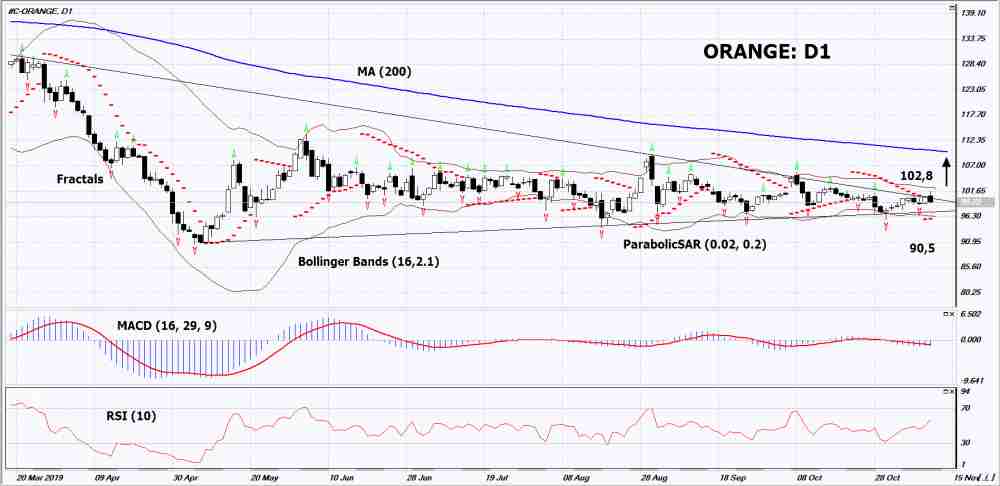
On the daily timeframe, Orange: D1 is correcting upwards from lowest since September 2009 and it has come near the resistance of the downtrend. Before opening a buy position, it should be breached up. Various technical analysis indicators have generated signals to increase. The further price increase is possible in case of a decline in the orange harvest in the USA.
The Parabolic indicator gives a bullish signal
The Bollinger bands have narrowed a lot which means low volatility.
The bullish momentum may develop in case if Orange will exceed the last two upper fractals and the upper Bollinger line: 102,8. This level may serve as an entry point. Initial stop lose may be placed below the 10-year low, the lower Bollinger band and the Parabolic signal: 90.5. After opening the pending order, we shall move the stop to the next fractal low following the Bollinger and Parabolic signals. Thus, we are changing the potential profit/loss to the breakeven point. Thus, we are changing the potential profit/loss to the breakeven point. More risk-averse traders may switch to the 4-hour chart after the trade and place a stop loss moving it in the direction of the trade. If the price meets the stop level (90.5) without reaching the order (102.8), we recommend canceling the order: the market sustains internal changes that were not taken into account.