On Thursday the 28th of November, trading on the euro ended in a nine-point increase for the single currency. Due to the Thanksgiving holiday in the United States and the subsequent lower level of activity by traders, bulls were unable to break through to the 1.1030 mark. Although, all of the necessary technical conditions for a recovery have now been met. In the US session, the pair was trading at 1.1010.
The market continues to be influenced by news coming out of the UK, Hong Kong and China. The pound sterling (GBP) is being temporarily boosted by YouGov, a company which publishes the results of public opinion polls ahead of parliamentary elections, which will be held on December 12. The latest results point heavily towards a Conservative Party parliamentary majority. GBP will hope to find a foothold on the back of this news.
The “trade war” between China and the United States also remains in the focus of market players. Investors fear that the Chinese could pull out of the deal in protest after US President Donald Trump signed a law aimed at supporting protesters in Hong Kong. China condemned the actions of the United States, but is keeping its hand close to its chest as the trade agreement negotiations draw to a close.
Today is a shorter working day in the US. Most likely, trading activity will remain at a low level. No forecast was made, as bulls can still bump the price to 1.1030. Yesterday, resistance was met at the 22nd degree and it’s fair to say that main level for upwards correction is at the 45th degree - 1.1044.
Gold finds opportunity to shine on fresh risk aversion
Another week, another record high for US stock markets despite renewed uncertainty and mixed messages from the US-China trade front.
Global equity bulls were initially inspired by positive US economic data mid-week as third-quarter GDP growth and durable goods orders exceeded market expectations, but trade woes lingered in the background. The fiery optimism revolving around a “phase one” deal between the United States and China was quelled after Donald Trump signed a bill backing Hong Kong protesters. Given the complex and intricate relationship between Hong Kong and China, this move by Washington will certainly raise concerns over the possibility of a US-China trade deal.
This negative sentiment is already being reflected in Asian markets on Friday with regional shares retreating as the month comes to an end. With China threatening that it would take “firm countermeasures” against the United States, investors may start questioning whether the “phase one” trade deal will be signed before the end of 2019. Until fresh clarity and direction are offered on the progress of US-China trade talks, markets may enter a wait-and-see mode as the year slowly comes to an end.
Sterling outlook influenced by polls
Buying sentiment towards the British Pound received and explosive boost mid-week after a closely watched poll projected a Conservative election victory.
A Boris Johnson win may signal the end of a lengthy Brexit deadlock with the UK possibly leaving the European Union before the January 31 2020 deadline. Such a market-friendly outcome has the potential the push the GBPUSD above 1.3000 and beyond. Alternatively, if the general elections results in a hung parliament and Brexit remains in limbo, the uncertainty is likely to weaken Sterling against every single G10 currency.
Dollar supported by positive US data
Encouraging economic data from the largest economy in the world continues to support the Greenback.
Sentiment towards the US economy has received a boost after third-quarter economic growth and durable goods orders both exceeded market expectations. With the data surprise reducing market expectations over the Federal Reserve cutting interest rates anytime soon, the Dollar is poised to push higher.
In regards to the technical picture, the Dollar Index is trading around 98.35 as of writing. An intraday breakout above 98.50 should encourage a move towards 99.00 and beyond.
Commodity spotlight – Gold
Gold is on track to end November shedding almost 4%, its worst monthly decline since November 2016.
Explosive levels of optimism over US-China trade talks, positive economic data from the United States and the Federal Reserve hinting a pause in cutting interest rates reduced appetite for Gold. Although bulls have lost the battle this month, the war still rages on. Given how the next tariff deadline falls on December 15th where additional U.S levies on Chinese exports will go into effect, Gold has the potential to shine as the year slowly comes to an end. Escalating trade tensions are poised to rekindle fears over slowing global growth and speculation around central banks across the world easing monetary policy. An unwelcome return of risk aversion and expectations over lower interest rates should revive buying sentiment towards Gold which has gained roughly 13.50% year-to-date (YTD).
Focusing on the technical picture, the precious metal is attempting to rebound on the daily timeframe. A breakout above $1459 should encourage move higher towards $1463 and $1475.
Disclaimer: The content in this article comprises personal opinions and should not be construed as containing personal and/or other investment advice and/or an offer of and/or solicitation for any transactions in financial instruments and/or a guarantee and/or prediction of future performance. ForexTime (FXTM), its affiliates, agents, directors, officers or employees do not guarantee the accuracy, validity, timeliness or completeness, of any information or data made available and assume no liability as to any loss arising from any investment based on the same.
One of the distinct advantages of getting good enough at Forex trading that you can do it full time is that it can be done from anywhere you have an internet connection.
If you’re a Forex trader, you have no boss, no need to commute in terrible traffic (or perhaps worse public transport) to the office, and you are not tied down to a specific place.
You can go anywhere, so why not pick the best location?
Naturally what’s best depends a lot on the person. But, there are some general considerations you should probably make as an FX trader, that we can follow to make a few recommendations.
Realistically, though, you are better off working towards making a consistent profit.
Making a couple of grand a month while living in, for example, LA, might not be all that appealing. However, that’s more than enough to live on, and quite comfortably so, in some very interesting places in the world.
As a forex trader, you’ll be aware of the varying purchasing power different currencies have, and should use that knowledge to your advantage. In fact, moving to a different country might actually improve your forex trading situation.
The Basics
In order to trade in the FX market, you need to have access to a secure internet connection, good banking infrastructure so you can withdraw your earnings and a friendly tax environment.
This latter bit is why a lot of people immediately think of moving to a country with no capital gains tax. But many of those countries, such as Singapore, Hong Kong, and Switzerland, have high costs of living.
On the other scale, countries with a low cost of living often have other problems, such as lack of infrastructure and security.
The idea is to find somewhat of a balance. But also to consider your preferred Forex trading hours.
This way, you don’t have to get up at an ungodly hour to place some crucial Forex trades.
The Candidates
If popularity is any metric, you could argue that Thailand is at the top of the list.
Not just for Forex traders, but many people who work online gravitate there. There is no capital gains tax, life is cheap, the people are very friendly, there’s good internet, and a lively ex-pat community to help you get settled.
Having access to tropical beaches doesn’t hurt either!
A close second would probably be neighboring Malaysia, for all the same reasons.
Other countries that aren’t as well known, but could be interesting candidates for FX traders include:
Panama: for people looking for a business-friendly, safe country close to the US and Canada.
Malta: has this same function to Europe; it has a similar climate as the Balearic Islands, but not the taxes. And most people speak English.
Last tip: before seriously considering moving, try visiting the country for vacation and try it out first!
(UPDATE – Angola’s central bank changed the scheduled Nov. 28 session of its monetary policy committee to Nov. 29 but said the agenda – which includes an analysis of the macroeconomic indicators, money and exchange markets – was unchanged. The last meeting of the bank’s monetary policy committee was held on Oct. 23, with the committee keeping the BNA rate steady at 15.5 percent while it raised the reserve requirement, relaxed some of the limits on payments for imports and implemented a floating exchange rate regime for the kwanza.)
This week – November 24 through November 30 – central banks from 18 countries or jurisdictions are scheduled to decide on monetary policy: Israel, Ghana, Kenya, Colombia, Kyrgyz Republic, Nigeria, Lesotho, Cape Verde, Mauritius, Fiji, Tajikistan, Gambia, South Korea, Sri Lanka, Angola, Bulgaria, Zimbabwe and Dominican Republic. Following table includes the name of the country, the date of the next policy decision, the current policy rate, the result of the last policy decision, the change in the policy rate year to date, and the rate one year ago.
The table is updated when the latest decisions are announced and can always accessed by clicking on This Week.
In its latest report, the Energy Information Administration reported yet another rise in US crude stores.
The report noted that in the week ending November 22nd, US crude stores were higher by another 1.6 million barrels. This result was in stark contrast to analyst forecasts of a 400k barrel drawdown and marks the fifth consecutive weekly rise in inventory levels.
With this latest increase, US crude stores are now sitting at 452 million barrels, both their highest reading since July and also 3% above the five-year average for this time of year.
Gasoline Inventories Rise
The inventories report also showed that US gasoline stores were higher by 5.1 million barrels over the week, again beating forecasts of a 1.2 million barrel increase. Coming on the back of the previous week’s 1.8 million barrel rise in gasoline stocks, gasoline prices have been heavily lower today.
Distillate stockpiles bucked the trend again, however, rising by 700k barrels over the week. This marked a stark shift from the prior week’s 2.5 million barrel decline.
Distillate fuel production over the week, at 5.1 million barrels per day, was roughly unchanged on the prior week.
US Crude Production Hits New Highs
One of the main points from the report, which has weighed so heavily on crude prices, was that US crude production surged once again last week. Production jumped by 100k barrels per day to hit another record high of 12.9 million barrels per days.
US Moving From Importer To Exporter
The seemingly relentless rise in US crude production has seen the US moving increasingly away from its traditional position of being a net importer of crude and further towards becoming a net exporter.
Over recent months, net exports have outstripped net imports on several occasions. In its report, the EIA noted that once again, net crude US imports were down by a further 235k barrels per day.
Trade Deal Still key Focus
The data will be a disappointing blow to bulls who had been enjoying a rally in crude over the week so far.
The latest news reports around ongoing US-China trade talks have seen encouraging comments from President Trump.
The President’s comments that the negotiations are in their final stages have fuelled expectations of a forthcoming trade deal. This would be a significant upside driver for oil prices.
Despite the concerns over the demand environment for crude, which have seen prices falling in the short term, the outlook remains positive for crude. Oil seems well support into the post-EIA dip as traders continue to focus on the prospect of a trade deal.
Technical Perspective
Crude continues to trade higher within the bullish channel which has framed recent price action. The rally has met resistance at the 58.69 level for now. However, while still in the channel, focus remains on further upside.
Above the 58.69 level, the next key topside zone is the round figure at 60 (with the channel top coming in just ahead). To the downside, the key structural level to watch is the 55.16 level, which comes in around the channel low. Only below here will the bullish focus shift.
US stocks will reopen today after the Thanksgiving holiday Thursday. US exchanges will operate on a shortened schedule today: both the New York Stock Exchange and the Nasdaq will close at 1 p.m. Eastern. Wednesday all three main indexes notched fresh closing records: the S&P 500 gained 0.4% to 3153.63; Dow Jones industrial average advanced 0.2% to 28164.00; Nasdaq rose 0.7% to 8705.18. The dollar strengthening halted yesterday: the live dollar index data show the ICE US Dollar index, a measure of the dollar’s strength against a basket of six rival currencies, slipped less than 0.1% to 98.31 and is lower currently. Futures on three main US stock indices indicate lower openings today.
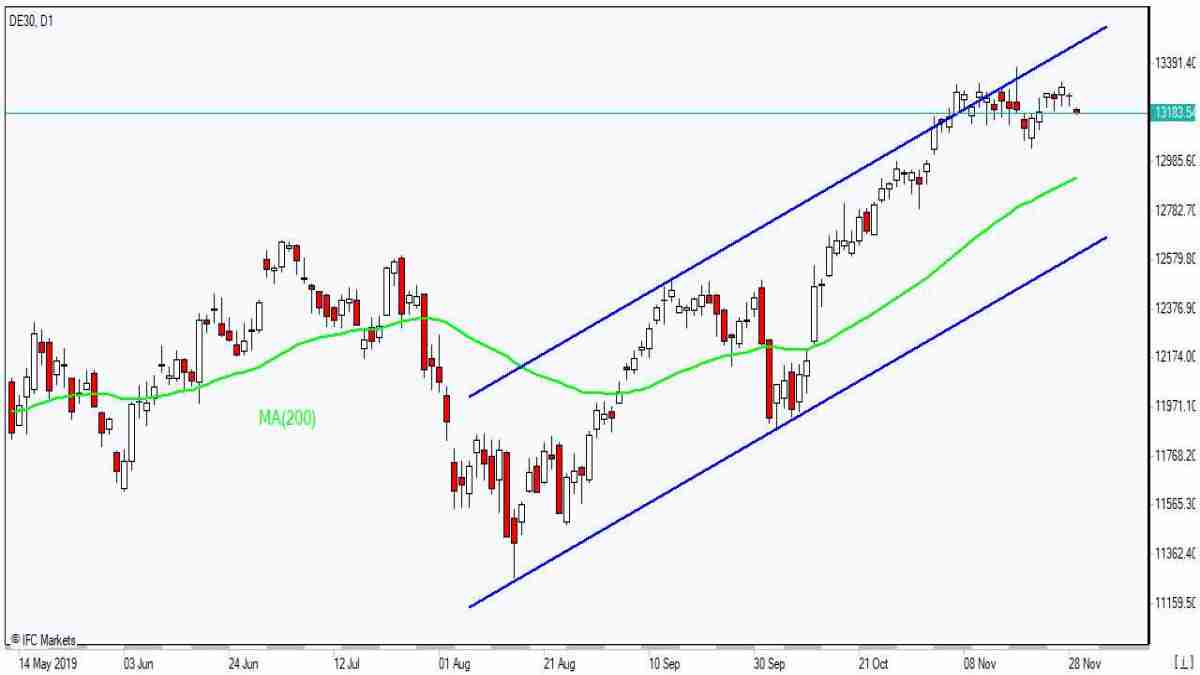
DAX 30 loss leadеr among European indexes
European stock indexes pulled back on Thursday in thin trading with US markets closed for Thanksgiving. The EUR/USD turned higher and GBP/USD turned lower yesterday with both pairs higher currently. The Stoxx Europe 600 index ended 0.16% lower led by auto shares down 1% despite a report sentiment across the euro-zone rose to above-forecast 101.3 points in November from 100.8 in October. Germany’s DAX 30 lost 0.3% to 13245.58. France’s CAC 40 slipped 0.2% and UK’s FTSE 100 slid 0.2% to 7416.43.
Hang Seng leads Asian indexes losses
Asian stock indices are mostly lower today after weak industrial output data from Japan and South Korea. Nikkei extended losses 0.5% to 23293.91 with yen climb against dollar intact despite data showing factory output fell 4.2% in October, the biggest month-on-month drop since January 2018. Chinese stocks are falling: the Shanghai Composite Index is down 0.7% while Hong Kong’s Hang Seng Index is 2.1% lower. Australia’s All Ordinaries Index pulled back 0.3% as Australian dollar resumed rising against the greenback.
Note: This overview has an informative and tutorial character and is published for free. All the data, included in the overview, are received from public sources, recognized as more or less reliable. Moreover, there is no guarantee that the indicated information is full and precise. Overviews are not updated. The whole information in each overview, including opinion, indicators, charts and anything else, is provided only for familiarization purposes and is not financial advice or а recommendation. The whole text and its any part, as well as the charts cannot be considered as an offer to make a deal with any asset. IFC Markets and its employees under any circumstances are not liable for any action taken by someone else during or after reading the overview.
The highlights of this investment story are outlined in a Zacks Small-Cap Research report.
In a Nov. 19 research note, analyst David Bautz reported that Zacks Small-Cap Research initiated coverage on Avivagen Inc. (VIV:TSX.V; CHEXF:OTCMKTS) with a US$2.50 valuation. The stock is currently trading at around US$0.39.
Avivagen is developing a line of animal products that promote growth and immunological health through its proprietary oxidized-carotene (OxBC) content. Its products reduce or eliminate animals’ need for antibiotics as a growth promoter. “Avivagen discovered that oxidized B-carotene (OxBC) contains a unique class of polymeric compounds that promote immunological health,” Bautz highlighted.
“Avivagen and its partners has shown that supplementation of feed with parts-per-million levels of OxC-beta Livestock can be used as a replacement for growth-promoting antibiotics while offering the same or better growth and health benefits without contributing to the development of antibiotic resistant organisms,” he commented.
Bautz pointed out another positive to the story, that the potential market for Avivagen’s OxC-beta Livestock is “enormous,” at about $1 billion. This estimate is derived from the fact that about 32,000 feed mills produce roughly 1.1 billion metric tons of feed every year, and the global feed market is forecast to hit roughly $37 billion in 2022.
Zacks’ model on Avivagen estimates sales of OxC-beta Livestock to reach CA$50 million in 2024. OxBC is approved in the U.S., the Philippines, Mexico, Thailand, Taiwan, New Zealand and Australia.
Further, Avivagen continues to gain market share in Asia, its priority target, which accounts for 35% of the total amount of animal feed produced each year globally, Bautz noted. Avivagen has several distribution partners in Asia, where the registration process is underway in a number of countries there, including China.
Lastly, indicated Bautz, Avivagen has and is following a set growth strategy. One part is to maximize its existing partnerships “by driving adoption and increasing new applications.” The second is to expand into new markets by getting approvals in additional countries. The third component is to make further distribution deals in approved markets.
As for potential competitors to Avivagen, Bautz wrote, “We were not able to uncover any other company that is developing technology similar to OxC-beta Livestock, however, there are a number of antibiotic alternative products that are available and could be considered competition to Avivagen and OxC-beta Livestock.”
Disclosure: 1) Doresa Banning compiled this article for Streetwise Reports LLC and provides services to Streetwise Reports as an independent contractor. She or members of her household own securities of the following companies mentioned in the article: None. She or members of her household are paid by the following companies mentioned in this article: None. 2) The following company mentioned in this article is a billboard sponsor of Streetwise Reports: Avivagen. Click here for important disclosures about sponsor fees. As of the date of this article, an affiliate of Streetwise Reports has a consulting relationship with Avivagen. Please click here for more information. 3) Comments and opinions expressed are those of the specific experts and not of Streetwise Reports or its officers. The information provided above is for informational purposes only and is not a recommendation to buy or sell any security. 4) The article does not constitute investment advice. Each reader is encouraged to consult with his or her individual financial professional and any action a reader takes as a result of information presented here is his or her own responsibility. By opening this page, each reader accepts and agrees to Streetwise Reports’ terms of use and full legal disclaimer. This article is not a solicitation for investment. Streetwise Reports does not render general or specific investment advice and the information on Streetwise Reports should not be considered a recommendation to buy or sell any security. Streetwise Reports does not endorse or recommend the business, products, services or securities of any company mentioned on Streetwise Reports. 5) From time to time, Streetwise Reports LLC and its directors, officers, employees or members of their families, as well as persons interviewed for articles and interviews on the site, may have a long or short position in securities mentioned. Directors, officers, employees or members of their immediate families are prohibited from making purchases and/or sales of those securities in the open market or otherwise from the time of the interview or the decision to write an article until three business days after the publication of the interview or article. The foregoing prohibition does not apply to articles that in substance only restate previously published company releases. As of the date of this article, officers and/or employees of Streetwise Reports LLC (including members of their household) own securities of Avivagen, a company mentioned in this article.
Welcome to this week’s Market Wrap Podcast, I’m Mike Gleason.
Coming up Larry Parks of the Foundation of the Advancement of Monetary Education joins me for an eye-opening discussion on our nation’s growing monetary problems and what you can do to help in the vital cause of bringing gold back into the nation’s consciousness. Larry also talks about some pretty shocking problems at most pension funds, so don’t miss our interview with Larry Parks, one of the foremost experts on sound money, coming up after this week’s market update.
Well, as traders on Wall Street take time off for Thanksgiving, they can be thankful markets are calm and equity averages moving steadily higher.
Of course, the stock market – and the banking sector in particular – is being artificially propped up by regular liquidity injections from the Federal Reserve. So perhaps Wall Street should give its thanks to Fed chairman Jerome Powell and his cadre of central bankers.
Powell gave a speech on Monday in which he stated interest rates were “well positioned.” In other words, he sees no need for further cuts – at least for the time being.
But Powell did vow to create more inflation. In Fedspeak fashion, he said the Fed would not wish to “permit an unhealthy downward drift in inflation expectations and inflation.” He reiterated the central bank’s goal of keeping the annual inflation rate around 2%.
Should everyday consumers be thankful for the fact that prices for household goods, medical care, insurance, education, and housing are all going up? Should savers be thankful for the fact that their dollars are losing value because of the arbitrary monetary policy decisions of an unelected and unaccountable Federal Reserve Board?
Perhaps not. But then, perhaps monetary policy isn’t designed to benefit the masses in the first place. Perhaps instead it’s tailored to fit the needs of bankers and politicians.
For now, Fed policy is also juicing stock market returns. But we know from history that when monetary inflation is injected into the financial system, it creates unsustainable bubbles and unintended consequences.
When the party finally ends on Wall Street, inflation will again become an enemy rather than a friend to investors. And those who are now entering the stock market at these elevated levels could end up being regretful.
Investors who have diversified into physical precious metals will be thankful that their wealth can’t be wiped out by gyrations in financial markets or failures in the banking system. They know that at some point, hard assets will shine.
As for this week’s action in precious metals markets, gold and silver drifted slightly lower through Wednesday’s close. The gold price ended New York trading on Wednesday at $1,455 per ounce, down 0.6% since last Friday’s close. Silver was off 0.5% ahead of Thanksgiving to trade at an even $17.00 an ounce.
Silver remains a bargain hunter’s delight. It is not only cheap in terms of dollars, but also in terms of gold. For the price of a single ounce of gold, you can buy just over 85 ounces of silver. Most metals investors who know something of the history of the gold:silver ratio would rather own 85 ounces of silver than a single ounce of gold.
Earlier this year, the gold:silver ratio reached a once in a generation high of nearly 95:1. Although it has since come down some in favor of silver, gold’s price premium remains quite elevated historically. As recently as 2011, the gold:silver ratio traded at just 32:1. Further back in history, it has found popular acceptance at 16:1.
Another metal that is trading at a big discount to gold is platinum. It ended the day on Wednesday at just $898 per ounce.
However, its sister metal palladium trades at an unusual premium to gold. The palladium price checks in at a lofty $1,837 and appears headed for a record high close on the heels a weekly advance of 3.0% as of Wednesday. The markets are open on Friday, albeit with an early close, and Money Metals is open for regular business.
As holiday shopping season kicks off, we hope you’ll consider some of the many ways to give the gift of sound money to loved ones.
Money Metals Exchange stocks bullion for all budgets – from copper rounds that can be stuffed into stockings to pure 24-karat gold for that special someone.
If you’re looking for affordable bullion gifts that come ready to give, you’ll want to order a handful of our holiday-enhanced Silver Eagles. We are pleased to offer the world’s most popular silver coin – the American Eagle – packaged in our exclusive “Merry Christmas” capsule.
This gleaming pure silver coin is a great alternative to cash, gift cards, or other run-of-the mill presents. But the truth is, precious metal in any form is virtually guaranteed to bring bigger smiles to people’s faces than the equivalent value represented in paper or plastic.
There is nothing like the timeless beauty and tangible weight of a bullion product. It leaves a lasting memory.
The gift of precious metal can be cherished for years or even decades to come. It can help teach children about the value of money, the risks of inflation, and the long-term benefits of saving. Unlike popular gifts such as clothing or electronics that will wear out or become obsolete over time, any quantity of precious metal stands to become more, not less valuable over the years.
Well now, without further delay, let’s get right to this week’s interview.
Mike Gleason: It is my privilege now to welcome in Lawrence Parks, founder and executive director of the Foundation of the Advancement of Monetary Education. Larry has dedicated much of his life towards the study and promotion of sound money, having author articles that have appeared numerous times in publications like The Economist, The Washington Times, National Review, and The Wall Street Journal just to name a few. He even hosts a weekly TV show that airs on cable networks in the Manhattan area called “The Larry Parks Show”. He is given expert testimony in Washington to the United States Congress on monetary policy. He’s a real champion for sound money, and it’s great to have him on with us today.
Larry thanks for the time and welcome. It’s good to talk to you.
Larry Parks: It’s a pleasure. Thank you for hosting this.
Mike Gleason: Well Larry, to set the stage here briefly give us some background about the Foundation of the Advancement of Monetary Education and what motivated you to take the helm of the organization nearly 25 years ago, let’s start there.
Larry Parks: I had been in the money management business and I had noticed along the way that I was getting severe distortions in the evaluation of the stocks that we used to cover. And I had known about the money issue, I had studied at one point with Murray Rothbard. And it wasn’t my intention right from the very beginning to do this. I tried to get other charities, other think tanks, to pay attention to this and nobody would touch it. Turns out there’s a good reason for that. Somebody suggested to me along the way “Why don’t you do it?” And I ended up doing it.
When we got started, we had all of the work that Committee for Monetary Education and Research did. (They) had several hundred monographs, a couple of which were authored by me. We had all that digitized. The people at The Foundation for Economic Education, that was Harry Stendhal’s at the time. They had all the work of Henry Hazlitt, I don’t know if you remember that name.
He was from The Times. He wrote a book called Common Sense Economics and stuff on gold, made all that stuff. I recruited 30 some odd board of advisers and board members, some of them had world-wide reputations, and we were off and running. And I thought that the gold space, especially the gold companies would sponsor our work but that never happened. It’s very interesting how the people on the other side, on the paper money side were able to co-op just about everybody and promulgate this, what I call this imaginary fake money into society on a worldwide basis. It’s just utterly remarkable they got away with this.
Mike Gleason: Now you’ve made the point that gold is the most important of all the commodities in the world, even more so than oil. Explain why you believe that to be the case if you would please?
Larry Parks: The reason gold is the most important commodity is that gold is the only way to ensure payment. And so the way I like to explain it is that the glue that holds society together is keeping promises. So for example I make up with you I’m going to be available at 3 o’clock today if I don’t keep my promise that hurts the relationship.
But the promises that are most important to society, aside from the promises that we make to family and friends, are the promises to pay. To pay pensions, to pay annuities, to pay savings, to pay rents, whatever. If those promises get broken society unravels. And so, what happens is that people who have promises of payment take pensions for example, pensions are really differed wages, they depend on that promise being kept. And in turn they make promises to other people mindful that they’re going to get paid. If that chain gets broken all of the inter relationships in society down and we’ve seen examples of that from all recorded history. The thing about gold is that gold is the only way to ensure payment over a long period. People think about gold as money they think about going to the grocery store, that’s absurd. Nobody would use gold for day to day transactions. Gold is important for payment into the future. And so, whatever it is that you use as money, say for example you use water, some of that water is going to spill. In the case of gold you have no spillage.
The guy who really put his finger on this the best is a guy named Carl Menger. He’s part of the so-called Austrian School of Economics picked up on Von Mises by Rothbard and others. And what they said was that gold is the sellable, most efficient money. And the way they measure that, and it’s really ingenious, if you look at all the things that could possibly be money and the things that have been money-like salt, cattle, copper, steel, all kinds of stuff- and you line them all up and you offer ever increasing amounts of each into the marketplace, the commodity for which the by sale spread increases the least that’s the most efficient money. And it just so happens that’s gold. No matter where you drop in in history, either in ancient times or Renaissance times, today, say in the 19th century, cross culture, cross time you see people using gold as money when it’s available. So it’s not like someone came down from the heavens and said “Look in China, in the Mideast, in Europe you have to use gold.” Somehow by trial and error they just figured out that gold is the most efficient money. But again it’s the key to holding society together.
Mike Gleason: Our listeners know that the market had chosen gold as the best form of money for thousands of years as you’ve just explained, but it hasn’t been openly used as money in recent decades. Talk about how and why gold was booted out of the world’s monetary system, at least officially.
Larry Parks: Well, what’s happened and this also goes back to ancient times, it was generally the rule of rulers of countries that said what the money was going to be. Best case is when the people themselves decided what the money was going to be, but a lot of times the rulers of those countries got involved with coinage. They put their images on it. They set the standards, but a long time ago people at the top of the heap figured a good way to steal was to debase the coinage. So in Renaissance times, when they started having precious metals as money, they used to clip the coinage. In modern times they figured out with things like factional reserve lending that they could really, in effect, debase the money completely. The problem with gold from that point of view is that gold protects the money.
So, if you have gold you have what you have. The way I like to say there’s no counterparty risk with gold. With everything else you have counterparty risk that somebody will do something that will damage the value of your currency. For example, if I pay you with a check, Mike, you have counterparty risk that the check may not be good. And if I pay you with a dollar, that we call a dollar today which is not a dollar, but what I call a dollar today you have counterparty risk that the issuing authority in our case it’s the banking system, the Federal Reserve and the banks, will depreciating the purchasing power of that money. And they tell you right out that they’re going to do that. The jargon for that is called inflation targeting. And see, you’re always at risk that after some long period you’re not going to have what you think you have, or you’re not going to get paid what you think you’re going to get paid.
However with gold it is what it is. By getting rid of gold they’re able, in effect, to engage in really a massive amount of thievery under the color of law of course where they transfer the wealth of society from the people who earn it — mostly ordinary working people — to the people who are in charge of the monetary system. We’ve developed on this end of the phone data from primary sources in this case the Federal Deposit Insurance Corporation, they have on their website one line for each year going back to 1934 when they got started of all the banking statistics. And up until the last tie to gold was broken, and that was in 1971, the money that went to the banks… and I can send anybody a chart on this if they wish just send me an email [email protected]… it was a small amount of money. It was a sum number of billions. Since the last tie to gold was broken in 1971 it’s in the trillions. Trillions. In dividends to their shareholders and in trillions in compensation to their employees. That would not be possible with gold.
Also, in the sense of the politicians there’s a very important book that people should take the time to read. It’s called “Fragile By Design” it’s by a Columbia Professor and his partner at, I think University of California by the name Steven Haber. It’s called “Fragile By Design” and they document very nicely that there is, on a world-wide basis what they call a grand bargain between the banking systems and the monetary authorities and banks in effect of paper money. When you have paper money you can have unlimited spending. So a lot of people complain about the deficit, about debt and what not. Well with paper money there is no limit to how much money you can spend. And if you have unlimited spending you get unlimited government. And if you have unlimited government the people in charge have unlimited power, they like that. Gold stands in the way. So, what they’ve done at this end in our country is, even though the Constitution guarantees us promises as gold and silver coin as money they’ve pretty much got gold out of the system and they’ve done it right from the get-go. Right from the time right after the Revolution. There’s a ton of stuff from 19th century where they recognize that gold is antagonistic to the paper money. And of course, the way they get you to use it is they force you to use it with what’s known as legal tender laws. Again another abomination.
Mike Gleason: There was a recent documentary financed and distributed by The Financial Times and in that piece one of their experts says gold is like “shiny pooh”. He goes on to say that “People who like gold are people who like to play with their pooh.” A silly comment to say the least but on a serious note, how do you explain the disdain for golf among financial elites Larry? Because this individuals comments are quite often shared by many.
Larry Parks: I can explain it in four words: gold pays no fees. So the people in the financial world especially on Wall Street, Wall Street is a fee business. So, when people have savings, and a lot of people are concerned, especially people who are at the upper end, they’re concerned about inter-generational wealth transfer, leaving money to their kids. People who retire, who are facing retirement, or plan to retire, they have and issue “How should I allocate my money?” And as far as Wall Street is concerned they want you to allocate it in a way that generates fees for them.
In the case of gold really the best thing that people can do for savings for the future is to buy gold, my favorite are U.S. Gold Eagles, and put them away. But if you do that where are the fees for Wall Street? And so, what they’ve done, it’s really incredible what they’ve gotten away with in the pension business. For example, in defined benefit pension plans in America there are roughly ten trillion dollars’ worth of investible assets. Ten trillion. And no gold. The only gold position that I can identify is the Texas Teachers Retirement System. They have a billion dollar position in physical gold out of roughly one hundred and forty billion dollars of investible assets but in the other ten trillion there’s no gold. And they have roughly something on the order of twenty some odd percent, last I looked around twenty-four or twenty-five percent of these assets in fixed income, these are Government bonds and court bonds, on the theory that people are safer.
In fact, the icon of American investing, that would be Warren Buffett, he said in one of his chairmen letters from his Berkshire Hathaway company followed up with an article in Fortune Magazine that the most unsafe, the most risky assets are currency denominated assets, and he specifically targets bonds. And the reason they’re unsafe and risky, the only risk you have to be concerned about is that at the end of the holding period that you have less purchasing power than when you started. The answer is that things like fixed income, that’s a guaranteed loser.
So how do you explain that you have ten trillion dollars, you have roughly two and half trillion dollars in the most risky most unsafe investment and no allocation to gold. And of course, the answer is, as I’ve said, gold pays no fees. So really what you have here is really cheating people on a massive scale, I mean it’s unbelievable how they’ve gotten away with this. In the last couple years there’s been talk about having these investment advisors having a fiduciary responsibility to their customers, and they defeated that. So basically, the way Wall Street works is that they’re in it for the fees. If the customer gets a good result, that’s a happy accident. So today… and I’ll tell you Mike it’s an incredible scandal, it doesn’t get enough press… there’s one hundred and fifty of these so-called multi-employer pension funds that are on the Department of Labor critical list which is to say they’re bust. And millions of workers are involved, what’s their remedy? What should these people do when they turn 65 or 70, whatever, and they can’t work anymore and their bodies are broken from the work that they used to do and they have no money, how are they supposed to live?
So really what’s happening in the country today is that there is, I perceive, a huge lean towards socialism. My view we are at best two election cycles, maybe one election cycle, away from the country going socialist. I don’t know how many people watched the State of The Union Address by President Trump, but he went out of his way to say in very strong terms he said, “We’re not going to have a socialist country.” Now you never heard any other President say something like that. The fact that he felt compelled to say that, they recognize also that there is this lean towards socialism. That would be an enormous tragedy, we are on the glide path right now to Venezuela.
Mike Gleason: Switching gears here a little bit, you talk to mining executives and you have your finger on the pulse there, so I want to ask you, do you think they believe there is price suppression in the metals’ markets? And as a follow up, if they believe there is – which to us seems hard to deny at this point – why don’t mining executives cry foul? Because it seems as though their companies would be the most impacted. Is it that they just don’t want to call out the very banks that they’re so depended upon for credit, or is it something else? Because the lack of an outcry for mining leaders has always baffled me Larry.
Larry Parks: Well, it’s not only baffling although I’ll give you an explanation for it, but it’s disheartening. These folks have fiduciary responsibility to their shareholders and also to themselves. Except for people like Rob McEwen, very good guy, and Rudi Fronk. Rob McEwen has McEwen Gold, Rudi Fronk at Seabridge. Very few have any kind of material interest in the companies at all. They’re in it for the payroll. In their defense, and it’s not a great defense but it is a defense, they don’t know anything about this business with gold and the monetary system. These guys, I don’t think there’s any women running any of these companies anymore. There was one woman and I think she sold out to Barrick some time ago. I forget her name. But basically, these people went to the Colorado School of Mines or its equivalent. Some of them have accounting degrees and that’s it. Also until recently none of these people were from America. So if you look at all the major gold companies, important gold companies, they were all headed by foreigners. So they don’t know anything about the constitutional issues here in America. Why would they?
So right now you have two. You have this fellow John Thornton who just took over a couple years ago at Barrick Gold. He’s an American. And Gary Goldberg who runs Newmont. But before Thornton took over it was Peter Munk. Peter Munk came from Hungary, grew up in Hungary, educated in Switzerland, considered himself a Canadian. Newmont was Jimmy Goldsmith, a Brit. And all the rest are from other parts of the world. No one knows anything about the provisions, the history and it’s really America that’s lead the way on this, not any other kind of country. There’s all a story to this, and I know we only have a few minutes for this podcast, but back in 1944-45 when the Bretton Woods Conference met really the dye was set there to get gold completely out of the system. Roosevelt did his part in 1933, but after Bretton Woods the idea was that the United States dollar would be convertible into gold for foreign governments and foreign central banks. At that time it was still a felony for Americans to own gold. That’s an interesting question you don’t get an answer to.
What is the public policy justification for making gold ownership in America a felony? I mean where have you seen that question asked in any economics textbook? Basically the guys that run these gold companies they don’t know about this. Why should they? They’re geologists, they’re mining engineers, it’s not part of their study.
Here in America educational system is highly controlled especially at the college level. Nobody gets ahead in economics talking the way I’m talking. The Huffington Post somebody did a study, and it turns out if you want to get ahead in the academy you have to publish. And it turns out that just about all the important economic journals are edited by a president or former employees of the Federal Reserve.
You don’t get ahead. So basically, there’s a lack of knowledge, and gold is denigrated and so those quotes that you gave from that Financial Times, imagine the Financial Times sponsoring, and I think that documentary, it’s called something like, “Dangerous Obsessions”… if you go on YouTube you can search those key words, dangerous obsession… it’s just outrageous that an expert should say it’s like pooh. This is really crazy, but that’s the level that we have now. When you start talking about gold people pigeon hold you. They say “You must be a gold bug” which is a derogatory statement.
Anyway, as far as the guys who run the mines are concerned they’re interested in salaries. They get good salaries. Like I say, very few of them have any skin in the game and that’s it. They don’t know the vocabulary, they don’t know what you’re talking about, they defer to the World Gold Council which is basically the world jewelry council. That’s been a thorn in my side the whole time I’m at this.
Mike Gleason: Yeah that’s I think the conclusion we’ve drawn as well. There’s no great explanation as to why these guys are just sort of completely AWOL when it comes to the suppression schemes. We have had (on our podcast) Keith Neumeyer CEO of First Majestic Silver who is a very outspoken individual when it comes to the manipulation. At least there are some out there that are doing that.
Well Larry, as we begin to close here tell folks how they can get involved or perhaps how they can partner with you in your efforts to help advance sound money policy, other than making a fully tax deductible donation to FAME… which can be done at FAME.org… talk about what people might do to join in the fight to help restore fiscal responsibility and sound money to our nations monetary policy.
Larry Parks: Well the first thing is they’re going to have to invest some of their most valuable resource and that’s their time to learn about this. We have on our website, especially the issues summary. It’s simple to do, there’s a lot of cognitive dissonance here. But we could use introductions, especially introductions to trustees of pension funds. And one of the big opportunities I think to get interest in gold we need to build a constituency for gold in the United States and there is no such constituency today. I think in December it’s a proxy for this, the mint sold something like three thousand gold eagles. That’s nothing. That’s like a tenth of a ton.
To put that into perspective for you, the mines produce about three thousand tons a year and there’s roughly two hundred thousand tons above ground. A tenth of a ton is nothing. You know because you’re in the business people keep denigrating gold. So really the opportunity to build a constituency is to get gold into pension funds.
I know you know about this Mike, I don’t know if your listeners know about it but we just had three bills that went down in flames in Wyoming. Which were going to compel the state of Wyoming… we had about seventeen representatives out of sixty vote in favor of it. But all of these pension funds are naked. And if these pension funds at least had some gold people would start taking an interest in what’s happened here. And what’s happened will not stand the light of day. Like I said this is just out and out thievery, stealing from ordinary people their future payments. It’s not like they come to your house and take what you have, but really we’re on a glide path to Venezuela as I’ve said.
We could use introductions. If the people can’t make a donation refer us to a trustee of a pension fund, any kind of pension fund. And I’m particularly interested in people who run pension funds for organized labor. The reason for that is that organized labor, they employ lobbyists and they have pull. They’re the principle victims so they’re the ones who could really make a difference here.
Mike Gleason: Well, it’s certainly been a great honor to speak with you and we greatly enjoyed the conversation. Keep up the great work. You guys are doing fantastic work there. People should go to FAME.org and make a contribution. You’ve just heard from Larry and how he has dedicated a lot of his life to this effort and it’s a very noble one. We certainly appreciate you coming on the Money Metals Podcast, take care Larry.
Larry Parks: A real pleasure, thank you Mike.
Mike Gleason: Well that will do it for this week, thanks again to Larry Parks of the Foundation of the Advancement of Monetary Education for more information visit the website FAME.org and please consider making a contribution to this important and vital cause. Again, you can do that and find out plenty of other information on these topics as well at FAME.org.
And check back here next Friday for our next Weekly Market Wrap Podcast. Until then this has been Mike Gleason with Money Metals Exchange, thanks for listening, and have a great weekend everybody.
The Money Metals News Service provides market news and crisp commentary for investors following the precious metals markets.
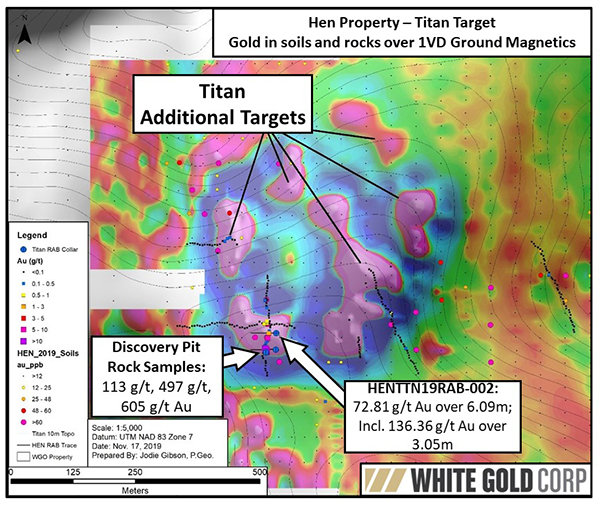
I compared WGO to Great Bear and in my view stated that I thought White Gold was better. In a release on Tuesday Nov 26th they seemed to have proved it. The hole showed 72.81 g/t gold over 6.09 meters including 136.36 g/t Au over 3.05 meters. That hole mineralization began near surface, only 10.67 meters down hole.
The Titan property has barely been scratched. You do not get results like that in a vacuum. I see WGO following up with more similar holes. Previous grab samples from Titan tested as high as 605 g/t Au, 497 g/t Au and 113 g/t Au.
There is a mag anomaly measuring 650 meters by 650 meters at Titan including half a dozen similar targets to the one just drilled.
I think White Gold just hit the big time. Look for higher prices when they tie similar holes together.
White Gold is an advertiser and I bought shares in the open market. Do your own due diligence.
White Gold Corp WGO-V $1.00 (Nov 26, 2019) WHGOF-OTCBB 113.4 million shares White Gold website.
Bob Moriarty founded 321gold.com, with his late wife, Barbara Moriarty, more than 16 years ago. They later added 321energy.com to cover oil, natural gas, gasoline, coal, solar, wind and nuclear energy. Both sites feature articles, editorial opinions, pricing figures and updates on current events affecting both sectors. Previously, Moriarty was a Marine F-4B and O-1 pilot with more than 832 missions in Vietnam. He holds 14 international aviation records.
Disclosure: 1) Bob Moriarty: I, or members of my immediate household or family, own shares of the following companies mentioned in this article: White Gold. White Gold is an advertiser on 321 Gold. I determined which companies would be included in this article based on my research and understanding of the sector. 2) The following companies mentioned are billboard sponsors of Streetwise Reports: None. Click here for important disclosures about sponsor fees. 3) Statements and opinions expressed are the opinions of the author and not of Streetwise Reports or its officers. The author is wholly responsible for the validity of the statements. The author was not paid by Streetwise Reports for this article. Streetwise Reports was not paid by the author to publish or syndicate this article. The information provided above is for informational purposes only and is not a recommendation to buy or sell any security. Streetwise Reports requires contributing authors to disclose any shareholdings in, or economic relationships with, companies that they write about. Streetwise Reports relies upon the authors to accurately provide this information and Streetwise Reports has no means of verifying its accuracy. 4) The article does not constitute investment advice. Each reader is encouraged to consult with his or her individual financial professional and any action a reader takes as a result of information presented here is his or her own responsibility. By opening this page, each reader accepts and agrees to Streetwise Reports’ terms of use and full legal disclaimer. This article is not a solicitation for investment. Streetwise Reports does not render general or specific investment advice and the information on Streetwise Reports should not be considered a recommendation to buy or sell any security. Streetwise Reports does not endorse or recommend the business, products, services or securities of any company mentioned on Streetwise Reports. 5) From time to time, Streetwise Reports LLC and its directors, officers, employees or members of their families, as well as persons interviewed for articles and interviews on the site, may have a long or short position in securities mentioned. Directors, officers, employees or members of their immediate families are prohibited from making purchases and/or sales of those securities in the open market or otherwise from the time of the interview or the decision to write an article until three business days after the publication of the interview or article. The foregoing prohibition does not apply to articles that in substance only restate previously published company releases.
Shares of ChemoCentryx Inc. opened greater than 330% higher today after the firm reported positive topline data from its pivotal Phase 3 ADVOCATE trial of Avacopan in treatment of ANCA-associated vasculitis.
After the U.S. markets closed yesterday, ChemoCentryx Inc. (CCXI:NASDAQ), a Mountain View, Calif.-based developer of new medications targeted at inflammatory and autoimmune diseases and cancer, and its Switzerland-based partner Vifor Fresenius Medical Care Renal Pharma (VFMCRP), part of the Vifor Pharma Group (CH0364749348:SIX Swiss Exchange), announced positive topline data from the pivotal Phase 3 ADVOCATE trial of avacopan for the treatment of patients with anti-neutrophil cytoplasmic antibody-associated vasculitis (ANCA-associated vasculitis or ANCA vasculitis).
The company notes that “avacopan is a first-in-class, orally-administered molecule that employs a novel, highly targeted mode of action in the treatment of ANCA-associated vasculitis and other complement-driven autoimmune and inflammatory diseases.” The firm notes that it owns and retains the commercial rights to avacopan in the U.S. and that VFMCRP has an exclusive license to commercialize the drug in all countries outside the U.S.
The ADVOCATE trial of avacopan was a 52-week global randomized, double-blind Phase 3 trial of 331 patients in 20 countries with ANCA-associated vasculitis. The pre-specified primary endpoints, which were successfully met in the trial, were remission of acute vasculitis activity at week 26 and sustained remission at week 52. The company highlighted that subjects who received avacopan also experienced significant reduction in glucocorticoid-related toxicity, significant improvement in kidney function in patients with renal disease and improvements in health-related quality of life metrics.
David Jayne, director of the Vasculitis and Lupus Clinic at Addenbrooke’s Hospital, Cambridge, commented, “This is the transformational result that clinicians and patients all over the world had been hoping for…The ADVOCATE trial demonstrated clearly that avacopan effectively brought patients into a state of remission for their acute vasculitis symptoms and kept them there for the entire period of this study. Importantly, avacopan did this in the absence of the traditional sustained daily steroid therapy that is the current standard of care and against which avacopan was compared…The notable and significant improvements in quality of life, the reductions in overall glucocorticoid toxicities and especially the improvements in renal function with avacopan therapy when compared to the steroid-containing standard of care are remarkable…In addition to changing the landscape of ANCA vasculitis therapy, these results have ramifications for other inflammatory diseases beyond ANCA vasculitis.”
ChemoCentryx’s President and CEO Thomas J. Schall, Ph.D., remarked, “These results exceed our expectations…We have for the first time demonstrated that a highly targeted therapy aimed at the very center of the ANCA disease process is superior to the traditional approach of broad immune suppression therapy; a therapy which the present findings may make obsolete…Working with our partner VFMCRP, we plan to make regulatory submissions for full marketing approval to both the European Medicines Agency (EMA) and the U.S. Food and Drug Administration (FDA) in 2020.”
Stefan Schulze, Vifor Pharma’s president of the Executive Committee and COO, added, “We are delighted with the positive topline data from the Phase 3 ADVOCATE trial for the treatment of ANCA vasculitis…By successfully meeting both primary endpoints and establishing superiority at 12 months, it confirms our belief that avacopan is a novel and better way to provide vasculitis control while reducing the risks of current standard of care and improving patient experience. This outcome is of high clinical relevance and an eagerly awaited change in the long-term treatment paradigm.”
The company explains that “ANCA vasculitis is a systemic disease in which over-activation of the complement pathway further activates neutrophils, leading to inflammation and destruction of small blood vessels. This results in organ damage and failure, with the kidney as the major target, and is fatal if not treated.”
ChemoCentryx’s partner Vifor Pharma Group is headquartered in Switzerland and is a global specialty pharmaceuticals company focused on iron deficiency, nephrology and cardio-renal therapies. Vifor Pharma Group companies include Vifor Pharma, Vifor Fresenius Medical Care Renal Pharma, Relypsa and OM Pharma.
ChemoCentryx is a biopharmaceutical company developing new medications targeted at inflammatory and autoimmune diseases and cancer. ChemoCentryx targets the chemokine and chemoattractant systems to discover, develop and commercialize orally-administered therapies. ChemoCentryx is currently focusing on its late stage drug candidates for patients with rare diseases, avacopan (CCX168) and CCX140. CCX140 is currently being developed for patients with focal segmental glomerulosclerosis (FSGS), a debilitating kidney disease.
ChemoCentryx ended the trading day yesterday with a market capitalization of approximately $469.6 million with about 58.27 million shares outstanding along with a short interest of around 5.6%. CCXI shares opened greatly higher today at $34.82 (+26.76, +332.01%) over yesterday’s closing price of $8.06. The stock set a new 52-week high price this morning of $36.88/share and has traded today between $26.74 to $36.88 per share. The company’s shares closed at $30.73 (+22.67, +281.27%).
Disclosure: 1) Stephen Hytha compiled this article for Streetwise Reports LLC and provides services to Streetwise Reports as an independent contractor. He or members of his household own securities of the following companies mentioned in the article: None. He or members of his household are paid by the following companies mentioned in this article: None. 2) The following companies mentioned in this article are billboard sponsors of Streetwise Reports: None. Click here for important disclosures about sponsor fees. 3) Comments and opinions expressed are those of the specific experts and not of Streetwise Reports or its officers. The information provided above is for informational purposes only and is not a recommendation to buy or sell any security. 4) The article does not constitute investment advice. Each reader is encouraged to consult with his or her individual financial professional and any action a reader takes as a result of information presented here is his or her own responsibility. By opening this page, each reader accepts and agrees to Streetwise Reports’ terms of use and full legal disclaimer. This article is not a solicitation for investment. Streetwise Reports does not render general or specific investment advice and the information on Streetwise Reports should not be considered a recommendation to buy or sell any security. Streetwise Reports does not endorse or recommend the business, products, services or securities of any company mentioned on Streetwise Reports. 5) From time to time, Streetwise Reports LLC and its directors, officers, employees or members of their families, as well as persons interviewed for articles and interviews on the site, may have a long or short position in securities mentioned. Directors, officers, employees or members of their immediate families are prohibited from making purchases and/or sales of those securities in the open market or otherwise from the time of the interview or the decision to write an article until three business days after the publication of the interview or article. The foregoing prohibition does not apply to articles that in substance only restate previously published company releases. 6) This article does not constitute medical advice. Officers, employees and contributors to Streetwise Reports are not licensed medical professionals. Readers should always contact their healthcare professionals for medical advice.