Sri Lanka holds rate as past easing seen reviving growth

By CentralBankNews.info
Sri Lanka’s central bank maintained its accommodative monetary policy stance and key interest rates, as expected, saying the measures it had taken in recent months were being transmitted to the economy and domestic economic activity is expected to gradually revive while inflation should remain within the desired range.
The Central Bank of Sri Lanka (CBS) has lowered its key interest rates by 100 basis points this year following cuts in May and August, and lowered the reserve requirements for banks by 250 points since November 2018, helping boost liquidity.
CBS’s Standing Deposit Facility Rate (SDFR) now stands at 7.0 percent and the Standing Lending Facility Rate (SLFR) stands at 8.0 percent.
While taking note of fiscal slippages, the central bank’s monetary board said recent tax revisions would support lower inflation and higher economic growth in the short term, but greater clarity with regard to the government’s fiscal path is required to assess the impact on the economy.
The decision to maintain rates was widely expected following the recent Nov. 16 election of Gotabaya Rajapaksa as president of Sri Lanka, and Indrajit Coomaraswamy’s decision on Nov. 26 to step down as governor of the central bank on Dec. 20.
Coomaraswamy, a Tamil,  joined CBS in 1974 and became governor in 2016 and said he was resigning for personal reasons and the age limit for staff at regulated entities.
“The decision of the Monetary Board is consistent with the aim of maintaining inflation in the desired 4-6 percent range while supporting economic growth to reach its potential over the medium term,” CBS said, adding monetary policy in several key economies has become increasingly accommodative “in view of the bleak global economic outlook.”
Sri Lanka’s economy is gradually recovering from the impact of the Easter Sunday suicide bombings, which killed more than 250 people, with the International Monetary Fund (IMF) forecasting growth to strengthen to 3.5 percent in 2020 from 2.7 percent this year as tourism gradually recovers, supported by government action to mitigate revenue shortfalls from the attacks.
Gross domestic product slowed to 1.6 percent year-on-year in the second quarter from 3.7 percent in the first quarter and CBS said growth is expected to be modest during the rest of this year but improving investor confidence supported by political stability and fiscal stimulus should boost domestic demand and drive economic growth in the short term.
Headline inflation has been volatile in recent months due to supply disruptions to food and inflation eased to 4.4 percent in November from 5.4 percent in October.
CBS expects continued volatility in inflation in the near term together with tax revisions and possible revisions to administered prices but still remain within the target range.
The rupee has been volatile in the immediate aftermath of the presidential election but is up 1.1 percent against the U.S. dollar this year, trading at 180.88 to the dollar today.

The Central Bank of Sri Lanka issued the following statement:

“The Monetary Board of the Central Bank of Sri Lanka, at its meeting held on 28 November 2019, decided to maintain its accommodative monetary policy stance with the Standing Deposit Facility Rate (SDFR) and the Standing Lending Facility Rate (SLFR) of the Central Bank remaining at their current levels of 7.00 per cent and 8.00 per cent, respectively. The Board arrived at this decision following a careful analysis of current and expected developments in the domestic economy and the financial market as well as the global economy. The decision of the Monetary Board is consistent with the aim of maintaining inflation in the desired 4-6 per cent range while supporting economic growth to reach its potential over the medium term.
Monetary policy in several key economies has become increasingly accommodative in view of the bleak global economic outlook

While mounting geopolitical and trade tensions have led to a significant deterioration of global growth and its outlook, resultant subdued demand pressures and low commodity prices have posed notable downside risks to the global inflation outlook. In response, most central banks of advanced economies as well as emerging market economies have continued to ease monetary policy with a view to stimulating aggregate demand and boosting consumer and investor confidence.

A gradual revival in domestic economic activity is expected over the medium term

Economic growth is predicted to be modest during the remainder of the year, with likely subpar growth in Industry and Services activities as implied by leading indicators. However, improved investor confidence, supported by political stability and fiscal stimulus driven boost to aggregate demand, is expected to drive short term growth. The introduction of an appropriate policy mix, which utilises the available limited policy space prudently, would support the economy to reach as well as enhance its potential over the medium term.

External sector remains resilient
External sector performance was buoyed by the cumulative contraction of the trade deficit over the first nine months of 2019, largely driven by the decline in import expenditure. Tourist arrivals continued to show a gradual yet steady improvement after the Easter Sunday attacks. The rupee denominated Government securities market experienced foreign inflows in recent weeks, but recorded a cumulative net outflow thus far during the year. Although there were net outflows from the stock market, market indices responded positively to political developments in recent weeks. The Sri Lankan rupee displayed increased volatility, following a notable appreciation against the US dollar in the immediate aftermath of the Presidential election. Overall, the rupee has appreciated against the US dollar by 1.0 per cent thus far during the year. Gross official reserves are estimated at US dollars 7.8 billion at end October 2019, providing an import cover of 4.7 months.

Market lending rates continue to decline, responding to the measures taken by the Central Bank
Market lending rates are adjusting downwards, responding to the relaxation of monetary policy and the imposition of caps on lending interest rates of licensed banks. A further decline in market lending rates is expected in the period ahead in line with the measures taken so far and also as a result of reduced cost of funds on account of the recent reduction in effective tax on the banking sector. Specifically, the Average Weighted Prime Lending Rate (AWPR) is expected to reduce by a further 70 basis points to 9.50 per cent by end 2019, while the Average Weighted Lending Rate (AWLR) is projected to decline by around 120 basis points to below 12.50 per cent by March 2020. Interest rates on the stock of deposits continued to decline, while interest rates on new deposits, which declined notably until September 2019, showed some increase in the month of October 2019, following the removal of the cap on deposit interest rates of licensed banks.

Growth of monetary and credit aggregates is expected to recover gradually
Monthly credit disbursements to the private sector continued to expand in absolute terms during August-October 2019. Accordingly, growth of private sector credit, which decelerated sharply during the first ten months of the year, is expected to accelerate gradually in 2020 with the revival of economic activity, the ongoing reduction in market lending rates and improved market sentiments. Meanwhile, credit to the public sector showed a cumulative expansion during the first ten months of the year. Driven by subdued credit expansion to the private sector, broad money growth (M2b) also continued to moderate during the period under review.

Despite near term volatilities, inflation is expected to remain in the desired range of 4-6 per cent in the near term as well as the medium term
Headline inflation, as measured by the year-on-year changes in Colombo Consumer Price Index (CCPI) as well as National Consumer Price Index (NCPI), accelerated recently due to increased food prices driven by domestic supply disruptions. These transitory supply side disruptions are expected to cause continued volatility in inflation in the near term together with tax revisions and possible revisions to administratively determined prices. Meanwhile, the planned public sector wage increases could have a direct upward impact on aggregate demand in 2020. However, with the prevailing negative output gap expected to close only gradually in the medium term, and supported by well anchored inflation expectations, inflation is projected to remain within the desired range over the medium term.

Policy interest rates maintained at current levels
The Monetary Board, at its meeting held on 28 November 2019, was of the view that the policy measures adopted by the Central Bank in recent months are being transmitted to the economy through the financial market with market lending rates declining as envisaged. While noting the fiscal slippages thus far during the year, the Monetary Board observed that the recent tax revisions would support lower inflation and higher economic growth in the short term, but was of the view that greater clarity with regard to the medium term fiscal path of the government is required to assess the impact on the economy over the medium term. Accordingly, considering the current and expected conditions in the economy and the financial market, the Monetary Board decided to maintain the Standing Deposit Facility Rate (SDFR) and the Standing Lending Facility Rate (SLFR) of the Central Bank at their current levels of 7.00 per cent and 8.00 per cent, respectively.”

    www.CentralBankNews.info
 

Fiji holds rate, easy policy needed to boost slower growth

By CentralBankNews.info
Fiji’s central bank left its benchmark Overnight Policy Rate (OPR) steady at 0.5 percent, saying the current easy monetary policy stance remains appropriate as “accommodative macroeconomic policies are needed to raise growth whilst maintaining price and external stability.”
The Reserve Bank of Fiji (RBF), which has not changed its rate since October 2011, said its monetary policy objectives, which include adequate foreign exchange reserves and price stability, remain intact and its current accommodative policy stance is supported by surplus bank liquidity of more than $600 million at the end of November.
Earlier this month RBF slashed its forecast for economic growth this year to 1.0 percent, the slowest growth rate in a decade, from May’s forecast of 2.7 percent and down from 3.5 percent in 2018.
In today’s statement, Ariff Ali, governor and chairman of RBF, said aggregate demand had softened as expected and private sector credit growth had slowed further in October.
Data for the first 9 months of the year show demand was weakening due to weak business and investor sentiment as well as lower government spending, with most business sectors expected to decelerate, RBF said on Nov. 7.
On the upside, commercial banks’ profitability has improved, visitor arrivals are up along with the fishing sector and education, health and information and communications sectors.
Growth in 2020 is expected to pick up to 1.7 percent as both domestic and global economic sentiments are expected to improve, with growth in 2021 seen rising to 2.9 percent and then to 3.0 percent in 2022.
The growth in tourism and remittances is underpinning stable foreign reserves but inflation turned negative in October, falling to minus 0.9 percent from a positive 0.4 percent in September, the first deflation since November 2014, with prices declining in all major categories.
“Given that aggregate demand is forecast to remain soft, demand side inflationary pressures are forecast to be broadly muted in the near-term,” RBF said.
Fiji’s foreign reserves amounted to $2.190 billion at the end of November, enough to cover 5 months of imports, and are forecast to remain at comfortable levels in the medium term.

The Reserve Bank of Fiji issued the following statement:

“The Reserve Bank of Fiji Board decided to keep the Overnight Policy Rate unchanged at 0.5 percent at its meeting on 28 November.
The Governor and Chairman of the Board, Mr Ariff Ali, stated that while the Bank’s twin objectives remained intact, major sectoral performances to date have been mixed and aggregate demand has softened in line with the 1.0 percent revised growth forecast for 2019. He added that in line with the latest business expectations and retail sales surveys, private sector credit growth further slowed in October.
Inflation has been decelerating since the middle of the year and has turned negative. Consumerprices declined annually by 0.9 percent in October compared with the 0.4 percent increase noted a month earlier and is much lower than the 5.2 percent growth recorded in the same month a year ago. All major categories noted a decline in prices, with the exception of food & non-alcoholic beverages. Given that aggregate demand is forecast to remain soft, demand side inflationary pressures are forecast to be broadly muted in the near-term.
In addition, balance of payments vulnerabilities have subsided. The decline in imports amid continuous growth in tourism and remittance receipts has led to an improvement in foreign reserves of around $180 million since the end of 2018. Foreign reserves were $2,190 million at the end of November, sufficient to cover 5.0 months of retained imports of goods and services and are forecast to remain at comfortable levels over the medium-term given the modest outlook for import growth and uptick in tourism and remittance inflows.
While the Reserve Bank’s monetary policy objectives are intact, accommodative macroeconomic policies are needed to raise growth whilst maintaining price and external stability. Therefore, the current accommodative monetary policy stance remains appropriate and is supported by surplus bank liquidity which was above $600 million throughout November.”

www.CentralBankNews.info


Gold & Silver Fall On Trade Deal Hopes

By Orbex

Gold

The yellow metal has been lower over the course of this week’s trading as better risk sentiment has seen diminished safe-haven flows. Gold prices have been trending lower for a few weeks now as expectations of a US/China trade deal have been ramped up in response to recent comments. Last week, President Trump said that a trade deal was “potentially very close”. This week, Trump added further to these comments saying that the two sides are now in the very “final throes” of completing the phase-one trade deal agreed in October.

The market has been waiting on a signing date following the cancellation of the APEC meeting which was to host the deal signing. While the market is yet to receive an official signing date, the momentum in recent comments from both sides has seen an increase in expectations that a deal will be coming in the next few weeks. In terms of a date, the market is expecting that a deal will be signed before December 15th which is the date the US has penned for the next round of trade tariffs on China.

If the two sides do sign a deal ahead of this date, the implications for gold will be heavily bearish as we will likely see a strong spell of risk-on trading. Equities prices have been trading higher into record levels over recent weeks, which has kept the pressure on gold. This theme is likely to continue if a deal is signed. Of course, if a deal does not come ahead of the December 15th date and the US does announce new tariffs, upside in equities will likely reverse quickly, seeing gold supported.

Technical Perspective

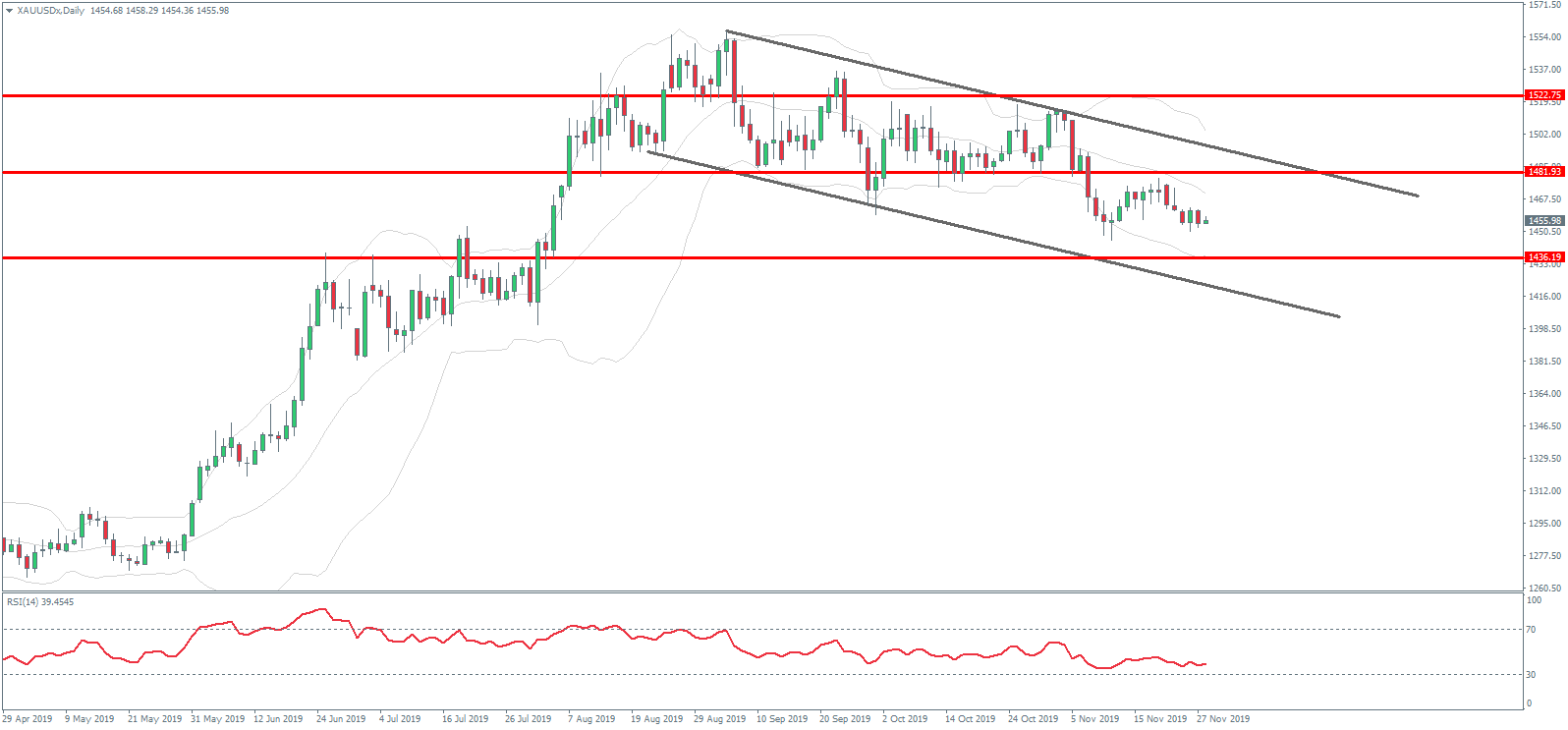
Gold prices continue to trade lower within the bearish channel which has framed the correction off year-to-date highs. The recent 1481.93 level, which has underpinned gold prices over the last three months, has now been broken. Focus is now on a test of the 1436.19 level next.

For now, the pattern can still be viewed as a corrective bull flag suggesting that upside could still materialize. If the price can break back above the1481.93 level, the key level to watch in the short term is 1522.75. This is a major long-term pivot for gold. Above here, the focus will be on a move back up to the recent 1554.69 level.

Silver

Silver prices have broken from their recent correlation with gold to trade higher across the week. On the back of the heavy sell-off seen last week, silver this week posted a mild recovery as the rally in equities leaned support. Expectations of a US/China trade are also helping support silver here due to expectations of increased industrial demand.

The outlook for the US dollar is important here also. The painting back of Fed easing expectations has seen USD supported over recent weeks which has offset some of the upside in silver.

Technical Perspective

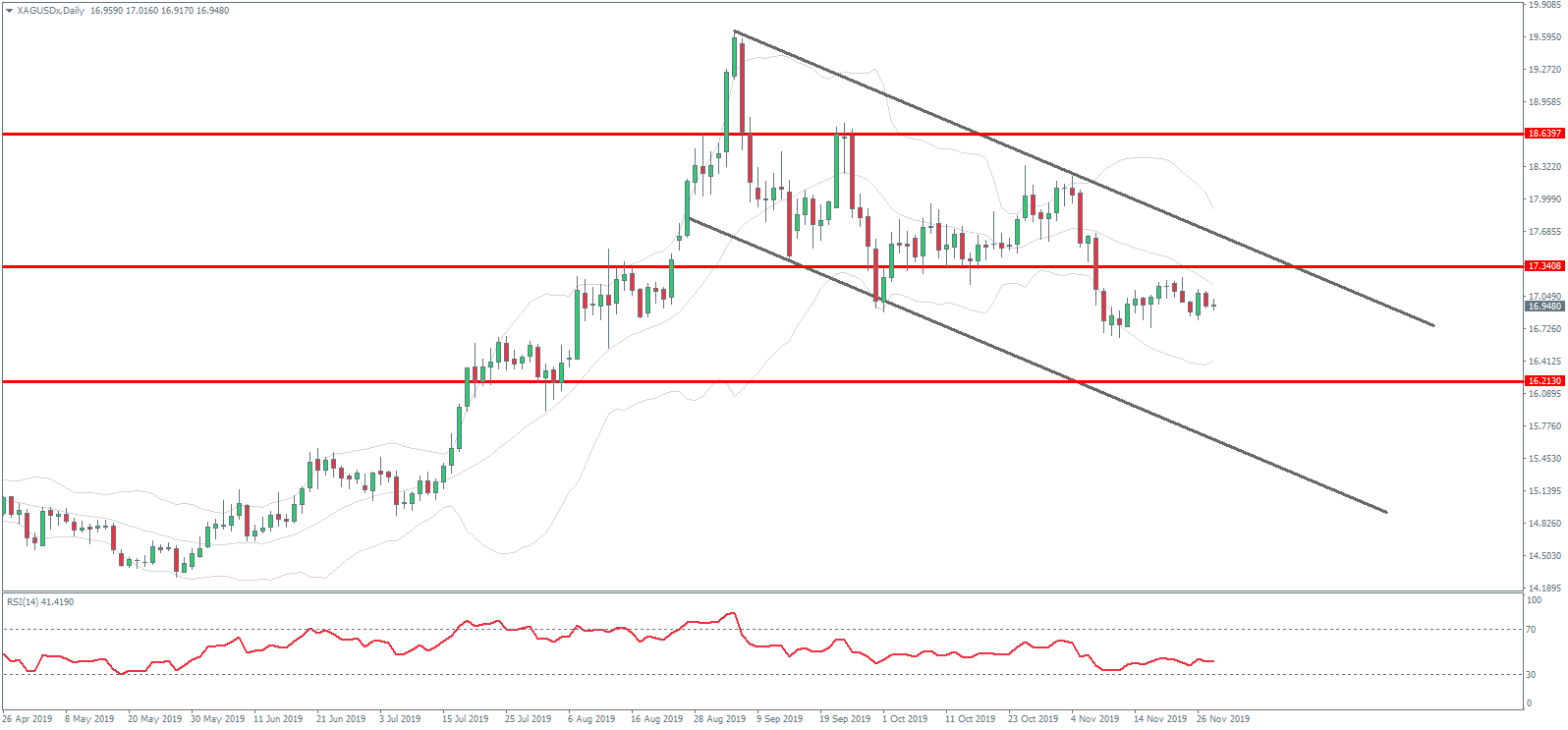
The recent breakdown in silver has seen price breaking down below the key 17.3408 level as the bearish channel develops further. While this channel can still be viewed as a corrective bull flag structure, for now, bulls will need to see price quickly back above that broken support.

Below 17.3408, the next major support level is down at 16.2130. This also holds the retest of the broken long term bearish trend line. To the topside, the 18.6397 level remains the key marker to break.

By Orbex


How Much Do Forex Brokers Charge?

By Orbex

This is an important question to consider when evaluating whether to sign up for a particular Forex broker in.

Not only can it impact your potential FX trading success, but it can also give you clues about how reputable the broker is.

There are certain charging practices among Forex brokers that you definitely want to avoid.

How Brokers Make Money

Before discussing how much you can expect to pay a Forex broker, let’s go over how they are supposed to make money.

Brokers give you access to the Forex markets, and usually, there are two ways that they can charge you for this service. One is through fixed commissions, and the other is through the spread.

Typically, banks charge commissions, while online brokers charge spreads.

Why is spread preferable to commissions? Well, the spread represents a difference in the buy and sell price, and in most forex operations it is really small. A fraction of a percent, in fact. This gives the Forex trader a lot more flexibility in picking their trade size because they always know at the time of trading how much it will cost.

Most importantly, the Forex broker only makes money if you trade. This means they are motivated to make sure you stick around and make money. And because the broker isn’t taking a percentage of your trading income, they have no motivation to interfere in the way you trade.

What Kind of Spreads Can You Expect?

How much the spread is, usually depends on the size of your account, and varies from broker to broker.

It also varies over time, depending on market circumstances, and how much liquidity there is. Brokers generally compete on the basis of offering smaller spreads, so there is an incentive for them to offer as low a spread is possible for their clients.

Most reputable Forex brokers who offer variable spreads automatically pass the lower spreads onto their clients in real-time.

Spreads vary between currencies, as well. The more popular – and therefore liquid – pairs typically have smaller spreads than the more exotic pairs. Pairs that have more volatility will also have larger spreads, generally.

Size Matters

Generally, for a small retail Forex trader with an account under $5,000, you should expect spreads of less than 2 pips for major currency pairs.

Exotic and crosses will likely have higher spreads, the less liquidity they have.

If you are a larger Forex trader, you can sign up for premium accounts that offer lower spreads, sometimes as low as 0.6 of a pip. This is more attractive for day traders, naturally, since they will be making more trades.

The Bottom Line

Reputable FX brokers will only charge spreads. Less reputable brokers usually introduce additional fees to get more money out of their customers, such as deposit and withdrawal fees, commissions, etc.

Usually, this is because they expect their customers to lose money, and not stay around for long. You’ll likely want a Forex broker that balances small spreads with good educational materials.

By Orbex


Investors Cautious Amid Thin Trading

By Orbex

The US markets were closed on Thursday on account of the Thanksgiving holiday. Investors were cautious amid the lack of any major fundamentals during the day. Doubts on the US and China trade deal still remain. This comes as the Washington administration passed a bill in support of the Hong Kong protests. Chinese authorities are reportedly not happy with the US decision. Investors fear that this could spill over into the trade talks.

German Consumer Prices Fall More than Expected

The monthly consumer price index data for Germany showed that inflation was weaker in November. Headline CPI for Germany was down 0.8% on the month in November. This was more than the forecasts of a 0.5% decline estimates given by economists. On a year over year basis, German CPI is up 1.1% however but below the median estimates of a 1.3% increase. Lower energy prices were attributed to the weakness in the headline inflation.

EURUSD Holds on to Support Firmly

The common currency recovered from the slump on Wednesday, but price action is still near the support level of the 1.1000 region. With the US markets partly open today, we could expect to see a flat close into the weekend. The prospects of a rebound come into the picture only when EURUSD can breakout above the local pivot high of 1.1020.

Sterling Trades Flat as Tories Lead in UK Poll

The incumbent Prime Minister Johnson’s Conservative Party is expected to win with a majority in the upcoming December 12th elections. The UK poll puts the Tories as the firm favorites despite the Labor party trailing closely. The sterling which fell earlier this week on news about the Labor party gaining ground erased the losses.

GBPUSD Back Within the Range

The currency pair is back trading within the range of 1.2960–1.2865. This sideways range could continue into the December 12th elections. So far, the upper range of 1.2960 has held up. So further gains can be expected only on a strong close above this level. To the downside as well, unless the declines are followed up by strong momentum, price action could remain muted.

Gold Prices Stay Muted Despite Modest Risk Aversion

The precious metal attempted to make some modest gains during the European trading session. But by the US session, the precious metal gave back the gains. With thin trading, gold prices were somewhat limited in their range. The US markets open today but it is a short trading day for the US ahead of the weekend.

XAUUSD Trending Weaker

XAUUSD has been somewhat subdued but the bias remains to the downside. With price action within the range of 1462 and 1445 levels, the sideways range could remain in play. The bias can shift to the upside on a break out above 1462. However, the Stochastics oscillator is indicating to continued bearish momentum.

By Orbex


South Korea holds rate, easy stance, still ready to adjust

By CentralBankNews.info
South Korea’s central bank left its base rate steady at 1.25 percent and said it would maintain its accommodative monetary policy stance as domestic economic growth is expected to be moderate and inflation low, confirming it is still willing to “judge whether to adjust the degree of monetary policy accommodation.”
The Bank of Korea (BOK), which has cut its rate twice this year by a total of 50 basis points in October and July, said the pace of domestic economic growth has remained slow but next year the  sluggishness in exports and facilities investment is expected to ease and consumption growth to rise moderately although the adjustment in construction investment will continue.
BOK lowered its forecast for 2019 growth to around 2.0 percent from July’s forecast of 2.2 percent  and forecast 2.3 percent growth in 2020, down from 2.5 percent previously forecast. In 2018 the economy grew 2.7 percent.
“As it is expected that domestic economic growth will be moderate and it is forecast that inflationary pressures on the demand side will remain at a low level, the Board will maintain its accommodative monetary policy stance,” BOK said.
Whether to adjust the degree of accommodation, BOK said this would be decided in light of developments in U.S.-China trade talks, the economic and monetary policies of major countries, the rise in household debt, along with geopolitical risks and their impact on the domestic economy and financial stability.
South Korea’s economy, considered a bellwether for the global economy and trade due to its reliance on exports, grew 2.0 percent annually in the third and second quarters of this year.
Last month BOK Governor Lee Ju-yeol said higher tariffs and uncertainties from the U.S.-China trade war had probably cut South Korea’s growth by 0.4 percentage points in 2019.
Consumer price inflation rose slightly in October to zero percent from a decline of 0.4 percent in September and BOK forecast headline inflation would rise moderately to around 1.0 percent in 2020 while core inflation, which excludes food and energy, would be in the upper zero percent level.

The Bank of Korea issued the following statement:

“The Monetary Policy Board of the Bank of Korea decided today to leave the Base Rate unchanged at 1.25% for the intermeeting period.
Based on currently available information the Board considers that the pace of global economic growth has continued to slow as trade has contracted. The global financial markets have been stable in general, as risk aversion has subsided in line mainly with progress in the US-China trade negotiations. Looking ahead, the Board sees global economic growth and the global financial markets as likely to be affected by factors such as the degree of the spread of trade protectionism, the changes in the monetary policies of major countries, and geopolitical risks.
The Board judges that the pace of domestic economic growth has remained slow, as consumption growth has weakened, while the adjustment in construction investment and the sluggishness in exports and facilities investment have continued. Employment conditions have continued to improve in some respects, with the increase in the number of persons employed having risen. With respect to the domestic economy during next year, the Board expects the sluggishness in exports and facilities investment will ease somewhat and the consumption growth rate will moderately rise, although the adjustment in construction investment will continue. GDP is forecast to grow at around 2% in 2019 and the lower-2% level in 2020.
Consumer price inflation was at the 0% level, due largely to a smaller decline in the prices of agricultural, livestock and fisheries products. Core inflation (with food and energy product prices excluded from the CPI) has been at the mid-0% range, and the rate of inflation expected by the general public has remained at the upper-1% level. Looking ahead, it is forecast that during next year consumer price inflation will moderately increase to around 1% and core inflation will be at the upper-0% level.
In the domestic financial markets, long-term market interest rates and stock prices have risen and the Korean won-US dollar exchange rate has fallen, affected chiefly by movements in the global financial markets. The rate of increase in household lending has continued to slow. Housing prices have risen as the pace of increase has expanded in Seoul and its surrounding areas. 
Looking ahead, the Board will conduct monetary policy so as to ensure that the recovery of economic growth continues and consumer price inflation can be stabilized at the target level over a medium-term horizon, while paying attention to financial stability. As it is expected that domestic economic growth will be moderate and it is forecast that inflationary pressures on the demand side will remain at a low level, the Board will maintain its accommodative monetary policy stance. In this process it will judge whether to adjust the degree of monetary policy accommodation, while carefully monitoring developments in the US-China trade negotiations, the economies and monetary policies of major countries, the trend of increase in household debt, and geopolitical risks and examining their effects on domestic macroeconomic and financial stability conditions.”


Angola holds rate, shrinks footprint in FX market further

By CentralBankNews.info
Angola’s central bank left its key interest rates unchanged, saying disinflation is continuing despite the implementation of value-added-tax (VAT) and the liberalization of the exchange rate in October.
The National Bank of Angola (BNA), which has cut its benchmark BNA rate by 100 points this year to 15.50 percent, added its monetary policy stance will remain restrictive through finer liquidity management by open market operations in order to consolidate the floating exchange rate regime and to ensure greater price stability.
In October BNA’s monetary policy committee raised the reserve requirement for kwanza deposits by 500 basis points to 22 percent and set a 10.0 percent interest rate for a new 7-day facility as it completed a transition to a market-determined exchange rate for the kwanza begun in January 2018.
This included scrapping a 2.0 percent trading band margin that had limited the kwanza’s move during currency auctions.
After taking over the reins of BNA in October 2017 – part of Angola President Joao Laurenco’s move to clean up the country’s image as corrupt –  Governor Jose Massano began a major overhaul of BNA in January 2018, including ditching a fixed exchange rate regime and adopting the monetary base as a operational variable to better control liquidity.
Continuing BNA’s policy of normalizing and reducing its intervention in the foreign exchange market, the bank today said it would stop purchasing foreign currency from oil companies as of Jan. 2, 2020 and in the future they should sell directly to commercial banks.
The limit on the foreign exchange position of commercial banks would also be lowered to 2.5 percent from 5.0 percent, with both measures aimed at raising the number of participants in the foreign exchange market and boosting the interbank foreign exchange market.
Since BNA began liberalizing the foreign exchange market by using auctions to set a reference rate in January last year, the kwanza has lost almost two-third of its value.
Today the kwanza was trading at 491.2 to the U.S. dollar, down 23 percent since October 1, 37 percent since the start of this year and down 66.2 percent since the pre-January 2018 peg of 166.
The monetary base expanded by 6.81 percent in October as compared to an 11.68 percent contraction in September, reflecting an increase in bank reserves by 8.24 percent, and bank notes and coins in circulation by 3.86 percent.
The M2 monetary aggregate, which comprises bank deposits, notes and coins, rose 2.97 percent in October while the stock of credit in local currency expanded 2.6 percent in October from September but on an annual basis credit stock was down 4.62 percent.
Angola’s inflation rate was steady at 16.08 percent in October and September, and in September Massano told Bloomberg inflation was expected to fall below 10 percent by 2022, providing scope for interest rates to fall.

www.CentralBankNews.info

Tax-Loss Selling Drives Down Junior Stock Prices

By The Gold Report

Source: Adrian Day for Streetwise Reports   11/27/2019

Money manager Adrian Day looks at three junior resource companies whose stocks are down significantly in the past few months, and attributes some of this to tax-loss selling. He also lists a handful of companies he believes are best buys right now.

Vista Gold Corp. (VGZ:NYSE.MKT; VGZ:TSX, US$0.59) has published an updated prefeasibility study (PFS) on its Mt Todd project in the Northern Territories in Australia, the largest undeveloped gold project in that country. The revisions to the old PFS include updating both the gold price (upward to $1,350/ounce) and the Australian dollar (downward to US$0.70). Both of these revisions help boost the returns on the project, as did other improvements, including on gold recoveries. Using the sensitivity table for today’s prices, the project has a net present value (NPV, with 5% discount) of $1.15 billion and an international rate of return (IRR) of over 30%.

Mind the gap
These are very strong numbers. It should be noted, though, that any strengthening in the Australian dollar—and the Aussie dollar, as other “commodity currencies,” usually appreciates in a resource bull market—would affect costs negatively. For a company with a market capitalization of under $60 million and no debt, this is an enormous gap.

The question is, how do shareholders realize at least some of that value. Now that the updated PFS and metallurgical testing have been completed, the company is continuing to derisk the project and seek a development partner. Vista has made clear that the project is too big for a company its size to develop independently. Obviously, one does not want to give away a project such as this too cheaply. On the other hand, one cannot seek too high a price that others will not pay in the current market.

How much dilution?
If Vista is patient—or stubborn—in waiting for a better gold market and a great deal, then the second major question flowing from this is how much dilution Vista shareholders will have to take while we wait. Right now, following a $1.5 million installment payment for the de Los Reyes property, Vista has about $5.5 million in cash. Its corporate expenses for the next 12 months will run around $4 million, plus another $1–2 million in programs at Mt Todd. (The property expenditures will drop significantly following the completion of the updated PFS.) That means Vista has cash for just one year’s expenditures.

The next payment on the sale of de Los Reyes will be in October 2021. Vista also has used mill equipment for sale, on the books for $5 million; and shares in Midas Gold, currently valued at about $7 million. So Vista has options to extend the time when it will have to raise additional funds, but will likely need to do so at some point over the next year.

The potential for an additional raise, as well as tax-loss selling (fatigue), has caused the stock price to drop from highs over $1 per share in August to the current $0.59/share. Hold for now.

Lots of Smoke but No Fire. . .Yet

Midland Exploration Inc. (MD:TSX.V, 0.72 x 0.75) has provided several updates on its exploration activities recently, including at James Bay and the Abitibi, as well as specifically on the copper/molybdenum Mythril project. In sum, one can say that the company continues to see mineralization and develop new targets on multiple properties, but the truth is that there have been no spectacular results. At Mythril, specifically, there is lots of smoke but, as yet, no fire.

Mythril is a large and complex system. I am not sure there is a good understanding of the ore body yet, and it will take a lot of drilling to explore. Shareholder BHP Billiton Ltd. (BHP:NYSE; BHPLF:OTCPK) is providing assistance, such as with age-testing the rocks, and Midland is moving ahead with a new drill program on the 100%-owned property.

Seeking partners
Elsewhere, Midland is putting a renewed focus on generating new partnerships, which had slipped somewhat over the past year or more. The company has multiple projects available for partnerships, in gold and base metals. It has a strong technical team, operates in one of the best mining jurisdictions in the world (Quebec), and has a solid balance sheet, with around $12 million in cash.

It has already been hit by disappointment on initial drilling at Mythril—though there were rather unrealistic expectations for a quick discovery—followed by tax-loss selling (aggravated by some fatigue). The stock has dropped from over $1.20/share in the spring to the current level in the low-$0.70s. Though there could be further tax-loss selling, we would now look to buy on any weakness.

Another Roadblock for Almaden

Almaden Minerals Ltd. (AMM:TSX; AAU:NYSE, US$0.47) has hit yet another roadblock in its permitting for its Ixtaca project. The Mexican environmental authority that issues mining permits (SEMARNAT) has put the approval process for Almaden’s environmental impact statement (EIS) on hold, pending outcome of a lawsuit in which the company is named.

The lawsuit, filed by a U.S.-based non-governmental organization (NGO), is primarily against the Mexican government and relates to a permit for land that Almaden subsequently abandoned. (We have discussed this previously.) Moreover, SEMARNAT’s mandate is to review the EIS on its technical merits, and, equally importantly, the agency has a time limit on when a decision must be reached; it should have been delivered by very early in the new year.

The decision to suspend consideration of the permit could simply be related to the confusion in Mexico following the election. Ixtaca would be the first new project to receive final go-ahead and there may be some political hesitation. Others has suggested that the decision could simply be a protest by SEMARNAT against cuts in the agency’s budget.

Not good for Mexico
Either way, Almaden is a political football and has said it is “considering its options.” And either way, this sort of things is not improving Mexico’s reputation as an attractive mining destination. Following the change in administration, Mexico is under scrutiny already.

This latest blow in a series of setbacks, as well as overall fatigue means Almaden is experiencing tax-loss selling. The stock was trading at $0.75 in August, and over $0.65 immediately prior to this latest news. I suspect we may see even more selling waiting for Almaden’s response, so we are holding waiting for clarification on the environmental decision, or when tax-loss selling appears to have played out before looking to buy again.

Preparing for Tax-Loss Buying

Based on some of the comments above, it is clear that junior gold stocks are being hit by tax-loss selling. Indeed, other than some of the erstwhile high-flying social media stocks, and oil service companies, there are few areas as ripe for tax-loss selling as the junior resource sector. In general, we suspect there is more to come. But we are now on alert for good buys that have been hard hit by such selling and that may experience a bounce in the New Year.

Among best buys now: Altius Minerals Corp. (ALS:TSX.V, 10.69 x 10.83) ; Fortuna Silver Mines Inc. (FSM:NYSE; FVI:TSX; FVI:BVL; F4S:FSE, US$3.02); Lara Exploration Ltd. (LRA:TSX.V, 0.455 x 0.50), Evrim Resources Corp. (EVM:TSX.V, 0.26 x 0.295), and Kingsmen Creatives Ltd. (KMEN:SI, 0.455). Midland, above, can be bought now if you do not already own it. We expect several companies to reach buying levels in coming weeks.

Adrian Day, London-born and a graduate of the London School of Economics, heads the money management firm Adrian Day Asset Management, where he manages discretionary accounts in both global and resource areas. Day is also sub-adviser to the EuroPacific Gold Fund (EPGFX). His latest book is “Investing in Resources: How to Profit from the Outsized Potential and Avoid the Risks.”

Sign up for our FREE newsletter at: www.streetwisereports.com/get-news

Disclosure:
1) Adrian Day: I, or members of my immediate household or family, own shares of the following companies mentioned in this article: Evrim Resources, Midland Exploration, Altius Minerals and Lara Exploration. I personally am, or members of my immediate household or family are, paid by the following companies mentioned in this article: None. My company has a financial relationship with the following companies mentioned in this article: None. Funds controlled by Adrian Day Asset Management hold shares of the following companies mentioned in this article: Midland Exploration, Vista Gold, Almaden Minerals, Altius Minerals, Fortuna Silver Mines, Lara Exploration, Evrim Resources, Kingsmen Creatives. I determined which companies would be included in this article based on my research and understanding of the sector.
2) The following companies mentioned in this article are billboard sponsors of Streetwise Reports: None. Click here for important disclosures about sponsor fees. The information provided above is for informational purposes only and is not a recommendation to buy or sell any security.
3) Statements and opinions expressed are the opinions of the author and not of Streetwise Reports or its officers. The author is wholly responsible for the validity of the statements. The author was not paid by Streetwise Reports for this article. Streetwise Reports was not paid by the author to publish or syndicate this article. Streetwise Reports requires contributing authors to disclose any shareholdings in, or economic relationships with, companies that they write about. Streetwise Reports relies upon the authors to accurately provide this information and Streetwise Reports has no means of verifying its accuracy.
4) This article does not constitute investment advice. Each reader is encouraged to consult with his or her individual financial professional and any action a reader takes as a result of information presented here is his or her own responsibility. By opening this page, each reader accepts and agrees to Streetwise Reports’ terms of use and full legal disclaimer. This article is not a solicitation for investment. Streetwise Reports does not render general or specific investment advice and the information on Streetwise Reports should not be considered a recommendation to buy or sell any security. Streetwise Reports does not endorse or recommend the business, products, services or securities of any company mentioned on Streetwise Reports.
5) From time to time, Streetwise Reports and its directors, officers, employees or members of their families, as well as persons interviewed for articles and interviews on the site, may have a long or short position in securities mentioned. Directors, officers, employees or members of their immediate families are prohibited from making purchases and/or sales of those securities in the open market or otherwise from the time of the interview or the decision to write an article until three business days after the publication of the interview or article. The foregoing prohibition does not apply to articles that in substance only restate previously published company releases. As of the date of this article, officers and/or employees of Streetwise Reports LLC (including members of their household) own securities of Evrim Resources, Midland Exploration, Vista Gold, Almaden Minerals, Altius Minerals and Lara Exploration, companies mentioned in this article.

( Companies Mentioned: AMM:TSX; AAU:NYSE,
ALS:TSX.V,
EVM:TSX.V,
FSM:NYSE; FVI:TSX; FVI:BVL; F4S:FSE,
KMEN:SI,
LRA:TSX.V,
MD:TSX.V,
VGZ:NYSE.MKT; VGZ:TSX,
)

Gambia holds rate, Thomas Cook collapse presents risk

By CentralBankNews.info
Gambia’s central bank left its policy rate steady at 12.50 percent as inflation is has started to decelerate and is expected to continue to trend downwards as long as the exchange rate of the delasi remains stable.
The Central Bank of The Gambia (CBG) added an improving current account along with a comfortable level of international reserves continues to support a stable delasi while the fundamentals of the banking sector remain strong, underpinned by adequate capital, high liquidity, a low level of non-performing loans, robust credit expansion and profitability.
But among the major risks to the economy are shocks to agriculture and food supply from weather-related factors, the impact on tourism from the collapse of Thomas Cook, and high public debt, CBG said.
Gambia’s inflation rate decelerated to 7.5 percent in October from 7.6 percent in September but is still able 6.6 percent in October 2018.
Gambia’s economy grew 6.5 percent in 2018 from 4.8 percent in 2017, supported by tourism, trade, financial services, insurance, transport and telecommunications, and has been forecast to growth 5.4 percent this year.
“Growth is projected to remain robust in 2019,” CBG said, cautioning the collapse of Thomas Cook in September may affect tourism along with the impact of delayed rains on agricultural output.
Tourism accounts for some 30 percent of economic output in the former British colony of Gambia, with the Thomas Cook Group accounting for about 40 percent of annual visitors.
Some 57,000 British customers had already book hotels or seats on charter flights for Gambia for the season that typically starts in October, around one-quarter of all tourists to Gambia in 2018.
The delasi has depreciated since July, with the fall accelerating in October although it has bounced back in recent days and the CBG said the exchange rate “remains broadly stable.”
The delasi was trading at 51.13 to the U.S. dollar today, down 3.5 percent this year.

The Central Bank of The Gambia issued the following statement:

“The Monetary Policy Committee (MPC) of the Central Bank of The Gambia met on Thursday, November 28, 2019 to assess economic developments and decide on the monetary policy rate. The following summarizes the deliberations on key economic indicators that informed the decision of the Committee.
Global Economic Developments

  1. Global economic growth is projected to decline in 2019 and there are significant risks to the outlook. In October 2019, the International Monetary Fund (IMF) revised downwards global growth projection for 2019 to 3.0 percent, lower than 3.6 percent in 2018. This is largely attributed to the significant slowdown in global trade, weak manufacturing output and investment, low business confidence, and geopolitical tensions. Growth is projected to pick up slightly to 3.4 percent in 2020.
  2. Growth in advanced economies is projected to decelerate to 1.7 percent in 2019 from 2.3 percent in 2018. Growth in emerging markets and developing economies is also projected to moderate to 3.9 percent in 2019 compared to 4.5 percent in 2018 before increasing to 4.6 percent in 2020. In sub-Sahara Africa, growth is projected at 3.2 percent in 2019 and 3.6 percent in 2020.

    Domestic Economic Outlook Real Sector

    1. The Gambian economy is estimated to have grown by robust 6.5 percent in 2018 compared to 4.8 percent in 2017, supported largely by the services sector including tourism and trade, financial services and insurance, as well as transport and telecommunication. Growth is projected to remain robust in 2019.
    2. However, there are risks to the outlook, including the collapse of Thomas cook that may affect tourism and the impact of delayed rains on agricultural production.

    External sector developments

    1. Preliminary balance of payments (BoP) estimates indicate that the current account balance improved to a deficit of US$43.1 million (2.4 percent of GDP) in the first nine months of 2019 from a deficit of US$55.6 million (3.4 percent of GDP) in the corresponding period of 2018, due to the improvement in the services account and current transfers.
    2. The goods account deficit is estimated at US$286.7 million (16.2 percent of GDP) in the first nine months of 2019, higher than the deficit of US$252.6 million (15.6 percent of GDP) in the corresponding period in 2018. Exports increased to US$107.4 million or by 17.19 percent during the period under review. The value of imports increased by 12.5 percent to US$409.02 million from US$363.7 million in the same period in 2018.
    3. The surplus in the services account stood at US$74.4 million compared to US$52.2 million in the same period last year, due mainly to the increase in personal income from tourism.
    4. Gross international reserves of the Bank is projected at 4 months of next year’s imports of goods and services.

      Exchange rate developments

      1. The volume of transactions in the foreign exchange market increased to US$2.3 billion in the year to end-October 2019 compared to US$1.9 billion in the corresponding period of the previous year. Purchases of foreign currency (indicating supply) increased by 19.2 percent to US$1.1 billion during the period. Similarly, sales of foreign currency, which indicates demand, also increased significantly by 19.5 percent to US$1.1 billion in the review period.
      2. The exchange rate of the dalasi remains broadly stable. From January to October 2019, the dalasi depreciated against the US dollar by 3.2 percent, pound sterling (1.2 percent), and CFA franc (0.7 percent). However, it appreciated against the euro by 0.2 percent. In real terms the dalasi appreciated against the US dollar by 3.1 percent.

      Fiscal Operations

      11. Preliminary estimates of government fiscal operations for the first nine months of 2019 showed that the budget deficit (including grants) narrowed to D2.3 billion
      (2.6 percent of GDP) compared to a deficit of D3.9 billion (4.9 percent of GDP) in the same period last year. The overall balance (excluding grants) also improved to D5.3 billion (6.0 percent of GDP) compared to a deficit of D6.9 billion (8.7 percent
      of GDP) a year ago.

      12.Revenue and grants generated during the period under review amounted to D11.9 billion (13.6 percent of GDP) relative to D9.7 billion (12.2 percent of GDP) in the same period last year. Domestic revenue, which comprises of tax and non-tax revenues, stood at D8.9 billion (10.1 percent of GDP) in the nine months to end- September 2019, higher than D6.7 billion (8.4 percent of GDP) in the corresponding period a year ago.
      13. Total government expenditure and net lending for the first nine months of 2019 totaled D14.2 billion (16.2 percent of GDP) compared to D13.6 billion (17.1 percent of GDP) in 2018.

      Domestic Debt

      1. As at end-October 2019, the stock of domestic debt increased to D33.0 billion (37.6 percent of GDP) from D31.1 billion (40.3 percent of GDP) in the corresponding period a year ago. The stock of Treasury and Sukuk-Al Salaam bills increased by 14.8 percent to D19.7 billion during the period under review.
      2. The yields on the 91- day, 182-day, and 364-day Treasury bills declined from 4.97 percent, 6.83 percent, and 9.25 percent at end-October 2018 to 2.56 percent, 5.26 percent, and 7.57 percent respectively at end-October 2019.

      Banking Sector
      16. The banking system remains adequately capitalized, liquid and profitable. The risk- weighted capital adequacy ratio stood at 32.3 percent as end-September 2019, higher than the statutory requirement of 10 percent. All the banks were above the minimum capital requirement. The ratio of liquid assets to total assets of the industry stood at 61.2 percent compared to 60.2 percent in the same period last year. Liquid assets to deposit ratio was 95.2 percent, above the statutory requirement of 30 percent. The ratio of non-performing loans to total loans declined from 6.3 percent in September 2018 to 2.5 percent in September 2019.
      17.Financial inclusion has emerged as a major policy priority for the Bank, and microfinance institutions continue to play an important role in this regard. The industry is growing both in terms of size and importance. As at end-September 2019, total assets of finance companies expanded by 4.4 percent to D1.4 billion compared to D1.2 billion in the same period last year. Total deposits mobilized increased by 24 percent to 1.0 billion during the period under review. Total loans extended increased by 31 percent to 282.9 million as at end-September 2019 from 215.1 million a year ago.
      Development in Monetary Aggregates
      18. Money supply growth moderated to 21.8 percent at end-September 2019 from 22.4 percent in the corresponding period a year ago. As at end-September 2019, the net domestic assets of the banking system increased to D25.0 billion, or by 9.9 percent. Net claims on government by the banking system declined to D22.8 billion, or by 9.5 percent compared to an increase of 14.5 percent last year.

      1. The net foreign assets of the banking system increased to D14.1 billion as at end- September 2019 from D9.4 billion in September 2018. The net foreign assets of the Central Bank expanded by 90.7 percent to D7.2 billion at end-September 2019 from D3.8 billion in the corresponding period last year. Similarly, the net foreign assets of commercial banks grew by 22.8 percent to D6.9 billion during the review period.
      2. Private sector credit grew by 28.6 percent as at end-September 2019, slightly lower than 29.3 percent growth recorded a year ago.
      3. Reserve money grew by 18.6 percent as at end-September 2019 compared to 11.8 percent in the same period last year. Currency in circulation rose by 15.9 percent, higher than 14.8 percent recorded a year ago. Similarly, reserves of commercial banks registered a growth of 22.2 percent compared to 7.9 percent recorded in 2018.

      Business Sentiment Survey
      22. According to the Bank’s quarterly Business Sentiment Survey, confidence in the economy remains strong and most respondents reported higher level of activity in the third quarter of 2019 than in the second quarter. Inflationary expectations also remain well-anchored with majority of respondents projecting lower inflation in the fourth quarter of 2019.
      Price Developments
      23. Inflation has started to decelerate, due to the deceleration in non-food consumer price inflation. Inflation expectations are well-anchored, and projection is that inflation will continue to decline in the near-term.

      24. Headline inflation decelerated by 0.1 percentage point to 7.5 percent in October 2019 from 7.6 percent in September 2019, due to the decrease in major components of non-food inflation. However, it is above the 6.6 percent recorded in the same period last year.
      25.Food inflation increased marginally by 0.1 percentage point to 7.3 percent in October 2019 compared to 7.2 percent in September 2019 and it is above the 6.4 percent recorded in October 2018. The main drivers of food inflation during the period include the price indices of bread cereals, vegetables, fish, and oils and fats.
      26. Non-food inflation, on the other hand, decelerated to 8.0 percent in October 2019 compared to 8.3 percent in September 2019 but it is higher than 6.8 percent recorded last year. The price indices of all the sub-components decreased when compared to the previous month except for alcoholic beverages, health care, and communication.
      27. The Committee noted the following:

      • The potential impact on the economy of the shocks to agriculture due to weather-related factors, and the effect of the collapse of Thomas Cook on tourism.
      • The improvement in the current account of the balance of payments continued to support the stability of the exchange rate of the dalasi.
      • Inflation has started to decelerate, and the medium-term outlook is that it will continue to trend downwards.
      • The fundamentals of the banking sector remain strong, underpinned by adequate capital, high liquidity, low level of non-performing loans, robust credit expansion, and profitability.
      • The level of international reserves of the Bank is at comfortable level. Outlook for Inflation
        28.The Committee is of the view that headline inflation will continue to trend downwards in the near-term, premised on the continued stability of the exchange rate and the well-anchored inflation expectations.
        29.Major risks to the outlook, however, continue to be the domestic food supply situation in the light of poor harvest, the impact of the shock to tourism as a result of the collapse of Thomas Cook and the uncertainty surrounding global food prices.
        30. Similarly, high public debt poses significant risk to the economy.
        The Committee’s Decision
        31. Taken the above factors into consideration, the Committee decided to maintain the Policy rate at 12.5 percent. The Committee also decided to maintain the interest rate on the standing deposit facility at 2.5 percent and the standing lending facility at 13.5 percent (MPR plus 1 percentage point).”

        www.CentralBankNews.info


Centrica plc, Coffee, ThyssenKrupp and Tesla lead Weekly Top Gainers/Losers

By IFCMarkets

Top Gainers – The World Market

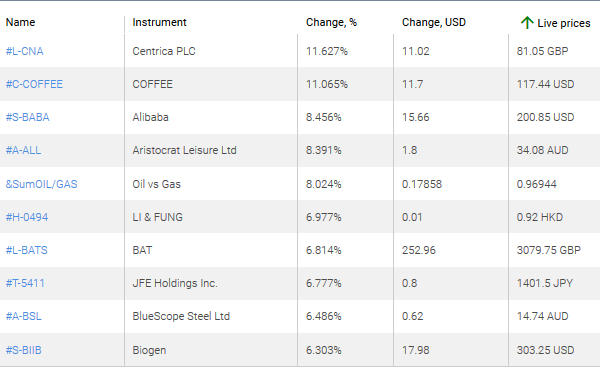
1. Centrica plc is a British supplier of electricity and natural gas to consumers.

2. Coffee CFD on futures contract on Arabica.

market sentiment ratio long short positions

 Top Losers – The World Market

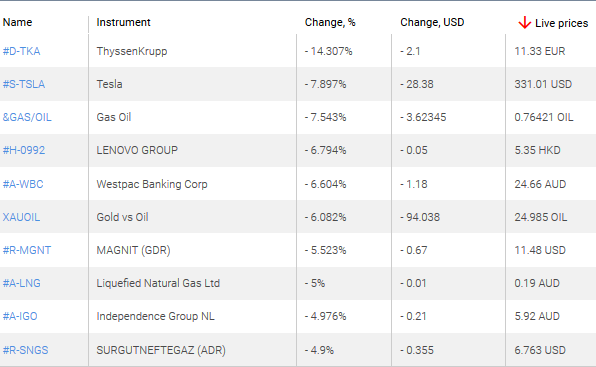
1. ThyssenKrupp AG is a German steel production company.

2. Tesla Motors Inc. is an American manufacturer of electric vehicles and space technology.

market sentiment ratio long short positions

 Top Gainers – Foreign Exchange Market (Forex)

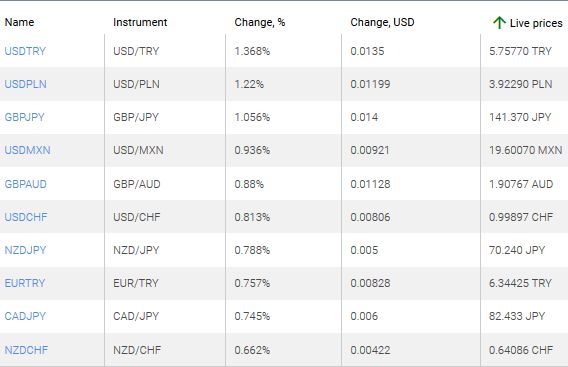
1. USDTRY, USDPLN – an increase in these charts means the strengthening of the US dollar against the Turkish lira and the Polish zloty.

2. GBPJPY, GBPAUD – an increase in these charts indicates the weakening of the Australian dollar and Japanese yen against the British pound.

market sentiment ratio long short positions

 Top Losers – Foreign Exchange Market (Forex)

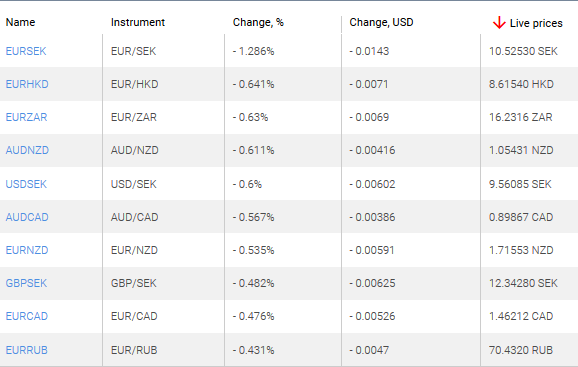
1. USDSEK, EURSEK – a decrease in these charts means the weakening of the US dollar and euro against the Swedish krona.

2. EURHKD, EURZAR – a decrease in these charts indicates the weakening of the euro against the Hong Kong dollar and the South African rand.

market sentiment ratio long short positions

Market Analysis provided by IFCMarkets

Note:
This overview has an informative and tutorial character and is published for free. All the data, included in the overview, are received from public sources, recognized as more or less reliable. Moreover, there is no guarantee that the indicated information is full and precise. Overviews are not updated. The whole information in each overview, including opinion, indicators, charts and anything else, is provided only for familiarization purposes and is not financial advice or а recommendation. The whole text and its any part, as well as the charts cannot be considered as an offer to make a deal with any asset. IFC Markets and its employees under any circumstances are not liable for any action taken by someone else during or after reading the overview.