Axsome Therapeutics Investors Awaken to Positive Outcome in Phase 2 Narcolepsy Trial

By The Life Science Report

Source: Streetwise Reports   12/03/2019

Axsome Therapeutics shares traded 14% higher today after the company reported that its narcolepsy drug candidate AXS-12 achieved its primary endpoint in the Phase 2 CONCERT Study.

This morning before U.S. markets opened, clinical-stage biopharmaceutical company Axsome Therapeutics Inc. (AXSM:NASDAQ), a developer of novel therapies for the management of central nervous system disorders, announced that “AXS-12 (reboxetine) met the prespecified primary endpoint and significantly reduced the number of cataplexy attacks as compared to placebo in patients with narcolepsy in the firm’s CONCERT Phase 2 trial.”

The company stated that in the trial “AXS-12 also significantly reduced excessive daytime sleepiness (EDS), and improved cognitive function, sleep quality and sleep-related symptoms.” Additionally, Axsome reported that AXS-12 was safe and well tolerated and that there were no serious adverse events reported in the trial.

Professor of Neurology at Albert Einstein College of Medicine Dr. Michael J. Thorpy commented, “Narcolepsy is a neurological disorder that interferes with mental and social functioning, increases work and driving related accidents, and results in a nearly two-fold higher mortality rate…Medications that have the potential to reduce cataplexy symptoms, promote wakefulness, and enhance cognitive function, such as AXS-12, if borne out in Phase 3 trials, could provide new treatment options for patients living with this debilitating disorder.”

Herriot Tabuteau, MD, CEO of Axsome, remarked, “We are very pleased with the results of the CONCERT trial, which demonstrated a strong effect of AXS-12 on both cataplexy and excessive daytime sleepiness symptoms, as well as on cognitive function, in narcolepsy patients. The improvement in the ability to concentrate with AXS-12 is especially relevant because the cognitive impairment associated with narcolepsy is one of the most distressing aspects of the disease for patients, as highlighted in the FDA’s The Voice of the Patient report on Narcolepsy…Based on these positive results, Axsome intends to initiate Phase 3 trials of AXS-12 in 2020 with the goal of bringing this differentiated experimental medicine to narcolepsy patients as soon as possible.”

The company’s SVP of Clinical Development and Medical Affairs Cedric O’Gorman, MD, added, “The CONCERT trial exemplifies Axsome’s commitment to accelerating the innovation of effective treatments for difficult-to-treat CNS disorders such as narcolepsy…Existing treatment options for narcolepsy are few, do not address all key symptoms, may not be well tolerated, and are mostly controlled substances. If successfully developed, AXS-12 may overcome these limitations and could make it a candidate as foundational therapy to meaningfully improve the lives of the many narcolepsy patients.”

The company advised that the CONCERT trial was a Phase 2, double-blind, randomized study of AXS-12 in 21 patients diagnosed with narcolepsy. The firm further explained that “narcolepsy afflicts an estimated 185,000 individuals in the U.S. and is a serious and debilitating neurological condition that causes dysregulation of the sleep-wake cycle and is characterized clinically by excessive daytime sleepiness, cataplexy, hypnagogic hallucinations, sleep paralysis, and disrupted nocturnal sleep.”

Axsome notes that “AXS-12 (reboxetine) is a highly selective and potent norepinephrine reuptake inhibitor for the treatment of narcolepsy. AXS-12 modulates noradrenergic activity to promote wakefulness, maintain muscle tone and enhance cognition.”

Axsome Therapeutics, headquartered in New York, is a clinical-stage biopharmaceutical company engaged in the development of novel therapies for the management of central nervous system (CNS) disorders. The firm states that its core CNS product candidate portfolio includes four clinical-stage candidates: AXS-05; AXS-07; AXS-09 and AXS-12. Ongoing studies include a phase 3 trial of AXS-05 in treatment resistant depression, a phase 3 trial in major depressive disorder, and a phase 2/3 trial in agitation associated with Alzheimer’s disease. The company also has two active phase 3 trials of its AXS-07 for the acute treatment of migraine, and a phase 2 trial of AXS-12 in narcolepsy.

Axsome Therapeutics has a market cap of about $1.4 billion with approximately 34.51 million shares outstanding and a short interest of 17.3%. AXSM shares opened today at $45.13 (+$5.51, +13.91%) over yesterday’s $39.62 closing price. The stock has traded between $42.34 to $47.24 per share today and currently is trading at $45.44 (+$5.82, +14.69%).

Sign up for our FREE newsletter at: www.streetwisereports.com/get-news

Disclosure:
1) Stephen Hytha compiled this article for Streetwise Reports LLC and provides services to Streetwise Reports as an independent contractor. He or members of his household own securities of the following companies mentioned in the article: None. He or members of his household are paid by the following companies mentioned in this article: None.
2) The following companies mentioned in this article are billboard sponsors of Streetwise Reports: None. Click here for important disclosures about sponsor fees.
3) Comments and opinions expressed are those of the specific experts and not of Streetwise Reports or its officers. The information provided above is for informational purposes only and is not a recommendation to buy or sell any security.
4) The article does not constitute investment advice. Each reader is encouraged to consult with his or her individual financial professional and any action a reader takes as a result of information presented here is his or her own responsibility. By opening this page, each reader accepts and agrees to Streetwise Reports’ terms of use and full legal disclaimer. This article is not a solicitation for investment. Streetwise Reports does not render general or specific investment advice and the information on Streetwise Reports should not be considered a recommendation to buy or sell any security. Streetwise Reports does not endorse or recommend the business, products, services or securities of any company mentioned on Streetwise Reports.
5) From time to time, Streetwise Reports LLC and its directors, officers, employees or members of their families, as well as persons interviewed for articles and interviews on the site, may have a long or short position in securities mentioned. Directors, officers, employees or members of their immediate families are prohibited from making purchases and/or sales of those securities in the open market or otherwise from the time of the interview or the decision to write an article until three business days after the publication of the interview or article. The foregoing prohibition does not apply to articles that in substance only restate previously published company releases.
6) This article does not constitute medical advice. Officers, employees and contributors to Streetwise Reports are not licensed medical professionals. Readers should always contact their healthcare professionals for medical advice.

( Companies Mentioned: AXSM:NASDAQ,
)

Fund Manager’s Top Performing Precious Metals Companies for 2019

By The Gold Report

Source: Streetwise Reports   12/03/2019

Ralph Aldis, portfolio manager at U.S. Global Investors, in this interview with Streetwise Reports, looks back at trends in 2019 and looks ahead to what we may expect in the precious metals in 2020; he also discusses the top performers in the precious metals fund that he manages.

Streetwise Reports: Ralph, thanks for joining us today. Looking back at 2019, what were some of the trends in precious metals that impressed you?

Ralph Aldis: I think gold’s relentless grind higher has been very impressive despite the dollar maintaining some strength. Obviously, the Federal Reserve has cut rates three times now, and that has been positive. But it hasn’t been a straight line up, of course.

In the third quarter we seem to have a little bit of a broadening out in the precious metals trade. Gold got to the $1,500 level and stalled around there, above it and below it, maybe establishing a new base.

But we did get rotation into silver. I think that was the best performing precious metal for the third quarter, up around 10%. And platinum got some money into it, started catching up and was up for the quarter. But palladium has been extremely hot related to catalytic converters to control auto emissions, and platinum has been left on the sidelines because that’s used more in diesel engines, whose market share has certainly dropped, particularly in Europe.

But that bottoming out of the trade says investors are getting positioned across multiple precious metals assets.

And then at U.S. Global Funds more recently, what we’ve seen that gives us a positive slant is that on some of these days in the past couple of weeks where we’ve had gold getting knocked down, we’ve actually seen some of our biggest inflows coming in. So there is a buy the dip attitude out there on gold price. It’s like people can see what’s coming. They hear the trade talks with China maybe are going to solve things, although I don’t think that’s the case. But this ball that’s rolling at us is getting bigger, and gold and the other precious metals seem to be getting some traction.

And it doesn’t hurt also that countries like Serbia, Poland and Hungary have been buying gold. If you look at people who understand money, central banks are continuing to buy gold. That’s probably going to continue to happen here.

SWR: Your fund, the U.S. Global Investors Gold and Precious Metals Fund (USERX), is up about 43% over the 12-month period ending at the end of October. What stocks were your top performers?

RA: The one that had the most impact was Wesdome Gold Mines Ltd. (WDO:TSX), up around 137% over the past 12 months. The management team at Wesdome, led by CEO Duncan Middlemiss, has done an excellent job in unlocking the potential at its Eagle River operations and the Kiena Complex where the future opportunities await.

Silvercorp Metals Inc. (SVM:TSX; SVM:NYSE) was another one that was a good performer for us. It was up 155%. Silvercorp definitely had a strong bid driving its price higher with silver bullion rallying coming into the fall.

And Centerra Gold Inc. (CG:TSX; CADGF:OTCPK) was up 121%. That actually helped us up quite a bit, too. Management has delivered above average returns on invested capital, and investors have been consummately rewarded.

Positions that were a little bit smaller but still in the Top 10, Top 20 area were K92 Mining Inc. (KNT:TSX.V), which did great. That was up 164%. John Lewins, K92 Mining’s CEO, is a real hands-on leader and very much has been the driver for performance at the operations. John understands capital markets and has the technical skill set to push the value drivers for the company.

We’ve had Alacer Gold Corp. (ASR:TSX; ALACF:OTMKTS; AQG:ASX) in there for the past year. It’s not as big a weighting, but it’s up 207% over the trailing 12 months. Alacer Gold has also been a strong deliverer of consistent returns on invested capital.

We had North American Palladium Ltd. (PDL:TSX; PAL:NYSE), but also added Impala Platinum Holdings Ltd. (IMP:JSE) earlier in the year. I haven’t owned Impala the entire trailing year, but it’s up 275% over that trailing year. In the last six months it’s done pretty good, too.

Silver Lake Resources Ltd. (SLR:ASX) out of Australia is another one that was in there that actually helped us out. It purchased Doray Minerals to get control of the Deflector operations where it has expanded the resources boundaries and added to reserves.

SWR: This is the tax-loss selling season. Are there stocks that have been beaten down that investors should be looking at in the next month?

RA: Chakana Copper Corp. (PERU:TSX.V) has been hammered down much further than I think it should. In my opinion, it should have been named Chakana Copper and Gold because the gold content is just as rich as the copper content. It has something like 2% copper, 2 grams gold in many of the holes that it is drilling in Peru; there are tourmaline breccia pipes there that host the mineralization. But Chakana did attract Gold Fields Ltd. (GFI:NYSE) to invest $8 million into that name recently. So it has money; it’s not going under.

The purpose of this money is to start drilling the 15 or so of these tourmaline breccia pipes on its property. It hasn’t tested all of them to find out where it should be starting. It’s on the side of a big hill, and you could actually drill from there and maybe find the ones that are interesting. Then you could get in there from an adit, from the side of the mountain, and basically cave the ore down through these pipes.

But the first drill holes that Chakana put out on its probe were just done from an engineering standpoint rather than a promotional standpoint. It was just like, hey, this is the one that we drilled first, yes it has some grades that are not the best but now we know this is probably not the one that we want to continue to do a lot more work on. So it is doing a systematic work program on the pipes to try to identify really where is the opportunity.

So Chakana is one stock to consider. I own it. It’s down below where I paid for it, but I’m still sticking with that one because I think because it is exploration focused the Street is ignoring it, but there is some money starting to come.

SWR: Looking ahead, what’s your outlook and forecast into the next year?

RA: We don’t necessarily have a black box model that tells us what the gold price is going to be. So we try to look at the macro, distill it down and try to think about what are the likely scenarios that could play out in front of us.

Obviously, for 2020 we have the U.S. elections coming up, which are very contentious. You can read the news and see all the opinions out there in terms about what’s going on. But I would say though it’s not so much whether a Democrat wins or whether a Republican wins. I mean, there are going to be differences, but I think the key thing that you are still going to see is either party is going to spend money. Right now, what we’re seeing with the U.S. debt issuance and the availability of cash to the overnight repo market, the primary brokers who buy it don’t even have the cash on the books to buy the debt. And that’s where we got out of whack on interest rates and why the Fed has come in with these measures on the repo market to try to stabilize it. In the Republican scenario, we’re issuing debt, and we’re probably going to have the same thing happen if a Democrat takes the White House.

Now, one thing that makes me wonder on this Republican-Democrat divide, and I’m not trying to sidestep here, but in 2016 gold was rallying and when we had the election and Trump won, it seemed like the market said, hey, we’re going to have good stock markets now. People who are rich are just going to get richer because we’re going to make everybody even richer with this market by keeping it going. And then gold slacked off these last three years and has been going kind of sideways. But as we’re getting closer to the elections again, gold seems to be picking up and holding up here, and I’m wondering if that’s just related to whether this race is going to be very tight.

You see lots of stress around the world. You almost wonder if 2020 might be the year of civil unrest. It’s like it’s coming to a city near you because there just really seems to be a lot of tension out there in the world, whether it’s Chile, Iran or Hong Kong. Environmental, social and governance (ESG) concerns are becoming very significant. ESG seems to be at the heart of a lot of these protests. And a lot of political leaders are very nationalistic. So it looks to me like a world that’s going to have a lot more conflict next year than peace. So I think it makes sense again that this precious metals trade probably should be part of your portfolio, whether it’s in stocks or whether it’s in the precious metals themselves. Some part of that should probably be in your fund at this point in time.

Central banks around the world are buying gold. Individual investors are absent from the party. They’re looking at Apple, they’re looking at Google and thinking who knows what, but I don’t think they’re thinking about all the risk properly.

SWR: People thought that with the Republican administration coming in in 2016, government would be more fiscally responsible and instead the debt has gone up.

RA: Yes. It’s really been a wall of debt coming. All of this could be good for precious metals, but I don’t want to see it at the expense of my brothers and sisters.

SWR: Thank you, Ralph, for your insights.

Ralph Aldis, CFA, portfolio manager of U.S. Global Investors, is responsible for analyzing gold and precious metals stocks for the World Precious Minerals Fund (UNWPX) and the Gold and Precious Metals Fund (USERX). In addition, Aldis serves as co-portfolio manager for the Global Resources Fund (PSPFX), Holmes Macro Trends Fund (MEGAX), All American Equity Fund (GBTFX), Emerging Europe Fund (EUROX), Near-Term Tax Free Fund (NEARX), U.S. Government Securities Ultra-Short Bond Fund (UGSDX), the China Region Fund (USCOX), and the U.S. Global Jets ETF (JETS). In 2011, and again in 2015, Aldis was named a U.S. Metals and Mining “TopGun” by Brendan Wood International. In 2016, he and Frank Holmes were named Best Americas-Based Fund Manager by the Mining Journal. Aldis received a master’s degree in energy and mineral resources from the University of Texas at Austin in 1988 and a Bachelor of Science in Geology, cum laude, in 1981, from Stephen F. Austin University. Aldis is a member of the CFA Society of San Antonio.

Sign up for our FREE newsletter at: www.streetwisereports.com/get-news

Disclosure:
1) Patrice Fusillo conducted this interview for Streetwise Reports LLC and provides services to Streetwise Reports as an employee. She owns, or members of her immediate household or family own, shares of the following companies mentioned in this article: None. She is, or members of her immediate household or family are, paid by the following companies mentioned in this article: None.
2) The following companies mentioned in this interview are billboard sponsors of Streetwise Reports: None. Click here for important disclosures about sponsor fees. The information provided above is for informational purposes only and is not a recommendation to buy or sell any security.
3) Ralph Aldis: I, or members of my immediate household or family, own shares of the following companies mentioned in this article: N/A. I, or members of my immediate household or family, are paid by the following companies mentioned in this article: N/A. My company has a financial relationship with the following companies mentioned in this interview: N/A. Funds controlled by U.S. Global Investors hold securities of the following companies mentioned in this article: Wesdome Gold Mines Ltd., Silvercorp Metals Inc., Centerra Gold Inc., K92 Mining Inc., Alacer Gold Corp, North American Palladium, Impala Platinum Holdings, Silver Lake Resources Ltd., Chakana Copper Corp. and Gold Fields Ltd. I determined which companies would be included in this article based on my research and understanding of the sector. I had the opportunity to review the interview for accuracy as of the date of the interview and am responsible for the content of the interview.
4) The interview does not constitute investment advice. Each reader is encouraged to consult with his or her individual financial professional and any action a reader takes as a result of information presented here is his or her own responsibility. By opening this page, each reader accepts and agrees to Streetwise Reports’ terms of use and full legal disclaimer. This article is not a solicitation for investment. Streetwise Reports does not render general or specific investment advice and the information on Streetwise Reports should not be considered a recommendation to buy or sell any security. Streetwise Reports does not endorse or recommend the business, products, services or securities of any company mentioned on Streetwise Reports.
5) From time to time, Streetwise Reports LLC and its directors, officers, employees or members of their families, as well as persons interviewed for articles and interviews on the site, may have a long or short position in securities mentioned. Directors, officers, employees or members of their immediate families are prohibited from making purchases and/or sales of those securities in the open market or otherwise from the time of the interview or the decision to write an article until three business days after the publication of the interview or article. The foregoing prohibition does not apply to articles that in substance only restate previously published company releases.

( Companies Mentioned: ASR:TSX; ALACF:OTMKTS; AQG:ASX,
CG:TSX; CADGF:OTCPK,
PERU:TSX.V,
IMP:JSE,
PDL:TSX; PAL:NYSE,
SLR:ASX,
SVM:TSX; SVM:NYSE,
WDO:TSX,
)

‘Enormous Mineral Potential’ Seen in Montana Mine Site

By The Gold Report

Source: James Kwantes for Streetwise Reports   12/03/2019

A site visit to this company’s project generated optimism in James Kwantes of Resource Opportunities.

Assays are pending for holes drilled this season at Iron Mountain and Camp Zone, two of Group Ten Metals Inc.’s (PGE:TSX.V; PGEZF:OTCQB; 5D32:FSE) most advanced targets at the Stillwater West platinum group element (PGE)-copper-nickel project in south-central Montana. I initiated coverage on Group Ten in the Oct. 9, 2017, newsletter and recently went on a site visit to the company’s 54-square-kilometer Stillwater West property. The visit reinforced the enormous mineral potential and gave me a glimpse of some of the hurdles that will need to be cleared in order to create shareholder value.

I flew into Billings, Montana’s largest city with a population of about 110,000, and it was a one-hour drive to Red Lodge, where I stayed. Red Lodge is the Gateway to Yellowstone Park and nestled against the majestic Beartooth Mountains. With coal mining roots and a tourist flavor, Red Lodge has multiple bars alongside real estate offices, art galleries (with some mining-themed art) and stores selling MAGA gear.

It’s another hour’s drive to Nye (population 300), where Group Ten’s core facility and helicopter landing zone are located. Nye is also on the doorstep of the Stillwater mine complex, which has three producing mines that form the highest-grade major platinum group metals (PGM) deposit in the world. Group Ten inherited a vast amount of historical data on Stillwater West, including some 28,000 meters of drill core. Company geologists have reevaluated about 12,000 meters of that core, and some of that has been submitted for assay, in cases where it was not assayed or assayed for only certain metals.

Group Ten is that rare junior mining company that is on the radar of majors but still under the radar for most retail investors. Majors are interested because Stillwater West truly has the potential to host multiple economic deposits (overuse has rendered “district scale” an almost-meaningless cliché, but it applies here). I believe Stillwater West hosts several bulk-tonnage deposits containing nickel and copper as well as platinum group metals, gold, rhodium and cobalt.

And the company is closer to delineating deposits at Stillwater West than many people expect, because of the historical data and core (Group Ten’s qualified person (QP), Mike Ostensen, was also QP for much of the prior drilling). According to its Oct. 31 news release, the company plans to publish mineral resource estimates at the three most advanced targets on the property: Iron Mountain, Camp Zone and Chrome Mountain.


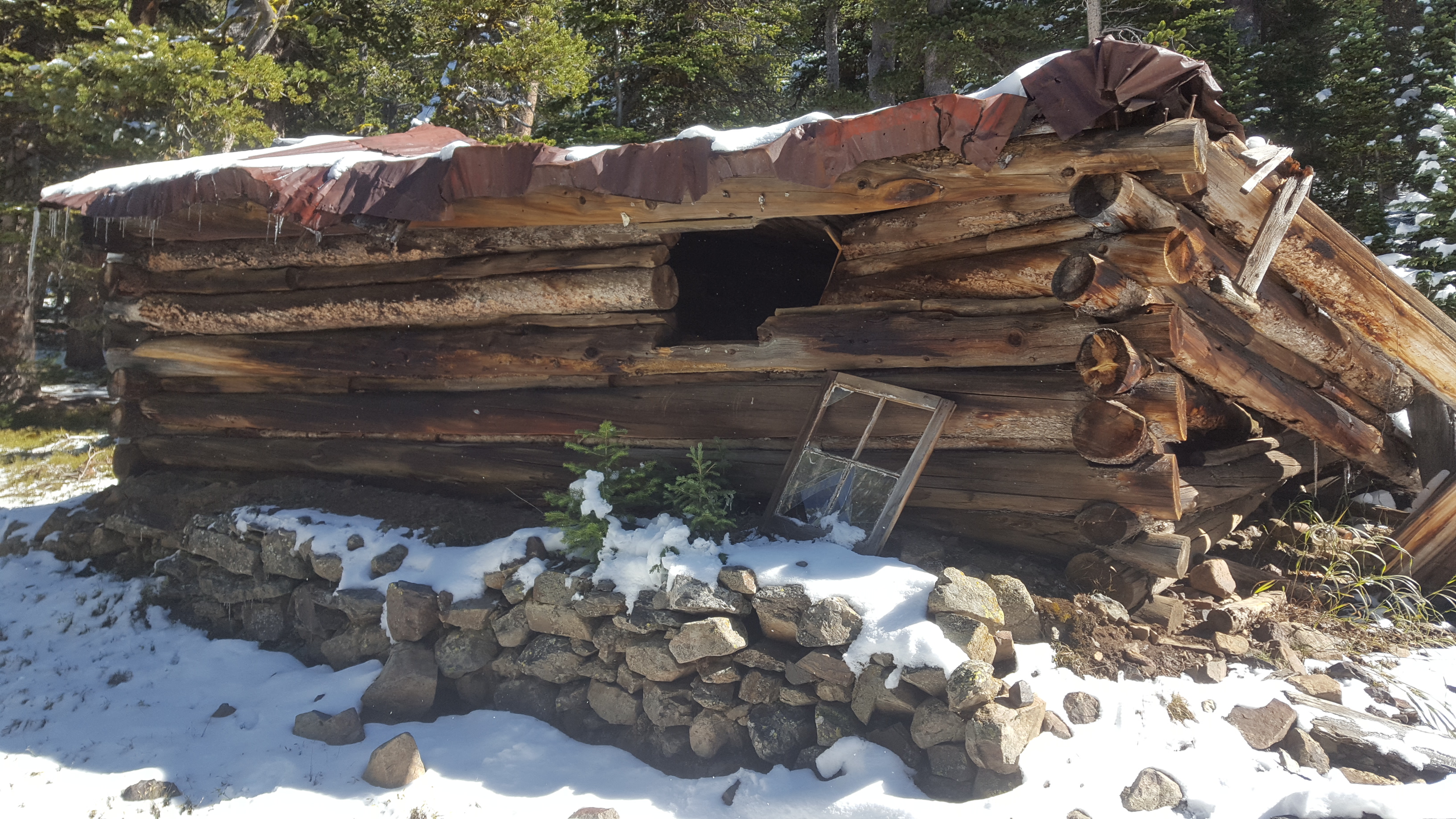
Impression #1: It was quickly apparent that mining is part of this area’s DNA and it’s not just the Stillwater mine complex, a major employer. You can buy miner’s boots (among other more peculiar and charming items) at the general store in Fishtail, which has been open since 1900. Red Lodge was founded on coal; Nye used to be a copper mining camp. A short hike from one of Group Ten’s drill sites was a prospector’s cabin, near an old collapsed adit where the hermit used to hand-mine copper.


Prospector’s cabin: The roof had caved in, but the foundation wasn’t going anywhere.

Group Ten first caught my attention in June 2017, when they acquired the Stillwater West PGE-nickel-copper project adjacent to the Stillwater mine in south-central Montana. A month before, South African miner Sibanye Gold Ltd. (SBGL:NYSE) had spent US$2.2 billion to buy Stillwater, rebranding as Sibanye Stillwater in a major diversification move out of South Africa. Much of the world’s palladium and platinum is mined in South Africa, but Stillwater is the world’s highest-grade PGM mining complex. The deposits host more than 105 million ounces of palladium and platinum (in all categories) at average grades of more than 12 g/t palladium and 3.5 g/t platinum.

The mineralization at Stillwater West is complex: The rocks are up to 2.7 billion years old, with multiple mineralization styles. Metal-rich magma was laid down layer after layer and cooled slowly, creating various deposit types. The closest analog globally is Platreef in South Africa, the rich PGM-copper-nickel deposit that David Broughton played a key role in discovering (Broughton is a Group Ten advisor). And its mineral endowment makes Platreef one of the most valuable pieces of real estate on Earth.

Flying over the Sibanye-Stillwater’s flagship mine (below) in a helicopter provided a good overview of the large operation. There were plenty of vehicles in the parking lot at the mill, which processes ore from three separate underground mines: Stillwater, East Boulder and Blitz. Local considerations are front and center: a separate vast tailings pond located away from the mill site was built behind a bluff, making it all but invisible from the road.


Impression #2: Group Ten’s local knowledge at Stillwater West is a big edge. In addition to consolidating the previously splintered land package, Group Ten employs geologists with combined decades of experience working the project for prior operators. Chief geologist Craig Bow has 40 years of global experience as an economic geologist, including years of work at Stillwater from exploration to a production decision. Both project geologist Mike Ostenson and project geophysicist Justin Modroo (a professional extreme skier) are Montana natives; both men worked in the Stillwater complex for previous operators Premium Exploration Inc. (PEM:TSX.V; PMMEF:OTCQX) and Beartooth Platinum Corp. (BTP:TSX.V). A small example of sensitivity to locals: The helicopter landing zone is a short ATV ride from the core shack, in a rural area where the flight path to the drills will cause the least disruption for residents.

With a helicopter-assisted drill program, Group Ten’s exploration costs are relatively high. (There are trails running to most of the drill locations but they are winding, time-consuming mountain ATV trails.) That makes dilution a major risk factor for Group Ten, but the company does have a few aces up its sleeve—namely, in-the-money warrants that should help boost the treasury, as well as non-core assets in Yukon (Kluane PGE-Ni-Cu) and Ontario (Black Lake-Drayton Au) that CEO Mike Rowley is working to monetize.

There has been merger and acquisition (M&A) action in the PGM sector, especially South African producers expanding outside of that (troubled) country. The latest was Impala Platinum Holdings Ltd.’s (IMP:JSE) $1-billion purchase of North American Palladium and its Lac des Iles PGM mine in Quebec. Majors also continue to be on the lookout for nickel and copper, which Group Ten has in abundance at Stillwater West. I was also intrigued to see Group Ten reference rhodium in its Oct. 31 NR headline and wonder if that’s a sign of good things to come. Rhodium is currently trading at about US$5,000 an ounce and palladium trades at US$1,833 an ounce, up almost 45% this year.

The path to shareholder profits for Group Ten probably involves doing a joint venture (JV) deal with a major mining company prepared to spend the money to turn Stillwater West into a drill-hole pincushion and advance the deposits. That would leave Group Ten with a smaller slice of a very valuable project, which could still be worth many multiples of the current market capitalization. Execution will be key, but Group Ten could be sitting on, if not a gold mine, multiple deposits containing PGMs, nickel, copper and cobalt. Upcoming catalysts include drill results and mineral resource estimates from three of the most advanced Stillwater West mineralized zones.

Price: 0.17
Shares out: 81.1 million (122M f-d)
Market cap: $13.8 million

James Kwantes is the editor of Resource Opportunities, a subscriber supported junior mining investment publication. Kwantes has two decades of journalism experience and was the mining reporter at Vancouver Sun, the city’s paper of record.

Sign up for our FREE newsletter at: www.streetwisereports.com/get-news

James Kwantes Disclosure: This report was published and sent to paid Resource Opportunities subscribers on Nov. 3, 2019. James Kwantes is a Group Ten Metals shareholder and the company covered costs associated with the site visit and for distribution. This report is for informational purposes only and all investors need to do their own research and due diligence.

Streetwise Disclosure:
1) James Kwantes’ disclosures are listed above.
2) The following companies mentioned in this article are billboard sponsors of Streetwise Reports: Group Ten Metals. Click here for important disclosures about sponsor fees. As of the date of this article, an affiliate of Streetwise Reports has a consulting relationship with Group Ten Metals. Please click here for more information. The information provided above is for informational purposes only and is not a recommendation to buy or sell any security.
3) Statements and opinions expressed are the opinions of the author and not of Streetwise Reports or its officers. The author is wholly responsible for the validity of the statements. The author was not paid by Streetwise Reports for this article. Streetwise Reports was not paid by the author to publish or syndicate this article. Streetwise Reports requires contributing authors to disclose any shareholdings in, or economic relationships with, companies that they write about. Streetwise Reports relies upon the authors to accurately provide this information and Streetwise Reports has no means of verifying its accuracy.
4) The article does not constitute investment advice. Each reader is encouraged to consult with his or her individual financial professional and any action a reader takes as a result of information presented here is his or her own responsibility. By opening this page, each reader accepts and agrees to Streetwise Reports’ terms of use and full legal disclaimer. This article is not a solicitation for investment. Streetwise Reports does not render general or specific investment advice and the information on Streetwise Reports should not be considered a recommendation to buy or sell any security. Streetwise Reports does not endorse or recommend the business, products, services or securities of any company mentioned on Streetwise Reports.
5) From time to time, Streetwise Reports LLC and its directors, officers, employees or members of their families, as well as persons interviewed for articles and interviews on the site, may have a long or short position in securities mentioned. Directors, officers, employees or members of their immediate families are prohibited from making purchases and/or sales of those securities in the open market or otherwise from the time of the interview or the decision to write an article until three business days after the publication of the interview or article. The foregoing prohibition does not apply to articles that in substance only restate previously published company releases. As of the date of this interview, officers and/or employees of Streetwise Reports LLC (including members of their household) own securities of Group Ten Metals, a company mentioned in this article.

Resource Opportunities Disclaimer: Readers are advised that this article is solely for information purposes. Readers are encouraged to conduct their own research and due diligence, and/or obtain professional advice. The information is based on sources which the publisher believes to be reliable, but is not guaranteed to be accurate, and does not purport to be a complete statement or summary of the available data.

Photos provided by the author.

( Companies Mentioned: PGE:TSX.V; PGEZF:OTCQB; 5D32:FSE,
)

Namibia maintains rate as economy slows in 2019

By CentralBankNews.info
Namibia’s central bank left its benchmark repo rate unchanged at 6.50 percent, saying domestic economic activity slowed in the first 10 months of the year, inflation remains low but the stock of international reserves continues to be sufficient to support the currency peg with South Africa.
The Bank of Namibia (BON), which cut its rate in August by 25 basis points for the first time since August 2017, added the economic slowdown was mainly reflected in mining, manufacturing, construction, wholesale and retail trade, and agriculture.
“Going forward, the domestic economy is projected to remain weak in 2019,” BON said.
In August the central bank forecast contraction of 1.7 percent this year before returning to growth in 2020. The economy shrank by an estimated 0.1 percent in 2018.
Namibia’s gross domestic product contracted by an annual 2.6 percent in the second quarter of this year, slightly better than a 2.9 percent shrinkage in the first quarter, hit by lower mining and diamond output, while drought has lowered agricultural output.
Amid strong growth in 2010-2015 fueled by rapid credit growth, Namibia’s public debt rose sharply and international reserves fell.
Although the government is now adjusting its fiscal policy, public debt remains on a rising path and banks’ asset quality has deteriorated, according to the International Monetary Fund in September.
Namibia’s economy has been in a slump since the start of 2017, with GDP on an annual basis contracting in the last 9 of 10 quarters. The second quarter of 2018 was the last quarter to show positive annual growth of 0.6.
“A likely slow recovery, the need for further fiscal adjustment to bring public debt to a sustainable path, persistent inequalities and structural impediments to growth, point to a challenging outlook,” IMF said, adding absent structural reforms growth is expected to converge to a long-term level of 3 percent,  which is took low to deliver meaningful improvements in income and reduce unemployment.
The IMF forecast a 0.2 percent decline in GDP this year and then growth of 1.6 percent in 2020.
Growth in private sector credit rose marginally to 6.8 percent in the first 10 months of the year from 6.2 percent in the same 2018 period, mainly due to higher uptake of credit in retail, real estate, financial and other services sectors.
But growth in credit to individuals slowed from last year and in October the annual growth in private sector credit extension was unchanged at 6.4 percent.
Namibia’s inflation rate has been trending lower since 2017 and fell to a 2019-low of 3.0 percent in October, down from 3.3 percent in September, and the recent peak of 5.6 percent in November 2018.
BON projected average inflation of 3.8 percent in 2019, below IMF’s estimate of 4.8 percent.
Namibia’s stock of International reserves was practically unchanged at N$32.5 billion from N$32.3 billion at the previous meeting of its monetary policy committee, enough to cover 4.3 months of imports, a level the central bank said was “sufficient to protect the peg” of the Namibia dollar to the South African rand and meet its international financial obligations.

www.CentralBankNews.info
 

Supply Crunch Coming as Silver Miners Scale Back

By Money Metals News Service

Through the first half of 2019, silver significantly underperformed gold. Put another way, gold gained relative to silver – culminating in the gold:silver ratio registering a 27-year high of 95:1.

That market signal was received by the mining industry. Since there are few primary silver producers, and those that do mine silver also typically mine gold and some base metals, precious metals miners had an incentive to invest more into gold production and less into silver.

Precious metals analyst Adam Hamilton wrote in a recent commentary, “As silver wasted away in recent years, its bombed-out prices heavily impaired silver mines’ ability to generate operating cash flows and profits. The silver miners were forced to adapt and shifted their focus and capital into adding gold production rather than boosting silver output.”

Hamilton notes that the top 17 components of the GlobalX Silver Miners ETF (SIL) produced a total of 72.2 million ounces of silver last quarter, amounting to a 4.4% year over year decline. At the same time, their total gold output increased by 11.9%.

What this suggests is that the silver market is being under-supplied. In fact, the Silver Institute recorded a 2.4% global silver supply shrinkage in 2018.

And things certainly aren’t looking up this year.

Silver’s mining supply problem could be a super-bullish driver of higher prices. Higher prices will eventually incentivize increased production from the mining industry. But it will take much higher prices sustained for some time in order to move the needle of mining production in any significant way.

Silver Mining ETF Sham: These Stocks Are Primarily in Other Metals

As silver miners have become less silver-centric, their stocks can be expected to show less correlation to the silver price. In fact, some stocks that have “silver” in their name derive a large majority of their business outside of the white metal.

Consider Pan American Silver (PAAS), a $3.6 billion company that makes up a 5.4% weighting in the Silver Miners ETF (SIL).

Miner

While Pan American is indeed a producer of silver, its business comes mainly from other metals. According to BMO estimates, only 33% of Pan American Silver’s revenue in 2019 will come from silver production.

SIL’s third-largest holding is Korea Zinc. It is base metals smelter, not a silver miner. It processes some silver, but that particular aspect of its business amounts to just 17% of annual revenue.

Rare is the “silver” company that actually derives most of its revenue from silver. Since silver deposits tend to accumulate around other metals, valuable byproducts will be extracted during the mining process. Most silver is produced as a byproduct of mining for base metals, so primary silver mines are few and far between.

One exception is First Majestic Silver (AG). It is the purest major producer, with 62% of its revenue attributable to its namesake metal.

Of course, you will never find a purer silver play than actual .999 pure silver bullion products.

The further your silver-related investments get from the underlying metal, the more they will be driven by other factors you may not necessarily understand or believe in.

When silver starts becoming a hot commodity again, Wall Street will surely supply a bevy of new “silver” equities and exchange-traded derivative products – most of which will serve to divert casual investors away from investing in silver itself.

Physical Silver Outperforms Corporate Silver

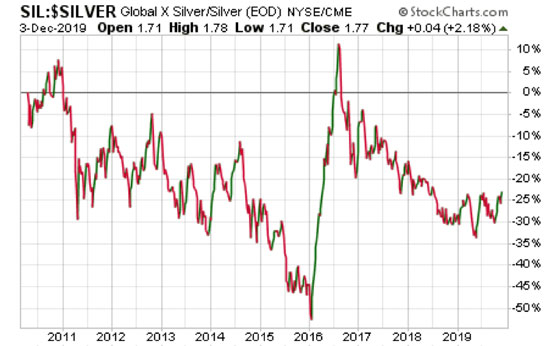
Silver bullion investors have tended to fare better than silver stock investors in recent years. Since its inception in 2010, the Silver Miners ETF has underperformed the silver price by a net 25%. See the chart below…

Silver Global Chart

Despite an impressive spike in 2016, silver equities have languished before and since versus silver itself.

Silver companies – especially those that actually derive the bulk of their business from silver – could certainly see the value of their shares multiplied during the next big precious metals run-up. But investing or speculating in mining companies is inherently riskier the owning the metal itself.

Silver is plenty capable of delivering eye-popping gains far in excess of gold’s when market conditions are favorable for the white metal. Silver’s volatility is more than some investors can stomach – in which case gold may be more suitable in a more conservative portfolio.

Silver, however, currently offers the more compelling supply story – combined with a heavily discounted relative valuation.


The Money Metals News Service provides market news and crisp commentary for investors following the precious metals markets.

Canada holds rate, signs of global growth stabilizing

By CentralBankNews.info

Canada’s central bank left its benchmark target for the overnight rate steady at 1.75 percent, as expected, and said future policy decisions would be based on how the adverse impact of trade conflicts affects the country’s resilient economy, notably consumer spending and housing.

The Bank of Canada (BOC), which has kept its rate steady since October 2018 in contrast to this year’s rapid pace of global monetary policy easing, added its October forecast for the global economy appeared to be intact and sounded a relatively upbeat tone about the outlook.

“There is nascent evidence that the global economy is stabilizing, with growth still expected to edge higher over the next couple of years,” BOC said, adding the ongoing trade conflicts are still weighing on global economic activity and remain the biggest source of risk to the outlook.

In October BOC lowered its forecast for 2019 global economic growth to 2.9 percent from 3.0 percent as trade conflicts, most notably between the U.S. and China, has led to a fall in global trade, with the slowdown most pronounced in business investments and the manufacturing sector.

In response to the global growth slowdown, central banks worldwide have eased their policy and BOC saw growth strengthening modestly in 2021, with a pickup in some emerging market economies more than offsetting slower growth in the United States and China.

Lower investments and commodity prices have hit Canada’s economy and BOC in October also lowered its 2020 forecast for economic growth in Canada for the second time to 1.7 percent from an earlier forecast of 1.9 percent due to the impact on Canadian exports.

But BOC’s forecast for 2019 growth was raised to 1.5 percent from an earlier 1.3 percent and in January it will update its forecast, taking into account fiscal policy following the re-election of Prime Minister Justin Trudeau in October.

Due to a decline in exports, Canada’s economy slowed in the third quarter to 1.3 percent year-on-year from 1.6 percent in the second quarter but BOC said activity was supported by consumer spending, stronger wage growth and housing investment, along with an unexpected increase in investments in transportation and engineering projects.

“The Bank will be assessing the extent to which this points to renewed momentum in investment,” BOC said.
In the third quarter business investment grew 2.6 percent, the fastest pace since the fourth quarter of 2017 while housing investment rose 3.2 percent, the highest since first quarter 2012.

Canada’s inflation rate has been steady at 1.9 percent in the last three months to October and BOC continues to expect inflation to track close to its 2.0 percent target in the next two years.

Canada’s dollar rose 0.6 percent in response to the BOC’s statement to 1.32 to the U.S. dollar to be up 3.0 percent this year.

The Bank of Canada issued the following statement:

“The Bank of Canada today maintained its target for the overnight rate at 1 ¾ percent. The Bank Rate is correspondingly 2 percent and the deposit rate is 1 ½ percent.
The Bank’s October projection for global economic growth appears to be intact. There is nascent evidence that the global economy is stabilizing, with growth still expected to edge higher over the next couple of years. Financial markets have been supported by central bank actions and waning recession concerns, while being buffeted by news on the trade front. Indeed, ongoing trade conflicts and related uncertainty are still weighing on global economic activity, and remain the biggest source of risk to the outlook. In this context, commodity prices and the Canadian dollar have remained relatively stable.
Growth in Canada slowed in the third quarter of 2019 to 1.3 percent, as expected. Consumer spending expanded moderately, underpinned by stronger wage growth. Housing investment was also a source of strength, supported by population growth and low mortgage rates. The Bank continues to monitor the evolution of financial vulnerabilities related to the household sector. As expected, exports contracted, driven by non-energy commodities. However, investment spending unexpectedly showed strong growth, notably in transportation equipment and engineering projects. The Bank will be assessing the extent to which this points to renewed momentum in investment.
CPI inflation in Canada remains at target, and measures of core inflation are around 2 percent, consistent with an economy operating near capacity. Inflation will increase temporarily in the coming months due to year-over-year movements in gasoline prices. The Bank continues to expect inflation to track close to the 2 percent target over the next two years.
Based on developments since October, Governing Council judges it appropriate to maintain the current level of the overnight rate target. Future interest rate decisions will be guided by the Bank’s continuing assessment of the adverse impact of trade conflicts against the sources of resilience in the Canadian economy – notably consumer spending and housing activity. Fiscal policy developments will also figure into the Bank’s updated outlook in January.”


Amazon Repricing: How it works and why your business needs it

Getting ahead of the game as an Amazon seller is quite difficult, but at least Amazon repricing software makes it somewhat easier.

Photo by Henry & Co.

Success on Amazon begins with understanding your competitors. Another one of your competitors includes the same hungry and skilled sellers in the market as you. Sometimes they sell identical products to you, which means that your product visibility and pricing are important to ensure maximum profitability.

Unfortunately, the more products you sell, the more it becomes impossible to keep up with your handiwork. Imagine how tedious it would be to keep up to date with the prices of your competitors, not to mention the need to manually update your prices in response to every change that is tracked.

Pricing software, also known as a “repricer”, is the best way to overcome this otherwise and impossible management of prices.

The repricer allows Amazon sellers to automatically compare and adjust prices for their products with those of competitors, regardless of who they are. Here is more in depth information on what an Amazon repricer actually is.

Some Amazon sellers are still unsure of how the software works in order to reduce risk and drive sales.

Let’s take a quick look at the repricing software, how it works, how long it takes to update the pricing information, and how it fits into the overall your sales process.

What is Automated Repricing Software?

Auto-repricing software is a technology where sellers can program price changes in their own name. To make this software work, sellers should set strategies with specific goals, such as owning a Buy Box or selling multiple units over a period of time.

Once these strategies have been developed, Automated Repricing Software will evaluate market data (such as competitor prices, vendor performance, such as feedback ratings, execution type, etc.) and make appropriate changes to the vendor’s prices.

One of the goals is to maximize the time your offers stay in the Amazon Buy Box. The automatic repricing software will compare market data, including the seller’s figures, with those of competitors and make suitable price changes on your behalf.

If you have goals that go beyond just owning a Buy Box, you can also install other pricing software to help you achieve these goals. For example, if you want to maximize profits, your pricing software may raise prices after you purchase ownership of the Buy Box. If you lose your Buy Box, your software will restart the process by lowering prices again.

How Amazon repricing software works

When you set up your repricer, your ads are automatically filled in by the software through reports provided by Amazon’s Subscriptions API.

The repricer then reviews your products and analyzes offers from all sellers on a particular listing to identify a competitor.

Repricing software usually allows users to narrow down their competition only by competing with:

– specific types of performance

– sellers who have the right to Buy Boxes

– competitors with a seller’s rating above a certain level

– Sellers with specific indicators, such as number of days of processing, not exceeding or below a certain amount.

The copyist will receive updates from Amazon when the competition changes on the listing, and will respond to changes in the price of your products in accordance to your strategy settings.

Any price change always occurs in relation to the minimum price you have provided, ensuring that your products will never be sold at a price lower than the one you prefer.

As an option, you can set the maximum price to ensure that your products will never be more expensive than MSRP. It is well known that Amazon has consequences for users who set excessively high prices, therefore, you should not lose sight of the maximum price setting.

Price updates from Amazon – timing

One of the most important reasons for using software for repricing is its ability to register changes from competition and react almost instantly.

The software reacts as quickly as Amazon allows – usually between 5-15 minutes.

Certain repricers aren’t capable of anything better than hourly adjustments, so it’s worth doing research before you start developing repricing software for your business.

Once you’ve set the parameters for your ads, including specifying minimum and maximum price points, and deciding on specific pricing strategies, you’ll be ready to start pricing, and the software will constantly work to promote your ads in the Buy Box as well as increase sales.

How it works with regards to the selling process

One of the reasons why repricing software is so efficient is because its model is repeated all the time. Even if sellers change the details of their ads, the software catches them and will adjust them in order to keep your ads competitive. Of course, you can keep and remove ads through this process. Repricing software will not include inactive, fixed prices or items that are not in stock.

The Bottom Line on Amazon Repricing Software

The Amazon repricer makes a permanent price war on Amazon easy and manageable.

Your ads remain competitive, without having to constantly spy on competitors and make your price changes manually, saving you from countless hours of work and unnecessary stress.

The software also ensures that more potential buyers will see your ads, putting them at a better place on the listing pages.

Basically you are in a much better position – and perhaps the only viable position – to compete effectively and win a Buy Box.

How Does Amazon Repricing Help Sellers?

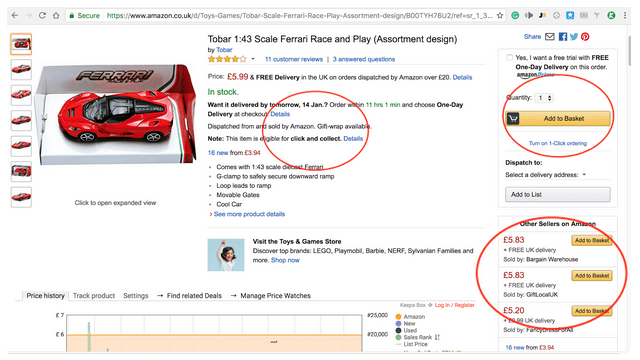
Everything sold on Amazon has its own page in the listing, so if the same product is sold by more than one supplier, several offers will be attached to the ad. One winning bid will take the attention-grabbing “Buy Box”.

Source

All other offers will be visible, but hidden in the section “Other Amazon Sellers”:

The way Amazon decides which seller owns the Box is a secret. However, price competitiveness is one of the key factors that has a significant impact on the situation. Winning a Buy Box is not an easy task for sellers, but the ROI can be huge, because more than 80% of sales on Amazon pass through the Buy Box.

Every day, often every hour, sellers will resell goods in an attempt to obtain (or regain) ownership of the Buy Box. One can try to do this manually, but most use sophisticated software to do it for them.

Is Repricing a Race to the Bottom?

Many sellers fear that repricing strategies will lead to a race to a lower price, also known as the minimum amount for which they are willing to sell. However, with Automated Repricing Software, you can set the minimum and maximum prices for the software that you will be working with when seeking for the best Buy Box price.

Does My Business Need Repricing Software?

Sellers around the world want to know if they should buy repricing software. Does it cost money? Do I need other software?

Yes, it’s true that you can log onto the Amazon system and manually reprice your products.

However, it is worth paying attention to the time and complexity involved in using automated repricing software. Automatic repricers take into account many different factors, and do so accurately and quickly. If you have more important things to do than analyzing and updating ads, you can be helped by software that offers better repricing options.

Conclusion

Success on Amazon begins with understanding your competitors. Part of your competition comes from Amazon itself, who can constantly adjust prices and stay at the top of the listings.

Another one of your competitors comes from similar sellers as you. Sometimes they sell identical products to you, which means that product visibility and pricing are equally important to ensure profitability.

Therefore, as an online business, it has become necessary to use Amazon repricing software.

About the Author:

Dmitrii B. is the founder of GRIN tech – a full-cycle white label agency delivering design, development and marketing solutions.


AUDUSD Analysis: Australia’s GDP miss bearish for AUDUSD

By IFCMarkets

Australia’s GDP miss bearish for AUDUSD

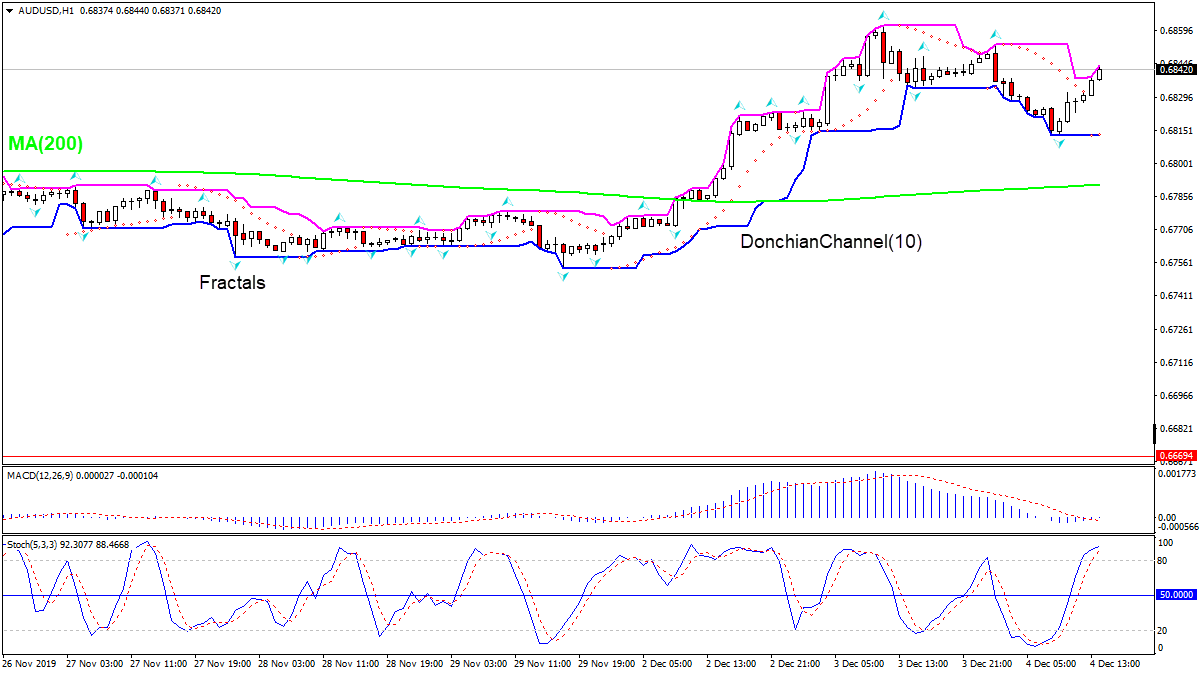
Australia’s Q3 GDP missed the low forecast. Will the AUDUSD decline?

AUDUSD rising above MA(200)

The price chart on 1-hour timeframe shows AUDUSD: H1 is trading sideways. The price is rising above the 200-period moving average MA(200) which is rising. And the Stochastic oscillator is in the overbought zone. There is no trend yet formed, traders have to decide when it would be a best time to enter the market.

Market Analysis provided by IFCMarkets

XAUSnP Analysis: US-China trade negotiations may be delayed until US presidential election

By IFCMarkets

US-China trade negotiations may be delayed until the US presidential election

In this review, we suggest considering the composite gold instrument Gold vs S&P 500 Index. Will the XAUSnP rise? Such a movement is observed when gold prices rise, and the S&P 500 decreases.

Gold is a safe-haven asset and its prices rise in case of an increase in political risks. These risks have increased amid US President Donald Trump’s statement that trade negotiations with China could last until the US presidential election in November 2020. Let us recall that on December 15, a number of duties on imports of Chinese goods to the US may be increased. This will strengthen tensions between the two countries. The other day, Donald Trump increased duties on steel and aluminum from Brazil and Argentina. Meanwhile, gold reserves in the largest SPDR Gold Trust fund have been at a minimum since mid-September of the current year and amount to 889.2 tons. At that time, gold was more expensive – about $1,500 per ounce. Recovery of reserves can positively affect gold prices. The US stock index S&P 500 has fallen by about 2.5% since the beginning of this week. The reaction to Donald Trump’s statement was sharply negative. Besides, the ISM Manufacturing indicator for November, which turned out to be weak, was published on Monday. The U.S. employment report and an important Non-farm Payrolls indicator, which may affect the S&P 500, will be released on Friday.

XAUSnP

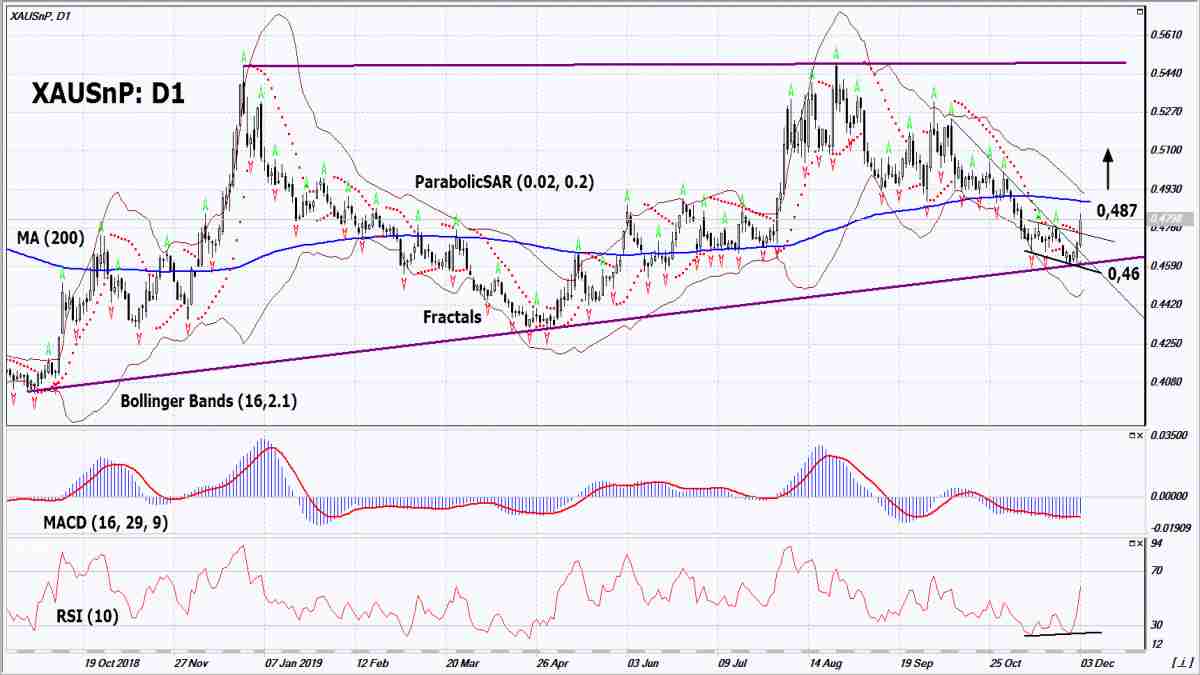
On the daily timeframe, XAUSnP: D1 is correcting up from the lower boundary of the long-term uptrend. It is the lower boundary of a large triangle. A number of technical analysis indicators formed buy signals. The further price increase is possible in case of the transfer of trade negotiations between China and the US and publication of weak corporate data in the US.

  • The Parabolic indicator gives a bullish signal
  • The Bollinger bands have narrowed, which indicates low volatility. The lower Bollinger band is titled upward
  • The RSI indicator is above 50. It has formed a positive divergence.
  • The MACD indicator gives a bullish signal.

The bullish momentum may develop in case XAUSnP exceeds the 200-day moving average line at 0.487. This level may serve as an entry point. The initial stop loss may be placed below the boundary of the triangle, the fractal low and the Parabolic signal at 0.46. After opening the pending order, we shall move the stop to the next fractal low following the Bollinger and Parabolic signals. Thus, we are changing the potential profit/loss to the breakeven point. More risk-averse traders may switch to the 4-hour chart after the trade and place there a stop loss moving it in the direction of the trade. If the price meets the stop level (0.46), without reaching the order (0.487), we recommend closing the position: the market sustains internal changes that were not taken into account.

Summary of technical analysis

PositionBuy
Buy stopAbove 0.487
Stop lossBelow 0.46

Market Analysis provided by IFCMarkets

Japanese Candlesticks Analysis 04.12.2019 (GOLD, NZDUSD)

Article By RoboForex.com

XAUUSD, “Gold vs US Dollar”

As we can see in the H4 chart, the ascending tendency continues. By now, after completing several reversal patterns, including Hammer, close to the support level, XAUUSD has reversed. At the moment, the pair is correcting. After completing this slight pullback, the price may grow towards 1491.50. At the same time, we shouldn’t exclude an opposite scenario, which implies that the instrument may continue falling towards 1455.50.

GOLD
Risk Warning: the result of previous trading operations do not guarantee the same results in the future

NZDUSD, “New Zealand vs. US Dollar”

As we can see in the H4 chart, the ascending channel continues. After forming several reversal patterns, including Harami, near the resistance level, NZDUSD is reversing. Later, the market may start a new decline to reach the support level at 0.6455. At the same time, one shouldn’t exclude an opposite scenario, according to which the instrument may grow towards 0.6555 and break the channel’s upside border.

NZDUSD

Article By RoboForex.com

Attention!
Forecasts presented in this section only reflect the author’s private opinion and should not be considered as guidance for trading. RoboForex LP bears no responsibility for trading results based on trading recommendations described in these analytical reviews.