Avid Bioservices’ Shares Rise on Q2/20 Earnings and Confirmed Outlook

By The Life Science Report

Source: Streetwise Reports   12/10/2019

Shares of Avid Bioservices traded higher today, reaching a new 52-week high, after the firm reported Q2/20 earnings and reaffirmed its revenue guidance for Full-Year 2020.

After the U.S. financial markets closed yesterday, biologics contract development and manufacturing organization Avid Bioservices Inc. (CDMO:NASDAQ), announced financial results for the second quarter of fiscal 2020 ended October 31, 2019.

Avid’s Interim President and CEO Rick Hancock summarized some of the key operational and financial highlights in the quarter commenting, “During the Q2/20, we strengthened multiple core areas of our business…Operationally, we continue to improve and enhance our equipment, facilities and systems. The opening of our new process development lab, the successful completion of our annual maintenance overhaul, and the planned installation of a new pharmaceutical grade water system in calendar 2020 all reflect the dedication we have to maintaining the highest standards possible…The revenues for this quarter were the highest since Avid transitioned to a pure-play CDMO in January 2018, and we achieved 18% gross margin, which represents a significant increase year-over-year…Productivity and efficiency contributed significantly to Avid’s strong second quarter results, and we expect that our financial performance will continue to track positively with these factors. We believe that Avid has turned an important corner, creating a stronger platform from which to achieve sustainable profitability.”

The firm reported that revenue in Q2/20 increased 80% to $18.3 million, compared to $10.2 million in Q2/19, and that H1/20 revenue increased 47% to $33.6 million, compared to $22.8 million in H1/19. The firm advised that the increases in each of these periods were due primarily to an increase in the number of in-process and completed manufacturing runs as a result of growing demand from a more diversified client base.

The company stated that the gross margin for the Q2/20 increased significantly to 18%, up from 3% in Q2/19, and for H1/20 was 13% versus 7% in H1/19. For Q2/20, the company recorded net loss of $1.9 million or $0.03 per share, compared to a net loss of $2.9 million or $0.05 per share in Q2/19.

In addition, Avid confirmed its prior revenue guidance by indicating at that for Full-Year 2020 it expects revenue of $64 million to $67 million.

The firm noted that in the quarter it launched its expanded state-of-the-art process development (PD) facility. The company indicated that the expanded facility allows it to expand existing relationships and attract new business by offering support to customers that seek to outsource their PD work.

Avid Bioservices, formerly Peregrine Pharmaceuticals Inc., is a contract development and manufacturing organization (CDMO) headquartered in Tustin, Calif. The company provides a comprehensive range of process development, high quality CGMP clinical and commercial manufacturing services for the biotechnology and biopharmaceutical industries. The firm’s services include “CGMP clinical and commercial product manufacturing, purification, bulk packaging, stability testing and regulatory strategy, submission and support. The company also provides a variety of process development activities, including cell line development and optimization, cell culture and feed optimization, analytical methods development and product characterization.”

Avid Bioservices started off this morning with a market capitalization of about $329 million with approximately 56.24 million shares outstanding and a short interest of around 3.90%. CDMO shares opened today at $6.30 (+$0.45, +7.69%) over yesterday’s $5.85 closing price. The firm’s stock then reached a new 52-week high price this morning of $7.15/share. The stock has traded between $6.27 to $7.15 per share and is presently trading at $6.98 (+$1.13, +19.32%).

Sign up for our FREE newsletter at: www.streetwisereports.com/get-news

Disclosure:
1) Stephen Hytha compiled this article for Streetwise Reports LLC and provides services to Streetwise Reports as an independent contractor. He or members of his household own securities of the following companies mentioned in the article: None. He or members of his household are paid by the following companies mentioned in this article: None.
2) The following companies mentioned in this article are billboard sponsors of Streetwise Reports: None. Click here for important disclosures about sponsor fees.
3) Comments and opinions expressed are those of the specific experts and not of Streetwise Reports or its officers. The information provided above is for informational purposes only and is not a recommendation to buy or sell any security.
4) The article does not constitute investment advice. Each reader is encouraged to consult with his or her individual financial professional and any action a reader takes as a result of information presented here is his or her own responsibility. By opening this page, each reader accepts and agrees to Streetwise Reports’ terms of use and full legal disclaimer. This article is not a solicitation for investment. Streetwise Reports does not render general or specific investment advice and the information on Streetwise Reports should not be considered a recommendation to buy or sell any security. Streetwise Reports does not endorse or recommend the business, products, services or securities of any company mentioned on Streetwise Reports.
5) From time to time, Streetwise Reports LLC and its directors, officers, employees or members of their families, as well as persons interviewed for articles and interviews on the site, may have a long or short position in securities mentioned. Directors, officers, employees or members of their immediate families are prohibited from making purchases and/or sales of those securities in the open market or otherwise from the time of the interview or the decision to write an article until three business days after the publication of the interview or article. The foregoing prohibition does not apply to articles that in substance only restate previously published company releases.
6) This article does not constitute medical advice. Officers, employees and contributors to Streetwise Reports are not licensed medical professionals. Readers should always contact their healthcare professionals for medical advice.

Georgia hikes rate 4th time, lari strengthens further

By CentralBankNews.info
Georgia’s central bank raised its benchmark refinancing rate by another 50 basis points to 9.0 percent, living up to its pledge from October to continue tightening its monetary policy stance until the pressure from a low exchange rate has receded, helping boost the lari’s exchange rate further.
The National Bank of Georgia (NBG) has now raised its rate by 250 basis points since September after two hikes that month and another hike in October and today.
These rate increases came after two rate cuts in January and March of a total of 50 points so the net increase in the central bank’s benchmark rate this year is 200 points.
Georgia’s inflation rate inched higher to a new 2019-high of 7.0 percent in November from 6.9 percent in October but NBG said it expects inflation to start declining from March next year and approach its target of 3.0 percent by the end of 2020.
“Along with one-off factors, the inflation overshooting was caused by the nominal exchange rate depreciation,” the central bank said, adding it had started to tighten policy in September to neutralize inflationary pressure from the depreciation.
“During the appreciation observed during the last few days, the GEL nominal effective exchange rate remains undervalued, pinning inflation exceptions above the target level,” NBG said, adding future policy decisions will depend on the speed of neutralization of inflationary pressures stemming from the exchange rate depreciation.
The central bank’s rate hikes have helped turn around the lari’s trend after it fell steadily through September. It then stabilized and has been rising since hitting a 2019 low of 2.98 to the U.S. dollar on Nov. 20.
Today the lari rose further and was trading at 2.87 to the dollar, up 3.8 percent since Nov. 20 but still down 6.6 percent since the start of the year.

The National Bank of Georgia issued the following statement:

“The Monetary Policy Committee (MPC) of the National Bank of Georgia (NBG) met on December 11, 2019, and decided to raise the refinancing rate by 0.5 percentage points to 9.0 percent.

In November, the annual inflation rate stood at 7.0 percent. Along with one-off factors, the inflation overshooting was caused by the nominal exchange rate depreciation. From September, the NBG started to tighten monetary policy aiming at neutralizing inflationary pressures stemming from the exchange rate depreciation. Despite the appreciation observed during the last few days, the GEL nominal effective exchange rate remains undervalued, pinning inflation expectations above the target level. As it was stated in previous decisions of the Committee, in order to maintain inflation close to the target level in the medium term, the policy tightening would continue until the pressure from exchange rate is receded. Therefore, the MPC increased the refinancing rate by 0.5 percentage points.
According to the forecast, other things equal the inflation will start declining from March 2020 and approach the target by the end of the year. The future decisions of the Committee will depend upon the speed of neutralization of inflationary pressure stemming from the exchange rate depreciation.
Moderate growth rate of export and money transfers is retained. After the decline in the previous months, tourism revenues increased in October and November in annual terms. Moreover, the FDI inflows grew as well in the third quarter. Against described external developments and robust credit growth,  the preliminary estimates indicate high economic activity.
The NBG will continue to monitor the developments in the economy and financial markets and will use all means and instruments at its disposal to ensure price stability.
The next meeting of the Monetary Policy Committee is scheduled on January 29, 2020. “

    www.CentralBankNews.info


Silver: the HARD Look

By The Gold Report

Source: Michael Ballanger for Streetwise Reports   12/10/2019

Precious metals expert Michael Ballanger takes a look at the factors behind silver’s recent price decline.

In this week’s commentary, I am going to respond to the rash of end-of-the-world emails and terror-stricken texts that bombarded me after the BLS reported a better-than-expected Non-Farm Payrolls number Friday that sent stocks screaming higher and the precious metals into a nosedive. I must confess that to the extent that the jobs number can be trusted (hint: it can’t), it nevertheless sent the algobots into apoplectic response mode with the worst-hit of the markets residing with my beloved silver.

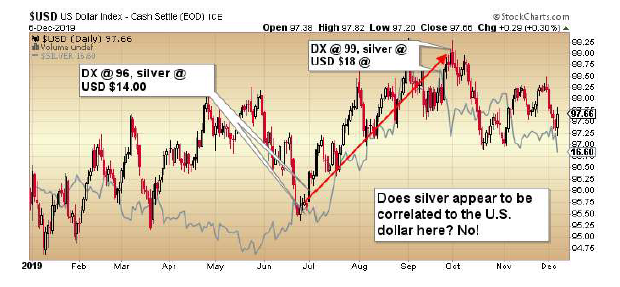
The CNBC bobbleheads blamed the spike in the U.S. dollar as the culprit but one glance at the chart below disputes that brilliant “theory” without argument. Silver rallied from $14 in July with the dollar index at 96.00 to over $18 with the dollar index over 99.00, so take the “strong dollar” rationale and bung it into the waste bin.

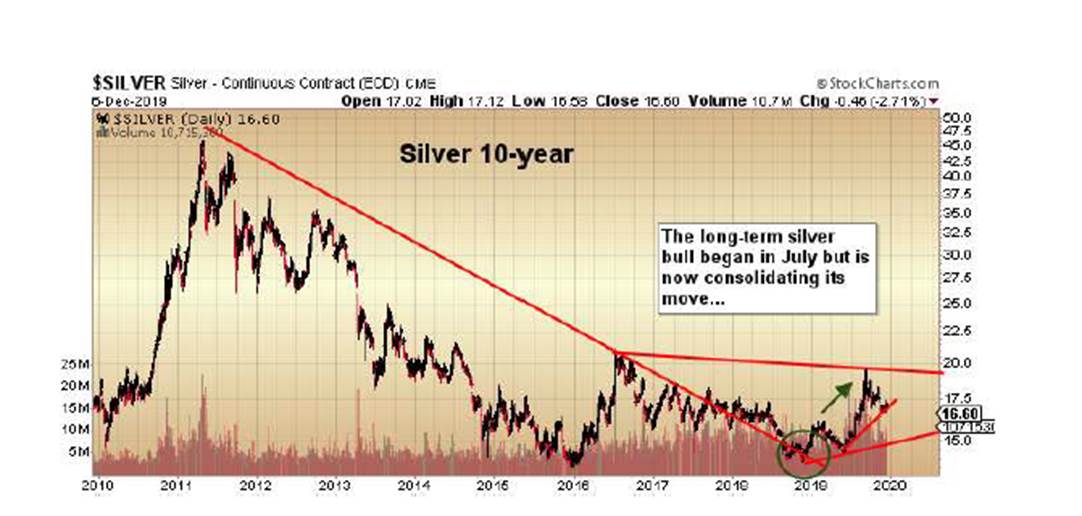
The reaction to the number was sharp and swift and more of a classic response by money managers betting on a repeat of last year’s debacle all sitting with far too many hedges (like gold and silver) and far too few momo stocks. The 337-point vault in the Dow Jones further highlighted just how alpha-starved these poor chaps are, so over the starboard bow went gold and silver and the VIX and tens of thousands of underwater put options, all the result of bearish capitulation. Nevertheless, my long- term picture for silver remains bullishly intact but certainly not yet prepared to resume the assault on $20 that culminated on September 4 as the Millennial Latecomers did their best to replicate the FOMO mentality so prevalent in the crypto stocks in 2017 and the weed deals in 2018. Silver broke out above the 10-year downtrend line back in July and despite the current corrective phase coming down off the US$19.75/oz. late summer peak, the long-term trend is still positive, albeit nerve-wracking beyond words.

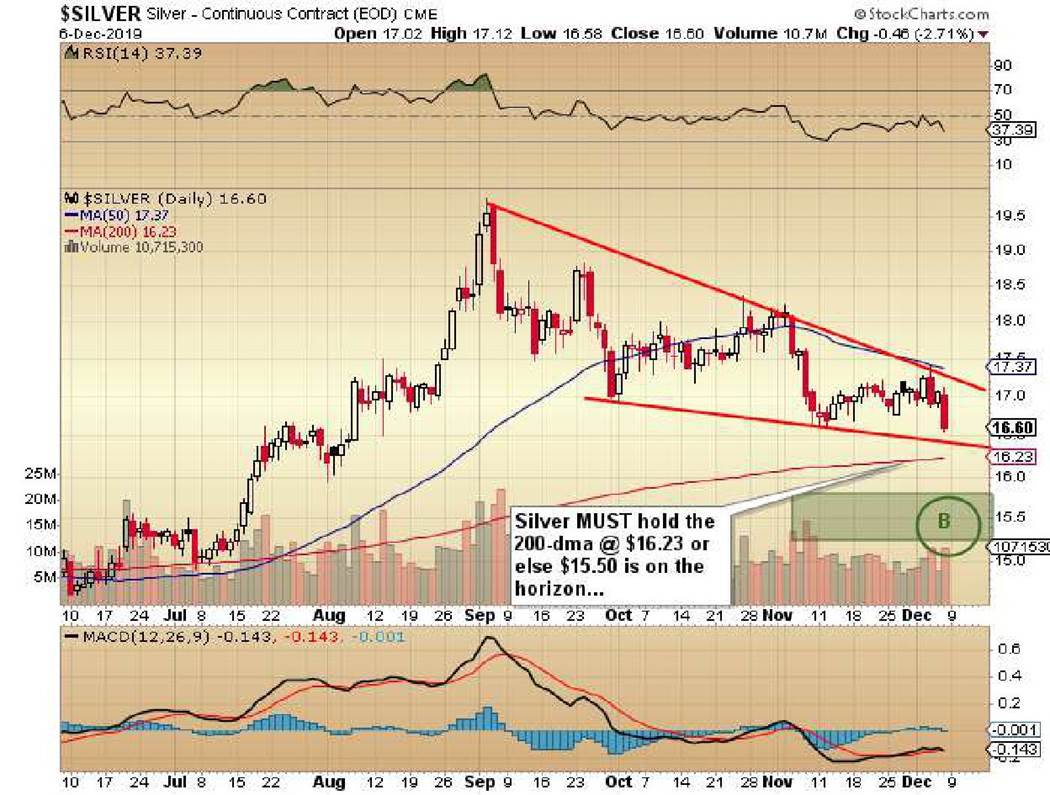
Now, the short-term trend is another matter as it looks to me that we are still locked in that pennant formation I wrote about in very early November. In fact, we came very close to breaking below the 50-dma back then but quickly turned and rallied back to the top of the channel just under $18. If by some ungodly act of Divine Intervention, those two big red candles from Wednesday and Friday turn out to be the retest of the bottom of the channel, then $16.30 followed by the 200-dma at $16.23 are “lines-in-the-sand” of technical support. If they BOTH buckle, then September 4 was THE top and it’s bombs away until $15. My prediction calls for a recovery rally from here this week but no major upside until the new year.

As a matter of housekeeping, I was stopped out of the March futures contracts at $16.70 after the jobs report shenanigans took hold, taking a relatively small $0.35/ounce haircut on the “punt” from last weekend. I am holding on to the SLV Jan $16 calls, which are under water but due to their relatively small exposure to the trading account P&L, I will continue to hold on, relying heavily on Haitian chicken bones and Irish cloverleafs for tailwind support.

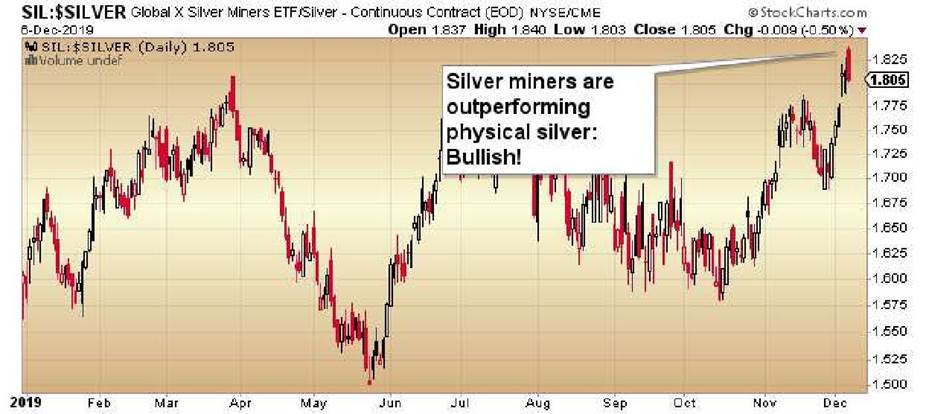
In reality, the near-term silver market is fighting through an acute bout of indigestion, having swallowed every morsel of food in its path in that May-to-September moonshot from US$14.56 to US$19.75. Now, the term “indigestion” is a loosely crafted excuse for “interference” and “intervention” because the action leading up to the advance last spring was abnormal, as if a large anvil were placed on its shoulders during each and every trading session. It appears that this “abnormality” has returned, which has pressured the gold-to-silver-ratio (GSR) to over 88 last week and in order to have confidence in the entire precious metals family of futures, options, leveraged and unleveraged ETFs, and senior and junior mining shares, I need the miners outperforming the metals (which they are) and silver outperforming gold (which it is not).

The above chart comparing the relative performances of physical silver to the silver miners is significant. Years ago, I learned that the most impactive signal for confirming the strength or weakness in the gold market was the action in gold mining shares. By example, if a short-term upward probe in spot gold to a new reaction high was confirmed by an accompanying new high in the gold miners’ index, the HUI, then it was to be seen as a “confirmation.” In contrast, a new reaction low in spot gold not accompanied by a similar low in the miners was to be seen as a “non-confirmation,” suggesting that the very near-term trend was coming to an end. Now, a short-term downtrend in the spot price accompanied by an UPTREND in the miners was to be seen as a “screaming, pound-the-table BUY.” Look carefully at the chart posted above; the silver miners ETF (SIL:US) is making year-to-date highs while spot silver probes the lower edge of the pennant. While this might be seen as “aberrative behavior” demanding that I consume copious quantities of muscle relaxants and hallucinogens washed down with bourbon, the probabilities favor a simple and quite BULLISH non-confirmation of recent silver price weakness (and no need for medicinal relief).

The conclusion is that silver remains locked within in the downtrend of the current and very bullish pennant formation. The correct set-up from a trading stance is to continue to buy any and all dips BUT if you are attempting to use leverage by way of options or futures or leveraged ETFs (USLV:US), you absolutely MUST use stop-losses (on futures) and leveraged ETFs while buying only options with a six-month fuse (or longer).

Lastly, because I titled this missive with the descriptive “the Hard Look,” let’s really bear down and look deeply into the mirror and ask, “What would force me to change my outlook from bullish to bearish?” Repeating my earlier comments: If we take out US$16.30 (the lower edge of the pennant) and then the 200-dma at US$16.23, and if price cannot reclaim those levels within seventy-two hours, I would take corrective action and reduce exposure. I would also probably launch my quote monitor OUT of the ninth-floor window in the immediate vicinity of anyone vaguely resembling a bullion bank trader (which would include shaved heads, designer spectacles, bulbous noses and liver spots).

While I remain convinced that a global reset is on the 2020 horizon collateralizing debt by re-pricing gold, we all need to view these markets with appropriate degrees of apprehension, objectivity and mistrust. The most dangerous of all creatures is one that is both trapped and wounded and that perfectly describes this insidious global alliance of politician and banker. As investors we take on the role of “matador” while the bull is the politico-financial cartel. A famous quote by Tara Brach best describes the challenge we face day after day in the 2019 version of “managed markets”:

“When he (the bull) finds his querencia (safe place), he gathers his strength and loses his fear. From the matador’s perspective, at this point the bull is truly dangerous, for he has tapped into his power.”

Herein lies the key to survival in not just silver but all markets: the wounds inflicted by outrageous money-printing and debt creation around the world are verging on near- fatal to the current financial system. Knowing that, they will stop at nothing in order to preserve the corrupt integrity of the status quo. As investors, we have to recognize that rules that held true in prior regimes have minimal impact today so our trading strategies must carry capital preservation as the primary objective. Failure to accept this as the reality of the day will invite an inhospitable outcome.

Ergo, trade accordingly.

Originally trained during the inflationary 1970s, Michael Ballanger is a graduate of Saint Louis University where he earned a Bachelor of Science in finance and a Bachelor of Art in marketing before completing post-graduate work at the Wharton School of Finance. With more than 30 years of experience as a junior mining and exploration specialist, as well as a solid background in corporate finance, Ballanger’s adherence to the concept of “Hard Assets” allows him to focus the practice on selecting opportunities in the global resource sector with emphasis on the precious metals exploration and development sector. Ballanger takes great pleasure in visiting mineral properties around the globe in the never-ending hunt for early-stage opportunities.

Sign up for our FREE newsletter at: www.streetwisereports.com/get-news

Disclosure:
1) Statements and opinions expressed are the opinions of Michael Ballanger and not of Streetwise Reports or its officers. Michael Ballanger is wholly responsible for the validity of the statements. Streetwise Reports was not involved in any aspect of the article preparation. Michael Ballanger was not paid by Streetwise Reports LLC for this article. Streetwise Reports was not paid by the author to publish or syndicate this article.
2) This article does not constitute investment advice. Each reader is encouraged to consult with his or her individual financial professional and any action a reader takes as a result of information presented here is his or her own responsibility. By opening this page, each reader accepts and agrees to Streetwise Reports’ terms of use and full legal disclaimer. This article is not a solicitation for investment. Streetwise Reports does not render general or specific investment advice and the information on Streetwise Reports should not be considered a recommendation to buy or sell any security. Streetwise Reports does not endorse or recommend the business, products, services or securities of any company mentioned on Streetwise Reports.
3) From time to time, Streetwise Reports LLC and its directors, officers, employees or members of their families, as well as persons interviewed for articles and interviews on the site, may have a long or short position in securities mentioned. Directors, officers, employees or members of their immediate families are prohibited from making purchases and/or sales of those securities in the open market or otherwise from the time of the interview or the decision to write an article until three business days after the publication of the interview or article. The foregoing prohibition does not apply to articles that in substance only restate previously published company releases.

Charts provided by the author.

Michael Ballanger Disclaimer:
This letter makes no guarantee or warranty on the accuracy or completeness of the data provided. Nothing contained herein is intended or shall be deemed to be investment advice, implied or otherwise. This letter represents my views and replicates trades that I am making but nothing more than that. Always consult your registered advisor to assist you with your investments. I accept no liability for any loss arising from the use of the data contained on this letter. Options and junior mining stocks contain a high level of risk that may result in the loss of part or all invested capital and therefore are suitable for experienced and professional investors and traders only. One should be familiar with the risks involved in junior mining and options trading and we recommend consulting a financial adviser if you feel you do not understand the risks involved.

Moldova slashes rate 200 bps as inflation seen declining

By CentralBankNews.info
Moldova’s central bank slashed its base rate by 200 basis points to 5.50 percent, noting the bank’s governor, Octavian Armasu, in the latest inflation report had said monetary policy would have to be relaxed as inflation is expected to decline next year.
It is the first rate cut by the National Bank of Moldova (BNM) since it raised its rate in June and July by a total of 100 basis points to lower inflationary pressures from rising aggregate demand.
NBM added the rate cut was aimed at keeping inflation within the bank’s target range of 5.0 percent, plus/minus 1.5 percentage points, the optimal rate to develop the national economy.
Moldova’s inflation rate has accelerated steadily this year from a combination of high demand from higher wages, pensions and consumer credit in the first half of 2019.
In November inflation rose to 7.1 percent from 6.8 percent in October and 2.2 percent in January.

     A fall in the leu during first half of the year also boosted import prices but the two rate hikes helped changed the trend and since mid-June the leu has risen.

The leu rose further today to trade at 17.3 to the U.S. dollar, up 5.2 percent since mid-June to be largely unchanged since the start of the year.
In its November inflation report, the central bank forecast inflation would hit a maximum of 8.0 percent in the fourth quarter of this year and then decline continuously until the end of 2020 before stabilizing near its inflation target by the end of its forecast horizon.
In the report it also said aggregate demand will remain pro-inflationary during this year and then become disinflationary starting in the first quarter of 2020 while real monetary conditions will remain restrictive during the entire forecast period.
“Under the disinflationary conditions of 2020, the NBM decision will support the competitiveness of the economy and stimulate lending activity,” the central bank said.
In addition to lowering the base rate, BNM also cut the interest rate on loans and overnight deposits to 8.5 percent from 10.5 percent and to 2.5 percent from 4.5 percent, respectively.
To encourage financial intermediation in the lei and discourage intermediation in foreign currencies, the central bank lowered the compulsory reserves in in lei and non-convertible currencies while it raised the ratio for freely convertible currencies.
The gross domestic product of Moldova, between Ukraine and Romania, rose by an annual 5.8 percent in the second quarter of this year, despite political instability, and the World Bank has projected growth of 3.6 percent in 2020 and 38 percent in 2021 as growth in the country’s trading partners strengthens.
Last month Moldova’s new prime minister raised the possibility of a pause in cooperation with the International Monetary Fund after the ex-Soviet republic said it was negotiating a $500 million loan with Russia.
This indicated a possible pivot back toward Russia by the former-Soviet republic after the previous pro-Western government suffered a no-confidence vote five months after taking over.
Moldova has received $157 million out of a 3-year  $183 million IMF program that expires in 2020, according to Reuters.

www.CentralBankNews.info


What To Expect From The SNB & ECB Rate Decisions

By Orbex

The Fed’s interest rate decision later today is only the first of several such meetings from major central banks.

Both the SNB and ECB are projected to keep rates on hold tomorrow. However, we expect them to get extra attention for different reasons. And all this while we wait for the fallout from the UK General Election!

The ECB is probably what most people are going to be looking at since this is the first meeting for the new President Christine Lagarde.

We’ll be especially interested because she’s been notoriously tight-lipped about her views on policy since taking the top job on November 1st. In all of her public speeches to date, she has managed to steer the conversation elsewhere.

But now, Lagarde will have to give her views on the monetary situation in Europe. Naturally, we expect this to generate a lot of buzz among traders and analysts!

The question on everyone’s mind is: how will her position change in comparison to her predecessor? And therefore, how much do we adjust our outlook for the ECB?

Now What?

The consensus among economists is that under the new leadership, the ECB won’t be cutting rates for the foreseeable future.

The question now is how long the rates will remain before returning to a growth cycle. There are some questions that we can expect reporters to ask during the press conference following the rate decision.

  1. Views on the September growth package?
    This is likely to be a proxy to judge whether Lagarde is in favor of more easing.
  2. Will there be a change in how policy decisions are made?
    Current policy is focused on boosting inflation, but will there be other indicators she’s interested in?
  3. What about increasing government spending?
    Germany’s stubborn refusal to open its wallet remains a contentious issue. And with the ECB supplying liquidity, it would certainly be an issue for the central bank.

All Is Not So Good in Switzerland

There is a very strong consensus among economists that Chairman Jordan will announce that the SNB has decided to keep its monetary policy steady.

We also expect him to reiterate that he sees the franc as highly valued. So sure of the outlook for the SNB are analysts, that none are actually predicting a change in policy for at least the next year!

However, banks in Switzerland are increasingly unhappy with the persistent negative rates that have been in place for five years at this point.

They undermine Switzerland’s prized banking system and affect pensions. However, the persistently strong franc given economic uncertainty has been the main argument the bank has made to keep policy where it is.

Continuing Intervention

Of those analysts inclined to suggest where things might go after a year from now, some even predict a further negative move. This means that the markets are likely to be very attentive to Jordan’s press conference after the rate decision, looking for any clues on what to expect over the next couple of months.

The SNB has reacted to the strong franc with currency intervention. This seems to be the preferred tool to avoid riling up the bankers even more with a rate cut.

We’d want to know if the SNB expects further appreciation of the franc. This would imply more intervention and potentially a rate cut. The best clues for that will be during the press conference immediately after the policy decision.

And we could expect some market volatility depending on how traders parse Jordan’s responses!

By Orbex


ArQule Shares Double on Proposed $2.7 Billion Tender Offer from Merck

By The Life Science Report

Source: Streetwise Reports   12/09/2019

ArQule Inc. shares traded more than 100% higher today after the company entered into definitive agreement to be acquired by a Merck subsidiary company for $20 per share. The deal is valued at $2.7 billion and is expected to close in the early part of Q1/20.

This morning, biopharmaceutical company ArQule Inc. (ARQL:NASDAQ), which is engaged in the research and development of therapeutics to treat cancers and rare diseases, and Merck & Co. Inc. (MRK:NYSE) announced that the companies have entered into a definitive agreement under which Merck will acquire ArQule through a subsidiary company for $20 per share in cash for an approximate total equity value of $2.7 billion. Merck believes that the purchase will serve to further diversify its oncology pipeline with expansion into targeted therapies that treat hematological malignancies.

ArQule is focused on kinase inhibitor discovery and development for the treatment of patients with cancer and other diseases. The firm indicated that “its lead investigational candidate, ARQ 531, is a novel, oral Bruton’s tyrosine kinase (BTK) inhibitor currently in a Phase 2 dose expansion study for the treatment of B-cell malignancies.”

Under the terms of the acquisition agreement, Merck will initiate a tender offer through a subsidiary to acquire all outstanding shares of ArQule. The tender offer, which has not yet commenced, will be subject to certain conditions including the tender of shares representing at least a majority of the total number of ArQule’s outstanding shares along with other customary and regulatory requirements. The transaction is expected to close in Q1/20.

ArQule’s CEO Paolo Pucci commented, “We are proud that Merck has recognized the contributions that ArQule, together with its scientific collaborators, has made to the field of precision medicine in oncology with ARQ 531 for the treatment of B-cell malignancies and with the rest of our clinical-stage pipeline…With this agreement, ArQule’s pipeline will benefit from Merck’s vast capabilities and determined engagement to benefit the patients who we have always strived to serve.”

Dr. Roger M. Perlmutter, president of Merck Research Laboratories, remarked, “ArQule’s focus on precision medicine has yielded multiple clinical-stage oral kinase inhibitors that have novel and important properties…This acquisition strengthens Merck’s pipeline with the addition of these strategic assets including, most notably, ARQ 531, a compelling candidate for the treatment of B-cell malignancies.”

In a separate release today, ArQule announced final results from the phase 1 study for ARQ 531 at the American Society of Hematology 2019 Annual Meeting & Expo in Orlando, Fla. The firm explained that “ARQ 531 is an orally bioavailable, potent and reversible dual inhibitor of both wild type and C481S-mutant Bruton’s tyrosine kinase (BTK) in patients with relapsed or refractory hematologic malignancies.”

Dr. Brian Schwartz, the company’s chief medical officer, commented, “The final phase 1 data set confirms the potential utility of ARQ 531 for the treatment of these heavily pretreated CLL patients. We were excited to observe such deep and durable responses at a well-tolerated dose in this highly refractory population…In addition, the three responses we observed in Richter’s Transformation patients were a welcome outcome and allowed several patients to transition to potentially curative therapies.”

Principal investigator of the study, Dr. Jennifer Woyach, associate professor of medicine at The Ohio State University, added, “ARQ 531 was selected and extensively tested preclinically to address the emerging therapeutic needs of patients who have become resistant to covalent BTK inhibitors in a broad set of hematologic malignancies…It is tremendously gratifying to witness the emergence of a potential therapeutic for patients with such a high degree of unmet need, such as C481S-mutant CLL and Richter’s Transformation, and beyond. The data presented in this poster provide compelling proof-of-concept for this novel class of reversible BTK inhibitors.”

ArQule is a biopharmaceutical company headquartered in Burlington, Mass., engaged in the research and development of targeted therapeutics to treat cancers and rare diseases. The company states that its mission is “to discover, develop and commercialize novel small molecule drugs in areas of high unmet need that will dramatically extend and improve the lives of our patients.” The firm’s clinical-stage pipeline consists of four drug candidates, which the company indicates are all in targeted, biomarker-defined patient populations.

Merck is a global healthcare company based in Kenilworth, New Jersey. The firm has market cap of more than $225 billion and has customers and operations in more than 140 countries. The company states that it is committed to bringing new hope to people with cancer and that it is driven to support accessibility to its cancer medicines. The firm focuses on providing vaccines and medicines that treat cancer, cardio-metabolic diseases, emerging animal diseases, Alzheimer’s disease and infectious diseases including HIV and Ebola.

ArQule Inc. started the day with a market capitalization of about $1.2 billion with approximately 120.7 million shares outstanding, and a short interest of around 16.8% . The stock set a new 52-week price this morning of $19.72. ARQL shares opened today at $19.62 (+$9.955, +103.00%) over Friday’s $9.665 closing price. The stock has traded today between $19.58 and $19.72/share and is currently trading at $19.70 (+$10.04, +103.78%).

Sign up for our FREE newsletter at: www.streetwisereports.com/get-news

Disclosure:
1) Stephen Hytha compiled this article for Streetwise Reports LLC and provides services to Streetwise Reports as an independent contractor. He or members of his household own securities of the following companies mentioned in the article: None. He or members of his household are paid by the following companies mentioned in this article: None.
2) The following companies mentioned in this article are billboard sponsors of Streetwise Reports: None. Click here for important disclosures about sponsor fees.
3) Comments and opinions expressed are those of the specific experts and not of Streetwise Reports or its officers. The information provided above is for informational purposes only and is not a recommendation to buy or sell any security.
4) The article does not constitute investment advice. Each reader is encouraged to consult with his or her individual financial professional and any action a reader takes as a result of information presented here is his or her own responsibility. By opening this page, each reader accepts and agrees to Streetwise Reports’ terms of use and full legal disclaimer. This article is not a solicitation for investment. Streetwise Reports does not render general or specific investment advice and the information on Streetwise Reports should not be considered a recommendation to buy or sell any security. Streetwise Reports does not endorse or recommend the business, products, services or securities of any company mentioned on Streetwise Reports.
5) From time to time, Streetwise Reports LLC and its directors, officers, employees or members of their families, as well as persons interviewed for articles and interviews on the site, may have a long or short position in securities mentioned. Directors, officers, employees or members of their immediate families are prohibited from making purchases and/or sales of those securities in the open market or otherwise from the time of the interview or the decision to write an article until three business days after the publication of the interview or article. The foregoing prohibition does not apply to articles that in substance only restate previously published company releases.
6) This article does not constitute medical advice. Officers, employees and contributors to Streetwise Reports are not licensed medical professionals. Readers should always contact their healthcare professionals for medical advice.

( Companies Mentioned: ARQL:NASDAQ,
)

US To Postpone Fresh China Tariffs?

By Orbex

The rollercoaster ride of the US-China trade negotiations took another turn yesterday. US equities jumped on news that the US is planning to delay the next round of tariffs.

The US was planning to activate a fresh round of 15% tariffs on $156 billion worth of Chinese goods if no deal is signed by December 15th.

Despite reports saying that talks remained in good health over recent weeks, the market was growing fearful that a deal would not be completed in time. With the prospect of fresh US tariffs also came the fear that China would retaliate. This would likely result in a breakdown in the talks.

However, on Tuesday, the Wall Street Journal reported sources close to the talks as saying that the two sides are working to agree on postponing the tariffs.

When questioned last week on whether the US would be going ahead with the tariffs, Trump quickly changed the subject. He claimed that he would “have to see” and that he didn’t want to talk about it.

“Laying The Groundwork”

However, just days ahead of the December 15th deadline, the Wall Street Journal has reported that negotiators are in talks to “lay the groundwork” to delay the tariffs.

The delay is not yet certain, nor do we know for how long it is being considered. However, the market has so far reacted with optimism, and US equities futures are higher.

Last week, equities recovered from an even deeper correction. This came on the back of news that China was increasing its purchases of some US pork and soybean products as a show of good faith amidst the negotiations.

The US has been asking China to step up its purchases. So, traders are hopeful that this latest move will help the two sides deliver the phase-one trade deal still yet to be signed.

US Pressing For Quarterly Chinese Spending Review

A part of the deal, the US is insisting on a quarterly review of Chinese purchases of US agricultural products. This is to ensure that China maintains the quote agreed upon.

China, meanwhile, is still insisting that the US remove the existing tariffs in place. It is this final demand which continues to be the biggest issue. The US is adamant that it will not remove tariffs.

However, China did announce last week that it will remove tariffs on some US agricultural products. It also stepped up purchases, as we mentioned. So, the market is hopeful that the US will be willing to compromise.

Trade Negotiations To Impact FOMC

The Fed will be closely watching the ongoing trade negotiations as it meets today. The central bank has struggled with the negative impact of the trade war all year.

In October, at the last rate cut, there was a strong hope that a deal would be in place ahead of this meeting. However, with a deal yet to be signed, the Fed is likely to once again lament the risks posed by the ongoing protectionist policies of the US government.

We don’t expect the Fed to cut rates this week. But, it will likely reiterate its message that it stands ready to ease further, if needed, as judged by the strength of incoming data.

Technical Perspective

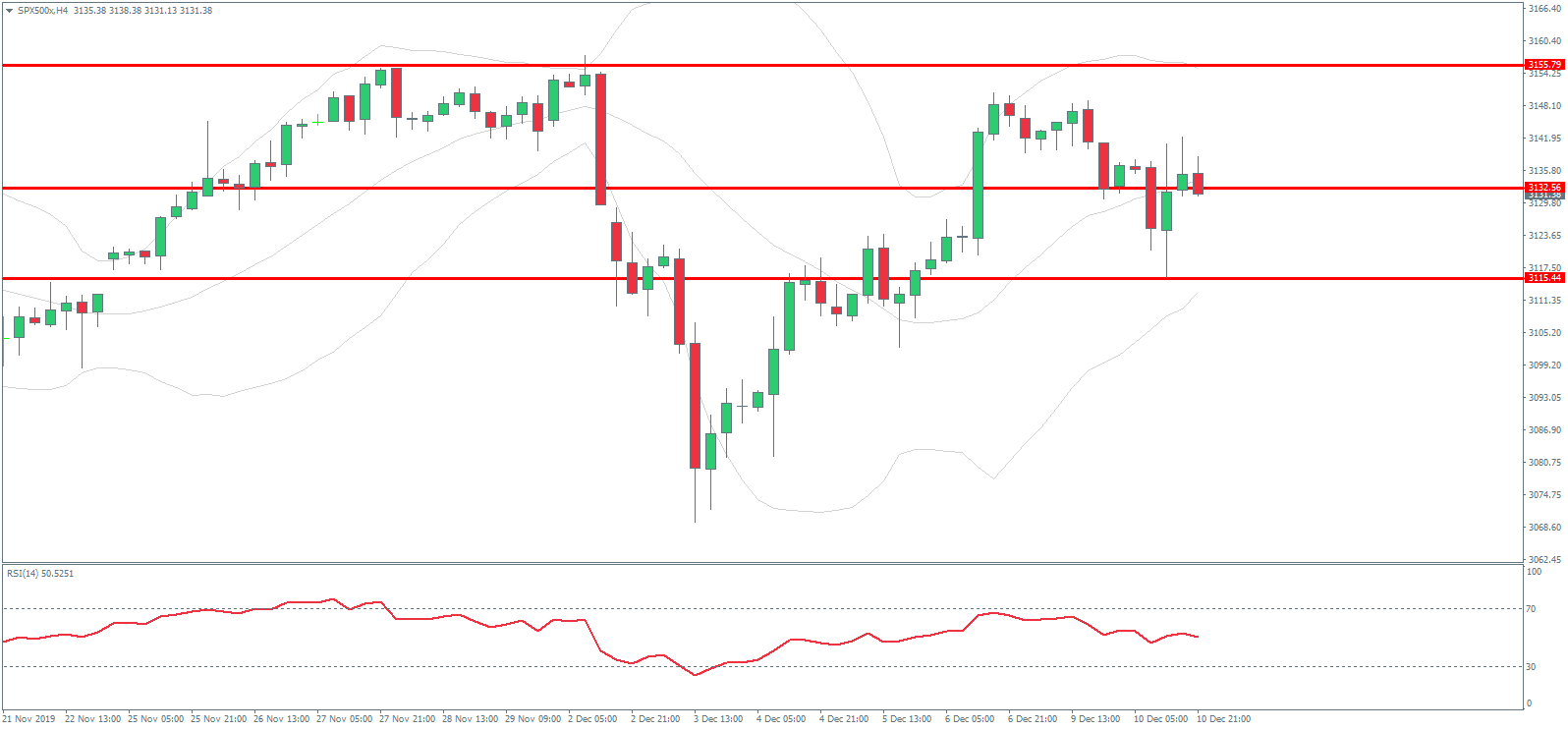
The SPX500 recovered strongly off the 3115.44 level support yesterday, to trade back up above the 3132.56 level. While above here, focus is on a move back up to test the current record highs around 3155.79. The SPX500 has been higher by around 25% this year. And, despite the recent pause in upside momentum, focus is on further upside.

By Orbex


R.I.P. Paul Volcker, the Last “Good” Central Banker

By Money Metals News Service

The last true enemy of inflation the Federal Reserve has seen died earlier this week.

Paul Volcker

Paul Volcker, former chairman of the Federal Reserve from 1979-1987, has passed away.

Credited with tampering incredibly high levels of inflation during the Carter and Reagan administration by jacking up interest rates to unpleasant levels, Volcker’s passing harkens back to a time when central bankers weren’t afraid to make tough choices.

Volcker instinctively knew that central planning of the economy by tugging on monetary policy levers was not only a tall order, but also wouldn’t ultimately succeed.

In an interview the former chairman said about the Keynesian “religion,” “…I was a bit turned off by the precision and certainty that these people attached to the doctrine. The analytical framework was very convincing but this feeling they had, that they could press the right buttons and manage the economy pretty exactly, for some reason it turned me off.”

Tall Paul (Volcker was reportedly 6’7”) was also the last chairman of the Federal Reserve who maintained plausible political independence, publicly butting heads with President Carter and President Reagan.

Though Volcker was one of the main architects of closing the gold window and once declared that “gold was the enemy,” he nevertheless seemed at least to understand the severe damage that inflation causes.

In an interview with PBS, Volcker said, “inflation is thought of as a cruel, and maybe the cruelest, tax because it hits in a many-sectored way, in an unplanned way, and it hits the people on a fixed income hardest. And there’s quite a lot of evidence, contrary to some earlier thinking, that it hit poorer people more than rich people…”

At a lecture in Singapore in 2008, when asked about a return to fundamentals of the Austrian school of economics as a response to the Great Recession, Volcker acutely answered, “you know, they [Austrian school economists] have some insights that maybe we have forgotten about…The idea of credit creation being important as one symptom of what is going on has certainly been vindicated.”

Volcker continued, “[Financial firms, investment banks, and commercial banks] all built up the balance sheet on the liability and asset side because of a sense of easy credit and no problems. That’s what’s come home to roost because suddenly they haven’t got enough capital to support the credit, which wouldn’t surprise most Austrian economists, I suspect.”

Former Chairman Paul Volcker wasn’t an Austrian economist – or even a strong proponent of sound money, despite including the term in the title of his memoir. But he understood the perils of inflation and the harm wrought by technocratic manipulation of the economy.

Volker’s approach stands in sharp contrast to that of current Fed Chairman Jerome Powell and his ilk. Far from fighting inflation, they are openly engaging in a campaign to push it higher.


The Money Metals News Service provides market news and crisp commentary for investors following the precious metals markets.

Sentiment Mixed, Speculation On US Tariffs

By Orbex

News sources indicate that the United States and China are planning on a delay of tariff hikes due to kick in on December 15th.

The Washington administration is expected to add 15% tariffs on over $165 billion worth of goods imported from China.

However, with both parties locked in the negotiations, there is scope for a delay of the tariff hikes. Investors remain cautious about the news and are preparing for the Fed meeting due later today.

Euro Trades Subdued Ahead of Fed Meeting

The euro has traded rather flat ahead of the FOMC meeting scheduled for today. There were no major new releases from the eurozone on Tuesday. Data from the US was also sparse on the day.

EURUSD Breaks Past Resistance Level

The euro broke past the resistance area of 1.1072. Price action is seen now trading close to the previously established resistance level of the 1.1100 region.

If this previously held resistance level holds, then price could turn flat within the said levels. A breakout from either 1.1100 or 1.1072 is needed to confirm the further direction in price action.

Sterling Retreats Off an 8-Month High

The pound sterling has retreated off an eight-month high. The declines came as the GBPUSD fell over 0.2% on the day. Reports of a possible hung parliament in the UK were seen hitting the sentiment.

With less than a day to go until the UK elections, the GBPUSD is expected to show some volatility.

Will the GBPUSD Decline Further?

The currency pair touched an eight-month high before easing back during the intraday session. Price is short of testing the immediate support level of 1.3100.

As long as this support holds, GBPUSD is on track for further gains if the current highs are breached. To the downside, a breakdown below 1.3100 will trigger further declines likely toward the 1.2960 region.

Gold Consolidates Ahead of Fed Meeting

The precious metal held its ground as a brief risk-off sentiment saw equity prices falling. However, the metal was relatively subdued on the day.

The Fed is expected to keep interest rates on hold at its meeting today. Investors will be looking at the meeting for further clues on monetary policy.

XAUUSD Consolidates at Support

XAUUSD is consolidating near the support/resistance area of 1462. The Stochastics oscillator is currently rising from the oversold level indicating a possible move to the upside.

If this occurs, XAUUSD could test the 1483 region once again. To the downside, the lower support at 1445 remains the target.

By Orbex

December 2019 Fed Preview

By Orbex

The Federal Reserve will be holding its final monetary policy meeting for 2019 today.

Heading into the meeting, no changes to interest rates are expected.

The Federal Reserve last cut its rates in September this year, bringing the benchmark Fed funds rate to 1.50% – 1.75%. Today’s no-change will see the second month of rates staying at the current levels.

Fed Funds Rate, October 2019

The central bank meeting comes at a time when economists are trying to figure out where the global and domestic economies are heading. The US is currently enjoying the longest expansionary patch in growth.

But, concerns remain amid signals from some parts of the economy that economic growth could slow. However, the concerns seem to be overblown at this stage. Various measures of the economy point to the fact that there is still some more room for growth.

Since the last Fed meeting in October, the third-quarter GDP figures were finalized. Data showed that the US economy advanced 2.1% in the third quarter ending September. This was a much needed change given that the initial estimates showed a 1.9% growth rate.

Although the current numbers are far from the 3% growth rate target set by Washington, the slowdown in the economy is in line with the general view.

After lowering rates in September, the central bank announced that it was done with its rate cut cycle for now. While this doesn’t mean that the Fed will be raising rates in the future, it indicated that the central bank will prefer to wait and assess the economy.

Among the major concerns for the Fed remains the trade issue with China.

Payrolls Report Shows Labor Market Resilience

While growth figures indicate a clear slowdown in the economy, the labor market has been very resilient. Last Friday’s figures showed a return to the 200k+ level in payroll numbers.

That being said, it is prudent not to read too much into just one month’s data. The payrolls for October also came out higher than initially expected.

But wage growth did not show any gains, although it remains at a healthy above 3% average rate for the year.

Today’s Fed meeting will also include the monetary policy forecasts on various indicators such as inflation, labor market, and growth. Ahead of the Fed meeting, the monthly inflation data is due.

Estimates show that the annual headline CPI will rise back above the 2% target rate set by the Fed. But officials will more likely wait for the core PCE figures which are tracked by the central bank.

The US unemployment rate fell to 3.5% in November, marking the historic lows last seen just a few months ago.

There is speculation that the central bank will have to lower rates once again in the future. Expectations are rising that this could happen in March next year. But a lot depends on the US economic growth indicators and external factors.

Fed Watch (CME Group)

In fact, it will only be closer to the end of next week when the status of the trade negotiations will be known. The US is on a deadline for December 15th when a fresh round of tariffs will be levied on goods from China.

Meanwhile, trade talks are progressing, or at least they seem to be. With the current strength in the labor market and the expectations that inflation will start rising again, today’s Fed meeting could be neutral to slightly hawkish.

By Orbex