On Tuesday the prices of American stocks decreased the second time in a row. Market participants fear that USA will increase duties on Chinese goods once again. The event was previously scheduled for December 15, 2019. But there is still a possibility, that it would not happen. The indices S&P 500 (-0,11%), Dow Jones Industrial Average (-0,1%) and Nasdaq (-0,07%) were closed in negative zone yesterday. From the beginning of the current year the S&P500 stock index has risen by 25%. The main reason for that was 3-fold decrease in US Federal Reserve’s rate. Due to this the loan burden of American corporations was lightened, and the bonds attractiveness was decreased as an alternative to stocks. No further rate cuts are expected, but US stock index futures are traded at higher prices. Today the inflation data for November will be published as well. According to forecasts, it may record a slightly higher rate than in October. ICE exchange dollar index is rising this morning, as the increase of inflation rate reduces the chances of FED monetary policy softening.
European stock indices are stucked in the expectance of British elections
Starting from Friday European stocks have been traded within a narrow range. Investors are waiting for early parliamentary elections in Great Britain on December 12, 2019. The results of these elections may have a strong impact on Brexit conditions. It’s worth mentioning, that Great Britain exit from EU is scheduled on December 31, 2020. The British FTSE has risen by 0,2% today. The EUR/USD exchange rate is slightly decreasing awaiting ECB tomorrow meeting. Significant statistics publication in Eurozone is not expected today.
Nikkei decreased slightly by 0,08% today
Asian indices are trading steadily today. Hang Seng of Hong Kong even rose by 1%. U.S sales representative Larry Kudlow said, that US hasn’t made any decision on increasing duties on the import of Chinese goods yet. It was scheduled on December 15 and involved products amounting $160 billion annually. The BSI Large Manufacturing indicator for the 4 quarter was published in Japan this morning, which was negative. Tomorrow another Japanese indicator Machine Orders will be published for October, which may decrease in annual terms. Such macroeconomic data may hinder the growth of Japanese stocks.
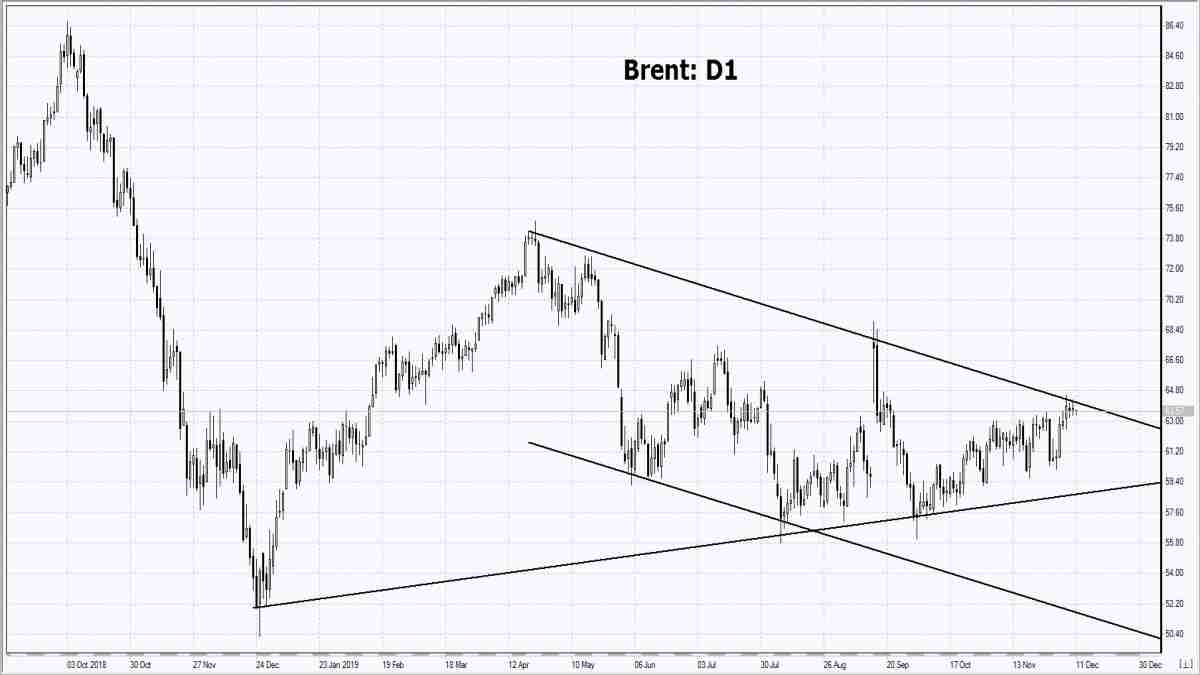
Brent has been traded within a narrow range 3 days in a row
Brent futures prices are stucked in expectance of December 15. The increase of tariffs on Chinese goods from the US may be negatively perceived by market participants, since the escalation of trade war may slow down the growth of the global economy. But up to now a positive factor for oil prices in the form of additional restrictions from OPEC for the next year – 500 thousand barrels a day, up to 1,7 million, is balanced by a significant increase in US reserves. In addition, Exxon Mobil Corp and Hess Corp American companies announced their plans of starting oil export from Guyana and increasing it up to 750 thousand barrels a day. 2 years ago the Payara oil field was discovered on the shelf of Guyana in the Atlantic Ocean.
Note: This overview has an informative and tutorial character and is published for free. All the data, included in the overview, are received from public sources, recognized as more or less reliable. Moreover, there is no guarantee that the indicated information is full and precise. Overviews are not updated. The whole information in each overview, including opinion, indicators, charts and anything else, is provided only for familiarization purposes and is not financial advice or а recommendation. The whole text and its any part, as well as the charts cannot be considered as an offer to make a deal with any asset. IFC Markets and its employees under any circumstances are not liable for any action taken by someone else during or after reading the overview.
The US dollar is trading 97.49 last, heading into today’s US session. The USD faces a high risk of volatility today with both November CPI and the FOMC meeting due. Inflation is forecast to have grown at 0.2% last month, down from the prior 0.4%.
Looking at the FOMC, the Fed is not expected to ease further. However, it will likely reaffirm its message that it could be forced to act again in the near future if the economy weakens further.
EUR Traders Waiting on ECB Tomorrow
EURUSD will be largely linked to USD flows today ahead of the ECB meeting tomorrow. Traders are eagerly awaiting the first meeting from new ECB president Lagarde. Industry commentators expect that Lagarde will stay close to the recent message delivered by former ECB head Mario Draghi.
In short, Lagarde is likely to reassure investors that the ECB will do all it can to achieve its inflation target, keeping the door open for further easing. EURUSD trades 1.1083 last, still above the 1.1024 support for now.
UK Elections Due Tomorrow
GBPUSD remains supported heading into the UK elections tomorrow. The Conservative party is widely expected to win a majority, supporting the view that the UK will press ahead and leave the EU under the terms of Boris Johnson’s Brexit deal by January 31st next year.
Any other result will represent a shock and likely see GBP lower in the near term. GBPUSD trades 1.3145 as of writing, just off yesterday’s highs.
Risk Recovers – Though Traders Still Jittery
Risk assets posted a firm recovery over the last 24 hours in response to reports that the US is weighing up postponing the next round of tariffs which are due to come into effect on December 15th.
If tariffs are postponed, this would be strongly supportive of risk sentiment and should see equities trading higher into the end of the year. SPX500 trades 3134.48 last, still sitting atop the 3132.56 level for now.
Safe Havens Rally
Safe havens have been firmer today with both JPY and gold higher against USD. The FOMC meeting today will be a key driver for short term price action. USDPY trades 108.69 last, moving further down off the week’s highs. XAUUSD trades 1467.07 last.
Crude Higher on Trade Deal Hopes
Oil prices have been bolstered once again by renewed optimism over a US-China trade deal and the prospect of further US tariffs being avoided.
The recently announced set of deeper OPEC cuts (cuts to extend from 1.2 million barrels per day to 1.7 million barrels per day, are also helping to support crude prices. Crude trades 59.05 last ahead of the EIA inventories report due later today.
FOMC in Focus
USDCAD remains subdued today ahead of key US risk events later. The potential for a more dovish tilt to the FOMC could see USD trading lower over the rest of the week. Meanwhile, strength in crude prices is likely to keep CAD supported. USDCAD trades 1.2335 last, back above the 1.3207 level.
Aussie on The Rebound
AUDUSD has been under pressure this week as concerns around the health of US-China trade talks have weighed on risk sentiment. However, with risk sentiment rebounding here, AUD has found some support. However, with hopes for a trade deal improving we have seen a strong reversal so far today with AUDUSD back up at .6832 as of writing.
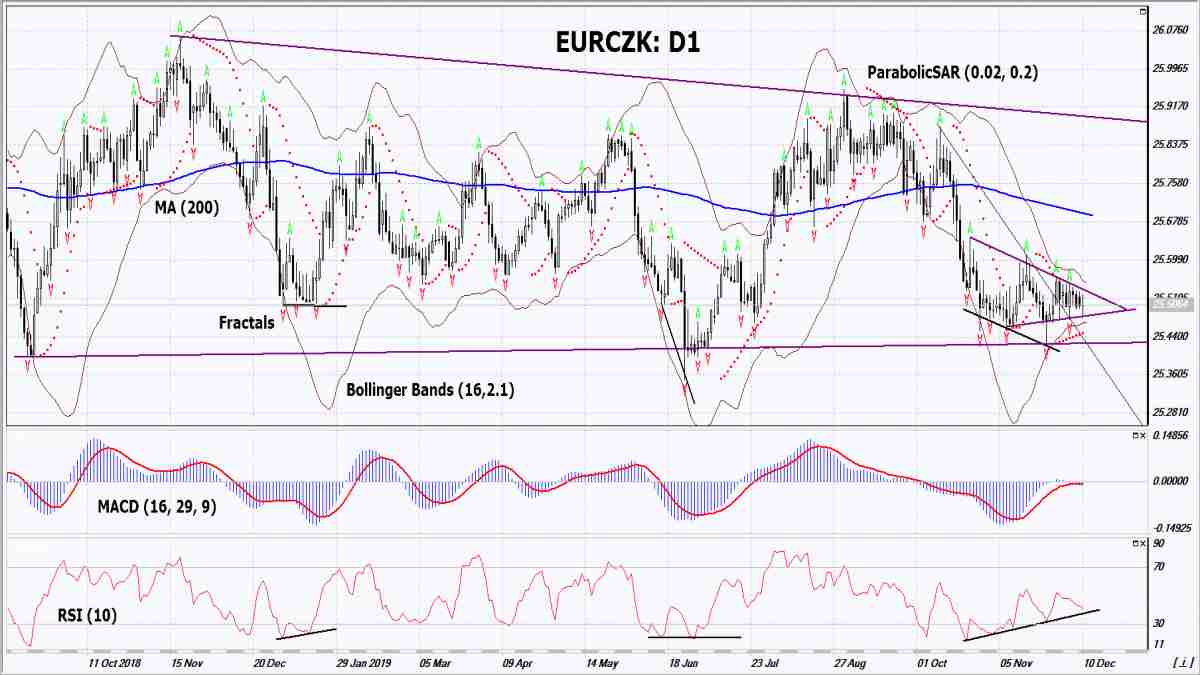
Weak inflation data for November came out in the Czech Republic. Is there a possibility for the EURCZK to rise?
An upward movement means the weakening of the Czech koruna against the euro. In November 2019, inflation in the Czech Republic increased by 0.3% and reached 3.1% in annual terms, against 2.7% year over year in October 2019. This is the biggest growth since October 2012. Inflation slightly exceeded the Czech National Bank’s target range amounting to 2% plus or minus 1%. Tomas Nidetzky, member of the Board of Directors of the Czech National Bank, said that it is advisable to keep the rate at the current level of 2%. Before the publication of the November inflation data, market participants did not exclude a 0.25% rate cut. Earlier, weak data on industrial production and the trade balance for October were published. The Czech GDP in the 3rd quarter of the current year rose by 2.5% year over year, which is 0.2% lower than the official forecast. The next meeting of the Czech National Bank will be held on December 18, 2019.
On the daily timeframe, the EURCZK: D1 approached the resistance line of the medium-term neutral trend and formed a triangle. Before opening a buy position, it should be breached up. A number of technical analysis indicators formed buy signals. The further price increase is possible in case of negative economic data in the Czech Republic and positive data in the Eurozone.
The Parabolic indicator gives a bullish signal.
The Bollinger bands have narrowed, which indicates low volatility. The lower Bollinger band is titled up.
The RSI indicator is below 50. It has formed a positive divergence.
The bullish momentum may develop in case EURCZK exceeds its two last fractal highs and the upper Bollinger band at 25.57. This level may serve as an entry point. The initial stop loss may be placed below the support line of the neutral trend, the lower Bollinger band, the two last fractal lows and the Parabolic signal at 25.4. After opening the pending order, we shall move the stop to the next fractal low following the Bollinger and Parabolic signals. Thus, we are changing the potential profit/loss to the breakeven point. More risk-averse traders may switch to the 4-hour chart after the trade and place there a stop loss moving it in the direction of the trade. If the price meets the stop level (25.4) without reaching the order (25.57), we recommend closing the position: the market sustains internal changes that were not taken into account.
EURUSD has completed the ascending wave at 1.1097; right now, it is consolidating at the top. Possibly, the pair may expand this range downwards and upwards, 1.1074 and 1.1084 respectively. If later the price breaks this range to the upside, the market may choose an alternative scenario and continue moving upwards to reach 1.1114; if to the downside – resume trading inside the downtrend with the first target at 1.1065.
GBPUSD, “Great Britain Pound vs US Dollar”
After reaching 1.3200, GBPUSD is quickly falling and has already formed two descending impulses. Today, the pair may correct towards 1.3154 and then start a new decline with the first target at 1.3090.
USDCHF, “US Dollar vs Swiss Franc”
USDCHF has reached the downside target at 0.9835; right now, it is growing towards 0.9880. Later, the market may start a new decline to reach 0.9855 and then form one more ascending structure with the first target at 0.9970.
USDJPY, “US Dollar vs Japanese Yen”
USDJPY has reached 108.75. Possibly, today the pair may fall to break 108.50 and then continue moving downwards with the target at 108.27.
AUDUSD, “Australian Dollar vs US Dollar”
AUDUSD has reached the target of Flag pattern at 0.6807; right now, it is growing towards 0.6834. Possibly, the pair may reach this level and then resume trading inside the downtrend with the target at 0.6817.
USDRUB, “US Dollar vs Russian Ruble”
USDRUB is moving downwards. Possibly, today the pair may test 63.64 from below and then form a new descending structure with the short-term target at 63.04.
USDCAD, “US Dollar vs Canadian Dollar”
USDCAD is moving downwards to reach 1.3217. Later, the market may form one more ascending structure towards 1.3274, thus forming a new consolidation range between these levels. If later the price breaks this range to the downside, the market may resume trading downwards to reach 1.3108; if to the upside – continue the uptrend with the target at 1.3282.
XAUUSD, “Gold vs US Dollar”
Gold has completed the ascending structure at 1468.62; right now, it is falling towards 1457.21. After that, the instrument may form onу more ascending structure to return to 1468.60 and then resume moving downwards with the target at 1444.00.
BRENT
Brent is still consolidating around 64.60. Possibly, today the pair may fall towards 63.74 and then grow to reach 68.46. After that, the market may start a new decline towards 64.60. If later the price breaks this range to the upside, the market may form one more ascending structure with the short-term target at 68.00; if to the downside – start another correction to reach 62.55.
BTCUSD, “Bitcoin vs US Dollar”
BTCUSD has broken 7340.00; right now, it is still moving downwards to reach 7030.00. After that, the instrument may resume moving upwards to break 7600.00 and then continue growing with the first target at 8165.00.
Attention! Forecasts presented in this section only reflect the author’s private opinion and should not be considered as guidance for trading. RoboForex LP bears no responsibility for trading results based on trading recommendations described in these analytical reviews.
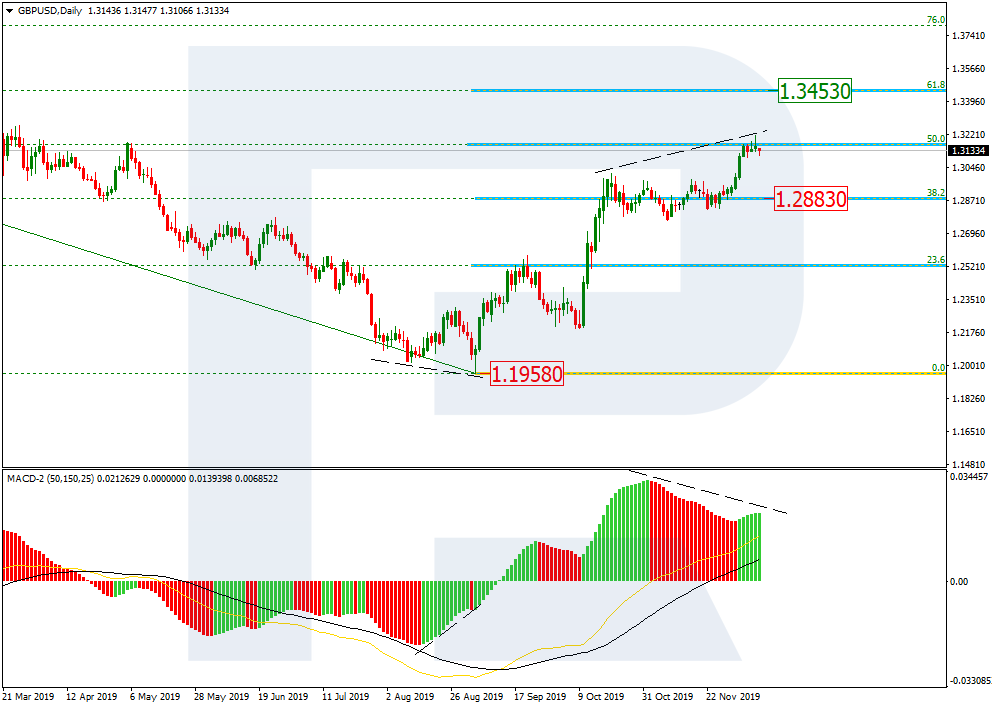
As we can see in the daily chart, the uptrend has reached 50.0% fibo. At the same time, there is a divergence on MACD, which may indicate a new pullback. However, the pair may yet continue growing towards 61.8% fibo at 1.3453. The short-term target of the above-mentioned pullback is the local support at 38.2% fibo (1.2883); the key support is the low at 1.1958.
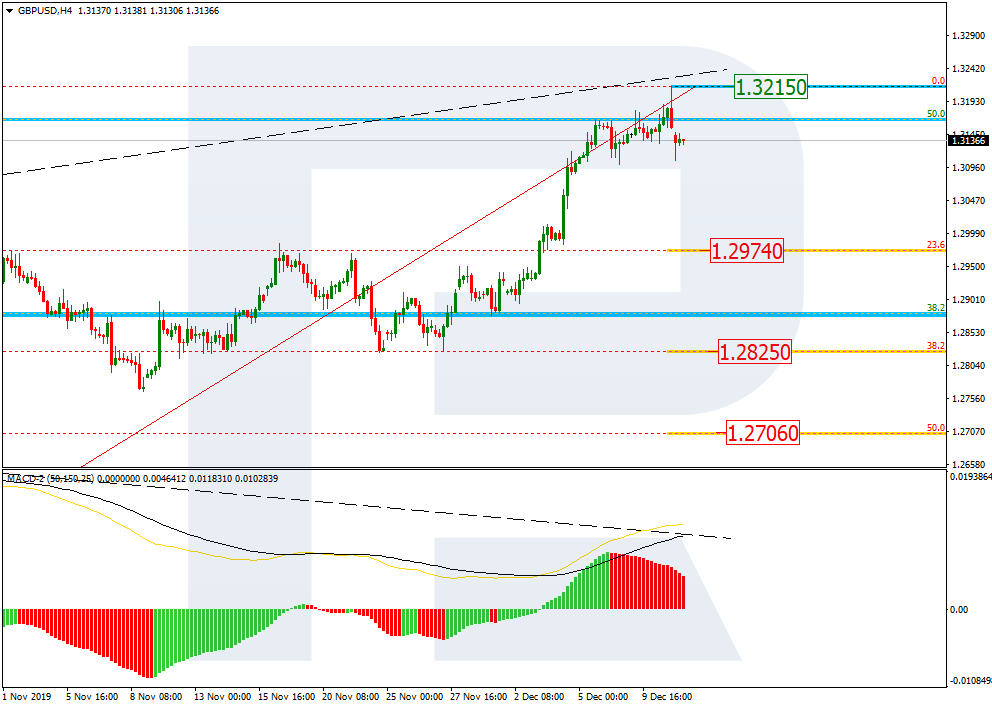
In the H4 chart, the divergence made GBPUSD start a new correction to the downside; the targets at are 23.6%, 38.2%, and 50.0% fibo at 1.2974, 1.2825, and 1.2706 respectively. The resistance is the high at 1.3215.
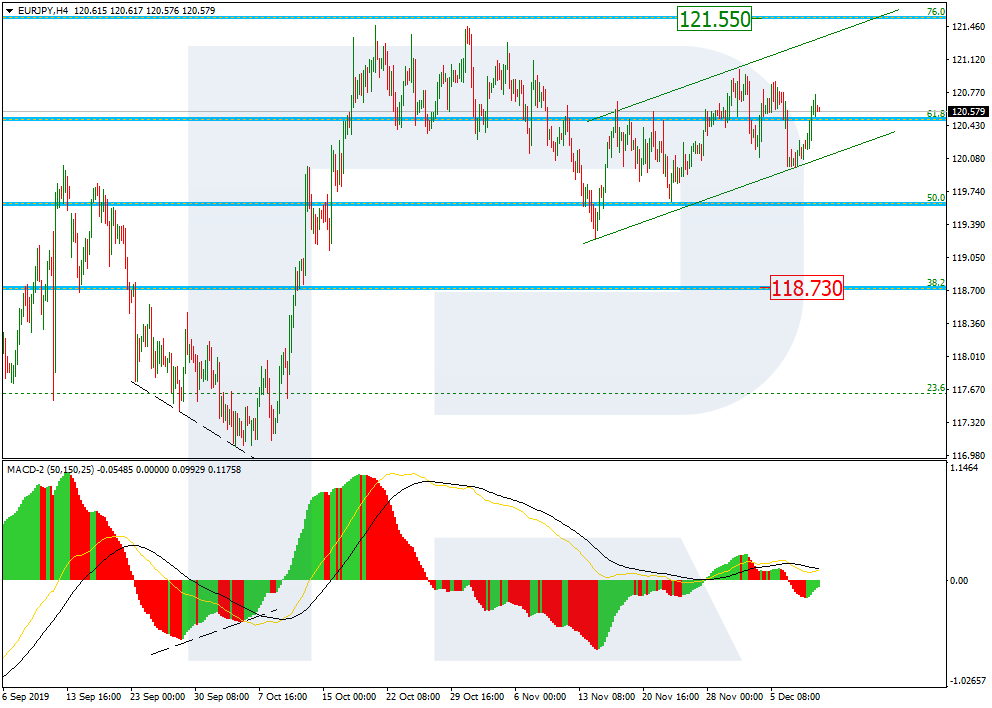
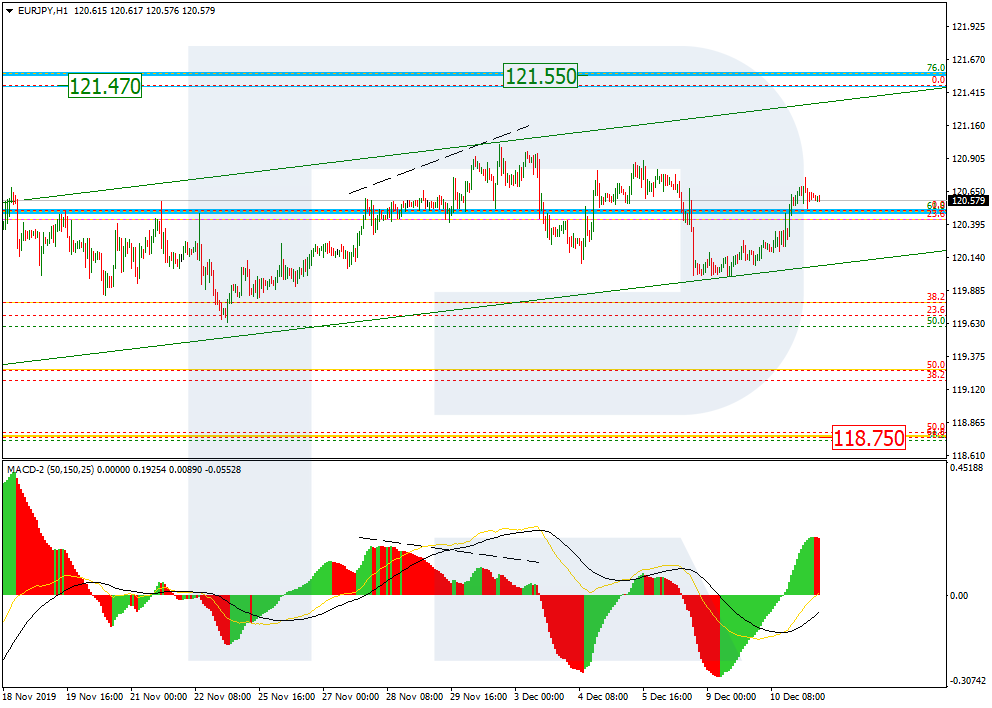
EURJPY, “Euro vs. Japanese Yen”
As we can see in the H4 chart, EURJPY continues the uptrend towards 76.0% fibo at 121.55. After breaking this level and fixing above it, the instrument may continue growing towards the high at 123.36. The support is at 38.2% fibo (118.73).
In the H1 chart, the divergence on MACD made the pair start a new decline towards the support. If the price breaks it, the decline may continue to reach 61.8% fibo at 118.75. The local resistance is the high at 121.47.
Attention! Forecasts presented in this section only reflect the author’s private opinion and should not be considered as guidance for trading. RoboForex LP bears no responsibility for trading results based on trading recommendations described in these analytical reviews.
The EUR/USD currency pair slightly increased during yesterday’s trading. At the moment, the technical pattern is ambiguous. Investors took a wait and see attitude before the Fed meeting, which will begin today and end tomorrow. Currently, the key support and resistance levels are 1.10700 and 1.10900, respectively. Open positions from these marks. We also recommend you to pay attention to the publication of important economic reports from the United States.
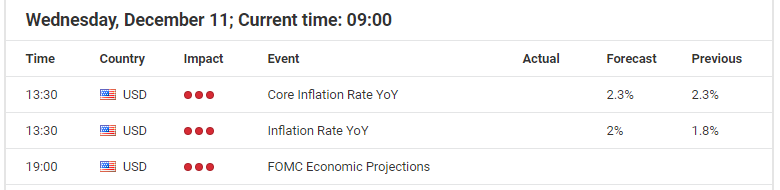
The Economic News Feed for 11.12.2019:
– Basis Consumer Price Index (US) – 15:30 (GMT+2:00);
Indicators point to the strength of buyers: the price is being traded above 50 MA and 100 MA.
The MACD histogram is in the positive zone, but below the signal line, which gives a weak signal to buy EUR/USD.
The Stochastic Oscillator is near the oversold zone, the %K line is above the %D line, which indicates bullish sentiment.
Trading recommendations
Support levels: 1.10700, 1.10500, 1.10200
Resistance levels: 1.10900, 1.11100
If the price consolidates below the level of 1.10700, expect a decrease to 1.10500-1.10400.
If the price consolidates above the resistance level of 1.10900, expect an uprising toward 1.11100-1.11300.
The GBP/USD currency pair
Technical indicators of the currency pair:
Prev Open: 1.31391
Open: 1.31546
% chg. over the last day: -0.12
Day’s range: 1.31357 – 1.31475
52 wk range: 1.1959 – 1.3385
In the course of yesterday’s trading on the GBP/USD currency pair, multidirectional dynamics was observed. The British pound was supported by optimistic economic data from the UK. So, GDP (q / q) did not change in the third quarter, although experts expected a decrease of 0.2%. GDP (YoY) grew in the third quarter by 0.7%, which coincided with the expectations of experts. The volume of production in the manufacturing industry grew in October by 0.2% instead of 0.1%. At the moment, the key support level is 1.31200. The key resistance level is 1.31600. We recommend opening positions from these marks.
The Economic News Feed for 11.12.2019 is calm.
Indicators do not provide accurate signals: the price has crossed 50 MA and 100 MA.
The MACD histogram is in the negative zone, but above the signal line, which gives a weak signal to sell GBP/USD.
The Stochastic Oscillator is in the neutral zone, the %K line crossed %D. There are no signals.
Trading recommendations
Support levels: 1.31200, 1.31000, 1.30650
Resistance levels: 1.31600, 1.32000, 1.32250
If the price consolidates above 1.31600, expect the quotes to rise toward 1.32000.
Alternatively, the quotes could descend toward 1.31000.
The USD/CAD currency pair
Technical indicators of the currency pair:
Prev Open: 1.32366
Open: 1.32300
% chg. over the last day: -0.03
Day’s range: 1.32266 – 1.32384
52 wk range: 1.2727 – 1.3664
The USD/CAD currency pair retains an ambiguous technical pattern. The trading instrument is in a flat. Investors expect additional drivers. The local support and resistance levels are still 1.32150 and 1.32500, respectively. We recommend paying attention to the dynamics of oil prices. Open positions from key levels.
The Canadian Economic News Feed for 11.12.2019 is calm. Pay attention to the US News Feed.
Indicators do not give accurate signals: the price has crossed 50 MA.
The MACD histogram is near the 0 mark, there are no signals.
The Stochastic Oscillator is in the neutral zone, the %K line is above the %D line, which also gives a signal to buy USD/CAD.
Trading recommendations
Support levels: 1.32150, 1.31800, 1.31500
Resistance levels: 1.32500, 1.32850
If the price consolidates above 1.32500, expect the quotes to rise 1.32850-1.33000.
Alternatively, the quotes could descend toward 1.31800-1.31650.
The USD/JPY currency pair
Technical indicators of the currency pair:
Prev Open: 108.553
Open: 108.716
% chg. over the last day: +0.19
Day’s range: 108.698 – 108.716
52 wk range: 104.97 – 114.56
The USD/JPY quotes slightly rose yesterday. Currently, the key support and resistance levels are 108.600 and 108.800, respectively. We recommend that you pay attention to the dynamics of yield on US government bonds. Open positions from key levels and pay attention to the US news background.
The Economic News Feed for 11.12.2019 is calm.
Indicators do not give accurate signals: the price is crossing 100 MA.
The MACD histogram is in the positive zone, but below the signal line, which gives a weak signal to buy USD/JPY.
The Stochastic Oscillator is in the oversold zone, the %K line is below the %D line, which indicates a bearish sentiment.
Trading recommendations
Support levels: 108.600, 108.400
Resistance levels: 108.800, 109.00
If the price consolidates above 108.800, expect further growth toward 109.000.
Alternatively, the quotes could descend toward 108.400-108.200.
On Wednesday the main event and focus will be on the Fed Rate Decision.
Last week, after US president Trump announced a plan to restore tariffs on steel and aluminium shipped from Brazil and Argentina, in addition to proposed tariffs “up to 100%” on certain French goods (about $2.4 billion worth) in retaliation for France’s digital services tax, risk-off in financial markets kicked in, initiating a drop in 10-year US-Treasuries yields.
As a result, Gold pushed higher, but gave back most of its gains by the weekly close, after Non-Farm Payrolls beat expectations with 266,000.
While we doubt the sustainability of the strong employment print, what will certainly be of high interest now is the Fed rate decision today.
If Trump’s statements last week are to be believed, indicating no sign of urgency for a trade deal with China and the intention to wait until after the Presidential election in 2020, then they suggest that there is a very real possibility that the next set of US tariffs, due December 15,could go into effect.
As a result, it could be in a very bullish spot with either a very dovish Fed or a risk-off mode from Trump escalating the trade war with China in the second half of the week.
In addition to that, we also want already to keep an eye on the seasonal bullish window in Gold between December 18 and January 10, where Gold saw an average gain of 47 USD for 12 of the past 15 years, while in the remaining three years, it dropped on average only 19.65 USD, while the maximum loss and the maximum drawdown of 31.03 USD.
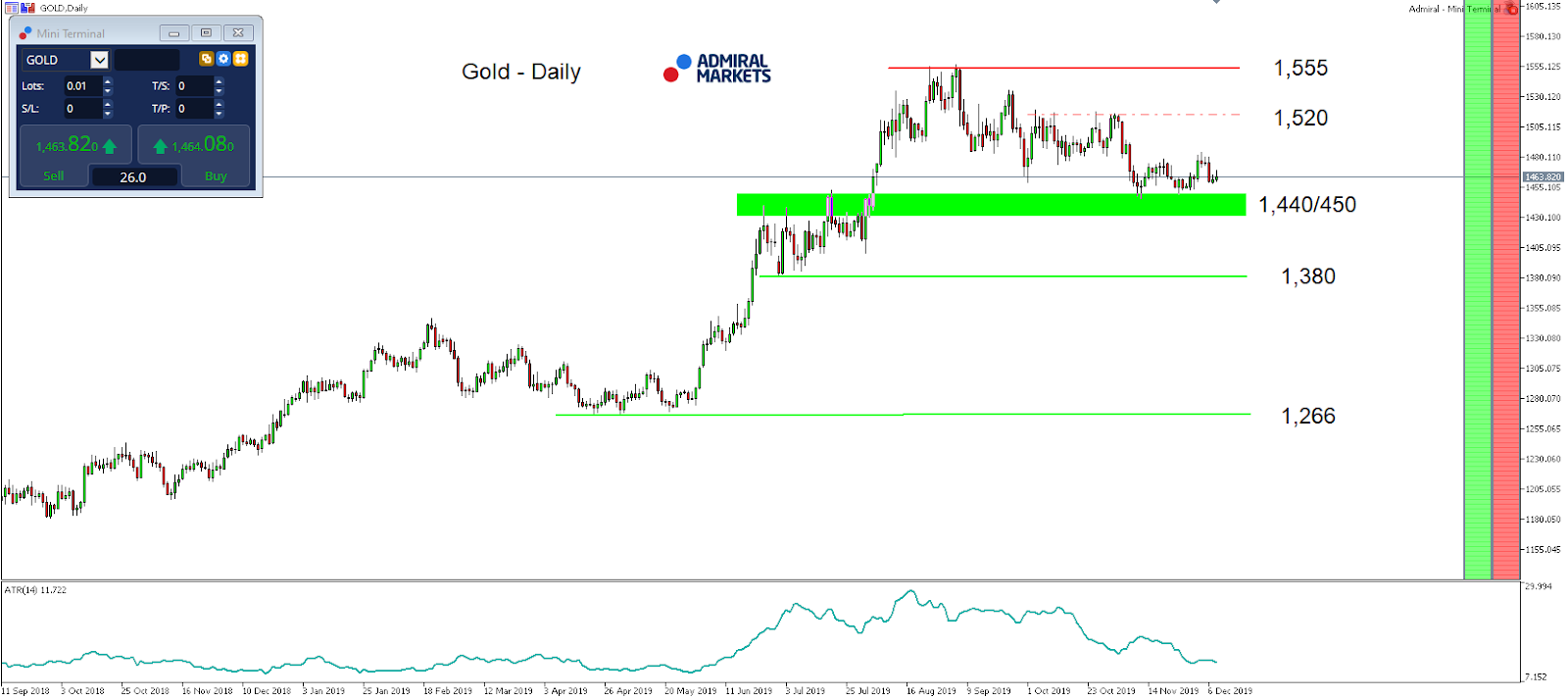
With that in mind, technically our picture switches to Long again with Gold breaking back above 1,520 USD which would level the path up to the current yearly highs around 1,557 USD:
Source: Admiral Markets MT5 with MT5-SE Add-on Gold Daily chart (between September 11, 2018, to December 11, 2019). Accessed: December 10, 2019, at 10:00pm GMT – Please note: Past performance is not a reliable indicator of future results, or future performance.
In 2014, the value of Gold fell by 1.7%, in 2015, it fell by 10.4%, in 2016, it increased by 8.1%, in 2017, it increased by 13.1%, in 2018, it fell by 1.6%, meaning that after five years, it was up by 6.4%.
Discover the world’s #1 multi-asset platform
Admiral Markets offers professional traders the ability to trade with a custom, upgraded version of MetaTrader 5, allowing you to experience trading at a significantly higher, more rewarding level. Experience benefits such as the addition of the Market Heat Map, so you can compare various currency pairs to see which ones might be lucrative investments, access real-time trading data, and so much more. Click the banner below to start your FREE download of MT5 Supreme Edition!
Disclaimer: The given data provides additional information regarding all analysis, estimates, prognosis, forecasts or other similar assessments or information (hereinafter “Analysis”) published on the website of Admiral Markets. Before making any investment decisions please pay close attention to the following:
This is a marketing communication. The analysis is published for informative purposes only and are in no way to be construed as investment advice or recommendation. It has not been prepared in accordance with legal requirements designed to promote the independence of investment research, and that it is not subject to any prohibition on dealing ahead of the dissemination of investment research.
Any investment decision is made by each client alone whereas Admiral Markets shall not be responsible for any loss or damage arising from any such decision, whether or not based on the Analysis.
Each of the Analysis is prepared by an independent analyst (Jens Klatt, Professional Trader and Analyst, hereinafter “Author”) based on the Author’s personal estimations.
To ensure that the interests of the clients would be protected and objectivity of the Analysis would not be damaged Admiral Markets has established relevant internal procedures for prevention and management of conflicts of interest.
Whilst every reasonable effort is taken to ensure that all sources of the Analysis are reliable and that all information is presented, as much as possible, in an understandable, timely, precise and complete manner, Admiral Markets does not guarantee the accuracy or completeness of any information contained within the Analysis. The presented figures refer that refer to any past performance is not a reliable indicator of future results.
The contents of the Analysis should not be construed as an express or implied promise, guarantee or implication by Admiral Markets that the client shall profit from the strategies therein or that losses in connection therewith may or shall be limited.
Any kind of previous or modeled performance of financial instruments indicated within the Publication should not be construed as an express or implied promise, guarantee or implication by Admiral Markets for any future performance. The value of the financial instrument may both increase and decrease and the preservation of the asset value is not guaranteed.
The projections included in the Analysis may be subject to additional fees, taxes or other charges, depending on the subject of the Publication. The price list applicable to the services provided by Admiral Markets is publicly available from the website of Admiral Markets.
Leveraged products (including contracts for difference) are speculative in nature and may result in losses or profit. Before you start trading, you should make sure that you understand all the risks.
On Tuesday the 10th of December, the euro was up at the close of trading. Strong ZEW data sparked a recovery to 1.1085 in European trading. In the US session, growth accelerated to 1.1098 on the back of the message from WSJ which broke the news that the US and China remain optimistic about making progress in their trade-deal negotiations. Also revealed, was that the countries have opened talks regarding the possibility of postponing the punitive hike in tariffs on a wide range of Chinese goods, which the US plans to bring into force on December 15. “Bearish” technical signals were levelled out as a result of other events reported in the news and bulls were able to claw back Friday’s losses.
In the end, the drop in value we expected to see did not materialise. This was down to the news backdrop working against the USD.
In Asian trading, the EURUSD pair is trading in the red, and at the time of writing, the euro is valued at 1.1088. It is also worth noting that in the early morning, GBP fell 90 points. This was down to the publication of a new YouGov poll ahead of the UK general election. According to the poll, the Conservatives Party now looks set to win 339 seats instead of the 359 predicted on November 27th. Meanwhile, the Labour Party stands to win 231 seats, which is 20 more than previously thought.
Both traders and investors are playing it safe in anticipation of the meetings of the US Federal Reserve, the ECB and the UK general election.
The next scheduled two-day meeting of the US Federal Reserve Open Market Committee began on Tuesday. The base rate of interest is expected to remain unchanged. At the end of the meeting, the bank’s management will present its forecasts as regards the development of the US economy for the next calendar year.
Today’s review comes without a forecast as we await Jerome Powell’s press conference after the FOMC meeting later in the day.
Asian markets were subdued on Wednesday morning as investors grew increasingly anxious over the lack of update on US-China trade talks.
Repeated mixed signals and messages ahead of the December 15 tariff deadline is fostering confusion across financial markets. This sentiment continues to be reflected in global equities as markets adopt a ‘wait and see’ approach until clarity and direction are offered on the trade front. In Europe, shares are expected to make a cautious start ahead of the U.S Federal Reserve’s final interest rate decision of 2019. Given how uncertainty remains a dominant theme this week, safe-haven assets like Gold and the Japanese Yen have the potential to appreciate as investors head for safety.
Steady Dollar ahead of Fed meeting
The Federal Reserve is widely expected to leave interest rates unchanged at 1.75% in December.
However, much of the focus will be directed towards the policy statement, economic projections, dot plot and press conference for clues on future monetary policy. Speculation around the Federal Reserve cutting interest rates anytime soon have been quelled by November’s blockbuster US jobs report. Although markets are pricing in a 54% probability of a rate cut by September 2020, it will be interesting to see whether the dot plot mirrors market expectations. Appetite towards the Dollar will also be influenced by Fed Chairman Jerome Powell’s remarks on the US economy and monetary policy. Should the press conference and policy statement adopt a dovish tone, the Dollar Index may dip back towards 97.40.
Pound dips on UK poll projections
Sterling’s depreciation against the Dollar on Wednesday continues to highlight how the currency remains extremely sensitive to polls.
Appetite towards the Pound was dealt a blow heavy after a poll showed a narrowing lead for Prime Minister Boris Johnson’s Conservative Party. Given how the general election is around the corner, the British Pound is set to remain volatile and highly reactive to polls.
Focusing on the technical picture, the GBPUSD is struggling to defend 1.3100 on the daily charts. A solid breakdown below this point should encourage a decline towards 1.3000 in the short to medium term.
Commodity spotlight – Gold
Gold is grinding higher amid caution ahead of a looming tariff deadline on December 15th. The precious has gained roughly 0.25% since the start of the week thanks to investors adopting a guarded approach. The sense of uncertainty is likely to continue supporting appetite for safe-haven assets for the rest of this week.
Gold is seen swinging within a range in the near term ahead of the tariff deadline. Prices are seen testing $1470 amid the market caution, with further uncertainty injecting bulls with enough confidence to attack $1476.50 and $1480, respectively. Given how the precious metal remains highly sensitive to trade headlines, any good this week could result in a decline back below $1458.
Disclaimer: The content in this article comprises personal opinions and should not be construed as containing personal and/or other investment advice and/or an offer of and/or solicitation for any transactions in financial instruments and/or a guarantee and/or prediction of future performance. ForexTime (FXTM), its affiliates, agents, directors, officers or employees do not guarantee the accuracy, validity, timeliness or completeness, of any information or data made available and assume no liability as to any loss arising from any investment based on the same.
Andrew Bowering, president of Prime Mining, talks with Maurice Jackson of Proven and Probable about his company’s plans to fast track its gold project.
Maurice Jackson: Joining us for conversation is Andrew Bowering, the president, director and CEO of Prime Mining Corp. (PRYM:TSX.V). Glad to have you on the program to share the value proposition before us in Prime Mining, which is an advanced stage exploration company. Focused on delivering high-grade gold at a low cost and set for production in two years. Prime Mining offers a number of virtues to the market. Before we delve into company specifics, Mr. Bowering, please acquaint us with Prime Mining and share the opportunity the company presents to the market.
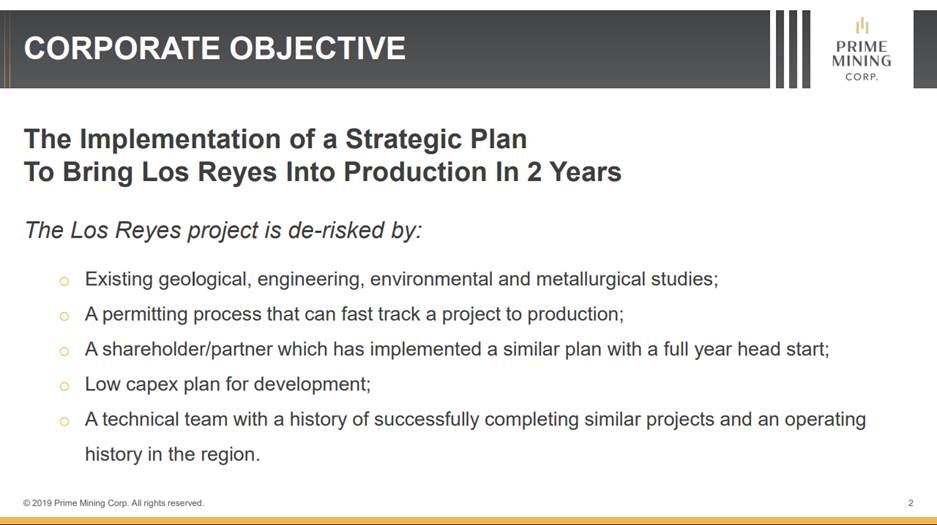
Andrew Bowering: Prime Mining is a relatively new company that’s come to the market with the plan of bringing a well-established, well-studied gold deposit in western Mexico into production. In the next 24 to 36 months producing a profitable gold mining company. We’re a collection of professional mining executives who have built mines in the past, some capital markets personnel who have funded some pretty significant projects. In addition, we have local Mexican operators who are very familiar with the region and know how to get it done. Collectively, we’re going to build a mine and pay it back to shareholders.
Maurice Jackson: One of the virtues I like in a company are the complementary combination of astute geological and business acumen, which Prime Mining has been successfully demonstrating. Mr. Bowering, take us to Sinaloa State, Mexico, where the company recently acquired its flagship Los Reyes project. Where exactly is the project located and provide us with some historical context on the region?
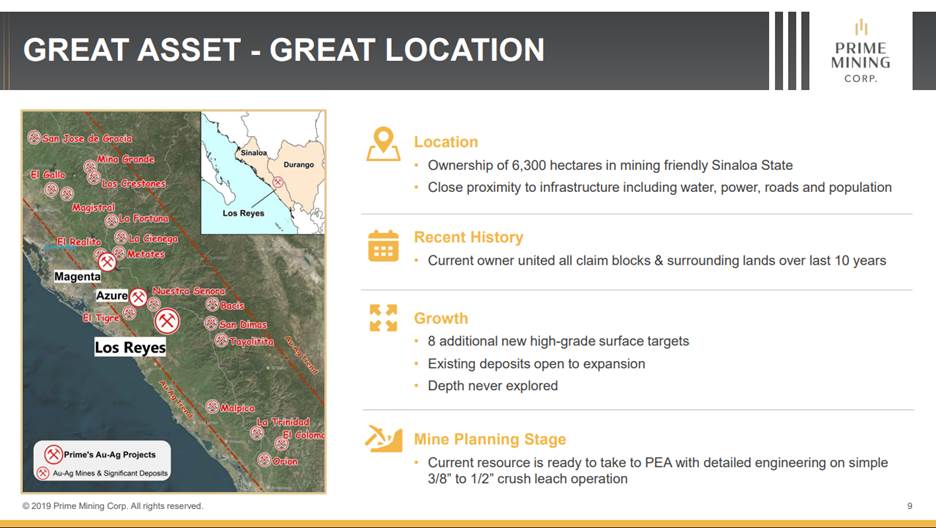
Andrew Bowering:Los Reyes is in western Mexico, in the southern part of Sinaloa, about three and a half hours north by car, off Mazatlán, a famous beach destination for tourists. It’s in the Sierra Madre Mountains, very famous for gold and silver exploration from the time of the conquistadors all the way up to the current. The region hosts numerous public company-operated mines such as Chesapeake Gold, American Silver and McEwen Mining, along with numerous others in the region. Los Reyes is nestled in the middle of a number of active producing mines; it sits about 30 kilometers away from a 9,500 population town called Cosala. The project itself is about 6,500 hectares with approximately $20 million U.S. in exploration development spent on it since the 1990s. The project itself was initially discovered in the 1600s and had historical production of several hundred thousand ounces of gold and millions of ounces of silver. Probably wasn’t touched again until the late 1980s, early 1990s, when modern exploration took over.
Maurice Jackson: For current and prospective shareholders, can you please answer the multi-million dollar question that Prime Mining presents to the market? That is why Los Reyes?
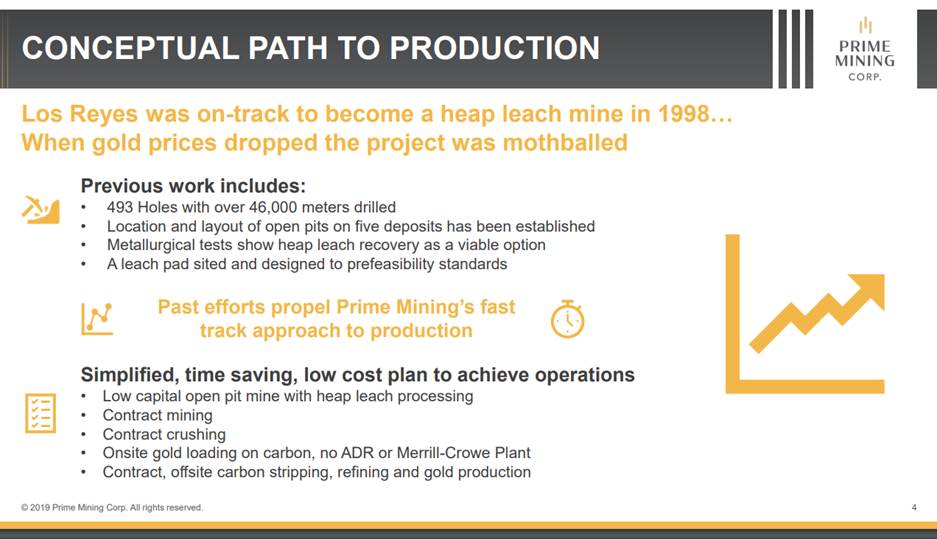
Andrew Bowering: Los Reyes is a well-established, well-studied asset that was available for us to pick up at a great time in the market. To really answer that, I need to take you back a little bit. I need to tell you where this asset was and how it got to where it is. So in the 1990s, a company called Northern Crown had it and put 493 drill holes into it. Then it took it through PFS pre-feasibility at a $325 gold price as an open-pit heap leach.
In 1999, gold was as low as $250 an ounce; the project got shelved in 2000, Northern Crown went bankrupt. Vista Gold came along and picked up the asset but it was busy with a project called Mt. Todd in Australia. By the time 2011 had rolled around, gold was $1,900 and Vista needed to have a look at this asset then. So they drilled a bunch of holes into it. They studied it, calculated a new resource, ran a PEA on it, engaged Tetra Tech to do the work. Tetra Tech delivered a PEA that suggested they build up a CIL plant, full grind, gravity circuit, tailings compound. Yes, recoveries were high, but it was $150 million cap-ex to build and about a $30-some odd million sustaining cost. During the course of that whole study, about two and a half years, the price of gold dropped by $300 some odd dollars an ounce. Vista was busy shoveling money into Mt. Todd. So they mothballed the project and looked for a way to recoup the $8 million they had put in to do that study.
Along came a company called Corex, cut a deal on the property for payments of a million and a half dollars to own it outright with a 1% NSR. Corex merged with Minera Alamos and there’s three projects in their company. 2017 comes along, they make an initial payment of a $1.5 million on the property. 2018 comes, they don’t have the money to make that second $1.5 million payment. They extend it for six months by a $150,000 cash payment. That’s where Prime Mining enters the picture. In February of 2019, Minera Alamos had a bank balance of about $1.8 million Canadian and $1.5 million U.S. payment due to Vista in 30 days.
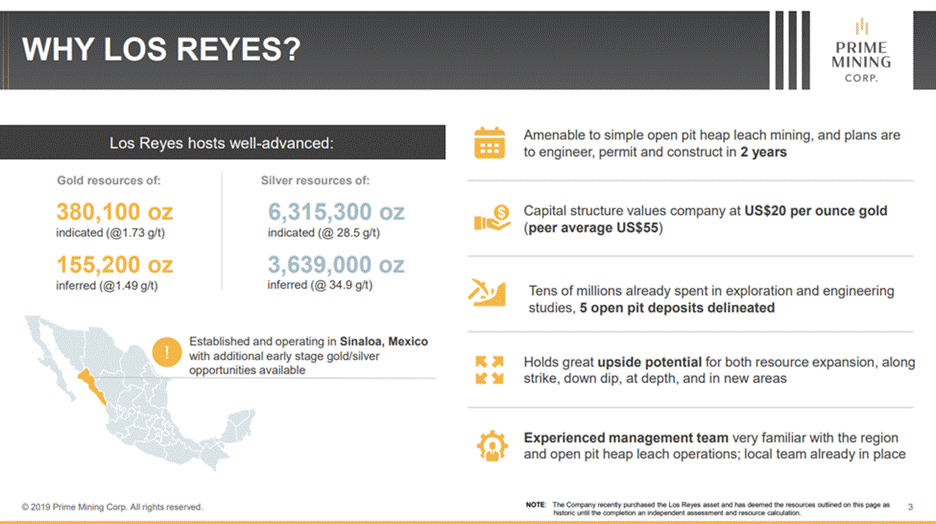
We cut the deal with Minera Alamos at that point in time and we got the project. So now we have bought a project for $6 million that has a well-studied 530,000 ounce, high-grade oxide deposit, and we know what to do with it. Our plan is to take all that work that’s been done in the past and move it forward into production in the next couple years. What’s important to note is that Mexico is one of those regions where you don’t have to have a mining plan to get a mining permit. Evidenced by SilverCrest this year where they announced their PEA in May of this year and their mining permit in July. Minera Alamos who announced their mining permit at Santana just three months ago, still has not announced the drill resource. Point is you can get a permit to mine in Mexico within 12 to 14 months.
We know that we’ve got a resource, it well studied. It’s already had a lot of met work done on it; it’s already had a bunch of rock engineering done on it. Consequently, we can short track it to production that meets our operating plan.
Maurice Jackson: This was a wonderful demonstration of the business acumen that I was referring to on the use of optionality here to acquire the project. You alluded to the mineral resource at Los Reyes. When was that conducted?
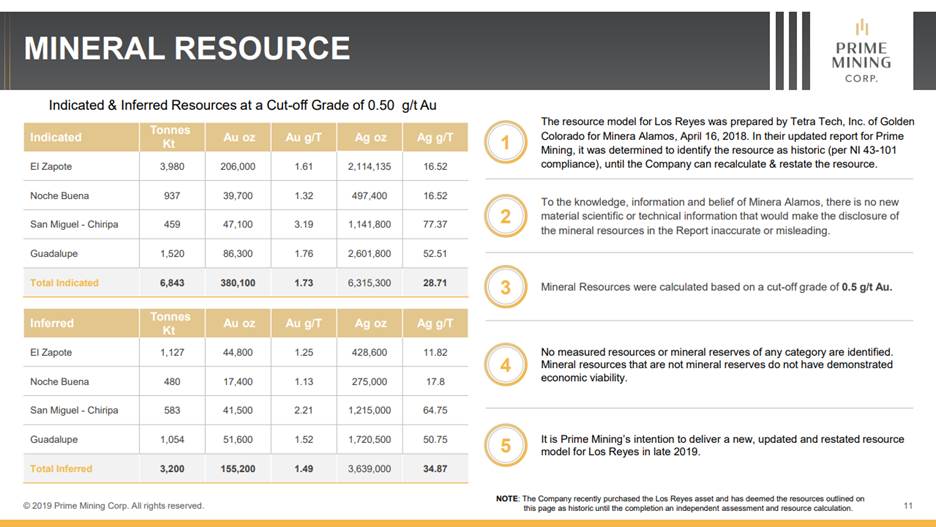
Andrew Bowering: Well, there’s a few different resources that were calculated. But the most current resource was calculated in 20122013 By Tetra Tech. It is 43-101 current, it’s about 530,000-ounces of gold and about 10 million ounces of silver. If you look at the grades of it but keep in mind, this is all oxide, there is no transition zone, no sulfide zone. It’s never been drilled deeper than 180 to 200 meters. It’s a 1.7-gram oxide deposit. In addition, there’s a 500,000-ton starter pit that’s at 3.4 grams. The grade of this deposit is twice the average operating grade of an open-pit heap leach in Mexico and maybe three times the grade of that which you would find in Nevada.
We put together 25 open-pit heap leaches operating in Mexico and the average of them is half this grade. It’s that robust and it’s been calculated on the back of 493 drill holes and considerable surface work. It’s ready to mine and it’s in a place where it’s right to mine.
Maurice Jackson: Mr. Bowering, you have our attention. Open-pit heap leach offer simplicity and the low cap-ex equals a potential for generous profits. But there’s more to the story. What can you share with us regarding exploration potential?
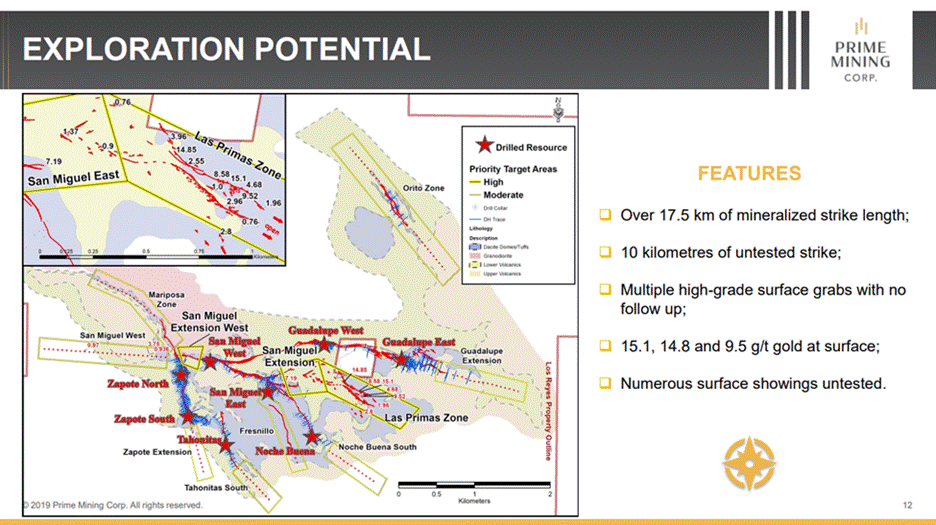
Andrew Bowering: That’s the interesting part about Los Reyes. There are those out there that tell you it can be a 1.5 to 2 million ounce deposit and that we should focus on some exploration rather than development. Okay, fair enough. But your drilling off ounces costs $8 to $12 US an ounce to drill them off historically. So to drill off another half million ounces might cost Prime Mining $5 to $7 million US. I would rather pay for that exploration out of cash flow, so get it operating and then explore it. What I will say is that only seven kilometers of known strike length of 17 kilometers have been drilled. If you just take the percentage of shoots that are mineralized, the average thicknesses, the average width, the average depth, and the length and model that all. That tells you there’s about 1.5 million potential ounces there. There are several surface showings that have never been drilled but grade from three-quarters of a gram all the way up to 15 grams on surface. So a lot of upsides in explorations but simply, we’re going to build a mine first, we’ll get it operating and we’ll use those cash flows to build it bigger later.
Maurice Jackson: Speaking of cash flow, the company has ambitious plans to be in production in two years. How did management determine the timeline?
Andrew Bowering: Well, we’ve looked at several other operations that have a built-in the region and that makes the most sense to us. So we came public September 3, we’ve been working to calculate a new resource and deliver a current resource that we understand. We would like to have that done by the end of this year. Then we will model it around an open-pit heap leach and deliver a PEA to PFS levels by April of next year.
Now when I say deliver that PEA to PFS levels, I mean we’re going to have to contractor bids for every piece of equipment we need to buy. At least two quotations on every process that we plan to employ in the operation of the mine. Once we have that document, we can make a production decision on it. We’re pretty sure that we’re going ahead with this just because of its grade and its size. But once we do, then we have to wait for that mining permit. Now, we started the process of applying for the mining permit this week. That’s about a 12- to 14-month process. When that’s completed, we can start the construction. Construction of an open-pit heap leach like this will take about eight months in the region. The only thing that would slow us down would be the rainy seasons, September and October. If we get caught at a certain part of the build during that time, we could be slowed down by a few weeks. Effectively, that’s about a two-year process then from start until finish. At that point, we would be employing mining operations, crushing, and stacking on our leach pad. Latency and the pad might lead you 60 days to 90 days before you recover gold, which will put you in that 24 to 30-month period. That’s pretty well the timeline for the whole process.
Look, we’re optimistic but there’s a lot going on in this company as we speak. There are four crews on the ground itself, doing surface geology. There is a team of two geologists, one in Vancouver and one in Tucson, Arizona, doing modeling of all the drill hole and all the data we have right now. There is a team in Boise, Idaho, that’s doing the engineering. So I’m talking about the haul road design, the leach pad design, the waste dump design, and the pit design, and then the operating equipment. So there are teams all over working together. I failed to mention there’s a team in Mazatlán that’s working on the environmental and the engineering to get the permitting completed. So in summary, you got to look at the people in this company and understand how we think that we can do this in a short period of time.
Maurice Jackson: We’re going to address that here shortly. I’m intrigued. Can you please provide us with a tour of the conceptual site plan?
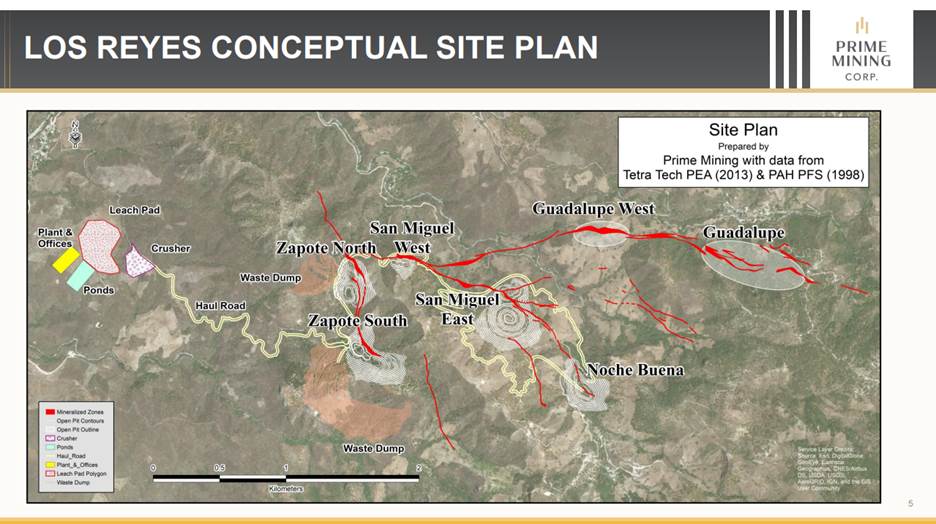
Andrew Bowering: So keep in mind that Los Reyes was on track to be an open-pit heap leach back in the late 1990s, when the price of gold and bad market conditions totally derailed it. But it’s a short time to get that done. Now, our plan is not to buy our own rolling stock. There are several contract miners that operate in Mexico. So we’re going to employ contract miners to do the mining and the crushing. We will take that crushed rock, agglomerate it with cement and cyanide. Stack it on our leach pads, operate our own carbon recovery circuit and then we will harvest a pregnant carbon and ship that off out of country for stripping. That’s a common practice down there. McEwen Mining ships carbon out of country to have it recovered, so does Argonaut. We want to do that so that we don’t spend that extra time and extra capital cost and building an ADR plant to recover our own gold. We will look to pay a third-party to strip it or potentially sell it as that offtake.
Maurice Jackson: Now, Mr. Bowering, what type of activity is being conducted currently on-site?
Andrew Bowering: One of the interesting things about Los Reyes is that when they first did all the drilling on it, they looked for adits, where the old miners had gone underground and simply mined. They drilled out from those. So you have these 493 drill holes that pierce the structures between 80 meters and 180 meters below surface. Interestingly though, there was never a coordinated surface trenching program done on the property. Since we’re planning an open-pit, we want to know exactly where all the structures are at surface. Now, all of the structures, at least in the first three deposits that we plan on mining on the property, sit on the dip slope, you can stand on them, they outcrop. But as I mentioned, the drill holes don’t pierce them higher than about 80 meters below surface. That means that the model is out there right now that was 530,000-ounces that we referenced earlier, either has some inferred on the surface or it’s considered waste rock. We are doing a massive 5,000 meters surface trenching program on the property. To fill in all those surface data points of the deposits.
There are four crews on that property. A crew is made up of one geologist, four diggers, and three samplers. There are four crews like that working on that property as we speak. That’s on-site. In addition, on-site, we have a couple of Caterpillar D6s opening up the drill roads and the trails that have gone around the property because no one’s been actively working there at over six years. So we’re cleaning it all up, getting it ready to run new LIDAR surveys and get everything ready to finalize our plans.
Maurice Jackson: Let’s discuss some important topics germane to the project, beginning with reversionary interests. Are there any on the project?
Andrew Bowering: There is an NSR due to Vista Gold of 1% of all production on the property. Then there are some other royalties on claims. Overall, there’s about a 3% royalty on the whole project. That’s very typical as most projects in Mexico have about a 3% royalty. That’s all in our models and doesn’t change any of our economics. Aside from that, the only other thing that’s out there is Vista Gold has a back-in right to a participating 49% in an underground operation. Now, keep in mind that we are planning an open-pit heap leach.
So there’s no ability for Vista to back into that. But if somewhere along the line we said that we want to start an underground operation based on an economic study or an engineering study that we’ve done, they have a 60-day right of first refusal to back in and pay 49% of the cost to enter that. It’s kind of a crazy short-circuit, I’m not even sure the words I want to use for it. It really doesn’t make any sense for them. I guess they thought that at the time that this agreement was written up, that if somebody did find a 5 or 10 million ounce deposit that they would want to be able to back into it. But 60 days doesn’t really give you enough time to determine anything. Quite honestly, if there’s a big underground mine found there, we’d probably be thrilled to have a partner.
Maurice Jackson: We’re going to get into some numbers later in this discussion. But from a capital expenditure standpoint, let’s remind audience members about the existing infrastructure. Why is this paramount to the value proposition?
Andrew Bowering: We’re planning on building up an open-pit heap leach. There are already sort of several roads established on the property. The pits have already been and deposits have already been established. So for us, it’s a relatively simple job. We’ve looked at three or four different models for this property and the plan. But I can tell you that we’re going to keep it simple. I mentioned earlier that we’re going to employ contract miners to mine it for us. We’re going to operate an open-pit at about 4,000 to 4,500 tons a day planned operation. That will be mined, hauled to our central facility on the west of the property. It’ll be two-stage crushed, agglomerated and then stacked on our leach pads. The cost of doing all that’s about a $14 million US build. We’re not buying rolling stock, we’re not buying our own crushers, we’re contracting that out. So effectively, we’re running a simple agglomerater, stacking on our leach pad and then running a simple carbon recovery circuit. Probably, no more than four carbon columns and then shipping carbon off. To have it stripped, Idaho’s one possibility. So no ADR plant, saving another $3 or $4 million in cap-ex there alone.
The operation is simple. There is enough water in the region. There may be two months, current water balance studies indicate that there’s two months of dry season. There’s enough power in the region for all of our operations with the exception of the crushing. We will have to generate power for the crushing. But other than that it’s a relatively simple operation, no milling, no tailings compound and we have a lot of concrete being poured. You’ve effectively got three concrete pads being poured. One for a crusher, one for the contractors to change oil on their vehicles. Then one for your agglomeration region. That’s about it. So relatively a simple easy build.
Maurice Jackson: What is your relationship with the community and are they on board with Prime Mining?
Andrew Bowering: That’s probably one of the greatest things about this whole deal. We’ve got to get into some of the management of this. So our executive chair is a gentleman named Dan Kunz. Dan has a storied career. He was CEO of Ivanhoe Mines, he was CEO of MK Gold. MK Gold was a Morrison-Knudsen spin-out that built Castle Mountain and American Girl in Southern California. But in addition, Dan Kunz was a founding director of Chesapeake Gold. Chesapeake Gold is 90 kilometers away with their Metates Project. A 20 million ounce gold deposit. Dan Kunz has a very good relationship with the locals in this community. Dan was able to get us a meeting with the mayor of Cosala the day after we went public. She got us in touch with the president of the local Ejido. Now, Ejido is the communal group that controls the surface access rights. Much like many parts of the world where you have First Nations that control surface access rights or various landholders, the Ejido is the group in Mexico. Without the Ejido on your side, you’re not building a mine.
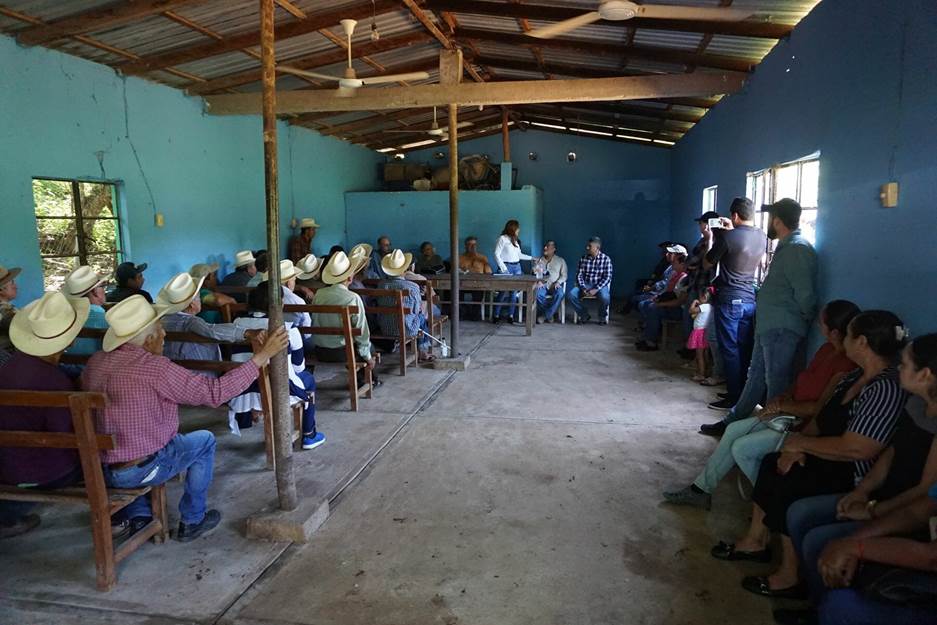
Anyway, we were able to, two days after going public, have a meeting with 17 members of the Ejido. They granted us instant access to the surface rights on the property and voted in favor of building a mine. They wanted a small annual payment and they wanted us to fix their roads so they could get in and out of their communities better. And they wanted us to help them with water during the dry period. Very simple, easy propositions and it was looked after. We will be saying more about the Ejido shortly in public disclosure but suffice to say that we have the access agreement with the local Ejido. We have a very good relationship with the mayor of the closest community, Cosala. We have good relations with the governor of the state. We have excellent relations with the federal government. Our legal counsel for this company was number two in the Ministry of Mines federally. So all in all, very good operating status in the region.
Maurice Jackson: Are you fully permitted?
Andrew Bowering: No, we are not fully permitted yet but we are working towards that. We will start the permitting process this month. We have engaged a firm out of Mazatlán to start that process. It’s about a 12 to 14-month process, based on two other companies that we know operating in the region. So we don’t suspect that’s going to be a significant difficulty. It’s a very mining-friendly region. There are several members of the community that really want to work, rather than having to drive 250 or 300 kilometers to work in the mines there. They’re looking forward to an operation here at Los Reyes.
Maurice Jackson: We’ve discussed the good, let’s address the bad. What can go wrong and what is your action plan to mitigate that wrong?
Andrew Bowering: That’s a tough one. This project has got a lot of things going for it. It’s had a lot of money spent on it. We know the resource is there, we know the metallurgy is good on it. It’s had column tests run. We know that recoveries are good. I don’t think there’s anything geologically that sets this company back. Permitting might take a little longer. We’ve seen companies do it in 12 months, we’ve seen companies do it in 14 months. Could we get a little delayed with permitting? Maybe. Other than that, I guess the only difficulties may be in funding. Markets can get tough, it can be hard to finance projects. But our company’s currently funded all the way through the resource we’re going to deliver, the PEA that we will deliver next April or thereabouts. Sometime next year, we’re going to have to raise about $20 million to take this through to production. That’ll be our tallest order raising the $20 million to put into production.
Now, having said that we’ve already talked to a couple of Mexican banks. I just came back from a trip to London; I was with several funds and bankers there. Everybody seems to really like this project. So I don’t see too many difficulties there. I really can’t think of anything that stands out, as being a showstopper here. We’ve been working on this day in, day out for months now. I don’t think anybody in the company would tell you that there’s anything here that stands out as worrisome at this point in time. The one last thing I’ll add to that is that go through our management, have a look at the depth of the people in here. Our COO’s built for mines in Mexico alone.
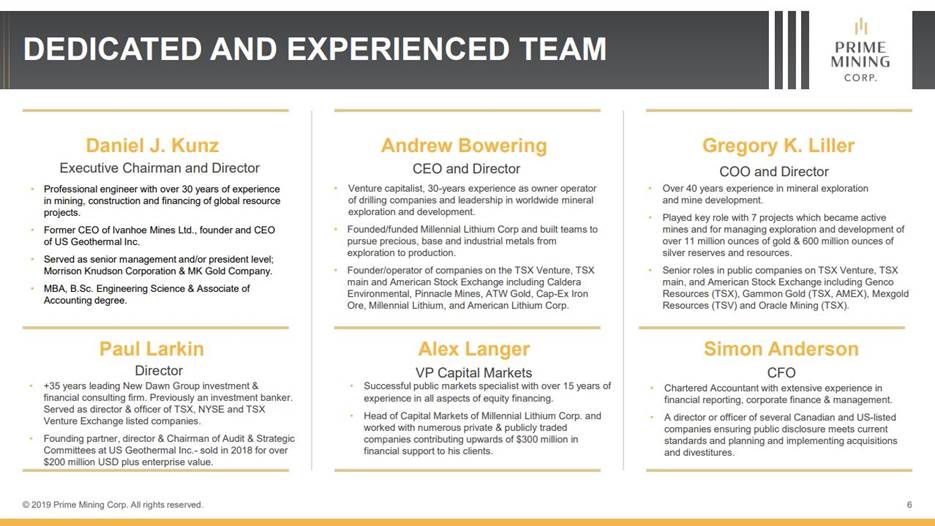
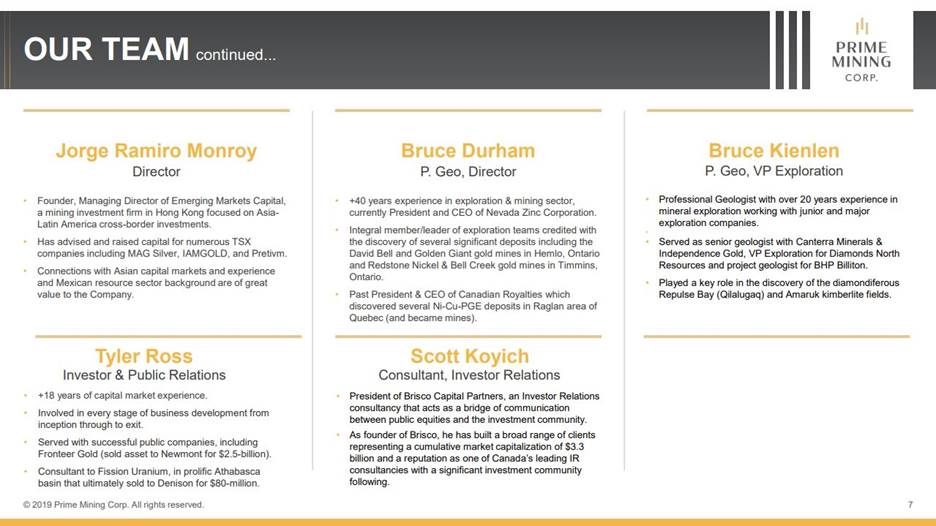
Maurice Jackson: Well, let’s get into the people right now. We’ve covered the project, let’s cover the virtue that Prime Mining offers to the market equally important, which are the people. Sir, your team has a proven pedigree of success. Let’s discuss the people responsible for increasing shareholder value. Mr. Bowering, please introduce us to your board of directors.
Maurice Jackson: Let’s get into some numbers. Sir, please share the capital structure for Prime Mining.
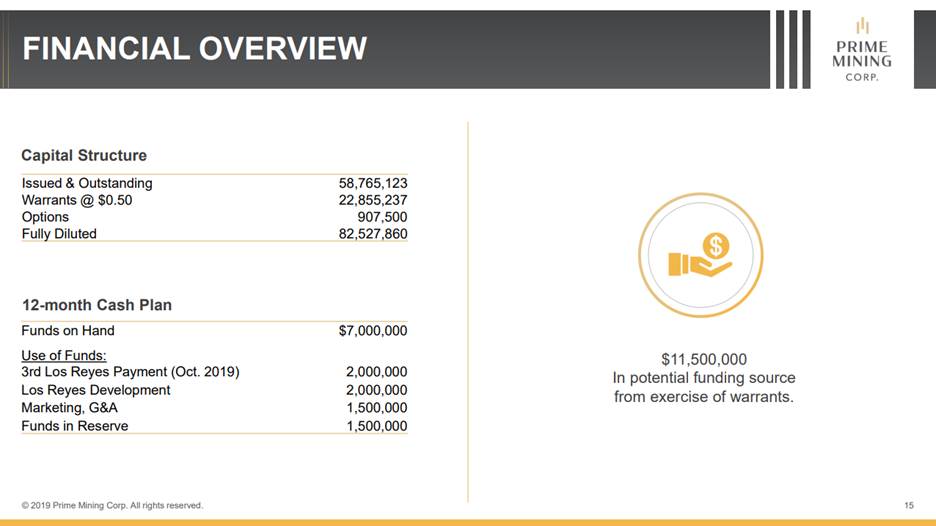
Andrew Bowering: Prime has about 58.7 million shares out. It has never had a share issued on it I think lower than 20 cents a share. There was a very small financing of about a million and a quarter units at 20 cents. The last financing round before this deal was done at 26.6 cents. We currently financed at 30 cents. We went out to raise six million, we ended up raising $8.7 million brokered through friends and insiders. I’m one of the largest investors in the company. I have $3.5 million of my own money tied up in the company. I do not take a salary from the company nor do I accrue one. I work for my equity position. Aside from me, anybody that did take a salary or deserves a salary, swapped out their first-year salary into equity of the company at 30 cents a share. We are all in this to build something successful and return it back to shareholders. There are a couple other mining engineers that have a couple of percent stake in the company and then there are a couple of funds worldwide that came into our financing.
Aside from that, 58.7 million shares issued in outstanding, there are 22 million warrants or thereabouts exercisable at 50 cents for two years. If those warrants were to come in due to a strong market, that’d be all the money we need to get this thing to the finish line.
Maurice Jackson: How much cash and cash equivalents do you have right now?
Andrew Bowering: Now, we have about just under $4 million in cash right now and are fully funded to deliver that new resource to the investors at the end of the year and the PEA mid-first-half next year.
Maurice Jackson: How much debt do you have?
Andrew Bowering: Right now, there’s $1 million in debt in the company that is a note payable to me. In March of this year when we first put this deal together with Minera Alamos there was that $1.5 million US payment due to Vista. I made that with two other parties. We put up $2 million Canadian to make that payment. On the financing closing August 30 this year, we paid back those two arm’s length investors and I agreed to keep my $1 million loan in the company at the direction of the board for conversion later or payment later when it was in the company’s better interest to do it.
Maurice Jackson: What is your burn rate?
Andrew Bowering: Now, that’s an interesting question because it really varies on what tasks we have going on. We’ve been buying a couple of trucks and little bits and pieces here and there and paying for surveys this. Different parts of the property and engineering services here in there. But I’m going to suggest it’s around $200,000 a month right now.
Maurice Jackson: Who are the major shareholders?
Andrew Bowering: I’m one of the largest shareholders and my family and I control well over 15% of the company. Minera Alamos owns 17% of the company, our board controls about another 10% of the company. A fund out of Australia called Terra Capital owns 4% of the company. Commodity Capital of Luxembourg owns 6% or 7% of the company. Then a bunch of our supporters, our friends, some mining engineers that recognize what we have own 3% or 3% of the company. It’s over 50% owned by our supporters.
Maurice Jackson: That addresses one of my next question, which is what is the float? I know you have a lot of capital invested in the company. But when was the last time you purchased shares and at what price?
Andrew Bowering: The last time I guess I purchased shares was in the financing that closed August 30. I would think one of my family members has purchased stock in the company within the last two or three weeks.
Maurice Jackson: Are there any redundant assets on the books that we should know about?
Andrew Bowering: Yes, there are a couple other assets. There are six or seven grassroots properties in Sinaloa State in Mexico that are in the company. We’re just trying to determine what to do with those now. We have Grupo Mexico looking at one of them and I have to get back to them shortly on a potential disposition cost. They’re looking to see what we would want for it. There’s also we have a 50% ownership in a gold-cobalt prospect in Idaho, that sits next to Jervois Idaho cobalt project. We have to determine what to do with that as well. But I think we will be divesting of it at some point.
Maurice Jackson: Are there any change of control fees? If yes, what is the compensation?
Andrew Bowering: No, there’s none. I’m really opposed to those sorts of things. As I mentioned earlier, I don’t take a wage from the company and I don’t believe in those fancy golden handshakes that really penalize shareholders because management did something successful. I’m just not in favor of them, so there aren’t any.
Maurice Jackson: Quite impressive. Is management charging a consultant fee for any services?
Andrew Bowering: I do not. Dan Kunz does not directly either. Dan Kunz takes no pay. But we do hire two of Dan Kunz’s engineers. I believe that we are saving the shareholder’s money by doing that because I think that they’re making things much easier for us when it comes to hiring the independent engineer to vet our final PEA. I think that the cost savings will be significant.
Maurice Jackson: In closing, multilayered question, what is the next unanswered question for Prime Mining? When can we expect the response and what determines success?
Andrew Bowering: Well, we’re going to deliver a resource to the market sometime in the next 30 days, I believe. The resource that’s out there now at 530,000 ounces of gold and 10 million ounces of silver. That’s a Tetra Tech resource calculated in 2013, re-papered or re-plated in 2018 by Minera Alamos. We need to be satisfied that all that work is correct, that it’s accurate and that it’s right. A whole bunch of new results from the property are coming over the next two months. Then a PEA coming shortly thereafter, that talks about this whole plan as an open-pit heap leach. What it’s going to look like, what the costs of it are going to be, what it looks like it’s going to be able to make, what its operating costs are going to be? It’ll be a very good statement for shareholders and we hope to have that delivered by about April. Then it will be simply waiting for that production announcement decision.
Maurice Jackson: Quite exciting times for Prime Mining, I look forward to the press releases here in the near future. Andrew, what keeps you up at night that we don’t know about?
Andrew Bowering: Just running companies, just running this company. I like to work, Maurice, I’ve worked hard all my life. I’m 60 now, I love doing this and I can’t let it go. So I lie in my bed and I think about what about this, what about that? What it’s going to look like when this data comes in? The success of this company is what keeps me up at night.
Maurice Jackson: Well, I can vouch for that, you and I’ve been corresponding here in the last month. We’re talking in all hours of the night, no matter where you are geographically. You’re on the task and you’re trying to increase shareholder value. I can vouch for that. We’ve had some discussions offline here. Mr. Bowering, last question. That is what did I forget to ask?
Andrew Bowering: That’s a good question, Maurice. You asked me about what keeps my mind up at night. Well, I can continue in that, I can think of things all the time. But you know what? I think you’ve done a really good job picking the main points of this thing and getting out of me what needs to get out. There’s really nothing else we need to go over right now. I am required to give you my answers sort of in the context of 43-101. But what I would like to do at a future date is I’d like to actually get into how that mining plan looks and talk about seven-year mine life and up. How many ounces of annual production and things like that as our relationship grows a little more.
Maurice Jackson: Well, we look forward to having you share that with our subscribers here. Mr. Bowering, for someone listening that wants to get more information about Prime Mining, please share the website address.
Maurice Jackson: For direct inquiries, contact Jeremy Ross at 604-428-6128 or you may email [email protected]. Prime Mining trades on the TSX.V, symbol PRYM.
Before you make your next bullion purchase make sure you call me. I’m a licensed representative for Miles Franklin Precious Metals Investments. We provide a number of options to expand your precious metals portfolio. From physical delivery, offshore depositories, precious metal IRAs and private blockchain distributed ledger technology. Call me directly at 855-505-1900 or you may email [email protected]. Finally, please subscribe to www.provenandprobable.com for mining insights and bullion sales.
Andrew Bowering of Prime Mining, thank you for joining us today on Proven and Probable.
Maurice Jackson is the founder of Proven and Probable, a site that aims to enrich its subscribers through education in precious metals and junior mining companies that will enrich the world.
Disclosure: 1) Maurice Jackson: I, or members of my immediate household or family, own shares of the following companies mentioned in this article: Prime Mining. I personally am, or members of my immediate household or family are, paid by the following companies mentioned in this article: None. My company has a financial relationship with the following companies mentioned in this article: None. Proven and Probable disclosures are listed below. 2) The following companies mentioned in this article are billboard sponsors of Streetwise Reports: None. Click here for important disclosures about sponsor fees. 3) Statements and opinions expressed are the opinions of the author and not of Streetwise Reports or its officers. The author is wholly responsible for the validity of the statements. The author was not paid by Streetwise Reports for this article. Streetwise Reports was not paid by the author to publish or syndicate this article. The information provided above is for informational purposes only and is not a recommendation to buy or sell any security. Streetwise Reports requires contributing authors to disclose any shareholdings in, or economic relationships with, companies that they write about. Streetwise Reports relies upon the authors to accurately provide this information and Streetwise Reports has no means of verifying its accuracy. 4) This article does not constitute investment advice. Each reader is encouraged to consult with his or her individual financial professional and any action a reader takes as a result of information presented here is his or her own responsibility. By opening this page, each reader accepts and agrees to Streetwise Reports’ terms of use and full legal disclaimer. This article is not a solicitation for investment. Streetwise Reports does not render general or specific investment advice and the information on Streetwise Reports should not be considered a recommendation to buy or sell any security. Streetwise Reports does not endorse or recommend the business, products, services or securities of any company mentioned on Streetwise Reports. 5) From time to time, Streetwise Reports LLC and its directors, officers, employees or members of their families, as well as persons interviewed for articles and interviews on the site, may have a long or short position in securities mentioned. Directors, officers, employees or members of their immediate families are prohibited from making purchases and/or sales of those securities in the open market or otherwise from the time of the interview or the decision to write an article until three business days after the publication of the interview or article. The foregoing prohibition does not apply to articles that in substance only restate previously published company releases.
Proven and Probable LLC receives financial compensation from its sponsors. The compensation is used is to fund both sponsor-specific activities and general report activities, website, and general and administrative costs. Sponsor-specific activities may include aggregating content and publishing that content on the Proven and Probable website, creating and maintaining company landing pages, interviewing key management, posting a banner/billboard, and/or issuing press releases. The fees also cover the costs for Proven and Probable to publish sector-specific information on our site, and also to create content by interviewing experts in the sector. Monthly sponsorship fees range from $1,000 to $4,000 per month. Proven and Probable LLC does accept stock for payment of sponsorship fees. Sponsor pages may be considered advertising for the purposes of 18 U.S.C. 1734.
The Information presented in Proven and Probable is provided for educational and informational purposes only, without any express or implied warranty of any kind, including warranties of accuracy, completeness, or fitness for any particular purpose. The Information contained in or provided from or through this forum is not intended to be and does not constitute financial advice, investment advice, trading advice or any other advice. The Information on this forum and provided from or through this forum is general in nature and is not specific to you the User or anyone else. You should not make any decision, financial, investments, trading or otherwise, based on any of the information presented on this forum without undertaking independent due diligence and consultation with a professional broker or competent financial advisor. You understand that you are using any and all Information available on or through this forum at your own risk.