There was a collective sigh of relief across financial markets on Wednesday evening after President Donald Trump toned down the rhetoric against Iran, while also extending an olive branch.
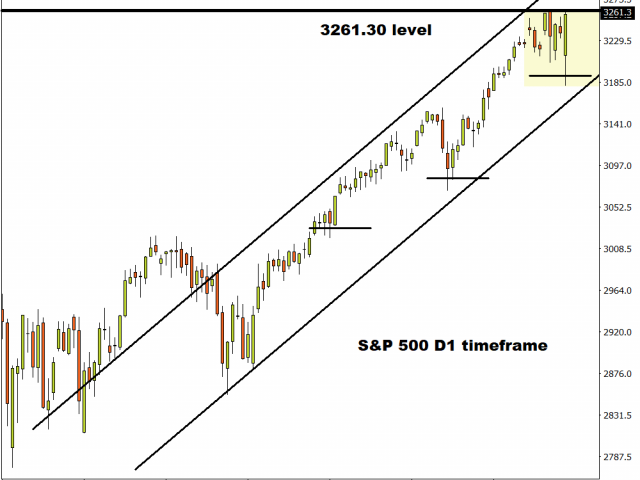
The S&P 500 hit an all-time high, while Gold and Oil prices crumbled as Trump’s comments cooled fears over a full-blown conflict between both sides. According to the US President, “Iran appears to be standing down, which is a good thing”. Given how Trump also expressed a desire to reach an agreement with the country, the risk-on mood across financial markets may return this week.
The biggest casualties from Trump’s speech were Gold and Oil.
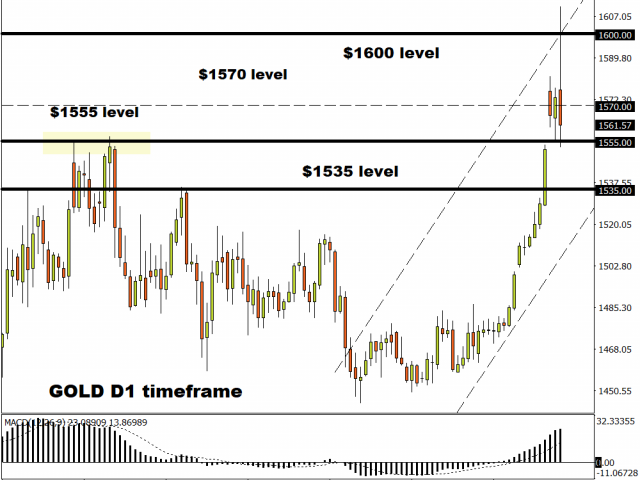
Gold collapsed like a house of cards, tumbling below $1560 after Trump calmed fears about escalating tensions between the US and Iran. The precious metal is likely to extend losses if $1555 proves to be an unreliable support level. A breakdown below this point should encourage a decline towards $1535.
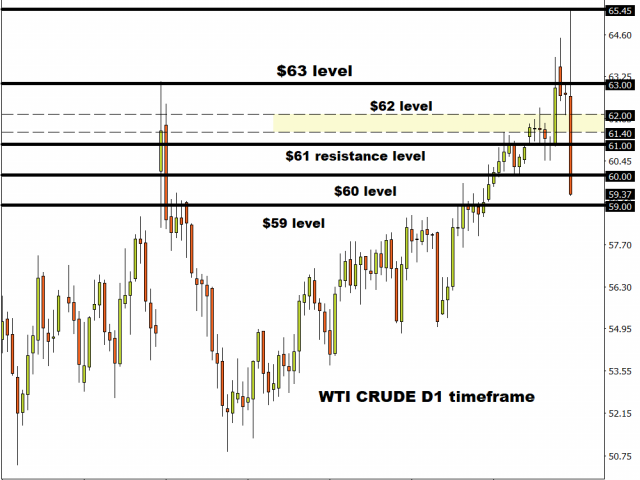
Oil prices extended losses on Wednesday evening, tumbling below $60.00 after official reports showed that U.S weekly crude inventories rose by roughly 1.2 million barrels last week.
Cooling tensions between the United States and Iran compounded to downside losses as fears over negative supply shocks faded. WTI Crude is positioned to extend losses this week as investors re-direct their focus back towards economic data, trade developments and global growth.
In regards to the technical picture, WTI Crude could extend losses towards $59 if $60.50 proves to be an unreliable support level.
Disclaimer: The content in this article comprises personal opinions and should not be construed as containing personal and/or other investment advice and/or an offer of and/or solicitation for any transactions in financial instruments and/or a guarantee and/or prediction of future performance. ForexTime (FXTM), its affiliates, agents, directors, officers or employees do not guarantee the accuracy, validity, timeliness or completeness, of any information or data made available and assume no liability as to any loss arising from any investment based on the same.
Maurice Jackson of Proven and Probable and Jayant Bhandari of Capitalism and Morality talk about the dangers posed by education, prosperity and democracy to economic stability and the accumulation of wealth.
Maurice Jackson: Joining us for conversation is Jayant Bhandari, the founder of Capitalism and Morality and highly sought-out advisor to institutional investors. Mr. Bhandari, welcome to the show, sir. Always a pleasure to speak with you. For the reader of today’s discussion members, we will be addressing global unrest, arbitrage opportunities for your natural resource portfolio, and the value proposition of precious metals.
Jayant, when we last spoke, we were addressing global civil unrest and the vices of education, prosperity, and democracy. I want to begin our conversation with the latter. Jayant, most people view education and prosperity and democracy as a virtue. Why do you believe this is a sophism?
Jayant Bhandari: Maurice, education, prosperity and democracy, put together, has been a complete disaster for the Third World, and we continue to think that the more we educate, the more prosperous these Third World countries become, the better it will be for the world. We continue to believe that the more democracy spreads, the more stable the world will become. The reality is actually completely contrary to the conventional wisdom.
Let’s look at prosperity. What happens when a lottery winner gets his money in the U.S.? He gets his millions of dollars, he leaves his job, he marries a stripper, he takes on drugs, and in a few years’ time he will have lost everything that he made from the lottery, and he would be much worse off than where he started before he won his lottery. Exactly the same thing is happening in the Third World. People in the Third World have become rich before becoming enlightened, before becoming rational, before becoming open-minded. They have become pompous and noisy. They have polluted the planet. And the end result is that they have become extremely materialistic.
Now, Maurice, I’m not a religious person, but we all should have a higher calling in life. We should aim for bigger things in life. Pleasure-centric life does not satisfy us. But people who haven’t become enlightened, people who don’t have families, and these days more and more people don’t have families. People just are pleasure-centric, and they are decadent in a lot of these Third World countries. And prosperity is working against them.
Maurice Jackson: How is democracy impacting the situation?
Jayant Bhandari: Now democracy is creating a very similar problem as well. The key thing is that education should have made people enlightened and rational. What education is doing is that it is telling us to become entitled. We go for all these liberal arts studies, gender studies, and we gain a sense of entitlements in the universities. We learn bad habits. We learn bad characteristics into our personality in these universities. Democracy means that everyone has a vote. Whether you understand public policy, whether you have a character or not, you still have a vote.
Masses don’t have a character. Masses are interested in materialism. And as time has gone by, character of the masses has come to be reflected in our politics in the Third World countries. Third World countries were much better off as dictators. In fact, democracy in any country, even in an enlightened country, will result in degradation of the institutions, because the level of democracy, the character of the masses, will reflect in the institutions. And institutions will fall to the level of the masses. And that’s why democracy is degrading the society as well.
Maurice Jackson: Yeah, I often run into or had discussions with people where they say everyone’s entitled to their opinion and I agree with them. They are entitled to their opinions, but everyone’s opinion doesn’t count. And I was given the example of if you needed a surgery and five people had an opinion on your surgery, four of them are doctors and one’s a janitor. Does everyone’s opinion count? And then it makes sense to them.
Jayant Bhandari: Absolutely. And that is why if you don’t understand public policy, you should not have the vote. You have no business participating in the political system if you don’t understand what is happening. And this is a big problem even in a relatively enlightened country like the U.S. or in Scandinavia. Even in such countries, more than 50% people want free stuff from the government and they can’t really understand that free stuff is not free stuff because you have to take it away from the wallets of someone else.
And these people, because of the fact that they vote, they have created institutions that are welfare-state institutions. They give free money to you and take away money from people who generate wealth. And because these people don’t generate, [and] they don’t understand public policy, they should not have had a vote. But because they have a vote, they have corrupted the institutions in the Western countries. And the corruption of institutions in the Third World countries have been absolutely horrendous.
Maurice Jackson: How does education, prosperity and democracy fit into the narrative of the former, as we’re witnessing an unprecedented number of protests currently throughout the world?
Jayant Bhandari: It boils down to one simple thing. Our institutions around the world in the First World countries and in the Third World countries have degraded with time. Democracy has destroyed our institutions. Our institutions have become less and less rational with time, because they’re not for governance. And to maintain the rule of law, they are there as nanny states today.
So our institutions have become worse, and at the same time our people, our society, has become infantilized around the world. Because of democracy, people have this sense of entitlements, and have become increasingly naive particularly in urban centersand, of course, in the Third World countries, because they have got this sense of entitlement and they vote for free stuff.
Now, [with] this combination degradation of the institutions and infantilization of the society, you have protests and extremely unstable societies around the world. The good place in my view, is East AsiaChina, Taiwan, Korea, Singapore, Hong Kong and Japanwhere the sense of entitlement does not exist. Democracy has not set its roots very deep in those countries, and as a result East Asia in my view is the only stable and improving part of the world.
Maurice Jackson: Speaking of Hong Kong, you recently wrote a musing regarding the situation there. For someone not familiar with the situation and the potential contagion that may occur, can you provide us with an update?
Jayant Bhandari: I have been to Hong Kong twice in the last six months, and I absolutely love Hong Kong. It is my favorite country. I have spent most of my time interacting with the protesters. I know where protests are going to happen next so I go to the protests. I watch the police and protestors fighting it out. It is an extremely difficult situation. I don’t even know which side I should take. I like that China is not interfering in Hong Kong, despite the fact that the media is sort of claiming that China is influencing events in Hong Kong. My guess is they are not. Police [are] shown to be very brutal on the television and I have seen police and protestors fighting it out, but when police [are] shown to be brutal, the media does not show the context of that brutality. In my view, police [have] been extremely calm and sober in Hong Kong, and they have a very limited police force in Hong Kong.
At the same time, I’m also on the side of protesters. Protesters have been extremely, extremely good. They have been very sober. They have not created a chaos in the city. Of course, they are trying to protest so they create chaos enough to trouble the police and the government, but they are not destroying the cities, they’re not breaking the shops. They are not stealing anything from the shops.
Despite that I favor all the three sides, I don’t know which side to take. My problem is that I don’t see a solution to this problem because all the three sides will continue to fight with each other and there is no solution to the Hong Kong problem. I feel sad about it, but at the same time, I walk around in Hong Kong, I feel completely safe. There [are] no police policing the city anymore because the police [are] all focused on protesters. And that makes me feel very good being with people who are so civilized.
Maurice Jackson: And let’s expand on that for a moment. You noted in your last musing, entitled Hong Kong Inexpensive Luxury. . .that Hong Kong is starting to exemplify what a non-status society can look like. Can you expand on that for us?
Jayant Bhandari: Hong Kong did not have much police to start with because Hong Kong has an extremely low crime rate. When you go to these protests, you realize something very interesting, something that never happens anywhere else in the world. Protesters and police fight it out, but as spectator you can just watch things and no one bothers you. In fact, protesters would come to me and tell me to go back a bit if they think that the police would be firing tear gas or police would be attacking the protesters. So protestors try to protect you if you’re a tourist. Women and old people and tourists and normal people just walk around their business unaffected by the protests.
Now, because the police is all focused on dealing with protesters, the city pretty much has no police in my viewthe rest of the cityand there’s no crime in the city. There’s no theft going on. Girls walk around without any problem. So that shows you that a relatively enlightened society does not need the government. You don’t need the policing system because people police themselves. And I’m reasonably sure if a crime has started to happen people in Hong Kong would just stand up against it. So you don’t really need the police in a society like Hong Kong.
Maurice Jackson: You travel frequently between China and Hong Kong. What is the general sentiment like in China regarding the situation in Hong Kong?
Jayant Bhandari: Well, firstly, I don’t really necessarily interact with people in China when I’m traveling in China, in terms of interacting with the local people. The thing is that the news of Hong Kong in China is relatively censored, so you don’t really get much news on it. I dont think people really have much political views in China anyway. So even if they had much news on Hong Kong, the Chinese don’t necessarily discuss much in politics.
Now I am on two sides on this issue. I think political activists expecting people to have an opinion on politics is too romanticized in the Western society. We think in the West that discussion on politics is about political freedom. But as I said earlier, most people haven’t a clue what is happening and the discussion that they get into in terms of politics is all about how I can get more free stuff. The Chinese are less politically minded, which is a great thing because it keeps the society stable. It keeps people away from things that they don’t really have influence on. So as such, Chinese are not so involved in what is happening in Hong Kong.
Maurice Jackson: Let’s move east and discuss the current situation in India. What is occurring there that has your attention?
Jayant Bhandari: This country saddens me to no end. This country has destroyed its institutions over the last 70 years, since the end of the British rule on this country. The institutions are just continuing to crumble and fall apart. You and I have discussed this issue several times in the past. India is imploding. . .the economy is stagnant. I understand that the international media continues to portray India as the next China. India will never, ever, be the next China. China is five times richer than India is already, and Indian economy is stagnant, whereas the Chinese economy’s growing at a nice pace.
So I am extremely sad about this country. My guess is that India will not exist as a country within the next few decades. There is no social cohesion. They are focused on all emotional reasons, things that come from envy and hatred, and a spirit to fight and demean other people. And I’m talking about all sidesHindu, Muslims, Buddhists, different linguistic elements. They all hate each other for no good reason and they’re not focused on what can bring the society together and what can develop this country economically. And that’s not happening.
Maurice Jackson: Sometimes we receive some comments regarding your views on India versus China, and I simply have to share with those that comment and disagree with you: When you look at what is being manufacturedwhen you look at your household goodsmost of them, at least in the United States [are] made in China. I can’t really think of anything that’s manufactured in India. So that kind of squashes that disagreement, if you have it with Mr. Bhandari.
Jayant Bhandari: The funny thing is that when you go to shops in India, most of the things you see in the shops are made in China as well, which is such a sorry thing for India. India should be manufacturing those things within its own borders because the labor cost is so cheap in this country. The problem is people have no skills in this country, and that is the fundamental problem of this country. People cannot be trained. And you can’t even get a simple plumbing job done in this country properly. That is really the cornerstone problem of India. This problem is not going to go away even in several generations. And that is a disastrous situation for 1.4 billion people. A lot of them still go hungry and a lot of increasing number of these peoples don’t have jobs.
Maurice Jackson: Has the situation in Kashmir diffused since we last spoke in November?
Jayant Bhandari: The situation in Kashmir has certainly improved, from what I have seen. There is a lockdown in Kashmir, and the Indian military has a massive presence in Kashmir. Kashmir has been fully incorporated into the country. It used to be a self-governing jurisdiction within the country; now it is not anymore. I have to be supportive of Narendra Modi, and I don’t like Narendra Modi. He is a Hindu fanatic. He’s taking the country in a wrong direction, but I think he’s doing the right thing in Kashmir, because the problem in Kashmir is that Pakistan has been supplying money and support to terrorism in Kashmir, and this had to stop. And Modi is doing a few very good things to stop that problem. That said, the problem with India is much bigger than just the problem of Kashmir. That is why, despite these few good steps that Modi has taken, . . .the direction of India is backward. It is regressing to its medieval past, not moving forward.
Maurice Jackson: Speaking of Prime Minister Modi, did he not recently pass a referendum in regarding citizenship, and it’s caused a lot of turmoil there?
Jayant Bhandari: Yeah. That should not have really caused a turmoil. He passed that legislation because he wanted to caterpanderto the Hindu fanatic element, but most people should have just ignored it. That legislation only helps about 25,000 people; 25,000 people in the scheme of India is nothing. It’s not even a drop in the ocean. Indian population increases by much more than 25,000 people per day.
Now there is also a legitimate problem to do with Christians, Hindus and Sikhs in Bangladesh and Pakistan. These peoplethe girls are kidnapped, they are raped, they are forcibly converted into Islam, and then married off to Muslim men. So there’s a legitimate problem with Christians, Sikhs and Hindus.
I can fully understand why India might want to give a preferential refugee status for these minorities and from Bangladesh and Pakistan, because Pakistan is a Islamic country. Within their constitution, minorities have a second-class status. And in fact, Maurice, all you have to do is to look at the visa application for Pakistan. They ask you strange questions on Islam. If you’re a Muslim, you have to sign a document, which basically says something about Islam. . .there’s only one God, and something to do with Koran. . .that’s how fanatic that country has become.
Maurice Jackson: Interesting. Moving from geopolitics, let’s discuss junior money companies. Which companies have your attention at the moment and why?
Jayant Bhandari: Maurice, a very good thing is that over the last six weeks, junior mining industry share prices have done very well. They have gone up by about 15%, which means that I have been able to sell a lot of garbage I had accumulated. A lot of good companies have gone up as well. We were talking about Irving Resources Inc. (IRV:CSE; IRVRF:OTCBB), which has done extremely well. It’s a company I’m very well invested in. What gets my attention is always a company, however, which the market is not paying attention to. I can talk about three companies, Maurice, that continue to be the ones that I want to buy at this point of time.
One company is O3 Mining Inc. (OIII:TSX.V). I have talked with you about this company previously. This company is now trading at $2.80/share. It has gone up quite a bit, but remember they did IPO financing at $3.88/share. By any kind of valuation, I get about 50% to 100% upside in owning this company.
Another company that I like is Maritime Resources Corp. (MAE:TSX.V), and it’s trading at ~$0.07. This company has been forgotten by the market. This company hasn’t really moved up over the last six weeks. That is something that makes me interested in this company, because it should have moved up and it hasn’t.
The last company I want to mention, which I want to buy more of, is a company called Core Gold Inc. (CGLD:TSX.V; CGLDF:OTCQX). This is an arbitrage opportunity. Core Gold has a hostile takeover offer, which pretty much gives you a premium of 100% over the current share price of $0.22. Now, this is a very complicated, hostile takeover situation. Core Gold has not accepted the hostile takeover offer. They have offers from some other companies, but all the offers are between $0.33 to $0.50 cents per share of Core Gold, and Core Gold is trading at $0..22. So I don’t really care what ends up happening so much. My view is that my downside risk is limited, and my upside can be as much as 50% to 100% in owning Core Gold.
Maurice Jackson: Moving onto precious metals, Mr. Bhandari, we’re entering a new decade. Where do you foresee precious metal prices in the next five to 10 years and why?
Jayant Bhandari: I see a very unstable future of the Third World countries. I think once Trump is gone, the United States will become extremely unstable. United States will go extremely leftward once Trump has gone. Without the United States, the world will become an extremely unstable place.
So you have a couple of things here. You have a social degradation happening in the world anyway. Institutions around the world will become unstable. Economies will become very unstable because taxes and regulations are going up everywhere. Governments, because of democracy and because of the sense of entitlement of the masses, are stealing more and more of the cash of the wealth-generating population of the world, which means that the economies will not do very well and you will have very limited ways to protect your capital.
There are two things that I can think of 10 years from now that I would want to be invested in. One is I want to be invested in East Asia because those are the stable societies. But apart from that, what should I do with my money? And that is gold and silver, because they are something I can control with my own hands. I can keep them in my own possession and that will happen increasingly as time goes by, which in my view means that not only buying of these precious metals will improve, their pricing should improve going forward, and that’s what you have exactly seen over the last one year or so.
Maurice Jackson: Jayant, many precious metal investors are not aware of the watershed moment that occurred last year with the Bank of International Settlements, which is the central bank of central banks. Basel III was a referendum passed that upgraded gold from a tier three asset to a tier one asset. How much of an impact do you believe that Basel III will have on the price of gold?
Jayant Bhandari: I don’t necessarily think that just because banks and financial institutions can buy more gold and provide lower risk factor on ownership of gold means much for the future of gold. What affects the gold price is the interest of the normal retail investor in gold because he wants to preserve his wealth. He has extremely limited options in terms of where he can keep his money. He cannot buy stocks in Hong Kong necessarily, he does not understand those companies. His option is to just buy physical gold and silver. That is what really improves and supports the volume and that’s what improves the price as well. His psychology is what will dominate the future of gold and silver.
Maurice Jackson: What precious metals are you buying right now and why?
Jayant Bhandari: Both silver and gold are very interesting to me. Gold is something that carries a lot of value in a very limited volume. That is what a lot of people, particularly with wealth, will be interested in. They keep a lot of their gold in their personal possessions, but they also keep it with companies who can hold gold for them.
Silver is also very interesting to me because a lot of silver actually gets used up for industrial purposes and new technology, which means that the silver price is always going to be supported by industrial demand. So in a way I can be more interested in silver. My problem is that for personal purposes, I don’t like to own silver because the volume of silver tends to be higher.
But then, I also, as I said earlier, the other option for people is to keep their money in East Asia. And I understand the stock market in East Asia. I invest my money in East Asia.
Maurice Jackson: For the person at home right now that does not own physical precious metals, what words of wisdom would you like to share with them?
Jayant Bhandari: Well, what options do most people have? They can buy properties. Properties are extremely expensive. They don’t necessarily understand the stock market, totally don’t understand what’s happening outside their own jurisdiction. So what options does a normal common guy have? And his option is to buy something that he can keep in his own pocket and away from the eyes of the government and away from the eyes of thieves basically, and that ends up being mostly gold and silver. And I’m sure there are other things, but gold and silver is something very important. People should pay attention to it.
Maurice Jackson: For [readers], we’re proud to share that we’re licensed to buy and sell precious metals through Miles Franklin Precious Metals Investments. To have a conversation with me is simple. Call (855) 505-1900, or you may e-mail [email protected].
I believe that having an allocation in precious metals is paramount for one’s portfolio, as it has been time-tested to serve as a medium of exchange, is a prudent savings account, and precious metals are the ultimate insurance to government currency debasement.
Moving on to philosophy. Mr. Bhandari, you’re the founder of a philosophical forum focused on reason, argumentation and liberty. Sir, please introduce us to Capitalism and Morality.
Jayant Bhandari: I have been running this philosophy seminar in Vancouver, Canada, for the last 11 years, Maurice. The next one will be held on the third of August this year. It will be held very likely at the Fairmont Hotel in downtown. People like Doug Casey, Rick Rule, Adrian Day speak at this seminar. It has grown [into] something that I’m very proud of. It’s a seminar in which I want to convey to people how important Western civilization is, how important the concept of reason is, how important rational institutions are for the future of humanity.
Maurice Jackson: For someone [who] hasn’t attended, Capitalism and Morality is remarkable. It’s intellectually enlightening. I love attending it, and it coincides with a symposium you and I both like, which is the Sprott Natural Resource Symposium. You’re in Vancouver. The weather is amazing. Very culinary little place to be if you’ve never been to Vancouver.
Mr. Bhandari, last questionand that is what did I forget to ask?
Jayant Bhandari: There’s something that I forgot to respond to and that is to do with how education is corrupting the people around the world. What is happening, is that most important thing for any society is to make its people rational. People have to learn to think objectively and rationally. What is happening in the Third World, and what is happening also in the First World, is that if people are educated without becoming rational, it burdens their mind, because the so-called education sits in their minds unassimilated with the general understanding of the world. It actually burdens their mind, makes them actually more superstitious and more ritualistic.
And as a result, it is among the so-called educated people that ritualistic religion is becoming a big problem in the Third World countries. Nationalism and religion are increasing in the Middle East and Africa, in South Asia. And that will not be a pleasant thing to face in the future.
Maurice Jackson: Jayant, there’s one more thing I noted there that you said, which was there’s a difference between Third World and emerging economies. Make that distinction for us please.
Jayant Bhandari: Well, the reality is that there’s only one emerging market, and that is China. Everything else is a Third World country and those Third World countries will implode and fall apart eventually. Those Third World countries are incapable of running themselves without Western support, without Western technology and without Western money. China is the only emerging market and it will continue to be an emerging market. China dominates the world’s growth. Without China world’s growth would fall drastically. That is truly the big difference for me between an emerging market, which is China, and the rest of the Third World.
Latin American countries, Africa, the Middle East, the Indian subcontinent: These countries will basically implode. My guess isand this is very sad thing to saybut Malthus was completely right. [Its been] delayed because of technology and industrial revolution, but Malthusian equilibrium will kick in at some point of time. Hundreds of millions of people will perish in the Third World countries because these people have grown in numbers without actually growing in the capacity to generate wealth.
Maurice Jackson: Truly unfortunate and disturbing. Jayant, for someone listening that wants to get more information about your work and Capitalism and Morality, please share the website address.
Jayant Bhandari: Everything I do goes on my website. It’s www.jayantbhandari.com and there’s a tab on my front page called Capitalism and Morality, which gives videos of all the past seminars and also gives you information about the next seminar.
Maurice Jackson: Before you make your next bullion purchase make sure you call me. I’m a licensed representative for Miles Franklin Precious Metals Investments, where we provide a number of options to expand your precious metals portfolio, from physical delivery, offshore depositories, precious metal IRAs, and private blockchain distributed ledger technology. Call me directly at (855) 505-1900, or you may e-mail [email protected].
Last but not least, please subscribe to www.provenandprobable.com for mining insights and bullion sales. Jayant Bhandari, the founder of Capitalism and Morality, thank you for joining us today on Proven and Probable.
Maurice Jackson is the founder of Proven and Probable, a site that aims to enrich its subscribers through education in precious metals and junior mining companies that will enrich the world.
Disclosure: 1) Maurice Jackson: I, or members of my immediate household or family, own shares of the following companies mentioned in this article: Irving Resources. I personally am, or members of my immediate household or family are, paid by the following companies mentioned in this article: None. My company has a financial relationship with the following companies mentioned in this article: Irving Resources is a sponsor of Proven and Probable. Proven and Probable disclosures are listed below. 2) Jayant Bandhari: I, or members of my immediate household or family, own shares of the following companies mentioned in this article: All. I personally am, or members of my immediate household or family are, paid by the following companies mentioned in this article: None. My company has a financial relationship with the following companies mentioned in this article: None. 3) The following companies mentioned in this article are billboard sponsors of Streetwise Reports: None. Click here for important disclosures about sponsor fees. 4) Statements and opinions expressed are the opinions of the author and not of Streetwise Reports or its officers. The author is wholly responsible for the validity of the statements. The author was not paid by Streetwise Reports for this article. Streetwise Reports was not paid by the author to publish or syndicate this article. The information provided above is for informational purposes only and is not a recommendation to buy or sell any security. Streetwise Reports requires contributing authors to disclose any shareholdings in, or economic relationships with, companies that they write about. Streetwise Reports relies upon the authors to accurately provide this information and Streetwise Reports has no means of verifying its accuracy. 5) This article does not constitute investment advice. Each reader is encouraged to consult with his or her individual financial professional and any action a reader takes as a result of information presented here is his or her own responsibility. By opening this page, each reader accepts and agrees to Streetwise Reports’ terms of use and full legal disclaimer. This article is not a solicitation for investment. Streetwise Reports does not render general or specific investment advice and the information on Streetwise Reports should not be considered a recommendation to buy or sell any security. Streetwise Reports does not endorse or recommend the business, products, services or securities of any company mentioned on Streetwise Reports. 6) From time to time, Streetwise Reports LLC and its directors, officers, employees or members of their families, as well as persons interviewed for articles and interviews on the site, may have a long or short position in securities mentioned. Directors, officers, employees or members of their immediate families are prohibited from making purchases and/or sales of those securities in the open market or otherwise from the time of the interview or the decision to write an article until three business days after the publication of the interview or article. The foregoing prohibition does not apply to articles that in substance only restate previously published company releases. As of the date of this article, officers and/or employees of Streetwise Reports LLC (including members of their household) own shares of Irving Resources, a company mentioned in this article.
Proven and Probable LLC receives financial compensation from its sponsors. The compensation is used is to fund both sponsor-specific activities and general report activities, website, and general and administrative costs. Sponsor-specific activities may include aggregating content and publishing that content on the Proven and Probable website, creating and maintaining company landing pages, interviewing key management, posting a banner/billboard, and/or issuing press releases. The fees also cover the costs for Proven and Probable to publish sector-specific information on our site, and also to create content by interviewing experts in the sector. Monthly sponsorship fees range from $1,000 to $4,000 per month. Proven and Probable LLC does accept stock for payment of sponsorship fees. Sponsor pages may be considered advertising for the purposes of 18 U.S.C. 1734.
The Information presented in Proven and Probable is provided for educational and informational purposes only, without any express or implied warranty of any kind, including warranties of accuracy, completeness, or fitness for any particular purpose. The Information contained in or provided from or through this forum is not intended to be and does not constitute financial advice, investment advice, trading advice or any other advice. The Information on this forum and provided from or through this forum is general in nature and is not specific to you the User or anyone else. You should not make any decision, financial, investments, trading or otherwise, based on any of the information presented on this forum without undertaking independent due diligence and consultation with a professional broker or competent financial advisor. You understand that you are using any and all Information available on or through this forum at your own risk.
Coming up later tonight, or early tomorrow depending on where you are, we have the first major bit of economic data out of Australia for the year.
A better than expected trade balance might be what the market needs to reverse the downslope in the AUDUSD so far this month.
The trade balance is also key given the weakness in commodity prices lately, despite the green shoots on the trade front.
Initial optimism about the US and China reaching a deal ahead of the holidays has turned into a bit of impatience. The two leaders have yet to actually sign the deal.
While the markets, so far, seem to generally not care about the tensions in the Middle East, it might be a distraction that could further delay a trade deal. And that wouldn’t help the case for Aussie strength.
What We Are Looking For
The headline number that is likely to move the market immediately is the Trade Balance.
Expectations are for this to increase to AUD6.1B from AUD4.5B in November. We should note that Chinese firms usually ramp up purchases to build inventory ahead of the Lunar New Year holidays.
Australia’s trade surplus has been declining since reaching a record peak in June. The driving force behind that, and what analysts are going to be interested in, could drive price action after we get the balance: the difference between imports and exports.
Components
Over the last several months, Australia has benefited from unusually high commodity prices. This includes iron ore, which has allowed them to increase the value of their exports substantially.
The trade balance has been over three times higher than last year. We could expect this to impart strength to the Aussie, as companies repatriate profits.
On the other hand, the internal economy has been struggling. We can clearly see this in weak import growth.
While exports grew 5% in November (the last month from which we have data), imports grew only 0.4%. We would expect this lack of consumer confidence to keep the RBA on an easing bias and offset potential strength from the good trade numbers.
Potential for Risk Aversion?
Last week’s PMIs came in just slightly better than anticipated, but still in contraction.
Generally, Australia’s outlook remains dependent on the situation in China. However, the recent headlines might also give some investors pause. This is because the economic effects of the wildfires across the country are not yet known.
The fires themselves have not majorly affected any significant economic infrastructure. However, the change in government policies to respond to them could have an effect on fiscal priorities. Also, the momentary disruption in transportation in different areas could have a slight negative impact on indicators for January.
Several analysts are pointing to the AUDUSD near significant support. This could be bolstered if we get some good economic data, later. However, that support might weaken a bit should we see a significant miss in the trade balance without an improvement in imports.
Last time oil peaked, it dropped nearly 20% soon afterward!
Profit during times when most others can’t which is why you should join my Wealth Trading Newsletter for index, metals, and energy trade alerts. Visit our website to learn how you can see what this research is telling us.
I am going to give away and ship out silver and gold rounds to anyone who buys a 1-year, or 2-year subscription to my Wealth Trading Newsletter. You can upgrade to this longer-term subscription or if you are new, join one of these two plans listed below, and you will receive:
Competition intensifies in the German postal market
На рынке почтовых услуг Германии усилилась конкуренция. Подешевеют ли акции Deutsche Post AG?
American online store Amazon expands its delivery service in Germany. According to Amazon Logistics, a subsidiary of Amazon, it already delivers about a third of all packages to German private customers. The Deutsche Post accounts for 40% of the German market. The third largest postal company in Germany is Hermes. High competition reduces profitability. Let us note that Deutsche Post AG receives 70% of its revenue from the provision of postal services outside Germany and competes there with local companies. In particular, the US and South America account for 18% of revenue and Asia accounts for 17%. The company’s annual earnings report will be released on March 10, 2020.
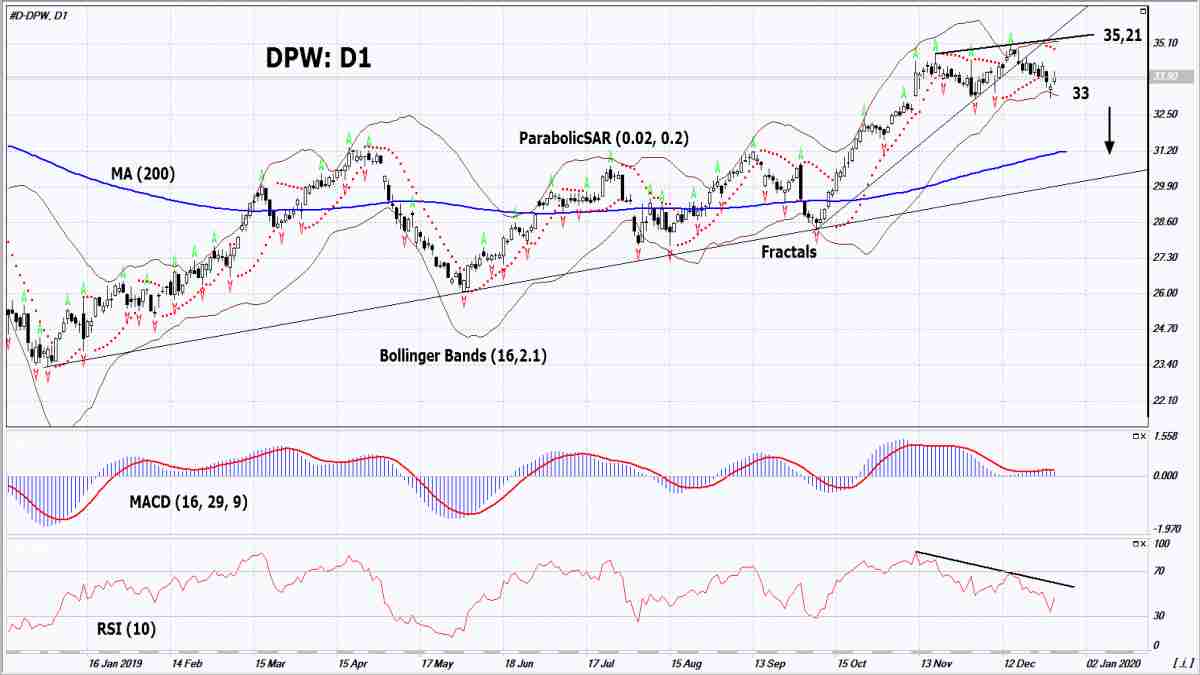
On the daily timeframe, the DPW: D1 breached down the support line of the medium-term uptrend and is traded in a neutral range. A number of technical analysis indicators formed sell signals. It is possible in case of negative news about the company’s operating activities during the New Year period.
The Parabolic indicator gives a bearish signal.
The Bollinger bands have narrowed, which indicates low volatility. The lower band is titled down.
The RSI indicator is below 50. It has formed a negative divergence.
The bearish momentum may develop in case DPW falls below the two last fractal lows and the lower Bollinger band at 33. This level may serve as an entry point. The initial stop loss may be placed above the last fractal high, the high since May 2018, the upper Bollinger band and the Parabolic signal 35.21. After opening the pending order, we shall move the stop to the next fractal high following the Bollinger and Parabolic signals. Thus, we are changing the potential profit/loss to the breakeven point. More risk-averse traders may switch to the 4-hour chart after the trade and place there a stop loss moving it in the direction of the trade. If the price meets the stop level (35.21) without reaching the order (33), we recommend cancelling the position: the market sustains internal changes that were not taken into account.
By Orbex – There are bubbling expectations that the UK might look to run trade talks with the US in parallel with its negotiations with the EU.
The UK PM’s spokesperson spoke during a briefing at Westminster this week. He told reporters that the UK would be “free to hold trade discussions with other countries across the world” following the January 31st departure date.
Johnson’s spokesman said:
“Once we have left the EU on January 31 we will be free to hold trade discussions with countries across the world and not just focus on discussing the future partnership with the EU.”
MP’s Split Over Handling Trade Talks
These comments follow reports over the weekend from UK newspapers revealing that the PM’s cabinet is divided over how best to approach the trade deal negotiations with the EU.
The report by the Sunday Times highlighted that some top ministers, such as Dominic Raab and Liz Truss, are in favor of running parallel talks with the US in order to exert pressure on the EU.
However, according to the report, other cabinet ministers deem this approach “unrealistic”.
MPs Debate Brexit Bill
UK MPs have returned from their Christmas break. They are now taking part in three days of debate on the PM’s Withdrawal Agreement Bill, before a final vote on Thursday.
Expectations are for the bill which was passed in its initial stage before Christmas, to be confirmed this week. This is primarily due to the strong majority held by the Conservative party in parliament.
Confirmation of the bill will see the UK leave the EU on January 31st. This will activate the transition phase, currently due to end on December 31st, 2020.
Deadline In Question
There is still a great deal of controversy around the current deadline for the transition phase.
Many critics argue that 11 months is nowhere near enough time to establish a proper trade deal. Many have even accused Boris of setting the talks up for failure.
Despite the criticism, Johnson remains adamant that the two sides can hammer out a deal within the current timeframe. However, he has warned that he will not extend the deadline if a deal is not ready. He is adamant that he remains prepared to leave the EU without a trade deal if necessary.
The issue of the deadline raises risks for GBP into the back end of the year. However, for now, it seems that traders are reveling in the calmer conditions. A no-deal Brexit is now out of the picture.
GBP has been well supported over recent weeks and looks likely to continue higher in the near term.
Technical Perspective
GBPUSD continues to fluctuate around the 1.3057 level. The initial breakout last month, was capped by the long-term bearish trend line from 2015 highs. That being said, the retest of the shorter-term bearish trend line has held as support.
While price holds above the 1.3057 support, focus remains on further upside with the 1.3375 level the key topside level to watch. To the downside, the 1.2768 level is the main structural support with the bullish trend line from 2019 lows coming in around the same level.
Another wild week for oil traders with missiles flying and huge overnight price swings in crude. As we recently pointed out within our current Oil research article, Oil and the Energy sector may be setting up for another great trade. We recently commented on how the supply/demand situation for oil has changed over the past 20+ years.
With US oil production near highs and a shift taking place toward electric and hybrid vehicles, the US and global demand for oil has fallen in recent years. By our estimates, the two biggest factors keeping oil prices below $75 ppb are the shift by consumers across the globe to move towards more energy-efficient vehicles and the massive new supply capabilities within the US.
Our researchers believe the downside price rotation in Crude Oil early this week, after the US missile attack in Iraq, suggests that global traders are just not as fearful of a disruption in oil supply as a result of any new military actions in Iraq, Iraq or anywhere near the Middle East. If there was any real concern, then the price of Crude Oil would have spiked recently.
This leads us to believe the inverse Energy ETF, ERY, maybe setting up a very nice bottom in price below $40. Ultimately, we believe a deeper price bottom may set up in the next 10 days where ERY may trade below the $36~37 range, but time will tell if we are correct about this or not.
Historically, price levels below $40 have resulted in some very nice long trade setups in ERY. This ERY Daily chart highlights the Support Channel we believe exists in ERY and why we believe any entry-level below $36 is an outstanding entry point for any future upside price move.
Weekly ERY Chart
This Weekly ERY chart highlights the past rallies that have originated from within the Support Channel. Pay special attention to the size and scope of these moves. The October 2018 rally resulted in a 183% price rally. The April 2019 rally resulted in a 57% price rally. The July 2019 rally resulted in a 50% price rally and the last move in September 2019 resulted in a 41% price rally.
Could this next setup in ERY be preparing for another 40% to 60%+ upside price rally?
We believe the setup in ERY is very close to generating an entry trigger. We have not issued any new trade triggers for our members-only service as we are waiting for confirmation of a potentially deeper price move in ERY. Right now, get ready for what may become a very good setup in ERY over the next few weeks.
Watch what happens in the energy sector over the next 30 to 60 days. We may be setting up for a fairly large price rotation as the tensions spill over into the global markets and precious metals. We may find that Oil is the big loser over the next 60+ days.
Profit during times when most others can’t which is why you should join my Wealth Trading Newsletter for index, metals, and energy trade alerts. Visit our website to learn how you can see what this research is telling us.
NOTICE : Our free research does not constitute a trade recommendation or solicitation for our readers to take any action regarding this research. It is provided for educational purposes only. Our research team produces these research articles to share information with our followers/readers in an effort to try to keep you well informed. Visit our web site (www.thetechnicaltraders.com) to learn how to take advantage of our members-only research and trading signals.
The US dollar is rebounding after a patch of strong economic reports from the United States.
The ISM non-manufacturing PMI was higher at 55.0, beating estimates of 54.5. It was also higher compared to November’s print of 53.9.
The trade balance figures also narrowed as exports outstripped imports. However, given the broader middle east tensions, investor sentiment remains in check.
Eurozone Flash Inflation Within Estimates
The latest flash inflation estimates for the eurozone for January matched expectations. Headline inflation rose by 1.3%, matching forecasts, while core CPI was also up 1.3% during the period ending January 2020.
However, the euro remained unimpressed by the big change in inflation. In a separate report, eurozone retail sales rose by 1.0%, beating estimates of a 0.6% increase.
EURUSD Back to Lower Support
The declines in the common currency sent EURUSD back to the support area of 1.1131. This comes amid a failure to breakout above the resistance level. The formation of a lower high also suggests that the downside momentum is building. In the event of a breakout below 1.1131 support, we expect the euro to slip to 1.1100 level next.
Brexit Fears Resurface Dampening Demand for GBP
With less than 24 days to go, Brexit is back in the headlines. UK Prime minister, Boris Johnson said that he is pushing for speedy talks with the EU. Despite the January 31 deadline, both parties are expected to kickstart a transition period for the trade negotiations to continue. The pound sterling is trading weaker on the day.
GBPUSD Holds on to Support
Price action in the GBPUSD is currently weaker as the support level of 1.3100 is being tested. We expect the currency pair to stay range-bound within 1.3226 and 1.3100 in the short term. A breakout from this region is required that will confirm the direction. For the moment, the bias remains to the upside.
Gold Holds Steady on Caution
Gold prices retreated on Monday, but price action remains bullish. The precious metal remains well bid as the ongoing tensions between Washington and Tehran show no signs of abating. Even some positive economic data from the US did not help stem the bullish gains in gold prices.
Will XAUUSD Breakout Higher?
This is the question to ask as gold prices approach the previous highs near 1577.68. A breakout past this level will confirm further gains to the upside. The next main target is at the 1600 level. However, if there is a correction, gold prices will be initially stalling near the current lows of 1557.76. A breakdown below this level will trigger declines down to 1534.
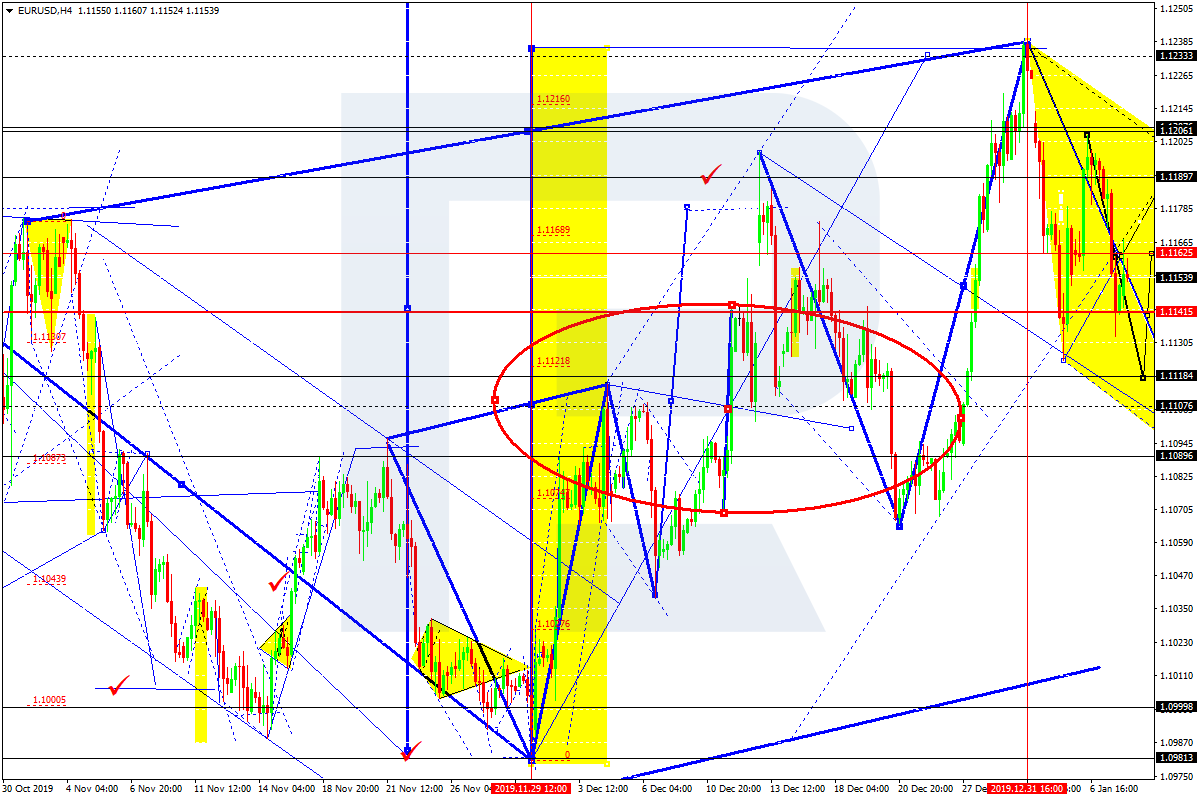
EURUSD is correcting towards 1.1090. Possibly, today the pair may fall with the short-term target at 1.1120 and then form one more ascending structure towards 1.1163, at least. Later, the market may start another decline to reach 1.1090.
GBPUSD, “Great Britain Pound vs US Dollar”
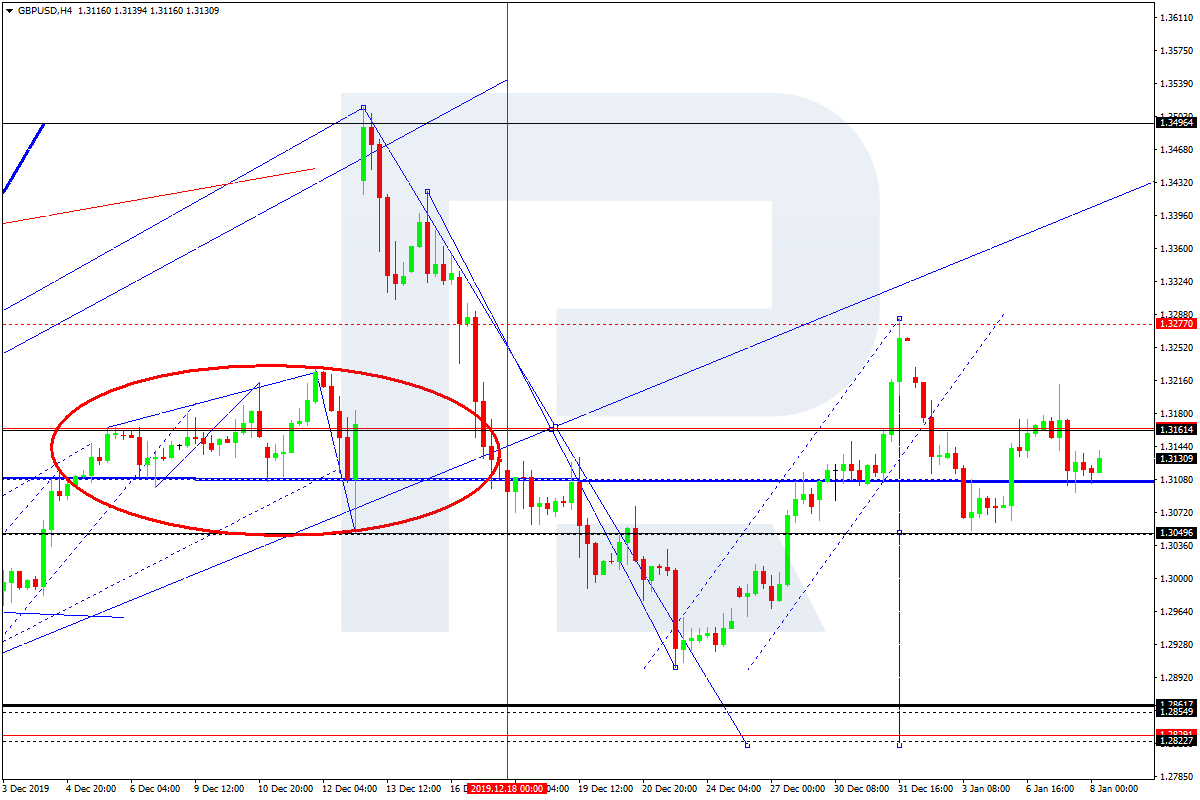
GBPUSD is forming the fifth correctional wave with the target at 1.2822. Today, the pair may reach 1.2888 and then start a new growth towards 1.3050. After that, the instrument may form a new descending structure to reach the above-mentioned target.
USDCHF, “US Dollar vs Swiss Franc”
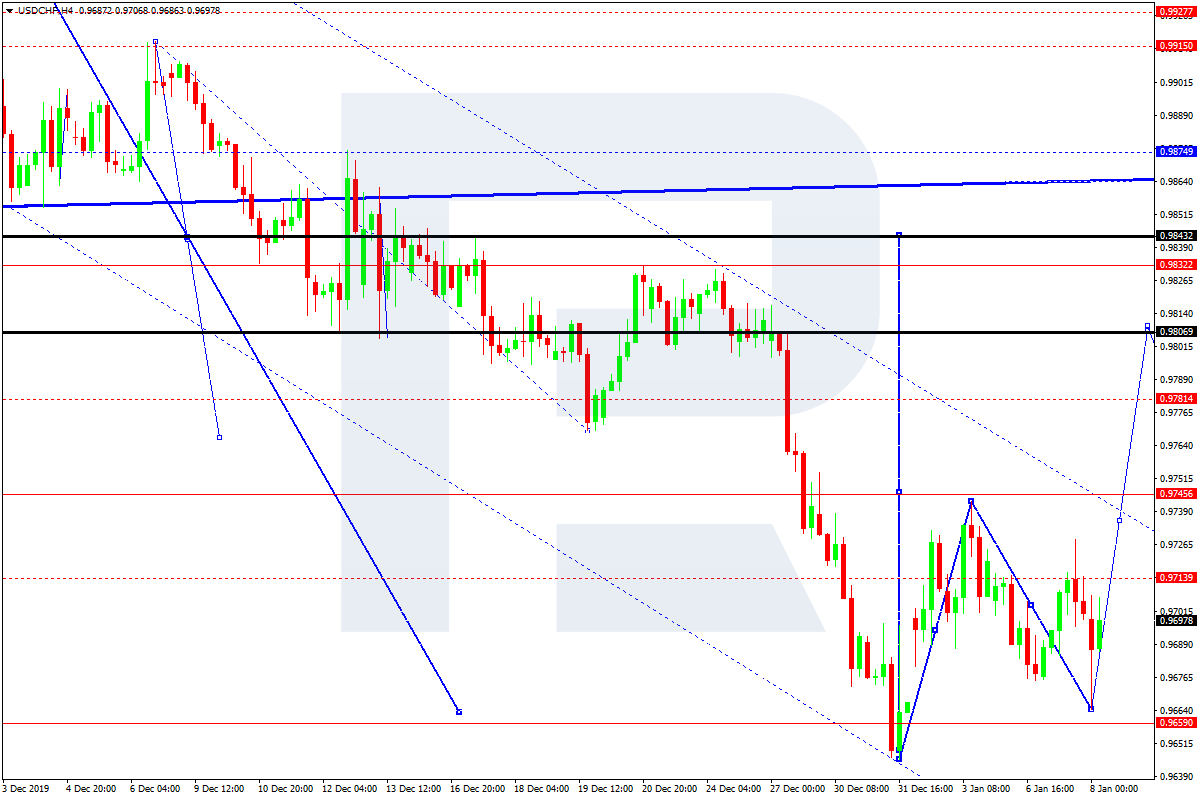
After completing the ascending impulse towards 0.9744, USDCHF has finished the correction at 0.9666. Possibly, today the pair may break this range to the upside to reach the short-term target at 0.9807. After that, the instrument may start a new decline to reach 0.9740 and then resume trading upwards with the target at 0.9844.
USDJPY, “US Dollar vs Japanese Yen”
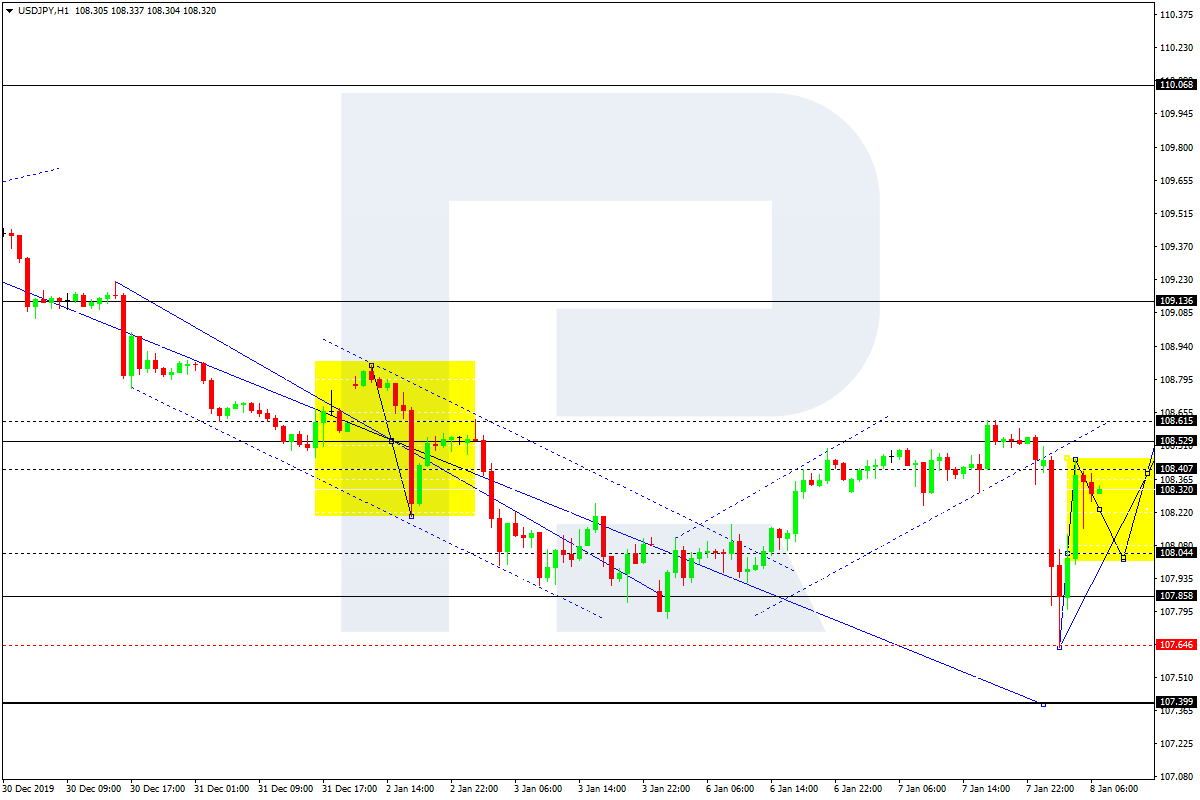
USDJPY has finished the ascending impulse towards 108.40. Today, the pair may correct to reach 108.05 and then start another growth with the target at 108.76.
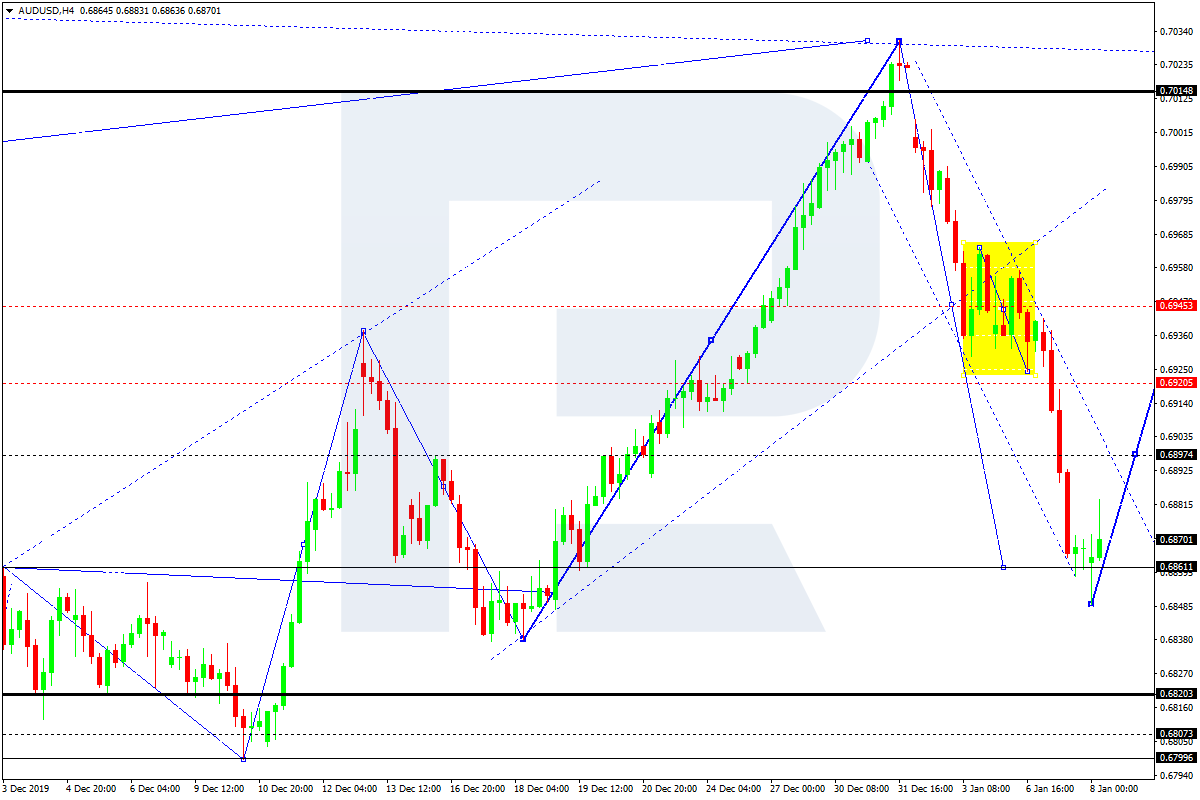
AUDUSD, “Australian Dollar vs US Dollar”
AUDUSD has reached 0.6860; right now, it is consolidating near the lows. Possibly, the pair may form one more ascending structure with the target at 0.6945.
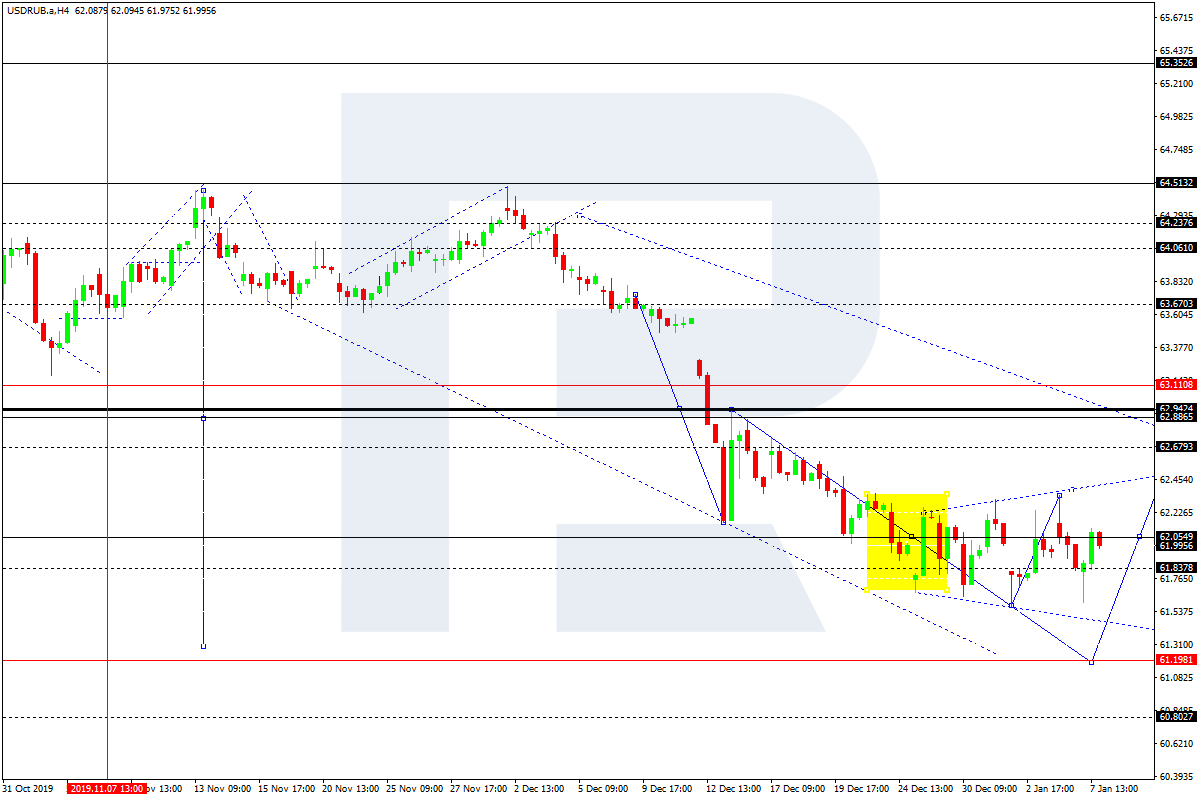
USDRUB, “US Dollar vs Russian Ruble”
USDRUB is consolidating around 62.00. The main scenario implies that the price may continue trading inside the downtrend towards 61.20. Later, the market may correct towards 63.00 and then resume moving downwards to reach 60.90.
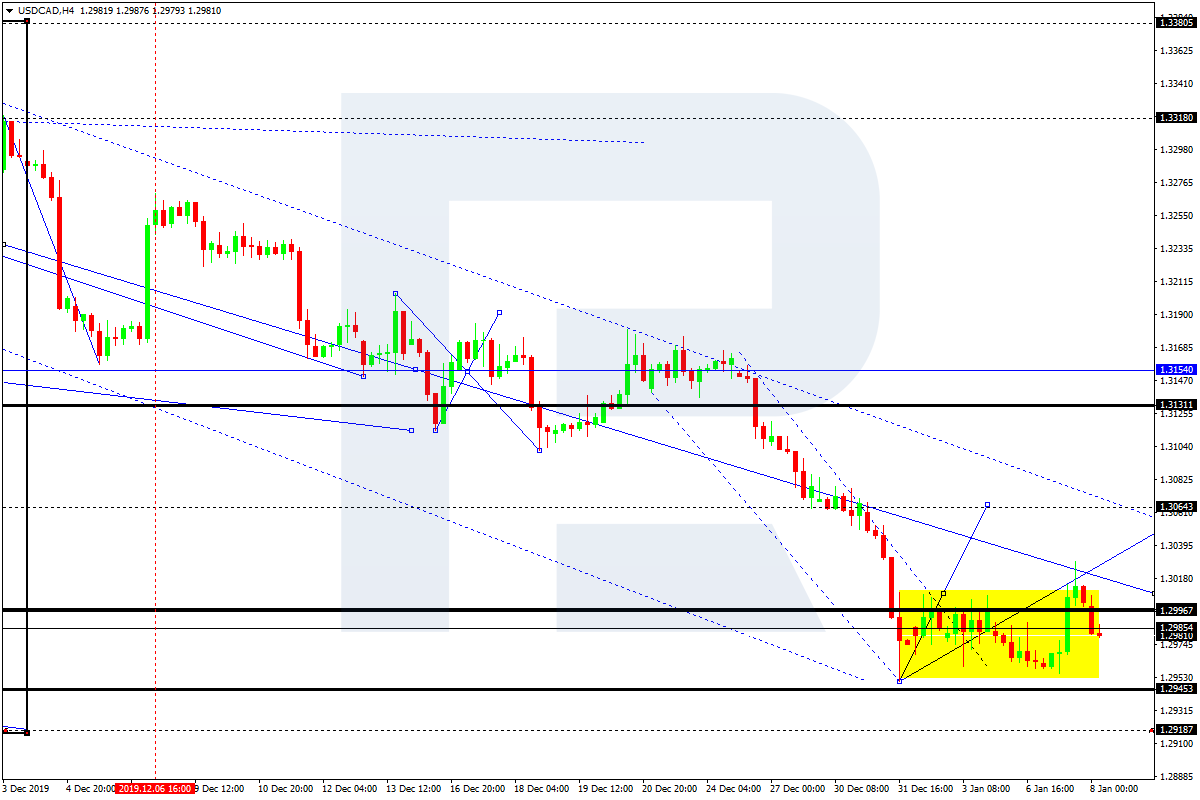
USDCAD, “US Dollar vs Canadian Dollar”
After reaching the short-term target at 1.2970, USDCAD continues moving downwards to reach 1.2950; right now, it is consolidating around 1.2985. Later, the market may break this range to the upside and start another correction towards 1.3060 and then form a new descending structure with the target at 1.2950.
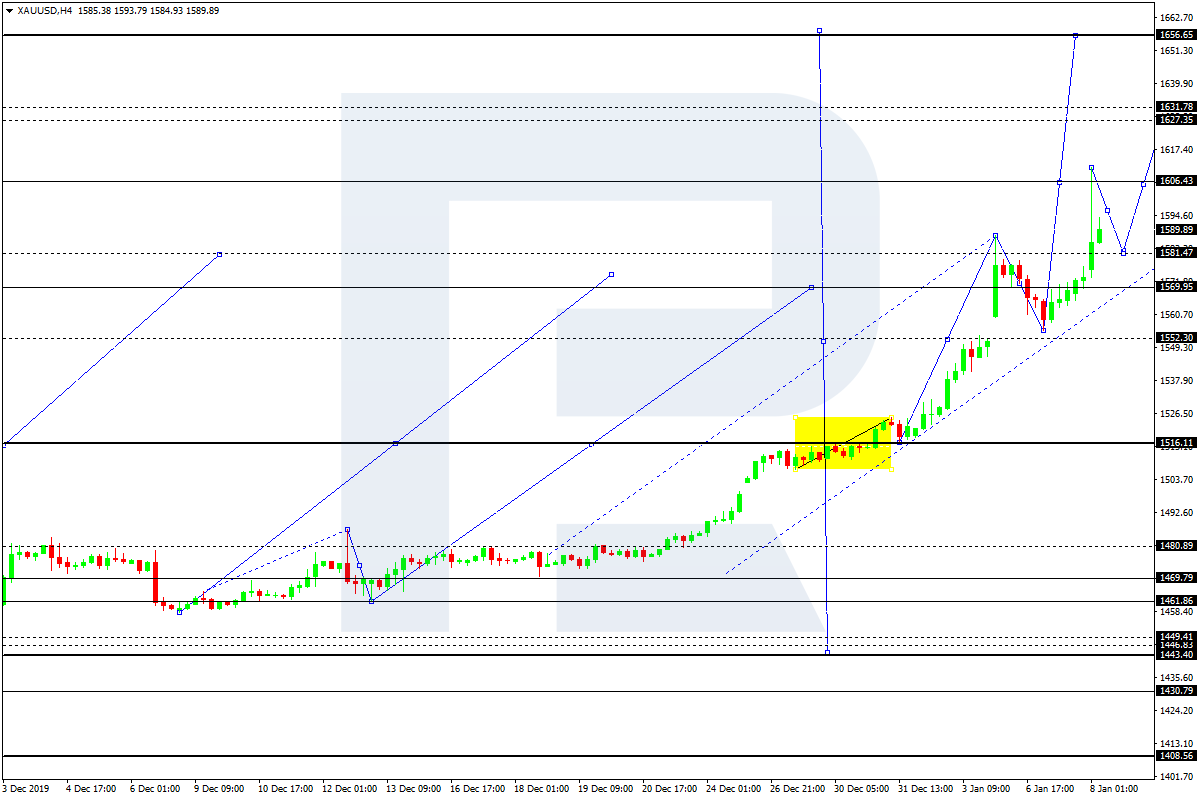
XAUUSD, “Gold vs US Dollar”
Gold continues moving upwards. Possibly, today the pair may test 1581.50 from above and then resume trading inside the uptrend towards with the target at 1627.38. After that, the instrument may start a new decline to reach 1606.50 and then form one more ascending structure towards 1656.65.
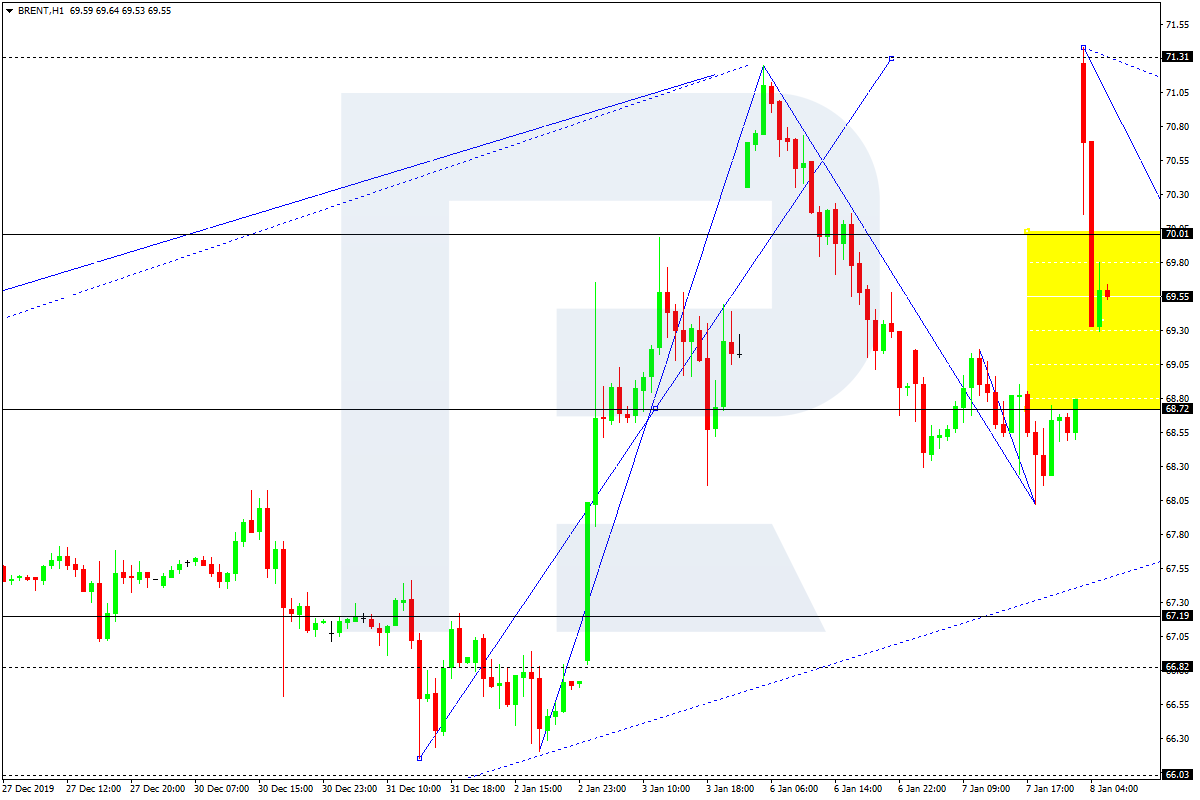
BRENT
Brent has reached the short-term target at 71.31; right now, it is correcting towards 69.72. After that, the instrument may resume trading upwards with the target is at 73.50.
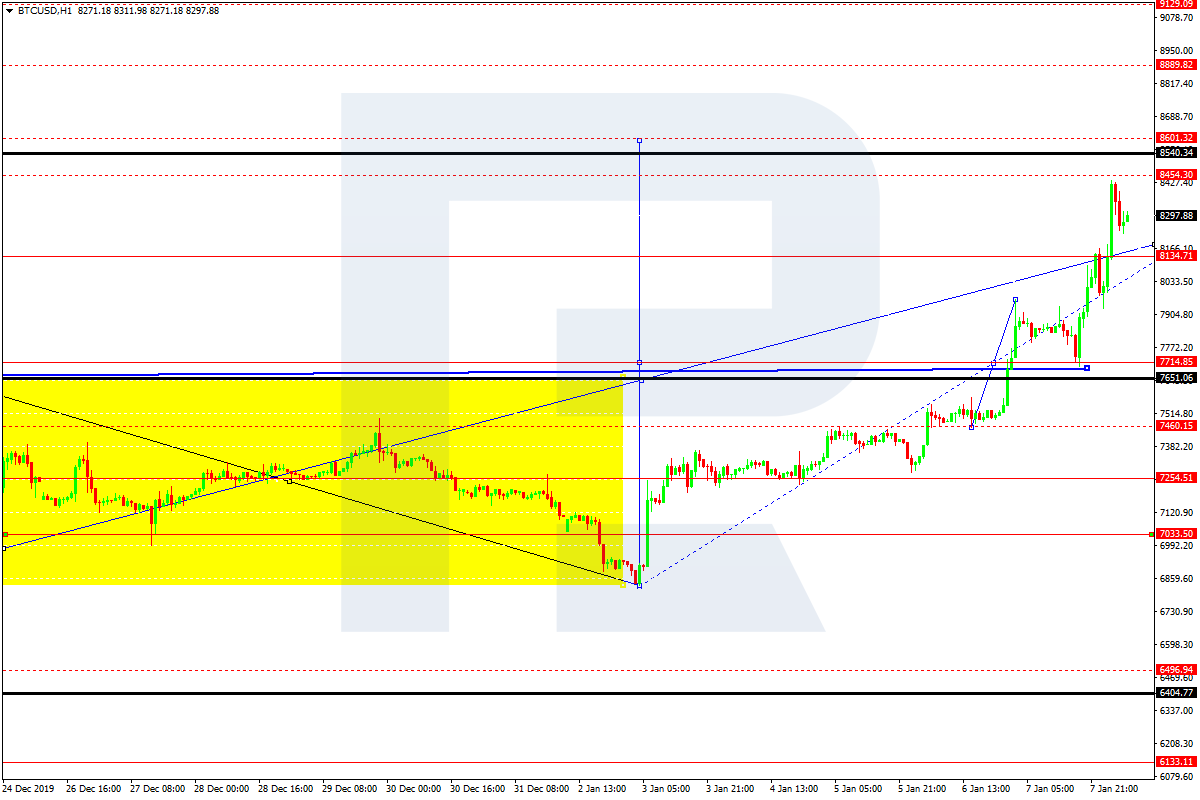
BTCUSD, “Bitcoin vs US Dollar”
After breaking 7700.00 to the upside, BTCUSD continues forming the third ascending wave towards 8600.00. Possibly, today the pair may reach this level and then start a new correction with the target at 7700.00.
Attention! Forecasts presented in this section only reflect the author’s private opinion and should not be considered as guidance for trading. RoboForex LP bears no responsibility for trading results based on trading recommendations described in these analytical reviews.
The US dollar has been on a stronger footing again today. Following a small retracement lower in the index overnight, price is now trading back up to yesterday’s highs, printing 96.73 last. A stronger than expected ISM non-manufacturing reading has helped boost the dollar along with news that the US trade deficit shrank to its lowest level in three years last month.
EUR Lower On Data Miss
EURUSD has been weaker today in light of the rally in USD. Eurozone flash CPI was in line with expectations yesterday at 1.3% though with German factory orders, release today, seen down again last month, EURUSD is trading lower. Price is currently testing the 1.1124 level support.
GBP Holds The Line
GBPUSD is currently flat on the session following the European open. Despite the rally in USD, positive expectations around Brexit are helping keep GBP underpinned at current levels. MPs are currently performing final scrutiny on the PM’s Withdrawal Agreement Bill which is expected to be passed this week. GBPUSD trades 1.3149 last.
Risk Assets Recover
Risk assets have been a little firmer today, recovering from a sharp drop in equities yesterday in response to news that Iran fired ballistic missiles as a US army base in Iraq. The SPX500 shed around 40 points in response to the news though has since recovered to trade back up to 3230s last.
Safe Havens Weaker Following Risk Recovery
Safe havens have been weaker today, following the recovery in risk assets which saw both JPY and gold pulling back from fresh highs. USDJPY trades 108.45 last, having pierced below the 107.89 level in response to news of the Iranian attack. XAUUSD trades 1583.09 last, down from overnight highs of 1611.39.
Oil Backs Off Highs
Oil prices were sharply higher overnight in response to news of the Iranian attack on a US army base in Iraq. Crude prices jumped to highs of 65.44 overnight, before falling back to 62.78 last. Yesterday, the API reported a further, massive drawdown in US crude stores of 6 million barrels. Traders are now waiting on the headline EIA report later today which could see oil higher again if a drawdown is confirmed.
Loonie Recovering
USDCAD has been higher today, supported by the rally in USD and the pullback in crude. USDCAD trades 1.3009 last as the recovery off the 1.2952 level continues. Canadian employment data later in the week will be the main domestic data focus along with the US employment reports.
Aussie Under Pressure
AUDUSD has been a little weaker today, despite the pickup in risk assets, as the recovery in USD weighs. AUDUSD trades .6866 last. The Aussie has been under pressure this week due to building expectations of an RBA rate cut at the bank’s February meeting.