On Wednesday, January 15, the euro was up by 0.2% at the close of trading. Reaction to the signing of the first phase of the US-China trade agreement saw the EURUSD pair rise to 1.1164 (at the 67th degree). New all-time highs were set on US stock indices. Today, US President Trump confirmed that negotiations concerning the second phase of the agreement will begin soon.
Even though the first phase of the agreement has been signed, China remains in a “losing” position. This is due to the fact that the US will maintain its current level of tariffs levied on Chinese imports until the second phase of the trade agreement has been concluded, as announced on Tuesday, by US Treasury Secretary Stephen Mnuchin.
16:30 USA: Retail Sales (MoM) (Dec), Philadelphia Fed Manufacturing Survey (Jan), Initial Jobless Claims 4-week average (Jan 10).
18:00 USA: NAHB Housing Market Index (Jan).
21:00 Eurozone: ECB’s President Christine Lagarde speech.
Current situation:
Yesterday’s expectations for growth were fully justified. During the American session, the euro hit 1.1164 (at the 67th degree).
We have two peaks here: 1.1147 and 1.1164, two bases: 1.1085 and 1.1105. Three values were used for the channel: 1.1085, 1.1105 and 1.1147. As you can see, the price is having difficulty passing the 50% level during growth. Now the 50% level is acting as support.
At the time of writing, the euro is valued at 1.1149. The formation from 1.1085 is complex. The situation is mixed amongst cross pairs. We really wanted to consider growth up to 1.1190, but if we centre on the position of the indicators at 1H and 4H, we can see further weakening of the euro for the lower channel trend line. The minimum projection is shown in the arcs drawn up to the 20:00-mark.
We can expect to see a fall to 1.1127 – the balance line will act as support. A rebound is possible, but given that the wave structure from 1.1085 to 1.1164 is corrective, a rebound is probably not going to happen. At 21:00, ECB President Christine Lagarde is due to make a speech, maybe she will act as the trigger for sharp price fluctuations.
By Hussein Sayed, Chief Market Strategist (Gulf & MENA), ForexTime
The long-awaited “phase one” trade deal has finally been signed. After two turbulent years of trade disputes that have weighed on the global economy, investors got some relief on Wednesday with the US and China agreeing a pause in the trade war.
The main ingredient of the deal is a commitment by China to purchase an additional $200 billion worth of US products over the next two years. Out of the total additional purchases, 39% will be in manufactured goods, 27% in the energy sector and 19% in services. In return, the US will cancel planned tariffs on some consumer products and half the tariff rate from 15% to 7.5% on other goods. However, the 25% tariffs on $250 billion worth of Chinese industrial products will remain in place, as will China’s retaliatory tariffs of $100 billion on US goods.
An enforcement mechanism has also been outlined in the 86-page agreement, but the next steps have been kept vague with no indications as to when we will see a “phase two” agreement.
Market reaction has been relatively subdued to the deal signing. Almost all details were already known to investors and priced into markets. Now investors will need to wait and see if the trade situation improves or levies will be re-imposed, but in the short term, attention will move to corporate earnings and economic data.
So far, more than 80% of US companies who have already reported have managed to beat the bottom line and if this trend continues we may see a positive quarter on a year-on-year basis as opposed to expectations of a 2% decline. This doesn’t necessarily mean stocks will go higher from current levels. The S&P 500 forward P/E ratio is currently standing at 18.4, and without further monetary or fiscal policy easing, it’s going to be difficult to justify a further rally in prices.
Disclaimer: The content in this article comprises personal opinions and should not be construed as containing personal and/or other investment advice and/or an offer of and/or solicitation for any transactions in financial instruments and/or a guarantee and/or prediction of future performance. ForexTime (FXTM), its affiliates, agents, directors, officers or employees do not guarantee the accuracy, validity, timeliness or completeness, of any information or data made available and assume no liability as to any loss arising from any investment based on the same.
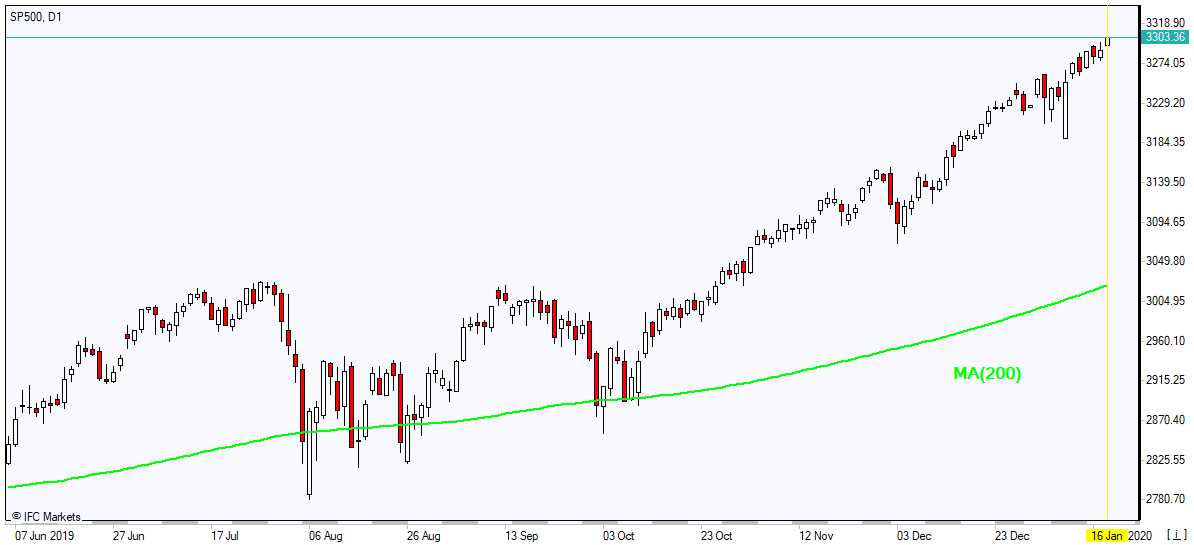
US stock market edged up to new records on Wednesday after President Trump signed the first phase of a trade agreement with China. The S&P 500 gained 0.2% to fresh record 3289.29. The Dow Jones industrial average rose 0.3% to new record 29030.22. Nasdaq added 0.1% 9258.70. The dollar strengthening reversed as the Labor Department reported US producer-price index rose below expected 0.1% in December. The live dollar index data show the ICE US Dollar index, a measure of the dollar’s strength against a basket of six rival currencies, declined 0.2% to 97.19 and is lower currently. Futures in stock indexes point to higher openings today.
FTSE 100 rose while other European indexes slipped
European stocks ended marginally higher on Wednesday ahead of US-China phase one deal signing. EUR/USD joined GBP/USD’s continued slide with both pairs lower currently. The Stoxx Europe 600 ended up 0.01% led utilities stocks. Germany’s DAX 30 declined 0.2% to 13432.30 despite. France’s CAC 40 slipped 0.1% while UK’s FTSE 100 rose 0.3% to 7642.80.
Australia’s All Ordinaries Index still ahead other Asian indexes
Asian stock indices are mostly higher today after US and China signed the interim phase one trade deal. Nikkei added 0.1% to 23933.13 as yen slide against the dollar resumed. Chinese stocks are mixed after vice premier Liu He signed the phase one deal in Washington committing to increase purchases of U.S. agricultural and other products, by more than $200 billion over the next two years, though “at market prices based on commercial considerations.”: the Shanghai Composite Index is down 0.5% while Hong Kong’s Hang Seng Index is 0.1% higher. Australia’s All Ordinaries Index added 0.7% with Australian dollar climb against the greenback intact.
Brent futures prices are extending losses today. Prices slipped on Wednesday despite EIA report US crude oil inventories fell by 2.5 million barrels last week. As shares of Saudi Aramco are trading on the country’s Tadawul exchange. JPMorgan rated Saudi Aramco “overweight,” setting a price target of 37 riyals ($9.86) per share. At the same time Citigroup gave Aramco a neutral rating with a price target of 34.1 Saudi riyals. Meantime Morgan Stanley rated Saudi Aramco as “underweight.” And Goldman Sachs issued Saudi Aramco a 12-month price target of 41 riyals a share, implying a potential 18% upside.
Gold retreats after rebound
Gold prices are edging lower after Wednesday’s pickup. The price of an ounce of gold for February delivery rebounded 0.6% to $1,554 Wednesday as the dollar strengthening reversed.
Note: This overview has an informative and tutorial character and is published for free. All the data, included in the overview, are received from public sources, recognized as more or less reliable. Moreover, there is no guarantee that the indicated information is full and precise. Overviews are not updated. The whole information in each overview, including opinion, indicators, charts and anything else, is provided only for familiarization purposes and is not financial advice or а recommendation. The whole text and its any part, as well as the charts cannot be considered as an offer to make a deal with any asset. IFC Markets and its employees under any circumstances are not liable for any action taken by someone else during or after reading the overview.
Chris Temple, editor and publisher of The National Investor, explains why he recommends this small-cap as a Buy.
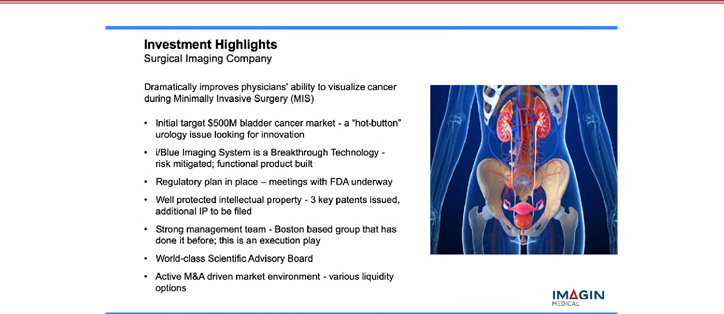
Imagin Medical’s disruptive technology is poised to deliver the most significant advancement in bladder cancer detection and removal in decades, making the detection and removal of cancer FAR more efficient and effective.
Already, Imagin’s i/Blue Imaging System is being embraced by urologists; most recently at the American Urological Association’s annual meeting, held in May in Chicago. Imagin held private focus groups, where leading urologists assessed the initial functional product and provided overwhelmingly positive feedback that was used to finalize the i/Blue product user’s needs.
So compelling is Imagin’s proprietary technology and potential benefits for both medical professionals and especially patients that leading urologists have even invested in Imagin Medical!
Whether in bull or bear markets, long-term success for individual investors has always primarily come from discovering and buying good companies when they are cheap.
Sometimes it’s a household name or some other large company that for a time is “unloved” for whatever reason on Wall Street. Many a time, we have picked off such companies at a low level and done quite well.
The real fun, though, is when we can find a company that almost nobody knows about.
Advances in science and technology. . .more efficient means of transportation and communication. . .pending CURES for diseases rather than just better treatment. . .and so many more themes are continually sought after. When you find the right combination of management, support, market need and the rest in a young company, the rewards (and not just monetary) can be astounding!
As I teach in a FREE tutorial on stock picking/research (easily accessible on my website), sometimes great investment ideas are right under our noses one way or another as we go about our everyday lives. Who among us, for instance, does NOT remember the decades-long run of the late actor and comedian Jerry Lewis and his annual Labor Day telethons? For many years our hearts broke for “Jerry’s kids” who were beset by one form or another of the scourge muscular dystrophy.
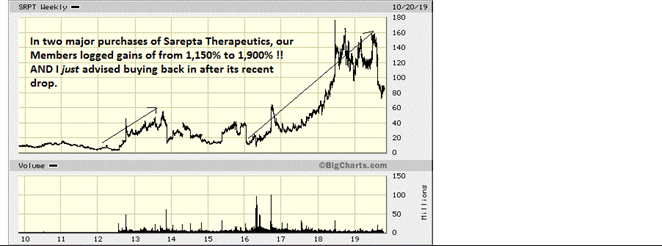
Years ago my “homework” brought me into contact with a tiny biotech start -up whose science on RNA-based therapeutics showed great promise. Sure enough, shares of Sarepta Therapeutics hit the big time back in 2012, when trials in adolescent patients who have Duchenne muscular dystrophy actually showed that Sarepta’s drug was allowing some of them to produce dystrophin and GROW muscle tissue!
Such a breakthrough as this had never before been seen. Sarepta has now gone from the tiny, largely unknown company it was when I first ran across it to, now, a multi-billion dollar biotech leader. Our members who followed my recommendations on Sarepta have made GOBS of money. More so, we have the satisfaction of being part of a great STORY that is changing lives for the better!
Biotechnology and other medical and health-related breakthroughs, from an investment perspective, are not only exciting and potentially VERY rewarding. They are opportunities as well that have little if anything to do with the broader economy and stock market. So arguably more than in any other sector of the market, health care/biotechnology companies are driven chiefly by their success. . .or failure.
As this is written I have other “story stocks” in this sector among my recommendations: companies working on everything from Alzheimer’s disease (a “return trip” in this one as well, after quadruple-digit gains here, too, a few years back!), to a potential reversal of type one diabetes.
And in the medical device/technology area, we have Imagin Medical.
Imagina company I have already recommended to my members at The National Investoris working on one of the most disruptive new technologies for medical devices in many years.
Chiefly, its technology holds the promise of leading to the most efficient detection and removal of bladder cancer of anything the industry has seen in some 30 years. Managed by a team with past success already in bringing transformative new products to market, Imagin has already been embraced by key urologists and opinion leaders in that industry. Some of them have already become shareholders of Imagin Medical to boot!
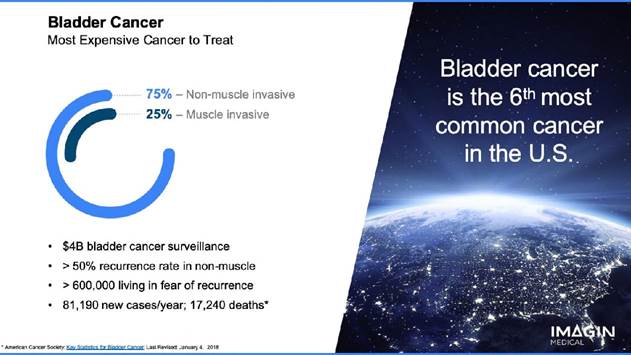
The need for a better, more efficient, modern standard of care is indisputable. Bladder cancer is the sixth-most prevalent cancer in America. One reason for its recurrence in too many patients is that the medical profession is, quite simply, using dated technology to detect bladder cancer in the first place. Imagin’s i/Blue Imaging System has the potential to be a game-changer in this area!
As I write this, the company has just had its second key meeting with the U.S. Food and Drug Administration.
On the home page of its website, Imagin Medical bills itself as a medical device andmoreso technology company that is, “. . .focused on establishing a new standard of care in visualizing cancerduring minimally invasive surgery. . .”
As I have rolled up my sleeves and come to get to know Imagin better, the companywhich intends to initially focus on bladder cancerseems to have an imaging technology and platform that is at the same time revolutionary . . . yet quite simple and common-sense. The concept has already shown a better ability to detect cancer and allow urologists to be more certain that they have completely removed it in a procedure.
I’ll quickly explain the current technology here, on the way to explaining how Imagin’s i/Blue Imaging Systemif commercially successfulwould be such a benefit to both doctors and patients.
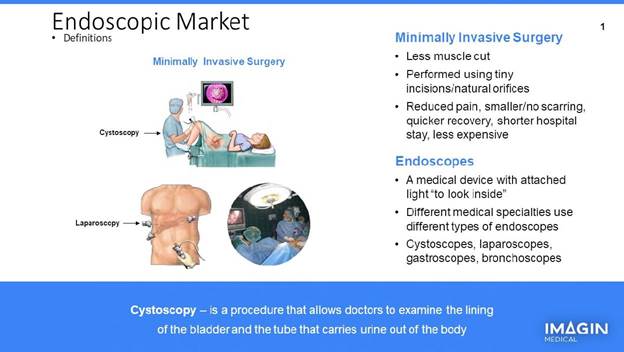
Surgical practices have advanced tremendously over the years with advances in technology and know-how. For many procedures, it was once common to open up a part of the bodysay, an abdomenand take care of what needed to be done. Among the things this meant was a longer hospital stay and a longer time to recover and heal following such an invasive procedure.
For almost everything, this has been replaced by minimally invasive surgery (MIS). Advances in optical technology especially have effectively allowed small cameras mounted on endoscopes to be inserted in pretty much any area of the body, whether to take out cancerous tissue, repair a hernia or what have you. Once the necessary procedure has been identified via the endoscope (which comes in many shapes and sizes, but all of which pretty much work on the same principles) the procedurefor our purposes, the identification and removal of bladder cancercan also be accomplished more simply than in the past.
In light of this, I’m sure you won’t be surprised to learn that globally, nearly $50 billion a year is spent on endoscopic procedures. This is not always to treat maladies or to eradicate cancerous tissue, but sometimes to confirm that further medical attention is not needed.
Where bladder cancer is concernedthe single most-expensive cancer in North America to treatmore than $4 billion per year is spent in the U.S. alone just on bladder cancer surveillance using the current generation’s imaging technology.
It is in this area that Imagin is focusing its technology to make this surveillanceand what the patient has to endureeasier, more efficient and more successful.
When I first had the opportunity to visit at some length a while ago with Jim Hutchensthe C.E.O. of ImaginI was surprised to learn how in one sense the current technology and products in the market can often fall far short in easily and accurately identifying some cancers and tumors. Indeed, Hutchens quipped that “It is shocking to me how dated it is,” meaning the relatively primitive optics and lighting currently used to “see” bladder cancer and tumors.
In typical white light cystoscopy, a fiber bundle or small camera is mounted at the end of an endoscopeor cystoscope in the case of bladder cancerand enters the body. These scopes are delivered through the urethra and into the bladder to project clear images; essentially, any tumors that protrude above the wall onto a monitor that the surgeon then evaluates for possible removal.
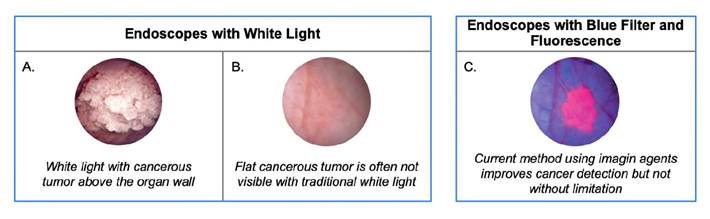
The first challenge of using white light is that a surgeon cannot easily differentiate flat or tiny malignant and premalignant tumors from normal tissue or see the borders/margins of the tumor. Consequently, some cancer cells may remain behind undetected after a procedure. Using this dated technology even now is a contributor to the high recurrence rate of over 50% for bladder cancer.
The “remedy” to this point has been the use of a “blue” light in conjunction with fluorescing imaging agents. The agents are absorbed by the cancerous cells in the bladder. When exposed to blue light, they fluoresce, improving the surgeons’ ability to detect flat cancers and visualize the margin for removal.
The challenge and shortcoming here, though, is that a urologist/surgeon has to switch back and forth between the white and blue images to figure out what is going on. The white light image shows the full landscape of the bladder but doesn’t highlight the cancer. The blue light shows the cancer but doesn’t show exactly where it is, so the surgeon loses orientation. In addition, the current technology gives the surgeons only one image at a time on the monitor, so they have to switch back and forth between the two and compare them from memory to remove the cancer.
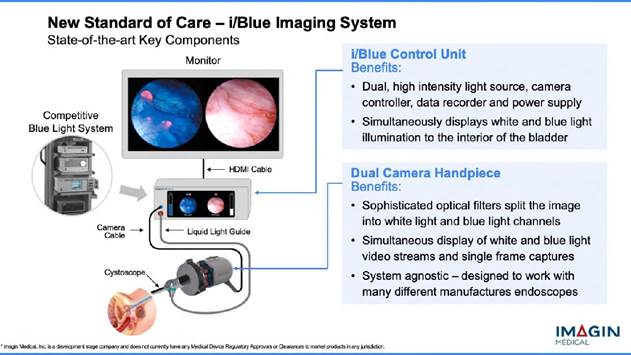
The i/Blue Imaging System addresses this problem because it shows both images on the monitor at the same time, side-by-side, and in real-time. So now, the surgeon won’t have to switchback and forth and rely on memory to locate and remove the cancer. The procedure has the potential to make bladder cancer detection and removal more efficient and faster, as well as dramatically reduce bladder cancer recurrence rates.
Another ground-breaking aspect of Imagin’s technology is the consolidation of instrumentation. The current blue light method needs a system tower that houses multiple units, including the light source, camera control unit and the video data recorder. The i/Blue Imaging System, on the other hand, using state-of-the -art technology, combines these three modules into one device , taking up a much smaller footprint. The current system is purchased as a “bundle” and, depending on accessories, can cost well over $100,000. The basic bundle includes the system’s three units along with the company’s proprietary hand-held “blue scope” with its built-in camera, the only scope that can be used with this system.
Imagin, however, plans to sell one System Control Unit and package it with a Dual Camera hand piece (see above). Special “blue scopes” are not needed because the i/Blue is “system agnostic,” which means a medical professional can use practically any endoscope that he/she already has together with Imagin’s superior imaging technology/platform. So not only does the addition of Imagin’s breakthrough technology to existing endoscopes provide transformative NEW efficiency, but with a smaller foot print and at a lower cost for the industry! (NOTE: Imagin Medical already has three issued patentswith others pendingon this technology/I.P.Intellectual Property.)
Stressing the relative simplicity of basically adding its own technologythe i/Blue Imaging Systemto the current standards of care/usage in endoscopy, Hutchens reiterated, “We are not in the endoscope business. Our product consists of a dual camera hand piece that houses a micro camera with sophisticated sensors and filters that attaches to endoscopes already in the market and our proprietary consolidated imaging unit. This combination allows us to put both images on the monitor, in real time, simultaneously. This was well received in our focus groups.” (Emphasis added.)
Indeed, a very upbeat Hutchens pointed out when he and I spoke recently how important the feedback was that the company received this past spring at the American Urology Association’s Annual Meeting in Chicago. Imagin held private focus groups where leading urologists assessed the company’s first initial functional product and provided feedback that was used to finalize the i/Blue product’s user needs.
COLLABORATION WITH OPTEL; AND JAY EASTMAN
Again, Imagin is not trying here to totally “reinvent the wheel.” It is simply adding cutting-edge imaging technology to make the “wheel” now used in cancer detection and removal more efficient than anything that has come around now for many decades. To that end, it’s hard to overstate the importance of CEO Hutchens and his team joining forces with such an elite company as Optel.
Notably, Optel is headed up by Dr. Jay Eastman. You might recognize that name, especially if youas I amare from upstate New York and/or know the histories of the legendary companies that made that state their home, such as Eastman Kodak.
An industry leader, Dr. Eastmanwho serves as Imagin’s Director of Developmenthas a Ph.D. in optical design. Those talents are helping move along the i/Blue Imaging System to ultimately bring this disruptive technology to the endoscopy market. You can learn more about Jay in a video interview and here, for some biographical information.
Imagin seems well positioned to use its protected Intellectual Property (specifically where i/Blue is concerned, in its process for simultaneous/parallel acquisition of images and combining them into one monitor) to first exploit the “low-hanging fruit” of the bladder cancer area. Notably, the company obtained much of this technology and patents from California’s prestigious Lawrence Livermore Lab. Indeed, a confident Hutchens recently mentioned to me, “This market is really ready for innovation. . .they know they’re behind.”
OVERALL MANAGEMENT TEAM WITH A PROVEN TRACK RECORD
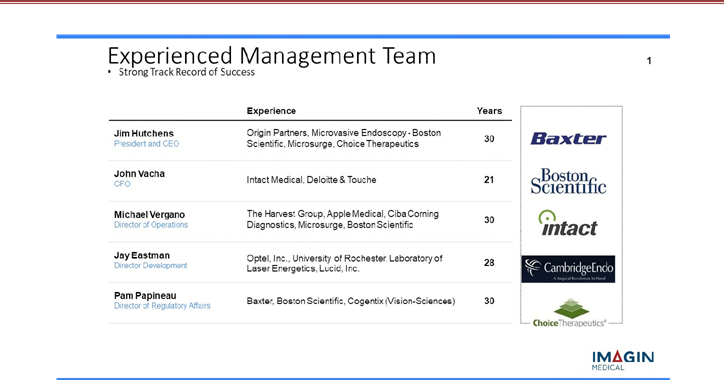
What’s especially nice to know hereapart from the company’s progress to date in moving toward development and commercializationis that this is “not the first rodeo” for Imagin’s management. Looking at the success of Hutchens and others in the medical equipment space overtimeand that added heavyweight name/stature of Dr. Eastman in the optical spacemakes Imagin a compelling story of a potential breakthrough technology being shepherded forward by experienced hands.
President and CEO Hutchens’ own background with the likes of Boston Scientific (NYSE-BSX), particularly in the medical device arena, demonstrates that he knows the ropes in developing and bringing to market new and better technology and products. Among his other past accomplishments aside from serving as an executive at BSX, he founded two other medical device companies. Further, Hutchens (at left, as he spoke last Fall at our Chicagoland investment conference) has bolstered research staff now at Imagin to strengthen the process and development regimen for the i/Blue Imaging System ahead of its recent meeting with the FDA as well as in anticipation of making the hoped-for approval process stronger.
John Vacha, Imagin’s chief financial officer, does not just add financial and administrative acumen. John has 20 years of experience in the healthcare field as well. Among other accomplishments, he holds two patents in electrosurgical administration and has as well brought a medical device company from start-up phase to acquisition, in that latter instance, serving for seven years as president, CEO and board member of Intact Medical Corporation before it was acquired by Medtronic, plc (NYSE-MDT) in 2017.
Among other key people, Imagin has brought on board Pam Papineau as sirector of regulatory affairs. Ms. Papineau has over 30 years of experience in quality and regulatory affairs with Baxter, Boston Scientific and Cogentix (Vision-Sciences) and has served as a consultant on a wide variety of devices that includes endoscopy, imaging, GI/GU, orthopedic and cardiovascular. She has successfully prepared dozens of FDA premarket submissions and European Union (EU) technical files.
A key medical advisor to Imagin is Dr. Ashish Kamat. He has been named by Expertscape as the world’s the top-rated expert in urinary bladder neoplasms. Dr. Kamat has extensive experience with cystoscopic procedures, has been a principal investigator for multiple oncology and urology clinical studies for both drugs and devices, and has been involved in blue light cystoscopy studies since 2007. Dr. Kamat is an Endowed Professor of Urologic Oncology and Cancer Research at the University of Texas MD Anderson Cancer Center (MDACC); Associate Cancer Center Director, RFHNH in Mumbai; and President of International Bladder Cancer Group (IBCG) and International Bladder Cancer Network (IBCN).
I encourage you to visit here for an even more complete background on all of the company’s management and advisers.
DEVELOPMENT PROGRESS; WHAT COMES NEXT
Like all medical device companies, Imagin’s fate will be determined by ultimate FDA approvals of the i/Blue Imaging System, its eventual design tweaks and then manufacturing of that system. This is why Hutchens early on knew he had to assemble such a top-flight team, one with direct, hands-on medical device experience in moving products from concept through development to commercialization, including managing the FDA process.
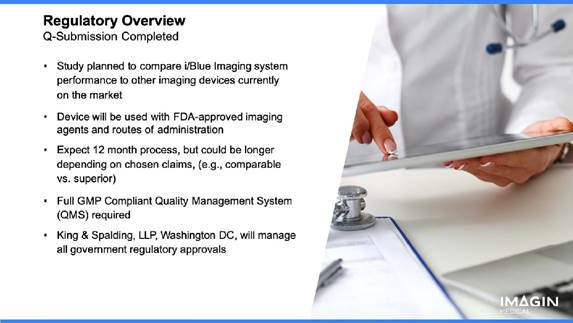
On September 26 Imagin announced that it had met with the FDA for its second so-called “Q-Sub” meeting. “We are pleased with the feedback we received from the FDA during our second meeting to discuss i/Blue’s regulatory path,” said Hutchens. “We will continue to collaborate with the Agency as we move closer to our submission package.”
The company had already announced progress back in Julybolstered, in part, by feedback from that May meeting/focus groupsthat its i/Blue product has entered the verification stage of the medical device design control process.
Along the way, a University of Rochester Medical Center 10-subject investigator-sponsored research study had led to some key redesign work of i/Blue. Imagin, in conjunction with Optel, furthered the refinement of the product, essentially from a “clunky box” to the streamlined unit that received such a positive reception back in May at that American Urological Association conference.
Said Dr. Eastman along the way, “The lessons learned from the URMC Research Study has provided valuable technical data, clinical insight and physician feedback that has significantly influenced the design of the i/Blue System. All of this information increased our confidence that the miniaturization, imaging quality and cost reduction goals for the i/Blue System are important to surgeons performing bladder cancer procedures.”
These design improvements will ultimately allow a surgeon/urologist to be more efficient in their work, and thatof courseis the whole point. And there’s something else: that is, Imagin hopes a successful development and commercialization of a superior and cost-effective system will bring the i/Blue Imaging System into practitioners’ offices as well. Greater efficiencies and a better standard of care still could be effected by urologists having such a state-of-the-art and quick system on hand outside the operating room, whether for initial examinations or post-procedure follow-ups.
Now, Imagin is moving forward to finish final design and manufacture of the initial i/Blue functional products, along with the necessary documentation to support them, over the coming few months (hopefully, in fact, prior to the end of 2019.) If all goes well and there are not any unforeseen delays, the company believes it can have a final product ready for commercialization and approval by late 2020. Thereafter, sales and revenue could commence very soon.
A COMPELLING INVESTMENT THESIS AND “RISK-REWARD” DYNAMICS
For any start-up/research-oriented company, a LOT has to go right. More companies over time fail than those which succeed for one or more reasons: everything from inept management and a lack of money to see things through, to the lack of legitimate expertise in its area, to misreading the need for its product/technology and more.
In the case of any such companyand realizing the general inherent risks of investing in such small companiesI always advocate we approach them and make investing decisions simply as Benjamin Franklin would have done. Franklin famously advocated that in any important decision, one simply write opposing pros and cons on a piece of paper opposite one anotherweight them as necessary, as to importanceand make a decision based on the preponderance of either positive or negative factors.
In my view, making a decision in this way as to investing in Imagin Medical’s shares is no contest, as the pros as I see them significantly outweigh the cons. Management knows what it is doing, in part due to its past experience. It has world-leading, cutting edge technical know-how, especially in the persons of Dr. Eastman and Dr. Kamat.
Most important, what Imagin is working toward is final FDA approval and commercialization, not in and of itself insurmountable. Keep in mind that the i/Blue Imaging System is simply adding its superior optical technology and far greater efficiency/utility to blue-light endoscope techniques that the F.D.A. has already approved.
Still, by their nature, companies involved in most any kind of research and development such as this are deemed to be speculative. Until Imagin has an approved product(s) for commercialization and the game plan/means to begin selling it to the industry, the company has no revenue, let alone a profit. Thusas much as this is a compelling storyeven an Imagin Medical is not a company that you put your grocery money into!
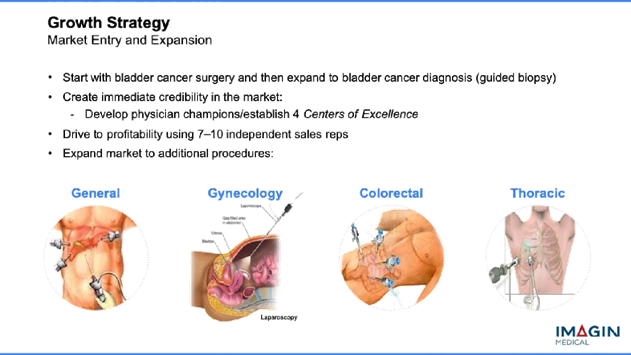
That said, there certainly does appear to be a great potential reward here to go with the usual risk. As of this writing, Imagin has a market cap of a tiny C$7 million, or about US$ 5.4 million. Compare that againstfirstthe US$4 billion market on bladder cancer scoping alone; not to mention thatif successful hereImagin may well be poised to proceed to disrupt other segments of the endoscopy market.
There are two main risks as I see them:
1. The FDA There is no guarantee that the company’s expected time frame will be realized. It may end up being a bit longer before commercialization is achieved. But the seeming risk would be one more to do with delay to satisfy the agency, not anything fundamental that calls into question Imagin’s technology.
2. Funding Still topped up for now following its most recent cash injection late last year (including the exercise of prior warrants, largely by management and “insiders”), it’s likely that by the middle of 2020 Imagin will need to go back to market to raise money. With shares on their back foot due to both some investors becoming impatient and the typical tax-loss selling that hits this time of year, any such financing to come could be dilutive of existing shareholders.
With its team, technology, progress and the rest, though, I think it’s much more a question of that than any worry over Imagin being able to raise money at all. And in any case, some dilution to come or not, Imagin’s market cap and share structure even afterwards will STILL be dwarfed by the potential upside, market penetration, etc.
In making a decision on my part to recommend Imagin Medicaland on your part to invest in itit’s VERY nice to know that we are joining as shareholders medical professionals including Dr. Stan Swierzewski, chief of surgery and director of urology at Holyoke Medical Center in Massachusetts, and Dr. Roger Buckley, division head of urology at North York General Hospital in Toronto.
To say the least, when the potential customers for Imagin’s iBlue System are so excited about what it will do for them and their patients that they want to invest in the company personally, it’s a vote of confidence the likes of which you don’t always see!
Said Dr. Swierzewski PUBLICLY about his own investment decision (investing in a private placement in Imagin in April, 2018),
“As a practicing urologist, I invested in Imagin because I have a duty and responsibility to advance any improvements in treatment and technology that will benefit my patients and save lives. Current technology is cumbersome and time consuming. . .making it less effective as a screening or follow-up tool. Bladder cancer patients are basically monitored for life with in-office cystoscopies which are not effective in differentiating between inflammation and cancer. To be safe, we perform surgery on many patients which often turns out to be negative. Imagin’s i/Blue technology, given its potential speed and sensitivity, will help us assess the patient’s condition more quickly and accurately and avoid unnecessary surgery. It will also make necessary surgery more successful, ultimately saving lives and reducing medical expenses. I’m confident that using the i/Blue system will become the (new) standard of care. . .I cannot wait to use this technology in treating my bladder cancer patients.”
This is all why Imagin Medical is rated as a speculative “BUY” in The National Investor!
I will, of course, have ongoing updates on the company as warranted, whether in my twice-monthly newsletter or, as appropriate, any of my between-issues shorter alerts. For more information, you can visit me at The National Investor.
And, of course, you should do your own due diligence on Imagin Medical directly, starting at the company’s website.
A Reminder. . .
HOW TO PURCHASE SHARES OF IMAGIN MEDICAL IF YOU ARE A U.S. INVESTOR USING A U.S.-BASED BROKERAGE ACCOUNT
For those of you who are not already used to buying shares of companies such as Imagin Medical that are listed primarily in Canada, I want to give you a quick and easy “tutorial.” It’s MUCH easier than you think, if you have never done so, to buy such companies in any U.S. brokerage account. Indeed, as I have explained in one of my investor tutorials, it’s just as easy and inexpensive to buy shares in an Imagin Medical as it is to buy Apple!
Many larger Canadian and other foreign companies have primary listings on more than one major exchange. For those listed on the New York Stock Exchange or the Nasdaq as well as Toronto, you need only buy/sell using the U.S. market. Generally, there would be no reason to check prices and such on the Toronto Exchange first.
More often than not, smaller companiesfor both cost and logistical reasonsdo not LIST their shares on a major U.S. exchange. But they are still easily TRADABLE in the U.S. via the NASDAQ’s OTC Market. All you need to know is the company’s symbol; unlike most U.S.-listed companies, it will always be a five-letter symbol ending with an “F.”
In Imagin Medical’s case, its ticker symbol in the U.S. is IMEXF , while on the Canadian Securities Exchange (CSE) it is IME. (NOTE: The CSE in Canada is the functional equivalent of the U.S. OTC market.)
The main consideration in buying shares of Canadian stocks via the U.S. OTC market is that SOMETIMESif you look at the OTC quote FIRSTyou are not getting as fresh and accurate a price as you would if you went to the Canadian Exchange. This is because with most, the majority of their activity is on the Canadian market where it is listed; sometimes hours can go by between trades on the OTC, if the company you’re looking to buy isn’t actively traded at the time. Thus, you simply need to insure, via a simple process, that you are neither overpaying for a stock when you buy it, nor getting less than you should when you sell. That is easy to accomplish.
The most reliable and current quotes for shares of companies such as Imagin are to be
found first on the Canadian Exchange where they are primarily LISTED. Prices and volume activity are updated all through the trading day on the Toronto Exchange, TSX.V and the CSE (again, the equivalent of the U.S. OTC market), just as they are on the NYSE or NASDAQ, and are generally fresh/instantaneous.
I will use the following example to show the simple process that will normally take you LESS THAN TWO MINUTES to enter a trade to buy Imagin’s stock via the OTC market in the U.S., in a typical U.S.-domiciled brokerage account:
1. First check the Canadian quote for the company, via its ticker symbol on the CSE, IME. You’ll find this at the Exchange’s website. Plug in “IME.” We’ll say for purposes of this lesson that the current asked price for IME’s shares is C$0.06, or 6 cents per share in Canadian currency.
2. Next determine what that price is in U.S. currency. If you don’t follow exchange rates on a daily basis, you can get a fresh picture by going to Kitco’s website, at www.kitco.com (or your own favorite one that lists currency differentials; there are many.) Near the bottom of Kitco’s front page, you will find a table of various currency exchange rates. At this writing the Canadian dollar, rounded off, is worth 76.9 cents in U.S. currency.
3. Do the math as to what IME’s U.S. asked (selling) price on the OTC market should be:
C 6 cents per share X .769 = US 4.61 cents per share.
4. Finally, enter a LIMIT ORDER to buy the number of shares of Imagin you want in your U.S. brokerage account at or very near that price. Personally, I would first start with US 3.9 cents per share; as of this writing, Imagin has a respectable amount of activity/liquidity on the OTC market for a company its size. If the order doesn’t fill right away, bump it up by a tenth of a cent once or twice until it does (these days, most online brokers will allow you to use tenths of a cent in pricing.)You would use the company’s 5-letter symbol, which is IMEXF.
It’s that simple! And, of course, you would do much the same thing when it was time to sell some of your holdings. But in the case of a sale, you would focus on the bid price listed on the CSE’s site for the company in question.
Don’t forget that those of you so inclined can follow my thoughts, focus and all daily.
* On Twitter, at https://twitter.com/NatInvestor
* On Facebook at https://www.facebook.com/TheNationalInvestor
* Via my (usually) daily podcasts/commentaries at http://www.kereport.com/
* On my You Tube channel, at https://www.youtube.com/channel/UCdGx9NPLTogMj4_4Ye_HLLA
Chris Temple is editor and publisher of The National Investor. He has had a more than three-decade career in various areas of the financial services industry. Temple is a sought-after guest on radio stations all across America, as well as a sought-after speaker for organizations. His commentaries and some of his recommendations have appeared in Barron’s, Forbes, the Dick Davis Digest, Investors’ Digest, PrudentBear.com, Kitco.com, the Korelin Economics Report and other media.
Disclosure: 1) Chris Temple: I, or members of my immediate household or family, do not own shares of the following companies mentioned in this article: None. I personally am, or members of my immediate household or family are, paid by the following companies mentioned in this article: None. My company has a financial relationship with the following companies mentioned in this article: Imagin Medical. The National Investor disclosures are below. 2) The following companies mentioned in this article are billboard sponsors of Streetwise Reports: Imagin Medical. Click here for important disclosures about sponsor fees. As of the date of this article, an affiliate of Streetwise Reports has a consulting relationship with Imagin Medical. Please click here for more information. The information provided above is for informational purposes only and is not a recommendation to buy or sell any security. 3) Statements and opinions expressed are the opinions of the author and not of Streetwise Reports or its officers. The author is wholly responsible for the validity of the statements. The author was not paid by Streetwise Reports for this article. Streetwise Reports was not paid by the author to publish or syndicate this article. Streetwise Reports requires contributing authors to disclose any shareholdings in, or economic relationships with, companies that they write about. Streetwise Reports relies upon the authors to accurately provide this information and Streetwise Reports has no means of verifying its accuracy. 4) This article does not constitute investment advice. Each reader is encouraged to consult with his or her individual financial professional and any action a reader takes as a result of information presented here is his or her own responsibility. By opening this page, each reader accepts and agrees to Streetwise Reports’ terms of use and full legal disclaimer. This article is not a solicitation for investment. Streetwise Reports does not render general or specific investment advice and the information on Streetwise Reports should not be considered a recommendation to buy or sell any security. Streetwise Reports does not endorse or recommend the business, products, services or securities of any company mentioned on Streetwise Reports. 5) From time to time, Streetwise Reports and its directors, officers, employees or members of their families, as well as persons interviewed for articles and interviews on the site, may have a long or short position in securities mentioned. Directors, officers, employees or members of their immediate families are prohibited from making purchases and/or sales of those securities in the open market or otherwise from the time of the interview or the decision to write an article until three business days after the publication of the interview or article. The foregoing prohibition does not apply to articles that in substance only restate previously published company releases. As of the date of this article, officers and/or employees of Streetwise Reports LLC (including members of their household) own securities of Imagin Medical, a company mentioned in this article.
6) This article does not constitute medical advice. Officers, employees and contributors to Streetwise Reports are not licensed medical professionals. Readers should always contact their healthcare professionals for medical advice.
The National Investor is published and is e-mailed to subscribers from [email protected]. The Editor/Publisher, Christopher L. Temple may be personally addressed at this address, or at our physical address, which is: National Investor Publishing, P.O. Box 1257, Saint Augustine, FL 32085. The Internet web site can be accessed at https://nationalinvestor.com/. Subscription Rates: $275 for 1 year, $475 for two years for “full service” membership (twice-monthly newsletter, Special Reports and between-issues e-mail alerts and commentaries.) Trial Rate: $75 for a one-time, 3-month full-service trial. Current sample may be obtained upon request (for first-time inquirers ONLY.) The information contained herein is conscientiously compiled and is correct and accurate to the best of the Editors knowledge. Commentary, opinion, suggestions and recommendations are of a general nature that are collectively deemed to be of potential interest and value to readers/investors. Opinions that are expressed herein are subject to change without notice, though our best efforts will be made to convey such changed opinions to then-current paid subscribers. We take due care to properly represent and to transcribe accurately any quotes, attributions or comments of others. No opinions or recommendations can be guaranteed. The Editor may have positions in some securities discussed. Subscribers are encouraged to investigate any situation or recommendation further before investing. The Editor receives no undisclosed kickbacks, fees, commissions, gratuities, honoraria or other emoluments from any companies, brokers or vendors discussed herein in exchange for his recommendation of them. All rights reserved. Copying or redistributing this proprietary information by any means without prior written permission is prohibited. No Offers being made to sell securities: within the above context, we, in part, make suggestions to readers/investors regarding markets, sectors, stocks and other financial investments. These are to be deemed informational in purpose. None of the content of this newsletter is to be considered as an offer to sell or a solicitation of an offer to buy any security. Readers/investors should be aware that the securities, investments and/or strategies mentioned herein, if any, contain varying degrees of risk for loss of principal. Investors are advised to seek the counsel of a competent financial adviser or other professional for utilizing these or any other investment strategies or purchasing or selling any securities mentioned. Chris Temple is not registered with the United States Securities and Exchange Commission (the SEC): as a broker-dealer under the Exchange Act, as an investment adviser under the Investment Advisers Act of 1940, or in any other capacity. He is also not registered with any state securities commission or authority as a broker-dealer or investment advisor or in any other capacity.
Notice regarding forward-looking statements: certain statements and commentary in this publication may constitute “forward-looking statements” within the meaning of the Private Securities Litigation Reform Act of 1995 or other applicable laws in the U.S. or Canada. Such forward-looking statements involve known and unknown risks, uncertainties and other factors, which may cause the actual results, performance or achievements of a particular company or industry to be materially different from what may be suggested herein. We caution readers/investors that any forward-looking statements made herein are not guarantees of any future performance, and that actual results may differ materially from those in forward-looking statements made herein. Copyright issues or unintentional/inadvertent infringement: In compiling information for this publication the Editor regularly uses, quotes or mentions research, graphics content or other material of others, whether supplied directly or indirectly. Additionally he makes use of the vast amount of such information available on the Internet or in the public domain. Proper care is exercised to not improperly use information protected by copyright, to use information without prior permission, to use information or work intended for a specific audience or to use others’ information or work of a proprietary nature that was not intended to be already publicly disseminated. If you believe that your work has been used or copied in such a manner as to represent a copyright infringement, please notify the Editor at the contact information above so that the situation can be promptly addressed and resolved. Additional disclosure: Imagin Medical has paid to National Investor Publishing the sum of US$2,500 for the preparation of and rights to this stand-alone report on the company. Imagin has not paid for the recommendation of the company by either Chris Temple or National Investor Publishing; said recommendation, as disclosed earlier, was already made to paid Members/subscribers to The National Investor prior to the preparation and publishing of this stand-alone Report. Further, as of January, 2020, Imagin has paid to National Investor Publishing the sum of US$10,000.00 to be used/managed at National Investor Publishings discretion to make this report and related information/updates available in a wider fashion through paid placement and other means on various web sites, social media and via other outlets.
Shares of Transenterix opened 50% higher after the company reported that it has submitted a 510(k) submission to the FDA for the first machine vision system for use in robotic surgery.
This morning, medical device company TransEnterix Inc. (TRXC:NYSE.American), which states that it is digitizing the interface between the surgeon and the patient to improve minimally invasive surgery, announced that “it has filed a 510(k) submission with an Intelligent Surgical Unit (ISUTM) that is designed to enable machine vision capabilities on the SenhanceⓇ Surgical System.”
The company’s President and CEO Anthony Fernando commented, “TransEnterix is the first company to seek FDA clearance for machine vision technology in abdominal robotic surgery. Rather than simply passing a video signal to the surgeon, the Intelligent Surgical Unit for Senhance will initially have the ability to actually visualize the surgical field to guide movement and capture information…This technology advance is an important first step towards enabling augmented intelligence and we believe it will support continued machine vision driven advances in surgery performed with the Senhance Digital Laparoscopy Platform.”
Transenterix stated in the report that the ISU will be compatible with the global installed base of Senhance Surgical Systems and other Senhance supported third-party vision systems. The company explained in the report that “the initial features of the ISU are designed to increase control in visualization beyond what has previously been available in digital laparoscopy or robotic surgery.” The firm also advised that though the Senhance System at present, already features unique eye-tracking camera control, the new technology would additionally provide for enabling machine vision driven control of the camera for a surgeon by responding to commands and recognizing certain objects and locations in the surgical field.
Dr. Amit Trivedi, chair of surgery at Hackensack Meridian Health Pascack Valley Medical Center and a participant in the design and usability studies conducted in support of the 510(k) submission of the ISU, commented, “Many of us that perform and teach surgery firmly believe that the care of patients will be transformed by augmented intelligence and machine vision capabilities in the future…Imagine if a computer could be the best assistant you’ve ever had in surgery by anticipating and moving a camera effortlessly to maximize control of the visual field. I’m very excited about this new addition to the Senhance System.”
TransEnterix is a medical device company headquartered in Morrisville, N.C. The firm stated that “it is digitizing the interface between the surgeon and the patient to improve minimally invasive surgery by addressing the clinical and economic challenges associated with current laparoscopic and robotic options in today’s value-based healthcare environment.” The company claims that its Senhance Surgical System which digitizes laparoscopic minimally invasive surgery, offers improved ergonomics, responsible economics and allows for robotic precision, haptic feedback, surgeon camera control via eye sensing. The firm indicated that the Senhance System is intended for use in adult patients in laparoscopic gynecological surgery, cholecystectomy colorectal surgery and inguinal hernia repair.
Transenterix has a market capitalization of around $28.9 million with approximately 19.67 million shares outstanding. TRXC shares opened greater than 50% higher today at $2.25 (+$0.78, +53.06%) over yesterday’s $1.47 closing price. The stock has traded today between $1.79 and $2.62 per share and is currently trading at $1.83 (+$0.36, +24.49%).
Disclosure: 1) Stephen Hytha compiled this article for Streetwise Reports LLC and provides services to Streetwise Reports as an independent contractor. He or members of his household own securities of the following companies mentioned in the article: None. He or members of his household are paid by the following companies mentioned in this article: None. 2) The following companies mentioned in this article are billboard sponsors of Streetwise Reports: None. Click here for important disclosures about sponsor fees. 3) Comments and opinions expressed are those of the specific experts and not of Streetwise Reports or its officers. The information provided above is for informational purposes only and is not a recommendation to buy or sell any security. 4) The article does not constitute investment advice. Each reader is encouraged to consult with his or her individual financial professional and any action a reader takes as a result of information presented here is his or her own responsibility. By opening this page, each reader accepts and agrees to Streetwise Reports’ terms of use and full legal disclaimer. This article is not a solicitation for investment. Streetwise Reports does not render general or specific investment advice and the information on Streetwise Reports should not be considered a recommendation to buy or sell any security. Streetwise Reports does not endorse or recommend the business, products, services or securities of any company mentioned on Streetwise Reports. 5) From time to time, Streetwise Reports LLC and its directors, officers, employees or members of their families, as well as persons interviewed for articles and interviews on the site, may have a long or short position in securities mentioned. Directors, officers, employees or members of their immediate families are prohibited from making purchases and/or sales of those securities in the open market or otherwise from the time of the interview or the decision to write an article until three business days after the publication of the interview or article. The foregoing prohibition does not apply to articles that in substance only restate previously published company releases. 6) This article does not constitute medical advice. Officers, employees and contributors to Streetwise Reports are not licensed medical professionals. Readers should always contact their healthcare professionals for medical advice.
The disruptive technology is ‘poised to deliver significant advancement in bladder cancer detection.’
Imagin Medical Inc. (IME:CSE; IMEXF:OTCQB) is developing technology that can greatly improve the ability to visualize cancer during minimally invasive surgeries. Its i/Blue Imaging System is in development for use in bladder cancer, the sixth most common cancer in the United States. The company has just hit the significant milestone of completing design verification for the system.
The company and its technology have caught the attention of two industry observers.
Chris Temple, editor and publisher of The National Investor, writes that Imagin Medical’s “disruptive technology is poised to deliver the most significant advancement in bladder cancer detection and removal in decades, making the detection and removal of cancer FAR more efficient and effective.”
“Imagin’s i/Blue Imaging System has the potential to be a game-changer.” – Chris Temple
Concerning the value proposition, Temple writes, “There certainly does appear to be a great potential reward here to go with the usual risk. As of this writing, Imagin has a market cap of a tiny C$7 million, or about US$ 5.4 million. Compare that againstfirstthe US$4 billion market on bladder cancer scoping alone, not to mention thatif successful hereImagin may well be poised to proceed to disrupt other segments of the endoscopy market.”
Imagin’s technology has the support of experts in the field. “Already, Imagin’s i/Blue Imaging System is being embraced by urologists; most recently at the American Urological Association’s annual meeting, held in May in Chicago. Imagin held private focus groups, where leading urologists assessed the initial functional product and provided overwhelmingly positive feedback that was used to finalize the i/Blue product user’s needs,” Temple writes.
“So compelling is Imagin’s proprietary technology and potential benefits for both medical professionals and especially patients that leading urologists have even invested in Imagin Medical,” he states.
Imagine Medical’s “technology holds the promise of leading to the most efficient detection and removal of bladder cancer of anything the industry has seen in some 30 years. Managed by a team with past success already in bringing transformative new products to market, Imagin has already been embraced by key urologists and opinion leaders in that industry. Some of them have already become shareholders of Imagin Medical to boot!” writes Temple.
“The need for a better, more efficient, modern standard of care is indisputable. Bladder cancer is the sixth-most prevalent cancer in America. One reason for its recurrence in too many patients is that the medical profession is, quite simply, using dated technology to detect bladder cancer in the first place. Imagin’s i/Blue Imaging System has the potential to be a game-changer in this area,” Temple concludes.
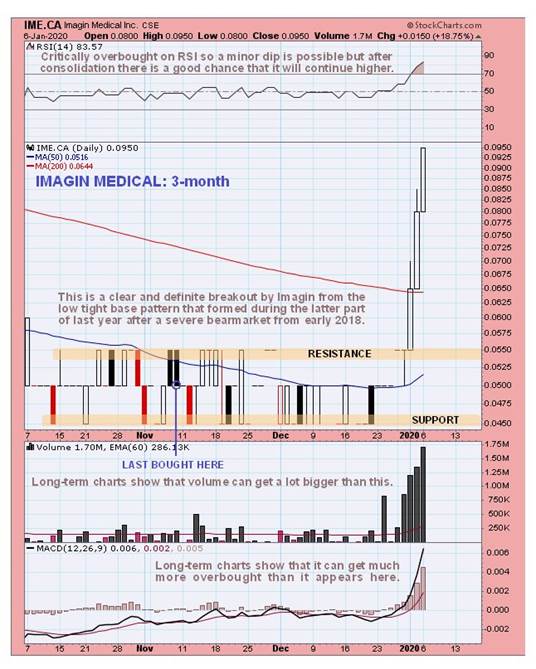
Technical analyst Clive Maund also follows Imagin Medical closely. Writing in CliveMaund.com on January 7, Maund stated, “We were accumulating Imagin Medical stock last fall, most recently in November, and the good news is that it has just staged a dramatic breakout, almost doubling in the last three trading days, or just since the start of the year.
“We can see this dramatic breakout to advantage on the latest 3-month chart, with it soaring above its 200-day moving average on expanding volume to become quite heavily overbought on a short-term basis, which makes it tempting to take profits or at least scale back positions, but should we?”
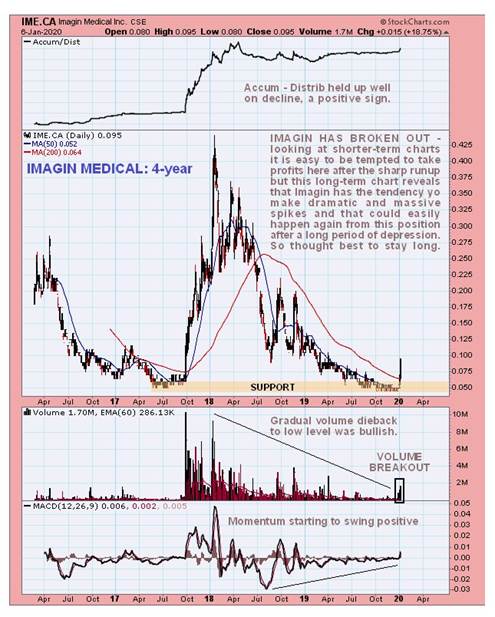
The longer-term charts come in most useful with respect to making such a decision. The 4-year chart shows that when this stock decides to go up, it goes up big, as it did most notably in late 2017 and early 2018. The spike moves can continue for a long time until it becomes massively overbought, and given that this company has a great invention, as we have already observed, it might be foolishly premature to sell this here as it could go much higher. So we stay long and it is a buy on any dips that might occur.
Disclosure: 1) Patrice Fusillo compiled this article for Streetwise Reports LLC and provides services to Streetwise Reports as an employee. She or members of her household own securities of the following companies mentioned in the article: None. She or members of her household are paid by the following companies mentioned in this article: None. 2) The following companies mentioned in this article are billboard sponsors of Streetwise Reports: Imagin Medical. Click here for important disclosures about sponsor fees. As of the date of this article, an affiliate of Streetwise Reports has a consulting relationship with Imagin Medical. Please click here for more information. An affiliate of Streetwise Reports is conducting a digital media marketing campaign for this article on behalf of Imagin Medical. Please click here for more information. 3) Comments and opinions expressed are those of the specific experts and not of Streetwise Reports or its officers. The information provided above is for informational purposes only and is not a recommendation to buy or sell any security. 4) The article does not constitute investment advice. Each reader is encouraged to consult with his or her individual financial professional and any action a reader takes as a result of information presented here is his or her own responsibility. By opening this page, each reader accepts and agrees to Streetwise Reports’ terms of use and full legal disclaimer. This article is not a solicitation for investment. Streetwise Reports does not render general or specific investment advice and the information on Streetwise Reports should not be considered a recommendation to buy or sell any security. Streetwise Reports does not endorse or recommend the business, products, services or securities of any company mentioned on Streetwise Reports. 5) From time to time, Streetwise Reports LLC and its directors, officers, employees or members of their families, as well as persons interviewed for articles and interviews on the site, may have a long or short position in securities mentioned. Directors, officers, employees or members of their immediate families are prohibited from making purchases and/or sales of those securities in the open market or otherwise from the time of the interview or the decision to write an article until three business days after the publication of the interview or article. The foregoing prohibition does not apply to articles that in substance only restate previously published company releases. As of the date of this interview, officers and/or employees of Streetwise Reports LLC (including members of their household) own securities of Imagin Medical, a company mentioned in this article. 6) This article does not constitute medical advice. Officers, employees and contributors to Streetwise Reports are not licensed medical professionals. Readers should always contact their healthcare professionals for medical advice.
Additional disclosures The National Investor has a financial relationship with the following companies mentioned in this article: Imagin Medical.
Clive Maund does not own shares of Imagin Medical and neither he nor his company has been paid by the company.
The report updates and the company being a takeout target are discussed in an iA Securities report.
In a Jan. 7 research note, iA Securities analyst George Topping reported that Rubicon Minerals Corp. (RMX:TSX; RBYCF:OTCMKTS) updated the mineral resource at its Phoenix gold project in Red Lake, Ontario.
Topping highlighted that the updated resource now contains 811,000 ounces (811 Koz) in the Measured and Indicated category, up 38% since the previous estimate of 589 Koz. The boost was driven primarily by M&I tonnage growing 34% to 3.9 million tons (3.9 Mt) from 2 Mt and Inferred ounces converted to M&I ounces. Gold grades mostly stayed the same at about 6.5 grams per ton.
The Phoenix project’s total resource is now about 1.3 million ounces. Another resource update is expected in H2/20.
The new resource, Topping indicated, “underpins the feasibility study,” also anticipated in H2/20. “With the updated ounces we expect the mine life and economics to improve substantially to our $2.50 per share target price,” he added. For one, the ramp-up is expected to exceed the level outlined in the preliminary economic assessment, and that would lower the all-in sustaining cost. Further, the current M&I resource supports production of about 90,000 ounces per year over an eight-year mine life, but exploration work should add years.
Certainly, exploration upside exists at the property, Topping pointed out. His firm listed the Top 20 drill results from Rubicon’s regional drilling since 1998. They indicated that the “limited amount of drilling done in the past on the McFinley, Island and CARZ zones yielded several high grade intercepts (e.g.,) 3 meters (3m) at 70 grams per ton (70 g/t) or 4.8m at 15 g/t,” and that those zones “provide a good place to start work on satellite deposits.”
Finally, Topping purported that Rubicon is an ideal takeout target. Along with its existing mine and “tightly drilled resource,” it holds value in its $690+ million in tax pools, its plant with a capacity of 1,500 tons per day, its mobile equipment and its prospective, 29,000 hectare land position. “Rubicon may get taken out due to mis(under)pricing by the market as majors look to consolidate the camp,” the analyst commented, noting that Evolution Mining and Anglogold are present there.
Along with its CA$2.50 per share target price on Rubicon Minerals, iA Securities has a Buy rating on the exploration company. Its stock is currently trading at around CA$1.08 per share.
Disclosure: 1) Doresa Banning compiled this article for Streetwise Reports LLC and provides services to Streetwise Reports as an independent contractor. She or members of her household own securities of the following companies mentioned in the article: None. She or members of her household are paid by the following companies mentioned in this article: None. 2) The following companies mentioned in this article are billboard sponsors of Streetwise Reports: None. Click here for important disclosures about sponsor fees. 3) Comments and opinions expressed are those of the specific experts and not of Streetwise Reports or its officers. The information provided above is for informational purposes only and is not a recommendation to buy or sell any security. 4) The article does not constitute investment advice. Each reader is encouraged to consult with his or her individual financial professional and any action a reader takes as a result of information presented here is his or her own responsibility. By opening this page, each reader accepts and agrees to Streetwise Reports’ terms of use and full legal disclaimer. This article is not a solicitation for investment. Streetwise Reports does not render general or specific investment advice and the information on Streetwise Reports should not be considered a recommendation to buy or sell any security. Streetwise Reports does not endorse or recommend the business, products, services or securities of any company mentioned on Streetwise Reports. 5) From time to time, Streetwise Reports LLC and its directors, officers, employees or members of their families, as well as persons interviewed for articles and interviews on the site, may have a long or short position in securities mentioned. Directors, officers, employees or members of their immediate families are prohibited from making purchases and/or sales of those securities in the open market or otherwise from the time of the interview or the decision to write an article until three business days after the publication of the interview or article. The foregoing prohibition does not apply to articles that in substance only restate previously published company releases.
Disclosures from iA Securities, Rubicon Minerals Corp., Research Update, January 7, 2020
Conflicts of Interest: The research analyst and or associates who prepared this report are compensated based upon (among other factors) the overall profitability of iA Securities, which may include the profitability of investment banking and related services. In the normal course of its business, iA Securities may provide financial advisory services for the issuers mentioned in this report. iA Securities may buy from or sell to customers the securities of issuers mentioned in this report on a principal basis.
Analyst’s Certification: Each iA Securities research analyst whose name appears on the front page of this research report hereby certifies that (i) the recommendations and opinions expressed in the research report accurately reflect the research analyst’s personal views about the issuer and securities that are the subject of this report and all other companies and securities mentioned in this report that are covered by such research analyst and (ii) no part of the research analyst’s compensation was, is, or will be directly or indirectly, related to the specific recommendations or views expressed by such research analyst in this report.
Analyst Trading: iA Securities permits analysts to own and trade in the securities and or the derivatives of the issuer under their research coverage, subject to the following restrictions. No trades can be executed in anticipation of coverage for a period of 30 days prior to the issuance of the report and 5 days after the dissemination of the report to our clients. For a change in recommendation, no trading is allowed for a period of 24 hours after the dissemination of such information to our clients. A transaction against an analyst’s recommendation can only be executed for a reason unrelated to the outlook of the stock for the issuer and with the prior approval of the Director of Research and the Chief Compliance Officer.
Company Related Disclosures: Rubicon Metals Corp.: In the past 12 months, Industrial Alliance Securities Inc. has managed or co-managed a public offering of securities for the issuer. The analyst has visited the issuers operations. No payment or reimbursement was received from the issuer for the associated travel costs. In the past 12 months, Industrial Alliance Securities Inc., its officers, directors, or analysts involved in the preparation of this report has provided services to the issuer for remuneration other than normal course investment advisory or trade execution services.
There are two major economic events tomorrow which could drive the euro.
First, we have the release of German inflation data. We generally expect this to affirm the flash number provided at the beginning of the month.
Then we have the release of the minutes from the last ECB meeting. Let’s focus on the former, to address the change in expectations around what the ECB might do this year.
Last week saw one of the highest (preliminary) inflation prints in the eurozone for the month of December in quite some time. And we expect the final data to confirm this.
There is divided reasoning as to why that happened, and whether or not it was a one-off event. Or, perhaps, it marks a new trend of rising prices across Europe.
We might get some more insights with the release of the data for Germany tomorrow. That could help shape expectations a bit.
Harmonized or Not?
There are two portions of this data that could move the market: CPI and HICP, depending on the results.
Both measure inflation, but from a market perspective, they have different implications.
CPI, or Consumer Price Index, is what we all know as inflation. It’s important for fiscal policy and is a leading indicator of what’s going on economically in the eurozone, since Germany is the largest component.
HICP, or Harmonized Index of Consumer Prices, is the inflation rate in Germany “harmonized” with the rest of Europe. It is, therefore, the measure that the ECB follows. Hence, analysts use it trying to gauge what monetary policy might be in the future.
What We Are Looking For
The consensus among surveyed economists is that December CPI will come in at 0.5%, just like the preliminary number. This was a significant increase over the prior month and could be interpreted as a sign of consumer confidence, and at the top of the normal range.
Annualized, this would imply a rate of 1.5%, again the same as the preliminary number.
As for the Harmonized ICP, expectations are that it will confirm the 0.6% preliminary figure. This would imply an annualized growth of 1.5% as well, repeating the flash figure.
An increase in inflation would imply the ECB would be more likely to raise rates (reversing the move they made last September), but a disappointing result could dash hopes of that.
What About the Next Move by the ECB?
Speaking of the central bank, money markets are starting to price in the next move by the ECB to be a hike, sometime in early 2021.
Up until the holidays, the outlook was pretty much that the low rates in Europe would continue, following the softer data that we got through most of last year.
Lately, there appears to be more optimism. And if inflation rates start moving higher, it would be seen affirming that view. It might even be that analysts start pulling forward their expectations of a hike, and contributing to the strengthening of the euro.
Shares of Adaptimmune Therapeutics more than tripled in value after the company reported that its SPEAR T-cell platform delivered positive initial responses in four different solid tumor indications.
United Kingdom-based clinical-stage immunotherapy company Adaptimmune Therapeutics Plc (ADAP:NASDAQ) today reported two confirmed Partial Responses (PRs) one in a patient with liver cancer and one in a patient with melanoma at the 38thJP Morgan Healthcare Conference. The firm reported that there are also two other unconfirmed PRs, one in a patient with gastro‑esophageal junction cancer and the other in a patient with head and neck cancer.
The company claimed that “these data further confirm the potential of Adaptimmune’s SPEAR T-cell platform for patients with multiple solid tumors adding that data were previously reported showing compelling efficacy with ADP-A2M4 in synovial sarcoma.”
Adaptimmune Therapeutics’ CEO Adrian Rawcliffe commented, “These responses demonstrate that our proprietary SPEAR T-cell platform is clearly active and can overcome the challenges of treating a range of solid tumors with a T-cell therapy product…These are early results and we need more patient data and durability information to determine which therapies to develop. Nonetheless, this is a critical demonstration of the value of our SPEAR T-cell therapies for people with cancer and a validation of the importance of our proprietary affinity engineering…We look forward to presenting data from these trials at future scientific congresses.”
The firm advised that “there continues to be a favorable benefit:risk profile for all products and indications under study and that most adverse events are consistent with those typically experienced by cancer patients undergoing cytotoxic chemotherapy or other cancer immunotherapies.”
In a separate release today, the company announced that effective immediately it has appointed Dr. Elliot Norry as SVP and chief medical officer (CMO) and further reported some additional changes to its R&D organization. The firm claimed that “these organizational changes will strengthen scientific and clinical development from early to late stage, and accelerate application of translational science learnings to therapeutic candidates and trials.”
The company indicated that Dr. Norry has been serving as the acting CMO since August 2019 and prior to joining Adaptimmune served as head of clinical safety and pharmacovigilance and leader of the ADP-A2AFP program since 2015.
CEO Adrian Rawcliffe remarked, “Elliot has done a fantastic job as acting CMO over the past few months. This builds on his impact leading the ADP-A2AFP program in liver cancer as well as leading our safety and pharmacovigilance team over the last four years. I look forward to continuing to work with Elliot to deliver cell therapy treatments to patients with cancer…In addition, we have made changes to our R&D leadership to accelerate how our products move from research to late stage development, including rapid application of translational learnings that are crucial to bringing cell therapies to patients.”
Adaptimmune is headquartered in Oxfordshire, U.K. and states that it is “a clinical-stage biopharmaceutical company focused on the development of novel cancer immunotherapy products for people with cancer.” The company proclaimed that “its unique SPEAR (Specific Peptide Enhanced Affinity Receptor) T‑cell platform enables the engineering of T-cells to target and destroy cancer across multiple solid tumors.”
Adaptimmune Therapeutics began the day with a market capitalization of around $139.9 million with approximately 105.2 million shares outstanding. ADAP shares opened 65% higher today at $2.20 (+$0.87, +65.41%) over Friday’s closing price of $1.33 and then accelerated even much higher. The stock has traded today between $2.10 and $5.84/share and is currently trading at $4.71 (+$3.38, +254.14%).
Disclosure: 1) Stephen Hytha compiled this article for Streetwise Reports LLC and provides services to Streetwise Reports as an independent contractor. He or members of his household own securities of the following companies mentioned in the article: None. He or members of his household are paid by the following companies mentioned in this article: None. 2) The following companies mentioned in this article are billboard sponsors of Streetwise Reports: None. Click here for important disclosures about sponsor fees. 3) Comments and opinions expressed are those of the specific experts and not of Streetwise Reports or its officers. The information provided above is for informational purposes only and is not a recommendation to buy or sell any security. 4) The article does not constitute investment advice. Each reader is encouraged to consult with his or her individual financial professional and any action a reader takes as a result of information presented here is his or her own responsibility. By opening this page, each reader accepts and agrees to Streetwise Reports’ terms of use and full legal disclaimer. This article is not a solicitation for investment. Streetwise Reports does not render general or specific investment advice and the information on Streetwise Reports should not be considered a recommendation to buy or sell any security. Streetwise Reports does not endorse or recommend the business, products, services or securities of any company mentioned on Streetwise Reports. 5) From time to time, Streetwise Reports LLC and its directors, officers, employees or members of their families, as well as persons interviewed for articles and interviews on the site, may have a long or short position in securities mentioned. Directors, officers, employees or members of their immediate families are prohibited from making purchases and/or sales of those securities in the open market or otherwise from the time of the interview or the decision to write an article until three business days after the publication of the interview or article. The foregoing prohibition does not apply to articles that in substance only restate previously published company releases. 6) This article does not constitute medical advice. Officers, employees and contributors to Streetwise Reports are not licensed medical professionals. Readers should always contact their healthcare professionals for medical advice.
Your average marijuana plant is a rather unimposing, forest green weed that blends well with nature. The dirty truth, however, is that the business of growing cannabis is anything but green. In fact, the growing of pot is so power-intensive that its ecological footprint is quickly becoming an environmental nightmare.
The $344 billion cannabis industry is one of the country’s most energy-intensive in the world, frequently demanding an array of heating, ventilation and air-conditioning (HVAC) systems, fans and 24-hour indoor lighting rigs at multiple growing sites.
Just how much electricity does the entire US marijuana industry consume?
The numbers are mind-boggling.
They’re also the bane of the cannabis industry, according to Joseph Maskell, founder and president of AAXLL, one cannabis company aiming to be a major disrupter of the short-lived status quo.
“The key in this emerging industry is to be asset-light,” says Maskell.
“With billions spent just on electricity in the US cannabis-growing industry, the companies that will survive the next culling, which is already in process, will be those with low capital outlays, no warehouses, no buildings, no machinery.”
Back in 2016, after the state of Oregon legalized recreational marijuana, Pacific Power in Portland recorded seven blackouts that the company traced to marijuana production.
Meanwhile, a good 45% of Denver’s increase in energy demand or “load growth” was directly linked to electricity that went to power marijuana growth.
In other words, investors are going to have to unplug unless they want to see their profits go up in smoke.
Appetite for Energy
The electricity consumption of marijuana grow houses is staggering when you compare it to consumption by the average business or residential unit.
In 2014, the NPCC worked out that it takes 4,000 to 6,000 kilowatt-hours (kWh) of energy to produce a single kilogram of marijuana product. Electricity costs can represent 20% of the total cost of cannabis production.
Back in 2015, it was estimated that a 5,000-square-foot indoor facility in Boulder County consumed ~41,808 kilowatt-hours per month–or nearly 66x the average consumption by a household in the county. More than two percent of the city’s electricity usage went to marijuana production.
More recent estimates are not very encouraging either, even as more energy professionals enter the marketplace.
Evan Mills, a scientist at the Lawrence Berkeley National Laboratory, says that production of legal marijuana in the US consumes 1% of total electricity, or 41.71 billion kilowatt-hours (kWh) of electricity, at a cost of $6 billion per year.
That’s enough energy to power 3.8 million homes or the entire State of Georgia. Generating that much electricity spews out 15m tons of greenhouse gas emissions (CO2), or about what three million average cars would produce in a year.
The actual figures could be much higher, says AAXLL’s Maskell.
A 2017 study by New Frontier Data revealed that only 25% of marijuana is produced legally, which is hardly surprising considering that recreational weed is legal in only 11 states and Washington DC. In effect, this means that growing marijuana could be consuming as much as 3-4% of the country’s electricity.
Obviously, such insane levels of electricity consumption is putting a major strain on public utilities as evidenced by the Pacific Power blackouts. As Steven Corson, a Portland General Electric (PGE) spokesman, has lamented: “We don’t track the numbers specifically related to cannabis producers, but some have created dangerous situations by overloading existing equipment.”
Lack of Standards
The huge energy appetite by the cannabis industry can be pinned on how grow houses operate.
Ron Flax, the chief building official in Boulder County, says the basic issue is the lighting intensity inside the grow facilities which is much higher than for any other plant. For instance, Solstice, a Washington based marijuana producer, uses 1,000W high intensity discharge lamps (HID), for the vegetative phase of growth.
Colorado, one of the leading cannabis states where most of the electricity is coal-powered, has devised schemes to discourage excessive power use by growers. The state requires commercial growers to either pay a 2c charge per kW or offset their electricity use with renewable energy (average electricity rate in Denver is 11.05 cents per kWh).
The accrued funds go to the Energy Impact Offset Fund where they are used to finance sustainable cannabis cultivation and also educate growers. Meanwhile, Seattle City Light is incentivizing growers to shift to more efficient lighting technologies. The public utility has promised six-figure rebates to growers who switch to LED lights instead of power-guzzling HIDs.
The big problem here is that the marijuana industry is still infantile and lacks clear standards. Even in states where weed is legal, production still tends to be done in underground operations with everyone doing what works for them.
It’s tough to be profitable right now in an industry that’s so energy-intensive. Cannabis 2.0, says Maskell, will be an entirely different beast. That’s why AAXLL isn’t focused on capital burying marijuana growing; rather, it’s focused on a revenue-generating end product that spends on marketing brilliance, like their Balance CBD line, not machinery.
Eventually, the market might dictate that growers use cheaper greenhouses and take production outdoors where costs are bound to be much lower. In the meantime, it’s going to be a steep learning curve for the burgeoning industry.
Companies to watch as the cannabis industry and the energy industry collide:
Canopy Growth Corporation (NYSE:CGC) (TSX:WEED)
After securing a major $4 billion investment from beverage giant Constellation Brands, it seemed like Canopy Growth was on the top of the world. The same day, shares in the company surged by 30 percent.
Though things have cooled down a bit since then after a downgrade from analysts of the Constellation Brands stock, Canopy has not stopped making moves in the market, most recently swallowing up renowned vaporizer producer Stor & Bickel Gmbh & Co., the creator of the iconic Volcano® Medic and the Mighty® Medic devices
The €145 million all-cash deal makes it one of the largest in the marijuana sector this year, and Canopy Growth is not likely to stop there.
Aurora Cannabis (NYSE:ACB) (TSX:ACB)
Aurora Cannabis is one of the biggest names in the burgeoning marijuana sector. With a market cap over $1.9 billion, Aurora has carved out its position as a leader in the industry. And the company is still making moves.
Recently, Aurora sealed a supply deal with Mexico’s Farmacias Magistrales SA, the country’s first and, for now, at least, only federally licensed importer of raw materials containing THC.
In an announcement from Aurora, the company stated that the deal “firmly establishes Aurora’s first-mover advantage in one of the world’s most populous countries, where more than 130 million people will have federally legal access to a range of Aurora’s non-flower medical cannabis products containing THC.”
Molson Coors (NYSE: TAP) (TSX: TPX-A)
Molson Coors is an iconic multi-national beer company, with brands that are recognizable across the United States and Canada. Besides just its Molson and Coors lines, the company has also ventured into more niche beverages to take advantage of the growing craft beer market, buying up brands like Leinenkugel’s and Blue Moon.
Not to be left behind in the marijuana boom, Molson Coors is also developing a line of non-alcoholic cannabis-based beverages with its partner, the Hydropothecary Corporation.
Molson Coors Canada president and CEO Frederic Landtmeters noted, “While we remain a beer business at our core, we are excited to create a separate new venture with a trusted partner that will be a market leader in offering Canadian consumers new experiences with quality, reliable and consistent non-alcoholic, cannabis-infused beverages.”
Exxon (NYSE:XOM) Despite Exxon’s late entry to the shale game, the company is still light years ahead of its competition in terms of profits.
Not only is Exxon held a key role in bringing the oil and gas industry into the modern era, the company is also a world leader in the development of biofuels and fuel cells.
Spending approximately $1-billion per year on the research and development in new energy technologies, Exxon is sure to continue on its path of innovation for years to come. Investors can rest assured; this research will pay off for them.
Halliburton (NYSE:HAL) is one of the largest oilfield services companies in the world. The company has secured its place in the oil and gas industry. But it didn’t happen overnight.
The oilfield services sector is highly competitive and ripe with innovation. In order to stay ahead, companies must be on the absolute cutting edge of technology. And that’s exactly what Halliburton has done.
And recently, Halliburton increased the heat for its competition. Partnering with Microsoft, Halliburton is securing its position as a leader in the industry.
This partnership is significant. Microsoft, a leader in the tech world, is looking to bring machine learning, augmented reality, and the Industrial Internet of Things to the oil and gas industry.
 Current situation: