By Hussein Sayed, Chief Market Strategist (Gulf & MENA), ForexTime
Global stocks supported by easing trade tensions and improved economic data
Central Banks expected to keep policies unchanged this week
Oil prices rally on supply disruption from Libya
Three weeks into the new year and equity bulls remain well in control. Wall Street continued to post new all-time highs with the S&P 500 up more than 3% year-to-date. Meanwhile, in Europe, the Stoxx 600 managed to break above recent resistance to close at a new record high on Friday.
Several factors have played a role in this bull run, including the US-China trade deal, better than expected economic data from the US and China and most importantly, the addition of short-term liquidity to the financial system by the Federal Reserve.
While it makes sense to be worried about high valuations in equity markets, as long as monetary policies remain loose, bond yields stay relatively low and economic data remains solid, we can still see further gains in global equities.
One ingredient that has been missing in the bull run is corporate earnings. The S&P 500 is expected to report its fourth consecutive quarter of year-on-year earnings declines, but many observers hope that Q4 will mark the end of the US earnings recession. Equity analysts are anticipating 4.3% earnings growth for Q1 2020 and for this to improve significantly in the quarters ahead, to reach 15% in Q4 2020. Given that markets are forward-looking, the recent weakness in corporate profits has been ignored.
After the large US investment banks delivered an upbeat start to the earnings season last week, 44 companies will announce their results this week. The list includes IBM, Netflix, Baker Hughes, Johnson & Johnson, Texas Instruments, Intel and Procter & Gamble.
Central banks meetings
Currency traders will be more interested in central bank meetings this week as The European Central Bank, Bank of Japan and Bank of Canada all hold their first monetary policy meetings of the year.
The ECB rendez-vous will likely be the most interesting one as new President, Christine Lagarde, launches only the central bank’s second strategic review in the euro’s two decade history. However, we do not expect to see any changes to interest rates or asset purchase program.
The BoJ and BoC are also expected to keep policy unchanged, given that the recent easing in trade tensions and improvement in economic data will buy them some time, before deciding on whether further rate cuts are required. That said, the tone of the statements may still have an impact on their currencies.
Oil jumps on supply disruption
Oil was the only asset class that saw significant moves early Monday. Brent was more than 1.2% higher at the time of writing, after two production bases in Libya were shut down. Although markets seem to be well supplied, such events remind investors that geopolitical risk remains an important factor in oil pricing. It is estimated that 800,000 barrels of crude supplies have been halted and if they don’t return fast, we may see a further rally in the days ahead.
Disclaimer: The content in this article comprises personal opinions and should not be construed as containing personal and/or other investment advice and/or an offer of and/or solicitation for any transactions in financial instruments and/or a guarantee and/or prediction of future performance. ForexTime (FXTM), its affiliates, agents, directors, officers or employees do not guarantee the accuracy, validity, timeliness or completeness, of any information or data made available and assume no liability as to any loss arising from any investment based on the same.
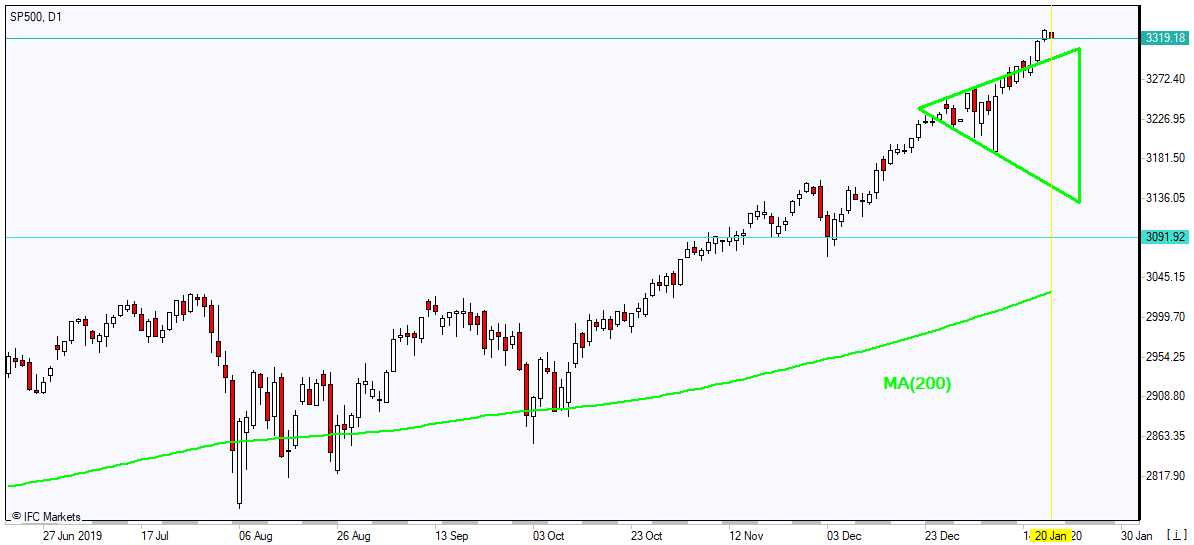
US stock market extended gains on Friday despite mixed data. The S&P 500 rose 0.4% to 3329.62, more than doubling its weekly gain to 2.0%. Dow Jones industrial added 0.2% to 29348. The Nasdaq gained 0.3% to 9388.94. The dollar strengthening accelerated as housing starts rose 16.9% in December while industrial production fell 0.3%. The live dollar index data show the ICE US Dollar index, a measure of the dollar’s strength against a basket of six rival currencies, rose 0.3% to 97.61 and is higher currently. Futures in stock indexes point to lower openings today.
European stock indexes rebounded
European stocks rebounded on Friday after EU Trade Commissioner said he had a good exchange of views with US Trade Representative in Washington. GBP/USD joined EUR/USD’s continuing slide on Friday with euro turning higher currently and Pound lower still. The Stoxx Europe 600 Index recovered 1%. The DAX 30 gained 0.7% Friday to 13526.13. France’s CAC 40 rose 1% and UK’s FTSE 100 advanced 0.9% to 7674.56.
Shanghai Composite leads Asian Indexes gains
Asian stock indices are mostly higher today. Nikkei edged up 0.2% to 24083.51 despite resumed yen climb against the dollar ahead of Bank of Japan’s two-day policy meeting. China’s markets are mixed: the Shanghai Composite Index is 0.7% higher while Hong Kong’s Hang Seng Index is down 0.9%. Australia’s All Ordinaries Index extended gains 0.2% with Australian dollar climb against the greenback resuming.
Brent futures prices are extending gains today. Prices rose on Friday: Brent for March settlement added 0.4% to $64.85 a barrel Friday. Saudi Aramco shares are down currently 0.2% to 34.30 riyals as they continue trading on country’s Tadawul exchange. After the company sold 450 million more shares to investors as part of overallotment option (following 3 billion shares sales at 32 Saudi riyals ($8.53) each at the IPO that netted $25.6 billion ), Saudi Aramco has sold 3.45 billion shares, raising the company’s public stake to 1.725% and raising its IPO earnings to $29.4 billion.
Gold rebounds
Gold prices are inching higher after closing lower last week. February gold slid 0.2% to 1550.50 on Friday.
Note: This overview has an informative and tutorial character and is published for free. All the data, included in the overview, are received from public sources, recognized as more or less reliable. Moreover, there is no guarantee that the indicated information is full and precise. Overviews are not updated. The whole information in each overview, including opinion, indicators, charts and anything else, is provided only for familiarization purposes and is not financial advice or а recommendation. The whole text and its any part, as well as the charts cannot be considered as an offer to make a deal with any asset. IFC Markets and its employees under any circumstances are not liable for any action taken by someone else during or after reading the overview.
Shares of NantKwest Inc. spiked as much as 85% higher in mid-morning trading setting a new 52-week high price after the company reported a series of positive results at the 38th J.P. Morgan Healthcare Conference in San Francisco. The firm reported that complete responses were noted in as many as six different multiple tumor types when “natural killer” cells and T cells are activated simultaneously.
In a presentation to the 2020 JP Morgan Healthcare Conference in San Francisco, Patrick Soon-Shiong, M.D., chairman and CEO of NantKwest Inc. ((NK:NASDAQ), a clinical-stage immunotherapy company focused on harnessing the power of the innate immune system by using the natural killer cell to treat cancer, infectious diseases and inflammatory diseases, and ImmunityBio Inc. presented an update of the Cancer Breakthrough 2020 Initiative and findings on the preliminary safety and early signals of efficacy in Phase 1 and 2 trials for multiple tumor types.
The firm advised in the presentation that “complete Responses were noted in multiple tumor types including Pancreatic, Triple Negative Breast, Head and Neck, Merkel Cell, and Bladder cancers and Non-Hodgkin’s Lymphoma when Natural Killer cells and T cells are activated simultaneously.”
Dr. Soon-Shiong commented, “We hypothesized that a common treatment protocol that harnesses both the natural-killer cell and T cells could be effective in inducing immunogenic cell death leading to durable responses across multiple tumor types. We are grateful for the support of the FDA and over 200 investigators in 41 states who have been involved in testing this hypothesis in cancer patients with advanced disease…The number of patients who experienced a complete remission in this advanced setting is encouraging and further validates our premise that high-dose chemo is harmful and that a paradigm change of exposing the tumor to a carefully orchestrated ‘triple triangle offense’ of NK cell, Dendritic cell and T-cell activation, is a safe cellular and immunotherapy regimen and can be administered in the outpatient setting with promising activity across multiple tumor types. Testing this hypothesis has been the basis of the QUILT trials since 2017.”
Dr. Soon-Shiong previously announced the initiative at the JP Morgan Healthcare Conference in 2016 and advised that the initiative has made significant progress since then based on research and clinical trials. Some of the specific highlights and achievements included for the initiative are that from 2017 to 2019 it has reportedly obtained 39 Investigational New Drugs authorizations from the FDA to undertake Phase 1 and 2 trials across multiple tumor types to assess safety and efficacy with 10 first-in-human immunotherapy agents as single agents and in novel combinations.
The report explained that “the Cancer Breakthroughs 2020 program is one of the most comprehensive cancer initiatives launched to date which seeks to accelerate the potential of combination immunotherapy as the next generation standard of care in cancer patients by inducing immunogenic cell death and thereby avoiding the adverse effects of high dose chemotherapy.”
NantKwest is headquartered in Culver City, Calif., and stated that “it is an innovative, clinical-stage immunotherapy company focused on harnessing the power of the innate immune system to treat cancer and virally induced infectious diseases,” and further claimed that it is the “leading producer of clinical dose forms of off-the-shelf Natural Killer (NK) cell therapies.” The company indicated that the safety of its optimized, activated NK cells along with their activity against a broad range of cancers, have been tested in Phase I clinical trials in Canada and Europe, and in multiple U.S.-based Phase I and II clinical trials.
The report indicated that ImmunityBio is a privately held immunotherapy company and its “oncological goals are to employ its broad portfolio of biological molecules to activate endogenous NK and CD8+ T cells, and to develop a T cell memory cancer vaccine to combat multiple tumor types without the use of high-dose chemotherapy.” The firm is also registered in Culver City, Calif.
NantKwest has a has a market capitalization of around $521.3 million with approximately 98.37 million shares outstanding and a short interest of about 2.9%. NK shares opened relatively unchanged today at $5.35 (+$0.05, +0.94%) over yesterday’s $5.30 closing price. The share price then took off during mid-morning trading and reached a new 52-week high price of $9.90. The stock has traded today between $5.35 to $9.90 per share and is presently trading at $8.16 (+$2.86, +53.96%).
Disclosure: 1) Stephen Hytha compiled this article for Streetwise Reports LLC and provides services to Streetwise Reports as an independent contractor. He or members of his household own securities of the following companies mentioned in the article: None. He or members of his household are paid by the following companies mentioned in this article: None. 2) The following companies mentioned in this article are billboard sponsors of Streetwise Reports: None. Click here for important disclosures about sponsor fees. 3) Comments and opinions expressed are those of the specific experts and not of Streetwise Reports or its officers. The information provided above is for informational purposes only and is not a recommendation to buy or sell any security. 4) The article does not constitute investment advice. Each reader is encouraged to consult with his or her individual financial professional and any action a reader takes as a result of information presented here is his or her own responsibility. By opening this page, each reader accepts and agrees to Streetwise Reports’ terms of use and full legal disclaimer. This article is not a solicitation for investment. Streetwise Reports does not render general or specific investment advice and the information on Streetwise Reports should not be considered a recommendation to buy or sell any security. Streetwise Reports does not endorse or recommend the business, products, services or securities of any company mentioned on Streetwise Reports. 5) From time to time, Streetwise Reports LLC and its directors, officers, employees or members of their families, as well as persons interviewed for articles and interviews on the site, may have a long or short position in securities mentioned. Directors, officers, employees or members of their immediate families are prohibited from making purchases and/or sales of those securities in the open market or otherwise from the time of the interview or the decision to write an article until three business days after the publication of the interview or article. The foregoing prohibition does not apply to articles that in substance only restate previously published company releases. 6) This article does not constitute medical advice. Officers, employees and contributors to Streetwise Reports are not licensed medical professionals. Readers should always contact their healthcare professionals for medical advice.
The potential of this company’s asset is discussed in an Echelon Wealth Partners report.
In a Jan. 10 research note, Echelon Wealth Partners analyst Gabriel Gonzalez purported that Revival Gold Inc.’s (RVG:TSX.V) updated Beartrack and Arnett Creek resource estimate, expected between mid and late Q1/20, should show growth and that “potential for much more” exists.
Echelon expects the updated gold resource to be between 2.7 and 2.8 million ounces (Moz). This compares to the current resource of 2.36 Moz, composed of 1.99 Moz at Beartrack and 380,000 ounces (380 Koz) at Arnett Creek.
The new estimate will include results from 15,000 meters of drilling done in 2018 and 2019 and “may also benefit from improved metallurgical recovery factors as well as an updated gold price,” Gonzalez wrote.
The analyst noted that next step for Beartrack and Arnett Creek after the resource estimate update is a preliminary economic assessment (PEA), which will evaluate the possibility of a “heap-leach production restart scenario with Beartrack’s current 330 Koz (Indicated plus Inferred) heap-leach resource.” Gonzalez added, “We believe such economics could be fairly attractive relative to a comparable greenfield project, given the existing gold adsorption recovery production plant at Beartrack and commensurate upfront capital savings.”
Also, Gonzalez pointed out that between Arnett Creek and Beartrack, Revival could grow the total resource further, perhaps even beyond 3 Moz. For one, based on 2019 geophysics and sampling results from Arnett Creek, there are prospective areas there that need to be drill tested. Two, Beartrack has areas that have not been explored, on the Panther Creek fault’s strike length for example. The exploration company intends to pursue the opportunities at both properties.
Gonzalez also highlighted that Revival represents a buying opportunity with its unwarranted, currently depressed share price. “We are steadfast in our belief that Revival is adding value through the drill bit, and that this should ultimately bear reflection in its share price, especially if the potential to exceed Revival’s baseline 3 Moz resource target materializes,” commented Gonzalez. Also, the company continues to trade at a discount to its peers, a gap that Echelon expects will shrink with the release of the updated resource estimate and, subsequently, the PEA.
Echelon has a Speculative Buy rating and a CA$1.80 per share price target on Revival Gold, which is now trading at around CA$0.63 per share.
Disclosure: 1) Doresa Banning compiled this article for Streetwise Reports LLC and provides services to Streetwise Reports as an independent contractor. She or members of her household own securities of the following companies mentioned in the article: None. She or members of her household are paid by the following companies mentioned in this article: None. 2) The following companies mentioned in this article are billboard sponsors of Streetwise Reports: None. Click here for important disclosures about sponsor fees. 3) Comments and opinions expressed are those of the specific experts and not of Streetwise Reports or its officers. The information provided above is for informational purposes only and is not a recommendation to buy or sell any security. 4) The article does not constitute investment advice. Each reader is encouraged to consult with his or her individual financial professional and any action a reader takes as a result of information presented here is his or her own responsibility. By opening this page, each reader accepts and agrees to Streetwise Reports’ terms of use and full legal disclaimer. This article is not a solicitation for investment. Streetwise Reports does not render general or specific investment advice and the information on Streetwise Reports should not be considered a recommendation to buy or sell any security. Streetwise Reports does not endorse or recommend the business, products, services or securities of any company mentioned on Streetwise Reports. 5) From time to time, Streetwise Reports LLC and its directors, officers, employees or members of their families, as well as persons interviewed for articles and interviews on the site, may have a long or short position in securities mentioned. Directors, officers, employees or members of their immediate families are prohibited from making purchases and/or sales of those securities in the open market or otherwise from the time of the interview or the decision to write an article until three business days after the publication of the interview or article. The foregoing prohibition does not apply to articles that in substance only restate previously published company releases. As of the date of this interview, officers and/or employees of Streetwise Reports LLC (including members of their household) own securities of Revival Gold, a company mentioned in this article.
Disclosures from Echelon Wealth Partners, Revival Gold Inc., January 10, 2020
Echelon Wealth Partners compensates its Research Analysts from a variety of sources. The Research Department is a cost centre and is funded by the business activities of Echelon Wealth Partners including, Institutional Equity Sales and Trading, Retail Sales and Corporate and Investment Banking.
I, Garbriel Gonzalez, hereby certify that the views expressed in this report accurately reflect my personal views about the subject securities or issuers. I also certify that I have not, am not, and will not receive, directly or indirectly, compensation in exchange for expressing the specific recommendations or views in this report.
Important Disclosures: Is this an issuer related or industry related publication? Issuer.
Does the Analyst or any member of the Analyst’s household have a financial interest in the securities of the subject issuer? No
The name of any partner, director, officer, employee or agent of the Dealer Member who is an officer, director or employee of the issuer, or who serves in any advisory capacity to the issuer.? No
Does Echelon Wealth Partners Inc. or the Analyst have any actual material conflicts of interest with the issuer? No
Does Echelon Wealth Partners Inc. and/or one or more entities affiliated with Echelon Wealth Partners Inc. beneficially own common shares (or any other class of common equity securities) of this issuer which constitutes more than 1% of the presently issued and outstanding shares of the issuer? No
During the last 12 months, has Echelon Wealth Partners Inc. provided financial advice to and/or, either on its own or as a syndicate member, participated in a public offering, or private placement of securities of this issuer? Yes
During the last 12 months, has Echelon Wealth Partners Inc. received compensation for having provided investment banking or related services to this Issuer? Yes
Has the Analyst had an onsite visit with the Issuer within the last 12 months? No
Has the Analyst or any Partner, Director or Officer been compensated for travel expenses incurred as a result of an onsite visit with the Issuer within the last 12 months? No
Has the Analyst received any compensation from the subject company in the past 12 months? No
Is Echelon Wealth Partners Inc. a market maker in the issuers securities at the date of this report? No
The numbers from the company’s three operations are reviewed in a CIBC report.
In a Jan. 12 research note, CIBC analyst Cosmos Chiu reported that Dundee Precious Metals Inc. (DPM:TSX) posted a solid Q4/19 and its production for 2019 fell well within the guidance range. “Overall, the results confirm that the company is set up for a strong 2020 as Chelopech’s high-margin production is complemented by Ada Tepe’s first full year of operation.”
Chiu reviewed Dundee’s Q4/19 and 2019 numbers, which were in line with CIBC’s estimates, and performance of each asset.
During the quarter, Dundee produced 69,500 ounces (69.5 Koz) of gold and 10 million pounds (10 Mlb) of copper, which took the year’s total for each to 231 Koz and 37 Mlb, respectively. These quantities fell in the higher end of full-year 2019 guidance, which was 200247 Koz for gold and 3339 Mlb for copper.
As for Dundee’s Chelopech operation in Bulgaria, it “continued its solid year,” Chiu noted. Total production was 173 Koz of gold, versus guidance of 155187 Koz. Copper production fell within the top end of guidance. During Q4/19, gold production was 43 Koz compared to CIBC’s estimate of 42 Koz, and production was 10 Mlb, the same as CIBC’s estimate. Dundee attributed Chelopech’s production levels, Chiu relayed, to having mined in higher-grade gold areas of the deposit and having recovered more gold in the pyrite concentrate.
This year, Dundee will continue to drill at Chelopech “as it looks to extend the current eight-year reserve life at its flagship operation,” noted Chiu.
Regarding Ada Tepe, also in Bulgaria, “it has progressed well since Dundee announced that the mine had completed its ramp-up on Sept. 27, 2019,” Chiu indicated. Total production there in 2019 was 57 Koz of gold, in the high end of revised (lowered) guidance of 4560 Koz. Q4/19 production came in at 26.5 Koz, under CIBC’s forecast of 27.3 Koz. “The positive impact of higher-grade material was offset by milling downtime as the SAG mill was relined within the quarter,” explained Chiu.
Gold sales of 38.9 Koz from Ada Tepe exceeded production due to there being extra gold concentrate in inventory from Q3/19. This was expected and should benefit Dundee’s Q4/19 financials.
With respect to Dundee’s Tsumeb operation in Namibia, it smelted 48,600 tons (48.6 Kt) of concentrate in Q4/19, more than CIBC’s projection of 45.5 Kt. Dundee revised full-year guidance downward to 210230 Kt due to scheduled maintenance of the smelter, and full-year production met that guidance. The company curtailed operations at Tsumeb from Sept. 3 through Oct. 25, during which annual maintenance was carried out. “No significant maintenance shutdown is now expected until 2021,” Chiu pointed out.
CIBC has an Outperformer rating and a CA$7 per share price target on Dundee, whose current share price is about CA$5.94.
Disclosure: 1) Doresa Banning compiled this article for Streetwise Reports LLC and provides services to Streetwise Reports as an independent contractor. She or members of her household own securities of the following companies mentioned in the article: None. She or members of her household are paid by the following companies mentioned in this article: None. 2) The following companies mentioned in this article are billboard sponsors of Streetwise Reports: None. Click here for important disclosures about sponsor fees. 3) Comments and opinions expressed are those of the specific experts and not of Streetwise Reports or its officers. The information provided above is for informational purposes only and is not a recommendation to buy or sell any security. 4) The article does not constitute investment advice. Each reader is encouraged to consult with his or her individual financial professional and any action a reader takes as a result of information presented here is his or her own responsibility. By opening this page, each reader accepts and agrees to Streetwise Reports’ terms of use and full legal disclaimer. This article is not a solicitation for investment. Streetwise Reports does not render general or specific investment advice and the information on Streetwise Reports should not be considered a recommendation to buy or sell any security. Streetwise Reports does not endorse or recommend the business, products, services or securities of any company mentioned on Streetwise Reports. 5) From time to time, Streetwise Reports LLC and its directors, officers, employees or members of their families, as well as persons interviewed for articles and interviews on the site, may have a long or short position in securities mentioned. Directors, officers, employees or members of their immediate families are prohibited from making purchases and/or sales of those securities in the open market or otherwise from the time of the interview or the decision to write an article until three business days after the publication of the interview or article. The foregoing prohibition does not apply to articles that in substance only restate previously published company releases.
Disclosures from CIBC, Dundee Precious Metals Inc., Earnings Update, January 12, 2020
Analyst Certification: Each CIBC World Markets Corp./Inc. research analyst named on the front page of this research report, or at the beginning of any subsection hereof, hereby certifies that (i) the recommendations and opinions expressed herein accurately reflect such research analyst’s personal views about the company and securities that are the subject of this report and all other companies and securities mentioned in this report that are covered by such research analyst and (ii) no part of the research analyst’s compensation was, is, or will be, directly or indirectly, related to the specific recommendations or views expressed by such research analyst in this report.
Potential Conflicts of Interest: Equity research analysts employed by CIBC World Markets Corp./Inc. are compensated from revenues generated by various CIBC World Markets Corp./Inc. businesses, including the CIBC World Markets Investment Banking Department. Research analysts do not receive compensation based upon revenues from specific investment banking transactions. CIBC World Markets Corp./Inc. generally prohibits any research analyst and any member of his or her household from executing trades in the securities of a company that such research analyst covers. Additionally, CIBC World Markets Corp./Inc. generally prohibits any research analyst from serving as an officer, director or advisory board member of a company that such analyst covers.
In addition to 1% ownership positions in covered companies that are required to be specifically disclosed in this report, CIBC World Markets Corp./Inc. may have a long position of less than 1% or a short position or deal as principal in the securities discussed herein, related securities or in options, futures or other derivative instruments based thereon.
Recipients of this report are advised that any or all of the foregoing arrangements, as well as more specific disclosures set forth below, may at times give rise to potential conflicts of interest.
Important Disclosure Footnotes for Dundee Precious MEtals INc. (DPM.TO)
2g CIBC World Markets Inc. expects to receive or intends to seek compensation for investment banking services from these companies in the next 3 months: Dundee Precious Metals Incorporated
For important disclosure footnotes for companies mentioned in this report that are covered by CIBC World Markets Inc., click here: Disclaimers & Disclosures.
In conversation with Maurice Jackson of Proven and Probable, the CEO elaborates on what could be a “company-making” event.
Maurice Jackson: Joining us for a conversation is David Cole of EMX Royalty Corp. (EMX:TSX.V; EMX:NYSE.American), the royalty generator. Pleasure to be speaking with you today to discuss a series of accretive transactions that EMX Royalty has consummated that continue to reward shareholders. Before we begin, Mr. Cole, for someone new to the value proposition, please introduce us to EMX Royalty and the opportunity the company presents to the market.
David Cole: We are a royalty generator. Royalties are phenomenal financial instruments. They are a slice off the top from metal production, so, if you own a 1% royalty on a project, 1% of the value of the metal that’s produced on that project goes to you. And the beauty of that is that it has embedded optionality. And that is exposure to additional discoveries, resource advancements, engineering advancements, etc., on that property to the benefit of the royalty holder at no cost to the royalty holder.
Therefore, it doesn’t matter how much capital is spent on the project, none of those bills come back to the royalty holder. We just get the 1% or 2% or 3% of the production that comes off that property. And also, of course, because these are commodities, we have commodity price optionality as well. As commodity prices move up or down, the payment structures for the value that represents can go up and down, and the long-term history is for commodity prices to rise.
The combination of commodity price optionality, discovery optionality and other aspects that add value to the royalty instrument makes royalties a really special thing. And the way we create them is through project generation, where we go out and we acquire prospective mineral rights, utilizing geological skill sets, add value, sell those for cash, shares, work commitments in the ground, and always a production royalty.
EMX Royalty has been successfully executing this business model for 16 years. We have 2.3 million acres of mineral right exposure and have approximately 70 royalties [around] the world.
Maurice Jackson: Truly is a wonderful value proposition. Let’s get everyone up to date on the company successes since our last interview, beginning in Turkey (Turkish assets), where EMX Royalty hosts seven projects dating back to 2003, when the company exercised its application of in-region geological knowledge as an early mover in its execution on its prospect generation business model.
Mr. Cole, take us to the Balya lead-zinc-silver mine, which was recently sold and where EMX holds an impressive 4% royalty on the property. What can you tell us about this transaction and its impact on EMX Royalty moving forward?
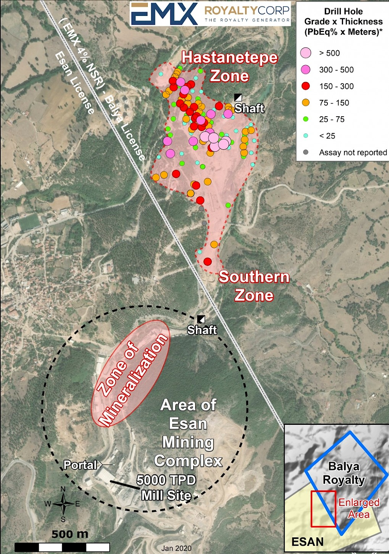
David Cole: The Balya royalty is an excellent example of exactly what we’re talking about. We acquired the Balya license from the Turkish government for $17,000 many years ago. We immediately executed geological modeling and delineation of prospective areas within that project. Sold it to a capable local Turkish company called Dedeman Madencilik for $100,000 in cash. We got all of our money back, plus more and a 4% production royalty. Dedeman went on to drill 59,000 meters of core and delineated multiple ore zones that are lead, zinc, silver rich on that property.
And then they started a test mine and had small tonnage. We’ve received some royalty payments from those. And now, they got bought out by their bigger neighbor, Esan Madencilik, [which] has a 5,000-ton per day mill. And that’s transformative to us, because now our ores, where we have that royalty, are going to go through the mill. It was a district consolidation [that] has substantial synergies. And we expect the production on this property to go up markedly over the course of the next two yearsit will become a multimillion-dollar per year annual cash-flowing royalty at today’s metal prices.
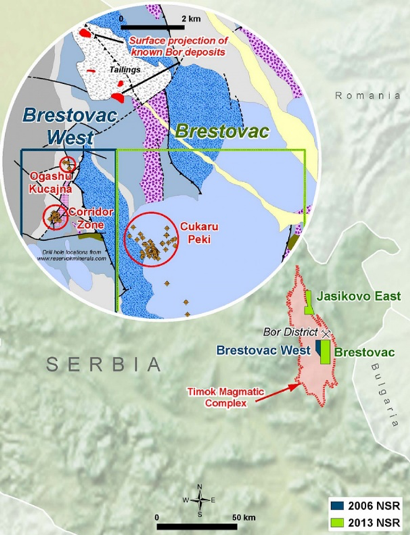
Maurice Jackson: Moving northeast, let’s go to Serbia and discuss the recent developments at the giant Timok copper-gold deposit, where EMX holds a 0.5% royalty. Zijin Mining Group Co. Ltd. is advancing the Timok, and they are moving in an expeditious manner to get into production. Take us onsite, and share the progress that Zijin Mining is making on the Timok.
David Cole: You know, the Chinese are metal hungry. They just cannot own enough metal. They continue to be on a buying spree around the world. They paid over a billion dollars to buy this particular asset. They have signed a memorandum of understanding with the Serbian government, whereby they will invest US$474 million into the ground to advance the upper zonethe upper high-grade zone within that larger deposit that’s been foundinto production very quickly.
We expect that to be in production in 2021. Based upon the feasibility study that was filed, our one-half of 1% royalty there [will] pay US$2.5 million per year in today’s metal prices. And we’re quite excited for that. That’s a nice augmentation cash flow.
But here’s where it becomes really interesting. And that is when they get into the huge lower zone. The lower zone is over a billion tonsa billion metric tons of mineralized rock that is defined within a compliant resource at 0.99% copper with a nice gold credit, so over 1% copper equivalent. And that’s going to be robustly economic in our opinion.
And the Chinese want the metal out of the ground. They’re moving forward very quickly. And when they get into the lower zone, our royalty payments are going to go up substantially. I believe this is a company-making event.
Maurice Jackson: Let’s take this conversation now to the United States. And let’s visit Nevada. Back in mid-December, EMX announced that they had acquired a 19.9% interest in the Rawhide Gold-Silver Mine. Can you walk us through how this might impact the future cash flow at EMX?
David Cole: One of the things that we do that makes us special is we also make strategic investments outside of the royalty sector. So, while our smart economic geologists and finance people are around the world identifying opportunities in the royalty space, if we see an investment opportunity that is so good that we cannot not do it, we will execute on that.
And our track record on our strategic investments is fantastic. It’s a 40% internal rate of return that’s compounded annually after tax on invested dollar over our 16-year history. [B]ecause of strategic investing gains [we] have as much money in the bank as we’ve raised in the history of the company, and no debt, in addition to the 2.3 million acres of mineral rights we have around the world.
So, that sets the stage, just so you understand how it is that we’ve made the strategic investment because it’s part of our business model, and when we’re sitting here with a large amount of cash and the capital markets are not robust right now in the mineral sector. Consequently, there’s a huge number of opportunities that are being shown to us.
People want us to invest money into their project, their company, etc. And so, we’re being shown a huge number of opportunities. And we have a team that’s comprised of an engineer, a metallurgist, geologists, finance guys, and we filter through those, and the vast majority of the things that we’re shown, they fail. But occasionally, one comes up. It’s like, holy smokes, this is very, very, very interesting.
I’ve personally been on site, toured the operation. It’s an active producing gold mine. They’re pouring ore almost every day. There’s a huge number of tons they have on the pad already and this will have, in our opinion, immediate cash flow. We’re expecting to have substantial cash flow from this. I’m not allowed to say the numbers until we put out a 43-101-compliant resource and production document that will define that. That’s in progress.
But we’re very happy with this investment. It meets all of our criteria and it’s going to give us additional cash flow in the near term. And we picked up to 20% of the Rawhide Mine for US$3.7 million. It was a great buy.
Maurice Jackson: Quite impressive. There are some interesting developments nearby as well, at the Leeville Complex. What can you share with us there?
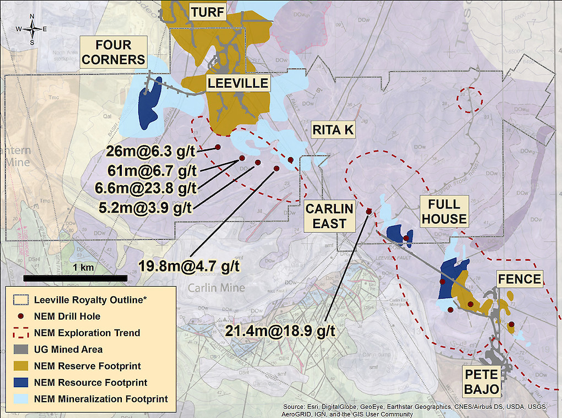
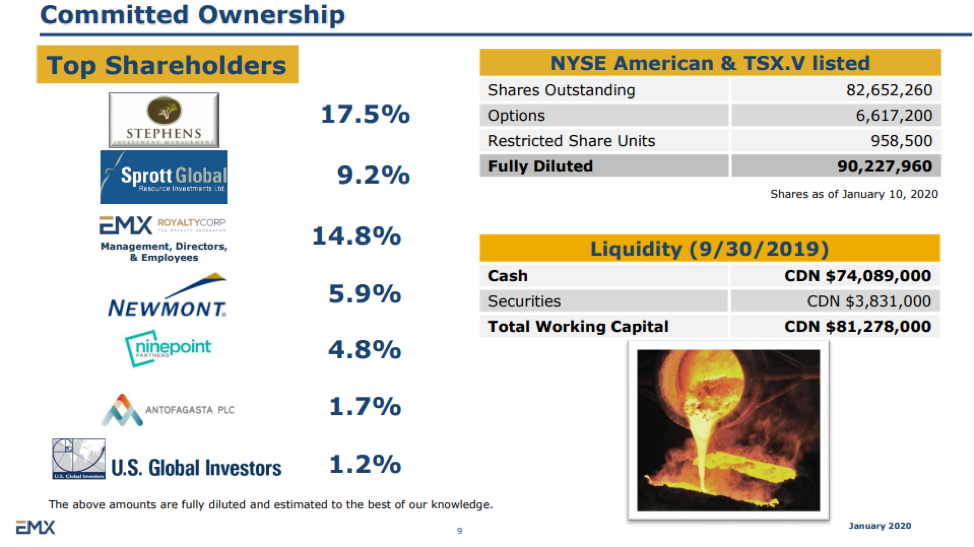
David Cole: We’ve had the 1% royalty over Leevillethat’s a producing mine for a number of years now. It’s paid US$13 million to us already, in the time that we’ve owned that royalty. Newmont Goldcorp Corp. (NEM:NYSE) was the previous operator for the years that we’ve had that. Newmont’s also a shareholder in EMX. They own about 6% of our stock. We have good relationship with them. I worked for Newmont for 18 years before I left to found EMX Royalty Corp.
In fact, early in my career, I was involved in discovery of Leeville deposits. And Newmont and Barrick Gold Corp. (ABX:TSX; GOLD:NYSE) formed a joint venture in Nevada where they pooled all their assets to take advantage of the synergies between the various infrastructure pieces that they had collectively in northern Nevada. And that joint venture company’s called Nevada Gold Mines. And Barrick is the operator of that.
When Barrick took over operation of all the assets including Leeville, as they managed Nevada Gold Mines, they came out with a new PowerPoint presentation where they were discussing the resource potentialthey call it drill Indicated resource potentialon the Leeville property as well as other properties within the portfolio. And in that documentand that document’s publicly available on the Nevada Gold Mines websitethey discuss Leeville in multiple places within their PowerPoint presentation.
It’s seems to be something that they’re very bullish on. And they delineate a large new zone that is drill indicated. And they show that the assays from drill holes [show] the stratigraphy with respect to where the gold mineralization is, and they talk about the total endowment of the whole region.
We can extrapolate, based upon the footprint of our royalty, relative to the entire Leeville complex. And we would estimate that what Barrick is suggesting is that there’s 10 million ounces in resource potential total, [which] would include the reserves, the resources, in addition to the drill Indicated resource potential. That’s the terminology that they use on our property.
And so, we’re extraordinarily happy about that. That’s why we originally acquired that 1% royaltybecause we believe that there was excellent exploration development potential on that property. I will point out that Newmont completed a $300 million new shaft to enhance the underground infrastructure within the Leeville Complex a few years ago. It’s a property that these very large gold companies take extraordinarily seriously and we’re delighted to be a royalty holder on that.
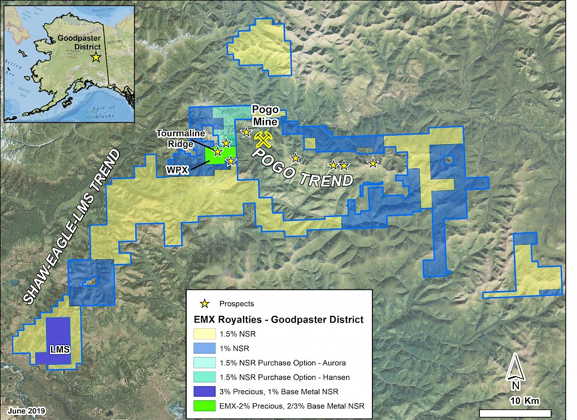
Maurice Jackson: Finally, let’s visit Alaska where EMX took a strategic position in Millrock Resources Inc. (MRO:TSX.V; MLRKF:OTCQB) to advance the formerly known Goodpaster project, now known as the 64 North Project. Do you have any updates to share with us?
David Cole: Well, that’s another example of us thinking laterally with respect to how to execute our business model. Greg Beischer, who is doing a great job of running Millrock, was low on capital and he had some excellent ideas about properties to acquire based upon their astute geological acumen. And he came to us, he says, “Dave, you know, I’ve got great ideas. I just need a few bucks.” I said, “Yeah, let’s do it.”
So, we invested money into his company at above-the-stock-price pricing. So, we got shares for doing that, in addition to royalties on the projects of which they acquired with that money. And that put us in a situation where we ended up with 233,000-acre percent, which is the number of acres of mineral rights times the percent royalty, and the royalty percentages vary block to block.
This transaction put us in a position where we’ve got a nice royalty over a growing gold district in Alaska. And then, subsequent to doing that deal, we’re delighted to be now strategic shareholders in Millrock. We think they do great work. They’ve executed a fantastic deal with an Australian company, where the Australian company’s going to come in and spend a bunch of money drilling. I’m not sure exactly how much it is. I think it’s $10 million per year for the next three years. It’s a salient amount of money.
Maurice Jackson: Let’s look at some numbers. Mr. Cole, please provide us with the current capital structure for EMX Royalty.
David Cole: EMX Royalty has $81 million in working capital as of our last quarterly reportthat’s in Canadian dollars. That would include $74 million in cash; no debt. We have no debt on the books. And so, we’re in fantastic shape. That’s roughly all the money I’ve raised in the history of the company, in addition to our whole portfolio. And that’s definitive that the business model works, right? We’ve got all the money we’ve raised in the history of the company plus the whole mineral rights portfolio.
Maurice Jackson: I have noticed something as well, Mr. Cole. A lot of insider buying. Can you talk to us about who’s buying shares?
David Cole: Well, here we are with a substantial percentage of our market cap in cash, let alone all these great royalties and mineral assets we have around the world. And in my view, we’ve been substantially undervalued now for years, and that’s why I’ve been in the market buying. I’ve been buying for four years and all my trades are reported, of course. And I’m just delighted to continue to increase my percentage ownership in the company. I’m up to a 4% fully diluted now. I’m very bullish. I’m in on this.
Maurice Jackson: Well, it speaks volumes when you, the CEO, the president, [is] actively buying at current prices. That speaks volumes to the market, and it certainly does for me. I too, am an active buyer myself.
Looking forward, multilayered question: What is the next unanswered question for EMX Royalty? When could we expect a response? And what determines success?
David Cole: So, one of the most frequent questions that I’m [asked] right now is what are you going to do with all the money in the bank? And you’ve seen a recent examplewe put $3.5 million to work by buying a 20% interest in the Rawhide gold mine, and we have a plethora of other opportunities that we’re continuing to evaluate.
And we’re focusing on current cashflow, we’re focusing on cash flowing royalties and other cashflow opportunities to enhance our top line, while we’re waiting for things like Timok to come into production and Balya to come into full-scale commercial production, which will occur over the course of the next two years and be transformative to our top line.
And we would like to augment that sooner rather than later with additional purchases of cash-flowing assets. That doesn’t mean that it will for sure happen, but [we] certainly remain alert for opportunities.
One of the main questions I’m asked is, how you can allocate that money? And I can’t say how I’m going to allocate it until it’s done, but our track record is good at allocating capital astutely.
Maurice Jackson: Last question, what did I forget to ask?
David Cole: Well, you’re always pretty good at covering the bases, Maurice. But I can’t think of anything specifically. I will say that we’re just delighted to see some of the traction that we’ve had in the marketplace over the course of the last few months. The stock prices performed nicely. I know I’ve got some new funds that are in there buying the stock that are looking for value situations, and I’m always pleased to see that.
Maurice Jackson: Mr. Cole, if investors want to get more information about EMX Royalty, please share the website address.
Maurice Jackson: For direct inquiries, contact Scott Close at (303) 973-8585, or you may e-mail [email protected]. EMX Royalty trades on the TSX.V: EMX | NYSE: EMX. And, just for the record, for the second year in a row, for every Boolean purchase I make this year, I plan on matching in shares in EMX Royalty.
EMX Royalty is a sponsor of Proven and Probable and we are proud shareholders for the virtues conveyed in today’s message. And as a reminder, I’m a licensed representative for Miles Franklin Precious Metals Investments where we provide a number of options to expand your precious metals portfolio, from physical delivery, offshore depositories, precious metal IRAs and private blockchain-distributed ledger technology. Call me directly at (855) 505-1900,or you may e-mail [email protected].
Finally, please subscribe to ProvenAndProbable.com, where we provide mining insights and Boolean sales. David Cole of EMX Royalty, thank you for joining us today on Proven and Probable.
Maurice Jackson is the founder of Proven and Probable, a site that aims to enrich its subscribers through education in precious metals and junior mining companies that will enrich the world.
Disclosure: 1) Maurice Jackson: I, or members of my immediate household or family, own shares of the following companies mentioned in this article: EMX Royalty. I personally am, or members of my immediate household or family are, paid by the following companies mentioned in this article: None. My company has a financial relationship with the following companies mentioned in this article: EMX Royalty is a sponsor of Proven and Probable. Proven and Probable disclosures are listed below. 2) The following companies mentioned in this article are billboard sponsors of Streetwise Reports: None. Click here for important disclosures about sponsor fees. 3) Statements and opinions expressed are the opinions of the author and not of Streetwise Reports or its officers. The author is wholly responsible for the validity of the statements. The author was not paid by Streetwise Reports for this article. Streetwise Reports was not paid by the author to publish or syndicate this article. The information provided above is for informational purposes only and is not a recommendation to buy or sell any security. Streetwise Reports requires contributing authors to disclose any shareholdings in, or economic relationships with, companies that they write about. Streetwise Reports relies upon the authors to accurately provide this information and Streetwise Reports has no means of verifying its accuracy. 4) This article does not constitute investment advice. Each reader is encouraged to consult with his or her individual financial professional and any action a reader takes as a result of information presented here is his or her own responsibility. By opening this page, each reader accepts and agrees to Streetwise Reports’ terms of use and full legal disclaimer. This article is not a solicitation for investment. Streetwise Reports does not render general or specific investment advice and the information on Streetwise Reports should not be considered a recommendation to buy or sell any security. Streetwise Reports does not endorse or recommend the business, products, services or securities of any company mentioned on Streetwise Reports. 5) From time to time, Streetwise Reports LLC and its directors, officers, employees or members of their families, as well as persons interviewed for articles and interviews on the site, may have a long or short position in securities mentioned. Directors, officers, employees or members of their immediate families are prohibited from making purchases and/or sales of those securities in the open market or otherwise from the time of the interview or the decision to write an article until three business days after the publication of the interview or article. The foregoing prohibition does not apply to articles that in substance only restate previously published company releases. As of the date of this article, officers and/or employees of Streetwise Reports LLC (including members of their household) own securities of EMX, Millrock and Newmont Goldcorp, companies mentioned in this article.
Proven and Probable LLC receives financial compensation from its sponsors. The compensation is used is to fund both sponsor-specific activities and general report activities, website, and general and administrative costs. Sponsor-specific activities may include aggregating content and publishing that content on the Proven and Probable website, creating and maintaining company landing pages, interviewing key management, posting a banner/billboard, and/or issuing press releases. The fees also cover the costs for Proven and Probable to publish sector-specific information on our site, and also to create content by interviewing experts in the sector. Monthly sponsorship fees range from $1,000 to $4,000 per month. Proven and Probable LLC does accept stock for payment of sponsorship fees. Sponsor pages may be considered advertising for the purposes of 18 U.S.C. 1734.
The Information presented in Proven and Probable is provided for educational and informational purposes only, without any express or implied warranty of any kind, including warranties of accuracy, completeness, or fitness for any particular purpose. The Information contained in or provided from or through this forum is not intended to be and does not constitute financial advice, investment advice, trading advice or any other advice. The Information on this forum and provided from or through this forum is general in nature and is not specific to you the User or anyone else. You should not make any decision, financial, investments, trading or otherwise, based on any of the information presented on this forum without undertaking independent due diligence and consultation with a professional broker or competent financial advisor. You understand that you are using any and all Information available on or through this forum at your own risk.
The specifics of both moves are presented in an iA Securities report.
In a Jan. 13 research note, analyst Jeremy Rosenfield reported that iA Securities raised its target price on Brookfield Renewable Energy Partners L.P. (BEP.UN:TSX) to CA$47 per share from CA$44. This comes after the master limited partnership (MLP) announced two pieces of news: It intends to take over Terraform Power Inc., and it plans to increase its dividend by 5%. “The full integration of Terraform into the Brookfield fold would be accretive to our estimates and valuation,” Rosenfield noted.
He outlined the acquisition. Brookfield would purchase the remaining 38% interest in Terraform Power Inc. that it does not already own, for US$1.5 billion. It would be an all share arrangement in which each acquired Terraform share would get swapped into new Brookfield shares at an exchange ratio of 0.36 Brookfield unit:1 Terraform share.
“The transaction implies a value for Terraform of about US$17.31 per share (an approximately 11% premium to the January 10, 2020 closing price, prior to the announcement),” the analyst indicated.
If approved, the deal would close in mid-2020 with the Brookfield share distribution occurring at that time.
Rosenfield presented the implications of the deal. For one, it would result in an initial funds from operations contribution to Brookfield of about US$0.150.20 per unit, or a roughly 57% accretion, according to iA Securities estimates. Two, it would provide Brookfield with a larger footprint in the solar and wind markets in North America and Western Europe.
As for the MLP’s dividend, Brookfield plans to raise it to US$2.17 per unit from US$2.06. “The dividend increase is at the lower end of Brookfield’s 59% annual dividend growth target, in line with our forecast as Brookfield aims to create headroom versus its dividend payout target,” commented Rosenfield.
He concluded the report by highlighting Brookfield’s compelling aspects. They are its high-quality global renewable power platform, its elevated level of contracted cash flows, its long-term strategy for growth and its attractive income characteristics. IA Securities has a Hold rating on Brookfield.
Disclosure: 1) Doresa Banning compiled this article for Streetwise Reports LLC and provides services to Streetwise Reports as an independent contractor. She or members of her household own securities of the following companies mentioned in the article: None. She or members of her household are paid by the following companies mentioned in this article: None. 2) The following companies mentioned in this article are billboard sponsors of Streetwise Reports: None. Click here for important disclosures about sponsor fees. 3) Comments and opinions expressed are those of the specific experts and not of Streetwise Reports or its officers. The information provided above is for informational purposes only and is not a recommendation to buy or sell any security. 4) The article does not constitute investment advice. Each reader is encouraged to consult with his or her individual financial professional and any action a reader takes as a result of information presented here is his or her own responsibility. By opening this page, each reader accepts and agrees to Streetwise Reports’ terms of use and full legal disclaimer. This article is not a solicitation for investment. Streetwise Reports does not render general or specific investment advice and the information on Streetwise Reports should not be considered a recommendation to buy or sell any security. Streetwise Reports does not endorse or recommend the business, products, services or securities of any company mentioned on Streetwise Reports. 5) From time to time, Streetwise Reports LLC and its directors, officers, employees or members of their families, as well as persons interviewed for articles and interviews on the site, may have a long or short position in securities mentioned. Directors, officers, employees or members of their immediate families are prohibited from making purchases and/or sales of those securities in the open market or otherwise from the time of the interview or the decision to write an article until three business days after the publication of the interview or article. The foregoing prohibition does not apply to articles that in substance only restate previously published company releases.
Disclosures from iA Securities, Brookfield Renewable Partners L.P., Research Update, January 13, 2020
Conflicts of Interest: The research analyst and or associates who prepared this report are compensated based upon (among other factors) the overall profitability of iA Securities, which may include the profitability of investment banking and related services. In the normal course of its business, iA Securities may provide financial advisory services for the issuers mentioned in this report. iA Securities may buy from or sell to customers the securities of issuers mentioned in this report on a principal basis.
Analyst’s Certification: Each iA Securities research analyst whose name appears on the front page of this research report hereby certifies that (i) the recommendations and opinions expressed in the research report accurately reflect the research analyst’s personal views about the issuer and securities that are the subject of this report and all other companies and securities mentioned in this report that are covered by such research analyst and (ii) no part of the research analyst’s compensation was, is, or will be directly or indirectly, related to the specific recommendations or views expressed by such research analyst in this report.
Analyst Trading: iA Securities permits analysts to own and trade in the securities and or the derivatives of the issuer under their research coverage, subject to the following restrictions. No trades can be executed in anticipation of coverage for a period of 30 days prior to the issuance of the report and 5 days after the dissemination of the report to our clients. For a change in recommendation, no trading is allowed for a period of 24 hours after the dissemination of such information to our clients. A transaction against an analyst’s recommendation can only be executed for a reason unrelated to the outlook of the stock for the issuer and with the prior approval of the Director of Research and the Chief Compliance Officer.
Company Related Disclosures: –In the past 12 months, Industrial Alliance Securities Inc. has managed or co-managed a public offering of securities for the issuer.
–The analyst has visited the issuers operations. No payment or reimbursement was received from the issuer for the associated travel costs.
This week – January 19 through January 25 – central banks from 9 countries or jurisdictions are scheduled to decide on monetary policy: China, Japan, Malaysia, Canada, Norway, Indonesia, the euro area, Paraguay and Nigeria.
Following table includes the name of the country, the date of the next policy decision, the current policy rate, the result of the last policy decision, the change in the policy rate year to date, and the rate one year ago.
The table is updated when the latest decisions are announced and can always accessed by clicking on This Week.
Welcome to this week’s Market Wrap Podcast, I’m Mike Gleason.
Coming up we’ll hear an encore of a wonderful interview with Guy Christopher, who wrote many popular columns for MoneyMetals.com before his passing. Throughout his time at Money Metals, Guy would often enlighten us as only he could, sharing his insights through his wonderful articles on our website, and we often had the privilege of discussing some of those stories with him here during our weekly podcasts.
In the conversation you will hear in just a bit I spoke with Guy on the topic of personal responsibility, estate planning, and making sure you don’t leave your loved ones with a financial nightmare and an unwelcome scavenger hunt. Some timeless wisdom from the late Guy Christopher, coming up after this week’s market update.
A big week on Wall Street, and a bigger week in Washington, have given us relatively quiet trading in gold and silver markets.
For the week, gold is down 0.4% to bring spot prices to $1,558 an ounce. Silver shows a weekly loss of 0.9% to trade at $18.02. The gold and silver mining stocks appear to have put in a near-term bottom. They rallied mid-week, so perhaps bullion will soon follow suit.
Turning to the platinum group metals, they are showing some real strength once again. Platinum prices look higher by 4.3% since last Friday’s close to come in at $1,025 per ounce.
Meanwhile, palladium continues to defy the odds and is surging here today and keeps breaking record after record. As of this Friday morning recording the white metal is up over $200, and that’s just in today’s trading and it now sports a price tag of $2,533 per ounce thanks to this week’s $407 or 19.1% gain. You heard that right, 19.1%. The massive price advance is due to lease rates spiking once again in the futures market, indicating a serious supply shortage for the industrial metal.
As the metals markets diverged, the S&P 500 surged to a new record high on Thursday. Stock market investors celebrated the passage of two big trade deals – a Phase One trade agreement with China and the USCMA pact with Canada and Mexico.
Democrats were completely upstaged after trying to make a show of delivering Articles of Impeachment to the U.S. Senate. Despite the mainstream media’s hyping of new Russian and Ukrainian conspiracy theories, the public seems to have lost interest in the entire charade. Everyone knows – and has known from the beginning – that it will end in President Donald Trump’s acquittal.
Meanwhile, CNN and the Democrats put on a debate that turned into an embarrassment for everyone involved. The party elites are trying to knock off Bernie Sanders, and their efforts are backfiring. He continues to surge ahead of Elizabeth Warren and Joe Biden. But the 78-year-old socialist is now facing accusations of being insufficiently “woke” on race and gender issues.
The party has historically weaponized identity politics against Republicans with great success. Now without a charismatic figure like Barack Obama to unify the various grievance groups, they are turning on each other.
This is all great news for Donald Trump, of course. The smart money is now betting on President Trump to cruise to re-election in November.
But if the Democrats nominate Bernie Sanders, that doesn’t mean investors can relax. There is a chance – a non-zero chance, anyway – that a black swan event or a change in social mood could propel him to an upset victory. That would likely cause a severe sell-off in stocks and a surge in safe-haven buying of gold.
Regardless of who wins, government spending and deficits will continue to grow – as will unpayable entitlement promises. It’s a bipartisan problem with no solution in sight.
On Monday the Treasury Department announced the federal budget deficit is running 11.8% higher compared to last year. Officials now expect to record a deficit in excess of a trillion dollars this year – and for many years to come.
News Anchor #1: For the first time in seven years the U.S. finds itself in a trillion dollar hole.
News Anchor #2: In a trillion dollar hole.
News Anchor #3: In a trillion dollar hole. The federal government’s budget deficit was released Monday by the treasury department. According to the data the government spent 1 trillion more than it took in during 2019 and the first quarter of 2020 is showing some similar signs. From October through December military spending and healthcare costs caused the deficit disorder 12% over the previous year.
Rising deficits mean the government will need a rising currency supply. That means a likely roll out of various bond buying and QE type programs by the Federal Reserve.
The Fed has already committed several hundred billion dollars to Treasury bill and repo markets over the past few months. According to the Wall Street Journal, the central bank is now considering a new tool to intervene even more deeply into overnight lending markets. Essentially it would involve pumping in more liquidity through hedge funds – yes, hedge funds.
Incredibly, all we hear is silence from Democrats who are supposed to be against helping Wall Street get richer at our expense. And on the other side, all we hear is silence from Republicans who are supposed to be against more interventions by unaccountable central planners.
The truth is that both sides are as addicted to inflationary stimulus from the Fed as Wall Street and the big banks are.
The steady inflationary pressures ahead should be enough to produce modest gains for precious metals markets. At some point if the fear trade kicks in over inflation, or national insolvency, or a socialist President, or a financial crisis on Wall Street, then gold and silver can be expected to deliver very outsized gains.
And now, we’ll pay tribute to our late friend Guy Christopher, who during his time with us here on earth lived quite a life. He was a member of the 101st Airborne during the Vietnam War and later worked as a stock broker, investigative journalist, and published author. All of this real-world experience combined with his communication skills helped him provide our readers and customers with some really great insights over the years. Thousands of readers enjoyed and often commented on his writings at MoneyMetals.com.
Today we’ll replay a conversation I had with Guy on a very important topic. The interview begins with a question about an article he wrote several years ago titled You Worked to Have It… Now Work to Keep It, a piece about how many Americans, who may have been thoughtful and diligent when it comes to accumulating some wealth, are often totally neglectful when it comes to protecting it. As we start out this interview, I asked Guy to address the question about why so many people regularly overlook having this important conversation.
Guy Christopher: Well, I think folks don’t like to talk about, or think about, dying and so they don’t pay a whole lot of attention to it. We have research from some pretty high powered research firms that show more than half of the United States citizens have no will or no legal trust, and really haven’t made a great many plans for taking care of their estates. Which can be complicated as gold and silver. That’s very often left at the bottom of the ladder when it comes time to explain things to family. You and I both know that very often family members don’t have any idea what your interests in gold and silver really are. They don’t understand it and that’s too bad, but that’s the way it is. When you’re trying to pass on gold and silver inheritances to family members, or to friends, they may be sitting there staring at a great deal of wealth, and they’re not sure how to handle it. I think it’s one of those things that we all have to face, some of us do a little better job of it than others. I think it starts with going to an attorney, and sitting down and saying, “What do I need to protect my estate for my children or my … and my family?”
Mike Gleason: Talking about precious metals specifically there. I can tell you from experience we often hear from heirs who just had a loved one pass, and they immediately just want to get rid of the gold and silver that grandpa, or grandma had there. They say, “What the heck are we going to do with this? Yeah, let’s just get rid of it right away.” So those conversations are often not happening between individuals and their heirs, and they don’t even understand the importance of owning gold and silver, and they want to get rid of it like a hot potato. I’m sure you’ve seen that sort of thing.
Guy Christopher: I have seen it, Mike. The example you just provided is excellent. When folks, first of all, families very often don’t agree with how to divvy up the remains of an estate unless there’s a will, and unless there are written instructions and legal instructions. I have personally seen families who have had great difficulties individually with each other, trying to decide what to do with this valuable, or that asset, or that keep sake. Certainly something, which is unfortunately as mysterious as gold and silver can be to some people. Unfortunately, those things are often left with estate matters, and like you said, folks call and say, “Hey, what’s this dollar amount?” They really don’t know what they have in their hands, and they just want to turn it into cash and move on.
So that’s unfortunate. I think that if you are a gold and silver owner, if you believe that you’re acquiring real wealth through gold and silver, and that it is a great way to save, and a great insurance policy, then I think it’s necessary, its incumbent upon you to try to explain to close family members, to close friends, what this is and why you have it, and what they should be thinking of doing with it. You don’t want to put your business on the streets too much, we’ve written articles about that. You can do these instructions legally, in a will, or you can do them in a letter to your family… just explaining, “Look, I believe in this stuff, and I want you to believe in it too”. I think that it’s just as necessary to have written instructions for gold and silver as it is to have for a real estate, or any other valuables you may own.
The reason you’ve got to that is because nobody else is going to do it for you. You and I both know there are a lot of folks out there who will take advantage of people who are suddenly given a handful of gold, or a bag full of silver. There are folks out there who can easily take advantage of your heirs, your grandchildren, your children, your wife, your husband, who don’t really understand what it is you have and why you have it. So I think that just leaving some written instructions … You’re not really spreading your business around on the street that way. You’re leaving written instructions with trusted people to say, “This is why I have this and this is why you should value it.” I think folks really appreciate that. Losing a loved one, we’ve all been there. Losing a loved one is a terrible thing to go through. You have enough on your mind, really, between funeral arrangements and just the grieving process. You have enough on your mind without also worrying about, “Hey, what’s this stuff worth in dollars?” First things first, you have your grieving to do, and then you also have business to take care of, and that’s always the case. I think it’s just helpful for your heirs, for your children, to have something that says, “This is why I had that and this why you should value it.”
Mike Gleason: Now, I know many precious metals investors are hiding them somewhere in their home, which is a great idea as it may deter theft if you’re unfortunate enough to have a break in. But it could also be problematic for your heirs after you pass. What advice to you have for people there? That’s something else you do have to keep in mind.
Guy Christopher: Absolutely, it’s a great idea to have your metals put away privately and secretly, but not so secretly that no one will ever find them. In the article we just published, we talk about the true story of a fellow. I knew the fellow, or know him, he’s still living, who was very secretive about his belongings. He lived in a very big house, many, many rooms, long hallways. His two daughters were grown. His two daughters visited once in a while, but they didn’t really hang out and explore the house that they grew up in. It was months and months and months before those children of his were able to come to grips with the fact that they didn’t know where anything was. There may be a great deal of wealth on that property, that may never be found. It may not be found for 200 years. We just don’t know, because there were no written instructions.
Those kinds of stories are repeated over, and over, and over. They’re unfortunate. They are preventable, but still in all when folks don’t take the time to think ahead, then they are really doing their loved ones a big disservice, because they haven’t taken the time to say to themselves, “I need to write down some things,” like the combination to the safe. I can’t imagine a worse situation than knowing your dad, or your mom, or someone has a safe, and you have to go find a safe hacker to get it open because there’s no combination written down anywhere, and nobody knows how to get into it. That’s a problem that a grieving family shouldn’t have to have. It’s just one example of the kinds of things you can do now to ensure that you can take care of yourself, and if you’re not around, you can take care of your family.
Mike Gleason: I know in the case of your acquaintance there, I’m sure there’s probably some real piling up medical bills, based on his condition. So having access to those precious metals that his daughters can’t find, I’m sure would be very helpful in covering some of those costs. Yeah, it’s very important, of course, to leave instructions.
Now, we’re are talking about people here that have already bought some precious metals. Those that haven’t yet, what would you say to the person who is still hesitating to make his, or her, first purchase of precious metals? Prices are down, it seems like a good time to act, but some may be afraid prices will go even lower. What do you have to say to that person?
Guy Christopher: That’s so true. I’ve noticed prices dropping, and I’ve also noticed the folks I know who are buying are the old timers who are committed to gold and silver, who believe in gold and silver, who understand gold and silver. Not so much the newcomers, the newbies, the folks who are just now looking around and saying, “What’s that gold and silver stuff all about?” The buying has been primarily, at least as far as I know, by those folks who are already acquainted with it. The problem we have, and we’ve written about this before, and it’s been written many times at Money Metals, not just by me. The problem we have is a matter of media and education. The government doesn’t like you owning gold and silver. The government would prefer you have either cash or digital money, that gets us down the road into the weeds and war on cash, but it’s very real. The government would prefer that you just forget all about gold and silver, and they have been very masterful at brainwashing Americans into believing that gold and silver are not real money. You and I know that gold and silver are currencies. We know that they are representations of wealth. The government knows they are real money, and the government knows they are representations of real wealth, but the government would prefer you not know that. The government would prefer you have debt as your money, which is exactly what the treasury bond, exactly what a U.S … one dollar, ten dollar, five dollar, fifty dollar bill is. It’s a note, it’s debt. It’s not real wealth, it’s just a representation of debt. And people have used this debt, they use these I.O.U’s as real money. They begin to think of these I.O.U’s as real wealth, and you and I know they’re not.
So the real problem we have here is that the government has been quite successful, over the past seven or eight decades, ever since FDR’s gold grab in the 1930’s, the government has been very successful in drumming gold and silver out of the American psyche. The last phase of that was probably 1965, when the government stopped putting silver in American coins, and gave us the mystery metal that we use today. I don’t know what’s in a 25 cent piece, I think there’s some copper, and some tin and maybe some zinc, I don’t know. Then, in 1982 they stopped putting copper in pennies. The government has tried to get away from precious metals as wealth. They’ve done that so that the rest of us will think of debt as money, as wealth, as currency.
The reason that it’s so hard to get new people involved is because they are, I hate to say the word again, but they are largely brainwashed into believing that real money is a digital message on a smart phone. That real money is an account statement from your bank. When, in fact, that’s not real money, that’s just a representation of debt. It’s too bad that more people don’t have the educated instincts to begin looking hard at what’s going on. If you look around the world, last few days we’ve had China jump in with both feet in what Jim Rickards calls, the currency wars. We’ve had stock markets up and down 200, 300, points per day, up 300, 200, points per day down. A lot of turmoil there. We’ve had trade wars, which we hear about in the news all the time. Different nations are trying to get a hand up, a leg up, on other nations in trade wars. There is every evidence that the economic system around the world is unraveling. And as it unravels, debt is going to be exposed as a serious, serious flaw in global economic matters. And the antidote to that flaw is, of course, precious metals.
Mike Gleason: Yeah, you certainly can’t be on an upward trajectory endlessly towards more and more debt without there being some sort of coming moment when it all comes crashing down. It’s just inevitable. It’s really just physics when you get down to it.
All of this does get back to education, as you hit on a moment ago, and it’s definitely one of our missions here, which of course you play a big role in. In one of those topics we’ve covered extensively this year, you alluded to it earlier, is the war on cash. We’ve talk about it many times here on the podcast, and in a lot of our articles, which many of them you’ve been responsible for, of course. Now, you wrote a great piece a few months back and I wanted to have you comment on that a bit. In your article titled FDIC Plots a Bank Heist Involving Your Account you wrote:
Court cases have upheld for decades that putting your money in savings, a C.D, or other bank products, means you’ve become an unsecured creditor. Your deposit is actually an unsecured loan to the bank, with all the problems of counterparty risk. Instead of being presented with collateral, you get an I.O.U, that pays a penitence in interest, or in many cases, nothing.
A busted bank doesn’t have to return your principle deposits, unlike when YOU are the borrower and THE BANK is the lender. The bank didn’t tender you a lawyer-ed up promissory note, or offer you a lean on its assets. Legally speaking, you may as well have handed your money to a stranger in the alley.
Unsecured creditor, means just what it says. No security.
Talk about this, because many people may not even be aware that this is how it works.
Guy Christopher: Mike, again, that’s just part in parcel of the lack of education and the extreme success the government, aided by its lapdog media, the government and the media have successfully erased the notion that we have to actually protect and fight for what we believe is right. Yes, when you put your money in the bank … and I didn’t know this when I was a young man, it took me a while to discover it. Most people don’t know that when you put your money in the bank, it’s the banks money at that point. Your money is listed as a debt from the bank to you. If the bank can’t pay you back, then you lose, which is why we have FDIC insurance, for what it’s worth. FDIC insurance came along because banks were going busted in the 1930’s, thanks to the Great Depression.
As those banks went out of business, farms failed, businesses failed, families failed. The government said, “Well, let’s throw some insurance on there.” Well, that FDIC insurance is largely worthless for two reasons. Number one, there’s not enough to pay for the trillions of dollars that are in banking accounts, savings, C.D’s, and what have you. And the other problem is that the FDIC can change the rules anytime it wants, as we wrote in that article. The FDIC can change, and probably will change, the rules anytime it wants to lower insurance rates or insurance limits, which are now supposedly $250,000 per account. They can change those rules anytime they want to make your deposits largely un-insurable, or worthless. In Greece, we have some rumblings of capital controls, a war on cash. Banks closing, ATM’s giving out just sixty euros per day, because the banks were going bust. Billions of euros were leaving Greece as the latest Greek bailout came through. And the opposite of the bailout is the bail in. The bail in is simply, if your money’s in the bank, that’s the money we’ll take to save the bank. The thing to remember about bail ins, they are not designed to save you, your family, your way of life. They are designed to save the bank. The banks are what’s important to governments, not you, not your life, not your way of life.
Mike Gleason: Well, it’s all very troubling and sobering to think about some of that stuff, but that’s where gold and silver can provide an alternative. We’ve said it before, but it really is true, it’s a different form of cash. It’s one that you hold in your hands. It’s one that’s free from counterparty risk, and it’s definitely something that more and more people need to be thinking about as we get more and more uncertain here with the global economic environment and landscape. And also, of course, the geopolitical issues and currency wars that we’re going to be facing here over the next decade. It’s a dangerous world and we’re glad that we have somebody like you on our team to help explain it all. It’s great stuff, and I always appreciate your insights. I know our audience does as well, and I enjoy your writings, and look forward to speaking with you again down the road. Thanks very much Guy for your time.
Guy Christopher: Mike, I appreciate that, and let me say that I’m very proud of Money Metals for the educational efforts that you folks do. You folks have poured a lot of time, energy, and money into education, and I just wish more people would take advantage of it.
Mike Gleason: Well, you’re certainly a big part of that, so thanks for your efforts and the role you play in that department.
Guy Christopher: Thank you, Mike. It’s been a pleasure talking with you.
Well, I hope you enjoyed the replay of that interview with Guy Christopher as much as I did. It was always a real joy to speak with Guy and he will be truly missed, but his wisdom lives on.
Well that will do it for this week. Please check back next Friday for our next Weekly Market Wrap Podcast. Until then this has been Mike Gleason with Money Metals Exchange, thanks for listening, and have a great weekend everyone.
The Money Metals News Service provides market news and crisp commentary for investors following the precious metals markets.
As a general rule, there is no limit to how long you can keep a trade open.
Some brokers might put limits, but any reputable Forex brokers won’t. As long as there is a market, theoretically, you could keep your trade open forever.
Now, just because you can, it doesn’t necessarily mean it’s a good idea.
Especially for most FX traders who are in the market to make money off of changes in value in different currencies.
You don’t “cash in” until you close a trade, so at some point, you’re going to have to do that in order to make money.
Is There a Reason to Keep Trades Open for a Long Time?
Yes. Well, there was, but with interest rates around the world going to near zero, the motivation has virtually vanished for most retail FX traders.
With larger interest spreads, some traders would engage in carry trading as a form of making a profit from their account.
How this works is depending on the interest rates of the currencies being traded, you can be paid a “rollover” interest on your margin.
If the interest rate differential is big enough, and the currency is relatively stable, you can make a steady income from the trade. So, those carry FX traders would keep their positions open for extended periods of time, up to years.
Speaking Practically Today?
Unless you are into carry trading, there isn’t much practical reason to keep a trade open for really long periods of time.
You’re generally looking to get a profit from a move in the Forex market, and once that move has completed, you’re going to close the trade.
That can take different amounts of time depending on your trading style:
Scalpers Generally, scalpers are looking to get a few pips out of short moves in the markets. They trade on time frames generally below M15. Usually, they won’t hold a trade for more than an hour or two at most.
Day Traders Typically, day traders are looking at capitalizing on a technical trend. They will generally cluster around the M30-H4 time frame charts. They’ll also usually complete their trades within a day (hence the name, day trader), often within a single “session” of up to six-ish hours.
Swing Traders These FX traders are looking to ride a trend, more often it’s a fundamental move. Usually, they stick to H4-M1 time frame charts and can be in a trade for a few days to a few months. Rarely a trend will last over a year, so it’s not common, but swing traders to on occasion have year-long trades.
Of course, depending on your style, you likely won’t fit neatly into one of those boxes.
Some FX traders have multiple styles, for example opening the occasional swing trade while being generally focused on day trading.
Opportunity Cost
The thing is, when you open a trade, you’re putting a certain amount of your capital in the market, which means you can’t use it for other trades. As a matter of capital efficiency, you don’t want to keep your trades open for longer than strictly necessary. The longer the trade is open, the more it is exposed to risk as well.
In the end, while brokers and the market don’t put any artificial limits on how long you keep your trade open, they aren’t really necessary because the practical needs of Forex traders mean almost all trades close as quickly as possible.
 Article by ForexTime