Chile’s central bank left its monetary policy interest rate steady at 1.75 percent for the second month to safeguard an expansionary policy stance as stated in December, with the policy report in March assessing the economic situation and the implications for inflation and monetary policy.
As in December, the decision by the Central Bank of Chile’s board was unanimous in its decision.
Chile’s central bank cut its rate three times last year by a total of 125 basis points between June and October but then said in December it would maintain the rate in coming months in light of increased fiscal spending following widespread social unrest and intervention in the foreign exchange market of some $10 billion after the peso fell some 15 percent.
The massive protests over inequality, which led to the death of more than 25 people, had a strong impact on the monthly economic activity index, known as Imacec, in October and November but the central bank said some moderation of this impact could be expected in data for December, as it had anticipated in its latest policy report.
Chile’s inflation rate rose for the third month in a row to 3.0 percent, below the central bank’s expectation, but upward pressures from the fall in the peso since October remain present.
On the other hand, the outlook for activity remains weak and the recovery of the economy continues to depend on how economic agents respond to the new economic situation, the bank said.
In December the central bank slashed its 2020 growth forecast to a range of 0.5 – 1.5 percent from and earlier 2.75 – 3.75 percent
The Central Bank of Chile issued the following press release:
“In its Monetary Policy Meeting, the Board of the Central Bank of Chile decided to hold the monetary policy interest rate at 1.75%. The decision was adopted with the unanimous vote of the Board members.
In the external scenario, the signing of Phase 1 of the trade agreement between China and the United States and the improved activity figures in the main economies had a positive impact on financial markets and commodity prices. However, the Coronavirus outbreak in China triggered a rise in the perception of global risk, which has translated into increases in risk premiums, a global appreciation of the dollar, and falls in stock markets, interest rates and commodity prices. The price of copper has been particularly affected.
Since the last meeting, domestic financial markets have shown volatility in line with the evolution of their internal and external fundamentals, and with the impact of the measures adopted by the Bank. As for banking loans, the marked deceleration of consumer credit stands out, while commercial and mortgage credit loans have shown no major changes in their annual expansion rates. At the same time, an important amount of corporate bond issues has been observed abroad, with favorable financial conditions. The Banking Credit Survey for the fourth quarter of 2019 reports that credit supply is perceived to have tightened, particularly in consumer and large company portfolios, and that demand had dwindled, particularly in the consumer segment.
Regarding activity, fourth-quarter data confirmed that the disruptions caused by the social crisis had a strong impact on the Imacec in October and November, but some moderation could be expected in the December figure, in line with the baseline scenario of the last Monetary Policy Report. On the expenditure side, different sources reveal a noticeable contraction of the tradable components of private consumption, a further fall in annual terms of imports of consumer goods, retail inventories still perceived as too high, and consumer expectations that persist in markedly pessimistic territory. The latter occurs in a context where administrative data show an incipient deterioration of the labor market.
As for investment, business expectations remained pessimistic and capital goods imports have continued to contract in annual terms. The Capital Goods Corporation’ investment plans survey has shown no big changes in the amounts committed for this year and next. In this scenario, in January’s Economic Expectations Survey growth expectations dropped to 1.2% annually for this year and 2.5% for 2021.
In recent months, annual inflation rose to 3% and the core measure remained at around 2.5%. Both fell short of expectations estimated in the December Report. The evolution of inflation continues to be exposed to opposing forces, whose relative impact is still uncertain. On the one hand, the pressures inherent in the idiosyncratic depreciation that the peso has accumulated since October are still present. On the other hand, the outlook for activity remains weak and its recovery continues to depend on the economic agents’ response to the changed scenario. Inflation expectations remain at around 3% two years ahead.
The decision to maintain the MPR at its current level is consistent with safeguarding the expansionary stance of monetary policy, as communicated by the Board last December, considering the evolution of the macro scenario and the set of extraordinary measures adopted. The March Monetary Policy Report will assess the macroeconomic situation and its implications for inflation and the monetary policy trajectory. The Board reaffirms its commitment to conduct monetary policy with flexibility, so that projected inflation stands at 3% over the two-year horizon.
The minutes of this Monetary Policy Meeting will be published at 8:30 a.m. on Thursday, 13 February, 2020. The next Monetary Policy Meeting will be held on Tuesday, 31 March and the statement thereof will be published at 18:00 hours the same day.”
US stock market closed mixed on Wednesday with better than expected corporate reports offset by concerns related to China’s coronavirus outbreak. The S&P 500 inched down 0.1% to 3273.40. The Dow Jones industrial average however added 0.04% to 28734.45. Nasdaq edged up 0.06% to 9275.16. The dollar strengthening accelerated as Fed kept rates unchanged, with Powell saying financial stability risks ‘are moderate overall’. The live dollar index data show the ICE US Dollar index, a measure of the dollar’s strength against a basket of six rival currencies, added 0.1% to 98.05 and is higher currently. Futures on stock indexes point to lower openings today.
CAC 40 led European indexes recovery
European stocks ended higher on Wednesday as Chinese coronavirus epidemic worries subsided. EUR/USD joined GBP/USD’s continued decline with both pairs lower currently. The Stoxx Europe 600 ended up 0.5% led by industrial shares. Germany’s DAX 30 advanced 0.2% to 13345. France’s CAC 40 rose 0.5% as French consumer confidence rose unexpectedly in January while UK’s FTSE 100 added 0.04% to 7483.57.
Hang Seng leads Asian indexes slump
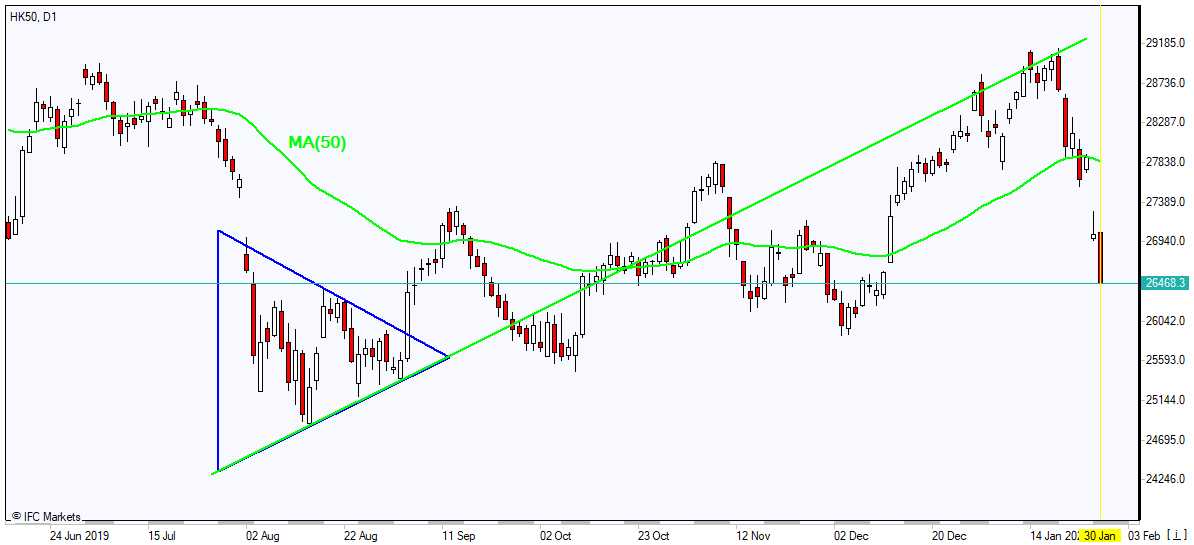
Asian stock indices are solidly lower today as coronovirus epidemic expands in China. Nikkei fell 1.7% to 22977.75 as yen climb against the dollar continued. Markets in mainland China are closed for Lunar New Year holiday. Hong Kong’s Hang Seng Index is 2.6% lower. Australia’s All Ordinaries Index lost 0.3% with Australian dollar decline against the greenback intact.
Brent futures prices are resuming declines today. Prices rebounded on Wednesday despite EIA report US crude oil inventories rose by bigger than expected 3.5 million barrels last week: March Brent added 0.5% to $59.81 on Wednesday. Shares of Saudi Aramco are down currently 0.6% to 34.20 riyals per share. Saudi oil official said Yemen’s Houthi rebels launched a missile attack on Saudi Aramco, but all projectiles were intercepted before they could hit their target in the southern Jazan region.
Gold rises despite Dollar strengthening
Gold prices are extending gains while dollar inches up. The price of an ounce of gold for February delivery rose to $1,569.90 Wednesday.
Note: This overview has an informative and tutorial character and is published for free. All the data, included in the overview, are received from public sources, recognized as more or less reliable. Moreover, there is no guarantee that the indicated information is full and precise. Overviews are not updated. The whole information in each overview, including opinion, indicators, charts and anything else, is provided only for familiarization purposes and is not financial advice or а recommendation. The whole text and its any part, as well as the charts cannot be considered as an offer to make a deal with any asset. IFC Markets and its employees under any circumstances are not liable for any action taken by someone else during or after reading the overview.
Bob Moriarty of 321gold sits down with Maurice Jackson of Proven and Probable to discuss geopolitics, precious metal prices and precious metal stocks.
Maurice Jackson: Joining us for our conversation is Bob Moriarty, a world-renowned bestselling author and founder of the websites 321gold and 321energy.com. For audience members, today we will hear from one of the most respected minds on the subject of geopolitics and investing, as we will discuss the impeachment trial of President Trump, bursting bubbles, and some very, very unique buying opportunities for your portfolio.
Bob, the impeachment trial of President Trump is dominating the news as the world is glued to their television sets with popcorn and soda in their hand, asking whatever happened to the United States of America? How does Bob Moriarty view the impeachment trial of President Trump? Is it warranted?
Bob Moriarty: There was a book was written in the 18th century and called Decline and Fall of the Roman Empire by Gibbon, and I think there were six volumes to the set. If you want to understand what the United States is going through today, you need to read Decline and Fall of the Roman Empire. We are experiencing the end of empire. There were two recent events, one being the murder of General Soleimani and the other the impeachment. We’re going to look back on this and a few years from now and say, “Were these people totally insane?” Now would you agree in general, that the thesis of the Democrats is that we need to impeach Trump to prevent him from being re-elected 2020 on the basis that he was using his political power to affect an election? Would you agree with that statement?
Maurice Jackson: I would agree with that statement.
Bob Moriarty: Now would it also be true that what the Democrats are doing, is they’re using their political power to affect an election?
Maurice Jackson: I would completely agree.
Bob Moriarty: Would you agree that is factual that what the Democrats are accusing Trump of doing, is exactly what they’re doing. Would that be correct?
Maurice Jackson: That would be definitely correct.
Bob Moriarty: Okay. And that’s bizarre. There’s actually only one, there’s one guy in the whole circus who seems to capture the insanity so far. Do you have any idea who that is?
Maurice Jackson: I would say Donald Trump.
Bob Moriarty: Oh, heavens no, that guy, he lost it years ago, pardon my French. No, Donald Trump’s a goof. I mean, the crazy thing is, what do you think he whacked Soleimani for? That was straight out of the movie “Wag the Dog,” what’s good enough for Clinton to do, it’s good enough for Trump to do. No, there’s one person who’s actually captures the insanity. And interesting enough, there’s a direct connection, remember the fiasco over the OJ Simpson trial in California?
Maurice Jackson: I recall it, yes.
Bob Moriarty: Okay. There was only one person in hindsight who was actually saying, and I can’t actually remember who it was, okay? Which embarrasses me a little bit because my memory is no good. But there was somebody that Rolling Stone had given a $50,000 check to, to listen to the trial and write a book. And the guy listened through the entire thing and the trial was over and Simpson got off. What do you suppose the guy did?
Maurice Jackson: I’m not familiar with this at all but I will assume he published the book.
Bob Moriarty: No, he tore up the check, called up Rolling Stone, and said, “This thing is such an embarrassment that I just couldn’t possibly associate something so corrupt. Everybody in the courtroom, was lying. Everybody in the courtroom was playing games and I don’t want to have anything to do with it, so I’m not going to charge you and I tore up the check.” The only sane person so far and only time will tell if he will be able to keep his sanity is Justice Roberts. And he said, “You guys are acting like kids. This is the Senate, grow up punks.”
Maurice Jackson: What has you most concerned about the impeachment trial? And what should we keep our eyes on?
Bob Moriarty: The fact that an impeachment trial exists in the first place. It’s an absolute circus and a joke. I don’t like Trump. I think the man is a buffoon as you can tell I’m not a Trump fan, but he is certainly not nearly as corrupt as Hillary Clinton. And if Americans want to throw Donald Trump out of office, they’ve got the opportunity to do that this coming November. The Democrats are not only trying to affect the 2020 election, they’re trying to affect the 2016 election.
Now, here’s what’s amazing about it. It cannot possibly get any better as it will only get worse. I’m old now, and but having the voters select the president, I think that’s just a dandy idea and it is a great way to pick your leaders. When the CIA, and the DOJ and the NSA and the FBI start thinking, “God, we’re doing so great with all these wars all over the world and all these regime changes, we’re so successful, we need to do it to the U.S.” And they failed and they just cannot come to grips with, “Jeez, nobody believes our bull that the Russian did it.” Well, no kidding! And the only question is can Justice Roberts maintain his sanity and that’s kind of 50-50 right now.
Maurice Jackson: You reference some players that I want to talk about, they’re called the deep state. What is their level of involvement in the impeachment process?
Bob Moriarty: 100%. Regardless of whether you love Trump or whether you hate Trump, it’s going to be obvious in six days or six months or six years, that this whole thing was a fiasco and extremely damaging to the reputation of the United States.
Maurice Jackson: Let’s move on to bursting bubbles and there are quite a few we can name here, we have government debt, interest rates, the repo operation, student loans, the Dow and the S&P 500 and real estate. Which bubble or bubbles should we be concerned with the most and why?
Bob Moriarty: All of them.
Maurice Jackson: In your book Basic Investing In Resource Stocks, you’re quoted as saying “that every debt gets paid. If not by the borrower, then by the lender.”
Bob Moriarty: That is correct.
Maurice Jackson: Talk to us about the fallout that may occur from any one of these bursting bubbles.
Bob Moriarty: Well, here’s the key, have you ever seen a child play with a jar of soap and one of those where they blow into it and lots of bubbles come out?
Maurice Jackson: It has been while but, yes, I do recall.
Bob Moriarty: Okay, when you’re watching a child do that, which bubble burst first?
Maurice Jackson: I actually never paid attention, I would assume the one that’s blown out first or the one that is farthest away.
Bob Moriarty: Who cares?
Maurice Jackson: Okay, there you go. That’s why I never noticed.
Bob Moriarty: And as a follow-up answer to that is if a child sitting there blowing bubbles and the child blows 50 bubbles, one of them is going to burst first. But it really doesn’t make any difference. But what do we know about the other bubbles?
Maurice Jackson: They will eventually burst as well.
Bob Moriarty: They’re all going to burst too, that’s the nature of bubbles. If they weren’t bubbles, they wouldn’t burst. They are bubbles so they will burst. Now here’s the key, and it’s very important, and this is the key point, everybody listen carefully, write it down, take it to the bank and you can cash this. No matter how well prepared you think you are, it’s going to be worse than you can imagine and everyone, no matter how well prepared, is going to be damaged.
There was a good piece today that I printed out, there was a report (click here) that only 41% of the Americans could come up with $1,000 cash to pay an emergency bill, and that’s interesting because 41% is not very high and what the real thing is, 59% could not come up with a $1,000. A lot of people are going to get hurt, it’s going to be ugly.
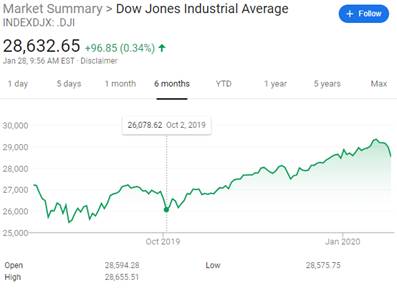
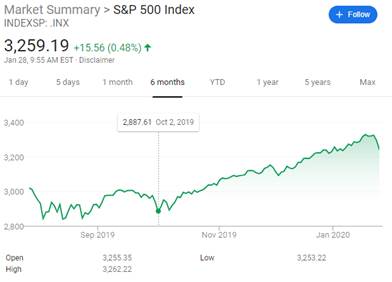
Now, I wish I could show it to you because I saw a chart yesterday. If you remember a year ago, I was saying that we were going to have a crash in October. And of course I don’t feel like a blathering idiot now because we didn’t ever crash in October and actually I’m not that big an idiot because I saw a chart of the stock market from the 1st of October until now and it’s gone up, but about a 45 degree angle. There has been no setback whatsoever. It’s virtually gone straight up. And that’s very interesting because what’s key about the timeframe around the 1st of October, what happened?
Source: Google.com
Maurice Jackson: Well, we had the repo program, is that correct? Is that what you’re relating to?
Source: Google.com
Bob Moriarty: Correct, on September 17, the Fed started pouring money into the system and if you look at chart of the Dow and the S&P, you realize that both of them have gone straight up since the 1st of October. Now that means that if I was wrong about predicting a crash, there are some blithering idiot at the Fed who’s just as wrong because that’s exactly what he was trying to prevent. And that’s what the repo madness is about. Now, anybody who thinks, well, they can cure this problem. I want you to go down to a store and I want you to buy a balloon and I don’t give care how big the balloon is, get any sized balloon. Blow into the balloon, and just keep blowing and when finally figure out what’s going to happen, give me a call back and say, “Bob, I didn’t realize it was going to blow up.” But it’s going to.
Maurice Jackson: Not if, but rather when, the bubbles burst, do you believe we’ll see blood in streets? Because I can foresee protests and riots as the masses will look to blame someone, something for their losses.
Bob Moriarty: Absolutely. There’s no question, we’re being set up for it now. The only issue in my mind has been well, will the blood in the streets be in the nature of a revolution or a civil war? I think it’s fairly clear it will be a civil war. It is scary to me the absurd positions politicians and leaders, and I put that in quotation marks, are taking because they are so inflammatory. I mean, Elizabeth Warren’s a real piece of work, she states, “Well, we need to forgive all the student debt.” Interestingly enough, the $1.7 trillion of student debt is the largest cash asset of the United States government. And she’s saying, “Well, we should just forget it,” which means she’s saying the taxpayers should pay for it.
When you listen to AOC or when you listen to Bernie Sanders, or when you listen to Warren, none of them will discuss who’s going to pay for all this debt! And the fact is, it’s always going to be the taxpayers. We’re coming to a fork in the road and both directions lead into a dead end. There are no good solutions. There are no solutions. It’s going to blow up, it’s going to be ugly.
Maurice Jackson: Sir, you’re one of the most serially successful investors in the world. And for the person listening that doesn’t want to become lost with the madness of the crowd, are physical precious metals, the most proven alternative for one to consider based on the afore mentioned?
Bob Moriarty: Yes!
Maurice Jackson: Which precious metals are you buying right now?
Bob Moriarty: Oh, that’s very funny. I’ll tell you what I’m not buying. And I’m not buying rhodium.
Maurice Jackson: But we weren’t saying that in the summer of 2017.
Bob Moriarty: That is correct, in 2017 rhodium was cheap. It is not cheap anymore. The strange thing is, and I realized something, this is really key. I’m glad that you got to ask that question because it gives me a lead in by every measure of the Daily Sentiment Index (DSI) or the Commitment of Traders (COT) or the Open Interest, gold should have had a correction. Now, will you agree? Do you agree with that?
Maurice Jackson: I don’t agree with it.
Bob Moriarty: Well, you should. Because believe me, the DSI, it’s very valuable in COT and worded extreme and the volume, same word extreme. We should in quotation marks, have a correction. I love corrections. I mean corrections give you the opportunity to get in cheap. And if you like gold at 1560, how are you going to love it when it’s 1000 bucks? Okay, that’s a better deal.
Maurice Jackson: I absolutely agree with you there.
Bob Moriarty: But here’s what’s happening. And unfortunately you’re sort of right. The Bank of International Settlements (BIS) has changed the definition of gold to make it a tier one asset. It was a tier three asset. And what that means is that these central banks were able to use gold as a form of reserves, but they only got credit for the artificial $42 an ounce figure rather than the actual figure. And the BIS said, well, that’s really stupid because gold’s a lot higher than that. Gold is now a tier one asset and you can put it on your books, at its real value. And what that means is the central bankers, and while they’re jackasses, they’re not stupid. Some of these guys actually passed Economics 101 they know disaster’s right around the corner and they’re doing exactly what prudent people in the world should do, they want to own precious metals.
And if you can use gold as tier one asset, there has been artificial buying into gold and while it should have corrected, the corrections have all been very minor and they don’t last for very long. And the central banks are loading up on gold like there is no tomorrow. And that leaves an opportunity for people who have read my books Nobody Knows Anything and Basic Investing in Resource Stocks and spent 12 bucks on it, and if you buy a book, I get to buy a Starbucks.
In both books, I make the point very effectively that you should buy what’s cheap and to sell what’s dear. Silver is very cheap, the ratio of silver to gold was about 86 to one; that’s very near record high. And platinum is the cheapest to gold it’s ever been. Platinum and silver are exceptionally cheap. Rhodium is off the chart expensive, palladium is off the chart expensive and gold’s expensive because of the central banks. But platinum and silver will catch up. So you’re going to see some extraordinary moves in those two metals.
Maurice Jackson: And I was basing my response actually on Basel III, which passed BIS in April of last year.
Moving onto buying opportunities for your portfolio. You and I were discussing some buying opportunities that have your tenseness. Let’s share them with the audience members beginning with Lion One Metals Ltd. (LIO:TSX.V; LOMLF:OTCQX).
Bob Moriarty: Lion One was number two out of 50 stocks on the OTCQX (Click Here) exchange in the United States for last year. The performance was extraordinary. They’ve made a transition from a good story into a great story. It will continue to get better. It’s not as cheap now as what it was a year ago, but it’s a lot cheaper than what it’s going to be a year from now.
Maurice Jackson: I believe it’s actually doubled since November, if I’m not mistaken and they’re doing a remarkable job there. And that’s Walter Berukoff there, he was a CEO with Lion One Metals, moving onto Hannan Metals Ltd. (HAN:TSX.V; HANNF:OTCPK).
Bob Moriarty: Hannan has two projects. A zinc property in Ireland that has an intrinsic value worth as much as the entire company’s market cap and because everybody hates zinc now they’re not even mentioning it. But they found some sedimentary copper near surface oxide in northern Peru. They’ve staked a bunch of it. Hannan is was one of my 2020 number one and two picks. Hannan has up about 150% in the last six weeks.
Bob Moriarty: Irving has just announced some really good results. And it was funny because nobody understood the results. Irving announced, “This is what we’ve found when we were drilling up the mine.” And everybody goes, “Oh, that’s boring. I want a 20 ounce gold.” The funny thing is the high grade gold should not be at surface. It should be 350 meters deep and all these intercepts are near surface, which means there’s a lot more really good stuff when you get deep. But they announced some good results, stock’s down a little bit, stock’s still exceptionally cheap compared to what it’ll be a year from now. But they’re going to announce hole 10, and I don’t know what hole 10 is going to have. I just know that every time somebody says the word hole 10, Quinton Hennigh gets a big, grin up on his face.
Bob Moriarty: Novo is making great progress. I was aware there was some behind the scenes discussion with the creditors of Millennium. Millennium has gone into bankruptcy and don’t hold me to the strict legal term. And the creditors now control the asset and the mill and they are in discussions with Novo, wanting to buy the mill. And the beauty is that the creditors have very deep pockets. The money’s not important to them. So I think they’ll do a very favorable deal with Novo, that would be very favorable for them.
And that would put Novo in production literally in a couple of weeks or a couple of months. And meanwhile they’re making great progress with the sorting machines at Egina and I expect once summer is over there, they’ll be in production this year. Big progress being made by Novo. And here’s a real key, and nobody quite understands this, Novo’s got so much ground that they’re going to be doing exploration a hundred years from now. Okay. It’s far bigger than any one company ever had, and in the Witwatersrand. So investors need to be patient. The gold is there but they got to go out and count it.
Bob Moriarty: Tri-Star is an interesting situation because it’s another Witwatersrand analog and they’ve got good gold there and they can define as many ounces as they want. All they have to do is go drill. Their single issue has been a lack of visibility, but really good management, really good project I think it will do very well.
Maurice Jackson: There’s a common theme in all the companies we’ve referenced and it’s the individual by the name of Dr. Quinton Hennigh. I learned years ago from you that you follow the right names that have a proven pedigree of success. Just for someone new to the name, can you just talk to us a little about who he is? Dr Quinton Hennigh, sir.
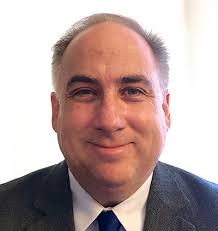
Dr. Quinton Hennigh
Bob Moriarty: You just burst my bubble. You don’t have to be smart to make money. You can be dumb and make money, but if you’re dumb and you want to make money, you need somebody who is smart and you need to follow him. So I am not some kind of genius investor. Okay? I’m just dumb. However, I am smart enough to know Quinton Hennigh. And he and I drove to Rattlesnake 11 years ago, we spent about six hours going up and about six hours coming back. We have spent weeks together visiting projects in New Zealand, in Australia, in Africa. Quinton is my best friend. He’s been wonderful and thoughtful after my wife Barbara died, which was pretty tough for me. But you can spend 15 minutes talking to Quinton and learn more than you would learn in a semester in a geology course.
I only know two or three guys in the entire industry that have the ability to share information that well. And he’s one of them. I always say he’s in the top five geologists in the world, but I think clearly he’s probably the best. Not every single project works. However, Quinton is straightforward and honest. He communicates well. And he’s a really interesting guy. He doesn’t dress very well. Actually he’s a bit of a slob. But he’s a fabulous guy. And it’s probably one of the safest investments you can make, if you see a name associated with Quinton Hennigh, you should probably buy it.
Bob Moriarty: Interesting situation there. Now my feeling is palladium is way too expensive and platinum’s way too cheap. Investors tend to say, well, palladium’s expensive because it’s used for gasoline cars and platinum’s cheap because it’s used for diesels and they’re not popular, but that’s way too simplistic. You can exchange platinum for palladium and the reason so many automobile manufacturers are using palladium now is because platinum was too expensive. But palladium’s not going to sit at $2,300 bucks and platinum sit at $1000 forever. Because there is a relationship. Platinum has a density of about 21 I think palladium’s about 11 to one. It takes a lot more palladium in a catalytic converter than it does platinum.
So the automobile manufacturers, it has cost them something like $18 billion, because the price of palladium went up. And sooner or later they’ll say, screw it, we got to bite the bullet and they’ll just switch over to platinum. Platinum is an exceptional deal right now, regardless of what you think is going to happen in the world economically. In relative terms palladium’s expensive, platinum’s cheap.
Maurice Jackson: You talk about the team there, you got to Greg Johnson and the CEO, Michael Raleigh there. And for someone who’s not familiar with the value proposition in platinum, if I can just expand on that, and you can correct me if I’m wrong please, 78% of the world’s platinum comes from one country, South Africa, and its costs of production is, I believe, at $1,100 right now. And that’s a process that can’t continue.
Bob Moriarty: No, it’s worse than that. They have socialist government in South Africa and they set the price of electricity below the cost of production. So the mines there are getting stiffed. 78% of the platinum and 45% of the palladium. But Group Ten has just drilled a couple of the greatest platinum, palladium, rhodium holes ever drilled, and they appear to have the other half of the Stillwater complex deposit. And it’s amazing to me, there’s three or four platinum palladium companies that I can think of and they’re just not getting the credit that they should. They had some extraordinary results (click here) and the market yawned.
Maurice Jackson: I would agree with you and for all of the companies that we’ve referenced, they’re sponsors of Proven & Probable and 321gold. And we are current shareholders. In closing, sir, what keeps you up at night that we don’t know about?
Bob Moriarty: Everything.
Maurice Jackson: You sound like me. If there’s one thing in particular, what would it be?
Bob Moriarty: Here’s what’s really funny, anyone who is sane and sober, who is aware of what’s going on in the world today politically and economically, deserves to get really, really drunk. That would be the only indication that you’re sane.
Maurice Jackson: And if I may ask, what would you be drinking?
Bob Moriarty: Anything.
Maurice Jackson: Anything. All right, last question, sir. And that is what did I forget to ask?
Bob Moriarty: I think you did a pretty good job.
Maurice Jackson: Well thank you, sir. Bob, for the readers that want to get more information about your books and your work, please share the website addresses.
Bob Moriarty: Amazon has both books or you can go to our website and we’ve got links on the website. And here’s what’s really interesting. If you’re even tempted to think about buying the books, do not listen to me, do not listen to Maurice, go to Amazon and read the reviews. The last book that I wrote, Basic Investing in Resource Stocks, has the highest ratings that I’ve ever seen on a book on Amazon. And that’s from ordinary readers who put their opinions in and they think it’s a great book. So don’t believe me. I mean, I’m the guy who makes five bucks every time they sell a book and I can use the money, but listen to the reviewers and at what they’ve got to say about the books. I’ll be real candid, anybody who is investing money, who hasn’t got 12 or 15 bucks or whatever it costs to buy one of those damn books, is a blithering idiot. It will pay for itself the first time you do a trade.
Maurice Jackson: Well, I don’t benefit financially from the sales of the book, but I have benefited exponentially and I want to underscore that, exponentially, from the investment. It’s a small tuition cost and you’re learning from one of the best minds. One of the most proven minds in the space.
Before you make your next bullion purchase, make sure you call me. I’m a licensed representative for Miles Franklin Precious Metals Investments where we provide a number of options to expand your precious metals portfolio from physical delivery, offshore depositories, precious metal IRAs and private blockchain distributed ledger technology. Call me directly at (855) 505-1900 or you may email [email protected]. Finally, please subscribe to www.provenandprobable.com where we provide mining insights and bullion sales. Subscription is free.
Bob Moriarty of 321gold and 321energy, thank you for joining us today on Proven and Probable.
Maurice Jackson is the founder of Proven and Probable, a site that aims to enrich its subscribers through education in precious metals and junior mining companies that will enrich the world.
Disclosure: 1) Maurice Jackson: I, or members of my immediate household or family, own shares of the following companies mentioned in this article: All. I personally am, or members of my immediate household or family are, paid by the following companies mentioned in this article: None. My company has a financial relationship with the following companies mentioned in this article: All are sponsors of Proven and Probable. Proven and Probable disclosures are listed below. 2) Bob Moriarty: I, or members of my immediate household or family, own shares of the following companies mentioned in this article: All. I personally am, or members of my immediate household or family are, paid by the following companies mentioned in this article: None. My company has a financial relationship with the following companies mentioned in this article: All of the companies mentioned are sponsors of 321gold. 3) The following companies mentioned in this article are billboard sponsors of Streetwise Reports: Lion One and Group Ten. Click here for important disclosures about sponsor fees. As of the date of this article, an affiliate of Streetwise Reports has a consulting relationship with Group Ten. Please click here for more information. 4) Statements and opinions expressed are the opinions of the author and not of Streetwise Reports or its officers. The author is wholly responsible for the validity of the statements. The author was not paid by Streetwise Reports for this article. Streetwise Reports was not paid by the author to publish or syndicate this article. The information provided above is for informational purposes only and is not a recommendation to buy or sell any security. Streetwise Reports requires contributing authors to disclose any shareholdings in, or economic relationships with, companies that they write about. Streetwise Reports relies upon the authors to accurately provide this information and Streetwise Reports has no means of verifying its accuracy. 5) This article does not constitute investment advice. Each reader is encouraged to consult with his or her individual financial professional and any action a reader takes as a result of information presented here is his or her own responsibility. By opening this page, each reader accepts and agrees to Streetwise Reports’ terms of use and full legal disclaimer. This article is not a solicitation for investment. Streetwise Reports does not render general or specific investment advice and the information on Streetwise Reports should not be considered a recommendation to buy or sell any security. Streetwise Reports does not endorse or recommend the business, products, services or securities of any company mentioned on Streetwise Reports. 6) From time to time, Streetwise Reports LLC and its directors, officers, employees or members of their families, as well as persons interviewed for articles and interviews on the site, may have a long or short position in securities mentioned. Directors, officers, employees or members of their immediate families are prohibited from making purchases and/or sales of those securities in the open market or otherwise from the time of the interview or the decision to write an article until three business days after the publication of the interview or article. The foregoing prohibition does not apply to articles that in substance only restate previously published company releases. As of the date of this interview, officers and/or employees of Streetwise Reports LLC (including members of their household) own securities of Irving Resurces and Group Ten, companies mentioned in this article.
Proven and Probable LLC receives financial compensation from its sponsors. The compensation is used is to fund both sponsor-specific activities and general report activities, website, and general and administrative costs. Sponsor-specific activities may include aggregating content and publishing that content on the Proven and Probable website, creating and maintaining company landing pages, interviewing key management, posting a banner/billboard, and/or issuing press releases. The fees also cover the costs for Proven and Probable to publish sector-specific information on our site, and also to create content by interviewing experts in the sector. Monthly sponsorship fees range from $1,000 to $4,000 per month. Proven and Probable LLC does accept stock for payment of sponsorship fees. Sponsor pages may be considered advertising for the purposes of 18 U.S.C. 1734.
The Information presented in Proven and Probable is provided for educational and informational purposes only, without any express or implied warranty of any kind, including warranties of accuracy, completeness, or fitness for any particular purpose. The Information contained in or provided from or through this forum is not intended to be and does not constitute financial advice, investment advice, trading advice or any other advice. The Information on this forum and provided from or through this forum is general in nature and is not specific to you the User or anyone else. You should not make any decision, financial, investments, trading or otherwise, based on any of the information presented on this forum without undertaking independent due diligence and consultation with a professional broker or competent financial advisor. You understand that you are using any and all Information available on or through this forum at your own risk.
Inovio Pharmaceuticals’ shares rose 30%, setting a new 52-week high price, after the firm reported it received a grant of up to $9 million to develop a vaccine against the coronavirus.
Among ongoing worldwide concerns, biotechnology firm Inovio Pharmaceuticals Inc. (INO:NASDAQ), which is focused on treating and preventing cancer and infectious diseases, recently announced that the Coalition for Epidemic Preparedness Innovations (CEPI) has “awarded it a grant of up to $9 million to develop a vaccine against the recently emerged strain of coronavirus (2019-nCoV) that has killed numerous people and infected hundreds more in China to date.”
The firm further indicated that “the initial CEPI funding will support Inovio’s preclinical and clinical development through Phase 1 human testing of INO-4800, its new coronavirus vaccine matched to the outbreak strain…and that CEPI previously awarded Inovio a grant of up to $56 million for the development of vaccines against Lassa fever and Middle East Respiratory Syndrome (MERS), also caused by a coronavirus.”
Richard Hatchett, CEO of the CEPI, commented, “Given the rapid global spread of the 2019-nCoV virus the world needs to act quickly and in unity to tackle this disease. Our intention with this work is to leverage our work with Inovio on the MERS coronavirus and rapid response platform to speed up vaccine development.”
Inovio’s President and CEO Dr. J. Joseph Kim added, “We’re extremely honored to expand our partnership with CEPI to tackle this new threat to global public health. Our DNA medicine platform represents the best modern day approach to combating emerging pandemics. We have already demonstrated positive clinical outcomes with our vaccine against MERS-CoV, another coronavirus. Importantly, following the Zika viral infection outbreak, Inovio and our partners developed a vaccine that went from bench to human testing in just seven months the fastest vaccine development on record in recent decades. We believe we can further improve upon this accelerated timeline to meet the current challenge of the emerging Chinese coronavirus 2019-nCoV.”
The firm explained in the report that “the CEPI is an innovative partnership between public, private, philanthropic, and civil organizations launched in Davos in 2017 to develop vaccines to stop future epidemics…To date, CEPI has committed to investing over $310 million in 12 vaccine candidates (five against Lassa virus, four against MERS-CoV, three against Nipah virus) and two vaccine platforms to develop vaccines against Disease X.”
Inovio Pharmaceuticals, a biotechnology company headquartered in San Diego, Calif., states that it is bringing IMMUNO-INGENUITY to life and reshaping the future of treating and preventing cancer and infectious diseases. The firm notes that it is focused on the rapid development and deployment of precisely designed DNA medicines to treat, cure and protect people from HPV, cancer and infectious diseases.
Inovio started the day with a market capitalization of around $424.0 million with approximately 100.0 million shares outstanding and a short interest of about 10.5%. INO shares opened more than 30% higher today at $5.60 (+$1.36, +32.08%) over Friday’s $4.24 closing price and reached a new 52-week high price this morning of $5.95. The stock has traded today between $5.10 and $5.95 per share and is currently trading at $5.53 (+$1.29, +30.42%).
Disclosure: 1) Stephen Hytha compiled this article for Streetwise Reports LLC and provides services to Streetwise Reports as an independent contractor. He or members of his household own securities of the following companies mentioned in the article: None. He or members of his household are paid by the following companies mentioned in this article: None. 2) The following companies mentioned in this article are billboard sponsors of Streetwise Reports: None. Click here for important disclosures about sponsor fees. 3) Comments and opinions expressed are those of the specific experts and not of Streetwise Reports or its officers. The information provided above is for informational purposes only and is not a recommendation to buy or sell any security. 4) The article does not constitute investment advice. Each reader is encouraged to consult with his or her individual financial professional and any action a reader takes as a result of information presented here is his or her own responsibility. By opening this page, each reader accepts and agrees to Streetwise Reports’ terms of use and full legal disclaimer. This article is not a solicitation for investment. Streetwise Reports does not render general or specific investment advice and the information on Streetwise Reports should not be considered a recommendation to buy or sell any security. Streetwise Reports does not endorse or recommend the business, products, services or securities of any company mentioned on Streetwise Reports. 5) From time to time, Streetwise Reports LLC and its directors, officers, employees or members of their families, as well as persons interviewed for articles and interviews on the site, may have a long or short position in securities mentioned. Directors, officers, employees or members of their immediate families are prohibited from making purchases and/or sales of those securities in the open market or otherwise from the time of the interview or the decision to write an article until three business days after the publication of the interview or article. The foregoing prohibition does not apply to articles that in substance only restate previously published company releases. 6) This article does not constitute medical advice. Officers, employees and contributors to Streetwise Reports are not licensed medical professionals. Readers should always contact their healthcare professionals for medical advice.
Acceleron Pharma’s shares established a new 52-week high after the company reported that sotatercept achieved both primary and secondary endpoints in the Phase 2 PULSAR study in patients with pulmonary arterial hypertension.
After U.S. markets closed for trading yesterday afternoon, biopharmaceutical company Acceleron Pharma Inc. (XLRN:NASDAQ), which endeavors to discover and develop TGF-beta superfamily therapeutics to treat serious and rare diseases, announced that “the PULSAR Phase 2 trial of sotatercept met its primary and key secondary endpoints in patients with pulmonary arterial hypertension (PAH).”
The firm advised that the PULSAR Phase 2 trial is a randomized, double-blind study of 106 people designed to evaluate the efficacy and safety of sotatercept in patients with PAH. The company reported that in patients on stable background PAH-specific therapies, sotatercept successfully met both the trial’s primary endpoint of the baseline change in pulmonary vascular resistance over a 24-week treatment period and the key secondary endpoint of six-minute walk distance, a measure of functional capacity and endurance.
The company’s President and CEO Habib Dable commented, “We’re thrilled to report such positive topline results from the PULSAR trial…PAH is a debilitating disease of high unmet medical need, so we’re encouraged by these data that signal that sotatercept could deliver added benefit to patients. We look forward to upcoming interactions with health authorities as we plan to globally develop and, if approved, commercialize sotatercept in PAH.”
PULSAR clinical trial investigator and Acceleron paid consultant Dr. Marc Humbert, professor of medicine and director of the French Pulmonary Hypertension Reference Center at the Université Paris-Saclay, remarked, “Approved therapies for patients with PAH target three main pathways of endothelial cell dysfunction to primarily promote pulmonary vasodilation…As a selective ligand trap for members of the TGF-beta superfamily, sotatercept is designed to rebalance BMPR-II signaling, which is a key molecular driver of PAH. The PULSAR data demonstrate that this novel approach has the potential to provide significant benefit on top of currently available therapies.”
Dr. Vallerie McLaughlin, professor of medicine and director of the Pulmonary Hypertension Program at the University of Michigan who also consulted on behalf of the firm in the trial, added, “These results are particularly impressive given the patient population, the majority of whom were on background combination therapy, including parenteral prostacyclins, had advanced hemodynamics and lengthy duration of disease…Exceptionally notable was the concordance of the effects across the prespecified subgroups. These clinically meaningful data raise the exciting possibility that sotatercept could potentially shift the treatment paradigm for patients with PAH.”
The company explained that sotatercept is an investigational agent designed to be a selective ligand trap for members of the TGF-beta superfamily to rebalance BMPR-II signaling, a key molecular PAH driver. The firm indicated that “in preclinical studies of PAH, sotatercept reversed pulmonary vessel muscularization and improved indicators of right heart failure.”
The firm characterized PAH in the report as “a rare and chronic, rapidly progressing disorder characterized by the constriction of small pulmonary arteries and elevated blood pressure in the pulmonary circulation. PAH results in significant strain on the heart, often leading to limited physical activity, heart failure, and reduced life expectancy.”
Acceleron is a biopharmaceutical company based in Cambridge, Mass., focused on the discovery, development and commercialization of therapeutics to treat rare and serious diseases. The firm’s research efforts are concentrated on harnessing the power of the TGF-beta protein superfamily, the target-rich area of biology behind the body’s remarkable capacity for cellular growth and repair. The company’s research is mostly centered on addressing hematologic, pulmonary and neuromuscular diseases.
Acceleron began the day with a market cap of around $2.8 billion with approximately 53.08 million shares outstanding and a short interest of about 7.4%. XLRN shares opened nearly 49% higher today at $78.74 (+$25.87, +48.93%) over yesterday’s $52.87 closing price and reached a new 52-week high price this morning of $81.99. The stock has traded today between $73.51 and $81.99 per share and is currently trading at $75.66 (+$22.79, +43.11%).
Disclosure: 1) Stephen Hytha compiled this article for Streetwise Reports LLC and provides services to Streetwise Reports as an independent contractor. He or members of his household own securities of the following companies mentioned in the article: None. He or members of his household are paid by the following companies mentioned in this article: None. 2) The following companies mentioned in this article are billboard sponsors of Streetwise Reports: None. Click here for important disclosures about sponsor fees. 3) Comments and opinions expressed are those of the specific experts and not of Streetwise Reports or its officers. The information provided above is for informational purposes only and is not a recommendation to buy or sell any security. 4) The article does not constitute investment advice. Each reader is encouraged to consult with his or her individual financial professional and any action a reader takes as a result of information presented here is his or her own responsibility. By opening this page, each reader accepts and agrees to Streetwise Reports’ terms of use and full legal disclaimer. This article is not a solicitation for investment. Streetwise Reports does not render general or specific investment advice and the information on Streetwise Reports should not be considered a recommendation to buy or sell any security. Streetwise Reports does not endorse or recommend the business, products, services or securities of any company mentioned on Streetwise Reports. 5) From time to time, Streetwise Reports LLC and its directors, officers, employees or members of their families, as well as persons interviewed for articles and interviews on the site, may have a long or short position in securities mentioned. Directors, officers, employees or members of their immediate families are prohibited from making purchases and/or sales of those securities in the open market or otherwise from the time of the interview or the decision to write an article until three business days after the publication of the interview or article. The foregoing prohibition does not apply to articles that in substance only restate previously published company releases. 6) This article does not constitute medical advice. Officers, employees and contributors to Streetwise Reports are not licensed medical professionals. Readers should always contact their healthcare professionals for medical advice.
The U.S. Federal Reserve kept its benchmark target for the federal funds steady at 1.50 – 1.75 percent for the second time but turned slightly dovish by describing house holding spending as rising “at a moderate pace” instead of “a strong pace,” as in December.
The Fed’s policy-making body, the Federal Open Market Committee (FOMC), reiterated its description of business fixed investments and exports as still weak and inflation continuing to run below the 2.0 percent target.
Countering that weakness the FOMC said the labor market remains strong and economic activity has been rising at a moderate rate. As in December, the FOMC was unanimous in its decision.
Early last year the Fed carried out a sharp U-turn when it reacted to weakness in the global economy and then cut the fed funds rate three times by a total of 75 basis points, ending in October.
In December the Fed then kept its rate steady and signaled it would keep rates on hold for a while, and it would take a “persistent” and “significant” rise in inflation before it considers any rate hike.
The Fed today reiterated it considers the current policy stance as “appropriate” to support sustained expansion of economic activity and strong labor market conditions and “inflation returning the Committee’s symmetric 2 percent objective.”
Today’s reference to getting inflation to return to 2 percent is slightly different to its December statement when it said the current policy stance was appropriate to support inflation “near” the 2 percent objective.
This reflects the recent uptick in headline inflation to 2.3 percent in December and 2.1 percent in November due to higher energy costs.
As in December, the FOM said it would continue to monitor the implications of incoming information for the economic outlook, including global developments and muted inflation pressures. In December the trimmed its forecast for the fed funds rate this year to average 1.6 percent from an earlier 1.9 percent, rising to 1.9 percent in 2021 and 2.1 percent in 2022.
In a separate statement on the implementation of its monetary policy, the FOMC raised its interest rate on excess reserves by 5 basis points to 1.60 percent, or 10 points above the bottom of its target range for fed funds, “to foster trading in the federal funds market at rates well within the FOMC’s target range.”
The Fed also said it term and overnight repo operations, which it began in October following a spike in money market rates, would continue “at least through April” to ensure the supply of reserves remains ample and mitigate the risk that pressures in money markets affect policy implementation.
The Fed said it would be conducting overnight reverse repurchase operations, and reverse repo operations with maturities of more than one day, at a rate of 1.50 percent in amounts only limited by the value of Treasury securities available for such operations and by a per-counterparty limit of $30 billion per day.”
It added that principal payments from agency debt and agency mortgage-backed securities up to $20 billion per month will continue to be reinvested in mortgage-backed securities and it would continue to roll over all principal payments from its holdings of Treasury securities.
The Board of Governors of the Federal Reserve System released the following statement, followed by a another statement about the implementation of monetary policy:
“Information received since the Federal Open Market Committee met in December indicates that the labor market remains strong and that economic activity has been rising at a moderate rate. Job gains have been solid, on average, in recent months, and the unemployment rate has remained low. Although household spending has been rising at a moderate pace, business fixed investment and exports remain weak. On a 12‑month basis, overall inflation and inflation for items other than food and energy are running below 2 percent. Market-based measures of inflation compensation remain low; survey-based measures of longer-term inflation expectations are little changed.
Consistent with its statutory mandate, the Committee seeks to foster maximum employment and price stability. The Committee decided to maintain the target range for the federal funds rate at 1‑1/2 to 1-3/4 percent. The Committee judges that the current stance of monetary policy is appropriate to support sustained expansion of economic activity, strong labor market conditions, and inflation returning to the Committee’s symmetric 2 percent objective. The Committee will continue to monitor the implications of incoming information for the economic outlook, including global developments and muted inflation pressures, as it assesses the appropriate path of the target range for the federal funds rate.
In determining the timing and size of future adjustments to the target range for the federal funds rate, the Committee will assess realized and expected economic conditions relative to its maximum employment objective and its symmetric 2 percent inflation objective. This assessment will take into account a wide range of information, including measures of labor market conditions, indicators of inflation pressures and inflation expectations, and readings on financial and international developments.
Voting for the monetary policy action were Jerome H. Powell, Chair; John C. Williams, Vice Chair; Michelle W. Bowman; Lael Brainard; Richard H. Clarida; Patrick Harker; Robert S. Kaplan; Neel Kashkari; Loretta J. Mester; and Randal K. Quarles.”
The Federal Reserve has made the following decisions to implement the monetary policy stance announced by the Federal Open Market Committee in its statement on January 29, 2020:
The Board of Governors of the Federal Reserve System voted unanimously to set the interest rate paid on required and excess reserve balances at 1.60 percent, effective January 30, 2020. Setting the interest rate paid on required and excess reserve balances 10 basis points above the bottom of the target range for the federal funds rate is intended to foster trading in the federal funds market at rates well within the FOMC’s target range.
As part of its policy decision, the Federal Open Market Committee voted to authorize and direct the Open Market Desk at the Federal Reserve Bank of New York, until instructed otherwise, to execute transactions in the System Open Market Account in accordance with the following domestic policy directive:
“Effective January 30, 2020, the Federal Open Market Committee directs the Desk to undertake open market operations as necessary to maintain the federal funds rate in a target range of 1-1/2 to 1-3/4 percent. In light of recent and expected increases in the Federal Reserve’s non-reserve liabilities, the Committee directs the Desk to continue purchasing Treasury bills at least into the second quarter of 2020 to maintain over time ample reserve balances at or above the level that prevailed in early September 2019. The Committee also directs the Desk to continue conducting term and overnight repurchase agreement operations at least through April 2020 to ensure that the supply of reserves remains ample even during periods of sharp increases in non-reserve liabilities, and to mitigate the risk of money market pressures that could adversely affect policy implementation. In addition, the Committee directs the Desk to conduct overnight reverse repurchase operations (and reverse repurchase operations with maturities of more than one day when necessary to accommodate weekend, holiday, or similar trading conventions) at an offering rate of 1.50 percent, in amounts limited only by the value of Treasury securities held outright in the System Open Market Account that are available for such operations and by a per-counterparty limit of $30 billion per day.
The Committee directs the Desk to continue rolling over at auction all principal payments from the Federal Reserve’s holdings of Treasury securities and to continue reinvesting all principal payments from the Federal Reserve’s holdings of agency debt and agency mortgage-backed securities received during each calendar month. Principal payments from agency debt and agency mortgage-backed securities up to $20 billion per month will continue to be reinvested in Treasury securities to roughly match the maturity composition of Treasury securities outstanding; principal payments in excess of $20 billion per month will continue to be reinvested in agency mortgage-backed securities. Small deviations from these amounts for operational reasons are acceptable.
The Committee also directs the Desk to engage in dollar roll and coupon swap transactions as necessary to facilitate settlement of the Federal Reserve’s agency mortgage-backed securities transactions.”
In a related action, the Board of Governors of the Federal Reserve System voted unanimously to approve the establishment of the primary credit rate at the existing level of 2.25 percent.
This information will be updated as appropriate to reflect decisions of the Federal Open Market Committee or the Board of Governors regarding details of the Federal Reserve’s operational tools and approach used to implement monetary policy.
More information regarding open market operations and reinvestments may be found on the Federal Reserve Bank of New York’s website.”
By TheTechnicalTraders – Most traders understand what a “Waterfall event” is if you’ve been trading for more than 3 years. Nearly every downside price reversion event initiates in a breakdown event (the first tier of the waterfall event) which is followed by additional deeper waterfall price collapses. Almost like price breaks lower, finds support, settles near support, then breaks lower targeting deeper price support levels.
SPY Daily Chart
This example SPY chart from October 2018 through December 2018 highlights this type of event almost perfectly. With each tier in the waterfall event, price searches for new support levels as price weakness drives price lower throughout each breakdown event. We’ve highlighted these breakdown events with the MAGENTA lines drawn on this chart.
The recent downside price rotation after the world was alerted to the Wuhan virus presented a very clear “first-tier” waterfall event. This first move lower is often rather condensed in size and scope – yet often within days of this first event, a bigger second downside waterfall event takes place confirming the bearish breakdown has momentum. We believe this first move lower could be the first real tier in a broader global market waterfall event which may result in a much deeper price reversion event.
We believe the total scope of the Wuhan virus will not be known for at least another 20 to 30+ days. After that span of time, we’ll know where and how aggressive this pandemic event has spread and what real capabilities we have for containment. Therefore, we believe the downside price concern within the global markets is very real and just starting.
Very much like what happened in October 2018, the initial downside price move initiated on the US fed news and expectations. When the Fed announced a rate cut, which shocked the markets, investors waited to see how the markets would react and within only 5+ days, the markets reacted violently to the downside.
Friday, January 24 was the “trigger date” for the breakdown in global markets from the news of the Wuhan virus. We believe any further downside risk to the global markets will be known within another 5 to 10+ trading days – as more information related to the spread and containment capabilities of the virus are known. Therefore, we are attempting to alert our followers and friend to the very real potential of a price breakdown event, a “Waterfall Event”, that may be set up in the global markets.
Daily Transportation Index Chart
This Daily TRAN chart highlights the recent breakdown in price that could be considered the first tier of the waterfall event. The support level, highlighted in LIGHT BLUE, suggests price may attempt to stall near 10,800 before any further price breakdown happens. A second waterfall tier could push the price well below the 10,000 level as the next real support exists near 9,9250.
Daily 400 Midcap Index Chart
This Daily MC (S&P 400 MidCap) futures chart highlights a similar price pattern. The initial breakdown tier is very clearly illustrated where the price fell to immediate support near 2050. We believe any further waterfall tier even may push the price below the 2000 level and target real support near 1952.
Daily Financial Sector Index Chart
This XLF (Financial Sector SPDR ETF) Daily chart, again, highlights the first tier breakdown in the price of the potential Waterfall event. This is actually one of the clearest examples of how price operates within this type of rotation. The initial downside tier broke through support near $30.00 and has begun to rally back above this level. The LIGHT BLUE highlighted support range shows us where the first tier may stall. Any further breakdown in price may push the price below the $28.50 level as price searches for new support.
We’ve referenced the 1855 “Third Plague Event” that hit in China and quickly spread to India, SE Asia, and other neighboring countries as an example of what may happen with the Wuhan virus. The 1855 event killed over 15 million people (nearly 1.25% of the total global population at the time) and lasted until 1960 when the Plague cases dropped below 200.
We urge all traders and investors to prepare for a broader downside market event in the future – possibly a “waterfall event”. We’ll know more about the size and scope of this potential pandemic within 30+ days – but this may become a much bigger issue across the globe very quickly. The volatility this event may create in the global markets is an ideal setup for skilled technical traders. In the last week, we locked in profits on two trades SSO for 6.5% and TLT for 3%. Learn how we can help you find and execute great trades related to this wildly volatile event.
Join my ETF Trade Alert Newsletter – Wealth Building Newsletter if you like what you read here and ride my coattails as I navigate these financial markets and build wealth while others lose nearly everything they own.
NOTICE: Our free research does not constitute a trade recommendation or solicitation for our readers to take any action regarding this research. It is provided for educational purposes only. Our research team produces these research articles to share information with our followers/readers in an effort to try to keep you well informed. Visit our web site to learn how to take advantage of our members-only research and trading signals.
Sector expert Michael Ballanger examines the possible effects the emergence of the coronavirus in China may have on markets, and offers his observations on January’s market performances.
There is a local casino just “up the road” from where we reside that we visit (once in a blue moon), small sums of pocketed cash in hand, to play a few favored slot machines to see if we can defy the house odds and come home winners. Called The Great Blue Heron Casino, we have nicknamed it “The Blue Goose,” in reference to how one usually feels upon departure.
On occasion, we drive back “down the road” with smiling faces because we spat in faces of the Gambling Gods and actually came out ahead. However, the majority of the time, we limp home dejectedly, vowing never ever to return. Then, a month later, back “up the road” we go with yet another modest wad of the ultimate in “risk capital” to fire into the vice machines, forgetting all vows of abstinence and reformation.
Now, being that it is the closest casino to the large Asian populations of the Greater Toronto Area, the Goose is frequented by busload after busload of (predominantly) gamblers of Chinese descent or origin, cash literally falling out of pockets, who dash immediately in the direction of the exclusive “high-roller” sections. I have observed from afar elderly Chinese women sitting at a slot machine for hours, reaching into well-guarded handbags for $100 bills, which they deposit with orderly precision and astonishing calm. The robotic nature in which they perform these functions are almost religious in nature but alas, this is not the point of the story.
Last evening, I was about to sneak into the “Goose” for a fast $500 “cleansing” when I looked up to see one of those packed tour buses unloading passengers. What struck me as “odd” was that all of these (predominantly Chinese) people were wearing surgical masks. The last time I saw people wearing surgical masks outside of an operating theater was during the SARS epidemic, circa 2002, and in the category of “How Quickly We Forget,” global markets were roiled by that frightening pandemic. So, with the arrival of a new strain of microbe known as the “coronavirus” now dominating the news cycles, it was as if a large bucket of ice water was dumped down my (and the market’s) back.
I recall reading John Naisbitt’s 1982 bestseller Megatrends: Ten New Directions Transforming Our Lives, in which one of the major new directions was the “mutation of the microbe.” The explosion of world travel, with emphasis on the mass immigration of Asians to every other continent on the planet, has made the transportation and incubation of harmful, if not deadly, strains of bacteria a definite problem. It was identified by Naisbitt forty years ago in his book, as was the ascension of China as a global powerhouse, and it would appear that both premonitions have now been proven correct.
Amazingly, however, the impact of a potential negative impact on retail trade and tourism has been largely brushed aside, as investors seized upon Thursday’s 200-point drop in the Dow as a buying opportunity and moved the tape from red to green in the last hour of trading, before the exchange closed mildly negative.
This brings me to the point of this discussion: Just as the 2008 sub-prime crisis began as a “contained problem” affecting only isolated financial institutions, it was only when it began to spread across all of the banking sector that things went south. Similarly, the outbreak of the Ebola virus in 2014 clipped the markets for nearly 10%, so events such as the coronavirus certainly carry the potential to act as catalysts for profit-taking (at best) and outright panic(at worst).
In early Friday morning trading, markets appeared to have made their judgment; this was an isolated event and certainly nowhere as severe as either SARS or Ebola, so line up your favorite cash-burning electric car company trading at all-time nosebleed levels and margin the living st out of it. That was before a case of coronavirus was confirmed in Chicago, and then the st hit the proverbial fan. As I tweeted out on Thursday afternoon, “Is this the catalyst for the next market correction/crash?” along with a picture of a microbe. It was exactly that, which set up Friday’s reversal, and despite a valiant effort to save the weekly charts from an ugly red candle, the S&P closed down 30.07 points or 0.9%.
I remain cautious on the near-term outlook for stocks and have made a small bet on a decline, which I’ll cover in the “Positions” part of the subscriber section. In the interim, precious metals prices are mixed, with gold and silver trying to maintain their uptrends. I remain a buyer of physical metal ahead of the miners because I am fearful that an overall market correction has the potential to cause a divergence between the two.
We love the Gold Miners (GDX and GDXJ) for their leverage to the upside, so powerfully evident during the Q3/2019 advance, but the Gold Miners are not exactly on fire right now and the underperformance of the HUI, plus the dismal performance of silver (and the GSR) this month gives me pause. I await a more optimal entry level for the initiation of unleveraged positions. But as far as options, futures and the leveraged Gold Miner exchange-traded funds (NUGT and JNUG) are concerned, I need a much better entry level before taking on risk. In two or three months I may look back with regret, but for now, my January strategy of caution has been working.
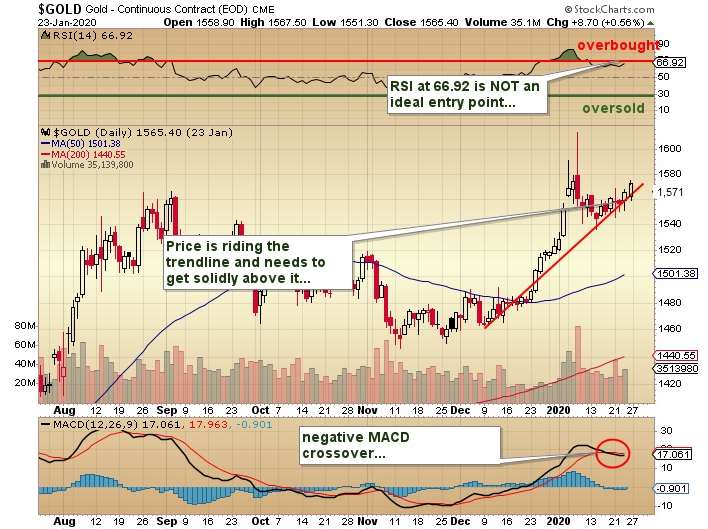
Gold prices are hugging the uptrend line drawn off the December lows, and in fact have finally, here on Friday, moved away from actually straddling that line earlier in the week. A move in February gold above US$1,580/ounce would suggest a test of the US$1,613 top, while a series of closes below US$1,560 would send it to US$1,525. Mind you, if the U.S. markets buckle under the coronavirus catalyst, gold will move sharply higher, and embolden me to action and away from caution.
You all know how much I adore silver. Most of the jewelry I buy as gifts and for personal use have always been silver. I actually have a sterling silver bathroom tissue dispenser in the master bedroom. Despite that last admission probably falling into the “too much information” category, I wince every time I look at Tesla in the mid $500s/share and silver sub-$20/ounce. I throw quote monitors from office windows in absolute outrage at the incessant illegality of the Crimex paper shenanigans that blackwash the silver “market.”
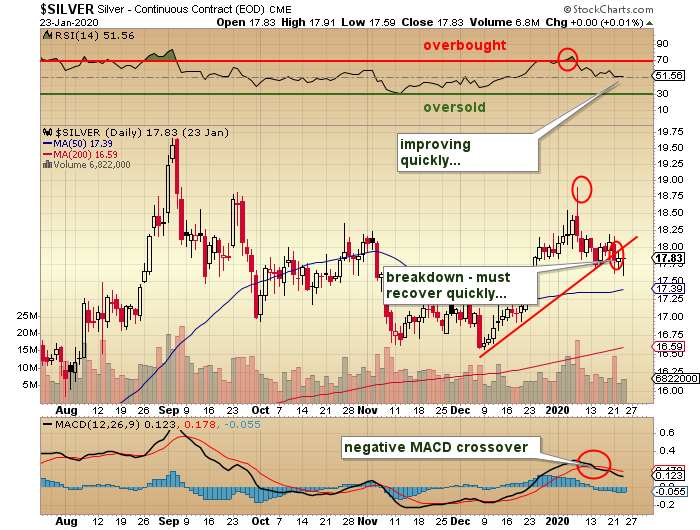
However, even as a steroid-filled silver bull, only through advancing senility have I been able to harness this inherent optimism and see the tree-diffused forest; my beloved silver is failing to hold up “her end.” Silver prices are not acting as the precious metals leader they became last July. And that is bad.
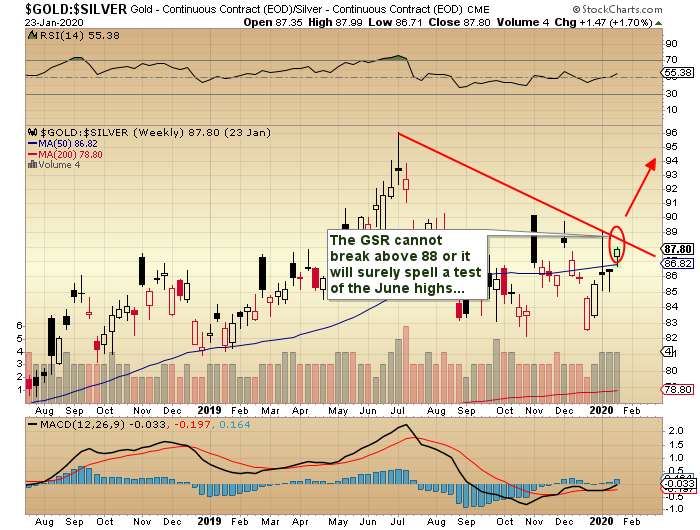
Before you throw this tardy missive into the bin, recall that in the very early stages of the gold breakout (June 2019), silver also acted in a “canine sort of way.” Then, when gold gurus were calling for a 100 GSR (gold-to-silver ratio), I put out the now-famous “Short the GSR!” invective at 92.40 (within literally hours of the top)but not before taking huge flak and derision from not only the anti-precious metals battalions of Tesla-wielding, wild-eyed stockroaches but also (and with considerably more vitriol) from the gold bulls!
We may be in a stage of the Great Bull Market in gold that began on Dec. 4, 2015, at US$1,045, where gold leads and silver followhence the deteriorating GSR. What I am looking out for is a “slingshot trade,” where the rampaging leader of a stock sector breaks out to new highs without any other sector members participating. People start to shout “Divergence!!!!” and sell both the leader and the other same-sector names, only to watch in horror as the leader rests and the followers suddenly explode higher. This is exactly what the silver metal and associated stocks did in the days and weeks after gold broke out above US$1,375.
To be sure, these are not easy markets to navigate and I, for one, am keeping my powder very dry, as my fear of a massive equity-market drawdown mitigates my precious metals ebullience. You will all recall, back in November, when I wrote that being “out” of my beloved Gold Miner ETFs (GDX and GDXJ) was actually more agonizing than back in March (2019) when they were down 12% and looking dreadful. Well, here we are in late January and I can tell you with total gums-exposed honesty that I am in the exact same state.
Bragging about an exit in the GDXJ at US$43 with it closing Friday at USD $41.79, is somewhat disingenuous, because we are a chip shot away from multiyear highs. That said, neither GDX or GDXJ has been able to take out the August 2016 highs at US$31.05 and US$49.37, which happened with gold trading at US$1,375.
So, with the metal now US$200 higher than the peak in 2016, either the miners are cheap, or the metal is rich, and therein lies my conundrum. I was trained many years ago by a brilliant futures trader that “lost opportunity is distinctly better than lost capital,” which is closely mirrored by “when in doubt, stay out!” To be clear, I am 70% invested in physical gold and silver and a handful of juniors; I am flat the miner ETFs because holding stocks terrifies me. I am trying to position myself before the end of the month in more physical metal and/or the jettisoned Gold Miner ETFs. If a gun is placed “upside my head” forcing me to action, I’ll opt for more silver first.
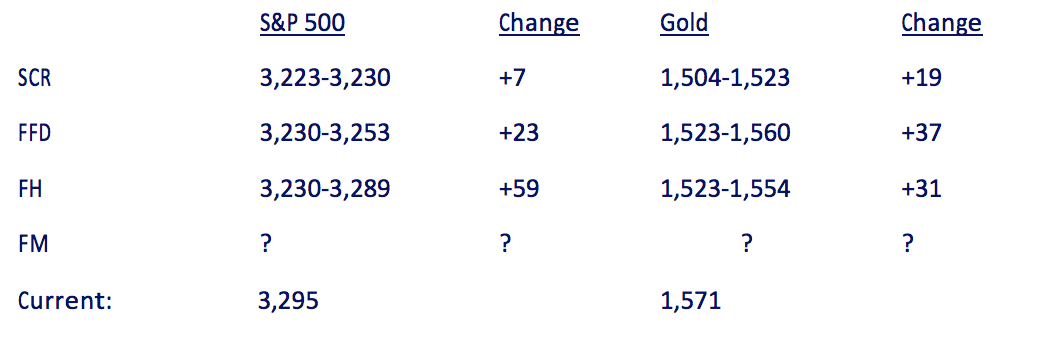
As we head into the last week of January, it is interesting to do the “January Barometer” (JB) analysis for stocks and for gold. Statistics show that as January goes, so goes the market for the rest of the calendar year. It is actually a tad more detailed than simply looking at the start and end levels for the S&P. The periods to be monitored are the Santa Claus rally (SCR) period (Dec. 24Dec. 31), the First Five Days (FFD; Dec. 31 closing priceJan. 8), First Half (FH; Dec. 31 closing priceJan. 15) and the Full Month (FM; Dec. 31 closing priceJan. 31 closing price). I like to do the same analysis for gold as an exercise only because gold is such a different beast so here we go:
As for the S&P, the JB for 2020 was in full “bull mode” with the SCR, FFD and FH readings all solidly positive, but with the late-week reversal, the S&P went out only 6 points above the FH close. Under the JB rules, stocks have to close out the month higher than the FH, FFD and 2019 closing prices, so if the big reversal on Friday sends the monthly close to under the FH close, then the JB is sending a mixed signal and the 2020 Trump Reelection Year may not go as swimmingly as one might have thought a week ago.
As for the JB for gold, with the close at US$1,571.90, things look decidedly better, as while the FFD close at US$1,560 was higher than the FH close at US$1,553, gold stands a very good chance of closing the month higher than the FH close, and that would be a huge positive for near-term performance.
The definition of the term “mixed emotions” is that it is the feeling one gets when that particularly hateful bullion bank trader drives your new Ferrari off a cliff. I have mixed emotions concerning gold because I have yet to buy the 2020 GGMA portfolio. As stated earlier, I am 70% long from purchases made in January 2019, but only 25% invested for new cash available for investment in 2020. Not to worry though, because I have a feeling that things will get resolved this week, for the better or for the worse.
With the coronavirus death toll having just jumped to 60% and now confirmed in Europe, traders in all markets are advised to beware the malevolent microbe.
Originally trained during the inflationary 1970s, Michael Ballanger is a graduate of Saint Louis University where he earned a Bachelor of Science in finance and a Bachelor of Art in marketing before completing post-graduate work at the Wharton School of Finance. With more than 30 years of experience as a junior mining and exploration specialist, as well as a solid background in corporate finance, Ballanger’s adherence to the concept of “Hard Assets” allows him to focus the practice on selecting opportunities in the global resource sector with emphasis on the precious metals exploration and development sector. Ballanger takes great pleasure in visiting mineral properties around the globe in the never-ending hunt for early-stage opportunities.
Disclosure: 1) Statements and opinions expressed are the opinions of Michael Ballanger and not of Streetwise Reports or its officers. Michael Ballanger is wholly responsible for the validity of the statements. Streetwise Reports was not involved in any aspect of the article preparation. Michael Ballanger was not paid by Streetwise Reports LLC for this article. Streetwise Reports was not paid by the author to publish or syndicate this article. 2) This article does not constitute investment advice. Each reader is encouraged to consult with his or her individual financial professional and any action a reader takes as a result of information presented here is his or her own responsibility. By opening this page, each reader accepts and agrees to Streetwise Reports’ terms of use and full legal disclaimer. This article is not a solicitation for investment. Streetwise Reports does not render general or specific investment advice and the information on Streetwise Reports should not be considered a recommendation to buy or sell any security. Streetwise Reports does not endorse or recommend the business, products, services or securities of any company mentioned on Streetwise Reports. 3) From time to time, Streetwise Reports LLC and its directors, officers, employees or members of their families, as well as persons interviewed for articles and interviews on the site, may have a long or short position in securities mentioned. Directors, officers, employees or members of their immediate families are prohibited from making purchases and/or sales of those securities in the open market or otherwise from the time of the interview or the decision to write an article until three business days after the publication of the interview or article. The foregoing prohibition does not apply to articles that in substance only restate previously published company releases.
Charts provided by the author.
Michael Ballanger Disclaimer: This letter makes no guarantee or warranty on the accuracy or completeness of the data provided. Nothing contained herein is intended or shall be deemed to be investment advice, implied or otherwise. This letter represents my views and replicates trades that I am making but nothing more than that. Always consult your registered advisor to assist you with your investments. I accept no liability for any loss arising from the use of the data contained on this letter. Options and junior mining stocks contain a high level of risk that may result in the loss of part or all invested capital and therefore are suitable for experienced and professional investors and traders only. One should be familiar with the risks involved in junior mining and options trading and we recommend consulting a financial adviser if you feel you do not understand the risks involved.
Throughout last week, the view of analysts was that the PMIs published on Friday would be decisive as to whether the BOE cut rates during its first meeting of the year.
But, in the end, the data split the difference and just increased uncertainty. Yes, the important manufacturing PMI was above expectations, but it was still technically in contraction.
Governor Carney has been hinting quite strongly that further easing was in the cards, despite the City urging them not to take action.
The latest data has been mixed, both monthly and quarterly. And it’s not terribly surprising given the General Election in early December that could distort the data a bit.
However, given the circumstances, the balance of expectations shows a pretty even split between those who expect a hold and those who expect a cut.
The Markets Don’t Like Uncertainty
Without a consensus as to what to expect from the BOE, the markets have not been able to price in the expectations. That means we could see a reaction no matter how it goes.
Generally, a cut in rates would be seen as negative for the pound, while a hold would be positive. However, the upside could be limited, as keeping rates on hold simply kicks the can down the road to February.
A cut has a more permanent effect, since virtually no analyst is expecting the reference rate to go below 0.5%.
With the swirling geopolitical risks around the world, the pound has traded largely flat. This is likely due to traders waiting for some direction from the BOE.
It’s a somewhat unique situation where there is such an even balance on expectations ahead of a central bank meeting. We could have some volatility in the immediate aftermath of the release.
Other Clues
It should be noted that this time, there is a press conference for Governor Carney scheduled for after the meeting. Normally, this would be a strong sign of potential policy changes.
However, this time around, as it’s the end of the quarter, the BOE will be issuing a Monetary Policy Report which routinely is followed by a press conference.
Regardless of what happens at the meeting, there are some factors to keep in mind to gauge the market’s potential reaction. First is the issue of the vote. Last time it was 7-2 in favor of maintaining policy.
Counting Votes
Should policy be maintained, but at a different margin of votes, the market could react to the hawkish or dovish shift in the vote.
Similarly, if there is a vote to cut, a 5-4 or even 6-3 vote would show little conviction towards easing by the bank. It would also lead to a market reaction of a “hawkish cut”.
It could even cause an immediate drop in sterling, followed by a longer-term move higher. More unanimity in the vote conveys more determination by the BOE. And it would likely cause a cleaner move in the market.
The other factor to keep in mind is the annual outlook and tone of the policy statement. Low rates for an extended period of time is the theme, cut or no. A change in that language could also rile up the markets.
Rhodium prices have surged along with palladium. Price discovery in rhodium works differently than for other precious metals, so investors need to be especially careful.
The “spot” price for rhodium surged to $9,985 last week. However, that price does not come from a market where regular trading produces live, real-time prices.
Rather, the rhodium ask price is simply declared by major refiners. Johnson Matthey is one of the firms which publishes a price.
Rhodium 2-Year Chart
The price is generally updated twice per day during the trading week.
Lately the published ask prices jumped dramatically higher. Bid prices, on the other hand, have not kept up.
The bid/ask spread in the thinly traded rhodium market has always been wider than in other precious metals, but it’s wider now than ever. Current bids are roughly $2,000 below the published ask price.
If there really are industrial users paying the refiners’ $10,000 ask price for physical rhodium, it is quite an opportunity for arbitrage. Traders could theoretically purchase bars at the bid price and sell them at a very healthy profit to anyone paying the ask price.
That isn’t happening, at least as far as we can determine. Someone may have published a $10,000 ask price, but we can’t locate anyone actually paying that sum for rhodium bars.
Despite what the surging “spot” price for rhodium may imply, the bid for physical rhodium remains weak.
Money Metals has taken dozens of calls per day from sellers trying to cash in on spot prices near $10,000/oz. Many are disappointed to find actual prices are far lower which is a result of wholesalers dropping their bids. We believe one major rhodium buyer will cease further buying soon.
The rhodium market is tiny and illiquid. Price discrepancies like the one we are seeing are common. Our advice to clients would be not to put much credence in the “spot” price they see published until the spread is much tighter than it currently is.
The true price of rhodium, like all assets, is based on what real buyers are actually paying. That is currently closer to $8,000/oz, not $10,000/oz.
The Money Metals News Service provides market news and crisp commentary for investors following the precious metals markets.