Pound rallies after Bank of England holds interest rates

By Lukman Otunuga, Research Analyst, ForexTime

Everyone wanted a piece of the British Pound on Thursday after the Bank of England left interest rates unchanged at 0.75%, in Mark Carney’s final meeting as governor.

The Pound jumped over 0.5% against the Dollar and appreciated against every single G10 currency as the central bank saved its monetary policy ammunition for another day. The 7-to-2 split vote suggests that the BoE may be waiting for more evidence of economic recovery before pulling the trigger on lower interest rates.

Overall, the tone of the policy statement was balanced as Monetary Policy Committee (MPC) members noted the rebound in sentiment since the general elections. However, GDP forecasts were cut for the next three years with estimates for growth in the fourth quarter of 2019 downgraded to zero. There was a strong focus on inflation which was projected to hit the central bank’s 2% goal by the end of 2021 – contingent to a rate cut in 2021.

All in all, it looks like the BoE will remain in ‘wait and see’ mode on rates but ready to act if Brexit uncertainty or external developments threaten the UK economy.

In regards to the technical picture, the GBPUSD jumped over 80 pips following the BoE rate decision with prices trading around 1.3090 as of writing. A solid daily close and breakout above 1.3100 should open the doors towards 1.3160. Alternatively, if 1.3100 proves to be reliable resistance, the currency pair could correct back towards the 1.3100 support level.

A classic breakout strategy still remains in play on the GBPUSD with 1.3160 acting as resistance and 1.3100 providing support.

GBPJPY punches above 142.50

It was a similar story with the GBPJPY as prices jumped over 100 pips on the BoE rate decision.

The currency pair remains in a wide 350 pip range on the daily charts with support at 141.00 and resistance at 144.50. A daily close above 142.50 should open the doors towards 143.60 and possibly 144.50. If 142.50 proves to be a stubborn resistance, the GBPJPY could decline back towards 141.00.

Disclaimer: The content in this article comprises personal opinions and should not be construed as containing personal and/or other investment advice and/or an offer of and/or solicitation for any transactions in financial instruments and/or a guarantee and/or prediction of future performance. ForexTime (FXTM), its affiliates, agents, directors, officers or employees do not guarantee the accuracy, validity, timeliness or completeness, of any information or data made available and assume no liability as to any loss arising from any investment based on the same.


Forex-Time-LogoArticle by ForexTime

ForexTime Ltd (FXTM) is an award winning international online forex broker regulated by CySEC 185/12 www.forextime.com

Ukraine cuts rate 6th time, sees rate at 7% end-2020

By CentralBankNews.info

Ukraine’s central bank cut its rate for the sixth time as it reached its inflation target earlier than envisaged and said it expects to lower its rate further to 7.0% percent by the end of 2020, with the fastest pace of rate cuts in the first half of this year.

The National Bank of Ukraine (NBU) cut its key policy rate by 150 basis points to 11.0 percent and has now cut it by a total of 700 points since it began its easing cycle in April 2019.

A steady rise in Ukraine’s hryvnia from September 2018 through December 2019 along with low energy and food prices has pushed down Ukraine’s inflation rate faster than expected.

In December headline inflation fell to a 6-year low of 4.1 percent from 5.1 percent in November and 9.8 percent in December 2018, in the lower end of NBU’s target of 5.0 percent, plus/minus 1 percentage point.

“The strengthening of the hryvnia was the key factor driving the rapid disinflation seen in late 2019, offsetting the effects of robust consumer demand,” NBU said.

NBU expects inflation to remain below its target range starting in January and most of this year before accelerating to 4.8 percent in the fourth quarter of 2020, mainly because the rise in the hryvnia will continue to be reflected in import prices, low energy prices will hold back domestic fuel prices, and food price inflation should be insignificant in the absence of supply shocks.

Administered prices, however, will grow somewhat faster than in 2019, mainly as taxes on tobacco products continue to converge to European levels, NBU said.

Based on its expectation of lower interest rates, NBU expects inflation in 2021 and 2022 to remain within its medium-term target, supported by prudent fiscal policy, low energy prices and higher productivity.

If inflation risks materialize, NBU cautioned it could slow the pace of rate cuts and conversely if reforms are implemented faster than expected along with significant inflows of investment, the rate could be cut at an even faster pace.
In 2019 the hryvnia appreciated almost 20 percent but since late December it has given back some of those gains to trade at 24.9 to the U.S. dollar today, down almost 5 percent this year.

Ukraine’s economy is expected to continue to strengthen in coming years and NBU confirmed its earlier forecast for growth this year of 3.5 percent, up from 3.3 percent in 2019, rising to around 4.0 percent in following years.

The current account deficit narrowed to only 0.7 percent of gross domestic product in 2019, partly after Ukraine’s state-owned gas company Naftogaz received $2.9 billion from Russia’s Gazprom after a legal battle was settled.

In 2020-22 NBU expects a current account deficit of 3-4 percent of GDP, a level it described as “acceptable,” with the deficit caused by large investment imports and lower revenue from natural gas transit amid greater capital inflows to the private sector.

The National Bank of Ukraine released the following statement:

“The Board of the National Bank of Ukraine has decided to cut the key policy rate to 11% per annum effective 31 January 2020. The NBU continues to ease its monetary policy with the aim of maintaining inflation at the target level of 5% and supporting steady economic growth.
In 2019 consumer inflation declined to a six-year low of 4.1% (versus 9.8% in 2018). The NBU thus achieved its medium-term inflation target of 5% ± 1 pp (declared in 2015) earlier than expected. The strengthening of the hryvnia was the key factor driving the rapid disinflation seen in late 2019, offsetting the effects of robust consumer demand.
Throughout most of 2020, inflation will be below the 5±1 pp target range, but it will return to the target range at the end of the year
According to the NBU’s estimates, inflation continues to slow. It will be below the 5±1 pp target range starting in January and throughout most of the year. However, it will accelerate in Q4 to 4.8% at year-end 2020.
This will be due to the following factors. First, the last year’s appreciation of the hryvnia will continue to be reflected in prices of imported goods and products with a large share of imported inputs. Second, continued relatively low global energy prices will curb the rise in domestic fuel prices. Third, in the absence of supply shocks, food price inflation will be insignificant owing to expected higher yields of fruit and vegetables.
At the same time, administered prices will grow somewhat faster than last year, mainly as excise taxes on tobacco products continue to converge with European levels.
Driven by the monetary policy easing, inflation in 2021–2022 will remain within the medium-term target of 5+/-1% pp. The further steady, low pace of inflation will also be due to the following factors:
  • a prudent fiscal policy
  • relatively low energy prices on the global markets
  • higher productivity of the Ukrainian economy.
In 2020 economic growth will accelerate to 3.5%, up from 3.3% in 2019, while accelerating to around 4% in the following years
The monetary policy easing will contribute to the faster economic growth. High private consumption and investment will remain the main economic growth drivers. At the same time, the contribution of net exports to GDP will remain negative on the back of the real sector’s considerable need for investment imports.
Real household income will grow at a fast pace, which will further narrow the wage gap with neighboring countries and thus make Ukrainians more interested in working in Ukraine rather than abroad.
The 2020–2022 current account deficit will remain acceptable
The deficit narrowed to 0.7% of GDP in 2019. An important factor behind the decrease in the deficit was the compensation received by Naftogaz of Ukraine from Russian Gazprom under a ruling of the Stockholm Arbitration Court. However, apart from that, the current account deficit shrank due to the decreased trade deficit in goods and services, steady growth in services exports, and smaller amounts of repatriated dividends.


The current account deficit will range from 3% to 4% in 2020–2022. In particular, the wider deficit will be caused by large volumes of investment imports and decreased proceeds from natural gas transit. However, this will be offset by greater capital inflows to the private sector amid an improvement in the investment climate.
 
Further cooperation with the International Monetary Fund remains the basic assumption of the macroeconomic forecast


The NBU expects that a new cooperation program with the IMF will be signed in the coming months, after the Ukrainian parliament approves the required draft laws. The new cooperation program, official borrowing and nonresidents’ sustained interest in domestic Treasury bonds and bills will sustain the rise in international reserves every year, despite Ukraine going through a period of peak external public debt payments. International reserves will exceed USD 29 billion in 2020, and will continue to rise in 2021–2022.


As before, the NBU believes any delay in entering into a new cooperation agreement with the IMF to be the key risk to the said macroeconomic forecast. Risks to macrofinancial stability also persist. These risks could mainly arise from Ukrainian court rulings on the responsibility and liability of the former owners of insolvent banks to the state.


If materialized, these risks could worsen exchange rate and inflation expectations, and make it harder for Ukraine to access the international capital markets in order to repay the heavy debt load of the coming years.


There are other significant risks. They include:


  • the continued cooling of the global economy and a further deterioration in terms of trade
  • an escalation of the military conflict in eastern Ukraine and new trade restrictions introduced by Russia
  • a drop in the harvest of grain, fruit and vegetable crops in Ukraine in the wake of unfavorable weather
  • the higher volatility of global food prices, driven by global climate change
  • a decrease in foreign capital inflows.


The outlined macroeconomic forecast and the unchanged balance of risks have enabled the NBU Board to cut the key policy rate by as much as 2.5 pp. This monetary policy easing will help revive lending to the real sector and speed up economic growth.


In light of the more rapid improvement in Ukraine’s macroeconomic conditions, the NBU expects to cut the key policy rate to 7% by the end of 2020


The most pronounced reduction in the key policy rate is expected to take place in H1 of the current year. This will lead to further decreases in interest rates on loans for businesses and households, thus stimulating business activity.


That said, if the above inflation risks, both internal and external, materialize, the key policy rate could be decreased more slowly.


Conversely, faster implementation of reforms, coupled with significant investment inflows, could enable the NBU to cut the key policy rate at a quicker pace.


The decision to cut the key policy rate to 11% was approved by NBU Board Decision No.76-D On the Key Policy Rate, dated 30 January 2020.


A summary of the discussion by Monetary Policy Committee members that preceded this decision will be published on 10 February 2020.


А new detailed macroeconomic forecast will be published in the Inflation Report on 6 February 2020.


The next meeting of the NBU Board on monetary policy issues will be held on 12 March 2020, as scheduled.”


Fed Keeps Rates Steady, As Expected

By Orbex

The Federal Reserve Bank held its monetary policy meeting yesterday. As widely expected, the central bank left interest rates unchanged.

It signaled that rates will remain steady while affirming its commitment to higher inflation. The Fed decision was unanimous, contrary to previous meetings that saw some dissent.

Equity markets closed mixed upon the news.

German Gfk Consumer Climate Improves in January

The Gfk survey on the consumer climate for Germany showed another modest improvement. The index rose to 9.9 in January, beating estimates of an increase to 9.6.

This was a slight improvement from December’s reading of a revised 9.7. The euro brushed aside the data which complements the recent increase in the Ifo business climate report.

EURUSD Holding on Near Support

The common currency is firmly testing the support area of the 1.1000 level. Price action has the potential to post a correction off this level. As long as the support level holds, there are signs of a bullish divergence building up. The upside correction could see the EURUSD back at 1.1072 level.

European Lawmakers Approve UK Withdrawal Agreement

In the run-up to tomorrow’s D-Day, European lawmakers approved the UK’s withdrawal bill. This means that the European parliament seats will also shrink.

The motion sets into play the formal exit from the EU by the UK tomorrow. This also opens an 11-month transition period for the UK to fully withdraw from the European Union.

GBPUSD Remains Subdued

The currency pair is extending declines, but price action is finding support off the dynamic support level of the trend line. Prices remain confined to the range of 1.3100 and 1.2960. A breakout from this level could trigger the direction in the near term. We expect GBPUSD to rise back to the 1.3100 level.

Gold Prices Gain on Fed Meeting

The precious metal regained some bullish momentum after the Fed meeting. The central bank reiterated its stance to keep rates steady while ensuring that inflation will rise. Taking cues from the meeting, gold prices advanced slightly as it attempts to retest the weekly highs.

XAUUSD Needs to Breakout Higher

The current gains in the precious metal is showing signs of exhaustion. Price action is close to testing the January 27th close near 1582. A breakout above this level is required to pursue further gains. Above this level, the main resistance at 1594 will be critical. Unless gold breaks above this level we expect price action to remain flat.

By Orbex

Ichimoku Cloud Analysis 30.01.2020 (AUDUSD, NZDUSD, USDCAD)

Article By RoboForex.com

AUDUSD, “Australian Dollar vs US Dollar”

AUDUSD is trading at 0.6736; the instrument is moving below Ichimoku Cloud, thus indicating a descending tendency. The markets could indicate that the price may test the cloud’s downside border at 0.6765 and then resume moving downwards to reach 0.6615. Another signal to confirm further descending movement is the price’s rebounding from the resistance level. However, the scenario that implies further decline may be canceled if the price breaks the cloud’s upside border and fixes above 0.6845. In this case, the pair may continue growing towards 0.6935.

AUDUSD
Risk Warning: the result of previous trading operations do not guarantee the same results in the future

NZDUSD, “New Zealand Dollar vs US Dollar”

NZDUSD is trading at 0.6508; the instrument is moving below Ichimoku Cloud, thus indicating a descending tendency. The markets could indicate that the price may test the cloud’s downside border at 0.6545 and then resume moving downwards to reach 0.6395. Another signal to confirm further descending movement is the price’s rebounding from the descending channel’s upside border. However, the scenario that implies further decline may be canceled if the price breaks the cloud’s upside border and fixes above 0.6595. In this case, the pair may continue growing towards 0.6685.

NZDUSD
Risk Warning: the result of previous trading operations do not guarantee the same results in the future

USDCAD

USDCAD is trading at 1.3202; the instrument is moving above Ichimoku Cloud, thus indicating an ascending tendency. The markets could indicate that the price may test the cloud’s upside border at 1.3150 and then resume moving upwards to reach 1.3305. Another signal to confirm further ascending movement is the price’s rebounding from the support level. However, the scenario that implies further growth may be canceled if the price breaks the cloud’s downside border and fixes below 1.3075. In this case, the pair may continue falling towards 1.2995.

USDCAD

Article By RoboForex.com

Attention!
Forecasts presented in this section only reflect the author’s private opinion and should not be considered as guidance for trading. RoboForex LP bears no responsibility for trading results based on trading recommendations described in these analytical reviews.

Japanese Candlesticks Analysis 30.01.2020 (USDCAD, AUDUSD)

Article By RoboForex.com

USDCAD, “US Dollar vs Canadian Dollar”

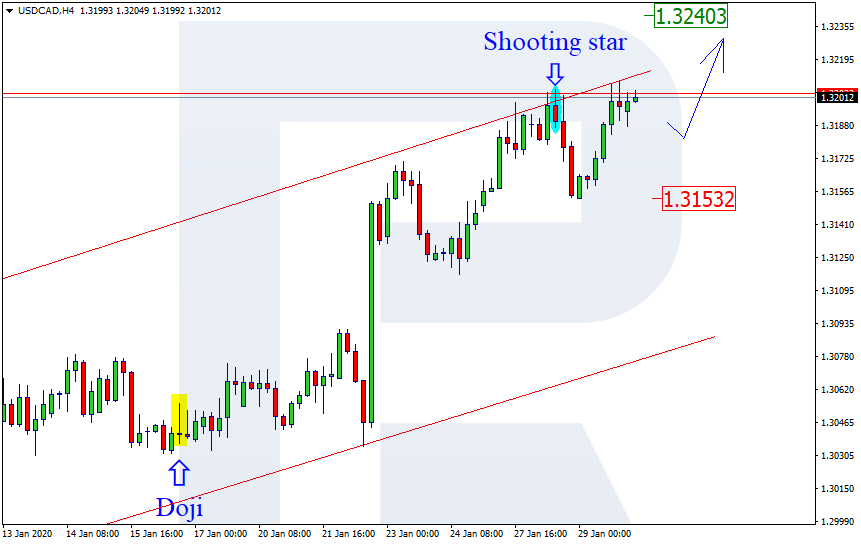
As we can see in the H4 chart, after completing another growth and forming Shooting Star pattern, the pair has reversed. The current situation implies that USDCAD may form a slight correction and then resume growing towards 1.3240. after that, the instrument may start a new decline to reach 1.3153 to continue forming the ascending channel.

USDCAD
Risk Warning: the result of previous trading operations do not guarantee the same results in the future

AUDUSD, “Australian Dollar vs US Dollar”

As we can see in the H4 chart, the pair has completed another decline: it has formed several reversal patterns, such as Hammer, not far from the channel’s downside border. Right now, AUDUSD is starting to reverse; the upside target may be at 0.6800. However, we shouldn’t ignore an alternative scenario, which implies that the instrument may continue falling towards 0.6688 without reversing and forming another rising wave.

AUDUSD

Article By RoboForex.com

Attention!
Forecasts presented in this section only reflect the author’s private opinion and should not be considered as guidance for trading. RoboForex LP bears no responsibility for trading results based on trading recommendations described in these analytical reviews.

BoE DECISION: Pound up, FTSE down – but sit tight and wait for Budget, investors warned

By George Prior

The pound strengthens and the FTSE faces losses on the Bank of England’s decision to leave interest rates unchanged – but investors should sit tight and wait for the 2020 Budget in March.

This is the warning from the founder and CEO of deVere Group, Nigel Green, as the UK’s central bank announced it is keeping interest rates at the current 0.75%.

Mr Green notes: “As the market had widely expected, the Bank of England voted to maintain the interest rate at 0.75%.

The decision was made, we can assume, because the underlying economic data is ambiguous rather than compelling, and we have yet to see how much fiscal expansion the government is set to do.

“The announcement has caused the pound to strengthen and FTSE 100, the UK’s leading stock index, to take a mild hit because of the translation effect of a stronger sterling on overseas earnings.

“However, within 24 hours of the Bank of England’s announcement, any market impact will likely be forgotten. As such, investors should sit tight.”

He continues: “The Bank of England is waiting for the Budget in March. The Chancellor Sajid Javid is promising an ‘infrastructure revolution’ – which will take years to heat up the economy as spending on that is slow to come through.

“But there could be more immediate fiscal sweeties, leading to inflation fears, such as tax cuts and increased current spending on public services, including health, defence and police.

“An expansionary fiscal policy carries with it greater uncertainty over inflation and growth. The BoE will want to keep their powder dry to address this.”

Mr Green goes on to add: “For investors, and particularly those interested in sterling, it will be the Bank of England’s response to a potentially expansionary fiscal policy that is the story of 2020. And for this, they have to sit tight until March.”

About:

deVere Group is one of the world’s largest independent advisors of specialist global financial solutions to international, local mass affluent, and high-net-worth clients.  It has a network of more than 70 offices across the world, over 80,000 clients and $12bn under advisement

The Analytical Overview of the Main Currency Pairs on 2020.01.30

by JustForex

The EUR/USD currency pair

Technical indicators of the currency pair:
  • Prev Open: 1.10222
  • Open: 1.10084
  • % chg. over the last day: -0.08
  • Day’s range: 1.10074 – 1.10181
  • 52 wk range: 1.0879 – 1.1572

EUR/USD currency pair continues to trade in a flat. There is no defined trend. Investors assess the results of the Fed meeting. As expected, the regulator kept the key interest rate range at 1.50%-1.75%. The central bank noted the stability of the labor market. The Fed officials plan to adhere to the current monetary policy rate. Inflation will act as the main factor determining future changes in interest rates. At the moment the trading instrument is consolidating in the range of 1.10000-1.10300. Technical correction of EUR/USD quotes is not excluded in the nearest future. Open positions from key levels.

The Economic News Feed for 30.01.2020:

  • – Labour Market Report (GER) – 10:55 (GMT+2:00);
  • – GDP Report (US) – 15:30 (GMT+2:00);
EUR/USD

Indicators do not give accurate signals: the price has crossed 50 MA and 100 MA.

The MACD histogram is near the 0 mark.

The Stochastic Oscillator is located in the neutral zone, the %K line has crossed the %D line. There are no signals at the moment.

Trading recommendations
  • Support levels: 1.10000, 1.09700
  • Resistance levels: 1.10350, 1.10600, 1.10750

If the price fixes above 1.10300, expect a correction toward 1.10600-1.10750.

Alternatively, the quotes can descend toward 1.09700-1.09500.

The GBP/USD currency pair

Technical indicators of the currency pair:
  • Prev Open: 1.30271
  • Open: 1.30186
  • % chg. over the last day: -0.05
  • Day’s range: 1.30061 – 1.30250
  • 52 wk range: 1.1959 – 1.3516

At the moment GBP/USD quotes are consolidating. The technical picture is ambiguous. Sterling tests the local support and resistance levels at 1.29900 and 1.30250, respectively. The European Parliament approved the agreement on UK’s exit from the EU. At the moment investors have taken a waiting position before the Bank of England meeting. The regulator is expected to keep the main parameters of monetary policy at the same level. We recommend you to pay attention to the comments made by the Central Bank representatives. Open positions from key levels.

At 14:00 (GMT+2:00) the Bank of England will announce its decision on key interest rate.

GBP/USD

Indicators do not give accurate signals: the price has crossed 50 MA.

MACD histogram is near the 0 mark.

The Stochastic Oscillator is located near the oversold area, the %K line is below the %D line, which gives a weak sell signal for GBP/USD.

Trading recommendations
  • Support levels: 1.29900, 1.29650
  • Resistance levels: 1.30250, 1.30650, 1.31000

If the price fixes below 1.29900, expect the quotes to fall toward 1.29600-1.29400.

Alternatively, the quotes could grow toward 1.30700-1.31000.

The USD/CAD currency pair

Technical indicators of the currency pair:
  • Prev Open: 1.31550
  • Open: 1.31974
  • % chg. over the last day: +0.33
  • Day’s range: 1.31882 – 1.32137
  • 52 wk range: 1.2949 – 1.3566

The USD/CAD currency pair continues to show positive dynamics. The trading instrument has set new local highs. At the moment the CAD is testing resistance level 1.32200. 1.31900 is the nearest support. We do not rule out further growth of USD/CAD quotes. The Canadian dollar is under pressure from the prolonged decline of oil prices. Today, we recommend you to pay attention to the economic releases from Canada. Open positions from key levels.

The news background on the Canadian economy is calm.

USD/CAD

The indicators signal the strength of buyers: the price has fixed above 50 MA and 100 MA.

MACD histogram is in the positive zone, which indicates a bullish sentiment.

The Stochastic Oscillator is in the neutral zone, the %K line crosses the %D line. No signals at the moment.

Trading recommendations
  • Support levels: 1.31900, 1.31550, 1.31350
  • Resistance levels: 1.32200, 1.32500

If the price fixes above 1.32200, expect the quotes to grow toward 1.32500-1.32700.

Alternatively, the quotes could correct toward 1.31600-1.31400.

The USD/JPY currency pair

Technical indicators of the currency pair:
  • Prev Open: 109.120
  • Open: 108.983
  • % chg. over the last day: -0.13
  • Day’s range: 108.823 – 109.064
  • 52 wk range: 104.45 – 113.53

USD/JPY currency pair is still in sideways movement. There is no unidirectional trend. At the moment, the trading instrument is testing the key support at 108.800 USD/JPY. 109.100 is the nearest resistance. USD/JPY quotes have a potential to fall. Today we recommend you to pay attention to the statistical data on the US economy. Open positions from key levels.

The publication of important economic reports from Japan is not planned.

USD/JPY

The indicators signal the sellers’ strength: the price has fixed below 50 MA and 100 MA.

The MACD histogram is in the negative zone, which indicates a bearish mood.

The Stochastic Oscillator is in the neutral zone, the %K line started crossing the %D line. There are no signals at the moment.

Trading recommendations
  • Support levels: 108.800, 108.500
  • Resistance levels: 109.100, 109.250, 109.650

If the price fixes below 108.800, expect the quotes to fall toward 108.500-108.300.

Alternatively, the quotes could grow toward 109.300-109.600.

by JustForex

Meetings of Key Central Banks Are in the Focus of Attention

by JustForex

The US dollar strengthened slightly against a basket of major currencies during yesterday’s trading session. The dollar index (#DX) closed in the green zone (+0.02%). The Fed decided on a key interest rate. As expected, the regulator left the indicator unchanged at 1.50% -1.75%. Fed Chairman Powell pointed to the power of the economy, but also expressed concern about the uncertainty caused by the Chinese coronavirus as well. The regulator also made it clear that it did not happy with low inflation and wanted to see an increase in the indicator to the target level. The central bank plans to adhere to the current monetary policy.

The European Parliament gave Brexit the last necessary endorsement, allowing Britain to exit from the EU finally. After an emotional debate, lawmakers approved the Brexit agreement. Britain will leave the bloc, which it entered in 1973, on the night of Friday to Saturday. Following this, a transitional period will begin, which will last until the end of the year. And soon new negotiations on further relations between London and Brussels will start. At the moment, financial market participants have taken a wait-and-see attitude before the Bank of England meeting. We recommend paying attention to the comments by regulator officials.

The “black gold” prices continue to decline. At the moment, futures for the WTI crude oil are testing the $52.40 per barrel mark.

Market Indicators

Yesterday, there was a variety of trends in the US stock market: #SPY (-0.08%), #DIA (+ 0.00%), #QQQ (+ 0.16%).

The 10-year US government bonds yield fell again. At the moment, the indicator is at the level of 1.56-1.57%.

The Economic News Feed for 30.01.2020:
  • – Data on German labor market at 10:55 (GMT+2:00);
  • – Bank of England interest rate decision at 14:00 (GMT+2:00);
  • – US GDP data at 15:30 (GMT+2:00).

by JustForex

Virus fears drag down Asian equities, safe-havens in demand

By Hussein Sayed, Chief Market Strategist (Gulf & MENA), ForexTime

During this time of the year, it’s usually the earnings season that drives investment decisions. However,  it’s the rising concerns over an outbreak of the deadly coronavirus that is currently dictating market moves. The number of confirmed cases has spiked to almost 8,000 and the death toll rose to 170 as of January 30. While we’re still in the early stages of the outbreak, it remains unclear whether the economic impact is going to be smaller or larger than the 2003 SARS outbreak.

Despite the Wuhan virus so far showing a lower mortality rate (below 3%) compared to SARS (10%), the number of confirmed cases has already overtaken SARS inside mainland China. Even though the country has acted much faster in limiting the transmission compared to previous episodes, evidence shows that the disease can be transmitted before a person shows any signs of illness, and that is making it a more frightening type of virus.

Several international retail and fast-food chains have closed in many cities across China, including H&M, McDonald’s and Starbucks. Google also announced yesterday that it is temporarily closing its China offices.

China today is a far larger economy than it was in 2003. Back then, it represented 5% of global output, now it’s almost a fifth of GDP with much more integration within the global economy. Chinese nationals have also become the main driver of global tourism and every luxury retailer is targeting them. More than 30% of European luxury brand revenues come from Chinese consumers and that is why they have been hit hard over the past several days.

While markets in China remain closed on Thursday for the Lunar holiday, the rest of Asian markets have seen their indices decline sharply. Taiwan’s Taiex plunged more than 5.75% as many shares reached their 10% limit down decline, including shares of major Apple supplier, Foxonn. Hong Kong’s Hang Seng fell 2.2% taking its two-day losses to more than 5%.

Expect to see further declines and more volatility in risk assets in the coming days. Investors who were waiting for the dips to buy may need to wait a little longer, until we see signs of a peak in the rate of virus infection.  Meanwhile, gold and Treasuries are likely to remain in demand.

Traders split ahead of BoE rate decision

Today’s BoE interest rate decision is likely to be more interesting than yesterday’s Fed which kept rates unchanged and stressed the US economy is in ‘a good place’.

Monetary Policy Committee members have a tough assignment today on deciding whether the UK economy has recovered strongly enough post-election to justify keeping rates unchanged. While most economists predict rates to remain at 0.75%, swap traders are pricing more than a 40% chance of 25 basis point rate cut.

Given this market confusion, expect to see strong moves in the Pound in the event of either decision. If the BoE holds steady and only two members vote for a rate cut like in previous meetings, Sterling will likely see a strong recovery towards the 1.31-1.32 range. Meanwhile, a rate cut could see the currency drop below strong support at 1.29.

Disclaimer: The content in this article comprises personal opinions and should not be construed as containing personal and/or other investment advice and/or an offer of and/or solicitation for any transactions in financial instruments and/or a guarantee and/or prediction of future performance. ForexTime (FXTM), its affiliates, agents, directors, officers or employees do not guarantee the accuracy, validity, timeliness or completeness, of any information or data made available and assume no liability as to any loss arising from any investment based on the same.


Forex-Time-LogoArticle by ForexTime

ForexTime Ltd (FXTM) is an award winning international online forex broker regulated by CySEC 185/12 www.forextime.com

Sri Lanka cuts rates 50 bps to help lower lending rates

By CentralBankNews.info

Sri Lanka’s central bank lowered its two main interest rates by another 50 basis points, saying this would “support a continued reduction in market lending rates, ensuring a broad based and sustained recovery in economic activity.”

The Central Bank of Sri Lanka (CBS) cut the Standing Deposit Facility Rate (SDFR) to 6.50 percent and the Standing Lending Facility Rate (SLFR) to 7.50 percent and said it would continue to monitor economic conditions and financial markets “with a view to maintaining aggregate demand conditions at appropriate levels, in the period ahead.”

It is the third rate cut by the central bank since May 2019 and both key rates have now been lowered by a total of 150 basis points.

In December the central bank kept the rates steady, saying tax cuts and a moratorium on the repayment of bank loans by small and medium-sized were likely to boost economic activity. In addition, CBS was also waiting for further clarity over the new government’s fiscal policy.

While market lending rates in Sri Lanka have declined in response to the central bank’s rate cuts, along with other regulatory measures, CBS said the pace of reduction in rates has decelerated and has been less than it had envisaged.

With a removal of caps on deposit rates offered by banks, new deposit rates have risen since September and yields on Treasury bills have trended upward.

“If not addressed, these trends could result in an undesirable turnaround in market lending rates,” CBS said.
Sri Lanka’s economy is slowing recovering after its tourism sector was hit hard by the 2019 Easter Sunday bombings, which killed more than 250 people.

Economic growth in the third quarter grew an annual 2.7 percent, up from 1.5 percent in the second quarter, and while growth in the fourth quarters remained subdued, the central bank expects a revival this year, helped by fiscal and monetary measures, improved business confidence and political stability.

In December the new governor, Weligamage Don Lakshman, forecast 4.5 percent economic growth in 2020.
Inflation in Sri Lanka rose to 4.8 percent in December from 4.4 percent in November but CBS expects inflation to hover below 5 percent this year and stabilize between 4-6 percent thereafter.

“The Monetary Board will stand ready to respond to any build-up of demand driven price pressures in the foreseeable future,” CBS said.

The Central Bank of Sri Lanka issued the following statement:

“The Monetary Board of the Central Bank of Sri Lanka, at its meeting held on 29 January 2020, decided to reduce the Standing Deposit Facility Rate (SDFR) and the Standing Lending Facility Rate (SLFR) of the Central Bank by 50 basis points to 6.50 per cent and 7.50 per cent, respectively. The Board arrived at this decision following a careful analysis of current and expected developments in the domestic economy and the financial market as well as the global economy. This decision supports a continued reduction in market lending rates, thereby facilitating the envisaged recovery in economic activity given the favourable medium term outlook for inflation, which is well anchored within the 4-6 per cent range.

Global monetary policy continued to remain accommodative amidst concerns over low economic growth
Downward revisions to global growth projections were announced in the January 2020 update of the World Economic Outlook (WEO) of the International Monetary Fund (IMF), owing to weaker than expected growth across emerging market economies, especially India. Global economy is estimated to have grown by 2.9 per cent in 2019 and projected to grow by 3.3 per cent and 3.4 per cent in 2020 and 2021, respectively. Meanwhile, global growth prospects have been further threatened by the spread of coronavirus originated in China. In light of subdued global growth and softening inflationary pressures, central banks of advanced economies continued to maintain an accommodative policy stance, while a number of emerging market economy central banks eased monetary policy further thus far in 2020.

A recovery in domestic economic growth is expected
As suggested by available indicators and latest estimates, domestic economic activity has remained subdued in the fourth quarter of 2019, primarily with subpar growth in Agriculture and Industry related activities. However, in 2020, a revival in economic activity is envisaged supported by appropriate fiscal and monetary measures, improved business confidence and political stability. The economy is expected to reach its full capacity over the medium term, benefitting from the low and stable inflation environment, a competitive exchange rate, low lending rates as well as improved consumer and investor sentiment. The growth momentum of the economy is expected to be sustained through the implementation of appropriate structural reforms designed in line with the policy priorities of the government.

Inflation is expected to remain in mid single digit levels in the medium term
Headline inflation, as measured by the year-on-year change in Colombo Consumer Price Index (CCPI), accelerated in December 2019 owing to domestic supply disruptions. In spite of such short term fluctuations, the near term forecast suggests that inflation will hover below 5 per cent in 2020, and stabilise between 4-6 per cent thereafter, assisted by appropriate policy measures and underpinned by well anchored inflation expectations. Meanwhile, National Consumer Price Index (NCPI) based headline inflation, which attaches a higher weight to the food basket, also accelerated in December 2019. Nevertheless, reflecting subdued aggregate demand conditions, core inflation, measured using both CCPI and NCPI, decelerated.

Headline Inflation (CCPI based) Projection: Inflation, which is projected to hover below 5 per cent in 2020, is expected to gradually stabilise in mid single digit levels thereafter. The Monetary Board will stand ready to respond to any build-up of demand driven price pressures in the foreseeable future.
Figure: 01
Note: A forecast is neither a promise nor a commitment.
The fan chart illustrates the uncertainty surrounding the baseline projection path using confidence bands of gradually fading colors. The projection reflects the available data and assumptions as well as judgments made at the January 2020 forecast round, and it may change at the next quarterly update in April 2020 as new information becomes available and the assumptions and judgments are revised accordingly.
The confidence intervals (CI) shown on the chart indicate the ranges of values within which inflation may fluctuate over the medium term. Specifically, the thick green shaded area represents 50 per cent confidence interval, implying there is a 50 per cent probability that the actual inflation outcome will be within this interval. The confidence bands show the increasing uncertainty in forecasting inflation over a longer horizon.

page3image1399248032

Source: CBSL Staff Projections


External sector remains resilient amidst growing macroeconomic headwinds
Trade performance during the first eleven months of 2019 improved over the previous year with a notable contraction in imports and a marginal improvement in merchandise exports, resulting in a significant decline in the trade deficit. A faster than anticipated recovery in the tourism sector helped mitigate the impact of Easter Sunday attacks to a larger extent, although arrivals and earnings remained low compared to 2018. Workers’ remittances moderated somewhat in 2019 reflecting the trend observed in recent years. Meanwhile, renewed foreign interest on the rupee denominated Government securities market resulted in a net inflow during the year thus far, although the Colombo Stock Exchange witnessed a marginal net outflow of foreign investment from the secondary market during this period. The Sri Lankan rupee, which appreciated by 0.6 per cent against the US dollar in 2019, remained broadly unchanged so far during 2020. Gross official reserves are estimated at US dollars 7.6 billion at end 2019, providing an import cover of 4.6 months.

The pickup in money and credit growth observed in December 2019 is expected to continue in 2020
Supported by the accommodative monetary policy stance, growth of credit extended to the private sector picked up in December 2019, on a year-on-year basis, following a continued slowdown since December 2018. Driven by domestic credit expansion, broad money growth (year-on-year) also picked up in December 2019. However, the absolute expansion in credit extended to both private and public sectors remained modest during 2019, compared to that of 2018. Going forward, the growth of money and credit aggregates is expected to accelerate with the envisaged continued decline in lending rates, expected expansion in economic activity supported by fiscal stimulus, announced credit support package for Small and Medium Enterprises (SMEs) and improved investor sentiment.

Market lending rates continued to decline, but the pace of reduction has decelerated
In response to monetary and regulatory measures taken by the Central Bank, market lending rates adjusted downwards, but the pace of reduction has decelerated. The reduction in lending rates thus far, except for the Average Weighted Prime Lending Rate (AWPR), has been less than envisaged. With the removal of caps on deposit interest rates offered by banks, new deposits rates have increased since September 2019. Yields on Treasury bills have trended upwards at recent auctions. If not addressed, these trends could result in an undesirable turnaround in market lending rates.

The monetary policy decision will support a continued reduction in market lending rates, ensuring a broad based and sustained recovery in economic activity
In consideration of the current and expected macroeconomic developments as highlighted above, the Monetary Board, at its meeting held on 29 January 2020, was of the view that it is essential that market lending rates reduce further in order to support the envisaged pickup in credit growth and economic activity. Accordingly, the Monetary Board decided to reduce the Standing Deposit Facility Rate (SDFR) and the Standing Lending Facility Rate (SLFR) of the Central Bank by 50 basis points to 6.50 per cent and 7.50 per cent, respectively, with effect from 30 January 2020. The Central Bank will continue to monitor macroeconomic and financial market developments with a view to maintaining aggregate demand conditions at appropriate levels, in the period ahead.”

    www.CentralBankNews.info