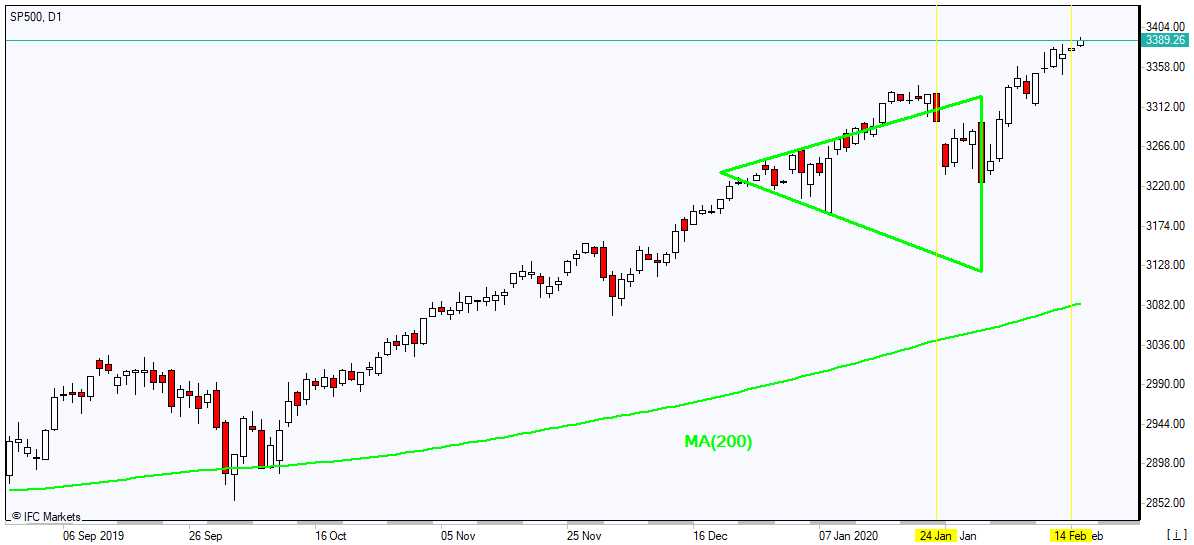
US stock market ended mixed on Friday amid mixed data. The S&P 500 rose 0.2% to new record 3380.16, advancing 1.6% for the week. Dow Jones industrial slid 0.1% to 29398.08. The Nasdaq gained 0.2% to fresh high 9731.18. The dollar strengthening slowed as retail sales ticked up to 0.3% in January while industrial production continued to falling. The live dollar index data show the ICE US Dollar index, a measure of the dollar’s strength against a basket of six rival currencies, added 0.02% to 98.68 and is higher currently. US markets are closed today for President’s Day holiday.
FTSE 100 led European indexes retreat
European stocks ended lower on Friday as US raised tariffs on European-built aircraft. EUR/USD slowed its decline while GBP/USD accelerated climbing on Friday with the dynamics reversed for both pairs currently. The Stoxx Europe 600 Index lost 0.1% on news US increased tariffs on aircraft imported from the European Union to 15% from 10. The DAX 30 slipped 0.01% to 13744.21 Friday as German Q4 GDP recorded zero rate of increase over quarter. France’s CAC 40 slid 0.4% and UK’s FTSE 100 slumped 0.6% to 7409.13.
Nikkei drop leads Asian indexes retreat
Asian stock indices are mixed today. Nikkei fell 0.7% to 23523.24 despite resumed yen slide against the dollar as Q4 GDP fell 6.3% . China’s markets are rising as the central bank cut one year lending rate and injected some 300 billion yuan into economy: the Shanghai Composite Index is up 2.3% while Hong Kong’s Hang Seng Index is 0.5% higher. Australia’s All Ordinaries Index slipped 0.1% with Australian dollar climb against the greenback resuming.
Brent futures prices slide resumed today. Prices rose on Friday: Brent for April settlement added 1.7% to $57.32 a barrel Friday, gaining 5.2% for the week, the first in six weeks.
Gold slips
Gold prices are edging lower today. April gold gained 0.5% to $1586.40 on Friday.
Note: This overview has an informative and tutorial character and is published for free. All the data, included in the overview, are received from public sources, recognized as more or less reliable. Moreover, there is no guarantee that the indicated information is full and precise. Overviews are not updated. The whole information in each overview, including opinion, indicators, charts and anything else, is provided only for familiarization purposes and is not financial advice or а recommendation. The whole text and its any part, as well as the charts cannot be considered as an offer to make a deal with any asset. IFC Markets and its employees under any circumstances are not liable for any action taken by someone else during or after reading the overview.
This week – February 16 through February 22 – central banks from 7 countries or jurisdictions are scheduled to decide on monetary policy: Turkey, Zambia, Namibia, Jamaica, China, Indonesia and Egypt.
Following table includes the name of the country, the date of the next policy decision, the current policy rate, the result of the last policy decision, the change in the policy rate year to date, and the rate one year ago.
The table is updated when the latest decisions are announced and can always accessed by clicking on This Week.
WEEK 8
FEB 16 – FEB 22, 2020:
TURKEY
19-Feb
11.25%
-75
-75
24.00%
EM
ZAMBIA
19-Feb
11.50%
0
0
9.75%
NAMIBIA
19-Feb
6.50%
0
0
6.75%
JAMAICA
19-Feb
0.50%
0
0
1.50%
CHINA 1)
20-Feb
4.15%
0
0
4.35%
EM
INDONESIA
20-Feb
5.00%
0
0
6.00%
EM
EGYPT
20-Feb
12.25%
0
0
15.75%
EM
1) As of Aug. 17, 2019 Loan Prime Rate is benchmark
Results from drill and water well testing at Minera Alamos’ project and their implications are reviewed in a Haywood research report.
Haywood analyst Kerry Smith reported in a Feb. 6 research note that drilling and water testing yielded positive results at Minera Alamos Inc.’s (MAI:TSX.V; MAIFF:OTCQB) Santana open-pit, heap-leach gold project.
Results are in for the first two follow-up holes drilled as part of Minera Alamos’ phase two program at Santana, and they suggest additional resource potential, Smith highlighted.
Drilled to a depth of 200 meters (200m) at the Divisadero discovery at Santana, the holes returned 0.42 grams per ton (0.42 g/t) gold over 96.4 meters (96.4m) and 0.56 g/t gold over 133.6m. Mineralization remains open in multiple directions.
Because Divisadero is 1 kilometer from the Nicho resource, it could become a satellite pit to it. Mining at Nicho is slated to begin later this year, Smith indicated. “The likely cutoff grade for Santana will be 0.2 g/t, suggesting good potential to add mineable resources at Divisadero,” he added.
Smith pointed out, too, that further zones of mineralization may exist at Santana. It may be found in the series of brecchia pipes on the property, as only two have have been drilled to date. The larger, porphyry-hosted Divisadero discovery suggests potential for different types of mineralization at Santana as well.
As for the well drilling, it revealed two areas where water volumes were high and, thus, could support the Santana project, noted Smith. The 800m of exploratory water well drilling identified five areas containing water, and two of those were chosen for further follow-up and pump testing. “We expect Minera Alamos will have adequate water for the current and any expanded future operation,” commented the analyst.
With a drill budget of CA$2 million, Minera Alamos intends to drill 2,5003,000m each quarter this year. With the new roads it plans to build, drill access will be improved.
Haywood has a Buy rating and a CA$0.50 per share target price on Minera Alamos, whose stock is currently trading at around CA$0.27 per share. “We recommend accumulating shares at current levels,” Smith wrote.
Disclosure: 1) Doresa Banning compiled this article for Streetwise Reports LLC and provides services to Streetwise Reports as an independent contractor. She or members of her household own securities of the following companies mentioned in the article: None. She or members of her household are paid by the following companies mentioned in this article: None. 2) The following companies mentioned in this article are billboard sponsors of Streetwise Reports: None. Click here for important disclosures about sponsor fees. 3) Comments and opinions expressed are those of the specific experts and not of Streetwise Reports or its officers. The information provided above is for informational purposes only and is not a recommendation to buy or sell any security. 4) The article does not constitute investment advice. Each reader is encouraged to consult with his or her individual financial professional and any action a reader takes as a result of information presented here is his or her own responsibility. By opening this page, each reader accepts and agrees to Streetwise Reports’ terms of use and full legal disclaimer. This article is not a solicitation for investment. Streetwise Reports does not render general or specific investment advice and the information on Streetwise Reports should not be considered a recommendation to buy or sell any security. Streetwise Reports does not endorse or recommend the business, products, services or securities of any company mentioned on Streetwise Reports. 5) From time to time, Streetwise Reports LLC and its directors, officers, employees or members of their families, as well as persons interviewed for articles and interviews on the site, may have a long or short position in securities mentioned. Directors, officers, employees or members of their immediate families are prohibited from making purchases and/or sales of those securities in the open market or otherwise from the time of the interview or the decision to write an article until three business days after the publication of the interview or article. The foregoing prohibition does not apply to articles that in substance only restate previously published company releases.
Disclosures from Haywood Securities, Minera Alamos Inc., February 6, 2020
Analyst Certification: I, Kerry Smith, hereby certify that the views expressed in this report (which includes the rating assigned to the issuers shares as well as the analytical substance and tone of the report) accurately reflect my/our personal views about the subject securities and the issuer. No part of my/our compensation was, is, or will be directly or indirectly related to the specific recommendations.
Important Disclosures
Of the companies included in the report the following Important Disclosures apply:
▪ Haywood Securities, Inc. has reviewed lead projects of Minera Alamos Inc. and a portion of the expenses for this travel have been reimbursed by the issuer.
Other material conflict of interest of the research analyst of which the research analyst or Haywood Securities Inc. knows or has reason to know at the time of publication or at the time of public appearance: n/a.
Shares of Exterran Corp. traded 20% higher after the company issued preliminary business operating results for the fourth quarter ended December 31, 2019.
Houston, Tex.-based turnkey midstream infrastructure solutions firm Exterran Corp. (EXTN:NYSE), which provides products and services to oil & gas, water and power services companies, today provided a fourth quarter 2019 operational update.
Exterran Corp.’s President and CEO Andrew Way commented, “Despite the difficult market conditions experienced in 2019, we finished the year strong with fourth quarter EBITDA, as adjusted, at the high end of what we had anticipated, while meaningfully lowering our debt levels compared to the third quarter. On top of this, 2020 is off to a very strong start as bookings to date have already exceeded $400 million, driven largely by international markets. This exceeds the aggregate volume of product awards received in 2019.”
The company reported preliminary results for Q4/19 of revenue between $265 million to $275 million. The firm stated that gross margin would be in the range of $80-85 million and that SG&A expenses were $36-38 million in the quarter.
The firm indicated that it had product sales bookings of $109 million with cash of $17 million on hand. Total debt outstanding was listed at $444 million.
CEO Way added, “We will provide additional details on our fourth quarter conference call on the year ahead along with the progress we have made in regards to our strategic review process regarding our U.S. compression manufacturing business.”
The company advised in the report that “it is close to finalizing its review regarding options for its U.S compression fabrication business, and as a result expects to report in its fourth quarter results non-cash asset impairment charges.”
Exterran is headquartered in Houston, Tex., and describes itself as “a global systems and process company offering solutions in the oil, gas, water and power markets.” The company states it is a leader in natural gas processing and treatment and compression products and services, providing critical midstream infrastructure solutions to customers throughout the world. The company operates through three segments: contract operations, aftermarket services, and oil and gas product sales. The firm employs approximately 4,500 people and operates in around 25 countries.
Exterran Corp. has a market capitalization of around $154.1 million with approximately 33.5 million outstanding shares. EXTN shares opened relatively unchanged today at $4.64 (+$0.04, +0.86%) compared to yesterday’s closing price of $4.60. The stock has traded today between $4.64 and $6.22 per share and is currently trading at $5.50 (+$0.90, +19.57%).
Disclosure: 1) Stephen Hytha compiled this article for Streetwise Reports LLC and provides services to Streetwise Reports as an independent contractor. He or members of his household own securities of the following companies mentioned in the article: None. He or members of his household are paid by the following companies mentioned in this article: None. 2) The following companies mentioned in this article are billboard sponsors of Streetwise Reports: None. Click here for important disclosures about sponsor fees. 3) Comments and opinions expressed are those of the specific experts and not of Streetwise Reports or its officers. The information provided above is for informational purposes only and is not a recommendation to buy or sell any security. 4) The article does not constitute investment advice. Each reader is encouraged to consult with his or her individual financial professional and any action a reader takes as a result of information presented here is his or her own responsibility. By opening this page, each reader accepts and agrees to Streetwise Reports’ terms of use and full legal disclaimer. This article is not a solicitation for investment. Streetwise Reports does not render general or specific investment advice and the information on Streetwise Reports should not be considered a recommendation to buy or sell any security. Streetwise Reports does not endorse or recommend the business, products, services or securities of any company mentioned on Streetwise Reports. 5) From time to time, Streetwise Reports LLC and its directors, officers, employees or members of their families, as well as persons interviewed for articles and interviews on the site, may have a long or short position in securities mentioned. Directors, officers, employees or members of their immediate families are prohibited from making purchases and/or sales of those securities in the open market or otherwise from the time of the interview or the decision to write an article until three business days after the publication of the interview or article. The foregoing prohibition does not apply to articles that in substance only restate previously published company releases.
Welcome to this week’s Market Wrap Podcast, I’m Mike Gleason.
Coming up David Smith of The Morgan Report and MoneyMetals.com columnist joins me to discuss the dearth of exploration that’s taking place in the silver mining industry and what that may mean for the supply of physical silver during the coming mania phase of retail buying he says will one day be upon us. David also offers some advice and a warning to those who are suffering from the widespread investor complacency we’re experiencing in today’s markets. So, don’t miss another fantastic interview with our good friend David Smith, coming up after this week’s market update.
As gold prices firmed on Thursday, the U.S. Senate weighed the issue of pegging the currency to a gold standard. Not surprisingly, the mere mention of gold ruffled the feathers of some Senators.
More on that in a bit. But first, let’s review this week’s price action in the precious metals markets.
As of this Friday morning recording, gold prices check in at $1,583 per ounce – 0.7% higher for the week. Silver is essentially unchanged on the week to trade at $17.79 an ounce. Platinum is off a slight 0.4% since last Friday’s close to trade at $967. And finally, palladium is putting in a weekly advance of $99 or 4.2% to trade at $2,430 per ounce.
The metals have had to contend with a rising U.S. dollar versus foreign currencies, a familiar story. The Dollar index has risen steadily since the beginning of the year and got an added boost from fears over the China virus outbreak.
The USDX is now close to taking out its 2019 high, although it may be getting overbought near term.
We have already seen most major commodities including copper and crude oil come off their coronavirus lows. A reversal in the dollar would likely add fuel to a recovery rally in raw materials. Since economically sensitive commodities got hit much harder than precious metals, they would also likely snap back more strongly – at least until they work off their oversold condition.
Meanwhile, gold continues to serve its function as a core safe-haven – holding quite well. It has stair-stepped modestly higher this year. While succumbing to some selling at the beginning of the month, gold has been far less volatile than other assets.
Gold remains the ultimate money, as former Federal Reserve chairman Alan Greenspan has acknowledged. And President Trump’s nominee to an open seat on the Fed Board of Governors would perhaps help revive gold’s standing in the monetary system.
But first she has to win approval by the U.S. Senate. Prospective Fed policymaker Judy Shelton faced a difficult task in trying to explain her unconventional views to Senators who are steeped in conventional thinking when it comes to monetary policy.
A sore spot for many of her Senate interrogators was Shelton’s history of supporting a gold standard. Reactions on both sides of the aisle ranged from confusion to concern to hostility.
On the Democrat side, Senators Sherrod Brown and John Tester led the attacks on Judy Shelton:
Sen Sherrod Brown (D): Ms. Shelton is not a conservative. She’s far outside the mainstream. She’s off the ideological spectrum. For three decades Ms. Shelton has been a prominent advocate for returning to the gold standard.
In making the case for Ms. Shelton’s nomination, her friend, James Grant, wrote in The Wall Street Journal, “With the nomination of Judy Shelton to the Fed the discussion is tilted to gold. Gold is money or a legacy form of money Ms. Shelton contends, and the gold standard is a reputably and superior form of monetary organization.”
Sen. John Tester (D): The gold standard, also in The Wall Street Journal let’s return to the gold standard. You hope that Vice President Pence would hasten a return to the gold standard. You talked about a new Bretton Woods would be held in Mar-a-Lago. If that isn’t advocating to returning to the gold standard, I mean what is?
Sen Sherrod Brown (D): The American dollar is the world’s reserve currency. It should stay that way. We want it that way. We agree that it should be that way and we’re proud of it.
On the Republican side, Shelton has the support of Senate Banking Committee chairman Mike Crapo. But at least two Republicans appear reluctant to support someone with ties to sound money principles.
CNBC Reporter: At least two Republican senators say that they are still on the fence over whether to support her nomination. One of them is Republican Senator Pat Toomey of Pennsylvania who was worried that her views on currency wars could be dangerous.
Sen. Pat Toomey (R): I’d remain concerned that she is an advocate for using monetary policy to devalue the dollar.
CNBC Reporter: And the other one is Senator Richard Shelby of Alabama, who said that her views on issues like the gold standard make her an outlier. You said you were troubled by some of her writings. Do you remain troubled?
Sen. Richard Shelby (R): Concerned.
CNBC Reporter: Now if either of these two Senators vote against her, that would sink her nomination in committee. So, she does have the support of the Chairman, (Sen.) Mike Crapo (R), who said that she is highly qualified to serve.
Even if Shelton manages to get confirmed, she would only be one voice on a seven-member board. And while she hasn’t disavowed her past support of gold, she has more recently come out in favor of lower interest rates and a weaker dollar – in line with President Trump’s priorities.
The Fed will probably never enact any restraints on itself when it comes to its abilities to create currency out of thin air. Whether it’s gold, or gold and silver as the Constitution prescribes, or a basket of commodities as some monetary reformers have proposed, trying to impose any kind of objective currency standard to tie the hands of central bankers is bound to fail.
The problem is the central banking system itself. As long as interest rates and inflation targets are centrally planned, the central planners will prevent true market discovery and innovation from taking place as they rig prices and prop up malinvestment within the “too big to fail” banking system.
Sound money advocates don’t necessarily believe that gold and silver are the only viable alternatives to fiat money. But the precious metals would likely play a significant role in any truly free-market monetary system where the confidence of currency holders must be earned.
Well now, without further delay, let’s get right to this week’s exclusive interview.
Mike Gleason: It is my privilege now to welcome back David Smith, Senior Analyst at The Morgan Report and regular contributor to MoneyMetals.com. David, it’s good to talk to you as always and how are you my friend?
David Smith: I’m just fine and it’s great to be back, Mike.
Mike Gleason: Yeah, well it’s been a handful of months since we had you on, and I’ve got a lot of topics to discuss today so we’ll get right into it. Now to start out, here we are about a month and a half into the new year. Metals prices perked up in December but haven’t really done much since that first week in January when it looked like we were about to head to war with Iran, which was a short-lived crisis thankfully. But in our view, markets are incredibly complacent, David. Stock prices just keep moving higher and higher. Nobody seems to be worried about risk, this despite there being plenty of reason for concern. To name a few, we’ve got a virus outbreak. There continues to be extraordinary activity in the repo markets – officials still haven’t really bothered to explain what’s going on there. And Brexit is finally happening. Maybe we’re missing something, but it really feels like markets ignore all this stuff completely.
A decade ago, the fed pumping hundreds of billions into the repo markets would have been a major market-shaking story. Meanwhile, one of the EUs largest economies having exited the trade union, raising questions about whether the EU can survive a story like that, would have been making serious waves. But the life cycle of these sorts of stories just keeps getting shorter and shorter. We’re to the point now where the impact of a major geopolitical event can be measured in hours, if there is any impact at all. So, what do you make of the complacency in markets?
David Smith: Well, Mike, I agree with everything you just said and it’s really amazing that no matter how big an item is, people just slough it off. They seem to feel that the central banks have their back almost no matter what. If they can, if you have an 800 points drop in the Dow over two days, why the Fed is going to come in and step in and pump it right back up again. Of course, that’s what they’ve been doing. But to make that your strategy I think is really pretty dangerous, and it works all the time except for the last time and then you get wiped out. I really think it’s worth being cautious, and not only that, but in terms of buying metals thinking, Oh, I’ll wait until it does something. Well, it’s time to do it when it’s quiet. That’s when you want to be involved, not when you’re competing with a bunch of other people.
Mike Gleason: Yeah, certainly. Good advice, it’s going to happen in the blink of an eye most likely when things do finally go off a cliff and hopefully, we don’t see that. But it does seem like it is inevitable, based on all the debt in the system and all these unintended consequences of all the money printing for well over a decade now. Of course, going back beyond that, but certainly the massive spike we’ve seen since the great financial crisis and the central bank’s response since then.
How about the coronavirus David? How might gold fair in the event that the pandemic either continues to build and then how might it fair if it doesn’t develop and ends up flaming out?
David Smith: Well, the demand for gold seems to be there no matter what, whether it’s fear or love or both. I was just reading yesterday where the gold jewelry purchases in China were down because of the coronavirus, but the gold bullion purchases were up. So, people are still buying the gold. They’re not going to stop buying it just because of what’s going on. In fact, you could make an argument that they have more disposable income to buy gold now since they’re not traveling as much. So, I suspect that’s no small factor because people want to hoard the gold and have more of it. I think that’s going to be just one more event driver, pushing things forward no matter how quickly this thing gets resolved, and no one can predict it. I mean, I’m not going to try to predict it.
It seems like things are better, but oftentimes these things blow over in a few weeks or a few months. But this could be something that’s totally different, and we just don’t know. And I think the hang your hat on the fact that it’s going to be like all the other short term disruptions in the market, I think that’s pretty risky.
Mike Gleason: Yeah. Certainly we don’t really know what to believe when it comes to information coming out of China regarding the pandemic. Who really knows? Maybe it’s far worse than we are being told. A lot of people seem to think it is, and others think it’s not that big of a deal at this point. I guess, time will tell ultimately. Hopefully it isn’t something that spreads to the rest of the globe or here in the States. That would be pretty bad news.
Well, silver has obviously been a real laggard in the precious metal space, David and the gold to silver ratio has stayed in the mid-eighties level for a while now. Has silver’s under-performance been a cause of concern for you?
David Smith: Not really. Silver likes to sit around and make people impatient, wish it would do something. On the charts, it loves to break down to its supposed to support zones and then turn right around and move up. I’m not concerned. When it does decide to go, it can move so quickly that you can’t even get ahold of your hat. People that want to accumulate should be doing it now sensibly and they shouldn’t be trying to pick the exact turn or when it’s going to become alive or whatever because silver is known as the restless metal for more reasons than one. Many, many times people that thought they could figure out what it was going to do and when it was going to do, we’re left standing at the gate. So, I would suggest people not get overconfident in that area either.
Mike Gleason: If we look at last year, actually silver did almost as well as gold. I think silver was up, what 14 or 15%. Gold was up about 18%, so it that gold silver ratio didn’t widen dramatically. We just have been stuck in that that eighties, mid-eighties to one range. What do you attribute silver being a laggard to David? Is it this push-pull scenario with it being both an industrial metal and a monetary metal and the market can’t decide what it wants to be? Is that what’s going on there?
David Smith: I really think that is an element in it and because it is an industrial metal versus an investment vehicle or actually sound money. And the thing is what it really takes to get silver going is an influx of buy orders from the retail space and from people that are accumulating it, in that regards. I haven’t seen a chart like this because I don’t think it’s possible to design one where you, for example, there was a build in gold, which X amount of gold has gone into central banks and to ETFs and things like that. But a lot of gold didn’t go into any of those things. It went into private hands, which is difficult to figure out where it went. I think that same thing is going on with silver, but there’s no chart to show them.
Some of the biggest funds in the world have stated lately, categorically that they feel silver is the most undervalued asymmetric asset that you can buy. And I don’t think they’re just talking their book. I think they’re buying their book. They’re going about it in ways that you and I can’t define, and picking up physical silver, and that’s taking away from the supply. And at some point, there’ll be a client where that becomes obvious to people what’s going on, and that’s where you’re going to get a big jump in the price. So, waiting for that to happen, you could see a $5 move in the price while you’re standing there looking at it over a couple of days, when it becomes obvious to the market. I just think it’s penny-wise, pound-foolish to try to wait until you see it and think that you can define that and get on board in time to even catch a part of that move.
Mike Gleason: Yeah. I want to get more into supply with you in a moment when I ask you about some of the mining situation there, but first sticking on the retail side of things, I wanted to dive into some of the recent numbers that we’ve been seeing from the sovereign mints in terms of bullion sales. What did you make of the recent U.S. Mint sales on Silver Eagles? Then comment on some big numbers we saw from Australia’s Perth Mint in terms of gold sales over the past a couple of months. Talk about the data you’re seeing there, David, if you would.
David Smith: Well, I think the sales of American Silver Eagles in December were paltry to say the least. I mean it was just that, I think it was like, I don’t know whether it was under 100,000 or something like that and then all of a sudden it was what, 3.4 million in January, and it just shows you how quickly those sales can turn on a dime. Trying to define that is just, it’s just impossible. It seems to me if you just go against the herd when it’s low, you buy more and when it moves up and you realize, “Hey, I did the right thing,” And the Perth Mint, they were selling enormous amounts of gold in December. It wasn’t just all from one country, but a lot of it was coming from Germany where, and I actually wrote about this in the current essay for Money Metals as part of the essay, where the German government had moved on, and I guess it’s law now, where you, if you bought under 10,000 euros worth of gold, you didn’t have to report it. But now it’s 2000, and three years ago it was 15,000 euros.
So, they’ve taken it down by about 90%. You can only buy one and fractional ounces of gold without going through a bunch of paperwork, and making sure that everybody in the world knows what you did. Because you want privacy, doesn’t mean you’re a criminal or you’re going to do something illegal. It means that it’s not everybody’s business what you do. Now these poor people in Germany and many of them lined up around the block of these stores, and most of them didn’t get any gold. Now they’re stuck with, no matter what happens, they can’t buy more than about an ounce of the time without doing a bunch of paperwork and getting permission from the government.
You can imagine when gold is several times higher than it is, which I believe will be the case in the next few years, you’ll be able to buy a fractional ounce and be under that 2,000 euro limit. So, it’s sad for them, but it’s the ruling idea of government wanting to be more and more in your business, and I say that sort of thing continuing around the globe.
Mike Gleason: Another reason to get it here while you can, and still be under the radar. That’s one thing that’s thankfully, we don’t have to deal with in the States when it comes to reporting or the government being aware of what it is that you’re doing. But who knows, maybe we get some politicians in there that want to become Big Brother when it comes to all kinds of things in that realm. Maybe, that’s another reason to be buying it now while you can and do so somewhat anonymously.
Well, you follow the precious metals mining sector very closely, obviously. So, I wanted to get an update on what’s happening there. In general, do you miners being profitable at these gold and silver prices? I mean, on average, what is the all-in cost of production for an ounce of gold and silver? Obviously every mine is unique, based on the quality of the deposits and lots of other factors. But we’re curious about how profitable you think the industry might be, assuming prices stay right about where they are today.
David Smith: Well that’s a double-edged question or I should say, there’s a way to answer it in several ways. One has to do with how efficient a particular miner has become in the last few years at lowering their costs and keeping labor under control, the expenses and things like that, and having projects that actually do well. A couple of companies that I follow have actually sold their base metal silver projects and they now, are working on gold, silver only. It takes a lot of money to separate out the lead, zinc and copper from a silver deposit. And if you have one that’s high grade silver and not so much of the base metal, by definition your costs, getting that silver out of the ground is going to be lower than if you have to go send them all to the smelter and separate each of the components. That’s one thing.
There are a couple of companies that I follow that are using new, more effective methods of silver recovery. So their cost is down and they’re making money now, even at these prices. They’ll be a practically cash power houses if we, not if, but when, we see silver above $20. They’ve been working really hard to make these things happen. One company went from a recovery of 65% of their silver to about 95%. That’s an enormous improvement. And that all goes to the bottom line. The companies that are doing a good job in that regard, they’re the ones to really watch.
Mike Gleason: Why are there even fewer primary silver producers then there were a few years ago? And what does this mean for the ability of silver supplies to handle future demand spikes in the investment space, which obviously as you mentioned, can turn on a dime… what happens when that that comes, and there just isn’t the supply? Talk about that from the silver mining perspective, and the lack of primary silver producers.
David Smith: Well, sometimes you hear something that really strikes a chord and you kind of knew it, but when you hear somebody that’s really got the gravitas that really strikes home. Last fall at the Silver Summit in San Francisco, I was a moderator on a panel with the three different silver companies, one of which was Peter Megaw of MAG Silver. Dr. Megaw, probably has discovered more silver ounces of more high-quality deposits than anyone else on the globe. He’s got just an incredible sense, not only an academic sense, but an intuitive sense about where good silver deposits are found. And he made the comment that about 75% of the silver comes as a byproduct of copper and base metal production. In fact, the company and that I follow in China, a Canadian company that produces silver there, their costs of silver is like $5 a an ounce to produce, but 40% on an average quarter, 40% of the production is actually lead.
They’re a primary silver producer, but an awful lot of the production of metal is lead. Because most of it comes from base metal, we get a big silver spike and the demand is out there and the supply starts dwindling. There are relatively few, I mean there are literally a handful, with some fingers left over of primary silver producers that are… and they’re juniors, they’re not 10, 20, 30 million ounces silver producers, they’re relatively small… and they’re the only ones that can step in to fill that gap. When things really get going, they’re not going to be able to fill that gap. So there’s no way that these very few relatively small companies are going to be able to make a huge difference, when that crunch comes. And that’s what people should understand, there’s no way to ramp it up. It isn’t like, Oh you open another copper project and suddenly you’ve got hundreds of thousands of tons of copper available. It’s not like that in silver. That is something really to pay attention to, I believe.
Mike Gleason: Not to mention that it takes a long time to even get mines up and running. There’s so many environmental issues, permitting and so forth just to bring a mine up to speed to the point where it can even be producing, and then that can take years in many cases, right?
David Smith: It’s not unusual to take eight or 10 years even on a small project… raising the money, finding how much silver you have so that you can write an I43-101 Compliant Report and, and making sure it’s feasible. I mean, there’ve been a couple of cases that I’m aware of, where they went ahead, the company went ahead before they had really looked at the feasibility statement, trying to take a shortcut. Sometimes that works. You save a lot of money. They found out that their project has a fraction of what they thought it had when they started, and they had built a mill and everything, and they went bankrupt. It’s high-risk out there. You’ve got to know your stuff and you got to be lucky too.
Mike Gleason: Obviously, with silver beaten down and just grinding sideways for the last five, six, seven years, what has that done to the exploration of these new silver projects, what do you make of that?
David Smith: It’s done the same thing it’s done for gold. The majors have put less money into it. They’ve gotten rid of a lot of their exploration staff and some of these other people have gone to a small company to try to do their own thing, and it’s just a frittered away that resource. I was just listening to Frank Holmes at the VRIC last month in Vancouver and he said that the cost of finding an ounce of gold… and I have to believe it’s somewhat similar for silver… is 2.8 times as much, it costs 2.8 times as much money to find an ounce of gold as it did 10 years ago. Even if it’s half that for silver, which I imagine it’s probably pretty close to gold, if it costs one and a half times as much as it did 10 years ago, that’s a lot more money to put into finding that ounce of gold or that ounce of silver.
When people hold these coins or these bars in their hand and they really should, they should really think about how wonderful it is to have that .999 or .9999, four 9s fine gold or silver in their hands, what it took in terms of money and effort and sweat and toil and time and energy to get that into their hand, and they should really feel privileged to have some.
Mike Gleason: Yeah, I like that. Very well put, and obviously we can see what can happen in a supply shortage situation. Rhodium or palladium, those markets have been going parabolic here. We have a true supply shortage in those markets at least that actually matters.
Well, finally David, as we begin to close here today, what are some of the key levels and gold and silver that you’re going to be looking for both to the upside and then to the downside, and then assess for us what you think 2020 will hold for the precious metals, and what type of year you think it will be as we begin to wrap up here today.
David Smith: Well, technically, on the upside you’ve got resistance at $18, 19 and 20 and that could even take a while to get through or it could just cut through it like a knife through butter. But that will tell you something, if it does. I think of the real realization is going to start dawning on people when silver gets above $20 and stays there for a few days, and then you’ve got a band of resistance, you really don’t have too much resistance between $20 and $26. And I think it’s very possible that by the end of this year, silver will challenge $26. I’m not saying it’ll get there or it will stay there, but that is a huge, huge ceiling of the selling supply that was broken some years ago on the downside, in which created the beginning of the run clear down into the low teens for silver. Once it hits, gets to $26, and gets above that and forms a bit of a platform, the lights are going to start going on around the world that hey, this is for real.
This is not just another bear market rally, and we’d better get ready for some action here. Then I think you’re going to see a fairly quick challenge between $26 and $50. Whether that will happen next year, it’s very possible. Certainly, over the year after, but I believe we’re going to all-time highs in silver over the next few years and it’s going to be in three digits eventually. And you referred to the palladium chart a while ago, I think that kind of action is going to be what we’ll see some years down the line in silver, where it’s just to an elevated level and people think, “Well this is it. It can’t go any higher.” And it acts like it’s a pop and all that, and suddenly it breaks through that high, just like palladium did about $1,100. It’s going to go and go and go and suddenly palladium, now it’s about $2,300. Who would’ve ever believed that would happen?
Not only that, but that you could watch it for months at a time and you could still be selling some of your metal. I think that the same thing is in the silver’s future. I think that the price that it gets is going to shock people, and they’re going to say, “Why in the world didn’t I buy silver when it was under $20 an ounce, because I wasn’t buying something like a boat or couch or something like that. I was just trading on the form of inferior money, fiat money, which loses value all the time for real money and something that can never go to zero, and it’s an industrial metal to boot. And I didn’t buy it. I can’t believe I didn’t do it or I didn’t buy more.
Mike Gleason: Well put. We’ll leave it there for today. Good advice and I couldn’t agree more. Well, thanks for the time. As always, David, I always enjoy the conversation, and we’ll continue to watch for more of your great articles as they become available at MoneyMetals.com and until next time, keep up the good work and take care of my friend.
David Smith: Thank you and I have greatly enjoyed our discussion. Have a great day.
Mike Gleason: Well that will do it for this week, thanks again to David Smith, Senior Analyst at The Morgan Report and a regular columnist for MoneyMetals.com, and the co-author, along with David Morgan, of the book Second Chance: How to Make and Keep Big Money During the Coming Gold and Silver Shock Wave, which is available at MoneyMetals.com and Amazon. Pick up a copy today.
And check back here next Friday for our next Weekly Market Wrap Podcast. Until then, this has been Mike Gleason, with Money Metals Exchange. Thanks for listening and have a great weekend everyone.
The Money Metals News Service provides market news and crisp commentary for investors following the precious metals markets.
Less than a year ago, the EC commissioned a study and found that the majority of Europeans felt that the EU as an institution would not be around within a generation.
Only three countries had a majority of people who felt that the block would last beyond the next two decades.
The survey was conducted in the middle of Brexit deliberations, and it’s understandable that it might have thrown into relief the issue of the union’s stability.
There have been increasing populist movements across Europe, with a decided anti-EU perspective. But the survey also showed that a majority of European citizens had a positive view of the block. In fact, the highest support in decades!
What About the Money?
The political issues around the EU aside, it’s undeniable that Brexit will have an impact on European finances, on both sides of the channel.
Each side of the leave/remain question touted (and perhaps exaggerated) the financial benefits of their preferred option. But, like all things EU, the financial relationship between the UK and the continent is a bureaucratic mess and practically complicated.
In non-bureaucratic terms, the UK contributed €19.4B to the EU budget in 2016 (when the process started). Or 13.4% of the total to be spent. This is not counting the budget shortfall, because we’re trying to not complicate things. That’s is about the size of the UK’s participation in the European project. And it’s comparable to population, budget and seats in parliament.
Where’s that Money Going to Come from Now?
Well, the UK got some of that money “back” in the form of subsidies and other EU spending on the Isles.
However, the UK was a net contributor to the EU. This means that adjusting for the loss of income and the decrease in spending, the EU will get 5% less income. Of course, that’s pending the “divorce payment” following the completion of Brexit negotiations. But again, let’s not complicate things.
For the current budget being discussed, that means the EU would be short €8.4B.
The shortfall could be met with increased deficit spending. But that wouldn’t look good for an EU trying to get many of its members to keep a lid on blowing out their budgets.
More practically, the block would likely have to adjust some of its priorities. It would likely have to cut some spending, and – here’s the complicated part – ask for more contributions from other countries.
Germany vs Italy
Germany is likely to have to pick up at least €2.5B of that tab, something that isn’t going to go down well in the fiscally conservative Berlin.
Italy and France, however, are already running budget deficits. They argue that Germany should be doing more to help the economy by increasing spending. The EU does not have the authority to levy taxes directly on its citizens. So, it’s stuck negotiating with the member states to increase their budgets and contribute more to Brussels
Up until Brexit, Britain had sided with the more liberal “north”. This includes Germany supporting fiscal austerity and open trade.
Without the UK, the center of fiscal gravity shifts south, supporting more fiscal liberalism and protectionism. The prominent example of this is Italy. Recently, the country elected leaders largely skeptical of the EU. This prompted speculation that should the UK do well on its own, Italy might follow suit.
Lack of Funds Likely to Heighten Tensions.
Part of the motivation to seek a harsh deal with the UK would be to discourage other countries from leaving.
However, that would come at an economic cost for the EU block which is teetering dangerously near a technical recession. Rather than foster support for the EU, it might have the opposite effect. Already there is a strong view among Italians and Spanish that their economic situation has worsened over the last couple of decades.
Of the remaining countries in the EU, however, only one has a majority of citizens who support leaving, and that’s Greece. Arguably, the chance of a breakup has increased with Brexit.
But, since we haven’t seen the effects it will have on both the UK and the EU, for now, the Union seems to be firmly in place.
By TheTechnicalTraders – One thing that continues to amaze our research team is the total scale and scope of the Capital Shift which is taking place across the globe. For almost 5+ years, foreign investors have been piling into the US stock market chasing the stronger US dollar and continued advancement of US share prices. It is almost like there is no other place on the planet that will allow investors to pool capital into such a variety of strong assets while protecting against foreign capital risks. Yet the one big question remains – when will a price reversion event hit the US stock market?
So many researchers, even our team of researchers, believe we have found the keys to unlocking when the price reversion event will take place. Time-honored technical analysis techniques have set up very clear triggers that were negated by higher prices and continued upside trending. What is certain at this point is that the Capital Shift is going to continue until it stops – at some point in the future.
Our research team decided to take a look at the FANG index and the individual symbols that make up that sector to see where the real strength and weakness exist. Our goal was to attempt to understand how and when a potential price reversion event may take place and how this event may be correlated to the global contraction event related to the Coronavirus spreading across the planed while paralyzing certain economies. Could the Coronavirus event be the catalyst that sets off a breakdown in the technology sector?
There are three components we want to start our focus on in this, Part I, of this research article. First, the very real possibility that we are “rallying to a peak” at some point in the near future. Second, the Custom Volatility Index highlighting continued overbought price action and the very real potential for a breakdown in price from these inflated levels. Lastly, the FANG index itself suggesting we are very near to upper price boundaries after capital has poured back into the US markets in early 2020.
These three components suggest a market that is full of over-enthusiastic optimism and capital that has poured into the US stock market chasing gains that were clearly expected as 2019 came to a close. Yet, in early 2020, a new risk suddenly became known, the Coronavirus, and this risk has already begun to devastate China’s economy and economic activity. What happens if this sudden collapse in economic activity spreads over the next 30+ days and how will it change future expectations in the US stock markets?
Custom Technology Index Weekly Chart
This Custom Technology Index Weekly chart highlights what we clearly believe is the “rally to the peak” type of price action related to the continued Capital Shift taking place in the global markets. The breakout to the upside in November 2019 prompted a concentrated pooling of capital into the US markets. After the end of the year, when institutional investors started engaging in the markets again, it was rumored that more than multiple-billions reentered the markets in early January 2020. It is obvious when you look at this chart.
By the second week of the new year, capital continued to pour into the technology sector – pushing it higher by nearly 15% in less than 45 days. That is an amazing rally to start off 2020 and could possibly be the “rally to the peak” process we’ve been hinting about.
Custom Volatility Index Weekly Chart
This Custom Volatility Index Weekly Chart is something we use to determine how overbought or oversold the US stock market is in relation to historical VIX weighted price ranges. When this index is above the GREEN middle range, the US stock market is reaching into extremely bullish trending and overbought territory. When this index is below the GREEN middle range, the US stock market is reaching extreme bearish trending and oversold territory. The GREEN middle range is a neutral zone for trading.
Obviously, as VIX spikes and price levels collapse, we can see this Custom Volatility Index falling to levels below 6.0. As price trends higher with moderately low VIX levels, we continue to see this Custom Volatility Index hover above 12~14. The downside rotation in the US stock market (the -600 pt Dow day) pushed this Custom Volatility Index from near 22 to 14 – a big reversion event on this chart. Now, the current level is back above 18 and pushing higher – the rally to the peak is setting up.
FANG Weekly Chart
Lastly, this FANG Weekly chart highlights the concentration of capital that has pushed the technology sector, and particularly the FANG stocks, much higher in 2020. The reality of the situation is that until forward expectations, guidance or global economic functions change, this rally will likely continue for some time. Our concern is that global market expectations could change very quickly in relative terms because of global economic functions and contractions related to the Corona Virus.
We recently authored an article suggesting that the entire Belt Road sector could become a risk factor if China is pushed into a very deep economic crisis. China’s banking sector recently underwent a stress test where China’s economy dipped below expected GDP levels. Nearly 15% of China’s banks will become insolvent if GDP drops below 5.5%. Nearly 50% of China’s banks will become insolvent if GDP drops below 4.5%. What happens if China’s GDP drops to 0.5% for a 4 to a 6-month span of time and the Chinese economy sputters in recovery after this Coronavirus event settles?
What happens to the Belt Road Initiative and the projects/relationships China has with those nations if, all a sudden, China enters a “Credit Crisis” in excess of $5 to $6 trillion US dollars. Bloomberg recently reported that China Home Sales plunged 90% in the first week of February. You don’t have to be a genius to understand the risks associated with that type of plunge in a key economic growth component.
If our research team is correct, this “rally to the peak” will continue in the US for as long as risk factors stay mildly calm for the US. Once risk levels elevate across to a point where the US investors and economy may become threatened, then traders will likely begin to bail out of overvalued sectors, like Technology, and into safe-haven investments. It is critical that skilled traders be prepared for this move because when it happened, it may happen very quickly and violently.
Join my Market Timing Signals Alert Newsletter if you like what you read here and ride my coattails as I navigate these financial markets and build wealth while others lose nearly everything they own.
NOTICE: Our free research does not constitute a trade recommendation or solicitation for our readers to take any action regarding this research. It is provided for educational purposes only. Our research team produces these research articles to share information with our followers/readers in an effort to try to keep you well informed. Visit our web site to learn how to take advantage of our members-only research and trading signals.
The European Commission released its winter forecast.
The report was slightly optimistic, pointing to a path of steady but moderate growth. The growth projections were unchanged.
The economy is forecast to grow at a rate of 1.2% both this year and in 2021 as well. Inflation forecasts were raised from 1.2% to 1.3% for this year.
Germany Inflation Falls 0.6% in January
The final inflation figures for Germany for January saw consumer prices falling. The decline was that of 0.6% during the month and was in line with the flash estimates.
Despite the decline, on a yearly basis, inflation hit a six-month high as CPI rose 1.7% on the year.
EURUSD Loses Support, Declines Further
The common currency failed to hold on the support area near 1.0897 and fell to a fresh yearly low. Price action remains biased to the downside amid the fundamentals also supporting this view.
The declines also mark a new low since mid-2017. With the downtrend in place, only a break of the falling trend line can confirm a shift to the upside.
US Inflation Rises in January
Consumer prices in the United States rose slightly in January. The gains came on the back of higher food and shelter prices while offsetting a drop in gasoline prices.
Data from the Labor Department showed that consumer prices rose 0.1% in January, following a 0.2% increase in November.
Gasoline prices fell 1.6% during the month. Core CPI also rose 0.2% following a 0.1% in the month before.
GBPUSD Swings to the Upside
The British pound caught a bid as price action swung to the upside. After clearing the key price level of 1.2960, GBPUSD is soaring higher.
However, the gains could be limited to the falling trend line. In the near term, the declines could stall near the 1.2960 region, where support could be found.
Investors Cautious as China Confirms Higher Coronavirus Cases
Equity markets took a pause amid news of China reporting a higher number of coronavirus cases. This comes as Chinese authorities changed the process which now includes “clinically diagnosed” people as well.
All major equity markets reacted negatively to the new numbers while there was a modest flight to safety.
XAUUSD Clears Resistance, but Will it Hold?
The precious metal maintained a bullish momentum which finally allowed price to break past the resistance area of 1573 – 1569. Given that the Stochastics is well overbought, there is doubt if the bullish streak can be maintained.
If prices slip back below this level, we expect the declines to continue.
The yellow metal has had a much quieter week in terms of volatility and has recovered from earlier weakness to end the week in the green.
The ongoing coronavirus spread has seen residual safe-haven demand for gold despite equities shrugging off the risks to continue higher. Recent reports suggest that the spread of the virus is slowing down. And, the market is hopeful that current clinical trials underway in China will produce a vaccine soon.
On the US data front, a weaker than expected CPI reading on Thursday (0.1% month on month vs 0.2% expected) has also helped keep gold demand intact.
US data, as a whole, has been strengthening recently, though stickiness in inflation (which is still subdued) means that the question of a Fed rate hike is still very much premature.
Technical Perspective
For now, gold prices remain in the upper part of the bullish channel from 2018 lows. Price is still holding above the 1554.69 level support, for now, suggesting continued upside.
However, weakness in the RSI indicator raises the risk of a reversal lower. If price breaks back below the 1554.69 level, the focus will turn to the 1481.93 level as the next support, ahead of a test of the rising channel low.
Silver
Silver prices have also posted a firm recovery this week. They bounced off lows seen earlier in the week to trade back up to around the opening price, as of writing.
The rally in USD is limiting upside for metals as the dollar continues to trade higher, supported by a slew of better data recently.
The coronavirus outbreak remains the main market theme. If a breakthrough is made, in terms of finding a cure for the virus, this will likely fuel a sharp relief rally in equities.
Although gold might lose out in these conditions, due to reduced safe-haven demand, silver might actually hold up given its ties to the industrial sector. The loss of activity in China during the outbreak has been a principal headwind to silver and we could see a firm recovery if a vaccine is announced.
Technical Perspective
Silver prices have been holding above the 17.3408 level for the last six week, keeping focus on further upside for now. However, while the 18.63 level remains intact, we could still have a lower high in place, suggesting a move lower is coming. Bears will need to see a break below the rising trend line, targeting a move down to the 16.5136 level next.
The US dollar has softened a little over the final European morning of the week, continuing to pull back from recent highs of 99. Despite the softness so far today, the dollar ends the week firmly higher. CPI data yesterday came in a little weaker than expected at 0.1% on the month vs 0.2% expected. However, in light of recent data strength, the figure hasn’t detracted from positive USD sentiment. Retail sales released later today will be the final key US data of the week.
EUR Slide Hits 2017 Levels
EURUSD has been a little firmer over the session so far today, rallying on the back of weakness in the dollar. However, the outlook remains firmly bearish for EUR in light of the heavy sell-off this week which has seen prices breaking down to their lowest level since early 2017. Both coronavirus fears and Brexit trade-deal uncertainty weigh on the currency. EURUSD trades 1.0845 last.
GBP Ends Week Higher
GBPUSD has been a little lower today with price pulling back from recent highs of 1.3060s to trade 1.3030s last. Despite the pull-back, GBPUSD is ending the week in the green. Better GDP data earlier in the week has helped lift sentiment for the UK currency.
SPX500 Softens Near Highs
Risk assets have had a more muted end to the week today with the SPX500 softening from recent highs following a breakout earlier in the week to new record highs. Despite the ongoing spread of the coronavirus, risk sentiment has been firmly resilient this week with markets seemingly shrugging off the risks to focus on better global data recently.
Safe Havens Gain
Safe havens have been a little firmer today in light of the softening seen in equities markets. Both JPY and gold have rallied against USD today with gold prices, in particular, starting to gather momentum. XAUUSD trades 1576.88 last, heading back up towards recent highs. USDJPY trades 109.79 last, recovering from earlier losses on the day.
Crude Ends The Week Higher
Oil prices have been a little subdued today with price continuing to sustain the tight consolidation seen over recent days. However, price is currently on course to end the week in the green, putting an end to the six consecutive weeks of downside seen. The improvement in risk appetite this week has helped oil prices rally despite a bearish report from the EIA. Crude trades 51.80 last.
Loonie Looking Lower
USDCAD has been a little lower again today as price is weighed on by the recovery in crude over the week, which has helped CAD. USDCAD trades 1.3247 last as the bearish move below the 1.33 level continues.
Aussie Congestion Continues
AUDUSD has been a little weaker so far today with price trading .6723 last. Flows in the Aussie have been fairly congested over recent days with price maintaining the range between .67 lows and .6730 highs as the market awaits fresh drivers.