USDCNH: Structure Looking Impulsive

By Orbex

The current USDCNH wave structure suggests that we are at the beginning of a new bullish trend. This is likely to be a 5-wave impulse move consisting of primary waves ①-②-③-④-⑤.

With waves ① and ②completed, we can now expect the intermediate wave (1) to form a new high.

Intermediate wave (1) consists of five minor sub-waves. All minor waves, apart wave 4 and 5, have been completed.

When PA forms minor wave 4, we could then see minor 5 breaking new highs above 7.057. That is, above the previous high formed by primary wave ①.

An alternative view suggests that the bearish primary wave ② isn’t completed yet. The bearish pattern reminds a zigzag that consists of intermediate sub-waves (А)-(В)-(С).

In the scenario this structure is correctly identified, we can expect to see a decline in wave (C) towards the 6.905 region.

By Orbex

Metals Collapse As Global Crisis Worsens

By Orbex

Gold

The yellow metal has reversed sharply from new highs this week, initially benefiting from the deeper collapse in risk appetite. This has seen equities and commodities prices cratering lower.

However, as the global response to the coronavirus crisis intensifies, and with cross-market assets plunging, gold was unable to escape the pervading sense of doom gripping traders this week. On Thursday, we saw gold experiencing its largest one-day drop since April 15th, 2013.

The central bank reaction function has kicked swiftly into place with many in the G10 bloc cutting rates. However, with the ECB opting to expand its asset purchases program along with reducing rates on credit funding to banks, there was an air of disappointment. This also reflected in the gold price reaction on Thursday.

For now, the situation remains incredibly volatile. As the UK and US both highlight plans for severe lock-downs, along with major cultural events around the world being canceled due to the virus, it is likely that we continue to see wild swings across the metals complex.

Technical Perspective

The reversal in gold prices this week has seen the market collapsing from above the 1689.33 level to touch the 1555.38 level. This level has, so far, found demand, keeping gold prices underpinned for now. While price holds above here, some consolidation and correction are likely. However, the outlook remains difficult and a further drop cannot be ruled out.

Silver

Matching the moves seen in gold this week, silver prices were heavily lower. Fears over the extent of the slowdown in China, which accounts for a large portion of silver’s industrial demand, are keeping the near term outlook tilted heavily lower.

As equities prices continue to plunge, the drop in industrial indexes is also weighing heavily on silver due to that same loss of demand globally. Traders will now have to wait and see if recent central bank action starts to provide any relief. Looking ahead, though, the weekend provides heavy gap risk once again for the Sunday open.

Technical Perspective

Silver prices have now dropped firmly below the 16.5288 level support and have traded as low as just below the 15.5528 level. However, as of writing, price has reclaimed the level and is now sitting back up above.

While we hold here, consolidation is likely as the market digests the last plunge lower. A further break, however, will put the focus on a test of the rising trend line next.

By Orbex

FR40 Analysis: Weak French data bearish for FR40

By IFCMarkets

Weak French data bearish for FR40

French economic data in the last couple of weeks were mixed. The Q4 GDP final reading confirmed economy contracted 0.1% over quarter in the fourth quarter of 2019, following a 0.3% growth in the previous three months. Retail sales growth declined to 2.1% over year in January after 2.5% increase in previous month. However, the private sector activities expansion speeded up a bit: final reading of Markit’s composite PMI was revised up to 52 in February after 51.1 reading for previous month. At the same time manufacturing sector recorded a decline in activities, the first contraction in seven months due to decline in new orders attributed to discontinuation of Boeing 737 Max production and coronavirus disruptions. The coronavirus impact will likely last at least a few weeks as the outbreak was designated a global pandemic on Wednesday and the US restricted travel from Europe for 30 days. Deteriorating economic data are bearish for FR40.

IndicatorVALUESignal
RSINeutral
MACDSell
Donchian ChannelSell
MA(200)Sell
FractalsSell
Parabolic SARSell


Summary of technical analysis

OrderSell
Buy stopBelow 3911.29
Stop lossAbove 4956.83

Market Analysis provided by IFCMarkets

USD/JPY traders with a sharp focus on US yields for the weekly close

By Admiral Markets

Economic Events

Source: Economic Events March 13, 2020 – Admiral Markets’ Forex Calendar

Given the massive volatility in US yields, and knowing the high positive correlation between US yields and the USD/JPY, high volatility in the currency pair over the last few days does not come as a big surprise.

In fact, we expect volatility to stay very high, especially if we get to see sharper moves in US yields, potentially driven by surprising US economic data sets.

According to the Fed Watch Tool, market participants expect the Fed to cut rates by another 75 basis points by next Wednesday, and the impact of today’s Michigan Consumer Sentiment seems limited on US yields and thus also the USD/JPY.

But a print below 95 points could add further fuel to current US recession fears, push US yields lower, and drive the USD/JPY lower, too.

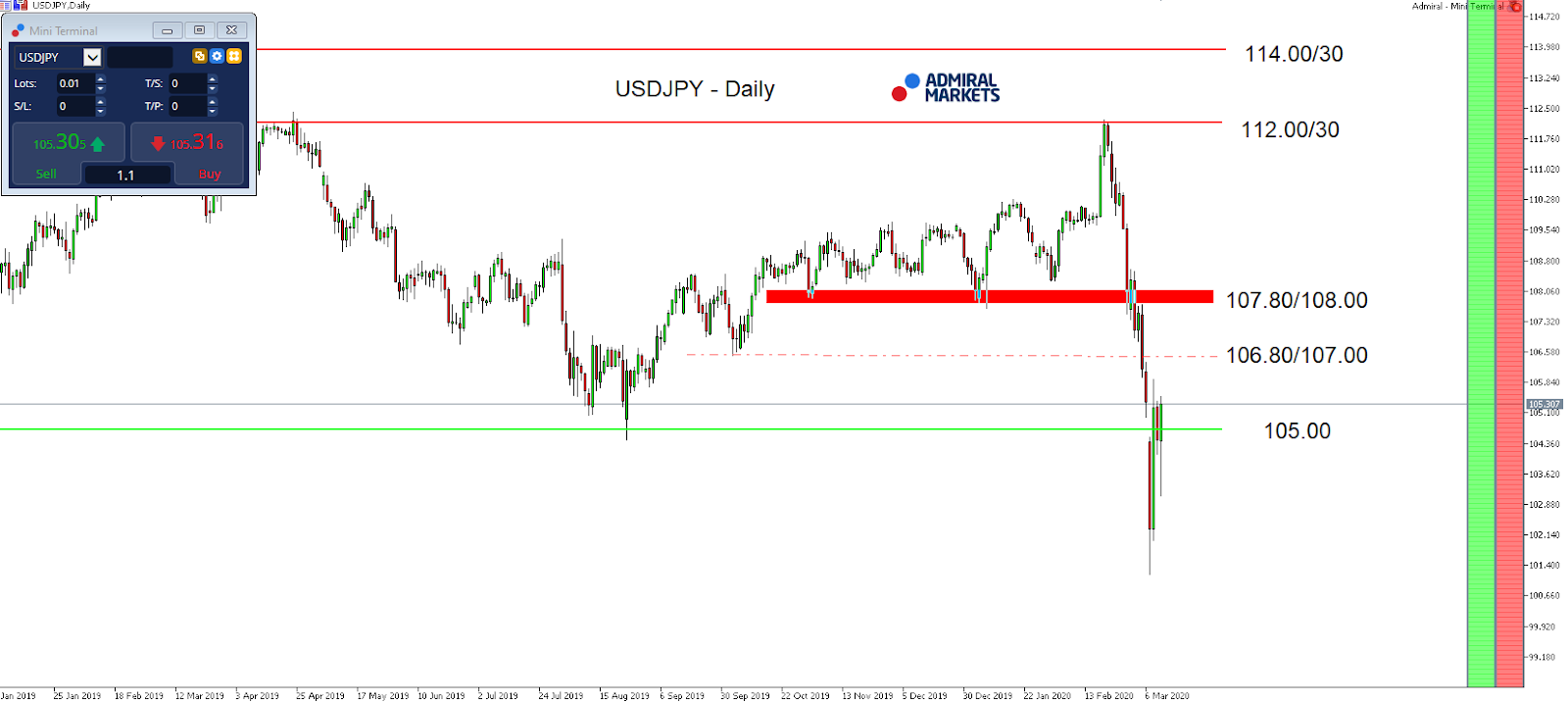
On the other hand, forex traders should keep an close eye on the BoJ and any comments which may make it over the news ticker: any verbal intervention from the BoJ e.g. openly expressing concerns over instability in Japanese financial sector and economy, warning between the lines that an intervention from the BoJ might be on its way, could see a sharper push higher in the USD/JPY above 105.00 and probably as high as 106.50.

Still and overall, we remain bearish towards the currency pair, and see with a next wave of risk off hitting the markets and a push lower in US yields, at least a re-test of the recent lows around 101.50 as a serious option:

USD/JPY Daily chart

Source: Admiral Markets MT5 with MT5-SE Add-on USD/JPY Daily chart (between 03 January 2019 to 12 March 2020). Accessed: 12 March 2020 at 10:00 PM GMT – Please note: Past performance is not a reliable indicator of future results, or future performance.

In 2015, the value of the USD/JPY increased by 0.5%, in 2016, it fell by 2.8%, in 2017, it fell by 3.6%, in 2018, it fell by 2.7%, in 2019, it fell by 0.85%, meaning that after five years, it was down by 9.2%.

Discover the world’s #1 multi-asset platform

Admiral Markets offers professional traders the ability to trade with a custom, upgraded version of MetaTrader 5, allowing you to experience trading at a significantly higher, more rewarding level. Experience benefits such as the addition of the Market Heat Map, so you can compare various currency pairs to see which ones might be lucrative investments, access real-time trading data, and so much more. Click the banner below to start your FREE download of MT5 Supreme Edition!

Download MetaTrader 5 and begin trading today!

Disclaimer: The given data provides additional information regarding all analysis, estimates, prognosis, forecasts or other similar assessments or information (hereinafter “Analysis”) published on the website of Admiral Markets. Before making any investment decisions please pay close attention to the following:

  1. This is a marketing communication. The analysis is published for informative purposes only and are in no way to be construed as investment advice or recommendation. It has not been prepared in accordance with legal requirements designed to promote the independence of investment research, and that it is not subject to any prohibition on dealing ahead of the dissemination of investment research.
  2. Any investment decision is made by each client alone whereas Admiral Markets shall not be responsible for any loss or damage arising from any such decision, whether or not based on the Analysis.
  3. Each of the Analysis is prepared by an independent analyst (Jens Klatt, Professional Trader and Analyst, hereinafter “Author”) based on the Author’s personal estimations.
  4. To ensure that the interests of the clients would be protected and objectivity of the Analysis would not be damaged Admiral Markets has established relevant internal procedures for prevention and management of conflicts of interest.
  5. Whilst every reasonable effort is taken to ensure that all sources of the Analysis are reliable and that all information is presented, as much as possible, in an understandable, timely, precise and complete manner, Admiral Markets does not guarantee the accuracy or completeness of any information contained within the Analysis. The presented figures refer that refer to any past performance is not a reliable indicator of future results.
  6. The contents of the Analysis should not be construed as an express or implied promise, guarantee or implication by Admiral Markets that the client shall profit from the strategies therein or that losses in connection therewith may or shall be limited.
  7. Any kind of previous or modeled performance of financial instruments indicated within the Publication should not be construed as an express or implied promise, guarantee or implication by Admiral Markets for any future performance. The value of the financial instrument may both increase and decrease and the preservation of the asset value is not guaranteed.
  8. The projections included in the Analysis may be subject to additional fees, taxes or other charges, depending on the subject of the Publication. The price list applicable to the services provided by Admiral Markets is publicly available from the website of Admiral Markets.
  9. Leveraged products (including contracts for difference) are speculative in nature and may result in losses or profit. Before you start trading, you should make sure that you understand all the risks.

By Admiral Markets

Norway cuts rate 50 bps, adds liquidity, cuts buffer

By CentralBankNews.info

Norway’s central bank rolled out three measures to cushion the impact of the coronavirus on the country’s economy, including cutting the policy rate by 50 basis points, pumping in liquidity by offering 3-month F-loans, and slashing the countercyclical buffer for banks.

Norges Bank (NB), which has kept rates on hold after pausing in September 2019 after four rate hikes to stem rising inflation, lowered its policy rate to 1.0 percent in the first rate cut since March 2016, and said it was ready to make further rate cuts.

“A lower policy rate cannot prevent the coronavirus outbreak from having a substantial on the Norwegian economy, but it could dampen the downturn and mitigate the risk of more persistent effects on output and employment,” NB said.

NB is the fifth central bank to cut its rate at an extraordinary policy meeting since the U.S. Federal Reserve’s surprise rate cut on March 3.

“There is considerable uncertainty about the duration and impact of the coronavirus outbreak, with a risk of a more pronounced economic downturn. The Committee is monitoring developments closely and is prepared to make further cuts,” NB said.

In the near term, NB said economic activity will decline considerably due to the outbreak of the coronavirus, or Covid-19, and many firms are already feeling the effects, with layoffs beginning and unemployment is expected to rise.

“Economic prospects have also weakened on the back of the sharp fall in oil prices,” it added.

Recent volatility in financial markets has boosted the risk premiums in Norway’s money market sharply and NB said it would offer extraordinary 3-month F-loans for as long as necessary to ensure its policy rate passes through to money market rates.

NB regularly offers short-term fixed rate lending and deposit facilities, known as F-loans and F-deposits, to manage liquidity.

From today NB will offer F-loans at the current policy rate and they will be fully allotted so banks receive the desired volume. New 3-month auctions will be held at least every week for the next four weeks.

In order to withdraw any surplus liquidity, NB said it would issue daily F-deposits with a one-day maturity and banks can then draw on the liquidity from the F-loans on a daily basis.

Lastly, NB said it had advised the country’s finance ministry to slash the countercyclical capital buffer for banks to 1.0 percent from 2.5 percent with immediate effect.

It added the ministry had followed this advice.

In Norway the countercyclical buffer is set once a quarter by the finance ministry under advice from the central bank.
In response to the global financial crises, banking supervisors worldwide devised capital buffers as a way to strengthen the capital basis of financial institutions and mitigate the procyclical effects of banks’ normal lending practices.

During good economic times, banks build up their buffers and during economic downturns these buffers can be lowered and capital drawn upon if credit becomes harder to obtain.

“Norwegian banks are solid,” NB said, adding they have sufficient capital to absorb losses but a lowering of the countercyclical capital buffer can counteract any tightening of banks’ lending standards, which can amplify an economic downturn.

NB added it didn’t expect the finance ministry to raise the buffer again until the first quarter of 2021 at the earliest.

Norges Bank released the following three statements, one on its policy decision, a second on the countercyclical buffer and a third on extraordinary F-loans to banks:

“Norway is contending with the outbreak of coronavirus (Covid-19). The most important measures to address the consequences of the outbreak are those that limit contagion and save lives.

Norges Bank’s mission is to promote economic stability. We do so by ensuring robust and efficient payment systems and financial markets and by adjusting the interest rate level to the economic situation.

Policy rate reduced by 0.50 percentage point to 1 percent

In the near term, activity in the Norwegian economy will decline considerably owing to the coronavirus outbreak. Many firms are feeling the negative effects. Layoff notices have already been issued, and unemployment is expected to rise. Economic prospects have also weakened on the back of the sharp fall in oil prices.
At an extraordinary meeting on 12 March, Norges Bank’s Monetary Policy and Financial Stability Committee voted unanimously to reduce the policy rate by 0.50 percentage point to 1.00 percent. There is considerable uncertainty about the duration and impact of the coronavirus outbreak, with a risk of a pronounced economic downturn. The Committee is monitoring developments closely and is prepared to make further rate cuts.
A lower policy rate cannot prevent the coronavirus outbreak from having a substantial impact on the Norwegian economy, but it could dampen the downturn and mitigate the risk of more persistent effects on output and employment.

Extraordinary F-loans to banks

In recent weeks there has been substantial volatility in financial markets. Risk premiums in the Norwegian money market have risen sharply. In order to ensure that the policy rate passes through to money market rates, Norges Bank offers extraordinary three-month F-loans for as long as deemed necessary. The F-loans will be fully allotted at an interest rate equal to the prevailing policy rate.

Countercyclical capital buffer should be reduced to 1 percent

Norges Bank has advised the Ministry of Finance to reduce the countercyclical capital buffer for banks from 2.5 to 1 percent, with immediate effect. The Ministry of Finance has today decided to follow Norges Bank’s advice.
Norwegian banks are solid. They have sufficient capital to absorb losses in the event of a severe downturn. However, tighter lending standards could amplify an economic downturn. A reduction in the countercyclical capital buffer can counteract a tightening of banks’ lending standards.

“Advice on the countercyclical capital buffer 2020 Q1

Norges Bank’s Monetary Policy and Financial Stability Committee has decided to advise the Ministry of Finance to reduce the buffer rate to 1.0 percent.
Norges Bank shall advice the Ministry of Finance on the level of the countercyclical capital buffer for banks. The countercyclical capital buffer rate is currently 2.5 percent.
In recent weeks, there has been considerable financial market volatility. The outbreak of coronavirus (Covid-19) and the measures to limit contagion will have a significant negative impact on growth in the Norwegian economy. There is substantial uncertainty about the duration and the consequences of the outbreak, with a risk of a pronounced economic downturn.
Norwegian banks are solid. They have sufficient capital to absorb losses in the event of a severe downturn. A tightening of lending standards may, however, amplify the downturn in the economy.
Against this background, the Committee has decided to advise the Ministry of Finance to reduce the buffer to 1.0 percent with immediate effect. The decision was unanimous.
Norwegian banks are profitable. When banks’ general meetings decide on dividend payments, they should in the period ahead take account of the extraordinary situation now facing our country.
The Committee does not expect to advise the Ministry to increase the buffer rate again until 2021 Q1 at the earliest. Normally, implementation of an increase in the countercyclical capital buffer will not be effective until 2022 Q1 at the earliest. In preparing its advice on the countercyclical capital buffer, Norges Bank has exchanged information and assessments with Finanstilsynet (Financial Supervisory Authority of Norway).”

“Extraordinary F-loans to banks

Owing to the market situation over the past few days, Norges Bank will offer extraordinary three-month NOK F-loans as from 13 March 2020. Norges Bank will offer extraordinary three-month F-loans for as long as is deemed appropriate. The loans are being offered to ensure that the policy rate passes through to money market rates.
The following conditions apply:
  • The F-loan falls due after three months.
  • The interest rate on the F-loan is the policy rate prevailing at any time.
  • The F-loan will be fully allotted. All banks will receive the desired volume at the announced interest rate. The same collateral requirements will apply as for ordinary F-loans.
  • Norges Bank will continue to aim to keep central bank reserves (banks’ unrestricted bank deposits at the central bank) overnight at around NOK 35 billion (with a target range of plus/minus NOK 5 billion).
  • Surplus liquidity will be withdrawn from the banking system using daily F-deposits with one-day maturity. Banks can then draw on the liquidity from the extraordinary F-loans on a daily basis.
  • New three-month F-auctions will be held at least every week for four weeks ahead, see auction calendar. The calendar will be updated on a continuous basis. Norges Bank will offer extraordinary three-month F-loans for as long as is deemed appropriate.”


Markets Drop As Central Banks Disappoint

By Orbex

Euro Slips as ECB Fails to Deliver – Is the Uptrend Over?

The euro fell as much as 1.78% intraday on Thursday. This follows the ECB meeting where interest rates were left unchanged. However, the ECB did announce stimulus measures.

Investors were clearly disappointed pushing the euro to retrace nearly half its gains from earlier. Price is currently testing the major trend line. We expect a modest rebound which may keep prices limited to the 1.1200 handle for the moment.

Sterling Slips to a 5-Month Low to the Dollar

The pound sterling gave up the gains and fell sharply on Thursday. This coincides as neighboring Ireland and Scotland announced new measures to tackle the COVID-19 pandemic.

GBPUSD is down over 2.18% and is more pronounced compared to the BoE decision on Wednesday. Price is trading at 1.2585 and is threatening to break down lower. A break of this floor could open the way for a drop to 1.2200.

WTI Crude Oil Stuck in a Range Amid Uncertainty

Crude oil prices are steadily declining after the recent rally to the 35.00 handle. Price action is in a steady short term decline. However, the momentum to the downside is starting to slow.

Going by the Stochastics oscillator, we could expect a possible attempt for a retest of the 35.00 handle. While to the downside, the previously established floor at 28.00 remains within reach. Given the market conditions, it would be a bit too early to call the direction in WTI crude oil prices.


XAUUSD Back at Familiar Support – But Will it Hold?

Gold prices fell sharply on Thursday, down over 3%. This comes after price broke below the initial support level at 1631.90. There was a brief momentum when gold was poised to pullback. However, the failure at 1631 saw prices dropping down to 1594 and lower.

Currently, gold prices are testing the previous support at 1572 – 1568 region. So far, this level looks to be holding out. But a break down from here could put 1500 within reach.

By Orbex

Forex Technical Analysis & Forecast 13.03.2020

Article By RoboForex.com

EURUSD, “Euro vs US Dollar”

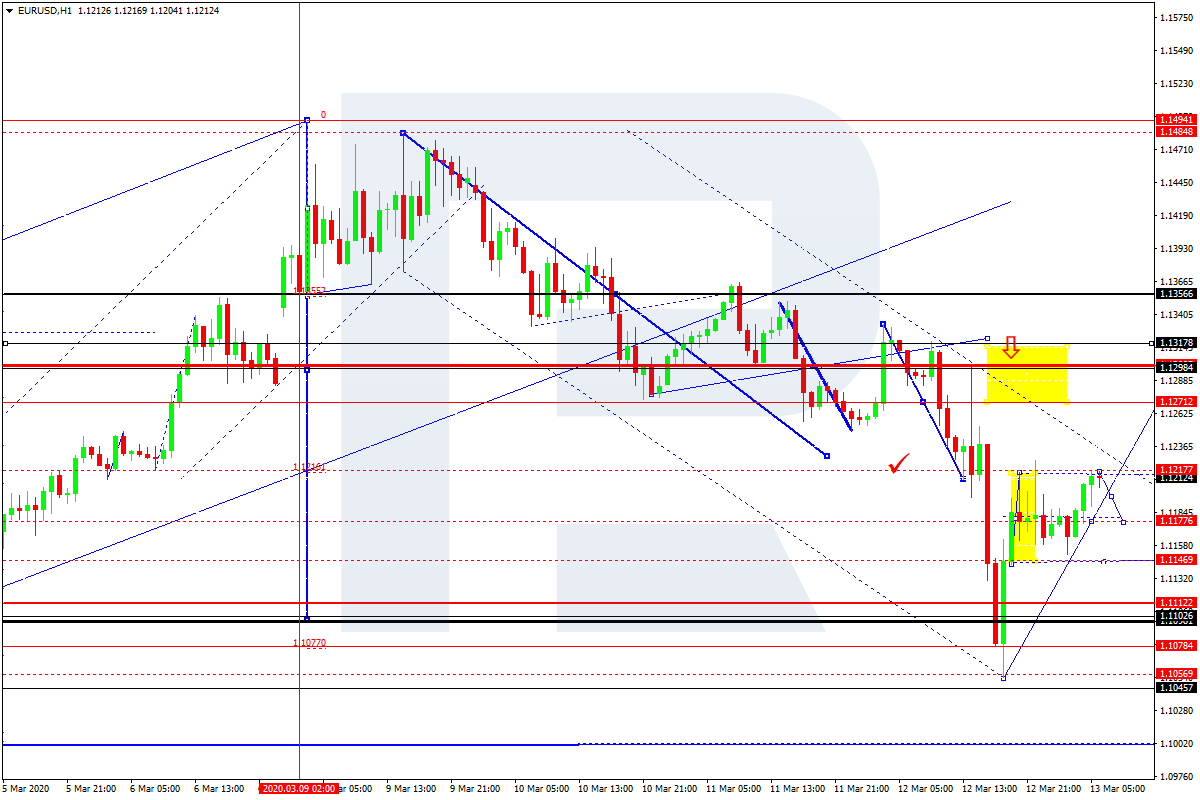
After reaching the first downside target at 1.1060 without forming any corrections, EURUSD has formed the ascending impulse; right now, it is consolidating around 1.1176. Possibly, the pair may break the range to the upside and continue the correction towards 1.1298.

EURUSD
Risk Warning: the result of previous trading operations do not guarantee the same results in the future

GBPUSD, “Great Britain Pound vs US Dollar”

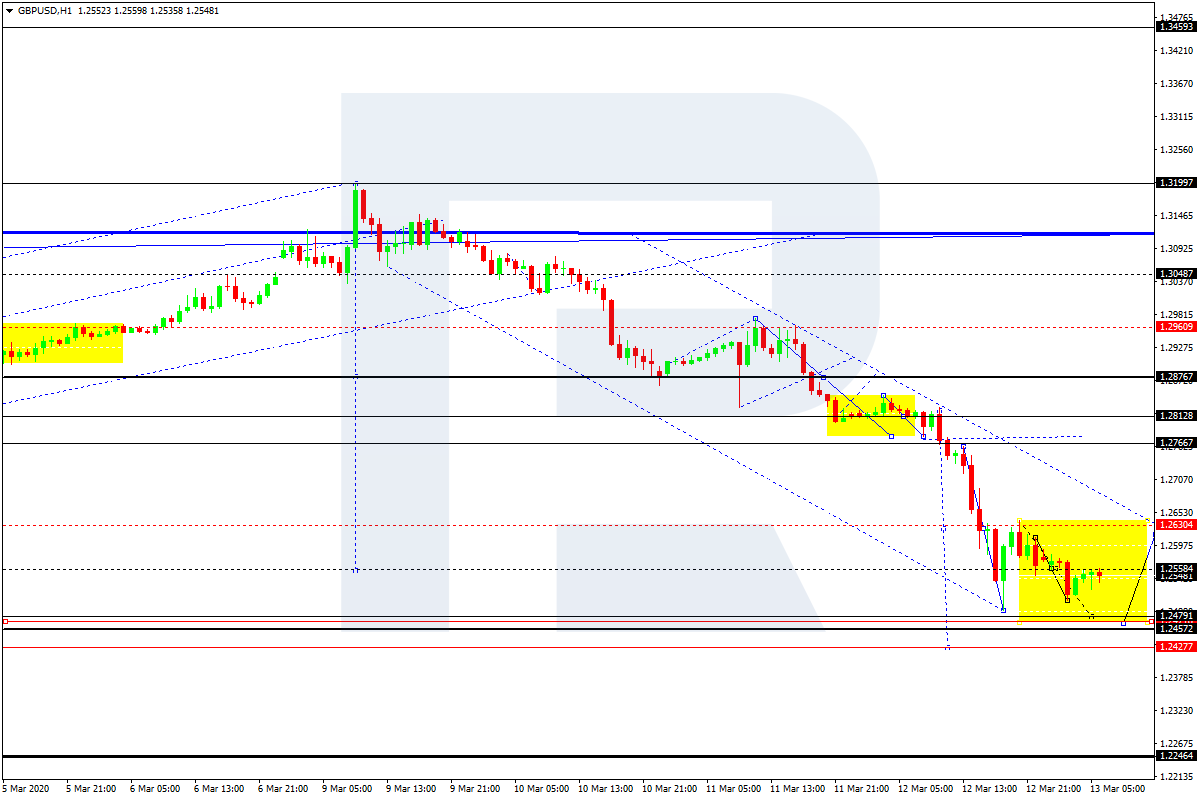
After breaking 1.2766, GBPUSD has reached 1.2556; right now, it is consolidating around the latter level. Possibly, today the pair may expand the range down to 1.2455 and then start another correction to return to 1.2766. Later, the market may resume falling with the target at 1.2246.

GBPUSD
Risk Warning: the result of previous trading operations do not guarantee the same results in the future

USDCHF, “US Dollar vs Swiss Franc”

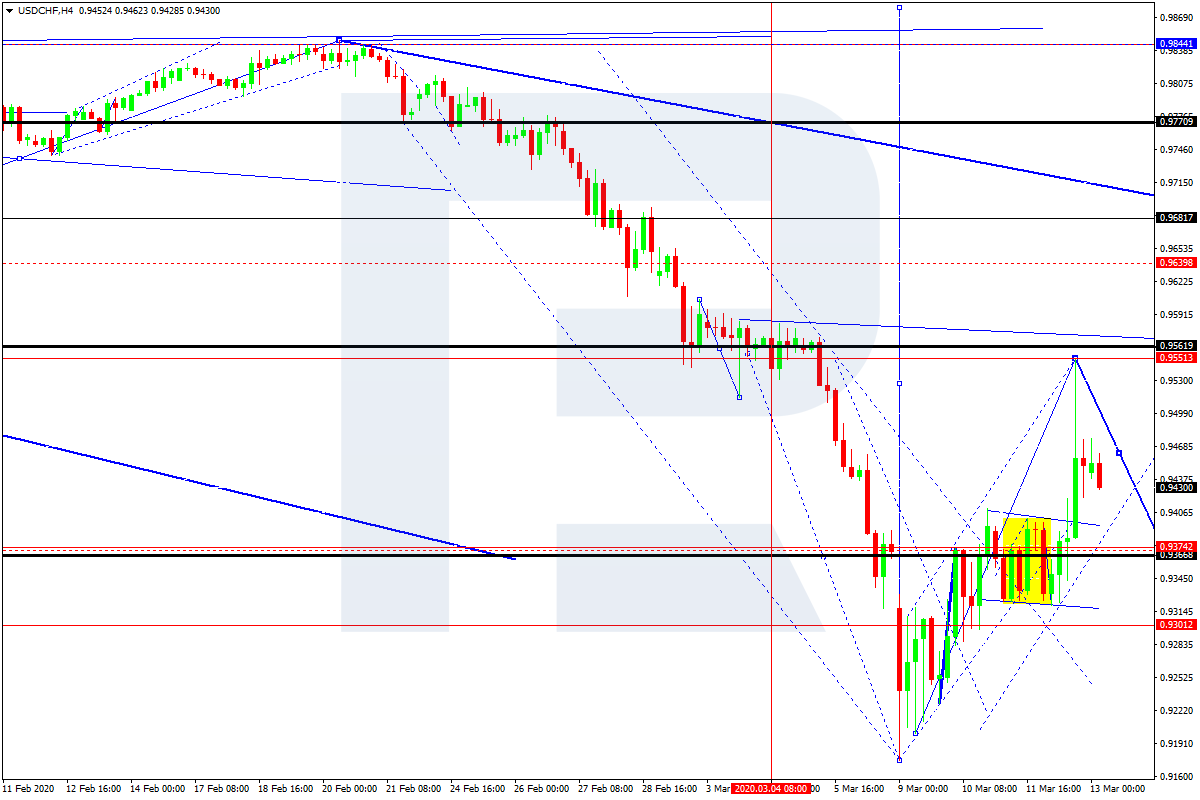
USDCHF has finished the first descending wave at 0.9550; right now, it is correcting towards 0.9375. Later, the market may start a new growth with the target at 0.9600.

USDCHF
Risk Warning: the result of previous trading operations do not guarantee the same results in the future

USDJPY, “US Dollar vs Japanese Yen”

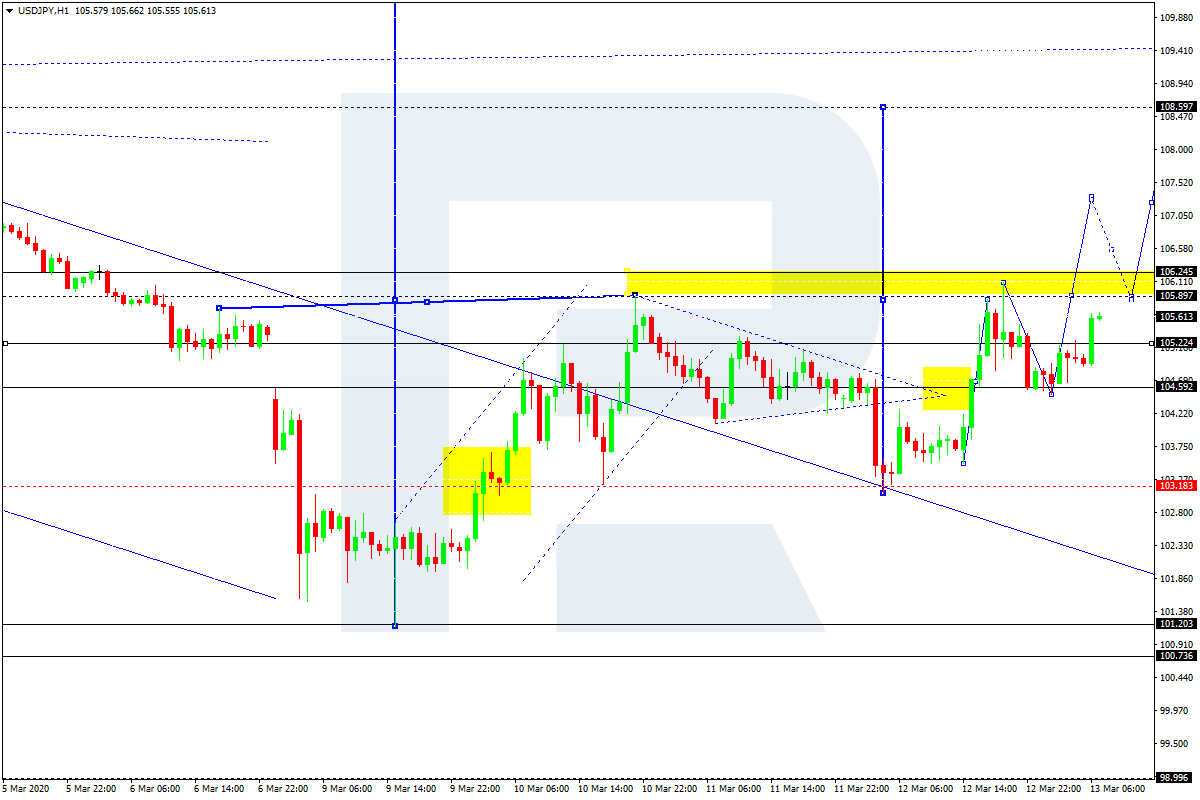
USDJPY is growing with the short-term target at 108.60. Today, the pair may break 105.90 to the upside and then reach 107.07. After that, the instrument may form a new descending structure towards 106.00 and then resume trading upwards to reach the above-mentioned target.

USDJPY
Risk Warning: the result of previous trading operations do not guarantee the same results in the future

AUDUSD, “Australian Dollar vs US Dollar”

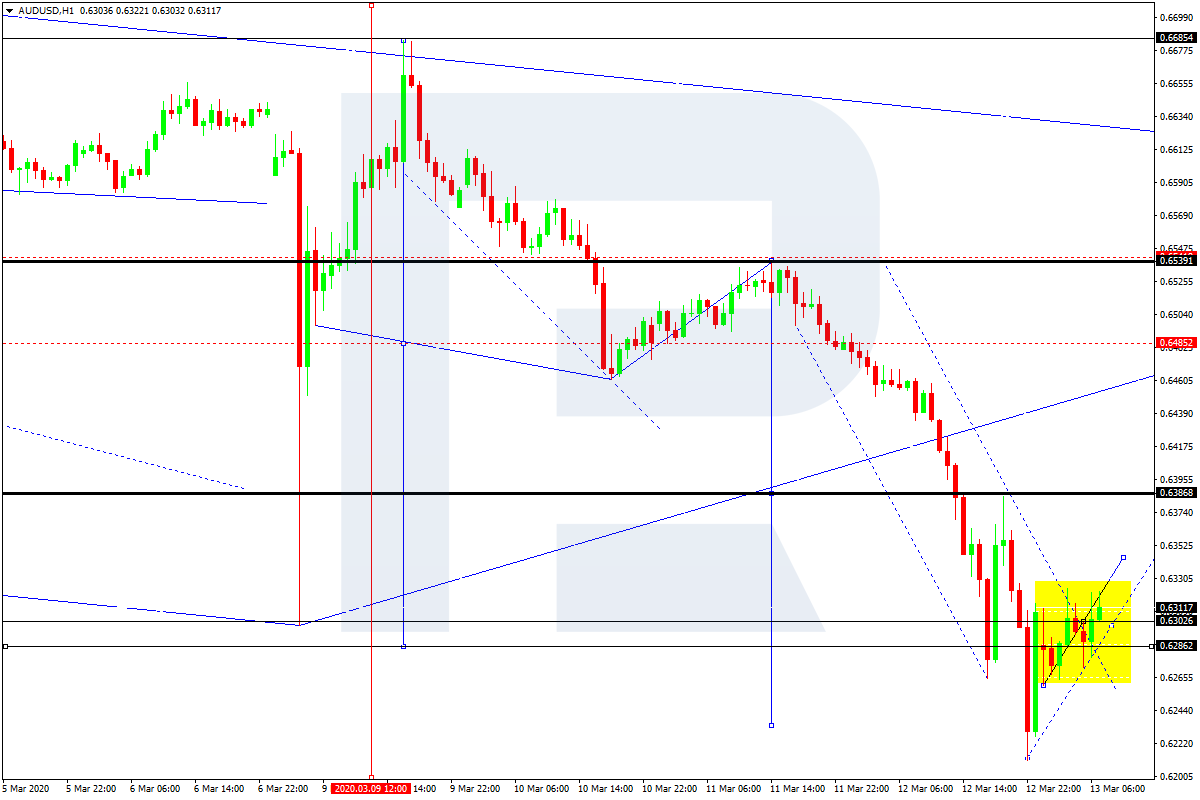
After completing another descending wave at 0.6222, AUDUSD is forming the first impulse to the upside. Possibly, the pair may reach 0.6385 and then fall towards 0.6300, After that, the instrument may resume trading upwards with the target at 0.6500.

AUDUSD
Risk Warning: the result of previous trading operations do not guarantee the same results in the future

USDRUB, “US Dollar vs Russian Ruble”

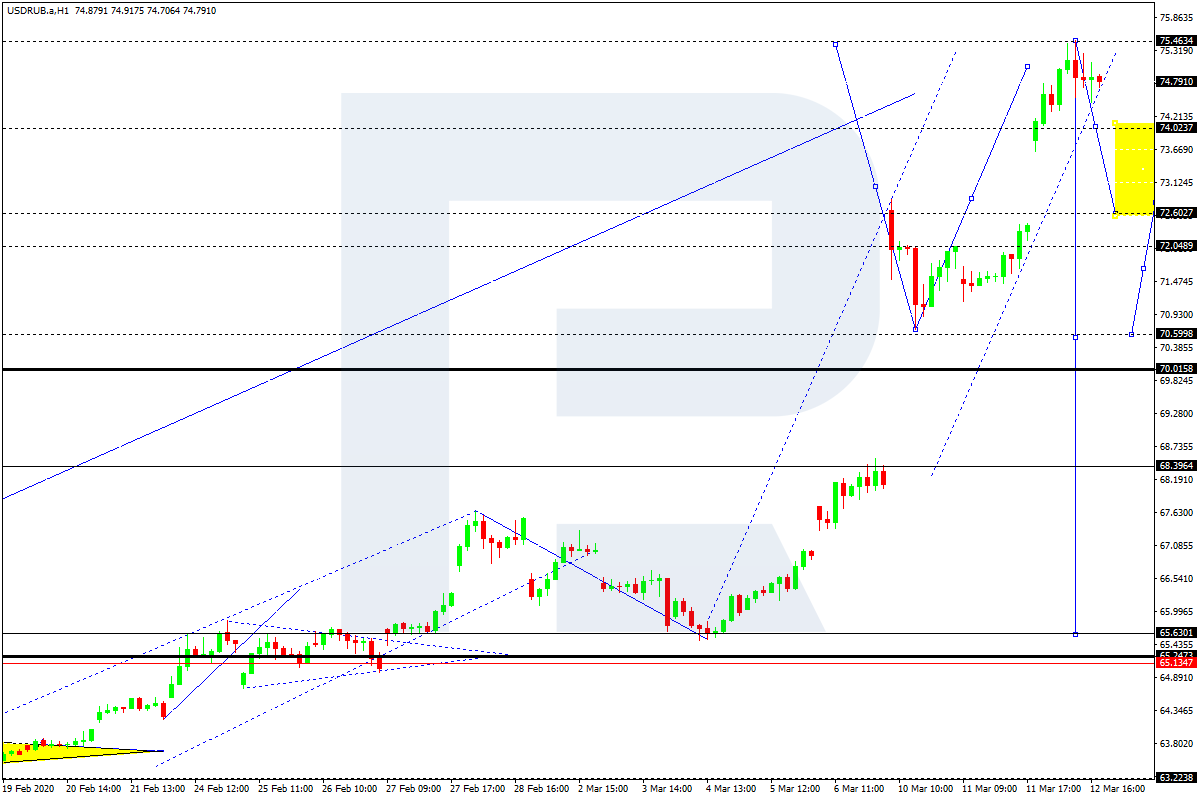
USDRUB has finished another ascending structure to reach 75.45; right now, it is falling towards 72.60. Later, the market may start another growth to reach 74.04 and then form a new descending structure with the short-term target at 70.60.

USDRUB
Risk Warning: the result of previous trading operations do not guarantee the same results in the future

USDCAD, “US Dollar vs Canadian Dollar”

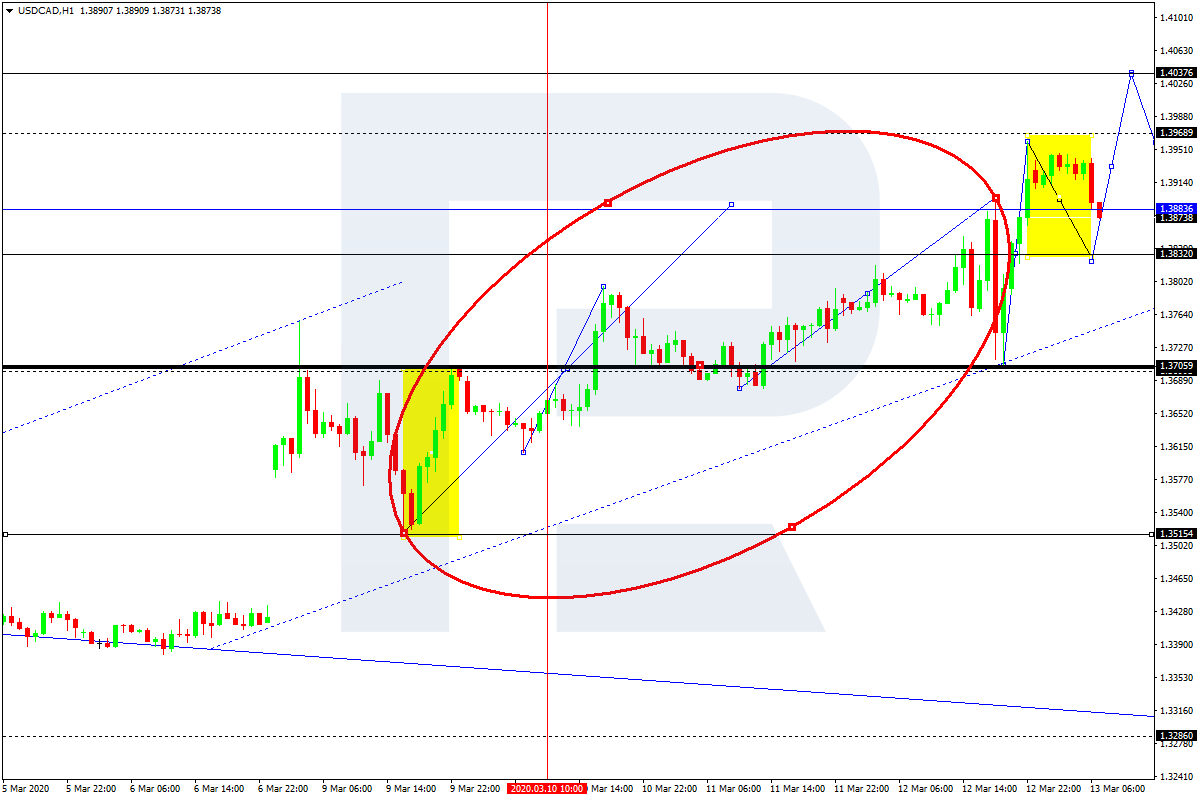
After completing the correction at 1.3700, USDCAD has broken the high at 1.3832; right now, it is still growing. Today, the pair may test the broken high from above and then form one more ascending structure with the short-term target at 1.4040.

USDCAD
Risk Warning: the result of previous trading operations do not guarantee the same results in the future

XAUUSD, “Gold vs US Dollar”

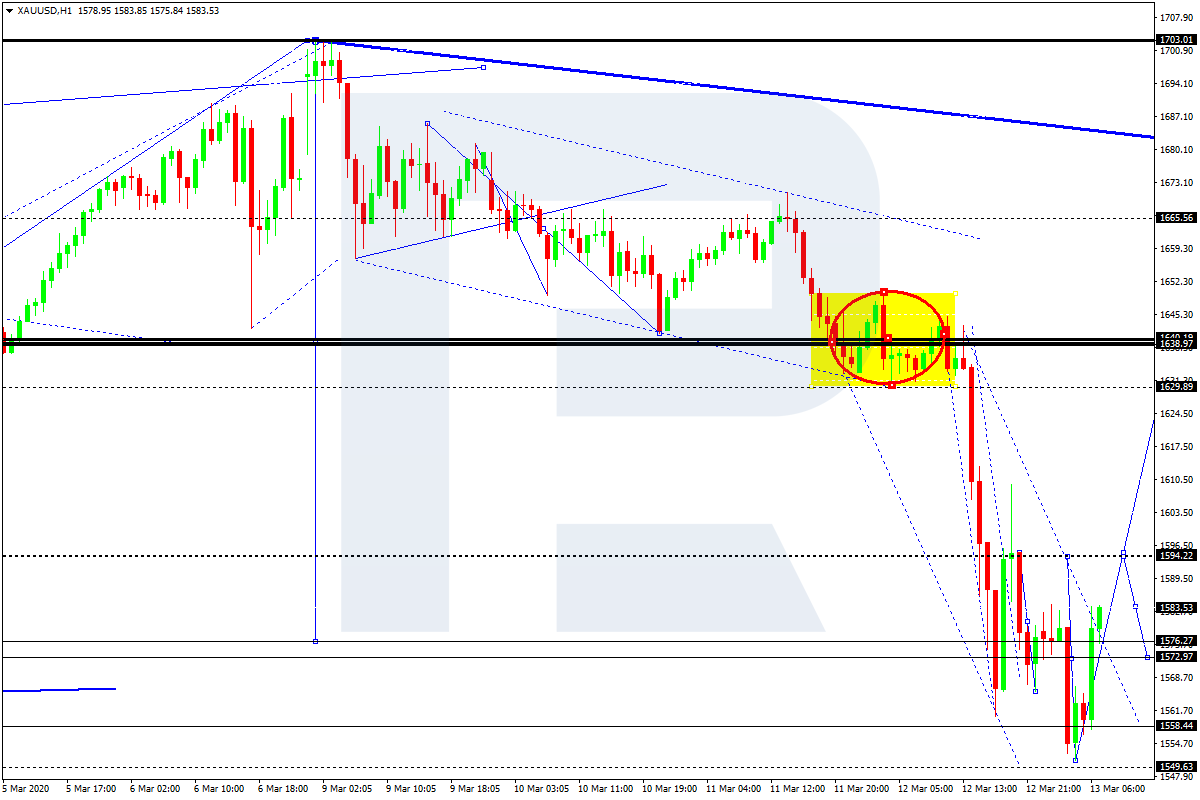
After forming a downside continuation pattern around 1638.98 and broken it downwards, Gold has completed the descending wave at 1555.55. Possibly, today the pair may form one more ascending structure to reach 1594.22. In fact, the instrument is expected to start a new rising wave with the target at 1768.50.

GOLD
Risk Warning: the result of previous trading operations do not guarantee the same results in the future

BRENT

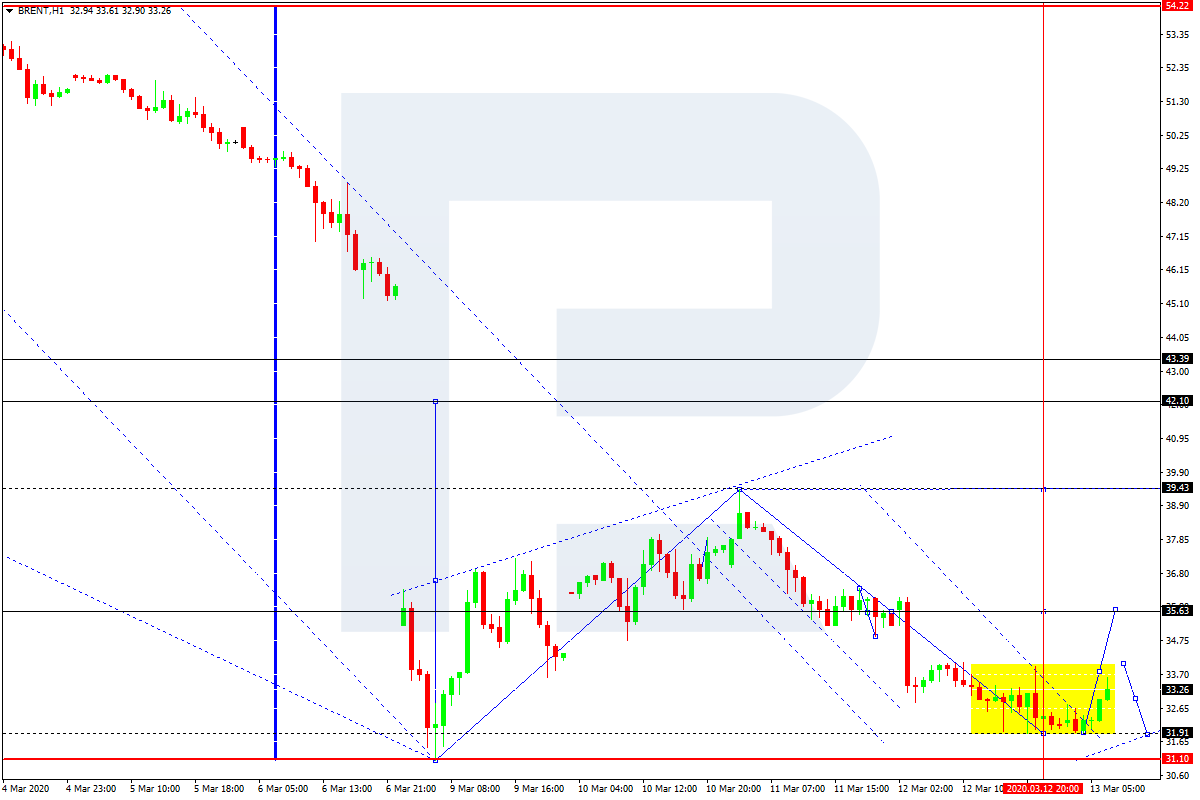
Brent continues falling; right now, it is consolidating below 32.00. According to the main scenario, the price is expected to break the range to the upside and grow to reach 35.60. Later, the market may break this level as well and then continue trading upwards with the first target at 39.44. .

BRENT
Risk Warning: the result of previous trading operations do not guarantee the same results in the future

BTCUSD, “Bitcoin vs US Dollar”

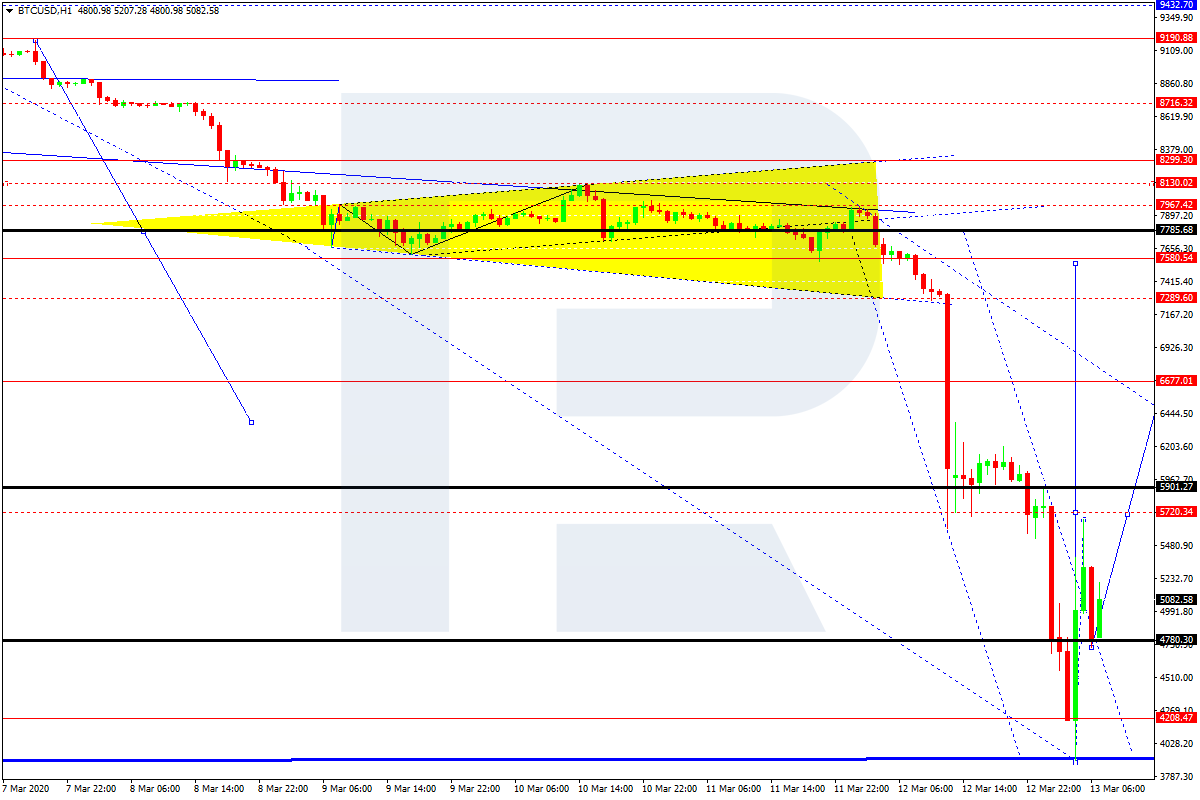
Earlier, BTCUSD broke 7300.00 and fell towards 5900.00. Today, after forming the consolidation range around this level and expanding it down to 3900.00, the price has finished the ascending impulse towards 5600.00 along with the correction at 4800.00. The main scenario implies that the instrument may form the second ascending impulse to reach 6600.00 and then start a new correction towards 5700.00. After that, the pair may resume trading upwards with the first target at 7600.00.

BTCUSD

Article By RoboForex.com

Attention!
Forecasts presented in this section only reflect the author’s private opinion and should not be considered as guidance for trading. RoboForex LP bears no responsibility for trading results based on trading recommendations described in these analytical reviews.

Countries Are Trying to Stimulate the Economy. US Stock Market Is Declining

by JustForex

The US dollar is recovering against a basket of major currencies. The dollar index (#DX) closed in the green zone (+1.01%). The US currency was supported by the fact that yesterday the US Federal Reserve tried to stop the market collapse by offering short-term loans $1.5 trillion worth. Also, the regulator gave a signal about the so-called start of a new wave of quantitative easing. In turn, investors also expect another reduction in the Fed interest rate.

The ECB has approved fresh stimulus measures and temporarily reduced capital requirements for banks to help the Eurozone cope with the crisis. The central bank increased its quantitative easing program by €120 billion by the end of the year. Also yesterday, the ECB decided on the interest rate. As experts forecasted, the regulator left interest rates unchanged.

The “black gold” prices are recovering after a significant collapse at the beginning of the week. Currently, futures for the WTI crude oil are testing the $33.10 mark per barrel. At 19:00 (GMT+2:00), Baker Hughes US rig count will be published.

Market indicators

Yesterday, there were aggressive sales in the US stock market: #SPY (-9.57%), #DIA (-10.06%), #QQQ (-9.17%).

The 10-year US government bonds yield rose slightly. At the moment, the indicator is at the level of 0.85-0.86%.

The news feed on 2020.03.13:
  • – Michigan consumer sentiment and expectations at 16:00 (GMT+2:00).

by JustForex

Fibonacci Retracements Analysis 13.03.2020 (BITCOIN, ETHEREUM)

Article By RoboForex.com

BTCUSD, “Bitcoin vs US Dollar”

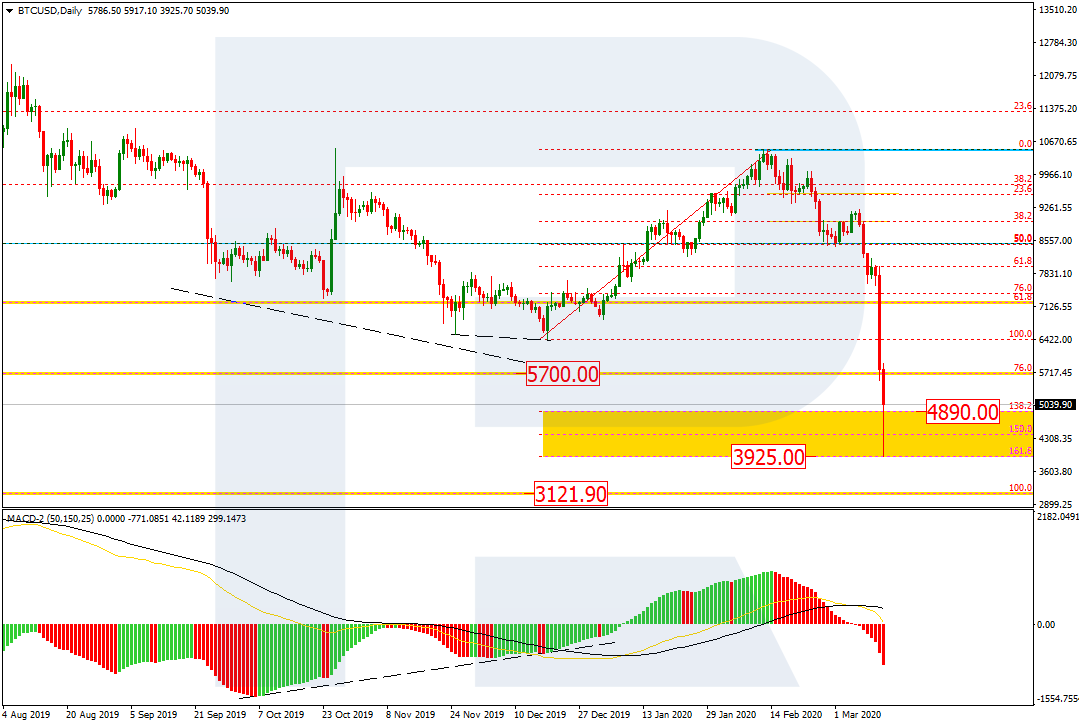
As we can see in the daily chart, Bitcoin is totally dominated by bears; the pair has completed such a strong descending impulse that it has reached all important downside targets along with the post-correctional extension area between 138.2% and 161.8% fibo at 4890.00 and 3925.00 respectively. At the moment, the instrument may start a pullback, but the next downside target may be the long-term fractal low at 3121.90.

BTCUSD_D1
Risk Warning: the result of previous trading operations do not guarantee the same results in the future

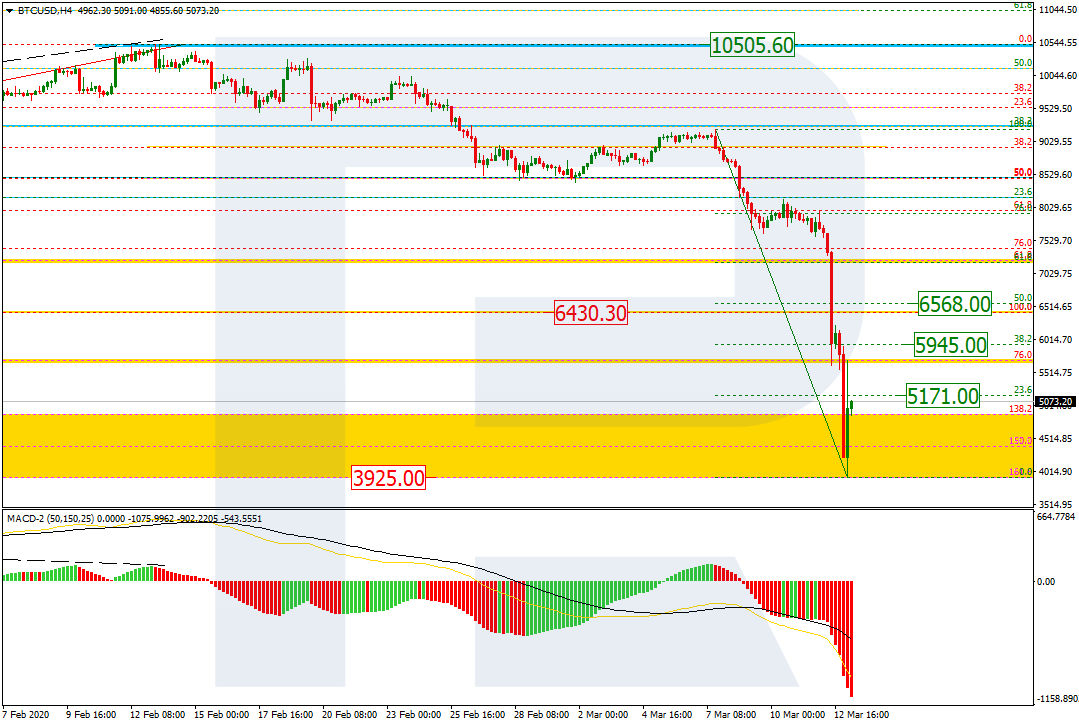
In the H4 chart, the pair is correcting after reaching the post-correctional extension area between 138.2% and 161.8% fibo at 4890.00 and 3925.00 respectively. The price is growing towards 23.6% fibo at 5171.00 and may later reach 38.2% and 50.0% fibo at 5945.00 and 6568.00 respectively.

BTCUSD_H4
Risk Warning: the result of previous trading operations do not guarantee the same results in the future

ETHUSD, “Ethereum vs. US Dollar”

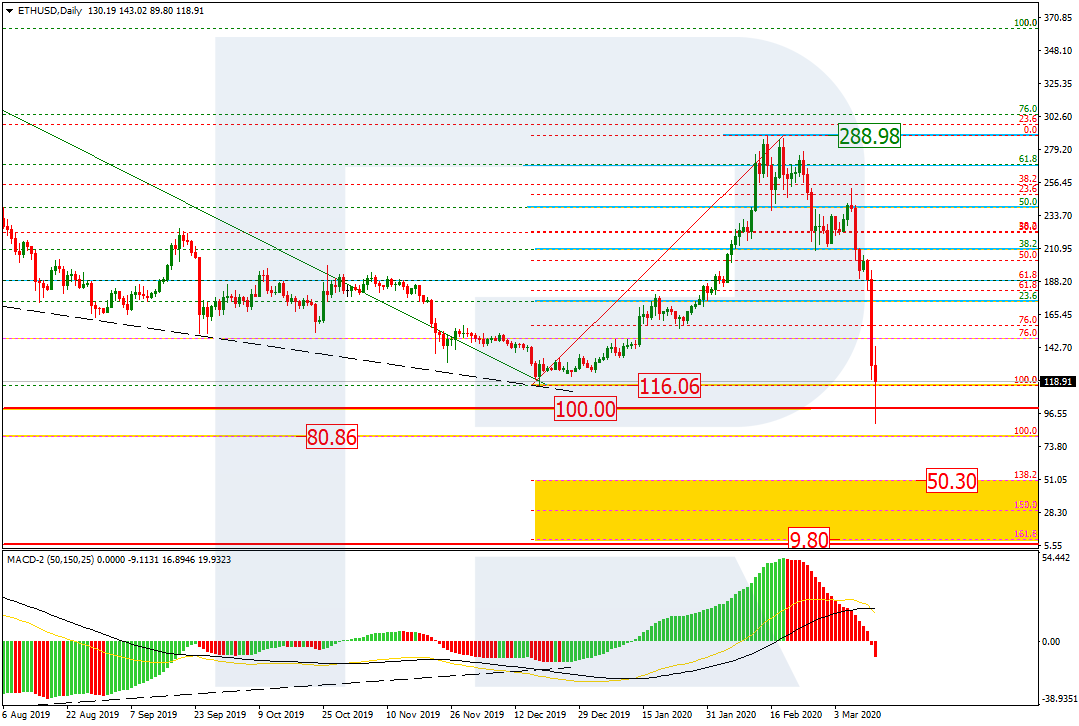
As we can see in the daily chart, the descending wave has tested the psychologically important support at 100.00. In the nearest future, ETHUSD may correct. However, after the correction, the pair may continue falling towards the long-term low at 80.86, as well as the post-correctional extension area between 138.2% and 161.8% fibo at 50.30 and 9.80 respectively.

ETHUSD_D1
Risk Warning: the result of previous trading operations do not guarantee the same results in the future

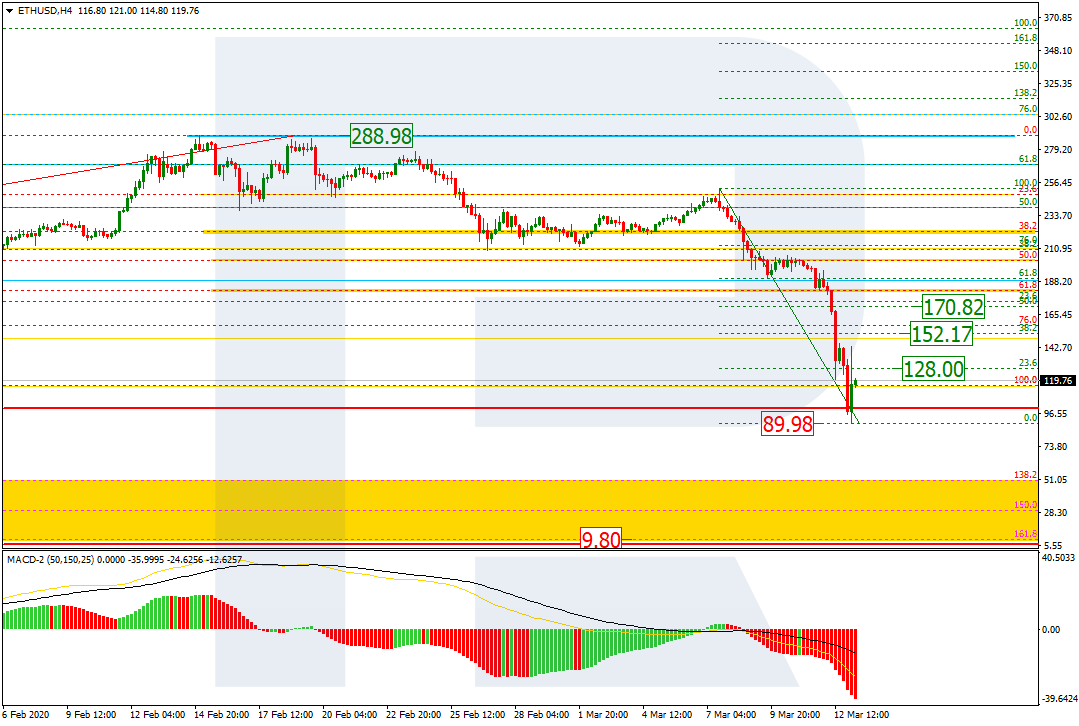
In the H4 chart, the pair is correcting after reaching 89.98. The price is getting close to 23.6% fibo at 128.00 and may later reach 38.2% and 50.0% fibo at 152.17 and 170.82.

ETHUSD_H4

Article By RoboForex.com

Attention!
Forecasts presented in this section only reflect the author’s private opinion and should not be considered as guidance for trading. RoboForex LP bears no responsibility for trading results based on trading recommendations described in these analytical reviews.

The Analytical Overview of the Main Currency Pairs on 2020.03.13

by JustForex

The EUR/USD currency pair

Technical indicators of the currency pair:
  • Prev Open: 1.12607
  • Open: 1.11739
  • % chg. over the last day: -0.76
  • Day’s range: 1.11522 – 1.12212
  • 52 wk range: 1.0879 – 1.1572

A bearish sentiment prevails on the EUR/USD currency pair. The trading instrument has updated the local lows. Yesterday ECB kept the base interest rate on loans at zero level, the rate on deposits at -0.5%. The regulator will increase the asset buyback program by 120 billion euro by the end of 2020. Investors continue to assess the risks of COVID-19 virus spread and its impact on the global economy. At present, EUR/USD quotes are consolidating in the range of 1.11550-1.12500. The EUR can decline further. Open positions from key levels.

The Economic News Feed for 13.03.2020:

  • – US export and import price indices – 14:30 (GMT+2:00);
  • – Consumer expectations and sentiment indices from the University of Michigan – 16:00 (GMT+2:00).
EUR/USD

The indicators signal the sellers’ power: the price has fixed below 50 MA and 100 MA.

MACD histogram is in the negative zone, but above the signal line, which gives a weak signal to sell EUR/USD.

The Stochastic Oscillator is located in the overbought zone, the %K line crossed the %D line. There are no signals at the moment.

Trading recommendations
  • Support levels: 1.11550, 1.10700, 1.10000
  • Resistance levels: 1.12500, 1.13250, 1.13650

If the price fixes below 1.11550, expect further decline toward 1.11000-1.10500.

Alternatively, the quotes could grow toward 1.13000-1.13500.

The GBP/USD currency pair

Technical indicators of the currency pair:
  • Prev Open: 1.28194
  • Open: 1.25656
  • % chg. over the last day: -1.94
  • Day’s range: 1.25075 – 1.25839
  • 52 wk range: 1.1959 – 1.3516

Aggressive selling is observed on GBP/USD currency pair. Since the beginning of this week the drop in quotes has exceeded 550 points. At the moment the sterling has stabilized. The local support and resistance levels are 1.25000 and 1.26300, respectively. The trading instrument has potential for further decline. We recommend opening positions from key levels.

The news background on the British economy is calm.

GBP/USD

The indicators signal the sellers’ strength: the price has fixed below 50 MA and 100 MA.

The MACD histogram is in the negative zone, which indicates a bearish sentiment.

The Stochastic Oscillator is in the neutral zone, the %K line has crossed the %D line. There are no signals at the moment.

Trading recommendations
  • Support levels: 1.25000, 1.24000
  • Resistance levels: 1.26300, 1.27450, 1.28500

If the price fixes below the round level of 1.25000, expect a further decline toward 1.24000-1.23500.

Alternatively, the quotes could grow toward 1.27400-1.28000.

The USD/CAD currency pair

Technical indicators of the currency pair:
  • Prev Open: 1.37748
  • Open: 1.39172
  • % chg. over the last day: +0.05
  • Day’s range: 1.37748 – 1.39172
  • 52 wk range: 1.2949 – 1.3566

USD/CAD currency pair has stabilized after a long rally. At the moment, the CAD is consolidating. Local support and resistance levels are at 1.38400 and 1.39500, respectively. Technical correction of the trading instrument is not ruled out in the nearest future. We recommend you to pay attention to the dynamics of oil prices. Open positions from key levels.

Publication of important economic releases from Canada is not planned.

USD/CAD

The indicators indicate the power of buyers: the price has fixed above 50 MA and 100 MA.

Histogram of MACD is in positive zone.

The Stochastic Oscillator is in the neutral zone, the %K line is below the %D line, which indicates a possible correction of the USD/CAD currency pair.

Trading recommendations
  • Support levels: 1.38400, 1.37100, 1.36200
  • Resistance levels: 1.39500, 1.40000

If the price fixes above 1.39500, expect a rise to 1.40000-1.40300.

Alternatively, the quotes could correct toward 1.37600-1.37000.

The USD/JPY currency pair

Technical indicators of the currency pair:
  • Prev Open: 104.423
  • Open: 104.733
  • % chg. over the last day: +0.21
  • Day’s range: 104.585 – 106.011
  • 52 wk range: 101.19 – 112.41

The USD/JPY currency pair has an ambiguous technical pattern. The trading instrument is in a flat. At the moment the safe haven currency is testing the round level of 106.000. 104.500 is the nearest support. USD/JPY can still recover. We recommend you to pay attention to the dynamics of the US government bonds yield. Open positions from key levels.

During the Asian trading session, there was a weak release on business activity in the service sector.

USD/JPY

The indicators signal the power of buyers: the price has fixed above 100 MA.

The MACD histogram is in the positive zone, which indicates a correction of the USD/JPY currency pair.

The Stochastic Oscillator is in the neutral zone, the %K line crossed the %D line. There are no signals at the moment.

Trading recommendations
  • Support levels: 104.500, 103.200, 102.000
  • Resistance levels: 106.000, 107.000, 107.700

If the price fixes above 106.000, expect the quotes to grow toward 107.000-107.700.

Alternatively, the quotes could descend toward 103.500-103.000.

by JustForex