This week – March 15 through March 21 – central banks from 17 countries or jurisdictions are scheduled to decide on monetary policy: Kazakhstan, Pakistan, Armenia, Morocco, Georgia, USA, Brazil, Japan, Taiwan, Indonesia, Philippines, Switzerland, Turkey, Azerbaijan, South Africa, China and Russia.
Following table includes the name of the country, the date of the next policy decision, the current policy rate, the result of the last policy decision, the change in the policy rate year to date, and the rate one year ago.
The table is updated when the latest decisions are announced and can always accessed by clicking on This Week.
Shares of Predictive Oncology traded higher after the company reported that it launched a new AI vaccine and drug development platform targeting coronaviruses and acute respiratory syndromes and that it is acquiring Soluble Therapeutics assets including its HSC Technology.
This morning, Predictive Oncology Inc. (POAI:NASDAQ), which focuses on applying artificial intelligence (AI) to personalized medicine and drug discovery, announced that “it will launch a new AI platform for vaccine and drug development targeting Coronaviruses and Acute Respiratory Syndromes (COVID-19, MERS, and SARS) through an operating agreement with Soluble Therapeutics.” The company additionally reported that “it has signed a letter of intent with InventaBioTech to acquire Soluble Therapeutics, its assets and its HSCTM Technology.”
The company reported that the Soluble Therapeutics purchase is expected to close in Q2/20 and is subject to the execution of a definitive agreement and customary closing conditions.
The company noted that “global health experts are predicting an ever-increasing number of viral outbreaks like COVID-19 and that it is taking proactive measures to be part of the solution by applying artificial intelligence to aid in the development of new drugs and vaccines…and that by using Soluble Therapeutics’ HSC technology and its six machines, Soluble’s computer system expects to be able to run over 12,000 computer simulations per machine to help generate new diagnostics, vaccines and therapeutics.”
Predictive Oncology’s CEO Carl Schwartz commented, “Soluble has six customized machines in its facilities that can help identify the best solutions for vaccines, proteins or antibodies being developed to help fight the COVID-19 contagion. Through this operating partnership and acquisition, we are ready to assist in the development of viable treatment options that use biological, complex ingredients and formulations to speed up the pre-clinical and clinical development of treatments.”
Dr. Larry DeLucas, co-inventor of the HSC technology, added, “The combination of Soluble Therapeutics’ technology with Predictive Oncology’s AI capability has the potential to rapidly optimize formulations thereby accelerating the early phase of protein therapeutic development.”
Predictive Oncology is based in Eagan, Minn., and operates via four subsidiary companies: Helomics, TumorGenesis, Skyline Medical and Skyline Europe.
Predictive Oncology has a market capitalization of around $8.4 million billion with approximately 3.925 million shares outstanding. POAI shares opened today at $2.10 (-$0.04, -1.87%) compared to yesterday’s $2.14 closing price. The stock has traded today between $2.20 and $4.42 per share and is closed the trading day at $2.28 (+$0.14, +6.54%).
Disclosure: 1) Stephen Hytha compiled this article for Streetwise Reports LLC and provides services to Streetwise Reports as an independent contractor. He or members of his household own securities of the following companies mentioned in the article: None. He or members of his household are paid by the following companies mentioned in this article: None. 2) The following companies mentioned in this article are billboard sponsors of Streetwise Reports: None. Click here for important disclosures about sponsor fees. 3) Comments and opinions expressed are those of the specific experts and not of Streetwise Reports or its officers. The information provided above is for informational purposes only and is not a recommendation to buy or sell any security. 4) The article does not constitute investment advice. Each reader is encouraged to consult with his or her individual financial professional and any action a reader takes as a result of information presented here is his or her own responsibility. By opening this page, each reader accepts and agrees to Streetwise Reports’ terms of use and full legal disclaimer. This article is not a solicitation for investment. Streetwise Reports does not render general or specific investment advice and the information on Streetwise Reports should not be considered a recommendation to buy or sell any security. Streetwise Reports does not endorse or recommend the business, products, services or securities of any company mentioned on Streetwise Reports. 5) From time to time, Streetwise Reports LLC and its directors, officers, employees or members of their families, as well as persons interviewed for articles and interviews on the site, may have a long or short position in securities mentioned. Directors, officers, employees or members of their immediate families are prohibited from making purchases and/or sales of those securities in the open market or otherwise from the time of the interview or the decision to write an article until three business days after the publication of the interview or article. The foregoing prohibition does not apply to articles that in substance only restate previously published company releases. 6) This article does not constitute medical advice. Officers, employees and contributors to Streetwise Reports are not licensed medical professionals. Readers should always contact their healthcare professionals for medical advice.
By Dan Steinbock – Despite containment in China, international response against the coronavirus has been lagging. So, what can be learned from the Chinese experience?
As the novel coronavirus is globalizing, the very nature of the outbreak – which the World Health Organization (WHO) has now declared a global pandemic – is changing.
As the early imported cases are now being augmented with local transmissions, the novel coronavirus outbreak has moved into a new, more serious phase. That’s why March will be the critical month worldwide.
International virus escalation
During the first week of February, I projected the turnaround in the outbreak; that is, deceleration of cases in China and acceleration of cases outside China. At the time, the number of the infected in the Chinese mainland was still below 30,000 and outside China less than 300.
Some observers, even “market experts,” thought that was the end of the story, whereas those with greater foresight understood it was just the tip of the iceberg.
Although relative infection rates were already increasing internationally, too many international observers saw the virus as “China’s problem.” In the coming months, that flawed misperception will prove very costly in terms of human lives and economic damage.
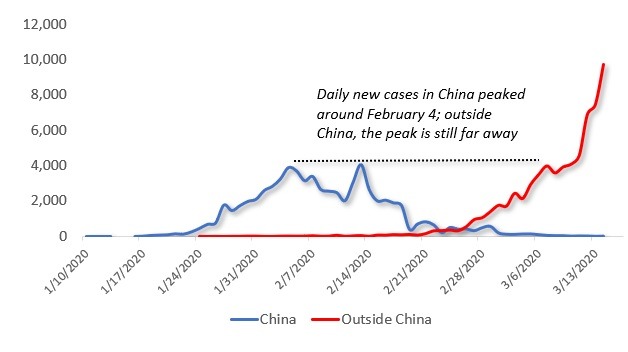
As confirmed cases in China now exceed 80,000, those outside China are climbing closer to that level. In China, the turnaround came about 1 month after the first recorded cases. Outside China, the early cases were first reported after mid-January, but there has been no turnaround. Instead, international escalation is rapidly intensifying (Figure).
FigureDaily new cases in and outside China
Source: WHO, China National Health Commission, Difference Group
Chinese containment
Facing a previously unknown virus, China rolled out what the WHO later called “perhaps the most ambitious, agile and aggressive disease containment effort in history.” Here’s how it worked.
Aggressive containment in three phases
The strategy that underpinned the Chinese containment effort started as a national approach, which pushed hard for universal temperature monitoring, masking, and hand washing. When China initiated the quarantine of tens of millions, it was a drastic measure amid a drastic crisis. But at the time, all alternatives were worse.
As the outbreak evolved, deepened and spread, more knowledge was gained. That’s when China took a science and risk-based approach to tailor the implementation.
Finally, specific containment measures were adjusted to the provincial, county and even community context, the capacity of the setting, and the nature of novel coronavirus transmission there.
Leadership and solidarity
It was the deep commitment of the Chinese people to collective action, which was devised and implemented by the Chinese leaders, that made possible broad containment and its enforcement – but not just at the national level.
Critically, remarkable solidarity was achieved in provinces and cities in support of the most vulnerable populations and communities. Effective at national, provincial and municipal levels, it was a lesson about the power of collective solidarity and multi-level governance cooperation, as opposed to disunity and friction.
What impressed many international observers who visited China at the time was the simple fact that, despite ongoing outbreaks in their own areas, Chinese governors and mayors continued to send thousands of health care workers and tons of vital personal protection equipment supplies into Wuhan, the epicenter of the crisis, and its surrounding province Hubei. In the battle against the coronavirus, we are only as strong as our weakest links.
Resolute determination
It wasthis bold approach to contain the rapid spread of the novel respiratory pathogen that changed the course of the rapidly escalating epidemic. What seemed to be a crushing plague-like disaster that would first spread through Hubei across China, then through Asia and the rest of the world was subdued in weeks.
As WHO’s executives like to point out, when their mission first arrived in China, there were almost 2,500 newly confirmed cases daily. Two weeks later, when they left, the number of new cases had shrunk to barely 400 – to less than a fifth.
Here’s why it’s so impressive: Outside China, the number of daily new cases was also about 2,500 by March 3. Today, that figure is not falling but soaring – and almost four times higher.
So, that’s the Chinese approach in a nutshell: Try to contain the crisis aggressively in phases. Foster leadership, bolster solidarity. Act decisively and with determination.
It sounds easy but it’s not. And no approach is devoid of mistakes; but what really matters is how quickly one can learn from those mistakes.
People before GDP
When Italy on March 9 imposed a national quarantine over some 60 million people, it has the potential to delay the spread and reduce the number of the infected in Italy and Europe, and internationally. If that costly decision had not been made, the repercussions would have been disastrous to Italy, Europe and the world.
It was also a lesson from China. When Beijing imposed the cordon sanitaire around Wuhan and neighboring municipalities on January 23, 2020, it was criticized in much of the West as a reflection of “Beijing’s autocratic measures” that would not help but could make the crisis a lot worse.
In reality, the quarantine and all the accompanying measures dramatically delayed and reduced further exportation of the coronavirus to elsewhere in the country, regional proximity and worldwide. That’s why the Chinese blueprint is now adapted elsewhere, when alternatives are few and rare.
Every country can learn from the Chinese experience, but all must also adjust those lessons to local conditions. Not every country is in a comparable situation, but no country can any longer avert a virus impact.
In China, economic development is seen as critical to the country’s future. But ultimately, Chinese leaders are not accountable to cold GDP figures. People come first.
It is thanks to that mindset that China is now busy getting back to business, working to bolster the economy with accommodative monetary and fiscal policies, while reopeningschools and trying to contain the remaining chains of transmission. As the populous country is moving from containment to the mitigation stage, the real challenge will be to contain new imported cases in the borders, while quickly extinguishing any potential new virus cluster at home.
There are no miracle cures against dangerous viruses. But some lessons are better than others. This is neither the first nor the last global pandemic. We can’t afford to learn too slowly.
About the Author:
Dr. Dan Steinbock is an internationally recognized strategist of the multipolar world and the founder of Difference Group. He has served at the India, China and America Institute (USA), Shanghai Institutes for International Studies (China) and the EU Center (Singapore). For more, see https://www.differencegroup.net
By TheTechnicalTraders – This is one of those articles that are packed with resources showing your what to expect for various assets both long-term and short-term and will guide you through these volatile times and this year.
Our friends and followers continue to contact us asking what to expect and what should they be doing with their assets and trades? Our research and analysis have been very clear up to this point; we warned of a Zombie Rally in early November and early December 2019, we warned that Oil would fall below $40 on November 15, 2019, and we warned of a global Black Swan event on January 26, 2020.
All of this research, in addition to our other research, was very clear that we believed the upside price rally that began in September/October 2019 was a “Zombie-like” price advance that didn’t have a supporting fundamental or technical foundation. We were warning clients and followers to use this advance as a means to move away from risk and into more of a cash position – in preparation for a future event that we believed was setting up. One of the clearest examples of our research team attempting to prepare our followers for what we expected in early 2020 was this post.
On Friday I was on TV “live from NASDAQ with TD Ameritrade” talking about the technical breakdown on the charts and what to expect here
S&P 500 Topping Chart Pattern
This article highlighted our belief that a major topping pattern was set up and that this same price pattern happened just before other major peaks in the US stock market. The Stealth, Awareness, and Mania Phases seemed to be in place – the only thing left was the Blow Off Phase.
This article, today, is going to attempt to share some additional research data developed by our team to help you better understand the potential future outcome of this unfolding event. As with anything we share related to making future price predictions or analysis, this is all based on our research team’s understanding of various global economic fundamentals and expectations related to capital functions throughout the global economic environment.
Be sure to opt-in to our free market trend signals before closing this page, so you don’t miss our next special report!
Let’s get started…
FED Fund Rate & Expectations
First, we want to share with you our modeling of the US economy and the Fed Funds Rate Optimal Levels which will assist all of us in understanding the future expectations and actions by the US Fed related to future economic modeling. This chart, created by our research team in early 2018, attempts to model the optimal US Fed Funds Rate (FFR) levels based on a decline in population and GDP while US Deficits also decline moderately after 2020 – in other words, more of the same type of global economic functions.
If the Covid-19 virus pushes the GDP lower while government expenses increase and consumer spending/activity decreases, we believe this model is most likely a proper representation of what to expect by the US Fed going forward. As you can see, this modeling system draws an expected FFR level in BLUE, a high variance level in PINK and a low variance level in GREY/TURQUOISE. After the near-zero rates after the 2008-09 credit crisis, our model expected the Fed to begin raising rates in 2013 and for rates to peak near 2017. We believe the US Fed was behind the curve in their actions to adjust the FFR levels throughout most of the past 8+ years. Although, The US Fed has positioned current rates very near to where our predictive modeling system expects for 2020; between 1.25~1.50%.
The future of this model suggests the US Fed will normalize rates near 1.0% as early as 2022 or 2023 and keep rates near 1.0% until sometime near 2027 or so. This model suggests a substantial advance in the US stock market may take place sometime between 2022 and 2028 – before it appears the US Fed will have to address another type of crisis event in near late 2028, or 2029, or early 2030.
How this chart plays into the current Covid-19 expectations is simple, the US Fed will have to attempt to lower rates while stimulating the US and global economies in conjunction with other Central Banks. This modeling system does not take into consideration a pandemic event or other type of Black Swan event. It does take into consideration modeled optimal levels based on a decrease in population, a decrease in GDP and an increase in US Deficits.
Concluding Thoughts:
The point of this article is to share some of our data and our future expectations with you, our friends and followers. As we continue to post additional sections/parts of this article, we’ll dig deeper into our research and forward expectations. Remember, we’ve just highlighted two charts that show potential global economic expectations well into and past 2030. We’ve also shared some predictive modeling that suggests a period between 2021~22 and 2027 should be relatively calm and trendy (likely Bullish) for the US markets. Keep this in mind as we continue our future article posts.
The type of market condition I think we have entered could be here for a while, a year or three, and it’s going to be a traders market, which means you must have a trading strategy, plan your trades, and trade your plan. It’s amazing how simple a few trading rules are written down on paper can save you thousands of dollars a year from locking in gains, or cutting losses. I have this mini trading strategy mastery course if you want to take control of your trades and override your emotional issues. It’s easy to hold winners until they turn into losers, taking to large of a position, or maybe you have masted the art of buying high and selling low repeatedly? Yikes! It happens to most traders, and it can easily be overcome with a logical game plan I cover in the crash course, pun intended ?
In short, if you have lost money with your trading account this year, holding some big losing trades that were big winners just a couple of weeks ago, I think it’s worth joining my trading newsletter so you can stay on top of the markets. I take the loud, emotional, and complex market and deliver simple common sense commentary and a couple of winning trades each month.
My trading is nothing extreme or crazy exciting because I’m not an adrenaline trading junky. I only want to grow my entire portfolio 2-4% a month with a couple of conservative ETF trades. Making 22%-48% return on my capital every year without the stress of being caught up in this type of market, feeling like I always need to be in a trad, and knowing I have a proven bear market trading strategy incase this market continues to fall is crucial for capital preservation, and my health.
As a technical analysis and trader since 1997, I have been through a few bull/bear market cycles. I believe I have a good pulse on the market and timing key turning points for short-term swing traders.
Visit my ETF Wealth Building Newsletter and if you like what I offer, and ride my coattails as I navigate these financial markets and build wealth while others lose nearly everything they own during the next financial crisis.
Welcome to this week’s Market Wrap Podcast, I’m Mike Gleason.
Coming up David Morgan of The Morgan Report joins me to breakdown the madness in the markets, tells us why he believes this is 2008 part 2 in the financial markets and also addresses the major frustration over silver and when he thinks it will start acting like a safe haven and start to play catch-up versus gold. So, don’t miss a tremendous interview with the market insider who has decades worth of market experience, the man they call the Silver Guru – David Morgan – coming up after this week’s market update.
As cancellations, emergency restrictions, and panic selling of assets spreads, the global economy is at risk of grinding to a halt. We are already in the throes of the worst market mayhem since 2008.
If the news on the coronavirus front gets any worse from here, we will be facing a once in a century financial crisis – and a possible Great Depression ahead.
That said, there are at least some reasons to be hopeful. The number of coronavirus cases in China and Korea appears to have plateaued. Warmer weather in the weeks ahead and more aggressive containment strategies may begin to inhibit the spread of the deadly infection in the U.S. and Europe.
But public officials so far are failing to inspire confidence. German Chancellor Angela Merkel shocked the markets when she said up to 70% of the German population could contract coronavirus if more isn’t done to stop its spread.
And the stock market tanked immediately after President Donald Trump spoke to the nation Wednesday evening.
Meanwhile, the response from central bankers and the Plunge Protection Team has so far been woefully ineffective. The Fed’s emergency rate cut last week and its $500 billion expansion of bond purchases announced Thursday have done little to stem trillions of dollars in market liquidations as circuit breakers on stock exchanges get blown out.
The tools central bankers have at their disposal aren’t suited to the problem at hand.
The Fed can address liquidity and solvency problems in the bond market and banking system. But it can’t get consumers, workers, and businesses in the real economy to return to their normal activities. Government officials wouldn’t allow a return to normalcy at this time, anyway.
President Trump is contemplating invoking temporary new emergency powers. And globalists are eyeing permanent new power grabs to restrict our personal travel and financial freedoms.
The World Health Organization is exploiting the coronavirus crisis as an opportunity to promote cashless technology. The WHO says paper cash may be spreading the virus and recommends people use digital payments instead.
One of the virtues of silver-based money, by the way, is silver’s antimicrobial properties. Viruses and bacteria that thrive on the surface of paper Federal Reserve notes are naturally repelled by silver coins.
But the threat of the Wuhan virus spreading through common currency is likely to accelerate the war on cash. That’s what trends forecaster and frequent Money Metals Podcast guest Gerald Celente warned about in a video presentation earlier this week.
Gerald Celente: No paper money. You’re going to spread them germs. We got digital dough for you. You think things are bad and the market’s going way down, economy’s crashing? Martial law, digital currency, and for me, I don’t give financial advice. My gold forecasts, match them, anybody, anywhere in the world. You said the gold bull run began in June of 2019, June 6th, and that gold bull is going to keep on running, as I see it. But you know. Think for yourself.
Although gold prices got pulled down on Thursday in the brutal wave of selling that hit Wall Street, the money metal this week is once again holding up much better than the stock market, commodities, and cryptocurrencies – believe it or not.
As the Dow Jones plunged 10% yesterday alone – its worst day since the 1987 crash – Bitcoin crashed 26%. Gold suffered only a 3% drop, although it dropping further here today.
For the week, gold prices are down 9% to trade at $1,525 per ounce. Meanwhile, silver is getting obliterating and shows a 15.5% weekly loss to come in at $14.75 an ounce as of this Friday afternoon recording.
Turning to the PGMs, platinum, is taking a similar pounding as silver, and is off by 15.8% this week to trade at $766. And finally, the once high-flying palladium market is crash landing – down 31% on the week – to bring spot prices to $1,790.
Another week like this in asset markets, and a true deflationary spiral could take hold, with a wave of corporate defaults and bankruptcies coming seemingly out of nowhere.
By this time next week, it’s even possible the stock market and banking system will be shut down – and some form of martial law imposed as you just heard Gerald Celente forecast.
The good news is that while deflation scares tend to be sudden and severe, they are ultimately short-lived. Deflation will never be allowed to persist for long while our inflationary fiat monetary system remains in place.
The old adage, “Don’t fight the Fed” is worth heeding.
The last deflation scare in 2008 led to Zero Interest Rate Policy, Quantitative Easing, and unprecedented Fed balance sheet expansion. The Fed is set to do all that and more this time around – possibly even buying up shares in U.S. companies and monetizing Americans’ tax bills.
The current turmoil in markets – and the central bank response – will create generational buying opportunities in beaten-down assets.
Those who hold gold and cash will be the real winners because their purchasing power is dramatically increasing versus virtually everything else now on the chopping block.
While Wall Street cheerleaders will scream about buying opportunities in U.S. stocks as they do on every down day, the greatest buying opportunities may be in overlooked markets such as silver.
On Thursday, the white metal fell to a historically low discount versus gold as the gold:silver ratio spiked to 100:1 – just as we suggested it might in last week’s podcast.
This extreme reading reflects just how stretched the deflation trade has now become. While gold is often thought of as an inflation hedge, it is actually better viewed as a crisis hedge. Once the crisis fades and markets reinflate, other hard assets can be expected to begin vastly outperforming gold.
At some point – and it could be any day now – the deflation/inflation dynamic will swing violently in the opposite direction. And when it does, silver is likely to be a prime beneficiary. Once a new bull market in silver and other inflation-correlated assets gets going, it can run for years.
So as painful as the past month has been for investors, it sets the stage for the next great inflationary mega trend that will last for many, many months to come.
Well now, without further delay, let’s get right to this week’s exclusive interview.
Mike Gleason: It is my privilege now to welcome back our good friend David Morgan of The Morgan Report. David, it’s always great to have you on and appreciate the time as always. How are you sir?
David Morgan: Well, Mike, I am doing well personally and the markets aren’t, but I’m hanging in there and thanks for having me on the show.
Mike Gleason: Yeah, definitely overdue, and great to have you back. Well David, we are seeing tremendous volatility in markets. The coronavirus is getting the blame for a huge sell off in stocks and in epic rally and bond prices. Commodities, oil in particular, are getting hammered. Maybe the only thing predictable about the recent market action is the Fed’s response. They did another emergency 50 basis point cuts and a lot of people expect them to cut another 50 basis points when the FOMC meets later this month. What is your take on the turmoil, David? Is this a short lived phenomenon and will markets recover as soon as the fear around the virus dissipates? Or we looking at the start of something more serious and maybe the bubble and equities is finally been popped?
David Morgan: Well, I think from a longer term perspective, it is 2008 part two. Really, the fact is after the financial crisis of 2008 where these bank stopped trusting each other and money actually stopped flowing, the Fed, right or wrong, came in and immediately exchanged this worthless or toxic subprime mortgages that the banks didn’t want anything to do with and stop trading with each other and replaced it with basically treasury bills, which is the sacrosanct debt that anyone would ever want, right. So it basically kept us from having, basically a total meltdown. Obviously it was a pretty big meltdown. Well, from that time until this, it’s basically been Quantitative Easing, one, two, three, four. It’s been Operation Twist. It’s been buying the long end of the yield curve. It’s been pumping money into the elite so they can buy Baptist stock and, and lower the floats so that the price goes up and the CEOs get big bonuses.
But the systemic problem in the underlying financial system really has not been addressed. So, now we have more debt than we had before. We have probably more bad paper if you factor in, not subprime, but you look at student loans, you look at pension fund problems, you look at interest rate swaps, you look at the derivatives market and you look at the over-leverage in the stock market. We’re probably set up for a bigger fall than we were in 2008 and that’s the truth. So, I look at the long-term is 2008 part two.
From a short-term perspective, if we do get some kind of resolution on this virus situation, yeah, there’ll be a relief rally. From a Fibonacci perspective, let’s say the market ends up down 10,000 from top to where this virus situation subsides, and then it takes back and moves up 5,000 or one half retracement. That could be a fairly likely scenario but it hasn’t fixed the systemic problem I just outlined, which means that you’re probably going to get a further sell off after that relief rally and continue down.
What most people don’t even realize is where we are in the United States stock market. Let me elaborate a little bit Mike. So, most markets go from undervalued to fair value to overvalued or from overvalued to fair value to undervalued. And it has that cycle over a long period of time. When we had the 2008 sell off in the stock market and I think the Dow got down to what, I forget the number 5,000 or something. What I do know is at that level stocks were fair valued. They weren’t undervalued. They were fair valued right there. So, if we take whatever the inflation rate was from there until now and put a fair market value on the S&P 500 or the Dow or both, we’ve got a long ways down before we’re fair valued again. We’re still over-valued. So, that’s my take on the stock market, Mike.
Mike Gleason: Well, it does seem like stocks were priced for absolute perfection for a number of years here and now we don’t have perfection. We have an economic situation that’s taken place because of the coronavirus and maybe that’s the straw that sort of broke the camel’s back. Obviously we got a lot of algorithms trading and these high frequency trading outfits and machines and so forth and it can kind of get bad as everybody runs for the exits at the same time. It sort of builds on itself, doesn’t it?
David Morgan: Yes it does. And there’s tangents that come off of it too. I mean you’ve got the overall market, then you’ve got to have the gold market intersect it. What does the oil mean to the overall financial system? And I mean on and on it goes Mike. So we are in my favorite expression, I said a hundred times, interesting times.
Mike Gleason: Yeah, we certainly are. Well switching the focus to metals. Gold in particular has done fine. Obviously silver has been sold along with stocks and commodities. Do you think we will see more futures market selling or will metals start to get a bid perhaps because speculators anticipate some safe haven demand and start buying futures or because the Fed is pulling out all the stops on stimulus… or both? The U.S. Dollar is not looking too good here. It’s been falling in currency markets despite the turmoil. Let’s get your thoughts here on metals and how they’re reacting to things.
David Morgan: Sure. Well gold is doing its job. Gold came off of bottom of December, 2015 and it’s up from that level and it’s worked through the $1,350 levels. Finally made a six-year high, hit the $1,550 level, which is resistance. Worked through that, we’re up at $1,700 gold in U.S. terms in the aftermarket, just a few trading sessions ago. So gold is responding, gold itself, not gold stocks. And sure it goes up and it was down, what, 60 bucks in one trading session a Friday, a week and a half ago or whatever. And then by the next Friday, it had taken back that $60 it had lost. So, these are very volatile markets in gold, especially gold equities are about the highest beta stocks, meaning beta ladies and gentlemen just means how volatile are given set of stocks. What do they do? And the gold stocks are notorious for big moves up and down.
So anyway, gold, I think doing quite well and it’s signaling us that there are more people coming in the gold markets seeking a safe haven and gold is the answer for right now. Silver on the other hand has gone to the hundred to one ratio, which it’s only done a couple of times previously and that has signaled the financial crisis in the past. So obviously I’m believing it’s signaling the financial crisis, which we’re probably in right now. So it’s done this job there. As gold becomes more and more of a safe haven and there’s more price pressure in gold and the gold stocks start to recover, I think you will see some people starting to move into the silver market. I mean this gentleman, Scott Minerd from Guggenheim, who’s their main investment advisor authority or the chief investment, I guess, officer, I don’t know if there’s such a term.
He was asked at Davos by some financial news reporters from Bloomberg, what was his go to trade for 2020 and he said silver. And a Bloomberg gentleman kind of rocked him on his heels a bit, said “Silver, why not gold?” And Mr. Minerd said, because gold is pretty near it’s a nominal high, but silver is about 65% off. And silver is an undervalued asset. That’s pretty close to what he said. And then the reporter went on to ask him, he said, do you think that, he didn’t say silver, but do you think the metals could perform like the non-precious metals have recently? What he meant by that was could gold and silver perform like palladium even though in my view he stated, it was well understood what meant. He was saying these other two metals, can they perform like palladium? And Scott said, I think there’s a high likelihood of that.
So, there’s a guy that’s managing a lot of money because I looked it up. In fact, I wrote about it in The Morgan Report two months ago. The amount of money that if they devoted to the silver market could certainly have a huge impact on the paper price if silver.
I’m going to digress a bit further Mike if you don’t mind. But when we look back in history, when (Warren) Buffet bought in 1999, he bought a hundred, almost 130 million ounces of physical silver and it took the market up from about five to by eight and a half, which didn’t double it, but moved it quite a bit. And when he reported that year, I got the Berkshire Hathaway annual statement because it’s part of my job to report on the silver market and the word silver never showed up. Are you kidding me David? David Morgan, silver didn’t show up and the Berkshire Hathaway and he bought 130 million ounces of silver, about 25% of the supply. Are you kidding?
And the answer is, I’m not kidding at all because by law, if you are a company like Berkshire Hathaway, well you’re an investment company basically. You only have to list out in detail anything that’s greater than 2% of your asset holdings. And since that amount of silver was less than 2% of what Berkshire held, they just said they made a miscellaneous purchase and that miscellaneous purchase happened to be 130 million ounces of silver. So, I think that gives some people an appreciation for how small the silver market is and there’s somebody as smart as Scott Minerd and he is. I could go on and on… let me just say this. When I hear his interview, I go, well that guy thinks just like me. So either we’re both smart or maybe we’re both missing something. I’ll say it that way, but very interesting.
So, I circled into gold. Gold is doing its job. Silver is lagging. Silver will come back. Silver is a precious metal. Silver is acting like it’s only an industrial metal or a base metal. It’s doing absolutely nothing, disappointing everyone. It’s been there before. It’s done that before. I’m just so old, I know that from my own experience. But it will come back as a safe haven asset again and as a precious metal. And it’s a spike. I mean these hundred to one ratios usually don’t last 10 years. They’re a momentary thing on a chart. It might be a month, might be two, I don’t know. It could more likely going to be about a month and a half or so. But we’ll see. But normally it’ll last long. So we’ll see silver start to outperform gold and go from a hundred to one and 90 to one, 80 to one, 70 to one and we’ll what happens. But it’s tough. It’s tough on silver holders. I know that, I’m one of them.
Mike Gleason: Yeah, 30 to one, we saw that or 32 to one, right in that ballpark less than a decade ago there in 2011. So those days are not too long ago and certainly could happen again if silver does outperform eventually you have to think it well. Well speaking of silver, David, man it has such amazing uses when it comes to antibacterial and antiviral applications. A pretty important metal at a time like this isn’t it?
David Morgan: Well, it is. If you don’t mind me saying it Mike, there is a way to take a look at that. If you go to TheMorganReport.com/silverwater. If you do that you will find an interview I did years ago in Salt Lake City with two doctors. You see the interview and you can make up your own mind what you want to think about silver’s properties, but it was a pretty interesting interview and I saved it basically for those that are interested in a structured silver water and what these doctors have to say about it.
Mike Gleason: My wife has been breaking out the colloidal silver here of late as we try to sanitize things and obviously just sort of practice good hygiene, especially at a time like this.
David Morgan: Let me interrupt you there, sorry. But there is pretty, I think it’s a legitimate report that the Chinese in some areas were taking one of these spray canned things and it was basically a company from the United States that produces this the silver water that is a biocide. Silver is a biocide. That’s a fact people. And they were using it as a spray down mechanism to basically sterilize the areas for this virus situation. So, maybe there’ll be more of that in the future. I don’t know. But I thought it was pretty interesting that even the mainstream news mentioned it, that it was being used. And I’ve said for years, if you really want to keep the public health at a better level, you would use nano silver. We’re not talking an ounce of silver and a doorknob.
We’re talking just pennies worth the silver, but you need to do every doorknob at every public facility, every airport, every school, every church, every corporate building, every government building and everything else, it would add up. And you can use copper, copper is pretty good. But silver obviously is the best. Is that going to happen? I doubt it. But the point I’m making is that it’s that important if you want to keep bacteria at bay. And the higher end Japanese cars put silver in their steering wheels. So, when you’re holding on to the steering wheel, you’re basically, no matter what’s on your hands, you’re not going to carry any germs.
Mike Gleason: Yeah, pretty interesting and amazing uses in silver for sure. Well, switching gears here a little bit, David, politically, you got to think the potential economic meltdown here could put Trump at risk, seems like things a couple months ago, looked like Trump was a certainty and was very safe for November. But maybe now he could be falling victim to an economy spiraling out of control, which seems like maybe the only thing that could derail his re-election bid. Any thoughts there?
David Morgan: No, I agree. I don’t really have much to add, Mike. I think you hit the nail on the head. I mean every election is pretty economically dependent. The old Clinton (line) who I’m not a big fan of, but he was president for two terms. It’s the economy stupid. I mean it carries a lot of weight with a lot of people and you said it. I mean it’s possible that things, if the economy gets “destroyed”, I don’t want to be too panicky here, talk in hyperbole. But it is a concern and it could be enough of a concern and people say, next, let’s vote in who knows? I wouldn’t even say it because I am equally distrustful the whole political class. But regardless, someone’s going to fill that vacancy or Trump will get reelected. We’ll just have to wait and see. But you make a great point.
Mike Gleason: Yeah, it’s going to be very interesting to see how that develops throughout the rest of the year and what kind of blame, I guess he takes. He has taken ownership of the stock market in the past and that could end up being to his detriment. Maybe we’ll find out. Well as we begin to wrap up here, David, any parting words for folks here today as we are looking at some serious tumult in the markets and in society as a whole? Any comments to share with us as we close?
David Morgan: Yeah, one I think is stay calm, don’t panic. The human species is quite adaptable and we’ve survived almost everything. But I want to move on to a different topic and that is this, I’ve been getting more and more correspondence communications with people that are worried about the next bale in and you cannot basically go to your friendly local banker and say, hey, “I’ve got 100,000 in my bank account and I’d like to cash it out.” They’ll tell you to stand in line, sign a form, take a thumbprint, get three photos, and you could get $5,000 and you got to wait a week for that to happen. So if you really want to move some of your savings out of the bank and into your own hands, the best way to do it is to invest in precious metals.
And I obviously favor silver and have for some time, but of a hundred to one ratio, I wouldn’t say go all in on silver. I think you should own both. And I said that basically from the beginning. However, it’s a good way to cash out pretty quickly. Just find a trusted dealer like you have there, Mike. I’ve known you and your brother for quite some time and I’ve never heard of one complaint. I’m sure there’s always a disgruntled somebody somewhere for something. But regardless, it’s one of the best and I don’t recommend very many as you know. So I would say if you’re out there listening and you’re worried about having too much cash reserves in your bank and you think this next bail out, which is now against the law will be a bail in which is in the law, and you have a lot of cash at risk in a bank, you might consider moving some of that through Mike and Stefan and whoever works there to get this precious metal into your own hands. And if you don’t want to hold it, they have a storage facility right there in Idaho that I visited as it was being built. And I’m not big on storage really, but there are cases where it makes a lot of sense. And that’s one, again, I would vouch for. So Mike, there you go.
Mike Gleason: Well thanks. I didn’t put you up to that, but certainly appreciate the kind words and it means a lot to us coming from you and certainly appreciate it. Well good stuff. It’s always a pleasure. Always love getting your insights and before we let you go of course we got to have you share with the folks about The Morgan Report and how they can get on board with your great service and the information that you put out there and how they can follow you more closely.
David Morgan: Sure. So the easiest things could in our free newsletter list, which is TheMorganReport.com. And then we have a paid service. You can go to the subscribe tab, pull down, watch the video and read. And I’ll just repeat, if you’re interested in a silver biocide properties, just type in TheMorganReport.com/silverwater. And you will see a pretty big set of videos that I did years ago interviewing two doctors that are extremely familiar with what silver solutions can do in the field of biocidal properties that can do everything from like decontaminate your floor, the air or whatever to help situations. So if you’re interested, go for it. If not, then don’t. It’s that simple.
Mike Gleason: Well, thanks again David. All the best to you. Strap on for what is likely going to be a wild ride and we’ll look forward to having you back on here in the not too distant future. And in the meantime we’ll be following the great stuff you’re always putting out there at The Morgan Report. Thanks again for the time and have a great weekend my friend.
David Morgan: You bet you. Take care. Thank you.
Mike Gleason: Well that will do it for this week. Thanks again to David Morgan, publisher of The Morgan Report. To follow David just visit TheMorganReport.com, you can also follow him on Twitter, it’s @silverguru22 and if you haven’t already, grab a copy of his book titled Second Chance: How to Make and Keep Big Money During the Coming Gold and Silver Shock Wave, which is available at MoneyMetals.com and other places where books are sold. Be sure to grab a copy of that today and then check out TheMorganReport.com and start getting his wonderful commentaries that David and his team put out there on an ongoing basis.
And don’t forget to check back here next Friday for our next Weekly Market Wrap Podcast. Until then, this have been Mike Gleason with Money Metals Exchange, thanks for listening and have a great weekend everybody.
The Money Metals News Service provides market news and crisp commentary for investors following the precious metals markets.
The highlights of Wesdome Gold Mines’ 2019 are presented in an iA Securities report.
In a March 11, 2020 research note, iA Securities analyst George Topping reported that Wesdome Gold Mines Ltd. (WDO:TSX) had “another strong year” in 2019.
The analyst reviewed the highlights. Production in 2019 of 91,700 ounces (91.7 Koz) fell in the high end of guidance. Throughput was decreased but made up for by Eagle underground mine gold grades of 28.6 grams per ton (28.6 g/t). For 2020, iA Securities models higher production, of 94 Koz, at lower gold grades, of 18.2 g/t.
As for the exploration and development company’s 2019 financials, Topping noted they were in line. Free cash flow was CA$6.6 million, cash flow per share was CA$0.15 and EBITDA was CA$25.6 million, all as expected. All in sustaining cost (AISC) was US$988 per ounce, also in line with iA Securities’ forecast. Wesdome ended the year with CA$36 million in cash and CA$41.5 million available through its credit facility.
Also noteworthy, Topping wrote, is that New Eagle’s mineral reserve was expanded by 36%. It now stands at 550 Koz at 14.4 g/t gold, which “supports a typical six-year mine life at a 95 Koz per year production rate.” Impressive drill results, particularly from the 303 lens, resulted in this 20% grade boost, he stated.
Topping noted there are two upcoming catalysts for Wesdome. One is drilling at the Kiena project. With the drilling platforms done, drill testing of the up-plunge extension is taking place. The second potential stock moving event is completion of a preliminary economic assessment for Kiena, which is expected in Q2/20.
Topping concluded that with New Eagle and Kiena, “Wesdome will be a 200270 Koz producer at sub-US$1,000 AISC, possibly as soon as three years from restart.”
IA Securities has a Buy rating and a CA$13.40 per share target price on Wesdome Gold, whose stock is trading now at around CA$8.41 per share.
Disclosure: 1) Doresa Banning compiled this article for Streetwise Reports LLC and provides services to Streetwise Reports as an independent contractor. She or members of her household own securities of the following companies mentioned in the article: None. She or members of her household are paid by the following companies mentioned in this article: None. 2) The following companies mentioned in this article are billboard sponsors of Streetwise Reports: None. Click here for important disclosures about sponsor fees. 3) Comments and opinions expressed are those of the specific experts and not of Streetwise Reports or its officers. The information provided above is for informational purposes only and is not a recommendation to buy or sell any security. 4) The article does not constitute investment advice. Each reader is encouraged to consult with his or her individual financial professional and any action a reader takes as a result of information presented here is his or her own responsibility. By opening this page, each reader accepts and agrees to Streetwise Reports’ terms of use and full legal disclaimer. This article is not a solicitation for investment. Streetwise Reports does not render general or specific investment advice and the information on Streetwise Reports should not be considered a recommendation to buy or sell any security. Streetwise Reports does not endorse or recommend the business, products, services or securities of any company mentioned on Streetwise Reports. 5) From time to time, Streetwise Reports LLC and its directors, officers, employees or members of their families, as well as persons interviewed for articles and interviews on the site, may have a long or short position in securities mentioned. Directors, officers, employees or members of their immediate families are prohibited from making purchases and/or sales of those securities in the open market or otherwise from the time of the interview or the decision to write an article until three business days after the publication of the interview or article. The foregoing prohibition does not apply to articles that in substance only restate previously published company releases.
Disclosures from iA Securities, Wesdome Gold Mines Ltd., Research Update, March 11, 2020
Conflicts of Interest: The research analyst and or associates who prepared this report are compensated based upon (among other factors) the overall profitability of iA Securities, which may include the profitability of investment banking and related services. In the normal course of its business, iA Securities may provide financial advisory services for the issuers mentioned in this report. iA Securities may buy from or sell to customers the securities of issuers mentioned in this report on a principal basis.
Analyst’s Certification: Each iA Securities research analyst whose name appears on the front page of this research report hereby certifies that (i) the recommendations and opinions expressed in the research report accurately reflect the research analyst’s personal views about the issuer and securities that are the subject of this report and all other companies and securities mentioned in this report that are covered by such research analyst and (ii) no part of the research analyst’s compensation was, is, or will be directly or indirectly, related to the specific recommendations or views expressed by such research analyst in this report.
Analyst Trading: iA Securities permits analysts to own and trade in the securities and or the derivatives of the issuer under their research coverage, subject to the following restrictions. No trades can be executed in anticipation of coverage for a period of 30 days prior to the issuance of the report and 5 days after the dissemination of the report to our clients. For a change in recommendation, no trading is allowed for a period of 24 hours after the dissemination of such information to our clients. A transaction against an analyst’s recommendation can only be executed for a reason unrelated to the outlook of the stock for the issuer and with the prior approval of the Director of Research and the Chief Compliance Officer.
Company Related Disclosures: Wesdome Gold Mines Ltd.: The analyst has visited the issuers operations. No payment or reimbursement was received from the issuer for the associated travel costs.
Ron Struthers of Struthers’ Resource Stock Report discusses the current market meltdown and the longer-term outlook for the markets and gold.
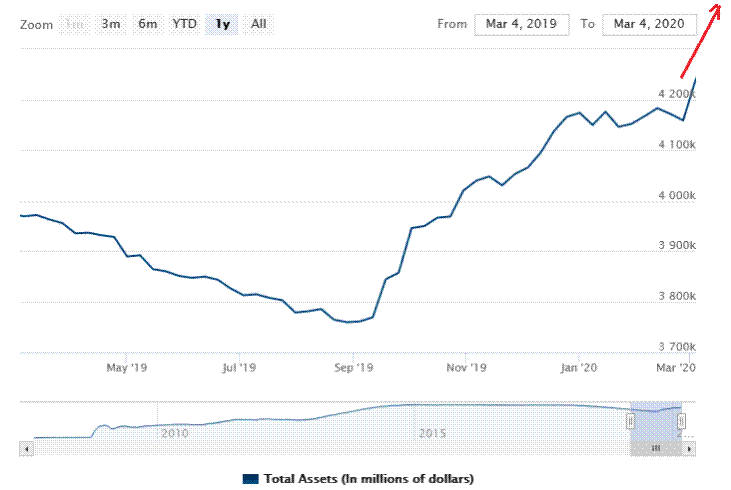
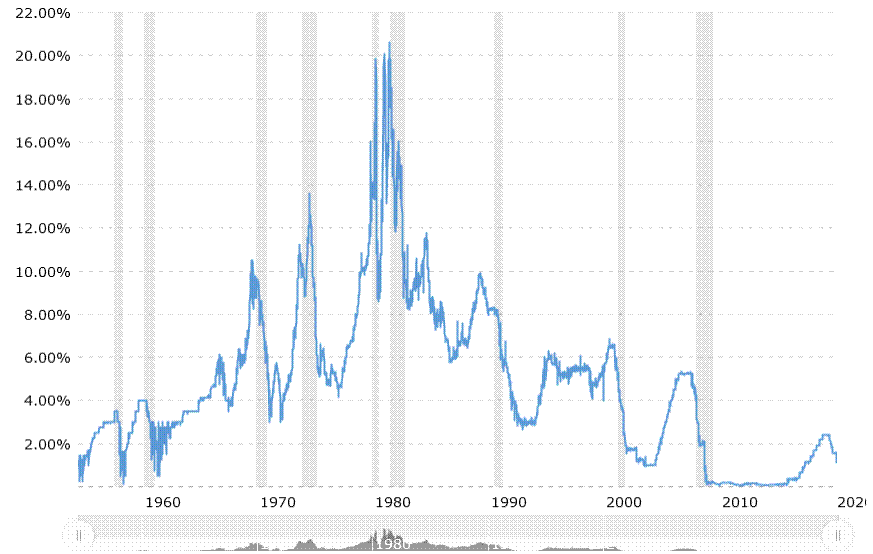
Although I know of some great companies and stocks out there, it is best just to wait. Markets are going a lot lower and investors in the main indexes and techs won’t have a recovery in their portfolios for many, many years. Gold is being sold down too at times but the uptrend is still in place. We can expect a recovery in gold, gold stocks and junior miners this year and then off to new highs in a raging bull market. We will soon have zero interest rates and massive QE. The Fed announced they are pumping up to $175 billion per day in the repo market up from $150 billion. The Fed balance sheet is heading up again and will go at a faster pace now. The red arrow is where it’s headed, off the chart.
This crash will cause some investment bank failures and soon they will implement new rules in stock markets like 2008. I hope the computers melt down and get discarded.
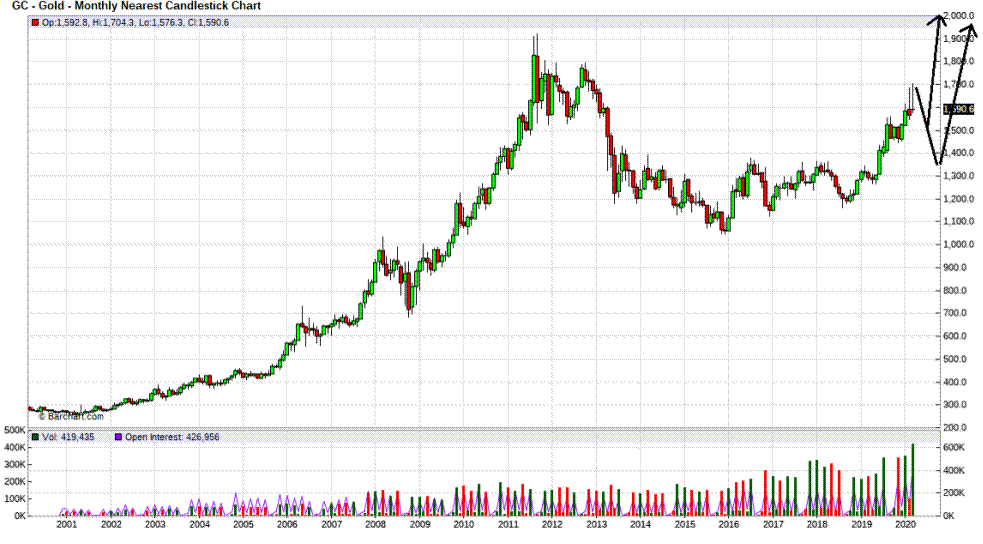
It will be similar to the 2008 crash in some ways. All the liquidity and money creation will debase currencies, so gold and gold stocks will rally like they did in 2008 to 2011. In that period gold ran from $700 to $1,900 over three years. This time after a possible pull back, gold will run to a minimum $4,000 to $5,000/ounce and it could go way higher. I expect this recession will be worse than 2008 and even much harder to recover from. I don’t like to be so pessimistic, but you can get away with it in a bear market. Nobody listens to you until after it happens. I warned about this a month ago. V26 #4.0 Corona Virus, Gold:
Feb 12th– “So far the effects from the coronavirus are being mostly ignored by the markets. There seems to be hope that this virus will be contained or maybe it is denial of economic damage it will, and could cause. …….. The economic impact could be catastrophic. What if markets start to price in the worse. China and the world economies were already slowing ahead of this……………Slowing economies will results in more QE and a quicker move to zero interest rates. U.S. stock markets are frothy at record levels and the balloon is seeking a pin.”
You can be certain fund managers and such are going to put gold back in their portfolios. I am not sure how far a pull back in gold we will get, $1,350 to $1,500 somewhere between the two arrows that will put gold off the chart in the coming years. Just like 2008, gold started to rally about two years ahead of the crisis, from the 2018 low this time.
In simple terms Covid19 will run its course and infect 30% to 70% of the population worldwide. Everything is going to shut down for a while and this will cause a deep recession and a severe bear market. There is no escaping it, there is no denying it. Right now just look after your health and family, Try to obtain essential supplies if stores get shut down. It is already too late for this in a lot of cases as panic has already emptied a lot of shelves. Canned goods and dried goods like pasta, beans and rice will get you by if things go real bad. Don’t worry about face masks and hand sanitize, it will not help much. Keep healthy, eat well, get rest and frequent washing with hot water and soap is all you can really do.
Because we will end up in a bad recession most everything will crash. Real estate is another bubble seeking a pin. I warned about this bubble, last July. I have been anxiously waiting for the RLB Crane Index for year-end 2019, but still not out. All I can find is this article that Toronto will soon pass Chicago as the #2 city with the most skyscrapers..Over half of Toronto condos are owned by investors and they are reliant on travel and tourism for rentals, and you know what’s happening there.
Real estate elsewhere will be negatively affected by the recession and high mortgage leverage. As always with real estate, different locations will suffer less than others. It has been a seller’s market for many years where buyers bid up above asking prices. This will change abruptly to a buyer’s market. The first effect is that people will not even want to go out and look at homes, they will be staying where they are. Those who have to sell will lower prices and then the ball starts rolling down hill.
The last real estate bubble peaked in 2006 and declined into a bottom in 2012. I do not expect this decline to be as bad because lending requirements have been tightened since then, but thelow mortgage rates has inspired high debt levels.
This is an older report from Stats Canada. From 1999 to 2016, mortgage debt represented two-thirds of the overall increase in debt for Canadian families, while consumer debt made up the remainder. In recent years (2012 to 2016), mortgage debt was responsible for 100% of the increase in total debt. More recent, (March 2019) according to Bloomberg – “Household debt in Canada, a nation generally known for moderation, has reached levels that could be qualified as excessive. Canadians owe $2.16 trillionwhich, as a share of gross domestic product, is the highest debt load in the Group of Seven economies. With the housing market cooling, a reckoning may be fast approaching.”
It is a debt party in the U.S. too, according to Reuters– “American households added $193 billion of debt in the fourth quarter, driven by a surge in mortgage loans, and overall debt levels rose to a new record at $14.15 trillion, the Federal Reserve Bank of New York said.” A big problem today is a lack of room for rate reductions. The Fed’s gun is about empty. In 2008 rates were cut from about 5% to near zero. This time it will be from 1.5%, so interest rate reductions will be useless this go around. Ignore the Fed, there is nothing it can do. Going to zero interest rates will do nothing in an economy already over leveraged. More QE keeps the financial system afloat; none of this solves the Covid19.
I follow the Michigan Consumer Index for recession warnings and it is showing no problems yet. This virus thing came on very fast, so it will be interesting to see the March numbers. I expect a big plunge.
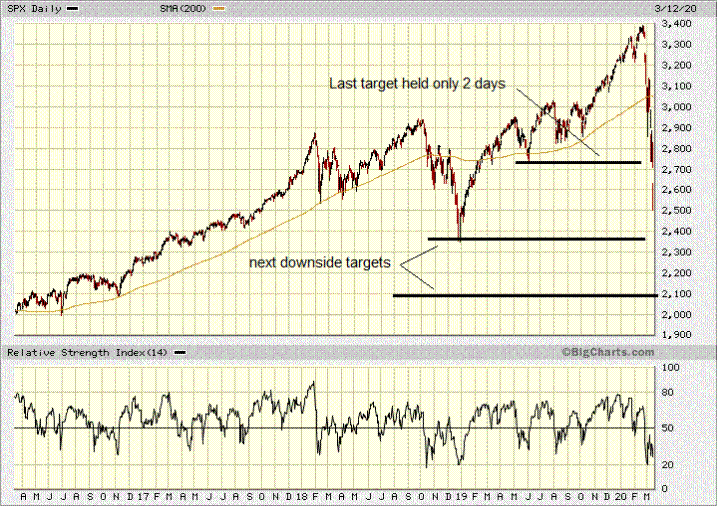
And finally my targets for stock markets as per the S&P index. My update last week when the S&P was still near 3,000 was a downside target just above 2,700. That only held two days. My next down side target is around 2,400 and we might hit that Friday as many traders will not want to be long over the weekend, then maybe a relief rally on Monday. This bear market will go down to at least the 2,100 area which is about a -38% decline. I could easily decline much more, depending on economic damage
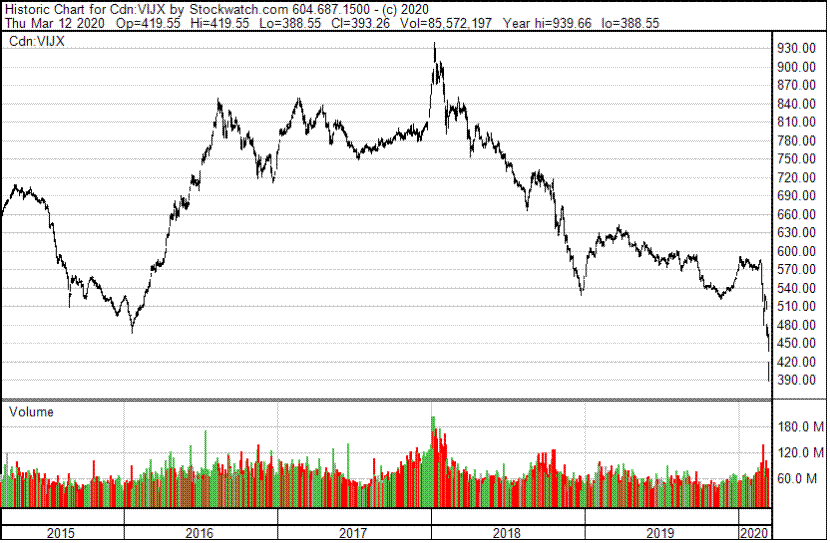
Just one more very ugly chart of the TSX Venture Index. At 388 it is about 100 points below the early 2016 bottom. The index is now down -84% from the 2011 high. This is more than a bear market, it is a broken market. Regulators need to get off their behinds and make changes. There is no way computer trading should be allowed to short nickel and dime stocks.
There is an initiative underway to try and get regulation changes. It is called “Save Canadian Mining.” It is not just about mining companies but all penny stocks in Canada. Check out this short video on youtube.
Ron Struthers founded Struthers’ Resource Stock Report 23 years ago. The report covers senior and junior companies with ample trading liquidity. He started his Millennium Index of dividend stocks in 2003 – $1,000 invested then was worth over $4,000 end of 2014 and the index returned 26.8% in 2016. He retired from IBM after 30 years in customer service, systems and business analyst, also developing his own charting software. He has expertise in junior start-ups and was a co-founder of Paramount Gold and Silver.
Disclosure: 1) Ron Struthers: I, or members of my immediate household or family, own shares of the following companies mentioned in this article: None. I personally am, or members of my immediate household or family are, paid by the following companies mentioned in this article: None. My company currently has a financial relationship with the following companies mentioned in this article: None. Additional disclosures below. I determined which companies would be included in this article based on my research and understanding of the sector. 2) The following companies mentioned in this article are sponsors of Streetwise Reports: None. Click here for important disclosures about sponsor fees. 3) Statements and opinions expressed are the opinions of the author and not of Streetwise Reports or its officers. The author is wholly responsible for the validity of the statements. The author was not paid by Streetwise Reports for this article. Streetwise Reports was not paid by the author to publish or syndicate this article. The information provided above is for informational purposes only and is not a recommendation to buy or sell any security. Streetwise Reports requires contributing authors to disclose any shareholdings in, or economic relationships with, companies that they write about. Streetwise Reports relies upon the authors to accurately provide this information and Streetwise Reports has no means of verifying its accuracy. 4) This article does not constitute investment advice. Each reader is encouraged to consult with his or her individual financial professional and any action a reader takes as a result of information presented here is his or her own responsibility. By opening this page, each reader accepts and agrees to Streetwise Reports’ terms of use and full legal disclaimer. This article is not a solicitation for investment. Streetwise Reports does not render general or specific investment advice and the information on Streetwise Reports should not be considered a recommendation to buy or sell any security. Streetwise Reports does not endorse or recommend the business, products, services or securities of any company mentioned on Streetwise Reports. 5) From time to time, Streetwise Reports LLC and its directors, officers, employees or members of their families, as well as persons interviewed for articles and interviews on the site, may have a long or short position in securities mentioned. Directors, officers, employees or members of their immediate families are prohibited from making purchases and/or sales of those securities in the open market or otherwise from the time of the interview or the decision to write an article until three business days after the publication of the interview or article. The foregoing prohibition does not apply to articles that in substance only restate previously published company releases.
Charts and images provided by the author.
Author’s Disclosures:All forecasts and recommendations are based on opinion. Markets change direction with consensus beliefs, which may change at any time and without notice. The author/publisher of this publication has taken every precaution to provide the most accurate information possible. The information & data were obtained from sources believed to be reliable, but because the information & data source are beyond the author’s control, no representation or guarantee is made that it is complete or accurate. The reader accepts information on the condition that errors or omissions shall not be made the basis for any claim, demand or cause for action. Because of the ever-changing nature of information & statistics the author/publisher strongly encourages the reader to communicate directly with the company and/or with their personal investment adviser to obtain up to date information. Past results are not necessarily indicative of future results. Any statements non-factual in nature constitute only current opinions, which are subject to change. The author/publisher may or may not have a position in the securities and/or options relating thereto, & may make purchases and/or sales of these securities relating thereto from time to time in the open market or otherwise. Neither the information, nor opinions expressed, shall be construed as a solicitation to buy or sell any stock, futures or options contract mentioned herein. The author/publisher of this letter is not a qualified financial adviser & is not acting as such in this publication.
c. Copyright 2020, Struther’s Resource Stock Report
By CentralBankNews.info Canada’s central bank cut its benchmark interest rate for the second time in 10 days as a “proactive measure taken in light of the negative shocks to Canada’s economy from the COVID-19 pandemic and the recent sharp drop in oil prices,” adding it was ready to adjust its monetary policy further if required to support the economy and keep inflation on target. The Bank of Canada (BOC) cut its target for the overnight rate by another 50 basis points to 0.75 percent and has now cut it by a full percentage point following the earlier cut on March 4, the first time it had cut the rate since raising it in October 2018. BOC is the sixth central bank to cut its rate at unscheduled policy meetings since the U.S. Federal Reserve’s surprise cut on March 3. Canada’s rate cut boosts the number of central banks that have cut rates this week to eight, with six banks cutting their rate by 50 basis points and the other two cutting by 100 points. Since Jan. 29, when Sri Lanka’s central bank was the first to refer to the threat from the virus to global growth when it cut its rate, 31 central banks have cut their rates, with BOC the only central bank to cut its rate twice. “It is clear that the spread of the coronavirus is having serious consequences for Canadian families, and for the Canadian economy,” BOC said, adding lower oil prices will weigh heavily on the economy, particularly in energy intensive regions. BOC will update its outlook for the economy at its next scheduled policy meeting on April 15. In January BOC forecast 1.6 percent growth for 2020, unchanged from 2019, and 2.0 percent growth for 2021. In a separate statement, BOC also announced it was planning to launch a Banker’s Acceptance Purchase Facility (BAPF) and starting March 23 it would conduct secondary market purchases of 1-month acceptances. The bankers’ acceptance market is one of Canada’s core funding markets and a key source of funding for small- and medium-sized corporate borrowers. BOC has also taken other steps to ensure liquidity in the financial system, including broadening the scope of its bond buyback program. The first operation will be a C$500 million switch operation in the 30-year sector on March 16 and on March 17 BOC will temporarily add new term repo operations with terms of 6 and 12 months. The operations will take place bi-weekly, with C$4 billion and C$3 billion offered that day for 168 day and 350 day maturities, respectively.
The Bank of Canada released two statements, first the monetary policy decision and then Governor Stephen Poloz’ opening statement to a press conference:
“The Bank of Canada today lowered its target for the overnight rate by 50 basis points to ¾ percent, effective Monday, March 16, 2020. The Bank Rate is correspondingly 1 percent and the deposit rate is ½ percent. This unscheduled rate decision is a proactive measure taken in light of the negative shocks to Canada’s economy arising from the COVID-19 pandemic and the recent sharp drop in oil prices.
It is clear that the spread of the coronavirus is having serious consequences for Canadian families, and for Canada’s economy. In addition, lower prices for oil, even since our last scheduled rate decision on March 4, will weigh heavily on the economy, particularly in energy intensive regions.
The Bank will provide a full update of its outlook for the Canadian and global economies on April 15. As the situation evolves, Governing Council stands ready to adjust monetary policy further if required to support economic growth and keep inflation on target.
The Bank has also taken steps to ensure that the Canadian financial system has sufficient liquidity. These additional measures have been announced in separate notices on the Bank’s website. The Bank is closely monitoring economic and financial conditions, in coordination with other G7 central banks and fiscal authorities.”
—-
“Thank you, Minister. The Bank of Canada is contributing to this collective effort to support the Canadian economy and financial system, and to ensure credit channels remain open.
The Bank is cutting its target for the overnight rate by 50 basis points to ¾ of a percent. It is already clear that the spread of the coronavirus is having serious consequences for Canadian families, and for Canada’s economy.
In addition, Lower prices for oil, even since our last scheduled rate decision on March 4, will weigh heavily on the economy, particularly in energy intensive regions.
Combined with the other measures announced today, lower interest rates will help to support confidence in businesses and households. For example, borrowing costs will be lowered both for new purchases and through variable rate mortgages and mortgage renewals.
Today, the Bank also announced a new Bankers’ Acceptance Purchase Facility. This will support a key funding market for small- and medium-size businesses at a time when they may have increased funding needs and credit conditions are tightening.
The Bank has also taken other steps to ensure that the Canadian financial system has sufficient liquidity. These additional measures have been announced in separate notices on the Bank’s website.
The Bank of Canada is taking concerted action to support the Canadian economy during this period of economic stress. The Bank’s Governing Council stands ready to do what is required to support economic growth and keep inflation on target, and we will continue to ensure that the Canadian financial system has sufficient liquidity.”
The simple answer is no, not by a long shot. But given the media coverage, it can certainly feel like it.
There are a lot of factors conspiring to make this outbreak seem especially bad. For one, it has been quite some time since the world has experienced a major outbreak.
Prior to 1900, it was relatively difficult for diseases to spread as broadly and quickly as they do today.
However, thanks to modern transportation, global pandemics can now develop relatively quickly.
We also have to consider that there are personal, political and monetary interests behind making the COVID-19 outbreak as scary as possible.
The media, vying for views, is apt to present a more worrying narrative. Politicians, on the other hand, see it as an opportunity to increase spending. And, people, in general, can get a lot of attention by sharing the scariest posts on social media.
It’s a Concern, Not the End of the World
The reality is that this is not an exceptionally deadly virus outbreak. In fact, it isn’t even the first coronavirus outbreak, nor the deadliest of the coronavirus outbreaks.
However, precisely because it’s less deadly, it might be more dangerous and harder to control.
The official designation for the current outbreak is COVID-19, but the virus itself is SARS-Cov-2. Sound familiar?
Yep, this is another strain of the SARS (Sudden Acute Respiratory Syndrome) outbreak from 2002-03. That outbreak had a mortality rate of nearly 10% and was contained relatively quickly, with just over 8K people being infected.
Historic Cases
Many have drawn parallels between this outbreak and prior viral pandemics. One that is often referenced is the 1918 “Spanish flu” which ravaged the world at the conclusion of WWI.
About a quarter of the world’s population was infected, with around 50 million deaths.
The Spanish flu actually originated in China, but it’s a completely different virus than the current pandemic: influenza.
Influenza is a seasonal infection that kills around 250,000 people around the world each year. The 1918 pandemic wasn’t an especially deadly virus. However, the lack of hygiene, malnourishment, and the spread of bacteria all contributed to so many people dying.
Wash Your Hands
That last point is one of the leading reasons that we haven’t had a major pandemic in a relatively long time.
Regular hygiene helps prevent the spread of deadly viruses and secondary bacterial infections which might come later.
When thinking of pandemics, some could have the “black” or bubonic plague in mind. However, the cause of the plague was bacterial, not viral. There was also cholera, which has claimed more lives than most viral outbreaks. However, that too is bacterial.
The Worst of the Worst
The viral outbreak that many people don’t think of as one of the worst in history is the smallpox outbreak in the Americas following contact with Europeans.
Estimates range to up to 90% of the population succumbing to the disease and killing well over 100 million people.
Despite the lethality of smallpox, it has been virtually eradicated from the world thanks to vaccination.
This brings us to how we hope to deal with the current pandemic. The idea is to try and contain the spread long enough for a vaccine to be developed.
There are over 100 institutions in the world currently trying to develop a vaccine. When one is finally proven to be effective, that likely will be the definitive end to coronavirus fears.
By Orbex – FX traders that can’t identify candle formations or candlestick patterns, fail to understand price action.
Of course, there are many candles formations and patterns to learn. However, there are only a few that carry as high an accuracy rate as the Cup & Handle pattern does.
The Cup and Handle Pattern is one of the rarest patterns traders can spot. It is also one of the highest probability patterns, and forex traders shouldn’t ignore it!
Just like the name suggests, a completed pattern looks like a cup, with a handle. It is a trend continuation pattern and its formation starts when prices register a fresh high.
The characteristic of its formation and visibility are as follows.
The Cup
Swing high: After price finds a temporary top, it starts to fall sharply in a short amount of time.
Retracement low: The price then retraces lower and forms a fresh bottom, where it’s expected to somewhat stabilize.
Revisiting swing high: After consolidating in a tight range, the price starts to trend back higher. This rally up north more or less mirrors the pace and proportion of the initial decline. However, it’s not necessarily forming a double top. The price ends up reaching at or around the initial peak high prior to the decline.
This whole price movement depicts an easily spotted cup on the charts.
The Handle marking top: After marking the second swing high, price starts to fall to the downside. However, in the handle formation, the range and duration of the drop are limited when compared to the Cup. While falling, it puts in a pattern that resembles the bull flag pattern.
Sloping decline: The downward biased price action should not weaken lower than a third of the Cup’s range. The quicker the bull flag formation is done, the stronger the breakout is likely to be on the upside. In case of price action weakening more than 50% of the Cup’s range, then the accuracy of the C&H pattern wears off.
Ways To Trade The Cup & Handle
There are 2 key ways to trade the Cup & Handle Pattern; aggressively or conservatively.
Aggressive FX traders take positions following an immediate handle breakout, or when the bull flag becomes vividly visible.
There is, of course, a downfall when trading aggressively. Usually, these turn out to be false breaks, so the impending breakout turns out to be just a triple top; a failed attempt to move beyond the top of the C&H pattern.
Conservative forex traders, on the other hand, wait for a valid breakout before entering into a trade. This means the trade should be taken at least following a successful candle close. Of course, there are more conservative traders who would not only wait for a successful candle close but also wait for a retest.
Tips You Should Not Ignore
The largest time frames like the daily or the weekly work best for the C&H pattern. This, of course, is valid for all assets, patterns or formations.
Larger time frames are more fruitful when trading C&H pattern in particular because when identified, the trend can continue for long periods of time. However, this will also depend on the signs of strength the initial breakout registered.
Now, when adding that market observers suggest that the majority of the C&H patterns are formed in the stock markets, you have to allocate a good amount of time ahead in order to look at your charts.