The Analytical Overview of the Main Currency Pairs on 2020.03.16

by JustForex

The EUR/USD currency pair

Technical indicators of the currency pair:
  • Prev Open: 1.11739
  • Open: 1.10831
  • % chg. over the last day: -0.36
  • Day’s range: 1.10849 – 1.11981
  • 52 wk range: 1.0879 – 1.1572

The technical picture on the EUR/USD currency pair is ambiguous. The trading instrument is in sideways movement. Unidirectional trend is not observed. The U.S. Federal Reserve has sharply reduced the key interest rate range to 0-0.25%. Such measures were taken in order to combat the risks due to the coronavirus COVID-19 spread. A number of countries around the world have announced a stricter regime as a means of combating the epidemic. At the moment EUR/USD quotes are consolidating in the range of 1.10700-1.11600. Open positions from these markers.

Today the news background is quite calm. No important economic releases are planned for publication.

EUR/USD

Indicators do not give accurate signals: the price is consolidating near 50 MA.

The MACD histogram is in the negative zone, but above the signal line, which gives a weak signal to sell EUR/USD.

The Stochastic Oscillator is in the neutral zone, the %K line is above the %D line, which indicates a bullish mood.

Trading recommendations
  • Support levels: 1.10700, 1.10000
  • Resistance levels: 1.11600, 1.12200, 1.12800

If the price fixes above 1.11600, EUR/USD quotes are expected to rise. Movement is tending to 1.12200-1.12800.

Alternatively, the EUR/USD currency pair may decline to the round level of 1.10000.

The GBP/USD currency pair

Technical indicators of the currency pair:
  • Prev Open: 1.25656
  • Open: 1.24085
  • % chg. over the last day: -1.02
  • Day’s range: 1.22849 – 1.24212
  • 52 wk range: 1.1959 – 1.3516

GBP/USD quotes continue to show negative dynamics. Sterling reached its six-month low. At the moment the trading instrument is consolidating. The local support and resistance levels are 1.22600 and 1.24250, respectively. The technical correction of GBP/USD currency pair is not excluded in the nearest future. We recommend you to monitor the current information about the COVID-19 virus spread. Open positions from key levels.

The news background on the UK economy is calm.

GBP/USD

The indicators signal the sellers’ strength: the price has fixed below 50 MA and 100 MA.

The MACD histogram is in the negative zone, which indicates a bearish sentiment.

The Stochastic Oscillator is in the neutral zone, the %K line is above the %D line, which indicates that the GBP/USD currency pair might correct.

Trading recommendations
  • Support levels: 1.22600, 1.22000
  • Resistance levels: 1.24250, 1.25100, 1.26400

If the price fixes above 1.24250, expect the quotes to correct toward 1.25500-1.26000.

Alternatively, the quotes could descend toward 1.22000.

The USD/CAD currency pair

Technical indicators of the currency pair:
  • Prev Open: 1.39172
  • Open: 1.37394
  • % chg. over the last day: -0.89
  • Day’s range: 1.37294 – 1.39098
  • 52 wk range: 1.2949 – 1.3566

The USD/CAD currency pair is in sideways movement. There is no defined trend. At the moment local support and resistance levels are at 1.38400 and 1.39500, respectively. The CAD remains under pressure amid aggressive sales in the black gold market. Nevertheless, technical correction of the trading instrument after prolonged growth is not excluded in the nearest future. Open positions from key levels.

The Economic News Feed for 16.03.2020 is calm.

USD/CAD

Indicators do not give accurate signals: the price tests 50 MA and 100 MA.

MACD histogram is near the 0 mark.

The Stochastic Oscillator is located in the overbought zone, the %K line is above the %D line, which gives a weak signal to buy USD/CAD.

Trading recommendations
  • Support levels: 1.38400, 1.37300, 1.36200
  • Resistance levels: 1.39500, 1.40000

If the price fixes above 1.39500, consider buying USD/CAD. The price will move toward 1.40500-1.41000.

Alternatively, the quotes could correct toward 1.37500-1.37000.

The USD/JPY currency pair

Technical indicators of the currency pair:
  • Prev Open: 104.733
  • Open: 107.304
  • % chg. over the last day: +3.13
  • Day’s range: 105.742 – 107.567
  • 52 wk range: 101.19 – 112.41

The USD/JPY currency pair has moved up. The trading instrument reached key extremums. The Bank of Japan kept the interest rate on commercial banks’ deposits at the same level -0.1% per annum. The regulator announced an increase in stimulus measures in response to the spread of the epidemic. At the moment, the Safe Haven currency is consolidating in the range of 106,000-107,400. USD/JPY quotes have potential for further growth. Open positions from key levels.

The Economic News Feed for 16.03.2020 is calm.

USD/JPY

The indicators signal the power of buyers: the price has fixed above 50 MA and 100 MA.

The MACD histogram is in the positive zone, but below the signal line, which gives a weak signal to buy USD/JPY.

The Stochastic Oscillator is in the neutral zone, the %K line is below the %D line, which indicates a bearish mood.

Trading recommendations
  • Support levels: 106.000, 104.500, 103.200
  • Resistance levels: 107.400, 108.400

If the price fixes above 107.400, expect further growth of USD/JPY quotes to 108.400-109.000.

Alternatively, the quotes could decline toward 105.000-104.000.

by JustForex

Fed Urgently Cut Interest Rate

by JustForex

The US dollar strengthened against a basket of major currencies on Friday. The dollar index (#DX) closed in the green zone (+1.33%). However, today the US currency is declining sharply. Yesterday, the US Federal Reserve urgently reduced the base interest rate to zero and announced the launch of a large-scale program of quantitative easing. The regulator lowered the rate to 0-0.25%, announced plans to purchase additional government bonds $500 billion worth and guaranteed mortgage-backed securities of $200 billion. The Fed also called on banks to increase lending from existing reserves. These measures were taken in order to stabilize financial markets and support the US economy.

All are concerned about a flash of coronavirus. A number of countries around the world have announced a stricter regime as methods of combating a pandemic. In many countries, external borders are closed, and a ban on movement between different cities is introduced, except for special needs. Educational institutions, cinemas, theaters, museums, sports facilities, discos, pubs are closing.

China’s economy has shown the worst figures over the past 30 years. Industrial production fell by 13.5% in February, while experts forecasted growth by 1.5%. Fixed investments collapsed by 24.5%. And the unemployment rate rose by 6.2% in China.

The “black gold” prices continued to fall. Currently, futures for the WTI crude oil are testing the $30.45 mark per barrel.

Market indicators

On Friday, shares in the US stock market started to recover: #SPY (+8.55%), #DIA (+9.43%), #QQQ (+8.47%).

The 10-year US government bonds yield fell again. At the moment, the indicator is at the level of 0.77-0.78%.

The news feed on 2020.03.16:
  • Today, the publication of important news is not expected.

by JustForex

EURUSD: Eurobulls use US Fed decision as springboard

By Alpari.com

On Friday, March 13, the euro was down at the close of trading. The price remained within Thursday’s range. The price fall began during the European session and intensified during trading in New York after US President Donald Trump’s speech. He declared a state of emergency in the country in connection with the coronavirus pandemic. Trump promised to allocate a significant amount of funds to help alleviate the strain on affected states.

Investors responded positively to his statements, as they believe that emergency measures will be effective at dealing with the virus. Stock indices rose significantly. At the end of the day, the S&P500 and DJAI index grew by 9.36% and 9.28%, respectively. The yield on 10-year US government bonds rose to 1.019%, up from a record low of 0.36%,

Today’s news (GMT +3):

  • 10:30 Switzerland: Producer and Import Prices (MoM) (Feb).
  • 14:00 Germany: German Buba Monthly Report.
  • 15:30 USA: NY Empire State Manufacturing Index (Mar).
  • 23:00 USA: Net Long-Term TIC Flows (Jan).

1603

Current situation:

The expectations laid out on Friday were fully justified. The EURUSD pair fell to the target of 1.1110.

On Monday, March 16, trading opened with a sharp increase to 1.1199. On March 3, the US Federal Reserve lowered its key interest rate from 1.5-1.75% per annum to 1-1.25% against the backdrop of the developing risks caused by the situation with the coronavirus (COVID-19). On Sunday, March 15, the agency lowered its key rate by 100 bp, to 0-0.25%. The committee plans to maintain the current range until it is sure that the economy has weathered the storm caused by recent events and is on its way to achieving its targets in the fields of employment and price stability. These targets are aimed at maintaining economic activity, developing favourable labour-market conditions and keeping inflation in-check. Once the situation has stabilised, the Fed plans on returning to its 2% target.

For almost four hours, bulls lost almost all of their profit made since the opening. This can be attributed to the fall of Asian stocks amidst the pandemic. Outside of China, the virus is spreading very quickly. In Spain, the armed forces have stepped in to help deal with the coronavirus. They are already patrolling the streets of Valencia, Seville, Zaragoza, Leon, Las Palmas and Santa Cruz de Tenerife. Sanctions for violation of the quarantine regime are very strict.

Disobedience or resistance towards officials, in cases where this does not constitute another crime, in particular, such as refusing to cooperate in identifying or providing false or inaccurate data in the process of identification carries a fine from 600 to 30,000 euros. Malicious disobedience or resistance towards the relevant authorities is punishable by imprisonment of three months to one year.

At the time of writing, the euro is worth 1.1142. On the hourly chart, a reversal formation appeared which points to growth, but its formation may drag on until mid-Tuesday. Since the price is trading below the balance line (Lb) and given the volatility of the situation surrounding the virus, it is assumed that bears will look to defend the 1.1230 level. A compromise for Monday would be the continuation of lateral movement under the Lb in the range of 1.1060 -1.1205. A breakdown of the resistance around the 1.1225-mark will open up the way for bulls to reach 1.1305, however, there is no guarantee this will come to fruition amidst the current situation with the coronavirus.

By Alpari.com

Did the Fed push the panic button to avoid another market meltdown?

By Jameel Ahmad, Global Head of Currency Strategy and Market Research at FXTM, ForexTime

Desperate times call for desperate measures.

For the second time in a matter of weeks and just days before the Federal Reserve were previously scheduled to announce the conclusion of its monetary policy meeting, another emergency US interest rate cut has been announced with the latest one hours prior to international financial markets opening for the new trading week.

One can’t help but wonder whether the Fed made this announcement on a Sunday shortly before international markets commence weekly trading to avoid another market meltdown for investors in stock markets.

Not only has the Federal Reserve thrown all of its tools out of the toolbox to help combat the economic pressures that the coronavirus will bring to the world economy, it has done so by firing all of its guns, grenades as well as bazookas at the problem. it can’t be helped to hold concern following this emergency move from the Fed to question what ammunition does the Fed have left to solve what will be a prolonged problem?

Nations around the world remain in the stage of announcing fresh control measures to prevent the spread of the coronavirus, and with cases still rising at an alarming rate the implications this will have on the world economy will naturally amplify. So investors will still demand more from central banks and world governments.

For this reason I don’t think what the Fed has announced will be enough for investors to buy back into stock markets. Volatility is moving at such an intense speed to coronavirus news that an investor can no longer expect for central bank decisions to remain current by the end of the same day, let alone in a week that has followed the sharpest declines seen in world stock markets since the global financial crisis.

The early aftermath of the Fed announcement suggests a weaker USD with both the EURUSD and GBPUSD advancing by close to 0.5% and just above 1%, respectively at time of writing but with the World Health Organisation announcing that Europe is now the epicenter of the virus these trends in FX remain at risk to living a very short shelf live.

Should central banks continue to announce emergency measures the impact it has on Gold price will be high on the radar of investors, and it should increase the probability of Gold pointing higher after it unexpectedly suffered its worst week since 1983 in the week prior.

Disclaimer: The content in this article comprises personal opinions and should not be construed as containing personal and/or other investment advice and/or an offer of and/or solicitation for any transactions in financial instruments and/or a guarantee and/or prediction of future performance. ForexTime (FXTM), its affiliates, agents, directors, officers or employees do not guarantee the accuracy, validity, timeliness or completeness, of any information or data made available and assume no liability as to any loss arising from any investment based on the same.


Forex-Time-LogoArticle by ForexTime

ForexTime Ltd (FXTM) is an award winning international online forex broker regulated by CySEC 185/12 www.forextime.com

German government brings out the stimulus, but DAX fails to recapture 10,000

By Admiral Markets

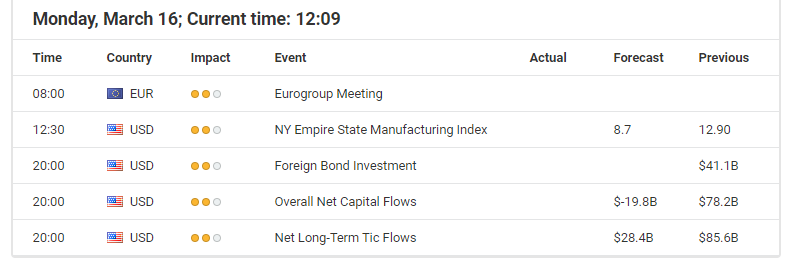
Economic Events

Source: Economic Events March 16, 2020 – Admiral Markets’ Forex Calendar

Last trading week saw massive volatility, starting with “Black Monday” due to both Coronavirus fears and oil prices collapsing due to Russia resisting Saudi Arabia’s push for deeper production cuts at the OPEC meeting in Vienna.

Thursday became a “Black Thursday” of sorts after the monetary stimulus from the ECB went nowhere, and market participants being concerned about US president Trump’s (surprising) travel ban from Europe to the US, resulting in the sharpest equity drop since the ‘real’ Black Monday on October 19, 1987.

As the week approached the close, signs point to a massive monetary stimulus in anticipation of a global economic downturn and recession, governments are also trying to fight Coronavirus induced recession fears.

The German government delivered a bomb by announcing billions of Euro to cushion the economy, with plans to set up a safety net for companies and no limit on credit programs.

As a result, the DAX30 CFD rallied sharply, gaining as much as 9% on the day, but gave back all of its gains in the hours later that day – a very weak sign.

Similar measures from other governments, especially European ones, should probably be expected. Short positions should be taken very cautiously, even though the overall advantage stays on the Short-side.

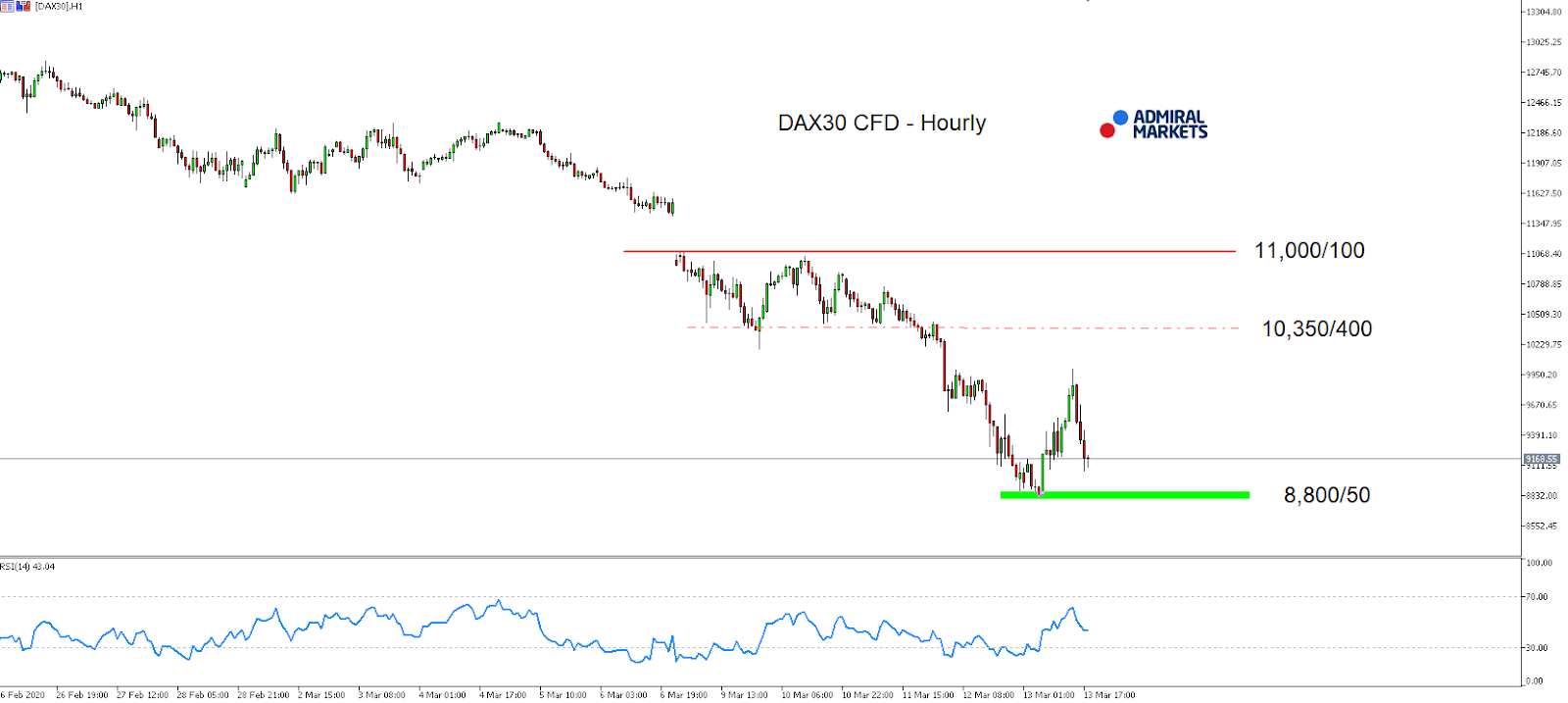
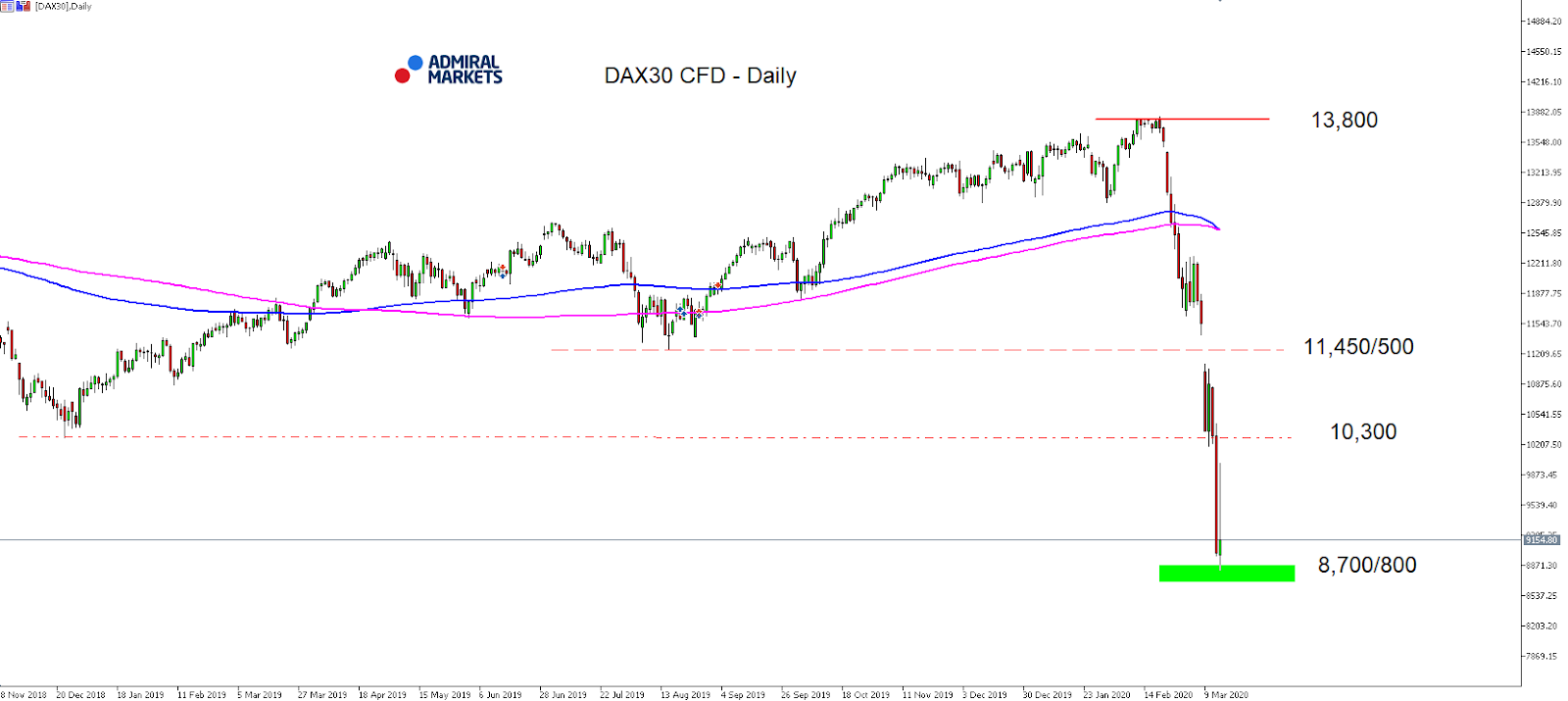
Technically, the Short sequence stays given as long as the DAX30 CFD trades below 11.000 points, drop below 9,000 points is clearly on the table with a potential target being found around 8,700 points, while a potential Short-trigger is technically found around 10,200 points:

MT5-SE Add-on DAX30 CFD Hourly chart

Source: Admiral Markets MT5 with MT5-SE Add-on DAX30 CFD Hourly chart (between February 26, 2020, to March 13, 2020). Accessed: March 13, 2020, at 10:00pm GMT

MT5-SE Add-on DAX30 CFD Daily chart

Source: Admiral Markets MT5 with MT5-SE Add-on DAX30 CFD Daily chart (between November 28, 2018, to March 13, 2020). Accessed: March 13, 2020, at 10:00pm GMT – Please note: Past performance is not a reliable indicator of future results, or future performance.

In 2015, the value of the DAX30 CFD increased by 9.56%, in 2016, it increased by 6.87%, in 2017, it increased by 12.51%, in 2018, it fell by 18.26%, in 2019, it increased by 26.44% meaning that after five years, it was up by 34.2%.

Discover the world’s #1 multi-asset platform

Admiral Markets offers professional traders the ability to trade with a custom, upgraded version of MetaTrader 5, allowing you to experience trading at a significantly higher, more rewarding level. Experience benefits such as the addition of the Market Heat Map, so you can compare various currency pairs to see which ones might be lucrative investments, access real-time trading data, and so much more. Click the banner below to start your FREE download of MT5 Supreme Edition!

Download MetaTrader 5 and begin trading today!

Disclaimer: The given data provides additional information regarding all analysis, estimates, prognosis, forecasts or other similar assessments or information (hereinafter “Analysis”) published on the website of Admiral Markets. Before making any investment decisions please pay close attention to the following:

  1. This is a marketing communication. The analysis is published for informative purposes only and are in no way to be construed as investment advice or recommendation. It has not been prepared in accordance with legal requirements designed to promote the independence of investment research, and that it is not subject to any prohibition on dealing ahead of the dissemination of investment research.
  2. Any investment decision is made by each client alone whereas Admiral Markets shall not be responsible for any loss or damage arising from any such decision, whether or not based on the Analysis.
  3. Each of the Analysis is prepared by an independent analyst (Jens Klatt, Professional Trader and Analyst, hereinafter “Author”) based on the Author’s personal estimations.
  4. To ensure that the interests of the clients would be protected and objectivity of the Analysis would not be damaged Admiral Markets has established relevant internal procedures for prevention and management of conflicts of interest.
  5. Whilst every reasonable effort is taken to ensure that all sources of the Analysis are reliable and that all information is presented, as much as possible, in an understandable, timely, precise and complete manner, Admiral Markets does not guarantee the accuracy or completeness of any information contained within the Analysis. The presented figures refer that refer to any past performance is not a reliable indicator of future results.
  6. The contents of the Analysis should not be construed as an express or implied promise, guarantee or implication by Admiral Markets that the client shall profit from the strategies therein or that losses in connection therewith may or shall be limited.
  7. Any kind of previous or modeled performance of financial instruments indicated within the Publication should not be construed as an express or implied promise, guarantee or implication by Admiral Markets for any future performance. The value of the financial instrument may both increase and decrease and the preservation of the asset value is not guaranteed.
  8. The projections included in the Analysis may be subject to additional fees, taxes or other charges, depending on the subject of the Publication. The price list applicable to the services provided by Admiral Markets is publicly available from the website of Admiral Markets.

Leveraged products (including contracts for difference) are speculative in nature and may result in losses or profit. Before you start trading, you should make sure that you understand all the risks.

By Admiral Markets

Safe havens show limited response to Fed slashing rates to near-zero

By Han Tan, Market Analyst, ForexTime

The Federal Reserve has lowered its rates by a full percentage point to 0 to 0.25 percent, which is the record low last seen in 2015, while also pledging to increase its bond holdings by US$ 700 billion or more. Despite the Fed announcing this latest set of emergency measures to support the US economy from the ill-effects of the coronavirus outbreak, the Dollar index (DXY) showed only a limited decline before paring losses as it rose back above the psychological 98.0 level.

Asian currencies and stocks are currently mixed at the time of writing, while futures on the S&P 500 point fell 5 percent to hit limit-down, which suggests another day of heightened volatility when the US stock market begins trading for the week.

While King Dollar is clearly holding court in global markets amid the heightened risk aversion, other safe haven assets are showing a relatively muted response to the Fed’s emergency moves. Gold rose past the $1560 level before moderating, while the Japanese Yen couldn’t stay on the stronger side of the 106 handle versus the US Dollar for long, as Gold and the JPY could only manage to pare just some of Friday’s losses.

This week has begun with a fluster of global central bankers moving their policy interventions forward, unable to risk waiting any longer given the tremendous impact from Covid-19. The Bank of Japan is set to announce its policy decision in less than an hour from the time of writing, moving its policy meeting a few days earlier, while the Reserve Bank of New Zealand has cut its benchmark interest rates by 75 basis points and mooted the possibility of quantitative easing being rolled out in New Zealand. Still, global investors remain skeptical at this point in time over the effectiveness of such supportive policies in the face of great uncertainty stemming from the coronavirus outbreak, which should lend itself towards heightened volatility in global financial markets over the near-term.

Disclaimer: The content in this article comprises personal opinions and should not be construed as containing personal and/or other investment advice and/or an offer of and/or solicitation for any transactions in financial instruments and/or a guarantee and/or prediction of future performance. ForexTime (FXTM), its affiliates, agents, directors, officers or employees do not guarantee the accuracy, validity, timeliness or completeness, of any information or data made available and assume no liability as to any loss arising from any investment based on the same.


Forex-Time-LogoArticle by ForexTime

ForexTime Ltd (FXTM) is an award winning international online forex broker regulated by CySEC 185/12 www.forextime.com

Futures stumble after Fed slashes interest rate to 0%

By IFCMarkets

US stocks bounced back while Trump declares emergency

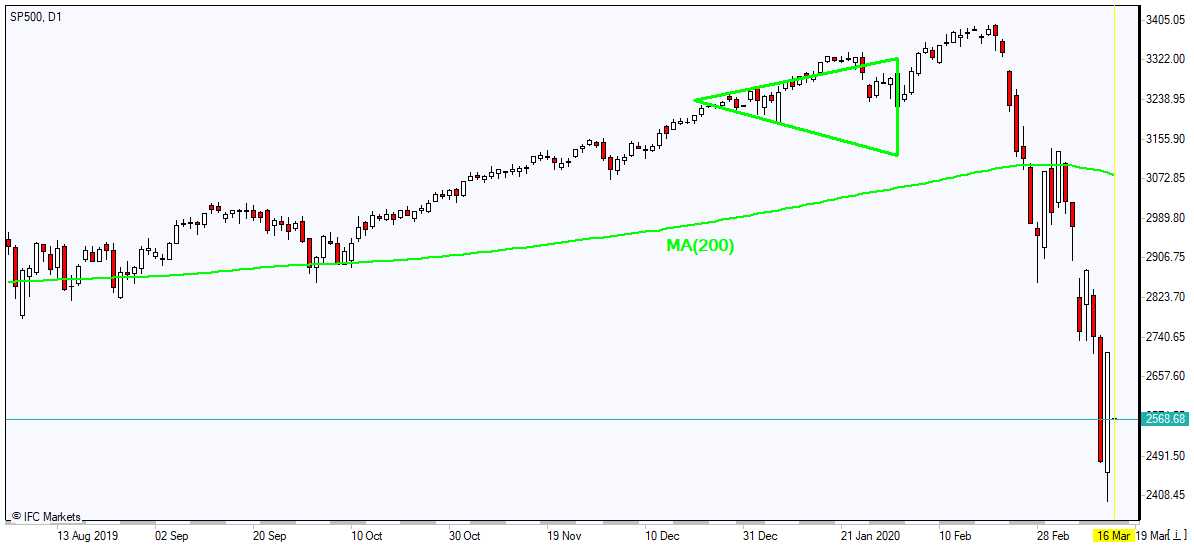
US stock market bounced back on Friday after President Trump declared a national emergency opening up $50 billion of financing to combat coronavirus outbreak. Sunday night Federal Reserve cut interest rates to 0% and announced $700 billion QE program. The S&P 500 rebounded 9.3% to 2711.02, booking a 8.8% loss for the week. Dow Jones industrial jumped 9.4% to 23185.62. The Nasdaq ended 9.3% higher at 7874.88. The dollar strengthening accelerated as University of Michigan consumer sentiment index declined less than expected. The live dollar index data show the ICE US Dollar index, a measure of the dollar’s strength against a basket of six rival currencies, rose 1% to 98.47 but is lower currently. Futures on stock indexes are down.

SP500 plunging below MA(200) 3/16/2020 Market Overview IFC Markets chart

FTSE 100 led European stock indexes rebound

European stocks rebounded on Friday. Both EUR/USD and GBP/USD continued sliding on Friday with both pairs higher currently. The Stoxx Europe 600 Index added 1% led by basic resources shares. The DAX 30 edged up 0.8% to 9232.08 Friday. France’s CAC 40 gained 1.8% and UK’s FTSE 100 rose 2.5% to 5366.1.

Australia’s All Ordinaries Index leads Asian indexes plunge

Asian stock indices are lower today after surprise one percentage point rate cut by the Federal Reserve. Nikkei fell 2.5% to 17002.04 as yen resumed its climbing against the dollar. China’s markets are falling after reports China’s industrial output, retail sales fell in the first two months of the year: the Shanghai Composite Index is down 3.4% while Hong Kong’s Hang Seng Index is 5.2% lower. Australia’s All Ordinaries Index plummeted 9.7% despite continued sliding of Australian dollar against the greenback.

Brent slips

Brent futures prices are in retreat following 25% plunge last week after Saudi Arabia boosted crude oil production. Prices rose on Friday as President Trump said strategic crude oil reserves will be replenished by purchases at current lower prices: Brent for May settlement added 1.9% to $33.85 a barrel Friday.

Gold rebounds as Dollar weakens

Gold prices are recovering today. Prices fell on Friday as dollar strengthening speeded up. Gold for April delivery lost 4.6% to $1516.70 on Friday.

Market Analysis provided by IFCMarkets

Note:
This overview has an informative and tutorial character and is published for free. All the data, included in the overview, are received from public sources, recognized as more or less reliable. Moreover, there is no guarantee that the indicated information is full and precise. Overviews are not updated. The whole information in each overview, including opinion, indicators, charts and anything else, is provided only for familiarization purposes and is not financial advice or а recommendation. The whole text and its any part, as well as the charts cannot be considered as an offer to make a deal with any asset. IFC Markets and its employees under any circumstances are not liable for any action taken by someone else during or after reading the overview.

The Fed is all in, but US stocks still hit limit down

By Hussein Sayed, Chief Market Strategist (Gulf & MENA), ForexTime

The coronavirus outbreak is proving to be stronger than any measures taken by governments and central banks.

In another surprise move, the US Federal Reserve slashed its interest rates to zero on Sunday and added a sweetener by expanding its balance sheet by $700 billion to purchase Treasuries and mortgage-backed securities.

China’s PBOC also made a surprise move on Friday with a fresh round of liquidity injections. The central bank cut its reserve requirements for banks to free up $79 bn in funds to support companies hit by the outbreak. Meanwhile, the Bank of Japan was the last to join central bank action by announcing several measures to ease monetary policy.

It’s becoming evident that the major central banks across the globe are using all their available tools to prevent a crisis, but it seems the fear of the pandemic is taking control of investors.

At the time of writing, all three major US indices were trading at their lower pre-open limit, a decline of 5%.

When stocks futures reach their limit down in pre-market trading, they leave investors wondering how bad it can get when the market resumes normal trading hours. Markets will continue going through this phase of extreme volatility until they are able to assess the scale of damage caused by the virus outbreak.

The longer the outbreak persists and countries stay in emergency status, the harder the global economy will be hit. A recession seems almost impossible to prevent at this stage, but the question remains, how bad is it going to be? Equity strategists, especially bottom-up ones, will not be able to provide meaningful targets for stock prices. That’s because even companies themselves cannot project revenue targets in such situations.

From a macro perspective, economic data released by China today has provided a snapshot on how bad things could turn out to be. Industrial production plunged 13.5% in the first two months of the year; that’s the worst reading ever for the sector. Retail sales fell 20.5% as consumers were locked at home, fixed income investments dropped 24.5% and the jobless rate rose to a record 6.2%.

While China has started to recover from the epidemic, we do not expect to see a V-shaped recovery. The simple reason is that the rest of the world is sick now, with the majority of infections outside China. That means demand for Chinese products will remain low for the foreseeable future. Whether US and Europe will receive a similar economic hit remains to be seen. However, the biggest risk is if this health crisis turns out to be a debt crisis. The answer largely depends on the time and scale of the outbreak.

Confidence is exceptionally low at this stage and that suggests selling market rallies like the one we saw on Friday, may be a profitable strategy. However, traders should be aware and prepared for another week of extreme volatility.

Disclaimer: The content in this article comprises personal opinions and should not be construed as containing personal and/or other investment advice and/or an offer of and/or solicitation for any transactions in financial instruments and/or a guarantee and/or prediction of future performance. ForexTime (FXTM), its affiliates, agents, directors, officers or employees do not guarantee the accuracy, validity, timeliness or completeness, of any information or data made available and assume no liability as to any loss arising from any investment based on the same.


Forex-Time-LogoArticle by ForexTime

ForexTime Ltd (FXTM) is an award winning international online forex broker regulated by CySEC 185/12 www.forextime.com

New Zealand cuts rate 75 bps, next move QE if required

By CentralBankNews.info

New Zealand’s’ central bank lowered its benchmark interest rate by a sharp 75 basis points to add further monetary stimulus in light of the negative impact on economic activity from the outbreak of the coronavirus, adding the rate “will remain at this level for at least the next 12 months.”

The Reserve Bank of New Zealand (RBNZ) cut its Official Cash Rate (OCR) rate to a new record low of 0.25 percent, its first rate cut since August 2019, and said large scale purchases of New Zealand bonds would be preferable to further rate cuts if further stimulus were to be required.

“The negative economic implications of the Covid-19 virus continue to rise warranting further monetary stimulus,” RBNZ said after an extraordinary meeting of its monetary policy committee.

To support the availability of credit, RBNZ also delayed the start of higher capital requirements for banks by one year to July 1, 2021, and would consider further delays if necessary.

It estimated this delay would enable banks to supply up to around $47 billion more in lending and the central bank is working on identifying other regulatory changes “to reduce the burden on financial institutions at this time of uncertainty.”

In February RBNZ left its rate steady, assuming the economic impact of the coronavirus, or Covid-19, would be of short duration but that it would have time to adjust its policy if the impact turned out to be larger and more persistent.

Since then, the outlook for the global economy has deteriorated significantly as global trade, trade, business and consumer spending has been curtailed significantly while governments are imposing a variety of restraints to mitigate the virus transmission.

“The negative impact on the New Zealand economy is, and will continue to be significant,” RBN said, adding demand for the country’s goods and services will be constrained, as will domestic production, while spending and investment will be subdued for an extended period.

On the other hand, RBNZ said the country’s financial system remains sound, with financial institutions well capitalized and the government is operating an expansionary fiscal policy and has imminent intentions for a fiscal package to provide both targeted and broad-based stimulus.

The New Zealand dollar has also depreciated, acting as a partial buffer for export earning.

In its discussions, the policy committee debated cutting OCR by 50 basis points, with the ability to follow up with more stimulus as needed at the regularly scheduled policy meeting later this month, or an immediate 75 point rate cut.

“Given views on the required level of stimulus given the economic impact of COVID-19, the Committee agreed a 0.75 percentage point reduction in the OCR would be a more suitable option,” RBNZ said.

The committee agreed the scheduled policy meeting on March 25 was no longer needed.

The Reserve Bank of New Zealand issued the following two statements:

“The Official Cash Rate (OCR) is 0.25 percent, reduced from 1.0 percent, and will remain at this level for at least the next 12 months.
The negative economic implications of the COVID-19 virus continue to rise warranting further monetary stimulus.
Since the outbreak of the virus, global trade, travel, and business and consumer spending have been curtailed significantly. Increasingly, governments internationally have imposed a variety of restraints on people movement within and across national borders in order to mitigate the virus transmission.
Financial market pricing has responded to these events with declining global equity prices and increased interest rate spreads on traditionally riskier asset classes.
The negative impact on the New Zealand economy is, and will continue to be, significant. Demand for New Zealand’s goods and services will be constrained, as will domestic production. Spending and investment will be subdued for an extended period while the responses to the COVID-19 virus evolve.
Several factors will continue to assist and support economic activity in New Zealand.
New Zealand’s financial system remains sound and our major financial institutions are well capitalised and liquid. The Reserve Bank is also ensuring that the banking system continues to function normally.
The Government is operating an expansionary fiscal policy and has imminent intentions to increase its support with a fiscal package to provide both targeted and broad-based economic stimulus.
The New Zealand dollar exchange rate has also depreciated against our trading partners acting as a partial buffer for export earnings.
And, the Monetary Policy Committee agreed to provide further support with the OCR now at 0.25 percent. The Committee agreed unanimously to keep the OCR at this level for at least 12 months.
The Committee also agreed that should further stimulus be required, a Large Scale Asset Purchase programme of New Zealand government bonds would be preferable to further OCR reductions.
More information:
  • There will be no OCR Review on 25 March 2020
  • Record of Meeting
  • The revised OCR will be effective from 17 March 2020
  • A live-stream of a media conference, with Governor Adrian Orr, will be available on the RBNZ YouTube channel at 11am today.

Record of meeting – Extraordinary OCR Review – 15 March 2020

Members met for an extraordinary session of the Monetary Policy Committee on 15 March at 2.30pm. This meeting was called in response to the rapidly deteriorating economic situation relating to COVID-19.
Staff briefed the Committee on agreed Reserve Bank financial stability measures that were to be announced in co-ordination with any monetary policy decision. The Secretary to the Treasury outlined the broad scale of intended fiscal policy measures in light of the deteriorating economic outlook.
Staff presented indicative scenarios of the impact of COVID-19 developments on the economy. However, it was noted that there is extreme uncertainty around these estimates, and that risks had already shifted to the downside since the scenarios had been finalised.
It was agreed that, since meeting in February, the outlook for the economy had deteriorated significantly as a result of the impacts of COVID-19. The slowdown in the global economy would act as a serious headwind for the New Zealand economy. International and domestic initiatives to limit the spread of the virus would have a serious impact on travel and trade affecting both supply and demand channels in the economy. It was agreed that the Government and the Reserve Bank of New Zealand had a vital role to play in cushioning the economic impact through fiscal, monetary and financial stability measures. The members welcomed the Government fiscal response and the Reserve Bank’s financial stability measures.
The Committee discussed the effectiveness of a monetary policy response given the nature of the economic shock and agreed that a significant easing in monetary policy was required in order to achieve the goals of price stability and maximum sustainable employment. Such a response would also support co-ordinated financial stability measures, and the upcoming announcement of fiscal stimulus.
The members discussed the broad range of Official Cash Rate (OCR) settings that would be suitable. Staff briefed the Committee on the scale of policy stimulus required given deteriorating global conditions and the impact of travel restrictions. The Committee discussed the relative contributions of planned fiscal and financial stability measures in consideration of the monetary policy response. Staff also advised that an OCR of 0.25 percent was currently the lower limit, given the operational readiness of the financial system for very low or negative interest rates.
Subsequent Committee discussion focused on two scenarios:
  • a 0.5 percentage point cut in the OCR to 0.5 percent, followed by an assessment of the rapidly developing COVID-19 situation, with the ability to follow up with more stimulus as needed at the scheduled March OCR review
  • A 0.75 percentage point reduction in the OCR to 0.25 percent.
Members noted that lower interest rates would likely support the soundness of the financial system – in the context of the Committee’s Remit.
Given views on the required level of stimulus given the economic impact of COVID-19, the committee agreed a 0.75 percentage point reduction in the OCR would be a more suitable option.
The Committee then discussed supporting this significant monetary stimulus with forward guidance. Members agreed to provide forward guidance that the OCR would stay at the level of 0.25 percent for at least 12 months. This guidance would also provide clarity to financial market participants that a negative OCR would not be implemented over this period.
The Committee was also briefed by staff on additional monetary tools, and which were likely best suited to providing additional stimulus, noting that the recently published principles recognise the best tool depends on the particular circumstances. Assuming markets are functioning effectively, staff indicated Large Scale Asset Purchases of New Zealand Government bonds were the next best monetary tool available to the Committee. The Committee agreed with this assessment. However, the Committee agreed that additional tools were not needed at this point.
The Committee reached a consensus to:
  • Cut the Official Cash Rate to 0.25 percent.
  • Provide forward guidance that the OCR would remain at 0.25 percent for at least 12 months.
  • Agree that Large Scale Asset Purchases of New Zealand government bonds would be the best additional tool to provide further monetary stimulus in the current situation – if needed.
The committee agreed that the scheduled meeting of the Committee on 25th of March was no longer required.
Attendees:
  • Reserve Bank staff: Adrian Orr, Geoff Bascand, Christian Hawkesby, Yuong Ha
  • External: Bob Buckle, Peter Harris, Caroline Saunders
  • Observer: Caralee McLiesh
  • Secretary: Adam Richardson”
 

Financial system sound, and Reserve Bank providing additional support

“New Zealand’s financial system is sound, with strong capital and liquidity buffers, but faces significant uncertainties from the impacts of COVID-19. The Reserve Bank is announcing additional measures to support the provision of credit and market functioning.
Reserve Bank Deputy Governor Geoff Bascand says the situation around COVID-19 is evolving rapidly, and there is much uncertainty.
“To support credit availability, the Bank has decided to delay the start date of increased capital requirements for banks by 12 months – to 1 July 2021. Should conditions warrant it next year, the Reserve Bank will consider whether further delays are necessary.”
“We are taking this action now to help support lending in the economy at time when there is a lot of uncertainty. The Reserve Bank’s expectation is that banks will utilise this flexibility to maintain lending to households and businesses. Banks have significant buffers above current regulatory minimums, and we encourage them to use them,” Mr Bascand said.
“Deferring the capital framework implementation provides banks with significant capital headroom. We estimate that this headroom will enable banks to supply up to around $47 billion more lending than would have been the case, had the decisions been implemented as planned.”
Mr Bascand said the Reserve Bank is currently identifying other regulatory initiatives that can be deferred, to reduce the burden on financial institutions at this time of uncertainty. These will be announced in coming days. The Reserve Bank is working closely with the Council of Financial Regulators and international regulators.
Assistant Governor Christian Hawkesby said the Bank is also ensuring there is sufficient liquidity in the financial system, through regular market operations.
“The Bank has a number of operational tools at its disposal to support liquidity and market functioning in New Zealand. This has helped the domestic cash market and foreign exchange swap market to continue to function effectively over recent weeks,” Mr Hawkesby says.
“Banks currently have robust liquidity and funding positions and can manage short-term disruptions to offshore funding markets. We will continue to monitor developments closely and engage regularly with market participants to ensure we are ready to provide support if needed.”
The Reserve Bank also announced the following changes to the pricing of its standing facilities and ESAS accounts, in part to assist cash market functioning at a lower OCR:
  • Cash that ESAS account holders have on deposit at the Reserve Bank that is in excess of their allocated ESAS credit tier will be remunerated at the OCR less 25 basis points (from OCR less 75 basis points).
  • Bonds lent through the Bond Lending Facility well be lent at the OCR less 50 basis points (from OCR less 75 basis points).
  • A maximum rate will be set for bonds lent through the Repo Facility at the OCR less 50 basis points (from OCR less 75 basis points).
  • Cash will continue to be lent via the Overnight Reverse Repo Facility at the OCR plus 25 basis points until further notice.
The Reserve Bank has a number of tools to provide additional liquidity, and support to market functioning, should these be required in the future:
  • The ability to provide term funding through a Term Auction Facility (TAF) which can provide collateralised loans out to 12 months. This facility was previously provided from 2008 to 2010.
  • The Bank has an established role to provide liquidity in the New Zealand dollar foreign exchange market in periods of illiquidity or dysfunction, and is operationally ready to undertake this role if required.
  • The ability to provide liquidity to the NZ government bond market to support market functioning.
Mr Hawkesby says the Reserve Bank continues to monitor developments, and is ready to act to ensure markets and the financial system operate in a stable and efficient manner.”


US Fed slashes rate another 100 bps, to buy assets

By CentralBankNews.info

The U.S. Federal Reserve slashed its rate by another 100 basis points to effectively zero and launched a new round of quantitative easing (QE) to counter the risk to the economy from the outbreak of the coronavirus and said it expects to maintain the rate at this level “until it is confident that the economy has weathered recent events and is on track to achieve its maximum employment and price stability goals.

In its second unscheduled policy decision in less than two weeks, the Fed cut the target range for its benchmark federal funds rate to 0.0 to 0.25 percent and has now cut it five times by a total of 2.25 percentage points in the last eight months.

In addition to its surprise rate cut, the Fed – in coordination with five other central banks; the Bank of Canada, the Bank of England, the Bank of Japan, the European Central Bank and the Swiss National Bank, cut the price of standing U.S. dollar liquidity swap arrangements by 25 basis points to “enhance the provision of liquidity.

The Fed’s policy rate is now back to the level it was from December 2008 to December 2015 when it slowly began raising rates until it was forced to reverse course early last year and then cut its rate three times from July 2019 until October.

But the outbreak of the coronavirus, or Covid-19, is wrecking havoc on the global economy and on March 3 the Fed cut its rate by 50 basis points in its first emergency rate since Oct. 8, 2008 in the global financial crises.

Although the Fed said the U.S. economy recently was on a strong footing, it said global financial conditions have been “significantly affected,” and the energy sector has come under stress while inflation is running below 2 percent and inflation expectations have declined.

“This action will help support economic activity, strong labor market conditions, and inflation returning to the Committee’s symmetric 2 percent objective,” the Federal Open Market Committee (FOMC), the Fed’s policy-making body said.

It added it was prepared to use its full range of tools to support the flow of credit to households and business, and launched a new round of asset purchases to support the “smooth functioning” of markets for Treasury securities and agency mortgage-backed securities.

Over the coming months the Fed will increase its holdings of Treasuries by at least $500 billion and its holdings of agency mortgage-backed securities by at least $200 billion. It will also reinvest all principal payments from its current holdings of agency debt and agency mortgage-backed securities.

It noted the New York Fed’s open market desk has recently expanded its overnight and term repo operations and the FOMC is “prepared to adjust its plans as appropriate.”

Nine of FOMC members agreed on the policy moves while Loretta Mester preferred to only cut the fed funds rate by 50 basis points. She supported the actions to promote the smooth functioning of financial markets and the flow of credit to households and businesses.

To provide easier access to funds from financial institutions, the Fed cut the primary credit rate by 150 basis points to 0.25 percent and said it was encouraging banks to turn to the discount window to help meet demands for credit from households and businesses.

The discount window helps banks manage their liquidity risks and avoid any actions that may have negative consequences for their customers, such as withdrawing credit “during times of stress.”

To widen the role of the discount window, the Fed said financial institutions could borrow funds for up to 90 days, repayable and renewable by the borrower on a daily basis.

The Fed also said it was encoring banks to use their capital and liquidity buffers when lending to households and businesses affected by the coronavirus.

Since the global financial crises, banks have built up capital and liquidity in excess of regulatory minimums and buffers, and the largest firms now have $1.3 trillion in common equity and $2.9 trillion in high quality liquid assets.
“The Federal Reserve supports firms that chose to use their capital and liquidity buffers to lend and undertake supportive actions in a safe and sound manner,” the Fed said.

As a final move to bolster the financial system, the Fed slashed its reserve requirement ratio to 0.0 percent, reflecting that fact that reserve requirements no longer play a significant role in the implementation of monetary policy following the shift to an “ample reserves” regime in January 2019.

The Board of Governors of the Federal Reserve System issued the following statements regarding its monetary policy decision, the coordinated action by central banks and actions to support the flow of credit to households and businesses.

“The coronavirus outbreak has harmed communities and disrupted economic activity in many countries, including the United States. Global financial conditions have also been significantly affected. Available economic data show that the U.S. economy came into this challenging period on a strong footing. Information received since the Federal Open Market Committee met in January indicates that the labor market remained strong through February and economic activity rose at a moderate rate. Job gains have been solid, on average, in recent months, and the unemployment rate has remained low. Although household spending rose at a moderate pace, business fixed investment and exports remained weak. More recently, the energy sector has come under stress. On a 12‑month basis, overall inflation and inflation for items other than food and energy are running below 2 percent. Market-based measures of inflation compensation have declined; survey-based measures of longer-term inflation expectations are little changed.
Consistent with its statutory mandate, the Committee seeks to foster maximum employment and price stability. The effects of the coronavirus will weigh on economic activity in the near term and pose risks to the economic outlook. In light of these developments, the Committee decided to lower the target range for the federal funds rate to 0 to 1/4 percent. The Committee expects to maintain this target range until it is confident that the economy has weathered recent events and is on track to achieve its maximum employment and price stability goals. This action will help support economic activity, strong labor market conditions, and inflation returning to the Committee’s symmetric 2 percent objective.
The Committee will continue to monitor the implications of incoming information for the economic outlook, including information related to public health, as well as global developments and muted inflation pressures, and will use its tools and act as appropriate to support the economy. In determining the timing and size of future adjustments to the stance of monetary policy, the Committee will assess realized and expected economic conditions relative to its maximum employment objective and its symmetric 2 percent inflation objective. This assessment will take into account a wide range of information, including measures of labor market conditions, indicators of inflation pressures and inflation expectations, and readings on financial and international developments.
The Federal Reserve is prepared to use its full range of tools to support the flow of credit to households and businesses and thereby promote its maximum employment and price stability goals. To support the smooth functioning of markets for Treasury securities and agency mortgage-backed securities that are central to the flow of credit to households and businesses, over coming months the Committee will increase its holdings of Treasury securities by at least $500 billion and its holdings of agency mortgage-backed securities by at least $200 billion. The Committee will also reinvest all principal payments from the Federal Reserve’s holdings of agency debt and agency mortgage-backed securities in agency mortgage-backed securities. In addition, the Open Market Desk has recently expanded its overnight and term repurchase agreement operations. The Committee will continue to closely monitor market conditions and is prepared to adjust its plans as appropriate.
Voting for the monetary policy action were Jerome H. Powell, Chair; John C. Williams, Vice Chair; Michelle W. Bowman; Lael Brainard; Richard H. Clarida; Patrick Harker; Robert S. Kaplan; Neel Kashkari; and Randal K. Quarles. Voting against this action was Loretta J. Mester, who was fully supportive of all of the actions taken to promote the smooth functioning of markets and the flow of credit to households and businesses but preferred to reduce the target range for the federal funds rate to 1/2 to 3/4 percent at this meeting.
In a related set of actions to support the credit needs of households and businesses, the Federal Reserve announced measures related to the discount window, intraday credit, bank capital and liquidity buffers, reserve requirements, and—in coordination with other central banks—the U.S. dollar liquidity swap line arrangements. More information can be found on the Federal Reserve Board’s website.”

Coordinated Central Bank Action to Enhance the Provision of U.S. Dollar Liquidity

“The Bank of Canada, the Bank of England, the Bank of Japan, the European Central Bank, the Federal Reserve, and the Swiss National Bank are today announcing a coordinated action to enhance the provision of liquidity via the standing U.S. dollar liquidity swap line arrangements.
These central banks have agreed to lower the pricing on the standing U.S. dollar liquidity swap arrangements by 25 basis points, so that the new rate will be the U.S. dollar overnight index swap (OIS) rate plus 25 basis points. To increase the swap lines’ effectiveness in providing term liquidity, the foreign central banks with regular U.S. dollar liquidity operations have also agreed to begin offering U.S. dollars weekly in each jurisdiction with an 84-day maturity, in addition to the 1-week maturity operations currently offered. These changes will take effect with the next scheduled operations during the week of March 16.1 The new pricing and maturity offerings will remain in place as long as appropriate to support the smooth functioning of U.S. dollar funding markets.
The swap lines are available standing facilities and serve as an important liquidity backstop to ease strains in global funding markets, thereby helping to mitigate the effects of such strains on the supply of credit to households and businesses, both domestically and abroad.”

Federal Reserve Actions to Support the Flow of Credit to Households and Businesses

The Federal Reserve is carefully monitoring credit markets and is prepared to use its full range of tools to support the flow of credit to households and businesses and thereby promote its maximum employment and price stability goals. In addition to actions taken by the Federal Open Market Committee, including actions taken in coordination with other central banks, the Federal Reserve Board announced a series of actions in support of these goals. These actions are summarized below.
Discount Window
Federal Reserve lending to depository institutions (the “discount window”) plays an important role in supporting the liquidity and stability of the banking system and the effective implementation of monetary policy. By providing ready access to funding, the discount window helps depository institutions manage their liquidity risks efficiently and avoid actions that have negative consequences for their customers, such as withdrawing credit during times of market stress. Thus, the discount window supports the smooth flow of credit to households and businesses. Providing liquidity in this way is one of the original purposes of the Federal Reserve System and other central banks around the world.
The Federal Reserve encourages depository institutions to turn to the discount window to help meet demands for credit from households and businesses at this time. In support of this goal, the Board today announced that it will lower the primary credit rate by 150 basis points to 0.25 percent, effective March 16, 2020. This reduction in the primary credit rate reflects both the 100 basis point reduction in the target range for the federal funds rate and a 50 basis point narrowing in the primary credit rate relative to the top of the target range. Narrowing the spread of the primary credit rate relative to the general level of overnight interest rates should help encourage more active use of the window by depository institutions to meet unexpected funding needs. To further enhance the role of the discount window as a tool for banks in addressing potential funding pressures, the Board also today announced that depository institutions may borrow from the discount window for periods as long as 90 days, prepayable and renewable by the borrower on a daily basis. The Federal Reserve continues to accept the same broad range of collateral for discount window loans.
Intraday Credit
The availability of intraday credit from the Federal Reserve supports the smooth functioning of payment systems and the settlement and clearing of transactions across a range of credit markets. The Federal Reserve encourages depository institutions to utilize intraday credit extended by Reserve Banks, on both a collateralized and uncollateralized basis, to support the provision of liquidity to households and businesses and the general smooth functioning of payment systems.
Bank Capital and Liquidity Buffers
The Federal Reserve is encouraging banks to use their capital and liquidity buffers as they lend to households and businesses who are affected by the coronavirus.
Since the global financial crisis of 2007-2008, U.S. bank holding companies have built up substantial levels of capital and liquidity in excess of regulatory minimums and buffers. The largest firms have $1.3 trillion in common equity and hold $2.9 trillion in high quality liquid assets. The U.S. banking agencies have also significantly increased capital and liquidity requirements, including improving the quality of regulatory capital, raising minimum capital requirements, establishing capital and liquidity buffers, and implementing annual capital stress tests.
These capital and liquidity buffers are designed to support the economy in adverse situations and allow banks to continue to serve households and businesses. The Federal Reserve supports firms that choose to use their capital and liquidity buffers to lend and undertake other supportive actions in a safe and sound manner.
Reserve Requirements
For many years, reserve requirements played a central role in the implementation of monetary policy by creating a stable demand for reserves. In January 2019, the FOMC announced its intention to implement monetary policy in an ample reserves regime. Reserve requirements do not play a significant role in this operating framework.
In light of the shift to an ample reserves regime, the Board has reduced reserve requirement ratios to zero percent effective on March 26, the beginning of the next reserve maintenance period. This action eliminates reserve requirements for thousands of depository institutions and will help to support lending to households and businesses.”