This Will Signal the Bear Market’s Halfway Point

By Elliott Wave International

On March 12, the date the DJIA closed lower more than 2350 points, the U.S. chief equity strategist for a major financial firm appeared on Bloomberg after the market close and opined that “90% of the damage has been done.”

He went on to affirm that if an investor’s time horizon is longer than two weeks, then yes, the stock market plunge represents a good buying opportunity.

Well, if that’s the sentiment after the DJIA had shed more than 28% (through March 12), then the downturn may have ways more to go than just another 10%. In other words, such financial confidence is usually not the prevailing sentiment near the end of a bear market.

Now, granted, this was just one opinion… except, it isn’t. The chief equity strategist’s sentiment is just one example of an entrenched financial optimism.

As our March 11 Elliott Wave Theorist says:

As yet, fear is nowhere near epic. … Relative to the size and breadth of the down days, TRINs have been remarkably low. All moving averages from 3 to 55 days are between 1.00 and 1.30, indicating nearly equal volume distribution in down stocks vs. up stocks. In other words, there has been no panic

How do you know when a bear market is past its midpoint? Answer: when people stop cheering for lower prices.

A Bloomberg article reported, “Vanguard’s VOO attracted nearly $4.2 billion so far in March.” What is the VOO, you ask? It is an exchange-traded fund representing the S&P 500 that is “commonly used by retail investors.” The phrase, “so far in March,” means just over the past 7 trading days. Inflows in the down month of February were $8.3 billion. [The graph] tells you all you need to know: Each day, people think they are buying a low. When the real low arrives, they will be selling.

The scores of technical indicators that our analysts study are revealing a lot about the potential depth of the unfolding bear market.

Of course, our primary analytical tool is the Elliott wave model.

It tells us that, even though the market’s recent dramatic behavior is rare, it is not unprecedented. Meaning, we can see one or more scenarios of how things will progress from here.

The good news is that you can access our latest Elliott wave analysis 100% free.

You see, Elliott Wave International has been guiding investors through bull and bear markets since 1979. From that long experience, EWI’s team of experienced analysts know that at certain market junctures, they can help the most by providing their latest analysis free.

Now is one of those market junctures.

Elliott Wave International has just made the entire “Stocks” section of their flagship market letter, the monthly Elliott Wave Financial Forecast, available to all its free Club EWI members. It’s a rare opportunity to see what EWI’s subscribers are reading.

Read the Financial Forecast excerpt now, free

This will help you understand how the markets got to this juncture — and, more importantly what’s likely next.

Also, please feel free to share this special excerpt with friends and family.
Japanese Candlesticks Analysis 19.03.2020 (GOLD, NZDUSD, GBPUSD)

Article By RoboForex.com

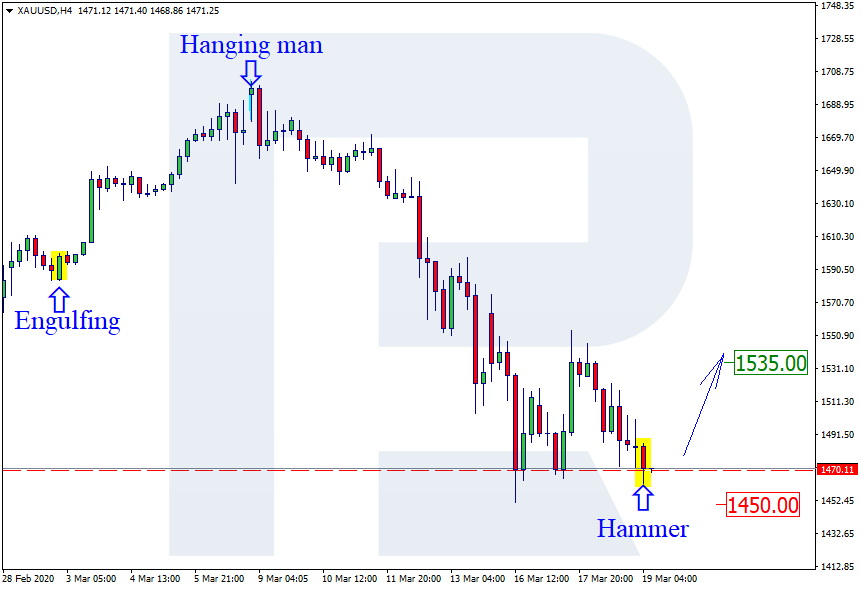
XAUUSD, “Gold vs US Dollar”

As we can see in the H4 chart, Gold is testing the support level. By now, it has formed several reversal patterns, such as Hammer. Possibly, the pair may reverse and start a new correction to reach 1535.00. However, one shouldn’t ignore another scenario, according to which the instrument may continue falling without any significant pullbacks. In this case, the downside target may be at 1450.00.

GOLD
Risk Warning: the result of previous trading operations do not guarantee the same results in the future

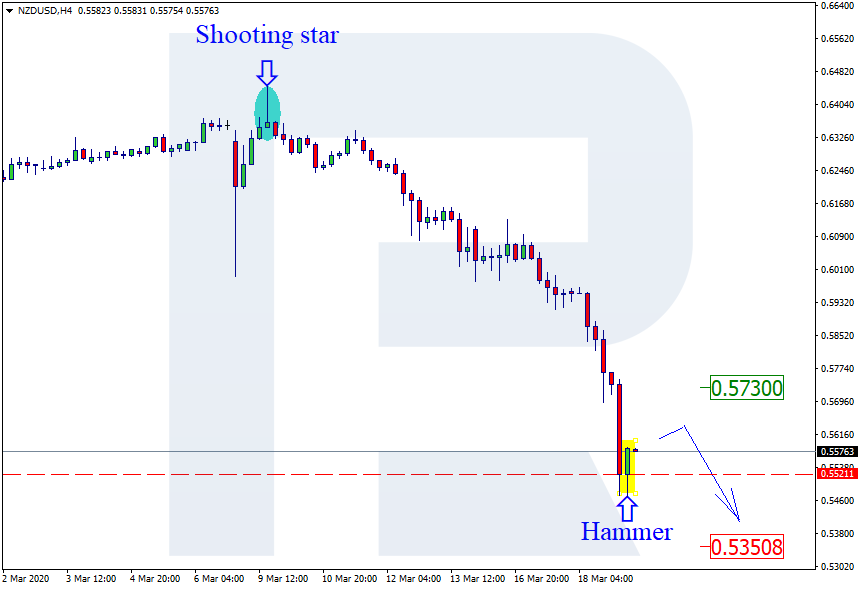
NZDUSD, “New Zealand vs. US Dollar”

As we can see in the H4 chart, after breaking the descending channel and forming a Hammer reversal pattern not far from the support level, NZDUSD is expected to reverse and get back to 0.5730. Later, the price may resume trading downwards. At the same time, one shouldn’t exclude an opposite scenario, according to which the instrument may fall towards 0.5350 without forming any serious corrections.

NZDUSD
Risk Warning: the result of previous trading operations do not guarantee the same results in the future

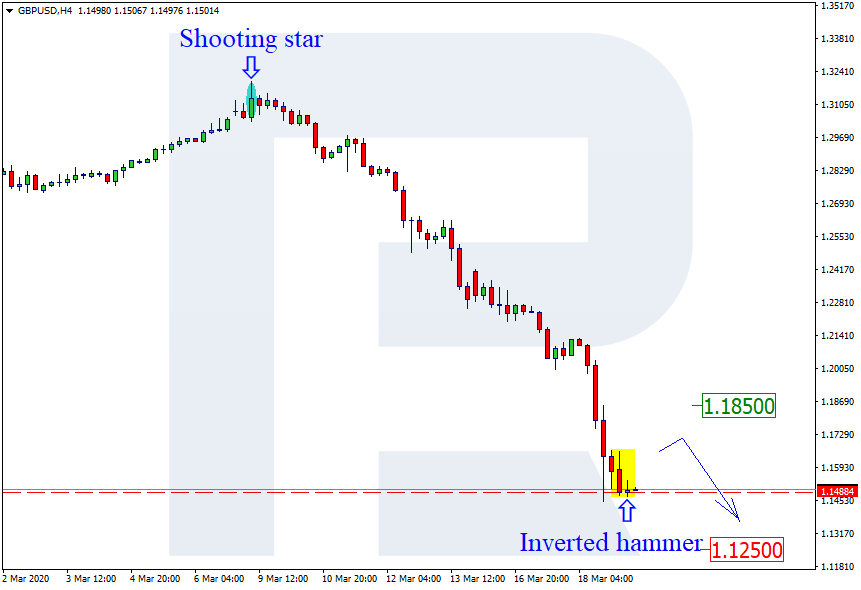
GBPUSD, “Great Britain Pound vs US Dollar”

As we can see in the H4 chart, the pair is no longer trading inside the descending channel. By now, GBPUSD has formed another Inverted Hammer reversal pattern close to the support level. Possibly, the pair may reverse and get back to 1.1850. Later, the market may continue the descending tendency. However, there is another scenario, which implies that the instrument may fall towards 1.1250 without reversing.

GBPUSD

Article By RoboForex.com

Attention!
Forecasts presented in this section only reflect the author’s private opinion and should not be considered as guidance for trading. RoboForex LP bears no responsibility for trading results based on trading recommendations described in these analytical reviews.

Countries Around the World Are Allocating Billions of Dollars to Support Economies. The British Pound Fell to a Low of 1985

by JustForex

The US dollar rose again relative to a basket of major currencies. The dollar index (#DX) closed in the positive zone (+1.74%). Countries around the world are developing measures to support economies that have suffered from the coronavirus pandemic. Thus, the US Senate has approved a bill to allocate billions of dollars to conduct free tests, pay sick leave and expand social insurance. Canada, in turn, published a massive stimulus package $82 billion worth in an attempt to cushion the blow from oil prices falling and the coronavirus pandemic. The Japanese government also discussed a package of measures that would include cash payments, and Germany decided to reduce the requirements for insurance capital stocks.

On Wednesday, the British pound fell to its lowest level against the dollar since 1985, and to more than a ten-year low against the euro due to concerns about coronavirus. During the Asian trading session, the Reserve Bank of Australia has lowered interest rates for the second time in a month, joining global central banks. The RBA urgently cut the rate to a record low of 0.25% and announced that it would not tighten its policy until it reached inflation targets.

The “black gold” prices have collapsed again. US senators have stepped up pressure on Saudi Arabia and Russia in order to stop the price war, which caused the collapse. Currently, futures for the WTI crude oil are testing the $23.55 mark per barrel.

Market indicators

Yesterday, there were aggressive sales in the US stock market: #SPY (-5.06%), #DIA (-6.60%), #QQQ (-3.04%).

The 10-year US government bonds yield rose slightly. At the moment, the indicator is at the level of 1.16-1.17%.

The news feed on 2020.03.19:
  • – Initial jobless claims in the US at 14:30 (GMT+2:00);
  • – Philadelphia Fed manufacturing index at 14:30 (GMT+2:00).

by JustForex

Sterling Falls To A 35-Year Low

By Orbex

The pound sterling gave way as it weakened sharply against the dollar.

Losing over 4% on the day, GBPUSD fell to the lowest levels since 1985.

This comes as the 1.2000 handle broke away and offered little support.

Price action in the GBPUSD is now near 1.1600. If this level holds, we might see a reversal in the short term.

However, it is a bit too early to expect any meaningful retracements.

By Orbex


The Analytical Overview of the Main Currency Pairs on 2020.03.19

by JustForex

The EUR/USD currency pair

Technical indicators of the currency pair:
  • Prev Open: 1.10070
  • Open: 1.09119
  • % chg. over the last day: -0.49
  • Day’s range: 1.08134 – 1.09812
  • 52 wk range: 1.0777 – 1.1494

EUR/USD quotes show negative екутвы. The demand for risky assets remains at a low level. The coronavirus pandemic is still in the spotlight. The ECB launched an emergency asset buyback program for 750 bln EUR. The US Federal Reserve announced a new $3.8 trillion credit program to fight the consequences of the virus crisis. Currently, EUR/USD currency pair is consolidating in the range of 1.08000-1.09550. The trading instrument can decline further. Open positions from key levels.

At 14:30 (GMT+2:00), the Philadelphian PMI will be published.

EUR/USD

The indicators signal the sellers’ power: the price has fixed below 50 MA and 100 MA.

The MACD histogram is in the negative zone, which indicates a bearish sentiment.

The Stochastic Oscillator is in the neutral zone, the %K line has crossed the %D line. There are no signals at the moment.

Trading recommendations
  • Support levels: 1.08000, 1.07000
  • Resistance levels: 1.09550, 1.10600, 1.11600.

If the price fixes below 1.08000, expect further descend toward 1.07000.

Alternatively, the quotes could recover toward 1.10500-1.11000.

The GBP/USD currency pair

Technical indicators of the currency pair:
  • Prev Open: 1.20594
  • Open: 1.15803
  • % chg. over the last day: -3.69
  • Day’s range: 1.14746 – 1.16614
  • 52 wk range: 1.1466 – 1.3516

The British pound fell on Wednesday to its lowest level against the dollar since 1985 and to more than a decade low against the euro due to concerns about the coronavirus and investors’ desire to hold on to the US dollar. Currently, GBP/USD quotes are consolidating in the range of 1.14500-1.16500. Technical correction of the trading instrument after a significant collapse is not ruled out in the nearest future. Open positions from key levels.

The Economic News Feed for 19.03.2020 is calm.

GBP/USD

The indicators signal the sellers’ power: the price has fixed below 50 MA and 100 MA.

The MACD histogram is in the negative zone, which indicates a bearish sentiment.

The Stochastic Oscillator is in the neutral zone, the %K line started crossing the %D line. There are no signals at the moment.

Trading recommendations
  • Support levels: 1.14500
  • Resistance levels: 1.16500, 1.20000, 1.21350

If the price fixes below 1.14500, expect the quotes to fall toward 1.13000.

Alternatively, the quotes could correct 1.18000-1.19000.

The USD/CAD currency pair

Technical indicators of the currency pair:
  • Prev Open: 1.42021
  • Open: 1.45086
  • % chg. over the last day: +1.99
  • Day’s range: 1.44256 – 1.46679
  • 52 wk range: 1.2949 – 1.4668

The CAD keeps losing ground against the USD. During yesterday and today’s trades the growth of USD/CAD quotes exceeded 400 points. The Canadian dollar remains under pressure amid a significant collapse of oil quotations. At the moment the trading instrument has stabilized. The key range is 1.44000-1.46600. Technical correction is not ruled out in the nearest future. Open positions from key levels.

The Economic News Feed for 19.03.2020 is calm.

USD/CAD

The indicators signal the strength of buyers: the price has fixed above 50 MA and 100 MA.

MACD histogram is in the positive zone, which indicates a bullish sentiment.

The Stochastic Oscillator is in the neutral zone, the %K line is below the %D line, which indicates a possible correction of the USD/CAD currency pair.

Trading recommendations
  • Support levels: 1.44000, 1.42750, 1.41500
  • Resistance levels: 1.46600, 1.48000

If the price fixes above 1.46600, consider buying USD/CAD as the price rises toward 1.48000.

Alternatively, the quotes could descend toward 1.42500-1.41500.

The USD/JPY currency pair

Technical indicators of the currency pair:
  • Prev Open: 107.604
  • Open: 108.042
  • % chg. over the last day: +0.63
  • Day’s range: 107.996 – 109.551
  • 52 wk range: 101.19 – 112.41

The USD/JPY currency pair has moved up. The quotes have updated the local highs. At the moment the trading instrument is consolidating in the range 108.500-109.500. Financial markets participants are waiting for additional drivers. We recommend you to pay attention to the dynamics of US government securities yield. USD/JPY currency pair has potential for further growth. Open positions from key levels.

The Economic News Feed for 19.03.2020 is calm.

USD/JPY

The indicators signal the strength of buyers: the price has fixed above 50 MA and 100 MA.

MACD histogram is in the positive zone, which gives a signal to buy USD/JPY.

The Stochastic Oscillator is located in the neutral zone, the %K line crosses the %D line. There are no signals at the moment.

Trading recommendations
  • Support levels: 108.500, 107.850, 106.500
  • Resistance levels: 109.500, 111.000

If the price fixes above 109.500, expect further growth toward 110.500-111.000.

Alternatively, the quotes could descend toward 107.000-106.500.

by JustForex

Euro Breaks Down Below Support

By Orbex

The euro turned weaker amid a stronger dollar.

Price action broke past the initial support level of 1.0855.

Further downside will see a test of the 1.0784 handle. This marks the lows from late February this year.

The Stochastics oscillator remains well in the oversold level suggesting further downside.

To the upside, the resistance level at 1.0855 will be the target which will cap the gains.

By Orbex


EURUSD: Bears control the market below the balance line

By Alpari.com

On Wednesday, March 18, trading on the EURUSD pair was down at the close. Investors ditched risky assets in the wake of the panic resulting from the spread of the new coronavirus, even despite the emergency measures taken by central banks and the governments of most countries. Consumers empty grocery store shelves, while investors and traders buy US dollars and bonds.

The price of Brent crude oil fell to $24.51 USD per barrel. Trading on US stock exchanges was suspended for a day, after the indices fell by 7%. By the end of the day, the DJIA index had fallen by 6.30%, to 19898.92 points, the S&P500 – by 5.18%, to 2398. The EURUSD pair fell to 1.0802. By the close of the day, the price rebounded by one figure to the level of 1.0919.

Today’s events (GMT+3):

  • 10:00 Switzerland: Trade Balance (Feb).
  • 12:30 SNB Interest Rate Decision.
  • 15:30 Canada: New Housing Price Index (MoM) (Feb).
  • 15:30 USA: Initial Jobless Claims (Mar 13), Philadelphia Fed Manufacturing Survey (Mar), Current Account (Q4).

1903Current situation:

In the forex market, pressure remains on all currencies. Coronavirus continues to keep the whole world at bay. According to the latest data, the number of cases in the world has grown to 218,000 people. There has been a sharp increase in the disease observed outside of China. The virus is actively spreading in Italy, Iran, Spain, Germany and the USA. Since March 12, the number of infected has increased by 190%, to 137,000 people.

Volatility in the forex market has grown significantly, so the price could well surpass the 135th degree without any rebounds. The EURUSD pair recovered to 157th degree. Bulls have not yet succeeded with their efforts for growth. Panic on stock exchanges adversely affects all markets. The current rate is 1.0879. According to the forecast, I am waiting for a fall to the lower line of the channel and the d4 line to 1.0802.

By Alpari.com

WTI Crude Oil Reaches New Lows

By Orbex

Crude oil prices tumbled on Wednesday, losing over 18% intraday.

The declines came after the previously held lows at 28.00 gave way. This led to a sharp and consistent fall in the commodity.

At the time of writing, oil prices are trading at $21.75. Further declines cannot be ruled out.

For the moment, price action is likely to continue attracting sellers into the market.

By Orbex


Dollar remains king as pandemic fears grip markets

By Lukman Otunuga, ForexTimeWords fail t o describe how explosively volatile and chaotic financial markets have been over the past few days.

Fears over a global recession sparked by the coronavirus pandemic are blunting appetite for stock markets with investors rushing to the perceived safety of the Greenback and Japanese Yen. King Dollar has soared against its peers in recent days despite two emergency rate cuts by the Fed with prices hitting multi-year highs above 101.80 on Wednesday. Given how financial markets remain in panic mood and risk-aversion is rife, the Dollar is positioned to extend gains against G10 currencies.

Looking at the technical picture, the Dollar Index is heavily bullish on the four hourly charts. A solid daily close above 101.00 should encourage a move towards fresh multi-year highs above 102.00.

Will the Pound parity dream become reality?

Sterling tumbled to multi-decade lows against the Dollar, falling as much as 4% as the coronavirus outbreak battered financial markets.

On Wednesday, the pound traded below $1.15 against the dollar for the first time since 1985, extending a decline over the past week. With the Dollar expected to dominant the FX arena amid safe-haven flows, the GBPUSD could plunge deeper into the abyss.

Looking at the charts, bears are certainly in control as there have been consistent lower lows and lower highs on the GBPUSD. A daily close under 1.15 may encourage a decline towards 1.14. Should 1.15 prove to be a reliable support, a sharp rebound towards 1.195 could be on the cards.

Another day, another circuit break for S&P 500

The S&P 500 extended its decline on Wednesday, plunging 7% to trigger the level 1 circuit breaker which halted trading on the New York Stock Exchange for 15 minutes.

US equity bears remain in control despite the Federal Reserve launching some bazooka’s and Trump pushing for a $1 trillion stimulus package. It is safe to say that the S&P 500 is bearish with the downside momentum dragging prices back below 2350.

Gold struggles to shine through market panic

It was the same old story with Gold as the precious metal fell over 2.5% despite risk aversion sweeping across financial markets.

Steep losses across the equity space have forced investors to dump assets for cash to cover margin calls. An appreciating Dollar also compounded to Gold’s woes with prices trading below $1500 as of writing. With Gold’s safe-haven status being overlooked amid the market chaos, further losses could be on the cards in the short term.

Commodity spotlight – WTI Oil

Oil is by far one of the biggest casualties from the novel coronavirus outbreak.

WTI Crude and Brent have both depreciated a staggering 60% since the start of 2020 and could extend losses as the pandemic darkens the outlook for fuel demand. To rub salt into the burning wound, the raging price war between Saudi Arabia and Russia is fuelling oversupply concerns. WTI Oil is trading around levels not seen in 17 years below $25 and may test $20 if nothing changes.

Disclaimer: The content in this article comprises personal opinions and should not be construed as containing personal and/or other investment advice and/or an offer of and/or solicitation for any transactions in financial instruments and/or a guarantee and/or prediction of future performance. ForexTime (FXTM), its affiliates, agents, directors, officers or employees do not guarantee the accuracy, validity, timeliness or completeness, of any information or data made available and assume no liability as to any loss arising from any investment based on the same.


Forex-Time-LogoArticle by ForexTime

ForexTime Ltd (FXTM) is an award winning international online forex broker regulated by CySEC 185/12 www.forextime.com

Multitrillion Dollar intervention fails to calm investors

By Hussein Sayed, Chief Market Strategist (Gulf & MENA), ForexTime

We are now seeing unprecedented policies by authorities across the globe on a daily basis – countries are shutting down their borders, governments are taking drastic approaches to limit the impact of the virus spread on their economies and central banks are using all their tools to calm financial markets. However, none of these measures seem to be calming investors’ nerves.

With fears over the spread of coronavirus intensifying, it’s reasonable and justified to see risk assets being sold aggressively. After all, the consequences on the global economy and corporate earnings may be enormous, depending on the duration of the pandemic. People are afraid they will lose their jobs, won’t be able to pay their bills and so are cutting expenses on all non-essential needs. But what’s interesting in the current market turmoil is that even the safest assets in financial markets, US government bonds, are being sold-off.

In a bear market, traditionally investors have flocked to US Treasury bonds which historically have been inversely correlated to stock markets. In fact, we did see tremendous inflows into Treasuries at the beginning of the coronavirus outbreak. From mid-February to early March, yields on the 10-year Treasury bond declined by 80% to reach a record low of 0.32%. However, over the last several days this pattern has changed, with the sell-off in US Treasuries intensifying, especially on Tuesday and Wednesday with yields now standing at 1.25%.

This kind of market behaviour is scary. It shows that investors are selling whatever they can to raise cash and this also explains why the Dollar is soaring to record highs. Investors are clearly being forced to build their cash reserves in order to survive a prolonged period of the current pandemic.

The Federal Reserve and other major central banks are using all their tools to provide liquidity to markets. Whether it’s through cutting rates, currency swap lines, repurchase operations or asset purchases. Unfortunately, none of these tactics are preventing the hoarding of Dollars, as the huge amount of Dollar debt that companies need to fund gives rise to a “Dollar squeeze”.

This kind of market behaviour is likely to remain if the growth in virus infections remains high. That’s going to be problematic, especially for Asia, where Dollar dominated debt has reached record highs over the past several years. The risks of the global health crisis transforming into a debt crisis is extremely high and that would lead to an even worse crisis than that seen in 2008.

At this stage, it seems only one solution can prevent an ugly financial crisis – that is, finding a cure to the coronavirus and very quickly – which we all hope can be achieved very soon.

Disclaimer: The content in this article comprises personal opinions and should not be construed as containing personal and/or other investment advice and/or an offer of and/or solicitation for any transactions in financial instruments and/or a guarantee and/or prediction of future performance. ForexTime (FXTM), its affiliates, agents, directors, officers or employees do not guarantee the accuracy, validity, timeliness or completeness, of any information or data made available and assume no liability as to any loss arising from any investment based on the same.


Forex-Time-LogoArticle by ForexTime

ForexTime Ltd (FXTM) is an award winning international online forex broker regulated by CySEC 185/12 www.forextime.com