XAUUSD: Will Gold Continue To Plummet?

By Orbex

The current XAUUSD reversal at the swing high suggests that we have now ended the super-cycle wave (b).

Like any other corrective pattern, it took the form of a 3-wave structure. In this case, this is a standard zigzag which consists of cycle degree waves a-b-c.

Wave completed with a false break above the $1700 handle. Since wave (a) was an impulse, this is expected to remain the case for wave (c) too.

At the time of writing, price action is indicative of more weakness in primary wave ①. This impulse move consists of intermediate waves (1)-(2)-(3)-(4)-(5).

With impulse (4) done, (5) could be completed soon. The $1420 makes a good test as it is the 161.8% Fibonacci extension of wave (3).

The current impulsive decline can, however, take a multi-degree pattern to lower lows.

This alternative view finds the primary impulse wave ① significantly lower, and the former primary ① as intermediate wave (3).

The extended decline in the intermediate waves (5) can be expected to continue near the $1350 area. But if there, bears will be encouraged to push to lower levels too.

By Orbex

Coronavirus Induced Bear Market with Chris Vermeulen

By TheTechnicalTraders.com

Chris Vermeulen says money is moving just as it has in the past 5 waves of panic. This is a normal technical behavior in this type of market. There will be a huge move when money comes back into the stock market within several weeks. This will mark the first bounce in the bear market. All the countries of the world are pumping and dumping money into their economies.

Eventually, the music will come to an end. Dumping trillions may work out well for everyone, Americans, government, and investors. Whatever happens, it’s going to be a major plus for precious metals and mining stocks.

Click Here to Listen to the Audio

As a technical analysis and trader since 1997, I have been through a few bull/bear market cycles. I believe I have a good pulse on the market and timing key turning points for short-term swing traders.

Visit my ETF Wealth Building Newsletter and if you like what I offer, and ride my coattails as I navigate these financial markets and build wealth while others lose nearly everything they own during the next financial crisis.

Chris Vermeulen
TheTechnicalTraders.com


Are We Heading Into A Credit Crunch?

By Orbex

The short answer: Yes. Definitely. We are already in one now.

The question really is what’s going to happen, why this one is different, and how best to prepare for the future.

How do we know there is a credit crunch?

Well, aside from the stock markets collapsing, the thing to notice is the price of gold. Everyone says you should invest in precious metals to be prepared in times of crisis, because they don’t lose value.

Well, the price of gold has been falling for a couple of days, erasing all the gains it had during the year, and even during the spike over coronavirus fears.

Now, obviously gold isn’t going to become worthless, and an argument can be made for it going back up again. But this drive down in both equities and “safe” assets like gold shows that there is a desperate need for cash.

Everyone is selling everything to cover losses, and to retain what value they have. To make matters worse, amateur financial investors are withdrawing their funds out of fear that the market will go down further.

Liquidity and Credit

With major banks needing to access cash quickly on behalf of customers, this increases the concern that financial institutions won’t be able to meet their credit obligations.

This is only a short-term phenomenon. Institutions will be able to pay in the future, but people want their cash now. And if they can’t get it now, it destroys the credibility of the financial institution. This means that they won’t be able to pay back in the future, either.

This is why central banks are injecting massive amounts of cash into the system, in order to guarantee that payments are being met. The objective is to avert a credit crisis, where financial institutions go insolvent (on a cash flow basis) because they don’t have enough liquidity to cover their credit obligations.

That’s what’s known as a “Lehman moment”, referring to the collapse of Lehman Brothers on September 15th, 2008, marking the beginning of the sub-prime crisis and subsequent “great recession”.

The mere fact central banks are injecting that much liquidity shows that there is a credit crunch

The question is…

Will it Unfold into a Credit Crisis?

Arguably, there is nothing inherently wrong with the financial system. COVID-19 is not infecting credit.

The question is whether companies who will suffer financially during the economic shutdown in order to prevent the spread of the virus will be unable to meet their credit obligations. And, in turn, whether that will precipitate a domino effect leading to a credit crisis.

Enough credit flexibility from regulators and central banks supplying liquidity, coupled with a relatively quick control of the pandemic leading a return to normal in the services sector, could mean that there is a credit crunch for a couple of weeks and then the market rebounds.

If one of those three pillars fails, then we could see a credit crisis forming, leading to a recession.

At this point, it’s not possible to determine that. And that’s why so many investors and traders are holding on to liquidity, and actually exacerbating the problem.

What Now?

The two things to watch out for are:

  • Debt Defaults
    If companies are unable to meet their debt obligations, it will be the first sign that a financial crisis might be in process. So far, companies have been able to roll over debt as it has come due.
  • The Evolution of Cases in Italy 
    Both China and South Korea have ostensibly controlled the COVID-19 outbreak, with the number of cases peaking and returning to low enough levels they can start relaxing economic measures.Italy was the first country in Europe to start having major cases. So, the question is when (and if) the number of reported cases peaks. That way, we can project when Europe can potentially start relaxing its economic measures.

By Orbex


COPPER Analysis: Falling Chinese fixed asset investment bearish for copper price

By IFCMarkets

Falling Chinese fixed asset investment bearish for copper price

China’s economy endured a severe blow from coronavirus infection as quarantine measures resulted in slowing of activities and shutdowns of industrial enterprises. China’s industrial production, retail sales and fixed asset investment fell steeply in the first two months of 2020. Industrial production in China fell 13.5% in January-February over the same period a year ago, while fixed asset investment dropped 24.5%. At the same time retail sales tumbled 20.5%. China is the top copper consumer in the world, accounting for 49% of global copper consumption. Copper is extensively used in construction, which is a major component of fixed asset investment. And while cases of new coronavirus infections in China peaked the economy is far from recovering from the disruption caused from quarantine measures. Falling fixed investment and industrial output in China is bearish for copper price.

IndicatorVALUESignal
RSIBuy
MACDSell
Donchian ChannelSell
MA(200)Sell
FractalsSell
Parabolic SARSell


Summary of technical analysis

OrderSell
Buy stopBelow 1.9717
Stop lossAbove 2.3492

Market Analysis provided by IFCMarkets

Silver Loses Steam

By Orbex

With the current events making an impact on every tradable asset, silver has felt the heat as well. It is currently trading at levels last seen in 2009.

The important break structure at $14 was broken with force on 16th March. Ever since, silver has been trying to provoke some relief rally.

A break higher above the $14 handle is required to consider a bottom is in place. Otherwise, silver is under risk for further slides towards $10.20/30.

The downfall of XAGUSD is owed to the lower demand by the manufacturing industries, which is likely to keep the pressure in check.

In the below chart, we can see that prices have fallen into a downward channel. The resistance of the channel comes to $12.25, where a break carries the potential for a run towards $13 handle.

silver

The lower blue trendline is forming a base at $11.55. If it holds, we can anticipate a move to the higher side; potentially testing the $13 handle.

The two blue trendlines also form a channel tilted slightly to the downside.

A break below the base support of the bearishly biased channel (blue) could lead to a further drop towards the $11.00 handle.

By Orbex


Uncharted Market Territory? No – complimentary webinar from EWI

There’s a lot of misinformation in the financial news right now.

You have questions. Now get answers.

On Friday, March 20, at 1pm ET, our friends at Elliott Wave International will present a special webinar by their Global Markets Strategist, Brian Whitmer. Brian will present indicators that have stood the test of time and are critically important to investors at a time like this.

Brian will show you what you should be paying attention to right now… and, perhaps even more importantly, what you should ignore.

Join free now and watch the broadcast on Friday, March 20, at 1pm Eastern.

The webinar is free — for the time being. It’s a $99 value.

Claim your free seat now.


Who is Elliott Wave International?
EWI is the world’s largest independent technical analysis firm. Founded by Robert Prechter in 1979, EWI helps investors and traders to catch market opportunities and avoid potential pitfalls before others even see them coming. Their unique perspective and high-quality analysis have been their calling card for nearly 40 years, featured in financial news outlets such as Fox Business, CNBC, Reuters, MarketWatch and Bloomberg.


USDJPY Analysis: USDJPY rising despite improved Japanese data

By IFCMarkets

USDJPY rising despite improved Japanese data

Business activity improvement in Japan was better than expected: All Industries Activity index rose 0.8% in January, when a 0.3% growth was expected. Despite better than expected Japanese business activity data USDJPY setup is bullish.

IndicatorVALUESignal
MACDBuy
StochasticSell
Donchian ChannelBuy
MA(200)Buy
FractalsNeutral
Parabolic SARBuy


Summary of technical analysis

OrderBuy
Buy stopAbove 109.99
Stop lossBelow 108.45

Market Analysis provided by IFCMarkets

Oil Market Collapse Continues

By Orbex

Inventories Rise Again

The latest report from the Energy Information Administration highlights the growing supply/demand imbalance affecting the crude oil market.

The EIA report showed that in the week ending March 13th, US crude stores rose by 2 million barrels.

This latest increase takes the total inventory level to 453.7 million barrels, the highest level since July 2019.

While the 2 million barrel increase was a little less than the 3.3 million increase forecast, it was enough to add further pressure for crude prices.

Gasoline & Distillate Stockpiles Fall

Despite the continued build in headline crude inventories, both gasoline and distillate levels have fallen again over the last week.

The EIA reported that gasoline stores were down by 6.2 million barrels over the week. This takes the total inventory level to 240.82 million barrels. The latest drop was far lower than the 2.9 million barrel decrease the market was looking for.

Distillate stockpiles were also lower last week falling by 2.9 million barrels. This latest drop, again lower than the 2 million barrel drop forecast, takes distillate stockpile levels to 125.12 million barrels.

In terms of regional levels, the report showed that crude levels at the Cushing delivery hub in Oklahoma were higher by 563k barrels over the week.

Refinery crude runs were higher by 118k barrels over the week. However, refinery utilization rates remained unchanged.

US Next Crude Exporter For Fifth Week

Net US crude imports were also lower over the week.

Imports fell by 841k barrels as the US once again reported a net exporter position over the week. This has now been the case for the last five weeks, marking the longest run on record.

Crude prices have been under relentless pressure amidst the ongoing rout in asset prices. Meanwhile, the coronavirus outbreak continues to dampen demand.

Nationwide lockdowns have been put in place around the globe and heavy travel restrictions have significantly weakened airline demand for fuel. As a result, crude prices have been pushing lower into the 20s.

Technical Perspective

Looking at the monthly chart for perspective, the sell-off in crude has now seen price breaking down through the 2016 lows of 26 to trade 22 last.

Price is now well on its way to testing the 2001 lows of 17.12. Unless this level holds as support, price will very quickly be looking at the 1998 lows of 10.72.

To the topside, any correction higher will need to break back above the 42.39 level to alleviate near term bearish pressure.

By Orbex


Ichimoku Cloud Analysis 19.03.2020 (EURUSD, AUDUSD, USDJPY)

Article By RoboForex.com

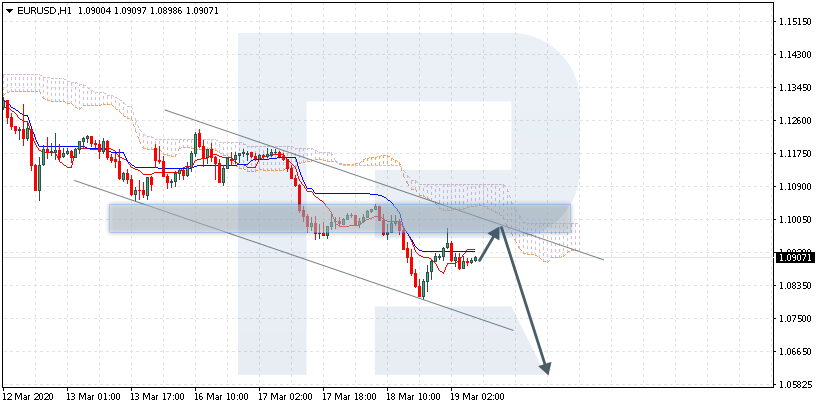
EURUSD, “Euro vs US Dollar”

EURUSD is trading at 1.0907; the instrument is moving below Ichimoku Cloud, thus indicating n descending tendency. The markets could indicate that the price may test the cloud’s downside border at 1.0925 and then resume moving downwards to reach 1.0595. Another signal to confirm further descending movement is the price’s rebounding from the descending channel’s upside border. However, the scenario that implies further decline may be canceled if the price breaks the cloud’s upside border and fixes above 1.1115. In this case, the pair may continue growing towards 1.1205.

EURUSD
Risk Warning: the result of previous trading operations do not guarantee the same results in the future

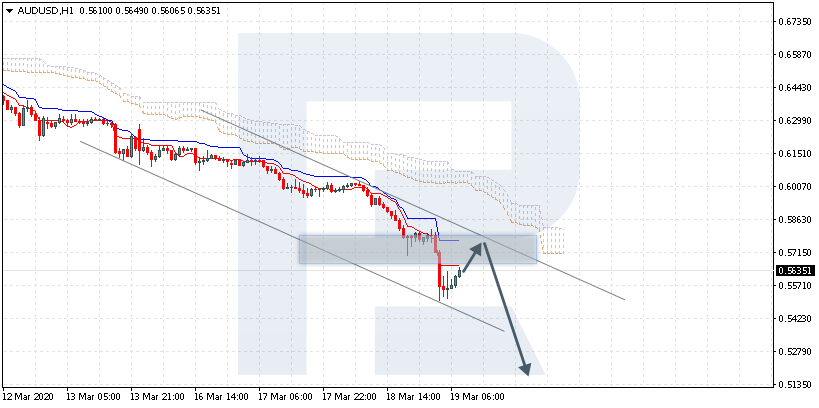
AUDUSD, “Australian Dollar vs US Dollar”

AUDUSD is trading at 0.5635; the instrument is moving below Ichimoku Cloud, thus indicating a descending tendency. The markets could indicate that the price may test Tenkan-Sen and Kijun-Sen at 0.5715 and then resume moving downwards to reach 0.5145. Another signal to confirm further descending movement is the price’s rebounding from the descending channel’s upside border. However, the scenario that implies further decline may be canceled if the price breaks the cloud’s upside border and fixes above 0.6185. In this case, the pair may continue growing towards 0.6265.

AUDUSD
Risk Warning: the result of previous trading operations do not guarantee the same results in the future

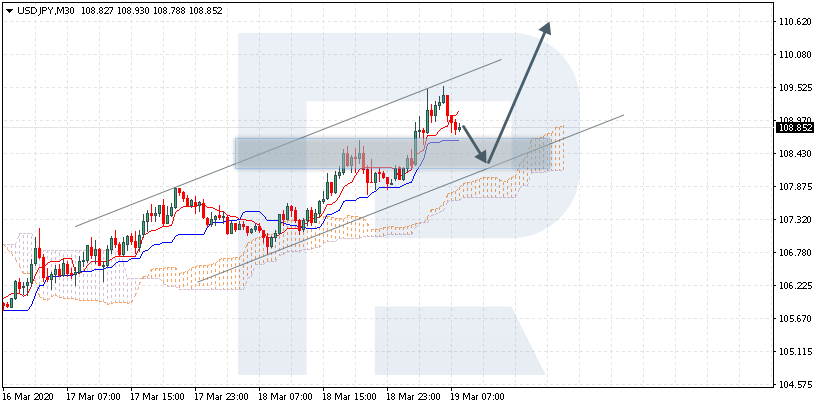
USDJPY, “US Dollar vs Japanese Yen”

USDJPY is trading at 108.85; the instrument is moving above Ichimoku Cloud, thus indicating an ascending tendency. The markets could indicate that the price may test the cloud’s upside border at 108.30 and then resume moving upwards to reach 110.65. Another signal to confirm further ascending movement is the price’s rebounding from the rising channel’s downside border. However, the scenario that implies further growth may be canceled if the price breaks the cloud’s downside border and fixes below 107.15. In this case, the pair may continue falling towards 106.25.

USDJPY

Article By RoboForex.com

Attention!
Forecasts presented in this section only reflect the author’s private opinion and should not be considered as guidance for trading. RoboForex LP bears no responsibility for trading results based on trading recommendations described in these analytical reviews.

XAUUSD Remains Range-Bound

By Orbex

Gold prices are showing signs of stabilizing. Price action is caught within the price corridor of 1534 and 1462.

However, given the strong support area, it will take some strong fundamentals to push the precious metal lower.

The longer-term downside target is around the 1440 handle.

For the moment, the evolving price action indicates a possible bottoming in the near term. But this will be valid only on a close above 1534.

By Orbex