U.S. Fed expands asset purchases, adds new lending

By CentralBankNews.info
The U.S. Federal Reserve is launching another round of measures to calm financial markets and support the flow of credit to households and businesses by launching three new credit facilities, adding agency commercial mortgage-backed securities to its shopping list and continuing to purchase Treasury securities and offering large-scale overnight and term repos, with the amounts to be assessed at future meetings.
“The coronavirus pandemic is causing tremendous hardship across the United States and around the world,” the Fed’s policy-setting committee, the Federal Open Market Committee (FOMC), said.
“While great uncertainty remains, it has become clear that our economy will face severe disruptions,”  and “aggressive efforts” must be taken across the public and private sectors to limit the losses to jobs and incomes and to promote a swift recovery once the disruptions abate,” it added.
To support the flow of credit to employers, consumers and businesses, the Fed will establish new programs of up to $300 billion in new financing, backed by the U.S. Treasury.
Two of these new facilities are aimed at supporting credit to large employers and a third to support the flow of credit to consumers and businesses.
The Primary Market Corporate Credit Facility (PMCCF) will help with new bond and loan issuance for large employers while the Secondary Market Corporate Credit Facility (SMCCF) will provide liquidity for outstanding corporate bonds.
The Term Asset-Backed Securities Loan Facility (TALF) will enable the issuance of asset-backed securities backed by student loans, auto loans, credit card loans, loans guaranteed by the Small Business Administration (SBA), and certain other assets.
The Fed said it was also expanding its flow of credit to municipalities by expanding its earlier-announced Money Market Mutual Fund Liquidity Facility (MMLF) to include a wider range of securities and ease the flow of credit by expanding the Commercial Paper Funding Facility (CPFF) to include high-quality, tax-exempt commercial paper as eligible securities.
The Fed said it also expected to soon announce a Main Street Business Lending Program to support lending to eligible small-and-medium sized businesses.

The Board of Governors of the Federal Reserve System released the following two statements:

Federal Reserve issues FOMC statement:

“The Federal Reserve is committed to use its full range of tools to support the U.S. economy in this challenging time and thereby promote its maximum employment and price stability goals.
The Federal Open Market Committee is taking further actions to support the flow of credit to households and businesses by addressing strains in the markets for Treasury securities and agency mortgage-backed securities. The Federal Reserve will continue to purchase Treasury securities and agency mortgage-backed securities in the amounts needed to support smooth market functioning and effective transmission of monetary policy to broader financial conditions. The Committee will include purchases of agency commercial mortgage-backed securities in its agency mortgage-backed security purchases. In addition, the Open Market Desk will continue to offer large-scale overnight and term repurchase agreement operations. The Committee will continue to closely monitor market conditions, and will assess the appropriate pace of its securities purchases at future meetings.
Voting (by notation) for the monetary policy action were Jerome H. Powell, Chair; John C. Williams, Vice Chair; Michelle W. Bowman; Lael Brainard; Richard H. Clarida; Patrick Harker; Robert S. Kaplan; Neel Kashkari; Loretta J. Mester; and Randal K. Quarles.
In a related set of actions, the Federal Reserve announced additional measures to support the flow of credit to households and businesses. More information can be found on the Federal Reserve Board’s website.
In connection with these plans, the Committee voted unanimously to authorize and direct the Federal Reserve Bank of New York, until instructed otherwise, to execute transactions in the System Open Market Account in accordance with the following domestic policy directive:
“Effective March 23, 2020, the Federal Open Market Committee directs the Desk to undertake open market operations as necessary to maintain the federal funds rate in a target range of 0 to 1/4 percent. The Committee directs the Desk to increase the System Open Market Account holdings of Treasury securities and agency mortgage-backed securities (MBS) in the amounts needed to support the smooth functioning of markets for Treasury securities and agency MBS. The Committee also directs the Desk to include purchases of agency commercial mortgage-backed securities in its agency mortgage-backed security purchases.
The Committee also directs the Desk to continue conducting term and overnight repurchase agreement operations to ensure that the supply of reserves remains ample and to support the smooth functioning of short-term U.S. dollar funding markets. In addition, the Committee directs the Desk to conduct overnight reverse repurchase operations (and reverse repurchase operations with maturities of more than one day when necessary to accommodate weekend, holiday, or similar trading conventions) at an offering rate of 0.00 percent, in amounts limited only by the value of Treasury securities held outright in the System Open Market Account that are available for such operations and by a per-counterparty limit of $30 billion per day.
The Committee directs the Desk to continue rolling over at auction all principal payments from the Federal Reserve’s holdings of Treasury securities and to reinvest all principal payments from the Federal Reserve’s holdings of agency debt and agency mortgage-backed securities received during each calendar month in agency mortgage-backed securities. Small deviations from these amounts for operational reasons are acceptable.
The Committee also directs the Desk to engage in dollar roll and coupon swap transactions as necessary to facilitate settlement of the Federal Reserve’s agency mortgage-backed securities transactions.”

Federal Reserve announces extensive new measures to support the economy

“The Federal Reserve is committed to using its full range of tools to support households, businesses, and the U.S. economy overall in this challenging time. The coronavirus pandemic is causing tremendous hardship across the United States and around the world. Our nation’s first priority is to care for those afflicted and to limit the further spread of the virus. While great uncertainty remains, it has become clear that our economy will face severe disruptions. Aggressive efforts must be taken across the public and private sectors to limit the losses to jobs and incomes and to promote a swift recovery once the disruptions abate.
The Federal Reserve’s role is guided by its mandate from Congress to promote maximum employment and stable prices, along with its responsibilities to promote the stability of the financial system. In support of these goals, the Federal Reserve is using its full range of authorities to provide powerful support for the flow of credit to American families and businesses. These actions include:
  • Support for critical market functioning. The Federal Open Market Committee (FOMC) will purchase Treasury securities and agency mortgage-backed securities in the amounts needed to support smooth market functioning and effective transmission of monetary policy to broader financial conditions and the economy. The FOMC had previously announced it would purchase at least $500 billion of Treasury securities and at least $200 billion of mortgage-backed securities. In addition, the FOMC will include purchases of agency commercial mortgage-backed securities in its agency mortgage-backed security purchases.
  • Supporting the flow of credit to employers, consumers, and businesses by establishing new programs that, taken together, will provide up to $300 billion in new financing. The Department of the Treasury, using the Exchange Stabilization Fund (ESF), will provide $30 billion in equity to these facilities.
  • Establishment of two facilities to support credit to large employers – the Primary Market Corporate Credit Facility (PMCCF) for new bond and loan issuance and the Secondary Market Corporate Credit Facility (SMCCF) to provide liquidity for outstanding corporate bonds.
  • Establishment of a third facility, the Term Asset-Backed Securities Loan Facility (TALF), to support the flow of credit to consumers and businesses. The TALF will enable the issuance of asset-backed securities (ABS) backed by student loans, auto loans, credit card loans, loans guaranteed by the Small Business Administration (SBA), and certain other assets.
  • Facilitating the flow of credit to municipalities by expanding the Money Market Mutual Fund Liquidity Facility (MMLF) to include a wider range of securities, including municipal variable rate demand notes (VRDNs) and bank certificates of deposit.
  • Facilitating the flow of credit to municipalities by expanding the Commercial Paper Funding Facility (CPFF) to include high-quality, tax-exempt commercial paper as eligible securities. In addition, the pricing of the facility has been reduced.
In addition to the steps above, the Federal Reserve expects to announce soon the establishment of a Main Street Business Lending Program to support lending to eligible small-and-medium sized businesses, complementing efforts by the SBA.
The PMCCF will allow companies access to credit so that they are better able to maintain business operations and capacity during the period of dislocations related to the pandemic. This facility is open to investment grade companies and will provide bridge financing of four years. Borrowers may elect to defer interest and principal payments during the first six months of the loan, extendable at the Federal Reserve’s discretion, in order to have additional cash on hand that can be used to pay employees and suppliers. The Federal Reserve will finance a special purpose vehicle (SPV) to make loans from the PMCCF to companies. The Treasury, using the ESF, will make an equity investment in the SPV.
The SMCCF will purchase in the secondary market corporate bonds issued by investment grade U.S. companies and U.S.-listed exchange-traded funds whose investment objective is to provide broad exposure to the market for U.S. investment grade corporate bonds. Treasury, using the ESF, will make an equity investment in the SPV established by the Federal Reserve for this facility.
Under the TALF, the Federal Reserve will lend on a non-recourse basis to holders of certain AAA-rated ABS backed by newly and recently originated consumer and small business loans. The Federal Reserve will lend an amount equal to the market value of the ABS less a haircut and will be secured at all times by the ABS. Treasury, using the ESF, will also make an equity investment in the SPV established by the Federal Reserve for this facility. The TALF, PMCCF and SMCCF are established by the Federal Reserve under the authority of Section 13(3) of the Federal Reserve Act, with approval of the Treasury Secretary.
These actions augment the measures taken by the Federal Reserve over the past week to support the flow of credit to households and businesses. These include:
  • The establishment of the CPFF, the MMLF, and the Primary Dealer Credit Facility;
  • The expansion of central bank liquidity swap lines;
  • Steps to enhance the availability and ease terms for borrowing at the discount window;
  • The elimination of reserve requirements;
  • Guidance encouraging banks to be flexible with customers experiencing financial challenges related to the coronavirus and to utilize their liquidity and capital buffers in doing so;
  • Statements encouraging the use of daylight credit at the Federal Reserve.
Taken together, these actions will provide support to a wide range of markets and institutions, thereby supporting the flow of credit in the economy.

The Federal Reserve will continue to use it full range of tools to support the flow of credit to households and businesses and thereby promote its maximum employment and price stability goals.”

www.CentralBankNews.info

Global financial markets to use China’s recovery as a critical gauge

By George Prior – Global financial markets will use China’s recovery as a sentiment tracker, affirms the CEO of one of the world’s largest independent financial advisory and services organizations.

The comments from Nigel Green come as European and Asian-Pacific markets and U.S. futures fell after a stream of stark headlines over the weekend.

His observations also follow Chen Yulu, a vice governor at the People’s Bank of China, giving a press conference on Sunday at which he noted that two ways the country is contributing to global financial recovery is by maintaining domestic financial markets’ stability and by being involved in international talks on macroeconomic policy collaboration.

Mr Green says: “Since the World Health Organisation upped its rhetoric on Covid-19 due to the rapid spread, financial markets – including stocks, oil, government bonds and gold – have experienced wild bouts of volatility and major sell-offs.

“Investors are now not only monitoring the habitual markers like the price of gold and oil and international fiscal and monetary policies, but they’re also tracking the global health policies and Coronavirus-death tolls.”

He continues: “The epicentre of Coronavirus has shifted from China to Europe. Europe has now registered more Coronavirus cases and fatalities than China.

“Almost immediately, the Chinese authorities launched intense lockdown measures to try and halt the outbreak. It appears to have been successful, with cases having fallen considerably.

“However, the adverse impact on the world’s second-largest economy – which drives in a large part – the global economy – has been significant.”

Mr Green goes on to say: “As such investors around the world will now be looking at how China gets back on its feet economically. Did the extreme lockdown work? Were the public health facilities adequate? Will there be another outbreak as activity resumes? How will the authorities now kickstart the economy? How will these decisions and the success of them impact the rest of the world?

“I’m confident that global financial markets will stage a relief rally when there is a definitive signal that the infection rate is dropping and that cases have peaked.  Investors will come off the sidelines and prices will jump.”

The deVere CEO concludes: “Therefore, the next stage in China’s public health and economic recovery is critical.

“What takes place in the People’s Republic will be used by investors as a sentiment guide and a gauge for the rest of the world, particularly the U.S. and Europe where Covid-19 transmissions are yet to peak.”

About:

deVere Group is one of the world’s largest independent advisors of specialist global financial solutions to international, local mass affluent, and high-net-worth clients.  It has a network of more than 70 offices across the world, over 80,000 clients and $12bn under advisement.


Forex Technical Analysis & Forecast 23.03.2020

Article By RoboForex.com

EURUSD, “Euro vs US Dollar”

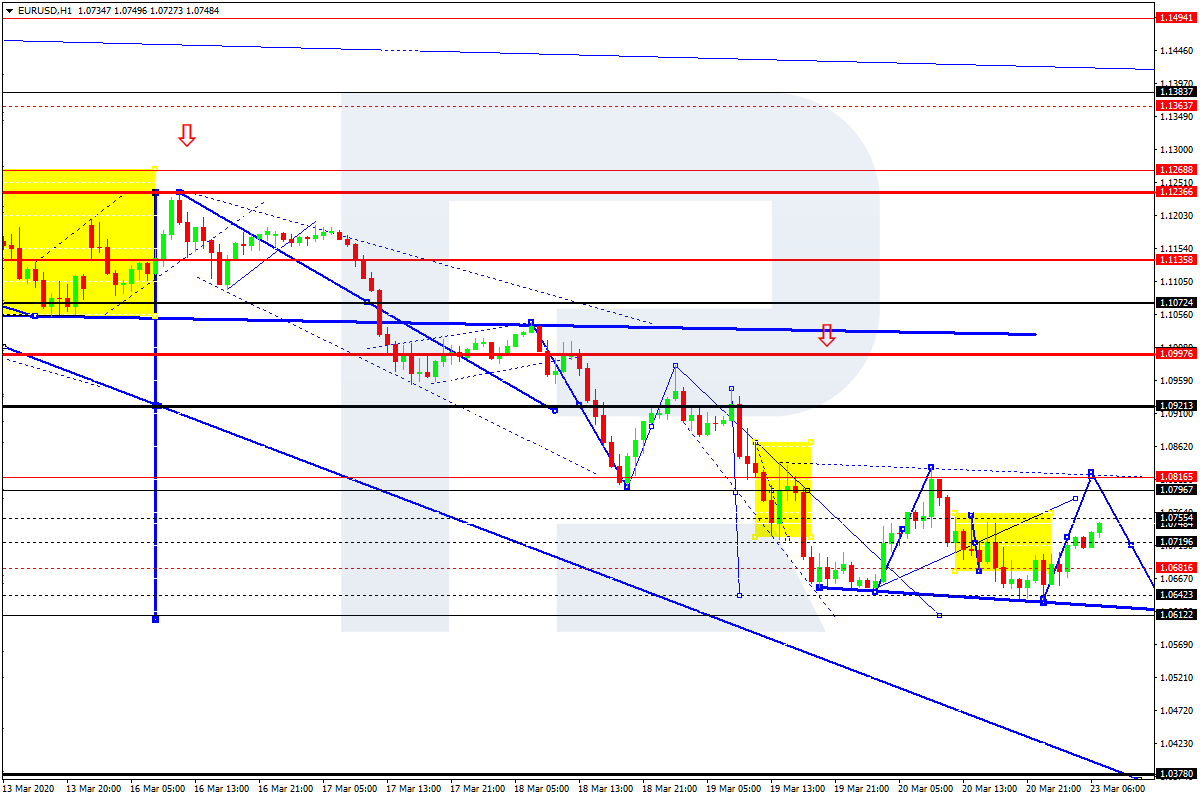
EURUSD is forming a wide consolidation range around 1.0720. Possibly, the pair may reach form one more ascending structure to reach 1.0797 and then start a new decline towards 1.0606. Later, the market may correct with the target at 1.0922.

EURUSD
Risk Warning: the result of previous trading operations do not guarantee the same results in the future

GBPUSD, “Great Britain Pound vs US Dollar”

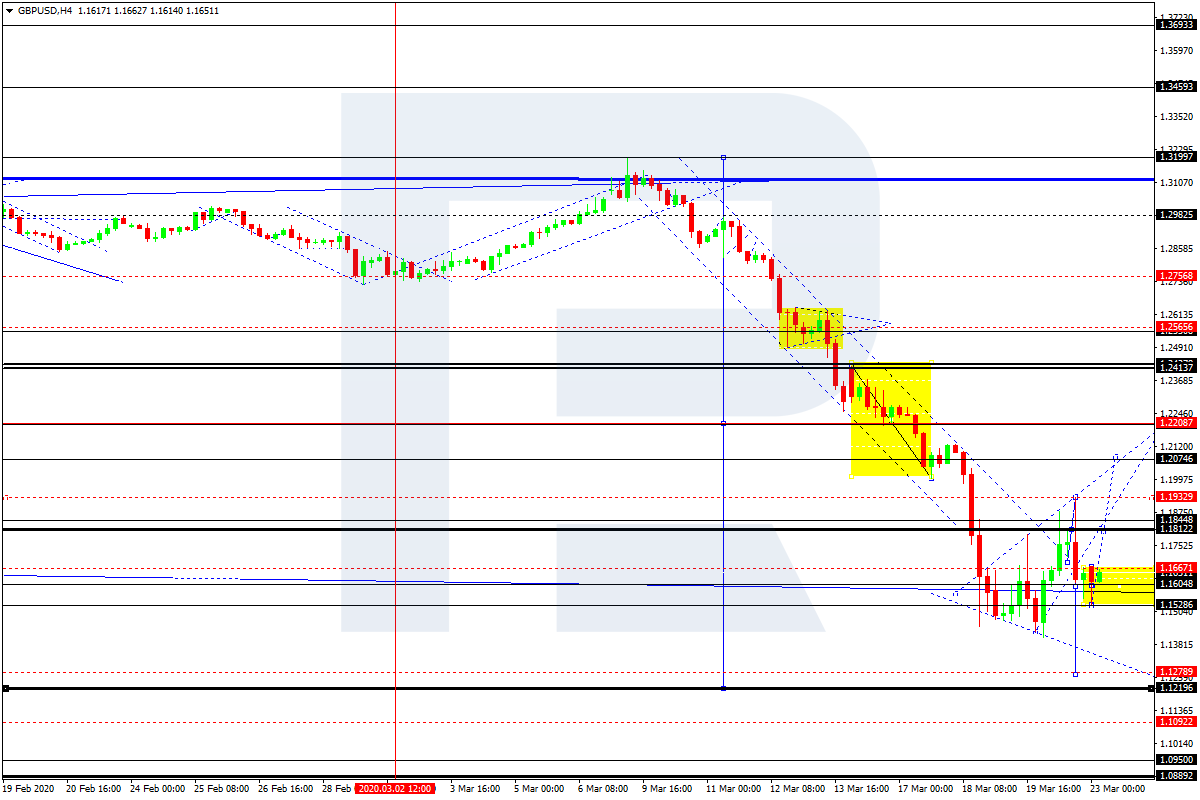
After completing the ascending impulse at 1.1922, GBPUSD has corrected this impulse towards 1.1529; right now, it is consolidating around 1.1605. If later the price breaks this range to the upside, the market may resume trading upwards to break 1.1812 and then continue growing to reach 1.2075; if to the downside – form a new descending structure with the target at 1.1220.

GBPUSD
Risk Warning: the result of previous trading operations do not guarantee the same results in the future

USDCHF, “US Dollar vs Swiss Franc”

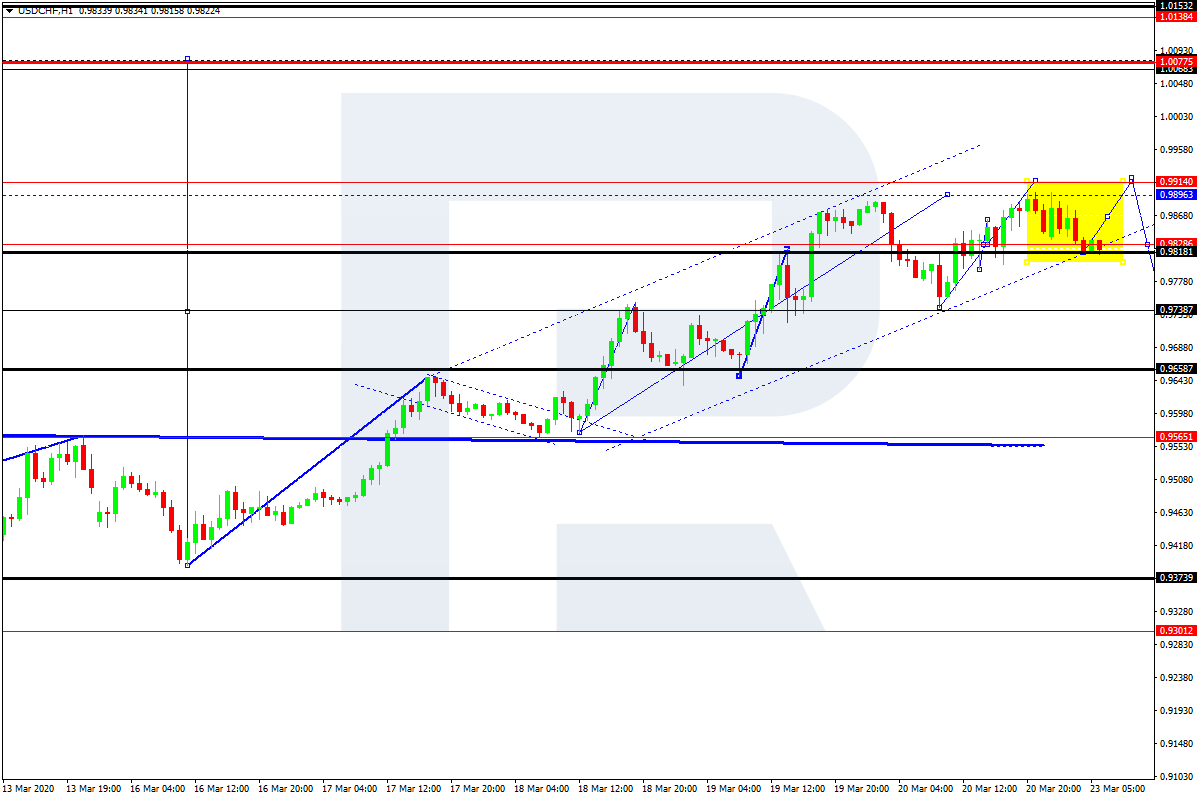
After finishing the ascending wave at 0.9900, USDCHF is falling with the target at 0.9240. Later, the market may start a new growth to break 0.9820 and then continue trading upwards to reach 0.9915.

USDCHF
Risk Warning: the result of previous trading operations do not guarantee the same results in the future

USDJPY, “US Dollar vs Japanese Yen”

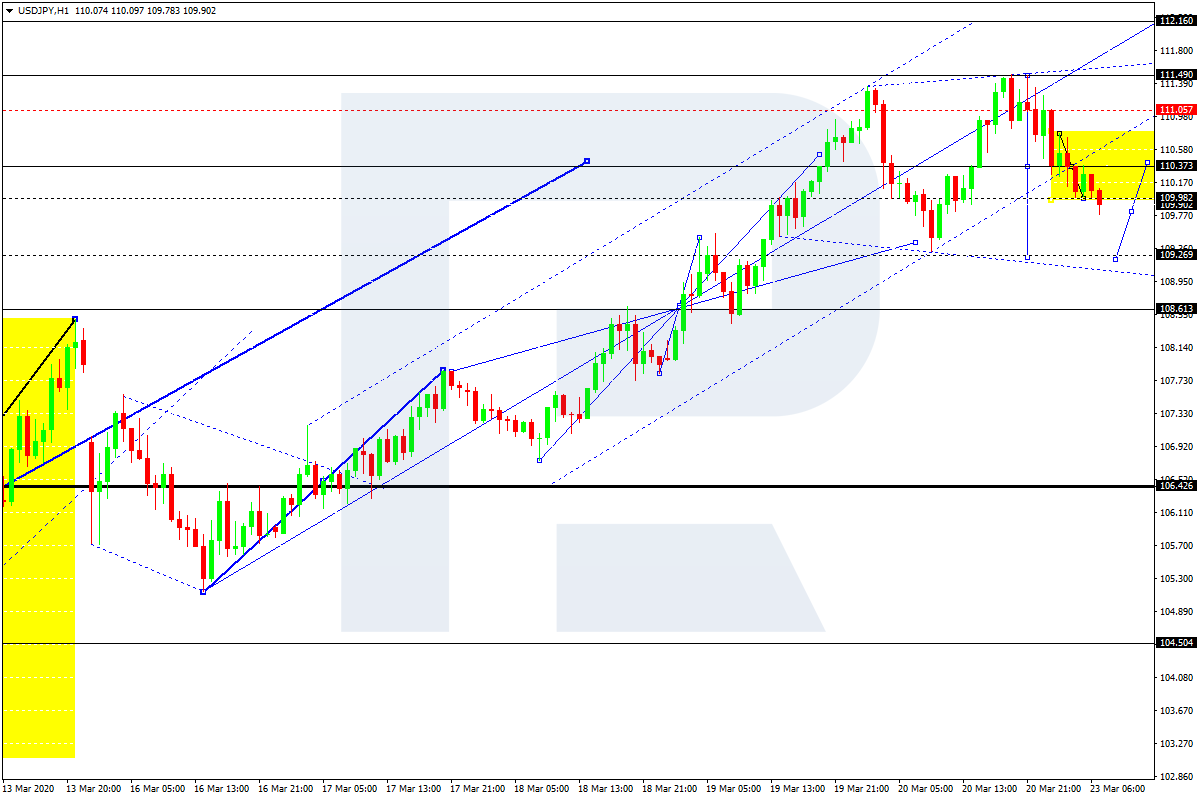
USDJPY has finished another ascending structure at 111.49; right now, it is forming a new descending impulse to reach 109.27. After that, the instrument may grow towards 110.37, thus forming a new consolidation range between two latter levels. If later the price breaks this range to the downside, the market may start another correction to reach 106.49; if to the upside – form one more ascending structure with the target at 112.12.

USDJPY
Risk Warning: the result of previous trading operations do not guarantee the same results in the future

AUDUSD, “Australian Dollar vs US Dollar”

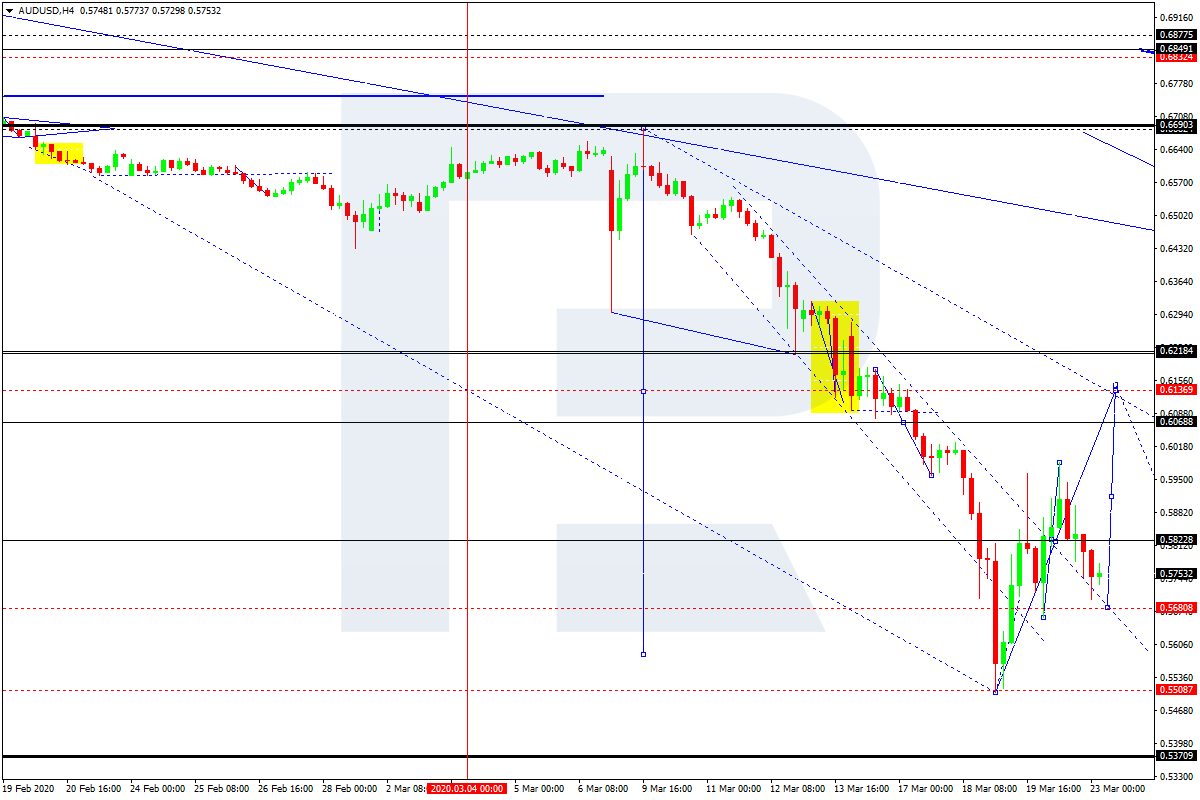
After finishing the ascending structure at 0.5945, AUDUSD is consolidating around 0.5828. Possibly, the pair may grow towards 0.6136. After that, the instrument may form a new descending structure to break 0.5822 and then continue trading inside the downtrend with the target at 0.5370.

AUDUSD
Risk Warning: the result of previous trading operations do not guarantee the same results in the future

USDRUB, “US Dollar vs Russian Ruble”

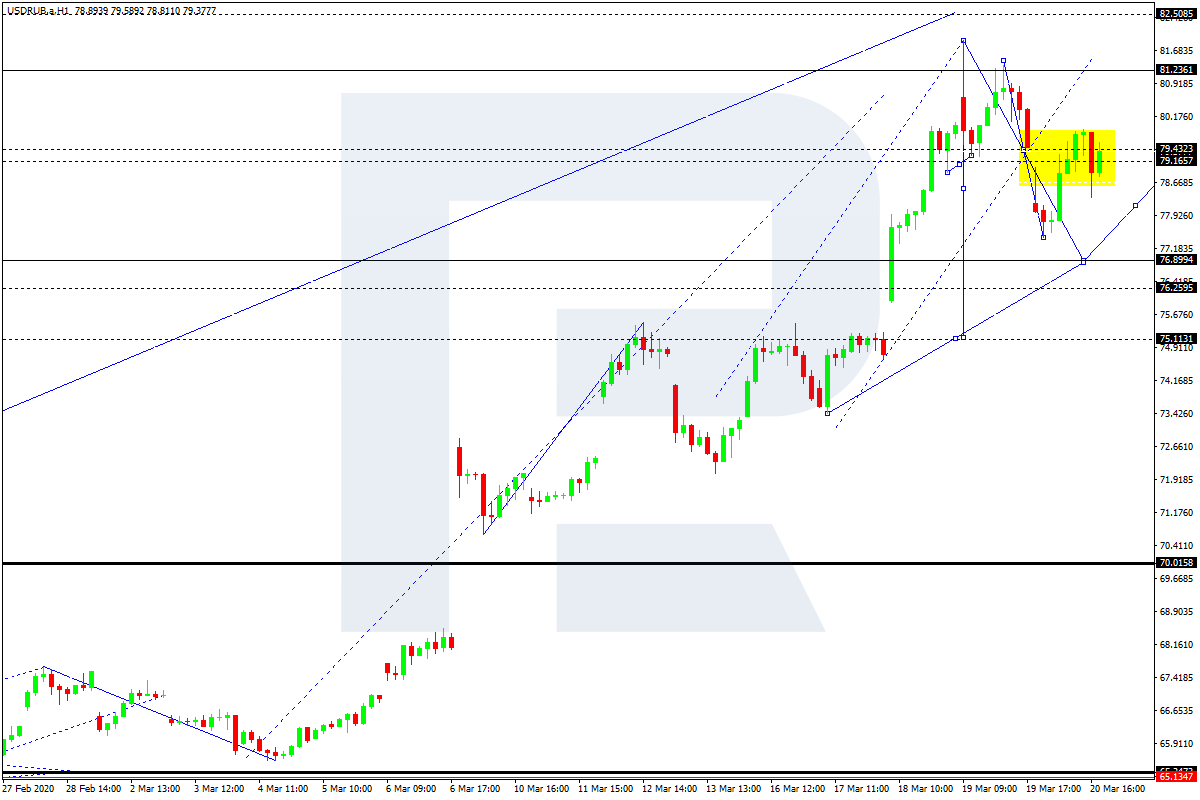
USDRUB is moving in the center of a wide consolidation range around 79.20. Possibly, today the pair may expand the range up to 82.50. Later, the market may start a new decline to break 76.90 and then continue trading downwards with the target at 75.11.

USDRUB
Risk Warning: the result of previous trading operations do not guarantee the same results in the future

USDCAD, “US Dollar vs Canadian Dollar”

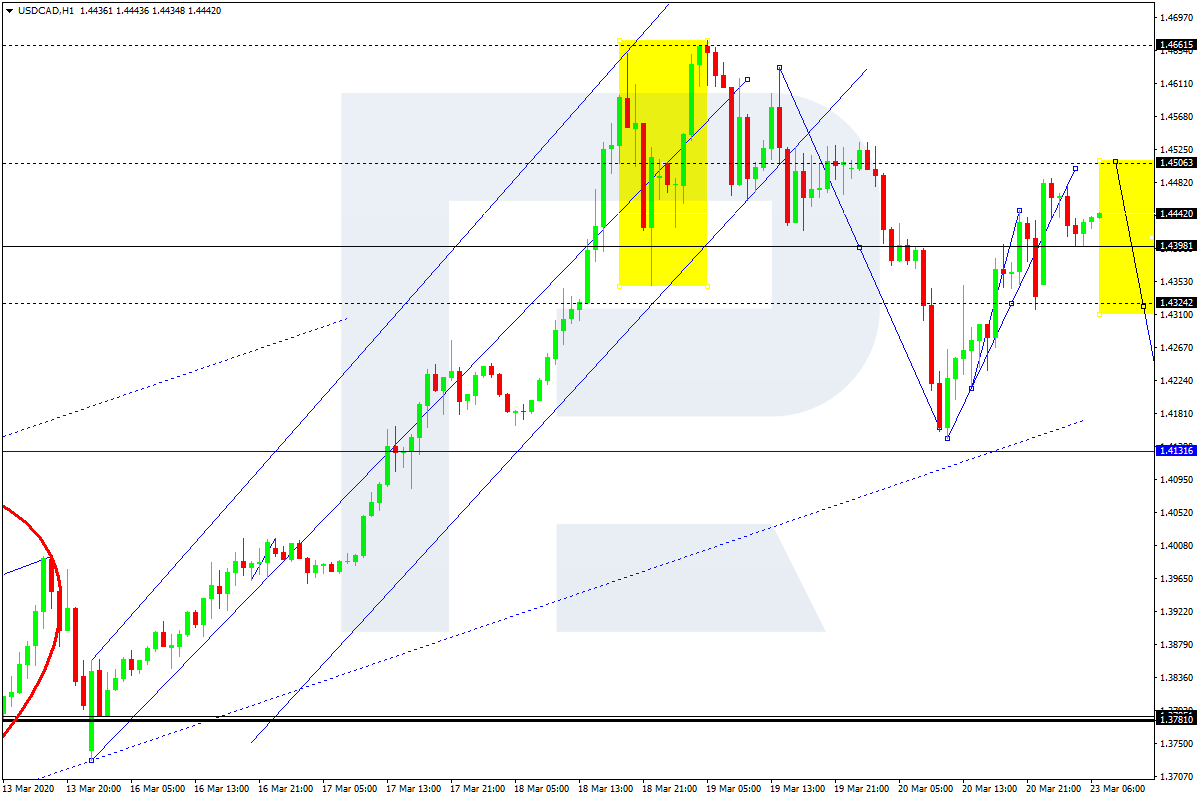
USDCAD is forming another ascending impulse towards 1.4506. Possibly, the pair may reach this level and then resume trading downwards to break 1.4324. Later, the market may continue the descending correction with the target at 1.4131.

USDCAD
Risk Warning: the result of previous trading operations do not guarantee the same results in the future

XAUUSD, “Gold vs US Dollar”

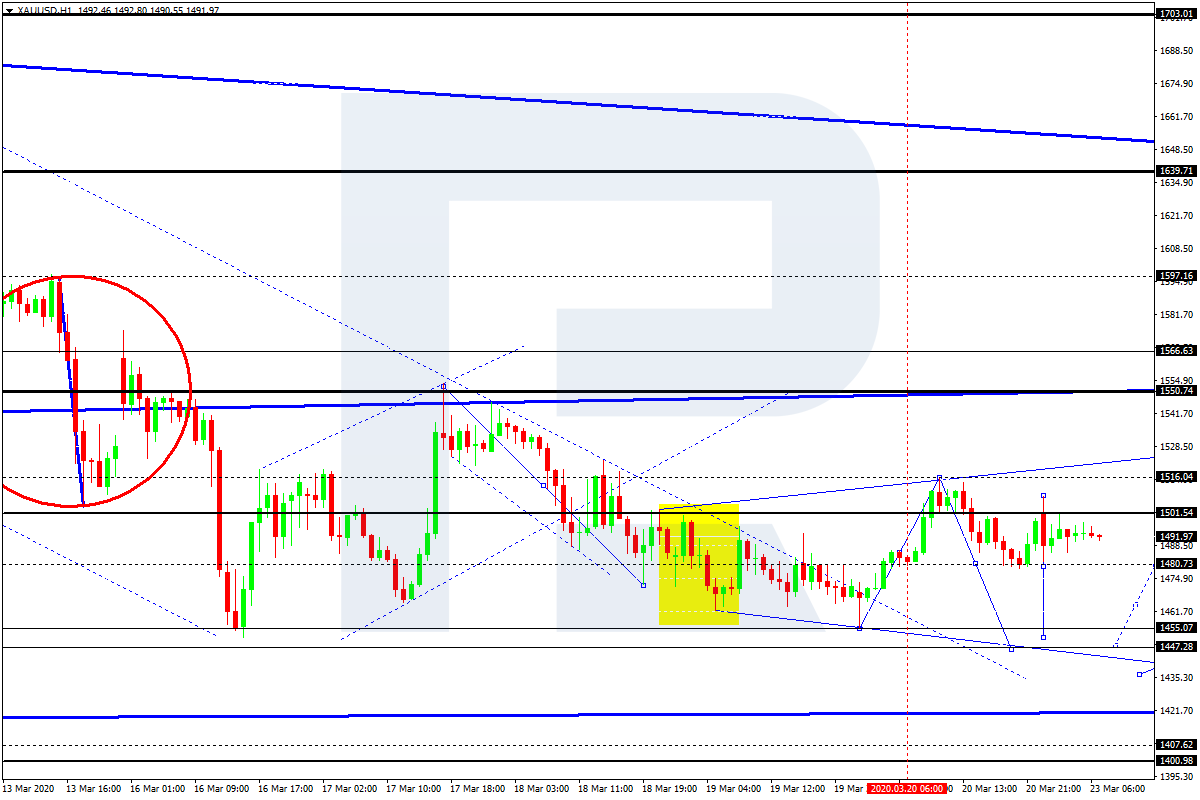
Gold is still consolidating around 1480.70 without any particular direction. Today, the pair may fall to reach 1450.00 and then grow to return to 1480.00. If later the price breaks this range to the downside, the market may start a new decline towards 1444.00; if to the upside – form one more ascending structure with the target at 1550.00.

GOLD
Risk Warning: the result of previous trading operations do not guarantee the same results in the future

BRENT

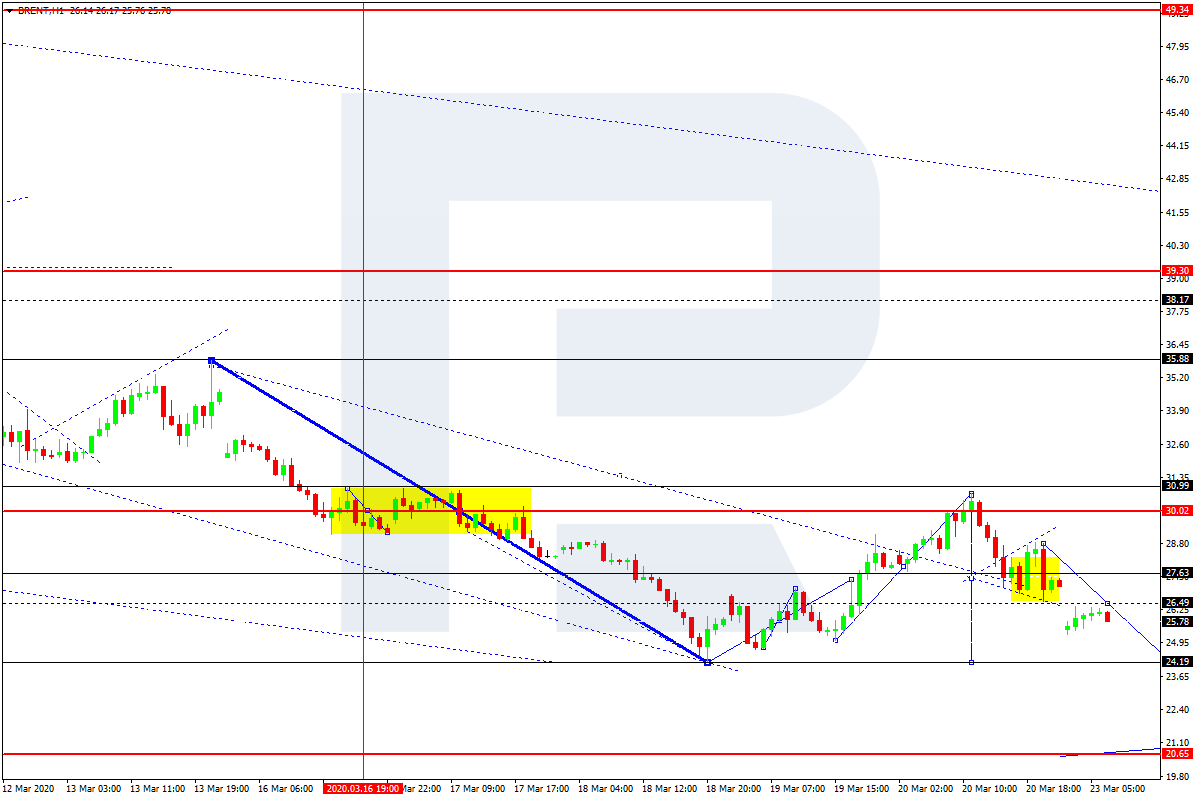
Brent is forming a wide consolidation range around 27.30. Possibly, today the pair may fall to reach 24.20 and then return to 27.30. If later the price breaks this range to the downside at 24.10, the market may resume trading downwards to reach 20.65; if to the upside at 28.50 – start a new growth to break 31.00 and then continue trading upwards with the target at 35.88.

BRENT
Risk Warning: the result of previous trading operations do not guarantee the same results in the future

BTCUSD, “Bitcoin vs US Dollar”

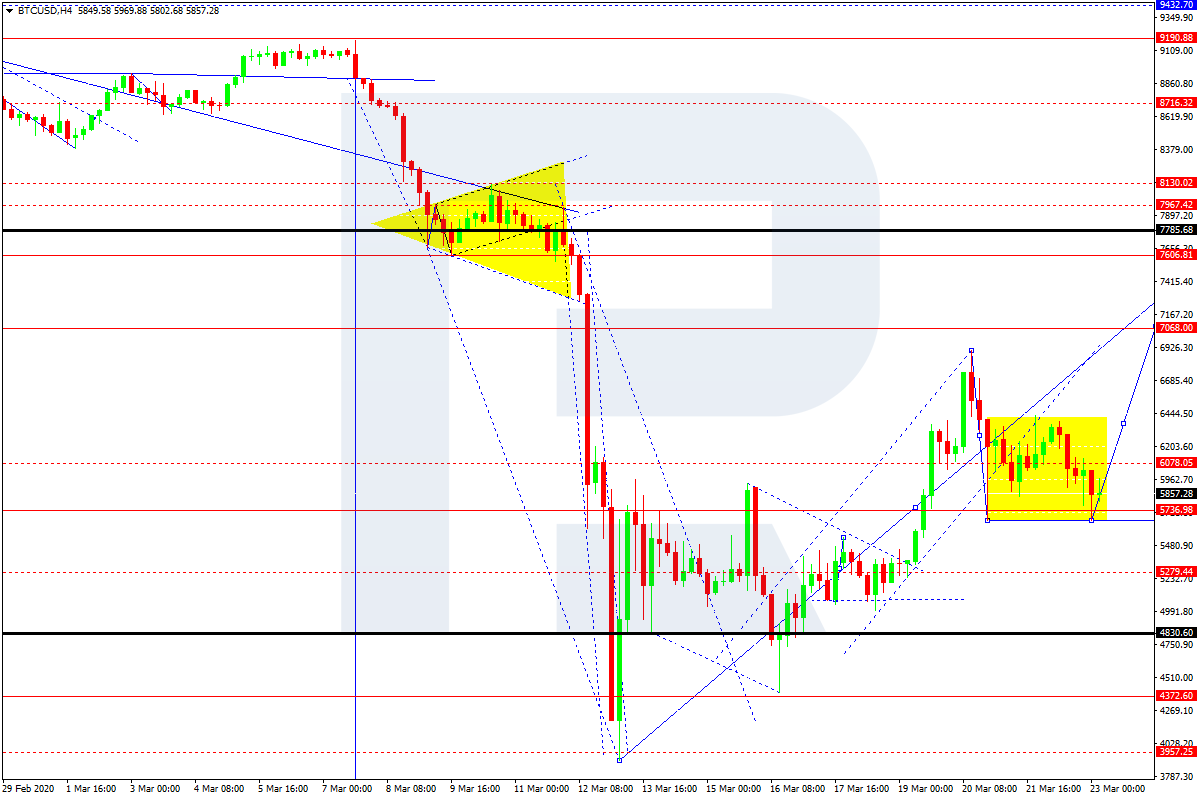
BTCUSD has finished the second ascending structure at 6800.00. The main scenario implies that the instrument may correct towards 5300.00 and then resume trading upwards to reach 7000.00. After that, the instrument may start another correction to return to 5300.00.

BITCOIN

Article By RoboForex.com

Attention!
Forecasts presented in this section only reflect the author’s private opinion and should not be considered as guidance for trading. RoboForex LP bears no responsibility for trading results based on trading recommendations described in these analytical reviews.

Oil Prices Are Ready for to Hit New Lows

By Dmitriy Gurkovskiy, Chief Analyst at RoboForex

On Monday, March 23rd, Brent is trading at 26.23 USD per barrel. After a quick rebound, market players resumed selling: demand for energy commodities remains low, thus putting pressure on prices.

The COVID-19 pandemic continues spreading worldwide and makes global governments enforce quarantine restrictions. The restrictions, in their turn, have a very significant influence on consumer activity. As a result, the global demand for energy commodities is decreasing as well.

The closer April the 1st is, when oil-producing countries-members of OPEC+ will no longer be bound by any agreements, the more nervous oil prices will be. There are reasons to believe that the market will be flooded with cheap oil and it might not only cause the chaos in prices but fix them on a very low level for a long period of time.

So far, the entire fundamental background is extremely negative for the oil.

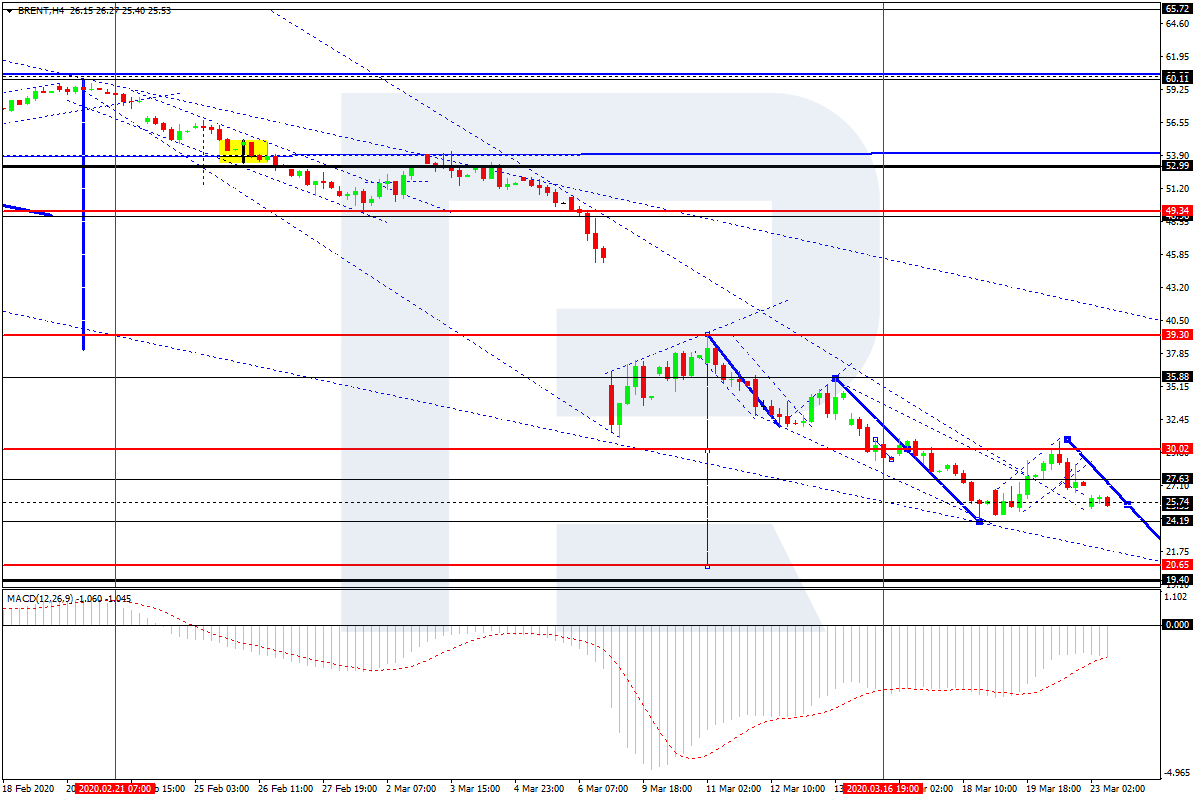
In the H4 chart, Brent is moving downwards. After breaking 26.00 to the downside, Brent may continue falling to reach 20.65. Later, the market may start a new growth with the first target at 30.03. From the technical point of view, this scenario is confirmed by MACD Oscillator: its signal line is moving below 0 and may enter the histogram area soon, thus indicating a further decline in the price chart.

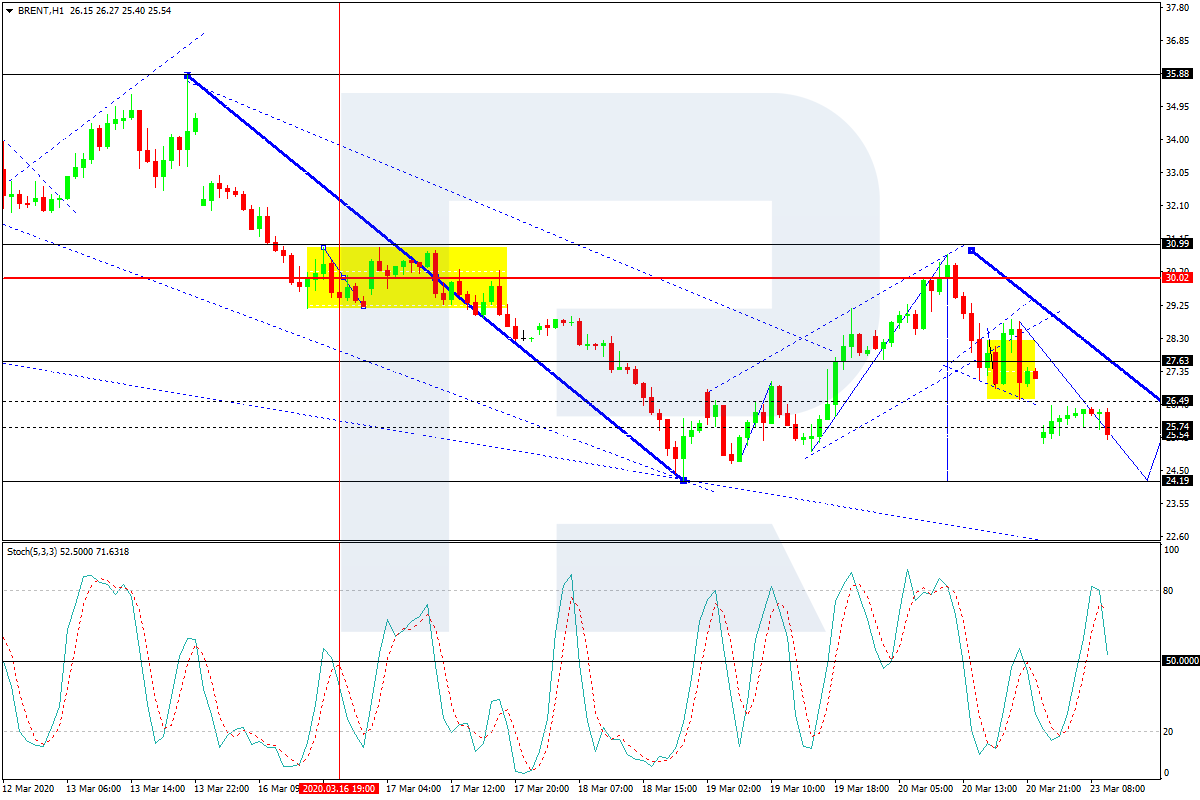
As we can see in the H1 chart, after finishing the descending impulse towards 27.63 and forming a new consolidation range around this level, Brent has broken it to the downside and may continue falling to reach 24.20. After that, the price may correct to return and test 27.63 from below. Later, the price may start a new decline with the short-term target at 23.50. From the technical point of view, this scenario is confirmed by Stochastic Oscillator: its signal line has rebounded from 80 to the downside and continues a steady decline towards 50. After breaking 50, the next target to reach is 20.

Disclaimer

Any predictions contained herein are based on the authors’ particular opinion. This analysis shall not be treated as trading advice. RoboForex shall not be held liable for the results of the trades arising from relying upon trading recommendations and reviews contained herein.


Navigating the upcoming economic crisis

By Hussein Sayed, Chief Market Strategist (Gulf & MENA), ForexTime 

Nowadays, there’s no other topic to talk about other than the coronavirus. The vast population across the globe is now sitting at home, trying to protect themselves and their family members from this deadly disease. Some are not even worried about losing their jobs as much as surviving this health crisis.

We are certainly living in an unprecedented time. The most watched indicator for investors has become the number of coronavirus cases, which has now topped 339,000 at the time of writing and continues to go higher. Many countries have reached, or are about to reach, a critical inflection point where things get out of control, as we’ve seen in Italy.

Navigating this crisis isn’t an easy one. To make an investment choice, you need to know whether the economy will go through a mild recession, a deep one or in the worst-case scenario, a depression. So far, it’s almost impossible to know where we are heading towards. Everything depends on when the coronavirus infections peak and begin to slow down.

US economic growth estimates from the biggest investment banks are becoming increasingly dire. Last week, JP Morgan expected GDP to shrink 14% in the second quarter of this year, Goldman Sachs sees a 24% fall, while the latest forecast by Morgan Stanley is even gloomier anticipating a 30% drop. However, the worst projections are coming from a well-respected Fed official, James Bullard, who said unemployment may hit 30% and GDP decline 50% in the second quarter.

Within the next couple of weeks, we will get to know how severe the upcoming economic crisis will be. The scariest scenario is that it turns into a credit crisis that will break the financial system. Leverage has skyrocketed over the past several years with inflows into US corporate and emerging market debt at very high levels. With most investors trying to withdraw their money from these asset classes, it could soon turn into a very deep financial crisis.

Those trying to pick a bottom on the S&P 500, should not get over-excited at this stage. The index has so far declined 32% from its February record high, and if we follow the current 5% decline which futures are indicating for the open, that will bring the losses to 37%. This would still be far less than the 57% decline of the 2007 – 2009 financial crisis and the 50% fall of the 2000 – 2002 dotcom bubble burst. And of course, that number is not even close to the 1929 – 1932 decline of 86%.

While it is tempting to buy stocks at their current cheap valuations, investors need to keep in mind that we still don’t have a clear picture of how the situation will evolve from here. The worst-case scenario of a prolonged recession is still not priced into equity markets. The right moment to begin accumulating equities is when all hope is lost, which could be months away unless a miracle happens and the virus suddenly disappears or a vaccination is discovered. Until then, expect demand for US dollars to remain high especially against emerging markets currencies.

Disclaimer: The content in this article comprises personal opinions and should not be construed as containing personal and/or other investment advice and/or an offer of and/or solicitation for any transactions in financial instruments and/or a guarantee and/or prediction of future performance. ForexTime (FXTM), its affiliates, agents, directors, officers or employees do not guarantee the accuracy, validity, timeliness or completeness, of any information or data made available and assume no liability as to any loss arising from any investment based on the same.


Forex-Time-LogoArticle by ForexTime

ForexTime Ltd (FXTM) is an award winning international online forex broker regulated by CySEC 185/12 www.forextime.com

The Analytical Overview of the Main Currency Pairs on 2020.03.23

by JustForex

The EUR/USD currency pair

Technical indicators of the currency pair:
  • Prev Open: 1.06560
  • Open: 1.07030
  • % chg. over the last day: -0.06
  • Day’s range: 1.06357 – 1.07867
  • 52 wk range: 1.0777 – 1.1494

The EUR/USD currency pair is traded in a flat. There is no defined trend. Investors are waiting for additional drivers. Currently, EUR/USD quotes are testing key support and resistance levels: 1.06550 and 1.08200, respectively. The spread of the COVID-19 virus still remains in the spotlight. China has recorded a decrease in the number of new cases of coronavirus during the day. The ECB reported that the response to the coronavirus outbreak was sufficient and effective, but the regulator is ready to do more if necessary. Open positions from key levels.

The Economic News Feed for 23.03.2020 is calm.

EUR/USD

Indicators do not give accurate signals: the price has crossed 50 MA.

MACD histogram is near the 0 mark.

The Stochastic Oscillator is located in the neutral zone, the %K line is below the %D line, which indicates a bearish sentiment.

Trading recommendations
  • Support levels: 1.06550, 1.06000
  • Resistance levels: 1.08200, 1.09550, 1.10600.

If the price fixes above 1.08200, expect the quote to correct toward 1.09000-1.09700.

Alternatively, the quotes could descend toward 1.06000.

The GBP/USD currency pair

Technical indicators of the currency pair:
  • Prev Open: 1.14620
  • Open: 1.16698
  • % chg. over the last day: +1.35
  • Day’s range: 1.15275 – 1.17145
  • 52 wk range: 1.1466 – 1.3516

GBP/USD quotes have stabilized after a significant collapse. The pound is now being consolidated. The key support and resistance levels are: 1.14500 and 1.17200, respectively. Investors continue to estimate the impact of COVID-19 virus on the global economy. Technical correction of GBP/USD currency pair is not excluded in the nearest future. Open positions from key levels.

The Economic News Feed for 23.03.2020 is calm.

GBP/USD

Indicators do not give accurate signals: the price has crossed 50 MA and 100 MA.

MACD histogram is near the 0 mark.

The Stochastic Oscillator is in the neutral zone, the %K line is below the %D line which points to a bearish sentiment.

Trading recommendations
  • Support levels: 1.14500
  • Resistance levels: 1.17200, 1.19000, 1.21350

If the price fixes above 1.17200, expect a correction toward 1.19000-1.20000.

Alternatively, the quotes could descend toward 1.14000-1.13500.

The USD/CAD currency pair

Technical indicators of the currency pair:
  • Prev Open: 1.45003
  • Open: 1.43566
  • % chg. over the last day: -1.02
  • Day’s range: 1.43507 – 1.44879
  • 52 wk range: 1.2949 – 1.4668

There is a mixed technical picture on the USD/CAD currency pair. At the moment CAD is consolidating. Local support and resistance levels are at: 1.43150 and 1.44900, respectively. Technical correction of the trading instrument after the prolonged rally is not ruled out in the nearest future. We recommend paying attention to the dynamics of oil quotations. Open positions from key levels.

The Economic News Feed for 23.03.2020 is calm.

USD/CAD

Indicators do not give accurate signals: the price has crossed 50 MA.

The MACD histogram is in the positive zone, which indicates a bullish sentiment.

The Stochastic Oscillator is in the neutral zone, the %K line is above the %D line, which gives a signal to buy USD/CAD.

Trading recommendations
  • Support levels: 1.43150, 1.41500, 1.40000
  • Resistance levels: 1.44900, 1.46600

If the price fixes below 1.43150, expect a correction toward 1.42000-1.41000.

Alternatively, the quotes could grow toward 1.46000-1.46500.

The USD/JPY currency pair

Technical indicators of the currency pair:
  • Prev Open: 110.888
  • Open: 110.755
  • % chg. over the last day: -0.05
  • Day’s range: 109.668 – 111.251
  • 52 wk range: 101.19 – 112.41

USD/JPY currency pair is in sideways movement. There is no defined trend. Financial markets participants are waiting for additional drivers. At the moment the key range is 109.500-111.450. Technical correction of the trading instrument after a prolonged fall is not ruled out in the nearest future. We recommend you to pay attention to the dynamics of US government securities yield. Oprn positions from key levels.

The Economic News Feed for 23.03.2020 is calm.

USD/JPY

Indicators do not give accurate signals: the price has crossed 50 MA.

MACD histogram is near the 0 mark.

The Stochastic Oscillator is located in the neutral zone, the %K line is above the %D line, which indicates a bullish sentiment.

Trading recommendations
  • Support levels: 109.500, 108.500, 107.850.
  • Resistance levels: 111.450, 112.000

If the price fixes below 109.500, expect the quotes to correct toward 109.500.

Alternatively, the quotes could grow toward 112.000.

by JustForex

Is the DAX30 currently waiting in the calm before the storm, below 8,000 points?

By Admiral Markets

Economic Events

Source: Economic Events March 23, 2020 – Admiral Markets’ Forex Calendar

Selling pressure on the DAX30 CFD remained high over the last week of trading, despite the massive monetary stimulus from the Fed on March 15, cutting rates to 0.0%-0.25% and launching a massive QE program of USD 700 billion, and by announcing swap lines with global central banks to make sure that enough USD is available and cutting reserve ratios for banks to 0. It also didn’t shift despite the massive monetary stimulus announced from the ECB on Wednesday evening.

The ECB went “all in”, launching a 750 billion euro emergency bond purchase scheme in a bid to stop a pandemic-induced financial rout from shredding the euro zone’s economy.

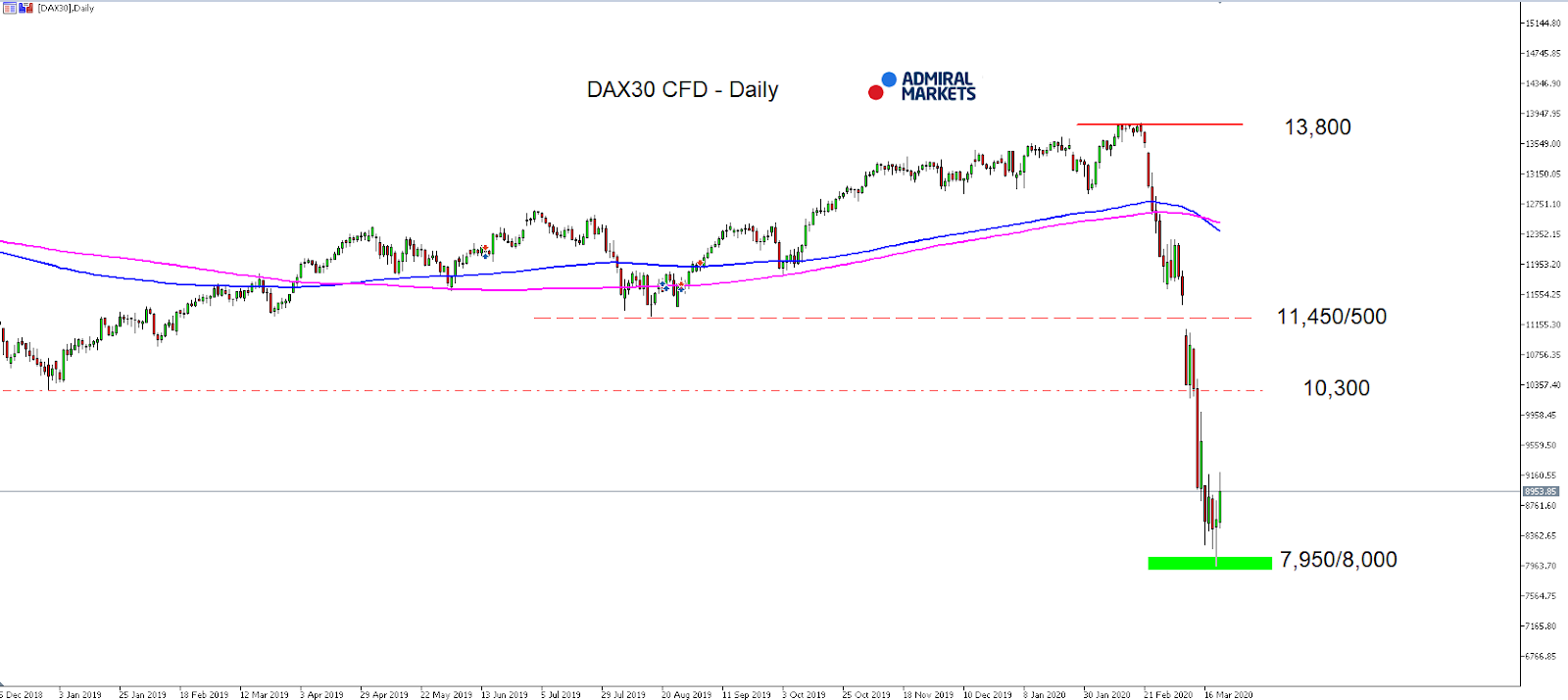
Still, the German index saw a solid weekly close, and if bulls and indications intensify that, the DAX30 CFD may have found, at the very least, a short-term bottom.

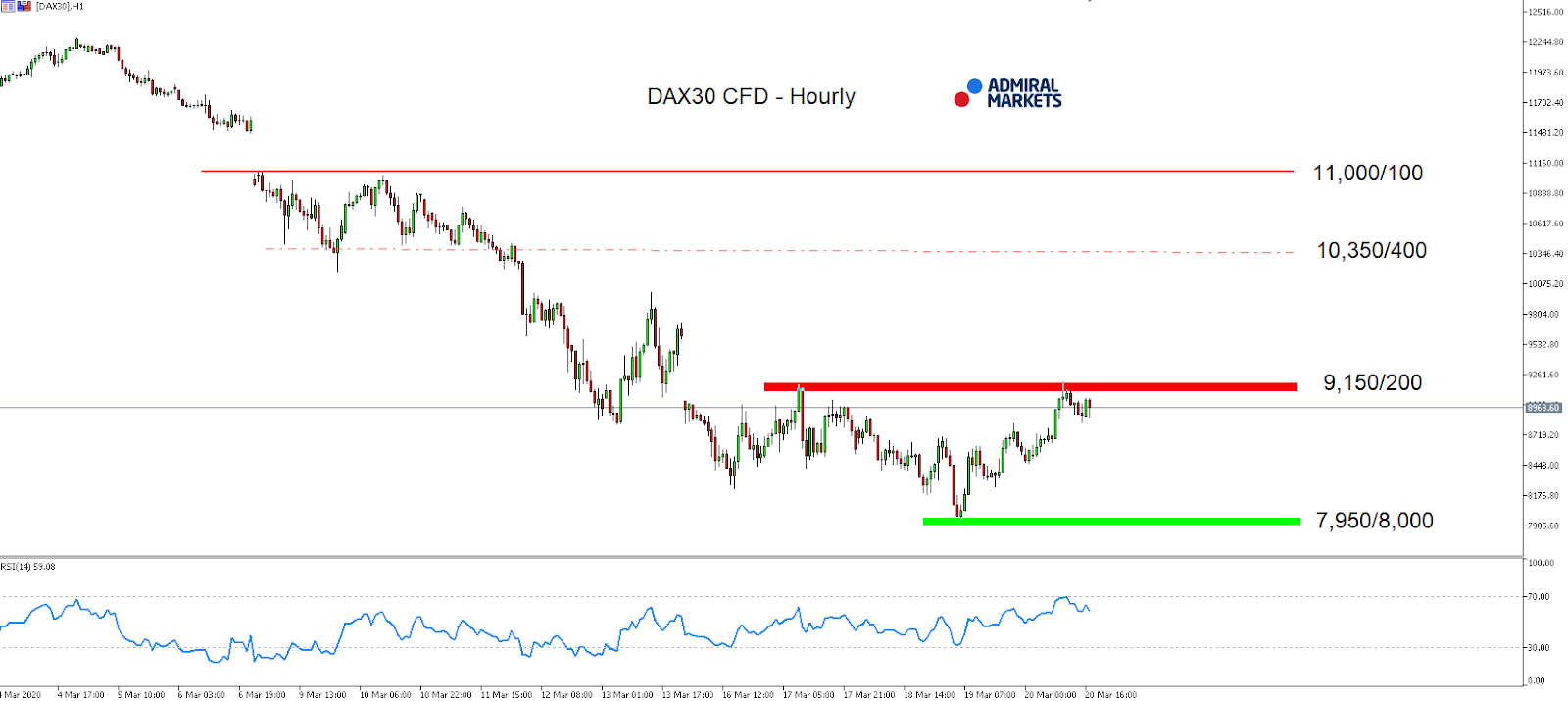
While volatility should be expected to stay massively elevated, the main focus on the upside is at the region around 9,150/200 points, and a break higher would accelerate the bullish momentum, bringing a re-test of the region around 10,000 points into play.

Nevertheless, the re-installed swap lines of the Fed is especially noteworthy since the world has built an enormous pile of USD debt over the years (especially over the last decade with the massive Fed QE), where 12.8 trillion of USD debt can be found in the books of banks around the globe. And this US dollar shortage will likely continue and force market participants to keep on dumping their Equity positions with the target to stay as liquid as possible.

That said, we stay bearish for the DAX30 CFD for the time being, consider any bullish stints as short-lived and see a drop as low as 7,500/8,000 points as a serious.

Hourly chart

Source: Admiral Markets MT5 with MT5-SE Add-on DAX30 CFD Hourly chart (between March 4, 2020, to March 20, 2020). Accessed: March 20, 2020, at 10:00 PM GMT

Daily chart

Source: Admiral Markets MT5 with MT5-SE Add-on DAX30 CFD Daily chart (between December 5, 2018 to March 20, 2020). Accessed: March 20, 2020, at 10:00pm GMT – Please note: Past performance is not a reliable indicator of future results, or future performance.

In 2015, the value of the DAX30 CFD increased by 9.56%, in 2016, it increased by 6.87%, in 2017, it increased by 12.51%, in 2018, it fell by 18.26%, in 2019, it increased by 26.44% meaning that after five years, it was up by 34.2%.

Discover the world’s #1 multi-asset platform

Admiral Markets offers professional traders the ability to trade with a custom, upgraded version of MetaTrader 5, allowing you to experience trading at a significantly higher, more rewarding level. Experience benefits such as the addition of the Market Heat Map, so you can compare various currency pairs to see which ones might be lucrative investments, access real-time trading data, and so much more. Click the banner below to start your FREE download of MT5 Supreme Edition!

Download MetaTrader 5 and begin trading today!

Disclaimer: The given data provides additional information regarding all analysis, estimates, prognosis, forecasts or other similar assessments or information (hereinafter “Analysis”) published on the website of Admiral Markets. Before making any investment decisions please pay close attention to the following:

  1. This is a marketing communication. The analysis is published for informative purposes only and are in no way to be construed as investment advice or recommendation. It has not been prepared in accordance with legal requirements designed to promote the independence of investment research, and that it is not subject to any prohibition on dealing ahead of the dissemination of investment research.
  2. Any investment decision is made by each client alone whereas Admiral Markets shall not be responsible for any loss or damage arising from any such decision, whether or not based on the Analysis.
  3. Each of the Analysis is prepared by an independent analyst (Jens Klatt, Professional Trader and Analyst, hereinafter “Author”) based on the Author’s personal estimations.
  4. To ensure that the interests of the clients would be protected and objectivity of the Analysis would not be damaged Admiral Markets has established relevant internal procedures for prevention and management of conflicts of interest.
  5. Whilst every reasonable effort is taken to ensure that all sources of the Analysis are reliable and that all information is presented, as much as possible, in an understandable, timely, precise and complete manner, Admiral Markets does not guarantee the accuracy or completeness of any information contained within the Analysis. The presented figures refer that refer to any past performance is not a reliable indicator of future results.
  6. The contents of the Analysis should not be construed as an express or implied promise, guarantee or implication by Admiral Markets that the client shall profit from the strategies therein or that losses in connection therewith may or shall be limited.
  7. Any kind of previous or modeled performance of financial instruments indicated within the Publication should not be construed as an express or implied promise, guarantee or implication by Admiral Markets for any future performance. The value of the financial instrument may both increase and decrease and the preservation of the asset value is not guaranteed.
  8. The projections included in the Analysis may be subject to additional fees, taxes or other charges, depending on the subject of the Publication. The price list applicable to the services provided by Admiral Markets is publicly available from the website of Admiral Markets.
  9. Leveraged products (including contracts for difference) are speculative in nature and may result in losses or profit. Before you start trading, you should make sure that you understand all the risks.

By Admiral Markets

US equity futures hit limit down, Asian stocks extend selloff

By Han Tan, Market Analyst, ForexTime

US stock futures have hit the limit-down level just minutes into the start of the Asian trading week, while most major Asian indexes began the week in the red. This comes as the number of confirmed Covid-19 cases globally breached the 300,000 mark over the weekend, while the US government’s plans for a US$2 trillion fiscal support package was met with political resistance, dealing a blow to investors who are hoping for some much-needed relief for the world’s largest economy.

The political wrangling in Congress could last anywhere between 12 hours to a few days before policymakers may agree on the details of the economic rescue package. In the meantime, the selloff in global equities is expected to continue as investors are given scarce reason to push stocks higher.

The S&P 500 futures have hit the limit down levels, which triggers a trading halt, for the ninth time in 10 days. Futures for the Dow Jones Index are falling by 4.88% at the time of writing, pointing to another day of losses when trading begins in New York.


New week, same Dollar

The Dollar index is still holding above the 103 psychological mark, prompting declines in most Asian currencies while triggering a mixed response from its G10 peers. The Japanese Yen is the star performer on Monday, gaining over 0.7 percent at the time of writing to test the 110 level against the US Dollar.

Considering the palpable risk aversion in the markets, which has triggered investors into clamoring for the Dollar for the refuge it provides, demand for the US Dollar is expected to remain elevated. Should the Dollar-funding crunch show signs of easing while investors’ patience levels continue being worn down, the Yen’s lure as a safe haven asset should eventually shine through once more.


Disclaimer: The content in this article comprises personal opinions and should not be construed as containing personal and/or other investment advice and/or an offer of and/or solicitation for any transactions in financial instruments and/or a guarantee and/or prediction of future performance. ForexTime (FXTM), its affiliates, agents, directors, officers or employees do not guarantee the accuracy, validity, timeliness or completeness, of any information or data made available and assume no liability as to any loss arising from any investment based on the same.


Forex-Time-LogoArticle by ForexTime

ForexTime Ltd (FXTM) is an award winning international online forex broker regulated by CySEC 185/12 www.forextime.com

EURUSD: coronavirus events boosting USD

By Alpari.com

On Friday, March 20, trading on the euro was down at the close. At the beginning of the European session, the price rose to 1.0831, before falling to 1.0638 in the US session. Markets collapsed on the back of the news that New York Governor Andrew Cuomo signed an order for the transfer to remote work for all employees of US-based companies. US President Donald Trump closed the border with Mexico, and then over the weekend – with Canada. The US is in lockdown.

Over the past week, the S&P500 index fell by 14.97%, to 2,304.9, (EURUSD) – by 3.66% or 406 points.

Today’s events (GMT+3):

  • 16:00 China: will publish an index of leading indicators for February.
  • 18:00 Eurozone: Consumer Confidence (Mar).

2303Current situation:

The expectations set out on Friday came true. The price rose up to the 135th degree, before falling to a new minimum price. Bears ran out of time in their quest to reach the target level of 1.0600.

In Asian trading, the euro set a new minimum, and recovered to the balance line (Lb). All attention remains focused on the pandemic and the spread of coronavirus.

Today is like Friday, we expect a rise to the Lb and a fall in price. We can see that the price has rebounded to the Lb and is ready for a new fall. If we consider the movement within the channel, then the target area for today is  found at the level of 1.0630.

To reverse the “bearish” trend, bulls need to gain a foothold above 1.0835. If the US market opens with growth, then a new minimum will not be reached. Given the ambiguous situation, working with the trend is safer.

By Alpari.com

Tentative schedule for this week in monetary policy: Kenya, Hungary, Nigeria, Thailand, Albania, Fiji, Czech Rep., UK, Angola, Colombia & Jamaica

By CentralBankNews.info

     Due to the high number of extraordinary policy meetings held by central banks in recent weeks, the following calendar for this week’s monetary policy decisions scheduled is tentative.
    Since March 3, when the U.S. Federal Reserve cut its benchmark rate at an emergency policy meeting, central banks worldwide have held at least 47 extraordinary meetings on how monetary policy should respond to the spread of the coronavirus, with interest rates cut at 45 of these meetings.

     At the other two emergency meetings where rates weren’t cut – one meeting by Sweden’s Riksbank and another by the European Central Bank (ECB)  – other monetary easing measures were decided, including the ECB’s new 750 billion euro Pandemic Emergency Purchase Program (PEPP) and the Riksbank’s increase of its bond purchases by up to 300 billion krona.
Five central banks that were scheduled to decide monetary policy this week, for example, already lowered their rates last week, a week that will go down in history as one of the most remarkable chapters in the history of monetary and economic policy.
The week started off with a bang on Sunday, March 15 when the Fed cut its rate to effectively zero at its second consecutive unscheduled rate cut in less than three weeks.
The Fed’s move was followed up with rate cuts by 44 other central banks during the following six days, with 30 of those cuts decided at emergency policy meetings.
Five of the 13 central banks that were scheduled to decide monetary policy this week already lowered their rates last week.
Of these five banks, Banco de Mexico communicated it had moved forward its policy meetings scheduled for this week while the Bank of England made clear it would be holding another monetary policy meeting this week.
Paraguay’s central bank pulled forward its policy meeting scheduled for this week (March 23) to March 13, when it cut its rate for the first time this year. But it then proceeded to hold an extraordinary meeting three days later on March 16, when it cut its rate once again.
It was not immediately clear from the other three banks that were among last week’s rate cutters – the Czech National Bank, the Bank of Thailand, and the Reserve Bank of Fiji – whether they would hold monetary policy meetings for the second week in a row.

This week – August 10 through August 15 – central banks from 11 countries or jurisdictions are scheduled to decide on monetary policy: Kenya, Hungary, Nigeria, Thailand, Albania, Fiji, Czech Republic, United Kingdom, Angola, Colombia and Jamaica.

    Following table includes the name of the country, the date of the next policy decision, the current policy rate, the result of the last policy decision, the change in the policy rate year to date, and the rate one year ago.

    The table is updated when the latest decisions are announced and can always accessed by clicking on This Week.

WEEK 13
MAR 22 – MAR 28, 2020:
KENYA23-Mar8.25%-100-1509.00%         FM
HUNGARY24-Mar0.90%000.90%         EM
NIGERIA24-Mar13.50%0013.50%         FM
THAILAND25-Mar0.75%-25-501.75%         EM
ALBANIA25-Mar1.00%001.00%
FIJI26-Mar0.25%-25-250.50%
CZECH REP.26-Mar1.75%-50-251.75%         EM
UNITED KINGDOM26-Mar0.10%-15-650.75%         DM
ANGOLA27-Mar15.50%0015.75%
COLOMBIA27-Mar4.25%004.25%         EM
JAMAICA27-Mar0.50%001.25%