The numbers will have much to do with the way the pandemic has changed our way of life.
We will be seeing the consumer confidence data coming out tomorrow and expectations are for a steeper fall.
Consumer confidence tracks sentiment among households or consumers. It represents the confidence consumers have in the economy and therefore assists in foreseeing consumer spending.
The higher the spending, the higher the confidence in the economy.
The forecast for March is 115.1 from a previous 130.7.
Latest Survey Reveals Gloomy Scenario
The latest survey conducted by Ipsos on March 24-25 states that the sentiment fell sharply in March. The majority of those surveyed said they are less comfortable making a major purchase like a home or a car (67%) and other household purchases (66%).
In fact, US consumer sentiment plummeted the most in March than it has since the market crash back in 2008. The surge in COVID-19 cases across the nation is alarming, with the lockdown of major businesses halting the economy.
In the 18 years since Ipsos started tracking US consumer confidence, this week’s slump has been the steepest to date. The index dropped to 46.0 from 60.9 previously.
The University of Michigan’s final sentiment index for March plunged 11.9 points to a three-year low of 89.1, data on Friday showed.
The economy has fallen into a pit with fear riding high amongst investors and consumers. The majority expect that the worst is yet to come.
Will Stimulus Put Confidence Back into the Economy?
The Fed is “committed to using its full range of tools to support households, businesses and the US economy overall.”
The bank is currently employing tactics used during the 2008 market crunch, along with new ones to soothe the market’s fears. However, the real question is whether the stimulus will able to halt the crumbling effect of the pandemic on the economy.
The answer is already available in the shape of the latest surveys mentioned above. Most small businesses will be hurt and will be forced to close. There will be a wave of unemployment and quite honestly, a recession may have already begun.
The Fed’s efforts have been tremendous, but the situation at hand is grim. All they can do is limit the damage and allow for recovery when the conditions are favorable.
The bank has been trying to bring calm into the financial markets. It wants to resurrect both bond markets and indices. A healthy turnaround in stocks and the bond market would certainly point to stability. This would lead to investor confidence, so the sooner this happens, the better.
Time is of the Essence
The lack of confidence will continue until the pandemic is under control or has been totally eradicated.
The longer the pandemic stays, and the longer it takes to find a vaccine, the worse it will get. No matter what the Fed does.
Don’t be surprised if the actual numbers come in much lower than forecast, as the situation is worsening every day.
By CentralBankNews.info The central bank of the Caribbean island of Barbados cut its interest rates for providing overnight funds to banks by 500 basis points to 2.0 percent along with further monetary policy easing measures to “support the domestic banking sector in light of the projected impact of COVID-19 on the economy and the financial system. The Central Bank of Barbados also announced a moratorium on loan payments for firms and individuals impacted by the pandemic for up to six months and will provide additional credit to its customer to address short-term liquidity challenges. “COVID-19 has had a crippling effect on the global economy,” the central bank said, noting the impact from a suspension of incoming flights to the island, the closure of hotels, attractions and restaurants. “We expect economic activity to contract, bringing with it the potential for signifiant job losses,” Governor Cleviston Haynes said.
“The Central Bank of Barbados today announced a series of measures to support the domestic banking sector in light of the projected impact of COVID-19 on the economy and the financial system.
In outlining the changes, the Bank said that, while the financial system is very liquid, liquidity at individual institutions may fluctuate from time to time, particularly in strained conditions. The Bank noted that financial institutions have access to the interbank market and/or negotiated credit line facilities.These actions, therefore, are intended to further help Barbados’ commercial banks and other deposit taking companies that it regulates navigate these trying circumstances.
Effective April 1, 2020,
The Bank’s discount rate at which it provides overnight lending to banks and deposit-taking non-banks licensed under the Financial Institutions Act will be reduced from 7 percent to 2 percent
The Bank will reduce the securities ratio for banks from 17.5 percent to 5 percent
The Bank will eliminate the 1.5 percent securities ratio for non-bank deposit taking licensees
The Bank also stands ready to make collateralised loans for up to six months as liquidity support for licensees, if necessary.
These actions will make it easier for financial institutions to assist their personal and business clients during the pandemic. The island’s commercial banks previously announced measures to help affected borrowers on a case by case basis. Those initiatives include:
A moratorium on loan payments for firms and individuals directly impacted by the pandemic and resulting economic downturn, for up to six months
Adjusted loan terms to reduce monthly payments and improve cash flows
Additional credit to existing customers to address short-term liquidity challenges
“COVID-19 has had a crippling effect on the global economy. Its impact on global tourism has already led to the suspension of incoming flights to Barbados and the closure of hotels, attractions and restaurants, which in turn has impacted other ancillary sectors,” said Central Bank Governor, Cleviston Haynes. “We expect economic activity to contract, bringing with it the potential for significant job losses.”
Governor Haynes said that because of the potential fallout, the Central Bank supports commercial banks’ efforts to work with their customers to ease the cash flow difficulties that are likely to emerge. He acknowledged, however, that these actions by commercial banks could adversely affect these institutions’ profitability and liquidity. “Given these circumstances, the Central Bank will enhance its monitoring and review its supervisory policies to enable institutions to address Covid-19 related problems.”
The Government earlier this month outlined countercyclical measures intended to stimulate domestic activity and to cushion the adverse effects on businesses and individuals.
The Bank says that its measures coupled with those of the Government and the commercial banks represent a multi-pronged response to dampen the effects of COVID-19, and should help to preserve financial stability and enable a faster turn-around in the economy once the crisis is over.
The Bank also noted that the impact of the crisis will be felt on foreign exchange earnings but that the country had a foreign reserve buffer that will be buttressed in the coming months by inflows from the international financial institutions.
It noted further, that the extent of the disruption hinges on several factors, including the duration and the depth of the impact of the pandemic and the speed at which the global recovery occurs.”
On Monday the 30th of March, trading on the euro closed down. The US dollar rose against the majors following a week of decline as investors prepare for a long period of uncertainty. This rise looks like a technical correction.
Trading on the US stock market closed up. The S&P 500 posted its highest weekly rise in percentage terms in 10 years. Stock indices were boosted by the announcement of a $2.2tn stimulus package for the US economy.
Day’s news (GMT+3):
10:55 Germany: unemployment rate (Mar).
11:30 UK: GDP (Q4).
12:00 Eurozone: CPI (Mar).
15:30 Canada: GDP (Jan).
16:00 US: S&P/Case-Shiller home price indices (Jan).
16:45 US: Chicago PMI (Mar).
17:00 US: consumer confidence (Mar).
Current situation:
Expectations of a drop on the EURUSD were met, except that the bears broke through the trend line in this morning’s Asian session. Fears over the spread of the coronavirus continue to reign supreme over the currency market.
We reckon that the downwards correction is set to continue. It would be nice to see a test of 1.0945/50 first. If the rate stays above 1.0953 today, then we can expect to revisit the 1.1148 high. Also bear in mind that the nonfarm payrolls report comes out in the US on Friday. Markets are already bracing themselves for a bad showing. Because of this, trading is likely to remain flat until Friday. Today, we’re forecasting a drop to the D3 line at 1.0945, followed by a bounce to 1.1035.
It has been an historic and volatile trading quarter defined by the novel coronavirus outbreak, with unprecedented central bank intervention, government action, global recession fears and severely depressed oil prices among many themes.
The sentiment pendulum has swung between extremes over the past few months, placing investors on an emotional rollercoaster ride as monetary policy bazookas and handsome fiscal packages have struggled to lift global confidence.
Although Asian markets are edging higher this morning following the better-than-expected China data and overnight gains on Wall Street, caution still lingers in the air. Global stock markets are on track for their worst quarter since the global financial crisis in 2008 and could experience more pain in Q2 as economic data from across the world starts to illustrate the negative impact of the virus outbreak.
Pound weakens as UK growth flatlines in Q4
Investors who were looking for another opportunity to attack the Pound were given the thumbs up after the UK GDP second estimate revealed that the economy showed no growth during the final quarter of 2019. Economic growth printed at 0.0% QoQ, while on an annualized basis, growth expanded 1.1% in Q4 matching market expectations.
The road ahead for the Pound remains filled with obstacles and buying sentiment is likely to diminish further, especially after the latest sovereign ratings downgrade from Fitch and lingering uncertainty over Brexit haunt investor attraction towards the currency.
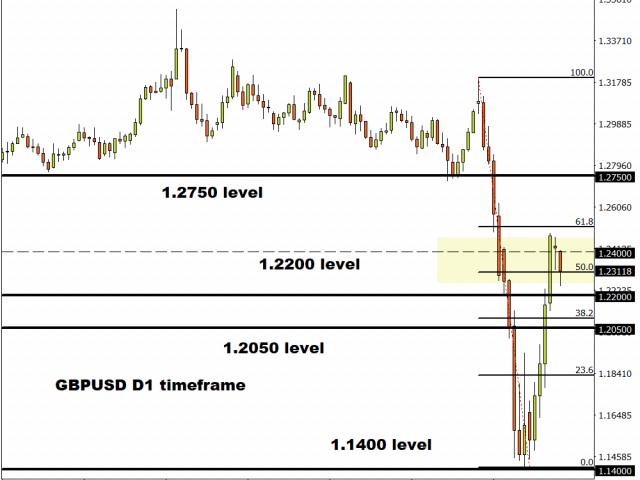
Focusing on the technical picture, GBPUSD is experiencing a technical rebound on the daily charts with prices trading around 1.2300 as of writing. A breakdown below the 50% Fibonacci level, could trigger a decline towards 1.2200 and 1.2050.
Dollar still wears crown
The mighty Dollar is on route to concluding the first quarter of 2020 standing tall against almost every single G10 currency, excluding the Swiss Franc and Japanese Yen.
In times of uncertainty, everyone wants a piece of the world’s most liquid currency. Appetite towards the Greenback should remain supported by the coronavirus pandemic and global recession fears. With caution still in the air, the currency may extend gains ahead of the US jobs report on Friday, which could offer fresh insight into the health of the US labour force.
Commodity spotlight – Gold
Gold is on standby after posting its best week since 2008, as investors await new economic data to access the damage caused by the novel coronavirus outbreak.
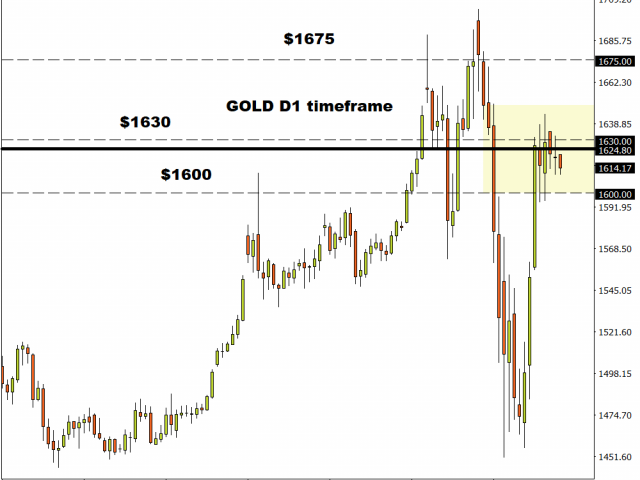
The precious metal should remain confined in a narrow $30 range until there is a fresh directional catalyst. Should the Dollar regain its footing on risk aversion and global recession fears, this may hinder Gold’s upside potential. Looking at the technical picture, prices could jump higher towards $1675 if a solid daily close above $1630 is achieved. Alternatively, sustained weakness below $1630 may open the door back towards $1600.
Disclaimer: The content in this article comprises personal opinions and should not be construed as containing personal and/or other investment advice and/or an offer of and/or solicitation for any transactions in financial instruments and/or a guarantee and/or prediction of future performance. ForexTime (FXTM), its affiliates, agents, directors, officers or employees do not guarantee the accuracy, validity, timeliness or completeness, of any information or data made available and assume no liability as to any loss arising from any investment based on the same.
US stock market rebounded on Monday as World Health Organization indicated the smallest increase in COVID-19 cases in two weeks were recorded in Italy. Overnight President Trump extended social-distancing guidelines through April 30. The S&P 500 rose 3.4% to 2626.65. Dow Jones industrial advanced 3.2% to 22327.48 as gains in Johnson & Johnson and UnitedHealth offset hefty Boeing loss. The Nasdaq gained 3.6% to7774.15. The dollar weakening reversed as the National Association of Realtors data showed pending home sales jumped 9.4% year over year in February: the live dollar index data show the ICE US Dollar index, a measure of the dollar’s strength against a basket of six rival currencies, recovered 0.8% to 99.04 and is higher currently.The President said Monday the US death rate was likely to peak in two weeks and the country would be “well on our way to recovery” by early June. Futures point to higher market openings today.
DAX 30 led European indexes rebound
European stocks rebounded on Monday. Both EUR/USD and GBP/USD reversed climbing yesterday with both pairs lower currently. The Stoxx Europe 600 index advanced 1.1% led by chemicals and healthcare shares supported by report euro-zone’s economic sentiment index fell less than expected in March. The DAX 30 rose 1.9% to 9815.97 as German annual inflation declined less than expected in March. France’s CAC 40 added 0.6% and UK’s FTSE 100 gained 1.0% to 5563.74.
Asian indexes mixed
Asian stock indices are mostly higher today following the rebound on Wall Street overnight. Nikkei however lost 0.9% to 18917.01 despite resumed yen decline against the dollar. Markets in China are rising as authorities reported China’s manufacturing activity and service sector bounced back stronger than expected in March: the Shanghai Composite Index is up 0.1% and Hong Kong’s Hang Seng Index is 1.1% higher. Australia’s All Ordinaries Index pulled back 2% as Australian dollar’s climb against the greenback continued.
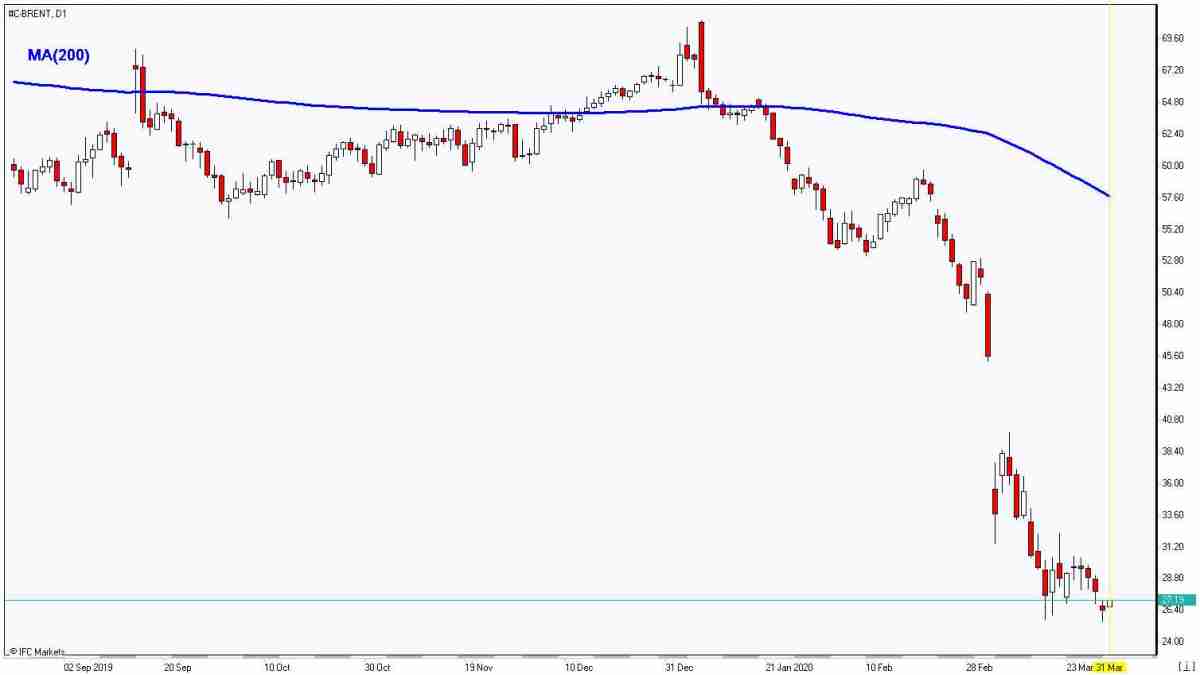
Brent futures prices are edging higher after a sharp drop on Monday. Prices tumbled yesterday on sharp fall in demand as countries implemented quarantine /lockdown measures: May Brent crude closed 8.7% lower at $22.76 a barrel on Monday, dropping 55.5% for the month.
Gold retreats as Dollar resumes strengthening
Gold prices are slipping today. April gold slid 0.2% to $1622 an ounce on Monday.
Note: This overview has an informative and tutorial character and is published for free. All the data, included in the overview, are received from public sources, recognized as more or less reliable. Moreover, there is no guarantee that the indicated information is full and precise. Overviews are not updated. The whole information in each overview, including opinion, indicators, charts and anything else, is provided only for familiarization purposes and is not financial advice or а recommendation. The whole text and its any part, as well as the charts cannot be considered as an offer to make a deal with any asset. IFC Markets and its employees under any circumstances are not liable for any action taken by someone else during or after reading the overview.
Bob Moriarty of 321gold comments on where he believes the economy is heading.
Those who never predicted a financial collapse in the first place are now edging closer to the swamp to dip their toes into the water. Now they are suggesting, perhaps we could have a recession.”
Forget that. You cannot have every supply chain in the world chopped in two and have a recession. A depression was baked into the cake before the Corona popped out of the six-pack. The US government dumping a $6 trillion dollar bailout for their buddies that has more pork in it than the butt of a two-ton pig is the proverbial pissing up a rope. We are in a depression. The entire financial system, education system, medical system, political system, hell, the entire artifice needs a total reset.
What do we get? More of the same. Well, if the government created the workspace for the depression by unlimited debt and financial chicanery, you are not going to fix it with more of the same.
Americans are unlike any other people on earth. At heart they want to trust their government. Granted, the Democrats understand that the Republicans are at the heart of all evil. And Republicans know full well that the Democrats caused all of the problems in the country but both agree that if only we elect their pet fools, all would be well with the world.
No other country on earth actually trusts their government. Their people growl and on occasion turn out in the streets to man the barricades but they know deep in their hearts that their “leaders” are fools who can do nothing well. Americans are always shocked to find their elected representatives are idiots. The rest of the world simply assumes stupidity and cupidity on their behalf and find themselves rarely disappointed.
Ignore the virus for a moment. True, it will kill tens of millions of people but everyone alive is going to die someday anyway. All the virus will do is accelerate the process. Some of those who survive will figure out how to cope.
The depression is another story. Already pundits are suggesting that investors should buy the dip. The FDIC actually put out a video saying, your money in the bank is safe. Do not withdraw your money. Are you kidding me, they really said that?
I’m told the FDIC chairman who actually put out the video was confused by the message. She stated in the first take of the video that “we are proud of the fact that since 1933 no American depositor covered by the FDIC ever lost a cent up until now. That’s a 99% success rate for us.” Naturally they had to brief her and rewrite her lines.
The message was clear. Just moments before a bank closes the president of the bank says, “Your money is perfectly safe in our bank.” And then slams the door forever.
Banks are going to close. The financial system may well shut down for a period. Lots of investors will go to bed rich and wake up poor.
Buying the dip is probably a really bad idea. We have had a crash. We have had a dead cat bounce and we are about to go back to the crash mode. Nothing at all has been fixed.
Between now and the end of this year I suspect the total drop will be between 85 and 92%. It could be worse. In the case of resource stocks, when the margin clerk calls, everything gets sold. Everything.
I have a lot of core positions of stocks I love. I will be putting in stink bids 20% lower than the close of shares I like the day before. While drops of 20% are common, drops of 25% are not. The value of these shares has not changed at all, only the price. Actually that’s not totally true, the latest $6 trillion piggy giveaway pretty much guarantees higher prices for real assets in the future. Keep some cash for screaming deals.
Rely on yourself, your family and your friends. The government is not your friend, not now, not ever.
Bob Moriarty founded 321gold.com, with his late wife, Barbara Moriarty, more than 16 years ago. They later added 321energy.com to cover oil, natural gas, gasoline, coal, solar, wind and nuclear energy. Both sites feature articles, editorial opinions, pricing figures and updates on current events affecting both sectors. Previously, Moriarty was a Marine F-4B and O-1 pilot with more than 832 missions in Vietnam. He holds 14 international aviation records.
Disclosure: 1) Statements and opinions expressed are the opinions of Bob Moriarty and not of Streetwise Reports or its officers. Bob Moriarty is wholly responsible for the validity of the statements. Streetwise Reports was not involved in the content preparation. Bob Moriarty was not paid by Streetwise Reports LLC for this article. Streetwise Reports was not paid by the author to publish or syndicate this article. 2) This article does not constitute investment advice. Each reader is encouraged to consult with his or her individual financial professional and any action a reader takes as a result of information presented here is his or her own responsibility. By opening this page, each reader accepts and agrees to Streetwise Reports’ terms of use and full legal disclaimer. This article is not a solicitation for investment. Streetwise Reports does not render general or specific investment advice and the information on Streetwise Reports should not be considered a recommendation to buy or sell any security. Streetwise Reports does not endorse or recommend the business, products, services or securities of any company mentioned on Streetwise Reports. 3) From time to time, Streetwise Reports LLC and its directors, officers, employees or members of their families, as well as persons interviewed for articles and interviews on the site, may have a long or short position in securities mentioned. Directors, officers, employees or members of their immediate families are prohibited from making purchases and/or sales of those securities in the open market or otherwise from the time of the interview or the decision to write an article until three business days after the publication of the interview or article. The foregoing prohibition does not apply to articles that in substance only restate previously published company releases.
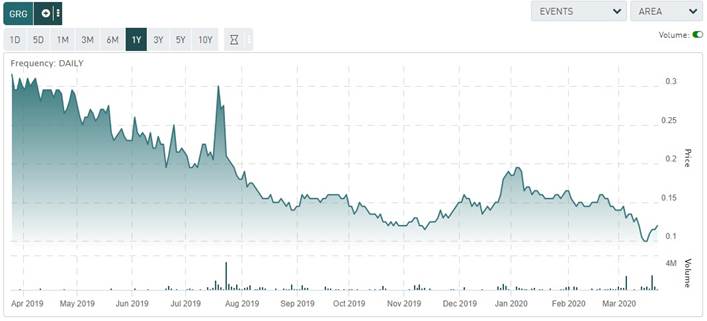
The coronavirus pandemic together with the Saudi Arabia-Russia oil production increase took its toll on the equity markets the last few weeks. The commodity markets in particular got hit too, as main end-user China got hit by a halt in manufacturing plants across the economy. Precious metals like gold rose initially, but after the virus spread globally it got sold off ruthlessly like any other asset class. Golden Arrow Resources Corp. (GRG:TSX.V; GARWF:OTCQB; G6A:FSE), as a gold explorer, didn’t come out completely unharmed either, as the following chart shows:
Share price Golden Arrow Resources 1 year time frame; Source Tmxmoney.com
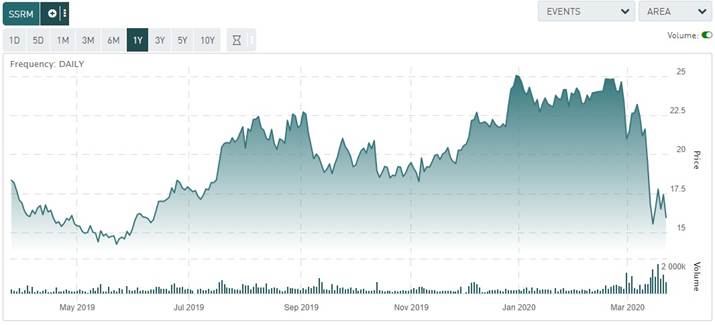
The drop in the share price for Golden Arrow is relatively comparable to that of SSR Mining, the company Golden Arrow holds roughly 1 million shares of (and which are the bulk of tangible assets at the moment):
At a current market capitalization of just C$14.3 million, Golden Arrow trades below the value of its SSR Mining holding, which attributes to C$16.2 million. Besides this, Golden Arrow has a modest cash position and its exploration assets among which is the promising Indiana gold project in Chile, so it is safe to say that the company has reached decent support levels technically and fundamentally speaking. Management decided this was the case as well, and came to the conclusion that it was probably easier to buy back shares in order to create accretive value for shareholders instead of trying to create value through the drill bit on its projects.
For that purpose, management announced a normal course issuer bid on March 12, 2020, to purchase up to 10,658,050shares being equal to 10% of the float. This bid commenced on March 17, 2020, and will end on the earlier of March 16, 2021, or when it’s been completed or terminated. The shares will be bought in the open market by PI Financial on behalf of Golden Arrow Resources. Management and the Board clearly think this will be advantageous for shareholders, as they commented as follows:
“The board of directors of the company are of the opinion that the recent market prices of its shares do not reflect the underlying value of its property portfolio and its strong financial position. Accordingly, the purchase of shares through the bid is in the best interests of the company and its shareholders, as it will increase the proportionate share interest of remaining shareholders. The bid will afford an increased degree of liquidity to the company’s shareholders. The directors also believe that there will be long term benefits to the company with fewer shares issued and outstanding.”
This news release was followed a few days later on March 16, 2020, by a statement of the President, Chairman and CEO Joseph Grosso, of which a few highlights are presented here:
“I believe that today’s market sentiment has resulted in a share price that does not reflect the Company’s asset value, or our future potential value. At this time, our asset value includes:
An extremely strong treasury of cash and cash equivalent securities.
100% control of a large property portfolio in Argentina with substantial geological values and work in progress.
The yearly compliance fee to hold these properties in Argentina is amongst the lowest in the world.
Three of Argentina’s most significant metal deposit discoveries had origins in this portfolio: Chinchillas, Gualcamayo and Navidad.
Golden Arrow has devoted considerable time, expertise and investment into advancing the portfolio to include a pipeline of mineral projects at various stages of exploration.
“In addition, our potential value includes:
Upside in our stock portfolio.
The discovery potential of the multiple mineral projects that we are currently exploring in Argentina, Chile and Paraguay. Any of these projects has the geological potential to generate significant discoveries and value in the near future.
“I believe that the current market is creating the significant disparity seen between the share price and the combination of our asset value and exploration potential. This has created the opportunity for management to initiate an economical buyback of up to 10% of the public float of our shares, as approved by the TSX Venture Exchange. This will benefit the shareholders by increasing their proportionate share interest, increasing liquidity provide long-term benefits afforded by a tighter structure.”
After reading this, I wasn’t immediately convinced if this was the best possible action for a junior explorer with a lot of current assets to its disposal, in a bear market. I have several reasons for this.
For juniors, cash is king in my view, and any available dollar should be guarded with their lives in bear markets, and preferably assigned solely to increase the value of their exploration assets.
Besides this, in a bear market it often doesn’t matter what you do as a junior mining company, it is very difficult to get rewarded for your actions/results as everything gets dragged down no matter what. On the other hand, a bull market lifts up all boats, as they say, and you get the most bang for your buck, so it seems more efficient to undertake share price enhancing actions during a bull market. Applying the kind of cash being used now for the buyback but instead aimed at, for example, marketing programs and market makers during better times would likely generate more significant results.
Furthermore, junior mining is a high risk, high reward sector, where share prices and market caps often fluctuate a lot, often based on nothing fundamental, and buyback programs are normally specifically based on enterprise values remaining the same in a more or less reliable and quantitative way, and resembles actions of blue chip multinationals.
Notwithstanding this, because of the current rout for oil companies, even the likes of Shell have halted their share buy back programs to save cash now, for harsh times to come. So, why Golden Arrow management decided to initiate a buyback program at a point where its SSR Mining shares are valued at about 40% lower compared to the highs of a few weeks ago, whereas Golden Arrow lost just 33% and already recovered towards a 20% loss from the share price right before the outbreak (probably caused partially by the buyback program itself), wasn’t really clear to me. If 10% of the float will be bought at an average price of 13c, this means C$1.38 million of precious cash will be gone. Therefore I asked them for more clarity on the subject.
Joseph Grosso commented himself as follows: “Golden Arrow has been trading at a discount to not only value, but to its cash (and cash equivalent) ever since the sale of Puna Operations to SSR Mining. Many investors had purchased Golden Arrow’s shares as a production story; even though we were a fairly passive investor in that project. The recent general market sell-off has exacerbated the discount. I believe that by initiating the repurchase of up to 10% of the company’s public float, we can show to the market that we firmly stand behind the value underpinning Golden Arrow. Since the announcement of our buyback program, the company’s shares are up by 20%. By reducing some of the outstanding shares, Golden Arrow is in effect mopping up excess stock held by investors with different investment objectives, and increasing the inherent value held across all remaining shareholders. As the bull market in gold continues to advance this should provide great leverage to all of our investors.”
One could wonder if investors who were in it for the leveraged production play didn’t already leave, and the sell-off wasn’t connected to a higher degree to the broader market sell-off itself, but let’s see what happens. At least they are buying back at an absolute low, and the leverage is optimized.
Exploration
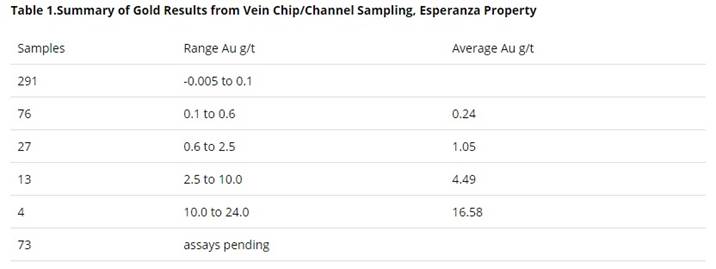
In the meantime, Golden Arrow progressed on its ongoing exploration programs, and the one at the Flecha de Oro project in Argentina delivered the first sampling results at the Esperanza and Puzzle properties. Sampling and mapping continued throughout the month of January at the Esperanza property, identifying high-grade and visible gold hosted in epithermal quartz veins. Especially the results at Esperanza were encouraging in my view, as shown here in this table:
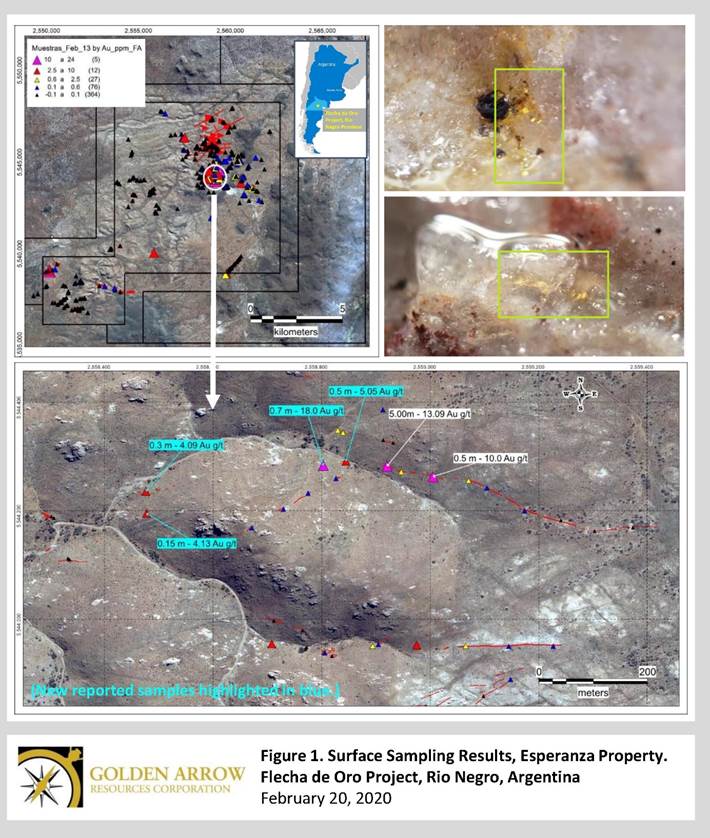
Everything topping 1 g/t Au at surface is showing high potential in my view, so if about 40 of 500 samples show these results, the sampling program was successful in my opinion. Several samples also involved visible gold, as can be seen at these pictures (in green):
At Esperanza, Golden Arrow’s target is to define high-grade mineralized zones within the 16 kilometers of identified quartz and chalcedony veins that display epithermal textures. The mapping program is continuing to gain greater understanding of the structural plumbing system and distribution of classic epithermal vein textures that can provide formation temperature information, which are both important in targeting thicker and higher-grade zones.
The company is using the Cerro Vanguardia district as an exploration model for the Esperanza property. There are geological similarities between the two areas, in particular the presence of swarms of low sulphidation epithermal quartz veins in an area of approximately 100 square kilometers. The Cerro Vanguardia district is located in Santa Cruz province in southern Argentina, and includes over 100 gold and silver-bearing epithermal veins. The district has a cumulative exposed vein strike extent of more than 240 kilometers, and has produced more than 4.5 million ounces of gold over the last 20 years.
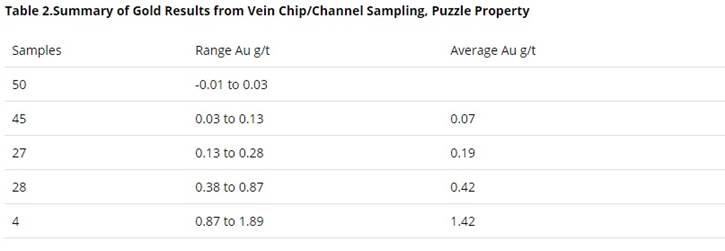
Golden Arrow Resources also received sampling results for the Puzzle property, but these were, despite establishing a trend of 6.5km, of much lower grade, and therefore of lower interest/potential in my view, especially since it is not heap leachable potential:
The trend can be seen here:
Despite these low-grade sampling results at Puzzle, the company made applications for additional concessions around both the Esperanza and Puzzle properties.
I also wondered if the corona pandemic had any influence on the ongoing exploration programs, and VP Exploration and Development Brian McEwen had this to say about this subject: “The Corona pandemic is a global phenomenon. Our first priority is the safety of our staff and personnel. Our organization is abiding by all the local regulations in every jurisdiction to keep our people safe. Although our exploration programs have been placed on a temporary holding pattern, we expect to pick up when this pandemic has passed us. We will provide updates, as appropriate.”
Conclusion
The share buyback program of 10% of the Golden Arrow Resources float came a bit as a surprise for me, as this is unusual for junior mining companies. After contacting Joseph Grosso, the reasoning became more clear, as they figured there were still investors with the objective of holding a (leveraged to silver) production play selling their shares, and they wanted to clean those up. The coronavirus seems to have a delaying impact on operations, according to Brian McEwen, as they paused their exploration programs in order to comply with all pandemic related regulations. It seems investors have to wait out the pandemic and its fallout, but in the meantime these share price levels trading below cash seem an interesting time to entry (or re-entry).
I hope you will find this article interesting and useful, and will have further interest in upcoming articles on mining. To never miss a thing, please subscribe to The Critical Investor’s free newsletter, http://www.criticalinvestor.eu, in order to get an email notice of my new articles soon after they are published.
The Critical Investor is a newsletter and comprehensive junior mining platform, providing analysis, blog and newsfeed and all sorts of information about junior mining. The editor is an avid and critical junior mining stock investor from The Netherlands, with an MSc background in construction/project management. Number cruncher at project economics, looking for high quality companies, mostly growth/turnaround/catalyst-driven to avoid too much dependence/influence of long-term commodity pricing/market sentiments, and often looking for long-term deep value. Getting burned in the past himself at junior mining investments by following overly positive sources that more often than not avoided to mention (hidden) risks or critical flaws, The Critical Investor learned his lesson well, and goes a few steps further ever since, providing a fresh, more in-depth, and critical vision on things, hence the name.
Disclaimer:The author is not a registered investment advisor, currently has a long position in this stock, and Golden Arrow Resources is a sponsoring company. All facts are to be checked by the reader. For more information go to www.goldenarrowresources.com and read the company’s profile and official documents on www.sedar.com, also for important risk disclosures. This article is provided for information purposes only, and is not intended to be investment advice of any kind, and all readers are encouraged to do their own due diligence, and talk to their own licensed investment advisors prior to making any investment decisions.
Streetwise Reports Disclosure: 1) The Critical Investor’s disclosures are listed above. 2) The following companies mentioned in the article are sponsors of Streetwise Reports: None. Click here for important disclosures about sponsor fees. The information provided above is for informational purposes only and is not a recommendation to buy or sell any security. 3) Statements and opinions expressed are the opinions of the author and not of Streetwise Reports or its officers. The author is wholly responsible for the validity of the statements. The author was not paid by Streetwise Reports for this article. Streetwise Reports was not paid by the author to publish or syndicate this article. Streetwise Reports requires contributing authors to disclose any shareholdings in, or economic relationships with, companies that they write about. Streetwise Reports relies upon the authors to accurately provide this information and Streetwise Reports has no means of verifying its accuracy.
4) The article does not constitute investment advice. Each reader is encouraged to consult with his or her individual financial professional and any action a reader takes as a result of information presented here is his or her own responsibility. By opening this page, each reader accepts and agrees to Streetwise Reports’ terms of use and full legal disclaimer. This article is not a solicitation for investment. Streetwise Reports does not render general or specific investment advice and the information on Streetwise Reports should not be considered a recommendation to buy or sell any security. Streetwise Reports does not endorse or recommend the business, products, services or securities of any company mentioned on Streetwise Reports. 5) From time to time, Streetwise Reports LLC and its directors, officers, employees or members of their families, as well as persons interviewed for articles and interviews on the site, may have a long or short position in securities mentioned. Directors, officers, employees or members of their immediate families are prohibited from making purchases and/or sales of those securities in the open market or otherwise from the time of the interview or the decision to write an article until three business days after the publication of the interview or article. The foregoing prohibition does not apply to articles that in substance only restate previously published company releases. As of the date of this article, officers and/or employees of Streetwise Reports LLC (including members of their household) own shares of Golden Arrow Resources, a company mentioned in this article.
Shares of Eton Pharmaceuticals traded higher after the company reported that it has acquired U.S. marketing rights to pediatric orphan drug Alkindi® Sprinkle from Diurnal Group Plc.
Eton Pharmaceuticals Inc. (ETON:NASDAQ), which is focused on developing and commercializing injectable and pediatric oral liquid products, today announced that “it has acquired U.S. marketing rights to Alkindi® Sprinkle from Diurnal Group Plc (DNL:AIM).”
The company indicated that “Alkindi Sprinkle’s New Drug Application is currently under review with the U.S Food and Drug Administration (FDA) for approval as a replacement therapy for pediatric adrenal insufficiency (AI), including congenital adrenal hyperplasia (CAH) in patients from birth to less than 17 years of age and that the application has been assigned a Prescription Drug User Fee Act date of September 29, 2020.”
The company’s CEO Sean Brynjelsen commented, “Alkindi Sprinkle represents a transformational acquisition for Eton and a major step forward on our journey to become a leader in pediatric rare disease products. This product represents the largest market opportunity within our pipeline and adds a major near-term product launch…We are excited to be partnering with Diurnal to bring Alkindi Sprinkle to pediatric patients, and we plan to immediately begin launch activities to ensure its commercial success.”
Martin Whitaker, CEO of Diurnal Group Plc, remarked, “We have been impressed by Eton’s enthusiasm and vision for the product throughout the Alkindi Sprinkle partnering process…If approved, Alkindi Sprinkle will provide a major breakthrough in the U.S. as the only licensed treatment specifically designed for use in children with adrenal insufficiency, where there is a significant unmet patient need.”
The company stated that its leadership position in pediatric rare diseases products makes Alkindi Sprinkle a strong strategic fit with its current pediatric portfolio. The firm advised that it believes this product represents a $100 million market opportunity. The company estimates that approximately 5,000 pediatric patients suffer from adrenal insufficiency in the U.S. and noted that “current FDA-approved treatment options do not offer physicians the ability to properly dose and titrate for many of these pediatric patients.”
The company explained that Alkindi Sprinkle is a taste neutral sprinkle granule formulation of hydrocortisone and added that if approved it would be the first AI replacement therapy specifically designed and developed for children. The firm defined AI as a condition in which the adrenal glands do not produce adequate amounts of cortisol, which is often caused by Addison’s Disease or CAH. The firm reported that the FDA has granted Alkindi Sprinkle Orphan Drug Designation and the drug was approved in Europe in 2018 under the trade name Alkindi and has been launched in several countries there.
The license agreement terms included an immediate cash payment by Eton to Diurnal in the amount of $3.5 million. In addition, Eton issued Diurnal 379,474 shares of its common stock, representing approximately $1.5 million based on Eton’s average fifteen-day trailing stock price. The firm noted that “upon commercial launch of the product with Orphan Drug Exclusivity granted, Eton will pay Diurnal an additional cash milestone payment of $2.5 million.”
The company reported that “in conjunction with the Alkindi Sprinkle transaction, it has executed agreements to raise $7.8 million from the sale of 2.6 million shares of common stock at $3.00 per share and that the equity financing was led by Opaleye Management.” The company also stated that it amended its credit line to draw $2 million of debt financing with the option to draw an additional $3 million and that the proceeds will be used to support current and future licensing payments to Diurnal, as well as Alkindi Sprinkle-related commercial launch expenses.
Eton Pharmaceuticals is a specialty pharmaceutical company based in Deer Park, Ill., that focuses on acquiring, developing and commercializing high-value innovative products. The company mentioned that it is primarily focused on hospital injectable and pediatric oral liquid products. The company stated that its first commercial product Biorphen, which was launched in December 2019 is the only FDA approved ready-to-use formulation of phenylephrine injection. The firm indicated that it has eight other products in development including three that are currently under FDA review.
Diurnal Group is headquartered in the U.K. and is a specialty pharmaceutical company developing medicines for treatment of chronic endocrine conditions including CAH and AI.
Eton Pharmaceuticals began the day with a market capitalization of around $59.5 million with approximately 17.88 million shares outstanding. ETON shares opened 5% higher today at $3.51 (+$0.18, +5.41%) over yesterday’s $3.33 closing price. The stock has traded today between $3.44 and $4.87 per share and at present is trading at $4.07 (+$0.74, +22.22%).
Disclosure: 1) Stephen Hytha compiled this article for Streetwise Reports LLC and provides services to Streetwise Reports as an independent contractor. He or members of his household own securities of the following companies mentioned in the article: None. He or members of his household are paid by the following companies mentioned in this article: None. 2) The following companies mentioned in this article are billboard sponsors of Streetwise Reports: None. Click here for important disclosures about sponsor fees. 3) Comments and opinions expressed are those of the specific experts and not of Streetwise Reports or its officers. The information provided above is for informational purposes only and is not a recommendation to buy or sell any security. 4) The article does not constitute investment advice. Each reader is encouraged to consult with his or her individual financial professional and any action a reader takes as a result of information presented here is his or her own responsibility. By opening this page, each reader accepts and agrees to Streetwise Reports’ terms of use and full legal disclaimer. This article is not a solicitation for investment. Streetwise Reports does not render general or specific investment advice and the information on Streetwise Reports should not be considered a recommendation to buy or sell any security. Streetwise Reports does not endorse or recommend the business, products, services or securities of any company mentioned on Streetwise Reports. 5) From time to time, Streetwise Reports LLC and its directors, officers, employees or members of their families, as well as persons interviewed for articles and interviews on the site, may have a long or short position in securities mentioned. Directors, officers, employees or members of their immediate families are prohibited from making purchases and/or sales of those securities in the open market or otherwise from the time of the interview or the decision to write an article until three business days after the publication of the interview or article. The foregoing prohibition does not apply to articles that in substance only restate previously published company releases. 6) This article does not constitute medical advice. Officers, employees and contributors to Streetwise Reports are not licensed medical professionals. Readers should always contact their healthcare professionals for medical advice.
Last week, retail demand for physical bullion tapered slightly from the frenetic pace of the prior two weeks.
Money Metals’ major competitors appear to be facing big challenges getting inventory and fulfilling orders – with the vast majority of their products either unavailable or significantly delayed. To be fair to the struggling dealers, buyers have vastly outnumbered the sellers for weeks, despite the big jump in premiums.
At Money Metals, however, we have done a better job than our peers when it comes to securing stock and fulfilling orders quickly – nor have we refused to allow smaller customers to place orders like all the others have.
Part of our secret is that Money Metals runs its own fulfillment operation (rather than outsourcing), has many good inventory sources, and is well capitalized and managed.
While the others have been jacking up premiums to astronomical levels, we have been able to cut premiums on key items including gold and silver American Eagles and 90% (junk) silver.
Moreover, the availability of our new Vault Silver and Vault Gold storage offering has taken some of the pressure off of our other inventories.
With Vault Metals, Money Metals clients now have another good option for avoiding the delivery delays and high premiums currently associated with many products, particularly silver.
One reason we created our low-cost Vault Metals storage program – which is built upon a hoard of large commercial gold and silver bars – is to allow Money Metals customers to bypass the production bottlenecks in retail coins, rounds, and bars that emerge during times of high demand.
The supply situation in fabricated products still has the potential to get worse before it gets better. The Royal Canadian Mint and major Swiss refiners including PAMP remain closed. There are also some signs of serious stress in the market for larger gold and silver bars.
But supply troubles may not be limited to retail bullion products. There is an increase in the number of investors standing for delivery of large bars in the futures markets. Under normal circumstances, very few contract holders ever take delivery. All of a sudden, physical supply and demand is starting to matter in the paper markets.
Bullion banks which sold paper gold to investors are now being asked to deliver. However, they have a problem.
They are having to draw on 400 oz gold bars vaulted in London. Their contracts specify 100 oz bars so the larger bars have to be melted. And the Swiss refiners who can convert those bars have closed shop temporarily. Air cargo is also more difficult – disrupted by COVID-19.
The COMEX, as always, is working very hard to help the bullion banks out of their pickle. The exchange massively hiked margin requirements, which contributed to the recent waterfall decline in futures prices for both metals.
Officials there also changed the delivery rules last week, providing banks with the option to deliver 400 oz and kilo sized gold bars – in London.
However, lower spot prices may now be contributing to the problem that the COMEX and bullion banks hoped to solve.
More people are asking for delivery, and physical bars now carry a significant premium.
Not everyone appears to be buying the story about the supply problems being temporary – the result of a lack of refining capacity and transport. Neither exchange officials, nor the bullion bankers, have explained why meeting delivery commitments in the U.S. is so dependent upon gold vaulted in London.
There is a COMEX vault network in the U.S. with bars which are supposed to be available to meet delivery requirements. So why isn’t that happening?
It appears that while bars may exist in the U.S., too few are categorized as “registered” and therefore can’t be released for purposes of making delivery. Prices may have to go higher before the owners are willing to part with actual physical bars.
The Money Metals News Service provides market news and crisp commentary for investors following the precious metals markets.
 Current situation: