Oil restores gains as OPEC+ set for emergency meeting

By Han Tan, Market Analyst, ForexTime

Brent futures erased earlier losses on Friday amid reports that OPEC+ is set to hold an emergency virtual meeting on Monday to stabilise global markets. Most Asian stocks and currencies are still declining, with US stock futures also in the red at the time of writing. News of the OPEC+ meeting comes after President Trump suggested on Twitter that Saudi Arabia and Russia could lower crude supply to stem the decline in Oil prices.

Crude prices are in need of a saviour, which must come by way of coordinated supply cuts by major producers, at least to put a firmer floor under prices. Even if the supply-cuts do materialise, it is unlikely to send ‘black gold’ soaring, considering the demand destruction already caused by the coronavirus.

With crude futures having plummeted by more than 50 percent year-to-date, prices can only hope to remain above the $30/bbl psychological level if OPEC+ can overcome its differences and reduce their collective output. Such coordination is needed to bring supply levels closer to the depressed demand that will accompany a global recession, which may then translate into a gentle lift for Oil prices. Aside from potential cuts, the other positive development for the market yesterday was the announcement that China would start building its reserves, taking advantage of the low-price environment.

US jobs announcement to hold little sway over Dollar index

Friday’s non-farm payrolls is not expected to reveal the true extent of the devastation in the US jobs market, seeing as the reference period ended before there were broad closures to businesses as part of the lockdown measures. Still, the non-farm payrolls print is set to post its first decline in a decade, which is expected to bring the US economy’s growth engine to a halt. With the Dollar index (DXY) now trading back above the 100 psychological level, the anticipated gloom contained in the jobs print is unlikely to significantly dampen the Greenback, which remains in demand amid the despairing global economy.

Riskier assets to be depressed by hard data

Global recession fears are now being confirmed by the incoming economic prints, from the shocking surge in US jobless claims, to the record drop in Italy’s manufacturing PMI and plummeting retail sales in Hong Kong. The coronavirus is clearly extending its reach across the globe, paralysing economic activity, while infecting over a million people and claiming over 53,000 lives in just four months.

Even after the health crisis has peaked, the economic ramifications are set to continue to be a drag on risk assets, with emerging markets being particularly vulnerable. Until the virus case count peaks and global economic conditions can find a more solid footing which means the business earnings outlook improves, risk sentiment may only experience fleeting bouts of positivity in the interim, as risk aversion remains the dominant de facto mode in global markets.


Disclaimer: The content in this article comprises personal opinions and should not be construed as containing personal and/or other investment advice and/or an offer of and/or solicitation for any transactions in financial instruments and/or a guarantee and/or prediction of future performance. ForexTime (FXTM), its affiliates, agents, directors, officers or employees do not guarantee the accuracy, validity, timeliness or completeness, of any information or data made available and assume no liability as to any loss arising from any investment based on the same.

Forex-Time-LogoArticle by ForexTime

ForexTime Ltd (FXTM) is an award winning international online forex broker regulated by CySEC 185/12 www.forextime.com
Futures slip ahead of jobs report

By IFCMarkets

US stocks recover led by oil shares propped by Trump tweet on expected crude output cut

US stock market rebounded on Thursday as optimism on rallying oil prices after President Trump tweeted Saudis and Russia would cut production by about 10 million barrels per day offset concerns about downturn in economy ahead of expected dismal jobs report. The S&P 500 rose 2.3% to 2526.9. erasing over half of previous session loss. The Dow Jones industrial average advanced 2.2% to 21413.44. Nasdaq composite index rebounded 1.7% to 7487.31. The dollar strengthening continued at previous pace despite report more than 6.6 million Americans filed for unemployment insurance for the first time last week doubling the previous week’s record: live dollar index data show the ICE US Dollar index, a measure of the dollar’s strength against a basket of six rival currencies, rose 1.4% to 100.09 and is higher currently. The labor market report due today is feared to show massive job losses caused by businesses shutting down due to the coronavirus pandemic.. Futures point to lower market openings today.

FTSE 100 leads European indexes’ advance

European stocks recovered partially on Thursday. GBP/USD joined EUR/USD’s accelerated slide yesterday with both pairs lower currently. The Stoxx Europe 600 index advanced 0.2% led by oil and gas shares. Germany’s DAX 30 gained 0.3% to 9570.82. France’s CAC 40 added 0.3% while UK’s FTSE 100 rose 0.5% to 5480.22.

Nikkei edges up while Asian indexes retreat

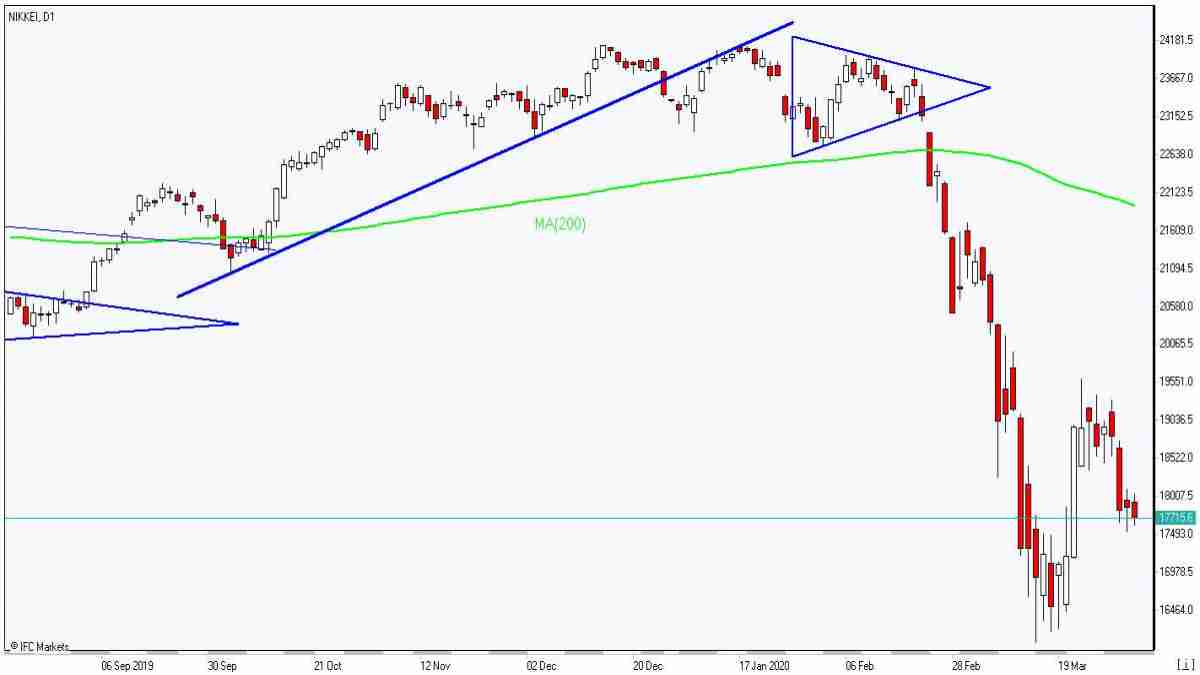
Asian stock indices are mostly lower today after solid gains on Wall Street staged by rally in energy shares. Nikkei ended marginally higher adding 1.5 points to 17820.19 as yen continued sliding against the dollar. Markets in China are falling despite Caixin report services PMI rebounded in March: the Shanghai Composite Index is down 0.6% while Hong Kong’s Hang Seng Index is 0.5% lower. Australia’s All Ordinaries Index pulled fell 1.7% despite the Australian dollar’s continued slide against the greenback.

Nikkei edges up toward MA(200) 4/3/2020 Market Overview IFC Markets chart

Brent advances

Brent futures prices are extending gains today. Prices jumped yesterday after President Trump tweeted that he expected a cutback of “approximately 10 Million Barrels, and maybe substantially more” in crude oil output by Saudi Arabia and Russia. Saudi Arabia news agencies reported the kingdom had called for an “urgent” meeting of the Organization of the Petroleum Exporting Countries and major producers to discuss restoring “ a desired balance of the oil markets.” The crude output curbing agreement between the Organization of the Petroleum Exporting Countries and non-member allies such as Russia expired on March 31. June Brent crude surged 21% to $29.94 a barrel on Thursday.

Gold pulls back

Gold prices are retracing lower today. Prices bounced yesterday: gold for June delivery rose 0.4% to $1638.30 an ounce on Thursday.

Market Analysis provided by IFCMarkets

Note:
This overview has an informative and tutorial character and is published for free. All the data, included in the overview, are received from public sources, recognized as more or less reliable. Moreover, there is no guarantee that the indicated information is full and precise. Overviews are not updated. The whole information in each overview, including opinion, indicators, charts and anything else, is provided only for familiarization purposes and is not financial advice or а recommendation. The whole text and its any part, as well as the charts cannot be considered as an offer to make a deal with any asset. IFC Markets and its employees under any circumstances are not liable for any action taken by someone else during or after reading the overview.

RoboMarkets Improves Trading Conditions for ECN-Pro and Prime Accounts

April 2nd, Limassol, Cyprus – RoboMarkets announces improvements of trading conditions offered to its clients – until the end of 2020, trading operations on accounts of ECN-Pro and Prime types will be available on the most comfortable conditions.

What changes have been introduced?

Spread values on ECN-Pro accounts are now similar to Prime ones. The leverage for ECN-Pro accounts has been increased up to 1:500. The maximum permissible leverage will be available only to Professional clients.

Trading conditions for premium accounts of a “Prime” type have also improved. The minimum deposited amount for these accounts is just 100 USD instead of 5,000 USD required earlier. The leverage value available to Professional clients has been increased up to 1:300.

We’re holding to our course on the improvement of trading conditions. Standing in close relations with our clients, we analyze the statistics and implement new technologies in order to follow our priorities for compliance with the highest quality standards. This promotion will allow RoboMarkets clients to take their trading operations to a brand new efficiency level and trade on some of the most competitive trading conditions in the industry throughout the entire year.” – said Anton Ivanov, a marketing manager at RoboMarkets.

About RoboMarkets

RoboMarkets is an investment company with the CySEC license No. 191/13. RoboMarkets offers investment services in many European countries by providing traders, who work on financial market, with access to its proprietary trading platforms. More detailed information about the Company’s products and activities can be found on the official website at www.robomarkets.com.


Egypt maintains rates after earlier emergency cut

By CentralBankNews.info
Egypt’s central bank left its benchmark interest rates steady, saying this would be consistent with achieving its inflation target following the 300 basis point rate cut at an unscheduled monetary policy meeting on March 16.
The Central Bank of Egypt (CBE) left its overnight deposit rate at 9.25 percent, the overnight lending rates at 10.25 percent, and the rate on its main operation and discount rate at 9.75 percent.
The decision was largely expected by analysts, with Egypt’s inflation rate easing to 5.3 percent in February from 7.2 percent in January on favorable base effects and contained inflationary pressures, CBE noted.
CBE targets inflation of 9 percent, plus/minus 3 percentage points in the fourth quarter of this year and price stability over the medium term.
Egypt’s tourism sector has been hit hard by the spread of the coronavirus and the associated containment measures worldwide and CBE said its rate cut on March 16 was a pre-emptive move to support economic activity, especially within households and businesses, and support employment, which is “essential in order to avoid a prolonged slowdown in economic activity and help speed the recovery once the outbreak is contained.”
Egypt’s economy grew 5.6 percent in the third quarter of 2019 year-on-year, down from 5.7 percent in the second quarter.

The Central Bank of Egypt issued the following statement:


“The Monetary Policy Committee (MPC) decided to keep the Central Bank of Egypt’s (CBE) overnight deposit rate, overnight lending rate, and the rate of the main operation unchanged at 9.25 percent, 10.25 percent, and 9.75 percent, respectively. The discount rate was also kept unchanged at 9.75 percent.
Annual headline urban inflation declined to 5.3 percent in February 2020 from 7.2 percent in January 2020, supported by favorable base effect as well as contained underlying inflationary pressures. The decline of annual headline inflation was mainly driven by lower annual food contribution, mainly volatile food items, while the contribution of non-food items remained broadly stable. Meanwhile, annual core inflation declined to 1.9 percent in February 2020 from 2.7 percent in January 2020, the lowest rate on record.
Real GDP growth had stabilized around 5.6 percent in 2019 H2, which was the same level recorded in FY2018/19. Meanwhile, the unemployment rate had recorded 8.0 percent in 2019 Q4 compared to 7.8 percent in 2019 Q3. Nevertheless, employment had been recovering on a quarterly basis for the fourth consecutive quarter.
However, the COVID-19 outbreak as well as the associated containment measures induce a considerable disruption to economic activity and financial markets globally. Furthermore, international oil prices witnessed substantial decline affected by weaker demand in addition to the lack of agreement between OPEC and non-OPEC members on additional production cuts.
The Central Bank of Egypt (CBE) moved preemptively, within its mandate, to support economic activity especially businesses and households. This should support employment in these exceptional times which is essential in order to avoid a prolonged slowdown in economic activity and help speed the recovery once the outbreak is contained.
Against this background, and following the reduction of 300 basis points during the previous unscheduled MPC meeting on March 16, 2020, the MPC decided that keeping key policy rates unchanged remains consistent with achieving the inflation target of 9 percent (±3 percentage points) in 2020 Q4 and price stability over the medium term.
The MPC closely monitors all economic developments and will not hesitate utilize all available tools to support the recovery of economic activity, within its price stability mandate, supported by the previous macroeconomic reforms.”

    www.CentralBankNews.info


Three COVID-19 Patients Treated with PLX Cells

By The Life Science Report

Source: Streetwise Reports   04/01/2020

Two programs, one new and the other ongoing, involving Pluristem Therapeutics’ regenerative products are reviewed in a Dawson James report.

In a March 30 research note, Dawson James Securities analyst Jason Kolbert reported that three high-risk COVID-19 patients were recently administered Pluristem Therapeutics Inc.’s (PSTI:NASDAQ) placental expanded (PLX) cells to evaluate the product as a potential treatment of the disease’s respiratory and inflammatory components.

“We are now seeing efforts from the leading regenerative medicine companies, including Pluristem, Mesoblast and Athersys, that these cell therapy treatments may help to soften the inflammatory cascade that initiates in acute respiratory distress syndrome (ARDS) patients and contributes to mortality,” Kolbert commented.

ARDS results from fluid collecting in the lungs’ alveoli, or air sacs, Kolbert explained. An infection in the lungs’ lobes can result from the coronavirus or pneumonia, “triggering an inflammatory cascade that causes death.”

Pluristem’s PLX cells, allogeneic, placenta derived and mesenchymal like, stimulate the body’s regenerative mechanisms, and thereby could possibly reduce COVID-19-induced pneumonia and pneumonitis, Kolbert wrote. “Previous preclinical findings of PLX cells revealed significant therapeutic effects in animal studies of pulmonary hypertension, lung fibrosis, acute kidney injury and gastrointestinal injury, which are potential complications of the severe COVID-19 infection,” he added.

The three COVID-19 patients who received Pluristem’s PLX cells have severe respiratory failure and are on ventilator support, noted Kolbert. The cells were dosed to them, in two hospitals in Israel, as part of a compassionate use program for the treatment of patients with the disease. This investigative program is a collaboration between Pluristem, the Berlin Institute of Health’s Center for Regenerative Therapy and the Charité Hospital’s Berlin Center for Advanced Therapies.

Kolbert also highlighted that the regenerative medicine firm has a late-stage clinical program in progress that Dawson James is watching, which is evaluating PLX cells in critical limb ischemia. Topline data from Pluristem’s Phase 3 trial in that indication could be available as early as next year.

Dawson James has a Buy rating and a $12 per share target price on Pluristem. The current share price is about $3.60.

Sign up for our FREE newsletter at: www.streetwisereports.com/get-news

Disclosure:
1) Doresa Banning compiled this article for Streetwise Reports LLC and provides services to Streetwise Reports as an independent contractor. She or members of her household own securities of the following companies mentioned in the article: None. She or members of her household are paid by the following companies mentioned in this article: None.
2) The following companies mentioned in this article are billboard sponsors of Streetwise Reports: None. Click here for important disclosures about sponsor fees.
3) Comments and opinions expressed are those of the specific experts and not of Streetwise Reports or its officers. The information provided above is for informational purposes only and is not a recommendation to buy or sell any security.
4) The article does not constitute investment advice. Each reader is encouraged to consult with his or her individual financial professional and any action a reader takes as a result of information presented here is his or her own responsibility. By opening this page, each reader accepts and agrees to Streetwise Reports’ terms of use and full legal disclaimer. This article is not a solicitation for investment. Streetwise Reports does not render general or specific investment advice and the information on Streetwise Reports should not be considered a recommendation to buy or sell any security. Streetwise Reports does not endorse or recommend the business, products, services or securities of any company mentioned on Streetwise Reports.
5) From time to time, Streetwise Reports LLC and its directors, officers, employees or members of their families, as well as persons interviewed for articles and interviews on the site, may have a long or short position in securities mentioned. Directors, officers, employees or members of their immediate families are prohibited from making purchases and/or sales of those securities in the open market or otherwise from the time of the interview or the decision to write an article until three business days after the publication of the interview or article. The foregoing prohibition does not apply to articles that in substance only restate previously published company releases.
6) This article does not constitute medical advice. Officers, employees and contributors to Streetwise Reports are not licensed medical professionals. Readers should always contact their healthcare professionals for medical advice.

Disclosures for Dawson James Securities, Pluristem Therapeutics, March 30, 2020,

The Firm does not make a market in the securities of the subject company(s). The Firm has NOT engaged in investment banking
relationships with PLURISTEM THERAPEUTICS in the prior twelve months, as a manager or co-manager of a public offering and has
NOT received compensation resulting from those relationships. The Firm may seek compensation for investment banking services in
the future from the subject company(s). The Firm has NOT received any other compensation from the subject company(s) in the last
12 months for services unrelated to managing or co-managing of a public offering.

Neither the research analyst(s) whose name appears on this report nor any member of his (their) household is an officer, director or advisory board member of these companies. The Firm and/or its directors and employees may own securities of the company(s) in this report and may increase or decrease holdings in the future. As of December 31, 2019, the Firm as a whole did not beneficially own 1% or more of any class of common equity securities of the subject company(s) of this report. The Firm, its officers, directors, analysts or employees may affect transactions in and have long or short positions in the securities (or options or warrants related to those securities) of the company(s) subject to this report. The Firm may affect transactions as principal or agent in those securities.

Analysts receive no direct compensation in connection with the Firm’s investment banking business. All Firm employees, including the analyst(s) responsible for preparing this report, may be eligible to receive non-product or service specific monetary bonus compensation that is based upon various factors, including total revenues of the Firm and its affiliates as well as a portion of the proceeds from a broad pool of investment vehicles consisting of components of the compensation generated by investment banking activities, including but not limited to shares of stock and/or warrants, which may or may not include the securities referenced in this report.

Analyst Certification: The analyst(s) whose name appears on this research report certifies that 1) all of the views expressed in this report accurately reflect his (their) personal views about any and all of the subject securities or issuers discussed; and 2) no part of the research analyst’s compensation was, is, or will be directly or indirectly related to the specific recommendations or views expressed by the research analyst in this research report; and 3) all Dawson James employees, including the analyst(s) responsible for preparing this research report, may be eligible to receive non-product or service specific monetary bonus compensation that is based upon various factors, including total revenues of Dawson James and its affiliates as well as a portion of the proceeds from a broad pool of investment vehicles consisting of components of the compensation generated by investment banking activities, including but not limited to shares of stock and/or warrants, which may or may not include the securities referenced in this report.

( Companies Mentioned: PSTI:NASDAQ,
)

Dollar higher despite U.S Jobless Claims hitting 6.6M

By Lukman Otunuga, Research Analyst, ForexTime

The largest economy in the world is certainly not bulletproof against the novel coronavirus outbreak and this stark reality was reflected in the latest US initial jobless claims figures.

A total of 6.65 million Americans applied for unemployment benefits last week which was double the previous record set at 3.3 million amid the widespread economic shutdown and chaos caused by the pandemic. These abysmal figures are painting a gloomy picture over how badly the coronavirus has hit the US economy with the pace of layoffs expected to accelerate as recession fears mount.

The Dollar appreciated despite the disappointing initial jobless claims data with the Dollar Index (DXY) pushing back above100.00. King Dollar is still considered as a destination of safety despite the horrible economic data from the United States. There is also a sentiment that if things are this bad in the largest economy in the world, how bad are things across the globe?

Technical traders will continue to closely observe how prices behave around 100.00 ahead of the US jobs report on Friday. Will the Dollar still be considered as a hotspot of safety if the US jobs report fails to meet market expectations? This is a question on the mind of many investors.

Disclaimer: The content in this article comprises personal opinions and should not be construed as containing personal and/or other investment advice and/or an offer of and/or solicitation for any transactions in financial instruments and/or a guarantee and/or prediction of future performance. ForexTime (FXTM), its affiliates, agents, directors, officers or employees do not guarantee the accuracy, validity, timeliness or completeness, of any information or data made available and assume no liability as to any loss arising from any investment based on the same.


Forex-Time-LogoArticle by ForexTime

ForexTime Ltd (FXTM) is an award winning international online forex broker regulated by CySEC 185/12 www.forextime.com

Concerned That Asia Could Blow A Hole In Future Economic Recovery

By TheTechnicalTraders 

– Thinking somewhat far off into the future, our researchers believe China/Asia could become the next Black Hole in the global economy.  China recently released its March PMI number which came in at 52.0 – showing moderate expansion in Chinese manufacturing.  The February Chinese PMI level was 35.7.  We strongly believe China wants to show some strength in their perceived economic recovery and that these PMI numbers are somewhat “manufactured for effect”.

We believe the real economic toll taking place in China/Asia will continue to unfold over the next 3 to 6+ months as the historic expansion of wealth and the exported foreign investment from Wealthy Chinese continues to contract over this time.  In a very similar manner to what happened in the US when the Japanese economy contracted in the 1990s – as wealth creation processes collapse, these foreign investors suddenly start to liquidate assets trying to protect their “home-country assets”.

(Suggested Reading: https://www.barrons.com/articles/china-pmi-data-coronavirus-51585666441)

We’ve recently posted an article suggesting the US Real Estate market could suddenly find itself in a real measurable collapse and we believe the foreign investors, speculators and speculative renters (Air BnB and others) will suddenly find themselves in a very difficult situation.  You can find our Real Estate article here.

As the COVID-19 virus event continues to unfold, the data from global nations will quickly identify any outlier factors and data points related to China/Asia and how they are reporting their data.  Chinese economic data has raised suspicions for quite some time with global analysts.  It seems highly unlikely that the Chinese economy rebounded from an almost complete shutdown in February and most of March to a moderate manufacturing growth level at the end of March 2020.  Meanwhile, throughout the rest of the globe, economies, and manufacturing levels are contracting as the COVID-19 shutdown continues.

(Suggested Reading: https://www.yahoo.com/finance/news/asias-factory-activity-plunges-coronavirus-044302834.html)

We believe the disparity between the global markets and the numbers China continues to proffer will quickly result in a complete lack of confidence in future data related to any Chinese economic activity or future expectations. We also believe the global capital markets will make an immediate shift away from risks associated with any falsified data originating from China by mitigating forward risks in investments and currency market exposure over the next 3 to 5+ years – possibly longer.

Before you continue, be sure to opt-in to our free market trend signals 
before closing this page, so you don’t miss our next special report!

Source: Finviz.com

What happens when global events like the COVID-19 virus event takes place is that capital immediately attempts to identify extreme risks and attempt to move to safer environments.  Currencies are no different.  Global markets, investment, and manufacturing are increasingly exposed to risks related to the shifting markets and any false or otherwise “outlier” data being reported right now.  The bigger players can’t afford to take risks and will take active measures to protect their futures and investments.

Source: Finviz.com

(Suggested Reading: https://www.cnbc.com/2020/03/31/asia-markets-china-official-pmi-coronavirus-global-economy-in-focus.html)

Our opinion is that the Chinese PMI level of 52 for March 2020 is an outlier data point.  This virus event started in early January in China and almost all of February and March were when the globe suddenly became aware of the risks and infection spread.  Even though China may have attempted to ramp up manufacturing over the past 2+ weeks to appear to be “back to normal” – it makes no sense to us that manufacturing in China actually “expanded”, based on historical levels, that quickly.

Watch how quickly global economies and currencies work to mitigate the risks related to perceived “outlier data”.  We believe most of Asia will continue into an economic contraction over the next 3+ months and we believe the FOREX market will relate the immediate risk concerns related to Asia/China/global market expectations.  In other words, watch the currencies to see how global investors perceive risks associated with true economic activity.

The World Bank many not have a deep enough piggy bank to back the extended risks of an Asian Economic contraction lasting 6+ months.

(Suggested Reading: https://www.marketwatch.com/story/world-bank-says-coronavirus-outbreak-may-take-heavy-toll-on-asias-economy-2020-03-30)

As a technical analysis and trader since 1997, I have been through a few bull/bear market cycles. I believe I have a good pulse on the market and timing key turning points for short-term swing traders.

I hope you found this informative, and if you would like to get a pre-market video every day before the opening bell, along with my trade alerts visit my Active ETF Trading Newsletter. If you are a long-term investor looking for signals when to own equities, bonds, or cash, be sure to look into my Long-Term Investing Signals.

Ride my coattails as I navigate these financial markets and build wealth while others lose nearly everything they own during the next financial crisis.

Chris Vermeulen
Chief Market Strategist

TheTechnicalTraders.com


WTI Crude Oil Hovers Below 22.00

By Orbex

Oil prices are trading slightly higher with prices rising modestly, by 1.50% intraday. However, prices remain strongly below the 22.00 handle meaning that there is still a downside risk.

For the moment, price action is caught in the range of 22.00 and 19.25. A breakout from these levels could be expected.

The Stochastics oscillator points to a possible hidden divergence which confirms with the downside bias.

By Orbex


Europe’s Coronavirus Contraction Part II: Bracing for Contraction and Debt Crisis

By Dan Steinbock     

Since inadequate preparedness prevailed in Europe until recently, the consequent pandemic will cast a prolonged, dark shadow over the regionwide economy – starting with the contraction, followed by the debt crisis.

Around the world, the early economic defense against the economic impact of the novel coronavirus has been by the major central banks to cut down the rates, inject liquidity and re-start major asset purchases.

But as the post-2008 decade has shown, monetary responses cannot resolve fiscal challenges.

Bracing for the plunge

The early damage has focused on a set of key sectors, such as healthcare, transportation, retail, tourism, among others. So easy money will be coupled with targeted fiscal stimuli in affected economies. Yet, current measures to restrict the infection and economic damage will contribute to further debt erosion in major advanced and emerging economies.

Recently, the White House signed the $2 trillion coronavirus bill, the largest ever U.S. stimulus. It may not ensure adequate support for more than 4-6 months. To overcome the crisis, an extended period of 6-18 months may loom ahead when some kind of fiscal accommodation will be needed.

In the US, sovereign debt has increased record fast in the Trump era and now exceeds $23.5 trillion (107% of GDP); that is, before the virus stimulus bill or bills will cause it to soar. And so, we are back in the post-2008 territory that was never supposed to recur. But now, after a decade of ultra-low rates, rounds of quantitative easing and liquidity injections, the situation is much worse.

In the Eurozone, recessionary pressures come in a particularly bad time. Before the virus, the annual economic growth was about 1.0% in the fourth quarter of 2019, signaling the weakest expansion in seven years. However, the first quarter could contract to -3.0%, while the second could be worse than in 2008-9.

In both the United States and the Eurozone/UK, the first quarter damage will only be the prelude to the second quarter carnage. And if the virus is not managed appropriately, the consequent hit will cast a shadow over the hoped-for rebound in the second half of 2020 as well, possibly into 2021.

In Europe, the Maastricht Treaty deems that member states should not have excessive government debt (60%+ of GDP). Today, no major European economy fulfills that criteria. To overcome their short-term challenges, countries will take more debt, which will further erode their debt-to-GDP ratios.

Certainly, central banks in Europe and the UK will follow US footprints into more monetary and fiscal accommodation. But that may fail to quell virus fears, if infection rates continue to soar. As virus mobilization intensifies in European economies, so will new debt-taking.

Even before the virus crisis, Italy’s level of sovereign debt soared from 110% as share of the GDP to the alarming 135% in the course of the 2010s. It will increase a lot faster now. In Spain, the debt crisis of the past decade pushed the ratio from just 60% to a peak of 100% of GDP in 2014. In the past half a decade, it has decreased but that progress will now be reversed.

In France, the ratio climbed from 85% to close to 100% in 2016 but has stayed at that level since then. Those days are now over as the ratio will start climbing. In the UK, sovereign debt was close to 60% in 2010, but soared to close to 85% in 2017, thanks to the impending Brexit. Now the UK will have to face the costs of the Brexit and the virus crisis.

Germany is the only major European economy in which sovereign debt as share of the GDP actually declined in the past decade from 80% to close to 60%. In the past two years, Berlin has been able to offset the US tariff war losses, but now it will have to cope with worse challenges. And when German economy contracts, the rest of Europe will plunge.

The way out

In advanced economies – and particularly in the heavily-indebted European countries, which are already struggling to absorb the costs of the 2008 great recession, the 2010 EU debt crisis, the UK Brexit, and the US tariff wars – the coronavirus contraction has potential to wipe out a decade of recovery. But that’s just a prelude.

Furthermore, if containment measures fail, or subsequent mitigation proves inadequate, or new virus clusters emerge after containment and mitigation, markets will remain volatile and economies will suffer further damage, particularly if multiple waves of secondary infections recur after current restrictive measures.

What is desperately needed is multipolar cooperation among major economies and across political differences. In this quest, China, where containment measures have been successful, can show the way, along with major advanced and emerging powers.

President Xi Jinping’s call on Trump to improve US-China relations amid Covid-19 crisis and cooperate against the virus is a good start.

But isn’t it time for Europe to join the bandwagon?

About the Author:

Dr. Dan Steinbock is an internationally recognized strategist of the multipolar world and the founder of Difference Group. He has served at the India, China and America Institute (USA), Shanghai Institutes for International Studies (China) and the EU Center (Singapore). For more, see https://www.differencegroup.net  For recent coronavirus briefings, see https://www.differencegroup.net/coronavirus-briefs

This is the second part of the commentary that the European Financial Review released online on March 30, 2020 online and will publish in its April/May print edition.

SUGAR Analysis: Expected rise in Brazil exports bearish for sugar price

By IFCMarkets

Expected rise in Brazil exports bearish for sugar price

Mills in Brazil are capable of switching cane toward sugar or ethanol production, depending on market prices. Low crude oil prices make production of bioethanol from sugar cane a less attractive alternative for sugar mills compared to production of sugar. And weaker currency of Brazil – real, makes switching from bioethanol to sugar production more profitable for Brazil’s mills as ethanol is mostly sold domestically while sugar is being exported, earning appreciating dollars for exporters. Brazil’s mills allocated an all-time low amount of cane for sugar last two years – around 34%, as ethanol gave them higher returns. Copersucar, the world’s largest sugar co-op, estimates mills will allocate 46% cane for sugar in the new season. This will increase Brazil’s sugar export by around 10 million tons. Brazil is the top global sugar producer. A rise in sugar supply is bearish for sugar prices.

IndicatorVALUESignal
RSINeutral
MACDSell
Donchian ChannelSell
MA(200)Sell
FractalsSell
Parabolic SARSell


Summary of technical analysis

OrderSell
Buy stopBelow 10.02
Stop lossAbove 11.55

Market Analysis provided by IFCMarkets