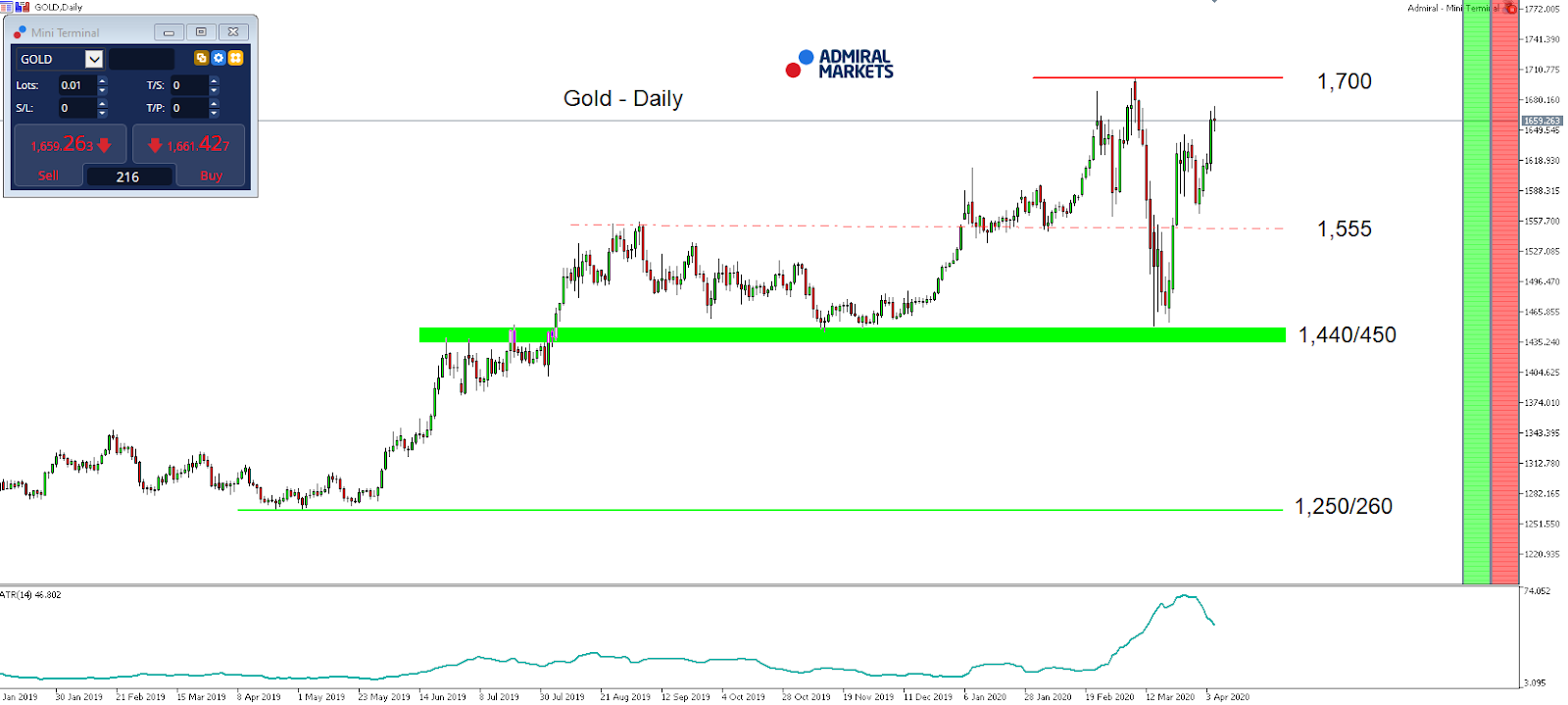
The technical picture in Gold stays tense. After finding a (short-term) bottom around 1,440/450 USD, and then pushing back above 1,600 USD in response the massive monetary stimulus from the Fed on March 23, the precious metal dropped back below 1,600 USD over the course of the last week of trading.
And even if the situation and volatility in Equities is to relax a little, despite the VIX having dropped back below 50 points since the beginning of March, we consider chances to be still high that a new wave of de-leveraging hitting global financial markets is a serious option, and will naturally not only result in high demand for the US dollar given the global USD shortage, but potentially also in a new wave of aggressive selling in Gold.
That disruption in mind, and given the massive steps from the Fed in addition to the deficit spending from the US government, to be long with Gold in the mid- to long-term is an interesting bet from a risk-reward perspective. But in the short-term, in our opinion, a sharp drop in Gold could happen at any time.
Technically, the key-support can still be found around 1,440/450, above that level another push up to 1,700 USD stays realistic.
Nevertheless, another “liquidation wave” could bring a short-term drop below 1,440/450 USD into play which would technically darken the picture, activating 1,250/260 USD as a first target:
Source: Admiral Markets MT5 with MT5-SE Add-on Gold Daily chart (between January 8, 2019, to April 7, 2020). Accessed: April 7, 2020, at 10:00pm GMT – Please note: Past performance is not a reliable indicator of future results, or future performance.
In 2015, the value of Gold fell by 10.4%, in 2016, it increased by 8.1%, in 2017, it increased by 13.1%, in 2018, it fell by 1.6%, in 2019, it increased by 18.9%, meaning that after five years, it was up by 28%.
Discover the world’s #1 multi-asset platform
Admiral Markets offers professional traders the ability to trade with a custom, upgraded version of MetaTrader 5, allowing you to experience trading at a significantly higher, more rewarding level. Experience benefits such as the addition of the Market Heat Map, so you can compare various currency pairs to see which ones might be lucrative investments, access real-time trading data, and so much more. Click the banner below to start your FREE download of MT5 Supreme Edition!
Disclaimer: The given data provides additional information regarding all analysis, estimates, prognosis, forecasts or other similar assessments or information (hereinafter “Analysis”) published on the website of Admiral Markets. Before making any investment decisions please pay close attention to the following:
This is a marketing communication. The analysis is published for informative purposes only and are in no way to be construed as investment advice or recommendation. It has not been prepared in accordance with legal requirements designed to promote the independence of investment research, and that it is not subject to any prohibition on dealing ahead of the dissemination of investment research.
Any investment decision is made by each client alone whereas Admiral Markets shall not be responsible for any loss or damage arising from any such decision, whether or not based on the Analysis.
Each of the Analysis is prepared by an independent analyst (Jens Klatt, Professional Trader and Analyst, hereinafter “Author”) based on the Author’s personal estimations.
To ensure that the interests of the clients would be protected and objectivity of the Analysis would not be damaged Admiral Markets has established relevant internal procedures for prevention and management of conflicts of interest.
Whilst every reasonable effort is taken to ensure that all sources of the Analysis are reliable and that all information is presented, as much as possible, in an understandable, timely, precise and complete manner, Admiral Markets does not guarantee the accuracy or completeness of any information contained within the Analysis. The presented figures refer that refer to any past performance is not a reliable indicator of future results.
The contents of the Analysis should not be construed as an express or implied promise, guarantee or implication by Admiral Markets that the client shall profit from the strategies therein or that losses in connection therewith may or shall be limited.
Any kind of previous or modeled performance of financial instruments indicated within the Publication should not be construed as an express or implied promise, guarantee or implication by Admiral Markets for any future performance. The value of the financial instrument may both increase and decrease and the preservation of the asset value is not guaranteed.
The projections included in the Analysis may be subject to additional fees, taxes or other charges, depending on the subject of the Publication. The price list applicable to the services provided by Admiral Markets is publicly available from the website of Admiral Markets.
Leveraged products (including contracts for difference) are speculative in nature and may result in losses or profit. Before you start trading, you should make sure that you understand all the risks.
The Markit UK Manufacturing PMI in March this year unexpectedly turned out to be better than expected and amounted to 47.8 points. Thus, its decrease was not so significant compared with February data (48 points), despite the spread of coronavirus. In March, the Bank of England increased its asset buyback program, and in particular corporate bonds, by £ 200 billion to £ 645 billion a year. These funds will be used to reduce the debt burden of companies and support the British economy. In addition, the Bank of England lowered the rate to 0.1%. Starting April 15, at this rate, businesses and households crediting will begin as part of the economic assistance program. On April 9, Britain will publish data for February: GDP, trade balance, industrial production and others. If they turn out to be positive, this may support GB100 quotations.
Even a quick look at a chart’s Elliott waves “usually pays off in spades”
By Elliott Wave International
In the world of investing, “complacency” is a potentially hazardous state of mind.
Consider that every year, September and October have often been rough on investors. But, in 2019, the S&P 500 had gained approximately 2% during each of those months.
Investors were comfortable with owning shares. Too comfortable.
That’s why in November 2019, the Elliott Wave Theorist discussed the U.S. stock market and said:
Complacency is widespread now.
Yes, that complacency actually extended well beyond the borders of the U.S.
Indeed, in 2019, investors were even pouring into some of the past decades worst-performing markets. As examples: Moscow’s main stock index spiked 29% and Italy’s MIB index rose 28%.
Even Greece, a nation that brings to mind headlines of financial woes, had its equity market as Europe’s top performer in 2019.
In fact, our January Global Market Perspective zeroed in on Greece specifically and showed this chart as an example of extreme complacency:
That complacency indeed marked a top in Greece’s ASE Index. Here’s an updated chart from our March Global Market Perspective, along with the commentary:
After prices briefly rose above the diagonal lines in a pattern that R.N. Elliott referred to as a “throwover,” the Athens Composite reversed course and plummeted 21%. Investors punished all stock markets in February, but they positively brutalized the markets they still perceive to be riskiest. As we have said before, it’s never wise to blindly jump into a market no matter how beaten down it has become. Likewise, even a quick consultation with the waves usually pays off in spades.
You see, in addition to the epic complacency, Elliott waves in the ASE Index also clearly indicated to our subscribers that a change in trend was at hand.
Now that a downturn has occurred in global equity markets, this is the time to learn about the Elliott wave method and get insights into how to apply it to your market analysis.
You can do so by reading the online version of Frost & Prechter’s Wall Street classic book, Elliott Wave Principle: Key to Market Behavior. Access is 100% free when you become a member of Club EWI. Membership is also free.
This article was syndicated by Elliott Wave International and was originally published under the headline Europe’s Best-Performing 2019 Market: a Harsh Lesson in Complacency. EWI is the world’s largest market forecasting firm. Its staff of full-time analysts led by Chartered Market Technician Robert Prechter provides 24-hour-a-day market analysis to institutional and private investors around the world.
Global risk sentiment appears to be at the crossroads, unsure whether to push higher or retreat meaningfully to safer waters, with investors still sieving for clues about the coronavirus’ overall impact. Most major stock indices across Europe and Asia are in the red, although US futures are now pointing to gains when trading begins in New York later today.
It remains to be seen whether US equities can prolong its nascent bull market, having climbed by over 20 percent since March 23, as uncertainties remain over how the depressed global economic outlook would ultimately feed into corporate earnings moving forward.
Policy paralysis leaves Euro on slippery slope
The Euro is now weaker by about 0.4 percent against the US Dollar, with EURUSD dipping further below the psychologically-important 1.09 level. The Euro’s weakness is, in turn, allowing the Dollar index (DXY) to reclaim the 100-handle, given that the Euro carries the most weight in the DXY.
Despite holding a 16-hour teleconference, European Union finance ministers are struggling to agree on how best to support the Eurozone economy amid the coronavirus-induced crisis. Such indecision is set to erode investors’ confidence that the bloc can be adequately supported, with the EU now on the brink of facing its deepest recession in its history. Unless concerted government support measures can be rolled out soon, markets may be willing to allow the Euro to explore more of its downside versus the Greenback amid the glaring policy uncertainties.
Disclaimer: The content in this article comprises personal opinions and should not be construed as containing personal and/or other investment advice and/or an offer of and/or solicitation for any transactions in financial instruments and/or a guarantee and/or prediction of future performance. ForexTime (FXTM), its affiliates, agents, directors, officers or employees do not guarantee the accuracy, validity, timeliness or completeness, of any information or data made available and assume no liability as to any loss arising from any investment based on the same.
By CentralBankNews.info Hungary’s central left its base rate steady but modified its operational framework and began buying bonds and re-started a loan program “to provide liquidity to the major sub-markets and to influence monetary conditions in a targeted manner” to help mitigate the effects of the coronavirus on the economy. The National Bank of Hungary (NBH) maintained its base rate at 0.90 percent, unchanged since May 2016, and the overnight deposit rate at minus 0.05 percent. However, NBH widened the interest rate corridor by making it symmetrical and raised the overnight and one-week collateralized lending rates by 95 basis points to 1.85 percent. The one-week deposit rate remains at the level of the base rate at 0.90 percent but will from now on it will let it deviate from the base rate within the rate corridor, setting the rate weekly. “By changing its policy instruments, the MNB has increased its room for monetary policy maneuver, so as to be able to address money market challenges in a flexible and timely manner,” the central bank said, or Magyar Nemzeti Bank in Hungarian language. The central bank’s measures form part of the government’s overall package of measures worth some $30 billion, or 20 percent of Hungary’s gross domestic product, including a moratorium on all repayments on corporate and household loans this year. As a growing number of other central banks, NBH also launched a program to purchase government securities in the secondary market to restore liquidity, and then relaunched its mortgage bond purchase program to “improve the long-term supply of funding to the banking sector.” Details of the size of the bond purchases will be released later, it added. Reflecting this injection of liquidity, the central bank said it would no longer set a target for banking sector liquidity be be crowded out from interest-bearing instruments from the second quarter. To help small and medium-sized businesses, NBH will re-launch its Funding for Growth Scheme (FGS), which was first used in 2013, adding 1 trillion forints so a total of 1.5 trillion will be available. Under FSG the central bank provides refinancing loans to credit institutions at zero percent interest rate while businesses will pay a maximum 2.5 percent interest, with a maximum maturity of the loans of 20 years. “After the last crises, the FGS has played a crucial role in avoiding a credit crunch and turning around the declining trend in lending to SMEs since 2013,” NBH said. The central bank’s corporate bond purchase program, known as the Bond Funding for Growth Scheme (BGS) will remain at 450 billion forint, with half of this used so another 200 billion is still available for NBH to purchase bonds by non-financial corporations based in Hungary. Although the current amount available under BGS is sufficient, the central bank said it may increase liquidity in the corporate bond market further by modifying some of the conditions.
The National Bank of Hungary issued the following statement:
“In the current extraordinary economic circumstances, the Magyar Nemzeti Bank’s mandate is still to achieve and maintain price stability, to preserve financial stability, as well as to support the Government’s economic policy. Consistent with this, mitigating the effects of the coronavirus pandemic on the real economy and financial markets and creating the conditions for restarting the economy have become the MNB’s key priorities. The MNB has recently responded to the emerging challenges by taking a series of coordinated measures, which will be complemented by additional actions to address the latest developments in money markets, the government securities market and the real economy. In particular, the MNB has adjusted its policy instruments and modified its operational framework. These changes will allow the MNB to provide liquidity to the major sub-markets and to influence monetary conditions in a targeted manner.
At its current meeting, the Monetary Council decided to make the interest rate corridor symmetrical. The Monetary Council left the base rate and the overnight deposit rate unchanged at 0.9 percent and -0.05 percent, respectively, and raised the overnight and one-week collateralised lending rates to 1.85 percent. The one-week deposit rate is currently still equal to the 0.9 percent base rate; however, the Monetary Council decided to allow the interest rate on the instrument to deviate from the base rate upward or downward within the interest rate corridor. The Bank will set the interest rate on the instrument each weak, at the time of the actual tender’s announcement.
The Monetary Council also decided to launch a government security purchase programme in the secondary market to restore the stable liquidity position of the government securities market, and to relaunch its mortgage bond purchase programme to improve the long-term supply of funding to the banking sector. Details of the programmes will be published later.
Consistent with the changes to the MNB’s monetary policy instruments, from the second quarter of 2020 the Council will not set a target amount of banking sector liquidity to be crowded out of the instruments bearing interest at the base rate. By changing its policy instruments, the MNB has increased its room for monetary policy manoeuvre, so as to be able to address money market challenges in a flexible and timely manner.
To ensure access to required, affordable funding for domestic small and medium-sized enterprises available for a wide variety of purposes, the Monetary Council will launch the Funding for Growth Scheme Go! on 20 April 2020, raising the current allocation amount by HUF 1,000 billion. Including HUF 500 billion undrawn under the FGS fix, the MNB will make available up to HUF 1,500 billion of cheap and stable source of lending to the SME sector under the FGS Go!.
The new Scheme is identical to the earlier phases of the FGS in terms of its key parameters and the method of implementation. The MNB will continue to provide refinancing loans to credit institutions at a zero interest rate, and interest to be paid by SMEs will continue to be maximum 2.5 percent. Investment loans (including leasing) will still be available; however, in order to secure the financing of protracted investment projects with a slower payback period, the maximum maturity of refinancing loans will be set at 20 years. To ensure the liquidity needs of enterprises, it will be possible to provide working capital loans, with a wide range of purposes for maturities up to three years. In addition, debtors will have the chance to redeem earlier loans, in order to reduce their debt service burden. To preserve the stability of larger participants of the SME sector, the maximum amount of loan available for an SME will be HUF 20 billion. The time for banks to make credit decisions will be limited to two weeks, in order to ensure that funding is made available for companies as soon as possible.
After the last crisis, the FGS has played a crucial role in avoiding a credit crunch and turning around the declining trend in lending to SMEs since 2013. The central bank transforms and extends the Scheme this time with the same view: to provide SMEs with the necessary funding and prevent credit market disruptions. The FGS has become a very popular and well-known credit product to SMEs and financial institutions in recent years; therefore, it may remain a key instrument to satisfy changed demand for loans in the coming period.
The total amount available under the Bank’s corporate bond purchase programme, the Bond Funding for Growth Scheme, will remain unchanged at HUF 450 billion. Half of the total amount has been utilised, and as a result, over HUF 200 billion is still available for the MNB to purchase bonds issued by non-financial corporations headquartered in Hungary. Although the amount available under the Bond Funding for Growth Scheme is currently sufficient, the MNB may help increase liquidity further in the corporate bond market by modifying certain conditions of the Scheme.
Raising the Bank’s maximum amount of exposure to a given group of corporations from HUF 20 billion to HUF 50 billion will help the corporate sector rely more on other methods of funding as an alternative to bank loans. Increasing the maturities of securities eligible for purchase under the Scheme from 10 years to 20 years will create the opportunity to provide the corporate sector with sustainable, stable and long-term funding, similarly to European competitors.
The Bank will sterilise the additional money created under the FGS Go! and BGS using the preferential deposit facility. As a result, the schemes are expected to have a neutral effect in terms of monetary policy. To encourage credit institutions to maintain their lending activity despite growing credit risks, the preferential deposit facility will bear tiered interest for a transitional period beginning from 4 May 2020 until the end of June 2021, in line with the Monetary Council’s decision. The MNB will pay an interest rate of 4 percent, higher than the base rate, for additions to the stocks of loans and bonds made after 7 April 2020 under the FGS Go! and the BGS.
The Magyar Nemzeti Bank assesses continuously the incoming data and prospects in this volatile environment. In line with its statutory mandate, the Bank will use every instrument at its disposal to achieve price stability and to support the Hungarian economic and financial system.”
Smaller slowing of industrial output in Germany bullish for EURUSD
Industrial production growth slowed in Germany less than forecast: Germany recorded 0.3% industrial output growth over month in February after 3.2% growth in previous month, when a 0.7% decline was forecast. This is bullish for EURUSD.
By OilPrice.com – As the global economy faces $1 trillion in damages within five years because of climate change, the explosive ride-sharing business is facing heightened scrutiny as one of the transportation sector’s biggest new polluters.
So, when a group of tech innovators with a vision of environmental and social responsibility from Ontario’s ‘Silicon Valley’ unleashed the next generation of CO2-reduced ride-sharing, Wall Street is likely to pay attention.
Ride-sharing 2.0 is being redefined by Facedrive (TSX:FD.V), which now offers riders something they can’t get from Uber or Lyft: A carbon-offset way to share a ride.
Facedrive’s business model puts the “people and planet first”, and that means planting trees and offsetting the CO2 for every ride hailed. The company’s innovative, state-of-the-art, in-app algorithm calculates estimated CO2 emissions for each car journey and allocates a monetary value to the local organizations to plant trees. Last year alone, in partnership with Forest Ontario, they planted over 3,500 trees in their soft launch phase.
For the first time in ride-sharing history, a company allows its riders to choose between EVs, hybrids and traditional cars. It’s a choice no one’s ever given to consumers–all without customers having to pay a premium.
Trees and the New Investing Mega-Trend
There are three realities that have come together to position Facedrive to change ride-sharing forever.
First, ESG (environmental, social and governance) investing isn’t just a fad anymore–it’s minting millionaires and billionaires. It’s in high demand, and it’s pressuring companies to make major changes. It’s the ethical squeeze of the century.
From Jeff Bezos’ $10-billion commitment to a Global Earth Fund to BlackRock CEO Larry Fink, we’re now seeing major ESG assets under management. BlackRock will increase its ESG assets from $90 billion to $1 trillion within a decade.
The second reality is that ride-sharing is already huge, and set for explosive growth in our “sharing” economy. The global market is already worth $235 billion, according to Canada’s commercial banking giant, Scotiabank, which has jumped on the Facedrive bandwagon as it embraces ride-sharing 2.0.
The third reality is that this same explosive growth is also having a huge negative impact on the environment.
A recent study by the Union of Concerned Scientists estimates that the average (U.S.) ride-hailing trip results in 69% more pollution than whatever transportation option it displaced.
Facedrive (TSX:FD.V) is positioned to solve this critical environmental problem by changing the footprint of ride-sharing, forever–and their goal is, without sacrificing profit.
According to researchers, it would require $300 billion to plant that many trees, working out to less than USD$1.50 per tonne of CO2 removed. In contrast, the best carbon capture technologies boast a breakeven point of ~$50/tonne of CO2 removed, or about 33x the cost of planting trees.
Each year, plants remove about 25% of the carbon emissions produced by human activities such as burning fossil fuels while a similar amount ends up in the oceans.
So, Facedrive is getting back to Mother Nature, and millennials love that.
This next-gen ride-share company also offers customers a choice for every ride; whether they want an EV, a hybrid, or a conventional car and then offsets the CO2 for ALL types of rides.
While Uber and Lyft were busy spending billions of dollars bringing ride-sharing into the mainstream, Facedrive was already getting ahead of the game, pinpointing the major problems the ride-hailing explosion was going to create for the environment at a time when investors are squeezing companies over ethics.
Facedrive doesn’t have to spend big on bringing ride-sharing into the mainstream, which is exactly why the giants in this space aren’t seeing any profit. There’s a lot of money to recoup.
What Next for Ride-Share 2.0?
It only gets greener from here–in more ways than one.
Facedrive’s ride count has gone from 200 a day just 4 months ago to 1,000+ rides per day right now–and counting.
In Ontario, Facedrive has been planting trees even before it went public in September 2019 and plans to move to over 15 cities over the next 24 months.
Its vision is to become #1 recognized eco-friendly and socially responsible TaaS (Transportation as a Service) platform and to benefit every community it enters. It’s already partnered with Canadian mobile giant to build a ride-sharing ecosystem with a unique ethos and revenue model, and even celebrities such as Will Smith and Jada Pinket Smith are on board with the first company in ride-sharing history to offset carbon in the best way possible, and for real.
Now, it’s planning to take its ride-sharing plus tree-planting global. The next stop is the United States and Europe, where the launch is already being prepared.
With ESG investing the hottest mega-trend in investing right now, and with ride-sharing going even beyond the mainstream, the company that plants trees while you ride and fixes all the mistakes that the giants of ride-sharing 1.0 made is positioned at that lucrative intersection of people, planet and profit.
Tech Giants Join the ESG Push
Google’s parent company Alphabet (GOOGL) is a shining star in the tech world. Despite being one of the largest companies on the planet, in many ways it has lived up to its original “Don’t Be Evil” slogan.
Not only is Google powering its data centers with renewable energy, it is also on the cutting edge of innovation in the industry, investing in new technology and green solutions to build a more sustainable tomorrow.
It’s bid to reduce its carbon footprint has been well received by both younger and older investors. And as the need to slow down climate change becomes increasingly dire, it’s easy to see why.
It’s no secret that Apple (AAPL) has always thought outside of the box. And when it brought back Steve Jobs in 1997, the company really took off.
Jobs also paved the way to a greener future for the company.
From the products themselves, to the packages they came in, and even the data centers powering them, Steve Jobs went above and beyond to cut the environmental impact of his company.
Transportation Mega-Companies Scramble To Stay In The Mix
General Motors (GM) has created its own brand of electric bikes, called Ariv. The bikes were just launched this year, but have already captured the attention of the European market.
While they err on the side of pricey, coming in at $3,800 per unit, they do boast a high top speed and can travel a modest distance on a single charge.
The kicker for many, however, is that they can fold into an easily carriable pack, making them the perfect choice for a lot of commuters. Especially in big cities like London or Berlin.
Ford (F) is taking a different approach. It’s swooped right into the scooter market, buying Spin for a clean $100 million.
Initially deployed in San Francisco back in 2017, Spin is widely considered to be a part of the Big Three of the scooter world, along with Lime and Bird.
While Ford’s buyout of Spin made headlines, it’s certainly not the first urban transportation alternative Ford’s sunk its teeth into.
In recent years, Ford also bought commuter shuttle service Chariot, Autonomic and TransLoc, aiming to ensure that it does not miss the boat as this new movement accelerates.
BAIDU (BIDU), for its part, is taking on the automated car market. With more miles under its belt than any of its competitors in Beijing, it’s an easy choice for a number of investors.
Likewise, it has an equally large portfolio of innovative new technology…at a lower entry point than its competitors.
As the ‘Chinese Google,’ Baidu is following a similar path to its American counterpart. It began as a search engine but is quickly expanding into almost all things tech related.
From artificial intelligence to television and finance, Baidu’s ever-expanding reach is a not to be ignored. Especially for investors looking to stay on top of the new tech trends.
Canadian Tech Companies Key to a Greener Tomorrow
Shopify Inc (TSX:SH) is a Canadian e-commerce company. More than 500,000 companies rely on Shopify’s real-time e-commerce, including Tesla, Budweiser and Red Bull, among many others. Shopify makes purchasing goods and services easy for anyone – and in a time where convenience is king, Shopify surely has staying power.
In addition to its revolutionary approach on e-commerce, Shopify is also delving into blockchain technology, making it a promising pick for investors, especially given that the sector is red hot right now.
BCE Inc. (TSX:BCE) is a Canadian giant. Founded in 1980, the company, formally The Bell Telephone Company of Canada is composed of three primary subsidiaries. Bell Wireless, Bell Wireline and Bell Media, however throughout its push into the position of one of Canada’s top telco groups, it has bought and sold a number of different firms.
BCE is also at the forefront of the Internet of Things movement in Canada. Its Machine to Machine solutions are being used by numerous businesses throughout North America and its new LTE-M network is sure to rapidly increase the adoption of these solutions.
Power Financial Corp (TSX:PWF) has been in the finance industry since 1984. The company operates in three segments: Lifeco, IGM and Pargesa Holding SA (Pargesa). And, with its holdings in a diversified portfolio spanning the United States and Europe, Power Financial is a leader in its field.
Focusing its investments in emerging industries, Power Financial stands to benefit by riding this wave into the future. The company’s forward-thinking attitude and liberal approach to technology is sure to leave investors satisfied.
Shaw Communications Inc (TSE:SJR.B): Shaw Communications, a giant in the Canadian telecoms sector, saw a drop in its share price following its disappointing forecasted earnings growth in 2017. In a sector that is set to see growth, undervalued and experienced companies such as this can make for a great hold play.
Shaw owns a ton of infrastructure throughout Canada and its cloud services and open-source projects look to address some of the biggest issues that its customers might face before the customers even face them.
With a market cap of $13.73 billion, Shaw Communications is going to be a big player in the sector for quite some time to come, and as it nears its 52-week low this could be a great time to pick up a telecoms giant.
The Descartes Systems Group Inc. (TSX:DSG) (commonly referred to as Descartes) is a Canadian multinational technology company specializing in logistics software, supply chain management software, and cloud-based services for logistics businesses. The company is making waves in the tech industry with its futuristic products and visionary leadership.
Recently, Descartes announced that it has successfully deployed its advanced capacity matching solution, Descartes MacroPoint Capacity Matching. The solution provides greater visibility and transparency within their network of carriers and brokers. This move could solidify the company as a key player in transportation logistics which is essential in the world of commerce.
By. Meredith Taylor
**IMPORTANT! BY READING OUR CONTENT YOU EXPLICITLY AGREE TO THE FOLLOWING. PLEASE READ CAREFULLY**
Forward-Looking Statements
This publication contains forward-looking information which is subject to a variety of risks and uncertainties and other factors that could cause actual events or results to differ from those projected in the forward-looking statements. Forward looking statements in this publication include that the demand for ride sharing services will grow; that the demand for environmentally conscientious ride sharing services companies in particular will grow; that Facedrive can achieve its environmental goals without sacrificing profit; that Facedrive plans to move to over 15 cities over the next 24 months; that Facedrive will be able to fund its capital requirements in the near term and long term; and that Facedrive will be able to carry out its business plan. These forward-looking statements are subject to a variety of risks and uncertainties and other factors that could cause actual events or results to differ materially from those projected in the forward-looking information. Risks that could change or prevent these statements from coming to fruition include changing governmental laws and policies; the company’s ability to obtain and retain necessary licensing in each geographical area in which it operates; the success of the company’s expansion activities; the ability of the company to attract a sufficient number of drivers to meet the demands of customer riders; the ability of the company to attract drivers who have electric vehicles and hybrid cars; the ability of the company to keep operating costs and customer charges competitive with other ride-hailing companies; and the company’s ability to continue agreements on affordable terms with existing or new tree planting enterprises in order to retain profits. The forward-looking information contained herein is given as of the date hereof and we assume no responsibility to update or revise such information to reflect new events or circumstances, except as required by law.
DISCLAIMERS
ADVERTISEMENT. This communication is not a recommendation to buy or sell securities. An affiliated company of Oilprice.com, Advanced Media Solutions Ltd, and their owners, managers, employees, and assigns (collectively “the Company”) has signed an agreement to be paid in shares to provide services to expand ridership and attract drivers in certain jurisdictions outside Canada and the United States. In addition, the owner of Oilprice.com has acquired additional shares of FaceDrive (TSX:FD.V) for personal investment. This compensation and share acquisition resulting in the beneficial owner of the Company having a major share position in FD.V is a major conflict with our ability to be unbiased, more specifically:
This communication is for entertainment purposes only. Never invest purely based on our communication. Therefore, this communication should be viewed as a commercial advertisement only. We have not investigated the background of the featured company. Frequently companies profiled in our alerts experience a large increase in volume and share price during the course of investor awareness marketing, which often end as soon as the investor awareness marketing ceases. The information in our communications and on our website has not been independently verified and is not guaranteed to be correct.
SHARE OWNERSHIP. The owner of Oilprice.com owns shares of this featured company and therefore has a substantial incentive to see the featured company’s stock perform well. The owner of Oilprice.com will not notify the market when it decides to buy more or sell shares of this issuer in the market. The owner of Oilprice.com will be buying and selling shares of this issuer for its own profit. This is why we stress that you conduct extensive due diligence as well as seek the advice of your financial advisor or a registered broker-dealer before investing in any securities.
NOT AN INVESTMENT ADVISOR. The Company is not registered or licensed by any governing body in any jurisdiction to give investing advice or provide investment recommendations. ALWAYS DO YOUR OWN RESEARCH and consult with a licensed investment professional before making an investment. This communication should not be used as a basis for making any investment.
RISK OF INVESTING. Investing is inherently risky. Don’t trade with money you can’t afford to lose. This is neither a solicitation nor an offer to Buy/Sell securities. No representation is being made that any stock acquisition will or is likely to achieve profits.
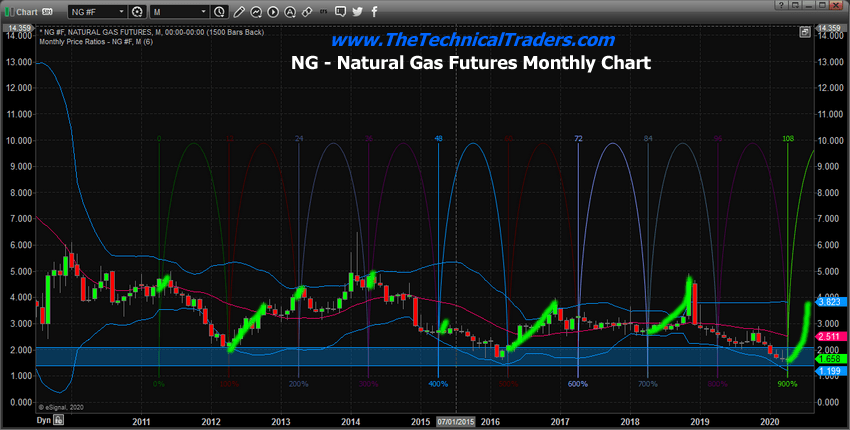
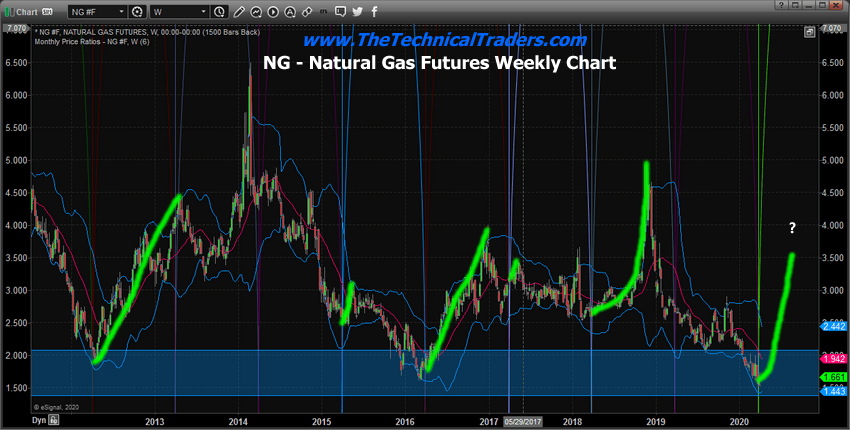
By TheTechnicalTraders – Our researchers have been following Natural Gas for many months and believe the current price level, near $1.65, is acting as a continued historical support level (a floor in price). Our researchers also used one of our data mining tools to attempt to identify if any opportunity exists in NG over the next 30 to 60+ days for skilled traders. The purpose of this data mining tool is to explore historical price activity and to determine if there is any true price “bias” that exists within certain months.
For example, if we could determine that Natural Gas tends to rally in April by a 2:1 ratio (historically) and that the rally in NG is typically somewhere between $0.50 and $1.50 to the upside, then we could attempt to use this information to set up a trade that allows us to attempt to profit from this potential future trend bias. A 2:1 ratio would indicate that, historically, the price rallied 10 times and didn’t rally 5 times over a span of 15 instances.
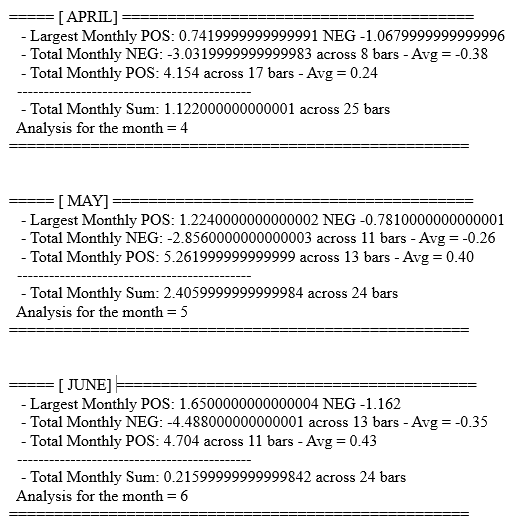
Our data mining utility reported the following data for April, May, and June in Natural Gas.
Monthly Natural Gas Price Chart
If we look at the APRIL data, the POS bars = 17 and the NEG bars = 8 – that sets up a slightly greater than 2:1 ratio of advancing price over declining price in April. The “Total Monthly Sum” across 25 instances of data is $1.12 whereas the Average for the POS price activity comes to just $0.24.
This suggests that in April, we have a fairly high opportunity for some upside price activity in Natural Gas based on this data – a nearly 2:1 advancing price ratio (historically). Yet it also means that advancing price may only rally $0.35 to $0.75 from any price bottom – so we have to be aware of risks that may exists with a small price advance from the current low levels.
If we take a look at the MAY data, the POS bars = 13 and the NEG bars = 11 – that sets up a 1.18:1 ratio that suggests a very slight advantage to the possibility that continued upside price activity will happen in May. Yet, the upside price advantage shown my the “Total Monthly Sum” data suggests a very big opportunity for a breakout rally in May (+$2.40). The way I interpret this data is to understand that May is roughly 60/40 biased to the upside whereas if any upside move takes place in April, a continuation of that trend in May could be incredibly profitable with a proper strategy.
Take a look at the JUNE data and try to come up with an interpretation yourself. The POS bars / NEG bars represent a less than 1:1 ratio. The Total Monthly Sum ($0.21) is not a very substantial price advance. The data is somewhat indecisive or inconclusive in suggesting any real price advantage in June for trading.
Yet, we have a very clear advantage in April and May. So, how are we going to approach this trade setup?
Weekly Natural Gas Chart – Cycles & Support
Currently, NG is testing very deep price levels within the BLUE support range box. Aggressive traders can attempt to look for opportunities within this range but must understand risks are still high for continued moderate price decline before a bottom sets up in April. Skilled traders would wait for the bottom to set up and possibly look for opportunities in ETFs as a means to limit risks on initial positions – attempting to scale into the trade comfortably.
Once the rally in NG really sets up and breaches the $1.98 level moving higher, then we believe we have a very real rally on our hands that may see price levels back above $2.75 eventually. The $1.85 to $1.99 price level will act as resistance as price attempts to move higher.
Before we continue, be sure to opt-in to our free market trend signals before closing this page, so you don’t miss our next special report!
Why are these types of setups so important to skilled traders? Historical price structures and patterns, like this data mining pattern, help to clearly illustrate strategic advantages in certain markets for skilled traders. Determining how to set up a proper trade knowing this data is also important. Risks exist with every trade you make and I’m sure we’ve all learned a lesson or two about making a hasty trade and not thinking about it?
Our research team believes April and May 2020 could be very exciting for Natural Gas.
As a technical analyst and trader since 1997, I have been through a few bull/bear market cycles in stocks and commodities. I believe I have a good pulse on the market and timing key turning points for investing and short-term swing traders.
I hope you found this informative, and if you would like to get a pre-market video every day before the opening bell, along with my trade alerts visit my Active ETF Trading Newsletter.
We all have trading accounts, and while our trading accounts are important, what is even more important are our long-term investment and retirement accounts. Why? Because they are, in most cases, our largest store of wealth other than our homes, and if they are not protected during a time like this, you could lose 25-50% or more of your entire net worth. The good news is we can preserve and even grow our long term capital when things get ugly like they are now and ill show you how and one of the best trades is one your financial advisor will never let you do because they do not make money from the trade/position.
If you have any type of retirement account and are looking for signals when to own equities, bonds, or cash, be sure to become a member of my Long-Term Investing Signals which we issued a new signal for subscribers.
Ride my coattails as I navigate these financial markets and build wealth while others lose nearly everything they own during the next financial crisis.
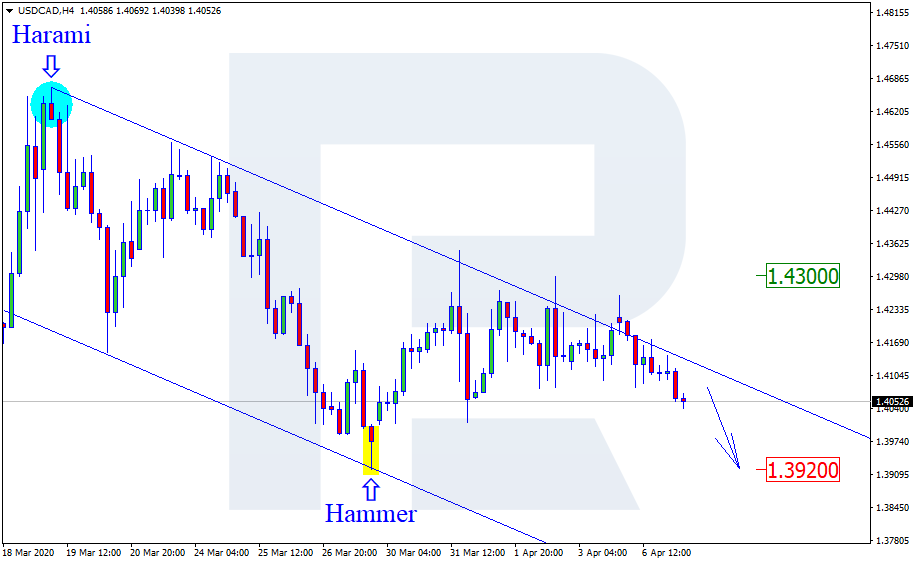
As we can see in the H4 chart, after forming a Hammer pattern and reversing, USDCAD has tested the channel’s upside border. At the moment, the pair is still rebounding from the resistance level to continue the descending tendency. In this case, the downside target may be at 1.3920. At the same time, there might be another scenario, which implies that the instrument may re-test the channel’s upside border and grow towards 1.4300.
AUDUSD, “Australian Dollar vs US Dollar”
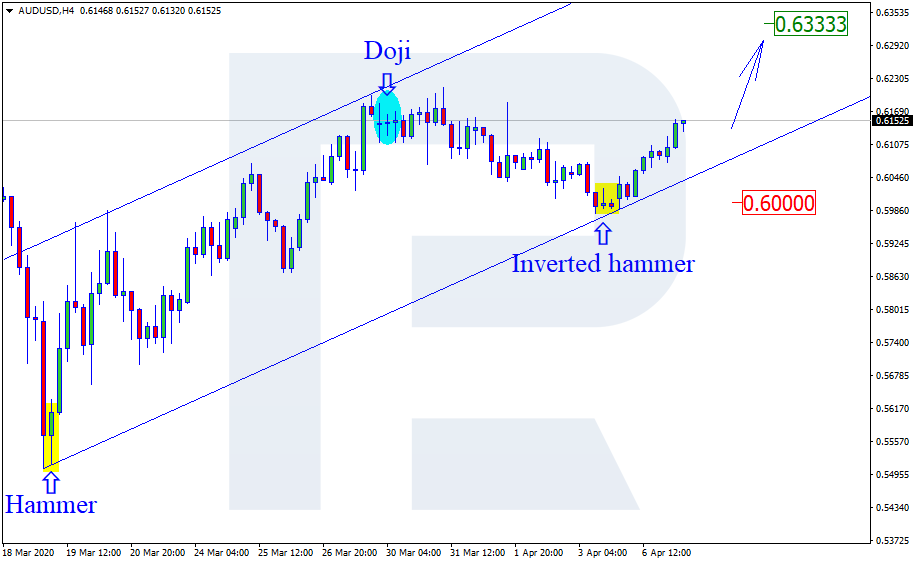
As we can see in the H4 chart, the pair continues the ascending tendency. After completing an Inverted Hammer pattern near the rising channel’s downside border, AUDUSD is reversing. Later, the price may continue trading upwards to reach 0.6333. Still, the instrument may choose a different scenario and continue falling towards 0.6000.
USDCHF, “US Dollar vs Swiss Franc”
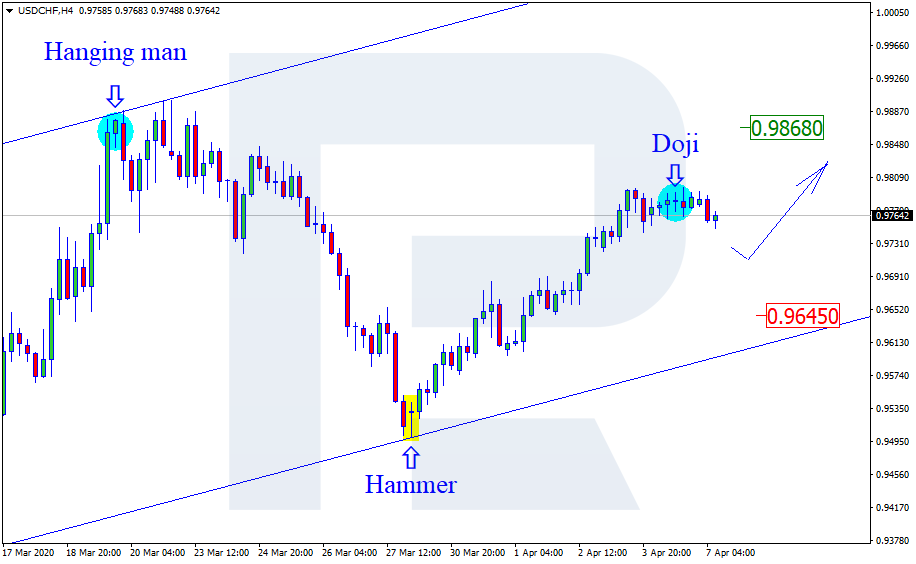
As we can see in the H4 chart, the pair continues forming the ascending channel. By now, USDCHF has formed a Doji pattern near the resistance level. The current situation suggests that after reversing the pair may start a slight correction and then continue the ascending tendency. In this case, the upside target may be at 0.9868. However, one shouldn’t ignore another scenario, which implies a deeper correction towards 0.9645.
Attention! Forecasts presented in this section only reflect the author’s private opinion and should not be considered as guidance for trading. RoboForex LP bears no responsibility for trading results based on trading recommendations described in these analytical reviews.
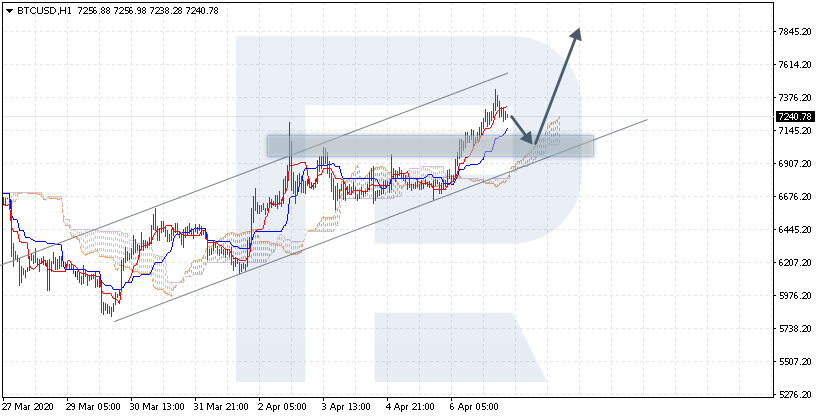
BTCUSD is trading at 7240.00; the instrument is moving above Ichimoku Cloud, thus indicating a bullish tendency. The markets could indicate that the price may test the cloud’s upside border at 7105.00 and then resume moving upwards to reach 7845.00. Another signal to confirm further ascending movement is the price’s rebounding from the rising channel’s downside border. However, the scenario that implies further growth may be canceled if the price breaks the cloud’s downside border and fixes below 6685.00. In this case, the pair may continue falling towards 5965.00.
AUDUSD, “Australian Dollar vs US Dollar”
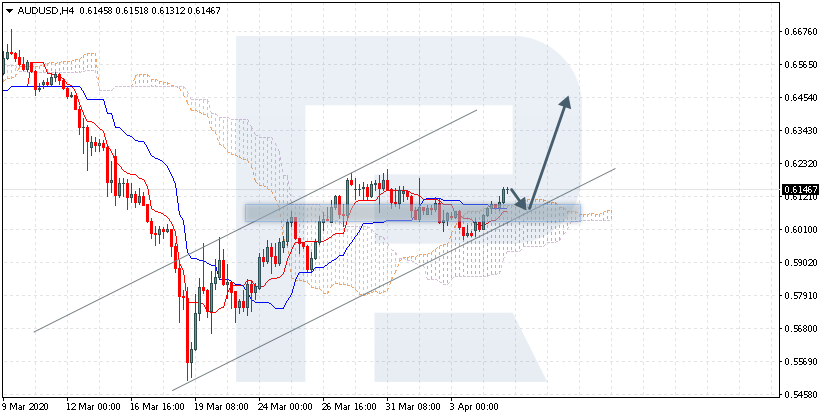
AUDUSD is trading at 0.6146; the instrument is moving above Ichimoku Cloud, thus indicating a bullish tendency. The markets could indicate that the price may test the cloud’s upside border at 0.6115 and then resume moving upwards to reach 0.6455. Another signal to confirm further ascending movement is the price’s rebounding from the rising channel’s downside border. However, the scenario that implies further growth may be canceled if the price breaks the cloud’s downside border and fixes below 0.5895. In this case, the pair may continue falling towards 0.5805.
USDCAD, “US Dollar vs Canadian Dollar”
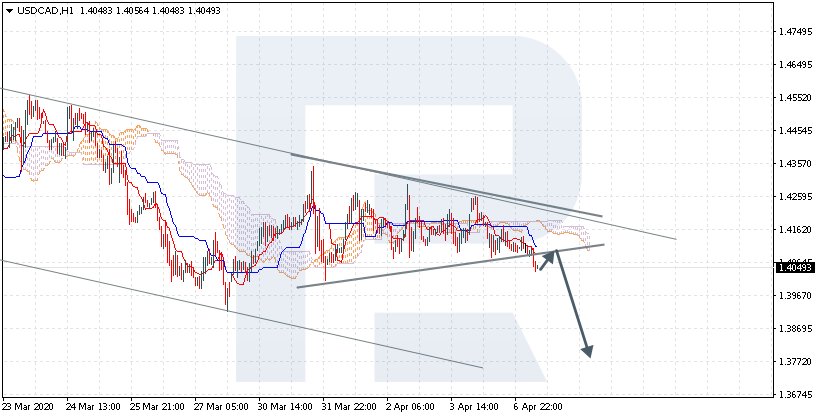
USDCAD is trading at 1.4049; the instrument is moving below Ichimoku Cloud, thus indicating a bearish tendency. The markets could indicate that the price may test Tenkan-Sen and Kijun-Sen at 1.4125 and then resume moving downwards to reach 1.3775. Another signal to confirm further descending movement is the price’s rebounding from the downside border of a Triangle pattern. However, the scenario that implies further decline may be canceled if the price breaks the cloud’s upside border and fixes above 1.4255. In this case, the pair may continue growing towards 1.4335.
Attention! Forecasts presented in this section only reflect the author’s private opinion and should not be considered as guidance for trading. RoboForex LP bears no responsibility for trading results based on trading recommendations described in these analytical reviews.