By CentralBankNews.info Serbia’s central bank cut its key policy rate for the second month in a row to “alleviate the negative effects of the coronavirus (Covid-19) on economic activity,” adding monetary and fiscal measures are feasible due to the low and stable inflation. The National Bank of Serbia (NBS) cut its policy rate by 25 basis points to 1.50 percent and has now cut it by 75 points this year following a 50 point cut at an extraordinary meeting of its executive board during the global rate cutting spree on March 11. NBS has been in a monetary easing cycle since May 2013 against a backdrop of improving economic fundamentals and declining inflation and has now lowered its rate by 10.25 percentage points since then. Today’s rate cut was mainly based on international data showing the negative effects of the virus on global economic growth “are stronger than expected,” NBS said, adding this has been reflected in international commodity and financial markets, and decisions by central banks and government worldwide. In the first two months of this year, parts of Serbia’s economy was topping the central bank’s expectations but in the second half of March economic activity contracted due to lower external demand and business conditions in many sectors has worsened. “After contracting in Q2, economic activity is expected to recover in the remainder of the year, the pace of recovery depending on the length of the pandemic,” NBS said, adding the medium-term economic prospects remain favorable and the negative effects of the crises in the short term should be mitigated by its own and the government’s measures. In addition to its two rate cuts, and a narrowing of the interest rate corridor to 1.0 percentage point from 1.25 points relative to the policy rate, NBS has also provided additional liquidity to bans through repos of dinar government securities and foreign exchange swaps. In coordination with Serbia’s government, the central bank also issued a moratorium on loan repayments for 90 days and fiscal assistance for businesses and individuals. Serbia’s inflation rate edged down to 1.9 percent in February from 2.0 percent in January and NBS expects inflationary pressures to remain low going forward, with the risk of trending below its projection in February due to the sharp drop in oil prices and lower aggregate demand, which will partly be alleviated from the fiscal and monetary measures. In February NBS expected inflationary pressures to remain low and inflation to move around the lower bound of its tolerance range until mid-2020 before gradually approaching the midpoint. NBS targets inflation of 3.0 percent, plus/minus 1.5 percentage points. In February NBS confirmed its forecast for 2020 and 2021 economic growth of 4.0 percent, down from 2019’s 4.2 percent.
The National Bank of Serbia issued the following statement:
“At its meeting today, the NBS Executive Board voted to cut the key policy rate further to 1.5%, in order to alleviate the negative effects of the coronavirus (Covid-19) on economic activity, while at the same time ensuring that inflation remains within the bounds of the target in the medium term. The Executive Board’s decision on further monetary policy accommodation is based primarily on the fact that indicators from the international environment signal that the negative effects of the virus on global economic growth are stronger than expected, which has also reflected on developments in the international commodity and financial markets and the decisions of central banks and governments of countries worldwide.
The Executive Board highlights that Serbia faced this crisis in a much more favourable position, with a growth rate of over 4%, low and stable inflation for seven years in a row, eliminated fiscal imbalance and a much reduced external imbalance, and foreign exchange reserves at their highest level on record, which created space for further monetary and fiscal policy easing during the crisis period, without threatening macroeconomic stability.
In making this decision, the Executive Board also took into account the previous monetary policy measures taken to alleviate the negative effects of the spread of the coronavirus – trimming of the key policy rate by 50 basis points in March, narrowing of the corridor of its main interest rates, from ±1.25 pp to ±1 pp relative to the key policy rate, and the provision of additional liquidity to banks through repo purchase of dinar government securities and FX swap purchase operations. In addition, direct support to the private sector also came from a coordinated reaction of the Government of the Republic of Serbia and the NBS through the decision on the moratorium on loan repayment during the state of emergency for at least 90 days and the fiscal assistance package for businesses and citizens.
The Executive Board underlines that monetary and fiscal policy measures aimed at supporting economic growth are feasible in conditions of low and stable inflation, which according to the latest available data measured 1.9% y-o-y in February. Inflationary pressures are expected to remain low in the period ahead, with somewhat more prominent risks of inflation trending even below the medium-term projection from February, mainly on account of a significant drop in oil prices and lower aggregate demand as a consequence of the pandemic, which will be alleviated in part by the implemented monetary and fiscal policy measures.
The coronavirus spread has significantly deteriorated the global economic growth outlook, causing major downward revisions to growth projections for this year for leading economies and emerging markets alike. Economic contraction was caused by the aggravated and discontinued work in many service sectors, and in some cases also disruption of global value chains, and the fall in consumer and business confidence. In such conditions, uncertainty in the international financial market has increased and investors favour safe assets, causing a downspin in global stock exchange indices and a rise in the price of gold and government securities of developed countries. Dented global growth prospects reflected also on the falling global prices of primary commodities, notably oil.
To moderate the negative effects of the crisis, many central banks reacted by easing their monetary policies further. The Fed lowered the target range for the federal funds rate to near zero and announced a quantitative easing programme that has neither time nor amount limits, while the ECB, pursuing a zero interest rate policy for some time already, increased the volume of its asset purchases. At the same time, governments worldwide unleashed massive fiscal stimuli. Coordinated moves of monetary and fiscal policy should contribute to alleviating the negative impact on economic growth and to maintaining favourable terms of financing in the new situation.
The Executive Board underlines that the data on the movement of economic activity indicators and the sources of its financing in the domestic market in the first two months of the year were favourable, many even outperforming the NBS’s expectations. It was in the second half of March that economic activity contracted under the impact of lower external demand, but also aggravated business conditions in many sectors. After contracting in Q2, economic activity is expected to recover in the remainder of the year, the pace of the recovery depending on the length of the pandemic. In the best collective judgement of the Executive Board, our medium-term economic growth prospects remain favourable, as the negative effects of the crisis on economic activity in the short term should be mitigated by the adopted monetary and fiscal policy measures.
The Executive Board emphasises that monetary and fiscal policy measures will continue to be fully coordinated, which will help ease potential further negative effects from the international environment and the consequences of the spread of the coronavirus. As so far, the NBS will closely monitor global developments and assess their implications for the domestic economy and inflation and will respond timely in order to preserve the achieved price and financial stability and contribute to the country’s sustainable economic growth.
The next rate-setting meeting will be held on 7 May.”
The latest news and a construction update on Pure Gold Mining’s Canadian project are provided in an Echelon Wealth Partners report.
In a March 30 research note, Echelon Wealth Partners analyst Ryan Walker reported that Pure Gold Mining Inc. (PGM:TSX.V; PUR:LSE) remains on schedule for first gold production in late 2020 at its Red Lake project in Ontario.
“We highlight the potential for the mine to begin ramping up production amid our expectations of a stronger post-COVID-19 gold price environment,” added Walker.
He relayed what recently happened with the Red Lake project and its current status in terms of development.
As for the financial aspect of Red Lake, Pure Gold updated the definitive budget for it to $124.6 million, up from $95 million in the 2019 feasibility study, relayed Walker. Also, the Vancouver-headquartered company opted for replacing versus refurbishing mill components to maximize availability and minimize startup risks, and that will cost $18.1 million.
As for progress with development at Red Lake, regarding surface work, significant upgrades of earthworks, road and utility infrastructure along with installation of new equipment are done. New mine support buildings have been built. There now are a administration complex that is fully operational and a mill warehouse.
In terms of underground progress, about 740 meters of development are finished. Ramp building, which was started ahead of schedule, is moving forward quickly. Due to that earlier start and significant recent efficiency in development, Pure Gold might be able to access the main stopes, optimize the mine plan and commence ore stockpiling earlier than anticipated.
Engineering and permitting remain on track. “Federal and provincial authorities have confirmed the project will not trigger a new environmental assessment,” Walker highlighted. With respect to procurement, Pure Gold already placed an order for equipment with a long lead time, including a new ball mill, gold room and electrical equipment, and gravity and leaching systems.
Walker also noted that the mining firm finished preliminary screening of major applications with both First Nations and Ontario ministries. In December 2019, it hosted many community and First Nations meetings about permitting and the amended mine closure plan. “Pure Gold contends that there remains strong support for project development from both the local communities and First Nations,” Walker wrote.
He concluded, “We continue to highlight the mine’s high-grade nature, potential for solid near-term, high-margin production and substantial exploration potential, all in a prolific Canadian mining camp.”
Echelon has a Speculative Buy rating and a CA$1.35 per share price target on Pure Gold, the stock of which is trading today at about CA$0.70 per share.
Disclosure: 1) Doresa Banning compiled this article for Streetwise Reports LLC and provides services to Streetwise Reports as an independent contractor. She or members of her household own securities of the following companies mentioned in the article: None. She or members of her household are paid by the following companies mentioned in this article: None. 2) The following companies mentioned in this article are billboard sponsors of Streetwise Reports: None. Click here for important disclosures about sponsor fees. 3) Comments and opinions expressed are those of the specific experts and not of Streetwise Reports or its officers. The information provided above is for informational purposes only and is not a recommendation to buy or sell any security. 4) The article does not constitute investment advice. Each reader is encouraged to consult with his or her individual financial professional and any action a reader takes as a result of information presented here is his or her own responsibility. By opening this page, each reader accepts and agrees to Streetwise Reports’ terms of use and full legal disclaimer. This article is not a solicitation for investment. Streetwise Reports does not render general or specific investment advice and the information on Streetwise Reports should not be considered a recommendation to buy or sell any security. Streetwise Reports does not endorse or recommend the business, products, services or securities of any company mentioned on Streetwise Reports. 5) From time to time, Streetwise Reports LLC and its directors, officers, employees or members of their families, as well as persons interviewed for articles and interviews on the site, may have a long or short position in securities mentioned. Directors, officers, employees or members of their immediate families are prohibited from making purchases and/or sales of those securities in the open market or otherwise from the time of the interview or the decision to write an article until three business days after the publication of the interview or article. The foregoing prohibition does not apply to articles that in substance only restate previously published company releases.
Disclosures from Echelon Wealth Partners, Pure Gold Mining Inc., March 30, 2020
Echelon Wealth Partners compensates its Research Analysts from a variety of sources. The Research Department is a cost centre and is funded by the business activities of Echelon Wealth Partners including, Institutional Equity Sales and Trading, Retail Sales and Corporate and Investment Banking.
I, Ryan Walker, hereby certify that the views expressed in this report accurately reflect my personal views about the subject securities or issuers. I also certify that I have not, am not, and will not receive, directly or indirectly, compensation in exchange for expressing the specific recommendations or views in this report.
Important Disclosures: Is this an issuer related or industry related publication? Issuer.
Does the Analyst or any member of the Analysts household have a financial interest in the securities of the subject issuer? No
The name of any partner, director, officer, employee or agent of the Dealer Member who is an officer, director or employee of the issuer, or who serves in any advisory capacity to the issuer. No
Does Echelon Wealth Partners Inc. or the Analyst have any actual material conflicts of interest with the issuer? No
Does Echelon Wealth Partners Inc. and/or one or more entities affiliated with Echelon Wealth Partners Inc. beneficially own common shares (or any other class of common equity securities) of this issuer which constitutes more than 1% of the presently issued and outstanding shares of the issuer? No
During the last 12 months, has Echelon Wealth Partners Inc. provided financial advice to and/or, either on its own or as a syndicate member, participated in a public offering, or private placement of securities of this issuer? No
During the last 12 months, has Echelon Wealth Partners Inc. received compensation for having provided investment banking or related services to this Issuer? No
Has the Analyst had an onsite visit with the Issuer within the last 12 months? No
Has the Analyst or any Partner, Director or Officer been compensated for travel expenses incurred as a result of an onsite visit with the Issuer within the last 12 months? No
Has the Analyst received any compensation from the subject company in the past 12 months? No
Is Echelon Wealth Partners Inc. a market maker in the issuers securities at the date of this report? No
Falling building permits in Canada bullish for USDCAD
Building permits fell in Canada more than expected in February: total number of building permits issued by Canadian municipalities decreased 7.3% in February, after 3.3% rise in January, when a 4%decline was forecast. This is bullish for USDCAD.
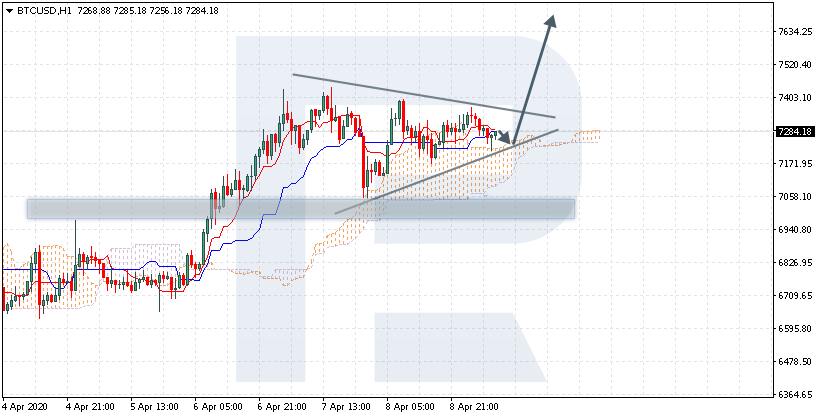
BTCUSD is trading at 7284.00; the instrument is moving above Ichimoku Cloud, thus indicating a bullish tendency. The markets could indicate that the price may test the cloud’s upside border at 7275.00 and then resume moving upwards to reach 7645.00. Another signal to confirm further ascending movement is the price’s rebounding from the Triangle’s downside border. However, the scenario that implies further growth may be canceled if the price breaks the cloud’s downside border and fixes below 7045.00. In this case, the pair may continue falling towards 6355.00. After breaking the pattern’s upside border and fixing above 7425.00, the price may resume moving upwards.
XAUUSD, “Gold vs US Dollar”
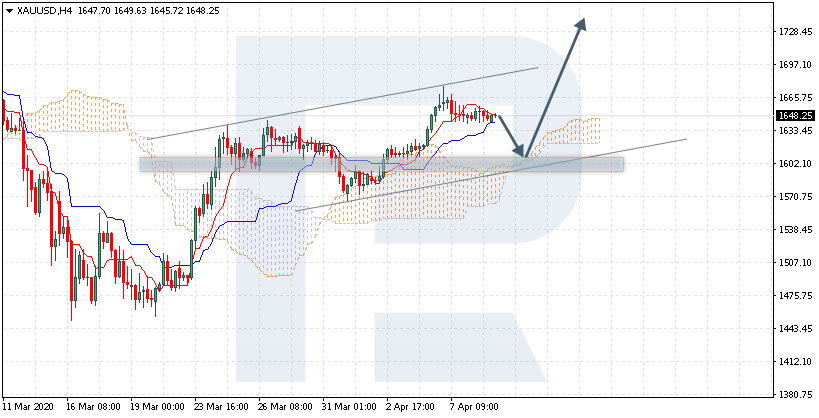
XAUUSD is trading at 1648.00; the instrument is moving above Ichimoku Cloud, thus indicating an ascending tendency. The markets could indicate that the price may test the cloud’s upside border at 1605.00 and then resume moving upwards to reach 1725.00. Another signal to confirm further ascending movement is the price’s rebounding from the rising channel’s downside border. However, the scenario that implies further growth may be canceled if the price breaks the cloud’s downside border and fixes below 1575.00. In this case, the pair may continue falling towards 1545.00.
USDCHF, “US Dollar vs Swiss Franc”
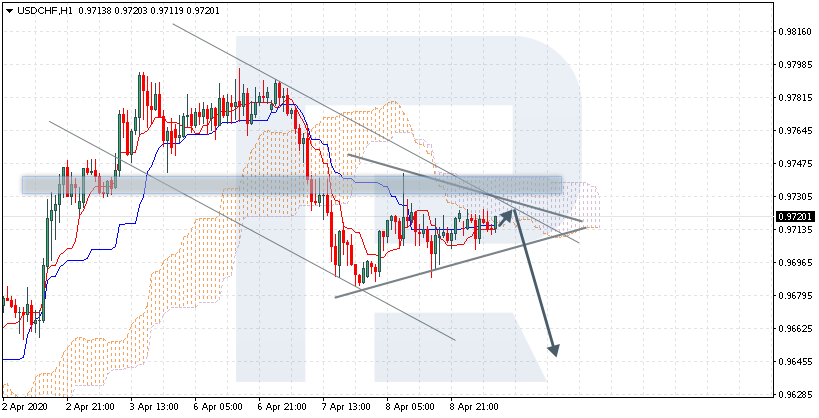
USDCHF is trading at 0.9720; the instrument is moving below Ichimoku Cloud, thus indicating a descending tendency. The markets could indicate that the price may test the cloud’s downside border at 0.9730 and then resume moving downwards to reach 0.9645. Another signal to confirm further descending movement is the price’s rebounding from the descending channel’s upside border. However, the scenario that implies further decline may be canceled if the price breaks the cloud’s upside border and fixes above 0.9755. In this case, the pair may continue growing towards 0.9845. After breaking the Triangle’s downside border and fixing below 0.9690, the price may resume moving downwards.
Attention! Forecasts presented in this section only reflect the author’s private opinion and should not be considered as guidance for trading. RoboForex LP bears no responsibility for trading results based on trading recommendations described in these analytical reviews.
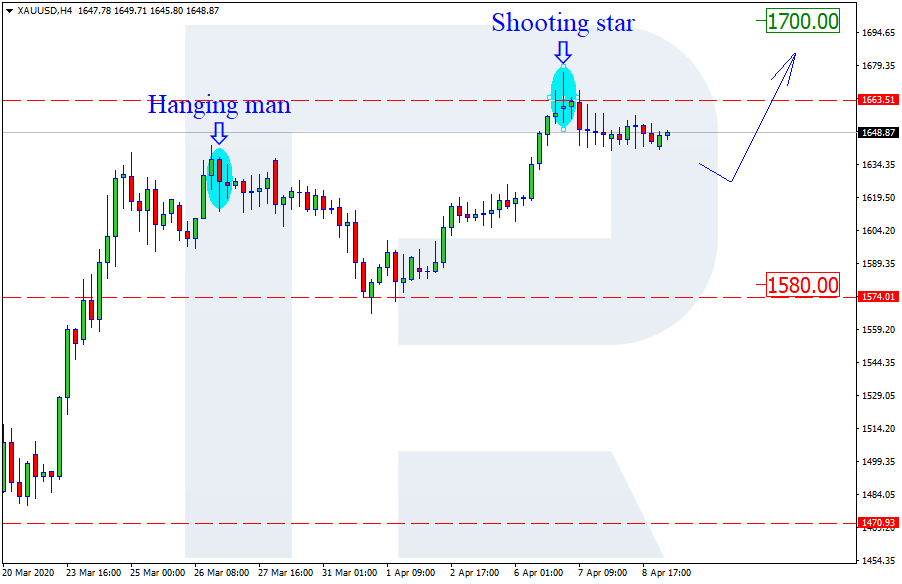
As we can see in the H4 chart, after testing another resistance level and forming several reversal patterns, such as Shooting Star, Gold is trading inside the horizontal channel and trying to reverse. The current situation implies that the pair may form a correction from the resistance level and then resume the rising tendency. In this case, the upside target may be at 1700.00. At the same time, there is another scenario, according to which the instrument may correct to reach the support level at 1580.00.
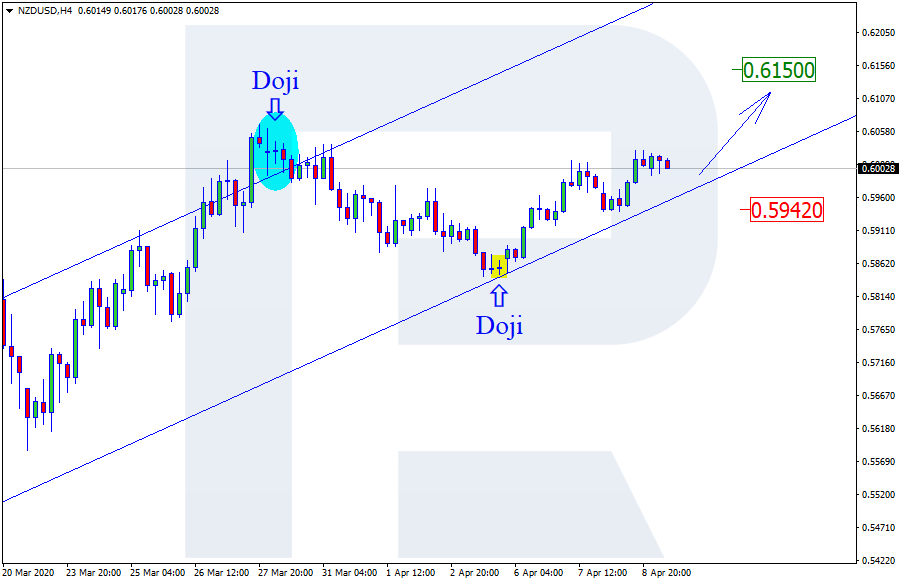
NZDUSD, “New Zealand vs. US Dollar”
As we can see in the H4 chart, the rising channel continues. After finishing a Doji reversal pattern, NZDUSD is reversing. Possibly, the pair complete the correction and resume trading upwards. The upside target may be at 0.6150. Still, one shouldn’t exclude another scenario, which says that the instrument may continue falling towards 0.5942.
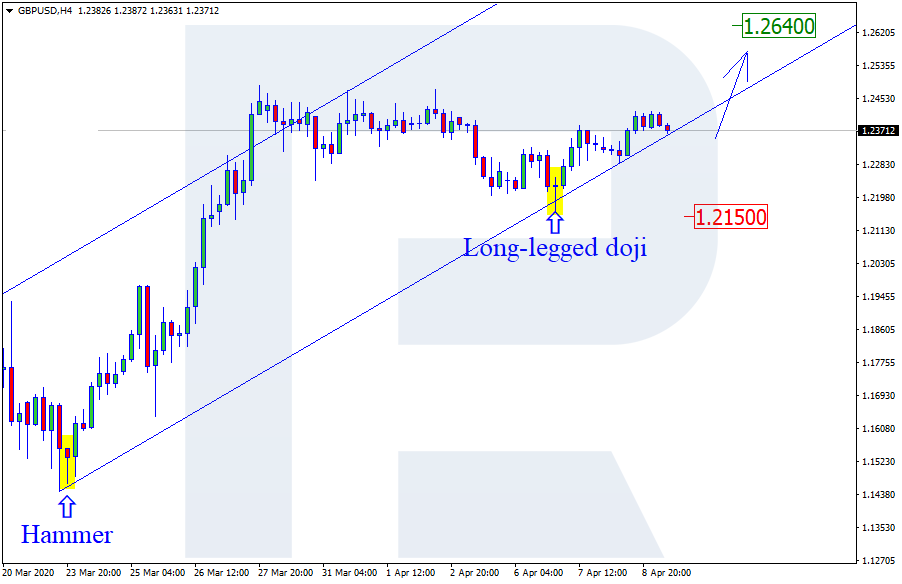
GBPUSD, “Great Britain Pound vs US Dollar”
As we can see in the H4 chart, the pair continues moving within the rising tendency. By now, GBPUSD has formed several reversal patterns, such as Long-Legged Doji, close to the support level. At the moment, the pair is reversing and may later resume growing with the target at 1.2640. However, there is another scenario, which implies that the instrument may fall and test 1.2150.
Attention! Forecasts presented in this section only reflect the author’s private opinion and should not be considered as guidance for trading. RoboForex LP bears no responsibility for trading results based on trading recommendations described in these analytical reviews.
The EUR/USD currency pair is consolidating. There is no defined trend. EUR/USD quotes are testing local support and resistance levels: 1.08250 and 1.08850, respectively. Financial market participants have taken a wait-and-see attitude before the publication of the ECB protocol. We recommend paying attention to the comments by representatives of the regulator. Investors will also assess important economic releases from the US. Positions should be opened from key support and resistance levels.
The Economic News Feed for 09.04.2020
– ECB monetary policy meeting account at 14:30 (GMT+3:00);
– Initial jobless claims in the US at 15:30 (GMT+3:00);
– US producer price index at 15:30 (GMT+3:00).
Indicators do not give accurate signals: the price has crossed 50 MA.
The MACD histogram is near the 0 mark.
Stochastic Oscillator is in the neutral zone, the %K line is above the %D line, which indicates the bullish sentiment.
Trading recommendations
Support levels: 1.08250, 1.07750
Resistance levels: 1.08850, 1.09250, 1.09700
If the price fixes above 1.08850, the EUR/USD currency pair is expected to grow. The movement is tending to 1.09250-1.09500.
An alternative could be a drop in the EUR/USD quotes to 1.07900-1.07700.
The GBP/USD currency pair
Technical indicators of the currency pair:
Prev Open: 1.23253
Open: 1.23753
% chg. over the last day: +0.39
Day’s range: 1.23608 – 1.24187
52 wk range: 1.1466 – 1.3516
The GBP/USD currency pair is in a sideways trend. There is no defined trend. At the moment, the local support and resistance levels are 1.23550 and 1.24250, respectively. The technical pattern signals a possible growth of the trading instrument. Today, investors will assess important statistics on the US economy. We recommend opening positions from key levels.
Great Britain published weak data on the country’s GDP. At the same time, UK manufacturing production grew by 0.5% and exceeded market expectations at 0.1%.
Indicators do not give accurate signals: 50 MA has crossed 100 MA.
The MACD histogram is in the positive zone, indicating the bullish sentiment.
Stochastic Oscillator is in the neutral zone, the %K line is above the %D line, which gives a signal to buy GBP/USD.
Trading recommendations
Support levels: 1.23550, 1.22900, 1.22150
Resistance levels: 1.24250, 1.24800
If the price fixes above 1.24250, GBP/USD quotes are expected to grow. The movement is tending to 1.24700-1.25000.
An alternative could be a decrease in the GBP/USD currency pair to a round level of 1.23000.
The USD/CAD currency pair
Technical indicators of the currency pair:
Prev Open: 1.39921
Open: 1.40137
% chg. over the last day: +0.14
Day’s range: 1.40002 – 1.40549
52 wk range: 1.2949 – 1.4668
At the moment, USD/CAD quotes are consolidating. The technical pattern is ambiguous. The local support and resistance levels are 1.40000 and 1.40800, respectively. Recovery of the “black gold” prices supports the loonie. We do not rule out the strengthening of the Canadian dollar relative to the greenback. Investors expect a report on Canada’s labor market. Positions should be opened from key levels.
At 15:30 (GMT+3:00), data on the labor market of Canada will be published.
Indicators do not give accurate signals: the price has crossed 50 MA.
The MACD histogram is near the 0 mark.
Stochastic Oscillator is in the neutral zone, the %K line has crossed the %D line. There are no signals at the moment.
Trading recommendations
Support levels: 1.40000, 1.39450
Resistance levels: 1.40800, 1.41750, 1.42600
If the price fixes below the round level of 1.40000, a further drop in the USD/CAD quotes is expected. The movement is tending to 1.39500-1.39200.
An alternative could be the growth of the USD/CAD currency pair to 1.41300-1.41600.
The USD/JPY currency pair
Technical indicators of the currency pair:
Prev Open: 108.744
Open: 108.824
% chg. over the last day: +0.11
Day’s range: 108.768 – 109.063
52 wk range: 101.19 – 112.41
The USD/JPY currency pair is still being traded in a flat. There is no defined trend. USD/JPY quotes are testing the key support and resistance levels: 108.550 and 109.000, respectively. US economic releases are in the focus of attention. We also recommend paying attention to the dynamics of the US government bonds yield. Positions should be opened from key levels.
The news feed on Japan’s economy is calm.
Indicators do not give accurate signals: the price has crossed 50 MA.
The MACD histogram is near the 0 mark.
Stochastic Oscillator is in the neutral zone, the %K line is below the %D line, which indicates the bearish sentiment.
Trading recommendations
Support levels: 108.550, 108.150, 107.600
Resistance levels: 109.000, 109.350, 110.100
If the price fixes above 109,000, further growth of USD/JPY quotes is expected. The movement is tending to 109.400-109.800.
An alternative could be a decrease in the USD/JPY currency pair to 108.200-107.800.
US economic data in the last couple of weeks were mixed. US businesses cut more than expected 701,000 jobs in March. However services sector expansion continued though at much slower rate: the ISM non-manufacturing PMI declined to 52.5 from 57.3 in January when a drop to 44 was forecast. Readings above 50.0 indicate sector expansion, below indicate contraction. Of more recent data the Mortgage Business Association reported mortgage applications dropped 17.9% in the week ended April 3 following a 15.3% rise in the previous week. And Fed minutes for the March 15 policy meeting showed policy makers saw no major economic recovery until next year as a worst-case scenario of the coronavirus outbreak. However, the US administration launched massive monetary and fiscal aid programs to combat coronavirus impact. On March 25, 2020 a $2 trillion Phase Three stimulus bill was passed, providing $301 billion in direct cash payments, totaling $1,200 for those earning up to $75,000 and $500 per child; $500 billion government loan program to companies impacted by the outbreak; $367 billion in federally guaranteed small business loans; $250 billion to expand unemployment insurance; $221 billion in business tax cuts; $390 billion to state governments and public programs such as agriculture, drugs and transportation. These measures together with monetary stimulus program by the Federal Reserve buoyed investors’ confidence, leading to recovery in equity market.
By Hussein Sayed, Chief Market Strategist (Gulf & MENA), ForexTime
Oil futures jumped on both sides of the Atlantic on expectations the world’s biggest producers would finally agree on production cuts. That comes a little over a month after the expired OPEC+ deal led to a surge of crude production by Saudi Arabia in a fight for market share, despite the industry being confronted with the coronavirus-driven collapse in demand.
Brent crude has managed to recover half of its losses from the March lows, while WTI has gained 34%. However, both Benchmarks have still lost more than half their value since the beginning of the year.
Many observers have thought it would be too challenging to get Russia and Saudi Arabia to sit round the same table any time soon, but collapsing oil prices and intervention from the US have made this possible.
In terms of demand, the US has seen a fall of 14.4 million barrels a day, according to the US Energy Information Administration. India, the world’s third-largest consumer, has seen a plunge in demand of 18% according to FGE, but refineries are painting a more gloomy picture saying their demand tumbled by more than two-thirds in early April. And while China’s economy is expected to fire on all cylinders soon, it still won’t be enough to compensate for the lost demand globally.
Interestingly, Oil futures are trading higher but physical purchasers can buy at a much lower price, with some grades in North America being sold at a price tag of less than $10 a barrel. That reflects the current distress and glut in energy markets at this stage with many wondering whether a Saudi – Russian deal will bring stability back to the market.
Given the magnitude of the current economic crisis, there’s a high chance of a deal being struck. Markets are pricing a 10 – 15 million barrels a day cut in oil production. That could send prices a little higher in the short term, but fundamentals will still rule further out and if demand doesn’t recover by the end of April, then that supply-demand equation will again look terrible. According to the latest estimates, global demand has fallen by nearly 25 million barrels a day and the awaited cut is still far from balancing the equation.
To have a more meaningful deal, the US needs to jump in, but given that all US producers are private companies, it makes this mission very difficult. Another source of stability could come from Friday’s G20 emergency energy minister’s meeting. If more producers join the deal and large oil consumers contribute to the demand side by adding to their strategic oil reserves, this should provide a longer-term stability factor to prices.
The worst-case scenario, where OPEC and its previous allies fail to commit to production cuts, would be disastrous for oil-producing economies and the energy sector. This would see both benchmarks test a single-digit number.
Disclaimer: The content in this article comprises personal opinions and should not be construed as containing personal and/or other investment advice and/or an offer of and/or solicitation for any transactions in financial instruments and/or a guarantee and/or prediction of future performance. ForexTime (FXTM), its affiliates, agents, directors, officers or employees do not guarantee the accuracy, validity, timeliness or completeness, of any information or data made available and assume no liability as to any loss arising from any investment based on the same.
US stock market rebounded on Wednesday as market sentiment was buoyed by hopes US administration may begin to reopen part of the economy sooner rather than later. Investors’ confidence was also boosted by the news progressive Democratic candidate Sanders exited the US presidential race. He had promised to rein in Wall Street and big corporations as president. The S&P 500 advanced 3.4% to 2749.98. The Dow Jones industrial average rose 3.44% to 23433.57. Nasdaq gained 2.6% to 8090.90. The dollar weakening halted: the live dollar index data show the ICE US Dollar index, a measure of the dollar’s strength against a basket of six rival currencies, rebounded 0.2% to 100.14 but is lower currently. Lower trading volumes are expected today as most markets, including US and European, will be closed tomorrow for Good Friday before Easter.. Futures are rising currently.
CAC 40 edged up while European indexes slid
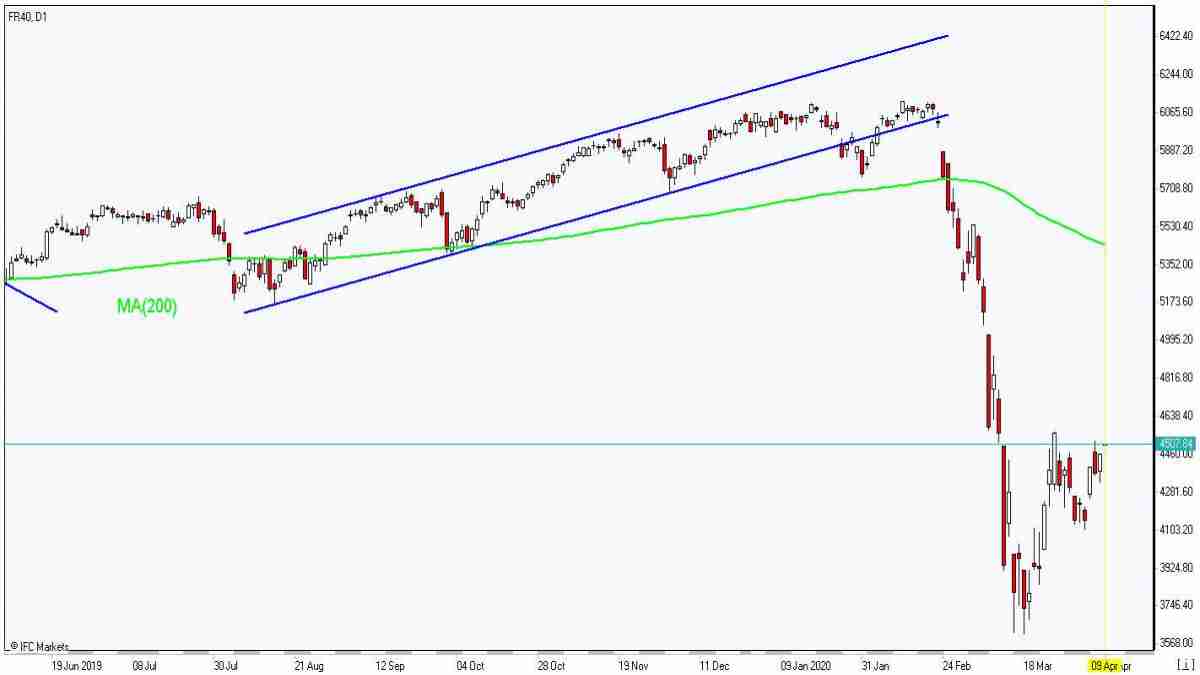
European stocks extended losses on Wednesday. The EUR/USD reversed lower yesterday while GBP/USD continued climbing with both pairs higher currently. The Stoxx Europe 600 ended down 0.2% led by energy shares. Germany’s DAX 30 shed 0.2% to 10332.89. France’s CAC 40 however added 0.1% while UK’s FTSE 100 slumped 0.5% to 5677.73.
Australia’s All Ordinaries Index leads Asian indexes advance
Asian stock indices are mostly higher today after rebound on Wall Street overnight. Nikkei however slipped 0.04% to 19345.77 despite resumed yen sliding against the dollar as Bank of Japan cut outlook for economy. Markets in China are rising: Shanghai Composite Index is 0.4% higher while Hong Kong’s Hang Seng Index is up 1.3%. Australia’s All Ordinaries Index jumped 3.5% with the Australian dollar little changed against the greenback.
Brent futures prices are sharply higher today ahead of a virtual meeting between Organization of the Petroleum Exporting Countries and major oil producers on output reduction. OPEC together with its allies and Russia are expected to cut crude oil output by 8 million to 10 million barrels per day over 90 days. OPEC officials have said they want the United States and other countries to contribute to coordinated production cuts. Prices rose yesterday despite the Energy Information Administration report US crude oil inventories rose by bigger than expected 15.2 million barrels last week, eleventh weekly rise in a row: June Brent added 3% to $32.84 on Wednesday.
Gold rises on weaker Dollar
Gold prices are extending gains today. June gold inched up 0.04% to $1684.30 an ounce on Wednesday.
Note: This overview has an informative and tutorial character and is published for free. All the data, included in the overview, are received from public sources, recognized as more or less reliable. Moreover, there is no guarantee that the indicated information is full and precise. Overviews are not updated. The whole information in each overview, including opinion, indicators, charts and anything else, is provided only for familiarization purposes and is not financial advice or а recommendation. The whole text and its any part, as well as the charts cannot be considered as an offer to make a deal with any asset. IFC Markets and its employees under any circumstances are not liable for any action taken by someone else during or after reading the overview.
Shares of Immunomedics opened 117% higher after the company reported that it has stopped its Phase 3 ASCENT study of sacituzumab govitecan after recording “compelling evidence of efficacy” in heavily pretreated patients with metastatic triple-negative breast cancer.
Biopharmaceutical company Immunomedics Inc. (IMMU:NASDAQ), which specializes in the area of antibody-drug conjugates, today announced that “its Phase 3 confirmatory ASCENT study will be halted due to compelling evidence of efficacy.” The firm advised that the decision to cancel the ASCENT trial prior to scheduled completion was made based on the unanimous recommendation by the independent Data Safety Monitoring Committee (DSMC) during its recent routine review of the study.
Julie R. Gralow, M.D., Jill Bennett Endowed Professor of Breast Cancer at University of Washington School of Medicine and member of the Fred Hutchinson Cancer Research Center, commented, “It is my distinct honor to have served as Chairperson of the independent DSMC for this important study…Triple-negative breast cancer (TNBC) is a disease with extremely limited treatment options beyond classic chemotherapy. The remarkable results we observed across multiple endpoints in the ASCENT study warranted early discontinuation of the trial and are indicative of a potential major advance in the treatment of this devastating disease that affects younger women and African American women at higher rates. I look forward to the release of the full and final analyses of these study data when they are available for public presentation.”
The company explained that “the ASCENT is a Phase 3 confirmatory study designed to validate the promising safety and efficacy data of sacituzumab govitecan observed in a Phase 2 study of heavily pretreated patients with metastatic TNBC (mTNBC).” The prior defined primary endpoint for the study is progression-free survival. The main secondary endpoints were identified as overall survival and objective response rate.
The company’s Chief Medical Officer Loretta M. Itri, M.D., added, “We want to thank the members of the DSMC for their guidance…This strengthens our resolve to complete the analysis and reporting of the final study results, thereby allowing these data to become available to physicians caring for the TNBC community in a timely fashion.”
“Today’s announcement marks a significant milestone towards fulfilling our promise to patients globally with TNBC of providing a new treatment option that can meaningfully improve their lives. We are grateful to all the patients, their families and healthcare providers who participated in the ASCENT study. On behalf of all of my colleagues at Immunomedics, we remain committed to working tirelessly to bring this potentially transformative drug to all mTNBC patients in need,” remarked Immunomedics’ Executive Chairman Dr. Behzad Aghazadeh.
The company indicated that “a biologics license application resubmission seeking accelerated approval of sacituzumab govitecan for the treatment of patients with mTNBC who have received at least two prior therapies for metastatic disease is currently under U.S. Food and Drug Administration (FDA) review, with a PDUFA target action date of June 2, 2020.” The firm advised that the FDA previously granted Breakthrough Therapy Designation for sacituzumab govitecan for use in this disease indication and trial setting.
Immunomedics is a clinical-stage biopharmaceutical company headquartered in Morris Plains, N.J., that this focused on developing and advancing monoclonal antibody-based products for targeted cancer, autoimmune and other serious disease treatments. The company stated that its primary corporate objective is to become a fully-integrated biopharmaceutical company and a leader in the field of antibody-drug conjugates.
Immunomedics began the day with a market capitalization of around $2.0 billion with approximately 213.9 million shares outstanding and a short interest of about 12.5%. IMMU shares opened 117% higher today at $20.11 (+$11.01, +117.13%) over Friday’s $9.40 closing price. The stock has traded today between $17.57 and 20.20 per share and is currently trading at $18.49 (+$9.09, +96.74%).
Disclosure: 1) Stephen Hytha compiled this article for Streetwise Reports LLC and provides services to Streetwise Reports as an independent contractor. He or members of his household own securities of the following companies mentioned in the article: None. He or members of his household are paid by the following companies mentioned in this article: None. 2) The following companies mentioned in this article are billboard sponsors of Streetwise Reports: None. Click here for important disclosures about sponsor fees. 3) Comments and opinions expressed are those of the specific experts and not of Streetwise Reports or its officers. The information provided above is for informational purposes only and is not a recommendation to buy or sell any security. 4) The article does not constitute investment advice. Each reader is encouraged to consult with his or her individual financial professional and any action a reader takes as a result of information presented here is his or her own responsibility. By opening this page, each reader accepts and agrees to Streetwise Reports’ terms of use and full legal disclaimer. This article is not a solicitation for investment. Streetwise Reports does not render general or specific investment advice and the information on Streetwise Reports should not be considered a recommendation to buy or sell any security. Streetwise Reports does not endorse or recommend the business, products, services or securities of any company mentioned on Streetwise Reports. 5) From time to time, Streetwise Reports LLC and its directors, officers, employees or members of their families, as well as persons interviewed for articles and interviews on the site, may have a long or short position in securities mentioned. Directors, officers, employees or members of their immediate families are prohibited from making purchases and/or sales of those securities in the open market or otherwise from the time of the interview or the decision to write an article until three business days after the publication of the interview or article. The foregoing prohibition does not apply to articles that in substance only restate previously published company releases. 6) This article does not constitute medical advice. Officers, employees and contributors to Streetwise Reports are not licensed medical professionals. Readers should always contact their healthcare professionals for medical advice.