– Everyone I know who is not involved in the stock market or has little knowledge about it is calling me and asking what stocks, indexes, and commodities to buy because everything is so cheap and dividends are juicy again.
Just look at the market sentiment chart, and price cycles that the stock market goes through, and listen to my talk below while reviewing these to images. It’s not rocket science, but the lack of education on the financial markets coupled with the force of greed to make money and miss out on the next big bull market has everyone getting suckered into this dead-cat bounce, also known as a bear trap, bear market rally.
If you want to see something else really exciting/nerve-wracking/ and real check out this post on the Stock Market Top.
A subscriber to my market video analysis and ETF trading newsletter said it perfectly:
“Always intrigues me how many amateur surfers get to the north shore beaches in Hawaii, take one look at monster waves and conclude it’s way too dangerous. Yet the amateur trader looks at treacherous markets like these and wants to dive right in!!”Richard P.
I have to toot my own horn here a little because subscribers and I had our trading accounts close at a new high watermark for our accounts. We not only exited the equities market as it started to roll over we profited from the sell-off in a very controlled way.
As a technical analyst and trader since 1997, I have been through a few bull/bear market cycles in stocks and commodities. I believe I have a good pulse on the market and timing key turning points for investing and short-term swing traders. 2020 is going to be an incredible year for skilled traders. Don’t miss all the incredible moves and trade setups.
I hope you found this informative, and if you would like to get a pre-market video every day before the opening bell, along with my trade alerts. These simple to follow ETF swing trades have our trading accounts sitting at new high water marks yet again this week, not many traders can say that this year. Visit my Active ETF Trading Newsletter.
We all have trading accounts, and while our trading accounts are important, what is even more important are our long-term investment and retirement accounts. Why? Because they are, in most cases, our largest store of wealth other than our homes, and if they are not protected during a time like this, you could lose 25-50% or more of your entire net worth. The good news is we can preserve and even grow our long term capital when things get ugly like they are now and ill show you how and one of the best trades is one your financial advisor will never let you do because they do not make money from the trade/position.
If you have any type of retirement account and are looking for signals when to own equities, bonds, or cash, be sure to become a member of my Long-Term Investing Signals which we issued a new signal for subscribers.
Ride my coattails as I navigate these financial markets and build wealth while others lose nearly everything they own during the next financial crisis.
– The coronavirus pandemic is one of the biggest and unprecedented seismic shifts in the global economy that we’ve ever seen in modern history, and it’s just getting started.
Already, economies around the world are shutting down. The federal reserve has pumped trillions into the United States economy in just a matter of days. Global supply chains have collapsed as entire Chinese industries went dark. And this is just the first stage. We’re heading into a year’s long recession that will have far-reaching consequences, some of which we can predict with near certainty, and some of which will be entirely unpredictable.
Of course, the global economic system has seen major shakeups before. The timespan known as modern history, in official terms, begins with the onset of the industrial revolution. The globalized market economy that we live in today is all thanks to the revolution that started in Great Britain in the late 18th century, which mechanized manufacturing and made mass production possible. Likewise, in only slightly lesser terms, our current political economy wouldn’t be what it is now without World Wars I and II, the Green Revolution, and the invention of the internet.
So no, market shocks and economic recalibration are nothing new. But with each passing year, the world’s economy becomes increasingly intertwined and interdependent. Globalization grows stronger and more widespread all the time, meaning that every economic shakeup anywhere on earth will only have more and more far-reaching consequences as we move forward. The evidence is overwhelming.
For those of us that have grown up against the backdrop of the 2008 recession, Arab Spring, Occupy Wall Street, to name just a few economic shakeups, crises, and movements, not to mention the looming omnipresent dread of the existential hyperobject that is climate change, it seems that, in many ways, the neoliberal economic trajectory that we are on has reached its limits and dropped us off at the doorway to Armageddon.
Hyperbole? Maybe. But spend five minutes on the internet and you’ll see that it’s a common sentiment.
In October of last year, protests, riots, and uprisings were fomenting and blooming like so many fireworks across the globe. “In Lebanon they are against a tax on WhatsApp and endemic corruption. In Chile, a hike in the metro fare and rampant inequality. In Hong Kong, an extradition bill and creeping authoritarianism. In Algeria, a fifth term for an aging president and decades of military rule,” the Guardian wrote at the time. “The protests raging today and in the past months on the streets of cities around the world have varying triggers. But the fuel is familiar: stagnating middle classes, stifled democracy and the bone-deep conviction that things can be different – even if the alternative is not always clear.” And now? Well, a global pandemic certainly isn’t improving the mood. And there’s likely more to come in the not so distant future.
Scientific American reports that we can expect a lot more pandemics in our future, as urbanization, suburban sprawl, deforestation, and overpopulation have worn down the spatial barriers between humans and wild animals.
“We invade tropical forests and other wild landscapes, which harbor so many species of animals and plants—and within those creatures, so many unknown viruses,” David Quammen, author of Spillover: Animal Infections and the Next Pandemic, wrote in the New York Times back in January.
“I am not at all surprised about the coronavirus outbreak,” disease ecologist Thomas Gillespie, associate professor in Emory University’s Department of Environmental Sciences, told Scientific American. “The majority of pathogens are still to be discovered. We are at the very tip of the iceberg.”
“We made the coronavirus pandemic,” reads a New York Times headline from January. “It may have started with a bat in a cave, but human activity set it loose.” When logging, mining, drilling, shopping malls, and apartment buildings have set us up for not just one apocalypse but an accelerating series of worsening apocalypses, it’s time for a change. And a new generation of investors, innovators, scientists, and scholars, are ready for it.
The coronavirus crisis has paved the way for one of the biggest shifts in capital reallocation that the world has ever seen. This new generation of investors is working with an urgency never felt before, because they believe that they’re the last line of defense to save the world.
Hyperbole? Probably not.
Look no further than the starry-eyed, revolutionary ideas of Elon Musk and the geniuses of Silicon Valley, and then consider that these are the old guys. Going forward, green energy, decarbonization, social justice, appropriate governance, sustainability, resilience, climate-smart investment, and equal rights won’t just be buzzwords, they will actually be on the corporate agenda. Continuing to pour money into Big Oil and Big Pharma will no longer be marketable.
Investors are already using their money as a voice for change. The ESG or Environment, Sustainability, and Governance investment niche already has over $30 trillion in assets under management. It’s now more than a trend. It’s the future.
And a small Canadian company with big ambitions knows this all too well. Facedrive is looking to take on some of the biggest names in transportation with a simple, but important philosophy: “take something as simple as hailing a ride and turn it into a collective force for change.” The company is actively taking control of its place in this movement and helping shape a better world. More importantly, it’s marketable. A key feature that has been missing from the adoption of greener alternatives.
Facedrive is a local company bringing its values to the main stage. Its message has traction. It’s already partnering with major international names and capturing investor attention in a way that other companies dream they could.
This is not about politics. It’s about logic and a healthy dose of realism. And that’s exactly what makes Facedrive so genuine and accessible. Sure, business, as usual has made a lot of money for a lot of people and has driven incredible innovation and some of the best quality of life in human history. Yes, an oil-powered industrial complex has paved the way for modern medicine that have saved untold millions if not billions of lives, food systems that have staved off widespread famine, and we now live with the comforts of electricity, heat and air-conditioning, air travel, and thousands of other nearly objective improvements to our daily lives. (In the first world, that is.) But now we must reckon with the unintended externalities of all of this economic growth. Our soil is degraded, our oceans are polluted and acidifying, we’re losing biodiversity at breakneck speed, and the earth is getting warmer. Investors, if they are smart, will start investing in the future, not in the cash cows of the past.
Few can attempt to deny that this is the direction that the global political economy is heading. Consumers are savvier, the stakes are higher, and business simply can’t go on as usual. It’s just a matter of time before a fossil-fuel based economy peters out, whether we reach peak oil by exploiting the global reserves or whether demand simply fades away as renewable energies become more efficient and more cost-effective. Solar and wind power are already cheaper than coal in most of the world, and they’re getting cheaper all the time.
Much of the developed world, with Canada, in particular, leading the charge, are already taking major strides towards decarbonizing their energy industries. Even cleaning up transportation with efforts like Toronto’s electric bus initiative, or even local companies like Facedrive making waves with greener solutions to some of our biggest challenges. And let’s not discount the researchers around the world racing to improve green energies and find a solution to unlock the solution to the green energy holy grail that is nuclear fusion. These efforts are all finally starting to be taken seriously, getting the attention, and maybe more importantly, the investments they need to push their visions further by the day.
Heck, even Saudi Aramco had to admit that peak oil is due by midcentury in documents shared as part of their initial public offering last year. Yes, to be sure, their IPO was the biggest in history, and fossil fuels continue to make big money for their investors–but for how much longer? And what of all those in the middle and lower classes that are not only not reaping any significant economic benefits from the current investment agenda, but are often actively suffering from it, either directly by market squeezes and a widening wealth gap, or indirectly by environmental and health externalities that the global poor routinely bear the burden of.
Last year’s protesters in Chile, Hong Kong, Algeria, Iraq, Iran, and Lebanon may not have known exactly what kind of change they wanted, but there are people that do. And a good number of those people are the new class of investors who give a damn.
Clean energy and climate-friendly technologies have long been bottlenecked at the research and development level because there simply wasn’t enough investment money. But that’s changing, and it’s changing rapidly. Some of the deepest pockets in the world are diving into renewable energies in a way that would have sounded like a fairy tale even five to ten years ago. The big four of Silicon Valley and the tech industry as a whole have been pouring money into the renewables sector.
Take Google (GOOGL), for example. Despite being one of the largest companies on the planet, in many ways it has lived up to its original “Don’t Be Evil” slogan. Not only is Google powering its data centers with renewable energy, it is also on the cutting edge of innovation in the industry, investing in new technology and green solutions to build a more sustainable tomorrow. It’s bid to reduce its carbon footprint has been well received by both younger and older investors. And as the need to slow down climate change becomes increasingly dire, it’s easy to see why.
Social media giant Facebook (FB) is doing its part, as well. Not only have they made dramatic progress towards their goal to run on 100% renewable energy by the end of 2020, they’re working to build more water-efficient data centers. In fact, their data centers use 80 percent less water than typical data centers.
Not to be outdone, Apple (AAPL) has made significant moves towards renewables, as well. All of Apple’s operations run on 100% renewable energy. “We proved that 100 percent renewable is 100 percent doable. All our facilities worldwide—including Apple offices, retail stores, and data centers—are now powered entirely by clean energy. But this is just the beginning of how we’re reducing greenhouse gas emissions that contribute to climate change. We’re continuing to go further than most companies in measuring our carbon footprint, including manufacturing and product use. And we’re making great progress in those areas too,” CEO Tim Cook explained.
Amazon (AMZN), for its part, is not carbon neutral quiet yet, but it is making massive moves to clean up its act. It pledges to be fully carbon neutral by 2040, and it is buying up 100,000 electric delivery vehicles to get there. Not only that, but it has also built a 253 MW wind farm in Scurry County, Texas, generating over one million megawatt-hours of electricity annually.
Even Big Oil supermajors have been dipping their toes into the sector to diversify their portfolios and hedge their bets in the rapidly changing cultural and economic zeitgeist. Total (TOT) maintains a ‘big picture’ outlook across all of its endeavors. It is not only aware of the needs that are not being met by a significant portion of the world’s growing population, it is also hyper-aware of the looming climate crisis if changes are not made. In its push to create a better world for all, it has committed to contributing to each of the United Nations’ Sustainable Development Goals. From workplace safety and diversity to societal progression and reducing its carbon footprint, Total is checking all of the boxes that the next generation of investors hold close to their hearts.
**IMPORTANT! BY READING OUR CONTENT YOU EXPLICITLY AGREE TO THE FOLLOWING. PLEASE READ CAREFULLY**
Forward-Looking Statements
This publication contains forward-looking information which is subject to a variety of risks and uncertainties and other factors that could cause actual events or results to differ from those projected in the forward-looking statements. Forward looking statements in this publication include that the demand for ride sharing services will grow; that the demand for environmentally conscientious ride sharing services companies in particular will grow; that Facedrive can achieve its environmental goals without sacrificing profit; that Facedrive plans to move to over 15 cities over the next 24 months; that Facedrive will be able to fund its capital requirements in the near term and long term; and that Facedrive will be able to carry out its business plan. These forward-looking statements are subject to a variety of risks and uncertainties and other factors that could cause actual events or results to differ materially from those projected in the forward-looking information. Risks that could change or prevent these statements from coming to fruition include changing governmental laws and policies; the company’s ability to obtain and retain necessary licensing in each geographical area in which it operates; the success of the company’s expansion activities; the ability of the company to attract a sufficient number of drivers to meet the demands of customer riders; the ability of the company to attract drivers who have electric vehicles and hybrid cars; the ability of the company to keep operating costs and customer charges competitive with other ride-hailing companies; and the company’s ability to continue agreements on affordable terms with existing or new tree planting enterprises in order to retain profits. The forward-looking information contained herein is given as of the date hereof and we assume no responsibility to update or revise such information to reflect new events or circumstances, except as required by law.
DISCLAIMERS
ADVERTISEMENT. This communication is not a recommendation to buy or sell securities. An affiliated company of Oilprice.com, Advanced Media Solutions Ltd, and their owners, managers, employees, and assigns (collectively “the Company”) has signed an agreement to be paid in shares to provide services to expand ridership and attract drivers in certain jurisdictions outside Canada and the United States. In addition, the owner of Oilprice.com has acquired additional shares of FaceDrive (TSX:FD.V) for personal investment. This compensation and share acquisition resulting in the beneficial owner of the Company having a major share position in FD.V is a major conflict with our ability to be unbiased, more specifically:
This communication is for entertainment purposes only. Never invest purely based on our communication. Therefore, this communication should be viewed as a commercial advertisement only. We have not investigated the background of the featured company. Frequently companies profiled in our alerts experience a large increase in volume and share price during the course of investor awareness marketing, which often end as soon as the investor awareness marketing ceases. The information in our communications and on our website has not been independently verified and is not guaranteed to be correct.
SHARE OWNERSHIP. The owner of Oilprice.com owns shares of this featured company and therefore has a substantial incentive to see the featured company’s stock perform well. The owner of Oilprice.com will not notify the market when it decides to buy more or sell shares of this issuer in the market. The owner of Oilprice.com will be buying and selling shares of this issuer for its own profit. This is why we stress that you conduct extensive due diligence as well as seek the advice of your financial advisor or a registered broker-dealer before investing in any securities.
NOT AN INVESTMENT ADVISOR. The Company is not registered or licensed by any governing body in any jurisdiction to give investing advice or provide investment recommendation. ALWAYS DO YOUR OWN RESEARCH and consult with a licensed investment professional before making an investment. This communication should not be used as a basis for making any investment.
RISK OF INVESTING. Investing is inherently risky. Don’t trade with money you can’t afford to lose. This is neither a solicitation nor an offer to Buy/Sell securities. No representation is being made that any stock acquisition will or is likely to achieve profits.
The US dollar has continued to decline against a basket of major currencies. The US dollar index (#DX) closed in the negative zone (-0.45) yesterday. US President Donald Trump announced the possibility of an early lifting of some restrictions aiming to slow the coronavirus spread. So, the President wants to reopen production on May 1st. However, Trump’s chief infectious disease expert says that this plan is “a bit overly optimistic.”
Meanwhile, investors expect the Bank of Canada meeting, which will be held today at 17:00 (GMT+3:00). It is expected that the regulator will keep the key marks of monetary policy at the same level. It should be recalled that last month the regulator lowered interest rates from 1.75% to a record low of 0.25%. We recommend paying attention to the comments by representatives of the Central Bank. Financial market participants will also assess important economic releases from the US.
The “black gold” prices have fallen again. Currently, futures for the WTI crude oil are testing the $19.70 mark per barrel. At 17:30 (GMT+3:00), EIA crude oil inventories will be published.
Market indicators
Yesterday, there was the bullish sentiment in the US stock market: #SPY (+2.95%), #DIA (+2.44%), #QQQ (+2.35%).
The 10-year US government bonds yield rose slightly. At the moment, the indicator is at the level of 0.69-0.70%.
The news feed on 2020.04.15:
– Data on retail sales in the US at 15:30 (GMT+3:00);
– US industrial production at 16:15 (GMT+3:00);
– Bank of Canada interest rate decision at 17:00 (GMT+3:00);
The bullish sentiment still prevails on the EUR/USD currency pair. Quotes have updated local highs again. Greenback demand remains at a fairly low level. Today, financial market participants will assess a number of important economic releases from the US, which may affect the further alignment of forces on currency majors. Currently, EUR/USD quotes are consolidating. The key range is 1.0950-1.0990. We do not rule out further growth of the single currency. Positions should be opened from key levels.
The Economic News Feed for 15.04.2020
– Report on retail sales in the US at 15:30 (GMT+3:00);
– Industrial production in the US at 16:15 (GMT+3:00);
– Fed’s “Beige Book” at 21:00 (GMT+3:00).
Indicators signal the power of buyers: the price has fixed above 50 MA and 100 MA.
The MACD histogram is in the positive zone, but below the signal line, which gives a weak signal to buy EUR/USD.
Stochastic Oscillator is in the oversold zone, the %K line is below the %D line, which indicates the bearish sentiment.
Trading recommendations
Support levels: 1.0950, 1.0915, 1.0885
Resistance levels: 1.0990, 1.1030, 1.1050
If the price fixes above 1.0990, further growth of the EUR/USD currency pair is expected. The movement is tending to 1.1020-1.1040.
An alternative could be a drop in EUR/USD quotes to 1.0920-1.0900.
The GBP/USD currency pair
Technical indicators of the currency pair:
Prev Open: 1.24975
Open: 1.26187
% chg. over the last day: +0.90
Day’s range: 1.25500 – 1.26308
52 wk range: 1.1466 – 1.3516
The GBP/USD currency pair has become stable after a prolonged rally. Investors have started to fix positions on the British pound partially. At the moment, the local support and resistance levels are 1.2535 and 1.2600, respectively. We expect the publication of important statistics from the US. We also recommend following the latest information regarding the COVID-19 spread. Positions should be opened from key levels.
The news feed on the UK economy is calm.
Indicators do not give accurate signals: the price has crossed 50 MA.
The MACD histogram has started to decline, which signals a possible correction of the GBP/USD currency pair.
Stochastic Oscillator is in the oversold zone, the %K line is below the %D line, which gives a weak signal to sell GBP/USD.
Trading recommendations
Support levels: 1.2535, 1.2480, 1.2440
Resistance levels: 1.2600, 1.2645
If the price fixes above 1.2600, further growth of GBP/USD quotes is expected. The movement is tending to 1.2650-1.2680.
An alternative could be a decrease in the GBP/USD currency pair to 1.2490-1.2460.
The USD/CAD currency pair
Technical indicators of the currency pair:
Prev Open: 1.38912
Open: 1.38861
% chg. over the last day: -0.15
Day’s range: 1.38764 – 1.39775
52 wk range: 1.2949 – 1.4668
USD/CAD quotes have been growing. The trading instrument has updated local highs. The loonie is under pressure due to a sharp decline in the “black gold” prices. At the moment, the key support and resistance levels are 1.3925 and 1.4000, respectively. Investors have taken a wait-and-see attitude before the Bank of Canada meeting. It is expected that the regulator will keep the key marks of monetary policy at the same level. It should be recalled that last month the regulator lowered interest rates from 1.75% to a record low of 0.25%. We recommend opening positions from key levels.
At 17:00 (GMT+3:00), the Bank of Canada will announce its key interest rate decision.
Indicators do not give accurate signals: the price has fixed between 50 MA and 100 MA.
The MACD histogram has started to rise, indicating the development of bullish sentiment.
Stochastic Oscillator is in the overbought zone, the %K line is above the %D line, which gives a weak signal to buy USD/CAD.
Trading recommendations
Support levels: 1.3925, 1.3855, 1.3800
Resistance levels: 1.4000, 1.4070, 1.4140
If the price fixes above the round level of 1.4000, further growth of USD/CAD quotes is expected. The movement is tending to 1.4040-1.4070.
An alternative could be a decrease in the USD/CAD currency pair to 1.3870-1.3840.
The USD/JPY currency pair
Technical indicators of the currency pair:
Prev Open: 107.745
Open: 107.211
% chg. over the last day: -0.45
Day’s range: 106.927 – 107.211
52 wk range: 101.19 – 112.41
The USD/JPY currency pair continues to show a steady downtrend. The trading instrument has updated local lows again. Demand for the “safe haven” currencies is still high amid the spread of the coronavirus pandemic. Nevertheless, in the near future, we do not exclude the technical correction of the USD/JPY currency pair. At the moment, USD/JPY quotes are consolidating in the range of 106.90-107.25. Economic reports from the US are in the spotlight. Positions should be opened from key levels.
The news feed on Japan’s economy is calm.
Indicators signal the power of sellers: the price has fixed below 50 MA and 100 MA.
The MACD histogram is in the negative zone, indicating the bearish sentiment.
Stochastic Oscillator is in the neutral zone, the %K line has crossed the %D line. There are no signals at the moment.
Trading recommendations
Support levels: 106.90, 106.50
Resistance levels: 107.25, 107.50, 107.75
If the price fixes below 106.90, a further drop in the USD/JPY quotes is expected. The movement is tending to 106.60-106.30.
An alternative could be the growth of the USD/JPY currency pair to 107.50-107.80.
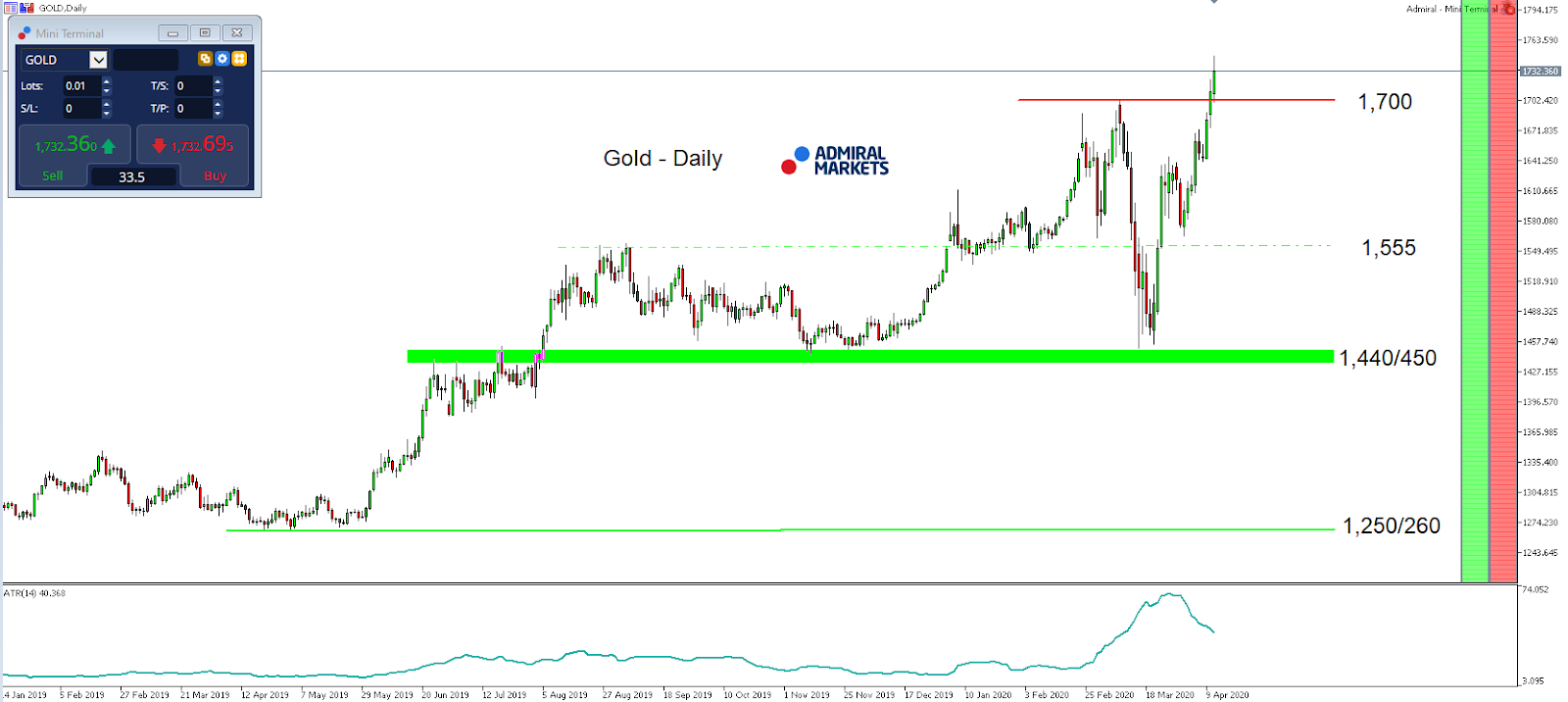
The picture in Gold hasn’t changed over the last week, and while we still consider the situation to be tense, the push above 1,700 USD on Monday is a clearly bullish sign.
Technically, the mode stays bullish as long as we trade above 1,440/450 USD.
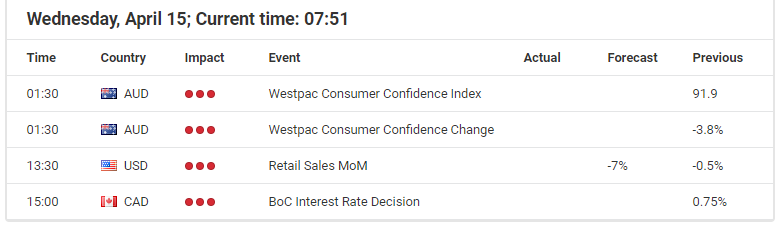
A potential driver for a push above 1,700 USD could come on Wednesday, from the Retail Sales data at 1230pm GMT.
After US Retail Sales posted their biggest fall in over a year last February, as consumers cut back on spending in a range of products, data for March is expected to come in even worse with the “Corona shutdown”.
In fact, the expected print of -7% would indicate the weakest number since the data set was first published back in 1992, and far below the current all-time low at -3.9% in 2008 during the Great Financial Crisis.
If we get to see a double-digit print (meaning everything greater -10%), Gold could see a push to new yearly highs, since Retail Sales can be considered the backbone of the US economy. Such a weak print, in addition to the explosion in initial jobless claims, could legitimately be seen as a very dark outlook for the US economy, thus favouring long engagements in the precious metal.
Still, short-term a next wave of de-leveraging hitting global financial markets shouldn’t be ruled out, mainly driven by the given global USD shortage, also resulting in a new wave of aggressive selling in Gold due to liquidity reasons.
But again: technically, the key-support can still be found around 1,440/450, above that level a deeper push above 1,700 USD is definitely an option.
Nevertheless, another “liquidation wave” could bring a short-term drop below 1,440/450 USD into play which would technically darken the picture, activating 1,250/260 USD as a first target:
Source: Admiral Markets MT5 with MT5-SE Add-on Gold Daily chart (between January 14, 2019, to April 14, 2020). Accessed: April 14, 2020, at 10:00pm GMT – Please note: Past performance is not a reliable indicator of future results, or future performance.
In 2015, the value of Gold fell by 10.4%, in 2016, it increased by 8.1%, in 2017, it increased by 13.1%, in 2018, it fell by 1.6%, in 2019, it increased by 18.9%, meaning that after five years, it was up by 28%.
Discover the world’s #1 multi-asset platform
Admiral Markets offers professional traders the ability to trade with a custom, upgraded version of MetaTrader 5, allowing you to experience trading at a significantly higher, more rewarding level. Experience benefits such as the addition of the Market Heat Map, so you can compare various currency pairs to see which ones might be lucrative investments, access real-time trading data, and so much more. Click the banner below to start your FREE download of MT5 Supreme Edition!
Disclaimer: The given data provides additional information regarding all analysis, estimates, prognosis, forecasts or other similar assessments or information (hereinafter “Analysis”) published on the website of Admiral Markets. Before making any investment decisions please pay close attention to the following:
This is a marketing communication. The analysis is published for informative purposes only and are in no way to be construed as investment advice or recommendation. It has not been prepared in accordance with legal requirements designed to promote the independence of investment research, and that it is not subject to any prohibition on dealing ahead of the dissemination of investment research.
Any investment decision is made by each client alone whereas Admiral Markets shall not be responsible for any loss or damage arising from any such decision, whether or not based on the Analysis.
Each of the Analysis is prepared by an independent analyst (Jens Klatt, Professional Trader and Analyst, hereinafter “Author”) based on the Author’s personal estimations.
To ensure that the interests of the clients would be protected and objectivity of the Analysis would not be damaged Admiral Markets has established relevant internal procedures for prevention and management of conflicts of interest.
Whilst every reasonable effort is taken to ensure that all sources of the Analysis are reliable and that all information is presented, as much as possible, in an understandable, timely, precise and complete manner, Admiral Markets does not guarantee the accuracy or completeness of any information contained within the Analysis. The presented figures refer that refer to any past performance is not a reliable indicator of future results.
The contents of the Analysis should not be construed as an express or implied promise, guarantee or implication by Admiral Markets that the client shall profit from the strategies therein or that losses in connection therewith may or shall be limited.
Any kind of previous or modeled performance of financial instruments indicated within the Publication should not be construed as an express or implied promise, guarantee or implication by Admiral Markets for any future performance. The value of the financial instrument may both increase and decrease and the preservation of the asset value is not guaranteed.
The projections included in the Analysis may be subject to additional fees, taxes or other charges, depending on the subject of the Publication. The price list applicable to the services provided by Admiral Markets is publicly available from the website of Admiral Markets.
Leveraged products (including contracts for difference) are speculative in nature and may result in losses or profit. Before you start trading, you should make sure that you understand all the risks.
Asian stocks and currencies are mixed while US equity futures are pointing south, offering a relatively subdued reaction to more dire warnings about the fate of the global economy. The IMF predicted that global GDP will contract by three percent this year, which would mark the steepest recession in almost a century.
According to estimates by the IMF as well as Wall Street, the global economy could lose anywhere between US$5-9 trillion of growth through 2021 because of the coronavirus. The signs are already there, as the likes of JPMorgan and Wells Fargo announced billions of Dollars being set aside in anticipation of more loans going bad, while reporting a steep drop in their respective Q1 net incomes with shares in both banks marking two consecutive days of losses.
Markets’ path dictated by longevity of Covid-19
Global stocks’ ability to post sustained gains appears predicated on how quickly major economies can restore some semblance of normalcy, while acknowledging that the lifting of quarantine measures may not necessarily mark an immediate return to business-as-usual. Lingering fears over the coronavirus could well put a lid on consumption and alter spending habits, while leaving corporate earnings stunted for an extended period.
Still, the US stock market has now retraced more than 50% of its losses during the corona-crash as investors turn a blind eye to the deteriorating near-term financial metrics of listed companies and focus solely on hopes of their eventual recovery, aided by the unprecedented supportive policies that have been rolled out across the globe. However, should the coronavirus make a return and force another round of lockdown measures, we could very easily see stocks turn substantially lower, leaving markets to question the efficacy of quarantine efforts, as well as the timeline for the eventual economic recovery. With the market outlook still mired in tremendous uncertainty, gains in equities remain far from a one-way bet.
Safe havens steady as global outlook sours
Gold prices seized on a waning Greenback to notch its highest level since November 2012, before moderating towards the $1700 mark. The Japanese Yen is currently the sole G10 gainer against the US Dollar, with USDJPY briefly strengthening past the 107 psychological level, while 10-year US Treasury yields have fallen by more than three percent to drop below 0.73 percent at the time of writing.
As the alarm bells over the state of the global economy ring louder, safe havens are strong this week and appear ready to seize any opportunity to claim further advances. The $1800 handle may well be within Bullion’s grasp and the Japanese Yen could mark a sustained move south of 107 against the Dollar, as long as risk aversion continues and the Dollar remains subdued. However, should the pandemic show more signs of stabilising over the near-term and major economies confirm plans to reopen, that could prompt the unwinding of recent gains in safe haven assets.
Disclaimer: The content in this article comprises personal opinions and should not be construed as containing personal and/or other investment advice and/or an offer of and/or solicitation for any transactions in financial instruments and/or a guarantee and/or prediction of future performance. ForexTime (FXTM), its affiliates, agents, directors, officers or employees do not guarantee the accuracy, validity, timeliness or completeness, of any information or data made available and assume no liability as to any loss arising from any investment based on the same.
Export restrictions may be removed with the end of quarantine
Earlier, consumer fears that farmers in a number of countries would not be able to produce enough rice against the backdrop of the Covid-19 pandemic have contributed to the increase in rice prices. In addition, some countries, such as Vietnam, have limited their rice exports. The quarantine in Bangladesh will last until April 25, and in India and Pakistan until the end of April. After the quarantine, rice exports from Southeast Asian countries may resume. The US Department of Agriculture (USDA) estimated exports reduction in April from Burma, Cambodia and Vietnam by 1.7 million tons, or 15%, and from India by another 0.3 million tons. Against this background, rice quotes recently updated their 6-year high. Meanwhile, according to the USDA, the reduction in world rice stocks in April will be insignificant – 0.7 million tons. At the same time, world stocks will remain at a record level of 181.6 million tons. 65% of this volume was accumulated by China.
Shares of CytoSorbents traded higher setting a new 52-week intraday high price after the company reported that the FDA granted emergency use authorization for CytoSorb for use in patients with COVID-19.
Critical care immunotherapy company CytoSorbents Corp. (CTSO:NASDAQ), which is focused on blood purification technology to treat cytokine storm and deadly inflammation in critically ill and cardiac surgery patients, announced that “the U.S. Food and Drug Administration (FDA) has granted Emergency Use Authorization (EUA) of CytoSorb® for use in patients with COVID-19 infection.”
The firm indicated that “under the EUA, CytoSorbents can make CytoSorb available, through commercial sales, to all hospitals in the U.S. for use in patients, 18 years of age or older, with confirmed COVID-19 infection who are admitted to the intensive care unit with confirmed or imminent respiratory failure who have early acute lung injury or acute respiratory distress syndrome, severe disease, or life-threatening illness resulting in respiratory failure, septic shock, and/or multiple organ dysfunction or failure, as described in FDA’s authorization.”
The company explained that “patients with COVID-19 infection often exhibit a cytokine storm with severe hyperinflammation that can contribute to worsened injury to vital organs like the lungs, heart, and the kidneys and that the goal of CytoSorb therapy is to reduce cytokine storm and the deadly inflammatory response through blood purification so that this injury may be mitigated or prevented.”
The company’s COO Vincent Capponi commented, “We greatly appreciate the FDA’s recognition, through this EUA, of the potential of CytoSorb and extracorporeal blood purification to help patients stricken with this terrible illness. It was clear in this truly collaborative process with the FDA that the Agency was committed to urgently providing physicians and patients with new treatment options in the fight against COVID-19.”
CytoSorbents’ CEO Phillip Chan, MD, Ph.D., remarked, “As a U.S. based company with CytoSorb device manufacturing in New Jersey, we are eager to expand the availability of CytoSorb to U.S. hospitals and patients as a treatment option to fight cytokine storm and deadly inflammation that is believed to exacerbate COVID-19 infection. With more than 555,000 documented coronavirus infections, the U.S. leads the world with over 22,000 deaths, and urgently needs new therapies to reduce the severity of this disease.”
“CytoSorb has been used in critically ill and cardiac surgery patients in more than 80,000 human treatments abroad, to help treat the same complications seen in COVID-19 patients such as lung failure, shock, and multi-organ failure. With CRRT, and in many cases ECMO, being standard in ICUs worldwide, CytoSorb can be easily implemented with minimal training. More than 200 COVID-19 patients have been treated with CytoSorb outside the U.S., resulting in the inclusion of CytoSorb into the COVID-19 treatment guidelines in Italy, Panama, and China,” Dr. Chan added.
CytoSorbents is a critical care immunotherapy firm based in Monmouth Junction, N.J., that specializes in blood purification. The company advised that its “flagship product” CytoSorb® is approved in the EU with distribution in 58 countries throughout the world. The company explained that “its purification technologies are based on biocompatible, highly porous polymer beads that can actively remove toxic substances from blood and other bodily fluids by pore capture and surface adsorption.”
CytoSorbents has a market capitalization of around $231 million with approximately 35.05 million shares outstanding and a short interest of about 8.8%. CTSO shares opened 30% higher today at $8.59 (+$2.00, +30.35%) over Friday’s $6.59 closing price and reached a new 52-week high price this morning of $9.40. The stock has traded today between $7.87 to $9.40 per share and is currently trading at $8.04 (+$1.44, +21.93%).
Disclosure: 1) Stephen Hytha compiled this article for Streetwise Reports LLC and provides services to Streetwise Reports as an independent contractor. He or members of his household own securities of the following companies mentioned in the article: None. He or members of his household are paid by the following companies mentioned in this article: None. 2) The following companies mentioned in this article are billboard sponsors of Streetwise Reports: None. Click here for important disclosures about sponsor fees. 3) Comments and opinions expressed are those of the specific experts and not of Streetwise Reports or its officers. The information provided above is for informational purposes only and is not a recommendation to buy or sell any security. 4) The article does not constitute investment advice. Each reader is encouraged to consult with his or her individual financial professional and any action a reader takes as a result of information presented here is his or her own responsibility. By opening this page, each reader accepts and agrees to Streetwise Reports’ terms of use and full legal disclaimer. This article is not a solicitation for investment. Streetwise Reports does not render general or specific investment advice and the information on Streetwise Reports should not be considered a recommendation to buy or sell any security. Streetwise Reports does not endorse or recommend the business, products, services or securities of any company mentioned on Streetwise Reports. 5) From time to time, Streetwise Reports LLC and its directors, officers, employees or members of their families, as well as persons interviewed for articles and interviews on the site, may have a long or short position in securities mentioned. Directors, officers, employees or members of their immediate families are prohibited from making purchases and/or sales of those securities in the open market or otherwise from the time of the interview or the decision to write an article until three business days after the publication of the interview or article. The foregoing prohibition does not apply to articles that in substance only restate previously published company releases. 6) This article does not constitute medical advice. Officers, employees and contributors to Streetwise Reports are not licensed medical professionals. Readers should always contact their healthcare professionals for medical advice.
– President Trump blames the WHO for his administration’s COVID-19 debacle. In reality, the White House knew about the virus threat already on Jan 3 but chose not to mobilize until late March.
In a recent interview with Fox News, President Trump said that the projections and pronouncements of the World Health Organization (WHO) about the coronavirus pandemic have been routinely wrong.
“Literally, they called every shot wrong,” the president added. “They didn’t want to say where [coronavirus] came from.” Threatening the WHO with the withdrawal of US funding, Trump charged WHO director-general Dr Tedros for siding with “Communist China.”
On April 14, Trump instructed his administration to halt funding to the WHO, as it conducts a “coronavirus review.” It is not clear how he intends to withhold WHO funding, much of which is appropriated by Congress. But it is clear that the review will be conducted by the same administration that delayed the virus response, in the first place. That will virtually ensure a prejudiced outcome.
Why did Trump target the WHO, its projections and its chief? And why did he do it now?
Ignoring realities
From early January, President Trump has dismissed the risk of the novel coronavirus, repeatedly. Two days after the first virus case was identified in the U.S., Trump said at the World Economic Forum in Davos that “we have [the novel coronavirus] totally under control. It’s one person coming in from China, and we have it under control,” (Jan 22).
After 10 days of national emergency in China and the WHO’s international emergency alert, Trump repeated that “we have it very well under control” (Jan 30). Even weeks later, he repeated his statement (Feb 23).
Soon thereafter, he declared in the White House that “[coronavirus is] going to disappear. One day — it’s like a miracle — it will disappear” (Feb 27).
Then, Trump took the blame-game to another level accusing Democrats for politicizing coronavirus, which he proclaimed “their new hoax” (Feb 28).
A day later, he announced again that his administration had the virus fully under control thanking his healthcare advisers (Feb 29) whose virus advice he had rejected – as we today know – since the first week of January.
In March, when the virus was about to have an almost free ride in New York City and the rest of America, Trump suggested that the WHO’s estimate of the global death rate was “false.” He described the virus as “very mild” and suggested that the infected could get better by “going to work” (Mar 4) – a suggestion that virus specialists considered idiotic.
Barely a week later, Trump declared the common flu worse than COVID-19 (Mar 9).
And yet, only a week later, Trump wanted Americans to believe he was taking the virus seriously. ““This is a pandemic,” he told reporters. “I felt it was a pandemic long before it was called a pandemic … I’ve always viewed it as very serious” (Mar 17).
What changed the tone?
Two and half months of delays
The simple answer is a New York Times expose one day before (Mar 16) and the impending presidential election.
As the Times reported, “from the beginning, the Trump administration’s attempts to forestall an outbreak of a virus now spreading rapidly across the globe was marked by a raging internal debate about how far to go in telling Americans the truth.”
What we know with certainty today is that, on January 3, China’s CDC completed the virus gene sequencing, initiated emergency monitoring and notified the WHO and relevant countries and regions about the virus.
As Hong Kong and Singapore began to prepare for the virus that same day, US CDC director Dr. Robert R. Redfield called Alex M. Azar II, Trump’s secretary of health and human services, to tell him China had discovered a new coronavirus. Azar told his chief of staff to inform the National Security Council (NSC) about the matter.
There was reason for hurry. When Trump arrived in the White House three years before, his administration had eliminated NSC’s global health unit that had monitored such virus risks. Now, the administration’s top health executive team began daily meetings in the basement of the West Wing.
Yet, there was no proactive mobilization in the White House. Rather, a long debate began within the Trump administration over “what to tell to the American public.” Meanwhile, cabinet members projected its mishandling on China, which was blamed for not being transparent, faking the case counts and associated deaths.
This odd state of affairs lasted two and a half months.
Deflecting responsibility
Faced with the Times expose, one of the greatest failures in U.S. pandemic preparedness and the impending fall election, President Trump declared that – actually – he had always viewed the COVID-19 as “very serious.”
After botching its virus response, the administration still would not disclose the full realities. Instead, Trump blamed the disastrous delay on China, the WHO, its chief and others who had been urging greater mobilization after mid- January.
After China’s CDC had alerted the WHO and its key members about the virus threat, WHO director-general Dr Tedros spoke about the potential risks in a series of international releases. On Jan 20, President Xi declared a national emergency in China. A day later, the WHO began daily situation reports about the virus spread.
On January 30, the WHO declared the virus outbreak a “public health emergency of international concern” (PHEIC). In the subsequent weeks, the WHO, its chief and his executives did whatever they could to alert the international community about the threats. And on March 11, the WHO proclaimed the virus a global pandemic.
The net effect? Almost 2 million COVID-19 cases and over 100,000 deaths which will be followed by the worst global economic contraction since the Great Depression. And an impending carnage that may prove far worse in vulnerable emerging and developing economies.
These nightmares were neither necessary nor inevitable. Most of them could have been avoided. That’s why President Trump ordered the “coronavirus review” – to rewrite the history of how his White House failed America
About the Author:
Dr. Dan Steinbock is an internationally recognized strategist of the multipolar world and the founder of Difference Group. He has served at the India, China and America Institute (USA), Shanghai Institutes for International Studies (China) and the EU Center (Singapore). For more, see https://www.differencegroup.net
The opportunities surrounding a potential district-scale prospect are outlined by Hannan Metals CEO Michael Hudson in conversation with Maurice Jackson of Proven and Probable.
Maurice Jackson: Today we will introduce an early-stage exploration company focused on identifying district-scale high-grade copper and silver systems in Peru. Joining us for our conversation is Michael Hudson, the CEO of Hannan Metals Ltd. (HAN:TSX.V; HANNF:OTCPK).
We’re glad to speak with you today to discuss the value proposition before us. Before we delve into company specifics, Mr. Hudson, please acquaint us with Hannan Metals, and share the opportunity the company presents to the market.
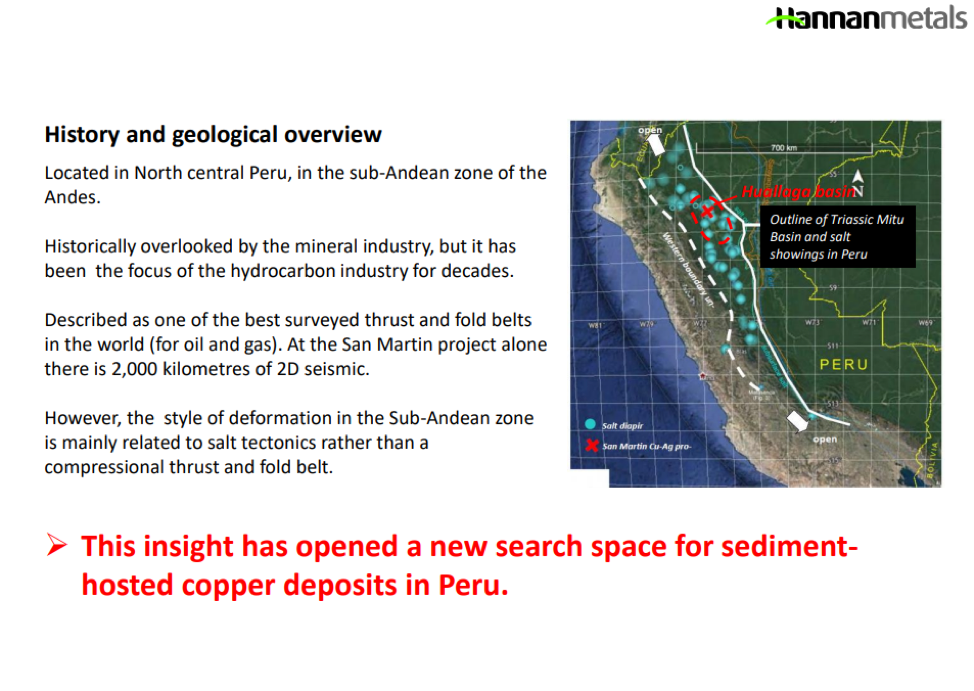
Michael Hudson: Hannan Metals Ltd. is a TSX.V-listed company exploring for copper and silver in Peru. The company is headed by people who have extensive experience within the mining industry, and specifically in Peru. We are exploring in a completely new district in the San Martin area of northeastern Peru. The project encompasses a newly identified, 120-kilometer (120 km) long, basin-scale, high-grade, sedimentary-hosted copper-silver system. This is a new deposit style for Peru, however it is the second-most prolific producer of copper, as a style, in the world, after porphyries. Geologically, the system shares similarities with sedimentary copper-silver deposits in the African copper belt. With a first-mover advantage, we recognized the exceptional potential for large copper-silver deposits during late 2018, and since then have aggressively staked 521 square kilometers of prospective geology.
Maurice Jackson: Let’s go to Peru and visit the San Martin. Where and how did Hannan Metals obtain the data that led to the acquisition of San Martin?
Michael Hudson: We have a 25-year history of exploring and acquiring exploration data in Peru. Based on some information from our datasets, we commenced reconnaissance exploration and found a significant amount of high-grade copper over a large area, and started staking. We put in our first claims in September 2018, and granting of these mining concessions started at the end of 2019. We are putting in a significant amount of effort to ensure that we meet and engage all relevant stakeholders, from local communities to regional and provincial authorities. Generally, the local people have been very welcoming. We are talking to people, listening to concerns, educating as we move forward, and building trust.
Maurice Jackson: Is the San Martin project already fully permitted?
Michael Hudson: We have about 40% of our mining concessions granted to date, with more continually being granted on a monthly basis. We are not at a drilling stage yet, with work over the first half of 2020 aimed at regional reconnaissance to [do] detailed mapping of mineralized horizons over specific prospect areas. Our aim is to balance project and social governance. We will try and keep the permitting process as simple as possible by keeping target areas small and engaging with the community to educate them and be transparent throughout the entire process. We are taking our time to define the right target areas and engage with the relevant communities.
Maurice Jackson: Can you elaborate on the infrastructure and the logistics surrounding San Martin?
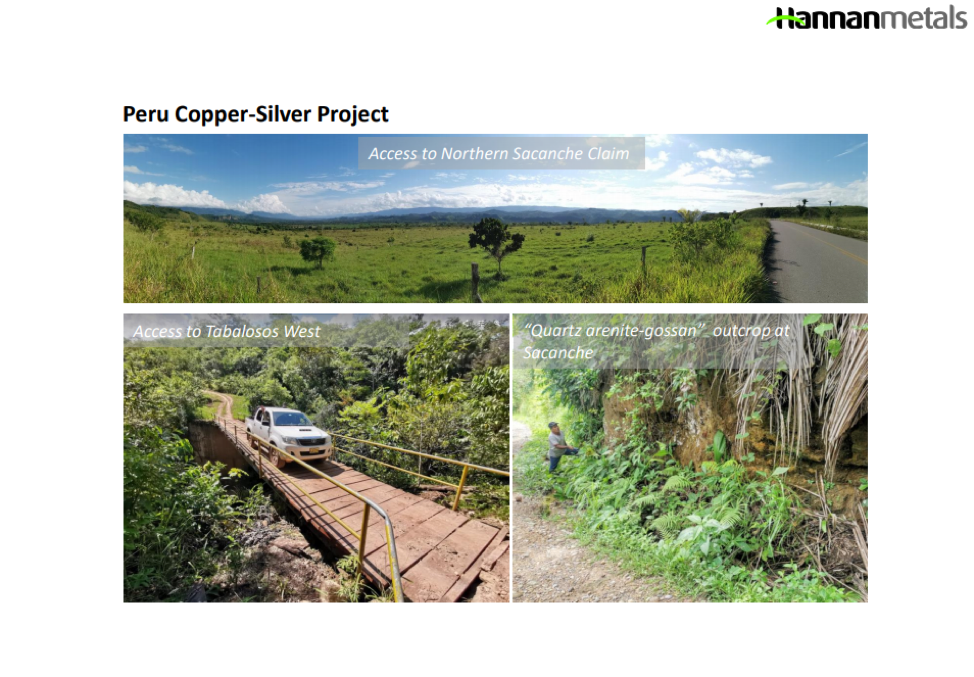
Michael Hudson: The San Martin project is located about west and south of Tarapoto. There are multiple daily flights into this city from Lima. Project access is excellent via a proximal paved highway and, broadly, no part of the project is more than two hours’ drive from Tarapoto. This infrastructure is, of course, relatively new for Peru, and makes this project so much easier than if we were tackling it, say, 20 years ago.
Maurice Jackson: Well, let’s talk about a clever way that Hannan Metals has de-risked their project. Hannan has shifted the paradigm on exploration by implementing a concept known as new search spaces. And the intellectual capital derived from this concept has positioned Hannan Metals in a first-mover competitive advantage among your peers. Sir, please introduce the concept of new search spaces, and how does it fit into the narrative of defining the San Martin as a greenfields or a brownfields exploration plain?
Michael Hudson: Well, firstly, I didn’t coin the phrase. It comes from a very smart geologist called Jon Hronsky. And really, this is a concept that’s been taken a little further than just talking about grassroots exploration or greenfields. It’s basically identifying an area of prospectivity for whatever you may be looking for. And it may be in an old or a very mature terrain where there’s lots of data, but you come up with a new thesis. And then you search for that new thesis, whether it’s going underground for high-grade systems underneath old oxide gold, for example, or you go into new areas completely and say, “Well, the San Martin area has the same geological characteristics for many, many reasons as some of those super deposits that form in Africa or in Poland and northern Germany.” And then you collect the data that opens up that search space, I suppose.
It really is the true way to make discovery. It’s very hard to go back to old ideas in old camps and do the same again. And really those easy pickings have been made in our business. So you really have to think a little broadly from the initial start of your exploration. It’s looking into new areas with new theses or ideas or concepts, and then collecting the data to support or refute those. That’s the exploration or scientific process, but it really means that you’re thinking about it much earlier on, from a perspective of trying to find something large and new.
Maurice Jackson: Mr. Hudson, to truly appreciate the value proposition of the San Martin, please provide us with a mental picture and tell us about this stratigraphy and the genetic model.
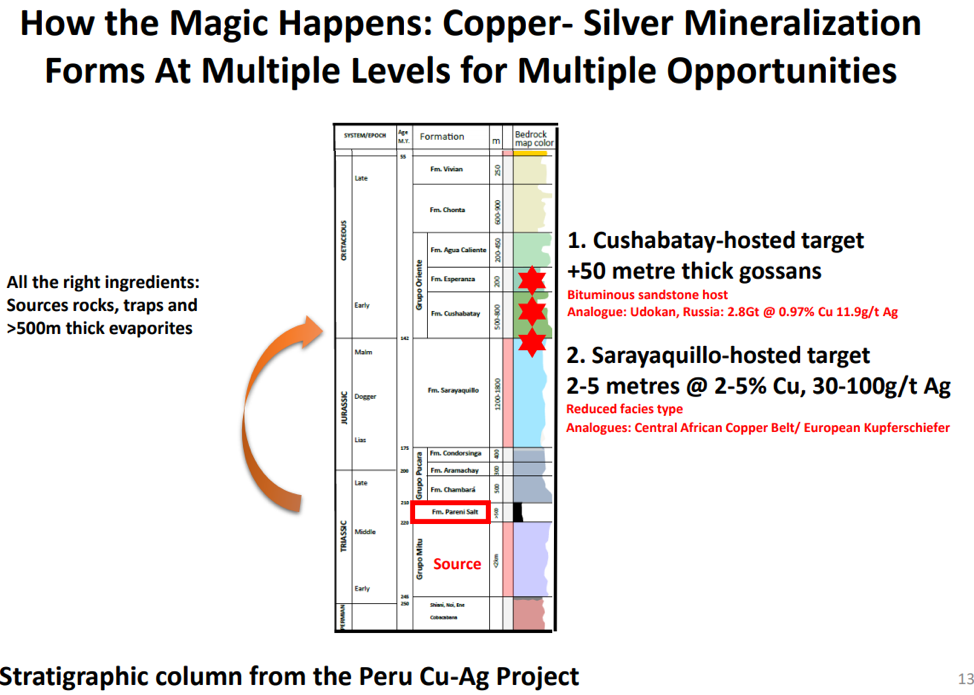
Michael Hudson: That is how the magic happens, I suppose, and we have been very fortunate here in, that this literally had very, very little exploration. There have been a couple of explorers in the past in this area, but we’re talking one year here and one year there. But really, the area and the understanding hasn’t been put together until. . .the last six to 12 months.
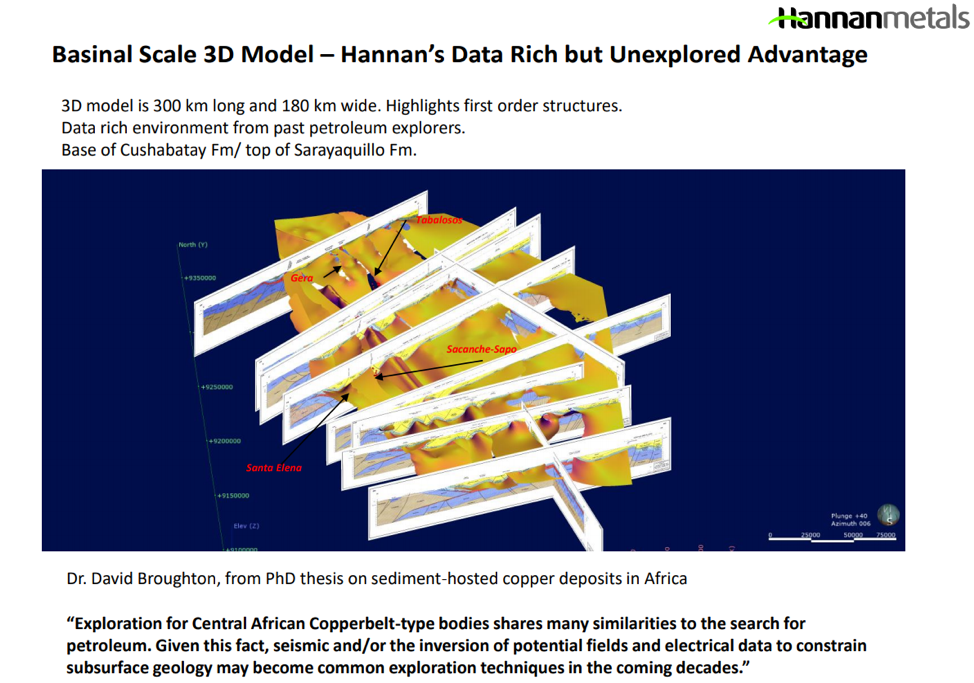
We’ve benefited from the data that has now been made freely available to the hardrock mining industry from the petroleum business, and the petroleum explorers were working in these areas a long time agoway, way, way before we ever thought there could be any prospectivity here for metals. And that’s important because the petroleum explorers have bought hundreds, if not millions, of dollars’ worth of exploration data collected in a different way for a different commodity, of courselooking for oil. We can use that data and apply it to the things that matter for copper, and the things that matter for copper here in the sediment-hosted copper systems
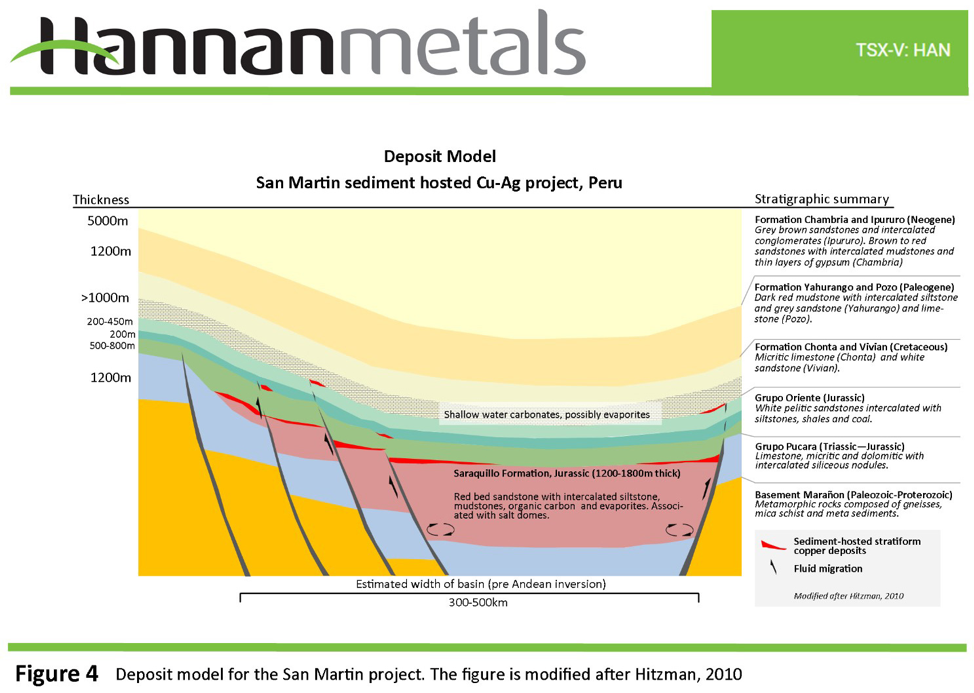
I should say, there’s quite a large amount of silver with this system. So it’s really a copper-silver system. The things that matter here for these systems, like any deposit, are source, transport and trap. And they’re fairly well defined. It’s a relatively simple model in its gross scale. We always look for a source, and the source rocks, and the seismic data that the oilees have produced over these areas, give us a great understanding of the rocks, or the stratigraphy, or the layers of rocks and how they’ve formed through that period of time.
So, we can identify source rocks. We can identify transport, which is really important also. The seismic shows us those big structures, those big faults that have operated from very early stages in this geological basin right through to when the Andes were forming, and they went from. . .extension to compression when the Andes were forming. All these different stages we can identify through the rock record, and determine not only what is important, but when, and then we can target those structures that have been moving at that appropriate time.
And then the trap is probably the most important part. And in this case, it’s a chemical reaction that drops the metal out. We call it a redox boundary, a reduced oxidized boundary. The fluids are oxidized, and when they see the first reduced rocks in the sequencethey could be anything from black shales or graphite to what we have here, organic materialthen the copper drops out.
The key point now is that these systems form over a vast scale. We have an area here that is under tenure for 120 kilometers of length. My apologies for using the metric system, but it’s something like 60 or 70 miles. It’s a very, very large system that is working that source, transport and trap. We’re finding copper in those trap horizons over this extensive zone. It’s not just one trap horizon we see. We see multiple traps, multiple redox boundaries forming in that stratigraphic pile of rocks. So, that data-rich environment that we have has really helped us fast track not only to understand, but to target, this system over such a large area.
Maurice Jackson: We have before us a 3D model. What are we looking at here?
Michael Hudson: This is quite an unusual circumstance, in that [this area has] really only been explored for less than a year, [and] we’re able to build up a comprehensive 3D model. And this is a model in a program called Leap Frog. It’s something like 300 kilometers long by 180 kilometers wide. We can see the planes, or the sections, like cross-cutting a loaf of bread along the long axis. Their interpretation is from the seismic sections that the oil companies have provided.
We’ve been able to tie all those together literally in this program, and we can start to understand all those features that I’ve just talked about: the source, transport and trap. Features that really allow us to understand how this copper basin formed, and how the copper formed, and that gives us the style. Once again, as I said, this style wasn’t really understood until all this data was pulled together.
Then it allows us to home in on specific areas, not only stake those areas, which we’ve done very aggressively. We’ve had a first-mover advantage here because we were first, and it’s led to a staking rush all around us, I should say. But we had that benefit of all that data and the ability to stake what we wanted first. And then, within those mining concession areas that we’ve staked, many of them have now been granted. We’re able to narrow down the areas which we want to explore.
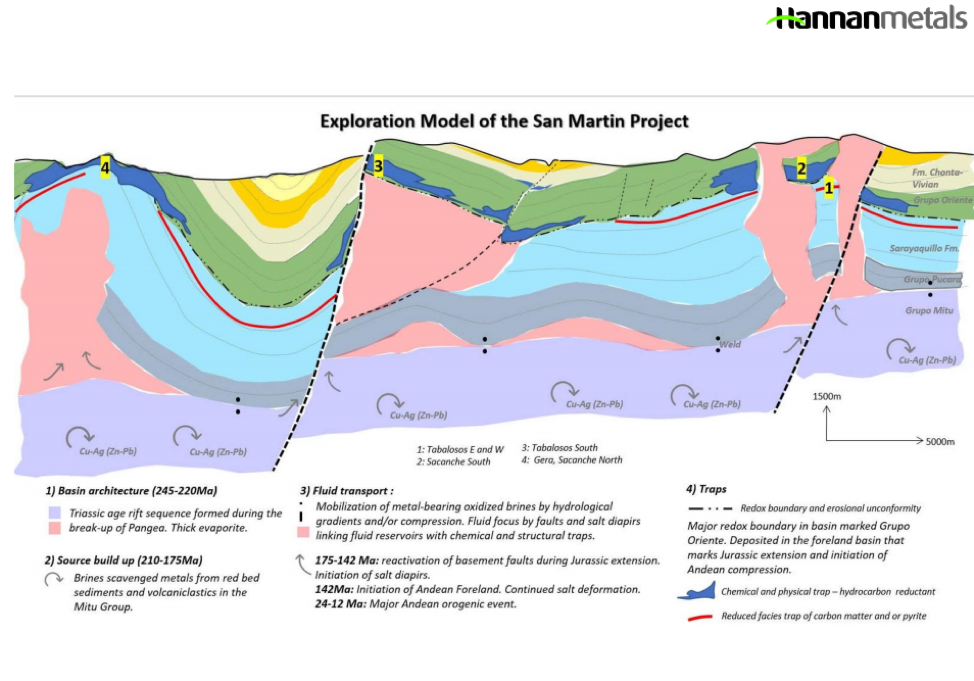
Maurice Jackson: Can you walk us through the exploration model?
Michael Hudson: This is a very good, summarized, cross-section model created by Lars Dahlenborg, the president of Hannan Metals. What he’s summarizing there is the source, which are those purple rocks and the fluids taking the copper. The other key point here that I didn’t mention before is that scavenging the fluids and bringing up into those source rocks is driven by salt, of all things.
So, there’s vast salt deposits that formed in these areas, and salt forms an amazing scavenger of metals. These highly brine-rich fluids act with superpowers, basically, to take the copper out of those purple rocks at the bottom. Then those fluids move up through those faults. So there’s the transport. We can see the dotted lines.
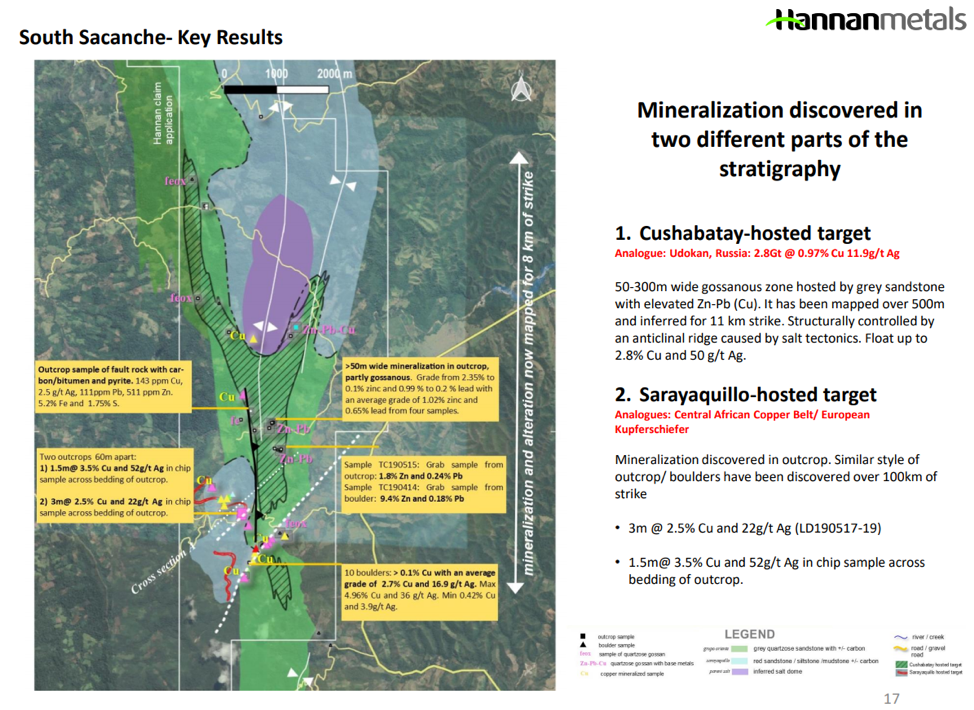
And then into those areas at the top there, we’ve got little red line. That’s one area we call the Sarayaquillo Formation, and that’s one area where this redox boundary, or the trap, formsand then even up and higher, where there’s the green rocks with the blue. They’re areas where we’re finding gossans of lead and zinc, which are peripheral to the copperand also copper in those areas now. [The gossans] are 50 to 80 meters wide at surface over multiple kilometers. This is a big and vast system. We’re talking about five- or six-kilometer views through the earth’s crust there. The scale of that is very big, but that’s the magic.
Maurice Jackson: You alluded to some comparisons earlier, but a picture’s worth a thousand words. And when I think of the San Martin, the first thing that comes to my mind is scale, and I’m talking about district scale. To put some things into perspective, can you provide us with some comparisons?
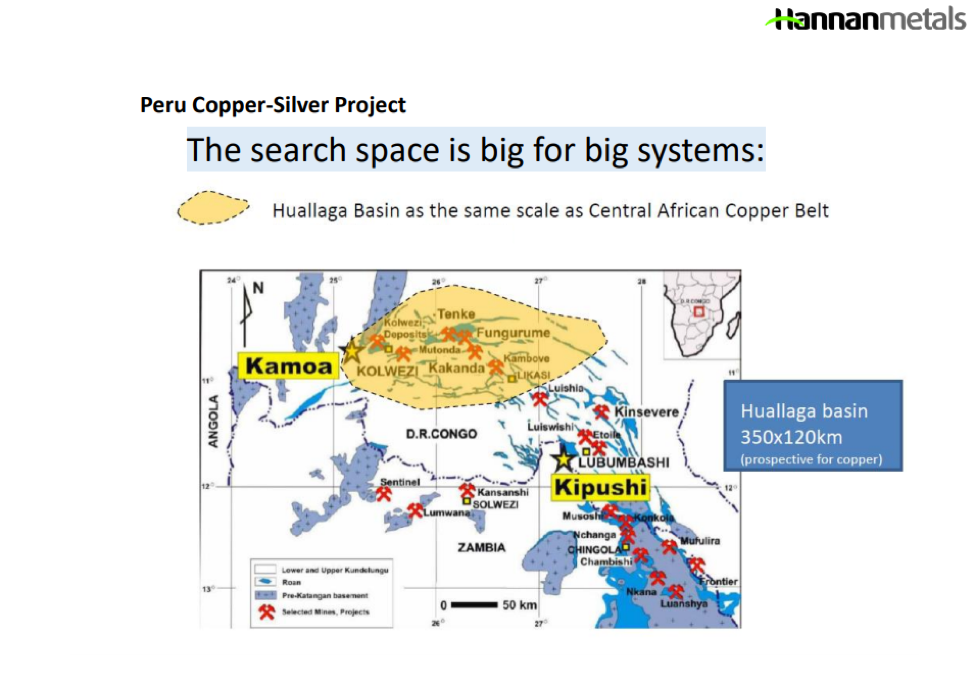
Michael Hudson: Yeah, the important things that you’ve just mentioned there are scale and grade, and if you can find that, that’s the nirvana of our business, of course. We have both of those in abundance. The picture that you see here is the Central African copper belt. It’s not where we’re exploring, of course, but what it shows is the scale of that system. The sediment-hosted copper deposits on earth are the second-most prolific form of copper, where we derive our copper fromthe first being porphyry these days. The porphyrys are coming to an end, in my prediction. Those higher-grade porphyrys have been mined. There’s many more of them that have a lower grade, but as the world is changing, those big open pits with lower and lower grades become less desirable. These higher-grade systems that have a smaller footprint will be more desirable. And that’s what happens here in the copper belt, in many respects.
These systems are big and high-grade. You can see the scale of the basin that we’re exploring, called the Huallaga Basin, and that’s overlaying in that yellow color. And you can see we’re about a third the size of the copper belt just in the basin that we’re exploring in. That is really only a small part of this full-end basin system that extends on the eastern side of the Andes.
This is a new copper belt that not only exists where we’re exploring, but it extends from Colombia through Ecuador, where we have some peer companies exploring for the same systems. They’re about 300 kilometers north of us, and then down through Peru into Argentina and Chile. So, this is a big new copper belt. We have some of the more advanced and more easily accessible areas and that’s why we targeted where we wanted to, but this has some big implications for Peru too, right? This is a new copper belt for Peru potentially developing here. They already produce, on a country basis, the second-most amount of copper in the world. This could shift them to number one, if this thesis continues to hold.
Maurice Jackson: We’re going to cover your technical team later, but they’ve been quite successful in the results on the implementation of the new search spaces. And that’s not just on scale, but equally impressive on identifying high-grade. What are some key results that have current shareholders excited?
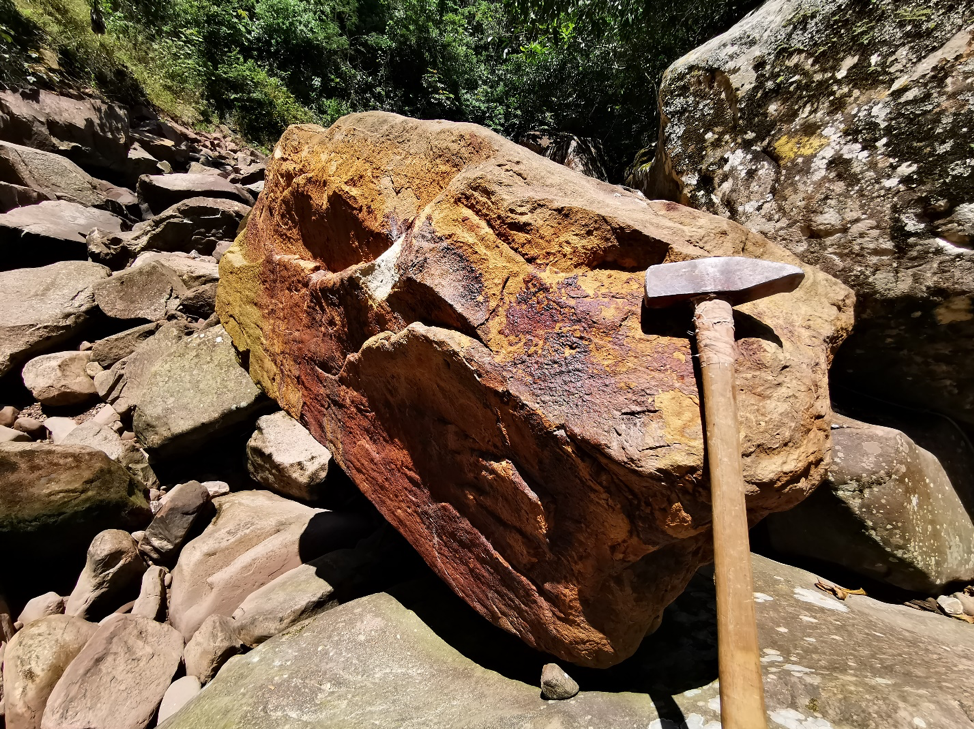
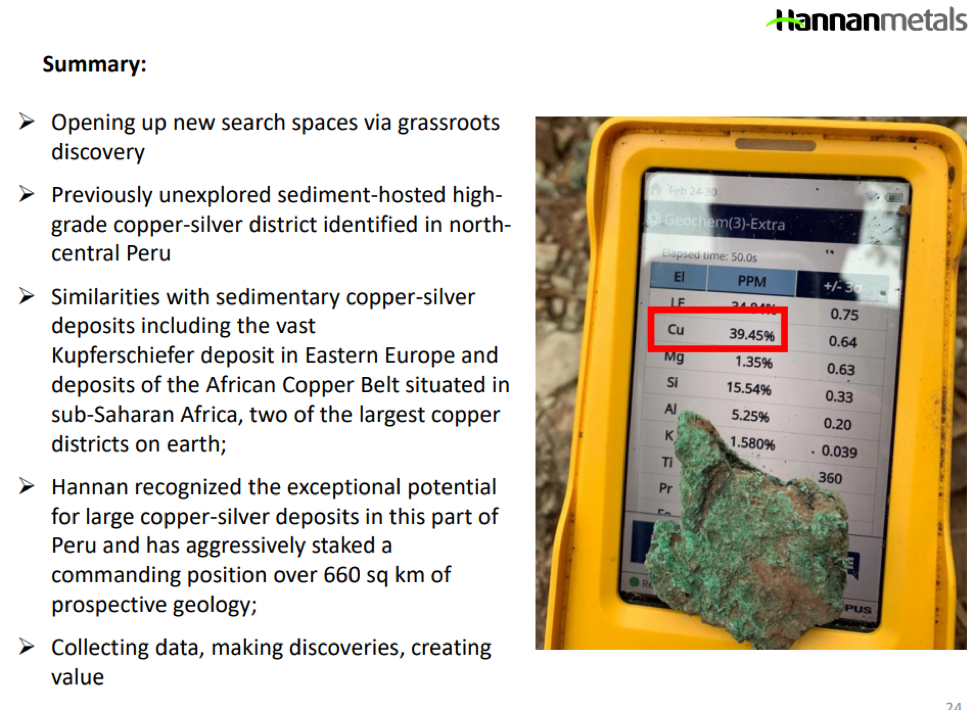
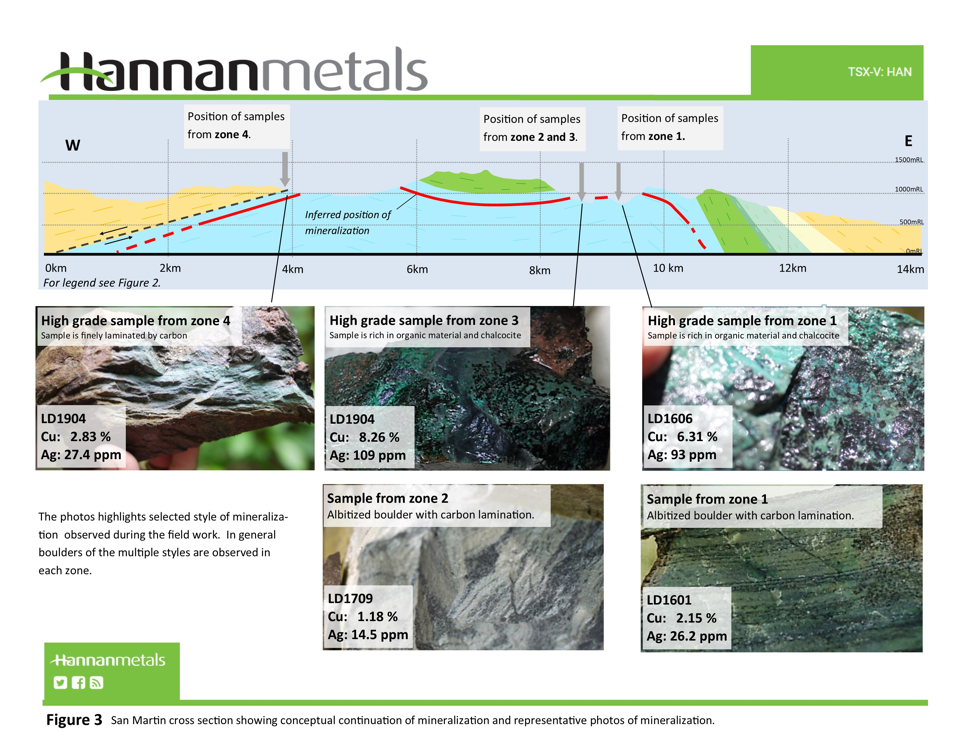
Michael Hudson: We have some very high grades, and they’ve actually surprised us too, to be completely frank, Maurice. This system is developing some very high grades, from the initial bouldersand hundreds of them that we found over this very vast area in creeksand then we’ve started to find some of these outcrops. We’re seeing three to five-meter-thick zones in the Sarayaquillo Formation running 25% copper, something like that. That obviously is our next challenge, is to find continuity of these high grades, and that’s what we’re working to do, of course. But as I’ve said, it’s relatively early stages. This is our first intense year of exploration, which has had a little hiatus, of course, now, with everything that’s going on in the world with COVID-19. But we still had quite a good start before we were shut down a few weeks ago.
There’ll be many more of these high grades found. Also, we’re finding not only that Sarayaquillo, that 25% copper over those widths over large areas. We’re seeing these outcrops 20 kilometers apart, and we’re finding very thick lead-zinc gossans that we think are peripheral to the copper-bearing parts of the system. These gossans are 50 to 80 meters wide and running percent levels, up to 10% zinc.
The main target here is copper. But you never know what you just may find here. And we may find bothnot only a copper system, but a lead-zinc system, as it’s turning out here. So, yeah, we’ve been very successful so far because of that data-rich environment that I talked about before, which has allowed us to target these areas. Just maybe there’s a hell of a lot more here to be found, of course, and so the early results will reflect where this project’s going.
Maurice Jackson: What are Hannan Metals’ principal objectives for the next 12 months?
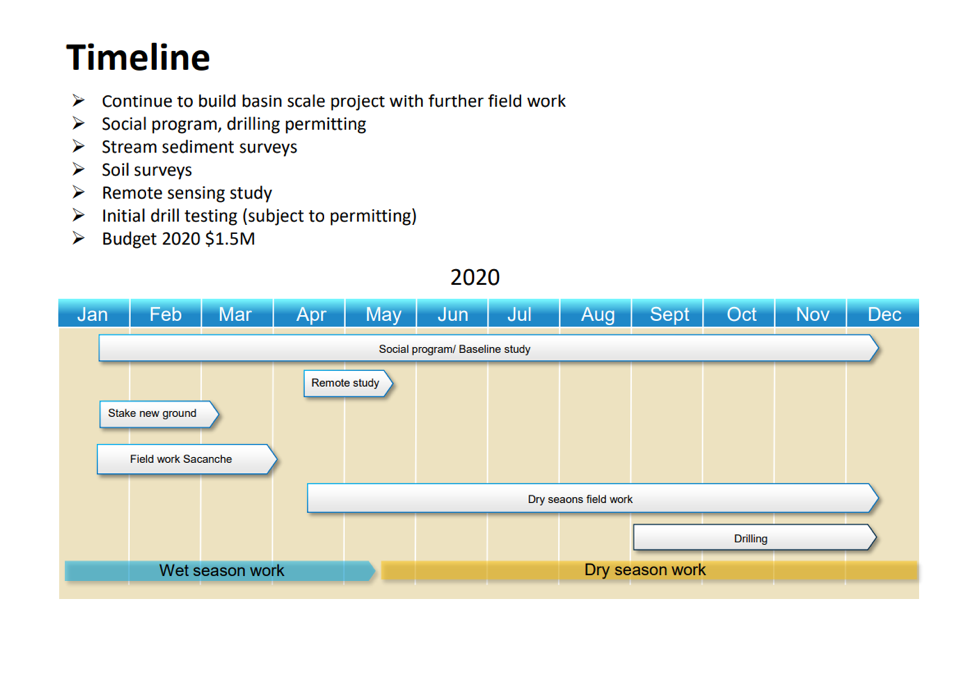
Michael Hudson: We hope that within the next year we will have drilled and demonstrated both continuity and scale of the mineralized system. This will be subject to permitting. We have recently raised CA$2.2 million (CA$2.2M) and now have a CA$1.7M budget for 2020 to complete a significant amount of field work over the next year.
The other key point is our main objective to work with the locals to tell them what we want to do, to gain their acceptance, and then come back and show them what we’ve done. And show that we’ve been operating with responsibility. Because these areas haven’t been explored before, there’s a general lack of understanding about what exploration is, so there’s a lot of education here to be done to explain that we’re prospectors, and obviously looking for areas that could potentially be mines one day.
But it’s a very high-risk business, of course, and we just don’t know where those better areas are going to be. So, it’s very much a first principle, working with the local people, as well. So, that’s a key objective as well, because if you get off on the wrong foot anywhere in the world from the very early stages, it’s very hard to recover. Starting well is a key objective for us in that respect.
Maurice Jackson: We’ve discussed the good. Let’s address the bad. What can go wrong, and what is your action plan to mitigate that wrong?
Michael Hudson: Well, lots of things can go wrong in exploration. You don’t find what you think is there, and then that second-guessing nature, without a doubt. As I hinted at before, we are de-riskers by nature, and the only similarity of businesses is the R&D [research and development] business in the pharmaceutical business where we spend lots of capital. There’s very few projects that progress and advance forward toward mining. That’s sort of like the wonder drugs that are eventually permitted and become very successful drugs, after lots of R&D in the pharmaceutical business. That’s what we’re doing. So there’s, of course, inherently a lot of risk.
How is that mitigated? That’s mitigated by having the right managers of the scarce capital that we’re able to access in the capital markets, and exploring appropriately. Not spending another dollar if we’re proving something isn’t there rather than is there. It all comes down to the opportunity itself, and whether the system develops. And so far so good. We can certainly see that there’s truly a great prize here to be gained. But we’ll spend the capital appropriately to mitigate those risks.
The other area, I suppose, and I touched on that, also is permitting. We want to make sure we get that right. So, it’s no good if we find the world’s biggest deposit of copper and we’re never able to access itand, of course, with getting the local stakeholders our side. We have to make sure that those two go hand-in-hand. And really, it’s working with credibility and respect, and good communication. And, like any relationship in life, if you have those values, then ideally things can progress for you, but that’s our culture of the company, and how we aim to succeed.
Maurice Jackson: Those are some good ethics to subscribe to. Switching gears, we’ve covered the project. Let’s discuss the people responsible for increasing shareholder value with their business acumen, and discuss the commercial and technical expertise your team provides to Hannan Metals’ shareholders. Mr. Hudson, please introduce us to your board of directors and management team.
Michael Hudson: Well, I’ve mentioned a few of the team here before. I see myself as a leader and spokesperson, but I have some much more capable, and fantastic people around me. I should just say that I’m a geologist, of course, and I worked in and breathed geology for my career over the last 30 years. And. . .what I really love doing is finding things, and that’s what motivates me.
I’ve worked with a good group of people, the majority of which I’ve worked with for the last 20 years in the junior business. We’re a very tight team. We’re technically driven. We’ve been in the capital markets, and made many discoveries before. In the last cycle we took three discoveries to half-a-billion-dollars in market capitalization, through from first principles, and really you can say this is our next one in waiting, in terms of the next discovery.
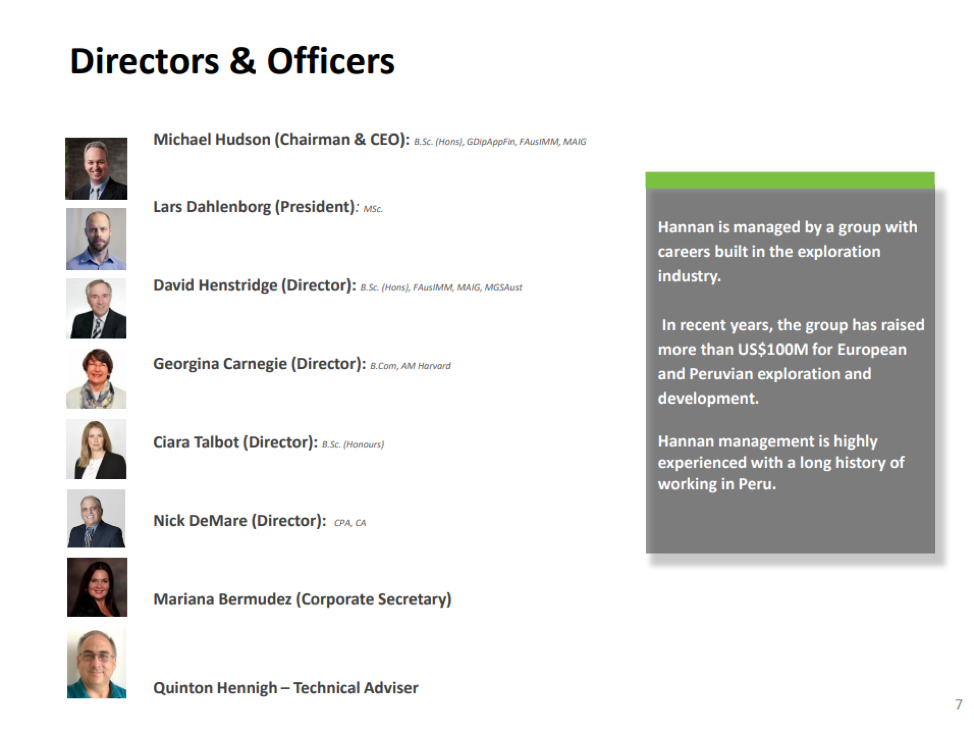
Lars Dahlenborg is the president. He and I have worked together for 12 or 13 years, and Lars is a brilliant geologist, and done most of the pulling together here. . . .It’s very important to have geologists who’ve made discoveries and know how to manage their capital. Some gray hair is important, and David Henstridge is a geologist I’ve worked with for 20 years, and he sits on the board also. Ciara Talbot is a geologist also. Ciara is the director of exploration for Lundin Mining Corp. (LUN:TSX), so she runs Lundin Mining’s large exploration budgets. So, she’s got some amazing experience worldwide and brings that larger company philosophy, of which most of us have worked for in our careers but not for some time, from my point of view.
Then, of course, you can’t just have geologists. You’ve got to have other people around you, and Georgina Carnegie is more from the geopolitical side of things. She’s Harvard trained, World Bank, OECD, came out of the Australian government, and she really has helped me in many places in the world unravel the different onion rings of power as you work your way up through a country. She’s been fantastic at articulating those messages.
And then you need the engine room, of course, behind you in running these public companies. Nick DeMare, a long-term business partner, manages all the governance, and that side of the business. And once again, Mariana Bermudez, who sits in Vancouver, is our long-suffering corporate secretary, and makes sure that the business runs on a day-to-day basis.
And so, that’s really the team from the board and the offices. I should say the hardest workers, in many respects are those geologists, and we’ve got long experience in Peru. We’ve gone back to people, for the most part, that we know and know well. They’re the people and the drivers and the helpers in the field who are doing the hard yards finding all this copper.
Maurice Jackson: Mr. Hudson, I notice we overlooked a very important name. Could you please share who that is?
Michael Hudson: Well, a very important person indeed, and that’s Dr. Quinton Hennigh, who came to the company relatively recently, but has known the company and the story pretty much from the first press release we put out on this copper discovery. Quinton is an extremely well-known geologist. He’s probably one of the most famous geologists in North America for his ability to think big, to pick discoveries, and then to support teams in developing them.
From a personal point of view, I’ve really enjoyed working with Quinton. You don’t generally learn a lot in this business, and in the junior business, unless you surround yourself with some super people, and Quinton is just one of those people who’s taught me a lot from his vast experience base. Quinton is an advisor to the company. We were both down in Peru relatively recently together, and kicking the rocks. And his voice and experience is a tremendous advantage, and we love having him on the team.
Maurice Jackson: Having Dr. Quinton Hennigh is a competitive advantage in and of itself.
Michael Hudson: Exactly.
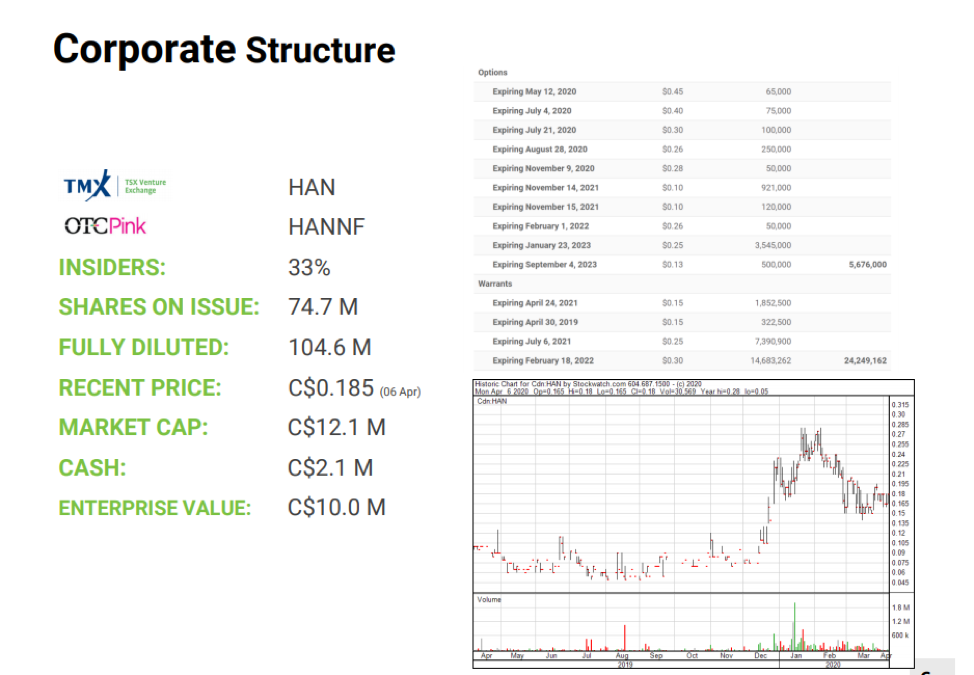
Maurice Jackson: All right, let’s get into some numbers. Please share the capital structure of Hannan Metals.
Michael Hudson: Well, we’ve got 74 million shares on issue; fully diluted around about 104 million shares. The market cap varies around $1012 million at the moment. In terms of cash, we’ve got about CA$2 million cash in the bank. That will see us well and truly for this year’s budget, which was targeted to be $1.7M, of which we’ve spent some of that already. We were going to end with about half-a-million dollars cash after this field season.
That, of course, has been changed somewhat with this lockdown that we’ve seen now globally, where we try to avoid spreading this nasty virus, and Peru is no different. So, we just have to see where things go, until it’s appropriate and responsible to start our efforts again. But we’ll surely have enough cash in the company to get through to that first drill program that we spoke about.
Maurice Jackson: How much debt do you have?
Michael Hudson: Zero. If you take debt into one of these companies it’s a death spiral, and you really don’t want to operate with any debt as a junior explorer, in my humble opinion.
Maurice Jackson: Who are the major shareholders?
Michael Hudson: Well, we just completed a capital raise with $2M with the Sprott Group out of Carlsbad in California, and so they have a large percentage on their books. And then the other large percentage is actually insiders. It’s something like 40% of the holdings tied up between those two groups.
Maurice Jackson: I hope readers are taking note here. We’ve got Dr. Quinton Hennigh and Rick Rule: Those are two names that have given the endorsement to Hannan Metals, so I would certainly take note of that. And there are some other high-profile names that vetted Hannan Metals and are shareholders.
Michael Hudson: We have been fortunate to have some high-profile names as shareholders, such Bob Moriarty, Mickey Fulp, Brent Cook, Joe Mazumdar and Maurice Jackson.
Maurice Jackson: Are there any redundant assets on the books that we should know about?
Michael Hudson: Wow, that’s an interesting question. We still absolutely hold our Irish projects. But I wouldn’t call them redundant in any way, shape, or form.
Actually, we did some fantastic work there, and probably have some of the most compelling targets that have developed through lots of exploration, and lots of seismic acquisition actually. And that’s what gave us the real insight to going into this data in Peru, with all that petroleum data. That has inherent value rather than redundant value.
But the key point there is if we can keep those on the books with minimal expenditures, we’ve got such an exciting project here in Peru. There will be interest in those assets in Ireland, and we’ll determine just how to monetize those for shareholders as we go forward.
Maurice Jackson: Are there any change of control fees, and if yes, what is the compensation?
Michael Hudson: No, there’s none.
Maurice Jackson: That’s quite impressive actually. Is management charging a consultant fee for any services?
Michael Hudson: Yes. Myself and Lars have a salary. But I think that you’re probably hinting at, do we have a separate company that charges above and beyond, which is not the case. I take a very modest salary; something like CA$8,000 a month to run this company, which is probably one of the lower cost CEO salaries you’ll find in the business. But I truly believe in putting money in the ground. And I’ve got a lot of equity. I’ve written lots of checks for this company, and I’m in it for discovery.
Maurice Jackson: When was the last time you purchased shares and at what price?
Michael Hudson: I purchased shares right up and down from $0.25 down to $0.15 down to $0.05. So, I’ve purchased all the way up and down the chain there. In fact, myself and my business partners, along with Rick, were the only ones writing checks last year when nobody was interested.
Maurice Jackson: In a closing, multilayered question. What is the next unanswered question for Hannan Metals? When can we expect a response, and what determines success?
Michael Hudson: Well, we’ll continue to put out press releases over the next three or four months. We’ve got rocks in the lab. We’ve got rocks in our field camp that need to be sent to the lab once we can get back there. Then we’ll go back into the field when it’s a responsible time to do so. There’ll be continuous news flow despite the lockdowns that we see in Peru.
What will success be? Success will be further discoveries and confirmation of these areas over the larger area. It’s very early days, as I’ve said, and so we need to collect a hell of a lot more data to de-risk, and find a lot more of those outcropping areas, ideally, that we move toward drill targets, permitting those drill targets, and then demonstrating that continuity of grade. And I think if we can do that over the next year, where we’ve de-risked this project, and really proven at the next level, the opportunity here.
Maurice Jackson: Michael, what keeps you up at night that we don’t know about?
Michael Hudson: What keeps me up at night: That’s a really good question. What drives me is discovery! I live here in Australia. I have the benefit of waking up and seeing the day’s field results, so I’ll always take a look there before I have my morning coffee. What keeps me up is capitalizing these projects, or these companies, appropriately, and finding the right shareholders who share the vision. I suppose it’s not keeping me up at night, but it’s always an ongoing challenge, of course. And making discoveries in a timely manner that fits the needs of that capital. Often that’s very hard to do, of course, because everything always takes longer. I’ve been managing these companies because I love it.
I suppose the only other thing that I should say is just the safety of people. We’ve got field teams operating in these challenging environments, and even a slip of the ankle on a slippery stone is some of these areas. In jungle areas it’s tough to medivac someone out, so they’d have to walk out. Safety is paramount and it is something that I think about, as I have firsthand experience, having spent lots of time in those areas myself.
Maurice Jackson: Mr. Hudson, last question: What did I forget to ask?
Michael Hudson: You had very thorough questions, Maurice. So, I think we’ve covered a lot about the project, the people and the opportunity here, so I thank you for that. I suppose I want to say two things.
I think there’s huge opportunity here for the mining industry to be reshaped. It’s not a popular industry per se, in wherever you go in the world, yet everybody relies on something for mining. I hope there’s a greater discussion between society and the mining industry itself, to demonstrate that this is such an essential industry. In fact, it is an essential industry. It’s one of the few industries still going here in Australia at the moment, because if we didn’t produce the metals, we don’t have our mobile phones. We don’t have our washing machines, houses, in any sort of infrastructure.
As we decarbonize the world and go toward electrification, copper plays an extremely important aspect of that. We’re going to mine more copper in the next 20 years than we have for the whole history of the earth. New discoveries are really needed to meet supply, and this discovery plays into that narrative perfectly. And as I mentioned there before, this has a huge opportunity for Peru to create a completely new mining district in what is already one of the world’s most prolific countries from a metal endowment point of view.
So, I think there are just a few high level thoughts that I have. I thank you for your time.
Maurice Jackson: Well, thank you, sir. Mr. Hudson, for someone listening that wants to get more information on Hannan Metals, please share the website address.
Maurice Jackson: For direct inquiries, contact Hannan Metals at (604) 699-0202, or you may e-mail [email protected]. Hannan Metals trades on the TSX.V: HAN | OTC: HANNF.
Before you make your next bullion purchase, make sure you call me. I’m a licensed representative for Miles Franklin Precious Metals Investments. We provide a number of options to expand your precious metals portfolio from physical delivery, offshore depositories, precious metal IRAs and private blockchain-distributed ledger technology. Call me directly at (855) 505-1900, or you may e-mail [email protected].
Michael Hudson of Hannan Metals, thank you for joining us today on Proven and Probable.
Maurice Jackson is the founder of Proven and Probable, a site that aims to enrich its subscribers through education in precious metals and junior mining companies that will enrich the world.
Disclosure: 1) Maurice Jackson: I, or members of my immediate household or family, own shares of the following companies mentioned in this article: Hannan Metals. I personally am, or members of my immediate household or family are, paid by the following companies mentioned in this article: None. My company has a financial relationship with the following companies mentioned in this article: Hannan Metals is a sponsor of Proven and Probable. Proven and Probable disclosures are listed below. 2) The following companies mentioned in this article are billboard sponsors of Streetwise Reports: None. Click here for important disclosures about sponsor fees. 3) Statements and opinions expressed are the opinions of the author and not of Streetwise Reports or its officers. The author is wholly responsible for the validity of the statements. The author was not paid by Streetwise Reports for this article. Streetwise Reports was not paid by the author to publish or syndicate this article. The information provided above is for informational purposes only and is not a recommendation to buy or sell any security. Streetwise Reports requires contributing authors to disclose any shareholdings in, or economic relationships with, companies that they write about. Streetwise Reports relies upon the authors to accurately provide this information and Streetwise Reports has no means of verifying its accuracy. 4) This article does not constitute investment advice. Each reader is encouraged to consult with his or her individual financial professional and any action a reader takes as a result of information presented here is his or her own responsibility. By opening this page, each reader accepts and agrees to Streetwise Reports’ terms of use and full legal disclaimer. This article is not a solicitation for investment. Streetwise Reports does not render general or specific investment advice and the information on Streetwise Reports should not be considered a recommendation to buy or sell any security. Streetwise Reports does not endorse or recommend the business, products, services or securities of any company mentioned on Streetwise Reports. 5) From time to time, Streetwise Reports LLC and its directors, officers, employees or members of their families, as well as persons interviewed for articles and interviews on the site, may have a long or short position in securities mentioned. Directors, officers, employees or members of their immediate families are prohibited from making purchases and/or sales of those securities in the open market or otherwise from the time of the interview or the decision to write an article until three business days after the publication of the interview or article. The foregoing prohibition does not apply to articles that in substance only restate previously published company releases.
Proven and Probable LLC receives financial compensation from its sponsors. The compensation is used is to fund both sponsor-specific activities and general report activities, website, and general and administrative costs. Sponsor-specific activities may include aggregating content and publishing that content on the Proven and Probable website, creating and maintaining company landing pages, interviewing key management, posting a banner/billboard, and/or issuing press releases. The fees also cover the costs for Proven and Probable to publish sector-specific information on our site, and also to create content by interviewing experts in the sector. Monthly sponsorship fees range from $1,000 to $4,000 per month. Proven and Probable LLC does accept stock for payment of sponsorship fees. Sponsor pages may be considered advertising for the purposes of 18 U.S.C. 1734.
The Information presented in Proven and Probable is provided for educational and informational purposes only, without any express or implied warranty of any kind, including warranties of accuracy, completeness, or fitness for any particular purpose. The Information contained in or provided from or through this forum is not intended to be and does not constitute financial advice, investment advice, trading advice or any other advice. The Information on this forum and provided from or through this forum is general in nature and is not specific to you the User or anyone else. You should not make any decision, financial, investments, trading or otherwise, based on any of the information presented on this forum without undertaking independent due diligence and consultation with a professional broker or competent financial advisor. You understand that you are using any and all Information available on or through this forum at your own risk.