Stocks Hit Resistance and Fall, Transportation Sector Forms Topping Pattern

By TheTechnicalTraders 

– Recently, the Transportation Index and the S&P SPDR ETF setup topping patterns near the end of April 2020.  In terms of technical triggers, these patterns need to see additional downside price confirmation before we can confirm the true potential for these setups. If they do confirm, we could be starting a new downside price trend fairly soon.

The recent market upside price move is dramatically different on the TRAN chart vs. the SPY chart.  Even though the SPY price advance has mirrored the move in the ES and NQ, the TRAN upside price move has been more muted.  This is because global economic activity has continued to stall and is not translating into active shipping and trucking activity.  Remember, the Transportation Index helps us to understand the core levels of economic activity as parcels and products move around the globe.

Initially, the downside price break that occurred on Friday, May 1, 2020, which acts as a potential new downside price trend, yet we would want to see the recent lows from 8 days ago breached before we could consider this a truly confirmed trend.  Technical traders may choose how and when to enter new trades/trends – yet we like to teach our followers to wait for true confirmation. I posted a short video about how I analyze the index for new trades here.

Transportation Index (TRAN) Daily Chart

On the TRAN chart, the recent lows near 7,762 would qualify as a breakdown price move.  Thus, if the TRAN sells off below that level, then we would have a confirmed downside price trend expecting 6,500 to be reached again.

SPY Daily Chart

On this SPY chart, a similar type of Three River Evening pattern setup a nearly perfect top over the past four days.  A confirmation appears to be valid on Friday, May 1, 2020.  Yet, we would need to wait to see if the low price level near 272 is breached before we could confirm a true breakdown in this upward price trend.

Skilled traders should pay very close attention to what happens over the next five or more trading days as any new breakdown in price could be very volatile and aggressive.  Our researchers believe the 251.50 level on the SPY would be the next downside target (see the YELLOW ARROW on this chart).

The heavy GREEN Arcing line near the recent peak is our proprietary Fibonacci Price Amplitude Arc representing a very key resistance level (1.618x).  Notice how this level played a very key role in providing initial support in early March and is now acting as a major top/resistance area.

We could be in for a very big ride if a new breakdown begins soon.

SPY Weekly Chart – Reversal Candle

This 35% bounce in the SP500 I called many weeks showing how this very similar setup unfolded during the 2000 market top.

2000 STOCK MARKET TOP & BEAR MARKET THAT FOLLOWED

The chart may look a little overwhelming, but look at each part and compare it to the market psychology chart above. What happened in 2000 is what I feel is happening this year with the stock market sell-off.

In 2000, all market participants learned of at the same time was that there were no earnings coming from their darling .com stocks. Knowing they were not going to make money for a long time, everyone started selling these terrible stocks, and the market collapsed 40% very quickly.

What is similar between 2000 and 2020? Simple really. COVID-19 virus has halted a huge portion of business activity, travel, purchases, sporting events, etc. Everyone knows earnings are going to be poor, and many companies are going to go bankrupt. It is blatantly clear to everyone this is bad and will be for at least 6-12 months in corporate earnings; therefore, everyone is in a rush to sell their stock shares and are in a panic to unload them before everyone does.

Before you continue, be sure to opt-in to our free market trend signals
before closing this page, so you don’t miss our next special report!

2020 STOCK MARKET TOP IS UNFOLDING

As you can see, this chart below of this year’s market crash is VERY similar to that of 2000 thus far, it’s based on a similar mindset.

I posted this chart originally mid-March, expecting a 30+% rally from these lows before the market starts to fall and continue the new bear market, which I believe we are entering. Only the price will confirm the direction and major trend to follow, and since we follow price action and do not pick tops or bottoms, all we have to do is watch, learn, and trade when price favors new low-risk, high reward trade setups.

It does not matter which way the market crashes from here, we will either profit from the next leg down, or will miss/avoid it depending on if we get a tradable setup. Either cause is a win, just one makes money, while the worst-case scenario just preserves capital in a cash position, you can’t complain either way if you ask me.

I have issued an Important Trade and Investment Alert here because a new bear market is potentially just around the corner.

Concluding Thoughts:

As a technical analyst and trader since 1997, I have been through a few bull/bear market cycles in stocks and commodities. I believe I have a good pulse on the market and timing key turning points for investing and short-term swing traders. 2020 is an incredible year for traders and investors.  Don’t miss all the incredible trends and trade setups.

Subscribers of my Active ETF Swing Trading Newsletter had our trading accounts close at a new high watermark. We not only exited the equities market as it started to roll over in February, but we profited from the sell-off in a very controlled way with TLT bonds for a 20% gain. This week we closed out SPY ETF trade taking advantage of this bounce and entered a new trade with our account is at another all-time high value.

Ride my coattails as I navigate these financial markets and build wealth while others watch most of their retirement funds drop 35-65% during the next financial crisis.

Just think of this for a minute. While most of us have active trading accounts, what is even more important are our long-term investment and retirement accounts. Why? Because they are, in most cases, our largest store of wealth other than our homes, and if they are not protected during the next bear market, you could lose 25-50% or more of your net worth. The good news is we can preserve and even grow our long term capital when things get ugly like they are now and ill show you how and one of the best trades is one your financial advisor will never let you do because they do not make money from the trade/position.

If you have any type of retirement account and are looking for signals when to own equities, bonds, or cash, be sure to become a member of my Passive Long-Term ETF Investing Signals which we issued a new signal for subscribers.

Chris Vermeulen
Chief Market Strategies
TheTechnicalTraders.com


Mega Solar Project in Puerto Rico Moving Ahead

The Energy Report

Source: Streetwise Reports   04/30/2020

Greenbriar Capital has signed an agreement for the design and construction of the Caribbean’s largest solar project.

The economic downturn and the coronavirus pandemic aren’t slowing down Greenbriar Capital Corp.’s (GRB:TSX.V; GEBRF:OTC) massive Montalva solar project in Puerto Rico, the largest renewable energy project in the Caribbean.

The project, which according to the company has the highest solar PV contract price in the U.S., took one step closer to realization when Greenbriar announced in early April that it had signed an agreement with the China Machinery Engineering Corporation (CMEC) to design, build, equip and construct the project. CMEC is part of the $40 billion China National Machinery Industry Corporation (Sinomach) group of companies.

This follows last August’s announcement of the signing of a $195 million financing mandate with Voya Investment Management. “The purpose of this Mandate is to structure, arrange, and provide key capital requirements for the Montalva Solar Project,” the company noted.

Puerto Rico’s power generation capabilities were severely battered by hurricanes Maria and Irma in 2017, and a strong earthquake in January 2020 severely damaged the Costa Sur oil-powered electric generation plant, which will not reopen.

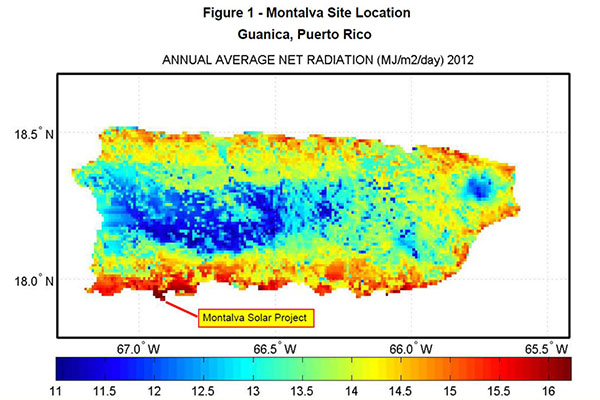
The Montalva plant will be built on Puerto Rico’s southwest coast, an area that is generally protected from hurricanes. The area features the island’s highest solar insolation and solar radiation. Montalva, which initially will be an 80 MW AC photovoltaic project, will have the capability to expand up to 165 MW AC.

Montalva map

The property also has the advantage that it is home to a Puerto Rico Electric Power Authority (PREPA) power line that connects to the island’s electrical grid.

Greenbriar believes the project will save the people of Puerto Rico up to $2 billion in fuel and operating costs over the 35 years of the power purchase agreement.

A valuation report, ordered by a judge and released publicly in 2018, valued the Montalva project at a net present value of $191 million. Greenbriar estimates that, in 2021, the project will produce annual recurring revenues of $36 million and cash flow of $13 million.

Technical analyst Clive Maund wrote on April 18, “the company itself will pay for all development expenses and has the funds to do so. It’s a win–win situation, because once the project is complete and starts to generate electricity, it will be able to sell it for considerably less to the island government than the cost of other sources of power. The reason that the company should be able to make a lot of money from this project is that (after the initial capital buildup) sunlight is actually free, and there is plenty of it in Puerto Rico.

“The key point to grasp with solar is that the costs of implementation have fallen dramatically in recent years, due to improvements in the technology, making it a serious contributor in the energy field, and this is the reason why Greenbriar can undertake such a mammoth project using just its own funds.”

Greenbriar has around 21 million shares outstanding and 26 million shares fully diluted, with around 24% owned by insiders. The company’s current market cap is CA$25 million.

Sign up for our FREE newsletter at: www.streetwisereports.com/get-news

Disclosure:
1) Patrice Fusillo compiled this article for Streetwise Reports LLC and provides services to Streetwise Reports as an employee. She or members of her household own securities of the following companies mentioned in the article: None. She or members of her household are paid by the following companies mentioned in this article: None.
2) The following company mentioned in this article is a billboard sponsor of Streetwise Reports: None. Click here for important disclosures about sponsor fees.
3) Comments and opinions expressed are those of the specific experts and not of Streetwise Reports or its officers. The information provided above is for informational purposes only and is not a recommendation to buy or sell any security.
4) The article does not constitute investment advice. Each reader is encouraged to consult with his or her individual financial professional and any action a reader takes as a result of information presented here is his or her own responsibility. By opening this page, each reader accepts and agrees to Streetwise Reports’ terms of use and full legal disclaimer. This article is not a solicitation for investment. Streetwise Reports does not render general or specific investment advice and the information on Streetwise Reports should not be considered a recommendation to buy or sell any security. Streetwise Reports does not endorse or recommend the business, products, services or securities of any company mentioned on Streetwise Reports.
5) From time to time, Streetwise Reports LLC and its directors, officers, employees or members of their families, as well as persons interviewed for articles and interviews on the site, may have a long or short position in securities mentioned. Directors, officers, employees or members of their immediate families are prohibited from making purchases and/or sales of those securities in the open market or otherwise from the time of the interview or the decision to write an article until three business days after the publication of the interview or article. The foregoing prohibition does not apply to articles that in substance only restate previously published company releases. As of the date of this article, officers and/or employees of Streetwise Reports LLC (including members of their household) own securities of Greenbriar Capital, a company mentioned in this article.

Additional Disclosures

CliveMaund.com
Clive Maund does not own shares of Greenbriar Capital, and neither he nor his company has a financial relationship with the company.

( Companies Mentioned: GRB:TSX.V; GEBRF:OTC,
)

All the King’s Men Are Trying to Put Humpty Dumpty Together Again

By Money Metals News Service

Hello again and welcome to another edition of the Money Metals Weekly Market Wrap Podcast, I’m Mike Gleason.

Precious metals markets enter the month of May with some mixed signals near term. But the long-term picture continues to look constructive. All the metals appear to have put in major bottoms during the panic selling of mid to late March.

Barring another wave of virus outbreaks and economic lockdowns, the gradual reopening of state, local, and national economies should start to unleash more industrial and jewelry demand going forward. And the extraordinary fiscal and monetary stimulus being pumped into the financial system will, if nothing else, work toward the debasement of the U.S. dollar.

Earlier this week, the Federal Open Market Committee met and pledged to keep interest rates near zero for as long as necessary. In prepared remarks, Federal Reserve chairman Jerome Powell admitted the economy is contracting at an unprecedented rate but vowed that the Fed would come to the rescue with a “full range of tools.”

Jerome Powell: The forceful measures that we as a country are taking to control the spread of the virus have brought much of the economy to an abrupt halt. Many businesses have closed, people have been asked to stay home and basic social interactions are greatly curtailed. People are putting their lives and livelihoods on hold at significant economic and personal cost.

Overall, economic activity will likely drop at an unprecedented rate in the second quarter. Inflation is also being held down, reflecting weaker demand as well as significantly lower energy prices. Both the depth and the duration of the economic downturn are extraordinarily uncertain. The Federal Reserve’s response is guided by our mandate to promote maximum employment and stable prices for the American people, along with our responsibilities to promote the stability of the financial system. We’re also committed to using our full range of tools to support the economy in this challenging time.

The Fed’s tools have built a gargantuan balance sheet that currently comes in today at a record $6.6 trillion. The ultimate consequences of its unprecedented actions are still unknown. But the huge rallies in the stock market and precious metals markets last month suggest strongly that the central bank has successfully held deflation at bay.

But all the kings men have not been able to put Humpty Dumpty back together again, at least not yet. In fact, the situation in the real economy continues to worsen at a dramatic rate.

This week, the federal government announced that Americans filed another 4.5 million new unemployment claims across the U.S., taking the total to over 30 million jobs lost in the past 6 weeks. This number is set to grow further — and will be slow to recover, even when the lockdowns are loosened.

In fact, as spending behaviors continue to change in our consumption-based economy, it’s unlikely that certain jobs and businesses will ever return. And once the full extent of the carnage sinks in with the American people and policymakers, new financial panics and government interventions could ensue.

Nevertheless, we could see the velocity of the greatly expanded currency supply pick up in the months ahead as some people return to work and spend back into the economy. That would have major inflationary implications.

We can look to precious metals markets for clues about inflation expectations among investors. Last month gold hit an 8-year high just shy of $1,800 an ounce before pulling back. That move was not confirmed by silver or other metals.

However, the more speculative gold mining stocks did record new multi-year highs. The miners led the stock market out of its March crash, becoming the strongest sector of all.

That bodes well for gold and silver prices. Mining stock investors are anticipating a healthier market for metals producers. And key to their ability to grow their profits is being able to sell mined products at higher spot prices.

As for spot prices this week, gold currently checks in at an even $1,700 per ounce after losing 2.5% since last Friday’s close.

On Thursday, the World Gold Council reported that total investment demand for the safe-haven metal surged 80% year-on-year in the first quarter to 540 metric tons. Strong bullion buying and ultra-stimulative monetary policy led Bank of America recently to raise its upside target for gold to $3,000 per ounce while pointing out “the Fed can’t print gold.”

Turning to the poor man’s gold, silver prices are down 2.2% this week to trade at $15.07 an ounce as of this Friday recording.

The best performing metal this week is platinum. It’s sporting a 1.0% gain to trade at $786. And finally, palladium is showing a weekly loss of 4.9% to come in at $1,983 per ounce.

Both platinum and silver have traded at historically large discounts to gold this year. Silver wasn’t able to gain much ground on gold in April. It remains extremely depressed in the paper market – although somewhat less so in the physical bullion market where silver coins continue to command large premiums above spot.

Fortunately, there are more cost-effective alternatives to popular coins such as Silver Eagles that are currently in short supply. Today the lowest premium silver bullion product available for delivery is the 10 oz. silver bar. It is great for stacking large amounts of wealth.

Those who don’t need to take immediate possession of bars or coins should consider Vault Silver. An exclusive service of Money Metals Depository, Vault Silver and Vault Gold are the lowest cost ways to own physical bullion. Through these programs, you obtain ownership in large bullion bars stored on your behalf in secure vaults.

Well that will do it for this week. Be sure to check back next Friday for our next Weekly Market Wrap Podcast. Until then this has been Mike Gleason with Money Metals Exchange, thanks for listening and have a great weekend everybody.


The Money Metals News Service provides market news and crisp commentary for investors following the precious metals markets.

Oil price: futures markets warn it won’t recover after coronavirus

By Mark Shackleton, Lancaster University

West Texas Intermediate (WTI) crude went negative for the first time in history this month as oil traders got stuck between a mammoth oversupply and lack of places to store it. The international price of “black gold” remains at the bottom of the barrel.

Oil producers are struggling to shut down their units or to find environmentally acceptable alternatives to dumping product. Sea tankers are finding it difficult to offload and are readjusting routes in their hunt for potential takers, but it’s not easy: COVID-19 has killed demand for oil everywhere.

WTI is trading at about US$17, while the Brent equivalent is around US$25, still the sort of levels where much global oil production is not profitable. Brent and WTI are the two main grades of oil that are used to benchmark prices around the world, with Brent found offshore and being of slightly higher quality than its onshore American counterpart.

More tolerable prices may return soon if the oversupply levels off and then global demand rises as lockdown restrictions are relaxed. But what are the longer term prospects for the price of oil, and how have they been affected by COVID-19?

Energy prices and time periods

The future price of oil is normally cheaper than the current, or “spot”, price. This reflects the fact that those willing to underpin future oil production with early orders usually get a discount. This can be seen in the graph below, which shows the prices of trading contracts over the past couple of years for oil for delivery in June 2021 (orange) and 2022 (grey) compared to the “spot” price, which is currently June 2020. This year, the normal order from least to most expensive has reversed.

WTI price in US$ for delivery, June 2020-22

Contango and cash.
Intercontinental Exchange

This crossover of spot and future prices is known as a contango, or short-term glut. This is certainly not the first contango in energy trading – electricity markets have periods of overgeneration in which producers pay consumers to take power that would damage the generating station otherwise.

Indeed, these events are becoming more common because of the world’s transition from types of energy that can be stored, such as oil, to those that cannot, such as wind and solar power. We’re seeing these events not just in the UK but across the world.

In the present case, the reason for the oil contango is basically that investors think that prices will improve in future as economies recover. The contango is greater than during the financial crisis of 2007-09. Incidentally, there’s no equivalent shift in the price of gas (LNG). The gas price has been supported by the fact that electricity demand has been higher because of everyone being at home during lockdown.

After COVID-19

The previous graph also tells us that investors don’t think the price of oil is going to recover to anywhere near pre-coronavirus levels by June 2022. Two years from now, they think the price will be somewhere between US$30 and US$40.

Even when we look at data for the mid-2020s, the sort of timescale in which you would hope COVID-19 has ceased to be a problem, the markets still don’t foresee a return to previous levels. Contracts for WTI oil in December 2026 are currently trading at slightly under US$46, compared to US$50 to US$55 historically. This time last year, they were trading at US$54.

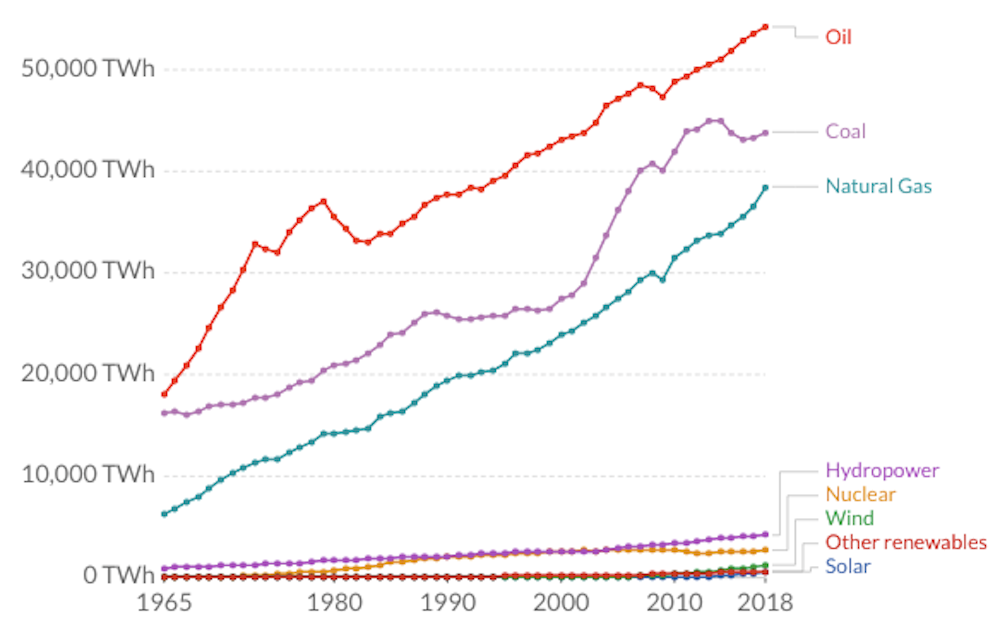
It was already likely to be the case that demand for fossil fuels would decline in the coming years as they face increasing competition from renewable electricity powering everything from home central heating to cars and buses. Coal consumption has peaked, though oil has had at least one advantage. Its high energy density and portability make it hard to replace in aviation, assuming the airline industry becomes viable again. On the other hand, increased tele-working during the pandemic may spur the decline of the daily commute and possibly business trips too.

World energy consumption (TWh) 1965-2018

Our World in Data

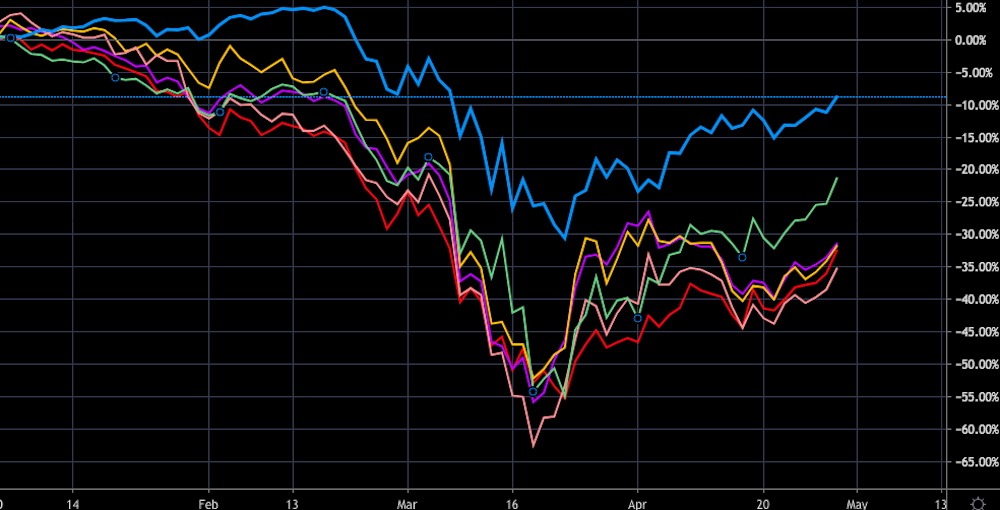
This change is reflected in the share prices of the oil majors. Operators such as Exxon and Shell, which have historically been seen as very safe investments, are down 40% since January compared to an overall stock market decline of about 15%.

These are traditionally high dividend payers, though Shell just cut its dividend for the first time since the second world war. Yet even if the current supply glut costs these companies one or two years of reduced earnings and lost dividends, this can’t account for the magnitude of their declines.

Share prices of top five oil majors vs S&P500

S&P500 = blue; Shell = pink; BP = yellow; Chevron = green; Total = purple; Exxon = red.
Trading View

The fact that Saudi Arabia has been trying to sell part of its assets by listing Saudi Aramco, the world’s largest oil owner, on the stock market, was itself a signal that they may think the most lucrative years are behind this industry. It had been hoping for a US$2 trillion listing on one of the world’s leading stock markets, but this is now looking less likely. Aramco has scaled down to the local Riyadh Tawadul exchange, with an implied valuation of US$1.5 billion.

The firm had promised to pay total dividends of US$75 billion this year, but this looks a tall order from company cash flows at the current oil price. The signals about future prices will be doing little to reassure investors about buying shares, since they had been holding these stocks for their high dividend yield and now that is getting cut.

So while the transition from oil was already underway, the global COVID-19 lockdown appears to have accelerated it. Oil remains essential for transport, but not as much as before – and gas and renewables continue to increase their share of energy generation. It could well be that COVID-19 has done more for the green revolution than any climate summit.The Conversation

About the Author:

Mark Shackleton, Professor of Finance, Lancaster University

This article is republished from The Conversation under a Creative Commons license. Read the original article.

All the King’s Men Hope to Put Humpty Dumpty Together Again

By Money Metals News Service

Hello again and welcome to another edition of the Money Metals Weekly Market Wrap Podcast, I’m Mike Gleason.

Precious metals markets enter the month of May with some mixed signals near term. But the long-term picture continues to look constructive. All the metals appear to have put in major bottoms during the panic selling of mid to late March.

Barring another wave of virus outbreaks and economic lockdowns, the gradual reopening of state, local, and national economies should start to unleash more industrial and jewelry demand going forward. And the extraordinary fiscal and monetary stimulus being pumped into the financial system will, if nothing else, work toward the debasement of the U.S. dollar.

Earlier this week, the Federal Open Market Committee met and pledged to keep interest rates near zero for as long as necessary. In prepared remarks, Federal Reserve chairman Jerome Powell admitted the economy is contracting at an unprecedented rate but vowed that the Fed would come to the rescue with a “full range of tools.”

Jerome Powell: The forceful measures that we as a country are taking to control the spread of the virus have brought much of the economy to an abrupt halt. Many businesses have closed, people have been asked to stay home and basic social interactions are greatly curtailed. People are putting their lives and livelihoods on hold at significant economic and personal cost.

Overall, economic activity will likely drop at an unprecedented rate in the second quarter. Inflation is also being held down, reflecting weaker demand as well as significantly lower energy prices. Both the depth and the duration of the economic downturn are extraordinarily uncertain. The Federal Reserve’s response is guided by our mandate to promote maximum employment and stable prices for the American people, along with our responsibilities to promote the stability of the financial system. We’re also committed to using our full range of tools to support the economy in this challenging time.

The Fed’s tools have built a gargantuan balance sheet that currently comes in today at a record $6.6 trillion. The ultimate consequences of its unprecedented actions are still unknown. But the huge rallies in the stock market and precious metals markets last month suggest strongly that the central bank has successfully held deflation at bay.

But all the kings men have not been able to put Humpty Dumpty back together again, at least not yet. In fact, the situation in the real economy continues to worsen at a dramatic rate.

This week, the federal government announced that Americans filed another 4.5 million new unemployment claims across the U.S., taking the total to over 30 million jobs lost in the past 6 weeks. This number is set to grow further — and will be slow to recover, even when the lockdowns are loosened.

In fact, as spending behaviors continue to change in our consumption-based economy, it’s unlikely that certain jobs and businesses will ever return. And once the full extent of the carnage sinks in with the American people and policymakers, new financial panics and government interventions could ensue.

Nevertheless, we could see the velocity of the greatly expanded currency supply pick up in the months ahead as some people return to work and spend back into the economy. That would have major inflationary implications.

We can look to precious metals markets for clues about inflation expectations among investors. Last month gold hit an 8-year high just shy of $1,800 an ounce before pulling back. That move was not confirmed by silver or other metals.

However, the more speculative gold mining stocks did record new multi-year highs. The miners led the stock market out of its March crash, becoming the strongest sector of all.

That bodes well for gold and silver prices. Mining stock investors are anticipating a healthier market for metals producers. And key to their ability to grow their profits is being able to sell mined products at higher spot prices.

As for spot prices this week, gold currently checks in at an even $1,700 per ounce after losing 2.5% since last Friday’s close.

On Thursday, the World Gold Council reported that total investment demand for the safe-haven metal surged 80% year-on-year in the first quarter to 540 metric tons. Strong bullion buying and ultra-stimulative monetary policy led Bank of America recently to raise its upside target for gold to $3,000 per ounce while pointing out “the Fed can’t print gold.”

Turning to the poor man’s gold, silver prices are down 2.2% this week to trade at $15.07 an ounce as of this Friday recording.

The best performing metal this week is platinum. It’s sporting a 1.0% gain to trade at $786. And finally, palladium is showing a weekly loss of 4.9% to come in at $1,983 per ounce.

Both platinum and silver have traded at historically large discounts to gold this year. Silver wasn’t able to gain much ground on gold in April. It remains extremely depressed in the paper market – although somewhat less so in the physical bullion market where silver coins continue to command large premiums above spot.

Fortunately, there are more cost-effective alternatives to popular coins such as Silver Eagles that are currently in short supply. Today the lowest premium silver bullion product available for delivery is the 10 oz. silver bar. It is great for stacking large amounts of wealth.

Those who don’t need to take immediate possession of bars or coins should consider Vault Silver. An exclusive service of Money Metals Depository, Vault Silver and Vault Gold are the lowest cost ways to own physical bullion. Through these programs, you obtain ownership in large bullion bars stored on your behalf in secure vaults.

Well that will do it for this week. Be sure to check back next Friday for our next Weekly Market Wrap Podcast. Until then this has been Mike Gleason with Money Metals Exchange, thanks for listening and have a great weekend everybody.


The Money Metals News Service provides market news and crisp commentary for investors following the precious metals markets.

Gold and Silver: Pay Attention to This Noteworthy Record High

Here’s what usually occurs in related financial markets when “big changes in social mood are afoot”

By Elliott Wave International

Related financial markets tend to move together. For example, gold and silver.

Or, consider stocks. When the Dow Industrials are up on a given trading day, the NASDAQ is usually in the green too. The same applies when the Dow is down. Other major stock indexes tend to close in negative territory as well.

However, when a trend is near exhaustion — whether bullish or bearish — “non-confirmations” often happen. A non-confirmation occurs when one market makes a new high (or low), but a related market does not.

Let’s stick with the example of stocks as we look at this chart and commentary from Elliott Wave International’s November 2019 Global Market Perspective:

Notice that while the FTSE 100 is off 6% since its May 2018 high, the Small-Cap index and the AIM 100 are down 9% and 23%, respectively. These non-confirmations are important, because markets almost always splinter when big changes in social mood are afoot. … It’s only a matter of time before the broad indexes abandon the bull-market party.

As we all know, abandon it they did — in a very dramatic way.

Now, let’s look at what’s going on with gold and silver.

Here’s a chart and commentary from EWI’s April 27, 2020 U.S. Short Term Update:

Gold is massively overvalued relative to physical commodities and the ratio of gold-to-silver recently jumped to a record high. There remains a large non-confirmation between gold and silver.

Even so, here’s an April 21 headline (CNBC):

Bank of America raises gold forecast by a whopping $1,000 to $3,000 because of zero rates

Well, this major bank’s outlook for gold might turn out to be correct.

On the other hand, it’s obvious — as you’ve just seen — that the gold and silver markets are significantly splintered.

Plus, the Elliott wave model is also providing clues about the next big moves in the gold and silver markets.

And, speaking of Elliott wave analysis, EWI has just made available a 1-hour course titled: The Wave Principle Applied. You can access this valuable resource 100% free through May 15, 2020.

How?

Simply join Club EWI. Membership is also free.

When you avail yourself of The Wave Principle Applied, you will learn how to spot Elliott wave patterns on a price chart. Plus, you’ll acquire trading insights.

As Frost & Prechter’s Elliott Wave Principle: Key to Market Behavior noted:

After you have acquired an Elliott “touch,” it will be forever with you, just as a child who learns to ride a bicycle never forgets. Thereafter, catching a turn becomes a fairly common experience and not really too difficult. Furthermore, by giving you a feeling of confidence as to where you are in the progress of the market, a knowledge of Elliott can prepare you psychologically for the fluctuating nature of price movement and free you from sharing the widely practiced analytical error of forever projecting today’s trends linearly into the future. Most important, the Wave Principle often indicates in advance the relative magnitude of the next period of market progress or regress.

Simply follow the link for your free membership into Club EWI, and then you can access The Wave Principle Applied — 100% free — through May 15 (EWI normally sells the course for $99).

This article was syndicated by Elliott Wave International and was originally published under the headline Gold and Silver: Pay Attention to This Noteworthy Record High. EWI is the world’s largest market forecasting firm. Its staff of full-time analysts led by Chartered Market Technician Robert Prechter provides 24-hour-a-day market analysis to institutional and private investors around the world.

Fed Cut Equities Stimulus 86% This Week and Stocks Are Falling

By TheTechnicalTraders

What happens to the global markets when the US Fed begins to weaken stimulus activity and when the global markets must begin to function on their own?  Are the global markets capable of sustaining current price levels without the Fed supporting them?

A recent news article suggests the US Fed has drastically slashed stimulus activity over the past 5+ days.  From a peak level of nearly $600 Billion a week to current levels near $83 Billion per week – a -86% decrease.  How will this reflect in the market’s ability to sustain current price levels in the face of disastrous Q2 expectations? Yup, markets are falling fast and hard going into the weekend as expected!

Before closing this page, be sure to opt-in to our free market trend signals, so you don’t miss our next special report!

Buffet Indicator

Another common tool for skilled traders is the Buffet Indicator which helps us understand stock market valuation levels and measures extreme trends by measuring Standard Deviation ranges. Currently, the Buffet Indicator is near the highest levels ever recorded over the past 60+ years.  Additionally, a “detrended” version of the Buffet Indicator suggests a broader global recession would require a further devaluation before a true bottom is likely to complete.

This first Buffet Indicator chart shows the current market value to GDP and highlights the recent peak as being the highest level ever recorded.  Notice how this level is much higher than the peak in 2000.  This indicates that the stock market valuation level is excessive compared to historical norms.

Detrended Buffet Indicator

This Detrended Buffet Indicator suggests the recent peak may not reflect the same excessive valuation levels as we experienced in 2000, yet are historically near the upper range of extended valuation levels.  Notice how price devalues as a process of setting up a valuation advance throughout time. When prices become overvalued (think of simple supply/demand theory), demand typically collapses – sending prices lower. At this time, we have the global Covid-19 virus event disrupting the demand-side of this equation.  When demand collapses, where do prices go?

Our research team believes the current trend will eventually end and global stock market prices will collapse again as a much deeper price low/bottom sets up.  Skilled traders need to understand that as long a the US Fed was pouring $600 Billion a week into the credit/stock market, the recovery in price was going to be substantial.  Once that stimulus ends and the markets are left to function on their own, the aspects of the demand collapse become more evident.

In a way, the Fed acted as a “demand supplement” for the US and global markets.  Buying up assets and supporting the credit markets in an effort to transition us past the crisis event that took place in late February and March 2020.  How quickly will the global markets transition back into a declining mode in the continues to stay passive?

Custom US Stock Market Index – Weekly Index

Our original targets where price may attempt to form a deeper bottom near the 2015~2016 price range is still very valid.  Near the peak of the recent selloff, price levels reached these predicted levels just before the US Fed began the stimulus programs. Now, price levels are nearly 35%+ above these low price levels.

Chart By: TradingView.com

Custom SmartCash Index – Weekly Chart

It seems obvious to our research team that continued lack of consumer demand and lack of central bank intervention will likely result in the US stock market moving lower in the near future and attempting to establish a true price bottom.  We believe that bottom will likely happen near July or August 2020 and will likely reach levels near, or below, the 2015~2016 price range but this analysis will change as we progress forward with new events and analysis.

You can see our predicted price bottom on this Weekly Smart Cash Index chart.  The lines we’ve drawn into the future show where we believe the first attempt at a true price bottom may take place near July or August 2020.

Chart By: TradingView.com

Concluding Thoughts:

Remember, this type of price rotation is very healthy for the US and global markets.  The price must rotate through these types of trends to eliminate excessive risk/froth and to secure a proper price equilibrium where valuation levels can begin to appreciate again.  This process is almost cathartic in a sense.  The ability to regain a “true valuation base/bottom” in price (consider Fibonacci Price Theory) allows the future appreciation cycle to function more efficiently (having eliminated excessive risk valuations).

We will get through this and the global economy will continue to function.  We just have to get through the next 6+ months and the relative economic disaster of Q2 and Q3 (likely) before we’re going to see any real chance at true price appreciation.

At this point, when the Fed-induced upside trend breaks – watch out below.

As a technical analyst and trader since 1997, I have been through a few bull/bear market cycles in stocks and commodities. I believe I have a good pulse on the market and timing key turning points for investing and short-term swing traders. 2020 is an incredible year for traders and investors.  Don’t miss all the incredible trends and trade setups.

Subscribers of my Active Swing Trading Newsletter had our trading accounts close at a new high watermark. We not only exited the equities market as it started to roll over in February, but we profited from the sell-off in a very controlled way with TLT bonds for a 20% gain. This week we closed out SPY ETF trade taking advantage of this bounce and entered a new trade with our account is at another all-time high value.

Ride my coattails as I navigate these financial markets and build wealth while others watch most of their retirement funds drop 35-65% during the next financial crisis.

Just think of this for a minute. While most of us have active trading accounts, what is even more important are our long-term investment and retirement accounts. Why? Because they are, in most cases, our largest store of wealth other than our homes, and if they are not protected during the next bear market, you could lose 25-50% or more of your net worth. The good news is we can preserve and even grow our long term capital when things get ugly like they are now and ill show you how and one of the best trades is one your financial advisor will never let you do because they do not make money from the trade/position.

If you have any type of retirement account and are looking for signals when to own equities, bonds, or cash, be sure to become a member of my Passive Long-Term Investing Signals which we issued a new signal for subscribers.

Chris Vermeulen
Chief Market Strategies
TheTechnicalTraders.com


How Apple and Google will let your phone warn you if you’ve been exposed to the coronavirus

By Johannes Becker, Boston University and David Starobinski, Boston University

On April 10, Apple and Google announced a coronavirus exposure notification system that will be built into their smartphone operating systems, iOS and Android. The system uses the ubiquitous Bluetooth short-range wireless communication technology.

There are dozens of apps being developed around the world that alert people if they’ve been exposed to a person who has tested positive for COVID-19. Many of them also report the identities of the exposed people to public health authorities, which has raised privacy concerns. Several other exposure notification projects, including PACT, BlueTrace and the Covid Watch project, take a similar privacy-protecting approach to Apple’s and Google’s initiative.

So how will the Apple-Google exposure notification system work? As researchers who study security and privacy of wireless communication, we have examined the companies’ plan and have assessed its effectiveness and privacy implications.

Recently, a study found that contact tracing can be effective in containing diseases such as COVID-19, if large parts of the population participate. Exposure notification schemes like the Apple-Google system aren’t true contact tracing systems because they don’t allow public health authorities to identify people who have been exposed to infected individuals. But digital exposure notification systems have a big advantage: They can be used by millions of people and rapidly warn those who have been exposed to quarantine themselves.

Bluetooth beacons

Because Bluetooth is supported on billions of devices, it seems like an obvious choice of technology for these systems. The protocol used for this is Bluetooth Low Energy, or Bluetooth LE for short. This variant is optimized for energy-efficient communication between small devices, which makes it a popular protocol for smartphones and wearables such as smartwatches.

Image by Gerd Altmann / Pixabay

Bluetooth LE communicates in two main ways. Two devices can communicate over the data channel with each other, such as a smartwatch synchronizing with a phone. Devices can also broadcast useful information to nearby devices over the advertising channel. For example, some devices regularly announce their presence to facilitate automatic connection.

To build an exposure notification app using Bluetooth LE, developers could assign everyone a permanent ID and make every phone broadcast it on an advertising channel. Then, they could build an app that receives the IDs so every phone would be able to keep a record of close encounters with other phones. But that would be a clear violation of privacy. Broadcasting any personally identifiable information via Bluetooth LE is a bad idea, because messages can be read by anyone in range.

Anonymous exchanges

To get around this problem, every phone broadcasts a long random number, which is changed frequently. Other devices receive these numbers and store them if they were sent from close proximity. By using long, unique, random numbers, no personal information is sent via Bluetooth LE.

Apple and Google follow this principle in their specification, but add some cryptography. First, every phone generates a unique tracing key that is kept confidentially on the phone. Every day, the tracing key generates a new daily tracing key. Though the tracing key could be used to identify the phone, the daily tracing key can’t be used to figure out the phone’s permanent tracing key. Then, every 10 to 20 minutes, the daily tracing key generates a new rolling proximity identifier, which looks just like a long random number. This is what gets broadcast to other devices via the Bluetooth advertising channel.

When someone tests positive for COVID-19, they can disclose a list of their daily tracing keys, usually from the previous 14 days. Everyone else’s phones use the disclosed keys to recreate the infected person’s rolling proximity identifiers. The phones then compare the COVID-19-positive identifiers with their own records of the identifiers they received from nearby phones. A match reveals a potential exposure to the virus, but it doesn’t identify the patient.

Most of the competing proposals use a similar approach. The principal difference is that Apple’s and Google’s operating system updates reach far more phones automatically than a single app can. Additionally, by proposing a cross-platform standard, Apple and Google allow existing apps to piggyback and use a common, compatible communication approach that could work across many apps.

No plan is perfect

The Apple-Google exposure notification system is very secure, but it’s no guarantee of either accuracy or privacy. The system could produce a large number of false positives because being within Bluetooth range of an infected person doesn’t necessarily mean the virus has been transmitted. And even if an app records only very strong signals as a proxy for close contact, it cannot know whether there was a wall, a window or a floor between the phones.

However unlikely, there are ways governments or hackers could track or identify people using the system. Bluetooth LE devices use an advertising address when broadcasting on an advertising channel. Though these addresses can be randomized to protect the identity of the sender, we demonstrated last year that it is theoretically possible to track devices for extended periods of time if the advertising message and advertising address are not changed in sync. To Apple’s and Google’s credit, they call for these to be changed synchronously.

But even if the advertising address and a coronavirus app’s rolling identifier are changed in sync, it may still be possible to track someone’s phone. If there isn’t a sufficiently large number of other devices nearby that also change their advertising addresses and rolling identifiers in sync – a process known as mixing – someone could still track individual devices. For example, if there is a single phone in a room, someone could keep track of it because it’s the only phone that could be broadcasting the random identifiers.

Another potential attack involves logging additional information along with the rolling identifiers. Even though the protocol does not send personal information or location data, receiving apps could record when and where they received keys from other phones. If this was done on a large scale – such as an app that systematically collects this extra information – it could be used to identify and track individuals. For example, if a supermarket recorded the exact date and time of incoming rolling proximity identifiers at its checkout lanes and combined that data with credit card swipes, store staff would have a reasonable chance of identifying which customers were COVID-19 positive.

And because Bluetooth LE advertising beacons use plain-text messages, it’s possible to send faked messages. This could be used to troll others by repeating known COVID-19-positive rolling proximity identifiers to many people, resulting in deliberate false positives.

Nevertheless, the Apple-Google system could be the key to alerting thousands of people who have been exposed to the coronavirus while protecting their identities, unlike contact tracing apps that report identifying information to central government or corporate databases.

About the Authors:

Johannes Becker, Doctoral student in Electrical & Computer Engineering, Boston University and David Starobinski, Professor of Electrical and Computer Engineering, Boston University

This article is republished from The Conversation under a Creative Commons license. Read the original article.

COVID-19 is a dress rehearsal for entrepreneurial approaches to climate change

By Jeffrey York, University of Colorado Boulder

As the U.S. struggles to control the COVID-19 pandemic, some experts have suggested that we can learn something about how to address climate change from this crisis.

Climate and social policy experts are recommending green stimulus packages to restart the economy. As a professor of sustainability and entrepreneurship, I see COVID-19 bringing the predicted future human health implications of climate change to horrifying life. Like COVID-19, climate change could increase respiratory illness and strain infrastructure.

However, just as with COVID-19, entrepreneurship can offer solutions to these challenges.

Searching for a solution

Saving small businesses is a central part of recovering from the pandemic. At the same time, entrepreneurs are innovating to preserve their business and help address the challenges of COVID-19.

The same thing is already happening with climate change. When entrepreneurs offer solutions that create simultaneous ecological and economic benefits, it is called “environmental entrepreneurship.” My research shows that such entrepreneurship happens in three ways.

First, successful environmental entrepreneurs tend to see themselves as both environmentalists and businesspeople. Because of this, they often recruit investors, employees and customers from a broader group than traditional startups. Some offer a hope of reducing carbon emissions through new technologies. Others are small business heroes, creating jobs and building new industries.

Second, environmental entrepreneurs are attuned to different signals than large firms are.

While they are encouraged by environmentalist beliefs, we have also found that the importance of family can predict the number of environmental entrepreneurs in a state. Our research shows that solar energy companies are more likely to form in states that value not only the environment, but also family relationships.

Further, while large firms tend to respond to government-driven policy and economic indicators, environmental entrepreneurs respond to more subtle signals, such as local values. In the green building industry, environmental entrepreneurs ignore economic indicators, but are encouraged by local beliefs and activism. In short, they move first, taking on risk before the evidence is in.

Third, environmental entrepreneurs make a difference. We looked at the effect of various policies, activism and business practices on the adoption of new technologies like green building and renewable energy. We then divided the U.S. into more politically conservative and liberal regions to see whether policies, activism or business practices mattered more under different norms.

We found that the only consistent factor that increased green building adoption in both types of political environments was the number of environmental entrepreneurs. These findings suggest that when a critical mass of entrepreneurship occurs, the political divide on climate change fades away, and we see a rapid uptick in adoption of environmentally beneficial practices.

Image by 272447 / Pixabay

Climate conclusions

A variety of proposals before Congress would encourage a green recovery by focusing on policy to simultaneously address climate change and the recession, but these plans will likely become mired in the political debate that entangled the Green New Deal.

Here’s what I’d suggest. Laser-focus on the creation of new small businesses as a way to rebuild, offering consulting, technical training and tax incentives.

By focusing on new ventures, those on both sides of the political aisle can rebuild an economy focused on long-term environmental sustainability and economic stability.

About the Author:

Jeffrey York, Associate Professor of Strategy and Entrepreneurship, University of Colorado Boulder

This article is republished from The Conversation under a Creative Commons license. Read the original article.


Dominican holds rate, inflation seen low but credit rising

By CentralBankNews.info

The Central bank of the Dominican Republic (BCRD) left its monetary policy rate steady at 3.50 percent and forecast inflation will remain below the lower limit of its target range for the rest of this year, adding that last month’s monetary and financial measures to cushion the impact of the coronavirus pandemic were already boosting credit to the private sector.
BCRD, which last months cut its rate 100 basis points, lowered the reserve requirement and injected liquidity, said it was important to highlight the economy was in a favorable cyclical position earlier this year with economic growth around potential and low inflationary pressures.
This had given it the flexibility to meet this adverse shock from the pandemic by adopting expansionary monetary measures aimed at boosting domestic demand.
Preliminary data from the monthly economic activity index IMAE indicate a marked slowdown in March as compared with January and February but it did not show negative economic growth during the first quarter due to the impact of COVID-19.
Inflation in the Dominican Republic fell to 2.45 percent in March from 3.66 percent in February and 4.17 percent in January, below the central bank’s target range of 4.0 percent, plus/minus 1 percentage point.
Core inflation, which reflects monetary conditions, rose to 2.67 percent in March.
Of the 100 billion pesos made available to financial intermediaries, some 50 billion have been channeled through different facilities and of this some 10 billion to private loans by the release of legal reserve resources and some 40 billion to provide liquidity to financial intermediation entities through 90-day repos.
BCRD pointed out the resources from the legal reserves had been “channel at a higher speed that all the previous occasions” when this instrument had been used and interest rates on loans granted by multiple banks during April had been reduced by some 300 basis points.
This had led to an acceleration of some 13 percent of credit to the private sector, especially the manufacturing, hotel and restaurant, construction and commerce sectors, the bank said.
BCRD said it has the necessary space to continue supporting the productive sectors and households once sanitary conditions allow a gradual normalization of the economy to help internal demand recover rapidly and the disbursement of some US$650 million of emergency assistance from the International Monetary Fund (IMF) will help the government face the challenges.
BCRD said it would continue to closely follow the impact of the coronavirus on the country’s economy and is prepared to continue to react in a timely manner to anything that may lead to a deviation of inflation from its target and affect economic growth.

www.CentralBankNews.info